
Chapter 11 Phenomenology Usher K and Jackson D.
GB
Published · 33 slides · 0 views

1 / 1
Description
Chapter 11 Phenomenology Usher K and Jackson D. (2014). In: Mills J and Birks M (eds) Qualitative methodologies: A practical guide. London: Sage Publications Learning objectives Outline the philosophical underpinnings of phenomenology
Related Topics
Share
Embed code
Download this presentation From Below
"Chapter 11 Phenomenology Usher K and Jackson D." is the property of its rightful owner. Permission is granted to download and print the materials on this website for personal, non-commercial use only, and to display it on your personal computer provided you do not modify the materials and that you retain all copyright notices contained in the materials. By downloading content from our website, you accept the terms of this agreement.
Presentation Transcript
01
Chapter 11
Phenomenology Usher K and Jackson D. (2014). In: Mills J and Birks M (eds) Qualitative methodologies: A practical guide. London: Sage Publications<br>
02
Learning objectives Outline the philosophical underpinnings of phenomenology
Identify the key philosophers involved in its development
Describe the different types of phenomenology
Discuss the role of the researcher undertaking a phenomenological study
Describe the strategies for data generation and analysis
Outline some of the ways that phenomenological research findings can be presented<br>
Identify the key philosophers involved in its development
Describe the different types of phenomenology
Discuss the role of the researcher undertaking a phenomenological study
Describe the strategies for data generation and analysis
Outline some of the ways that phenomenological research findings can be presented<br>
03
Introduction Careful and systematic reflective study of the lived experience
Proponents of phenomenology share an interest in understanding what it is like to be human and what constitutes out lived world (Smith et al., 2009)
Both a philosophy and a methodology<br>
Proponents of phenomenology share an interest in understanding what it is like to be human and what constitutes out lived world (Smith et al., 2009)
Both a philosophy and a methodology<br>
04
Introduction Characteristics of lived experience that differentiate it from other types of qualitative research that focus on human experience:
Reflection on the lived experience is free from theoretical, prejudicial and suppositional intoxications (van Manen, 2007)
Experience is examined as it actually occurs and on its own terms (Smith et al., 2009)<br>
Reflection on the lived experience is free from theoretical, prejudicial and suppositional intoxications (van Manen, 2007)
Experience is examined as it actually occurs and on its own terms (Smith et al., 2009)<br>
05
History of the methodology Evolved from late 19th and throughout the 20th century
Countenance to positivistic scientific thought
Originated in Germany, spread across Europe then Asia, North America and other continents<br>
Countenance to positivistic scientific thought
Originated in Germany, spread across Europe then Asia, North America and other continents<br>
06
History of the methodology Early work: Brentano (1838-1917) & Stumpf (1848-1936)
Notion of intentionality main focus of early philosophers
Intentionality – consciousness is always conscious of something<br>
Notion of intentionality main focus of early philosophers
Intentionality – consciousness is always conscious of something<br>
07
History of the methodology Intentionality – infers a reaching out of one’s consciousness to interact with objects and concepts as a means of relating to the world (Crotty, 1996)
Intentionality – subscribing a questioning and/or theorizing nature to the world, so that actors become more a part of the world under observation (Moustakas, 1994)<br>
Intentionality – subscribing a questioning and/or theorizing nature to the world, so that actors become more a part of the world under observation (Moustakas, 1994)<br>
08
Philosophical underpinnings Husserl (1857-1938) considered the originator
Developed transcendental phenomenology
Husserl considers that phenomenology is the way knowledge comes into being in the consciousness, which helps to clarify assumptions underlying all human understandings of the everyday world (Adams and van Manen, 2008)<br>
Developed transcendental phenomenology
Husserl considers that phenomenology is the way knowledge comes into being in the consciousness, which helps to clarify assumptions underlying all human understandings of the everyday world (Adams and van Manen, 2008)<br>
09
Philosophical underpinnings Understanding how individuals come to know their own experience of a phenomenon, allows them to identify the essential qualities of that experience
A phenomenological stance turns to the activity and attends to the taken-for-granted experience<br>
A phenomenological stance turns to the activity and attends to the taken-for-granted experience<br>
10
Philosophical underpinnings Eidetic description determines the essential nature and acts of consciousness
Eidetic reduction/bracketing/epoche – key element of Husserlian phenomenology
Eidetic reduction/bracketing/epoche – means to put aside the taken-for-granted world to focus on the perception of the world<br>
Eidetic reduction/bracketing/epoche – key element of Husserlian phenomenology
Eidetic reduction/bracketing/epoche – means to put aside the taken-for-granted world to focus on the perception of the world<br>
11
Philosophical underpinnings Heidegger (1889-1976) – focused on hermeneutics
Recognizes that human existence is embedded in a world of meanings
Phenomenology becomes hermeneutical when its method becomes interpretive rather than purely descriptive as is the case in transcendental phenomenology<br>
Recognizes that human existence is embedded in a world of meanings
Phenomenology becomes hermeneutical when its method becomes interpretive rather than purely descriptive as is the case in transcendental phenomenology<br>
12
Philosophical underpinnings Heidegger contends that all description is already an interpretation
Central to Heidegger’s hermeneutic phenomenology is the notion of dasein – being-there / of being in the world
Heidegger rejected Husserl’s notion of bracketing<br>
Central to Heidegger’s hermeneutic phenomenology is the notion of dasein – being-there / of being in the world
Heidegger rejected Husserl’s notion of bracketing<br>
13
Philosophical underpinnings Heidegger believed that in order to understand a phenomenon the person must first of all have their own knowledge or experience of the phenomenon
Ricoeur and Gadamer also pivotal to the development of hermeneutic phenomenology<br>
Ricoeur and Gadamer also pivotal to the development of hermeneutic phenomenology<br>
14
Philosophical underpinnings:
Key concepts Being in the world: Humans as questioning beings
Embodiment: bodily knowledge of the world – that all our understanding of the world is based on our perceptions and our initial awareness of the object
Lifeworld: life as we experience it rather than as we conceptualize it<br>
Embodiment: bodily knowledge of the world – that all our understanding of the world is based on our perceptions and our initial awareness of the object
Lifeworld: life as we experience it rather than as we conceptualize it<br>
15
Philosophical underpinnings:
Key concepts Reduction: describes the phenomenological process that permits us to discover an experiential understanding of the lifeworld
Lived experience: pre-reflective understandings of the world as we experience it prior to putting language to it
Bracketing: a neutral stance, without believing or disbelieving in the existence of a phenomenon<br>
Lived experience: pre-reflective understandings of the world as we experience it prior to putting language to it
Bracketing: a neutral stance, without believing or disbelieving in the existence of a phenomenon<br>
16
Philosophical underpinnings:
Key concepts Verstehen (understanding): occurs through sharing common meaning, culture and language as it is lived
The phenomenological nod: a form of validation when a person reads a phenomenological description and thinks “this is an experience I could have” (Van der Zalm and Bergum, 2000)<br>
The phenomenological nod: a form of validation when a person reads a phenomenological description and thinks “this is an experience I could have” (Van der Zalm and Bergum, 2000)<br>
17
Positioning of the researcher Transforming information provided by participants as research partners
A reflective stance
Research question arises from who the researcher is professionally and personally
Self-awareness and perceptiveness<br>
A reflective stance
Research question arises from who the researcher is professionally and personally
Self-awareness and perceptiveness<br>
18
Positioning of the researcher Researcher is a writer
Craft of writing is central to this research design
Writer’s performance will be judged by the presence (or not) of the participants phenomenological nod (Van der Zalm and Bergum, 2000)<br>
Craft of writing is central to this research design
Writer’s performance will be judged by the presence (or not) of the participants phenomenological nod (Van der Zalm and Bergum, 2000)<br>
19
Aligning philosophy and methodology with purpose Selection of phenomenology should be driven by the research question
There are various approaches to phenomenology and each will inform the methods of a particular study
The study of the lived experience should be prominent in the research question<br>
There are various approaches to phenomenology and each will inform the methods of a particular study
The study of the lived experience should be prominent in the research question<br>
20
Data generation and collection Aim is to generate understanding into the essential nature of a particular phenomenon
Knowing the experience is through people who have first-hand lived the experience of the phenomenon of interest
Allow adequate time for recruitment processes
Recruitment continues until no new data is being revealed (data saturation)<br>
Knowing the experience is through people who have first-hand lived the experience of the phenomenon of interest
Allow adequate time for recruitment processes
Recruitment continues until no new data is being revealed (data saturation)<br>
21
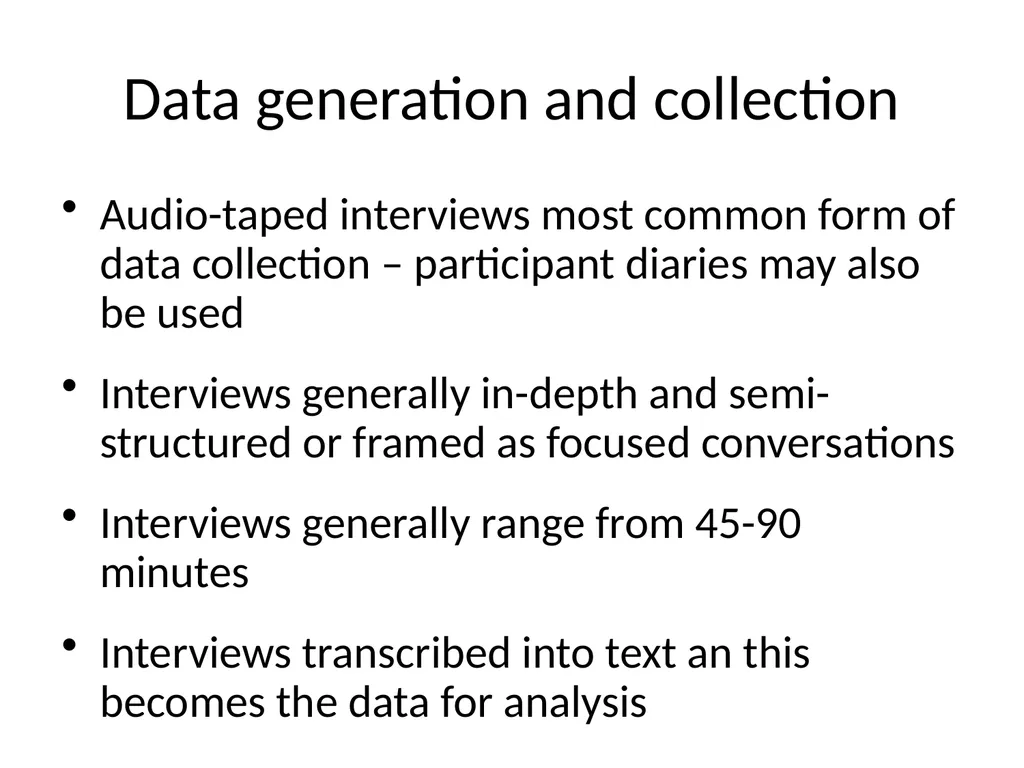
Data generation and collection Audio-taped interviews most common form of data collection – participant diaries may also be used
Interviews generally in-depth and semi-structured or framed as focused conversations
Interviews generally range from 45-90 minutes
Interviews transcribed into text an this becomes the data for analysis<br>
Interviews generally in-depth and semi-structured or framed as focused conversations
Interviews generally range from 45-90 minutes
Interviews transcribed into text an this becomes the data for analysis<br>
22
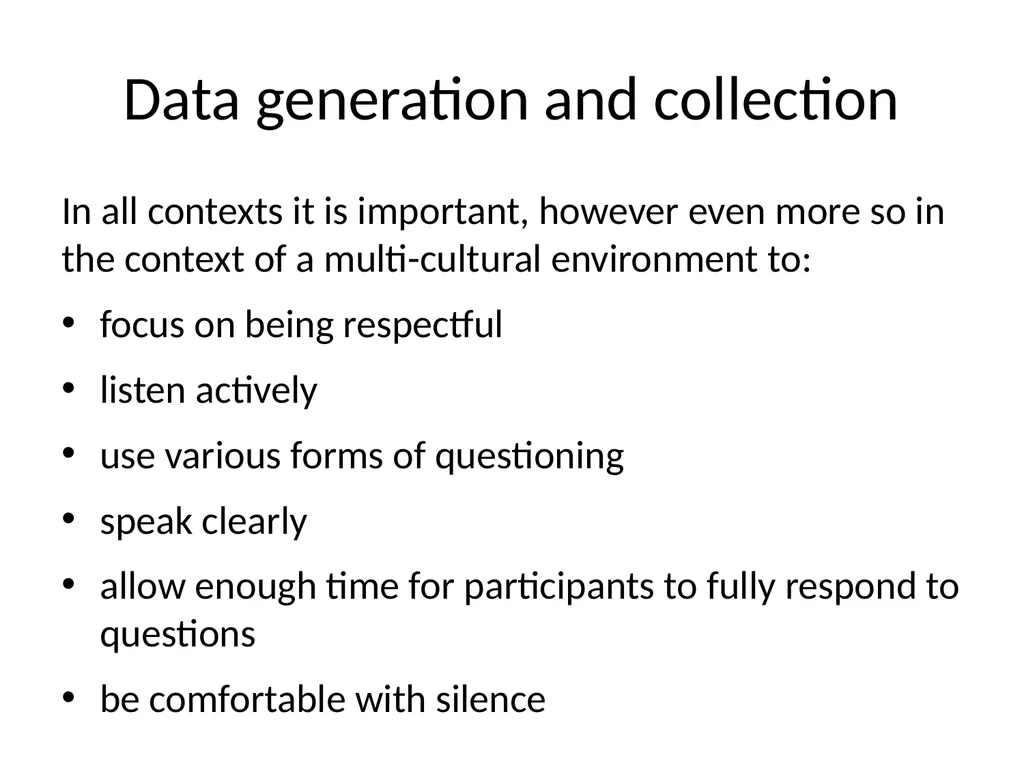
Data generation and collection In all contexts it is important, however even more so in the context of a multi-cultural environment to:
focus on being respectful
listen actively
use various forms of questioning
speak clearly
allow enough time for participants to fully respond to questions
be comfortable with silence<br>
focus on being respectful
listen actively
use various forms of questioning
speak clearly
allow enough time for participants to fully respond to questions
be comfortable with silence<br>
23
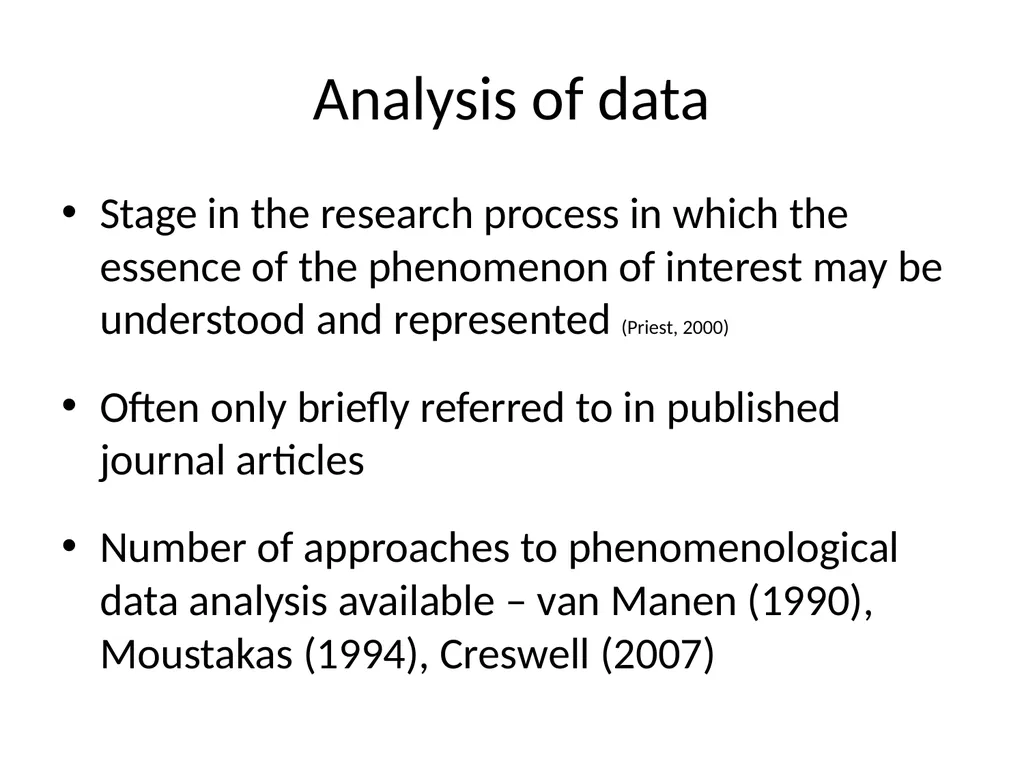
Analysis of data Stage in the research process in which the essence of the phenomenon of interest may be understood and represented (Priest, 2000)
Often only briefly referred to in published journal articles
Number of approaches to phenomenological data analysis available – van Manen (1990), Moustakas (1994), Creswell (2007)<br>
Often only briefly referred to in published journal articles
Number of approaches to phenomenological data analysis available – van Manen (1990), Moustakas (1994), Creswell (2007)<br>
24
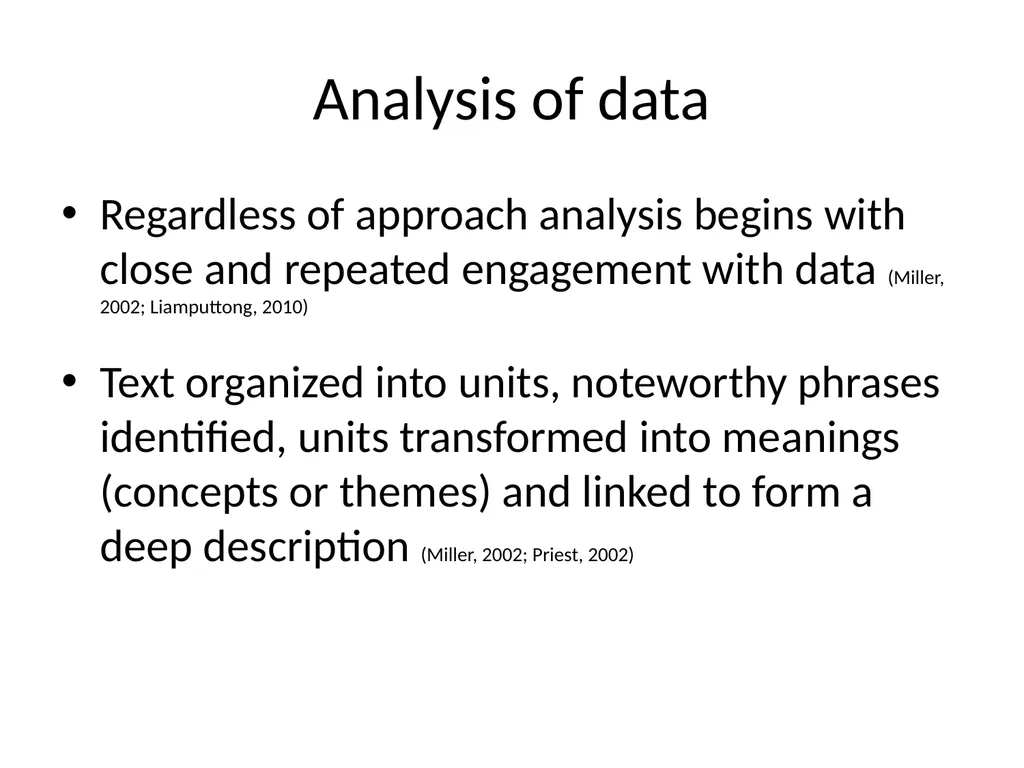
Analysis of data Regardless of approach analysis begins with close and repeated engagement with data (Miller, 2002; Liamputtong, 2010)
Text organized into units, noteworthy phrases identified, units transformed into meanings (concepts or themes) and linked to form a deep description (Miller, 2002; Priest, 2002)<br>
Text organized into units, noteworthy phrases identified, units transformed into meanings (concepts or themes) and linked to form a deep description (Miller, 2002; Priest, 2002)<br>
25
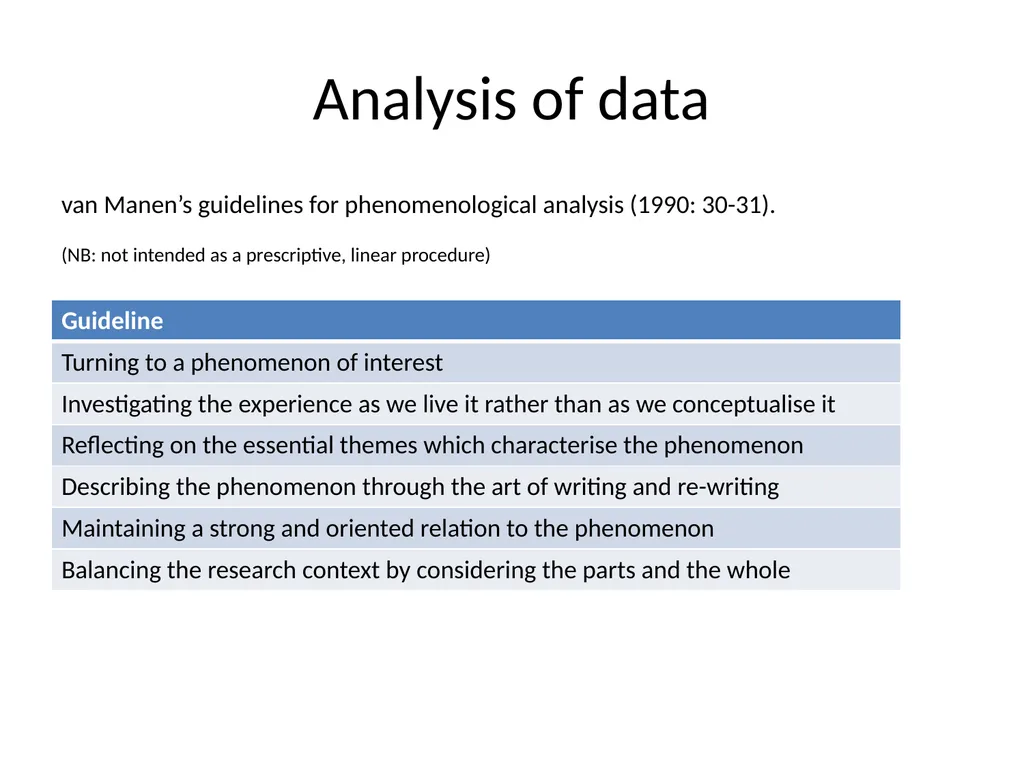
Analysis of data van Manen’s guidelines for phenomenological analysis (1990: 30-31).
(NB: not intended as a prescriptive, linear procedure)<br>
(NB: not intended as a prescriptive, linear procedure)<br>
26
Quality and rigor Strategies such as:
stating presuppositions
member checking
achieving representativeness<br>
stating presuppositions
member checking
achieving representativeness<br>
27
Quality and rigor Member-checking involves going back to participants to ensure that analysis is a legitimate representation of the phenomenon
Debated issue
Participant’s multiple realities
Breaches of confidentiality
Potential of distress when participants read accounts of their experiences<br>
Debated issue
Participant’s multiple realities
Breaches of confidentiality
Potential of distress when participants read accounts of their experiences<br>
28
Quality and rigor “Framework of expressions” (de Witt and Ploeg, 2006: 227)
for establishing rigor in interpretive phenomenology:
Balanced integration
Openness
Concreteness
Resonance
Actualization<br>
for establishing rigor in interpretive phenomenology:
Balanced integration
Openness
Concreteness
Resonance
Actualization<br>
29
Quality and rigor Preference for individual researcher decisions for individual studies (Rolfe, 2006)
Phenomenology is a philosophy and a method, which attracts ongoing scholarly discourse
Ongoing attention ensures that phenomenology as a method continues to develop and strategies to ensure rigor continue to be refined<br>
Phenomenology is a philosophy and a method, which attracts ongoing scholarly discourse
Ongoing attention ensures that phenomenology as a method continues to develop and strategies to ensure rigor continue to be refined<br>
30
Presentation and dissemination of findings Series of themes or motifs
Excerpts of participants’ narratives support themes
Balance between philosophical aspects of the method and the actual findings of the study<br>
Excerpts of participants’ narratives support themes
Balance between philosophical aspects of the method and the actual findings of the study<br>
31
Summary Phenomenology is appropriate when the aims of the study are to gain insight into the lived experience of a phenomenon
Eight key concepts related to philosophical underpinnings
Position of the researcher as writer
Interviewing – most common method of data collection
Phenomenology is a philosophy and a method<br>
Eight key concepts related to philosophical underpinnings
Position of the researcher as writer
Interviewing – most common method of data collection
Phenomenology is a philosophy and a method<br>
32
References Adams C and van Manen M. (2008) Phenomenology. In: Given L (ed) The SAGE Encyclopedia of Qualitative Research Methods. Thousand Oaks: Sage, 614-619.
Creswell J. (2007) Qualitative Inquiry and Research Design. Choosing among five approaches, Thousand Oaks, CA.: Sage Publications.
Crotty M. (1996) Phenomenology and Nursing Research, Melbourne: Livingstone.
De Witt L and Ploeg J. (2006) Critical appraisal of rigor in interpretive phenomenological nursing research. Journal of Advanced Nursing 55: 215-229.
Miller S. (2002) Analysis of phenomenological data generated with children as research participants. Nurse Researcher 10: 68-82.
Liamputtong P. (2010) Research methods in health: Foundations for evidence-based practice, Melbourne: Oxford University Press.<br>
Creswell J. (2007) Qualitative Inquiry and Research Design. Choosing among five approaches, Thousand Oaks, CA.: Sage Publications.
Crotty M. (1996) Phenomenology and Nursing Research, Melbourne: Livingstone.
De Witt L and Ploeg J. (2006) Critical appraisal of rigor in interpretive phenomenological nursing research. Journal of Advanced Nursing 55: 215-229.
Miller S. (2002) Analysis of phenomenological data generated with children as research participants. Nurse Researcher 10: 68-82.
Liamputtong P. (2010) Research methods in health: Foundations for evidence-based practice, Melbourne: Oxford University Press.<br>
33
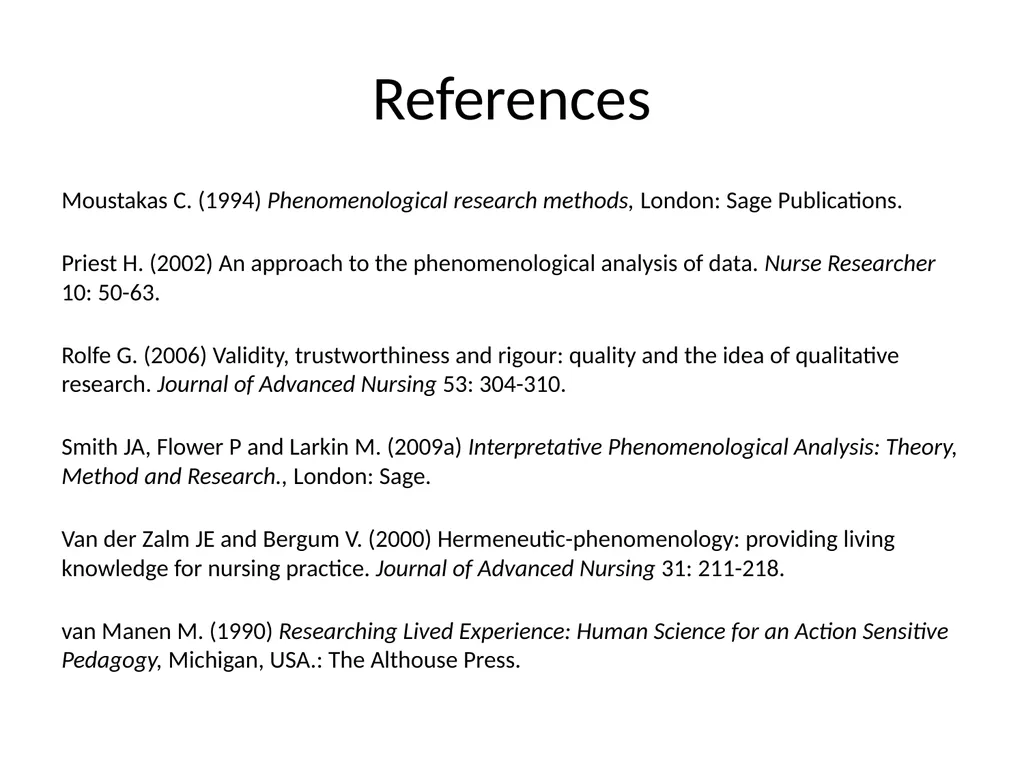
References Moustakas C. (1994) Phenomenological research methods, London: Sage Publications.
Priest H. (2002) An approach to the phenomenological analysis of data. Nurse Researcher 10: 50-63.
Rolfe G. (2006) Validity, trustworthiness and rigour: quality and the idea of qualitative research. Journal of Advanced Nursing 53: 304-310.
Smith JA, Flower P and Larkin M. (2009a) Interpretative Phenomenological Analysis: Theory, Method and Research., London: Sage.
Van der Zalm JE and Bergum V. (2000) Hermeneutic-phenomenology: providing living knowledge for nursing practice. Journal of Advanced Nursing 31: 211-218.
van Manen M. (1990) Researching Lived Experience: Human Science for an Action Sensitive Pedagogy, Michigan, USA.: The Althouse Press.<br>
Priest H. (2002) An approach to the phenomenological analysis of data. Nurse Researcher 10: 50-63.
Rolfe G. (2006) Validity, trustworthiness and rigour: quality and the idea of qualitative research. Journal of Advanced Nursing 53: 304-310.
Smith JA, Flower P and Larkin M. (2009a) Interpretative Phenomenological Analysis: Theory, Method and Research., London: Sage.
Van der Zalm JE and Bergum V. (2000) Hermeneutic-phenomenology: providing living knowledge for nursing practice. Journal of Advanced Nursing 31: 211-218.
van Manen M. (1990) Researching Lived Experience: Human Science for an Action Sensitive Pedagogy, Michigan, USA.: The Althouse Press.<br>