
Chapter 12: Drafting and Water Shuttle Operations
LV
Published · 106 slides · 0 views

1 / 1
Description
Chapter 12: Drafting and Water Shuttle Operations Knowledge Objectives Describe the mechanics of drafting. Describe how to verify the operational readiness of the pump. Describe water supply management within the Incident Management System.
Related Topics
Share
Embed code
Download this presentation From Below
"Chapter 12: Drafting and Water Shuttle Operations" is the property of its rightful owner. Permission is granted to download and print the materials on this website for personal, non-commercial use only, and to display it on your personal computer provided you do not modify the materials and that you retain all copyright notices contained in the materials. By downloading content from our website, you accept the terms of this agreement.
Presentation Transcript
01
Chapter 12: Drafting and Water Shuttle Operations<br>
02
Knowledge Objectives Describe the mechanics of drafting.
Describe how to verify the operational readiness of the pump.
Describe water supply management within the Incident Management System.
Describe the process for selecting a suitable site for water drafting.
Describe how to position a fire pumper for drafting.
Describe the process for establishing a pumping operation from a draft.<br>
Describe how to verify the operational readiness of the pump.
Describe water supply management within the Incident Management System.
Describe the process for selecting a suitable site for water drafting.
Describe how to position a fire pumper for drafting.
Describe the process for establishing a pumping operation from a draft.<br>
03
Knowledge Objectives Describe how to perform drafting operations.
Describe complications of drafting operations.
Describe how to provide an uninterrupted water supply.
Describe water shuttle operations.
Describe dump site operations.
Describe water shuttle operations in the Incident Management System.<br>
Describe complications of drafting operations.
Describe how to provide an uninterrupted water supply.
Describe water shuttle operations.
Describe dump site operations.
Describe water shuttle operations in the Incident Management System.<br>
04
Introduction Driver/operator pumps water from the tank onboard the fire apparatus or from a pressurized water source.
In many rural fire areas and other emergency situations or disasters, the usual water supplies either are not available or are inadequate.
The ability to draft water from a static source makes your fire apparatus a versatile resource.<br>
In many rural fire areas and other emergency situations or disasters, the usual water supplies either are not available or are inadequate.
The ability to draft water from a static source makes your fire apparatus a versatile resource.<br>
05
Introduction Drafting water from a static source can present challenging operating conditions.
Ensure success in these situations by:
Making sure that the pump on your fire apparatus is in good operating condition
Understanding and applying the principles involved in drafting
Delivering water to the incident from a static water source<br>
Ensure success in these situations by:
Making sure that the pump on your fire apparatus is in good operating condition
Understanding and applying the principles involved in drafting
Delivering water to the incident from a static water source<br>
06
The Mechanics of Drafting Drafting process
Atmospheric pressure is 14.7 pounds per square inch (psi) at sea level.
As you move up in elevation the pressure decreases.
Pressure drops approximately 0.5 psi for every 1000 ft of elevation above sea level.
Atmospheric pressure at your drafting site is the maximum supply pressure for drafting.<br>
Atmospheric pressure is 14.7 pounds per square inch (psi) at sea level.
As you move up in elevation the pressure decreases.
Pressure drops approximately 0.5 psi for every 1000 ft of elevation above sea level.
Atmospheric pressure at your drafting site is the maximum supply pressure for drafting.<br>
07
The Mechanics of Drafting When you engage the primer, you begin pumping air out of the fire pump.
Creates a vacuum
Must be contained inside some type of airtight vessel
As vacuum increases inside the hose, the atmospheric pressure in the hose decreases.
This difference in pressure can be used to support a column of liquid.<br>
Creates a vacuum
Must be contained inside some type of airtight vessel
As vacuum increases inside the hose, the atmospheric pressure in the hose decreases.
This difference in pressure can be used to support a column of liquid.<br>
08
The Mechanics of Drafting Mercury measures vacuum in the laboratory because its density makes it more convenient to use than water for this purpose.
Pressure is commonly measured in units of inches or millimeters of mercury.<br>
Pressure is commonly measured in units of inches or millimeters of mercury.<br>
09
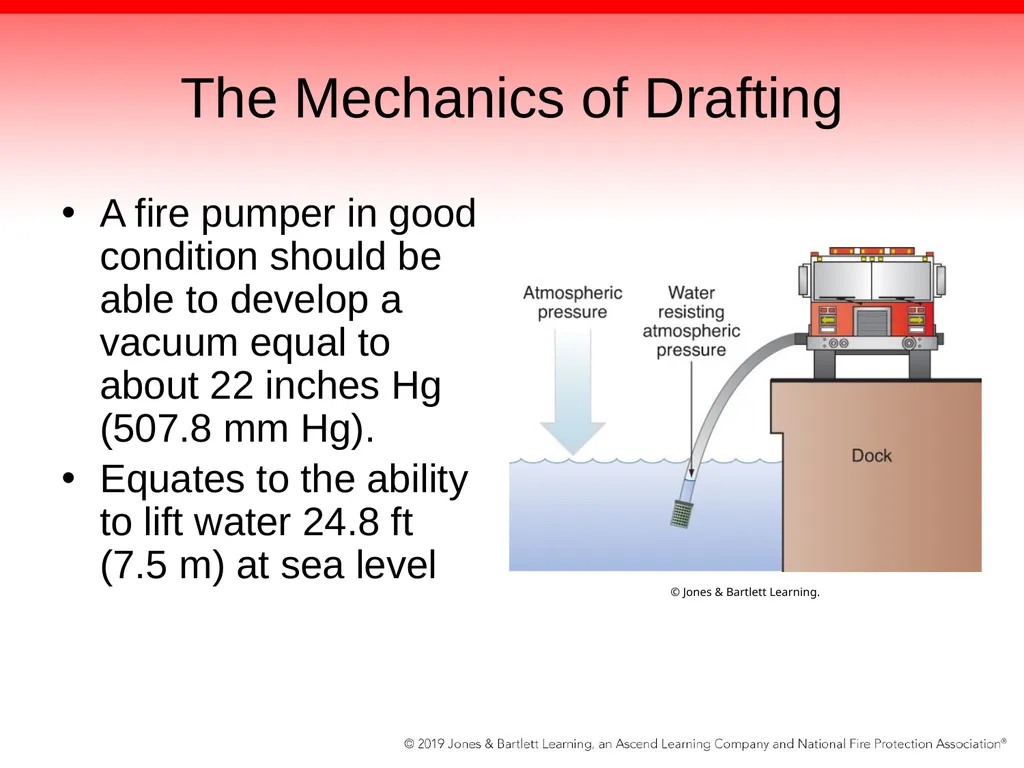
The Mechanics of Drafting A fire pumper in good condition should be able to develop a vacuum equal to about 22 inches Hg (507.8 mm Hg).
Equates to the ability to lift water 24.8 ft (7.5 m) at sea level © Jones & Bartlett Learning.<br>
Equates to the ability to lift water 24.8 ft (7.5 m) at sea level © Jones & Bartlett Learning.<br>
10
The Mechanics of Drafting As you lift water to a greater height, more atmospheric pressure is required to support the weight of the water.
Dependable lift is the height that a column of water can be lifted in a quantity considered sufficient to provide reliable fire flow.
The pumps found in fire apparatus have their capacity ratings established by pumping from a draft.<br>
Dependable lift is the height that a column of water can be lifted in a quantity considered sufficient to provide reliable fire flow.
The pumps found in fire apparatus have their capacity ratings established by pumping from a draft.<br>
11
The Mechanics of Drafting For example, a pumper must:
Lift water 10 ft (3 m) through 20 ft (6 m) of hard-sided supply hose for pumps up to 1500 gpm, 8 ft (2.5 m) for pumps up to 1750 gpm, and 6 ft (2 m) for pumps up to 2000 gpm, and larger
And deliver its rated capacity at a discharge pressure of 150 psi (1000 kPa), as measured at the pump panel<br>
Lift water 10 ft (3 m) through 20 ft (6 m) of hard-sided supply hose for pumps up to 1500 gpm, 8 ft (2.5 m) for pumps up to 1750 gpm, and 6 ft (2 m) for pumps up to 2000 gpm, and larger
And deliver its rated capacity at a discharge pressure of 150 psi (1000 kPa), as measured at the pump panel<br>
12
Inspections, Routine Maintenance, and Operational Testing Fire departments generally have a prescribed process for performing inspections, routine maintenance, and operational testing.
You must check the operational readiness of the priming system and the overall condition of the fire pump on your fire apparatus on a periodic basis.<br>
You must check the operational readiness of the priming system and the overall condition of the fire pump on your fire apparatus on a periodic basis.<br>
13
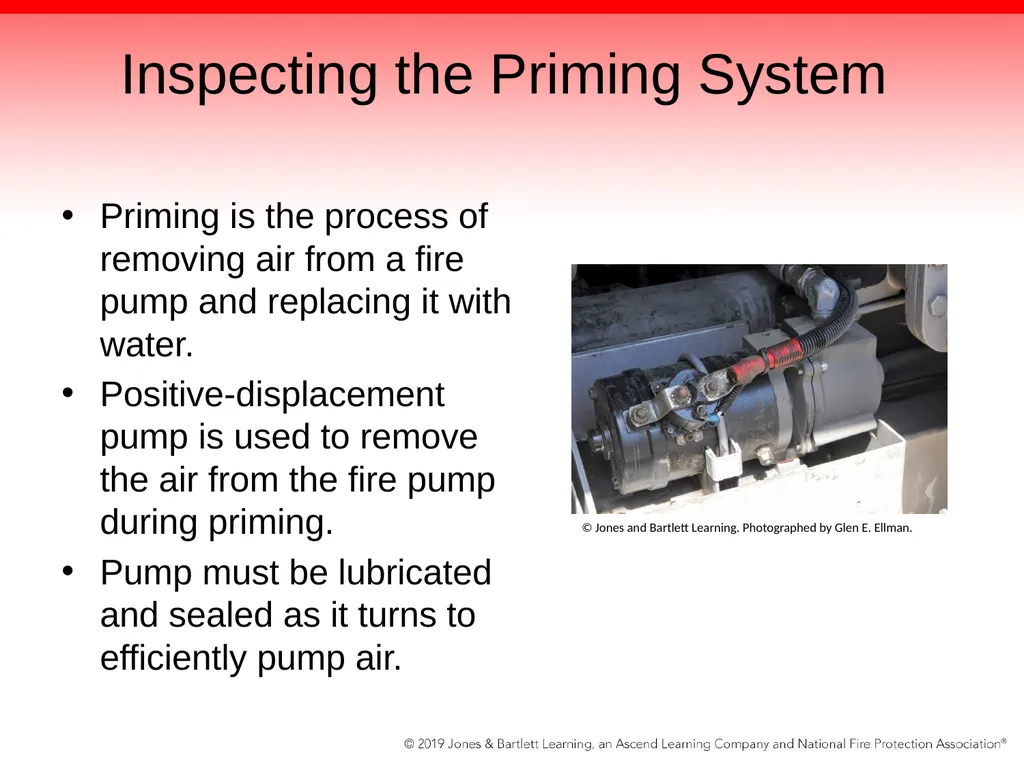
Inspecting the Priming System Priming is the process of removing air from a fire pump and replacing it with water.
Positive-displacement pump is used to remove the air from the fire pump during priming.
Pump must be lubricated and sealed as it turns to efficiently pump air. © Jones and Bartlett Learning. Photographed by Glen E. Ellman.<br>
Positive-displacement pump is used to remove the air from the fire pump during priming.
Pump must be lubricated and sealed as it turns to efficiently pump air. © Jones and Bartlett Learning. Photographed by Glen E. Ellman.<br>
14
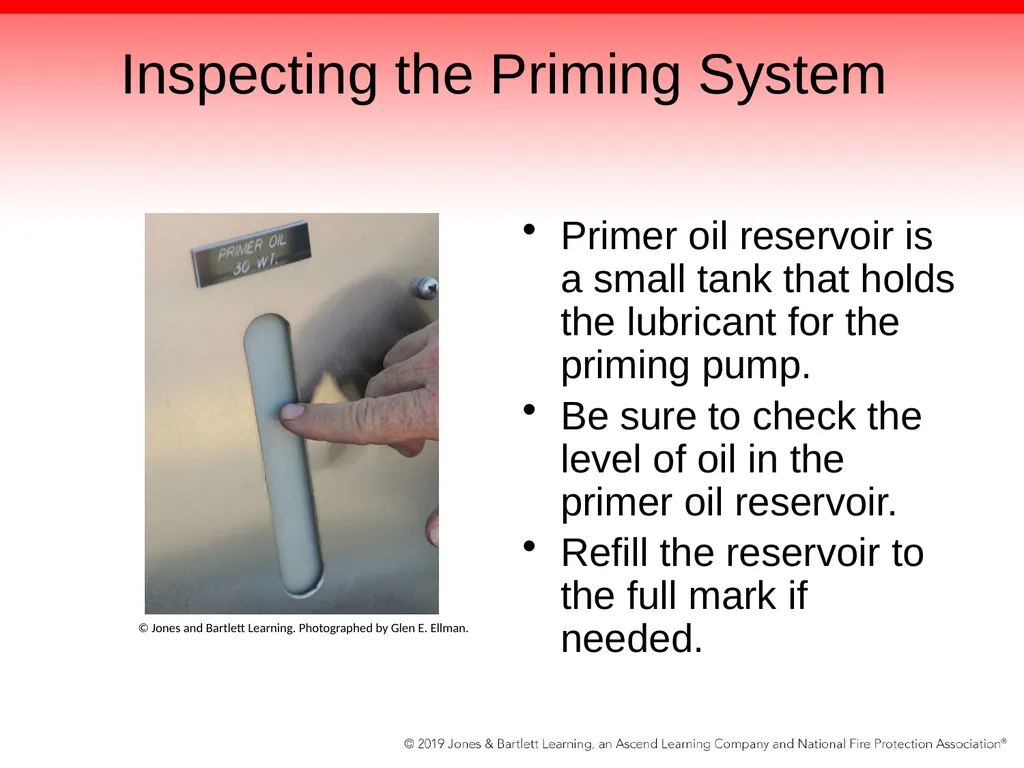
Inspecting the Priming System Primer oil reservoir is a small tank that holds the lubricant for the priming pump.
Be sure to check the level of oil in the primer oil reservoir.
Refill the reservoir to the full mark if needed. © Jones and Bartlett Learning. Photographed by Glen E. Ellman.<br>
Be sure to check the level of oil in the primer oil reservoir.
Refill the reservoir to the full mark if needed. © Jones and Bartlett Learning. Photographed by Glen E. Ellman.<br>
15
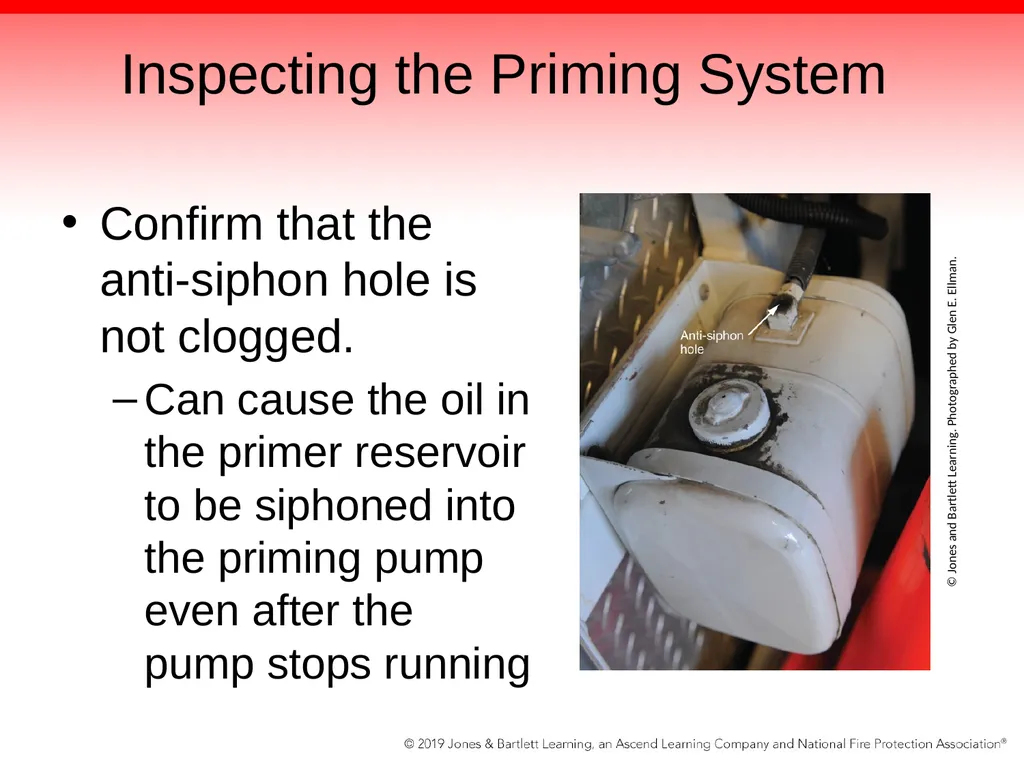
Inspecting the Priming System Confirm that the anti-siphon hole is not clogged.
Can cause the oil in the primer reservoir to be siphoned into the priming pump even after the pump stops running © Jones and Bartlett Learning. Photographed by Glen E. Ellman.<br>
Can cause the oil in the primer reservoir to be siphoned into the priming pump even after the pump stops running © Jones and Bartlett Learning. Photographed by Glen E. Ellman.<br>
16
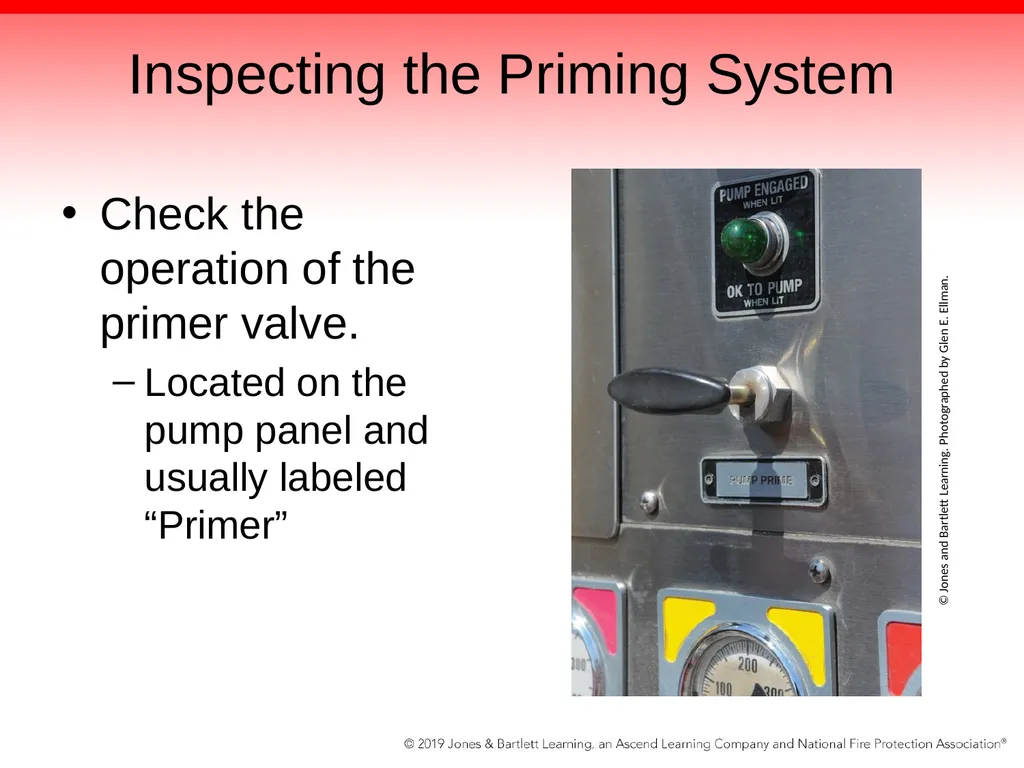
Inspecting the Priming System Check the operation of the primer valve.
Located on the pump panel and usually labeled “Primer” © Jones and Bartlett Learning. Photographed by Glen E. Ellman.<br>
Located on the pump panel and usually labeled “Primer” © Jones and Bartlett Learning. Photographed by Glen E. Ellman.<br>
17
Performing the Vacuum Test Part of annual pump testing and not a routine check performed by a driver/operator.
A separate calibrated gauge set must be used.
NFPA 1911 lists very specific conditions for this test when it is performed for certification of a new fire pump.
Before performing the vacuum test, take the time to remove all discharge caps and drain the booster tank.<br>
A separate calibrated gauge set must be used.
NFPA 1911 lists very specific conditions for this test when it is performed for certification of a new fire pump.
Before performing the vacuum test, take the time to remove all discharge caps and drain the booster tank.<br>
18
Finding a Vacuum Leak A fire pump that retains any vacuum for 5 minutes should prime and draft water easily in most situations.
To find a suspected vacuum leak, place an EMS glove over the uncapped discharge and pull the primer.
If the glove sucks in, there is a leak.
If the driver/operator cannot verify the location of the leak, an evaluation must be performed by a qualified mechanic.<br>
To find a suspected vacuum leak, place an EMS glove over the uncapped discharge and pull the primer.
If the glove sucks in, there is a leak.
If the driver/operator cannot verify the location of the leak, an evaluation must be performed by a qualified mechanic.<br>
19
Water Supply Management in the Incident Management System Water supply management is a vital part of any fire incident.
Can become a major part of the IMS in scenarios where a reliable public or private water system is not available
Drafting operations, relay pumping, water shuttles, and nurse tender operations will become the responsibility of the water supply officer in these situations.<br>
Can become a major part of the IMS in scenarios where a reliable public or private water system is not available
Drafting operations, relay pumping, water shuttles, and nurse tender operations will become the responsibility of the water supply officer in these situations.<br>
20
Water Supply Management in the Incident Management System Water supply officer position reports to the operations section chief.
Also responsible for ensuring that an adequate supply of water is available to mitigate the incident
If no operations section chief is designated, then this officer reports directly to the IC.
Water supply officers should be given a priority on any scene.<br>
Also responsible for ensuring that an adequate supply of water is available to mitigate the incident
If no operations section chief is designated, then this officer reports directly to the IC.
Water supply officers should be given a priority on any scene.<br>
21
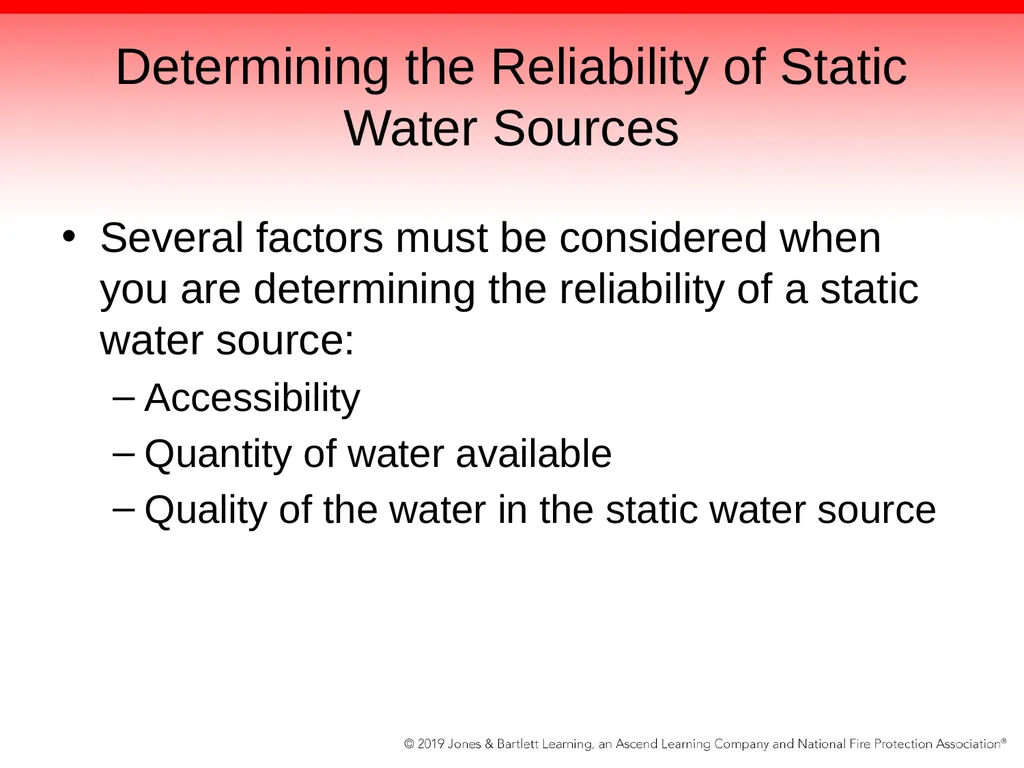
Determining the Reliability of Static Water Sources Several factors must be considered when you are determining the reliability of a static water source:
Accessibility
Quantity of water available
Quality of the water in the static water source<br>
Accessibility
Quantity of water available
Quality of the water in the static water source<br>
22
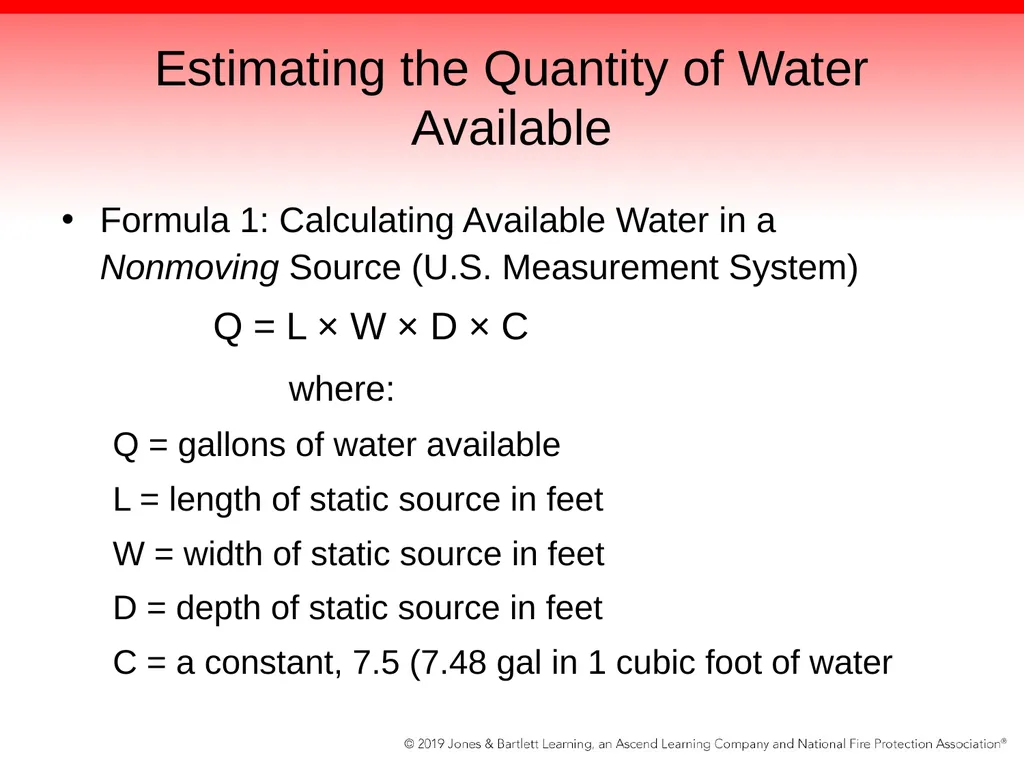
Estimating the Quantity of Water Available Formula 1: Calculating Available Water in a Nonmoving Source (U.S. Measurement System)
Q = L × W × D × C
where:
Q = gallons of water available
L = length of static source in feet
W = width of static source in feet
D = depth of static source in feet
C = a constant, 7.5 (7.48 gal in 1 cubic foot of water<br>
Q = L × W × D × C
where:
Q = gallons of water available
L = length of static source in feet
W = width of static source in feet
D = depth of static source in feet
C = a constant, 7.5 (7.48 gal in 1 cubic foot of water<br>
23
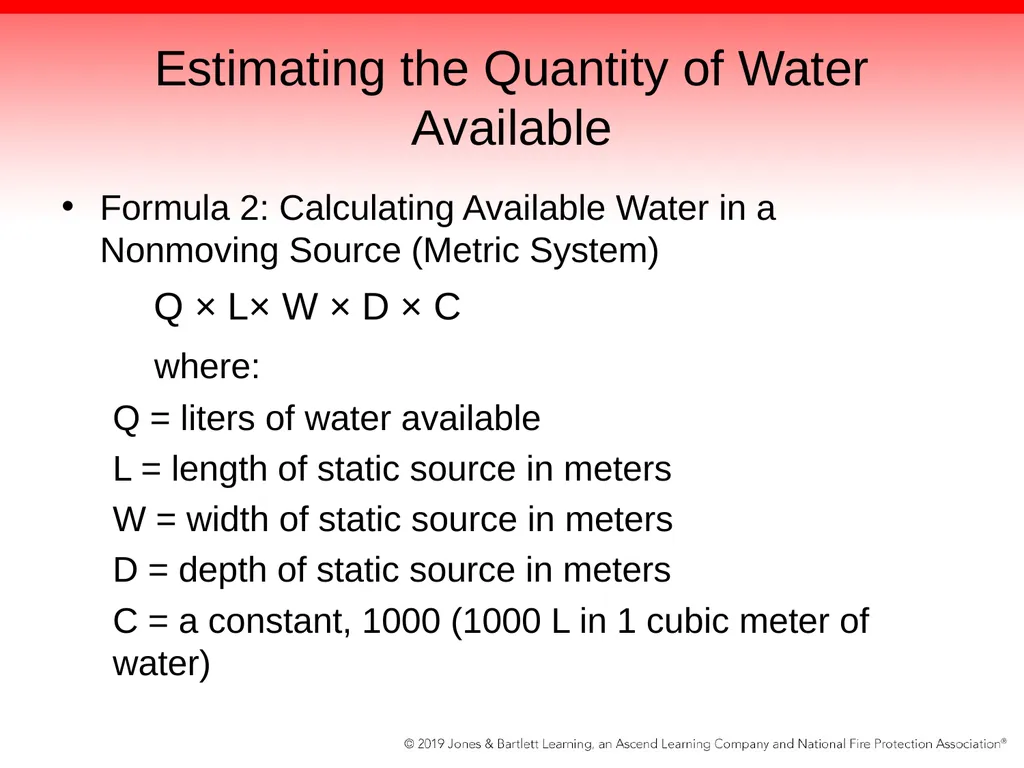
Estimating the Quantity of Water Available Formula 2: Calculating Available Water in a Nonmoving Source (Metric System)
Q × L× W × D × C
where:
Q = liters of water available
L = length of static source in meters
W = width of static source in meters
D = depth of static source in meters
C = a constant, 1000 (1000 L in 1 cubic meter of water)<br>
Q × L× W × D × C
where:
Q = liters of water available
L = length of static source in meters
W = width of static source in meters
D = depth of static source in meters
C = a constant, 1000 (1000 L in 1 cubic meter of water)<br>
24
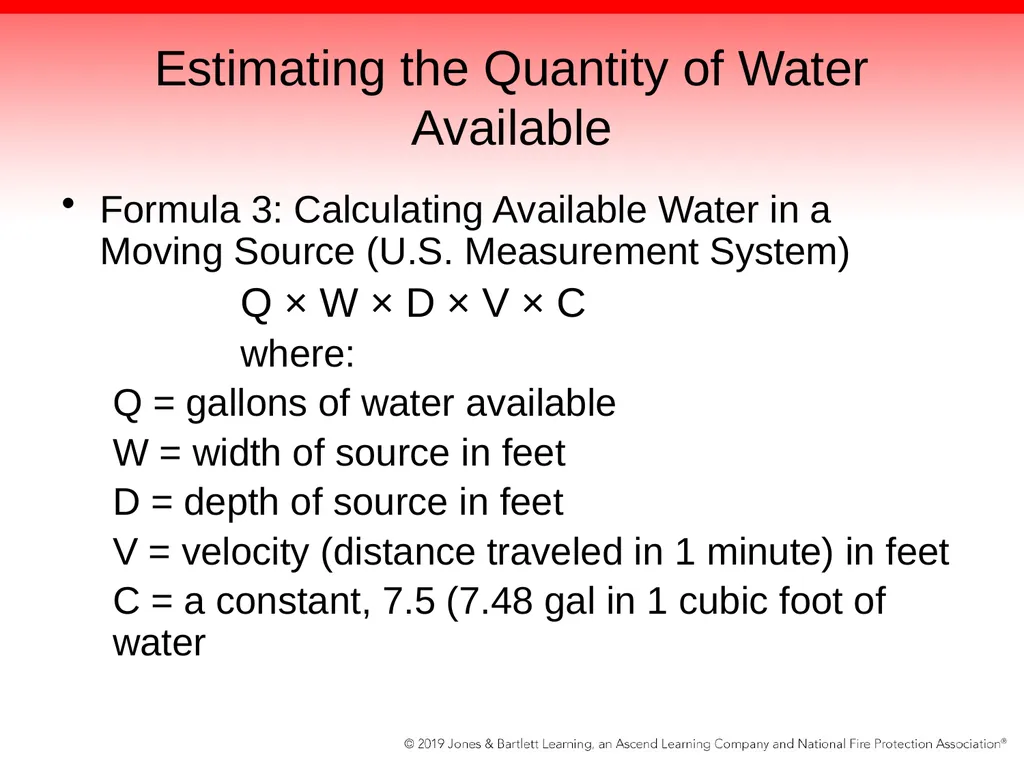
Estimating the Quantity of Water Available Formula 3: Calculating Available Water in a Moving Source (U.S. Measurement System)
Q × W × D × V × C
where:
Q = gallons of water available
W = width of source in feet
D = depth of source in feet
V = velocity (distance traveled in 1 minute) in feet
C = a constant, 7.5 (7.48 gal in 1 cubic foot of water<br>
Q × W × D × V × C
where:
Q = gallons of water available
W = width of source in feet
D = depth of source in feet
V = velocity (distance traveled in 1 minute) in feet
C = a constant, 7.5 (7.48 gal in 1 cubic foot of water<br>
25
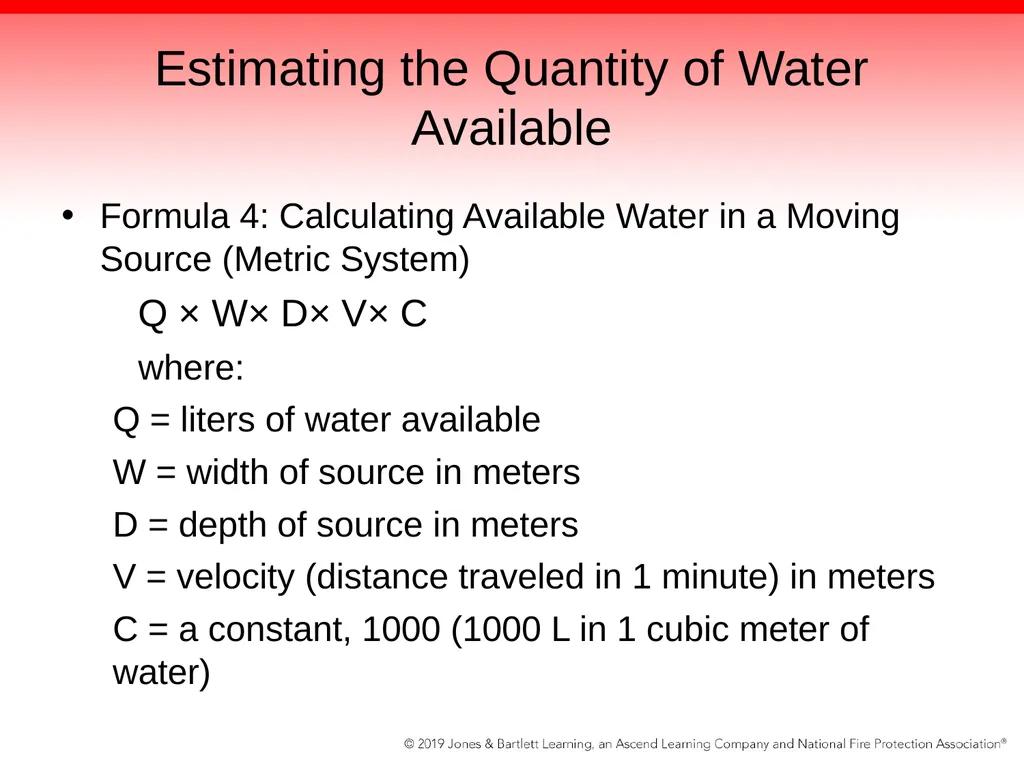
Estimating the Quantity of Water Available Formula 4: Calculating Available Water in a Moving Source (Metric System)
Q × W× D× V× C
where:
Q = liters of water available
W = width of source in meters
D = depth of source in meters
V = velocity (distance traveled in 1 minute) in meters
C = a constant, 1000 (1000 L in 1 cubic meter of water)<br>
Q × W× D× V× C
where:
Q = liters of water available
W = width of source in meters
D = depth of source in meters
V = velocity (distance traveled in 1 minute) in meters
C = a constant, 1000 (1000 L in 1 cubic meter of water)<br>
26
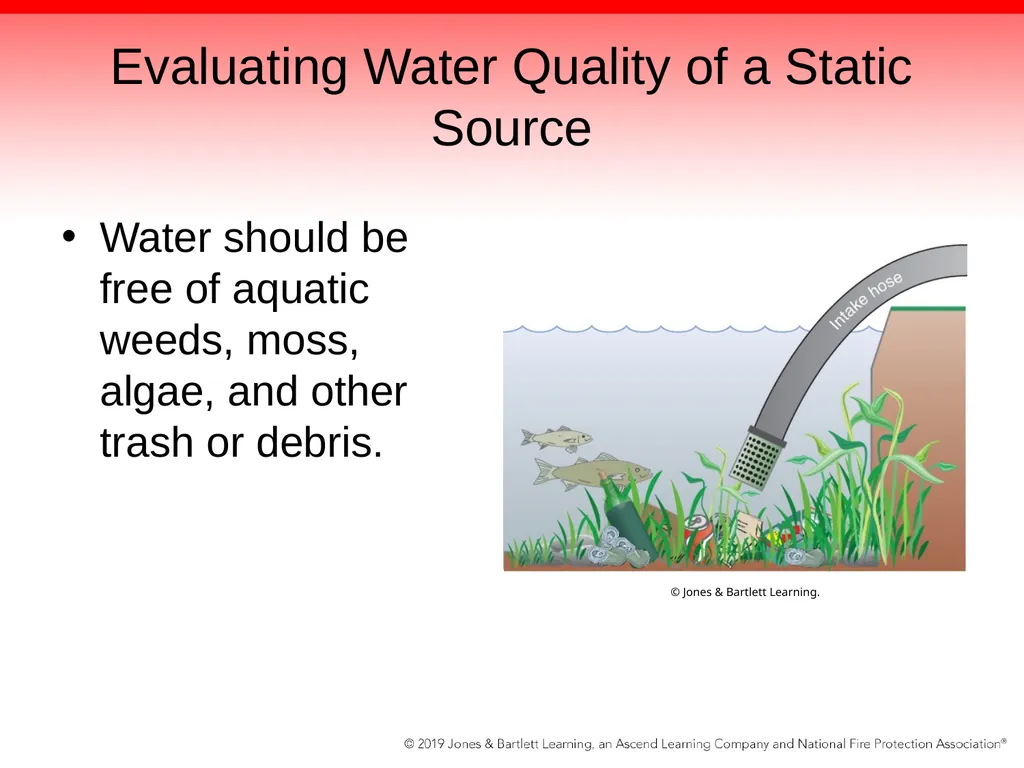
Evaluating Water Quality of a Static Source Water should be free of aquatic weeds, moss, algae, and other trash or debris. © Jones & Bartlett Learning.<br>
27
Evaluating Water Quality of a Static Source Foreign material plugs the strainer on the supply hose and hinders your ability to deliver a reliable water supply for firefighting operations.
Clean water is preferred over muddy or murky water, which contains sand or silt that can clog nozzles, damage the wear rings inside the pump, and even cause pump failure.<br>
Clean water is preferred over muddy or murky water, which contains sand or silt that can clog nozzles, damage the wear rings inside the pump, and even cause pump failure.<br>
28
Accessibility of the Static Water Source Safely position the fire apparatus close enough to the water source to completely submerge the strainer of the hard-sided supply hose in the water once it is connected to the fire pump.
Determine that the soil will support apparatus.
Identify a drafting site that is relatively level and free of trees, bushes, rocks, fences, and other obstructions that may limit access to the static water source.<br>
Determine that the soil will support apparatus.
Identify a drafting site that is relatively level and free of trees, bushes, rocks, fences, and other obstructions that may limit access to the static water source.<br>
29
Accessibility of the Static Water Source Obtaining access to static water sources can be especially difficult during winter weather conditions.
Snow can hide possible hazardous conditions.
Ice covering the water presents an access problem and a potential life-safety situation.
Never walk on ice without a personal flotation device and safety line unless you know water is less than waist deep.<br>
Snow can hide possible hazardous conditions.
Ice covering the water presents an access problem and a potential life-safety situation.
Never walk on ice without a personal flotation device and safety line unless you know water is less than waist deep.<br>
30
Special Accessibility Conditions Drafting from a bridge is one possible solution to accessibility problems.
Identify drafting sites during preplanning efforts rather than waiting for a fire to force you to find one in an emergency situation.
Determine which sources will and will not work for your operation during preplanning.<br>
Identify drafting sites during preplanning efforts rather than waiting for a fire to force you to find one in an emergency situation.
Determine which sources will and will not work for your operation during preplanning.<br>
31
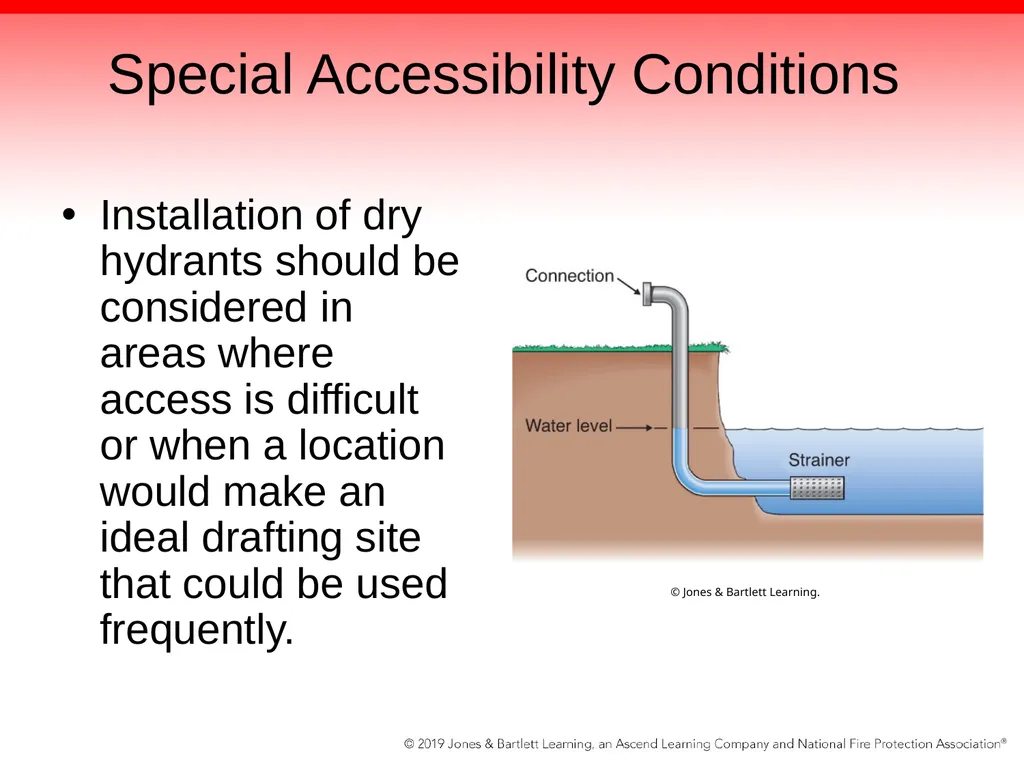
Special Accessibility Conditions Installation of dry hydrants should be considered in areas where access is difficult or when a location would make an ideal drafting site that could be used frequently. © Jones & Bartlett Learning.<br>
32
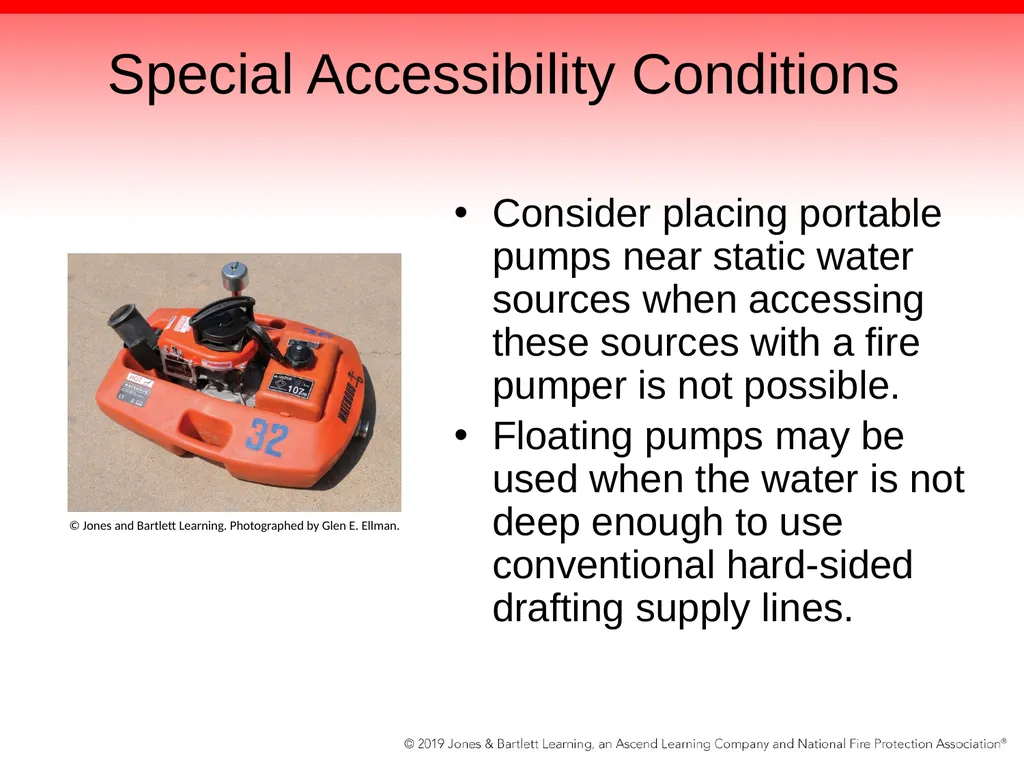
Special Accessibility Conditions Consider placing portable pumps near static water sources when accessing these sources with a fire pumper is not possible.
Floating pumps may be used when the water is not deep enough to use conventional hard-sided drafting supply lines. © Jones and Bartlett Learning. Photographed by Glen E. Ellman.<br>
Floating pumps may be used when the water is not deep enough to use conventional hard-sided drafting supply lines. © Jones and Bartlett Learning. Photographed by Glen E. Ellman.<br>
33
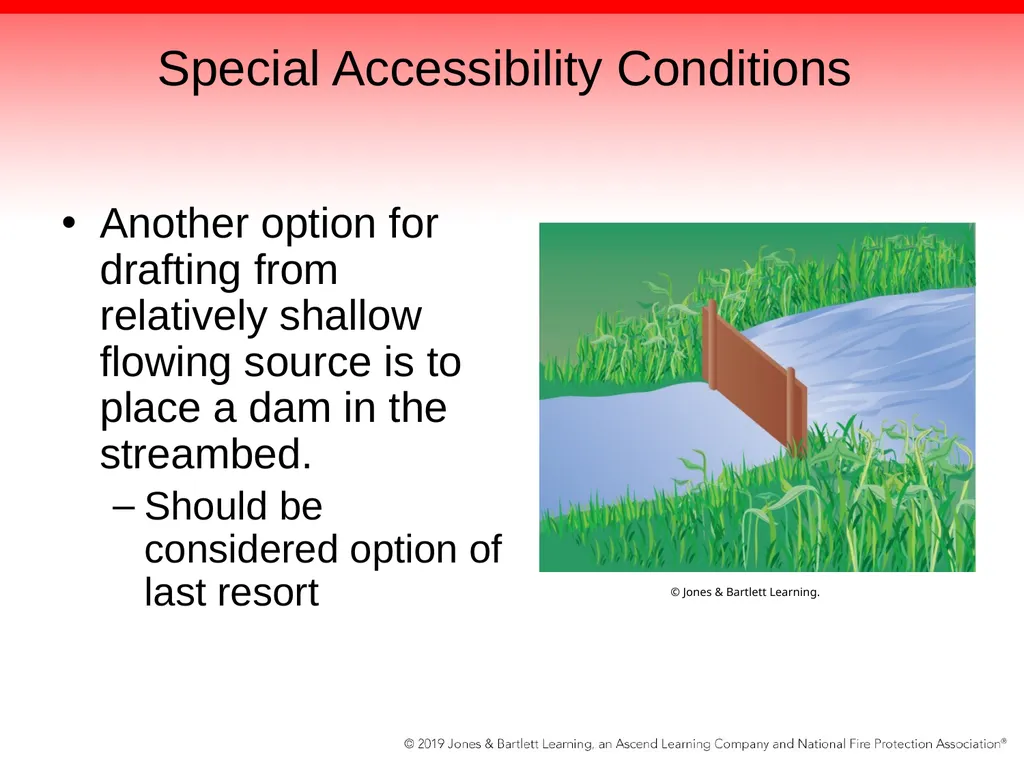
Special Accessibility Conditions Another option for drafting from relatively shallow flowing source is to place a dam in the streambed.
Should be considered option of last resort © Jones & Bartlett Learning.<br>
Should be considered option of last resort © Jones & Bartlett Learning.<br>
34
Operational Considerations for Site Selection The best choice of drafting site is determined by the location and the purpose of the drafting operation.
If you are directly supplying water for firefighting operations that are nearby, then the closest available drafting site is usually the preferred option.
Be mindful of fire apparatus movement in and out of the scene.<br>
If you are directly supplying water for firefighting operations that are nearby, then the closest available drafting site is usually the preferred option.
Be mindful of fire apparatus movement in and out of the scene.<br>
35
Operational Considerations for Site Selection As the distance increases, water supply options become limited.
Consider other methods: water shuttle, relay pumping, or a nurse tender operation as a source for water.
May need to lay a supply line from an access point that can easily be extended from or connected to by another pumper<br>
Consider other methods: water shuttle, relay pumping, or a nurse tender operation as a source for water.
May need to lay a supply line from an access point that can easily be extended from or connected to by another pumper<br>
36
Operational Considerations for Site Selection If your purpose for drafting is to supply a water shuttle or to be the source pumper in a relay pumping operation, then:
Select a drafting site that will not block access to the fireground for any additional equipment that may respond to the incident.
Select a drafting site that allows water tenders in a shuttle operation to be filled without having to back up or turn around.<br>
Select a drafting site that will not block access to the fireground for any additional equipment that may respond to the incident.
Select a drafting site that allows water tenders in a shuttle operation to be filled without having to back up or turn around.<br>
37
Pumping from a Draft First step in establishing a drafting operation is to locate an appropriate water source.
Before any connections are made, inspect the gaskets for proper placement, cracks, and any debris.
Once you have determined the length of hose needed, place a strainer on the hose’s end.
Three types of strainers are used for drafting operations, each with a specific function.<br>
Before any connections are made, inspect the gaskets for proper placement, cracks, and any debris.
Once you have determined the length of hose needed, place a strainer on the hose’s end.
Three types of strainers are used for drafting operations, each with a specific function.<br>
38
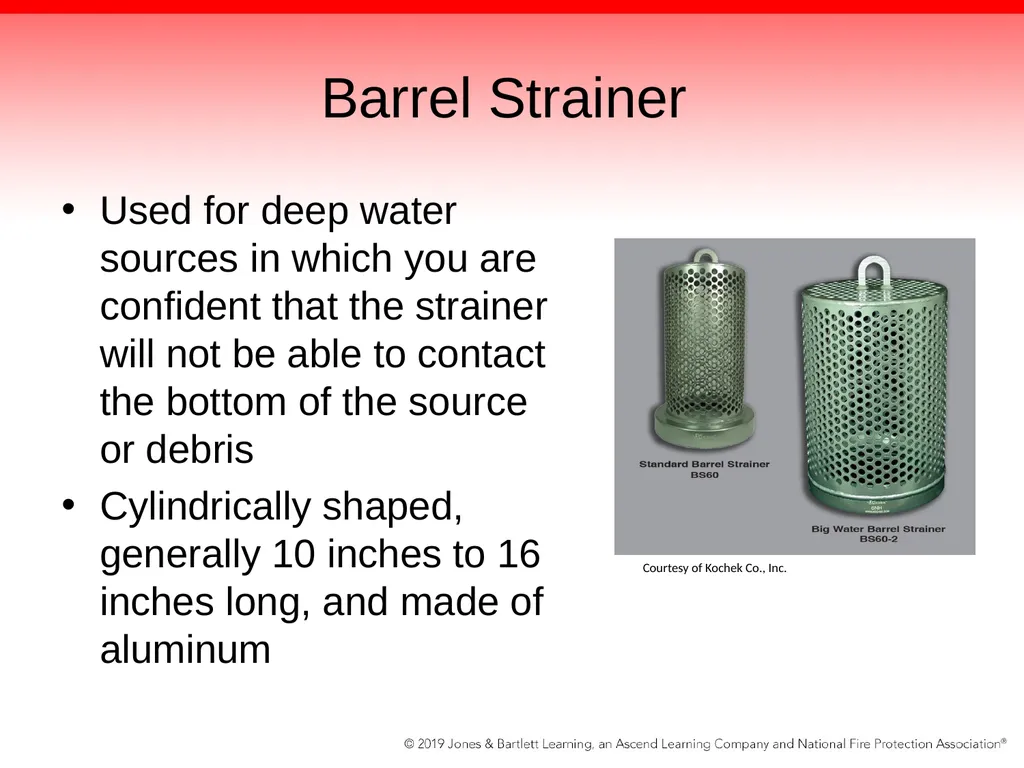
Barrel Strainer Used for deep water sources in which you are confident that the strainer will not be able to contact the bottom of the source or debris
Cylindrically shaped, generally 10 inches to 16 inches long, and made of aluminum Courtesy of Kochek Co., Inc.<br>
Cylindrically shaped, generally 10 inches to 16 inches long, and made of aluminum Courtesy of Kochek Co., Inc.<br>
39
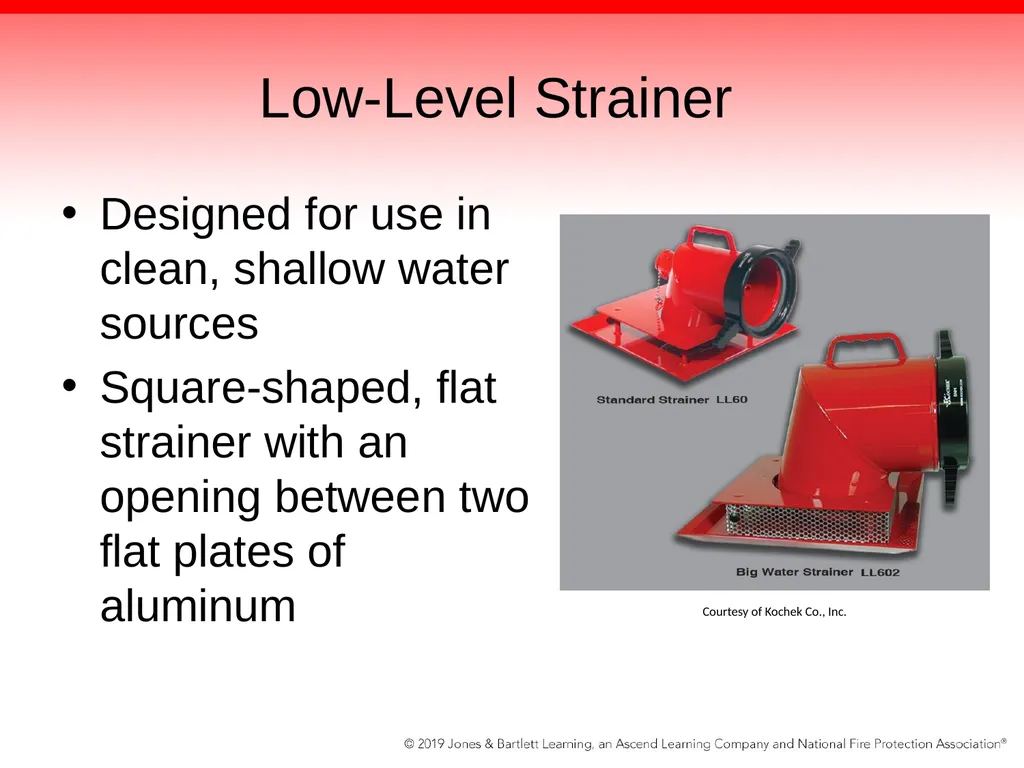
Low-Level Strainer Designed for use in clean, shallow water sources
Square-shaped, flat strainer with an opening between two flat plates of aluminum Courtesy of Kochek Co., Inc.<br>
Square-shaped, flat strainer with an opening between two flat plates of aluminum Courtesy of Kochek Co., Inc.<br>
40
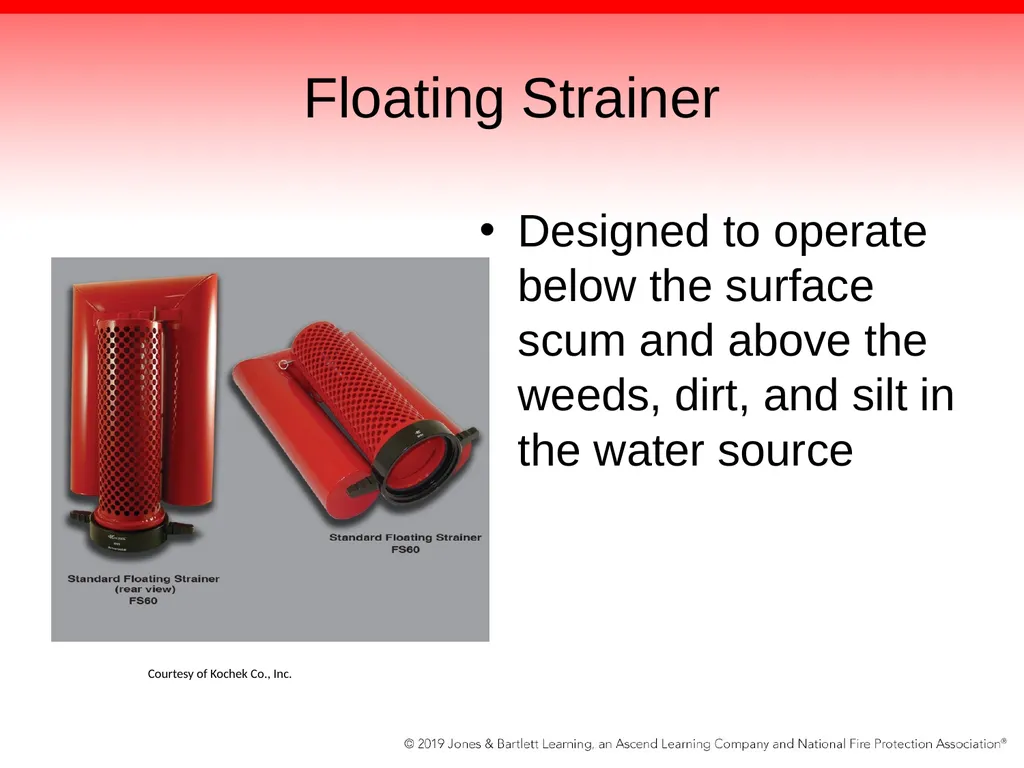
Floating Strainer Designed to operate below the surface scum and above the weeds, dirt, and silt in the water source Courtesy of Kochek Co., Inc.<br>
41
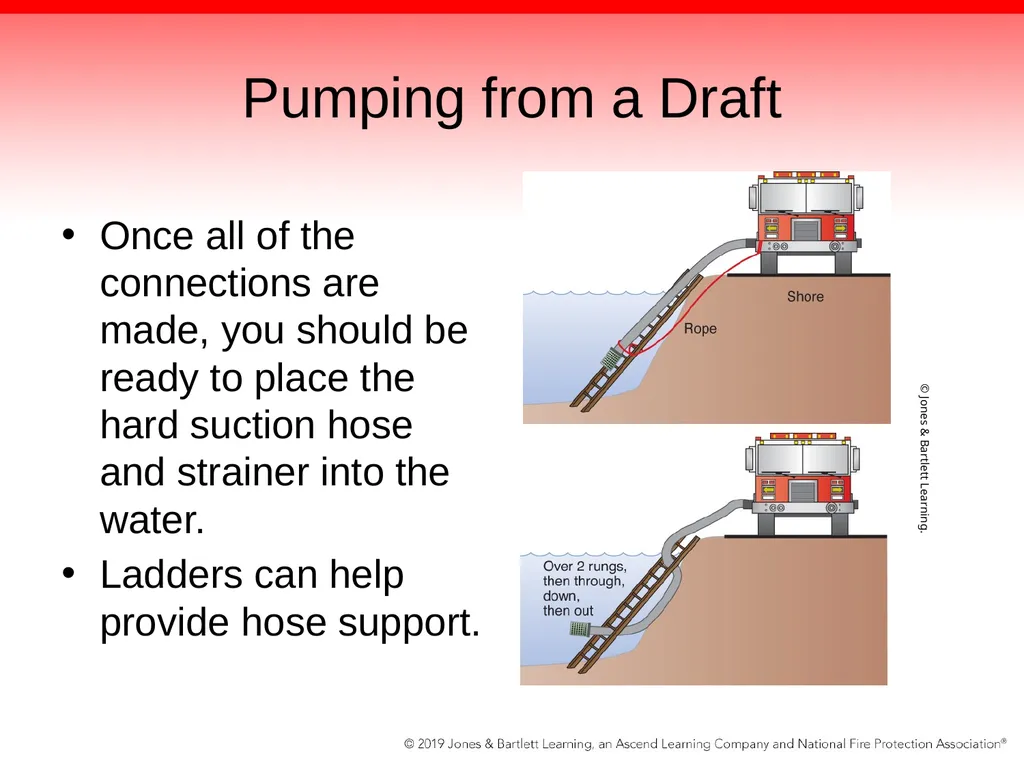
Pumping from a Draft Once all of the connections are made, you should be ready to place the hard suction hose and strainer into the water.
Ladders can help provide hose support. © Jones & Bartlett Learning.<br>
Ladders can help provide hose support. © Jones & Bartlett Learning.<br>
42
Preparing to Operate at Draft by Priming the Pump First step in preparing to draft from a water source is finding the water source.
Once suction hose has been connected and placed into the water source, air is drawn from the pump using the priming pump.
Activation of the priming pump lowers the atmospheric pressure within the fire pump, making it lower than the outside pressure.
Two pressures will try to equalize, and water will be drawn into the pump<br>
Once suction hose has been connected and placed into the water source, air is drawn from the pump using the priming pump.
Activation of the priming pump lowers the atmospheric pressure within the fire pump, making it lower than the outside pressure.
Two pressures will try to equalize, and water will be drawn into the pump<br>
43
Preparing to Operate at Draft by Priming the Pump Atmospheric pressure outside the pump presses down on the water source.
This causes water to rise inside the hard suction supply hose and replace the air being pumped out.
Process continues until all of the air is removed from the pump and replaced with water.<br>
This causes water to rise inside the hard suction supply hose and replace the air being pumped out.
Process continues until all of the air is removed from the pump and replaced with water.<br>
44
Priming a Fire Pump Before you begin, ensure that all of the drains and valves are closed.
Firmly pull (or push) the priming pump handle out until it stops and hold it out.
Water and air will be discharged under the fire apparatus.
As you hold the handle out, a vacuum reading will appear on the supply master gauge, indicating that a draft is starting.<br>
Firmly pull (or push) the priming pump handle out until it stops and hold it out.
Water and air will be discharged under the fire apparatus.
As you hold the handle out, a vacuum reading will appear on the supply master gauge, indicating that a draft is starting.<br>
45
Priming a Fire Pump More water will start to flow out of the priming pump and be discharged under the apparatus when the air is pumped out.
Do not stop operating the priming pump until you note pressure on the discharge side.
Take care not operate the primer longer than 30 or 45 seconds.<br>
Do not stop operating the priming pump until you note pressure on the discharge side.
Take care not operate the primer longer than 30 or 45 seconds.<br>
46
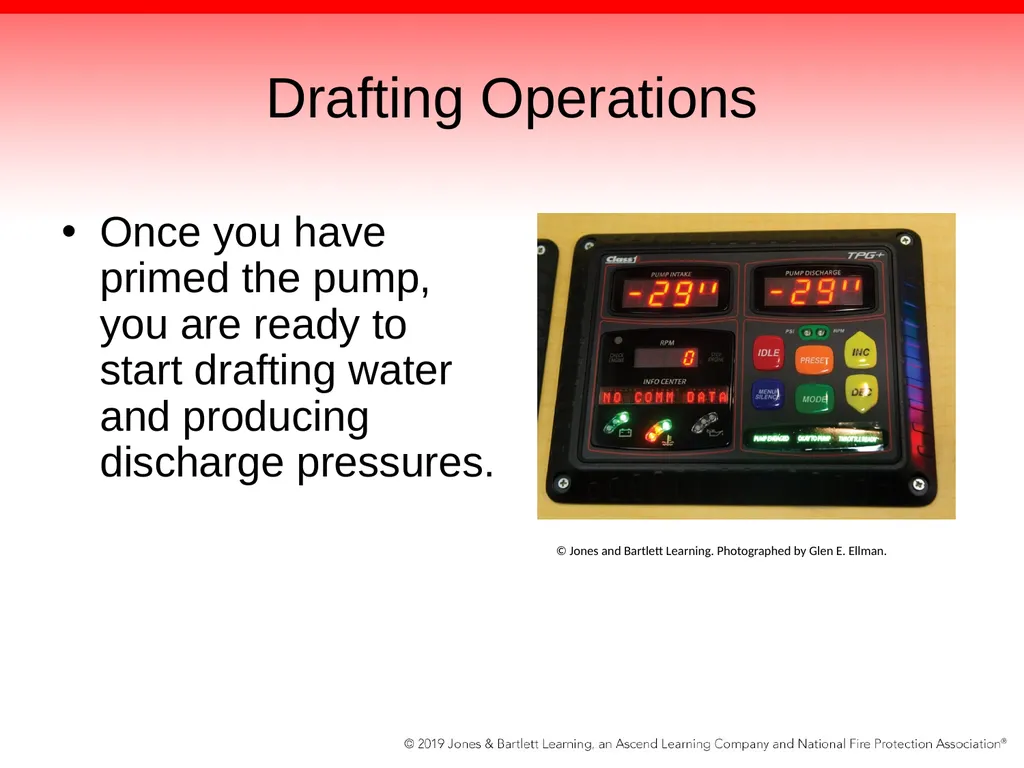
Drafting Operations Once you have primed the pump, you are ready to start drafting water and producing discharge pressures. © Jones and Bartlett Learning. Photographed by Glen E. Ellman.<br>
47
Drafting Operations First establish a dump line.
Slowly open the corresponding discharge valve for the dump line and begin flowing water.
If you open the valve too fast, you may cause a loss of vacuum and break the draft of the pump.<br>
Slowly open the corresponding discharge valve for the dump line and begin flowing water.
If you open the valve too fast, you may cause a loss of vacuum and break the draft of the pump.<br>
48
Drafting Operations Water from the dump line should be discharged back into the water source, away from the strainer.
Avoid introducing air into the hard suction hose
An inflow of air may lead to loss of the vacuum and end the pump’s draft.
If you cannot discharge the dump line back into the water source, you will have to discharge the water onto the ground.
Always follow SOPs/SOGs.<br>
Avoid introducing air into the hard suction hose
An inflow of air may lead to loss of the vacuum and end the pump’s draft.
If you cannot discharge the dump line back into the water source, you will have to discharge the water onto the ground.
Always follow SOPs/SOGs.<br>
49
Drafting Operations Once a sustained stream of water flows through the dump line, you can begin to attach the hoselines you will be supplying.
Operation will go faster if other crew members make these connections while you are establishing the draft and dump line
Once water is flowing from the dump line and the lines being supplied are attached, you are ready to increase the amount of water that will flow.<br>
Operation will go faster if other crew members make these connections while you are establishing the draft and dump line
Once water is flowing from the dump line and the lines being supplied are attached, you are ready to increase the amount of water that will flow.<br>
50
Producing the Flow of Water Whether you are supplying attack lines or water for the fire attack pumper, make sure the crews know that you are ready before you open the discharge valve.
Notification can be made over the radio, through face-to-face contact with the crew, or through hand signals as established by your department’s SOPs.<br>
Notification can be made over the radio, through face-to-face contact with the crew, or through hand signals as established by your department’s SOPs.<br>
51
Producing the Flow of Water Slowly open the discharge valve for the hoseline and begin flowing water.
If you open the hoseline too fast, you may cause a loss of vacuum and end the pump’s draft.
Flow of water into the pump is usually slower than the discharge flow because it takes more energy to create a vacuum.
Continue to increase the throttle until you have reached the desired discharge pressure.<br>
If you open the hoseline too fast, you may cause a loss of vacuum and end the pump’s draft.
Flow of water into the pump is usually slower than the discharge flow because it takes more energy to create a vacuum.
Continue to increase the throttle until you have reached the desired discharge pressure.<br>
52
Producing the Flow of Water Once the draft has been accomplished, do not drop the draft until the operation is completed and either the water supply officer or the IC gives the order to do so.
Establishing a drafting operation takes time.
The incident should not be left without a water supply unless directed through the incident command structure.<br>
Establishing a drafting operation takes time.
The incident should not be left without a water supply unless directed through the incident command structure.<br>
53
Complications During Drafting Operations You must be able to recognize some of the common problems that you may encounter while attempting to draft or during the operation itself.
As a driver/operator, it’s your responsibility to know what the problem is and how to correct it.<br>
As a driver/operator, it’s your responsibility to know what the problem is and how to correct it.<br>
54
Complications During Drafting Operations The driver/operator must continuously observe the intake pressure while drafting.
If you see any drop in this pressure, check the strainer for debris.
If you are flowing large volumes of water, you will be drafting large volumes of water from the water source, which may draw debris from areas that you did not initially see.<br>
If you see any drop in this pressure, check the strainer for debris.
If you are flowing large volumes of water, you will be drafting large volumes of water from the water source, which may draw debris from areas that you did not initially see.<br>
55
Complications During Drafting Operations Continuously observe the engine and pump temperature gauges.
Sometimes not enough water will flow to keep them cool.
If you are supplying a dump line while you wait to fill a tender shuttle operation, your flow will be less than 100 gpm.
Open and close the cooling lines as recommended by the manufacturer to prevent engine or pump overheating condition.<br>
Sometimes not enough water will flow to keep them cool.
If you are supplying a dump line while you wait to fill a tender shuttle operation, your flow will be less than 100 gpm.
Open and close the cooling lines as recommended by the manufacturer to prevent engine or pump overheating condition.<br>
56
Complications During Drafting Operations If not enough water covers the strainer or if the draft is strong as a result of flowing large volumes of water, a whirlpool may form as a vacuum draws in water.
Whirlpool allows the pump to suck in air, which can break the vacuum and cause a loss of water supply.
To avoid this problem, place an inflatable ball into the whirlpool.<br>
Whirlpool allows the pump to suck in air, which can break the vacuum and cause a loss of water supply.
To avoid this problem, place an inflatable ball into the whirlpool.<br>
57
Complications During Drafting Operations Cavitation occurs when you attempt to flow water faster than it is being supplied to the pump.
Usually caused by a vacuum leak, which introduces air into the intake water supply
As the air flows through the pump, it creates small water hammers along its path through to the discharge point.
Correcting the vacuum leak will correct the cavitation problem.<br>
Usually caused by a vacuum leak, which introduces air into the intake water supply
As the air flows through the pump, it creates small water hammers along its path through to the discharge point.
Correcting the vacuum leak will correct the cavitation problem.<br>
58
Complications During Drafting Operations If you suspect cavitation, follow these steps:
Check the water around the intake screen on the hard supply hose.
Check the vacuum reading on the master intake gauge.
If you have a near-normal vacuum reading, check for vacuum leaks by confirming the tightness of all supply hose couplings.
If you have a higher than normal vacuum reading, check the intake screen.<br>
Check the water around the intake screen on the hard supply hose.
Check the vacuum reading on the master intake gauge.
If you have a near-normal vacuum reading, check for vacuum leaks by confirming the tightness of all supply hose couplings.
If you have a higher than normal vacuum reading, check the intake screen.<br>
59
Complications During Drafting Operations Failure of the pump to prime is one of the most common problems during drafting operations.
Many times the cause of this problem is driver/operator error.
Make sure you are not the cause of the problem by double-checking the steps required for priming a pump.
The fire pump on your fire apparatus should prime in 30 seconds or less in most cases.<br>
Many times the cause of this problem is driver/operator error.
Make sure you are not the cause of the problem by double-checking the steps required for priming a pump.
The fire pump on your fire apparatus should prime in 30 seconds or less in most cases.<br>
60
Complications During Drafting Operations Perform these diagnostic steps if unable to prime the pump:
Note the vacuum reading on the master intake gauge after holding the primer valve fully open for 20 to 30 seconds.
If the vacuum reading is less than 12–15 inches Hg, recheck all valves on the pump control panel to verify that they are in the closed position.
If the vacuum reading is greater than 12–15 inches Hg, make sure the intake screen is clean and you are not attempting to lift water too high.<br>
Note the vacuum reading on the master intake gauge after holding the primer valve fully open for 20 to 30 seconds.
If the vacuum reading is less than 12–15 inches Hg, recheck all valves on the pump control panel to verify that they are in the closed position.
If the vacuum reading is greater than 12–15 inches Hg, make sure the intake screen is clean and you are not attempting to lift water too high.<br>
61
Uninterrupted Water Supply In areas where municipal or static water supplies are not available close to the incident, IC must establish a plan to obtain an uninterrupted water supply.
Could be through a relay pumping operation, a tender shuttle, or a nurse tender operation
Labor and equipment intensive
Appointing a water supply officer to oversee them will ease the burden on the IC<br>
Could be through a relay pumping operation, a tender shuttle, or a nurse tender operation
Labor and equipment intensive
Appointing a water supply officer to oversee them will ease the burden on the IC<br>
62
Water Shuttle In many rural and remote areas, water must be carried to the fire scene in an operation called a water shuttle.
Specialized vehicle called a tanker or tender
A water shuttle does not just consist of the tenders, but also includes fill sites and dump sites.<br>
Specialized vehicle called a tanker or tender
A water shuttle does not just consist of the tenders, but also includes fill sites and dump sites.<br>
63
Fill Sites Any location at which a tender can be filled, such as a hydrant, a pond, a lake, or a river
Not always readily available
Can often be located great distances from the incident and beyond the limits for a practical relay operation<br>
Not always readily available
Can often be located great distances from the incident and beyond the limits for a practical relay operation<br>
64
Fill Sites Fill site with a static water source has same characteristics and hazards as the locations used for a drafting operation.
Only difference between a fill site and a static water source for drafting is the distance from the incident.
Fill sites utilizing a hydrant are often the most reliable due to their unobstructed access and the quantity and quality of the water that they offer.<br>
Only difference between a fill site and a static water source for drafting is the distance from the incident.
Fill sites utilizing a hydrant are often the most reliable due to their unobstructed access and the quantity and quality of the water that they offer.<br>
65
Establish a Fill Site Using a Hydrant Find a suitable hydrant that has a flow pressure of at least 50 psi (350 kPa).
Pressure will allow the tender to be filled quickly and without the help of a pumper.
There are only a couple of ways that you can use a hydrant as a fill site.
Regardless of which approach you use, you must flush the hydrant until the water runs clear before connecting any hoselines.<br>
Pressure will allow the tender to be filled quickly and without the help of a pumper.
There are only a couple of ways that you can use a hydrant as a fill site.
Regardless of which approach you use, you must flush the hydrant until the water runs clear before connecting any hoselines.<br>
66
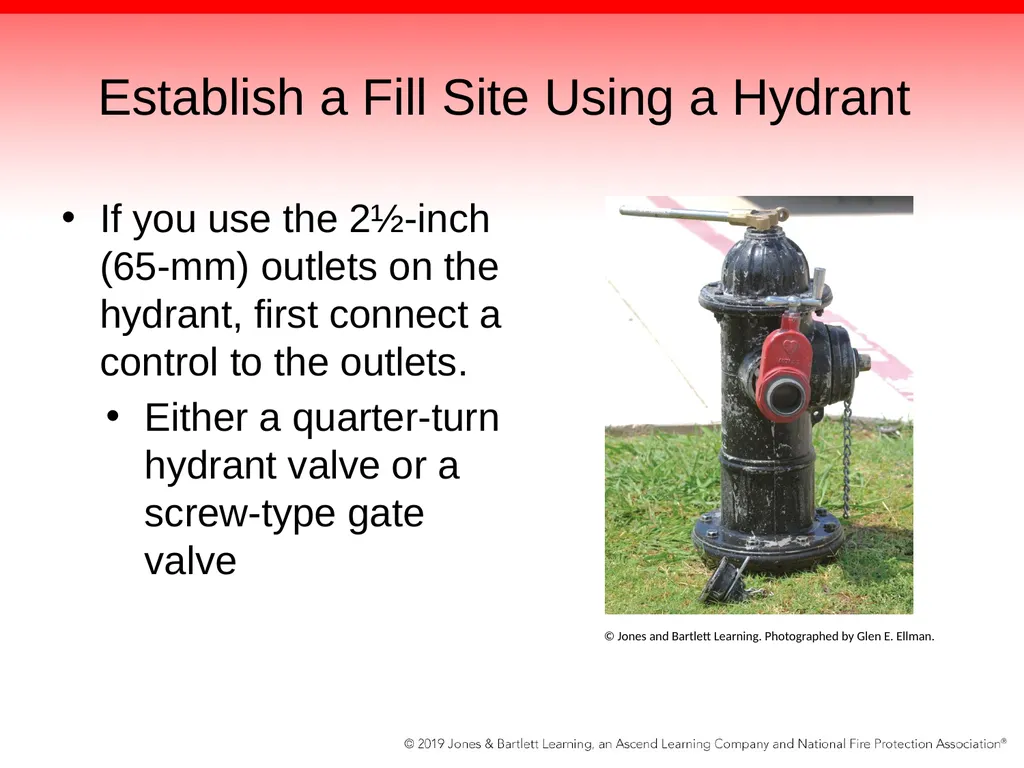
Establish a Fill Site Using a Hydrant If you use the 2½-inch (65-mm) outlets on the hydrant, first connect a control to the outlets.
Either a quarter-turn hydrant valve or a screw-type gate valve © Jones and Bartlett Learning. Photographed by Glen E. Ellman.<br>
Either a quarter-turn hydrant valve or a screw-type gate valve © Jones and Bartlett Learning. Photographed by Glen E. Ellman.<br>
67
Establish a Fill Site Using a Hydrant Using a control valve on each outlet allows you to supply two tenders simultaneously without having to shut down the hydrant between operations.
Large-diameter hose (LDH) can also be used at a fill site from a hydrant.<br>
Large-diameter hose (LDH) can also be used at a fill site from a hydrant.<br>
68
Establish a Fill Site Using a Hydrant If possible, leave a fire fighter (or two) at the hydrant fill site to fill incoming tenders and to monitor the site.
If fire personnel cannot be spared, leave the hose next to the hydrant for the next incoming tender to speed up the operation.
Call for the police to monitor the site because of unattended equipment.<br>
If fire personnel cannot be spared, leave the hose next to the hydrant for the next incoming tender to speed up the operation.
Call for the police to monitor the site because of unattended equipment.<br>
69
Establishing a Fill Site at a Static Water Source Establishing a fill site from a static water source entails following the same procedures discussed earlier in this chapter.
The benefit of establishing a fill site at a static water source is that the pumper drafting the water can supply the tenders being filled at a remote location that is better suited for tender movement.<br>
The benefit of establishing a fill site at a static water source is that the pumper drafting the water can supply the tenders being filled at a remote location that is better suited for tender movement.<br>
70
Fill Sites in Inaccessible Areas If unable to get a pumper close to the static water source, you may have to consider using portable pumps.
Establishing a suitable drafting site for a portable pump requires 24 inches (0.5 m) of water in all directions around the strainer and enough hose to get the water to the fill site.<br>
Establishing a suitable drafting site for a portable pump requires 24 inches (0.5 m) of water in all directions around the strainer and enough hose to get the water to the fill site.<br>
71
Fill Sites in Inaccessible Areas Ensure the quantity of water available is large enough to support drafting with a portable pump.
If not deep enough, use floating strainer for portable pump hard suction hose
Once you have the area ready for the portable pump to start drafting, connect the hard-sided suction lines to the pump, and place a strainer on the intake end of the hose.<br>
If not deep enough, use floating strainer for portable pump hard suction hose
Once you have the area ready for the portable pump to start drafting, connect the hard-sided suction lines to the pump, and place a strainer on the intake end of the hose.<br>
72
Fill Sites in Inaccessible Areas Portable floating pumps have become a very popular option for obtaining water in inaccessible areas in recent years.
Once in the water, portable floating pumps are difficult to turn on and off and reposition.
Make sure they are ready for a long-duration operation before launching them.<br>
Once in the water, portable floating pumps are difficult to turn on and off and reposition.
Make sure they are ready for a long-duration operation before launching them.<br>
73
Fill Sites in Inaccessible Areas Whether using a floating or stationary portable pump, monitor the pump to ensure it is functioning properly and flowing water.
When an inaccessible area will serve as a fill site, the use of some type of portable pump that discharges the water into a portable tank is effective in obtaining a water supply.<br>
When an inaccessible area will serve as a fill site, the use of some type of portable pump that discharges the water into a portable tank is effective in obtaining a water supply.<br>
74
Filling Tenders When filling tenders, fill only one at a time when you are using medium-size hoselines.
Having two hoselines ready with control valves and personnel at the ends ready to connect to the tenders will increase the speed of the operation and reduce turnaround times for the operation.
Once the tank is completely full on the tender, close the control point valve before closing the tank fill valve on the tender.<br>
Having two hoselines ready with control valves and personnel at the ends ready to connect to the tenders will increase the speed of the operation and reduce turnaround times for the operation.
Once the tank is completely full on the tender, close the control point valve before closing the tank fill valve on the tender.<br>
75
Safety for Water Shuttle Operations Water shuttle operations present the same risks that are encountered in relay pumping operations.
Steps that can be taken to improve incident safety include:
Preplanning locations for obtaining the water
Being trained in the use and operation of the equipment
Knowing which equipment you have to use<br>
Steps that can be taken to improve incident safety include:
Preplanning locations for obtaining the water
Being trained in the use and operation of the equipment
Knowing which equipment you have to use<br>
76
Safety for Water Shuttle Operations Personnel operating at the fill sites will need to wear the same level of PPE as is worn during a relay operation.
Water shuttle operation involves moving tenders full of water from the fill site to the dump site, with the empty tenders then returning to the fill site.<br>
Water shuttle operation involves moving tenders full of water from the fill site to the dump site, with the empty tenders then returning to the fill site.<br>
77
Safety for Water Shuttle Operations Tenders are specialized types of fire apparatus that carry several hundred or several thousand gallons of water, which can weigh more than 80,000 pounds.
Most personnel are not familiar with the handling characteristics of tenders and do not make adjustments to their driving habits when at the wheel of these apparatus.<br>
Most personnel are not familiar with the handling characteristics of tenders and do not make adjustments to their driving habits when at the wheel of these apparatus.<br>
78
Safety for Water Shuttle Operations Extreme caution must be emphasized while driving tenders, because they do not handle in the same manner as a standard pumper.
The ability to maneuver is greatly reduced due to their size and weight.
Driver/operators should be well trained in driving these vehicles both full and empty.
At no time should these vehicles be operated beyond the posted speed limit.<br>
The ability to maneuver is greatly reduced due to their size and weight.
Driver/operators should be well trained in driving these vehicles both full and empty.
At no time should these vehicles be operated beyond the posted speed limit.<br>
79
Establishing Dump Site Operations Location at which the shuttled water will be offloaded is called a dump site.
Establishing the dump site location takes practice and forethought.
Ideal dump site location is close enough that the source pumper can supply the attack pumper(s) without a relay pumper, but not so close that the tenders cannot access it.<br>
Establishing the dump site location takes practice and forethought.
Ideal dump site location is close enough that the source pumper can supply the attack pumper(s) without a relay pumper, but not so close that the tenders cannot access it.<br>
80
Using Portable Tanks Usually carried on tenders
Should hold as much water as the capacity of the tender will allow
Place a salvage cover or tarp on the ground in the area where the tank will be positioned to prevent any damage to the tank by rocks, sticks, or glass that may be present on the ground.
The tank is initially filled by a tender before it enters the water shuttle operation.<br>
Should hold as much water as the capacity of the tender will allow
Place a salvage cover or tarp on the ground in the area where the tank will be positioned to prevent any damage to the tank by rocks, sticks, or glass that may be present on the ground.
The tank is initially filled by a tender before it enters the water shuttle operation.<br>
81
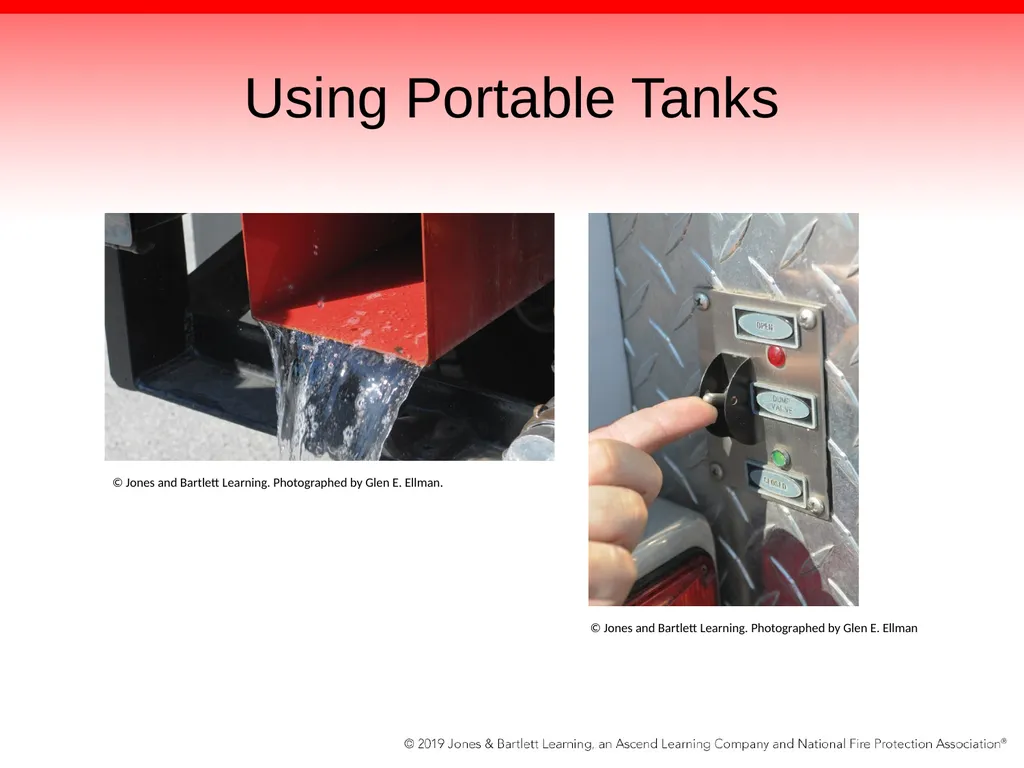
Using Portable Tanks Tender offloads the water through a dump valve on the tank.
Dump valve is a large opening connected directly to the tank that allows it to be emptied quickly
If multiple portable tanks are being used, once the first tender has emptied its tank and moves out of the way, the next tender can get into position to repeat the steps until all of the portable tanks are full.<br>
Dump valve is a large opening connected directly to the tank that allows it to be emptied quickly
If multiple portable tanks are being used, once the first tender has emptied its tank and moves out of the way, the next tender can get into position to repeat the steps until all of the portable tanks are full.<br>
82
Using Portable Tanks © Jones and Bartlett Learning. Photographed by Glen E. Ellman. © Jones and Bartlett Learning. Photographed by Glen E. Ellman<br>
83
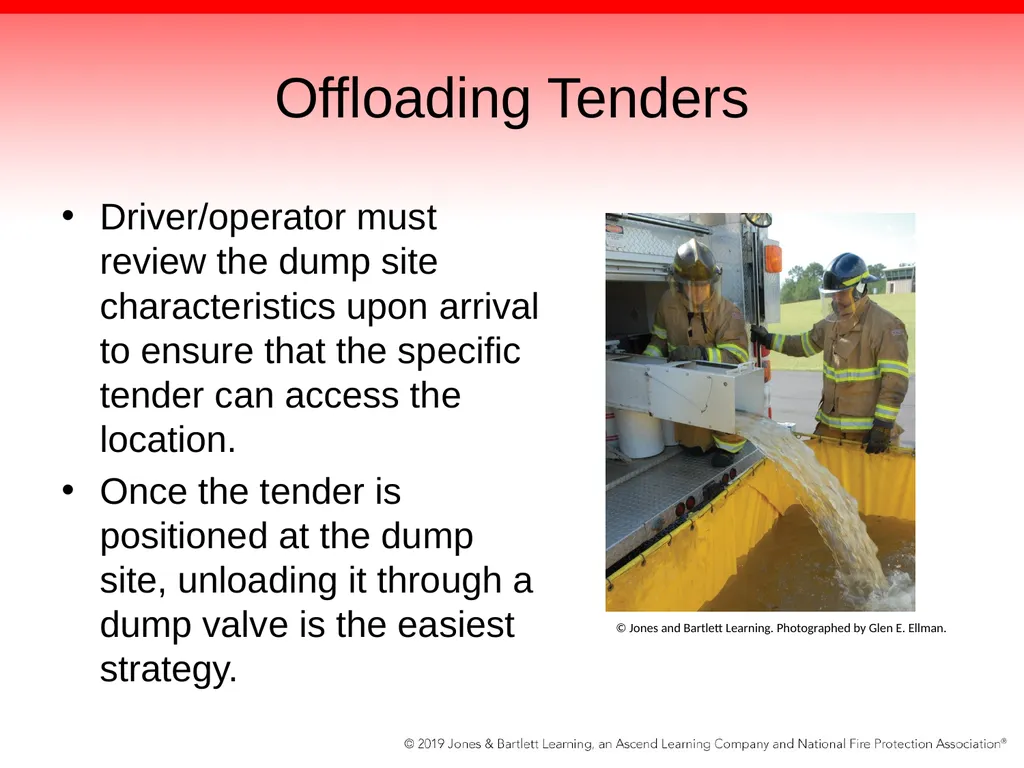
Offloading Tenders Driver/operator must review the dump site characteristics upon arrival to ensure that the specific tender can access the location.
Once the tender is positioned at the dump site, unloading it through a dump valve is the easiest strategy. © Jones and Bartlett Learning. Photographed by Glen E. Ellman.<br>
Once the tender is positioned at the dump site, unloading it through a dump valve is the easiest strategy. © Jones and Bartlett Learning. Photographed by Glen E. Ellman.<br>
84
Offloading Tenders Another method of offloading a tender when large dump valves are not installed on the apparatus is to attach medium-size lines to the pump of the tender and place the other end of the lines into the portable tank.
Driver/operator of the tender should pump water through these hoselines at a maximum pressure of 50 psi (350 kPa).<br>
Driver/operator of the tender should pump water through these hoselines at a maximum pressure of 50 psi (350 kPa).<br>
85
Use of Multiple Portable Tanks Tanks are positioned starting at the high point of the ground and then going down slope.
Main objective is to keep the water moving toward the tank.
If there is no slope, hook the tanks together using the rings on the drains if they are so equipped.
Many tanks are equipped with two “drains” so that they can be hooked together.<br>
Main objective is to keep the water moving toward the tank.
If there is no slope, hook the tanks together using the rings on the drains if they are so equipped.
Many tanks are equipped with two “drains” so that they can be hooked together.<br>
86
Use of Multiple Portable Tanks Jet siphon adapters use the hard suction hose as a pathway for flowing water that is being forced through the hose by Venturi forces.
Do not use the dump line to supply the jet siphon, as it may not always be in operation and the dump line must constantly flow water.<br>
Do not use the dump line to supply the jet siphon, as it may not always be in operation and the dump line must constantly flow water.<br>
87
Source Pumper Considerations for Portable Tank Operations Main objective in moving water from one tank to another when using multiple tanks is to keep the main portable tank full.
After source pumper has established a draft from the static water supply, all efforts should be taken to prevent air from being introduced into the pump.
The main tank should not run low on water during the operation if the tender shuttle is working as designed.<br>
After source pumper has established a draft from the static water supply, all efforts should be taken to prevent air from being introduced into the pump.
The main tank should not run low on water during the operation if the tender shuttle is working as designed.<br>
88
Traffic Flow Within a Dump Site Consideration must be given to how the tenders will offload their contents:
Will two tenders offload their water at the same time?
How will they approach the portable tanks to dump the water?
In which direction will the tenders depart the dump site to return to the fill site?<br>
Will two tenders offload their water at the same time?
How will they approach the portable tanks to dump the water?
In which direction will the tenders depart the dump site to return to the fill site?<br>
89
Traffic Flow Within a Dump Site Most modern tenders have the ability to offload from the sides and the rear of the vehicle.
The portable tanks should be placed in as open an area as possible so you can easily maneuver around the site.
All tenders should travel the same path to enter and then exit the dump site.<br>
The portable tanks should be placed in as open an area as possible so you can easily maneuver around the site.
All tenders should travel the same path to enter and then exit the dump site.<br>
90
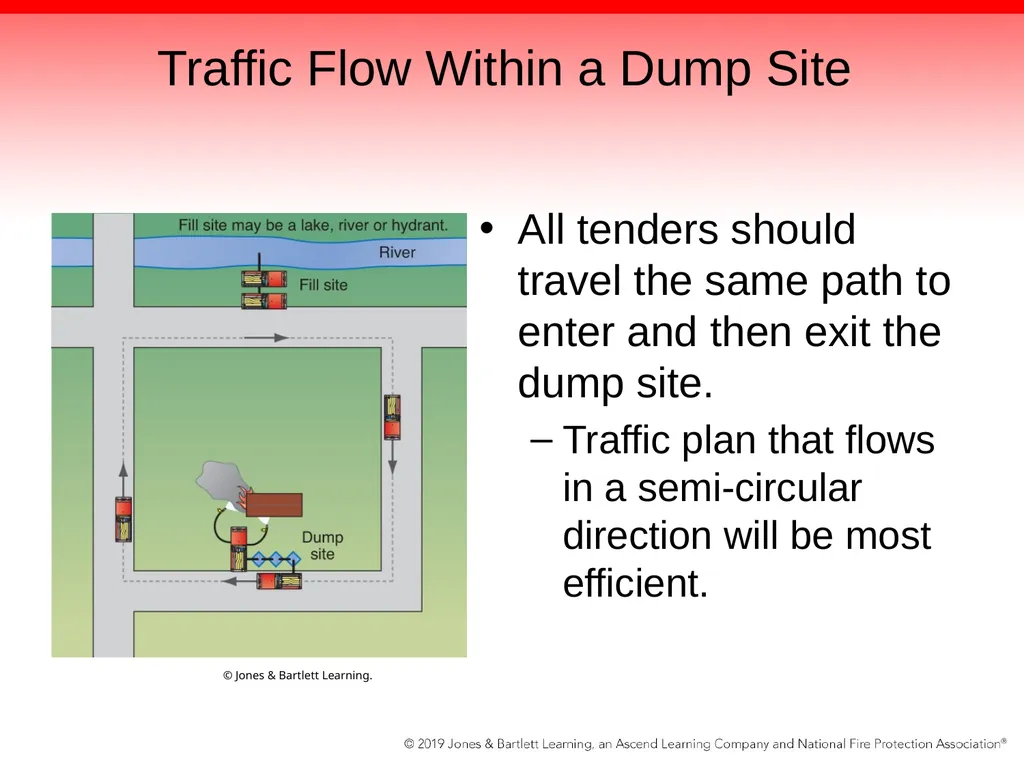
Traffic Flow Within a Dump Site All tenders should travel the same path to enter and then exit the dump site.
Traffic plan that flows in a semi-circular direction will be most efficient. © Jones & Bartlett Learning.<br>
Traffic plan that flows in a semi-circular direction will be most efficient. © Jones & Bartlett Learning.<br>
91
Nurse Tender Operations Offloading a tender into another tender or into a pumper as a form of a water source
Eliminates the use of portable tanks, as the attack pumper is supplied directly by the nurse tender
Operation is set up when there is no room to establish a dump site, a relay operation, or a combination of the two.<br>
Eliminates the use of portable tanks, as the attack pumper is supplied directly by the nurse tender
Operation is set up when there is no room to establish a dump site, a relay operation, or a combination of the two.<br>
92
Nurse Tender Operations Can be used when the size of the fire is small enough that establishing a detailed supportive water supply mechanism is not practical
Can be performed at the start of an incident as a way to provide water to the attack pumper while the relay or fill-and-dump operation is being established<br>
Can be performed at the start of an incident as a way to provide water to the attack pumper while the relay or fill-and-dump operation is being established<br>
93
Nurse Tender Operations Ideal nurse tender is the largest tender that is available.
Tractor-trailer tenders, which can carry as much as 6000 gal (24,000 L) of water, are very good choices.
Most tractor-trailer tenders have a small pump located on the trailer to assist with offloading.<br>
Tractor-trailer tenders, which can carry as much as 6000 gal (24,000 L) of water, are very good choices.
Most tractor-trailer tenders have a small pump located on the trailer to assist with offloading.<br>
94
Nurse Tender Operations Other tenders can supply, via nursing, this new “source.”
Can also be supplied by the source pumper at a dump site that was established farther away
When you are filling a nurse tender, do not fill it too fast.
You want to avoid or limit the introduction of air into the water<br>
Can also be supplied by the source pumper at a dump site that was established farther away
When you are filling a nurse tender, do not fill it too fast.
You want to avoid or limit the introduction of air into the water<br>
95
Communications for Tender Operations Communication is a vital part of the water supply and tender shuttle operations.
Water supply officer should request from the IC that all tender operators be assigned to a tactical channel.
Staying in touch via effective communication is also a way of maintaining accountability for each tender and its personnel.<br>
Water supply officer should request from the IC that all tender operators be assigned to a tactical channel.
Staying in touch via effective communication is also a way of maintaining accountability for each tender and its personnel.<br>
96
Water Shuttle Operations in the Incident Management System Water supply officers should be given a top priority at any scene.
If this position is not officially assigned, the IC assumes the responsibility.
Once a water shuttle operation is established, a water supply officer should be established as part of the IMS.
May also include dump site officer and fill site officer<br>
If this position is not officially assigned, the IC assumes the responsibility.
Once a water shuttle operation is established, a water supply officer should be established as part of the IMS.
May also include dump site officer and fill site officer<br>
97
Water Shuttle Operations in the Incident Management System Dump site officer is responsible for:
Establishing the dump site
Creating the traffic patterns
Ensuring that the source pumper at the site has a sustained water supply<br>
Establishing the dump site
Creating the traffic patterns
Ensuring that the source pumper at the site has a sustained water supply<br>
98
Water Shuttle Operations in the Incident Management System If incident is complex and includes multiple dump sites, several officers may be collectively responsible for all of them.
Officers will need to communicate with each dump site to ensure water is routed appropriately.<br>
Officers will need to communicate with each dump site to ensure water is routed appropriately.<br>
99
Water Shuttle Operations in the Incident Management System Fill site officer is responsible for:
Establishing the fill site location(s)
Ensuring that the water source for filling the tenders will meet the demand
Creating the traffic patterns in and out of the fill site<br>
Establishing the fill site location(s)
Ensuring that the water source for filling the tenders will meet the demand
Creating the traffic patterns in and out of the fill site<br>
100
Water Shuttle Operations in the Incident Management System Filling two tenders at a time requires a strong water source such as a pumper at draft or a hydrant with a LDH manifold.
If these options are not available and the fill operation is the cause of slower dumping cycles, fill site officers may consider establishing multiple fill sites.
This will require same level of communication as between multiple dump sites.<br>
If these options are not available and the fill operation is the cause of slower dumping cycles, fill site officers may consider establishing multiple fill sites.
This will require same level of communication as between multiple dump sites.<br>
101
Summary The ability to draft water from a static source makes your fire apparatus a versatile resource.
Fire departments generally have a prescribed process for performing inspections, routine maintenance, and operational testing of water supply apparatus and the equipment those apparatus carry.
Water supply management is a vital part of any fire incident and can become a major part of the IMS in the event that a reliable water system is not available.<br>
Fire departments generally have a prescribed process for performing inspections, routine maintenance, and operational testing of water supply apparatus and the equipment those apparatus carry.
Water supply management is a vital part of any fire incident and can become a major part of the IMS in the event that a reliable water system is not available.<br>
102
Summary The water supply officer takes responsibility for drafting operations, relay pumping, water shuttles, and nurse tender operations.
Once the driver/operator has found a suitable location with an adequate water source that is close enough to reach, it is time to set up your pump to draft. This task requires teamwork, and the driver/operator should be assisted by two or more fire fighters.<br>
Once the driver/operator has found a suitable location with an adequate water source that is close enough to reach, it is time to set up your pump to draft. This task requires teamwork, and the driver/operator should be assisted by two or more fire fighters.<br>
103
Summary The first step in preparing to draft from a water source is to prime the pump.
Once the suction hose has been connected and placed into the water source, air is drawn from the pump using the priming pump.
Once the pump is primed, you are ready to start drafting water and producing discharge pressures.<br>
Once the suction hose has been connected and placed into the water source, air is drawn from the pump using the priming pump.
Once the pump is primed, you are ready to start drafting water and producing discharge pressures.<br>
104
Summary Whether you are supplying attack lines or supplying water for the fire attack pumper, make sure the crews know that you are ready to start flowing water before you open the discharge valve.
Radio
Face-to-face contact
Hand signals
Slowly open the corresponding discharge valve for the hoseline and begin flowing water.<br>
Radio
Face-to-face contact
Hand signals
Slowly open the corresponding discharge valve for the hoseline and begin flowing water.<br>
105
Summary Establishing an uninterrupted water supply is one of the most important objectives for any incident commander.
In many rural and remote areas of a jurisdiction, water must be carried to the fire scene in an operation called a water shuttle, utilizing a specialized vehicle called a tender.<br>
In many rural and remote areas of a jurisdiction, water must be carried to the fire scene in an operation called a water shuttle, utilizing a specialized vehicle called a tender.<br>
106
Summary Establishing the dump site location takes practice and forethought.
The location at which the shuttled water will be offloaded is called a dump site.
In a nurse tender operation, a tender is offloaded into another tender or into a pumper that serves as a water source for on-scene operations.
Obtaining a sustainable water supply is a vital aspect of any fire incident scene.<br>
The location at which the shuttled water will be offloaded is called a dump site.
In a nurse tender operation, a tender is offloaded into another tender or into a pumper that serves as a water source for on-scene operations.
Obtaining a sustainable water supply is a vital aspect of any fire incident scene.<br>