
Chapter 12: Project Procurement Management Note:
MY
Published · 41 slides · 0 views
1 / 1




Description
Chapter 12: Project Procurement Management Note: See the text itself for full citations. Information Technology Project Management, Seventh Edition Understand the importance of project procurement management and the increasing use of
Related Topics
Share
Embed code
Download this presentation From Below
"Chapter 12: Project Procurement Management Note:" is the property of its rightful owner. Permission is granted to download and print the materials on this website for personal, non-commercial use only, and to display it on your personal computer provided you do not modify the materials and that you retain all copyright notices contained in the materials. By downloading content from our website, you accept the terms of this agreement.
Presentation Transcript
01
Chapter 12:
Project Procurement Management Note: See the text itself for full citations. Information Technology Project Management, Seventh Edition<br>
02
Understand the importance of project procurement management and the increasing use of outsourcing for information technology (IT) projects
Describe the work involved in planning procurements for projects, including determining the proper type of contract to use and preparing a procurement management plan, statement of work, source selection criteria, and make-or-buy analysis
Discuss how to conduct procurements and strategies for obtaining seller responses, selecting sellers, and awarding contracts Learning Objectives Information Technology Project Management, Seventh Edition 2<br>
Describe the work involved in planning procurements for projects, including determining the proper type of contract to use and preparing a procurement management plan, statement of work, source selection criteria, and make-or-buy analysis
Discuss how to conduct procurements and strategies for obtaining seller responses, selecting sellers, and awarding contracts Learning Objectives Information Technology Project Management, Seventh Edition 2<br>
03
Understand the process of controlling procurements by managing procurement relationships and monitoring contract performance
Describe the process of closing procurements
Discuss types of software that are available to assist in project procurement management Learning Objectives (cont’d) Information Technology Project Management, Seventh Edition 3<br>
Describe the process of closing procurements
Discuss types of software that are available to assist in project procurement management Learning Objectives (cont’d) Information Technology Project Management, Seventh Edition 3<br>
04
Procurement means acquiring goods and/or services from an outside source
Other terms include purchasing and outsourcing
Experts predict that global spending on computer software and services will continue to grow
People continue to debate whether offshore outsourcing helps their own country or not Importance of Project Procurement Management Information Technology Project Management, Seventh Edition 4<br>
Other terms include purchasing and outsourcing
Experts predict that global spending on computer software and services will continue to grow
People continue to debate whether offshore outsourcing helps their own country or not Importance of Project Procurement Management Information Technology Project Management, Seventh Edition 4<br>
05
Some companies, such as Wal-Mart, prefer to do no outsourcing at all, while others do a lot of outsourcing. GM recently announced plans to switch from outsourcing 90% of IT service to only 10%
Most organizations do some form of outsourcing to meet their IT needs and spend most money within their own country
The U.S. temporary workforce continues to grow as people work for temporary job agencies so they can more easily move from company to company Debates on Outsourcing Information Technology Project Management, Seventh Edition 5<br>
Most organizations do some form of outsourcing to meet their IT needs and spend most money within their own country
The U.S. temporary workforce continues to grow as people work for temporary job agencies so they can more easily move from company to company Debates on Outsourcing Information Technology Project Management, Seventh Edition 5<br>
06
U.S. companies are transferring more work abroad, especially in the areas of IT infrastructure, application development and maintenance, and innovation processes
India, China, and the Philippines are the preferred locations for outsourcing, and Latin America is growing in popularity
A shortage of qualified personnel, not cost savings, is the top reason for global outsourcing of IT services IT Outsourcing Market Continues to Grow Information Technology Project Management, Seventh Edition 6<br>
India, China, and the Philippines are the preferred locations for outsourcing, and Latin America is growing in popularity
A shortage of qualified personnel, not cost savings, is the top reason for global outsourcing of IT services IT Outsourcing Market Continues to Grow Information Technology Project Management, Seventh Edition 6<br>
07
To access skills and technologies
To reduce both fixed and recurrent costs
To allow the client organization to focus on its core business
To provide flexibility
To increase accountability Why Outsource? Information Technology Project Management, Seventh Edition 7<br>
To reduce both fixed and recurrent costs
To allow the client organization to focus on its core business
To provide flexibility
To increase accountability Why Outsource? Information Technology Project Management, Seventh Edition 7<br>
08
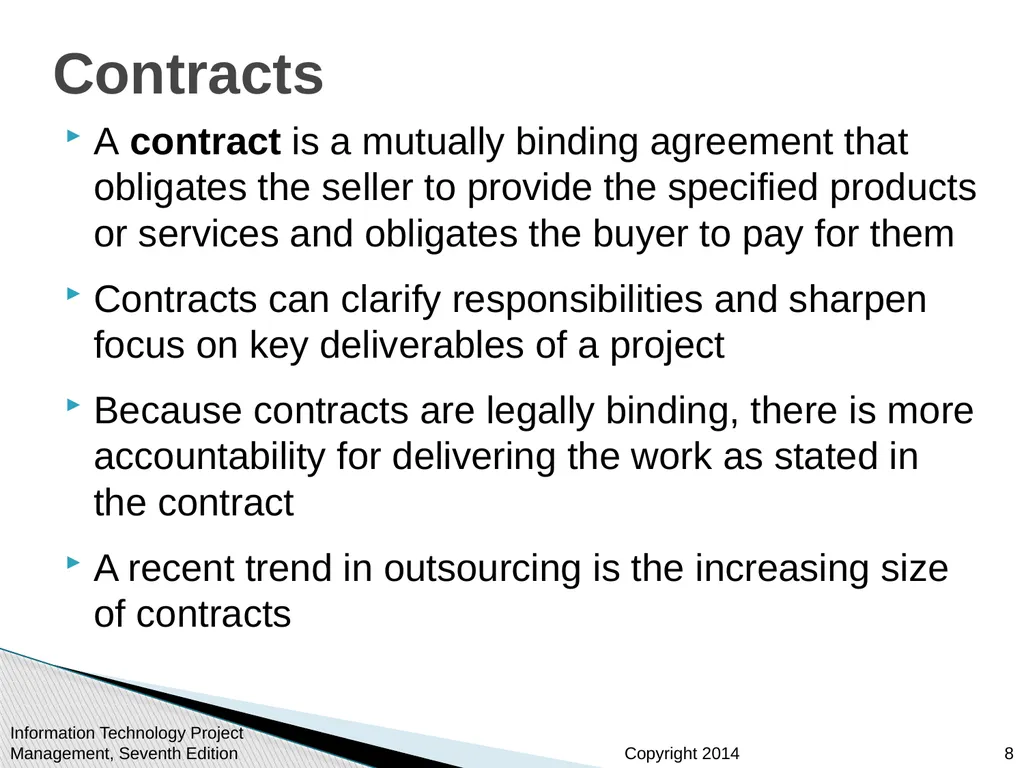
A contract is a mutually binding agreement that obligates the seller to provide the specified products or services and obligates the buyer to pay for them
Contracts can clarify responsibilities and sharpen focus on key deliverables of a project
Because contracts are legally binding, there is more accountability for delivering the work as stated in the contract
A recent trend in outsourcing is the increasing size of contracts Contracts Information Technology Project Management, Seventh Edition 8<br>
Contracts can clarify responsibilities and sharpen focus on key deliverables of a project
Because contracts are legally binding, there is more accountability for delivering the work as stated in the contract
A recent trend in outsourcing is the increasing size of contracts Contracts Information Technology Project Management, Seventh Edition 8<br>
09
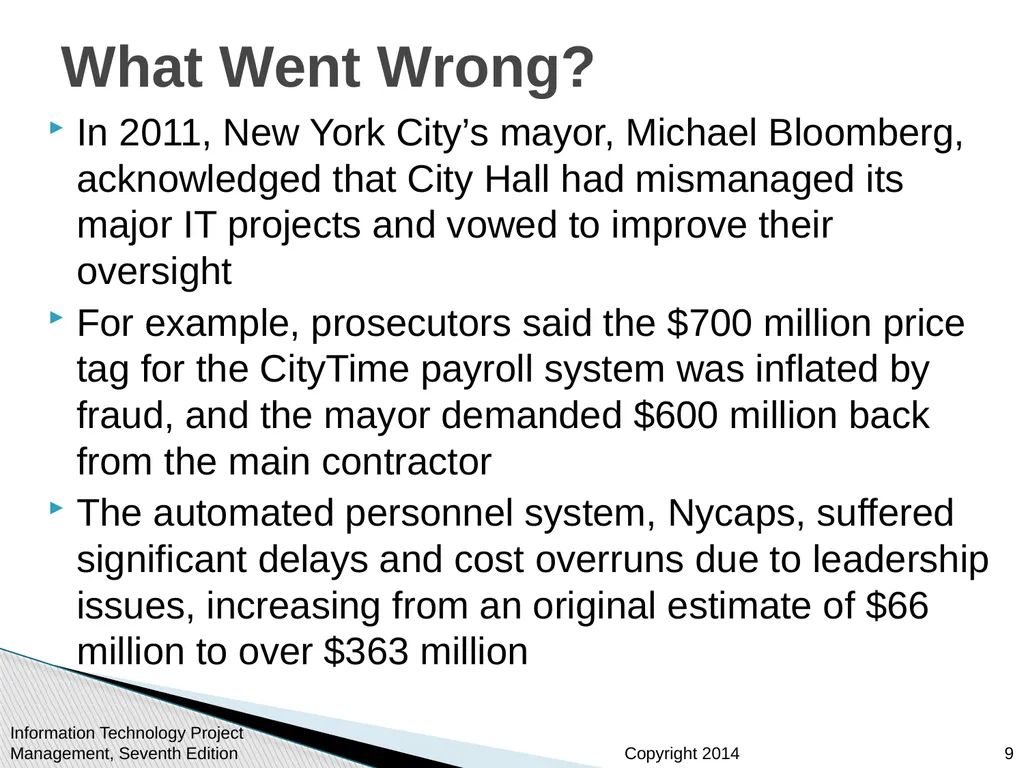
In 2011, New York City’s mayor, Michael Bloomberg, acknowledged that City Hall had mismanaged its major IT projects and vowed to improve their oversight
For example, prosecutors said the $700 million price tag for the CityTime payroll system was inflated by fraud, and the mayor demanded $600 million back from the main contractor
The automated personnel system, Nycaps, suffered significant delays and cost overruns due to leadership issues, increasing from an original estimate of $66 million to over $363 million What Went Wrong? Information Technology Project Management, Seventh Edition 9<br>
For example, prosecutors said the $700 million price tag for the CityTime payroll system was inflated by fraud, and the mayor demanded $600 million back from the main contractor
The automated personnel system, Nycaps, suffered significant delays and cost overruns due to leadership issues, increasing from an original estimate of $66 million to over $363 million What Went Wrong? Information Technology Project Management, Seventh Edition 9<br>
10
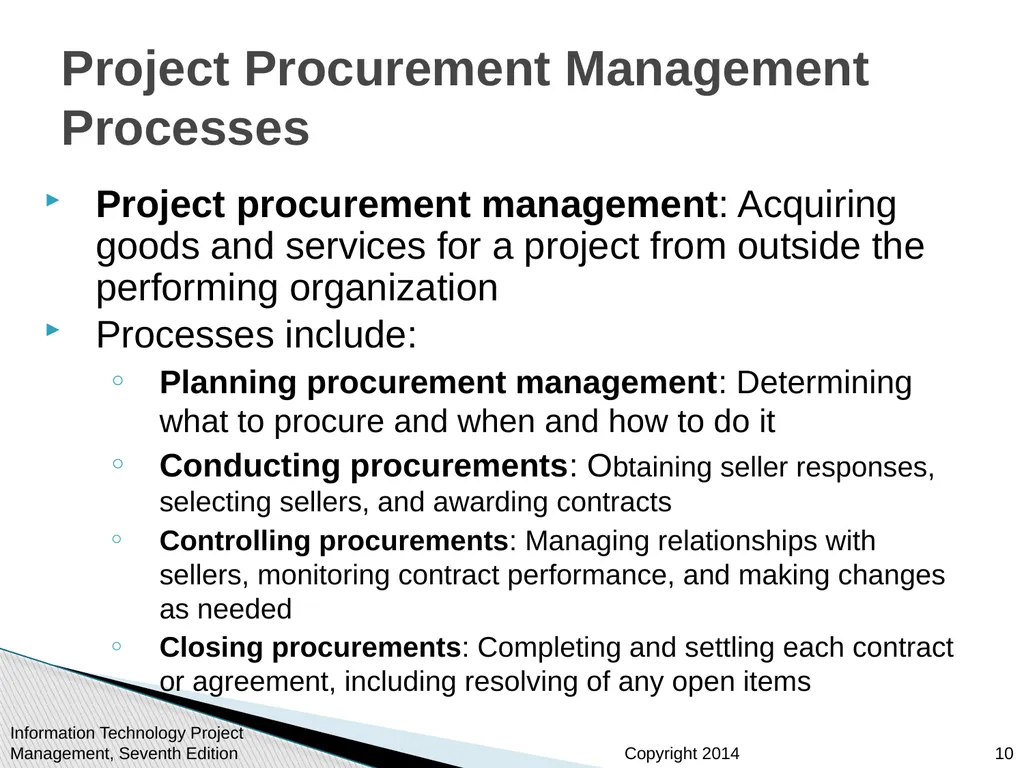
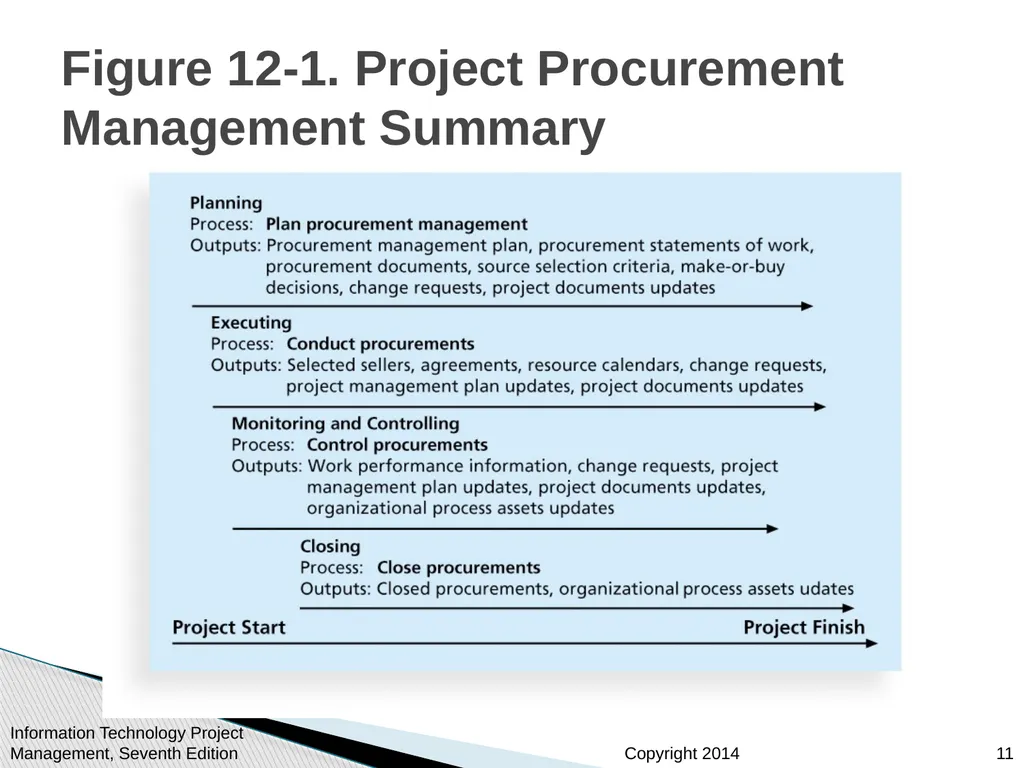
Project procurement management: Acquiring goods and services for a project from outside the performing organization
Processes include:
Planning procurement management: Determining what to procure and when and how to do it
Conducting procurements: Obtaining seller responses, selecting sellers, and awarding contracts
Controlling procurements: Managing relationships with sellers, monitoring contract performance, and making changes as needed
Closing procurements: Completing and settling each contract or agreement, including resolving of any open items Project Procurement Management Processes Information Technology Project Management, Seventh Edition 10<br>
Processes include:
Planning procurement management: Determining what to procure and when and how to do it
Conducting procurements: Obtaining seller responses, selecting sellers, and awarding contracts
Controlling procurements: Managing relationships with sellers, monitoring contract performance, and making changes as needed
Closing procurements: Completing and settling each contract or agreement, including resolving of any open items Project Procurement Management Processes Information Technology Project Management, Seventh Edition 10<br>
11
Figure 12-1. Project Procurement Management Summary Information Technology Project Management, Seventh Edition 11<br>
12
Identifying which project needs can best be met by using products or services outside the organization
If there is no need to buy any products or services from outside the organization, then there is no need to perform any of the other procurement management processes Planning Procurement Management Information Technology Project Management, Seventh Edition 12<br>
If there is no need to buy any products or services from outside the organization, then there is no need to perform any of the other procurement management processes Planning Procurement Management Information Technology Project Management, Seventh Edition 12<br>
13
Several organizations, such as The Boots Company PLC in England, outsource their IT services to save money compared with the cost of running the systems themselves
Carefully planning procurement can also save millions of dollars, as the U.S. Air Force did by using a unit pricing strategy for a large office automation project What Went Right? Information Technology Project Management, Seventh Edition 13<br>
Carefully planning procurement can also save millions of dollars, as the U.S. Air Force did by using a unit pricing strategy for a large office automation project What Went Right? Information Technology Project Management, Seventh Edition 13<br>
14
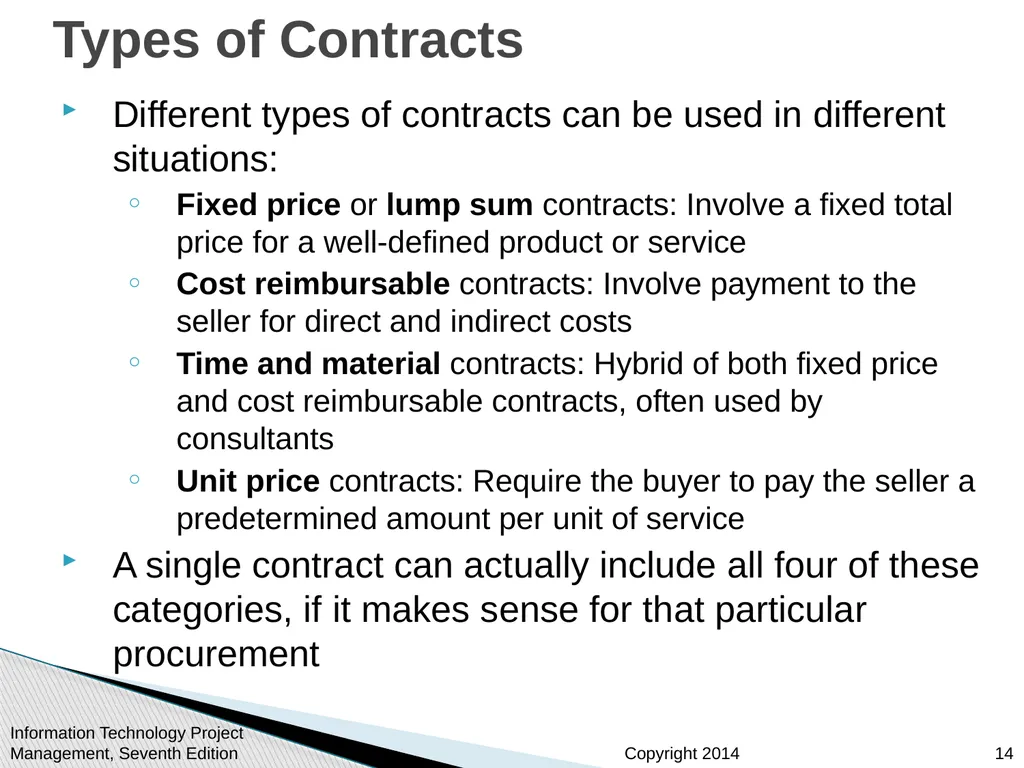
Different types of contracts can be used in different situations:
Fixed price or lump sum contracts: Involve a fixed total price for a well-defined product or service
Cost reimbursable contracts: Involve payment to the seller for direct and indirect costs
Time and material contracts: Hybrid of both fixed price and cost reimbursable contracts, often used by consultants
Unit price contracts: Require the buyer to pay the seller a predetermined amount per unit of service
A single contract can actually include all four of these categories, if it makes sense for that particular procurement Types of Contracts Information Technology Project Management, Seventh Edition 14<br>
Fixed price or lump sum contracts: Involve a fixed total price for a well-defined product or service
Cost reimbursable contracts: Involve payment to the seller for direct and indirect costs
Time and material contracts: Hybrid of both fixed price and cost reimbursable contracts, often used by consultants
Unit price contracts: Require the buyer to pay the seller a predetermined amount per unit of service
A single contract can actually include all four of these categories, if it makes sense for that particular procurement Types of Contracts Information Technology Project Management, Seventh Edition 14<br>
15
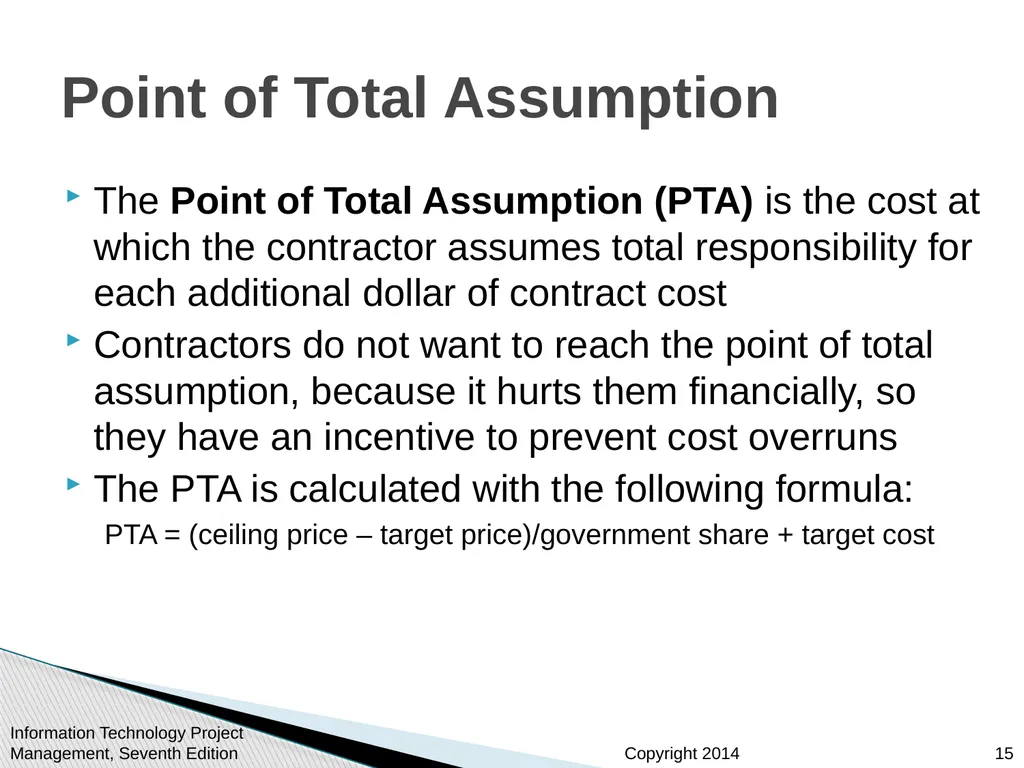
The Point of Total Assumption (PTA) is the cost at which the contractor assumes total responsibility for each additional dollar of contract cost
Contractors do not want to reach the point of total assumption, because it hurts them financially, so they have an incentive to prevent cost overruns
The PTA is calculated with the following formula:
PTA = (ceiling price – target price)/government share + target cost Point of Total Assumption Information Technology Project Management, Seventh Edition 15<br>
Contractors do not want to reach the point of total assumption, because it hurts them financially, so they have an incentive to prevent cost overruns
The PTA is calculated with the following formula:
PTA = (ceiling price – target price)/government share + target cost Point of Total Assumption Information Technology Project Management, Seventh Edition 15<br>
16
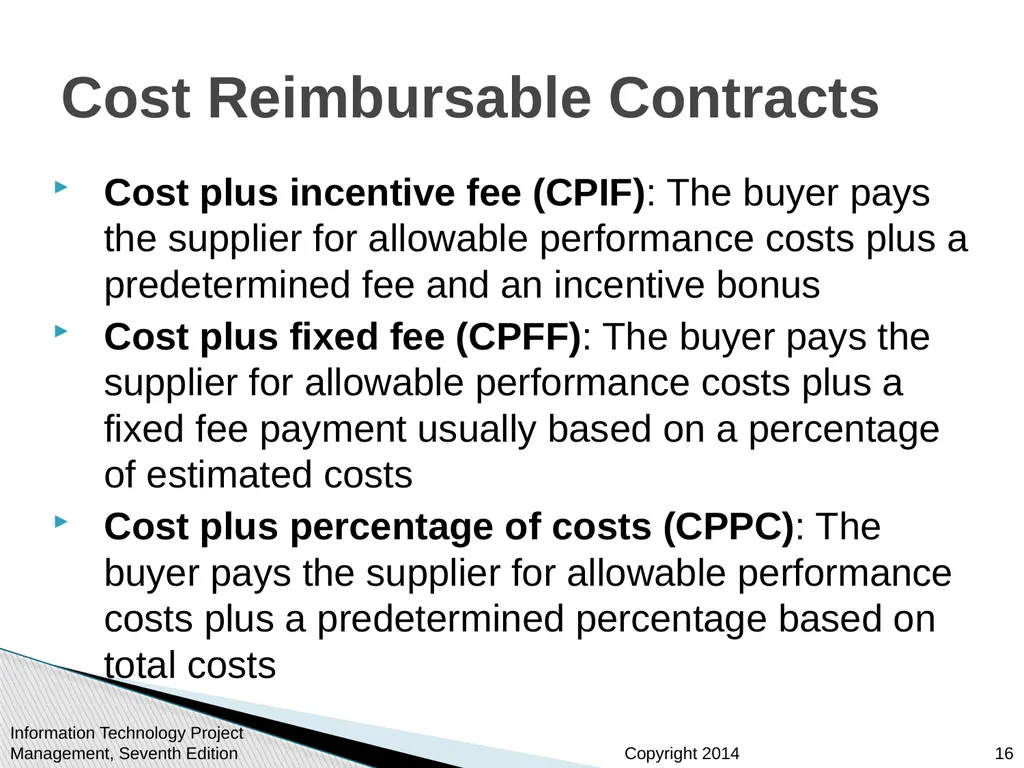
Cost plus incentive fee (CPIF): The buyer pays the supplier for allowable performance costs plus a predetermined fee and an incentive bonus
Cost plus fixed fee (CPFF): The buyer pays the supplier for allowable performance costs plus a fixed fee payment usually based on a percentage of estimated costs
Cost plus percentage of costs (CPPC): The buyer pays the supplier for allowable performance costs plus a predetermined percentage based on total costs Cost Reimbursable Contracts Information Technology Project Management, Seventh Edition 16<br>
Cost plus fixed fee (CPFF): The buyer pays the supplier for allowable performance costs plus a fixed fee payment usually based on a percentage of estimated costs
Cost plus percentage of costs (CPPC): The buyer pays the supplier for allowable performance costs plus a predetermined percentage based on total costs Cost Reimbursable Contracts Information Technology Project Management, Seventh Edition 16<br>
17
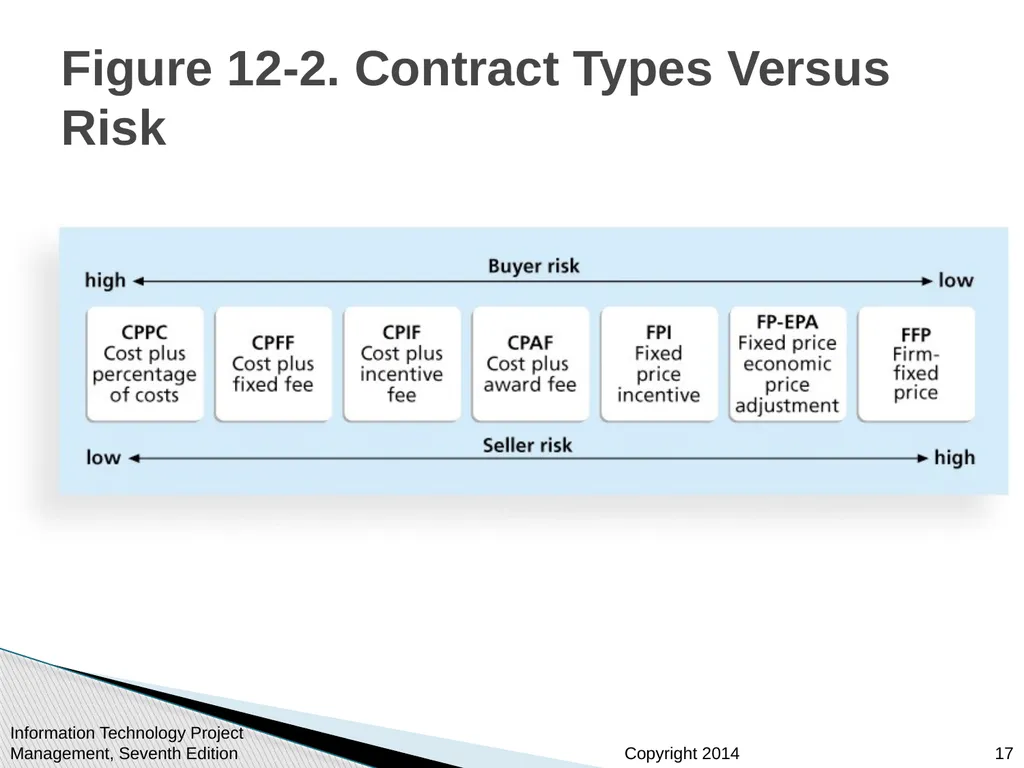
Figure 12-2. Contract Types Versus Risk Information Technology Project Management, Seventh Edition 17<br>
18
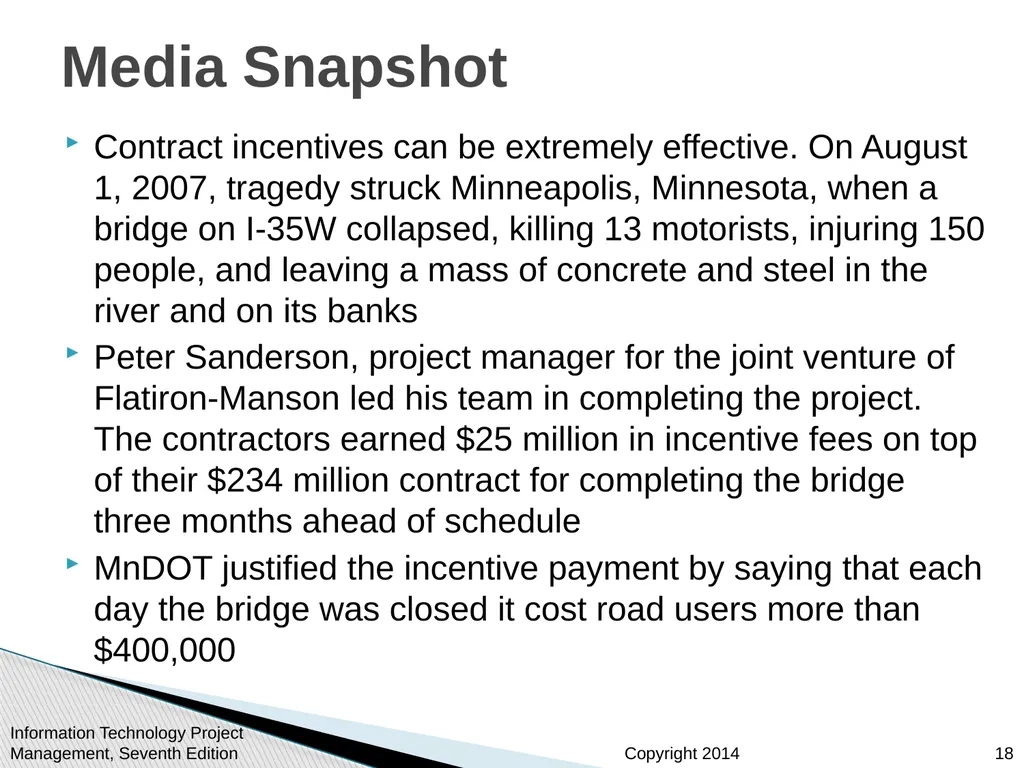
Contract incentives can be extremely effective. On August 1, 2007, tragedy struck Minneapolis, Minnesota, when a bridge on I-35W collapsed, killing 13 motorists, injuring 150 people, and leaving a mass of concrete and steel in the river and on its banks
Peter Sanderson, project manager for the joint venture of Flatiron-Manson led his team in completing the project. The contractors earned $25 million in incentive fees on top of their $234 million contract for completing the bridge three months ahead of schedule
MnDOT justified the incentive payment by saying that each day the bridge was closed it cost road users more than $400,000 Media Snapshot Information Technology Project Management, Seventh Edition 18<br>
Peter Sanderson, project manager for the joint venture of Flatiron-Manson led his team in completing the project. The contractors earned $25 million in incentive fees on top of their $234 million contract for completing the bridge three months ahead of schedule
MnDOT justified the incentive payment by saying that each day the bridge was closed it cost road users more than $400,000 Media Snapshot Information Technology Project Management, Seventh Edition 18<br>
19
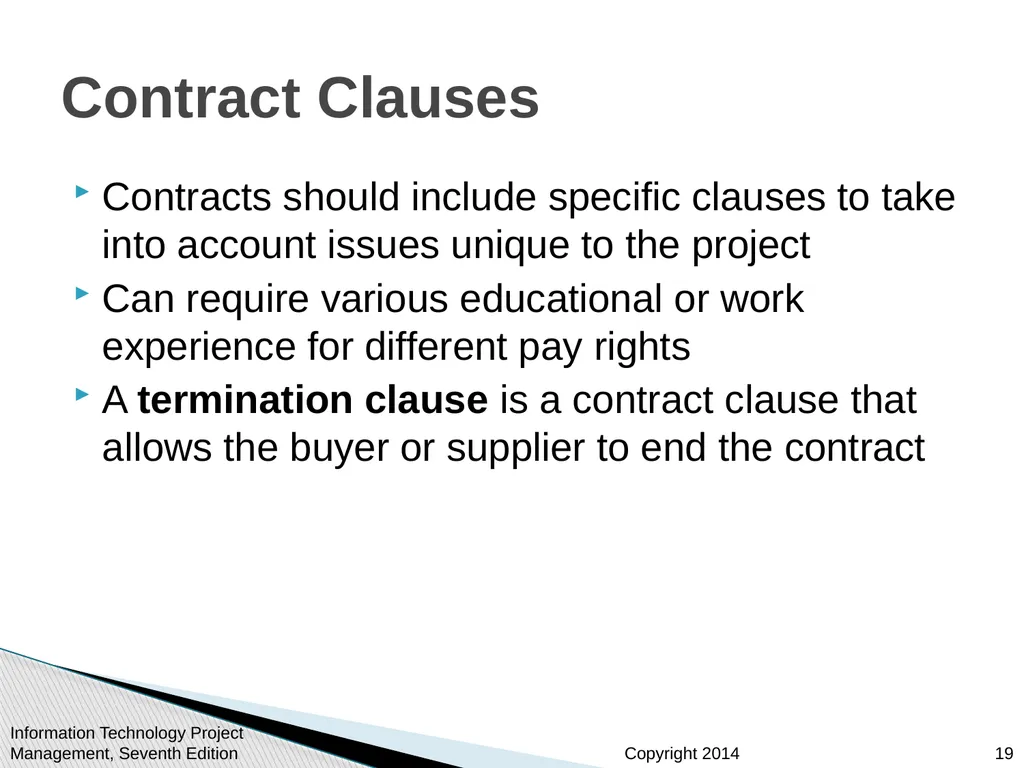
Contracts should include specific clauses to take into account issues unique to the project
Can require various educational or work experience for different pay rights
A termination clause is a contract clause that allows the buyer or supplier to end the contract Contract Clauses Information Technology Project Management, Seventh Edition 19<br>
Can require various educational or work experience for different pay rights
A termination clause is a contract clause that allows the buyer or supplier to end the contract Contract Clauses Information Technology Project Management, Seventh Edition 19<br>
20
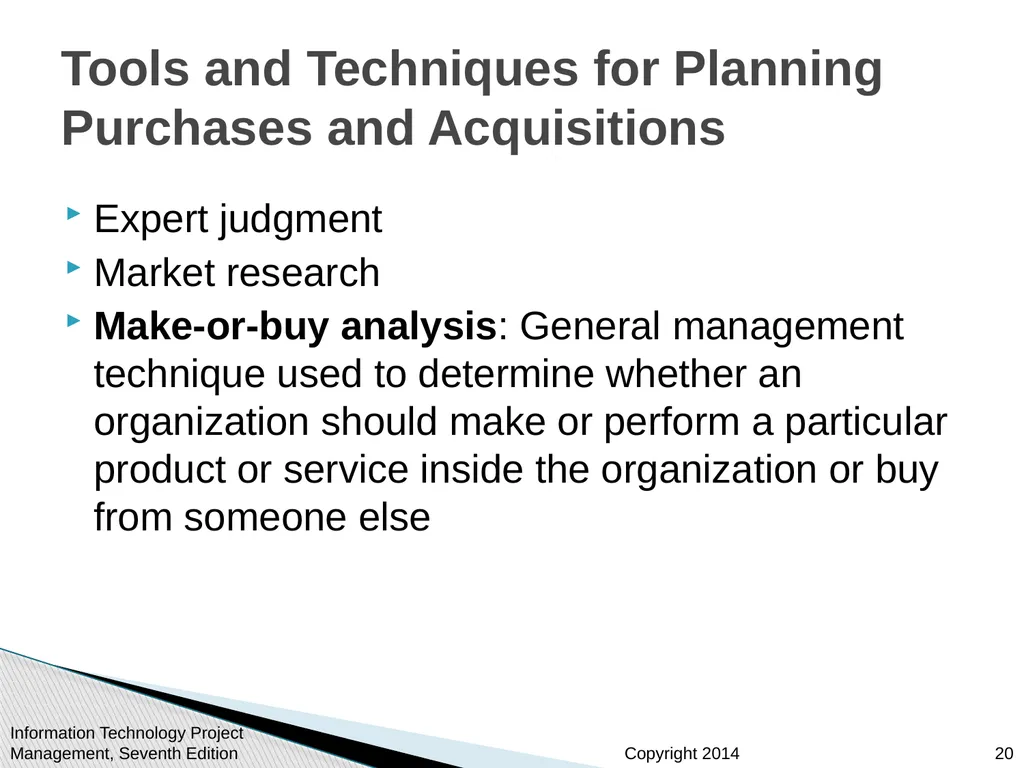
Expert judgment
Market research
Make-or-buy analysis: General management technique used to determine whether an organization should make or perform a particular product or service inside the organization or buy from someone else Tools and Techniques for Planning Purchases and Acquisitions Information Technology Project Management, Seventh Edition 20<br>
Market research
Make-or-buy analysis: General management technique used to determine whether an organization should make or perform a particular product or service inside the organization or buy from someone else Tools and Techniques for Planning Purchases and Acquisitions Information Technology Project Management, Seventh Edition 20<br>
21
Assume you can lease an item you need for a project for $800/day. To purchase the item, the cost is $12,000 plus a daily operational cost of $400/day
How long will it take for the purchase cost to be the same as the lease cost? Make-or-Buy Example Information Technology Project Management, Seventh Edition 21<br>
How long will it take for the purchase cost to be the same as the lease cost? Make-or-Buy Example Information Technology Project Management, Seventh Edition 21<br>
22
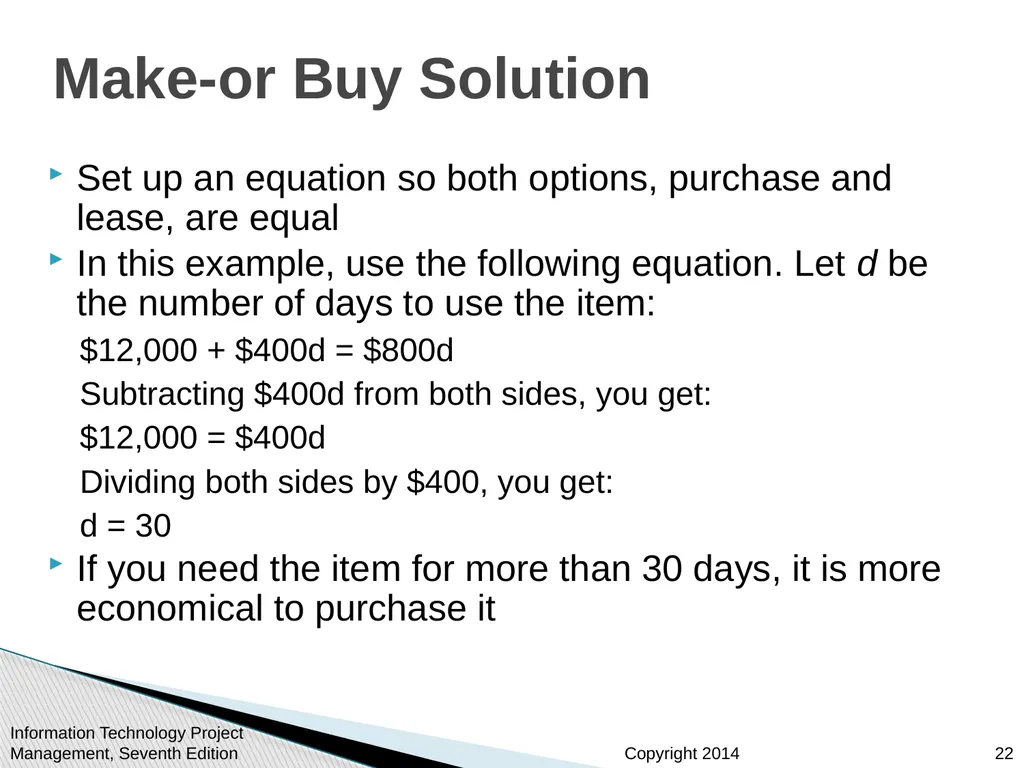
Set up an equation so both options, purchase and lease, are equal
In this example, use the following equation. Let d be the number of days to use the item:
$12,000 + $400d = $800d
Subtracting $400d from both sides, you get:
$12,000 = $400d
Dividing both sides by $400, you get:
d = 30
If you need the item for more than 30 days, it is more economical to purchase it Make-or Buy Solution Information Technology Project Management, Seventh Edition 22<br>
In this example, use the following equation. Let d be the number of days to use the item:
$12,000 + $400d = $800d
Subtracting $400d from both sides, you get:
$12,000 = $400d
Dividing both sides by $400, you get:
d = 30
If you need the item for more than 30 days, it is more economical to purchase it Make-or Buy Solution Information Technology Project Management, Seventh Edition 22<br>
23
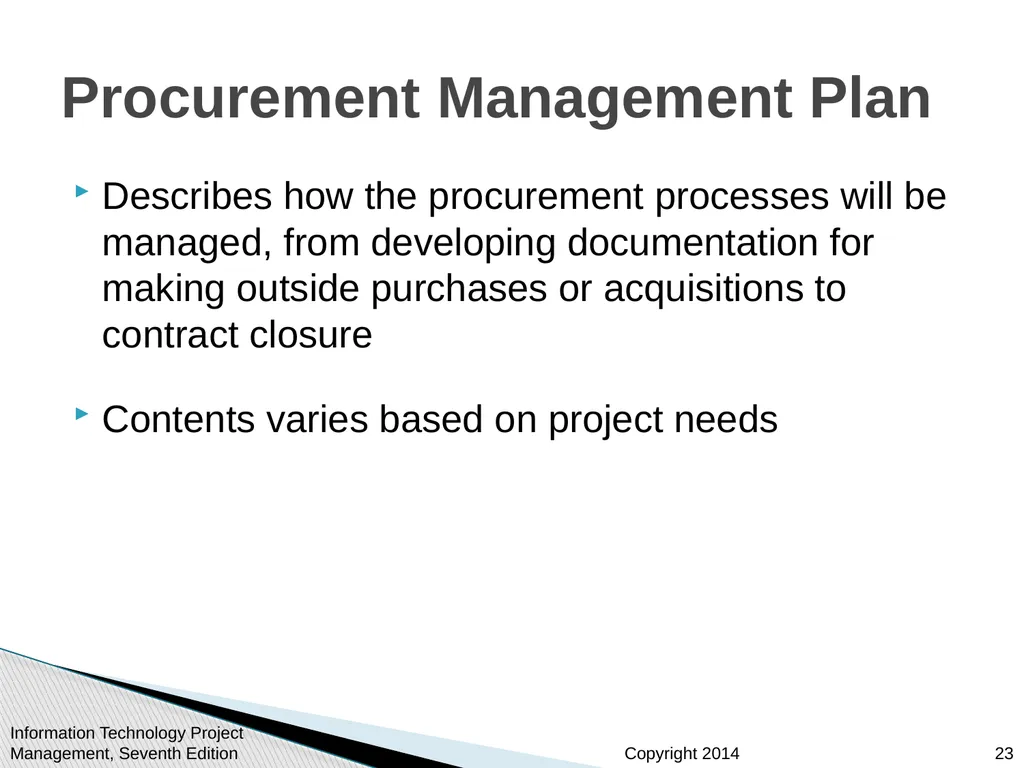
Describes how the procurement processes will be managed, from developing documentation for making outside purchases or acquisitions to contract closure
Contents varies based on project needs Procurement Management Plan Information Technology Project Management, Seventh Edition 23<br>
Contents varies based on project needs Procurement Management Plan Information Technology Project Management, Seventh Edition 23<br>
24
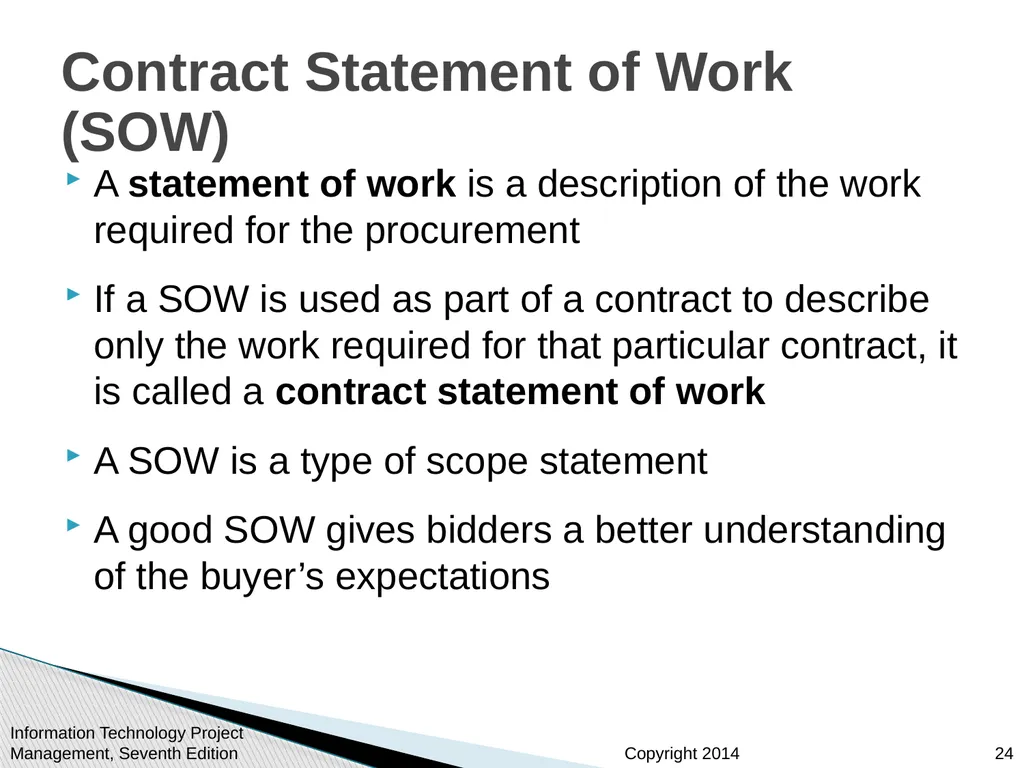
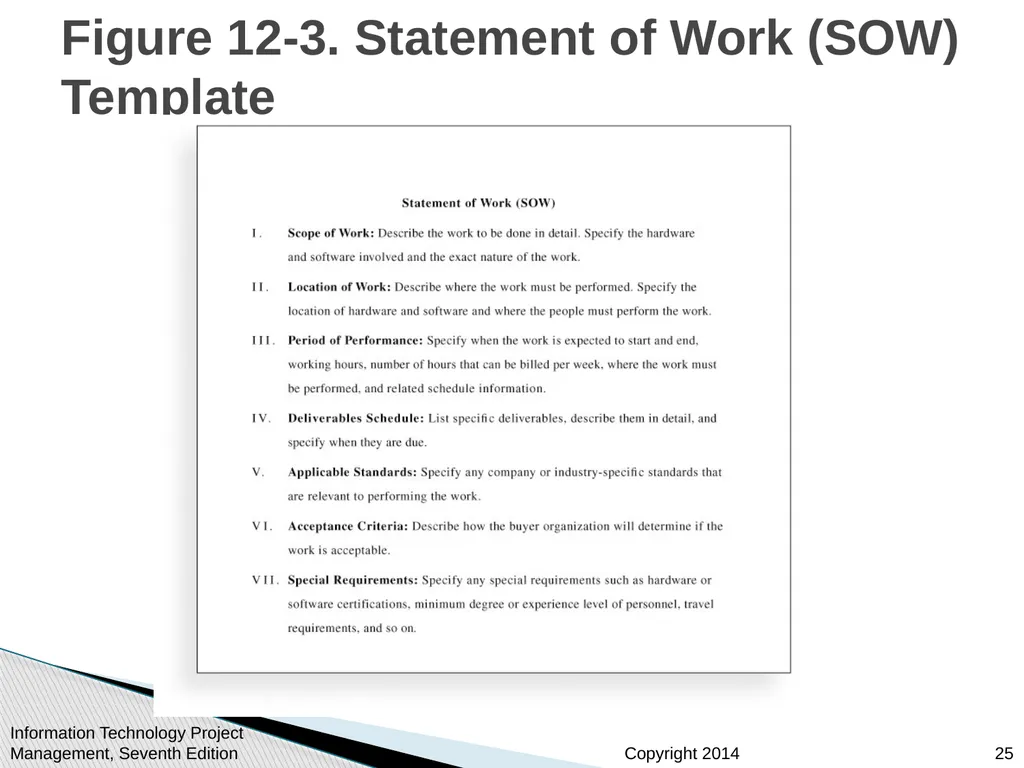
A statement of work is a description of the work required for the procurement
If a SOW is used as part of a contract to describe only the work required for that particular contract, it is called a contract statement of work
A SOW is a type of scope statement
A good SOW gives bidders a better understanding of the buyer’s expectations Contract Statement of Work (SOW) Information Technology Project Management, Seventh Edition 24<br>
If a SOW is used as part of a contract to describe only the work required for that particular contract, it is called a contract statement of work
A SOW is a type of scope statement
A good SOW gives bidders a better understanding of the buyer’s expectations Contract Statement of Work (SOW) Information Technology Project Management, Seventh Edition 24<br>
25
Figure 12-3. Statement of Work (SOW) Template Information Technology Project Management, Seventh Edition 25<br>
26
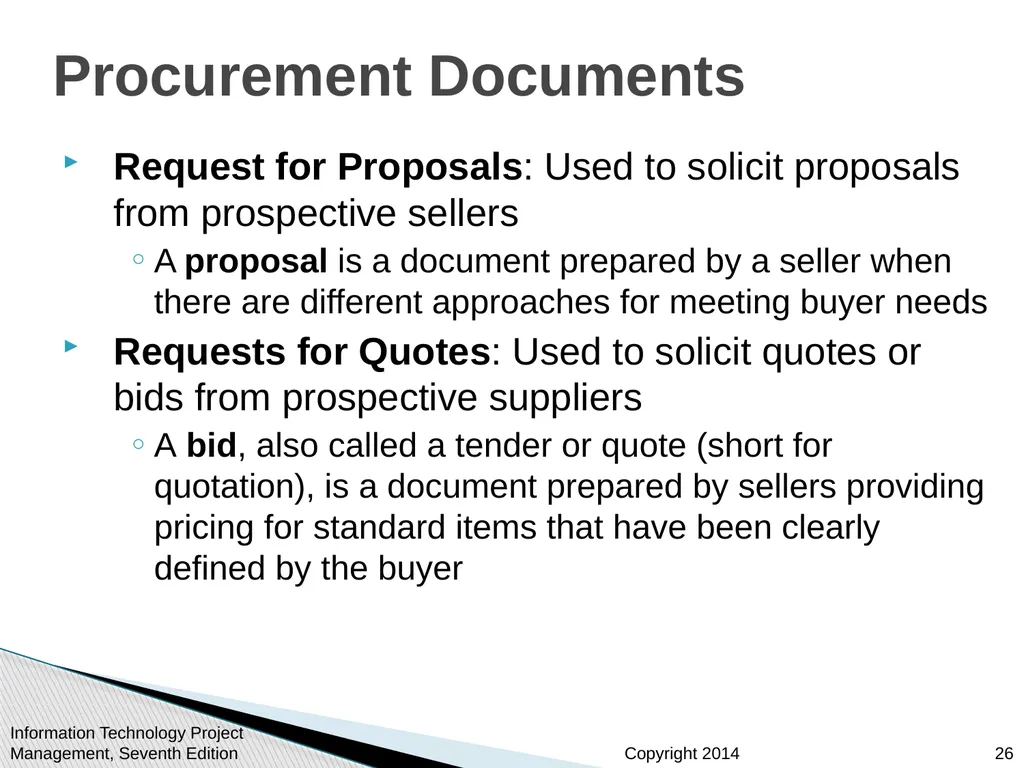
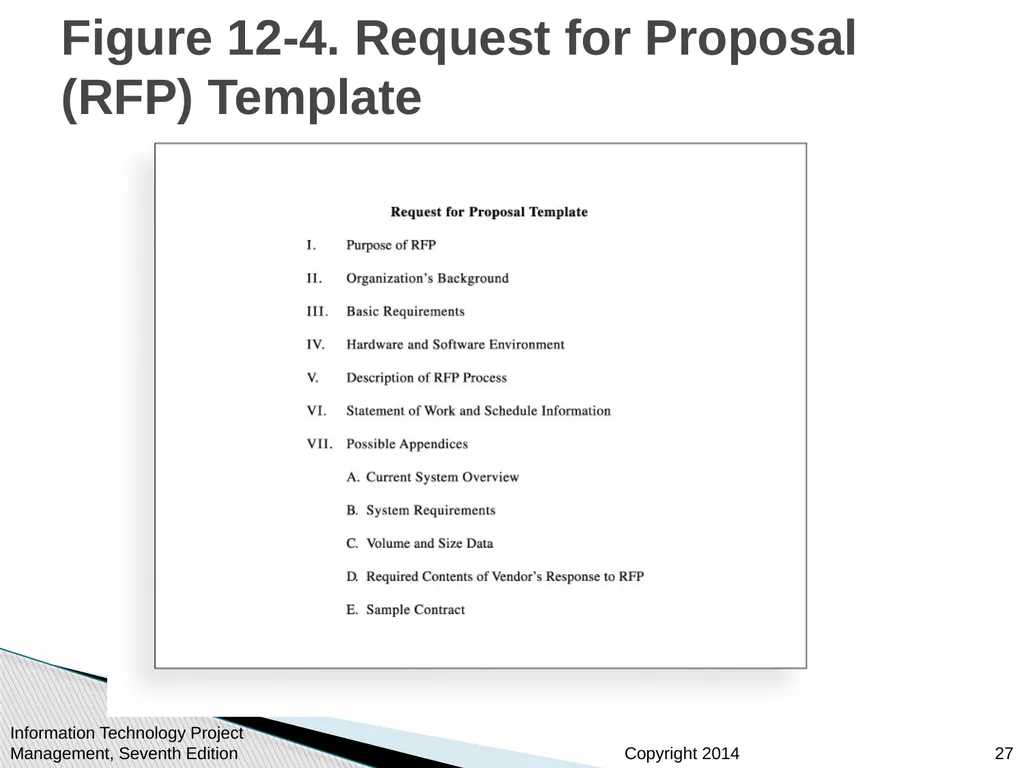
Request for Proposals: Used to solicit proposals from prospective sellers
A proposal is a document prepared by a seller when there are different approaches for meeting buyer needs
Requests for Quotes: Used to solicit quotes or bids from prospective suppliers
A bid, also called a tender or quote (short for quotation), is a document prepared by sellers providing pricing for standard items that have been clearly defined by the buyer Procurement Documents Information Technology Project Management, Seventh Edition 26<br>
A proposal is a document prepared by a seller when there are different approaches for meeting buyer needs
Requests for Quotes: Used to solicit quotes or bids from prospective suppliers
A bid, also called a tender or quote (short for quotation), is a document prepared by sellers providing pricing for standard items that have been clearly defined by the buyer Procurement Documents Information Technology Project Management, Seventh Edition 26<br>
27
Figure 12-4. Request for Proposal (RFP) Template Information Technology Project Management, Seventh Edition 27<br>
28
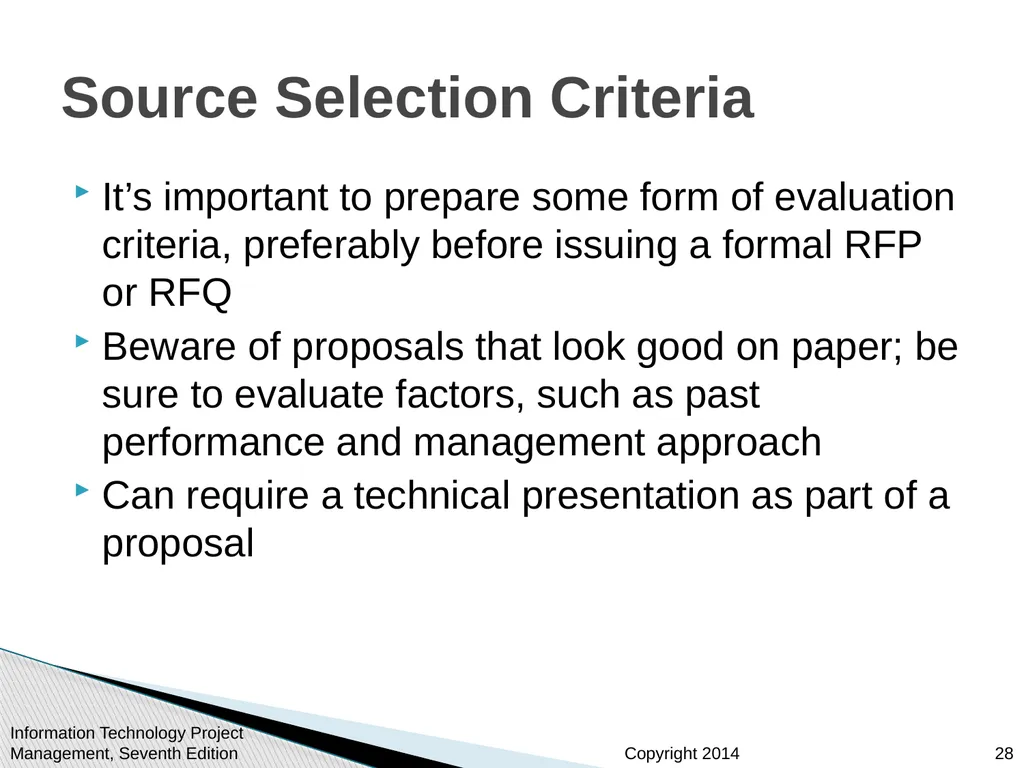
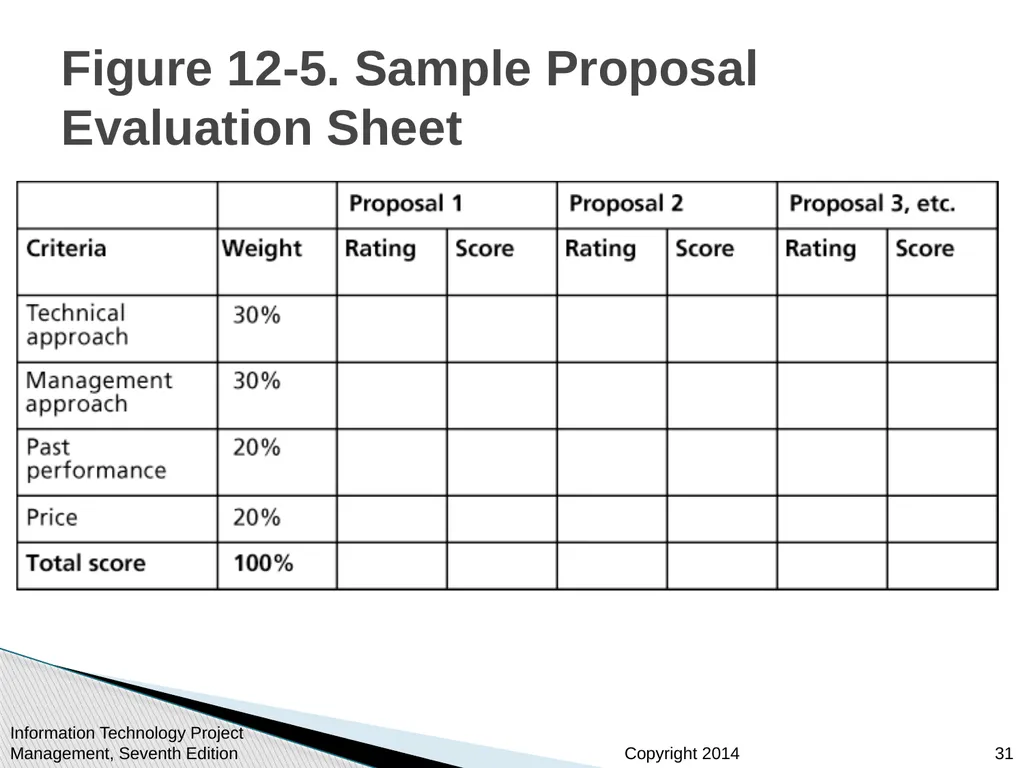
It’s important to prepare some form of evaluation criteria, preferably before issuing a formal RFP or RFQ
Beware of proposals that look good on paper; be sure to evaluate factors, such as past performance and management approach
Can require a technical presentation as part of a proposal Source Selection Criteria Information Technology Project Management, Seventh Edition 28<br>
Beware of proposals that look good on paper; be sure to evaluate factors, such as past performance and management approach
Can require a technical presentation as part of a proposal Source Selection Criteria Information Technology Project Management, Seventh Edition 28<br>
29
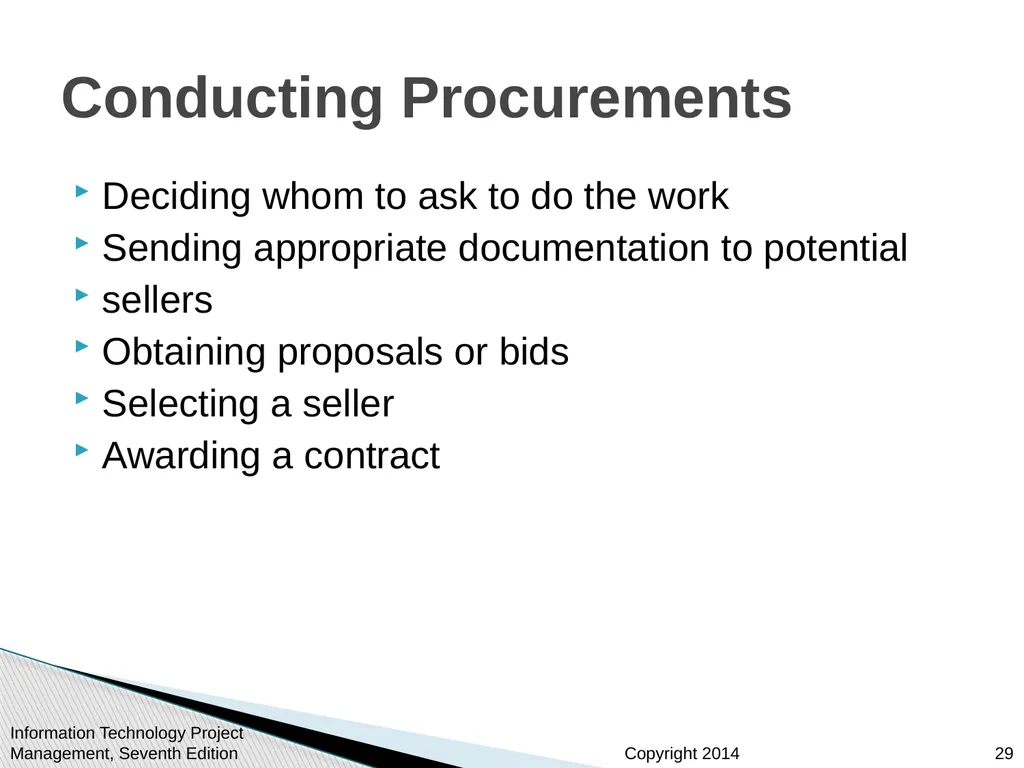
Deciding whom to ask to do the work
Sending appropriate documentation to potential
sellers
Obtaining proposals or bids
Selecting a seller
Awarding a contract Conducting Procurements Information Technology Project Management, Seventh Edition 29<br>
Sending appropriate documentation to potential
sellers
Obtaining proposals or bids
Selecting a seller
Awarding a contract Conducting Procurements Information Technology Project Management, Seventh Edition 29<br>
30
Organizations can advertise to procure goods and services in several ways:
Approaching the preferred vendor
Approaching several potential vendors
Advertising to anyone interested
A bidders’ conference can help clarify the buyer’s expectations Approaches for Procurement Information Technology Project Management, Seventh Edition 30<br>
Approaching the preferred vendor
Approaching several potential vendors
Advertising to anyone interested
A bidders’ conference can help clarify the buyer’s expectations Approaches for Procurement Information Technology Project Management, Seventh Edition 30<br>
31
Figure 12-5. Sample Proposal Evaluation Sheet Information Technology Project Management, Seventh Edition 31<br>
32
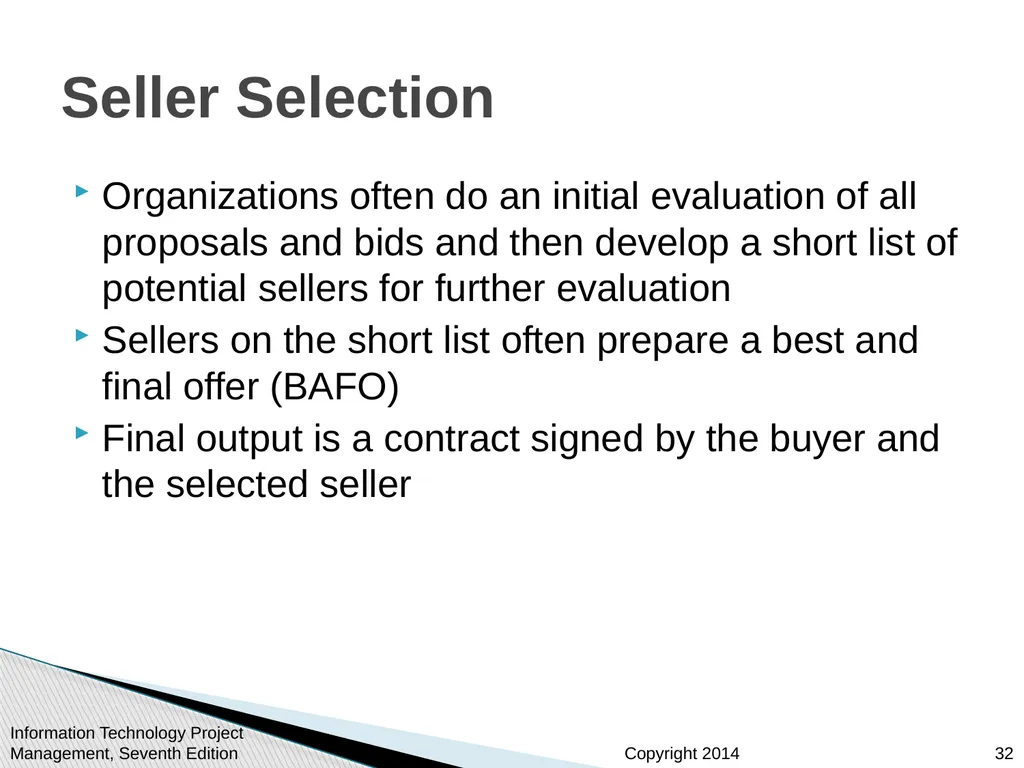
Organizations often do an initial evaluation of all proposals and bids and then develop a short list of potential sellers for further evaluation
Sellers on the short list often prepare a best and final offer (BAFO)
Final output is a contract signed by the buyer and the selected seller Seller Selection Information Technology Project Management, Seventh Edition 32<br>
Sellers on the short list often prepare a best and final offer (BAFO)
Final output is a contract signed by the buyer and the selected seller Seller Selection Information Technology Project Management, Seventh Edition 32<br>
33
Ensures that the seller’s performance meets contractual requirements
Contracts are legal relationships, so it is important that legal and contracting professionals be involved in writing and administering contracts
It is critical that project managers and team members watch for constructive change orders, which are oral or written acts or omissions by someone with actual or apparent authority that can be construed to have the same effect as a written change order Controlling Procurements Information Technology Project Management, Seventh Edition 33<br>
Contracts are legal relationships, so it is important that legal and contracting professionals be involved in writing and administering contracts
It is critical that project managers and team members watch for constructive change orders, which are oral or written acts or omissions by someone with actual or apparent authority that can be construed to have the same effect as a written change order Controlling Procurements Information Technology Project Management, Seventh Edition 33<br>
34
A recent trend is to hire people in rural areas of the same country to perform work, often at less cost. Rural sourcing uses two simple premises: Smaller towns need jobs, and workers there often charge 25 to 50 percent less than their urban counterparts.
Onshore Technology Services recruits workers from low-paying jobs and gives them intensive training in IT specialties. The company employs 65 people in IT centers in the rural Missouri towns of Macon, Lebanon, and Joplin
CrossUSA recruits older IT workers who are nearing retirement and want to enjoy a small-town quality of life. The company has 100 employees in Sebeka, Minnesota (population 700) and Eveleth, Minnesota (population 3,000) Global Issues Information Technology Project Management, Seventh Edition 34<br>
Onshore Technology Services recruits workers from low-paying jobs and gives them intensive training in IT specialties. The company employs 65 people in IT centers in the rural Missouri towns of Macon, Lebanon, and Joplin
CrossUSA recruits older IT workers who are nearing retirement and want to enjoy a small-town quality of life. The company has 100 employees in Sebeka, Minnesota (population 700) and Eveleth, Minnesota (population 3,000) Global Issues Information Technology Project Management, Seventh Edition 34<br>
35
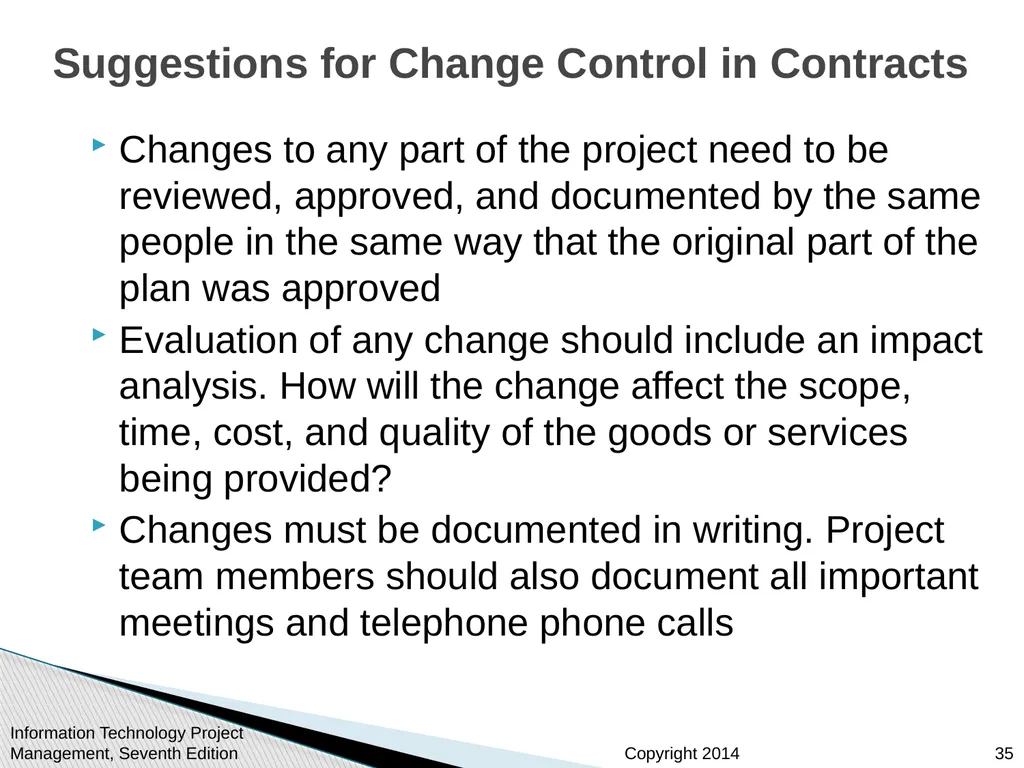
Changes to any part of the project need to be reviewed, approved, and documented by the same people in the same way that the original part of the plan was approved
Evaluation of any change should include an impact analysis. How will the change affect the scope, time, cost, and quality of the goods or services being provided?
Changes must be documented in writing. Project team members should also document all important meetings and telephone phone calls Suggestions for Change Control in Contracts Information Technology Project Management, Seventh Edition 35<br>
Evaluation of any change should include an impact analysis. How will the change affect the scope, time, cost, and quality of the goods or services being provided?
Changes must be documented in writing. Project team members should also document all important meetings and telephone phone calls Suggestions for Change Control in Contracts Information Technology Project Management, Seventh Edition 35<br>
36
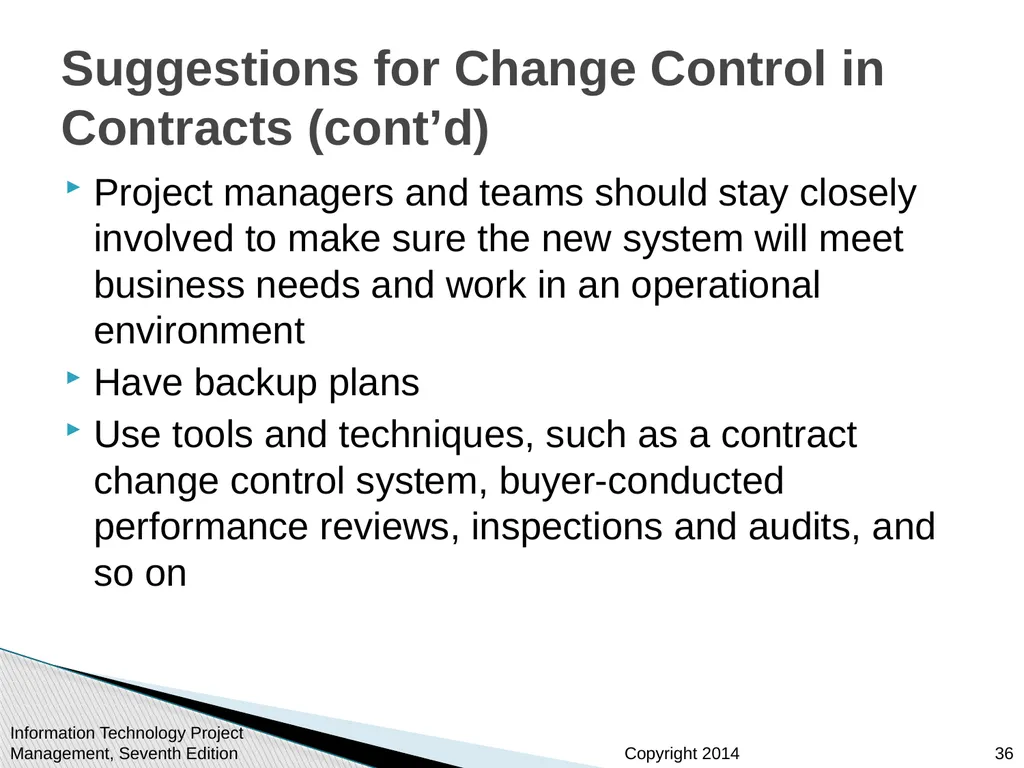
Project managers and teams should stay closely involved to make sure the new system will meet business needs and work in an operational environment
Have backup plans
Use tools and techniques, such as a contract change control system, buyer-conducted performance reviews, inspections and audits, and so on Suggestions for Change Control in Contracts (cont’d) Information Technology Project Management, Seventh Edition 36<br>
Have backup plans
Use tools and techniques, such as a contract change control system, buyer-conducted performance reviews, inspections and audits, and so on Suggestions for Change Control in Contracts (cont’d) Information Technology Project Management, Seventh Edition 36<br>
37
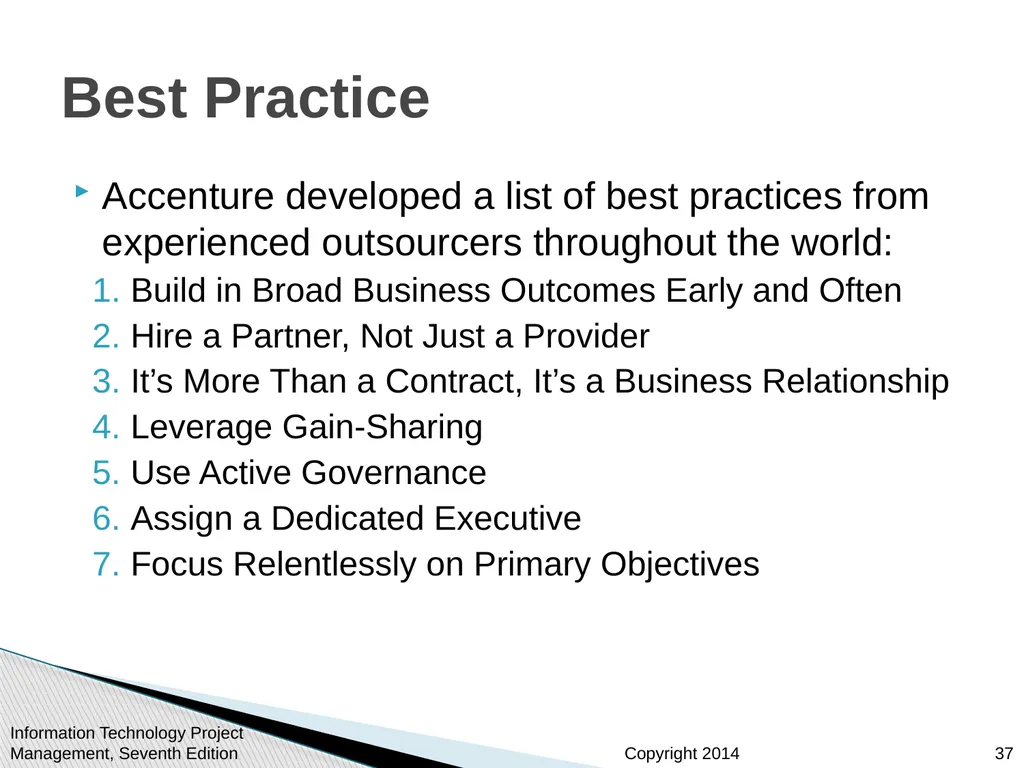
Accenture developed a list of best practices from experienced outsourcers throughout the world:
Build in Broad Business Outcomes Early and Often
Hire a Partner, Not Just a Provider
It’s More Than a Contract, It’s a Business Relationship
Leverage Gain-Sharing
Use Active Governance
Assign a Dedicated Executive
Focus Relentlessly on Primary Objectives Best Practice Information Technology Project Management, Seventh Edition 37<br>
Build in Broad Business Outcomes Early and Often
Hire a Partner, Not Just a Provider
It’s More Than a Contract, It’s a Business Relationship
Leverage Gain-Sharing
Use Active Governance
Assign a Dedicated Executive
Focus Relentlessly on Primary Objectives Best Practice Information Technology Project Management, Seventh Edition 37<br>
38
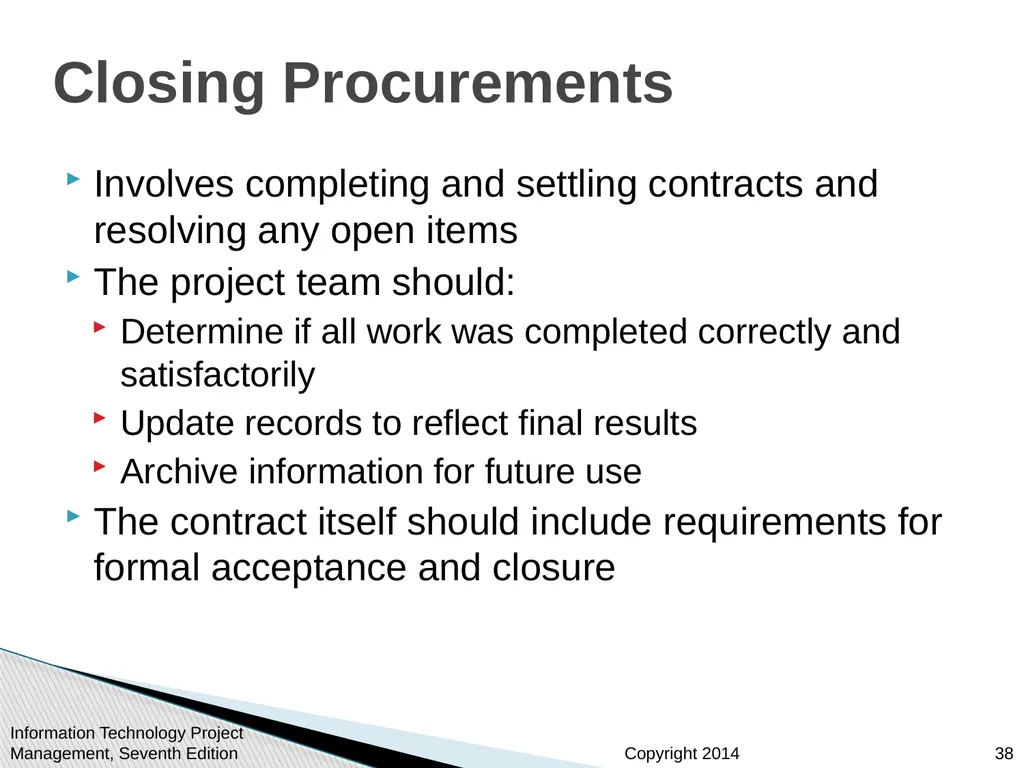
Involves completing and settling contracts and resolving any open items
The project team should:
Determine if all work was completed correctly and satisfactorily
Update records to reflect final results
Archive information for future use
The contract itself should include requirements for formal acceptance and closure Closing Procurements Information Technology Project Management, Seventh Edition 38<br>
The project team should:
Determine if all work was completed correctly and satisfactorily
Update records to reflect final results
Archive information for future use
The contract itself should include requirements for formal acceptance and closure Closing Procurements Information Technology Project Management, Seventh Edition 38<br>
39
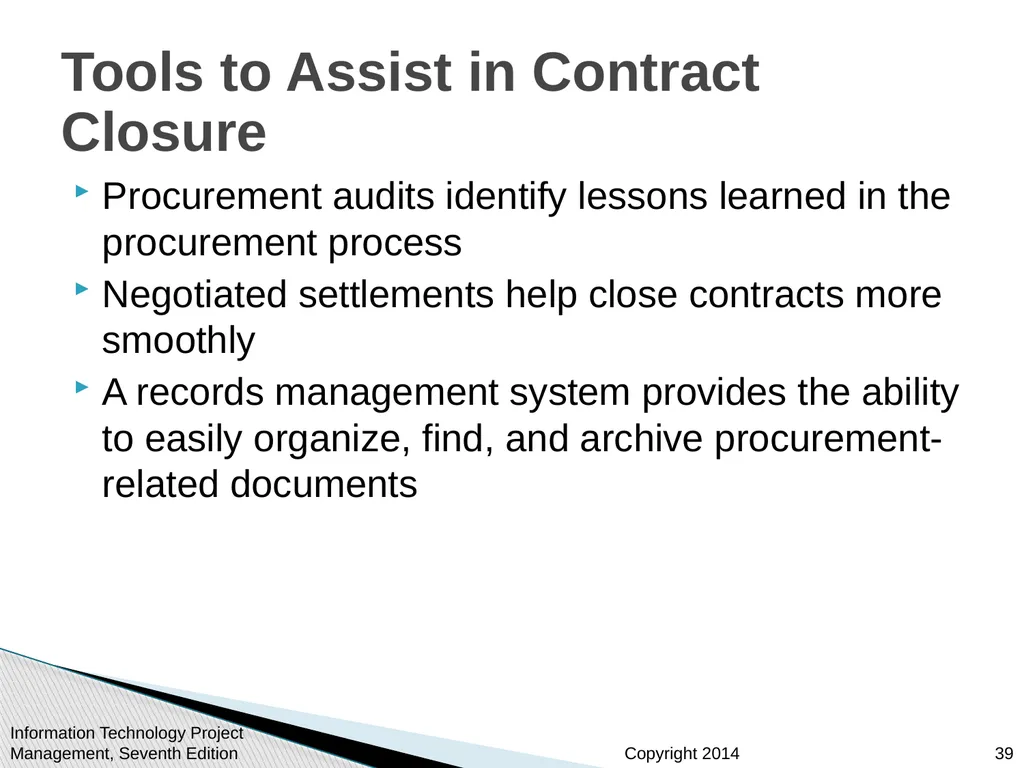
Procurement audits identify lessons learned in the procurement process
Negotiated settlements help close contracts more smoothly
A records management system provides the ability to easily organize, find, and archive procurement-related documents Tools to Assist in Contract Closure Information Technology Project Management, Seventh Edition 39<br>
Negotiated settlements help close contracts more smoothly
A records management system provides the ability to easily organize, find, and archive procurement-related documents Tools to Assist in Contract Closure Information Technology Project Management, Seventh Edition 39<br>
40
Word processing software helps write proposals and contracts, spreadsheets help evaluate suppliers, databases help track suppliers, and presentation software helps present procurement-related information
E-procurement software does many procurement functions electronically
Organizations also use other Internet tools to find information on suppliers or auction goods and services Using Software to Assist in Project Procurement Management Information Technology Project Management, Seventh Edition 40<br>
E-procurement software does many procurement functions electronically
Organizations also use other Internet tools to find information on suppliers or auction goods and services Using Software to Assist in Project Procurement Management Information Technology Project Management, Seventh Edition 40<br>
41
Project procurement management involves acquiring goods and services for a project from outside the performing organization
Processes include:
Plan procurement management
Conduct procurements
Control procurements
Close procurements Chapter Summary Information Technology Project Management, Seventh Edition 41<br>
Processes include:
Plan procurement management
Conduct procurements
Control procurements
Close procurements Chapter Summary Information Technology Project Management, Seventh Edition 41<br>