
Chapter 13 Finding Your Place David N. Entwistle,

Description: Chapter 13 Finding Your Place David N. Entwistle, PsyD These slides are designed to accompany Integrative Approaches to Psychology and Christianity, 4th ed. Material protected by copy write. Users are welcome to make changes to the
Related Topics
Download Presentation
"Chapter 13 Finding Your Place David N. Entwistle," is the property of its rightful owner. Permission is granted to download and print the materials on this website for personal, non-commercial use only, and to display it on your personal computer provided you do not modify the materials and that you retain all copyright notices contained in the materials. By downloading content from our website, you accept the terms of this agreement.
Presentation Transcript
slide1. Chapter 13
Finding Your Place
David N. Entwistle, PsyD
These slides are designed to accompany Integrative Approaches to Psychology and Christianity, 4th ed.
Material protected by copy write. Users are welcome to make changes to the presentations and to use them for educational purposes, provided that the original acknowledgement is maintained and any changes to the presentation clearly identified. Integrative Approaches to Psychology and Christianity – 4th ed.<br>
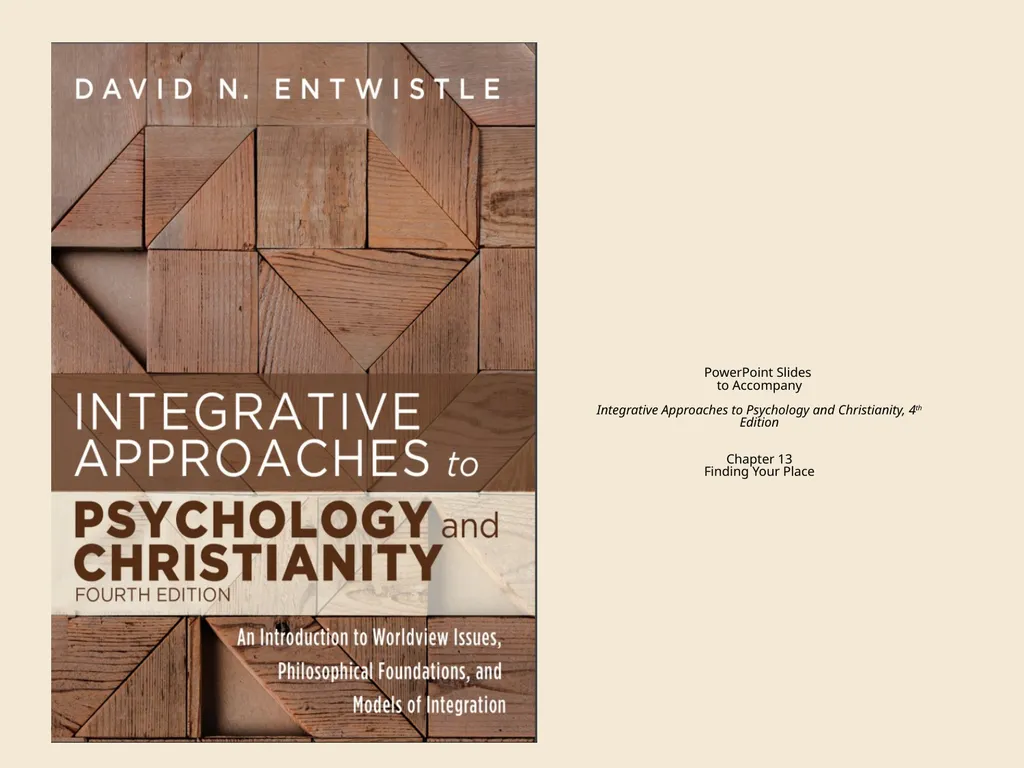
slide2. PowerPoint Slides to Accompany Integrative Approaches to Psychology and Christianity, 4th Edition Chapter 13 Finding Your Place<br>
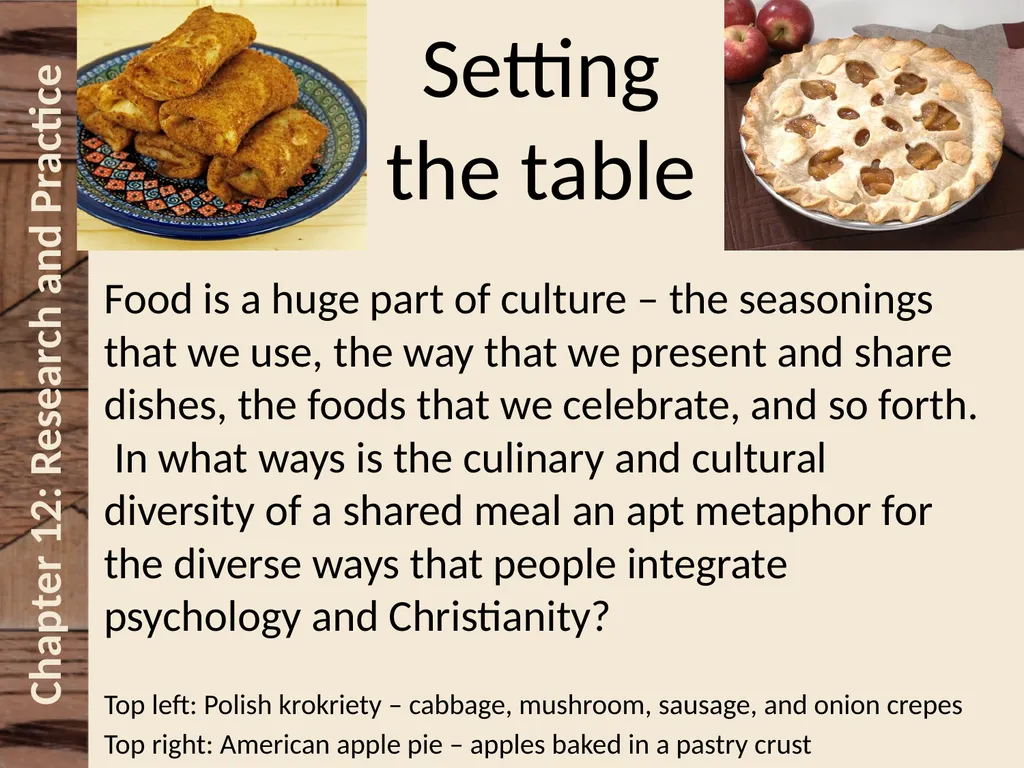
slide3. Setting the table Food is a huge part of culture – the seasonings that we use, the way that we present and share dishes, the foods that we celebrate, and so forth. In what ways is the culinary and cultural diversity of a shared meal an apt metaphor for the diverse ways that people integrate psychology and Christianity?
Top left: Polish krokriety – cabbage, mushroom, sausage, and onion crepes
Top right: American apple pie – apples baked in a pastry crust<br>
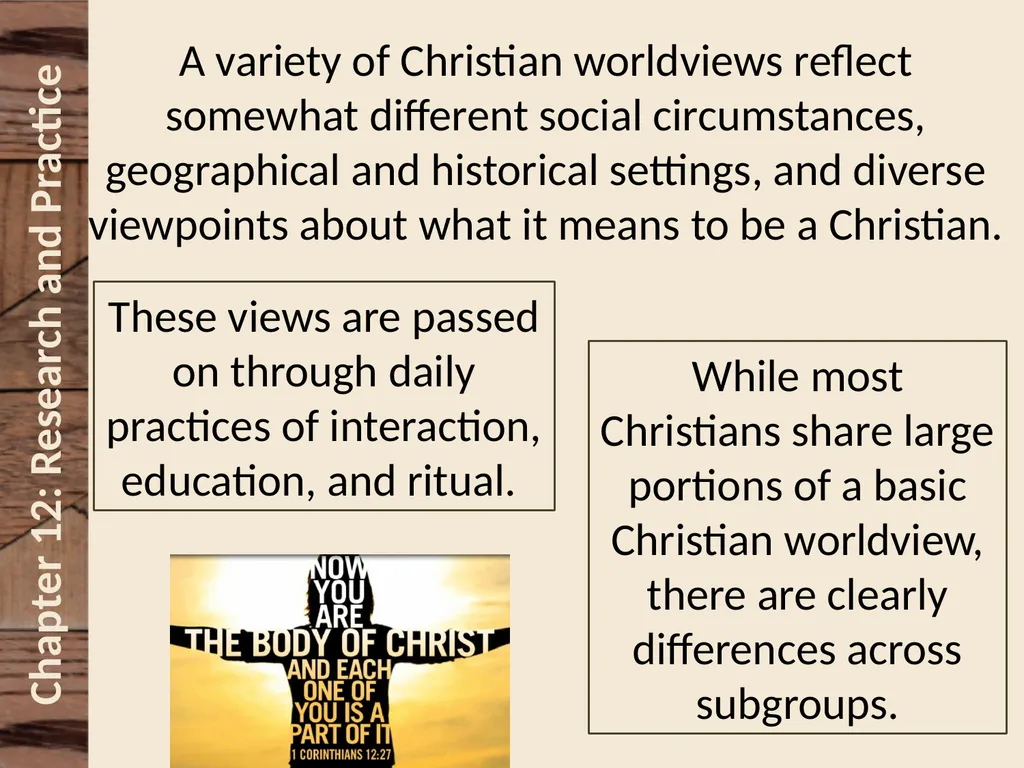
slide4. A variety of Christian worldviews reflect somewhat different social circumstances, geographical and historical settings, and diverse viewpoints about what it means to be a Christian. While most Christians share large portions of a basic Christian worldview, there are clearly differences across subgroups. These views are passed on through daily practices of interaction, education, and ritual.<br>
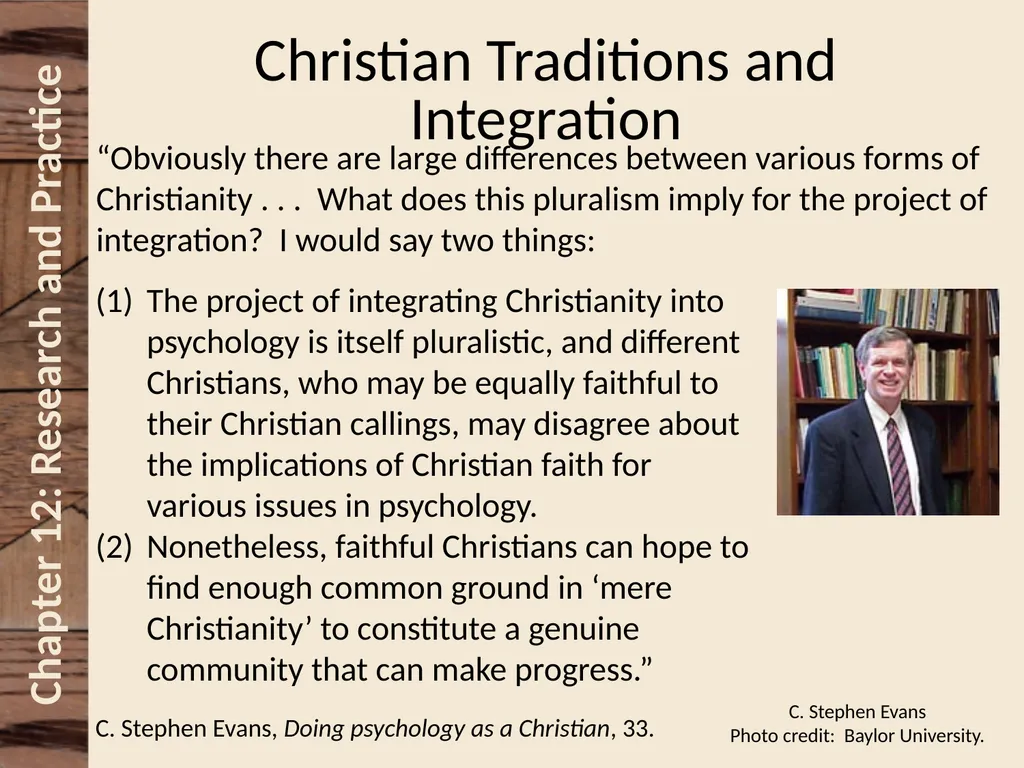
slide5. Christian Traditions and Integration “Obviously there are large differences between various forms of Christianity . . . What does this pluralism imply for the project of integration? I would say two things: The project of integrating Christianity into psychology is itself pluralistic, and different Christians, who may be equally faithful to their Christian callings, may disagree about the implications of Christian faith for various issues in psychology.
Nonetheless, faithful Christians can hope to find enough common ground in ‘mere Christianity’ to constitute a genuine community that can make progress.”
C. Stephen Evans, Doing psychology as a Christian, 33. C. Stephen Evans
Photo credit: Baylor University.<br>
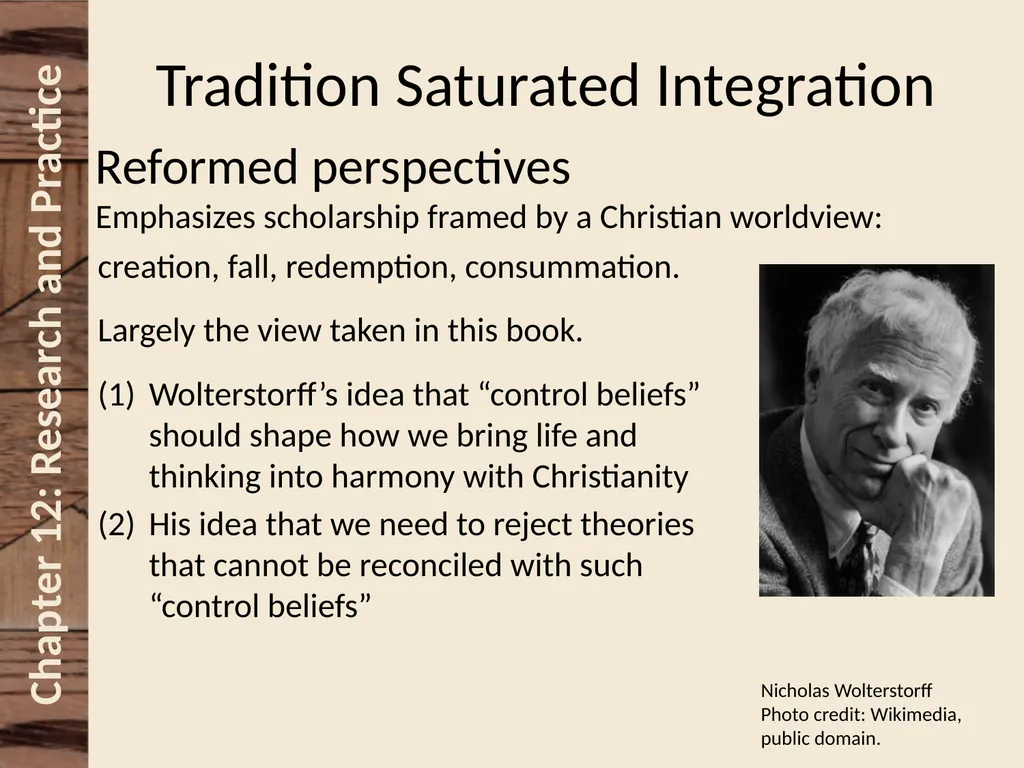
slide6. Tradition Saturated Integration creation, fall, redemption, consummation.
Largely the view taken in this book.
Wolterstorff’s idea that “control beliefs” should shape how we bring life and thinking into harmony with Christianity
His idea that we need to reject theories that cannot be reconciled with such “control beliefs” Reformed perspectives
Emphasizes scholarship framed by a Christian worldview: Nicholas Wolterstorff
Photo credit: Wikimedia, public domain.<br>
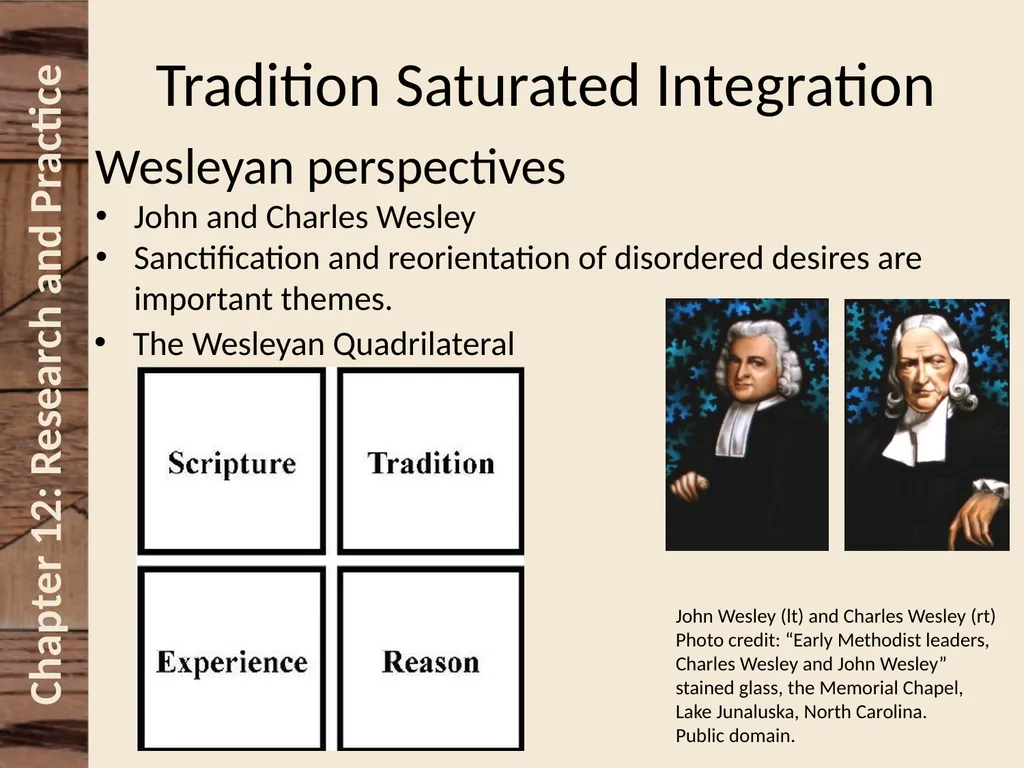
slide7. Tradition Saturated Integration The Wesleyan Quadrilateral Wesleyan perspectives
John and Charles Wesley
Sanctification and reorientation of disordered desires are important themes. John Wesley (lt) and Charles Wesley (rt)
Photo credit: “Early Methodist leaders, Charles Wesley and John Wesley” stained glass, the Memorial Chapel, Lake Junaluska, North Carolina.
Public domain.<br>
slide8. Tradition Saturated Integration Emphasis on experience and care rather than on abstract theology.
Importance of “testimonies”
“Spiritual warfare” and “healing of memories” – prayer for God to bring healing for troubling memories – comes out of this tradition. Charismatic / Pentecostal perspectives
Emphasizes revivalism, holiness, prophecy, healing, activity of the Holy Spirit<br>
slide9. Tradition Saturated Integration We are shaped by liturgical celebration and sacraments
Liturgical calendar
Emphasizes both doctrine and social justice
Concord of faith and reason
Respect for tradition
Sacramental nature of all of life
Sanctity of life
Inclusivity Roman Catholic perspectives
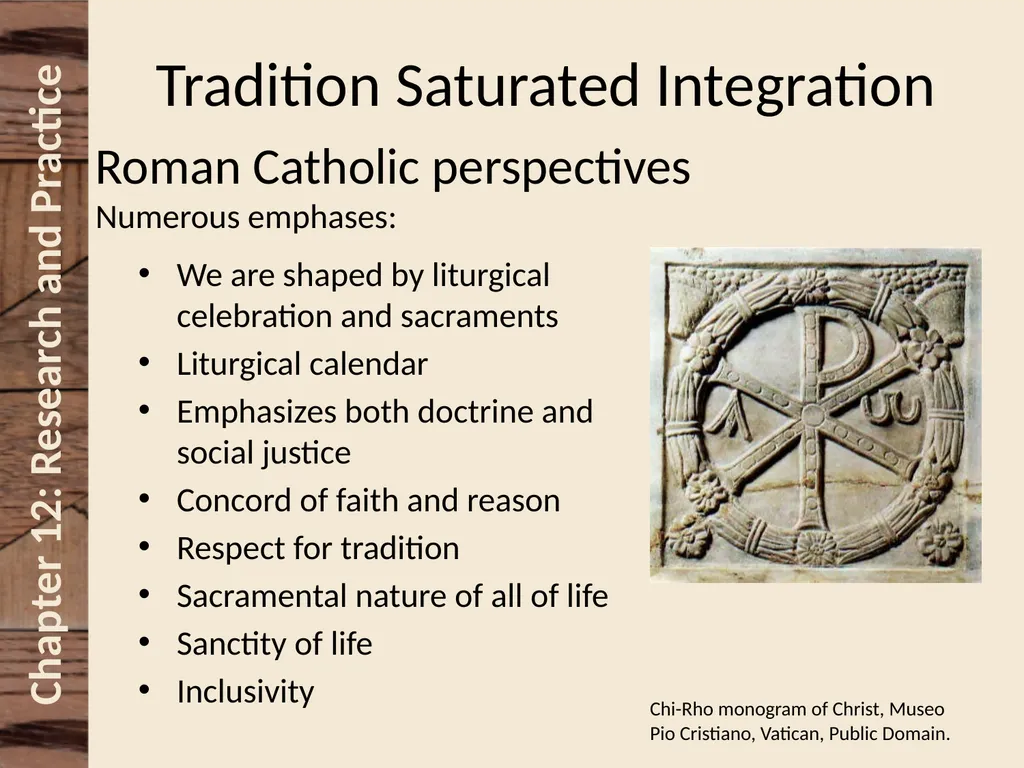
Numerous emphases: Chi-Rho monogram of Christ, Museo Pio Cristiano, Vatican, Public Domain.<br>
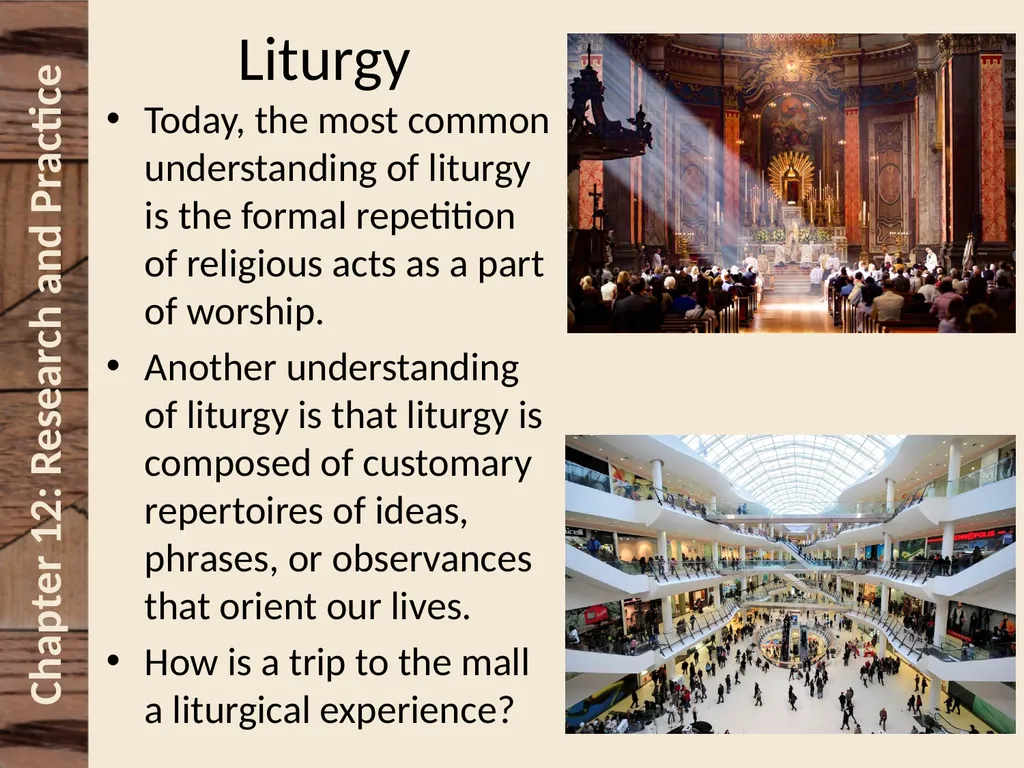
slide10. Liturgy Today, the most common understanding of liturgy is the formal repetition of religious acts as a part of worship.
Another understanding of liturgy is that liturgy is composed of customary repertoires of ideas, phrases, or observances that orient our lives.
How is a trip to the mall a liturgical experience?<br>
slide11. Tradition Saturated Integration CPS service during WW-II, and interest in psychiatric reform following the war.
The Mennonite model emphasizes faith and living more than faith and learning. Anabaptist perspectives
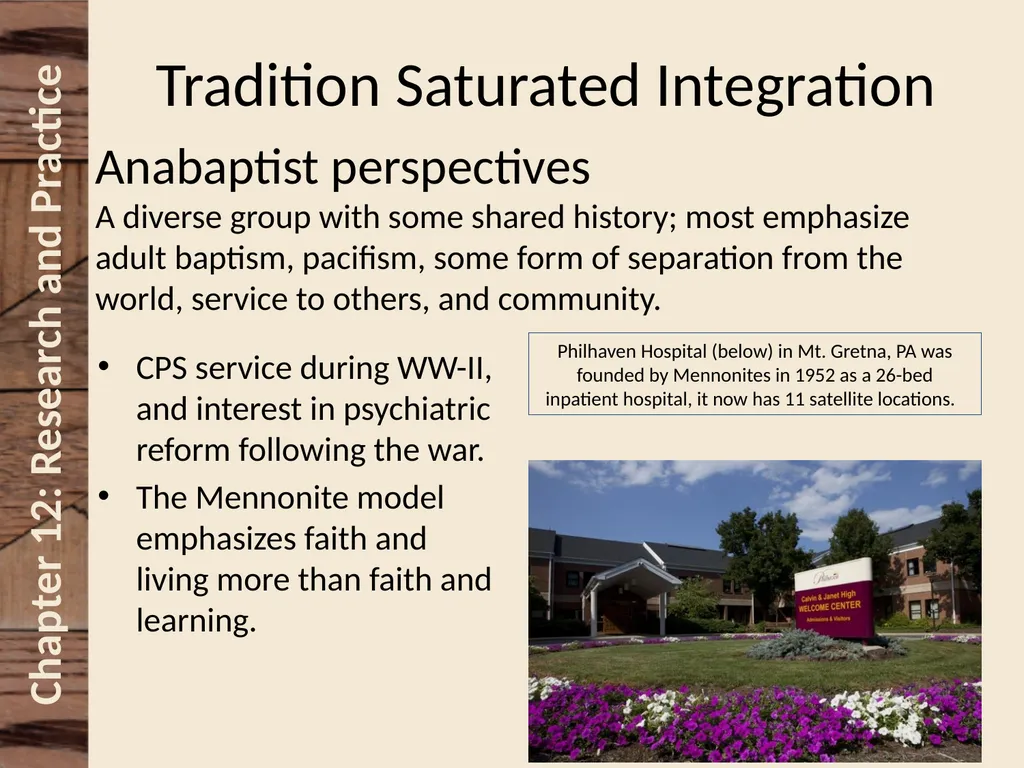
A diverse group with some shared history; most emphasize adult baptism, pacifism, some form of separation from the world, service to others, and community. Philhaven Hospital (below) in Mt. Gretna, PA was founded by Mennonites in 1952 as a 26-bed inpatient hospital, it now has 11 satellite locations.<br>
slide12. From Tradition to Personal Experience We are shaped by our personal experiences as well as by our religious traditions.
In the following slides, we will look at how different experiences and different traditions have led people to think about how faith and psychology interact in a variety of ways.<br>
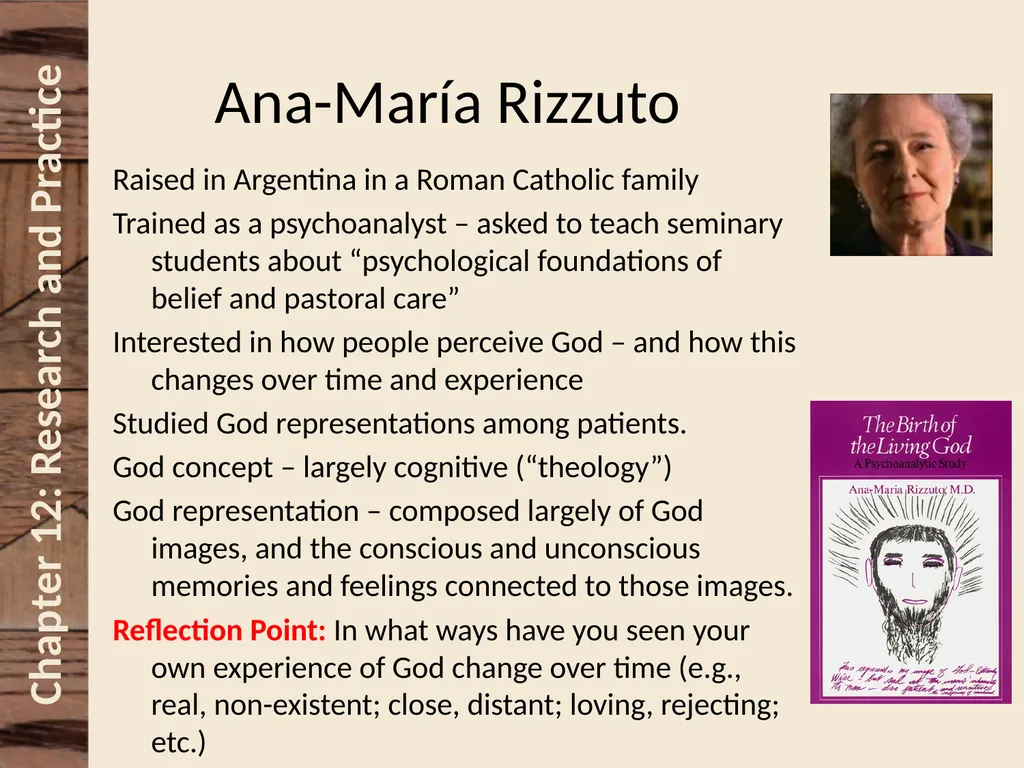
slide13. Ana-María Rizzuto Raised in Argentina in a Roman Catholic family
Trained as a psychoanalyst – asked to teach seminary students about “psychological foundations of belief and pastoral care”
Interested in how people perceive God – and how this changes over time and experience
Studied God representations among patients.
God concept – largely cognitive (“theology”)
God representation – composed largely of God images, and the conscious and unconscious memories and feelings connected to those images.
Reflection Point: In what ways have you seen your own experience of God change over time (e.g., real, non-existent; close, distant; loving, rejecting; etc.)<br>
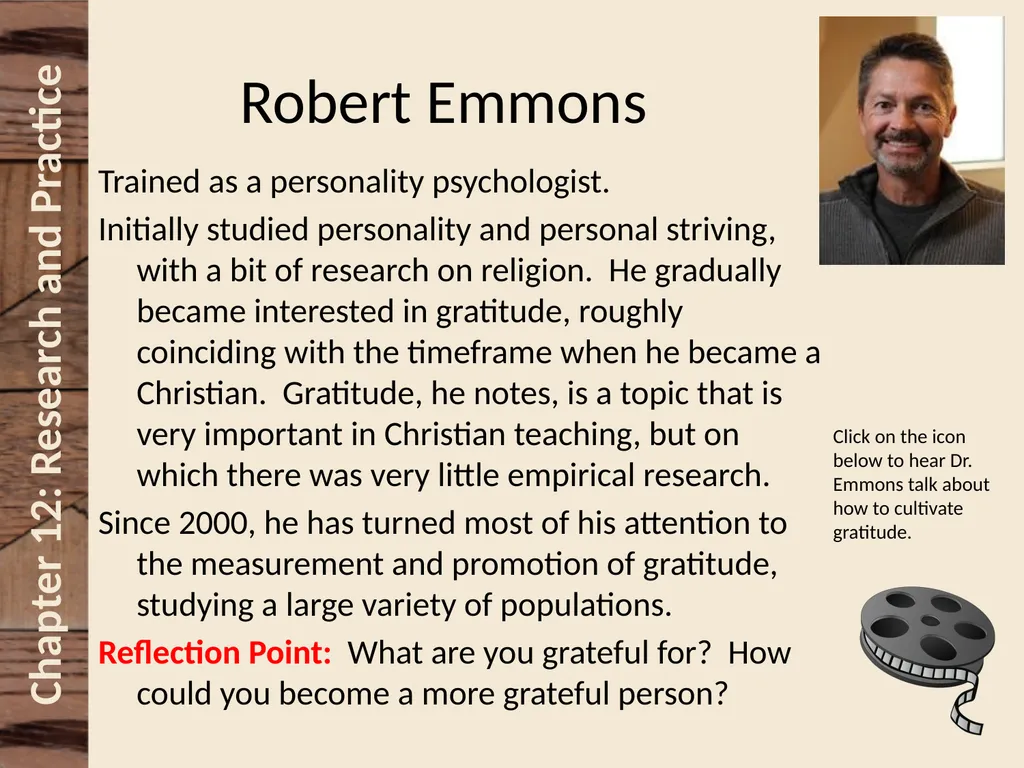
slide14. Robert Emmons Trained as a personality psychologist.
Initially studied personality and personal striving, with a bit of research on religion. He gradually became interested in gratitude, roughly coinciding with the timeframe when he became a Christian. Gratitude, he notes, is a topic that is very important in Christian teaching, but on which there was very little empirical research.
Since 2000, he has turned most of his attention to the measurement and promotion of gratitude, studying a large variety of populations.
Reflection Point: What are you grateful for? How could you become a more grateful person? Click on the icon below to hear Dr. Emmons talk about how to cultivate gratitude.<br>
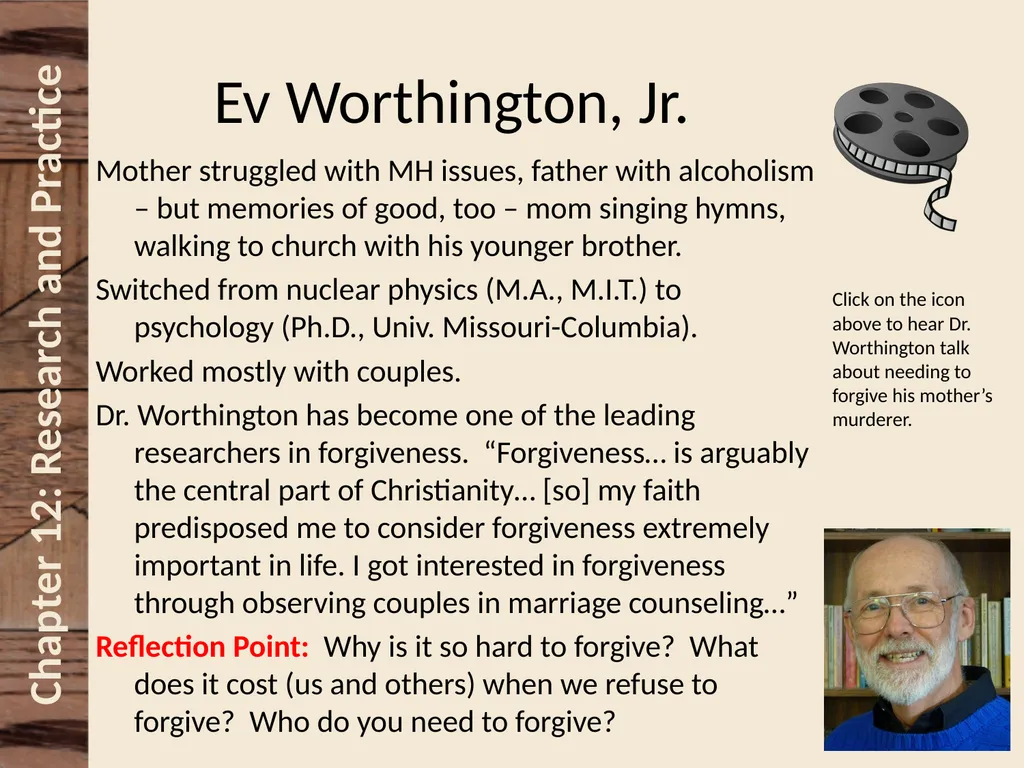
slide15. Ev Worthington, Jr. Mother struggled with MH issues, father with alcoholism – but memories of good, too – mom singing hymns, walking to church with his younger brother.
Switched from nuclear physics (M.A., M.I.T.) to psychology (Ph.D., Univ. Missouri-Columbia).
Worked mostly with couples.
Dr. Worthington has become one of the leading researchers in forgiveness. “Forgiveness… is arguably the central part of Christianity… [so] my faith predisposed me to consider forgiveness extremely important in life. I got interested in forgiveness through observing couples in marriage counseling…”
Reflection Point: Why is it so hard to forgive? What does it cost (us and others) when we refuse to forgive? Who do you need to forgive? Click on the icon above to hear Dr. Worthington talk about needing to forgive his mother’s murderer.<br>
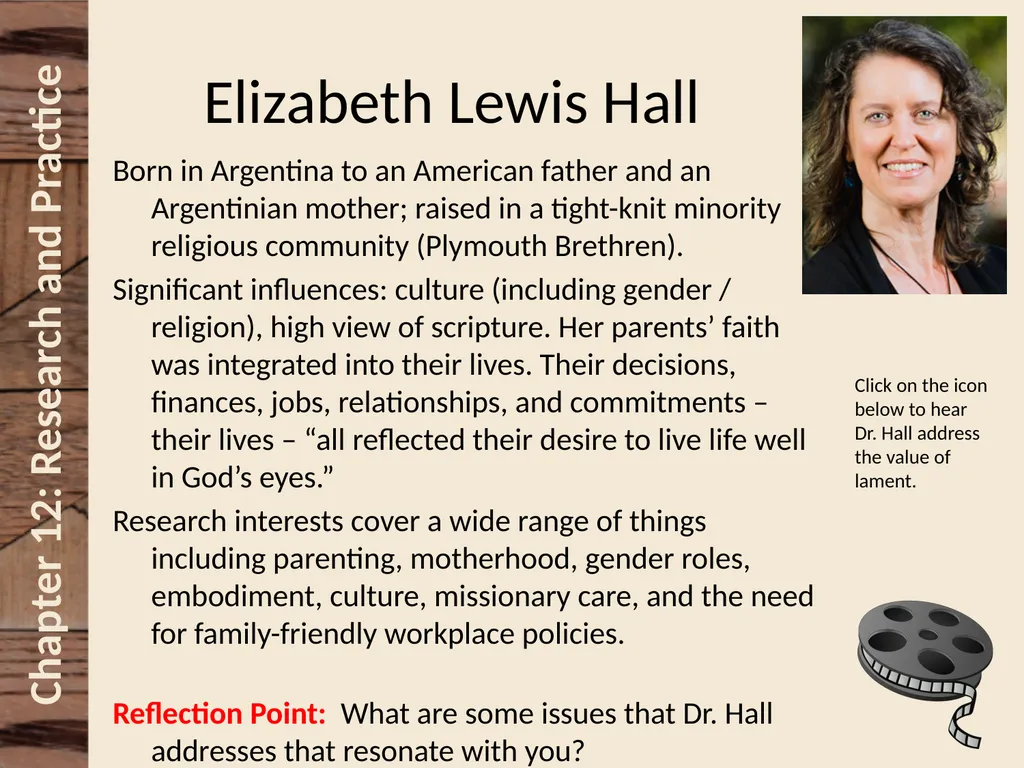
slide16. Elizabeth Lewis Hall Born in Argentina to an American father and an Argentinian mother; raised in a tight-knit minority religious community (Plymouth Brethren).
Significant influences: culture (including gender / religion), high view of scripture. Her parents’ faith was integrated into their lives. Their decisions, finances, jobs, relationships, and commitments – their lives – “all reflected their desire to live life well in God’s eyes.”
Research interests cover a wide range of things including parenting, motherhood, gender roles, embodiment, culture, missionary care, and the need for family-friendly workplace policies.
Reflection Point: What are some issues that Dr. Hall addresses that resonate with you? Click on the icon below to hear Dr. Hall address the value of lament.<br>
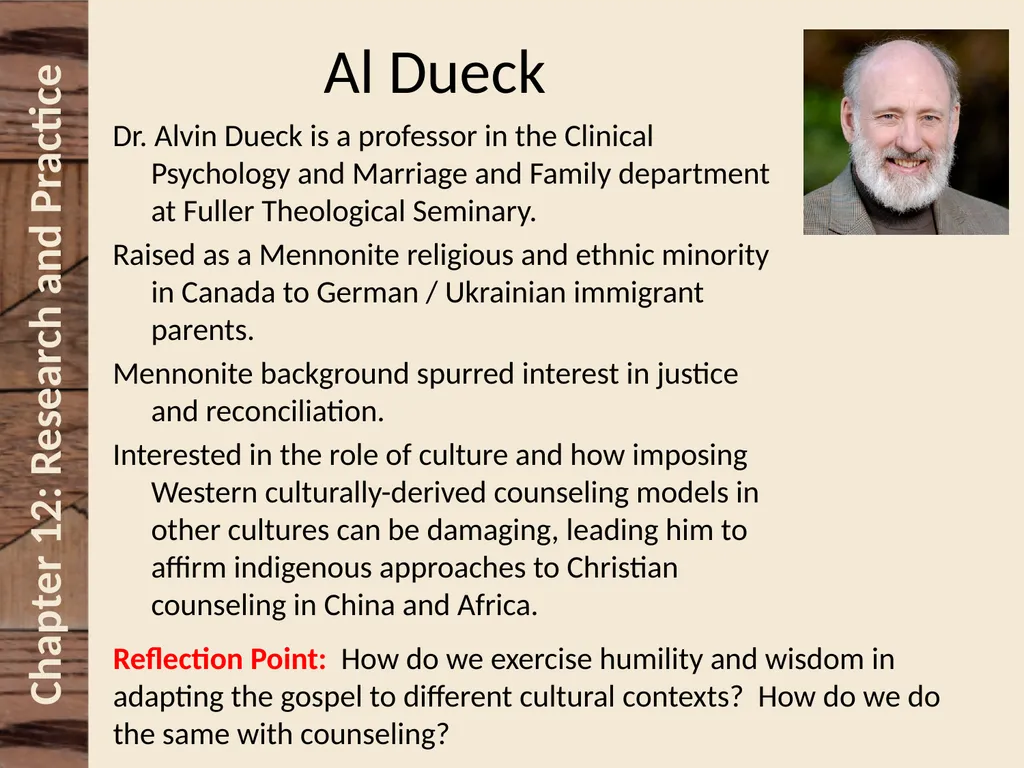
slide17. Al Dueck Dr. Alvin Dueck is a professor in the Clinical Psychology and Marriage and Family department at Fuller Theological Seminary.
Raised as a Mennonite religious and ethnic minority in Canada to German / Ukrainian immigrant parents.
Mennonite background spurred interest in justice and reconciliation.
Interested in the role of culture and how imposing Western culturally-derived counseling models in other cultures can be damaging, leading him to affirm indigenous approaches to Christian counseling in China and Africa. Reflection Point: How do we exercise humility and wisdom in adapting the gospel to different cultural contexts? How do we do the same with counseling?<br>
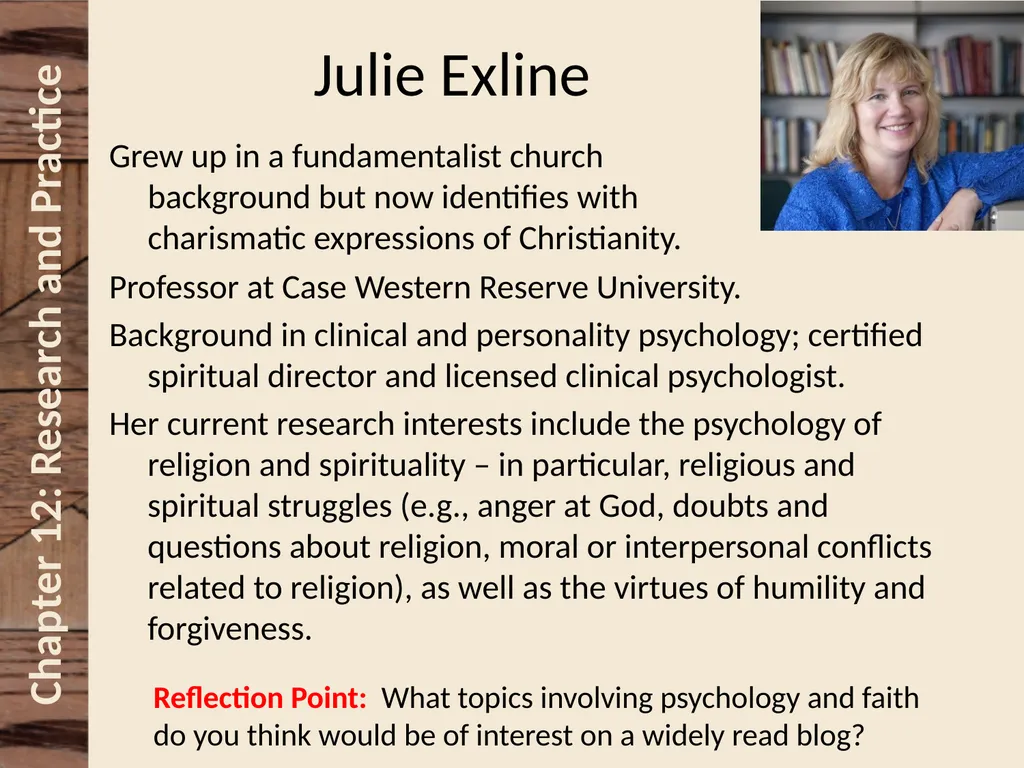
slide18. Julie Exline Grew up in a fundamentalist church background but now identifies with charismatic expressions of Christianity. Reflection Point: What topics involving psychology and faith do you think would be of interest on a widely read blog? Professor at Case Western Reserve University.
Background in clinical and personality psychology; certified spiritual director and licensed clinical psychologist.
Her current research interests include the psychology of religion and spirituality – in particular, religious and spiritual struggles (e.g., anger at God, doubts and questions about religion, moral or interpersonal conflicts related to religion), as well as the virtues of humility and forgiveness.<br>
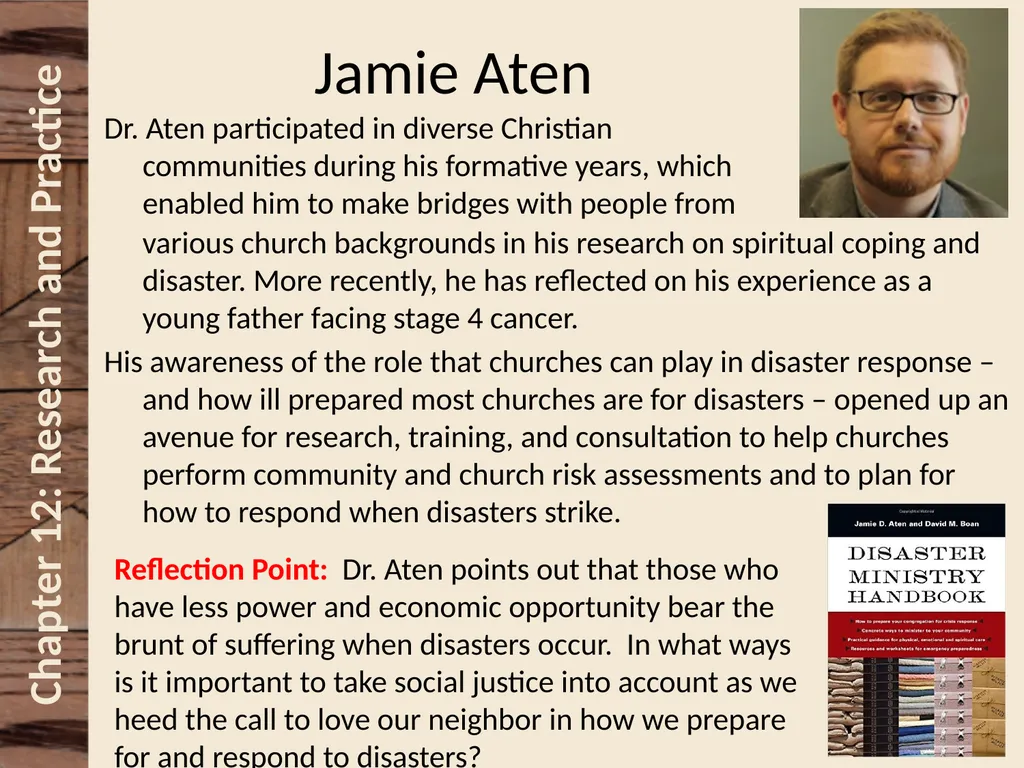
slide19. Jamie Aten Dr. Aten participated in diverse Christian communities during his formative years, which enabled him to make bridges with people from various church backgrounds in his research on spiritual coping and disaster. More recently, he has reflected on his experience as a young father facing stage 4 cancer.
His awareness of the role that churches can play in disaster response – and how ill prepared most churches are for disasters – opened up an avenue for research, training, and consultation to help churches perform community and church risk assessments and to plan for how to respond when disasters strike. Reflection Point: Dr. Aten points out that those who have less power and economic opportunity bear the brunt of suffering when disasters occur. In what ways is it important to take social justice into account as we heed the call to love our neighbor in how we prepare for and respond to disasters?<br>
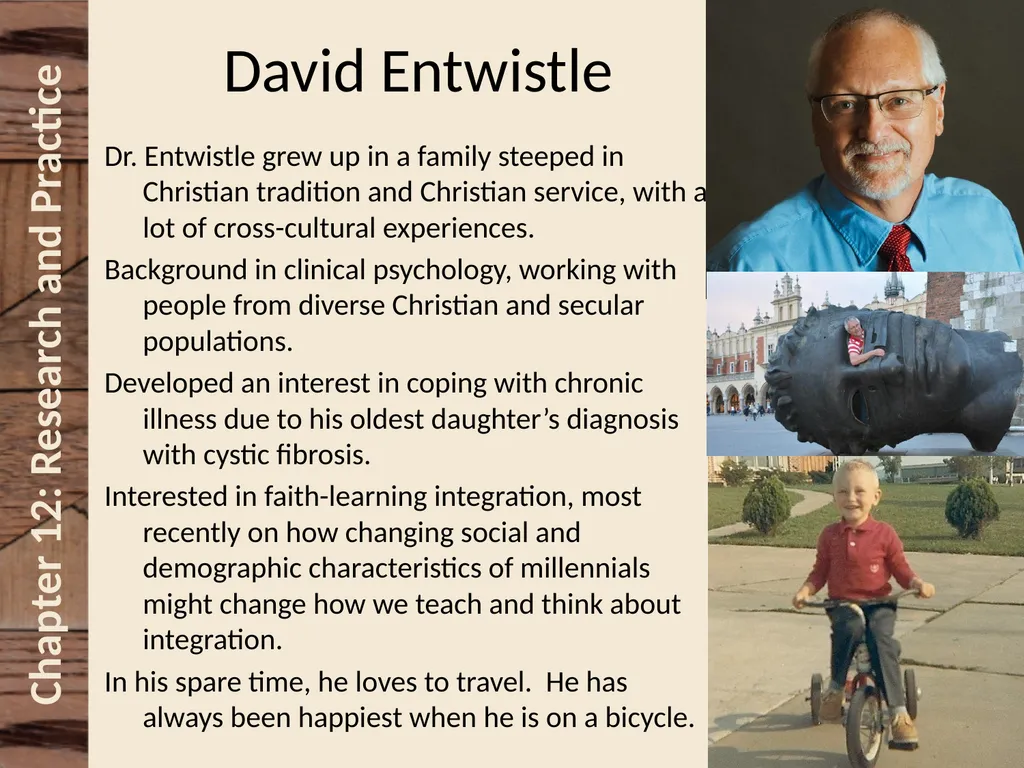
slide20. David Entwistle Dr. Entwistle grew up in a family steeped in Christian tradition and Christian service, with a lot of cross-cultural experiences.
Background in clinical psychology, working with people from diverse Christian and secular populations.
Developed an interest in coping with chronic illness due to his oldest daughter’s diagnosis with cystic fibrosis.
Interested in faith-learning integration, most recently on how changing social and demographic characteristics of millennials might change how we teach and think about integration.
In his spare time, he loves to travel. He has always been happiest when he is on a bicycle.<br>
slide21. Finding Your Place at the Table Julie Exline offers some helpful questions for you to ponder as you discern your place.
Are you more interested in qualitative or quantitative research, theological reflection, or philosophical inquiry?
How much do you want to draw on a specific Christian tradition in your approach to integration? Would working in a faith-based or a secular setting be best for you?
What are the personal skills, strengths, and weaknesses you have that might guide you into (or away from) particular vocational tasks?<br>
slide22. Finding Your Place at the Table Julie Exline offers some helpful questions for you to ponder as you discern your place.
What wounds (“hurts, disappointments, or offenses”) from your past might be areas that need to be healed or forgiven so that they don’t block your effectiveness and satisfaction?
What are you passionate about? How can you use your passions and interests to motivate research or clinical work? Reflection Point: As you reflect on your gifts and talents, what questions, methods, and populations are you drawn to?<br>
slide23. Who among you is willing to join the conversation?
Who among you will become leaders in relating the Christian faith to the field of psychology? Reflection Point: What topics or activities are you interested in that could move the conversation about Christianity and psychology forward?<br>
Finding Your Place
David N. Entwistle, PsyD
These slides are designed to accompany Integrative Approaches to Psychology and Christianity, 4th ed.
Material protected by copy write. Users are welcome to make changes to the presentations and to use them for educational purposes, provided that the original acknowledgement is maintained and any changes to the presentation clearly identified. Integrative Approaches to Psychology and Christianity – 4th ed.<br>
slide2. PowerPoint Slides to Accompany Integrative Approaches to Psychology and Christianity, 4th Edition Chapter 13 Finding Your Place<br>
slide3. Setting the table Food is a huge part of culture – the seasonings that we use, the way that we present and share dishes, the foods that we celebrate, and so forth. In what ways is the culinary and cultural diversity of a shared meal an apt metaphor for the diverse ways that people integrate psychology and Christianity?
Top left: Polish krokriety – cabbage, mushroom, sausage, and onion crepes
Top right: American apple pie – apples baked in a pastry crust<br>
slide4. A variety of Christian worldviews reflect somewhat different social circumstances, geographical and historical settings, and diverse viewpoints about what it means to be a Christian. While most Christians share large portions of a basic Christian worldview, there are clearly differences across subgroups. These views are passed on through daily practices of interaction, education, and ritual.<br>
slide5. Christian Traditions and Integration “Obviously there are large differences between various forms of Christianity . . . What does this pluralism imply for the project of integration? I would say two things: The project of integrating Christianity into psychology is itself pluralistic, and different Christians, who may be equally faithful to their Christian callings, may disagree about the implications of Christian faith for various issues in psychology.
Nonetheless, faithful Christians can hope to find enough common ground in ‘mere Christianity’ to constitute a genuine community that can make progress.”
C. Stephen Evans, Doing psychology as a Christian, 33. C. Stephen Evans
Photo credit: Baylor University.<br>
slide6. Tradition Saturated Integration creation, fall, redemption, consummation.
Largely the view taken in this book.
Wolterstorff’s idea that “control beliefs” should shape how we bring life and thinking into harmony with Christianity
His idea that we need to reject theories that cannot be reconciled with such “control beliefs” Reformed perspectives
Emphasizes scholarship framed by a Christian worldview: Nicholas Wolterstorff
Photo credit: Wikimedia, public domain.<br>
slide7. Tradition Saturated Integration The Wesleyan Quadrilateral Wesleyan perspectives
John and Charles Wesley
Sanctification and reorientation of disordered desires are important themes. John Wesley (lt) and Charles Wesley (rt)
Photo credit: “Early Methodist leaders, Charles Wesley and John Wesley” stained glass, the Memorial Chapel, Lake Junaluska, North Carolina.
Public domain.<br>
slide8. Tradition Saturated Integration Emphasis on experience and care rather than on abstract theology.
Importance of “testimonies”
“Spiritual warfare” and “healing of memories” – prayer for God to bring healing for troubling memories – comes out of this tradition. Charismatic / Pentecostal perspectives
Emphasizes revivalism, holiness, prophecy, healing, activity of the Holy Spirit<br>
slide9. Tradition Saturated Integration We are shaped by liturgical celebration and sacraments
Liturgical calendar
Emphasizes both doctrine and social justice
Concord of faith and reason
Respect for tradition
Sacramental nature of all of life
Sanctity of life
Inclusivity Roman Catholic perspectives
Numerous emphases: Chi-Rho monogram of Christ, Museo Pio Cristiano, Vatican, Public Domain.<br>
slide10. Liturgy Today, the most common understanding of liturgy is the formal repetition of religious acts as a part of worship.
Another understanding of liturgy is that liturgy is composed of customary repertoires of ideas, phrases, or observances that orient our lives.
How is a trip to the mall a liturgical experience?<br>
slide11. Tradition Saturated Integration CPS service during WW-II, and interest in psychiatric reform following the war.
The Mennonite model emphasizes faith and living more than faith and learning. Anabaptist perspectives
A diverse group with some shared history; most emphasize adult baptism, pacifism, some form of separation from the world, service to others, and community. Philhaven Hospital (below) in Mt. Gretna, PA was founded by Mennonites in 1952 as a 26-bed inpatient hospital, it now has 11 satellite locations.<br>
slide12. From Tradition to Personal Experience We are shaped by our personal experiences as well as by our religious traditions.
In the following slides, we will look at how different experiences and different traditions have led people to think about how faith and psychology interact in a variety of ways.<br>
slide13. Ana-María Rizzuto Raised in Argentina in a Roman Catholic family
Trained as a psychoanalyst – asked to teach seminary students about “psychological foundations of belief and pastoral care”
Interested in how people perceive God – and how this changes over time and experience
Studied God representations among patients.
God concept – largely cognitive (“theology”)
God representation – composed largely of God images, and the conscious and unconscious memories and feelings connected to those images.
Reflection Point: In what ways have you seen your own experience of God change over time (e.g., real, non-existent; close, distant; loving, rejecting; etc.)<br>
slide14. Robert Emmons Trained as a personality psychologist.
Initially studied personality and personal striving, with a bit of research on religion. He gradually became interested in gratitude, roughly coinciding with the timeframe when he became a Christian. Gratitude, he notes, is a topic that is very important in Christian teaching, but on which there was very little empirical research.
Since 2000, he has turned most of his attention to the measurement and promotion of gratitude, studying a large variety of populations.
Reflection Point: What are you grateful for? How could you become a more grateful person? Click on the icon below to hear Dr. Emmons talk about how to cultivate gratitude.<br>
slide15. Ev Worthington, Jr. Mother struggled with MH issues, father with alcoholism – but memories of good, too – mom singing hymns, walking to church with his younger brother.
Switched from nuclear physics (M.A., M.I.T.) to psychology (Ph.D., Univ. Missouri-Columbia).
Worked mostly with couples.
Dr. Worthington has become one of the leading researchers in forgiveness. “Forgiveness… is arguably the central part of Christianity… [so] my faith predisposed me to consider forgiveness extremely important in life. I got interested in forgiveness through observing couples in marriage counseling…”
Reflection Point: Why is it so hard to forgive? What does it cost (us and others) when we refuse to forgive? Who do you need to forgive? Click on the icon above to hear Dr. Worthington talk about needing to forgive his mother’s murderer.<br>
slide16. Elizabeth Lewis Hall Born in Argentina to an American father and an Argentinian mother; raised in a tight-knit minority religious community (Plymouth Brethren).
Significant influences: culture (including gender / religion), high view of scripture. Her parents’ faith was integrated into their lives. Their decisions, finances, jobs, relationships, and commitments – their lives – “all reflected their desire to live life well in God’s eyes.”
Research interests cover a wide range of things including parenting, motherhood, gender roles, embodiment, culture, missionary care, and the need for family-friendly workplace policies.
Reflection Point: What are some issues that Dr. Hall addresses that resonate with you? Click on the icon below to hear Dr. Hall address the value of lament.<br>
slide17. Al Dueck Dr. Alvin Dueck is a professor in the Clinical Psychology and Marriage and Family department at Fuller Theological Seminary.
Raised as a Mennonite religious and ethnic minority in Canada to German / Ukrainian immigrant parents.
Mennonite background spurred interest in justice and reconciliation.
Interested in the role of culture and how imposing Western culturally-derived counseling models in other cultures can be damaging, leading him to affirm indigenous approaches to Christian counseling in China and Africa. Reflection Point: How do we exercise humility and wisdom in adapting the gospel to different cultural contexts? How do we do the same with counseling?<br>
slide18. Julie Exline Grew up in a fundamentalist church background but now identifies with charismatic expressions of Christianity. Reflection Point: What topics involving psychology and faith do you think would be of interest on a widely read blog? Professor at Case Western Reserve University.
Background in clinical and personality psychology; certified spiritual director and licensed clinical psychologist.
Her current research interests include the psychology of religion and spirituality – in particular, religious and spiritual struggles (e.g., anger at God, doubts and questions about religion, moral or interpersonal conflicts related to religion), as well as the virtues of humility and forgiveness.<br>
slide19. Jamie Aten Dr. Aten participated in diverse Christian communities during his formative years, which enabled him to make bridges with people from various church backgrounds in his research on spiritual coping and disaster. More recently, he has reflected on his experience as a young father facing stage 4 cancer.
His awareness of the role that churches can play in disaster response – and how ill prepared most churches are for disasters – opened up an avenue for research, training, and consultation to help churches perform community and church risk assessments and to plan for how to respond when disasters strike. Reflection Point: Dr. Aten points out that those who have less power and economic opportunity bear the brunt of suffering when disasters occur. In what ways is it important to take social justice into account as we heed the call to love our neighbor in how we prepare for and respond to disasters?<br>
slide20. David Entwistle Dr. Entwistle grew up in a family steeped in Christian tradition and Christian service, with a lot of cross-cultural experiences.
Background in clinical psychology, working with people from diverse Christian and secular populations.
Developed an interest in coping with chronic illness due to his oldest daughter’s diagnosis with cystic fibrosis.
Interested in faith-learning integration, most recently on how changing social and demographic characteristics of millennials might change how we teach and think about integration.
In his spare time, he loves to travel. He has always been happiest when he is on a bicycle.<br>
slide21. Finding Your Place at the Table Julie Exline offers some helpful questions for you to ponder as you discern your place.
Are you more interested in qualitative or quantitative research, theological reflection, or philosophical inquiry?
How much do you want to draw on a specific Christian tradition in your approach to integration? Would working in a faith-based or a secular setting be best for you?
What are the personal skills, strengths, and weaknesses you have that might guide you into (or away from) particular vocational tasks?<br>
slide22. Finding Your Place at the Table Julie Exline offers some helpful questions for you to ponder as you discern your place.
What wounds (“hurts, disappointments, or offenses”) from your past might be areas that need to be healed or forgiven so that they don’t block your effectiveness and satisfaction?
What are you passionate about? How can you use your passions and interests to motivate research or clinical work? Reflection Point: As you reflect on your gifts and talents, what questions, methods, and populations are you drawn to?<br>
slide23. Who among you is willing to join the conversation?
Who among you will become leaders in relating the Christian faith to the field of psychology? Reflection Point: What topics or activities are you interested in that could move the conversation about Christianity and psychology forward?<br>