
Chapter 14 Futures Valuation and Hedging By Cheng
MJ
Published · 54 slides · 0 views

1 / 1



Description
Chapter 14 Futures Valuation and Hedging By Cheng Few Lee Joseph Finnerty John Lee Alice C Lee Donald Wort Outline 14.1 FUTURES VERSUS FORWARD MARKETS 14.2 FUTURES MARKETS: OVERVIEW 14.3 COMPONENTS AND MECHANICS OF FUTURES MARKETS 14.4 THE
Related Topics
Share
Embed code
Download this presentation From Below
"Chapter 14 Futures Valuation and Hedging By Cheng" is the property of its rightful owner. Permission is granted to download and print the materials on this website for personal, non-commercial use only, and to display it on your personal computer provided you do not modify the materials and that you retain all copyright notices contained in the materials. By downloading content from our website, you accept the terms of this agreement.
Presentation Transcript
01
Chapter 14 Futures Valuation and Hedging By
Cheng Few Lee
Joseph Finnerty
John Lee
Alice C Lee
Donald Wort<br>
Cheng Few Lee
Joseph Finnerty
John Lee
Alice C Lee
Donald Wort<br>
02
Outline 14.1 FUTURES VERSUS FORWARD MARKETS
14.2 FUTURES MARKETS: OVERVIEW
14.3 COMPONENTS AND MECHANICS OF FUTURES MARKETS
14.4 THE VALUATION OF FUTURES CONTRACTS
14.5 HEDGING CONCEPTS AND STRATEGIES
14.6 SUMMARY 2<br>
14.2 FUTURES MARKETS: OVERVIEW
14.3 COMPONENTS AND MECHANICS OF FUTURES MARKETS
14.4 THE VALUATION OF FUTURES CONTRACTS
14.5 HEDGING CONCEPTS AND STRATEGIES
14.6 SUMMARY 2<br>
03
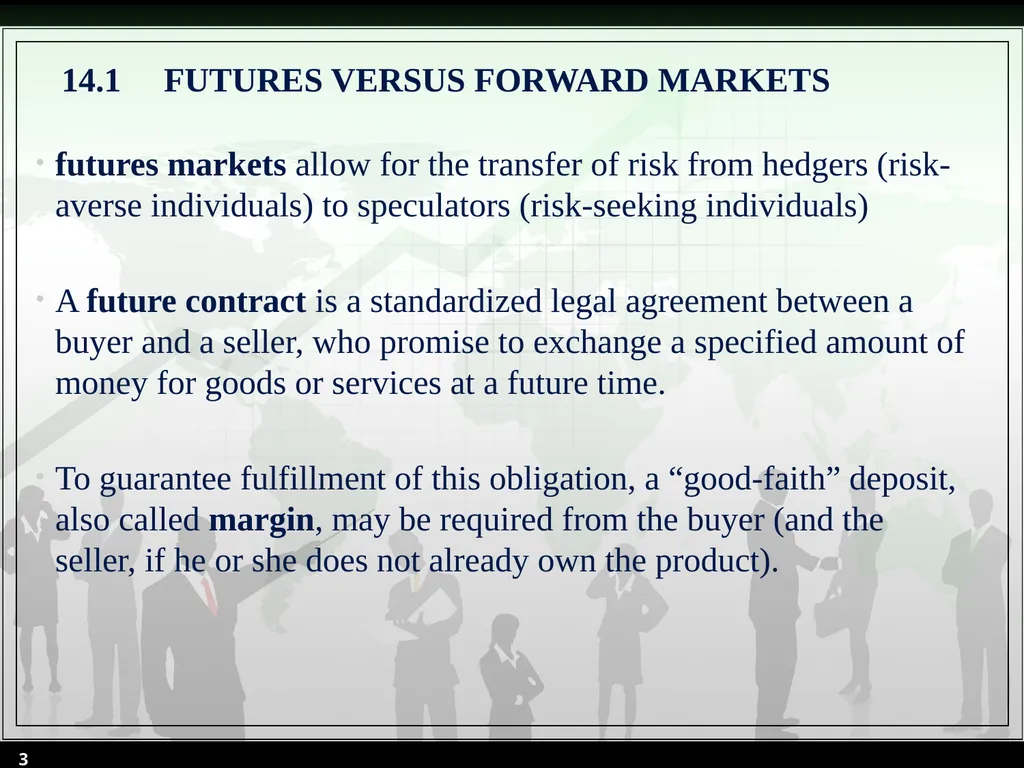
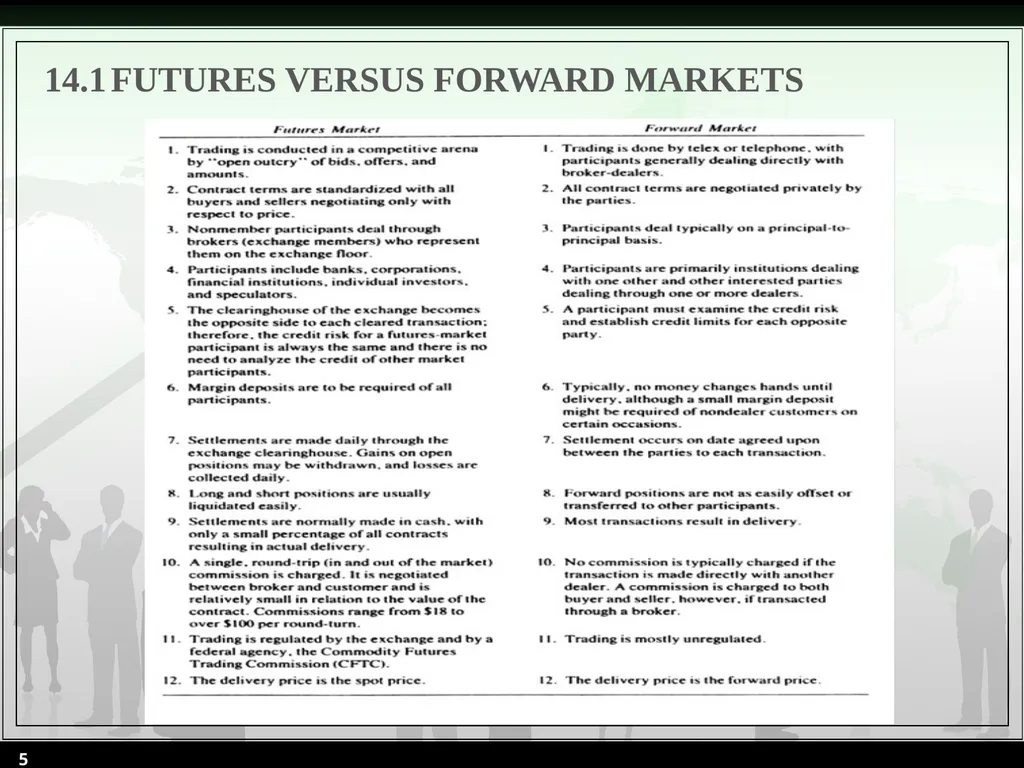
14.1 FUTURES VERSUS FORWARD MARKETS futures markets allow for the transfer of risk from hedgers (risk-averse individuals) to speculators (risk-seeking individuals)
A future contract is a standardized legal agreement between a buyer and a seller, who promise to exchange a specified amount of money for goods or services at a future time.
To guarantee fulfillment of this obligation, a “good-faith” deposit, also called margin, may be required from the buyer (and the seller, if he or she does not already own the product). 3<br>
A future contract is a standardized legal agreement between a buyer and a seller, who promise to exchange a specified amount of money for goods or services at a future time.
To guarantee fulfillment of this obligation, a “good-faith” deposit, also called margin, may be required from the buyer (and the seller, if he or she does not already own the product). 3<br>
04
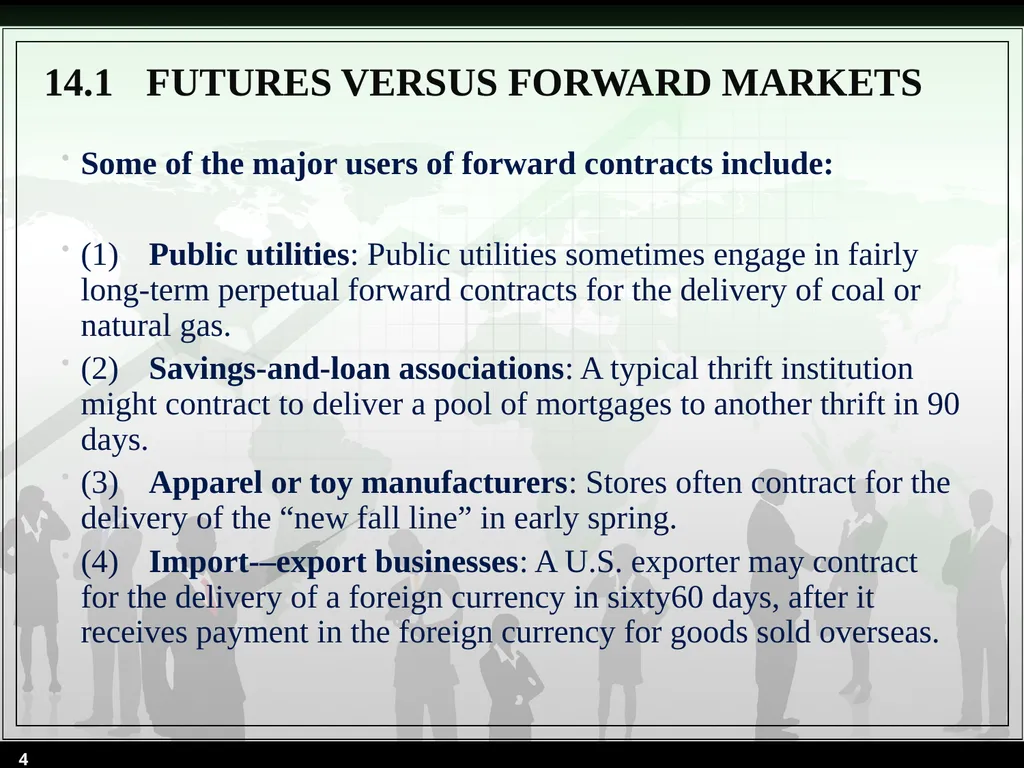
Some of the major users of forward contracts include:
(1) Public utilities: Public utilities sometimes engage in fairly long-term perpetual forward contracts for the delivery of coal or natural gas.
(2) Savings-and-loan associations: A typical thrift institution might contract to deliver a pool of mortgages to another thrift in 90 days.
(3) Apparel or toy manufacturers: Stores often contract for the delivery of the “new fall line” in early spring.
(4) Import-–export businesses: A U.S. exporter may contract for the delivery of a foreign currency in sixty60 days, after it receives payment in the foreign currency for goods sold overseas. 14.1 FUTURES VERSUS FORWARD MARKETS 4<br>
(1) Public utilities: Public utilities sometimes engage in fairly long-term perpetual forward contracts for the delivery of coal or natural gas.
(2) Savings-and-loan associations: A typical thrift institution might contract to deliver a pool of mortgages to another thrift in 90 days.
(3) Apparel or toy manufacturers: Stores often contract for the delivery of the “new fall line” in early spring.
(4) Import-–export businesses: A U.S. exporter may contract for the delivery of a foreign currency in sixty60 days, after it receives payment in the foreign currency for goods sold overseas. 14.1 FUTURES VERSUS FORWARD MARKETS 4<br>
05
14.1 FUTURES VERSUS FORWARD MARKETS 5<br>
06
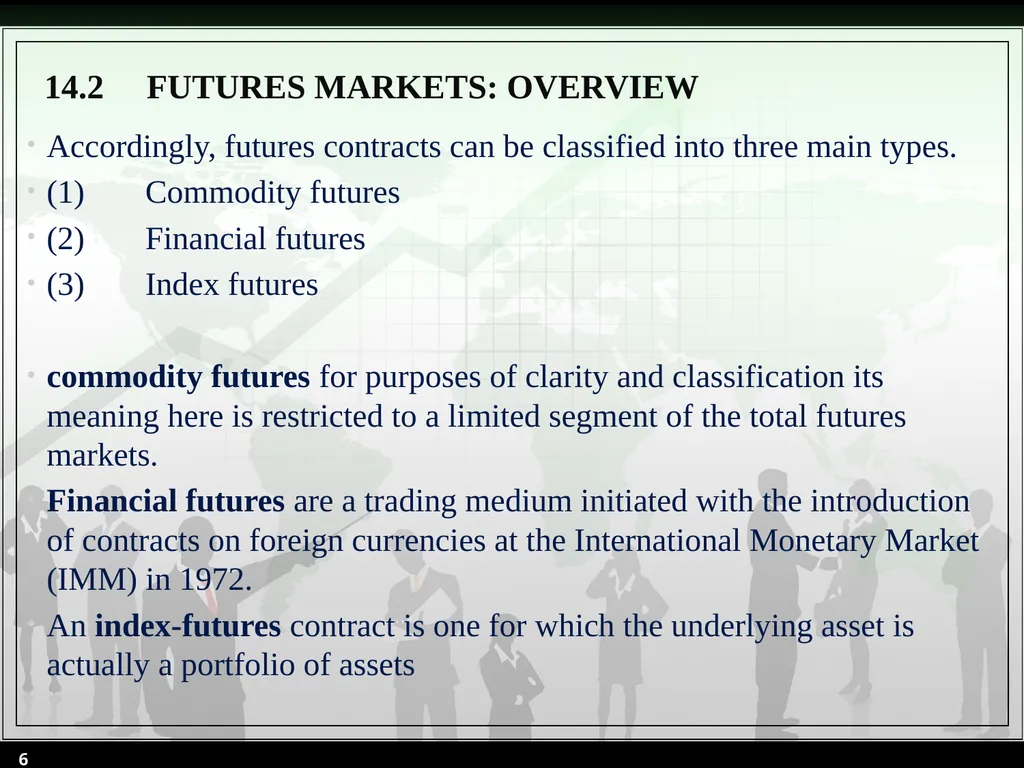
Accordingly, futures contracts can be classified into three main types.
(1) Commodity futures
(2) Financial futures
(3) Index futures
commodity futures for purposes of clarity and classification its meaning here is restricted to a limited segment of the total futures markets.
Financial futures are a trading medium initiated with the introduction of contracts on foreign currencies at the International Monetary Market (IMM) in 1972.
An index-futures contract is one for which the underlying asset is actually a portfolio of assets 14.2 FUTURES MARKETS: OVERVIEW 6<br>
(1) Commodity futures
(2) Financial futures
(3) Index futures
commodity futures for purposes of clarity and classification its meaning here is restricted to a limited segment of the total futures markets.
Financial futures are a trading medium initiated with the introduction of contracts on foreign currencies at the International Monetary Market (IMM) in 1972.
An index-futures contract is one for which the underlying asset is actually a portfolio of assets 14.2 FUTURES MARKETS: OVERVIEW 6<br>
07
Futures-market participants are divided into two broad classes: hedgers and speculators.
Hedging refers to a futures-market transaction made as a temporary substitute for a cash-market transaction to be made at a later date.
Futures market speculation involves taking a short or long futures position solely to profit from price changes. 14.2 FUTURES MARKETS: OVERVIEW 7<br>
Hedging refers to a futures-market transaction made as a temporary substitute for a cash-market transaction to be made at a later date.
Futures market speculation involves taking a short or long futures position solely to profit from price changes. 14.2 FUTURES MARKETS: OVERVIEW 7<br>
08
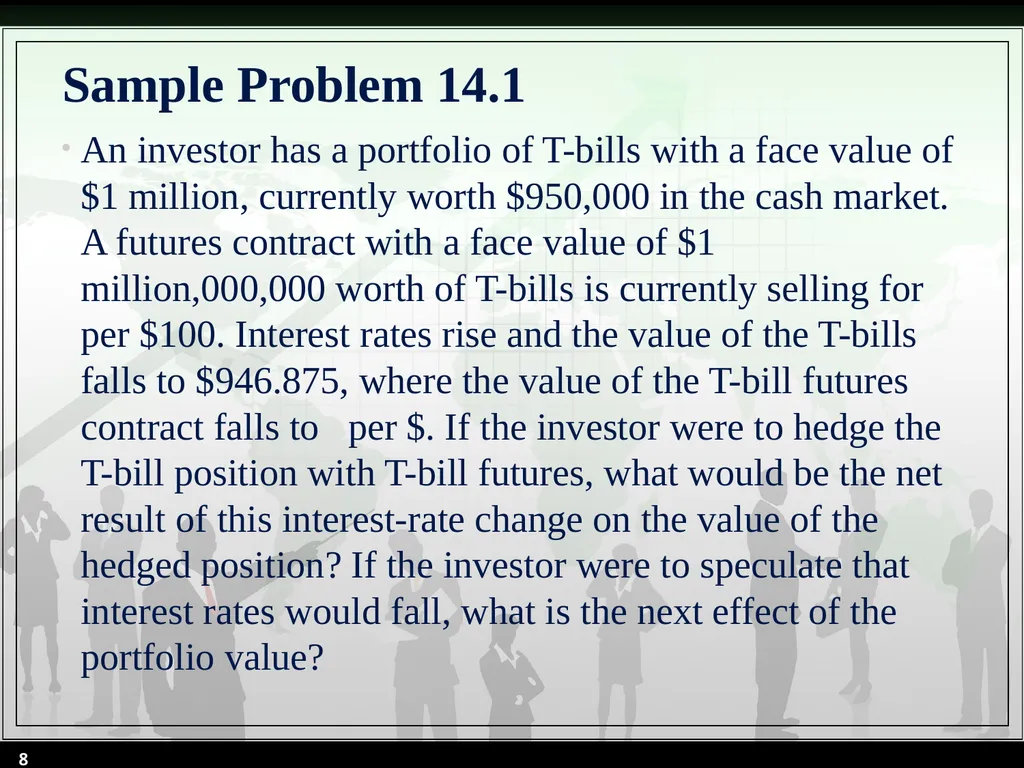
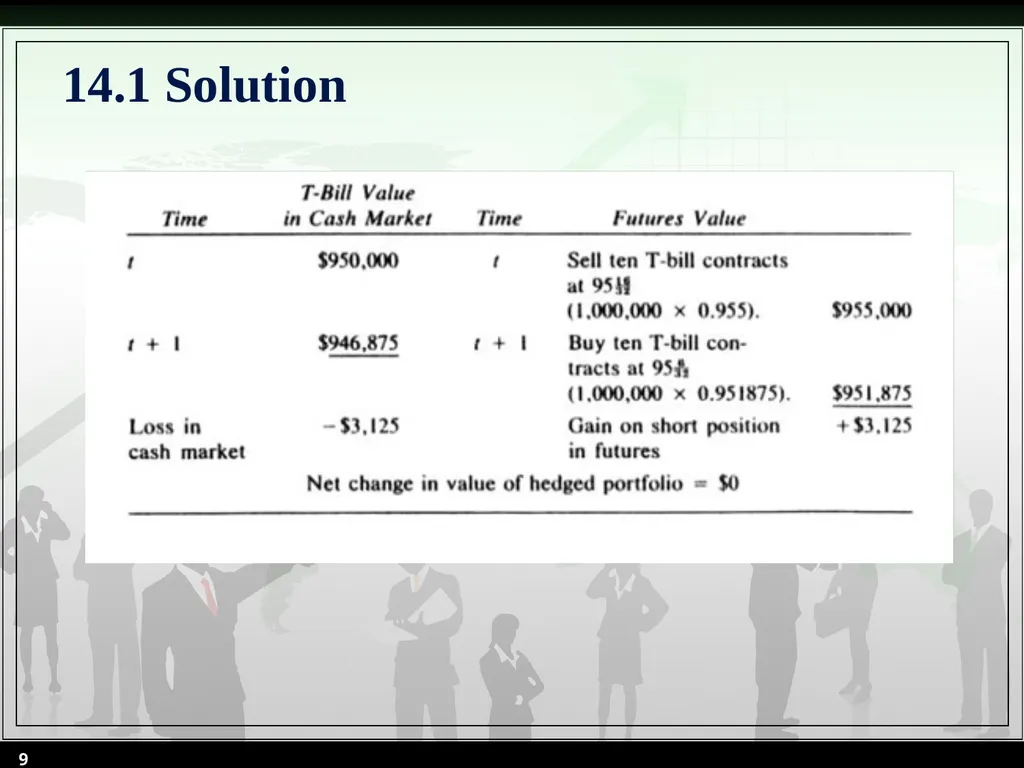
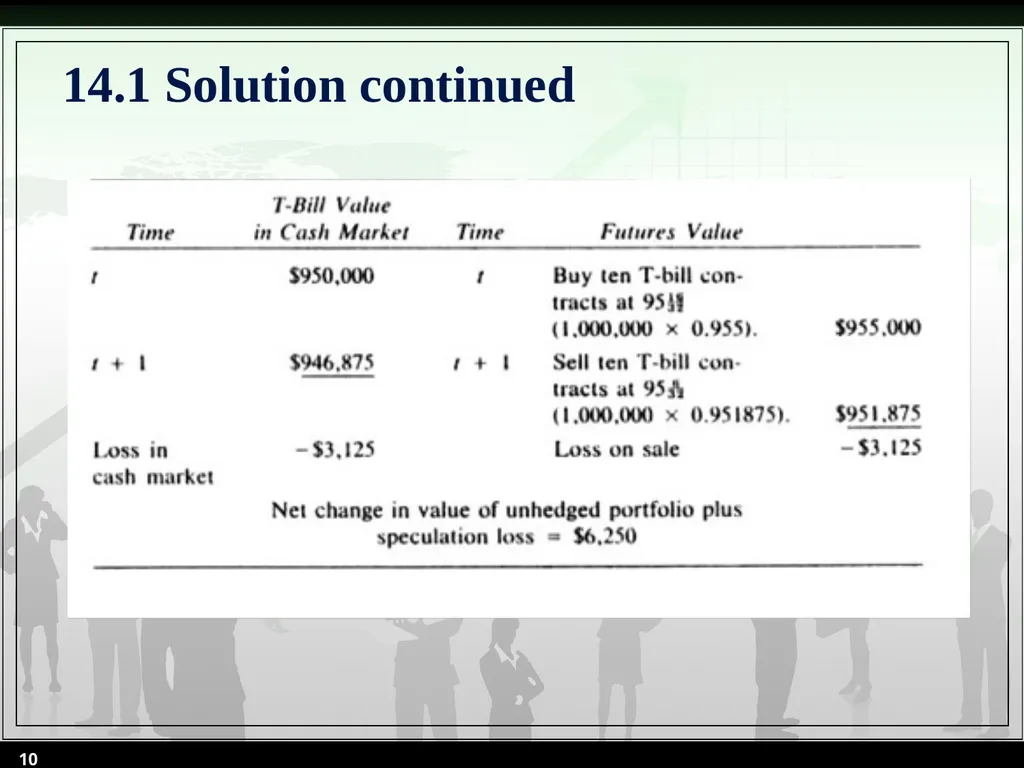
Sample Problem 14.1 An investor has a portfolio of T-bills with a face value of $1 million, currently worth $950,000 in the cash market. A futures contract with a face value of $1 million,000,000 worth of T-bills is currently selling for per $100. Interest rates rise and the value of the T-bills falls to $946.875, where the value of the T-bill futures contract falls to per $. If the investor were to hedge the T-bill position with T-bill futures, what would be the net result of this interest-rate change on the value of the hedged position? If the investor were to speculate that interest rates would fall, what is the next effect of the portfolio value? 8<br>
09
14.1 Solution 9<br>
10
14.1 Solution continued 10<br>
11
14.3 COMPONENTS AND MECHANICS OF FUTURES MARKETS This chapter discusses:
Exchanges
Clearinghouse
Margin
Order execution
T-bill futures transactions 11<br>
Exchanges
Clearinghouse
Margin
Order execution
T-bill futures transactions 11<br>
12
14.3.1 The Exchanges A futures exchange, just like a stock exchange, is the arena for the actual daily trade. Members include individual traders, brokerage firms, and other types of institutions. The exchange’s governing rules and procedures are determined by its members, who serve on various policy committees and elect the officers of the exchanging of futures contracts. 12<br>
13
14.3.2 The Clearinghouse Central to the operation of organized futures markets is the clearinghouse or clearing corporation for the exchange. Whenever someone enters a position in a futures contract on the long or short side, the clearinghouse always takes the opposite side of the contract.
The advantages of having a central organization providing this role are threefold.
(1) The clearinghouse eliminates concern over the creditworthiness of the party on the other side of the transaction.
(2) It frees the original trading partners from the obligation of delivery or offset with each other.
(3) It provides greater flexibility in opening or closing a position. 13<br>
The advantages of having a central organization providing this role are threefold.
(1) The clearinghouse eliminates concern over the creditworthiness of the party on the other side of the transaction.
(2) It frees the original trading partners from the obligation of delivery or offset with each other.
(3) It provides greater flexibility in opening or closing a position. 13<br>
14
14.3.3 Margin Whenever someone enters into a contract position in the futures market, a security deposit, commonly called a margin requirement, must be paid.
marking to market –adjustments where every futures-trading account is incremented or reduced by the corresponding increase or decrease in the value of all open futures positions at the end of each trading day.
maintenance margin- the additional sum that a clearing member firm will usually require to be deposited at the initiation of any futures position 14<br>
marking to market –adjustments where every futures-trading account is incremented or reduced by the corresponding increase or decrease in the value of all open futures positions at the end of each trading day.
maintenance margin- the additional sum that a clearing member firm will usually require to be deposited at the initiation of any futures position 14<br>
15
14.3.4 Order Execution Each order to buy and sell futures contracts comes to the exchange floor either by telephone or by a computerized order-entry system. The person receiving the order is called a phone clerk. The phone clerk then hands the order to a runner, who relays it to the appropriate trading area or pit, to the floor broker.
When the order is executed, the floor broker endorses its time, price, and size while a specially trained employee of the exchange, the pit observer, records the price for immediate entry into the exchange’s computerized price-reporting system. 15<br>
When the order is executed, the floor broker endorses its time, price, and size while a specially trained employee of the exchange, the pit observer, records the price for immediate entry into the exchange’s computerized price-reporting system. 15<br>
16
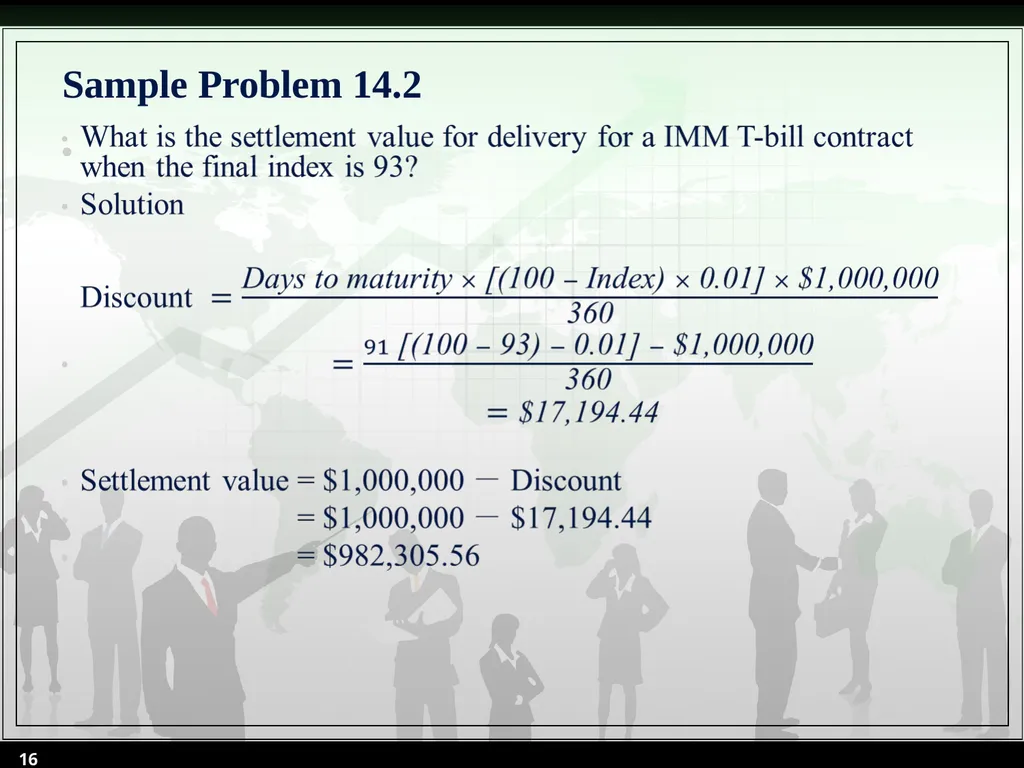
Sample Problem 14.2 16<br>
17
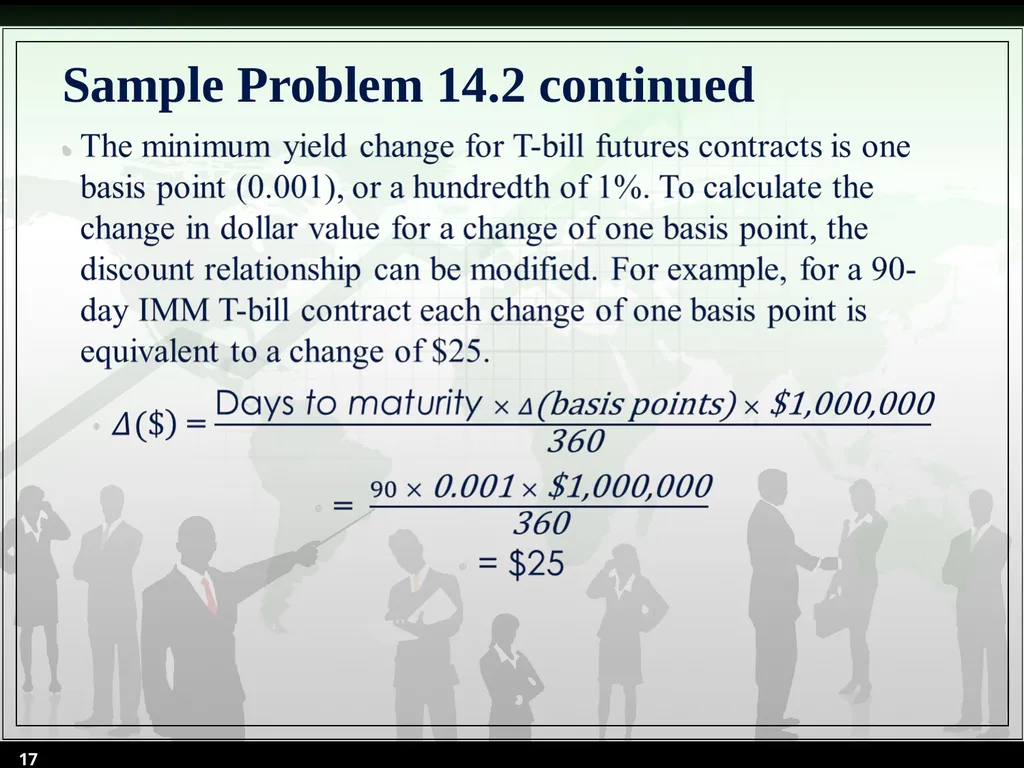
Sample Problem 14.2 continued 17<br>
18
14.4 THE VALUATION OF FUTURES CONTRACTS The discussions of each of the three classifications of futures contracts have pointed out pricing idiosyncrasies and have examined specific pricing models for particular types of contracts. Nevertheless, the underlying tenets of any particular pricing model have their roots in a more general theoretical framework of valuation. 18<br>
19
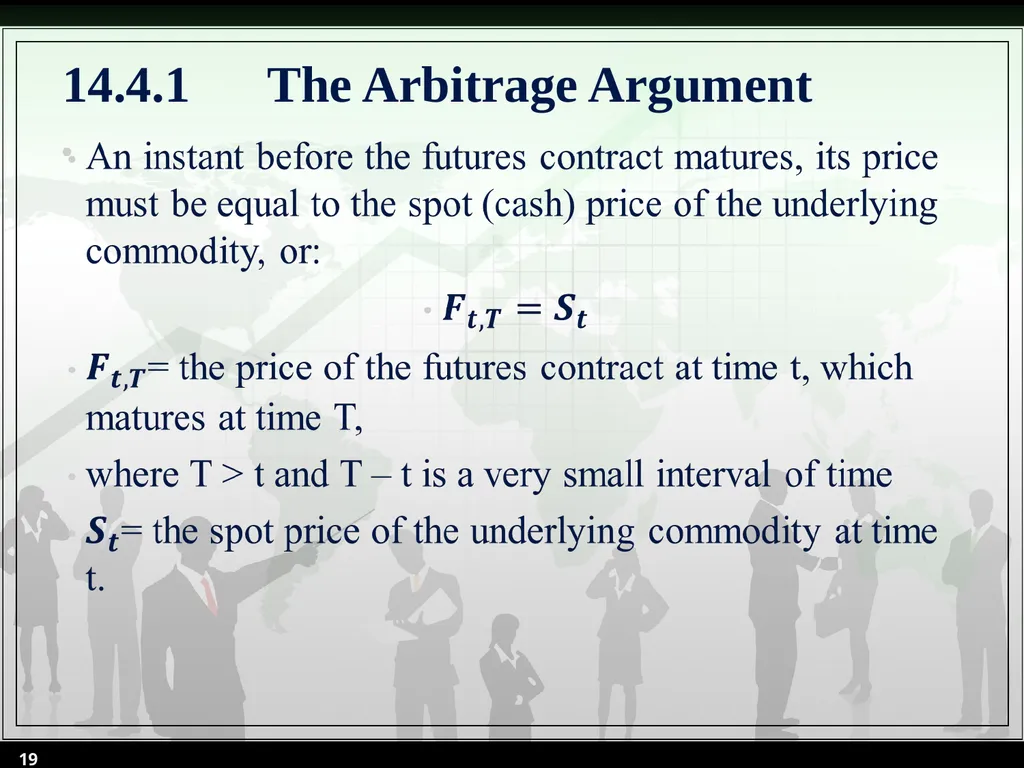
14.4.1 The Arbitrage Argument 19<br>
20
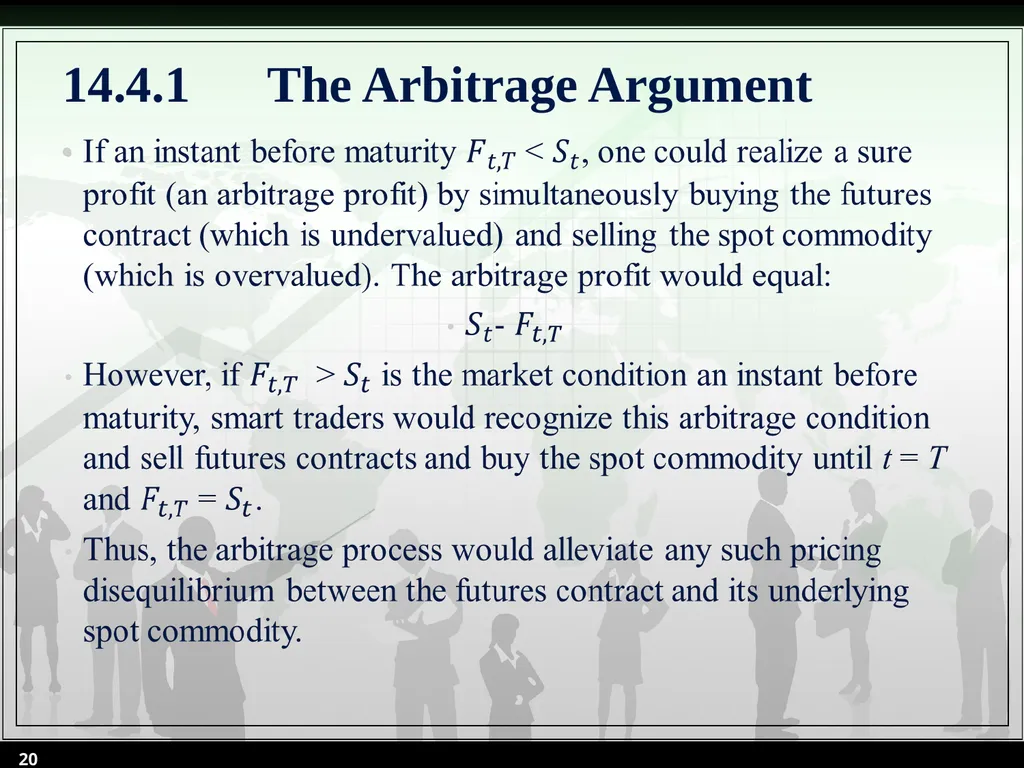
14.4.1 The Arbitrage Argument 20<br>
21
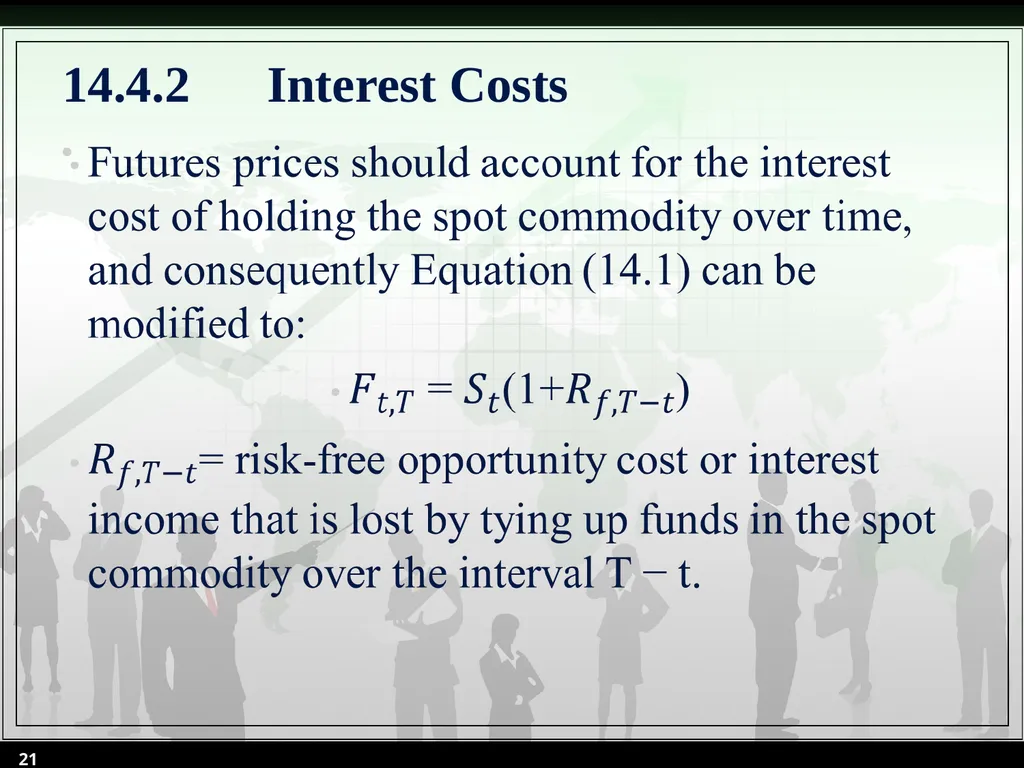
14.4.2 Interest Costs 21<br>
22
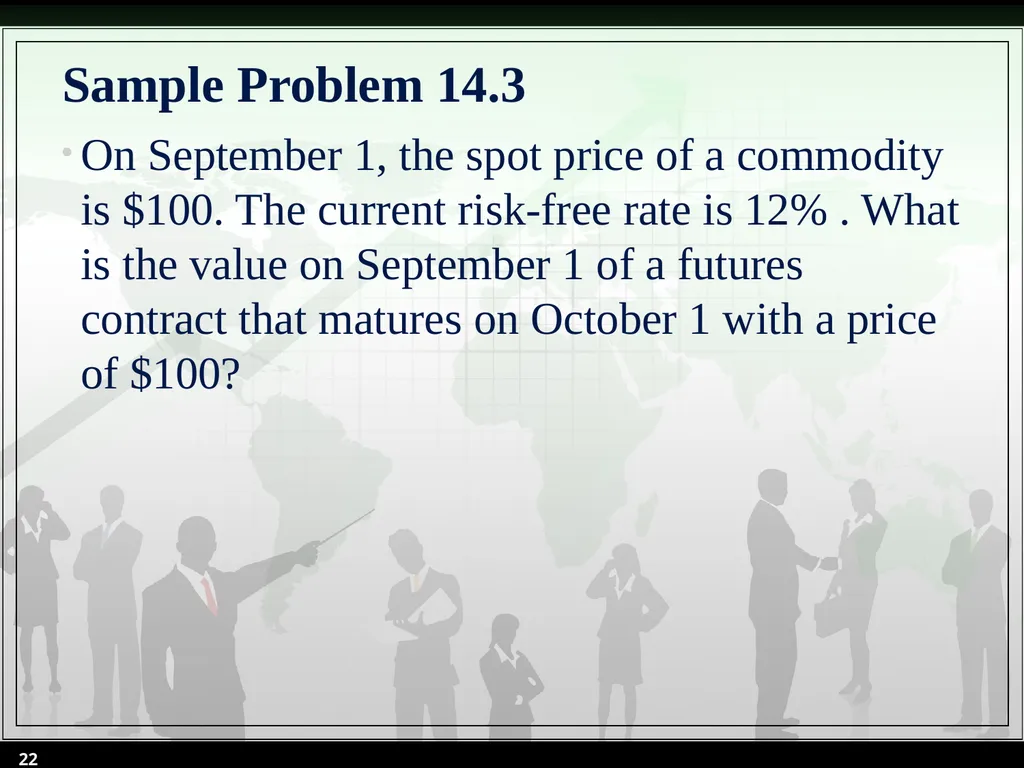
Sample Problem 14.3 On September 1, the spot price of a commodity is $100. The current risk-free rate is 12% . What is the value on September 1 of a futures contract that matures on October 1 with a price of $100? 22<br>
23
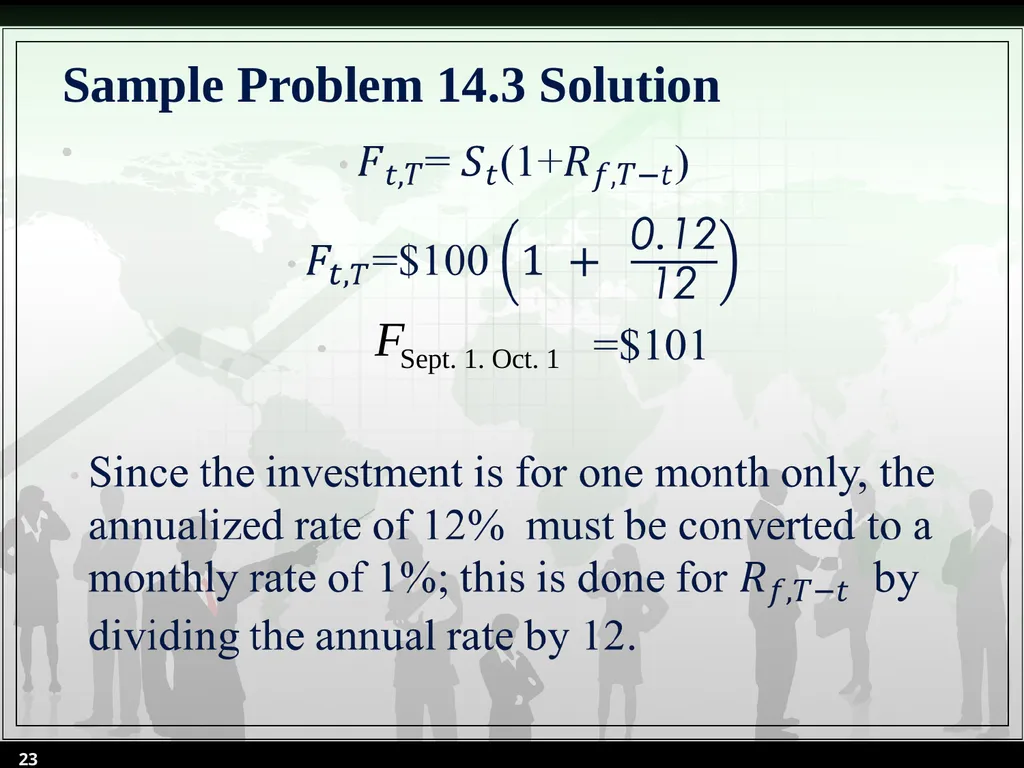
Sample Problem 14.3 Solution 23<br>
24
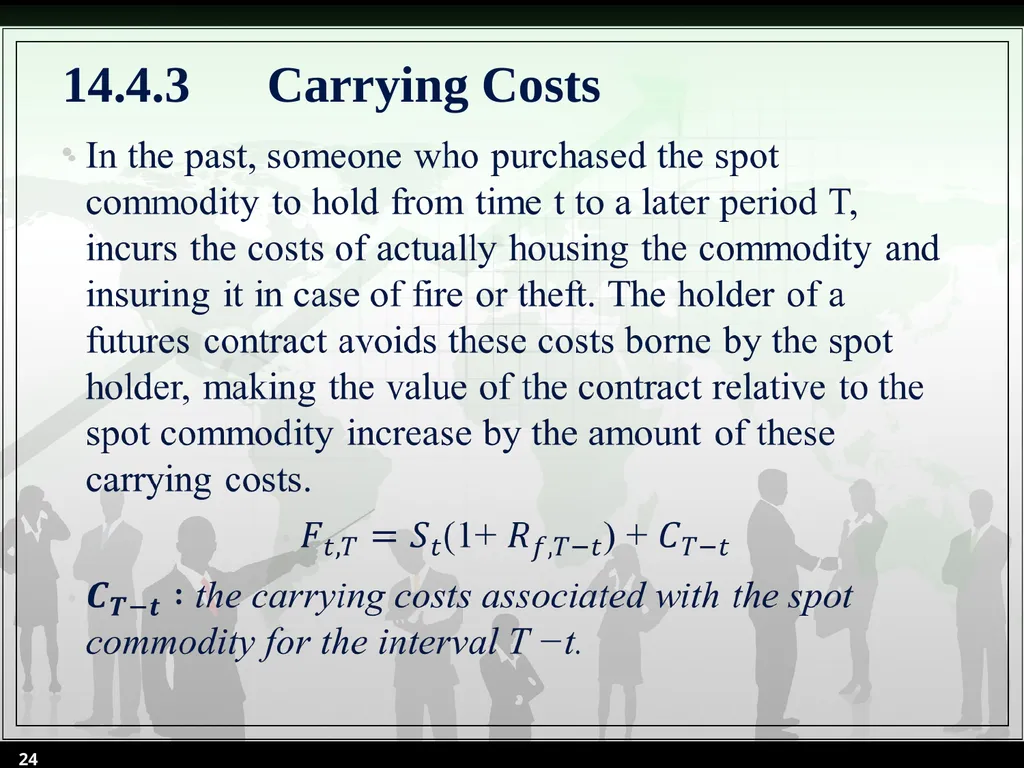
14.4.3 Carrying Costs 24<br>
25
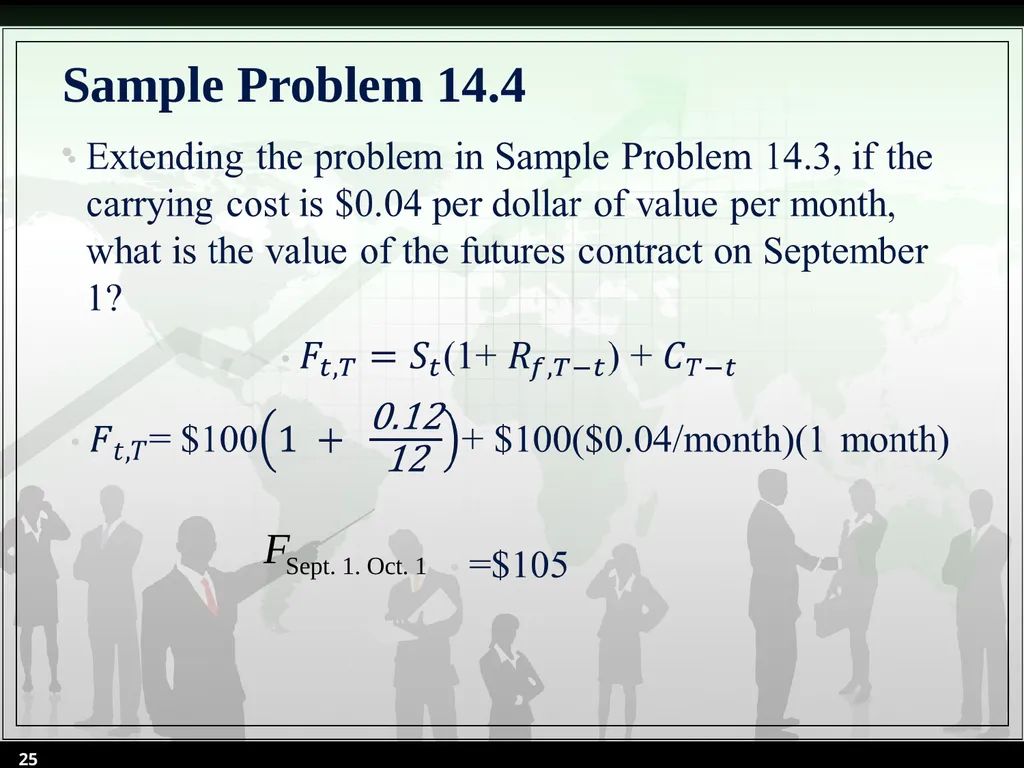
Sample Problem 14.4 25<br>
26
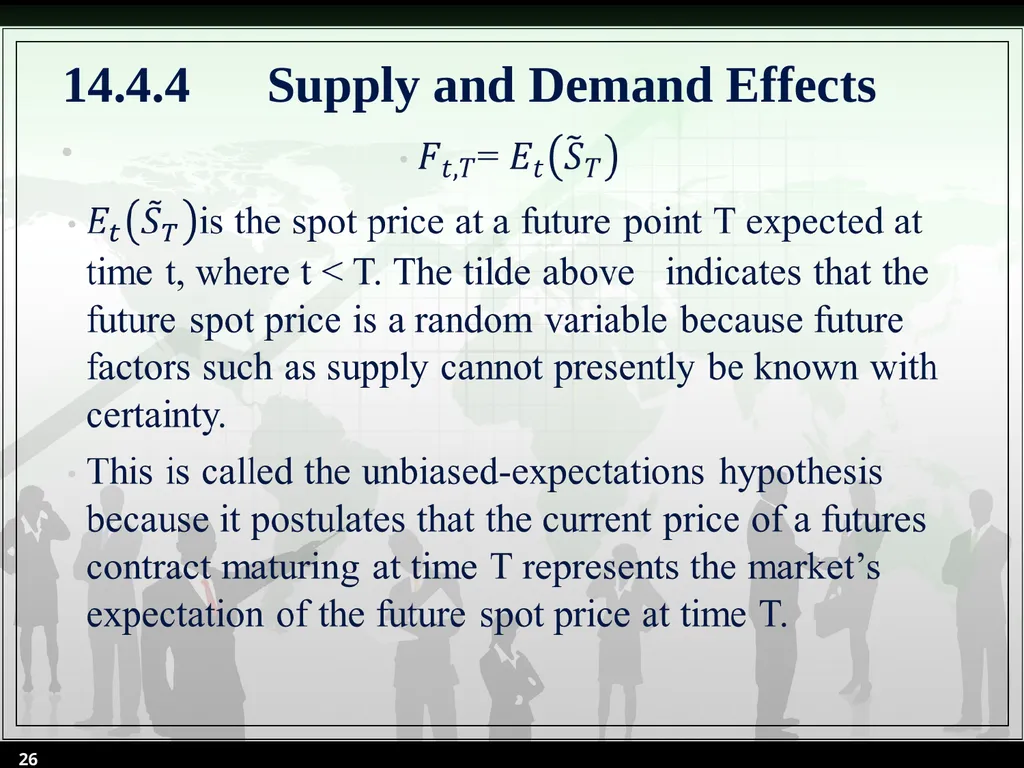
14.4.4 Supply and Demand Effects 26<br>
27
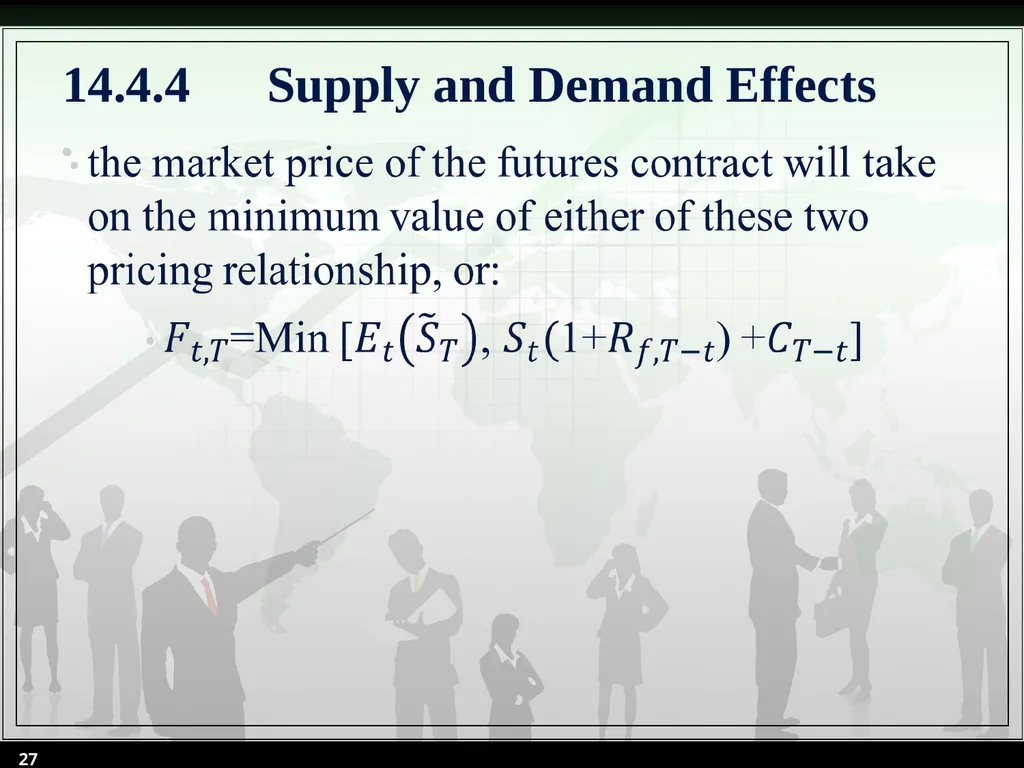
14.4.4 Supply and Demand Effects 27<br>
28
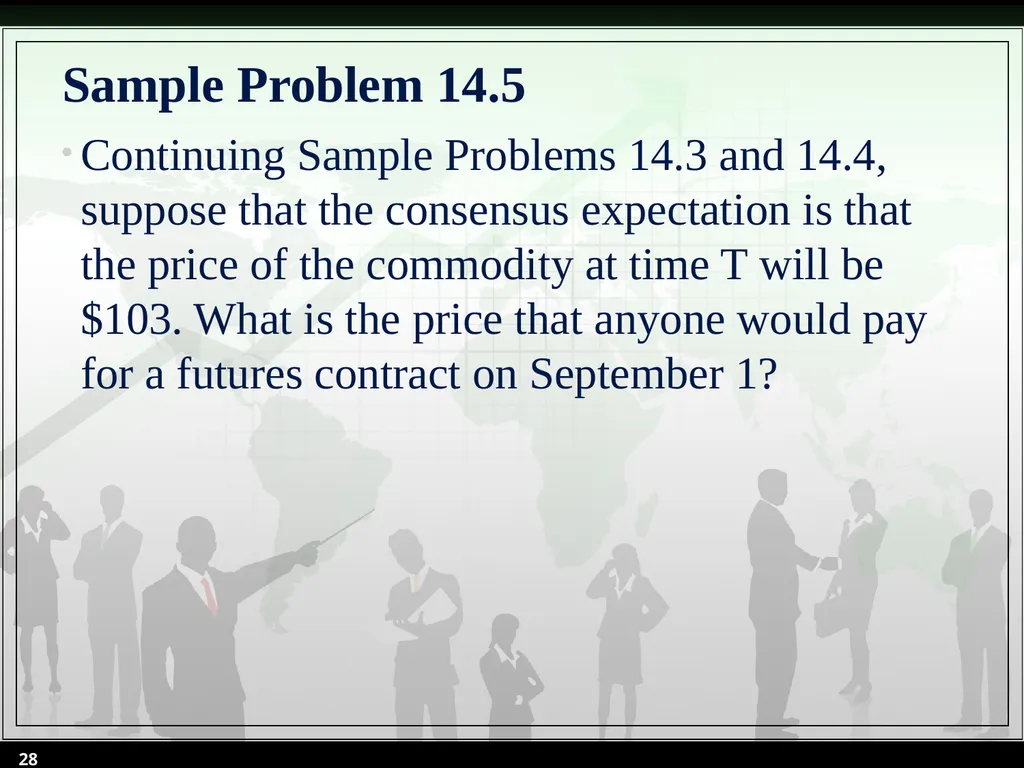
Sample Problem 14.5 Continuing Sample Problems 14.3 and 14.4, suppose that the consensus expectation is that the price of the commodity at time T will be $103. What is the price that anyone would pay for a futures contract on September 1? 28<br>
29
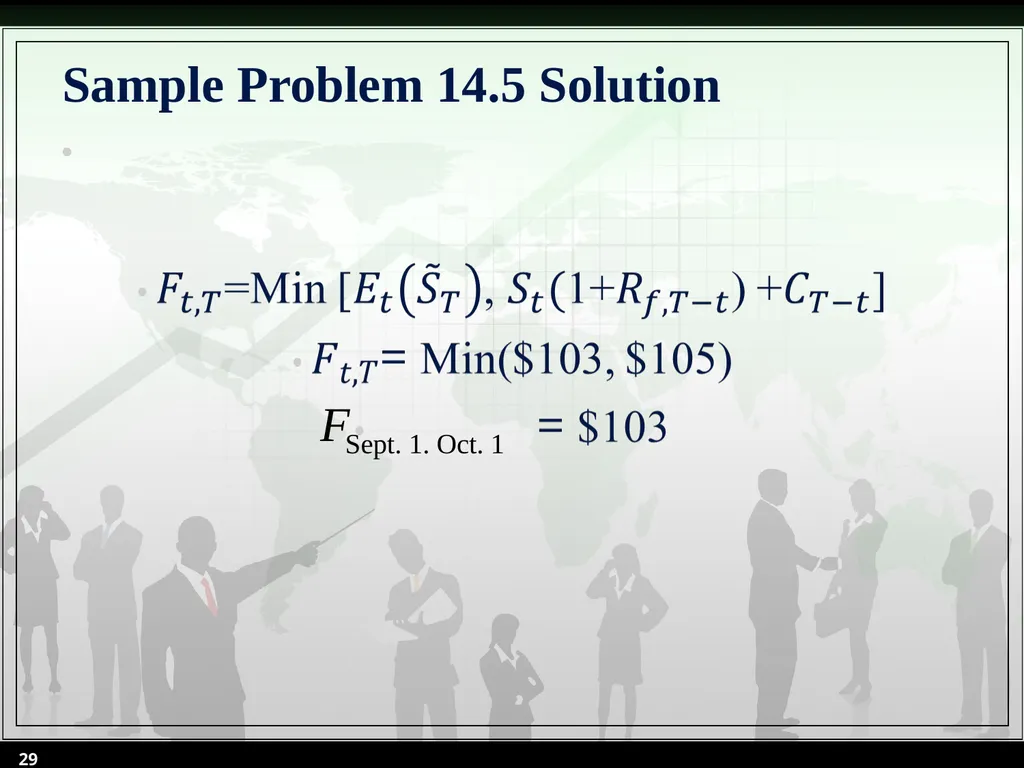
Sample Problem 14.5 Solution 29<br>
30
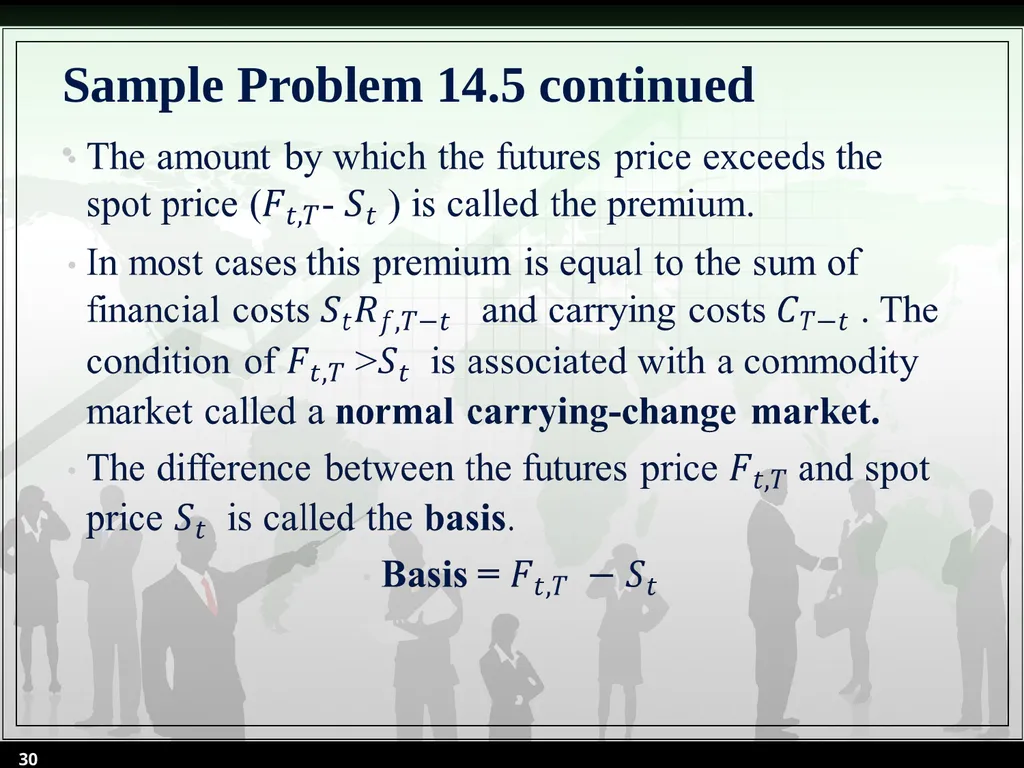
Sample Problem 14.5 continued 30<br>
31
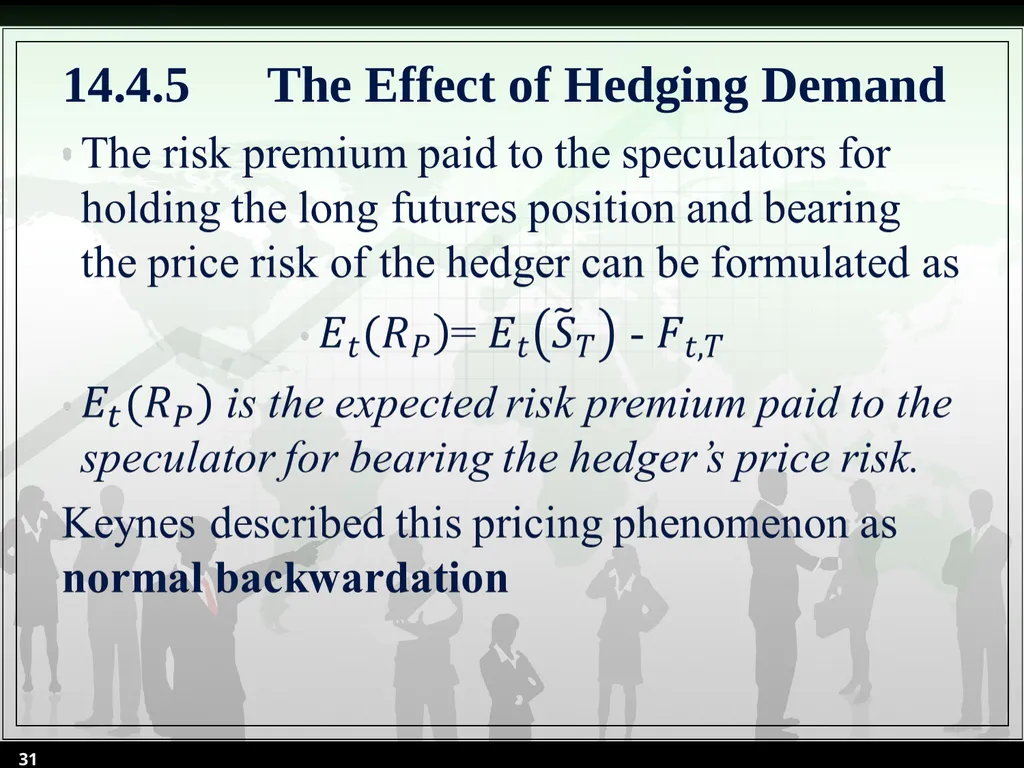
14.4.5 The Effect of Hedging Demand 31<br>
32
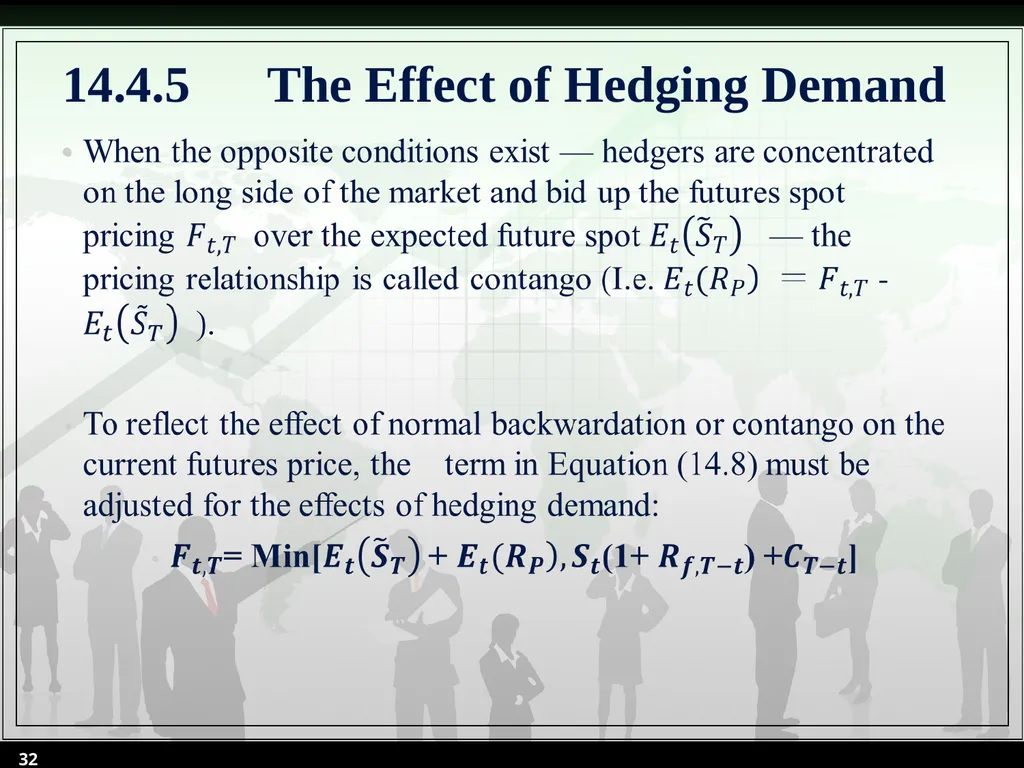
14.4.5 The Effect of Hedging Demand 32<br>
33
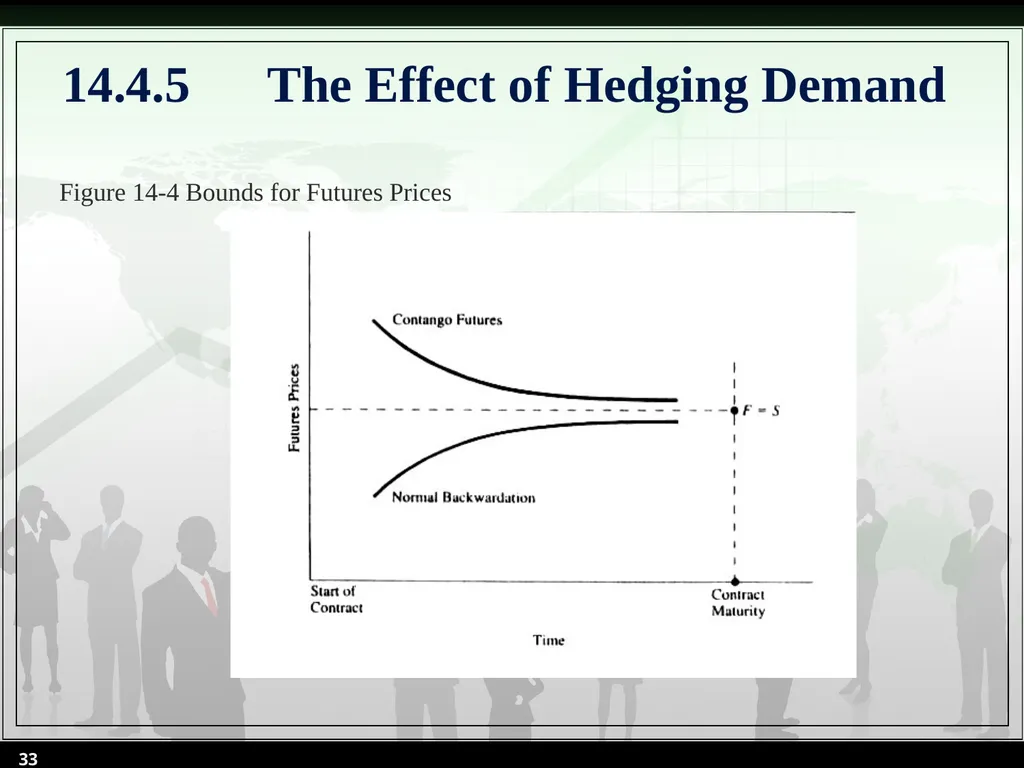
14.4.5 The Effect of Hedging Demand Figure 14-4 Bounds for Futures Prices 33<br>
34
14.5 HEDGING CONCEPTS AND STRATEGIES The underlying motivation for the development of futures markets is to aid the holders of the spot commodity in hedging their price risk; consequently, the discussion now focuses on such an application of futures market. 34<br>
35
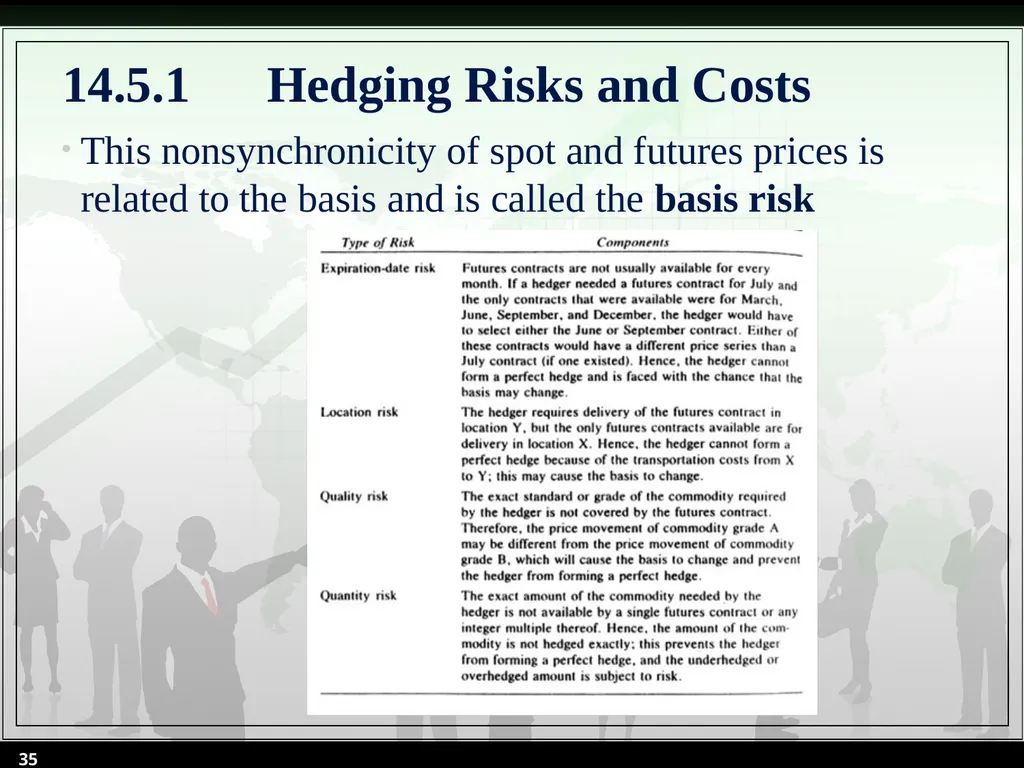
14.5.1 Hedging Risks and Costs This nonsynchronicity of spot and futures prices is related to the basis and is called the basis risk 35<br>
36
14.5.1 Hedging Risks and Costs Cross-hedging refers to hedging with a futures contract written on a nonidentical commodity (relative to the spot commodity).
is frequently the best that can be done with financial and index futures.
Changes in the basis risk induced by the cross-hedge are caused by less than perfect correlation of price movements between the spot and futures prices — even at maturity. 36<br>
is frequently the best that can be done with financial and index futures.
Changes in the basis risk induced by the cross-hedge are caused by less than perfect correlation of price movements between the spot and futures prices — even at maturity. 36<br>
37
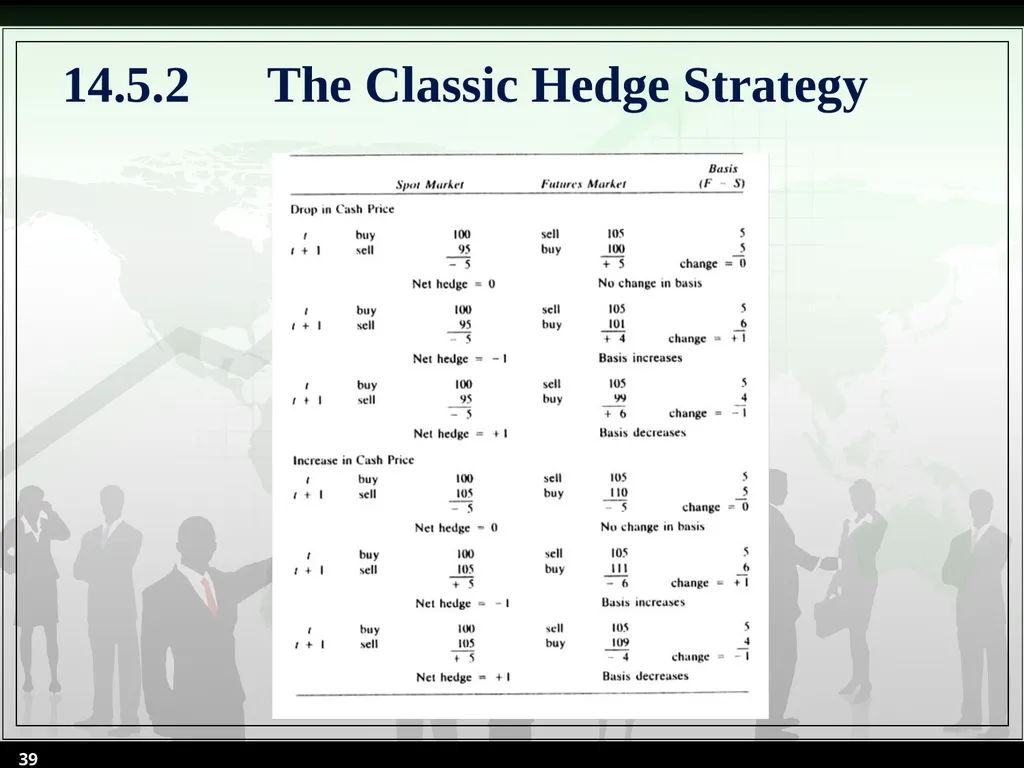
Sample Problem 14.6 Basis risk is illustrated in Table 14-35. The spot price is $100 and the futures price is $105 on day t. The top half of the exhibit shows what can happen if the spot price falls at day t + 1, and the bottom half shows what happens if the spot price rises. It is assumed that the hedger is trying to create a fully hedged position in each of the cases presented.
If the basis is unchanged, the hedged position will neither gain nor lose. As can be seen in Table 14-53, the gain or loss on the hedged position is related to the change in the basis. Hence, the asset position’s exposure to price risk is zero and the only risk the hedger faces is a change in the basis. 37<br>
If the basis is unchanged, the hedged position will neither gain nor lose. As can be seen in Table 14-53, the gain or loss on the hedged position is related to the change in the basis. Hence, the asset position’s exposure to price risk is zero and the only risk the hedger faces is a change in the basis. 37<br>
38
14.5.2 The Classic Hedge Strategy To apply the classic hedge strategy to the hedging problem, an opposite and equal position is taken in the futures market for the underlying commodity.
Classic strategy implies that the objective of the classic hedge is risk minimization or elimination. 38<br>
Classic strategy implies that the objective of the classic hedge is risk minimization or elimination. 38<br>
39
14.5.2 The Classic Hedge Strategy 39<br>
40
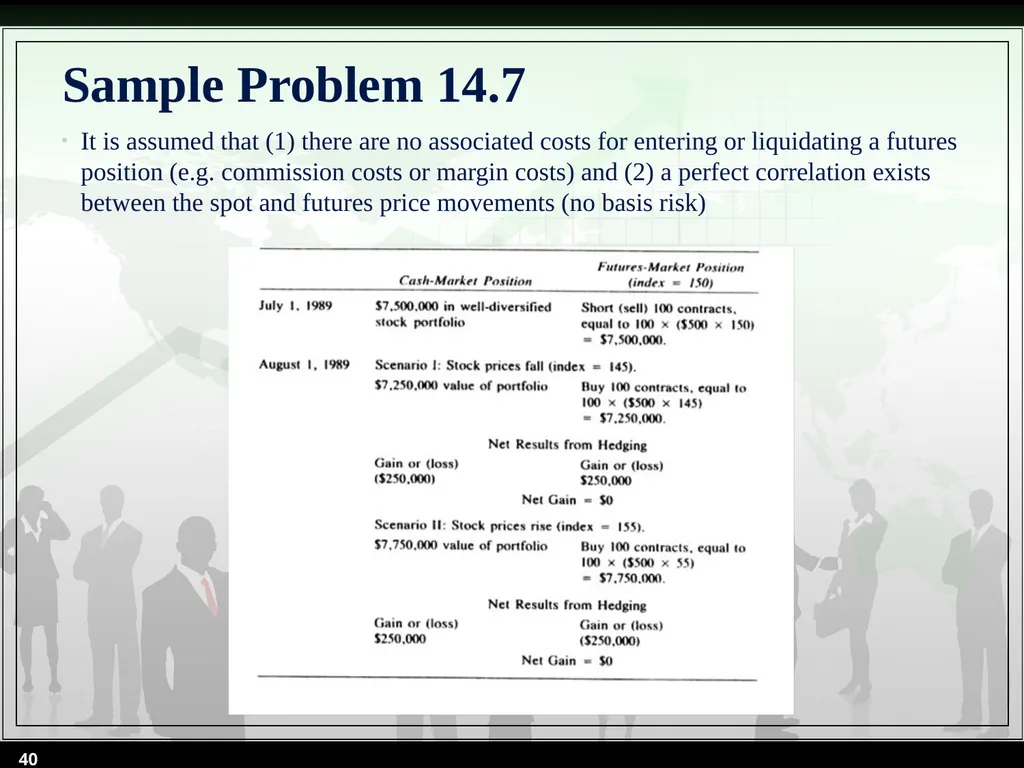
Sample Problem 14.7 It is assumed that (1) there are no associated costs for entering or liquidating a futures position (e.g. commission costs or margin costs) and (2) a perfect correlation exists between the spot and futures price movements (no basis risk) 40<br>
41
14.5.3 The Working Hedge Strategy The Working hedge strategy makes explicit the speculative aspect of hedging. That is, in any hedged position the basis will not be constant over time. Therefore, the hedger in a certain sense is speculating on the future course of the basis.
This speculative aspect to hedging is exploited in Working’s model by simultaneously determining positions in the spot and futures markets in order to capture increased return arising from relative movements in spot and futures prices. 41<br>
This speculative aspect to hedging is exploited in Working’s model by simultaneously determining positions in the spot and futures markets in order to capture increased return arising from relative movements in spot and futures prices. 41<br>
42
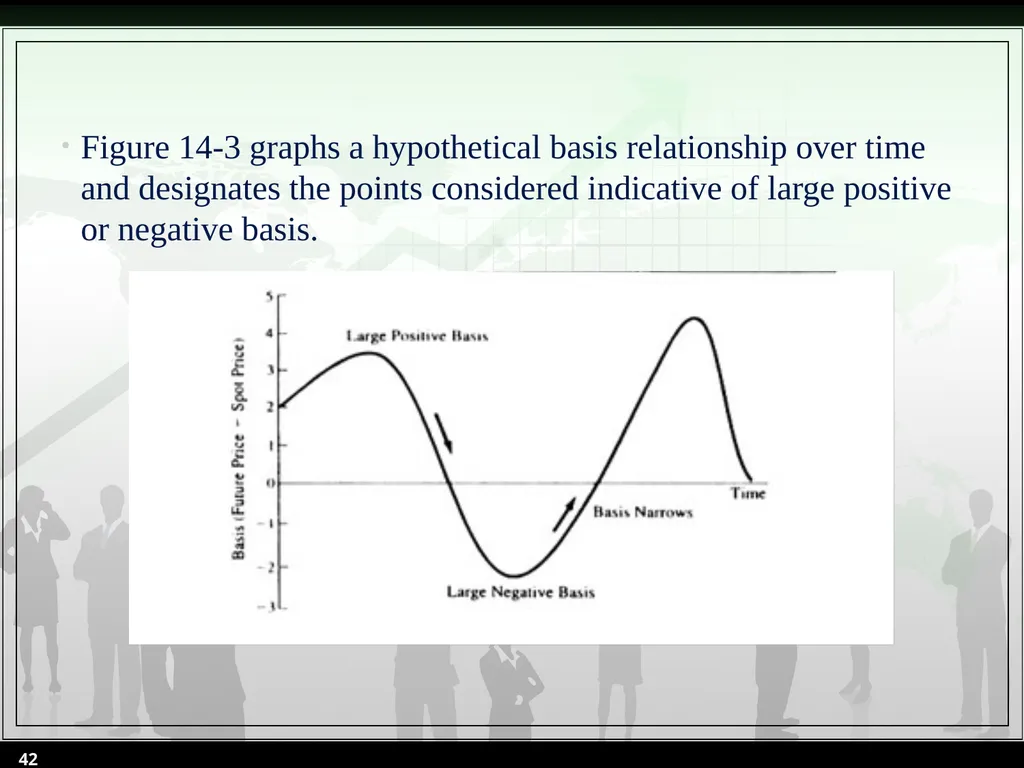
Figure 14-3 graphs a hypothetical basis relationship over time and designates the points considered indicative of large positive or negative basis. 42<br>
43
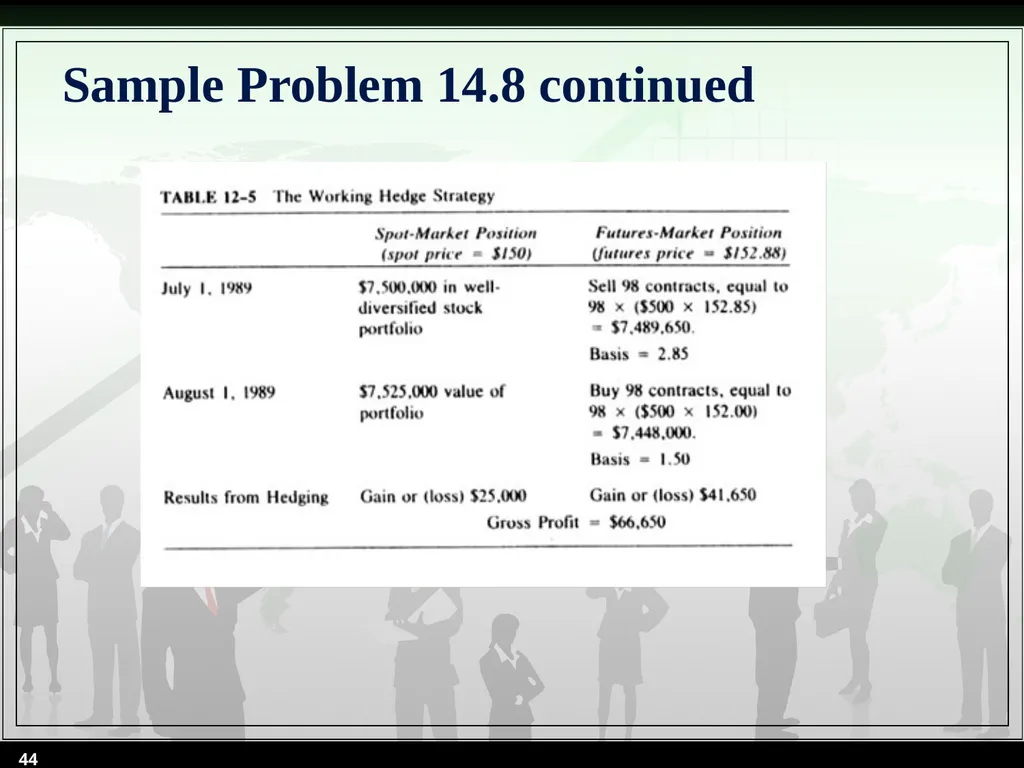
Sample Problem 14.8 Assume that the manager of the well-diversified portfolio of stocks worth $7.5 million sees a difference between the stock-index futures price for the S&P 500 near-term contract and the spot price of 2.85 (152.85 – 150.00) on July 1. Her portfolio is highly correlated with the S&P 500 index, and she sells 98 contracts to achieve an approximately equally valued position in the futures. Table 14-75 summarizes the results of this hedge strategy one month later. 43<br>
44
Sample Problem 14.8 continued 44<br>
45
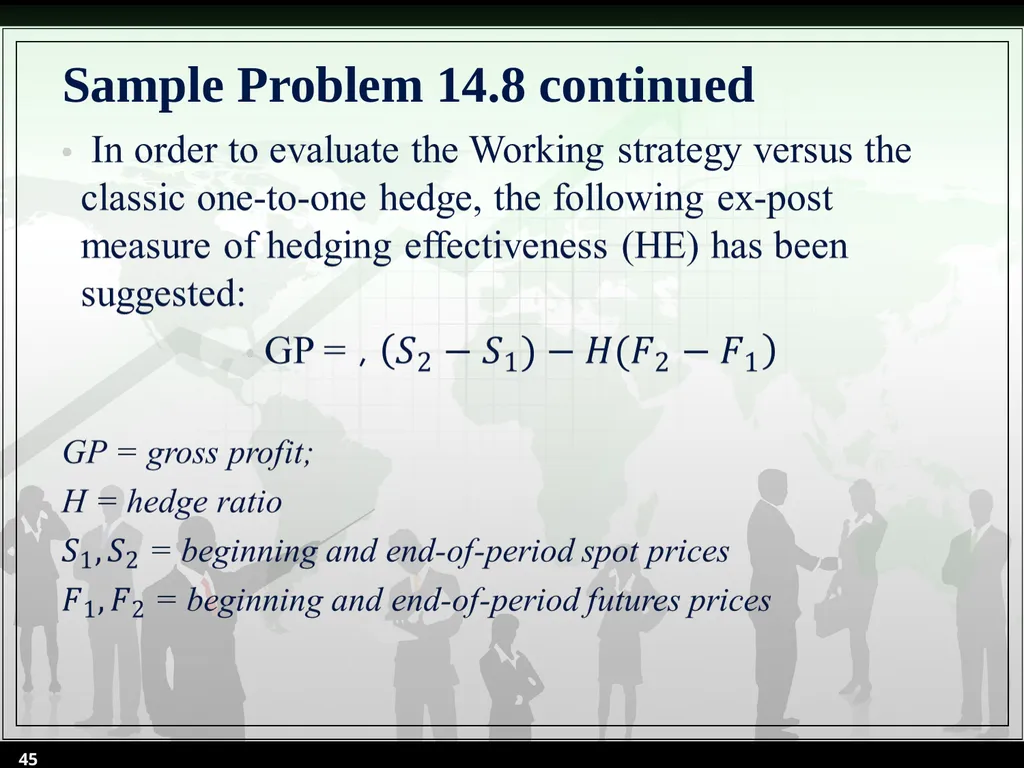
Sample Problem 14.8 continued 45<br>
46
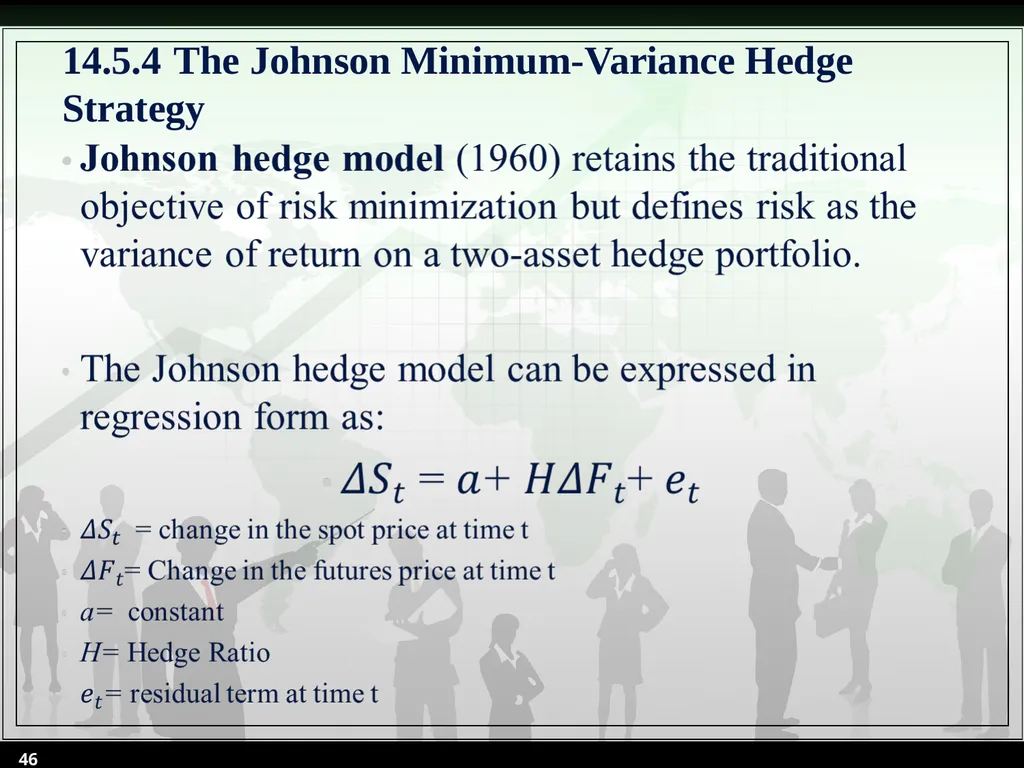
14.5.4 The Johnson Minimum-Variance Hedge Strategy 46<br>
47
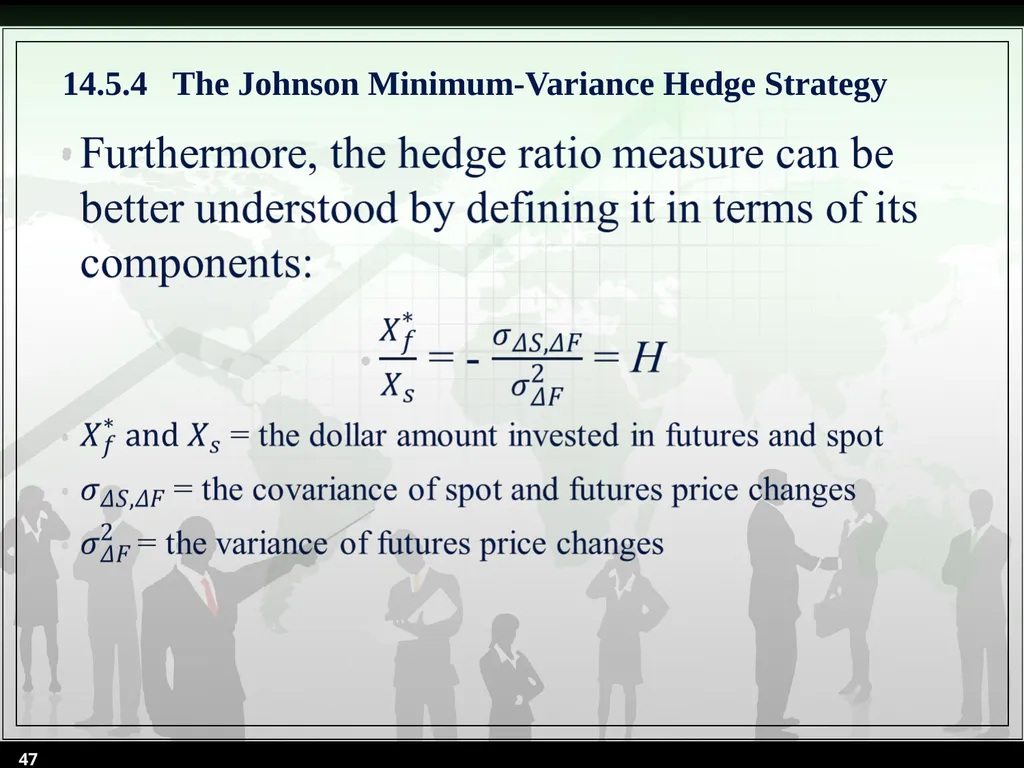
14.5.4 The Johnson Minimum-Variance Hedge Strategy 47<br>
48
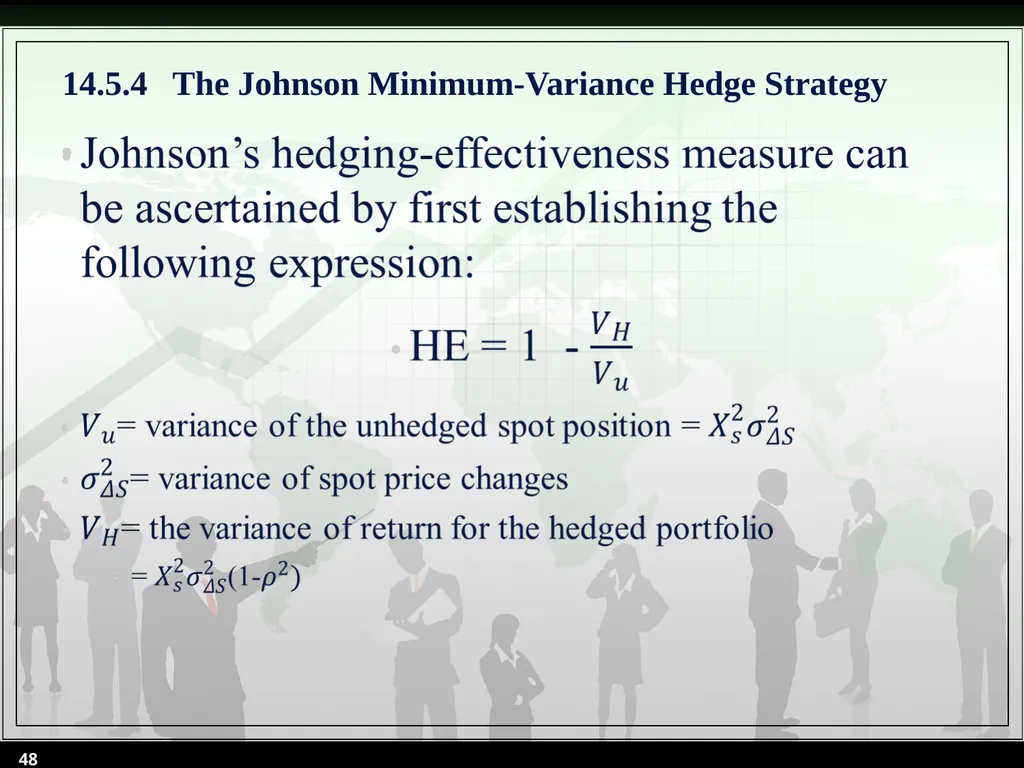
14.5.4 The Johnson Minimum-Variance Hedge Strategy 48<br>
49
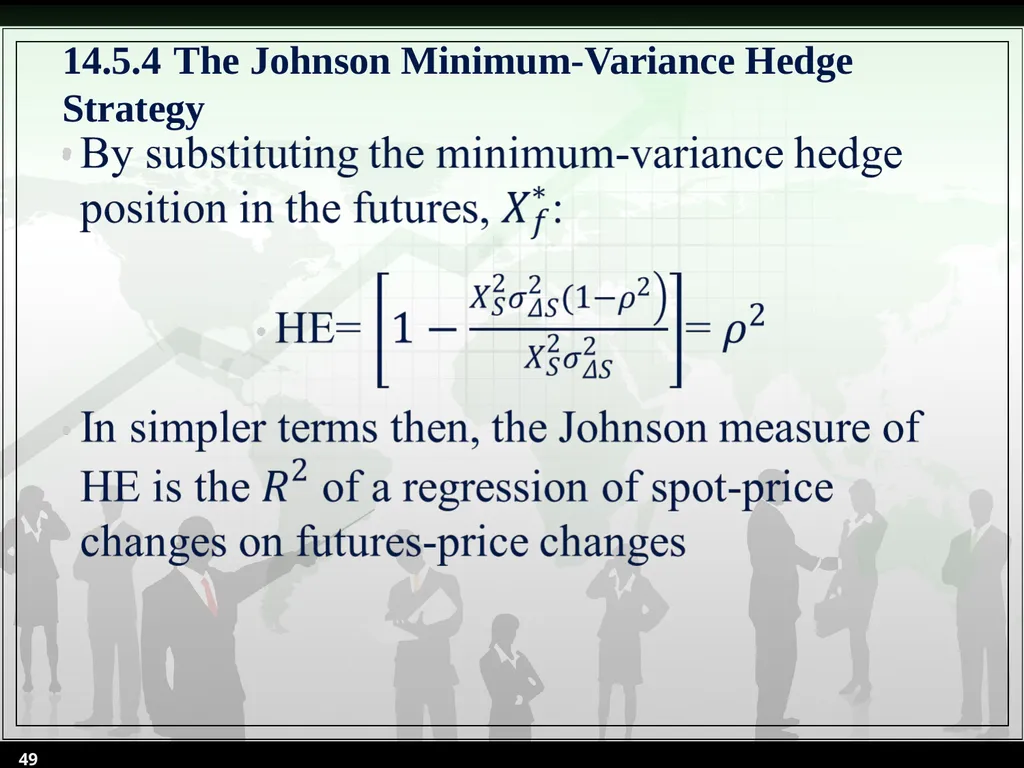
14.5.4 The Johnson Minimum-Variance Hedge Strategy 49<br>
50
14.5.5 The Howard-D’Antonio Optimal Risk-Return Hedge Strategy 50<br>
51
14.5.5 The Howard-D’Antonio Optimal Risk-Return Hedge Strategy 51<br>
52
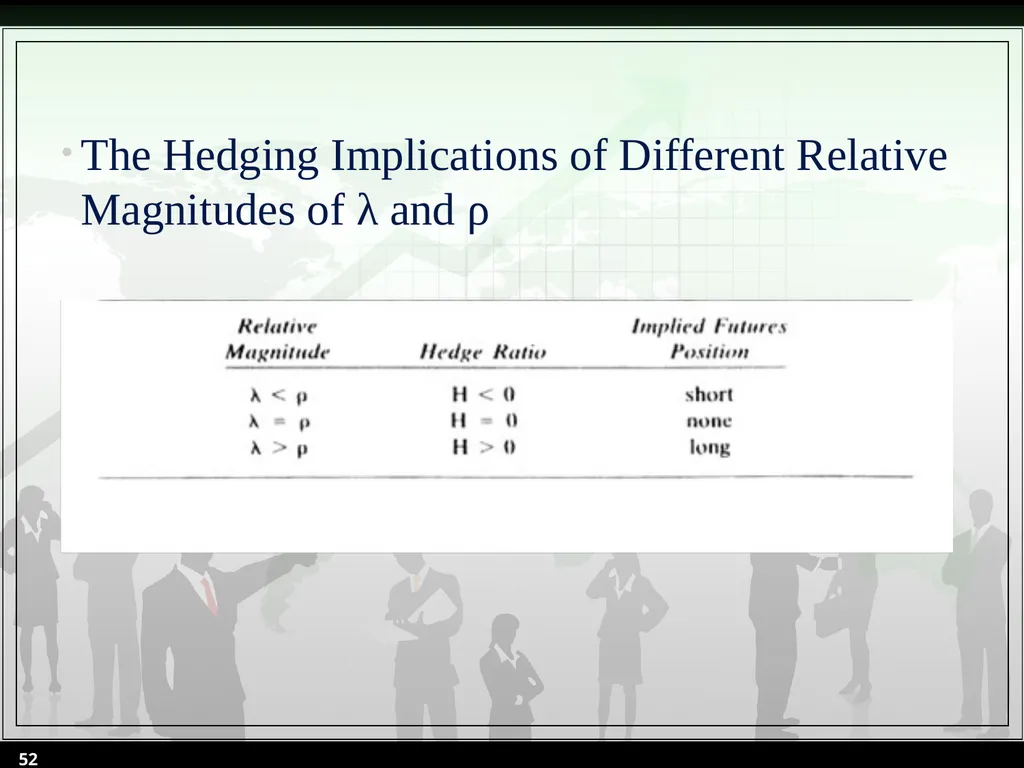
The Hedging Implications of Different Relative Magnitudes of λ and ρ 52<br>
53
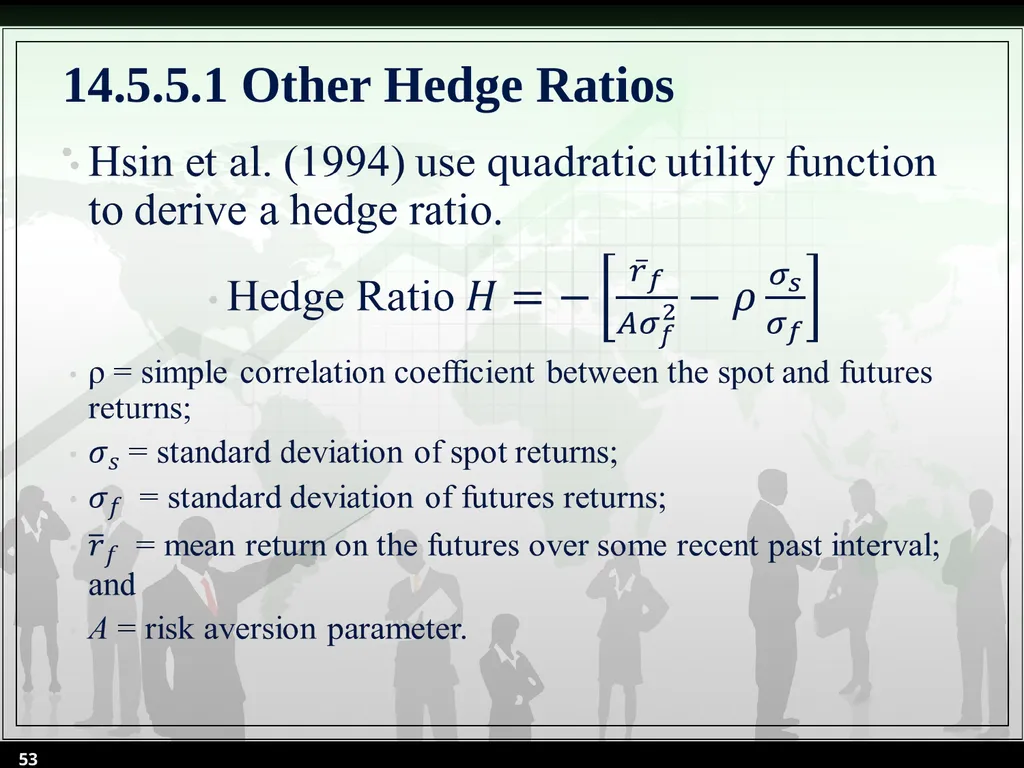
14.5.5.1 Other Hedge Ratios 53<br>
54
14.6 SUMMARY This chapter has focused on the basic concepts of futures markets. Important terms were defined and basic models to evaluate futures contracts were discussed. The differences between futures and forward markets also received treatment. Finally hedging concepts and strategies were analyzed and alternative hedging ratios were investigated in detail. These concepts and valuation models can be used in security analysis and portfolio management related to futures and forward contracts. The next chapter investigates in depth commodity futures, financial futures, and index futures. 54<br>