
Chapter 15: Apparatus Equipped with an Aerial
MS
Published · 172 slides · 0 views

1 / 1







































Description
Chapter 15: Apparatus Equipped with an Aerial Device Knowledge Objectives Describe the function of aerial apparatus in the fire service. Describe the types and features of aerial apparatus. Describe the construction of aerial apparatus.
Related Topics
Share
Embed code
Download this presentation From Below
"Chapter 15: Apparatus Equipped with an Aerial" is the property of its rightful owner. Permission is granted to download and print the materials on this website for personal, non-commercial use only, and to display it on your personal computer provided you do not modify the materials and that you retain all copyright notices contained in the materials. By downloading content from our website, you accept the terms of this agreement.
Presentation Transcript
01
Chapter 15: Apparatus Equipped with an Aerial Device<br>
02
Knowledge Objectives Describe the function of aerial apparatus in the fire service.
Describe the types and features of aerial apparatus.
Describe the construction of aerial apparatus.
Describe the aerial apparatus hydraulic system.
Describe the aerial device inspection requirements and process.<br>
Describe the types and features of aerial apparatus.
Describe the construction of aerial apparatus.
Describe the aerial apparatus hydraulic system.
Describe the aerial device inspection requirements and process.<br>
03
Knowledge Objectives Identify the capabilities and limitations of an aerial device related to reach, tip load, angle of inclination, and angle from chassis axis, as well as the effects of topography, ground, and weather conditions as they apply to safe deployment.
Determine the correct position for an aerial apparatus, maneuver the apparatus into that position, and avoid obstacles to operations.<br>
Determine the correct position for an aerial apparatus, maneuver the apparatus into that position, and avoid obstacles to operations.<br>
04
Knowledge Objectives Describe how to maneuver and position an aerial apparatus.
Describe how to recognize system problems and how to correct any deficiency noted in accordance with department policies and procedures.
Describe the stabilization requirements and effects of topography and ground conditions on stabilization.<br>
Describe how to recognize system problems and how to correct any deficiency noted in accordance with department policies and procedures.
Describe the stabilization requirements and effects of topography and ground conditions on stabilization.<br>
05
Knowledge Objectives Describe the safe operating practices for aerial apparatus.
Describe the considerations and requirement for the deployment of an elevated stream.
Describe the aerial device’s emergency operating system(s).<br>
Describe the considerations and requirement for the deployment of an elevated stream.
Describe the aerial device’s emergency operating system(s).<br>
06
Introduction The aerial apparatus is an expensive tool, and a new aerial apparatus can cost more than $1 million.
Fire department must use this tool correctly.
Optimal positioning of the aerial apparatus must be a key consideration upon arrival.<br>
Fire department must use this tool correctly.
Optimal positioning of the aerial apparatus must be a key consideration upon arrival.<br>
07
Introduction Positioning must occur based on the current conditions, the occupancy, and what is known—not what may be learned later Courtesy of Drew Smith.<br>
08
History of the Fire Apparatus Aerial apparatus have evolved over the past 100-plus years.
As U.S. entered the 20th century and buildings began to rise past a few stories, fire fighters needed additional capabilities to deal with fires in these multistory structures.
Portable extension ladders were not adequate or feasible.<br>
As U.S. entered the 20th century and buildings began to rise past a few stories, fire fighters needed additional capabilities to deal with fires in these multistory structures.
Portable extension ladders were not adequate or feasible.<br>
09
History of the Fire Apparatus Innovators developed the vehicle-mounted aerial ladder and the water tower.
Remained separate until the mid-20th century
In the 1950s, the articulating platform for firefighting use was modified.
By the 1970s, apparatus manufacturers had designed aerial apparatus with heavy-duty ladders, attached platforms, and telescoping waterways.<br>
Remained separate until the mid-20th century
In the 1950s, the articulating platform for firefighting use was modified.
By the 1970s, apparatus manufacturers had designed aerial apparatus with heavy-duty ladders, attached platforms, and telescoping waterways.<br>
10
History of the Fire Apparatus The traditional, most obvious role for aerial apparatus on the fireground remains the rescue of trapped persons.
Other functions can also be performed from these devices.
The rescue of human life is always the top priority for fire fighters, and all aerial operations must first address this need.<br>
Other functions can also be performed from these devices.
The rescue of human life is always the top priority for fire fighters, and all aerial operations must first address this need.<br>
11
Rescue Accomplished either by removing victims from the fire’s threat or by extinguishing or knocking down the fire
Fire fighters must prevent the spread of fire to uninvolved areas of the fire building or other combustibles by confining the fire.
Fire fighters must know their job and their equipment so that they may save lives and property.<br>
Fire fighters must prevent the spread of fire to uninvolved areas of the fire building or other combustibles by confining the fire.
Fire fighters must know their job and their equipment so that they may save lives and property.<br>
12
Aerial Deployment Priority 1: Rescue Aerial ladder is usually needed for victim removal above the third floor.
Most portable ladders carried on fire apparatus will be of insufficient length for this operation.
When victim removal is not immediately needed, a secondary means of egress for fire fighters operating in a fire area above the third floor becomes a priority.<br>
Most portable ladders carried on fire apparatus will be of insufficient length for this operation.
When victim removal is not immediately needed, a secondary means of egress for fire fighters operating in a fire area above the third floor becomes a priority.<br>
13
Aerial Deployment Priority 2: Exposure Protection Before efforts are directed at extinguishment, the IC must ensure the fire will not spread.
When faced with a large fire and no immediate need for the aerial device to perform rescue work, the apparatus may be called upon to provide an elevated stream.
Driver/operator must identify exposures upon approach of the incident scene.<br>
When faced with a large fire and no immediate need for the aerial device to perform rescue work, the apparatus may be called upon to provide an elevated stream.
Driver/operator must identify exposures upon approach of the incident scene.<br>
14
Aerial Deployment Priority 3: Ventilation Aerial may be used to perform horizontal or vertical ventilation.
Providing a safe and rapid method for accessing the windows of upper floors or roofs is a job for the aerial device.
Driver/operator must identify optimal positioning locations upon approach to the incident scene based on his or her past experience and prefire planning.<br>
Providing a safe and rapid method for accessing the windows of upper floors or roofs is a job for the aerial device.
Driver/operator must identify optimal positioning locations upon approach to the incident scene based on his or her past experience and prefire planning.<br>
15
Aerial Deployment Priority 4: Elevated Stream Operations The application of an elevated stream by the aerial apparatus can be an effective tactic in the suppression of heavy fire.
Elevated streams can multiply flows to 500–1200 gpm (2000–5000 L/min).
Application should be considered when stopping the forward progress of the fire is beyond the capabilities of deployable handlines.<br>
Elevated streams can multiply flows to 500–1200 gpm (2000–5000 L/min).
Application should be considered when stopping the forward progress of the fire is beyond the capabilities of deployable handlines.<br>
16
Aerial Deployment Priority 4: Elevated Stream Operations While a handline can be advanced up and off the tip of an aerial, another elevated stream operation entails deployment of a stream fed by a standpipe.
Whenever a hoseline is deployed in this manner and advanced into a structure, the ability of the aerial to serve other functions is impaired.<br>
Whenever a hoseline is deployed in this manner and advanced into a structure, the ability of the aerial to serve other functions is impaired.<br>
17
Aerial Apparatus Types and Features Aerial apparatus are known by a variety of names.
Some are specific to certain regions of North America.
Truck, ladder, and tower
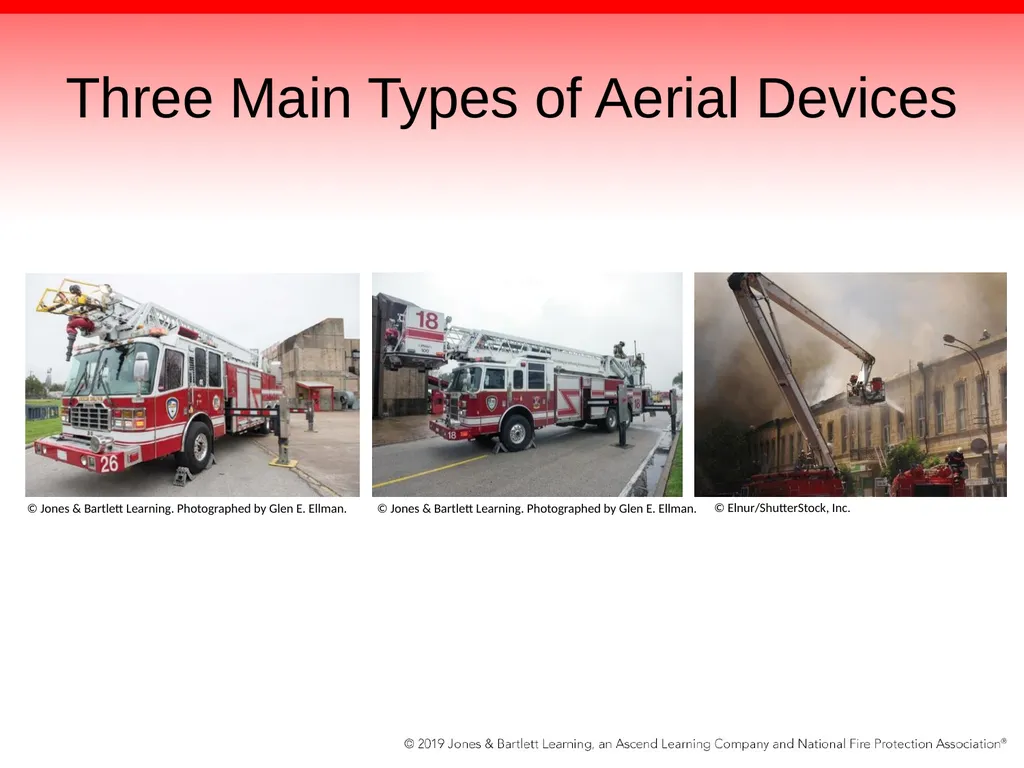
Three main types of aerial apparatus:
Straight ladders
Elevated platforms
Articulating platforms<br>
Some are specific to certain regions of North America.
Truck, ladder, and tower
Three main types of aerial apparatus:
Straight ladders
Elevated platforms
Articulating platforms<br>
18
Aerial Apparatus Types and Features In 1991, NFPA adopted a new standard on aerial apparatus that improved the design and load requirements of aerial apparatus.
Incorporated into NFPA 1901
All aerial apparatus have a turntable.
Location where the aerial device attaches to the chassis
Connection is made in the middle of the chassis and the rear of the chassis.<br>
Incorporated into NFPA 1901
All aerial apparatus have a turntable.
Location where the aerial device attaches to the chassis
Connection is made in the middle of the chassis and the rear of the chassis.<br>
19
Three Main Types of Aerial Devices © Jones & Bartlett Learning. Photographed by Glen E. Ellman. © Jones & Bartlett Learning. Photographed by Glen E. Ellman. © Elnur/ShutterStock, Inc.<br>
20
Aerial Ladder Aerial ladder without any basket or platform is a straight ladder.
Straight ladder may be referred to as truck, ladder truck, or aerial ladder.
Some fire departments may use these terms to describe aerial platforms as well.
Straight ladders have a truss construction.
NFPA 1901 requires a minimum tip load capacity of 250 pounds.<br>
Straight ladder may be referred to as truck, ladder truck, or aerial ladder.
Some fire departments may use these terms to describe aerial platforms as well.
Straight ladders have a truss construction.
NFPA 1901 requires a minimum tip load capacity of 250 pounds.<br>
21
Aerial Platform Can be referred to as tower ladder or ladder tower, depending on the region
Has a telescoping boom that does not articulate and is equipped with a bucket, basket, or platform from which fire fighters can operate
Lengths may vary.
Boom may or may not serve as a ladder.<br>
Has a telescoping boom that does not articulate and is equipped with a bucket, basket, or platform from which fire fighters can operate
Lengths may vary.
Boom may or may not serve as a ladder.<br>
22
Aerial Platform Ladder-type boom is most common.
All telescoping booms that serve as ladders are heavy-duty design by necessity.
Aerial platforms with a boom of the non-ladder design may be outfitted with an extension ladder that is permanently affixed to the boom.<br>
All telescoping booms that serve as ladders are heavy-duty design by necessity.
Aerial platforms with a boom of the non-ladder design may be outfitted with an extension ladder that is permanently affixed to the boom.<br>
23
Articulating Platform Consists of a boom with a hinge or knuckle joint in its midsection
May or may not telescope like aerial platforms
May range from 50 ft (15 m) to more than 100 ft (30 m) in length
Not covered in this text<br>
May or may not telescope like aerial platforms
May range from 50 ft (15 m) to more than 100 ft (30 m) in length
Not covered in this text<br>
24
Aerial Ladder Construction Aerial ladders and aerial platforms may be constructed of either aluminum or steel.
When aluminum is used as the base material, it is generally not painted but rather finished with a brushed appearance. © Jones & Bartlett Learning. Photographed by Glen E. Ellman.<br>
When aluminum is used as the base material, it is generally not painted but rather finished with a brushed appearance. © Jones & Bartlett Learning. Photographed by Glen E. Ellman.<br>
25
Aerial Ladder Construction Steel construction is painted or may also be galvanized. © Jones & Bartlett Learning. Photographed by Glen E. Ellman.<br>
26
Aerial Ladders and Platforms Aerial ladders and aerial platforms of aluminum and steel can be constructed using welded, riveted, or bolted connections.
Most common construction technique for an aerial device is truss construction.
All aerial apparatus should meet the requirements of NFPA 1901.
Specific maintenance requirements specified by the manufacturer as well<br>
Most common construction technique for an aerial device is truss construction.
All aerial apparatus should meet the requirements of NFPA 1901.
Specific maintenance requirements specified by the manufacturer as well<br>
27
Hydraulic and Electrical Systems The modern aerial is stabilized and maneuvered using hydraulic systems operated by electronic controls.
Separate, electrically powered pump is typically used to supply emergency power to the aerial in the event that the chassis motor, PTO, or hydraulic pump fails.<br>
Separate, electrically powered pump is typically used to supply emergency power to the aerial in the event that the chassis motor, PTO, or hydraulic pump fails.<br>
28
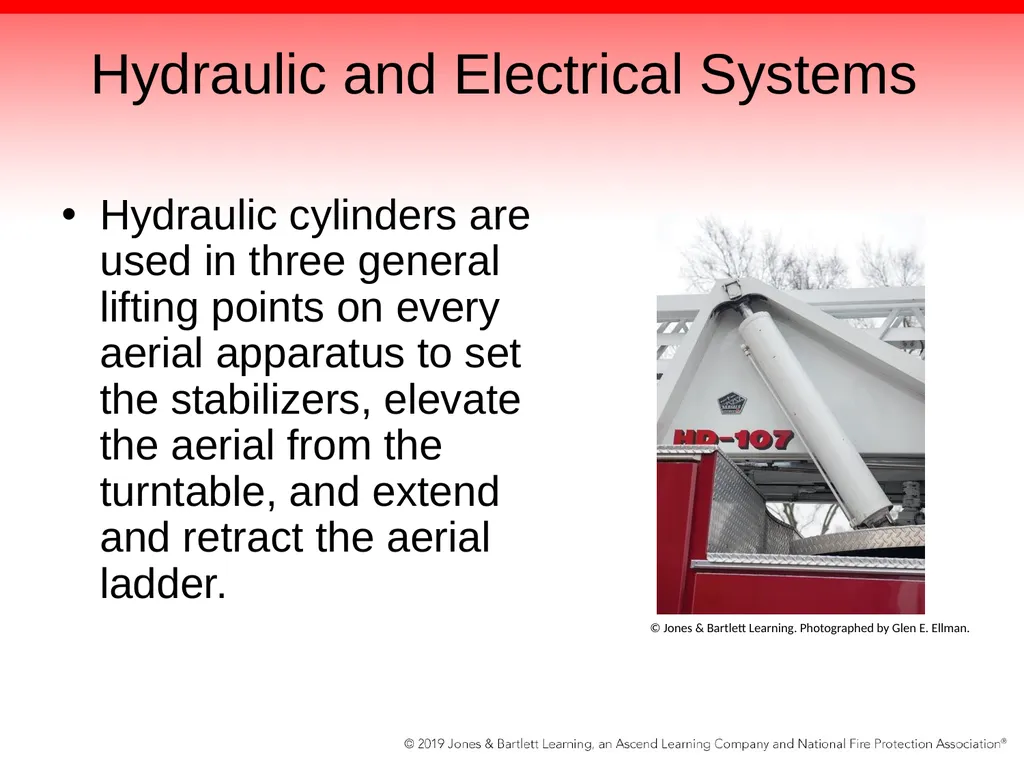
Hydraulic and Electrical Systems Hydraulic cylinders are used in three general lifting points on every aerial apparatus to set the stabilizers, elevate the aerial from the turntable, and extend and retract the aerial ladder. © Jones & Bartlett Learning. Photographed by Glen E. Ellman.<br>
29
Hydraulic and Electrical Systems Depending on the aerial apparatus, the aerial hydraulic pump and the electronic controls may be operated by a single switch or by separate switches.
Switches may be located in the cab near the driver’s position, near the turntable, or in both locations.
Consult the aerial apparatus’ operator’s manual to determine when it is permissible to engage these switches.<br>
Switches may be located in the cab near the driver’s position, near the turntable, or in both locations.
Consult the aerial apparatus’ operator’s manual to determine when it is permissible to engage these switches.<br>
30
Hydraulic and Electrical Systems A series of cables attached to sheave and hydraulic cylinders connect the sections of the aerial, permitting it to extend and retract.
The sections of the aerial extend and retract along a series of slides and/or rollers.
Slides are made of metal or synthetic materials designed to reduce friction and ensure minimum wear over the life of the aerial.<br>
The sections of the aerial extend and retract along a series of slides and/or rollers.
Slides are made of metal or synthetic materials designed to reduce friction and ensure minimum wear over the life of the aerial.<br>
31
Stabilizers
(Jacks, Outriggers, and Downriggers) All aerial apparatus must be stabilized prior to elevation, extension, and rotation of the aerial device to prevent the entire apparatus from overturning.
Four basic types of stabilizers:
H-type
A-type
Fold-down
Drop-Down<br>
Four basic types of stabilizers:
H-type
A-type
Fold-down
Drop-Down<br>
32
H-Type Stabilizers Most common type of stabilizer
Stabilizer is first extended horizontally to achieve a maximum width for the footprint, then extended down vertically to take the chassis load off the suspension.
Load is firmly and evenly transferred to the earth.<br>
Stabilizer is first extended horizontally to achieve a maximum width for the footprint, then extended down vertically to take the chassis load off the suspension.
Load is firmly and evenly transferred to the earth.<br>
33
H-Type Stabilizers Courtesy of Jimmy Faulkner.<br>
34
A-Type Stabilizers Also referred to as X-type stabilizers
Extend out and down from the chassis in a single action Courtesy of Jimmy Faulkner.<br>
Extend out and down from the chassis in a single action Courtesy of Jimmy Faulkner.<br>
35
A-Type Stabilizers Cannot be short-jacked and must firmly contact the earth
For aerials of the same type and length, the typical width of fully extended A-type stabilizers is often less than the width of the typical H-type stabilizer when short-jacked.<br>
For aerials of the same type and length, the typical width of fully extended A-type stabilizers is often less than the width of the typical H-type stabilizer when short-jacked.<br>
36
Fold-Down Stabilizers Extend out following an arc
Some will telescope once they touch the ground.
Of the four types of stabilizers, fold-downs need the most room to be deployed. © Jones & Bartlett Learning.<br>
Some will telescope once they touch the ground.
Of the four types of stabilizers, fold-downs need the most room to be deployed. © Jones & Bartlett Learning.<br>
37
Drop-Down Stabilizers Do not have horizontal extension
Used in conjunction with other stabilizer types
Come straight down from the underside of the chassis and contact the earth to increase the footprint of the aerial apparatus [ © Jones & Bartlett Learning.<br>
Used in conjunction with other stabilizer types
Come straight down from the underside of the chassis and contact the earth to increase the footprint of the aerial apparatus [ © Jones & Bartlett Learning.<br>
38
Jack Locations Manufacturer’s design will dictate stabilizer locations.
Two A- or H-type stabilizers, one on each side of the apparatus, may be placed near the turntable.
Four A- or H-type stabilizers, two on each side of the apparatus, may be placed with one set ahead of and one set behind the rear axles for aerial ladders more than 90 ft (27 m) in length and all aerial platforms.<br>
Two A- or H-type stabilizers, one on each side of the apparatus, may be placed near the turntable.
Four A- or H-type stabilizers, two on each side of the apparatus, may be placed with one set ahead of and one set behind the rear axles for aerial ladders more than 90 ft (27 m) in length and all aerial platforms.<br>
39
Jack Locations If apparatus is equipped with fold-down stabilizers, there may be only one stabilizer on each side of the apparatus and multiple drop-down stabilizers used on the corners of the apparatus.
If the aerial is of a midship turntable design, H-type or fold-down stabilizers with drop-down stabilizers are most commonly used.<br>
If the aerial is of a midship turntable design, H-type or fold-down stabilizers with drop-down stabilizers are most commonly used.<br>
40
Jack Locations Aerials more than 20 years old may demonstrate variations of these common designs.
Apparatus should be raised only as high as required by the manufacturer’s specifications to achieve proper stabilization.
Integral parts of the stabilization system are rotation interlock and overload protection.<br>
Apparatus should be raised only as high as required by the manufacturer’s specifications to achieve proper stabilization.
Integral parts of the stabilization system are rotation interlock and overload protection.<br>
41
Aerial Reach Vertical reach of the aerial ladder or platform is rated by the manufacturer.
Generally based on the apparatus being set up on level ground with the aerial device raised to its maximum extension at a 75° angle<br>
Generally based on the apparatus being set up on level ground with the aerial device raised to its maximum extension at a 75° angle<br>
42
Aerial Reach Horizontal reach should be measured as follows: distance reached is measured from the middle of the turntable to the last rung of the fly section of the aerial ladder or the outermost rail of the aerial platform.
Should be provided with lights c Jones & Bartlett Learning.<br>
Should be provided with lights c Jones & Bartlett Learning.<br>
43
Equipment Mounting at Tip Mounting of equipment should be evaluated to ensure it will not interfere with driver/operator’s ability to maneuver the aerial into position.
Equipment should be positioned so that it will not catch on windows, balconies, and roofs.<br>
Equipment should be positioned so that it will not catch on windows, balconies, and roofs.<br>
44
Equipment Mounting at Tip An intercom system must be provided between the aerial tip or platform, the turntable operator’s position, and the pump operator’s position.
Systems must allow for a hands-free response.
A breathing air system may also be provided, especially on aerial platforms.<br>
Systems must allow for a hands-free response.
A breathing air system may also be provided, especially on aerial platforms.<br>
45
Inspection of Aerial Apparatus Regular inspections should occur:
Daily or weekly
After each use by the aerial operator
After repairs
Using recommendations and practices of the aerial’s manufacturer<br>
Daily or weekly
After each use by the aerial operator
After repairs
Using recommendations and practices of the aerial’s manufacturer<br>
46
Inspection of Aerial Apparatus Inspection should focus on aerial device, its stabilizing system, and components.
Look for obvious damage, wear, deficiencies, and unsafe conditions.
If PTO or stabilization system will not engage or operate, or the aerial device will not perform one of the five basic maneuvers, it should be removed from service.<br>
Look for obvious damage, wear, deficiencies, and unsafe conditions.
If PTO or stabilization system will not engage or operate, or the aerial device will not perform one of the five basic maneuvers, it should be removed from service.<br>
47
Inspection of Aerial Apparatus If any components of the aerial device are damaged, frayed, leaking, deformed, or missing parts, the apparatus:
Should not respond to any emergency
Should be driven only as necessary
Qualified personnel who are certified emergency vehicle technicians should perform a detailed inspection of the apparatus and aerial device.<br>
Should not respond to any emergency
Should be driven only as necessary
Qualified personnel who are certified emergency vehicle technicians should perform a detailed inspection of the apparatus and aerial device.<br>
48
Inspection of Aerial Apparatus Apparatus should be subject to an nondestructive test as well as a detailed inspection:
At least once every five years
Whenever a visual inspection indicates an issue
After major repairs have been performed
NDT should be performed by an accredited third-party testing firm.<br>
At least once every five years
Whenever a visual inspection indicates an issue
After major repairs have been performed
NDT should be performed by an accredited third-party testing firm.<br>
49
Inspection of Aerial Apparatus NFPA 1911 contains out-of-service criteria and outlines inspection procedures in detail.
Annual inspection and nondestructive test should examine all:
Welds, fasteners, and bolts
The hydraulic system and its components
The turntable, torque box, suspension, and rotation bearing
The elevation, rotation, and extension interlocks<br>
Annual inspection and nondestructive test should examine all:
Welds, fasteners, and bolts
The hydraulic system and its components
The turntable, torque box, suspension, and rotation bearing
The elevation, rotation, and extension interlocks<br>
50
Aerial Apparatus Positioning Priorities Rescue: Is a physical rescue needed that requires an aerial apparatus?
Exposure protection: Does fire spread require application of an elevated stream?
Ventilation: Will access to upper floors or the roof for ventilation require use of an aerial apparatus?
Elevated streams: Does fire spread require application of an elevated stream?<br>
Exposure protection: Does fire spread require application of an elevated stream?
Ventilation: Will access to upper floors or the roof for ventilation require use of an aerial apparatus?
Elevated streams: Does fire spread require application of an elevated stream?<br>
51
Aerial Apparatus Positioning Apparatus must be placed at best vantage point.
Driver/operator must use his or her experience regarding how to park.
How long has the driver/operator been driving and operating this particular aerial?
Has the driver/operator been to this structure before?
What is the driver/operator expected to do based on department SOPs or SOGs?<br>
Driver/operator must use his or her experience regarding how to park.
How long has the driver/operator been driving and operating this particular aerial?
Has the driver/operator been to this structure before?
What is the driver/operator expected to do based on department SOPs or SOGs?<br>
52
Residential Structures For most one- and two-family private dwellings, placement of the apparatus will be front and center.
Sweeping the A side of the structure will be easily accomplished from this position.
If necessary or if conditions warrant, the turntable could be positioned on the A/B or A/D corner of the structure.
Local conditions, topography, and SOPs will dictate the best placement.<br>
Sweeping the A side of the structure will be easily accomplished from this position.
If necessary or if conditions warrant, the turntable could be positioned on the A/B or A/D corner of the structure.
Local conditions, topography, and SOPs will dictate the best placement.<br>
53
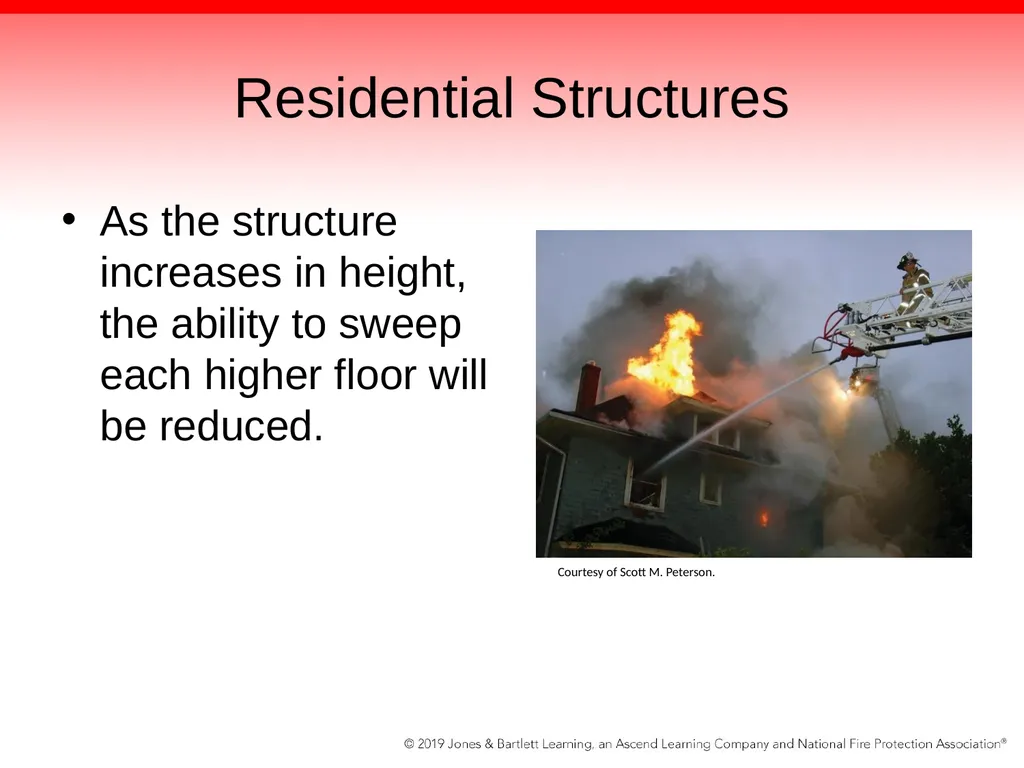
Residential Structures As the structure increases in height, the ability to sweep each higher floor will be reduced. Courtesy of Scott M. Peterson.<br>
54
Residential Structures Knowledge of the fire building will allow for better positioning at taller structures.
At these taller structures, there is less need for the aerial to aid in roof work.
Setting up at these structures before there is a fire allows driver/operator to gain insight and experience the challenges.<br>
At these taller structures, there is less need for the aerial to aid in roof work.
Setting up at these structures before there is a fire allows driver/operator to gain insight and experience the challenges.<br>
55
Commercial/Industrial Structures Prime concern at commercial or industrial structures is usually collapse.
Commercial and industrial properties are often single-story structures that contain high ceilings and open floor plans.
Creates potential for large fire volumes
Lightweight building construction is another concern.<br>
Commercial and industrial properties are often single-story structures that contain high ceilings and open floor plans.
Creates potential for large fire volumes
Lightweight building construction is another concern.<br>
56
Commercial/Industrial Structures Conventional wisdom calls for positioning the aerial apparatus at a corner. Courtesy of Drew Smith.<br>
57
Commercial/Industrial Structures When a second aerial apparatus is dispatched on the initial alarm, it should usually stage unless otherwise instructed by SOP or SOG or given an order by the IC.
In some departments with a two-aerial response on the initial alarm, the second aerial positions opposite of the first aerial.
Positioning must be preplanned.<br>
In some departments with a two-aerial response on the initial alarm, the second aerial positions opposite of the first aerial.
Positioning must be preplanned.<br>
58
Positioning and Spotting Considerations Driver/operator must address a number of considerations in a matter of seconds.
Training, education, and simulations prior to an actual emergency improve success.
There are multiple questions the driver/operator must ask and answer at each incident.<br>
Training, education, and simulations prior to an actual emergency improve success.
There are multiple questions the driver/operator must ask and answer at each incident.<br>
59
Building Type and Height The following information will aid the driver/operator in deciding where to position and set up the aerial apparatus:
Width of the lot
Setback from the paved road or parking lot
Number of stories and general construction type
Function (occupancy) of the structure<br>
Width of the lot
Setback from the paved road or parking lot
Number of stories and general construction type
Function (occupancy) of the structure<br>
60
Building Type and Height: Residential Structures In developed residential areas, lots generally have standard widths.
Roads and streets that are straight and laid out in a grid are a help to the driver/operator
All lots in a subdivision will have similar widths
In developed areas, most residential structures will also have a standard setback from the road.
Exceptions may be found (cul-de-sacs)<br>
Roads and streets that are straight and laid out in a grid are a help to the driver/operator
All lots in a subdivision will have similar widths
In developed areas, most residential structures will also have a standard setback from the road.
Exceptions may be found (cul-de-sacs)<br>
61
Building Type and Height: Residential Structures At low-rise apartments, parking or landscaping may increase the setback and affect the positioning and reach of the apparatus.
Mid-rise apartments may have a greater need for vertical reach Courtesy of David Traiforos.<br>
Mid-rise apartments may have a greater need for vertical reach Courtesy of David Traiforos.<br>
62
Building Type and Height: Commercial Structures Typical role is to support roof operations or elevated stream application.
Share concerns with private residences: Structures will generally not have a large setback, occupy most or all of the lot width, and may be an exposure risk. c Jones & Bartlett Learning. Photographed by Glen E. Ellman.<br>
Share concerns with private residences: Structures will generally not have a large setback, occupy most or all of the lot width, and may be an exposure risk. c Jones & Bartlett Learning. Photographed by Glen E. Ellman.<br>
63
Building Type and Height: Strip Malls Locations of entrances and exits may limit ingress.
Traffic lane at the front of the structure may position the aerial in the collapse zone if the driver/operator has not preplanned the complex.
Parking lot arrangement may impair turning or maneuvering.<br>
Traffic lane at the front of the structure may position the aerial in the collapse zone if the driver/operator has not preplanned the complex.
Parking lot arrangement may impair turning or maneuvering.<br>
64
Building Type and Height: Strip Malls Height and the depth of the front façade or parapet may impair roof access. © Jones & Bartlett Learning. Photographed by Glen E. Ellman.<br>
65
Building Type and Height: Strip Malls The rear of the structure may offer a better option for apparatus positioning.
Evaluation should include the potential for fire spread.
Determine the likely direction of fire spread and identify which side of the strip mall has the most uninvolved structure.<br>
Evaluation should include the potential for fire spread.
Determine the likely direction of fire spread and identify which side of the strip mall has the most uninvolved structure.<br>
66
Building Type and Height: Big-Box Structures Setback is usually not an issue, and access to all sides of the structure is usually possible. © Jones & Bartlett Learning. Photographed by Glen E. Ellman.<br>
67
Building Type and Height: Big-Box Structures Biggest question: Where is the fire, and how close can I get?
Many modern big-box structures use tilt-slab construction.
Under defensive fire conditions, wall failure upon roof collapse should be expected at these sites.<br>
Many modern big-box structures use tilt-slab construction.
Under defensive fire conditions, wall failure upon roof collapse should be expected at these sites.<br>
68
Building Type and Height: Industrial Structures Present with a combination of access and positioning challenges
Many have undergone multiple additions or had separate buildings joined together.
Variety of construction types and materials can affect fire spread.
Preplanning is essential.<br>
Many have undergone multiple additions or had separate buildings joined together.
Variety of construction types and materials can affect fire spread.
Preplanning is essential.<br>
69
Approach to the Scene Dramatically slow down the vehicle’s speed at least 500 ft before the fire location.
Allows driver to:
Observe fire conditions
Account for parked cars
Calculate room needed for other apparatus to pass
Scan for overhead obstructions and surface encumbrances
Check for victims in need of physical rescue<br>
Allows driver to:
Observe fire conditions
Account for parked cars
Calculate room needed for other apparatus to pass
Scan for overhead obstructions and surface encumbrances
Check for victims in need of physical rescue<br>
70
Collapse Zone Horizontal separation distance between the wall of a structure and the positioned apparatus
Distance must be equal to or greater than the height of the structure.
Distance should include a safety factor one-half the structure’s height.
Tip of the aerial ladder or the aerial platform must remain out of the structure’s collapse zone.<br>
Distance must be equal to or greater than the height of the structure.
Distance should include a safety factor one-half the structure’s height.
Tip of the aerial ladder or the aerial platform must remain out of the structure’s collapse zone.<br>
71
Turntable Positioning for Rescue Sweep/Scrub Area Wind direction and fire and smoke conditions are indicators of the desired turntable location.
Determines the scrub or sweep area for the aerial
Driver/operator will size up the structure and fire conditions.
Note height, width, and depth of structure and affected area.<br>
Determines the scrub or sweep area for the aerial
Driver/operator will size up the structure and fire conditions.
Note height, width, and depth of structure and affected area.<br>
72
Turntable Positioning for Rescue Sweep/Scrub Area Most structures will present with either:
A wide front and a shallow depth
Driver/operator will decide the best position for maximum sweep/scrub based on fire conditions, wind, need for physical rescue and ventilation.
A narrow front and a significant depth
A corner placement is usually best.<br>
A wide front and a shallow depth
Driver/operator will decide the best position for maximum sweep/scrub based on fire conditions, wind, need for physical rescue and ventilation.
A narrow front and a significant depth
A corner placement is usually best.<br>
73
Rescue Profile Key considerations should include the height of the structure and the location of the fire.
Whether the aerial device is needed for rescue is based on the rescue profile.
Rescue profile will tell the officer whether ground ladders or the aerial is needed.
Generally speaking, fires on the second and perhaps third floors can be handled more quickly with portable extension ladders.<br>
Whether the aerial device is needed for rescue is based on the rescue profile.
Rescue profile will tell the officer whether ground ladders or the aerial is needed.
Generally speaking, fires on the second and perhaps third floors can be handled more quickly with portable extension ladders.<br>
74
Making Up for Poor Placement Even when a driver/operator attempts best positioning of the aerial apparatus, that choice can come up short.
Some corrective action may be needed.
Includes circumstances in which the aerial cannot be set up where it can access the structure or in which the ground surface will not provide for proper stabilization.<br>
Some corrective action may be needed.
Includes circumstances in which the aerial cannot be set up where it can access the structure or in which the ground surface will not provide for proper stabilization.<br>
75
Making Up for Poor Placement Aerial apparatus should not be driven over unimproved surfaces that will not support its weight.
Driver/operator and company officer must make a risk–benefit analysis of the situation and then proceed.
When a stabilizer cannot be fully deployed, the apparatus may be short-jacked on the non-operational side.
Check the operator’s manual<br>
Driver/operator and company officer must make a risk–benefit analysis of the situation and then proceed.
When a stabilizer cannot be fully deployed, the apparatus may be short-jacked on the non-operational side.
Check the operator’s manual<br>
76
Setup and Stabilization of Aerial Apparatus Before the aerial can be raised and lowered safely, the chassis must be stabilized.
Proper stabilization broadens the base of vehicle to prevent it from tipping over.
Stabilization widens the footprint of the aerial’s chassis to beyond that of its wheels.
Outriggers act like a load and a lever on a fulcrum.<br>
Proper stabilization broadens the base of vehicle to prevent it from tipping over.
Stabilization widens the footprint of the aerial’s chassis to beyond that of its wheels.
Outriggers act like a load and a lever on a fulcrum.<br>
77
In-Cab Procedures Each aerial apparatus utilizes a somewhat different setup procedure.
When the pump and the aerial are both needed, it is faster to set up the aerial device first, then place the pump in gear.
Setup and stabilization of all apparatus follow at least some common in-cab procedures.
Bring the apparatus to a complete stop, shift the transmission to neutral, and set the parking brake.<br>
When the pump and the aerial are both needed, it is faster to set up the aerial device first, then place the pump in gear.
Setup and stabilization of all apparatus follow at least some common in-cab procedures.
Bring the apparatus to a complete stop, shift the transmission to neutral, and set the parking brake.<br>
78
Setting Stabilizers Driver/operator exits the cab and looks around and above the aerial apparatus to check for surface or overhead obstructions or hazards.
Check of all four sides for surface and overhead obstructions and hazards is required.
During walk-around, driver/operator can place the wheel chocks.<br>
Check of all four sides for surface and overhead obstructions and hazards is required.
During walk-around, driver/operator can place the wheel chocks.<br>
79
Setting Stabilizers: Full-Jacking Complete extension of all stabilizers
Always the desired action © Jones & Bartlett Learning. Photographed by Glen E. Ellman.<br>
Always the desired action © Jones & Bartlett Learning. Photographed by Glen E. Ellman.<br>
80
Setting Stabilizers: Short-Jacking Apparatus-specific procedure
Must be permitted by the manufacturer specs
Stabilizers are not fully extended on the side of the aerial apparatus where the aerial will not be raised, lowered, or rotated. Courtesy of Drew Smith.<br>
Must be permitted by the manufacturer specs
Stabilizers are not fully extended on the side of the aerial apparatus where the aerial will not be raised, lowered, or rotated. Courtesy of Drew Smith.<br>
81
Setting Stabilizers: Short-Jacking Only aerial apparatus with H-type stabilizers can be short-jacked.
Load capacity of the aerial must be reduced as specified in load charts.
Modern aerial apparatus are equipped with an aerial rotation interlock that prevents the aerial from being moved into a position in which the stabilizers are not fully deployed.<br>
Load capacity of the aerial must be reduced as specified in load charts.
Modern aerial apparatus are equipped with an aerial rotation interlock that prevents the aerial from being moved into a position in which the stabilizers are not fully deployed.<br>
82
Setting Stabilizers: Short-Jacking The decision to use a short-jacking procedure must be based on a risk–benefit analysis.
A mission-critical need that can be safely accomplished is the only justification for the use of short-jacking.
Follow the manufacturer’s specifications.<br>
A mission-critical need that can be safely accomplished is the only justification for the use of short-jacking.
Follow the manufacturer’s specifications.<br>
83
Compensating for Uneven Grades When terrain is uneven, stability of the apparatus will be compromised.
Uneven terrain can be:
Longitudinal (in line with the chassis frame or roadway)
Lateral (side-to-side or curb-to-curb)
Or a combination of both<br>
Uneven terrain can be:
Longitudinal (in line with the chassis frame or roadway)
Lateral (side-to-side or curb-to-curb)
Or a combination of both<br>
84
Compensating for Uneven Grades When the unevenness exceeds 6%, compensation is usually necessary.
6% = 3.5° of angle and can be measured using apparatus-mounted angle or slope indicators. © Jones & Bartlett Learning. Photographed by Glen E. Ellman.<br>
6% = 3.5° of angle and can be measured using apparatus-mounted angle or slope indicators. © Jones & Bartlett Learning. Photographed by Glen E. Ellman.<br>
85
Stabilizing on Curbs Do not set the stabilizers on top of a curb. Courtesy of Drew Smith.<br>
86
Stabilizing on Curbs Applying force to the top of a curb with a stabilizer results in a lever.
The top of the curb becomes the fulcrum, the curb becomes a load, and the stabilizer applies the force.
Curb could heave from the ground
It is best to reposition the apparatus so the stabilizer can be placed on a firm and level surface.<br>
The top of the curb becomes the fulcrum, the curb becomes a load, and the stabilizer applies the force.
Curb could heave from the ground
It is best to reposition the apparatus so the stabilizer can be placed on a firm and level surface.<br>
87
Operation of Aerial Ladder or Platform Controls Once stabilizers are fully set and apparatus has been leveled longitudinally and laterally, the aerial ladder or platform can be raised, rotated, and extended.
Some aerials will have controls at the turntable and at the tip or in the platform to accomplish these operations.<br>
Some aerials will have controls at the turntable and at the tip or in the platform to accomplish these operations.<br>
88
Operation of Aerial Ladder or Platform Controls Some platform controls are fully hydraulic.
Some controls are electronic and operate hydraulic valves in the turntable. Courtesy of Drew Smith.<br>
Some controls are electronic and operate hydraulic valves in the turntable. Courtesy of Drew Smith.<br>
89
Operation of Aerial Ladder or Platform Controls Turntable electronic controls and the tip/platform controls are the usual and customary controls operated. © Jones & Bartlett Learning. Photographed by Glen E. Ellman.<br>
90
Operation of Aerial Ladder or Platform Controls Driver/operator typically utilizes the turntable controls while fire fighters operate the tip/platform controls.
Two speeds
Slow when motor is idle
Fast when throttle is set to high
Controls at the ladder tip or in the platform generally operate only at a reduced speed regardless of whether the high idle is activated.<br>
Two speeds
Slow when motor is idle
Fast when throttle is set to high
Controls at the ladder tip or in the platform generally operate only at a reduced speed regardless of whether the high idle is activated.<br>
91
Operation of Aerial Ladder or Platform Controls As aerial approaches the work site, reduce motor speed to idle and communicate to tip/platform fire fighter to take over final placement.
Excellent communication is essential.
Keep the high idle off when the device is located in close proximity to structures, hazards, or people.
Driver/operator should stay positioned at turntable.<br>
Excellent communication is essential.
Keep the high idle off when the device is located in close proximity to structures, hazards, or people.
Driver/operator should stay positioned at turntable.<br>
92
Operation of Aerial Ladder or Platform Controls Jerking or sudden movements of the aerial can be dangerous and can result in damage to the apparatus.
Skilled and practiced driver/operator should be able to combine the maneuvers of raising/lowering, rotating, and extending/ retracting the aerial with feathering of the controls.<br>
Skilled and practiced driver/operator should be able to combine the maneuvers of raising/lowering, rotating, and extending/ retracting the aerial with feathering of the controls.<br>
93
Safe Aerial Practices Pay particular attention to the locations of any overhead wires and treat all wires as if they are electrically charged.
Use caution when maneuvering the aerial device, and maintain a minimum separation distance of at least 10 ft—preferably farther—for distribution wires.<br>
Use caution when maneuvering the aerial device, and maintain a minimum separation distance of at least 10 ft—preferably farther—for distribution wires.<br>
94
Safe Aerial Practices To avoid electrocution, the driver/operator of any pump on a raised aerial should stand on the provided slide-out tray.
Fire fighters should not touch the aerial apparatus whenever the aerial device is being maneuvered.
Before getting on or off the vehicle, make sure the aerial apparatus is clear of any overhead electrical wire.<br>
Fire fighters should not touch the aerial apparatus whenever the aerial device is being maneuvered.
Before getting on or off the vehicle, make sure the aerial apparatus is clear of any overhead electrical wire.<br>
95
Safe Aerial Practices Driver/operator should manage the loads placed on the aerial.
Shock loads are equivalent to multiplied loads.
Loads should be positioned perpendicular—not lateral—to rungs, whenever possible.
Fire fighters should climb in the center of the ladder, rather than to the side.
Both fire fighters and civilians are considered loads.<br>
Shock loads are equivalent to multiplied loads.
Loads should be positioned perpendicular—not lateral—to rungs, whenever possible.
Fire fighters should climb in the center of the ladder, rather than to the side.
Both fire fighters and civilians are considered loads.<br>
96
Safe Aerial Practices Every aerial will have a chart dictating the maximum number of persons who can occupy each section of the aerial.
Ensure that when the aerial is operated at low angles that any necessary reduction on loading occurs.
Occupants should be evenly distributed on platforms.
Stop movement of the aerial before permitting anyone to get on or off.<br>
Ensure that when the aerial is operated at low angles that any necessary reduction on loading occurs.
Occupants should be evenly distributed on platforms.
Stop movement of the aerial before permitting anyone to get on or off.<br>
97
Safe Aerial Practices The more in line with the chassis the aerial is extended or retracted, the more stable the apparatus will be because the force of the aerial is applied more evenly to all stabilizers.
When the aerial is more perpendicular to the chassis, only half of the stabilizers carry the load.<br>
When the aerial is more perpendicular to the chassis, only half of the stabilizers carry the load.<br>
98
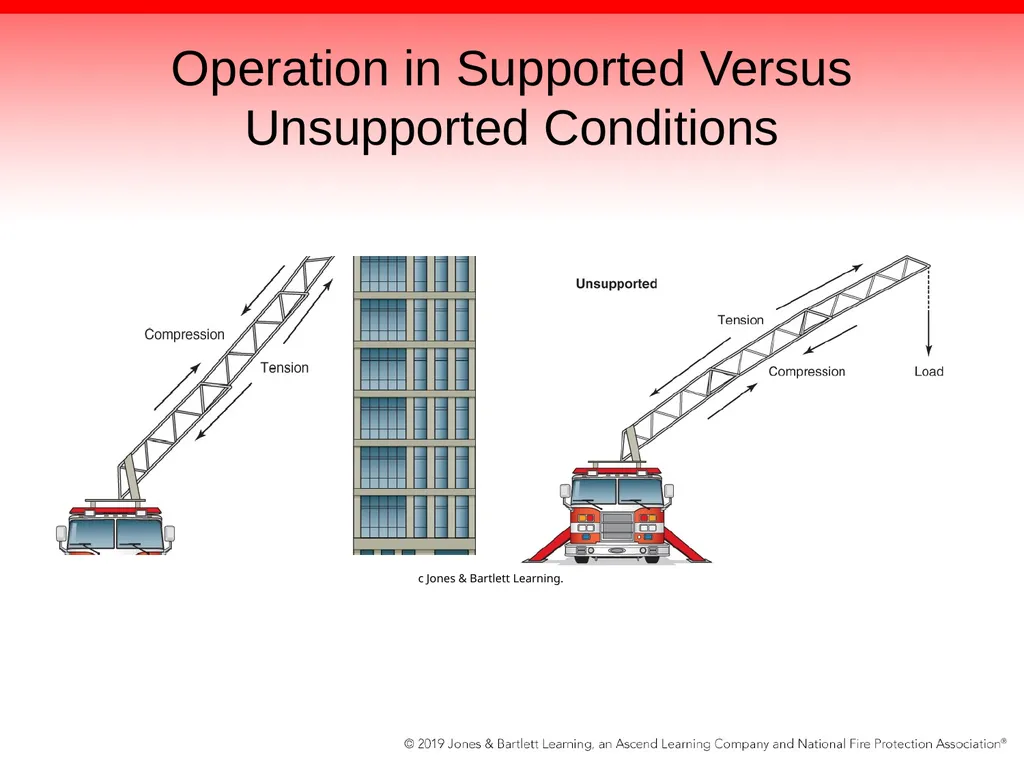
Operation in Supported Versus Unsupported Conditions The modern aerial is not designed to have its ladder or boom rest upon a structure.
Driver/operator should never support the extended ladder or boom against a building.
Resting the aerial against a structure reverses the loading.<br>
Driver/operator should never support the extended ladder or boom against a building.
Resting the aerial against a structure reverses the loading.<br>
99
Operation in Supported Versus Unsupported Conditions c Jones & Bartlett Learning.<br>
100
Load Placed on the Aerial Aerials need to support a number of loads.
Humans, equipment, water, environmental conditions
Maximum load may need to be reduced based on whether the waterway is charged, which additional equipment is being supported by the aerial, and/or which other environmental factors are considerations.<br>
Humans, equipment, water, environmental conditions
Maximum load may need to be reduced based on whether the waterway is charged, which additional equipment is being supported by the aerial, and/or which other environmental factors are considerations.<br>
101
Load Placed on the Aerial The driver/operator must know the rated capacity of the aerial.
Contained in the operator’s manual and usually on a plate or sign Courtesy of Drew Smith.<br>
Contained in the operator’s manual and usually on a plate or sign Courtesy of Drew Smith.<br>
102
Load Placed on the Aerial Driver/operator should ensure that the rungs for each section are in alignment.
Driver/operator at the turntable can help manage activity by directing when each fire fighter can begin to climb.
Weight of equipment must also be accounted for.<br>
Driver/operator at the turntable can help manage activity by directing when each fire fighter can begin to climb.
Weight of equipment must also be accounted for.<br>
103
Load Placed on the Aerial When a prepiped waterway is charged or a ladder pipe is affixed to the tip and charged with a hoseline, there is additional load on the ladder.
Must know if the aerial is designed to support this load
Environmental conditions are the final load consideration.
Snow, ice, and wind place loads on aerials.<br>
Must know if the aerial is designed to support this load
Environmental conditions are the final load consideration.
Snow, ice, and wind place loads on aerials.<br>
104
Improper Aerial Conditions Improper conditions include:
Unnecessary exposure to heat and fire conditions
Improper use of the aerial as a crane or other platform
Allowing firefighters to ride the aerial ladder when it is moving
Position the apparatus to prevent the aerial being subjected to excessive heat or flame.<br>
Unnecessary exposure to heat and fire conditions
Improper use of the aerial as a crane or other platform
Allowing firefighters to ride the aerial ladder when it is moving
Position the apparatus to prevent the aerial being subjected to excessive heat or flame.<br>
105
Improper Aerial Conditions Driver/operator should know which protective features exist on the aerial, how to operate them, and when they should be deployed.
Platform sprinklers and heat shields Courtesy of Drew Smith.<br>
Platform sprinklers and heat shields Courtesy of Drew Smith.<br>
106
Improper Aerial Conditions Do not use aerial as a crane.
Lifting victims in litter baskets is acceptable, if the aerial is rated to do so.
If fire fighters or rescue personnel desire to use an aerial as a high anchor point for a haul/lower system, it needs to be preplanned.
Only rated anchors should be used for this purpose.<br>
Lifting victims in litter baskets is acceptable, if the aerial is rated to do so.
If fire fighters or rescue personnel desire to use an aerial as a high anchor point for a haul/lower system, it needs to be preplanned.
Only rated anchors should be used for this purpose.<br>
107
Personal Protective Equipment Needed Driver/operator at the turntable and fire fighters climbing the aerial ladder or operating at the tip or platform should wear full structural firefighting PPE.
When fire fighters operating from the tip or platform need to use SCBA, there should be a safety evaluation to determine if those operating positions can function unstaffed.<br>
When fire fighters operating from the tip or platform need to use SCBA, there should be a safety evaluation to determine if those operating positions can function unstaffed.<br>
108
Fall Protection Any fire fighter climbing the aerial ladder or occupying the tip or platform should wear a ladder belt meeting the requirements of NFPA 1983.
Ladder belts should be connected to a ladder rung or to anchors in the platform. © Jones & Bartlett Learning. Photographed by Glen E. Ellman.<br>
Ladder belts should be connected to a ladder rung or to anchors in the platform. © Jones & Bartlett Learning. Photographed by Glen E. Ellman.<br>
109
Climbing or Riding a Moving Aerial Ladder When aerial ladder is being extended, retracted, or moved, fire fighters should not be in any location other than the platform.
As the ladder is extended or retracted, the ladder rungs of one section pass those of another section, creating areas that can be pinched.
A caught foot, hand, arm, or leg could be seriously injured or severed.<br>
As the ladder is extended or retracted, the ladder rungs of one section pass those of another section, creating areas that can be pinched.
A caught foot, hand, arm, or leg could be seriously injured or severed.<br>
110
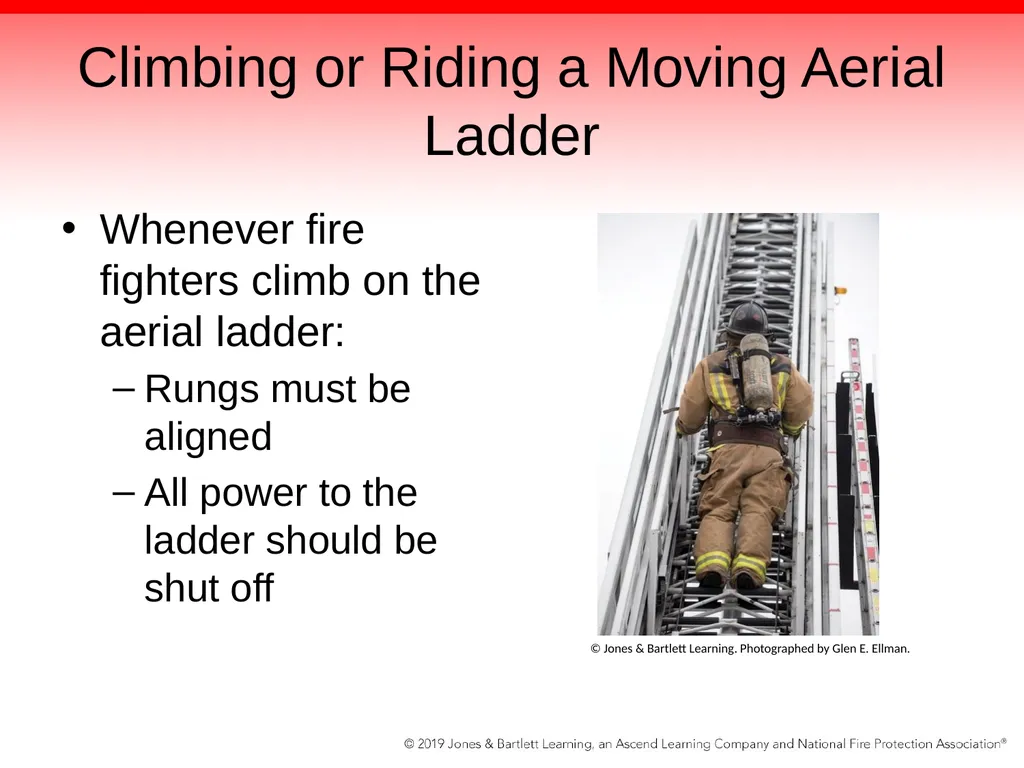
Climbing or Riding a Moving Aerial Ladder Whenever fire fighters climb on the aerial ladder:
Rungs must be aligned
All power to the ladder should be shut off © Jones & Bartlett Learning. Photographed by Glen E. Ellman.<br>
Rungs must be aligned
All power to the ladder should be shut off © Jones & Bartlett Learning. Photographed by Glen E. Ellman.<br>
111
Allow Space for Deflection When aerial is raised and fire fighters get on or off, the aerial platform will move when load is added or removed.
Fire fighters or victims getting on to the aerial platform will increase the load.
Driver/operator will ensure that any deflection does not create an unsafe condition.
Aerial resting against the structure or too high to safely disembark or be reboarded<br>
Fire fighters or victims getting on to the aerial platform will increase the load.
Driver/operator will ensure that any deflection does not create an unsafe condition.
Aerial resting against the structure or too high to safely disembark or be reboarded<br>
112
Maneuvering Aerial Device To practice maneuvering the aerial device, select a location that is free of hazards and any obstructions.
Develop proficiency by practicing:
Rotate while raising
Extend while rotating or raising
Retract while lowering or rotating
Any combination of the above as permitted by aerials’ manufacturer<br>
Develop proficiency by practicing:
Rotate while raising
Extend while rotating or raising
Retract while lowering or rotating
Any combination of the above as permitted by aerials’ manufacturer<br>
113
Using the Aerial to Effect a Rescue Driver/operator must position and stabilize apparatus before deploying the ladder or platform to the victim.
Aerial should be positioned to best effect the rescue while recognizing that other victims may be present and aerial may be needed for ventilation or elevated streams.<br>
Aerial should be positioned to best effect the rescue while recognizing that other victims may be present and aerial may be needed for ventilation or elevated streams.<br>
114
Using the Aerial to Effect a Rescue As the tip of the ladder or the platform approaches the victim, keep it to the upwind side and raised above the victim’s location. c Jones & Bartlett Learning.<br>
115
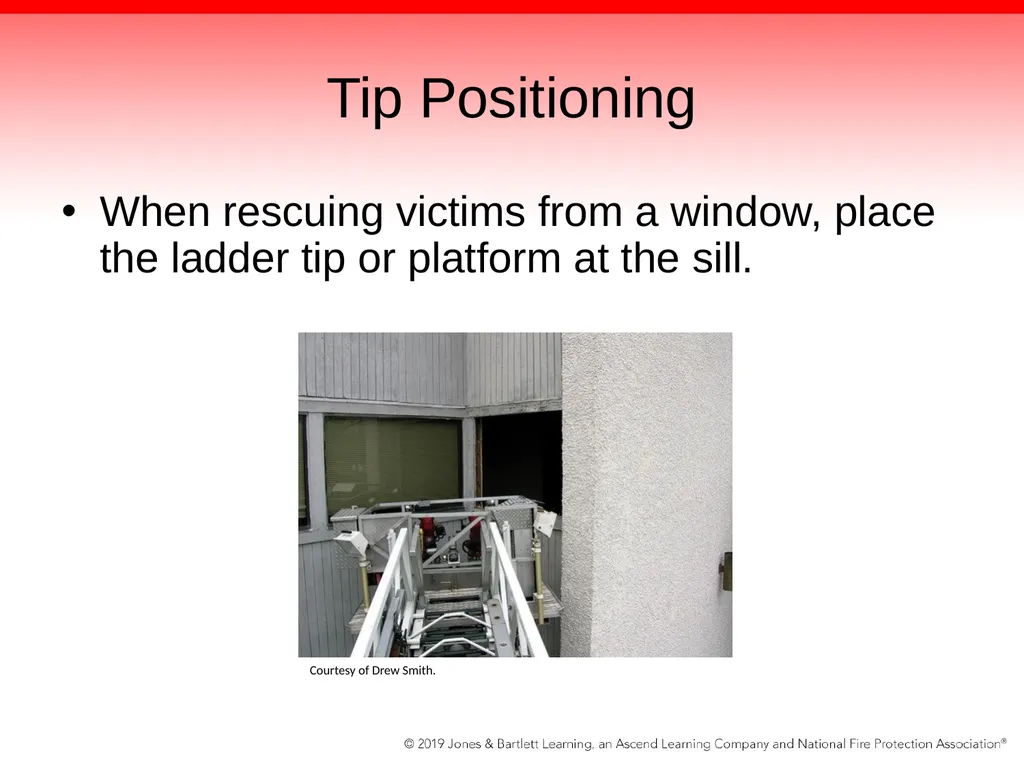
Tip Positioning When rescuing victims from a window, place the ladder tip or platform at the sill. Courtesy of Drew Smith.<br>
116
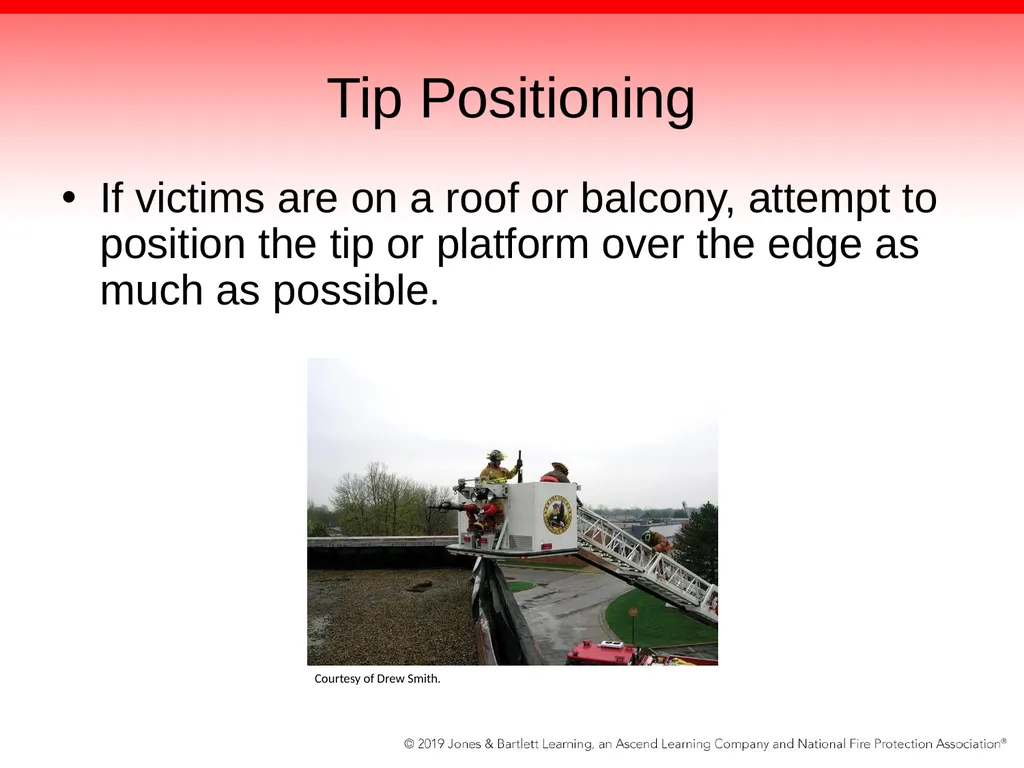
Tip Positioning If victims are on a roof or balcony, attempt to position the tip or platform over the edge as much as possible. Courtesy of Drew Smith.<br>
117
Tip Positioning When victims are able to climb down on the ladder, care must be exercised to avoid overloading it.
Follow manufacturer’s recommendation.
It is often quicker to lower the platform to the ground and offload the victims from it and then return the platform for another load of victims, versus letting the individual victims climb down the ladder<br>
Follow manufacturer’s recommendation.
It is often quicker to lower the platform to the ground and offload the victims from it and then return the platform for another load of victims, versus letting the individual victims climb down the ladder<br>
118
Rescue Priorities: Multiple Victims Level of threat and proximity to the fire are key considerations.
Individuals directly exposed to fire conditions are top priority.
May be best to have the aerial company shelter victims in areas other than the immediate fire area in place or direct them to use building features to isolate smoke<br>
Individuals directly exposed to fire conditions are top priority.
May be best to have the aerial company shelter victims in areas other than the immediate fire area in place or direct them to use building features to isolate smoke<br>
119
Rescue Priorities: Physical Rescue Unconscious victims will need physical rescue.
Conscious individuals may need physical rescue, assistance with accessing the aerial or direction on how to climb down, or only simple directions on where to go and how to proceed.
Ensure an adequate number of fire fighters to effect the rescues.<br>
Conscious individuals may need physical rescue, assistance with accessing the aerial or direction on how to climb down, or only simple directions on where to go and how to proceed.
Ensure an adequate number of fire fighters to effect the rescues.<br>
120
Rescue Priorities: Rescue Carries Generally, one fire fighter grasps the victim from above the head and another fire fighter grasps the legs from below.
Victim is then carried down the ladder feet first.
Carrying a victim down the aerial ladder requires at least three fire fighters: two for the carry and one below providing direction and guidance.<br>
Victim is then carried down the ladder feet first.
Carrying a victim down the aerial ladder requires at least three fire fighters: two for the carry and one below providing direction and guidance.<br>
121
Rescue Priorities: Rescue Carries Basket litter makes handling and maneuvering the victim easier and safe.
Whether using an aerial ladder or a platform, it is safer and faster to move the victim onto the aerial and then lower the tip or platform to the ground versus trying to carry the victim or letting the person climb down.<br>
Whether using an aerial ladder or a platform, it is safer and faster to move the victim onto the aerial and then lower the tip or platform to the ground versus trying to carry the victim or letting the person climb down.<br>
122
Ventilation Positioning When performing horizontal ventilation via windows, position the aerial upwind of the ventilation location.
Chassis should be positioned to avoid falling glass and other debris.
Consider whether one or multiple windows must be broken out.<br>
Chassis should be positioned to avoid falling glass and other debris.
Consider whether one or multiple windows must be broken out.<br>
123
Vertical Ventilation via Rooftop Operations For vertical ventilation, aerial should be positioned so that fire fighters accessing the roof will be able to escape rapidly.
When fire fighters get onto the roof, they should do so in an area where the fire is less likely to spread
Fire fighters should be provided with two ways off the work site.
Could be a combination of ground and aerial ladders or all aerial devices<br>
When fire fighters get onto the roof, they should do so in an area where the fire is less likely to spread
Fire fighters should be provided with two ways off the work site.
Could be a combination of ground and aerial ladders or all aerial devices<br>
124
Vertical Ventilation via Rooftop Operations Many structures will present with a tall parapet wall or false roof on one or more sides.
May be a better decision to use the rear or a different side of the structure to obtain access
Use a straight ladder to safely climb down to the flat roof deck, then secure the ladder.<br>
May be a better decision to use the rear or a different side of the structure to obtain access
Use a straight ladder to safely climb down to the flat roof deck, then secure the ladder.<br>
125
Elevated Streams A major role of the aerial device is elevated streams.
They may be used at any angle permitted by the aerial’s manufacturer.
Driver/operator must know at which angles use of the aerial device is permitted.
Aerial ladders may be constructed with a prepiped waterway and tip-mounted master stream.<br>
They may be used at any angle permitted by the aerial’s manufacturer.
Driver/operator must know at which angles use of the aerial device is permitted.
Aerial ladders may be constructed with a prepiped waterway and tip-mounted master stream.<br>
126
Elevated Stream Positioning Reach has two components:
Reach of stream from the nozzle
Reach of the aerial
For water to reach its objective, both of these components must be considered.
Rarely are elevated streams operated at elevations greater than 75 degrees.
In many cases, the best results are produced when the stream is as low and close to the fire as possible.<br>
Reach of stream from the nozzle
Reach of the aerial
For water to reach its objective, both of these components must be considered.
Rarely are elevated streams operated at elevations greater than 75 degrees.
In many cases, the best results are produced when the stream is as low and close to the fire as possible.<br>
127
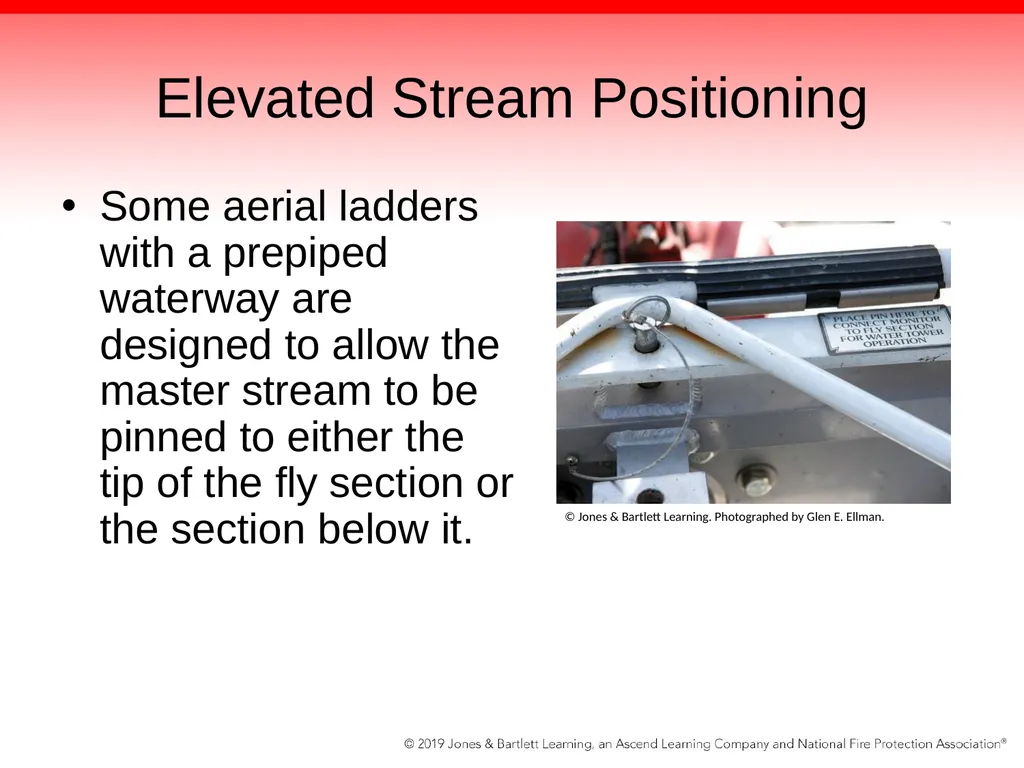
Elevated Stream Positioning Some aerial ladders with a prepiped waterway are designed to allow the master stream to be pinned to either the tip of the fly section or the section below it. © Jones & Bartlett Learning. Photographed by Glen E. Ellman.<br>
128
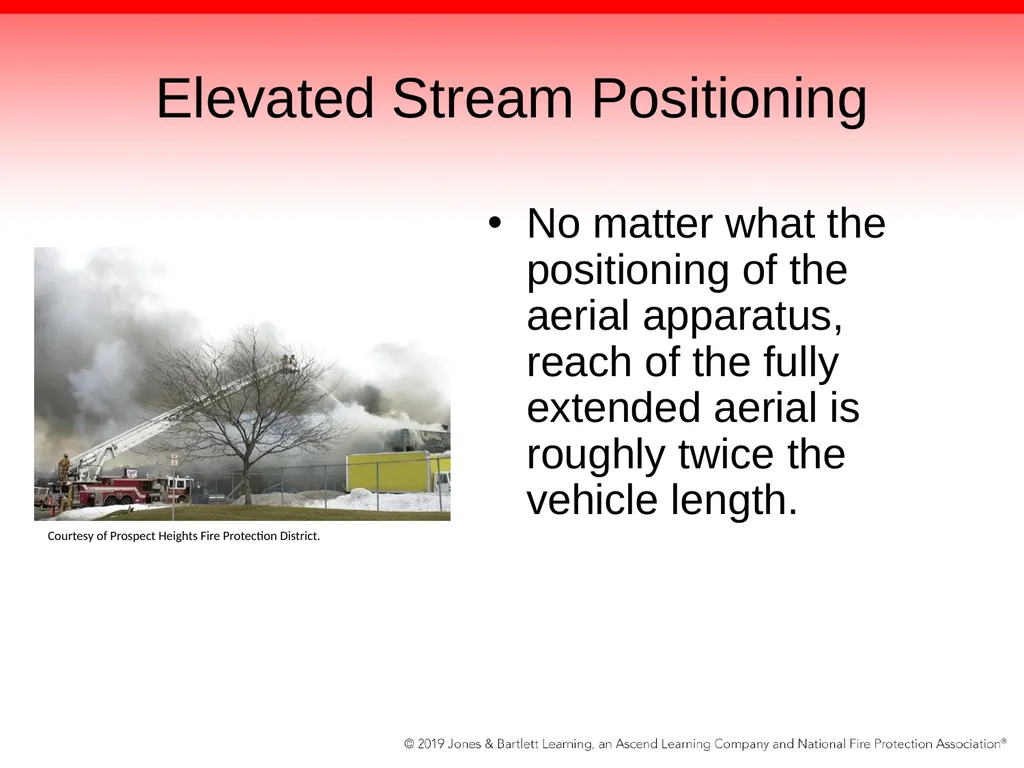
Elevated Stream Positioning No matter what the positioning of the aerial apparatus, reach of the fully extended aerial is roughly twice the vehicle length. Courtesy of Prospect Heights Fire Protection District.<br>
129
Elevated Stream Positioning Primary considerations related to elevated stream operations:
Ensuring adequate separation from the fire
Staying out of the collapse zone.
Other considerations include wind direction and speed, presence of ice or snow, overhead wires or other obstructions or hazards, and roadway conditions.<br>
Ensuring adequate separation from the fire
Staying out of the collapse zone.
Other considerations include wind direction and speed, presence of ice or snow, overhead wires or other obstructions or hazards, and roadway conditions.<br>
130
Operating Under Adverse Environmental Conditions Adverse conditions that may present to the driver/operator of an aerial apparatus are fire and weather.
Anytime the aerial is exposed to high winds, ice, and snow, the load may have to be reduced.
Consult the operator’s manual as well as the placards posted at the turntable pedestal.<br>
Anytime the aerial is exposed to high winds, ice, and snow, the load may have to be reduced.
Consult the operator’s manual as well as the placards posted at the turntable pedestal.<br>
131
Operating Under Adverse Environmental Conditions To maximize stability and load-bearing capacity of the aerial, operate the aerial extended over the cab or off the rear. Courtesy of Prospect Heights Fire Protection District.<br>
132
Operating Under Adverse Environmental Conditions When ice and snow begin to accumulate on the aerial, periodically maneuver the aerial to prevent its build-up.
The modern aerial’s elevated stream is usually operable using remote controls.
IC, safety officer, and aerial company officer should determine if the tip or platform should be unstaffed to maximize safety.<br>
The modern aerial’s elevated stream is usually operable using remote controls.
IC, safety officer, and aerial company officer should determine if the tip or platform should be unstaffed to maximize safety.<br>
133
Stream Types Elevated streams can be either solid or fog patterns.
Solid streams or solid-bore nozzles come in a variety of sizes and have different operating characteristics.
Driver/operator must understand the advantages and disadvantages of each and know exactly which nozzles are on the aerial.<br>
Solid streams or solid-bore nozzles come in a variety of sizes and have different operating characteristics.
Driver/operator must understand the advantages and disadvantages of each and know exactly which nozzles are on the aerial.<br>
134
Stream Types Driver/operator can use engineering calculations to deliver an approximate flow.
Calculation method depends on the driver/operator having accurate data:
Hose diameter and lengths
Friction loss for any appliances, a prepiped waterway, and the master stream device
Accurate height for the master stream’s operating position<br>
Calculation method depends on the driver/operator having accurate data:
Hose diameter and lengths
Friction loss for any appliances, a prepiped waterway, and the master stream device
Accurate height for the master stream’s operating position<br>
135
Stream Types On modern aerial apparatus with a prepiped waterway, using a flow meter is the best way to ensure desired flow is delivered. © Jones & Bartlett Learning. Photographed by Glen E. Ellman.<br>
136
Water Supply Water supply for the aerial must be of sufficient pressure and volume.
If aerial is equipped with its own pump that will be used to supply the elevated stream, then it may secure its own water source or be supplied via relay pumper.
If aerial’s pump will not be used, then supplying pumper must directly feed the waterway or ladder pipe.<br>
If aerial is equipped with its own pump that will be used to supply the elevated stream, then it may secure its own water source or be supplied via relay pumper.
If aerial’s pump will not be used, then supplying pumper must directly feed the waterway or ladder pipe.<br>
137
Stream Application Elevated stream:
objective is to stop the forward progress of the fire and ensure extinguishment.
imposes large dead load on the structure.
Avoid areas where companies are located. c Glen E. Ellman.<br>
objective is to stop the forward progress of the fire and ensure extinguishment.
imposes large dead load on the structure.
Avoid areas where companies are located. c Glen E. Ellman.<br>
138
Stream Application Stream may be sent through the window and toward the ceiling to bounce water onto the fire.
Direct attack with the elevated stream will have the best results.
Horizontal application of the stream onto the fire Courtesy of David Traiforos.<br>
Direct attack with the elevated stream will have the best results.
Horizontal application of the stream onto the fire Courtesy of David Traiforos.<br>
139
Stream Application It will become necessary to maneuver the stream to reach other fire locations.
Move the ladder or platform horizontally before adjusting the master stream device. Courtesy of David Traiforos.<br>
Move the ladder or platform horizontally before adjusting the master stream device. Courtesy of David Traiforos.<br>
140
Exposure Protection Particular consideration should be given to the collapse zone.
Direction and effect of wind on both the ladder and the potential fire spread must be evaluated.
Aerial apparatus should not be positioned in a location where it will be exposed to fire and from which both the fire fighters and the apparatus cannot reposition themselves.<br>
Direction and effect of wind on both the ladder and the potential fire spread must be evaluated.
Aerial apparatus should not be positioned in a location where it will be exposed to fire and from which both the fire fighters and the apparatus cannot reposition themselves.<br>
141
Exposure Protection When ordered to protect the exposure, direct the water from the elevated stream onto the exposure and not the fire.
Goal is to keep the fuel below its ignition temperature so it will not burn.
When faced with a fire at a large structure, the IC may elect to use fire attack and exposure protection simultaneously but in different areas.<br>
Goal is to keep the fuel below its ignition temperature so it will not burn.
When faced with a fire at a large structure, the IC may elect to use fire attack and exposure protection simultaneously but in different areas.<br>
142
Other Considerations When operating a platform’s nozzle over a fire or near an exposure, turn on the platform’s sprinkler.
Open the valve fully, never partially, as a partially open valve may close itself.
Before retracting a charged waterway, it is best to uncharge it, keep the nozzle valve open, and open the drain.<br>
Open the valve fully, never partially, as a partially open valve may close itself.
Before retracting a charged waterway, it is best to uncharge it, keep the nozzle valve open, and open the drain.<br>
143
Use of the Aerial to Deploy an Elevated Stream To practice using the aerial to deploy an elevated stream, the driver/operator should select a location that is free of hazards and any obstructions.<br>
144
Use of the Aerial Device’s Emergency Power or Operations Feature Emergency systems generally rely on an electrically operated pump or a manual hand-crank to lower the aerial.
Each manufacturer will use a specific procedure and system.
Often an emergency hydraulic pump that uses 12-volt power from the chassis cannot operate indefinitely without sustaining damage.<br>
Each manufacturer will use a specific procedure and system.
Often an emergency hydraulic pump that uses 12-volt power from the chassis cannot operate indefinitely without sustaining damage.<br>
145
Use of the Aerial Device’s Emergency Power or Operations Feature Should there be a failure requiring the use of the emergency system, ask:
Can personnel occupying the aerial tip or platform remain in that location without risk?
Should any elevated stream be terminated to reduce load and force on the aerial?
How much time do you have before the aerial must be lowered?<br>
Can personnel occupying the aerial tip or platform remain in that location without risk?
Should any elevated stream be terminated to reduce load and force on the aerial?
How much time do you have before the aerial must be lowered?<br>
146
Key Points Before Dispatch Know your aerial’s operator’s manual thoroughly, including stabilization requirements and load limitations.
Perform and complete a thorough check of the aerial during each shift worked or at least weekly if on call.
Practice positioning, stabilizing, and maneuvering the aerial at a variety of structures in your area.<br>
Perform and complete a thorough check of the aerial during each shift worked or at least weekly if on call.
Practice positioning, stabilizing, and maneuvering the aerial at a variety of structures in your area.<br>
147
Key Points Upon Dispatch Recall your previous knowledge of and experiences at the structure, including not just fires but also EMS and service calls.
Understand the nature and other dispatch information that can aid in making positioning decisions.
Use preplan information to confirm the structure and occupancy type.<br>
Understand the nature and other dispatch information that can aid in making positioning decisions.
Use preplan information to confirm the structure and occupancy type.<br>
148
Key Points En Route Drive safely.
Listen to the two-way radio traffic to gain insight and information about the nature of the incident.
Identify possible water supplies that may be needed to supply an elevated stream.<br>
Listen to the two-way radio traffic to gain insight and information about the nature of the incident.
Identify possible water supplies that may be needed to supply an elevated stream.<br>
149
Key Points on Approach Slow down and drive slowly as you enter the final block approaching the scene.
Note the building type and occupancy.
What is the separation between the building and the roadway or parking lot?
Note the terrain, environmental conditions, fire and smoke conditions, and victim locations that may impact final positioning.<br>
Note the building type and occupancy.
What is the separation between the building and the roadway or parking lot?
Note the terrain, environmental conditions, fire and smoke conditions, and victim locations that may impact final positioning.<br>
150
Key Points Once Positioned Energize the aerial following the manufacturer’s in-cab procedures.
Don the required PPE.
Stabilize the apparatus.
Prepare to maneuver the aerial device as required.
Locate previously identified water supplies.
Unless required otherwise, maintain your position at the turntable controls.<br>
Don the required PPE.
Stabilize the apparatus.
Prepare to maneuver the aerial device as required.
Locate previously identified water supplies.
Unless required otherwise, maintain your position at the turntable controls.<br>
151
Positioning and Setup Seek out the permission of property owners to bring the aerial to their property and set it up to check what can be reached and which issues arise.
Verify suitable surfaces.
Actually position the apparatus, stabilize it, and maneuver the ladder near the structure.<br>
Verify suitable surfaces.
Actually position the apparatus, stabilize it, and maneuver the ladder near the structure.<br>
152
Stabilizing the Apparatus Seek out parking lots and roadways free of regular traffic with differences in lateral and longitudinal grades.
Practice stabilizing the apparatus when side-to-side or front-to rear grades are present.
Practice stabilizing the aerial apparatus where there is no road shoulder, a poor shoulder, or unimproved surface.<br>
Practice stabilizing the apparatus when side-to-side or front-to rear grades are present.
Practice stabilizing the aerial apparatus where there is no road shoulder, a poor shoulder, or unimproved surface.<br>
153
Operation of Aerial Controls With the aerial properly stabilized in an open area free of overhead hazards, securely tie a rope to the tip or platform.
At the other end of the rope, secure a small, lightweight object.
Space out traffic cones or other targets such as old tires, plastic barrels, or similar objects that the operator can set the load into.
Then practice smoothly maneuvering the controls to raise, extend, rotate, and lower the load into the target.<br>
At the other end of the rope, secure a small, lightweight object.
Space out traffic cones or other targets such as old tires, plastic barrels, or similar objects that the operator can set the load into.
Then practice smoothly maneuvering the controls to raise, extend, rotate, and lower the load into the target.<br>
154
Operation of Aerial Controls If the fire station, training tower, or other structure owned by the governing body has multiple roof or wall levels, the aerial can be properly stabilized in an area free of overhead hazards.
Raise the unextended aerial up completely vertical, rotate it 180 degrees, and then lower it while extending it to an objective<br>
Raise the unextended aerial up completely vertical, rotate it 180 degrees, and then lower it while extending it to an objective<br>
155
Maneuvering to Multiple Windows/Targets Driver/operator should be given orders to maneuver from the bedded position to a specific window.
Driver/operator should be directed to move to a different window that will require the aerial to be rotated, retracted, raised, or lowered.
Evolution may include rebedding the aerial or lowering its tip or platform to the ground each time.<br>
Driver/operator should be directed to move to a different window that will require the aerial to be rotated, retracted, raised, or lowered.
Evolution may include rebedding the aerial or lowering its tip or platform to the ground each time.<br>
156
Maneuvering to the Roof Both flat and pitched roofs should be used during this training.
Key considerations include making sure:
Driver/operator and fire fighter at the tip/platform communicate via radio or intercom
Controls are feathered to prevent the aerial from striking the parapet or roof
Changes in the load when fire fighters get on or off the tip or platform have been accounted for so as to minimize the risk of deflection<br>
Key considerations include making sure:
Driver/operator and fire fighter at the tip/platform communicate via radio or intercom
Controls are feathered to prevent the aerial from striking the parapet or roof
Changes in the load when fire fighters get on or off the tip or platform have been accounted for so as to minimize the risk of deflection<br>
157
Flowing Water into a Training Tower Practice applying an elevated stream.
Ensure the structure is unoccupied.
Skills that can be practiced include:
Charging the master stream device to avoid water hammer and shock loads
Maneuvering the master stream device itself using its controls or remote controls
Maneuvering the aerial to keep the stream reaction/nozzle force in line with the aerial versus perpendicular to the ladder or platform<br>
Ensure the structure is unoccupied.
Skills that can be practiced include:
Charging the master stream device to avoid water hammer and shock loads
Maneuvering the master stream device itself using its controls or remote controls
Maneuvering the aerial to keep the stream reaction/nozzle force in line with the aerial versus perpendicular to the ladder or platform<br>
158
Combining Multiple Skills Rapidly bringing the aerial tip or platform with a simulated victim and a fire fighter to the ground so the victim can be offloaded and then returning the aerial to ferry another victim.
Positioning the aerial for flat roof access when there is a tall parapet, requiring the use of a ground ladder either affixed to the aerial tip or platform or resting against the top of the parapet wall. Must be planned and trained before attempting at an actual emergency.<br>
Positioning the aerial for flat roof access when there is a tall parapet, requiring the use of a ground ladder either affixed to the aerial tip or platform or resting against the top of the parapet wall. Must be planned and trained before attempting at an actual emergency.<br>
159
An Example of Skills in Action Courtesy of Tim Olk. c Jones & Bartlett Learning.<br>
160
An Example of Skills in Action Courtesy of Tim Olk. Courtesy of Tim Olk. Courtesy of Tim Olk.<br>
161
An Example of Skills in Action c Jones & Bartlett Learning.<br>
162
Summary The aerial apparatus should be an effective tool, not just an expensive taxi.
The driver/operator should use the aerial apparatus to support the tactical priorities, in the following order: (1) rescue, (2) exposure protection, (3) ventilation, and (4) application of an elevated stream.
There are three types of aerial apparatus: the straight ladder, the elevated platform, and the articulating platform. Straight ladders and elevated platforms are the most commonly encountered units.<br>
The driver/operator should use the aerial apparatus to support the tactical priorities, in the following order: (1) rescue, (2) exposure protection, (3) ventilation, and (4) application of an elevated stream.
There are three types of aerial apparatus: the straight ladder, the elevated platform, and the articulating platform. Straight ladders and elevated platforms are the most commonly encountered units.<br>
163
Summary Most aerial ladders are of truss construction; you must understand how the load of the ladder itself applies compression and tension to the truss.
You must also understand how resting any portion of the aerial’s truss against a structure can reverse this compression and tension, leading to damage or device failure.<br>
You must also understand how resting any portion of the aerial’s truss against a structure can reverse this compression and tension, leading to damage or device failure.<br>
164
Summary The chassis powertrain supplies energy to the hydraulic and electrical systems used to operate the aerial device. It is essential that the driver/operator understands the functioning and operation of each of these systems.
Safe and effective aerial operations start with effective stabilization. Each aerial uses one or more types of stabilizers to achieve this goal. The driver/operator must know which type(s) are used on his or her apparatus and how to properly use them to achieve full stabilization of the apparatus prior to operating the aerial device.<br>
Safe and effective aerial operations start with effective stabilization. Each aerial uses one or more types of stabilizers to achieve this goal. The driver/operator must know which type(s) are used on his or her apparatus and how to properly use them to achieve full stabilization of the apparatus prior to operating the aerial device.<br>
165
Summary Safety systems are located strategically on the aerial ladder and the H-jack equipment; these safety mechanisms are intended to prevent driver/operators from doing something potentially dangerous. They can be bypassed by the manual override procedures under certain circumstances and with the proper knowledge.
Knowing the effective reach of the aerial device is key to positioning the apparatus and performing setup.<br>
Knowing the effective reach of the aerial device is key to positioning the apparatus and performing setup.<br>
166
Summary Positioning factors include the tactical priority of the incident and any rescue profile; the structure type, occupancy, and features; the terrain characteristics and surface features as well as overhead obstructions and hazards; the collapse zone; and the effective sweep or scrub area for the aerial.
Stabilization begins with properly executing in-cab procedures, activating and deploying the stabilizers, and setting the stabilizers in full-or short-jacked manner.<br>
Stabilization begins with properly executing in-cab procedures, activating and deploying the stabilizers, and setting the stabilizers in full-or short-jacked manner.<br>
167
Summary If uneven grades are encountered or short-jacking is required, then the driver/operator must completely understand and adhere to the operational limitations required for safe continued operation of the aerial apparatus.
To safely operate the aerial device, the driver/operator must identify and avoid risks such as overhead electrical wires, excessive heat or flame exposure, and overloading of the aerial in any manner with fire fighters or civilians.<br>
To safely operate the aerial device, the driver/operator must identify and avoid risks such as overhead electrical wires, excessive heat or flame exposure, and overloading of the aerial in any manner with fire fighters or civilians.<br>
168
Summary All members operating on the aerial must wear the proper PPE, including fall protection.
An aerial apparatus should never be used as a crane.
When using the aerial apparatus to deliver an elevated stream, the driver/operator must compensate per the manufacturer’s recommendation to reduce load.<br>
An aerial apparatus should never be used as a crane.
When using the aerial apparatus to deliver an elevated stream, the driver/operator must compensate per the manufacturer’s recommendation to reduce load.<br>
169
Summary When presented with excessive winds or the build-up of ice or snow on the aerial device, the driver/operator must compensate per the manufacturer’s recommendation to reduce load.
To prevent damage to the apparatus, the driver/operator must take deflection of the aerial ladder or boom into account when maneuvering it.<br>
To prevent damage to the apparatus, the driver/operator must take deflection of the aerial ladder or boom into account when maneuvering it.<br>
170
Summary When conducting a rescue via the aerial device, victims should be approached from above and in the order of priority commensurate with the conditions encountered.
The driver/operator, in consultation with the company officer, should consider the risk–benefit tradeoff of having victims attempt to climb down the aerial ladder versus lowering the tip or platform and then repositioning it if additional victims are present.<br>
The driver/operator, in consultation with the company officer, should consider the risk–benefit tradeoff of having victims attempt to climb down the aerial ladder versus lowering the tip or platform and then repositioning it if additional victims are present.<br>
171
Summary When using the aerial device to support fire fighters performing ventilation, the driver/operator must ensure there is adequate egress from roofs and approach the work area from an upwind direction.
When using the aerial device for an elevated stream operation, factors such as permitted load on the aerial, nozzle reaction, freezing weather, exposures, collapse zone, and reach of the fire stream must all be considered.<br>
When using the aerial device for an elevated stream operation, factors such as permitted load on the aerial, nozzle reaction, freezing weather, exposures, collapse zone, and reach of the fire stream must all be considered.<br>
172
Summary The water supply must be adequate for the fire stream gpm flow desired. Either direct pumping into the waterway or the use of the aerial’s own pump or an adjacent engine company may be necessary to ensure an adequate flow.<br>