
Chapter 15 – Cyber Operations Part I Cyber “A




Description: Chapter 15 Cyber Operations Part I Cyber A failure by the Department to secure its systems in cyberspace would pose a fundamental risk to our ability to accomplish defense missions today and in the future. - 2010 Quadrennial Defense
Related Topics
Download Presentation
"Chapter 15 – Cyber Operations Part I Cyber “A" is the property of its rightful owner. Permission is granted to download and print the materials on this website for personal, non-commercial use only, and to display it on your personal computer provided you do not modify the materials and that you retain all copyright notices contained in the materials. By downloading content from our website, you accept the terms of this agreement.
Presentation Transcript
slide1. Chapter 15 – Cyber Operations Part I<br>
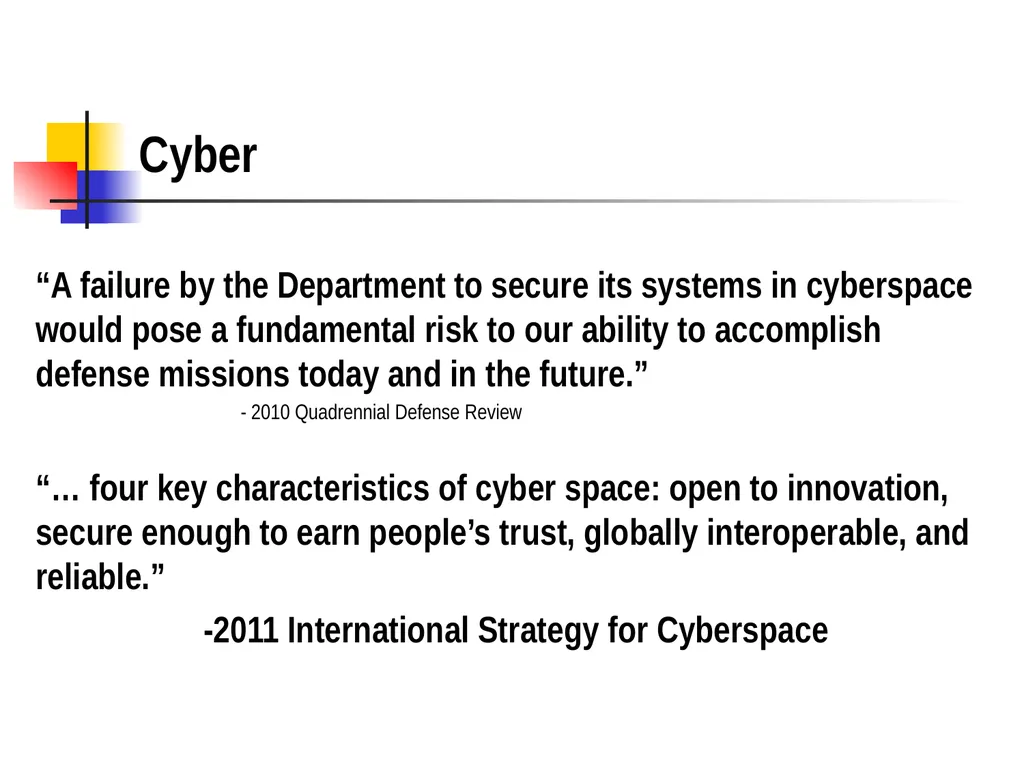
slide2. Cyber “A failure by the Department to secure its systems in cyberspace would pose a fundamental risk to our ability to accomplish defense missions today and in the future.”
- 2010 Quadrennial Defense Review
“… four key characteristics of cyber space: open to innovation, secure enough to earn people’s trust, globally interoperable, and reliable.”
-2011 International Strategy for Cyberspace<br>
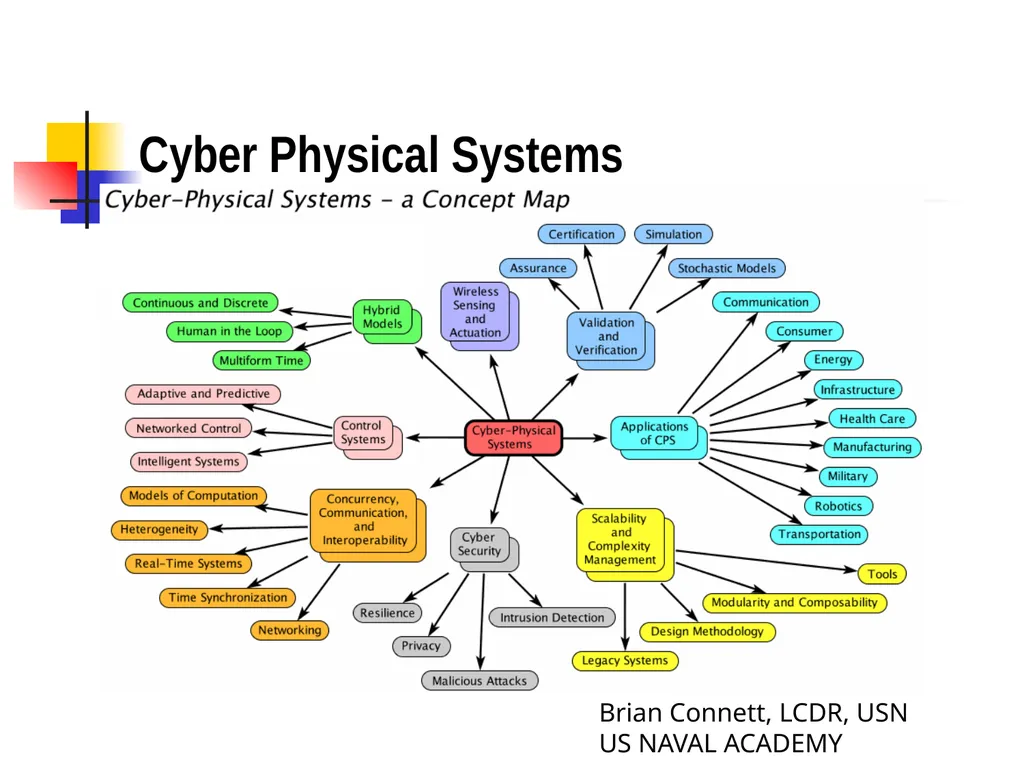
slide3. Cyber Physical Systems Brian Connett, LCDR, USN
US NAVAL ACADEMY<br>
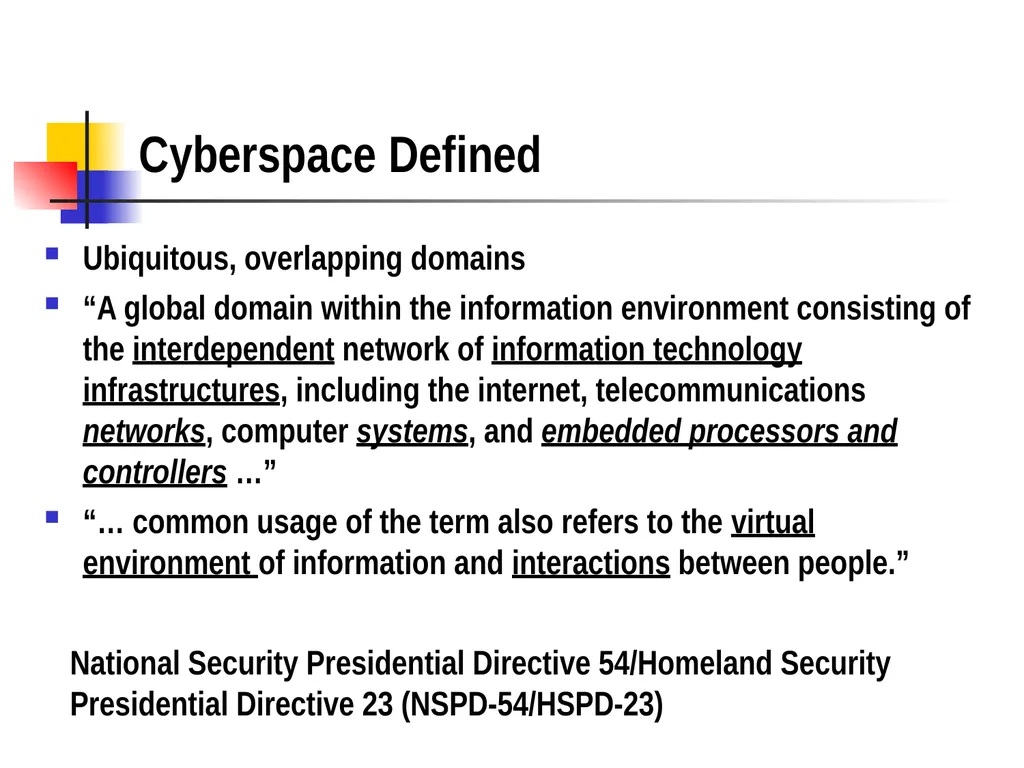
slide4. Cyberspace Defined Ubiquitous, overlapping domains
“A global domain within the information environment consisting of the interdependent network of information technology infrastructures, including the internet, telecommunications networks, computer systems, and embedded processors and controllers …”
“… common usage of the term also refers to the virtual environment of information and interactions between people.”
National Security Presidential Directive 54/Homeland Security Presidential Directive 23 (NSPD-54/HSPD-23)<br>
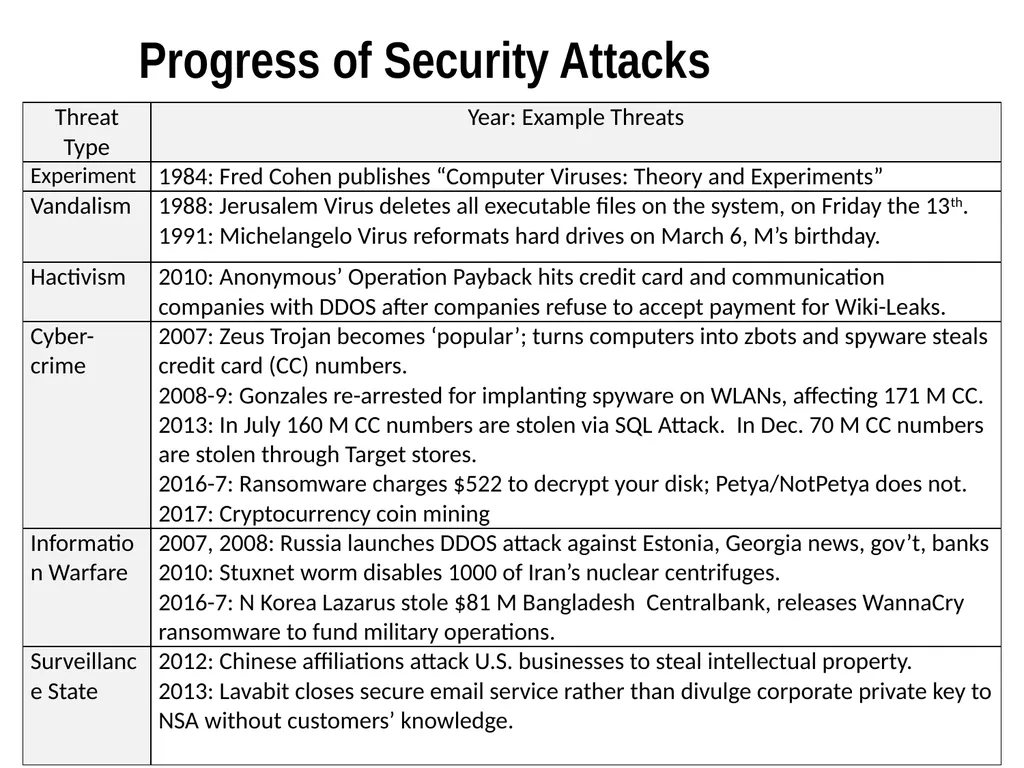
slide5. Progress of Security Attacks<br>
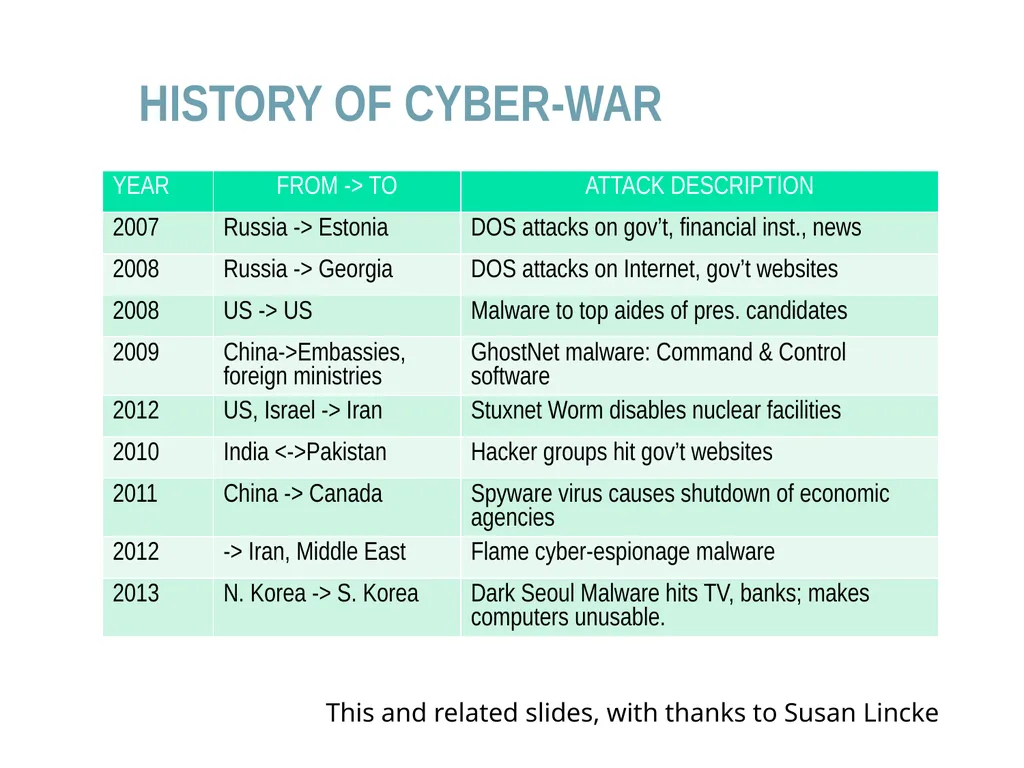
slide6. History of Cyber-WAR This and related slides, with thanks to Susan Lincke<br>
slide7. Types of Attackers 7<br>
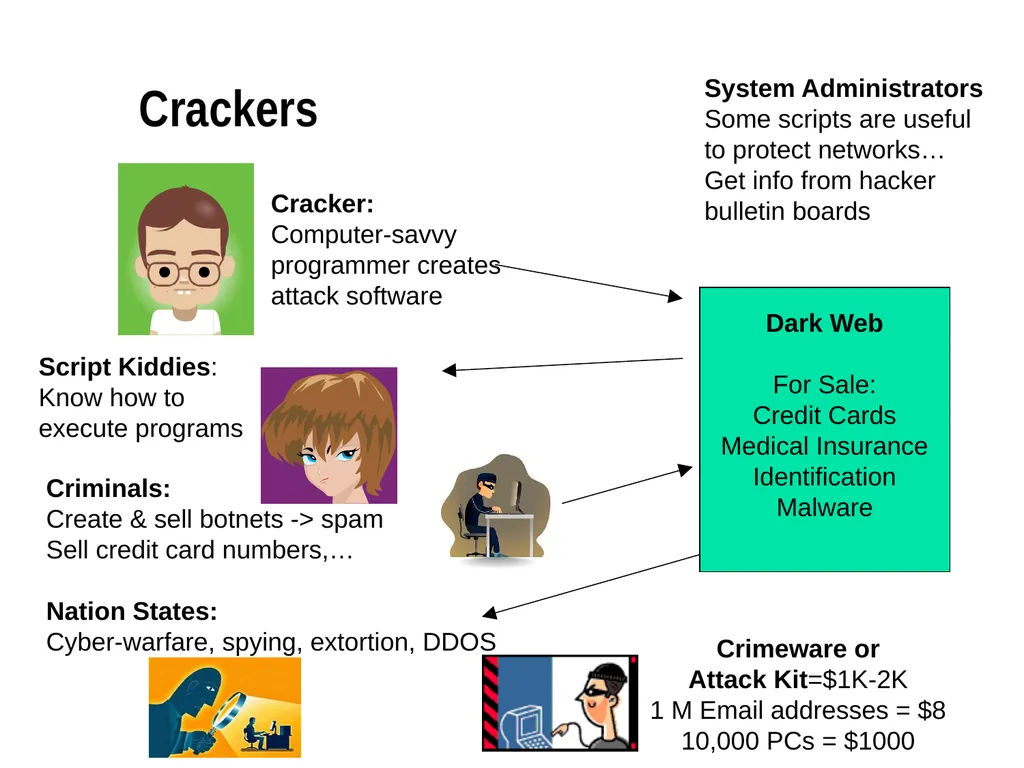
slide8. Crackers Cracker:
Computer-savvy
programmer creates
attack software Script Kiddies:
Know how to
execute programs Dark Web
For Sale:
Credit Cards
Medical Insurance
Identification
Malware Criminals: Create & sell botnets -> spam
Sell credit card numbers,…
Nation States:
Cyber-warfare, spying, extortion, DDOS System Administrators
Some scripts are useful
to protect networks…
Get info from hacker
bulletin boards Crimeware or
Attack Kit=$1K-2K
1 M Email addresses = $8
10,000 PCs = $1000<br>
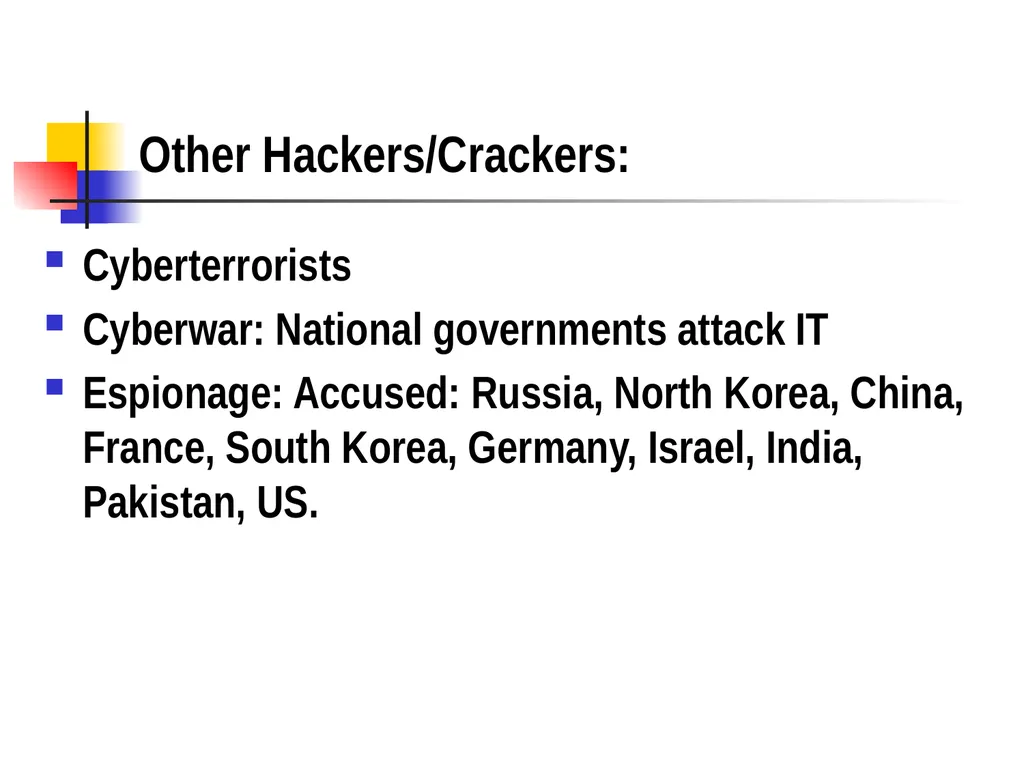
slide9. Other Hackers/Crackers: Cyberterrorists
Cyberwar: National governments attack IT
Espionage: Accused: Russia, North Korea, China, France, South Korea, Germany, Israel, India, Pakistan, US.<br>
slide10. Types of Attacks 10<br>
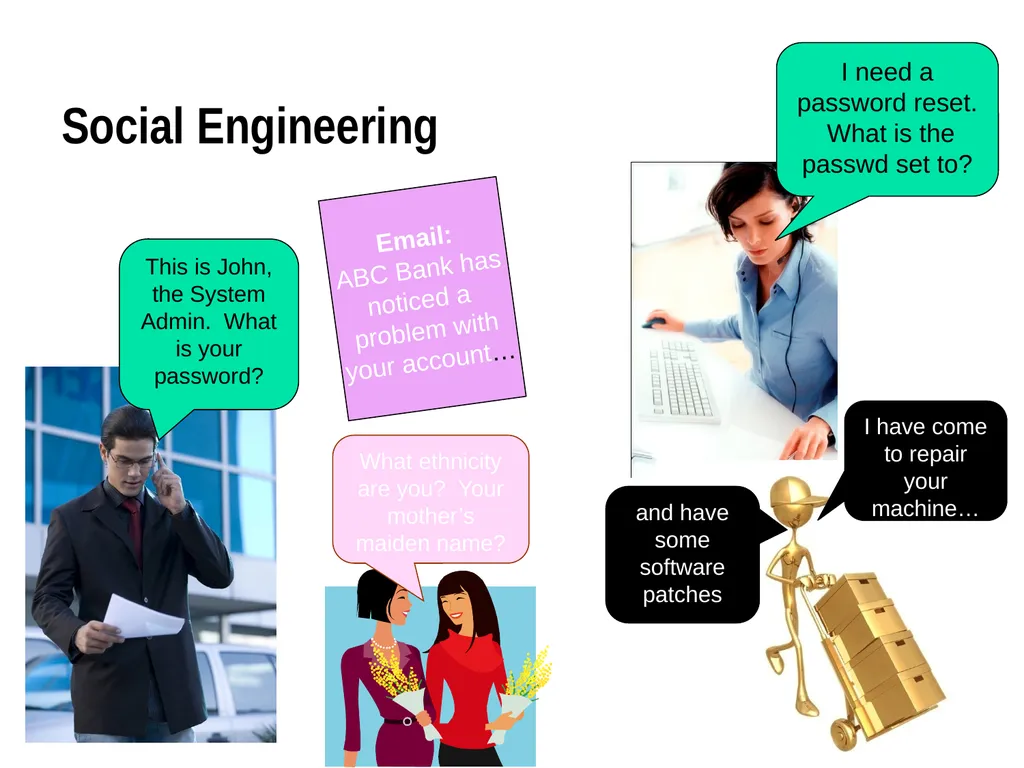
slide11. Social Engineering I need a password reset. What is the passwd set to? This is John, the System Admin. What is your password? Email:
ABC Bank has
noticed a
problem with
your account… I have come to repair your machine… and have some software patches What ethnicity are you? Your mother’s maiden name?<br>
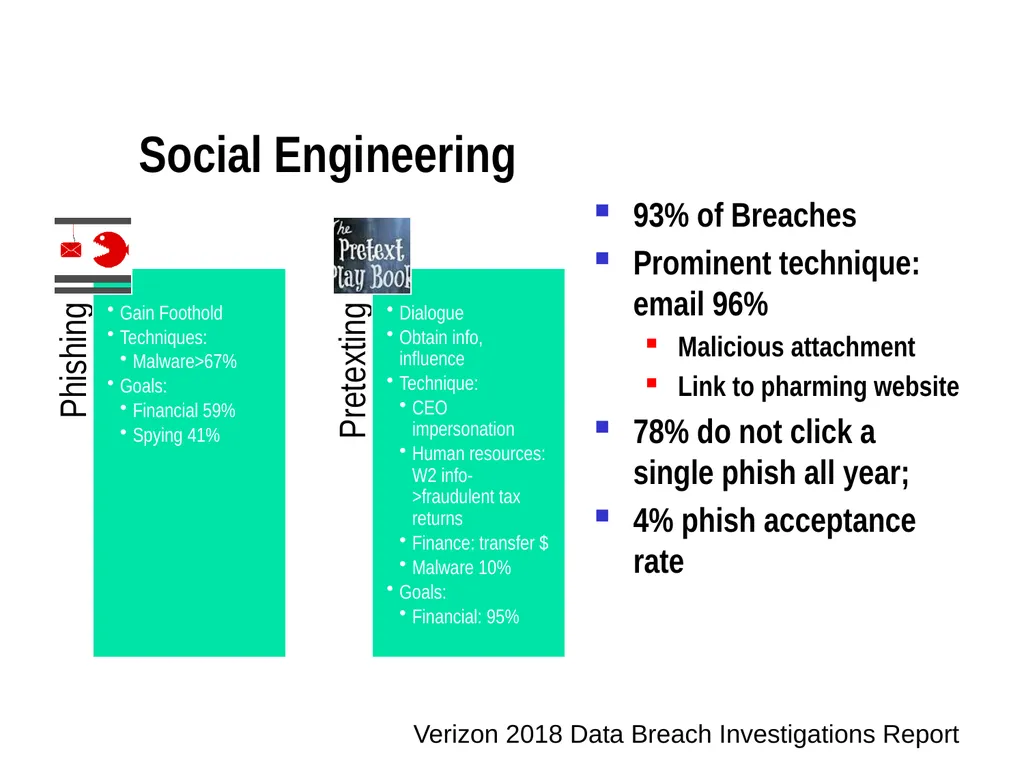
slide12. Social Engineering 93% of Breaches
Prominent technique: email 96%
Malicious attachment
Link to pharming website
78% do not click a single phish all year;
4% phish acceptance rate Verizon 2018 Data Breach Investigations Report<br>
slide13. ABC BANK
Your bank account password is about to expire.
Please login… Phishing = Fake Email The bank has found
problems with your
account.
Please contact …” Spearfishing
John:
Could you send Automated Services $1200?
Joe (CEO)<br>
slide14. Stopped here 14<br>
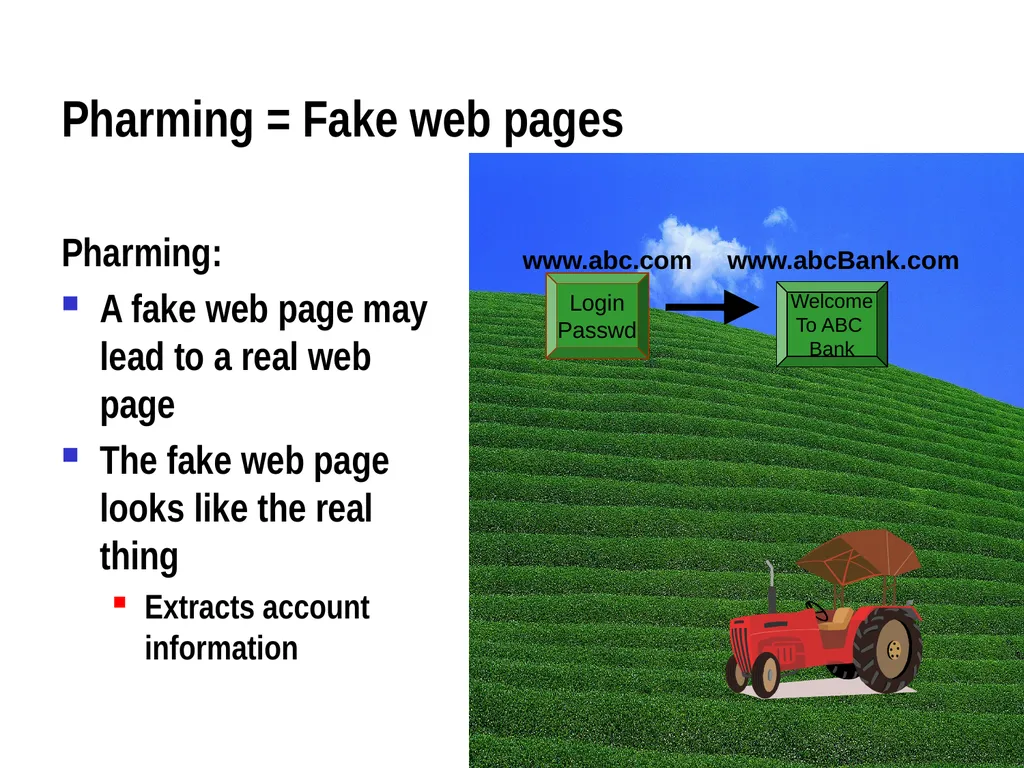
slide15. Pharming = Fake web pages Pharming:
A fake web page may lead to a real web page
The fake web page looks like the real thing
Extracts account information Login
Passwd Welcome
To ABC
Bank www.abc.com www.abcBank.com<br>
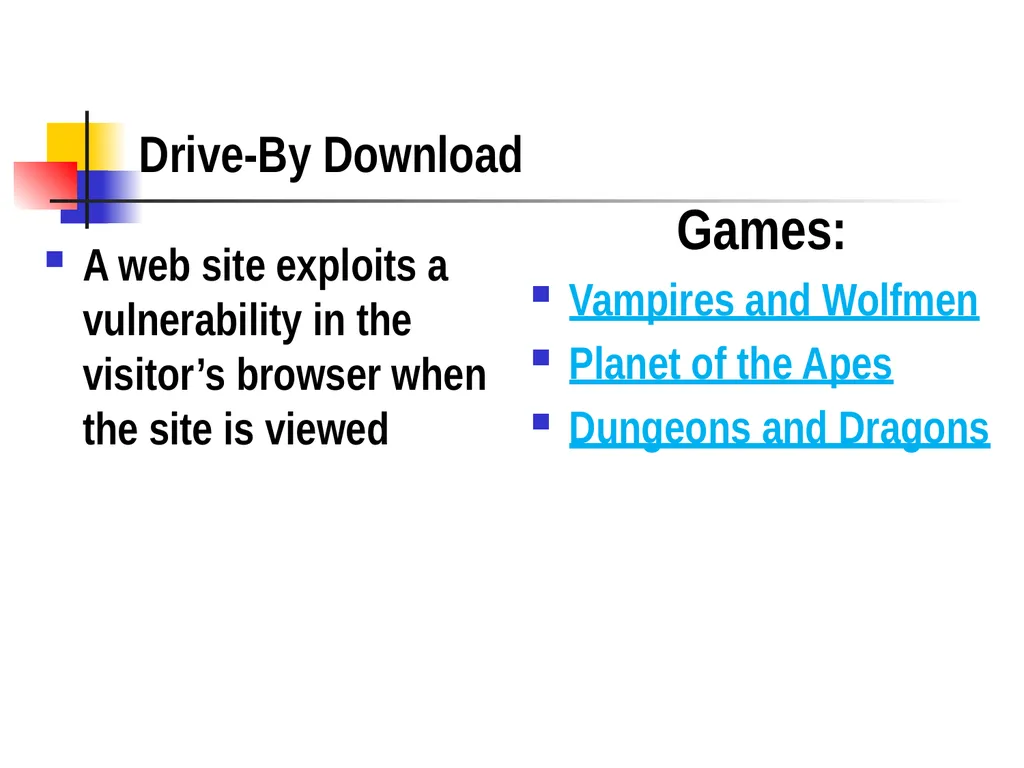
slide16. Drive-By Download A web site exploits a vulnerability in the visitor’s browser when the site is viewed Games:
Vampires and Wolfmen
Planet of the Apes
Dungeons and Dragons<br>
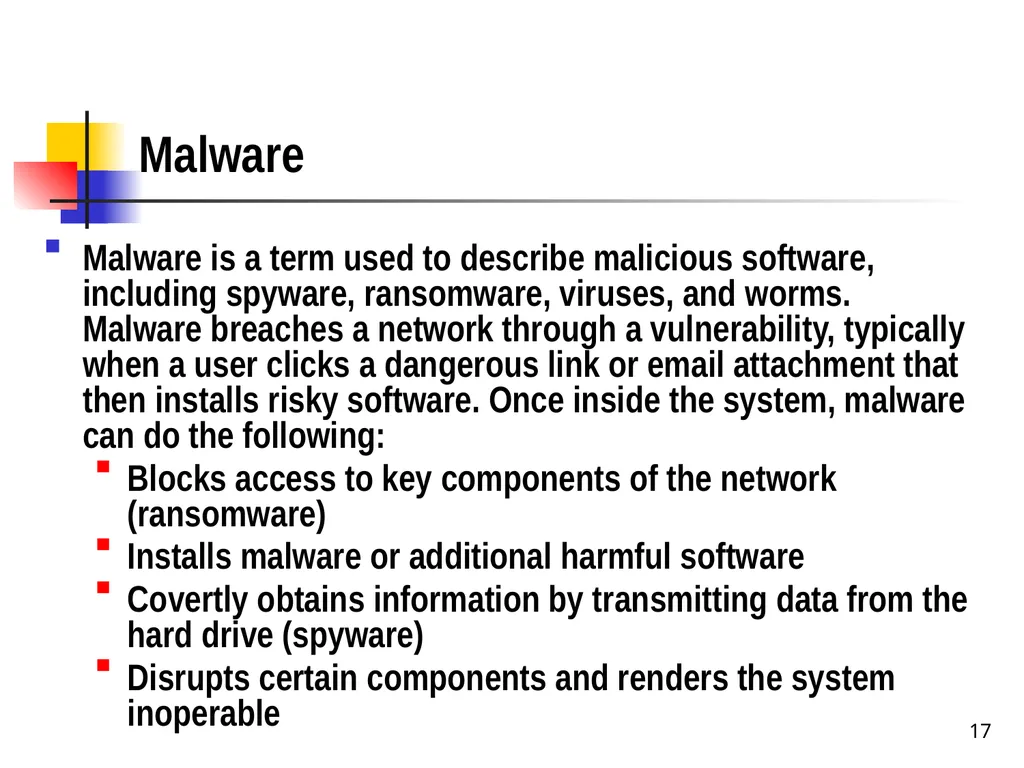
slide17. Malware Malware is a term used to describe malicious software, including spyware, ransomware, viruses, and worms. Malware breaches a network through a vulnerability, typically when a user clicks a dangerous link or email attachment that then installs risky software. Once inside the system, malware can do the following:
Blocks access to key components of the network (ransomware)
Installs malware or additional harmful software
Covertly obtains information by transmitting data from the hard drive (spyware)
Disrupts certain components and renders the system inoperable 17<br>
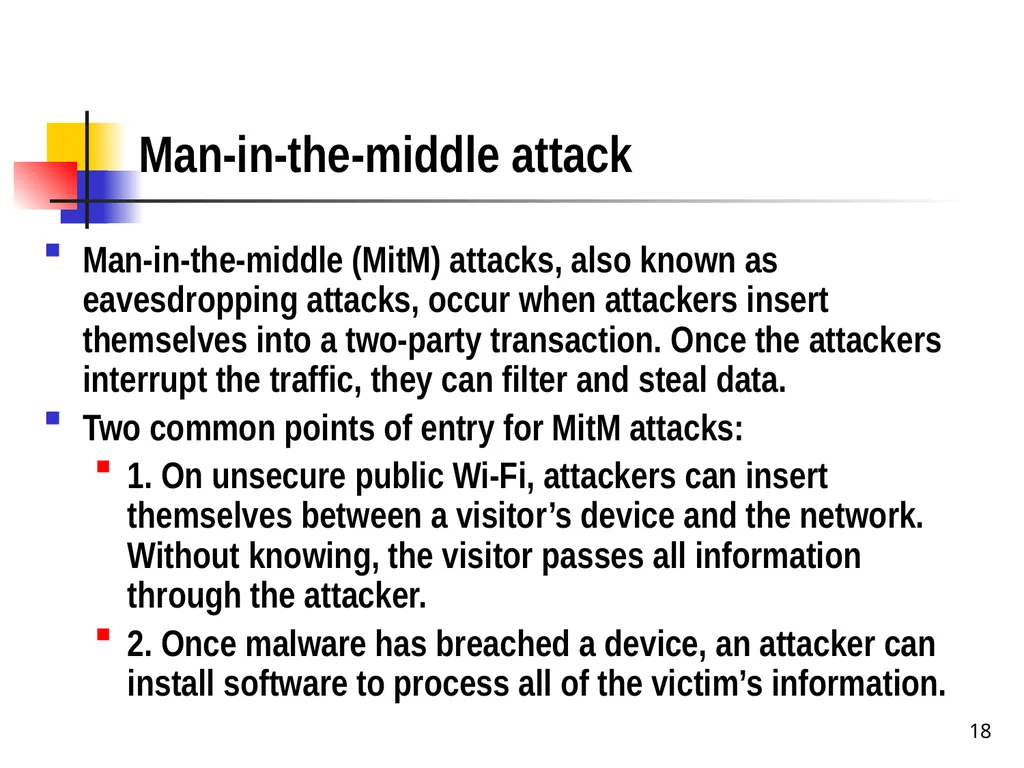
slide18. Man-in-the-middle attack Man-in-the-middle (MitM) attacks, also known as eavesdropping attacks, occur when attackers insert themselves into a two-party transaction. Once the attackers interrupt the traffic, they can filter and steal data.
Two common points of entry for MitM attacks:
1. On unsecure public Wi-Fi, attackers can insert themselves between a visitor’s device and the network. Without knowing, the visitor passes all information through the attacker.
2. Once malware has breached a device, an attacker can install software to process all of the victim’s information. 18<br>
slide19. Denial-of-service attack A denial-of-service attack floods systems, servers, or networks with traffic to exhaust resources and bandwidth. As a result, the system is unable to fulfill legitimate requests. Attackers can also use multiple compromised devices to launch this attack. This is known as a distributed-denial-of-service (DDoS) attack. 19<br>
slide20. Distributed-denial-of-service, or DDoS, attack A distributed-denial-of-service, or DDoS, attack is the bombardment of simultaneous data requests to a central server. The attacker generates these requests from multiple compromised systems.
In doing so, the attacker hopes to exhaust the target’s Internet bandwidth and RAM. The ultimate goal is to crash the target’s system and disrupt its business. 20<br>
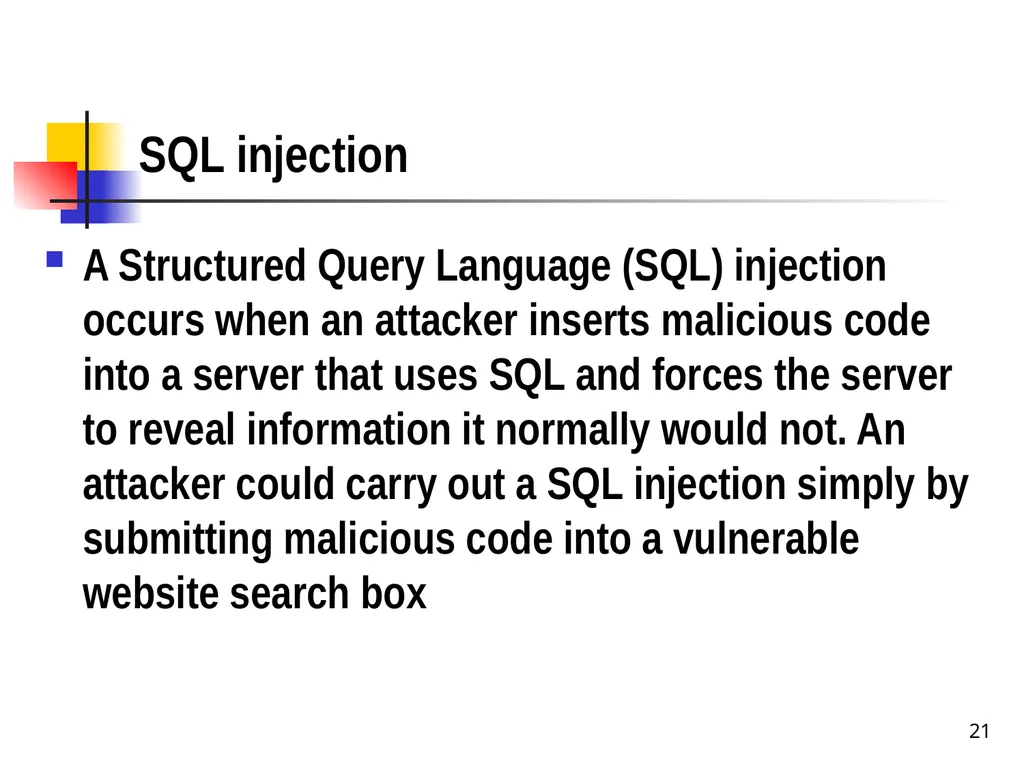
slide21. SQL injection A Structured Query Language (SQL) injection occurs when an attacker inserts malicious code into a server that uses SQL and forces the server to reveal information it normally would not. An attacker could carry out a SQL injection simply by submitting malicious code into a vulnerable website search box 21<br>
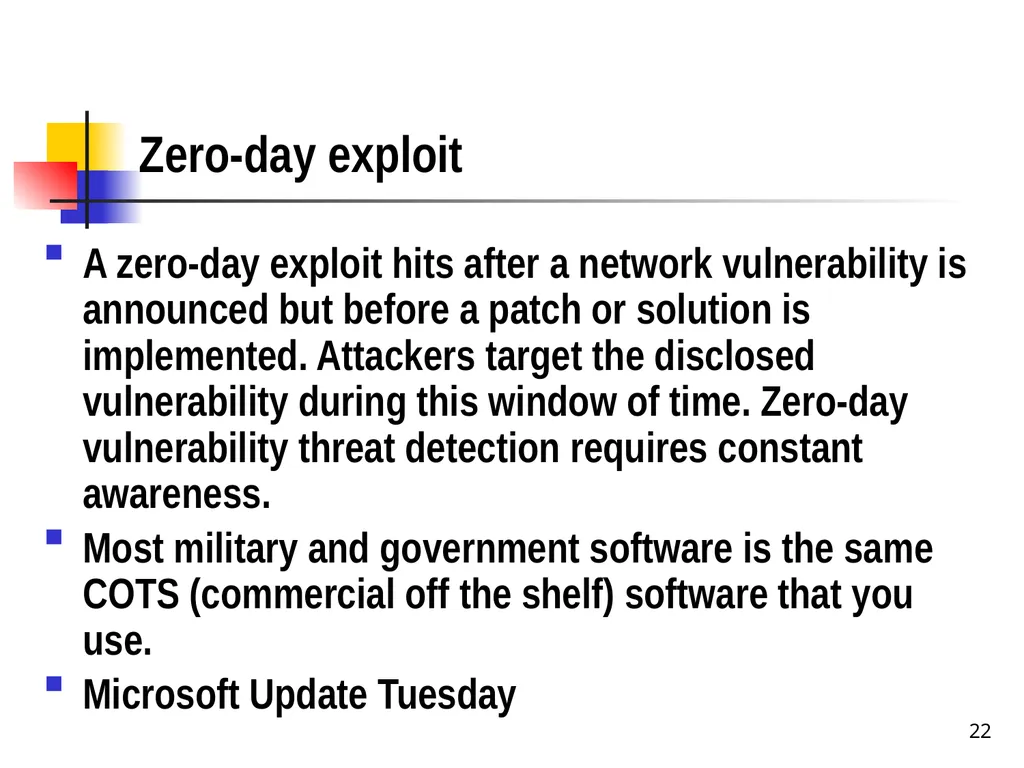
slide22. Zero-day exploit A zero-day exploit hits after a network vulnerability is announced but before a patch or solution is implemented. Attackers target the disclosed vulnerability during this window of time. Zero-day vulnerability threat detection requires constant awareness.
Most military and government software is the same COTS (commercial off the shelf) software that you use.
Microsoft Update Tuesday 22<br>
slide23. Advanced Persistent Threat Advanced: Combination of custom & common malware
Target: Business or Gov’t data/operation
Persistent: Extended period attack until target is compromised – often data is mined until the attack is detected.
Threat: Organized, capable, well-funded attacker
Source: Gov’t or criminal enterprise<br>
slide24. Information War/Cyber War<br>
slide25. Russian-US Example Is an escalated state of cyber conflict between or among states in which cyber attacks are carried out by state actors against cyber infrastructure as part of a military campaign
Declared: that is formally declared by an authority of one of the parties.
De Facto: with the absence of a declaration.
Cyber conflict: is a tense situation between or among nation-states or organized groups where unwelcome cyber attacks result in retaliation.
Cyber attack: is an offensive use of a cyber weapon intended to harm a designated target.
Cyber infrastructure: is the aggregation of people, processes and systems that constitute cyberspace. 25<br>
slide26. Estonia, 2007? Attacks came from 178 countries, including large botnets
Attacker could not be definitively attributed to a nation-state
CERT-EE and NATO classified it as a “cyber riot”
Did not trigger NATO Art. 5, requiring “armed attack”
Ultimately characterized as “patriotic hacking”
Estonian government chose to treated as cyber crime
Attempted to use MLAT and letters rogatory but Russia refused 26<br>
slide27. Sources of IW Threats and Attacks Nation-States
Cyberterrorists
Corporations
Activists
Criminals
Hobbyists<br>
slide28. Nation-States: China People’s Republic of China major actor
People’s Liberation Army doctrine explicitly includes information warfare
Widespread evidence of massive probes and attacks originating from China through state sponsorship
Formal training for cadres
Other countries involved in information warfare
ECHELON (SIGINT) organized by UK-USA Security Agreement (Australia, Canada, New Zealand, the United Kingdom, and the United States)<br>
slide29. Nation-States: Stuxnet (2010) Written to subvert SCADA for Siemens centrifuge programmable logic controllers (PLCs)
Damaged Uranium-enrichment centrifuges in Iran
Spun too fast – crashed physically
60% of Stuxnet infections were in Iran
Speculations that US & Israel wrote Stuxnet Worm
No direct proof
Circumstantial evidence includes codes and dates that might be related to Israel
Documents supporting view that US involved were released by Edward Snowden in July 2013<br>
slide30. Critical Infrastructure Attacked Volz, D. (2016-02-25). “U.S. government concludes cyber attack caused Ukraine power outage.” Reuters < http://tinyurl.com/hsf47hl >
2015-12-23
225,000 people affected
1st known successful cyberattack on a grid
Likely from Russian Sandworm group
Installed malware that switched breakers off
DoS on customer-service phones
Prevented real customers from reporting outages<br>
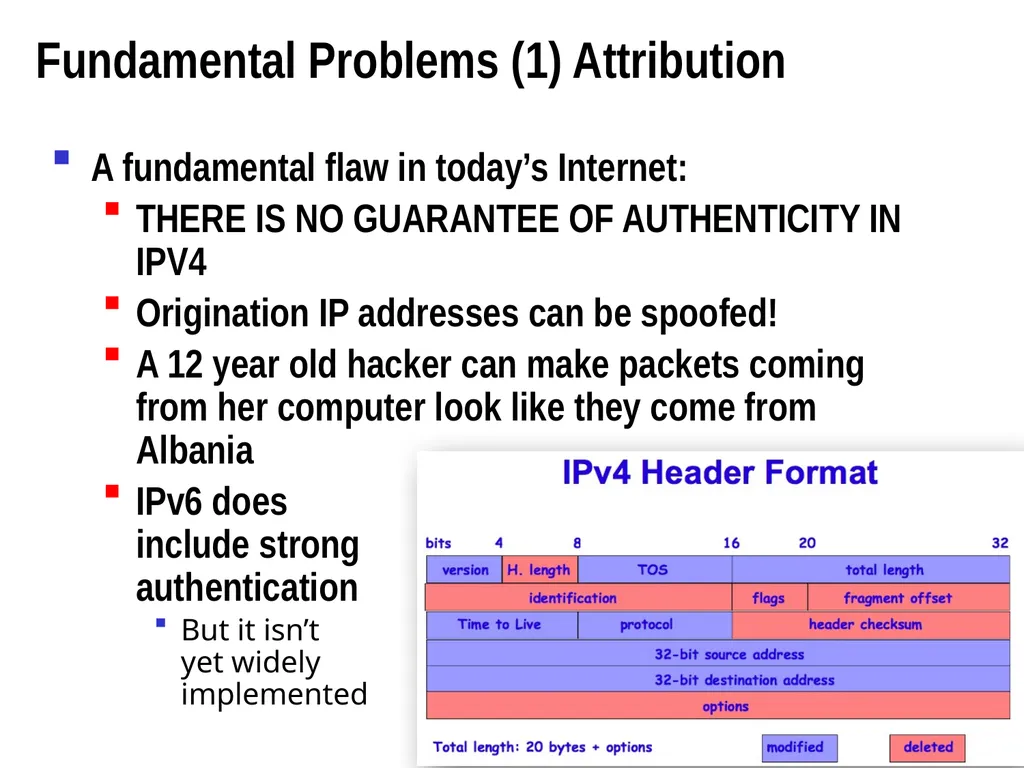
slide31. Fundamental Problems (1) Attribution A fundamental flaw in today’s Internet:
THERE IS NO GUARANTEE OF AUTHENTICITY IN IPV4
Origination IP addresses can be spoofed!
A 12 year old hacker can make packets coming from her computer look like they come from Albania
IPv6 does include strong authentication
But it isn’t yet widely implemented<br>
slide32. Fundamental Problems (2) Criminals & hostile forces can use distributed attacks
Botnets created by commandeering poorly-secured computers owned by amateurs
Botnets can have 10,000 zombies
Distributed networks are impervious to take-down
Multiple connectivity
Multiple replication
Shut down one TOR node, no one notices*<br>
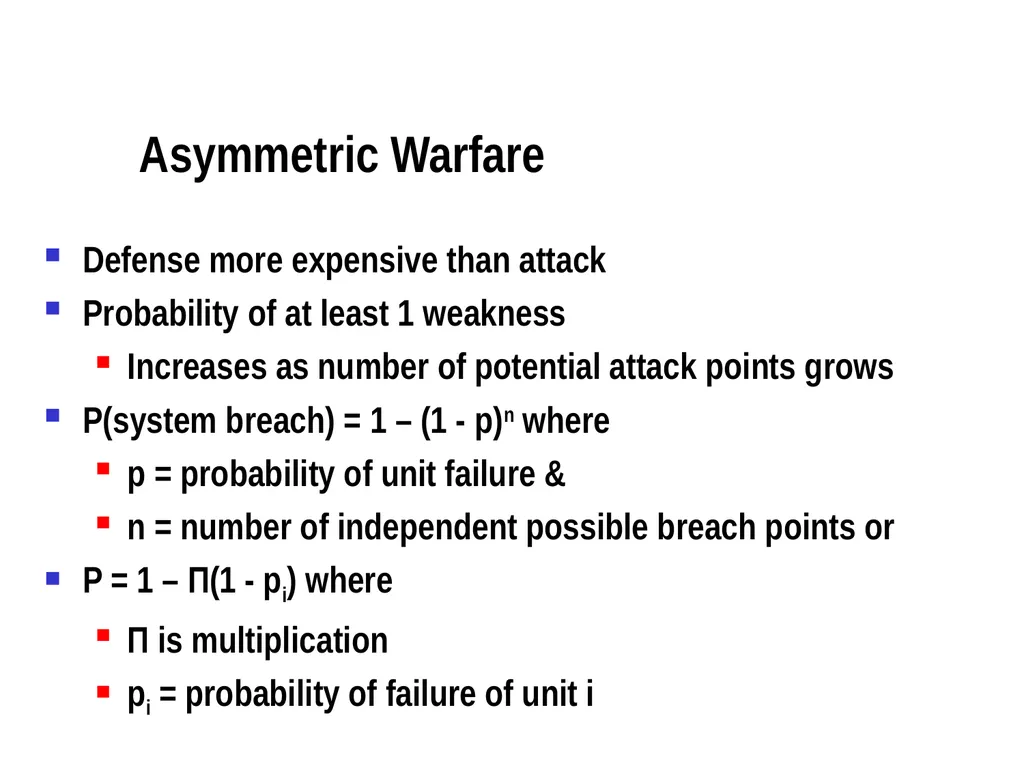
slide33. Asymmetric Warfare Defense more expensive than attack
Probability of at least 1 weakness
Increases as number of potential attack points grows
P(system breach) = 1 – (1 - p)n where
p = probability of unit failure &
n = number of independent possible breach points or
P = 1 – Π(1 - pi) where
Π is multiplication
pi = probability of failure of unit i<br>
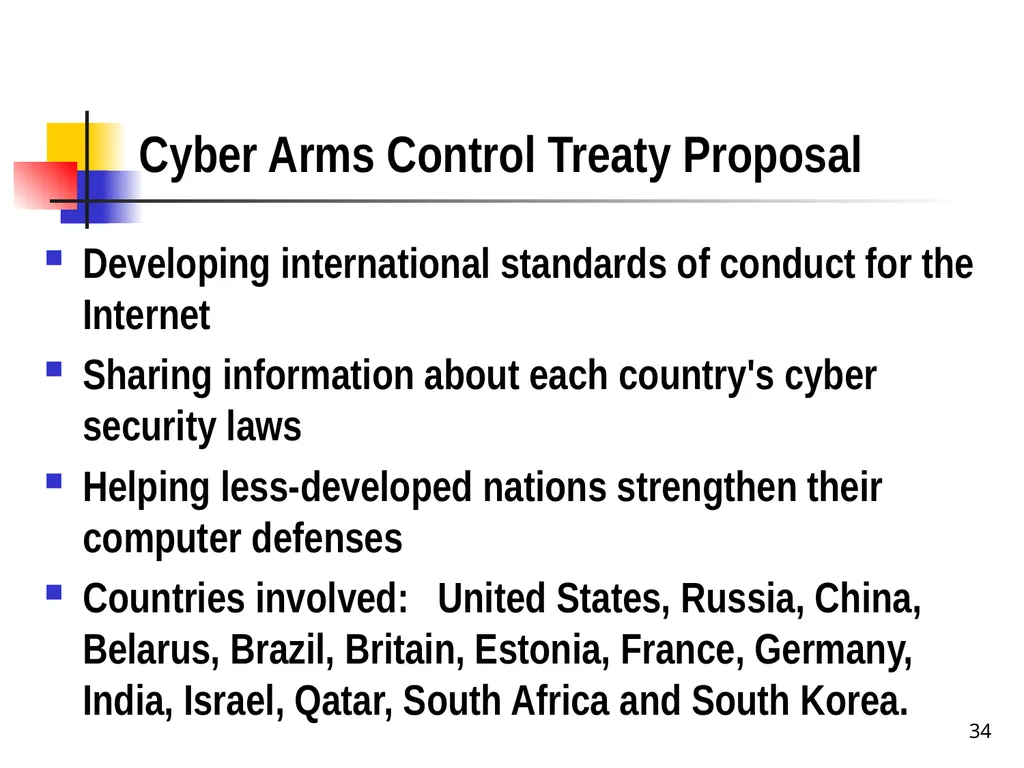
slide34. Cyber Arms Control Treaty Proposal Developing international standards of conduct for the Internet
Sharing information about each country's cyber security laws
Helping less-developed nations strengthen their computer defenses
Countries involved: United States, Russia, China, Belarus, Brazil, Britain, Estonia, France, Germany, India, Israel, Qatar, South Africa and South Korea. 34<br>
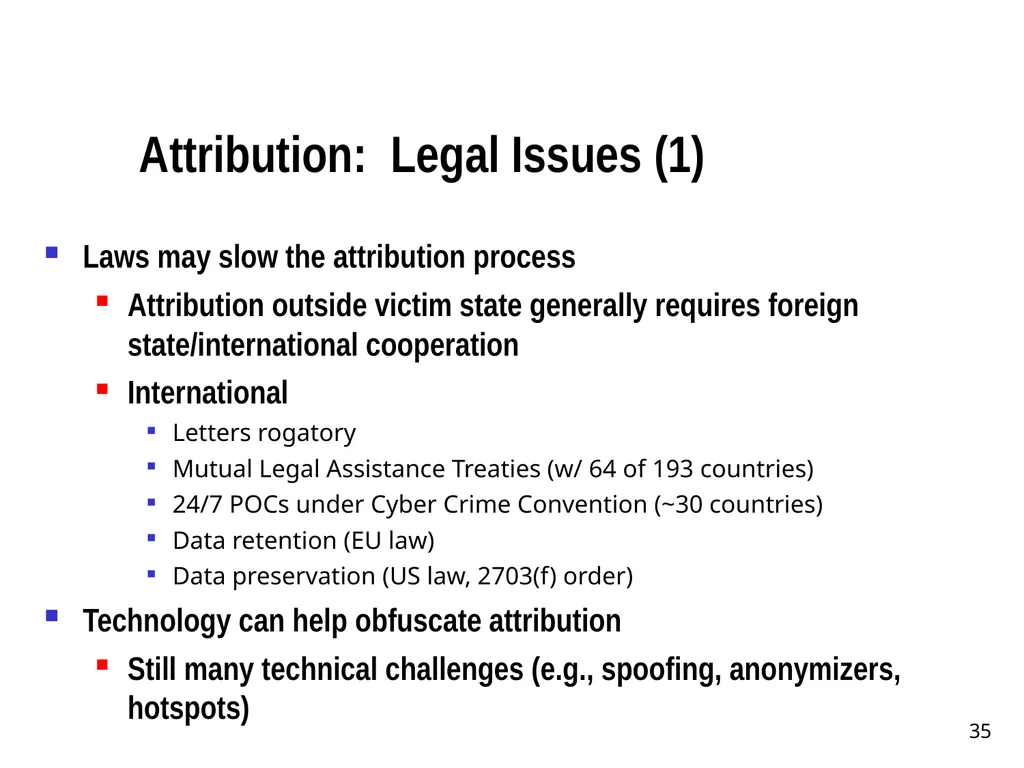
slide35. Attribution: Legal Issues (1) Laws may slow the attribution process
Attribution outside victim state generally requires foreign state/international cooperation
International
Letters rogatory
Mutual Legal Assistance Treaties (w/ 64 of 193 countries)
24/7 POCs under Cyber Crime Convention (~30 countries)
Data retention (EU law)
Data preservation (US law, 2703(f) order)
Technology can help obfuscate attribution
Still many technical challenges (e.g., spoofing, anonymizers, hotspots) 35<br>
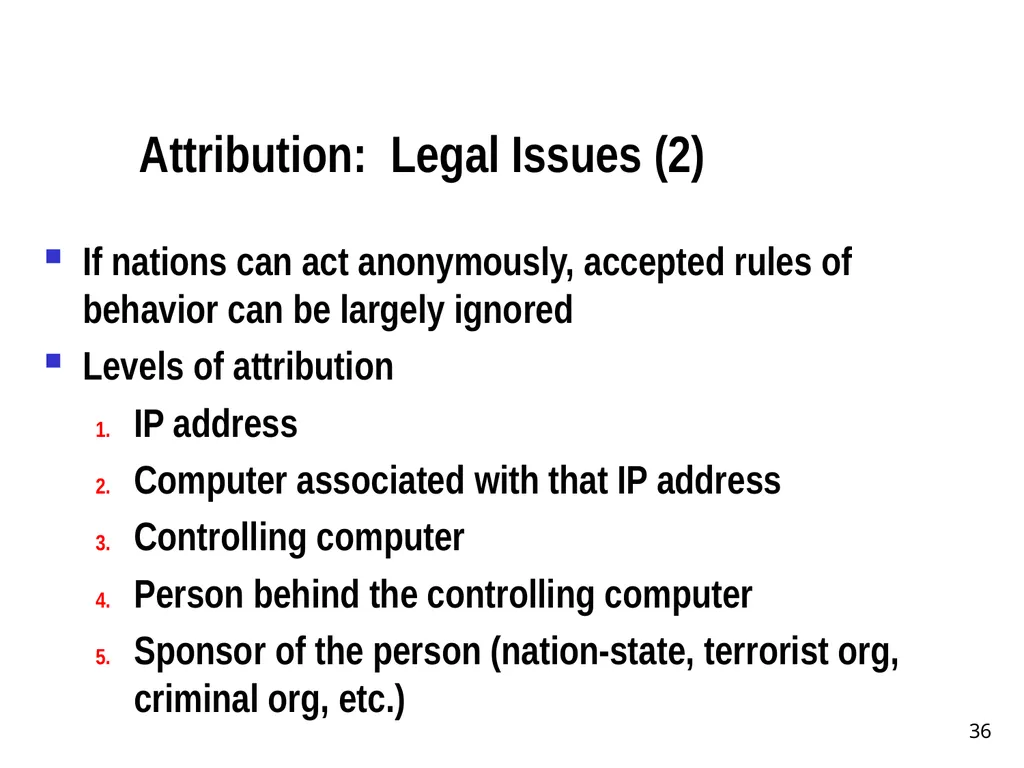
slide36. Attribution: Legal Issues (2) If nations can act anonymously, accepted rules of behavior can be largely ignored
Levels of attribution
IP address
Computer associated with that IP address
Controlling computer
Person behind the controlling computer
Sponsor of the person (nation-state, terrorist org, criminal org, etc.) 36<br>
slide37. Examination of a Third, ‘Other-Than-War’ Mode “There is no clear, internationally agreed upon definition of what would constitute a cyber war. In fact, there is considerable confusion.”
Where does it fit?
Jus ad bellum – right to wage war
Jus in bello – law of war 37<br>
slide38. Consideration of the Geneva Protocol Principles for Cyber Weaponry “Russian and U.S. governments must be open to the possibility that some weapon attributes may be unacceptable because they are offensive to the principles of humanity and from dictates of public conscience.”
Currently prohibited weapons:
Generally: Those that cause unnecessary suffering or widespread, long-term and severe damage to the natural environment
Cyber analogs to specifically prohibited weapons are unclear. 38<br>
slide39. Recognizing New Non-State Actor and Netizen Power Stature “The digital revolution has unleashed non-state actors and individuals to occupy, control and operate in cyber territory. This creates new power asymmetries and magnifies the clout of new participants who can violate Convention principles on a massive scale.”
Traditional application of LOAC to state actors
Common Article 3 of Geneva
Post-9/11 application of LOAC to non-state actors
Application to netizens? 39<br>
slide40. Application of the Distinctive Geneva Emblem Concept in Cyberspace “The Geneva and Hague Conventions direct that protected entities, protected personnel and protected vehicles be marked in a clearly visible and distinctive way. This recommendation proposes analogous markers in cyberspace to designate protected entities, personnel and other assets.”
What of IP-based attacks?
What of identifying “hospital” in URL?
How does it protect medical telepresence?
Who bears costs?
What’s the incentive? 40<br>
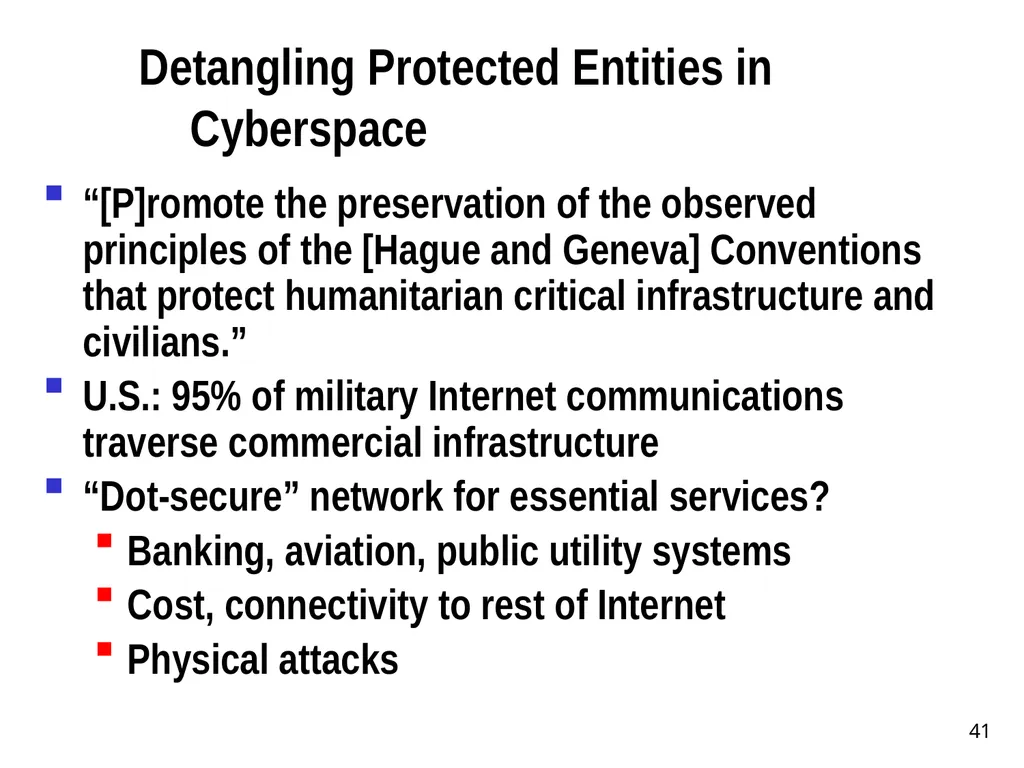
slide41. Detangling Protected Entities in Cyberspace “[P]romote the preservation of the observed principles of the [Hague and Geneva] Conventions that protect humanitarian critical infrastructure and civilians.”
U.S.: 95% of military Internet communications traverse commercial infrastructure
“Dot-secure” network for essential services?
Banking, aviation, public utility systems
Cost, connectivity to rest of Internet
Physical attacks 41<br>
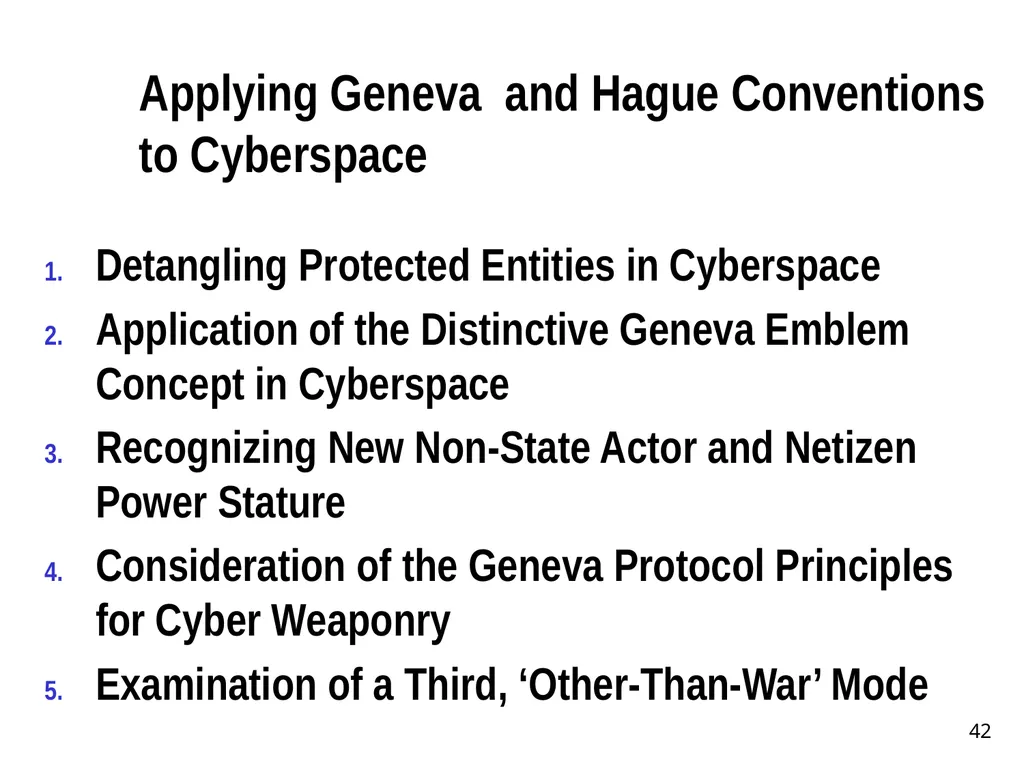
slide42. Applying Geneva and Hague Conventions to Cyberspace Detangling Protected Entities in Cyberspace
Application of the Distinctive Geneva Emblem Concept in Cyberspace
Recognizing New Non-State Actor and Netizen Power Stature
Consideration of the Geneva Protocol Principles for Cyber Weaponry
Examination of a Third, ‘Other-Than-War’ Mode 42<br>
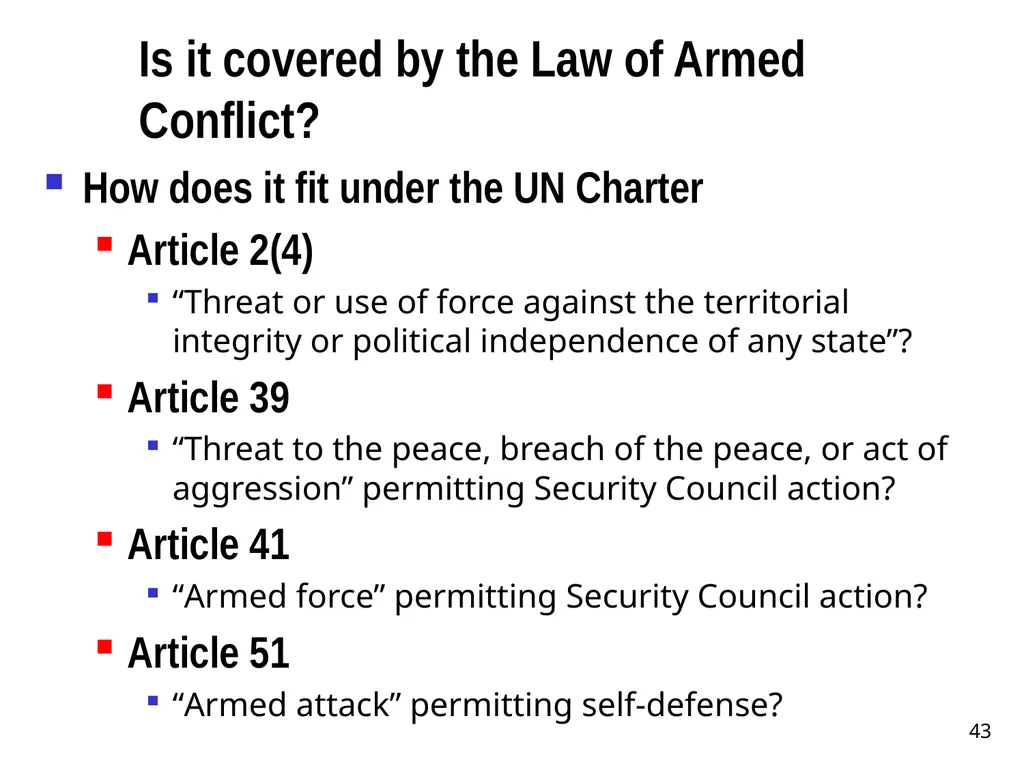
slide43. Is it covered by the Law of Armed Conflict? How does it fit under the UN Charter
Article 2(4)
“Threat or use of force against the territorial integrity or political independence of any state”?
Article 39
“Threat to the peace, breach of the peace, or act of aggression” permitting Security Council action?
Article 41
“Armed force” permitting Security Council action?
Article 51
“Armed attack” permitting self-defense? 43<br>
slide2. Cyber “A failure by the Department to secure its systems in cyberspace would pose a fundamental risk to our ability to accomplish defense missions today and in the future.”
- 2010 Quadrennial Defense Review
“… four key characteristics of cyber space: open to innovation, secure enough to earn people’s trust, globally interoperable, and reliable.”
-2011 International Strategy for Cyberspace<br>
slide3. Cyber Physical Systems Brian Connett, LCDR, USN
US NAVAL ACADEMY<br>
slide4. Cyberspace Defined Ubiquitous, overlapping domains
“A global domain within the information environment consisting of the interdependent network of information technology infrastructures, including the internet, telecommunications networks, computer systems, and embedded processors and controllers …”
“… common usage of the term also refers to the virtual environment of information and interactions between people.”
National Security Presidential Directive 54/Homeland Security Presidential Directive 23 (NSPD-54/HSPD-23)<br>
slide5. Progress of Security Attacks<br>
slide6. History of Cyber-WAR This and related slides, with thanks to Susan Lincke<br>
slide7. Types of Attackers 7<br>
slide8. Crackers Cracker:
Computer-savvy
programmer creates
attack software Script Kiddies:
Know how to
execute programs Dark Web
For Sale:
Credit Cards
Medical Insurance
Identification
Malware Criminals: Create & sell botnets -> spam
Sell credit card numbers,…
Nation States:
Cyber-warfare, spying, extortion, DDOS System Administrators
Some scripts are useful
to protect networks…
Get info from hacker
bulletin boards Crimeware or
Attack Kit=$1K-2K
1 M Email addresses = $8
10,000 PCs = $1000<br>
slide9. Other Hackers/Crackers: Cyberterrorists
Cyberwar: National governments attack IT
Espionage: Accused: Russia, North Korea, China, France, South Korea, Germany, Israel, India, Pakistan, US.<br>
slide10. Types of Attacks 10<br>
slide11. Social Engineering I need a password reset. What is the passwd set to? This is John, the System Admin. What is your password? Email:
ABC Bank has
noticed a
problem with
your account… I have come to repair your machine… and have some software patches What ethnicity are you? Your mother’s maiden name?<br>
slide12. Social Engineering 93% of Breaches
Prominent technique: email 96%
Malicious attachment
Link to pharming website
78% do not click a single phish all year;
4% phish acceptance rate Verizon 2018 Data Breach Investigations Report<br>
slide13. ABC BANK
Your bank account password is about to expire.
Please login… Phishing = Fake Email The bank has found
problems with your
account.
Please contact …” Spearfishing
John:
Could you send Automated Services $1200?
Joe (CEO)<br>
slide14. Stopped here 14<br>
slide15. Pharming = Fake web pages Pharming:
A fake web page may lead to a real web page
The fake web page looks like the real thing
Extracts account information Login
Passwd Welcome
To ABC
Bank www.abc.com www.abcBank.com<br>
slide16. Drive-By Download A web site exploits a vulnerability in the visitor’s browser when the site is viewed Games:
Vampires and Wolfmen
Planet of the Apes
Dungeons and Dragons<br>
slide17. Malware Malware is a term used to describe malicious software, including spyware, ransomware, viruses, and worms. Malware breaches a network through a vulnerability, typically when a user clicks a dangerous link or email attachment that then installs risky software. Once inside the system, malware can do the following:
Blocks access to key components of the network (ransomware)
Installs malware or additional harmful software
Covertly obtains information by transmitting data from the hard drive (spyware)
Disrupts certain components and renders the system inoperable 17<br>
slide18. Man-in-the-middle attack Man-in-the-middle (MitM) attacks, also known as eavesdropping attacks, occur when attackers insert themselves into a two-party transaction. Once the attackers interrupt the traffic, they can filter and steal data.
Two common points of entry for MitM attacks:
1. On unsecure public Wi-Fi, attackers can insert themselves between a visitor’s device and the network. Without knowing, the visitor passes all information through the attacker.
2. Once malware has breached a device, an attacker can install software to process all of the victim’s information. 18<br>
slide19. Denial-of-service attack A denial-of-service attack floods systems, servers, or networks with traffic to exhaust resources and bandwidth. As a result, the system is unable to fulfill legitimate requests. Attackers can also use multiple compromised devices to launch this attack. This is known as a distributed-denial-of-service (DDoS) attack. 19<br>
slide20. Distributed-denial-of-service, or DDoS, attack A distributed-denial-of-service, or DDoS, attack is the bombardment of simultaneous data requests to a central server. The attacker generates these requests from multiple compromised systems.
In doing so, the attacker hopes to exhaust the target’s Internet bandwidth and RAM. The ultimate goal is to crash the target’s system and disrupt its business. 20<br>
slide21. SQL injection A Structured Query Language (SQL) injection occurs when an attacker inserts malicious code into a server that uses SQL and forces the server to reveal information it normally would not. An attacker could carry out a SQL injection simply by submitting malicious code into a vulnerable website search box 21<br>
slide22. Zero-day exploit A zero-day exploit hits after a network vulnerability is announced but before a patch or solution is implemented. Attackers target the disclosed vulnerability during this window of time. Zero-day vulnerability threat detection requires constant awareness.
Most military and government software is the same COTS (commercial off the shelf) software that you use.
Microsoft Update Tuesday 22<br>
slide23. Advanced Persistent Threat Advanced: Combination of custom & common malware
Target: Business or Gov’t data/operation
Persistent: Extended period attack until target is compromised – often data is mined until the attack is detected.
Threat: Organized, capable, well-funded attacker
Source: Gov’t or criminal enterprise<br>
slide24. Information War/Cyber War<br>
slide25. Russian-US Example Is an escalated state of cyber conflict between or among states in which cyber attacks are carried out by state actors against cyber infrastructure as part of a military campaign
Declared: that is formally declared by an authority of one of the parties.
De Facto: with the absence of a declaration.
Cyber conflict: is a tense situation between or among nation-states or organized groups where unwelcome cyber attacks result in retaliation.
Cyber attack: is an offensive use of a cyber weapon intended to harm a designated target.
Cyber infrastructure: is the aggregation of people, processes and systems that constitute cyberspace. 25<br>
slide26. Estonia, 2007? Attacks came from 178 countries, including large botnets
Attacker could not be definitively attributed to a nation-state
CERT-EE and NATO classified it as a “cyber riot”
Did not trigger NATO Art. 5, requiring “armed attack”
Ultimately characterized as “patriotic hacking”
Estonian government chose to treated as cyber crime
Attempted to use MLAT and letters rogatory but Russia refused 26<br>
slide27. Sources of IW Threats and Attacks Nation-States
Cyberterrorists
Corporations
Activists
Criminals
Hobbyists<br>
slide28. Nation-States: China People’s Republic of China major actor
People’s Liberation Army doctrine explicitly includes information warfare
Widespread evidence of massive probes and attacks originating from China through state sponsorship
Formal training for cadres
Other countries involved in information warfare
ECHELON (SIGINT) organized by UK-USA Security Agreement (Australia, Canada, New Zealand, the United Kingdom, and the United States)<br>
slide29. Nation-States: Stuxnet (2010) Written to subvert SCADA for Siemens centrifuge programmable logic controllers (PLCs)
Damaged Uranium-enrichment centrifuges in Iran
Spun too fast – crashed physically
60% of Stuxnet infections were in Iran
Speculations that US & Israel wrote Stuxnet Worm
No direct proof
Circumstantial evidence includes codes and dates that might be related to Israel
Documents supporting view that US involved were released by Edward Snowden in July 2013<br>
slide30. Critical Infrastructure Attacked Volz, D. (2016-02-25). “U.S. government concludes cyber attack caused Ukraine power outage.” Reuters < http://tinyurl.com/hsf47hl >
2015-12-23
225,000 people affected
1st known successful cyberattack on a grid
Likely from Russian Sandworm group
Installed malware that switched breakers off
DoS on customer-service phones
Prevented real customers from reporting outages<br>
slide31. Fundamental Problems (1) Attribution A fundamental flaw in today’s Internet:
THERE IS NO GUARANTEE OF AUTHENTICITY IN IPV4
Origination IP addresses can be spoofed!
A 12 year old hacker can make packets coming from her computer look like they come from Albania
IPv6 does include strong authentication
But it isn’t yet widely implemented<br>
slide32. Fundamental Problems (2) Criminals & hostile forces can use distributed attacks
Botnets created by commandeering poorly-secured computers owned by amateurs
Botnets can have 10,000 zombies
Distributed networks are impervious to take-down
Multiple connectivity
Multiple replication
Shut down one TOR node, no one notices*<br>
slide33. Asymmetric Warfare Defense more expensive than attack
Probability of at least 1 weakness
Increases as number of potential attack points grows
P(system breach) = 1 – (1 - p)n where
p = probability of unit failure &
n = number of independent possible breach points or
P = 1 – Π(1 - pi) where
Π is multiplication
pi = probability of failure of unit i<br>
slide34. Cyber Arms Control Treaty Proposal Developing international standards of conduct for the Internet
Sharing information about each country's cyber security laws
Helping less-developed nations strengthen their computer defenses
Countries involved: United States, Russia, China, Belarus, Brazil, Britain, Estonia, France, Germany, India, Israel, Qatar, South Africa and South Korea. 34<br>
slide35. Attribution: Legal Issues (1) Laws may slow the attribution process
Attribution outside victim state generally requires foreign state/international cooperation
International
Letters rogatory
Mutual Legal Assistance Treaties (w/ 64 of 193 countries)
24/7 POCs under Cyber Crime Convention (~30 countries)
Data retention (EU law)
Data preservation (US law, 2703(f) order)
Technology can help obfuscate attribution
Still many technical challenges (e.g., spoofing, anonymizers, hotspots) 35<br>
slide36. Attribution: Legal Issues (2) If nations can act anonymously, accepted rules of behavior can be largely ignored
Levels of attribution
IP address
Computer associated with that IP address
Controlling computer
Person behind the controlling computer
Sponsor of the person (nation-state, terrorist org, criminal org, etc.) 36<br>
slide37. Examination of a Third, ‘Other-Than-War’ Mode “There is no clear, internationally agreed upon definition of what would constitute a cyber war. In fact, there is considerable confusion.”
Where does it fit?
Jus ad bellum – right to wage war
Jus in bello – law of war 37<br>
slide38. Consideration of the Geneva Protocol Principles for Cyber Weaponry “Russian and U.S. governments must be open to the possibility that some weapon attributes may be unacceptable because they are offensive to the principles of humanity and from dictates of public conscience.”
Currently prohibited weapons:
Generally: Those that cause unnecessary suffering or widespread, long-term and severe damage to the natural environment
Cyber analogs to specifically prohibited weapons are unclear. 38<br>
slide39. Recognizing New Non-State Actor and Netizen Power Stature “The digital revolution has unleashed non-state actors and individuals to occupy, control and operate in cyber territory. This creates new power asymmetries and magnifies the clout of new participants who can violate Convention principles on a massive scale.”
Traditional application of LOAC to state actors
Common Article 3 of Geneva
Post-9/11 application of LOAC to non-state actors
Application to netizens? 39<br>
slide40. Application of the Distinctive Geneva Emblem Concept in Cyberspace “The Geneva and Hague Conventions direct that protected entities, protected personnel and protected vehicles be marked in a clearly visible and distinctive way. This recommendation proposes analogous markers in cyberspace to designate protected entities, personnel and other assets.”
What of IP-based attacks?
What of identifying “hospital” in URL?
How does it protect medical telepresence?
Who bears costs?
What’s the incentive? 40<br>
slide41. Detangling Protected Entities in Cyberspace “[P]romote the preservation of the observed principles of the [Hague and Geneva] Conventions that protect humanitarian critical infrastructure and civilians.”
U.S.: 95% of military Internet communications traverse commercial infrastructure
“Dot-secure” network for essential services?
Banking, aviation, public utility systems
Cost, connectivity to rest of Internet
Physical attacks 41<br>
slide42. Applying Geneva and Hague Conventions to Cyberspace Detangling Protected Entities in Cyberspace
Application of the Distinctive Geneva Emblem Concept in Cyberspace
Recognizing New Non-State Actor and Netizen Power Stature
Consideration of the Geneva Protocol Principles for Cyber Weaponry
Examination of a Third, ‘Other-Than-War’ Mode 42<br>
slide43. Is it covered by the Law of Armed Conflict? How does it fit under the UN Charter
Article 2(4)
“Threat or use of force against the territorial integrity or political independence of any state”?
Article 39
“Threat to the peace, breach of the peace, or act of aggression” permitting Security Council action?
Article 41
“Armed force” permitting Security Council action?
Article 51
“Armed attack” permitting self-defense? 43<br>