
Chapter 16 Economic and Social Welfare
SB
Published · 35 slides · 0 views

1 / 1

Description
Chapter 16 Economic and Social Welfare Policymaking Jenna Grunwald, Hannah Schaeffer, Rachel Seagren, Brooke Knutson and Hannah Schaeffer 16.1 Economic Policymaking Sociotropic voting- assessing overall rate of employment and unemployment
Related Topics
Share
Embed code
Download this presentation From Below
"Chapter 16 Economic and Social Welfare" is the property of its rightful owner. Permission is granted to download and print the materials on this website for personal, non-commercial use only, and to display it on your personal computer provided you do not modify the materials and that you retain all copyright notices contained in the materials. By downloading content from our website, you accept the terms of this agreement.
Presentation Transcript
01
Chapter 16
Economic and Social Welfare Policymaking Jenna Grunwald, Hannah Schaeffer, Rachel Seagren, Brooke Knutson and Hannah Schaeffer<br>
Economic and Social Welfare Policymaking Jenna Grunwald, Hannah Schaeffer, Rachel Seagren, Brooke Knutson and Hannah Schaeffer<br>
02
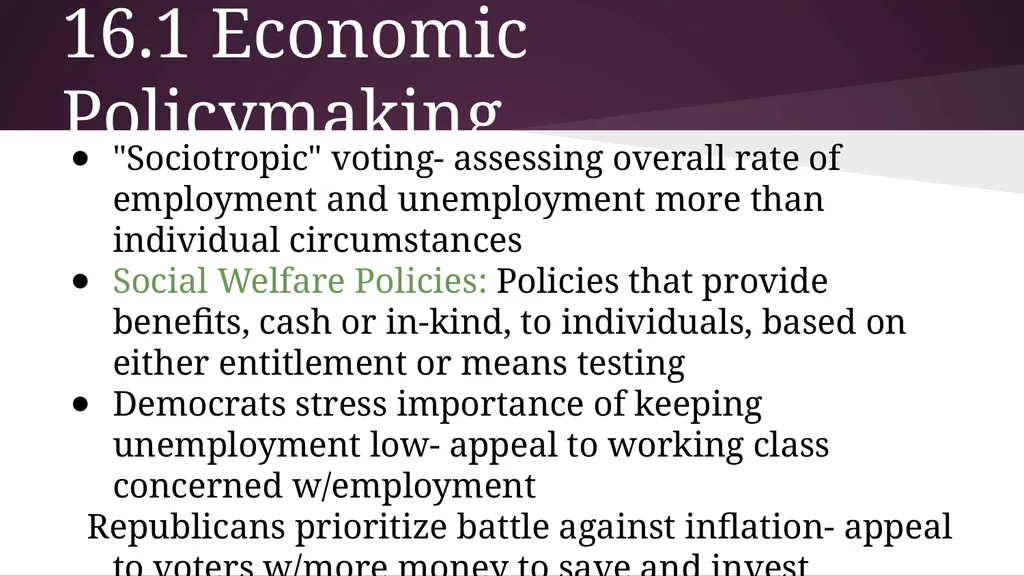
16.1 Economic Policymaking "Sociotropic" voting- assessing overall rate of employment and unemployment more than individual circumstances
Social Welfare Policies: Policies that provide benefits, cash or in-kind, to individuals, based on either entitlement or means testing
Democrats stress importance of keeping unemployment low- appeal to working class concerned w/employment
Republicans prioritize battle against inflation- appeal to voters w/more money to save and invest<br>
Social Welfare Policies: Policies that provide benefits, cash or in-kind, to individuals, based on either entitlement or means testing
Democrats stress importance of keeping unemployment low- appeal to working class concerned w/employment
Republicans prioritize battle against inflation- appeal to voters w/more money to save and invest<br>
03
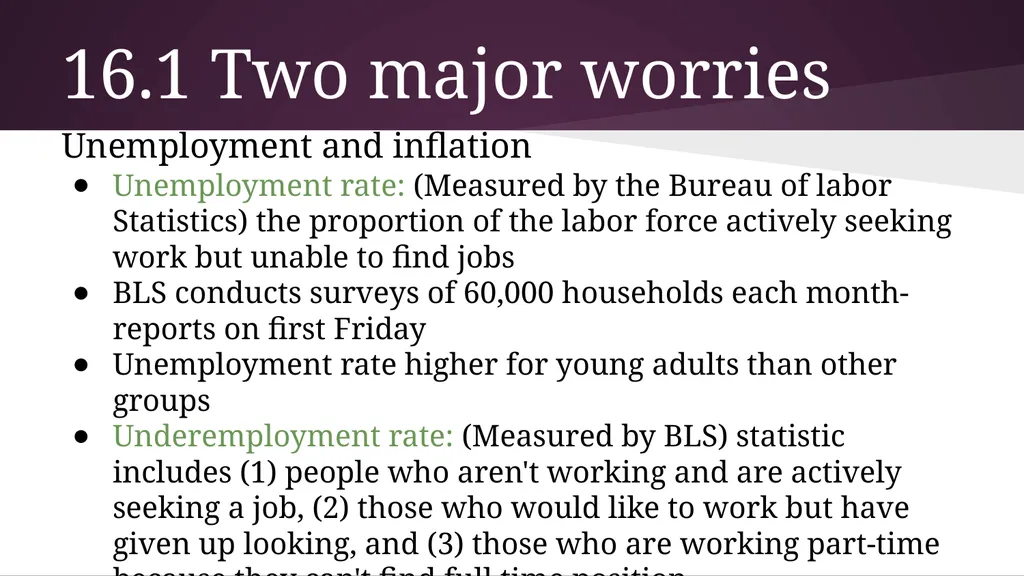
16.1 Two major worries Unemployment and inflation
Unemployment rate: (Measured by the Bureau of labor Statistics) the proportion of the labor force actively seeking work but unable to find jobs
BLS conducts surveys of 60,000 households each month- reports on first Friday
Unemployment rate higher for young adults than other groups
Underemployment rate: (Measured by BLS) statistic includes (1) people who aren't working and are actively seeking a job, (2) those who would like to work but have given up looking, and (3) those who are working part-time because they can't find full time position<br>
Unemployment rate: (Measured by the Bureau of labor Statistics) the proportion of the labor force actively seeking work but unable to find jobs
BLS conducts surveys of 60,000 households each month- reports on first Friday
Unemployment rate higher for young adults than other groups
Underemployment rate: (Measured by BLS) statistic includes (1) people who aren't working and are actively seeking a job, (2) those who would like to work but have given up looking, and (3) those who are working part-time because they can't find full time position<br>
04
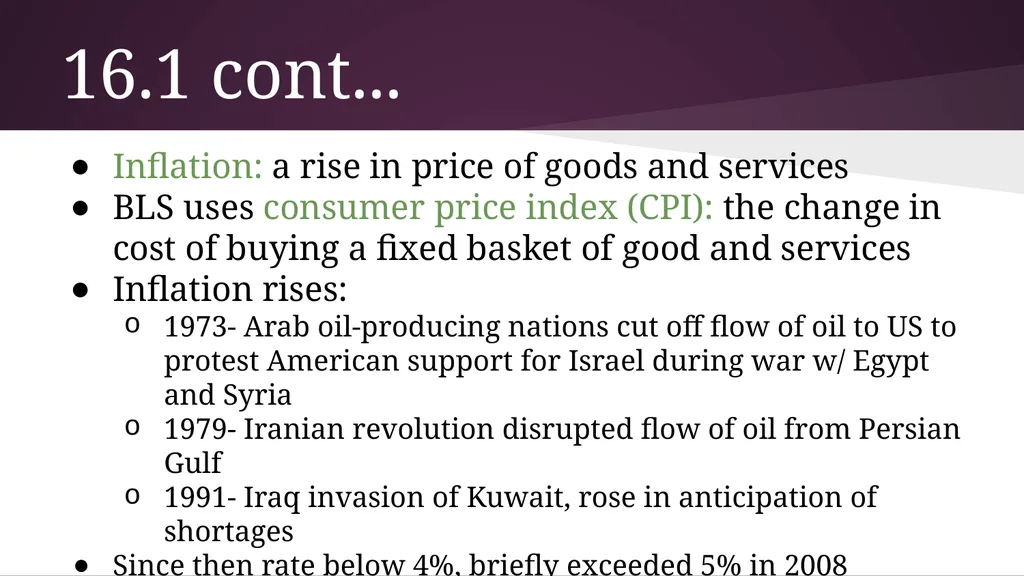
16.1 cont... Inflation: a rise in price of goods and services
BLS uses consumer price index (CPI): the change in cost of buying a fixed basket of good and services
Inflation rises:
1973- Arab oil-producing nations cut off flow of oil to US to protest American support for Israel during war w/ Egypt and Syria
1979- Iranian revolution disrupted flow of oil from Persian Gulf
1991- Iraq invasion of Kuwait, rose in anticipation of shortages
Since then rate below 4%, briefly exceeded 5% in 2008<br>
BLS uses consumer price index (CPI): the change in cost of buying a fixed basket of good and services
Inflation rises:
1973- Arab oil-producing nations cut off flow of oil to US to protest American support for Israel during war w/ Egypt and Syria
1979- Iranian revolution disrupted flow of oil from Persian Gulf
1991- Iraq invasion of Kuwait, rose in anticipation of shortages
Since then rate below 4%, briefly exceeded 5% in 2008<br>
05
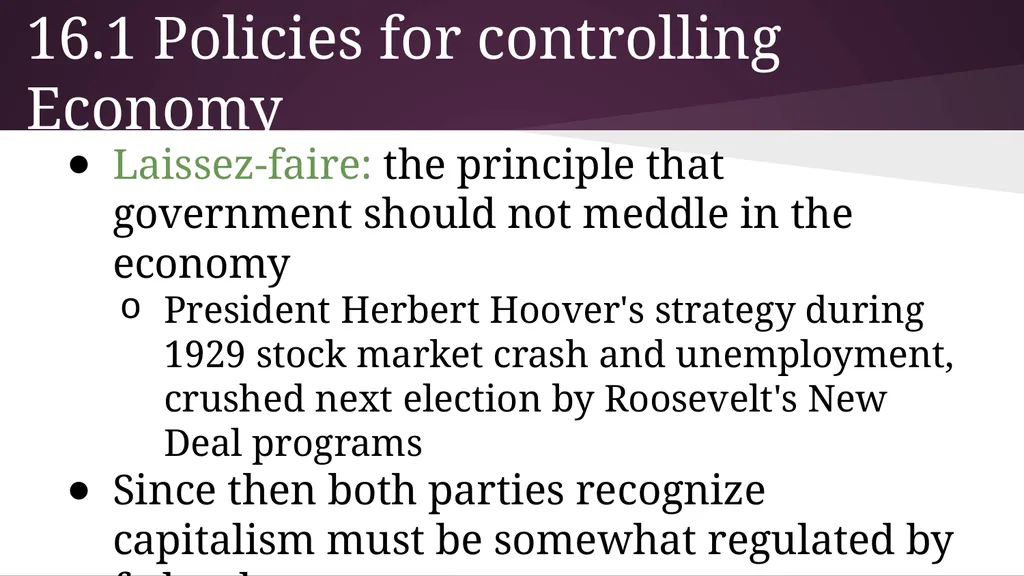
16.1 Policies for controlling Economy Laissez-faire: the principle that government should not meddle in the economy
President Herbert Hoover's strategy during 1929 stock market crash and unemployment, crushed next election by Roosevelt's New Deal programs
Since then both parties recognize capitalism must be somewhat regulated by federal government<br>
President Herbert Hoover's strategy during 1929 stock market crash and unemployment, crushed next election by Roosevelt's New Deal programs
Since then both parties recognize capitalism must be somewhat regulated by federal government<br>
06
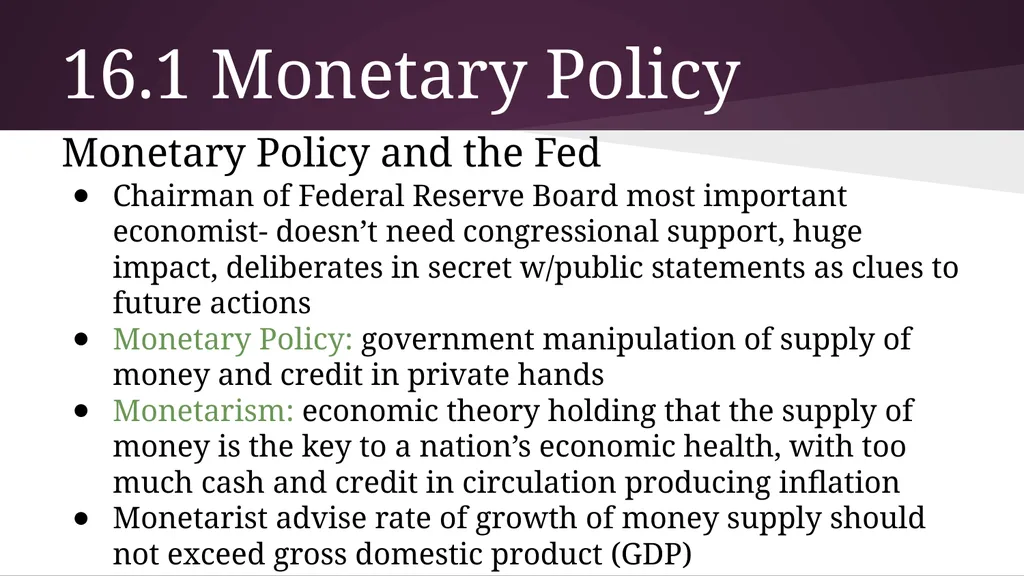
16.1 Monetary Policy Monetary Policy and the Fed
Chairman of Federal Reserve Board most important economist- doesn’t need congressional support, huge impact, deliberates in secret w/public statements as clues to future actions
Monetary Policy: government manipulation of supply of money and credit in private hands
Monetarism: economic theory holding that the supply of money is the key to a nation’s economic health, with too much cash and credit in circulation producing inflation
Monetarist advise rate of growth of money supply should not exceed gross domestic product (GDP)<br>
Chairman of Federal Reserve Board most important economist- doesn’t need congressional support, huge impact, deliberates in secret w/public statements as clues to future actions
Monetary Policy: government manipulation of supply of money and credit in private hands
Monetarism: economic theory holding that the supply of money is the key to a nation’s economic health, with too much cash and credit in circulation producing inflation
Monetarist advise rate of growth of money supply should not exceed gross domestic product (GDP)<br>
07
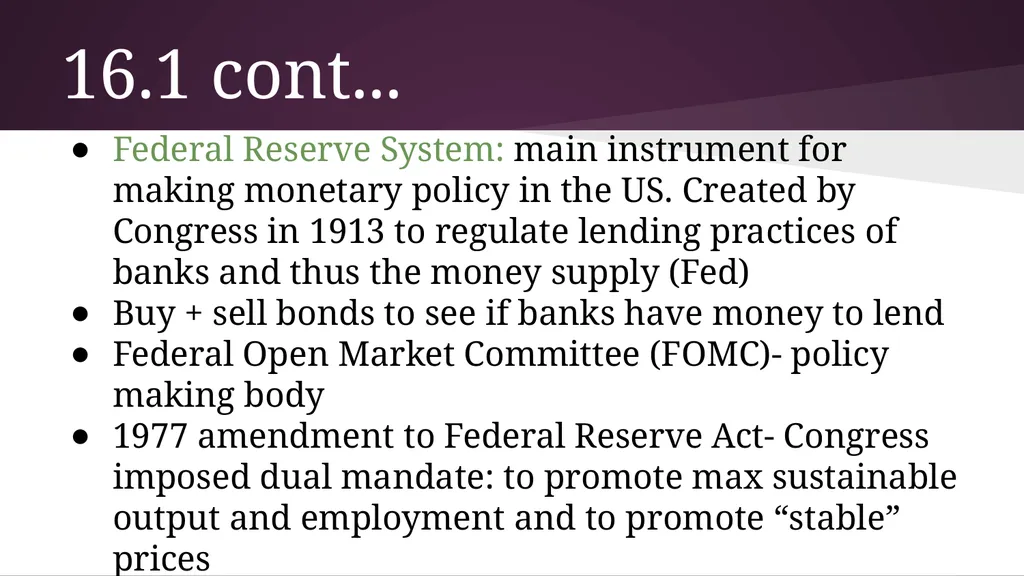
16.1 cont... Federal Reserve System: main instrument for making monetary policy in the US. Created by Congress in 1913 to regulate lending practices of banks and thus the money supply (Fed)
Buy + sell bonds to see if banks have money to lend
Federal Open Market Committee (FOMC)- policy making body
1977 amendment to Federal Reserve Act- Congress imposed dual mandate: to promote max sustainable output and employment and to promote “stable” prices<br>
Buy + sell bonds to see if banks have money to lend
Federal Open Market Committee (FOMC)- policy making body
1977 amendment to Federal Reserve Act- Congress imposed dual mandate: to promote max sustainable output and employment and to promote “stable” prices<br>
08
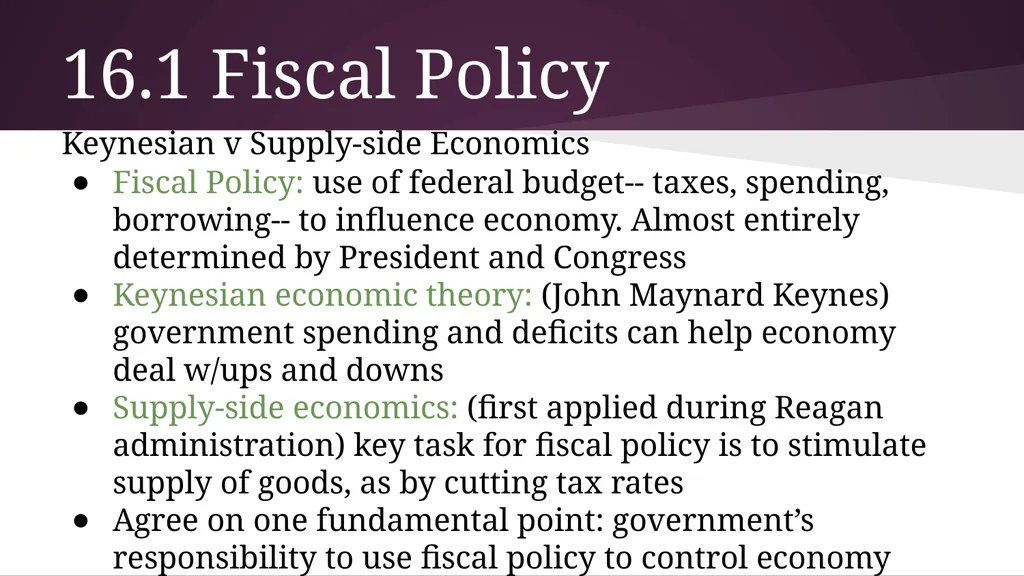
16.1 Fiscal Policy Keynesian v Supply-side Economics
Fiscal Policy: use of federal budget-- taxes, spending, borrowing-- to influence economy. Almost entirely determined by President and Congress
Keynesian economic theory: (John Maynard Keynes) government spending and deficits can help economy deal w/ups and downs
Supply-side economics: (first applied during Reagan administration) key task for fiscal policy is to stimulate supply of goods, as by cutting tax rates
Agree on one fundamental point: government’s responsibility to use fiscal policy to control economy<br>
Fiscal Policy: use of federal budget-- taxes, spending, borrowing-- to influence economy. Almost entirely determined by President and Congress
Keynesian economic theory: (John Maynard Keynes) government spending and deficits can help economy deal w/ups and downs
Supply-side economics: (first applied during Reagan administration) key task for fiscal policy is to stimulate supply of goods, as by cutting tax rates
Agree on one fundamental point: government’s responsibility to use fiscal policy to control economy<br>
09
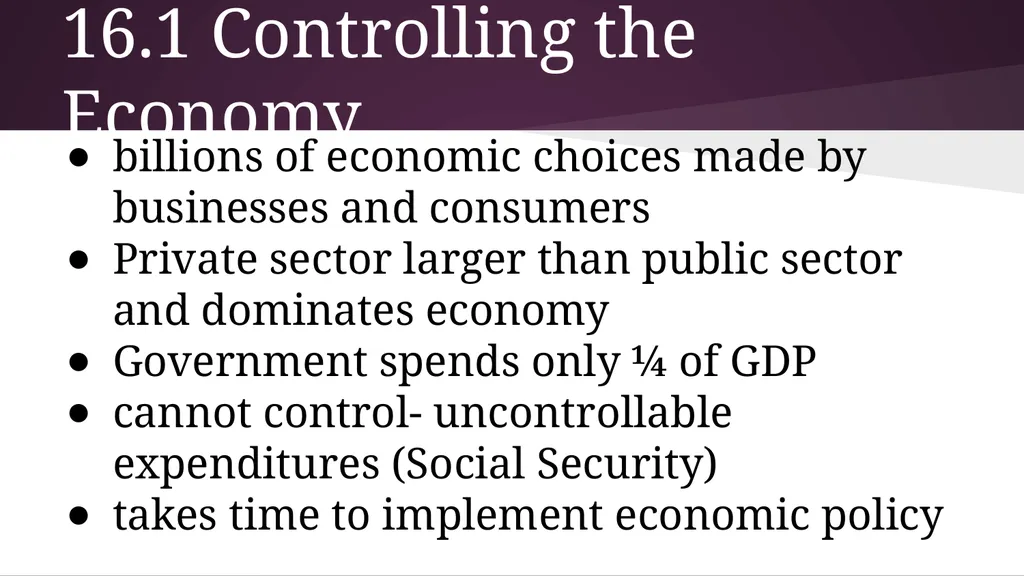
16.1 Controlling the Economy billions of economic choices made by businesses and consumers
Private sector larger than public sector and dominates economy
Government spends only ¼ of GDP
cannot control- uncontrollable expenditures (Social Security)
takes time to implement economic policy<br>
Private sector larger than public sector and dominates economy
Government spends only ¼ of GDP
cannot control- uncontrollable expenditures (Social Security)
takes time to implement economic policy<br>
10
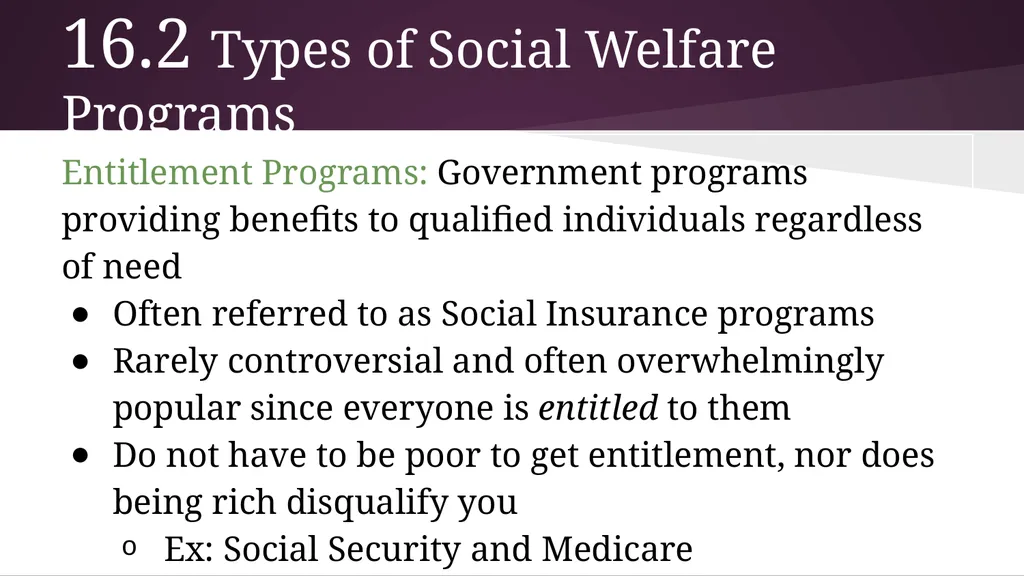
16.2 Types of Social Welfare Programs Entitlement Programs: Government programs providing benefits to qualified individuals regardless of need
Often referred to as Social Insurance programs
Rarely controversial and often overwhelmingly popular since everyone is entitled to them
Do not have to be poor to get entitlement, nor does being rich disqualify you
Ex: Social Security and Medicare<br>
Often referred to as Social Insurance programs
Rarely controversial and often overwhelmingly popular since everyone is entitled to them
Do not have to be poor to get entitlement, nor does being rich disqualify you
Ex: Social Security and Medicare<br>
11
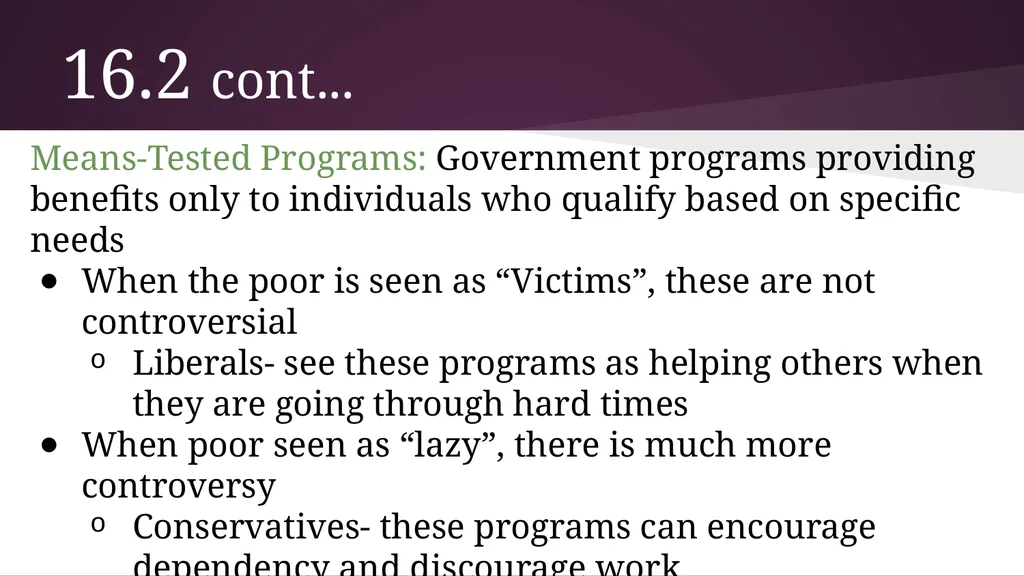
16.2 cont... Means-Tested Programs: Government programs providing benefits only to individuals who qualify based on specific needs
When the poor is seen as “Victims”, these are not controversial
Liberals- see these programs as helping others when they are going through hard times
When poor seen as “lazy”, there is much more controversy
Conservatives- these programs can encourage dependency and discourage work
Ex: Food Stamps and Medicaid<br>
When the poor is seen as “Victims”, these are not controversial
Liberals- see these programs as helping others when they are going through hard times
When poor seen as “lazy”, there is much more controversy
Conservatives- these programs can encourage dependency and discourage work
Ex: Food Stamps and Medicaid<br>
12
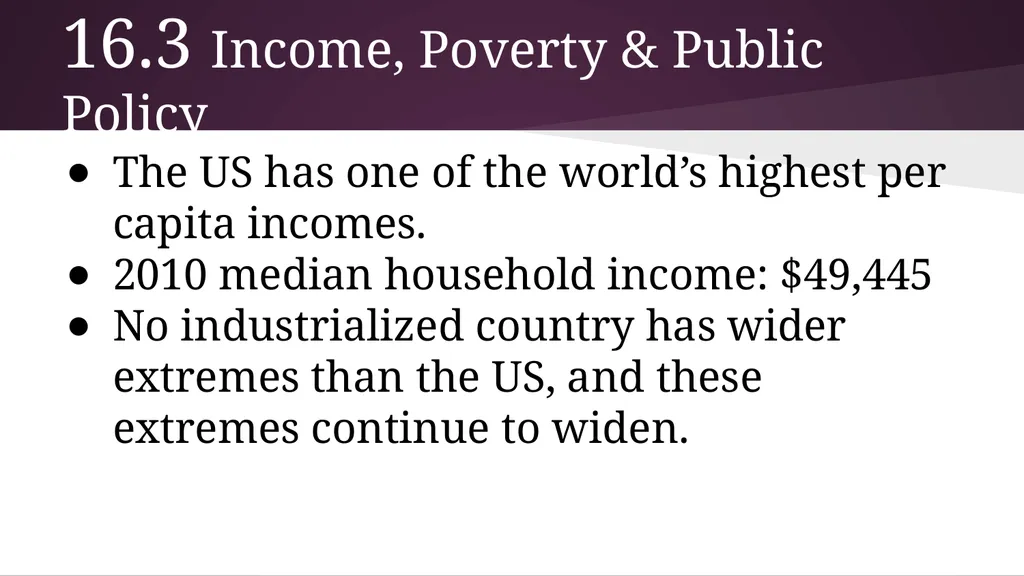
16.3 Income, Poverty & Public Policy The US has one of the world’s highest per capita incomes.
2010 median household income: $49,445
No industrialized country has wider extremes than the US, and these extremes continue to widen.<br>
2010 median household income: $49,445
No industrialized country has wider extremes than the US, and these extremes continue to widen.<br>
13
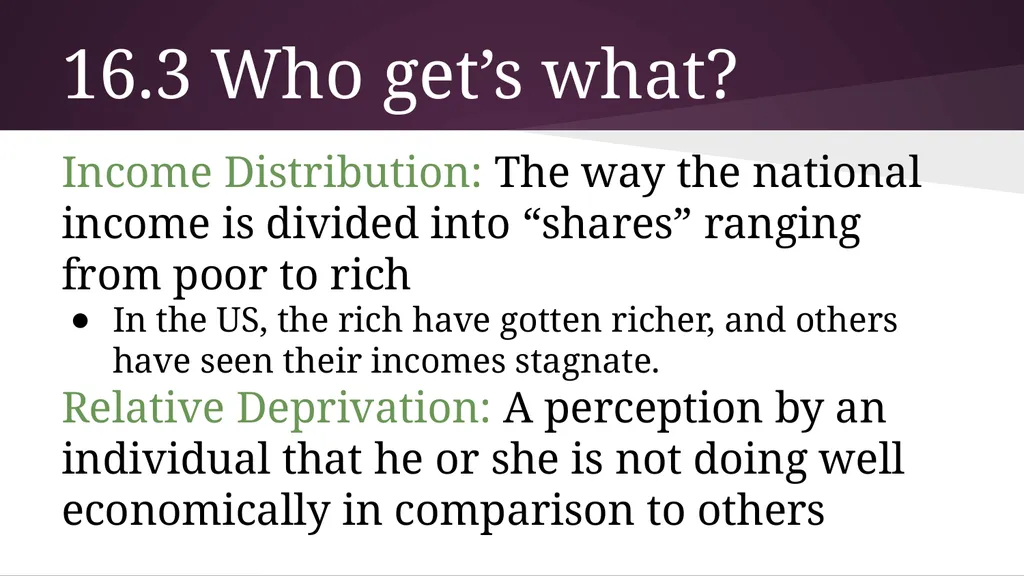
16.3 Who get’s what? Income Distribution: The way the national income is divided into “shares” ranging from poor to rich
In the US, the rich have gotten richer, and others have seen their incomes stagnate.
Relative Deprivation: A perception by an individual that he or she is not doing well economically in comparison to others<br>
In the US, the rich have gotten richer, and others have seen their incomes stagnate.
Relative Deprivation: A perception by an individual that he or she is not doing well economically in comparison to others<br>
14
16.3 The increase in income inequality & the rise of the top 1 percent:<br>
15
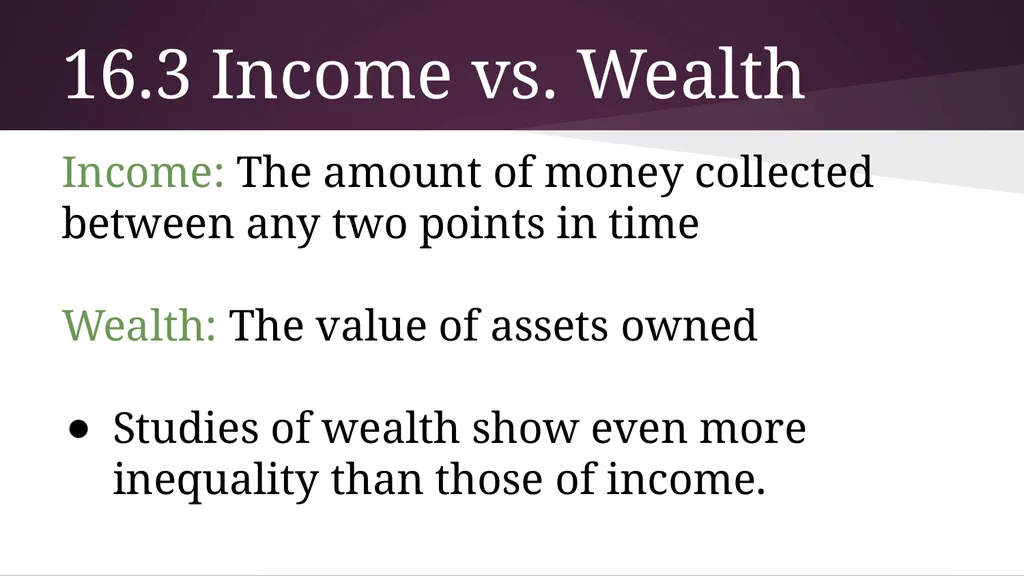
16.3 Income vs. Wealth Income: The amount of money collected between any two points in time
Wealth: The value of assets owned
Studies of wealth show even more inequality than those of income.<br>
Wealth: The value of assets owned
Studies of wealth show even more inequality than those of income.<br>
16
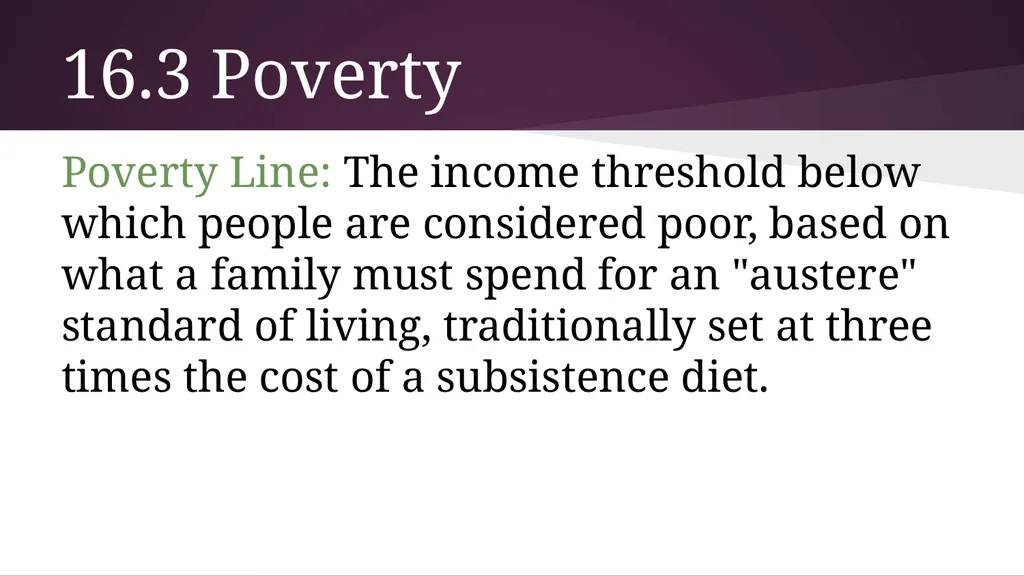
16.3 Poverty Poverty Line: The income threshold below which people are considered poor, based on what a family must spend for an "austere" standard of living, traditionally set at three times the cost of a subsistence diet.<br>
17
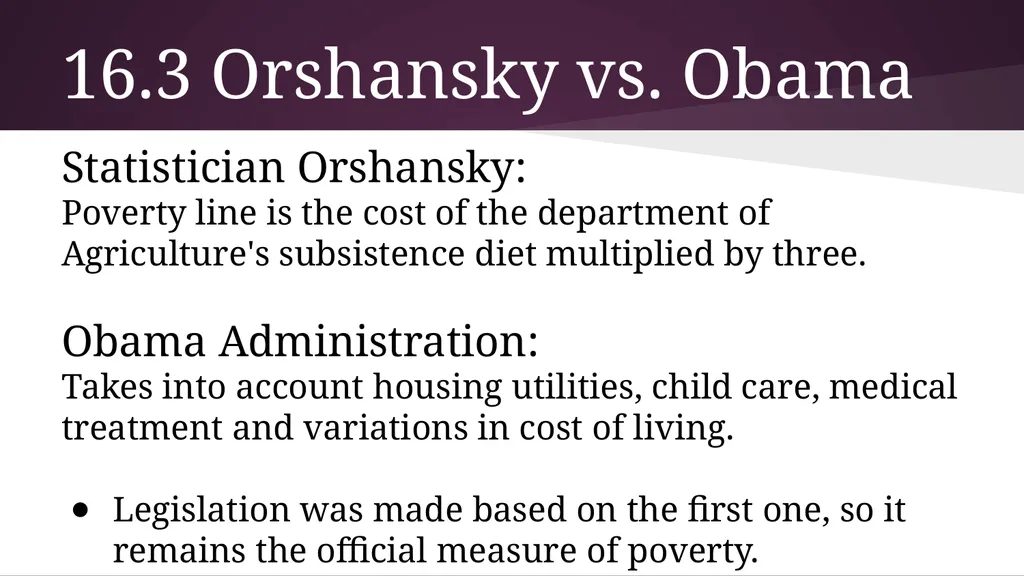
16.3 Orshansky vs. Obama Statistician Orshansky:
Poverty line is the cost of the department of Agriculture's subsistence diet multiplied by three.
Obama Administration:
Takes into account housing utilities, child care, medical treatment and variations in cost of living.
Legislation was made based on the first one, so it remains the official measure of poverty.<br>
Poverty line is the cost of the department of Agriculture's subsistence diet multiplied by three.
Obama Administration:
Takes into account housing utilities, child care, medical treatment and variations in cost of living.
Legislation was made based on the first one, so it remains the official measure of poverty.<br>
18
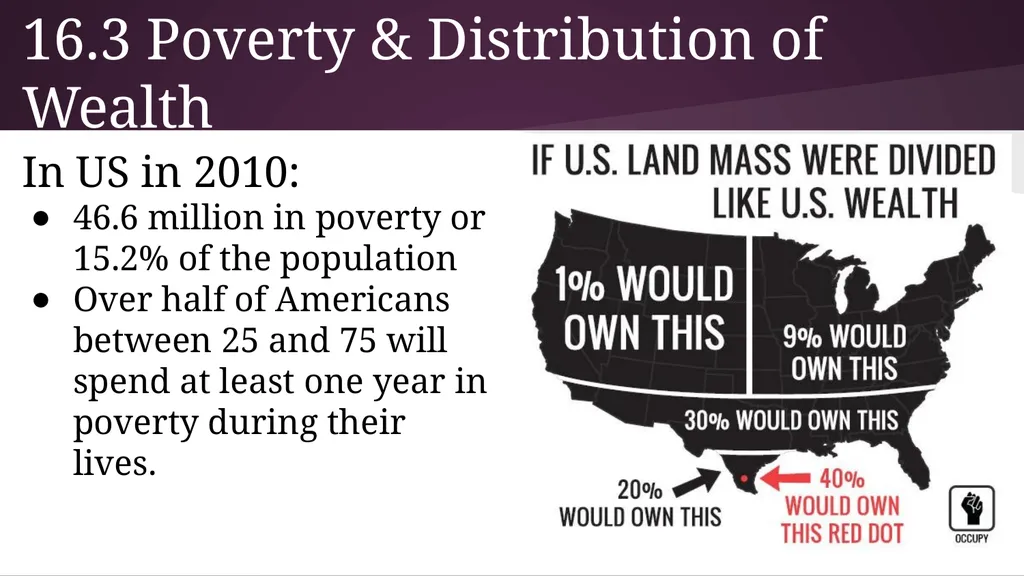
16.3 Poverty & Distribution of Wealth In US in 2010:
46.6 million in poverty or 15.2% of the population
Over half of Americans between 25 and 75 will spend at least one year in poverty during their lives.<br>
46.6 million in poverty or 15.2% of the population
Over half of Americans between 25 and 75 will spend at least one year in poverty during their lives.<br>
19
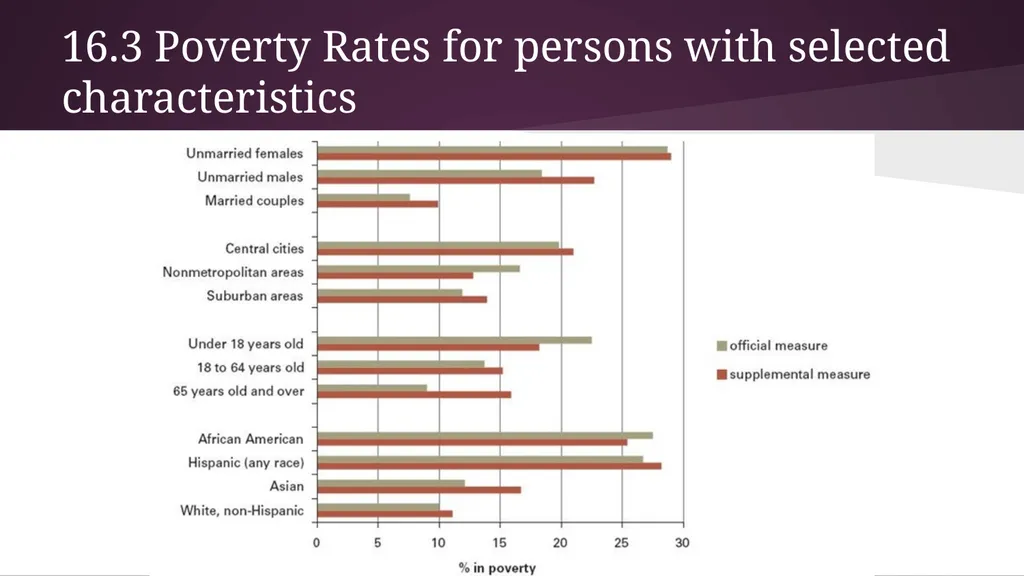
16.3 Characteristics of Poverty Feminization of Poverty: The increasing concentration of poverty among women, especially unmarried women and their children.
30% of single mom families are in poverty compared to 10% of two parent families.
Poverty rates are higher for: African Americans, Hispanics, Unmarried women, children, and inner-city residents.
Poverty used to be a large problem for the elderly until Social Security.<br>
30% of single mom families are in poverty compared to 10% of two parent families.
Poverty rates are higher for: African Americans, Hispanics, Unmarried women, children, and inner-city residents.
Poverty used to be a large problem for the elderly until Social Security.<br>
20
16.3 Poverty Rates for persons with selected characteristics<br>
21
16.3 How Public Policy Affects Income Since government spends 1 out of every 3 dollars in the American Economy, it is bound to have a major impact on citizen’s income & wealth. The two principal ways government affects income & wealth are through:
Taxing Powers
Expenditure Policies<br>
Taxing Powers
Expenditure Policies<br>
22
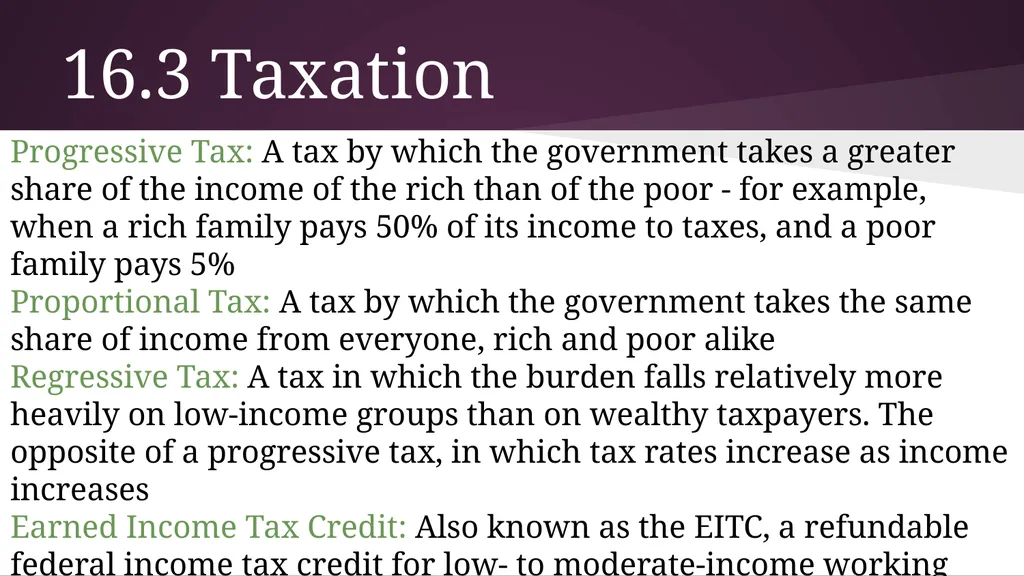
16.3 Taxation Progressive Tax: A tax by which the government takes a greater share of the income of the rich than of the poor - for example, when a rich family pays 50% of its income to taxes, and a poor family pays 5%
Proportional Tax: A tax by which the government takes the same share of income from everyone, rich and poor alike
Regressive Tax: A tax in which the burden falls relatively more heavily on low-income groups than on wealthy taxpayers. The opposite of a progressive tax, in which tax rates increase as income increases
Earned Income Tax Credit: Also known as the EITC, a refundable federal income tax credit for low- to moderate-income working individuals and families, even if they did not earn enough money to be required to file a tax return<br>
Proportional Tax: A tax by which the government takes the same share of income from everyone, rich and poor alike
Regressive Tax: A tax in which the burden falls relatively more heavily on low-income groups than on wealthy taxpayers. The opposite of a progressive tax, in which tax rates increase as income increases
Earned Income Tax Credit: Also known as the EITC, a refundable federal income tax credit for low- to moderate-income working individuals and families, even if they did not earn enough money to be required to file a tax return<br>
23
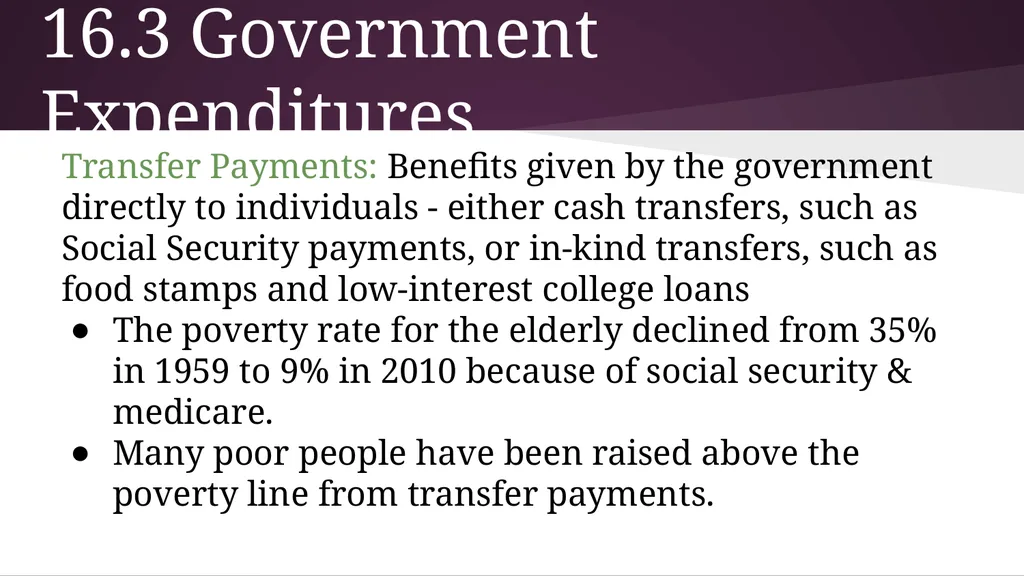
16.3 Government Expenditures Transfer Payments: Benefits given by the government directly to individuals - either cash transfers, such as Social Security payments, or in-kind transfers, such as food stamps and low-interest college loans
The poverty rate for the elderly declined from 35% in 1959 to 9% in 2010 because of social security & medicare.
Many poor people have been raised above the poverty line from transfer payments.<br>
The poverty rate for the elderly declined from 35% in 1959 to 9% in 2010 because of social security & medicare.
Many poor people have been raised above the poverty line from transfer payments.<br>
24
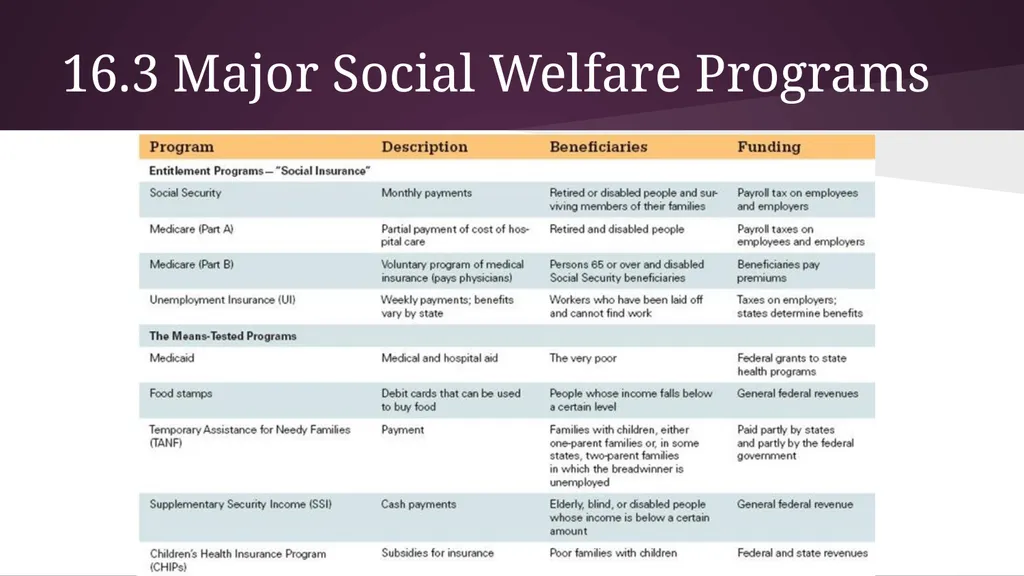
16.3 Major Social Welfare Programs<br>
25
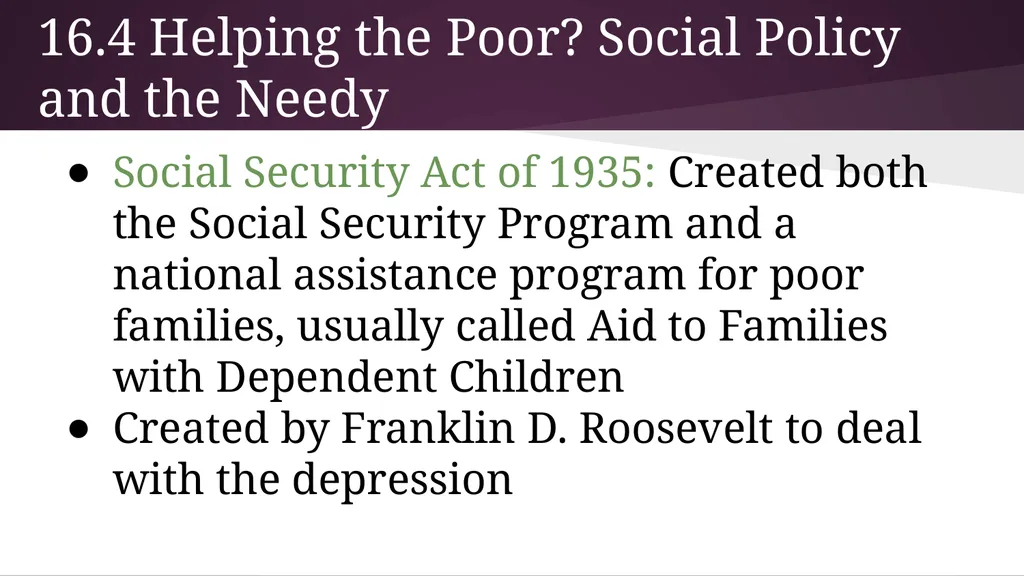
16.4 Helping the Poor? Social Policy and the Needy Social Security Act of 1935: Created both the Social Security Program and a national assistance program for poor families, usually called Aid to Families with Dependent Children
Created by Franklin D. Roosevelt to deal with the depression<br>
Created by Franklin D. Roosevelt to deal with the depression<br>
26
16.4 cont... War on Poverty:
Launched by Lyndon Johnson in 1964
Spurred by civil rights movement
Food stamps and other programs
War on Anti Poverty programs:
Ronald Reagan in 1981
cut welfare benefits and lower number receiving
“Welfare proved to be a failure”<br>
Launched by Lyndon Johnson in 1964
Spurred by civil rights movement
Food stamps and other programs
War on Anti Poverty programs:
Ronald Reagan in 1981
cut welfare benefits and lower number receiving
“Welfare proved to be a failure”<br>
27
16.4 cont... One of the major issues of Welfare is the negative connotation it has
Stereotypes associated with Welfare:
“Deadbeat dads”- ran out on families leaving them on Welfare
“welfare queens”- collect money they don’t deserve due to the broken system
“race coded”- African Americans, more commonly on Welfare, perceived as lazy<br>
Stereotypes associated with Welfare:
“Deadbeat dads”- ran out on families leaving them on Welfare
“welfare queens”- collect money they don’t deserve due to the broken system
“race coded”- African Americans, more commonly on Welfare, perceived as lazy<br>
28
16.4 Welfare Reform Personal Responsibility and Work Opportunity Reconciliation Act (enacted by Clinton): 1996 welfare reform law which implemented Temporary Assistance for Needy Families program
Each state would receive a fixed amount of money to run its own welfare programs
people on welfare would have to find work within two years or lose all their benefits
There would be a lifetime maximum of five years for welfare<br>
Each state would receive a fixed amount of money to run its own welfare programs
people on welfare would have to find work within two years or lose all their benefits
There would be a lifetime maximum of five years for welfare<br>
29
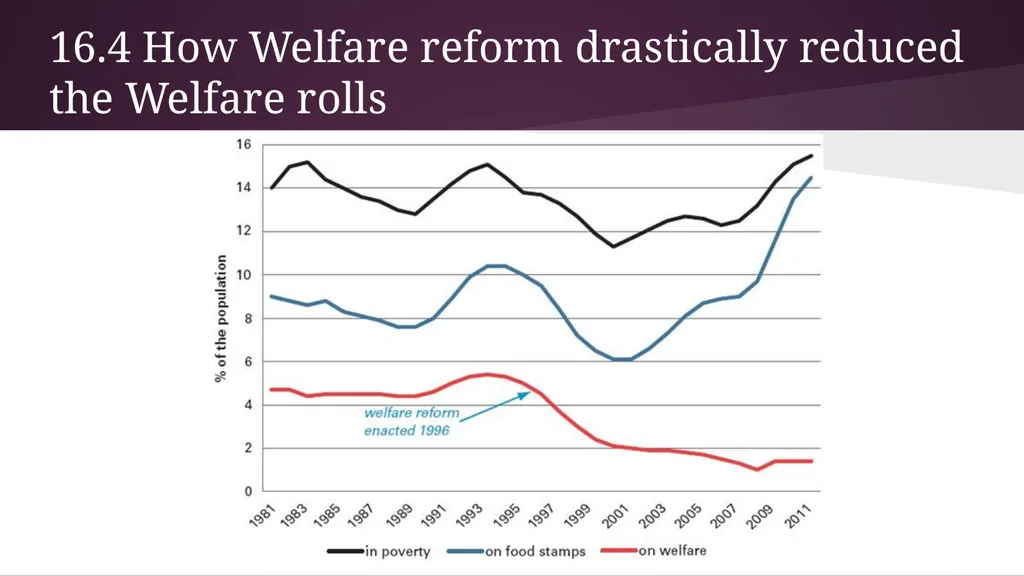
16.4 cont…. Temporary Assistance for Needy Families (New name for welfare): Replacing Aid to Families w/Dependent Children as program for public assistance to needy families, requires people on welfare to find work within 2 years and sets lifetime maximum of 5 years
Due to Welfare reform welfare has been greatly reduced
Welfare spending remains unpopular compared to most other governmental expenditures<br>
Due to Welfare reform welfare has been greatly reduced
Welfare spending remains unpopular compared to most other governmental expenditures<br>
30
16.4 How Welfare reform drastically reduced the Welfare rolls<br>
31
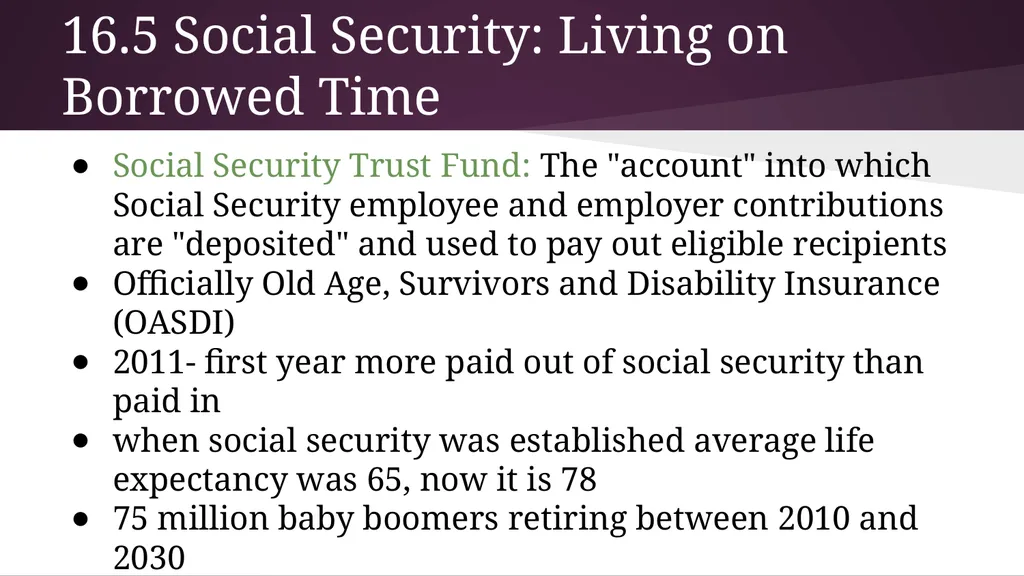
16.5 Social Security: Living on Borrowed Time Social Security Trust Fund: The "account" into which Social Security employee and employer contributions are "deposited" and used to pay out eligible recipients
Officially Old Age, Survivors and Disability Insurance (OASDI)
2011- first year more paid out of social security than paid in
when social security was established average life expectancy was 65, now it is 78
75 million baby boomers retiring between 2010 and 2030<br>
Officially Old Age, Survivors and Disability Insurance (OASDI)
2011- first year more paid out of social security than paid in
when social security was established average life expectancy was 65, now it is 78
75 million baby boomers retiring between 2010 and 2030<br>
32
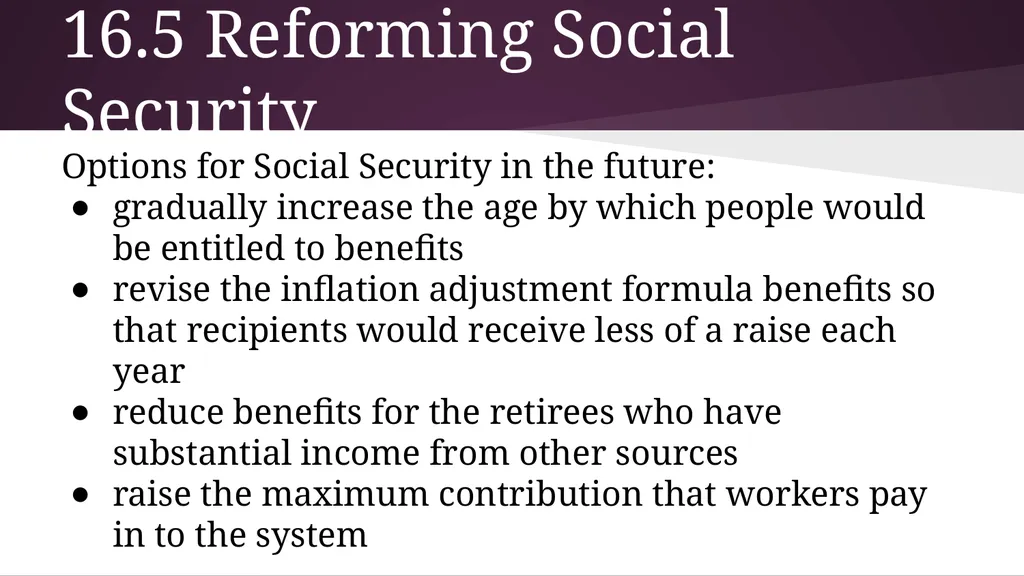
16.5 Reforming Social Security Options for Social Security in the future:
gradually increase the age by which people would be entitled to benefits
revise the inflation adjustment formula benefits so that recipients would receive less of a raise each year
reduce benefits for the retirees who have substantial income from other sources
raise the maximum contribution that workers pay in to the system<br>
gradually increase the age by which people would be entitled to benefits
revise the inflation adjustment formula benefits so that recipients would receive less of a raise each year
reduce benefits for the retirees who have substantial income from other sources
raise the maximum contribution that workers pay in to the system<br>
33
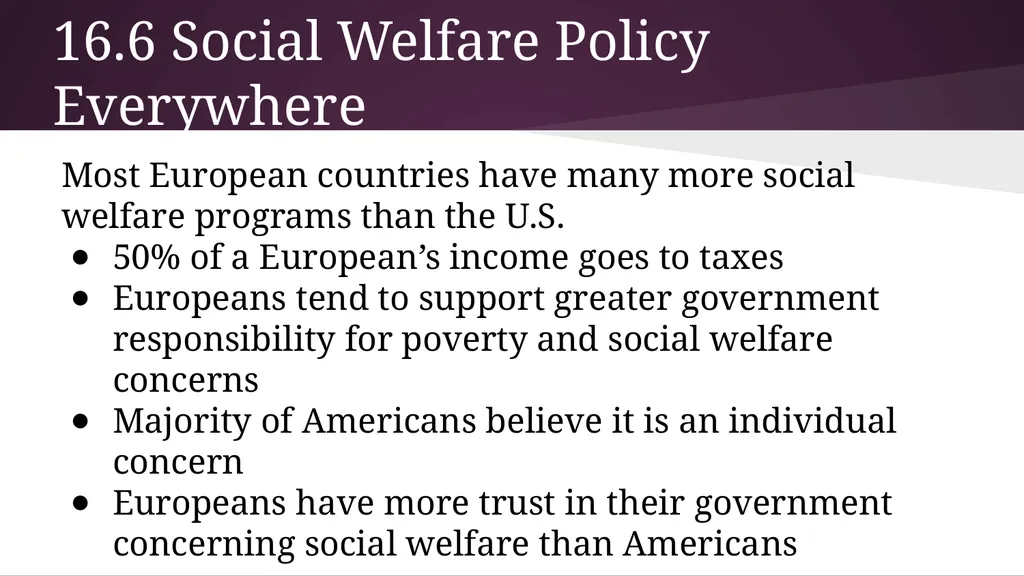
16.6 Social Welfare Policy Everywhere Most European countries have many more social welfare programs than the U.S.
50% of a European’s income goes to taxes
Europeans tend to support greater government responsibility for poverty and social welfare concerns
Majority of Americans believe it is an individual concern
Europeans have more trust in their government concerning social welfare than Americans<br>
50% of a European’s income goes to taxes
Europeans tend to support greater government responsibility for poverty and social welfare concerns
Majority of Americans believe it is an individual concern
Europeans have more trust in their government concerning social welfare than Americans<br>
34
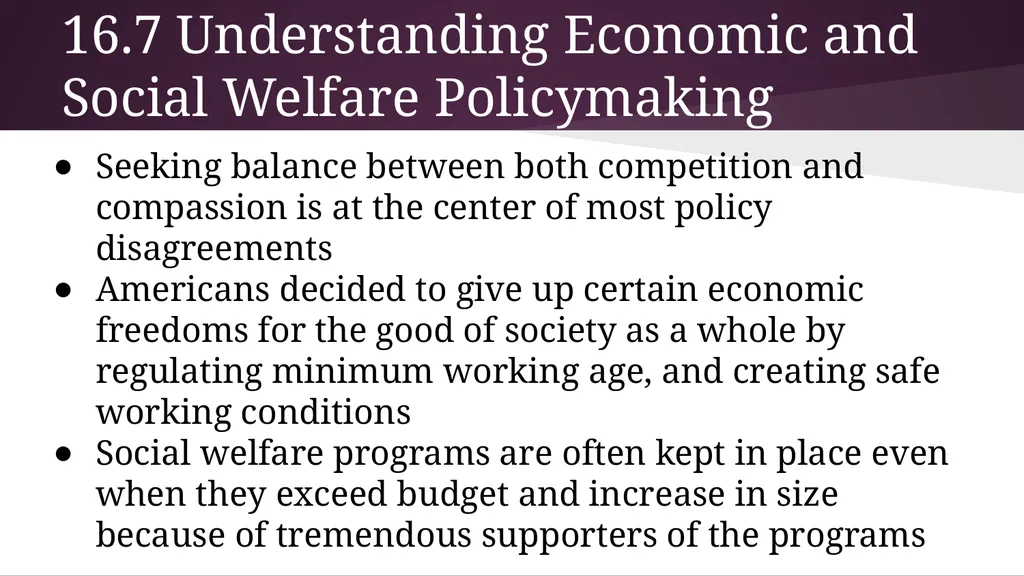
16.7 Understanding Economic and Social Welfare Policymaking Seeking balance between both competition and compassion is at the center of most policy disagreements
Americans decided to give up certain economic freedoms for the good of society as a whole by regulating minimum working age, and creating safe working conditions
Social welfare programs are often kept in place even when they exceed budget and increase in size because of tremendous supporters of the programs<br>
Americans decided to give up certain economic freedoms for the good of society as a whole by regulating minimum working age, and creating safe working conditions
Social welfare programs are often kept in place even when they exceed budget and increase in size because of tremendous supporters of the programs<br>
35
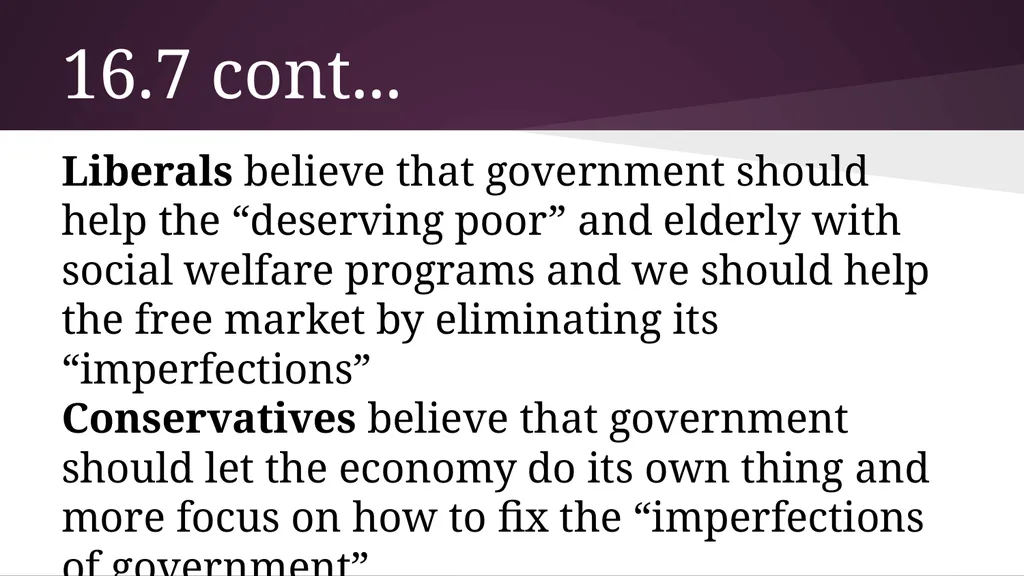
16.7 cont... Liberals believe that government should help the “deserving poor” and elderly with social welfare programs and we should help the free market by eliminating its “imperfections”
Conservatives believe that government should let the economy do its own thing and more focus on how to fix the “imperfections of government”<br>
Conservatives believe that government should let the economy do its own thing and more focus on how to fix the “imperfections of government”<br>