
Chapter 16: Exploring Perspectives on Canadian


Description: Chapter 16: Exploring Perspectives on Canadian Identity National Identity and Government Policy Canada is a pluralistic, democratic nation- state which contains many perspectives such as national interests which leads to a national
Related Topics
Download Presentation
"Chapter 16: Exploring Perspectives on Canadian" is the property of its rightful owner. Permission is granted to download and print the materials on this website for personal, non-commercial use only, and to display it on your personal computer provided you do not modify the materials and that you retain all copyright notices contained in the materials. By downloading content from our website, you accept the terms of this agreement.
Presentation Transcript
slide1. Chapter 16: Exploring Perspectives on Canadian Identity<br>
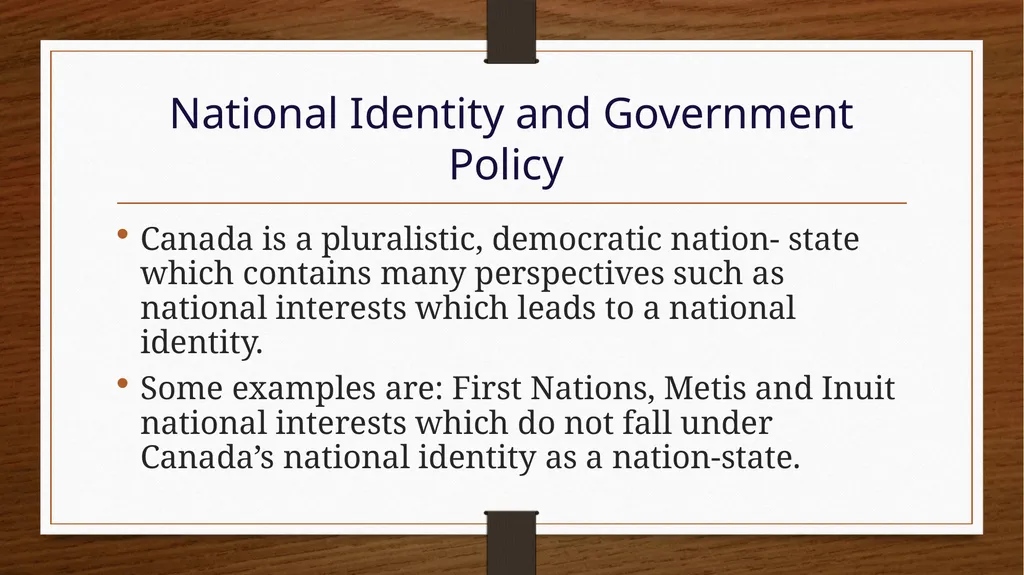
slide2. National Identity and Government Policy Canada is a pluralistic, democratic nation- state which contains many perspectives such as national interests which leads to a national identity.
Some examples are: First Nations, Metis and Inuit national interests which do not fall under Canada’s national identity as a nation-state.<br>
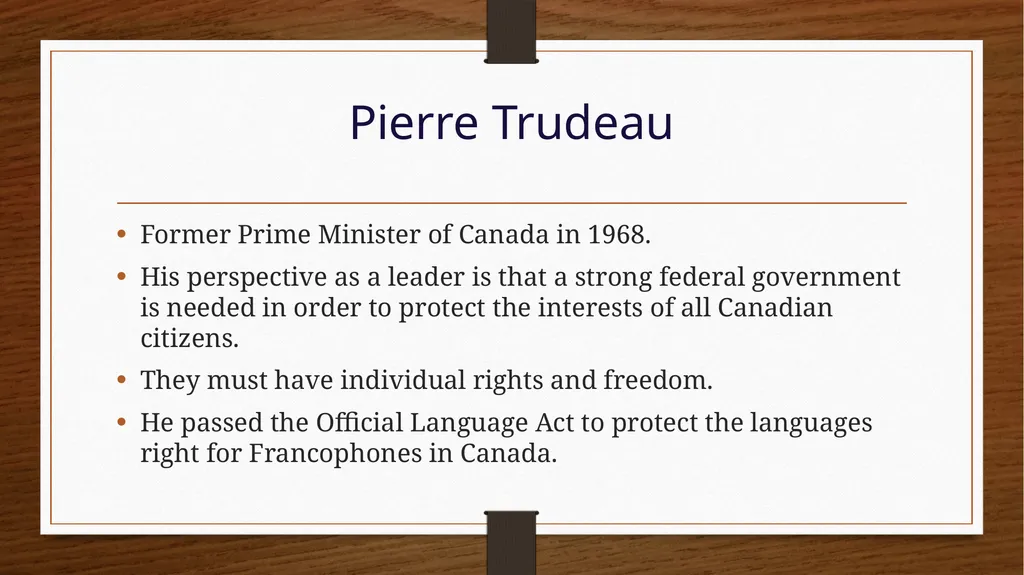
slide3. Pierre Trudeau Former Prime Minister of Canada in 1968.
His perspective as a leader is that a strong federal government is needed in order to protect the interests of all Canadian citizens.
They must have individual rights and freedom.
He passed the Official Language Act to protect the languages right for Francophones in Canada.<br>
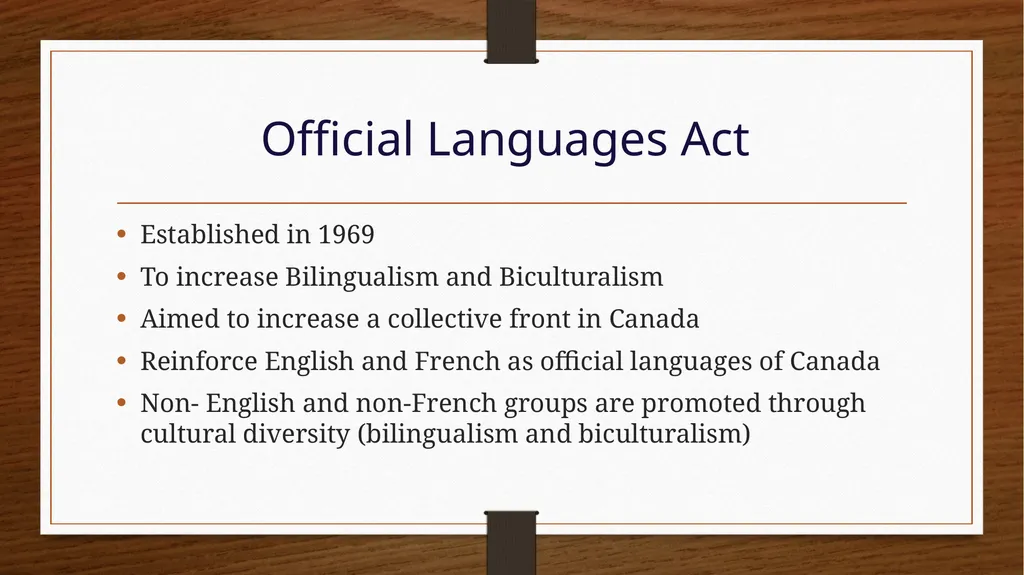
slide4. Official Languages Act Established in 1969
To increase Bilingualism and Biculturalism
Aimed to increase a collective front in Canada
Reinforce English and French as official languages of Canada
Non- English and non-French groups are promoted through cultural diversity (bilingualism and biculturalism)<br>
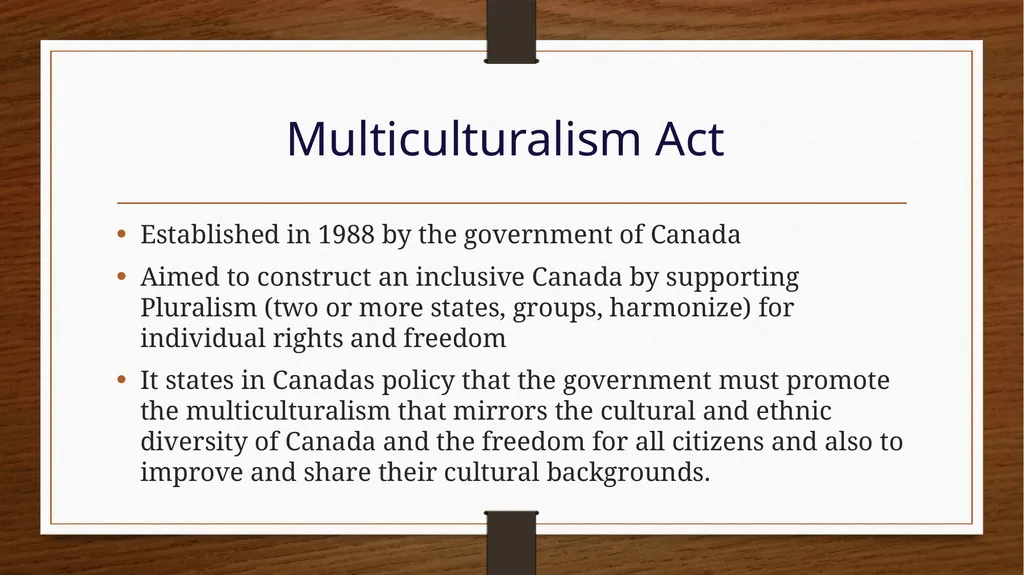
slide5. Multiculturalism Act Established in 1988 by the government of Canada
Aimed to construct an inclusive Canada by supporting Pluralism (two or more states, groups, harmonize) for individual rights and freedom
It states in Canadas policy that the government must promote the multiculturalism that mirrors the cultural and ethnic diversity of Canada and the freedom for all citizens and also to improve and share their cultural backgrounds.<br>
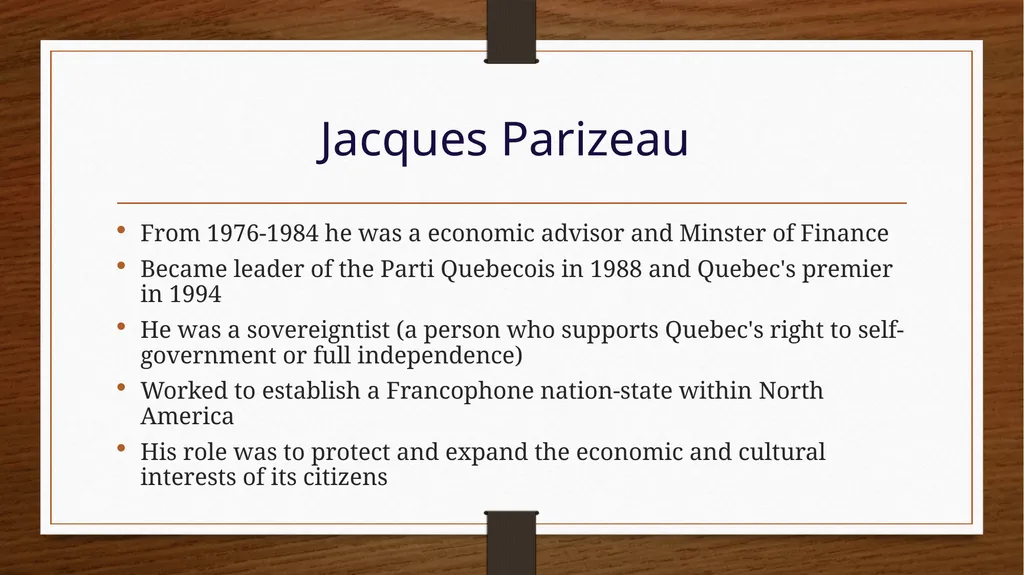
slide6. Jacques Parizeau From 1976-1984 he was a economic advisor and Minster of Finance
Became leader of the Parti Quebecois in 1988 and Quebec's premier in 1994
He was a sovereigntist (a person who supports Quebec's right to self-government or full independence)
Worked to establish a Francophone nation-state within North America
His role was to protect and expand the economic and cultural interests of its citizens<br>
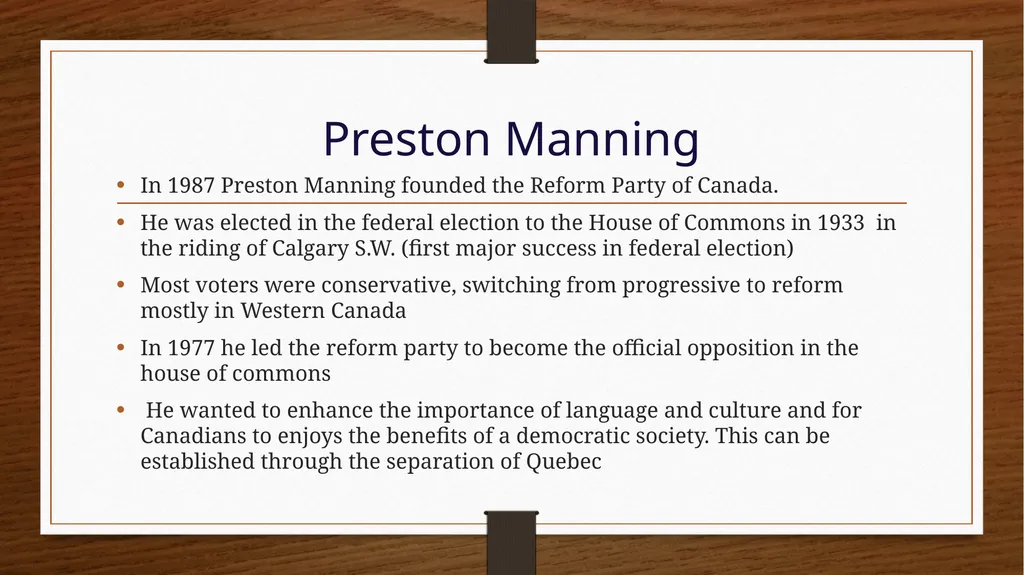
slide7. Preston Manning In 1987 Preston Manning founded the Reform Party of Canada.
He was elected in the federal election to the House of Commons in 1933 in the riding of Calgary S.W. (first major success in federal election)
Most voters were conservative, switching from progressive to reform mostly in Western Canada
In 1977 he led the reform party to become the official opposition in the house of commons
He wanted to enhance the importance of language and culture and for Canadians to enjoys the benefits of a democratic society. This can be established through the separation of Quebec<br>
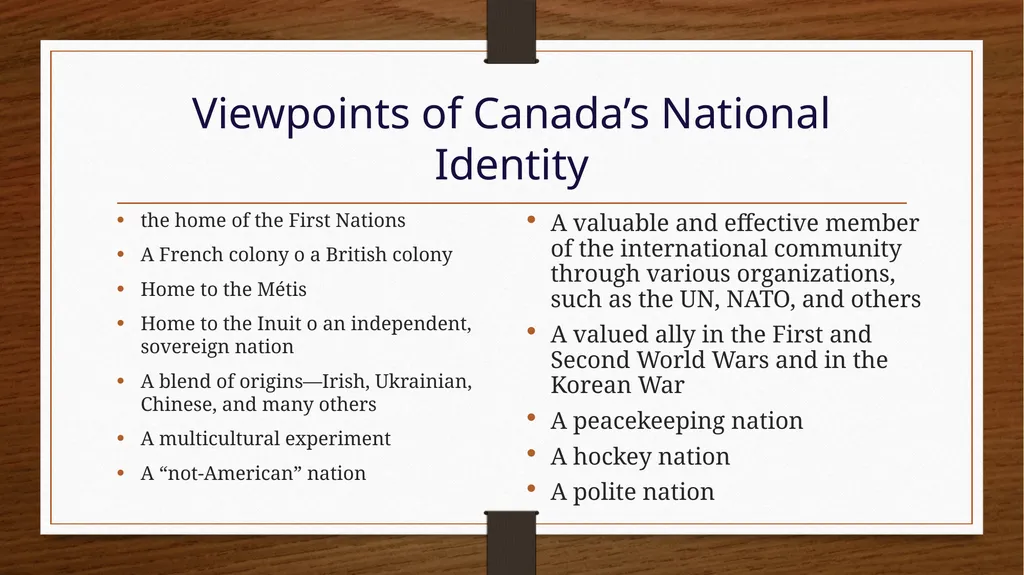
slide8. Viewpoints of Canada’s National Identity the home of the First Nations
A French colony o a British colony
Home to the Métis
Home to the Inuit o an independent, sovereign nation
A blend of origins—Irish, Ukrainian, Chinese, and many others
A multicultural experiment
A “not-American” nation A valuable and effective member of the international community through various organizations, such as the UN, NATO, and others
A valued ally in the First and Second World Wars and in the Korean War
A peacekeeping nation
A hockey nation
A polite nation<br>
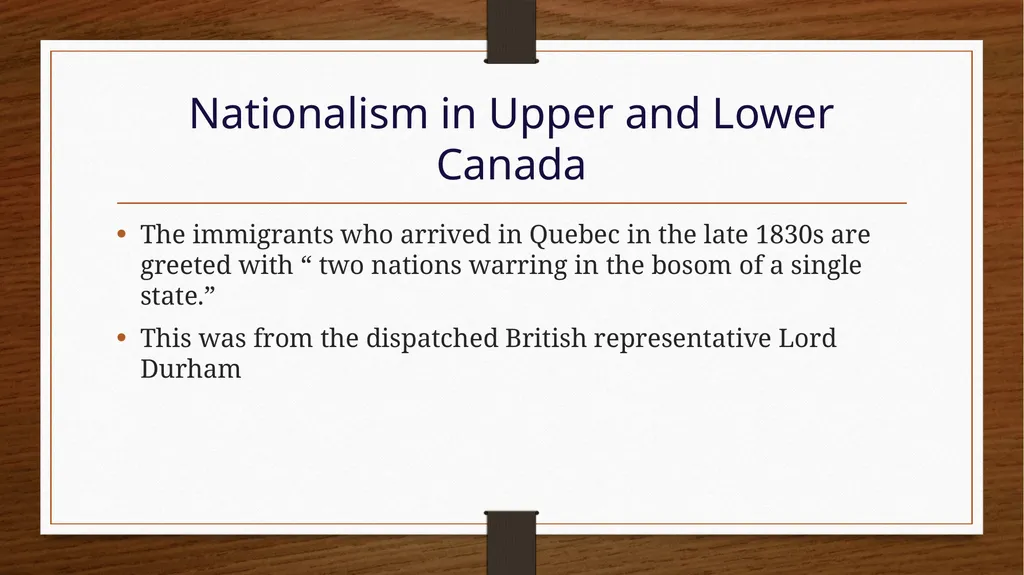
slide9. Nationalism in Upper and Lower Canada The immigrants who arrived in Quebec in the late 1830s are greeted with “ two nations warring in the bosom of a single state.”
This was from the dispatched British representative Lord Durham<br>
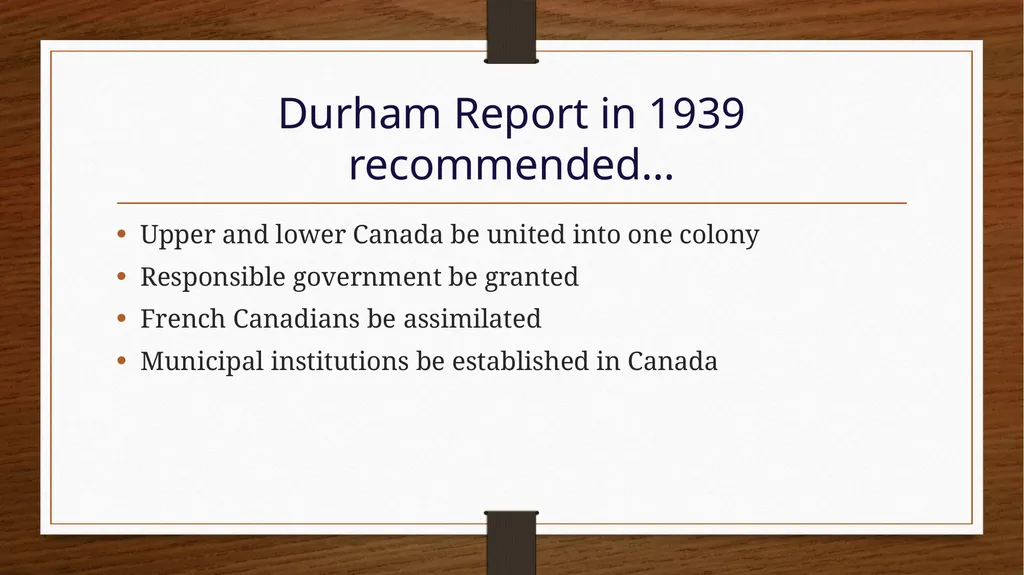
slide10. Durham Report in 1939 recommended… Upper and lower Canada be united into one colony
Responsible government be granted
French Canadians be assimilated
Municipal institutions be established in Canada<br>
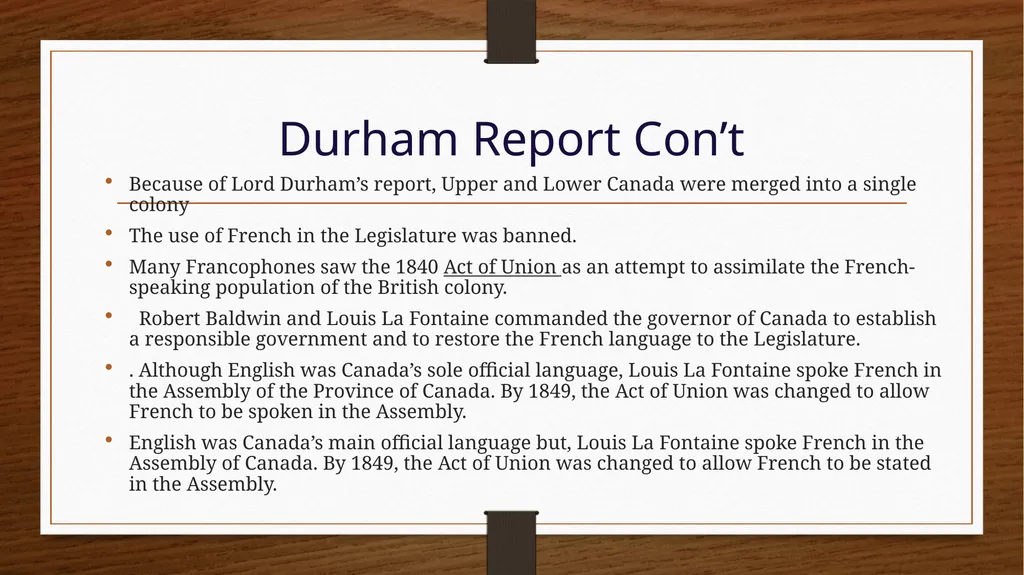
slide11. Durham Report Con’t Because of Lord Durham’s report, Upper and Lower Canada were merged into a single colony
The use of French in the Legislature was banned.
Many Francophones saw the 1840 Act of Union as an attempt to assimilate the French-speaking population of the British colony.
Robert Baldwin and Louis La Fontaine commanded the governor of Canada to establish a responsible government and to restore the French language to the Legislature.
. Although English was Canada’s sole official language, Louis La Fontaine spoke French in the Assembly of the Province of Canada. By 1849, the Act of Union was changed to allow French to be spoken in the Assembly.
English was Canada’s main official language but, Louis La Fontaine spoke French in the Assembly of Canada. By 1849, the Act of Union was changed to allow French to be stated in the Assembly.<br>
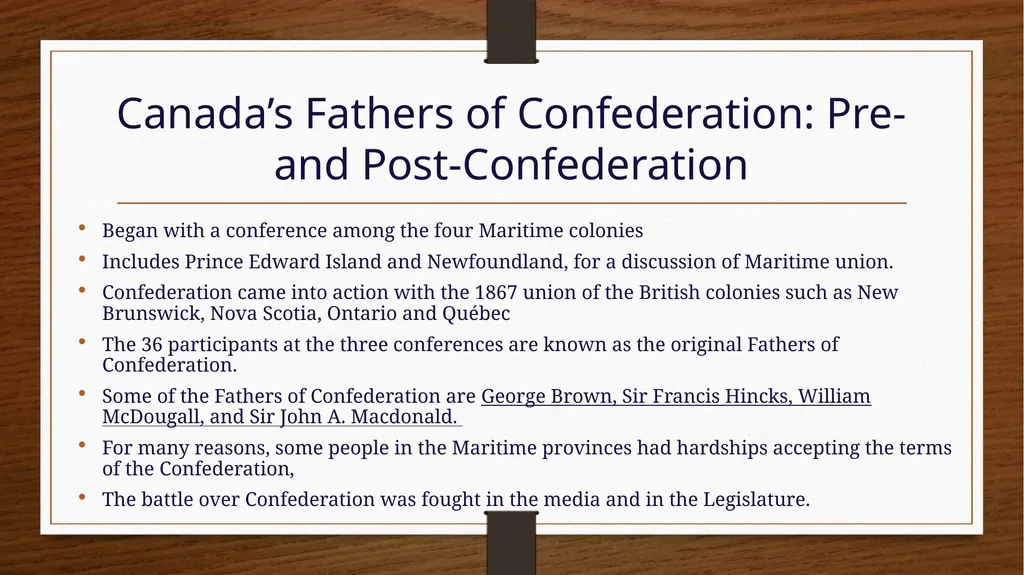
slide12. Canada’s Fathers of Confederation: Pre- and Post-Confederation Began with a conference among the four Maritime colonies
Includes Prince Edward Island and Newfoundland, for a discussion of Maritime union.
Confederation came into action with the 1867 union of the British colonies such as New Brunswick, Nova Scotia, Ontario and Québec
The 36 participants at the three conferences are known as the original Fathers of Confederation.
Some of the Fathers of Confederation are George Brown, Sir Francis Hincks, William McDougall, and Sir John A. Macdonald.
For many reasons, some people in the Maritime provinces had hardships accepting the terms of the Confederation,
The battle over Confederation was fought in the media and in the Legislature.<br>
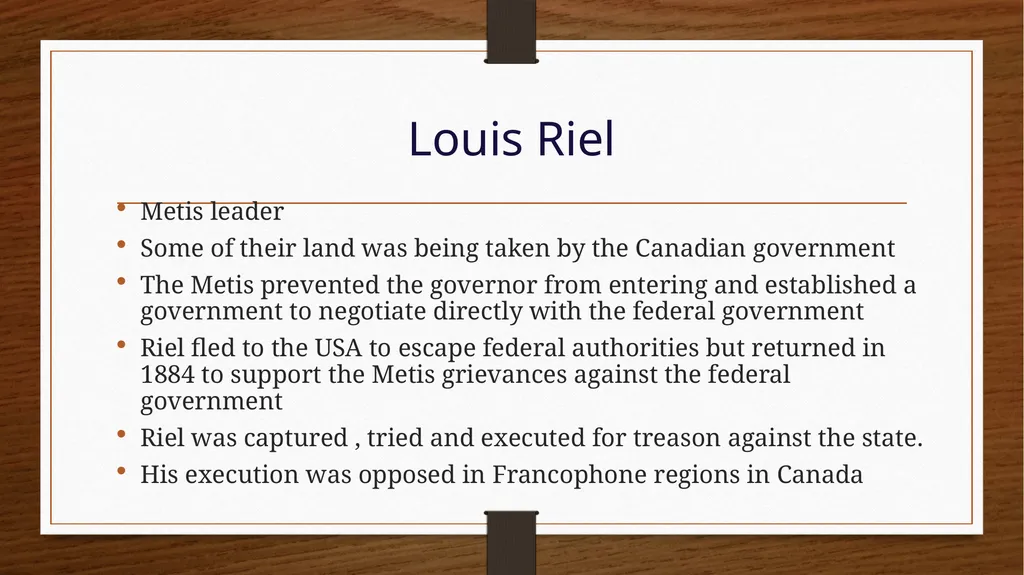
slide13. Louis Riel Metis leader
Some of their land was being taken by the Canadian government
The Metis prevented the governor from entering and established a government to negotiate directly with the federal government
Riel fled to the USA to escape federal authorities but returned in 1884 to support the Metis grievances against the federal government
Riel was captured , tried and executed for treason against the state.
His execution was opposed in Francophone regions in Canada<br>
slide14. Louis Riel Bill To honor Louis and the Metis
An Act respecting Louis Riel
For his role in the advancement of the Canadian Confederation and the rights and interests of the Métis people and the people of Western Canada
This bill did not become law.<br>
slide15. Building Canadian National Identity Since colonial times, Canada has been a nation of immigrants.
Immigration has had an impact on our national identity, and our immigration policies have at times reflected changing perspectives on our national identity.
From Confederation until into the 20th century, Canada had preferential immigration policies, although with varying degrees of restrictiveness.
Immigrants from the British Isles were actively recruited up until Confederation.
Various factors—such as the desire to settle Rupert’s Land and the need for labour for manufacturing and the building of the railroad—fuelled a more aggressive campaign to recruit immigrants.<br>
slide16. CON’T Clifford Sifton, who was a Minister of the Interior from 1896 to 1905
Implemented a vigorous recruitment program of large-scale immigration from eastern and central Europe to Canada.
This selective recruitment brought with it members of religious groups such as the Doukhobors and Mennonites. With this recruitment came a greater diversity of languages, cultures, and religions to Canada.
From 1906 to 1920, Canada improved to exclude immigration from Asia. In the late 1920s, Canadian National and Canadian Pacific Railway companies were given the right to recruit workers directly from central and eastern Europe.<br>
slide17. Scott Carpenter Canadian writer<br>
slide18. Matthew Coon Come National chief of the assembly of First Nations
Takes part in the opening ceremonies at the 23rd annual assembly in Quebec
The three-day meeting addressed a variety of economic and social issues affecting First Nations in Canada.<br>
slide2. National Identity and Government Policy Canada is a pluralistic, democratic nation- state which contains many perspectives such as national interests which leads to a national identity.
Some examples are: First Nations, Metis and Inuit national interests which do not fall under Canada’s national identity as a nation-state.<br>
slide3. Pierre Trudeau Former Prime Minister of Canada in 1968.
His perspective as a leader is that a strong federal government is needed in order to protect the interests of all Canadian citizens.
They must have individual rights and freedom.
He passed the Official Language Act to protect the languages right for Francophones in Canada.<br>
slide4. Official Languages Act Established in 1969
To increase Bilingualism and Biculturalism
Aimed to increase a collective front in Canada
Reinforce English and French as official languages of Canada
Non- English and non-French groups are promoted through cultural diversity (bilingualism and biculturalism)<br>
slide5. Multiculturalism Act Established in 1988 by the government of Canada
Aimed to construct an inclusive Canada by supporting Pluralism (two or more states, groups, harmonize) for individual rights and freedom
It states in Canadas policy that the government must promote the multiculturalism that mirrors the cultural and ethnic diversity of Canada and the freedom for all citizens and also to improve and share their cultural backgrounds.<br>
slide6. Jacques Parizeau From 1976-1984 he was a economic advisor and Minster of Finance
Became leader of the Parti Quebecois in 1988 and Quebec's premier in 1994
He was a sovereigntist (a person who supports Quebec's right to self-government or full independence)
Worked to establish a Francophone nation-state within North America
His role was to protect and expand the economic and cultural interests of its citizens<br>
slide7. Preston Manning In 1987 Preston Manning founded the Reform Party of Canada.
He was elected in the federal election to the House of Commons in 1933 in the riding of Calgary S.W. (first major success in federal election)
Most voters were conservative, switching from progressive to reform mostly in Western Canada
In 1977 he led the reform party to become the official opposition in the house of commons
He wanted to enhance the importance of language and culture and for Canadians to enjoys the benefits of a democratic society. This can be established through the separation of Quebec<br>
slide8. Viewpoints of Canada’s National Identity the home of the First Nations
A French colony o a British colony
Home to the Métis
Home to the Inuit o an independent, sovereign nation
A blend of origins—Irish, Ukrainian, Chinese, and many others
A multicultural experiment
A “not-American” nation A valuable and effective member of the international community through various organizations, such as the UN, NATO, and others
A valued ally in the First and Second World Wars and in the Korean War
A peacekeeping nation
A hockey nation
A polite nation<br>
slide9. Nationalism in Upper and Lower Canada The immigrants who arrived in Quebec in the late 1830s are greeted with “ two nations warring in the bosom of a single state.”
This was from the dispatched British representative Lord Durham<br>
slide10. Durham Report in 1939 recommended… Upper and lower Canada be united into one colony
Responsible government be granted
French Canadians be assimilated
Municipal institutions be established in Canada<br>
slide11. Durham Report Con’t Because of Lord Durham’s report, Upper and Lower Canada were merged into a single colony
The use of French in the Legislature was banned.
Many Francophones saw the 1840 Act of Union as an attempt to assimilate the French-speaking population of the British colony.
Robert Baldwin and Louis La Fontaine commanded the governor of Canada to establish a responsible government and to restore the French language to the Legislature.
. Although English was Canada’s sole official language, Louis La Fontaine spoke French in the Assembly of the Province of Canada. By 1849, the Act of Union was changed to allow French to be spoken in the Assembly.
English was Canada’s main official language but, Louis La Fontaine spoke French in the Assembly of Canada. By 1849, the Act of Union was changed to allow French to be stated in the Assembly.<br>
slide12. Canada’s Fathers of Confederation: Pre- and Post-Confederation Began with a conference among the four Maritime colonies
Includes Prince Edward Island and Newfoundland, for a discussion of Maritime union.
Confederation came into action with the 1867 union of the British colonies such as New Brunswick, Nova Scotia, Ontario and Québec
The 36 participants at the three conferences are known as the original Fathers of Confederation.
Some of the Fathers of Confederation are George Brown, Sir Francis Hincks, William McDougall, and Sir John A. Macdonald.
For many reasons, some people in the Maritime provinces had hardships accepting the terms of the Confederation,
The battle over Confederation was fought in the media and in the Legislature.<br>
slide13. Louis Riel Metis leader
Some of their land was being taken by the Canadian government
The Metis prevented the governor from entering and established a government to negotiate directly with the federal government
Riel fled to the USA to escape federal authorities but returned in 1884 to support the Metis grievances against the federal government
Riel was captured , tried and executed for treason against the state.
His execution was opposed in Francophone regions in Canada<br>
slide14. Louis Riel Bill To honor Louis and the Metis
An Act respecting Louis Riel
For his role in the advancement of the Canadian Confederation and the rights and interests of the Métis people and the people of Western Canada
This bill did not become law.<br>
slide15. Building Canadian National Identity Since colonial times, Canada has been a nation of immigrants.
Immigration has had an impact on our national identity, and our immigration policies have at times reflected changing perspectives on our national identity.
From Confederation until into the 20th century, Canada had preferential immigration policies, although with varying degrees of restrictiveness.
Immigrants from the British Isles were actively recruited up until Confederation.
Various factors—such as the desire to settle Rupert’s Land and the need for labour for manufacturing and the building of the railroad—fuelled a more aggressive campaign to recruit immigrants.<br>
slide16. CON’T Clifford Sifton, who was a Minister of the Interior from 1896 to 1905
Implemented a vigorous recruitment program of large-scale immigration from eastern and central Europe to Canada.
This selective recruitment brought with it members of religious groups such as the Doukhobors and Mennonites. With this recruitment came a greater diversity of languages, cultures, and religions to Canada.
From 1906 to 1920, Canada improved to exclude immigration from Asia. In the late 1920s, Canadian National and Canadian Pacific Railway companies were given the right to recruit workers directly from central and eastern Europe.<br>
slide17. Scott Carpenter Canadian writer<br>
slide18. Matthew Coon Come National chief of the assembly of First Nations
Takes part in the opening ceremonies at the 23rd annual assembly in Quebec
The three-day meeting addressed a variety of economic and social issues affecting First Nations in Canada.<br>