
CHAPTER 17 Wildland Fires Objectives Describe what

Description: CHAPTER 17 Wildland Fires Objectives Describe what is considered to be a wildlandurban interface area. Discuss the three basic types of wildland fires and the hazards associated with each. Objectives Discuss the strategic goals specific to
Related Topics
Download Presentation
"CHAPTER 17 Wildland Fires Objectives Describe what" is the property of its rightful owner. Permission is granted to download and print the materials on this website for personal, non-commercial use only, and to display it on your personal computer provided you do not modify the materials and that you retain all copyright notices contained in the materials. By downloading content from our website, you accept the terms of this agreement.
Presentation Transcript
slide1. CHAPTER 17 Wildland Fires<br>
slide2. Objectives Describe what is considered to be a wildland–urban interface area.
Discuss the three basic types of wildland fires and the hazards associated with each.<br>
slide3. Objectives Discuss the strategic goals specific to wildland fires.
Discuss the tactical objectives specific to wildland fires.<br>
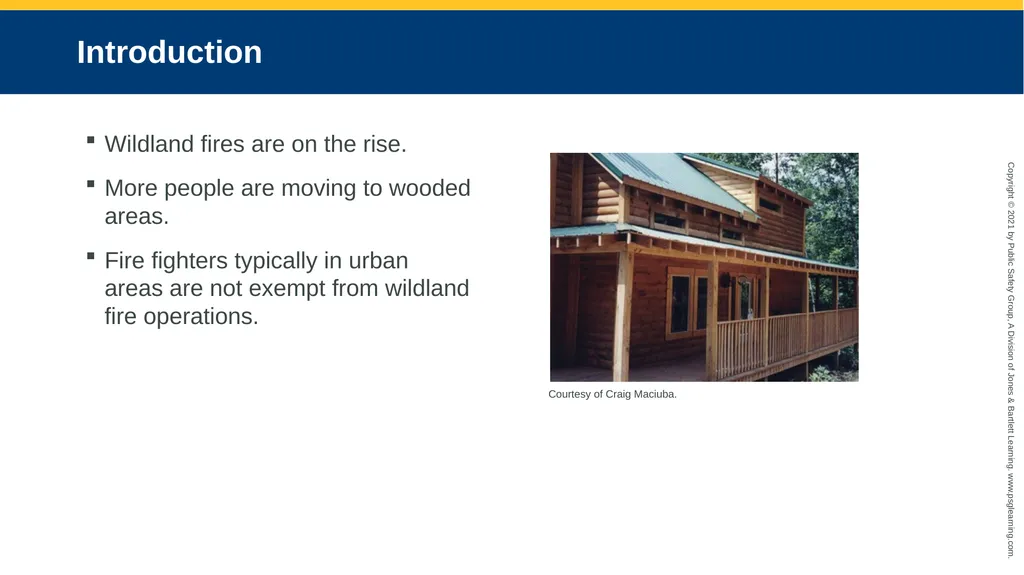
slide4. Introduction Wildland fires are on the rise.
More people are moving to wooded areas.
Fire fighters typically in urban areas are not exempt from wildland fire operations. Courtesy of Craig Maciuba.<br>
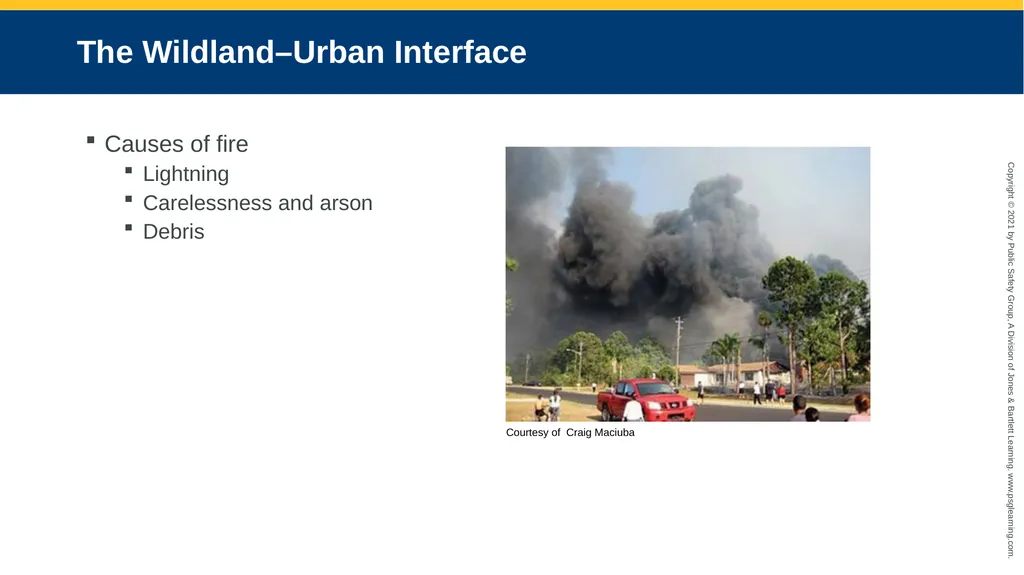
slide5. The Wildland–Urban Interface Causes of fire
Lightning
Carelessness and arson
Debris Courtesy of Craig Maciuba<br>
slide6. The Wildland–Urban Interface Rate and intensity
Fire spread affected by:
Types of fuel burning
Slope or aspect
Weather conditions
Fire intensity
Describes how hot a fire is burning<br>
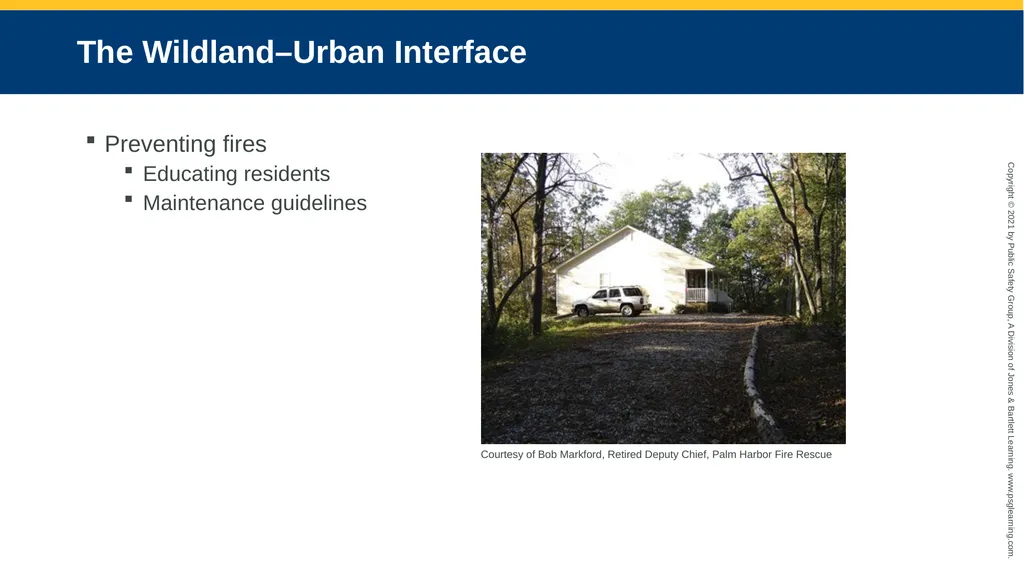
slide7. The Wildland–Urban Interface Preventing fires
Educating residents
Maintenance guidelines Courtesy of Bob Markford, Retired Deputy Chief, Palm Harbor Fire Rescue<br>
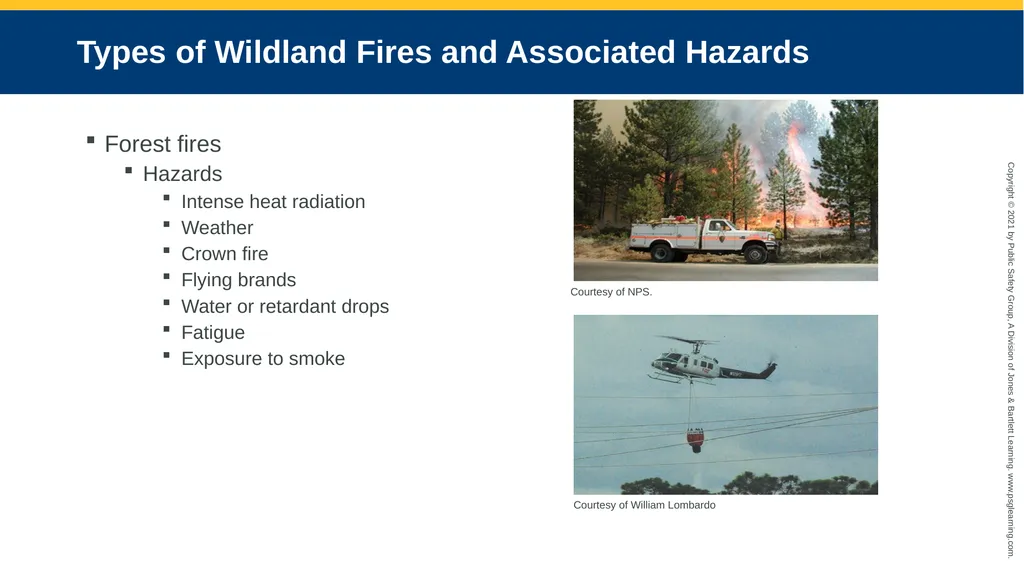
slide8. Types of Wildland Fires and Associated Hazards Forest fires
Hazards
Intense heat radiation
Weather
Crown fire
Flying brands
Water or retardant drops
Fatigue
Exposure to smoke Courtesy of NPS. Courtesy of William Lombardo<br>
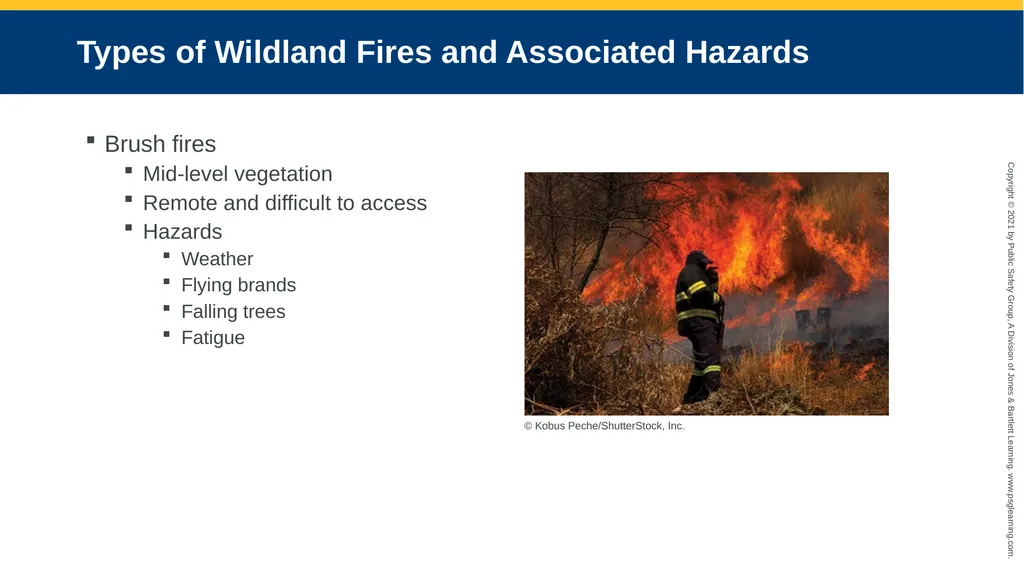
slide9. Types of Wildland Fires and Associated Hazards Brush fires
Mid-level vegetation
Remote and difficult to access
Hazards
Weather
Flying brands
Falling trees
Fatigue © Kobus Peche/ShutterStock, Inc.<br>
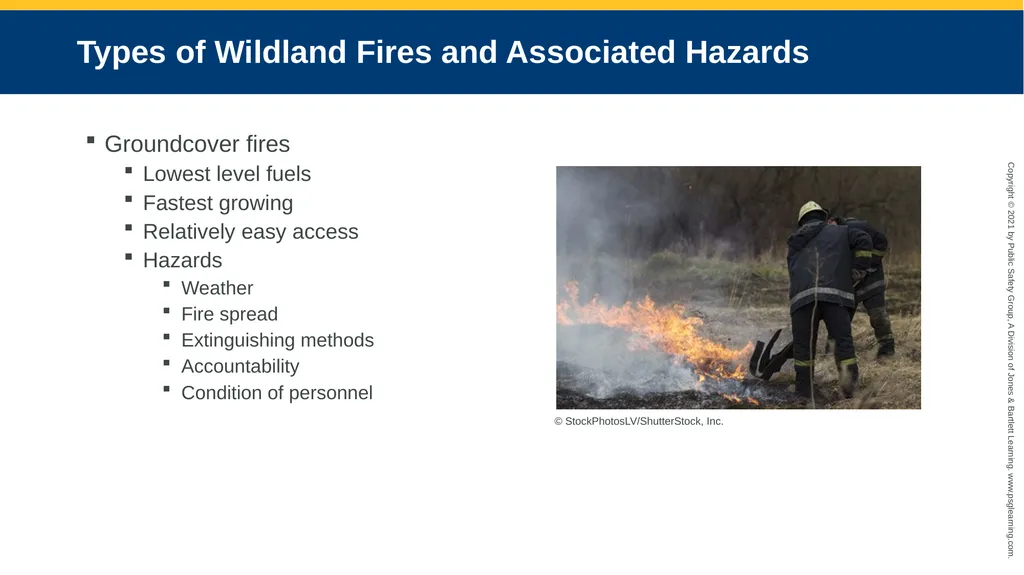
slide10. Types of Wildland Fires and Associated Hazards Groundcover fires
Lowest level fuels
Fastest growing
Relatively easy access
Hazards
Weather
Fire spread
Extinguishing methods
Accountability
Condition of personnel © StockPhotosLV/ShutterStock, Inc.<br>
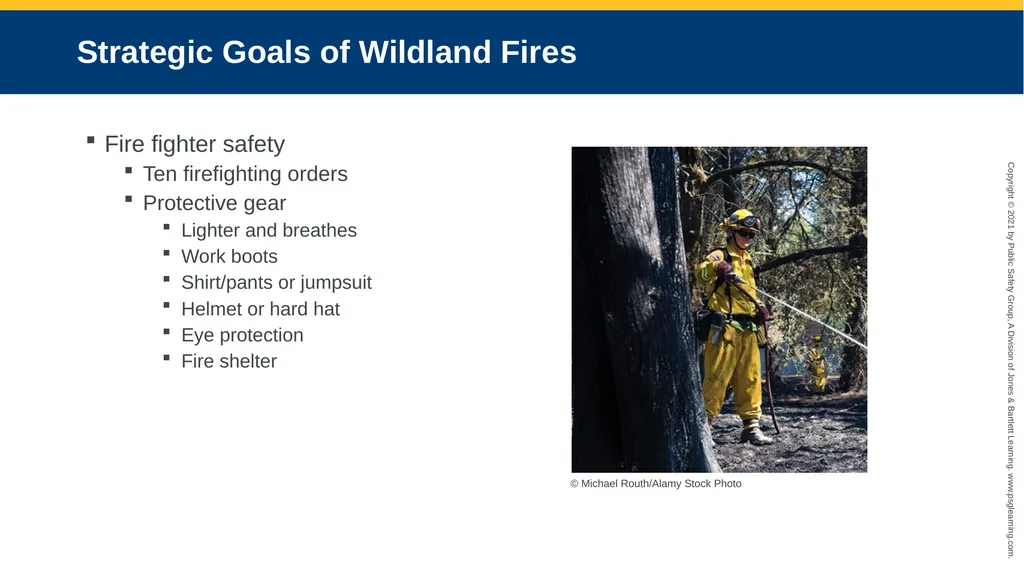
slide11. Strategic Goals of Wildland Fires Fire fighter safety
Ten firefighting orders
Protective gear
Lighter and breathes
Work boots
Shirt/pants or jumpsuit
Helmet or hard hat
Eye protection
Fire shelter © Michael Routh/Alamy Stock Photo<br>
slide12. Strategic Goals of Wildland Fires Search and rescue
Possible for homeowners who did not evacuate
Evacuation
Time-consuming and personnel-intensive
Determine:
Who will conduct the evacuation
Where to send and house the evacuees
When to order the evacuation<br>
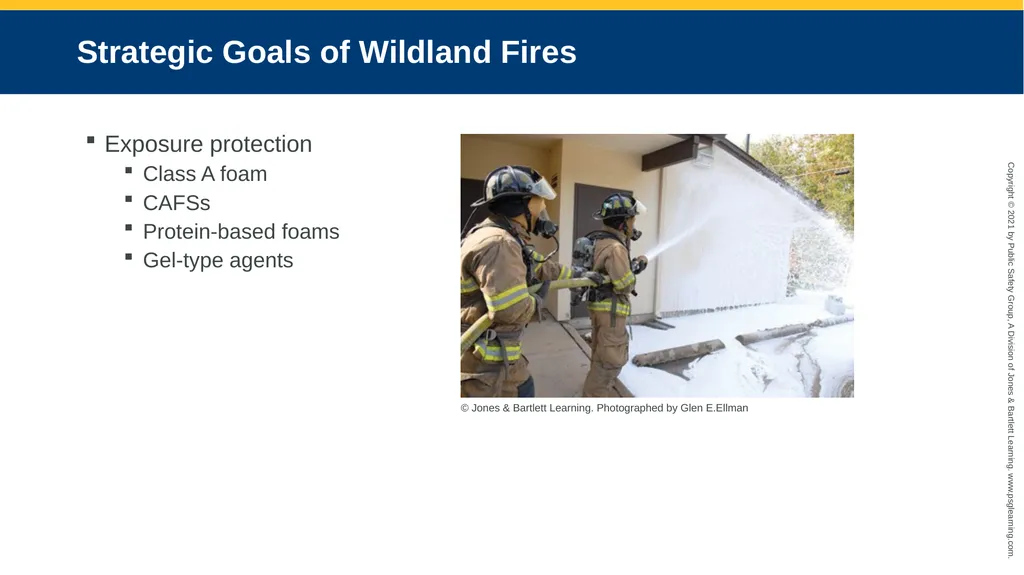
slide13. Strategic Goals of Wildland Fires Exposure protection
Class A foam
CAFSs
Protein-based foams
Gel-type agents © Jones & Bartlett Learning. Photographed by Glen E.Ellman<br>
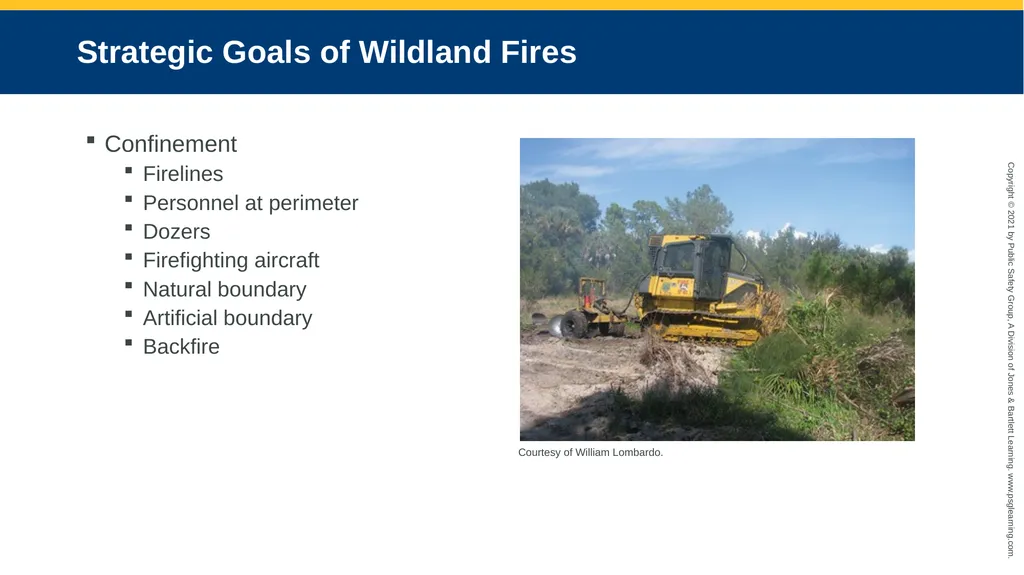
slide14. Strategic Goals of Wildland Fires Confinement
Firelines
Personnel at perimeter
Dozers
Firefighting aircraft
Natural boundary
Artificial boundary
Backfire Courtesy of William Lombardo.<br>
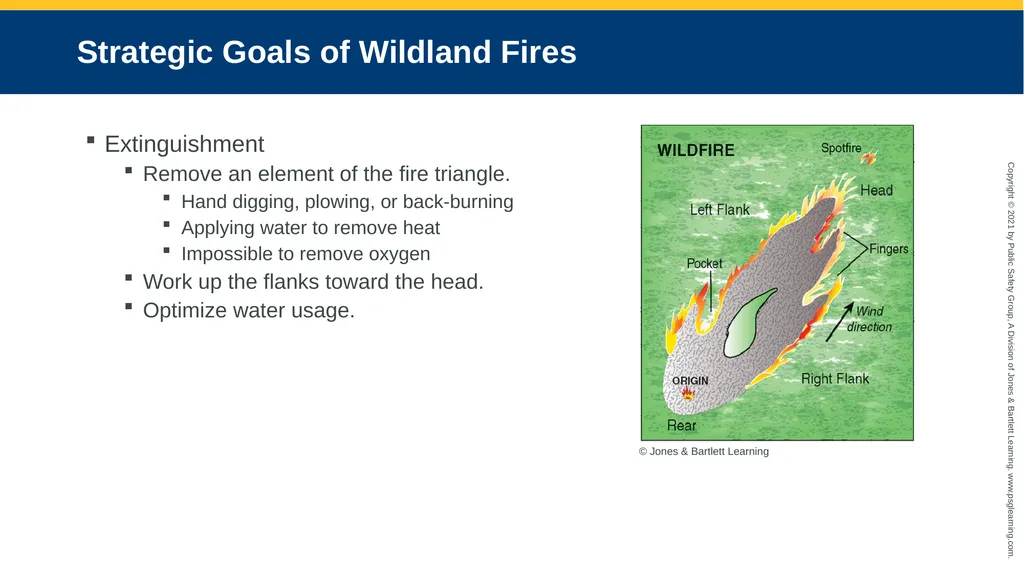
slide15. Strategic Goals of Wildland Fires Extinguishment
Remove an element of the fire triangle.
Hand digging, plowing, or back-burning
Applying water to remove heat
Impossible to remove oxygen
Work up the flanks toward the head.
Optimize water usage. © Jones & Bartlett Learning<br>
slide16. Strategic Goals of Wildland Fires Overhaul
Termed mop up
Conduct a thorough overhaul.
Entire perimeter
Hot spots
Overhauling by hand
Hand tools<br>
slide17. Strategic Goals of Wildland Fires Salvage
May be needed in structures
Burned down: few salvageable items
Threatened by fire<br>
slide18. Tactical Objectives Specific to Wildland Fires Overview
Primary concern is fire fighter safety.
Secondary is providing for the greatest good.
Local resources
What areas can be defended
What areas cannot be defended
Using SOGs
Safer and more organized operation<br>
slide19. Tactical Objectives Specific to Wildland Fires Defending multiple structures
Many variables
Escape route
Water supply
Spot fires
Construction material
Roof involvement
Interior involvement
Hazardous materials<br>
slide20. Tactical Objectives Specific to Wildland Fires Implementing safeguards
Fire fighters and their apparatus
Safety zones
Ingress and egress route
Structure location
Exterior finish of the structure
Fuel conditions and other hazards
Available water source<br>
slide21. Summary The threat and number of wildland fires continue to rise because people are drawn to forested areas.
A wildland–urban interface has developed due to the influx of people and building development in these areas.
Lightning is the primary cause of wildland fires; however, incidents caused by human carelessness and arson are on the rise.<br>
slide22. Summary Wildland fires are affected by the rate of fire spread (how quickly the fire moves) and fire intensity (how hot a fire is burning).
Educating residents in the wildland–urban interface on the causes of wildland fires can help reduce the occurrences of wildland fire incidents.<br>
slide23. Summary There are three basic types of wildland fires: forest fires, brush fires, and groundcover fires.
Forest fires occur in heavily forested, high-level vegetation areas. They produce the greatest amount of heat.
Brush fires occur in mid-level vegetation areas that are not as heavily wooded as the high-level vegetation areas.<br>
slide24. Summary Groundcover fires primarily involve fuels at the lowest levels. They are the fastest moving fire, but they produce the least amount of heat.
Many of the strategic goals applicable to structure fires are also applicable to wildland fires. However, the characteristics of wildland fires must be taken into account.<br>
slide25. Summary Fire fighter safety in wildland fires is paramount. There are 10 firefighting orders that can positively impact fire fighter safety at wildland fires.
A Risk/Benefit analysis must be conducted by the IC at all wildfires.
For the most part, search and rescue efforts are not a major concern in wildland fires. There are instances where this operation is required, but usually the people have already evacuated the area.<br>
slide26. Summary Evacuation efforts are a huge undertaking at wildland fires. Many factors need to be considered, including where to send evacuees, where to set up shelter, which agencies need to be involved in the effort, and who conducts the evacuation.<br>
slide27. Summary Exposure protection can involve nearly anything from protecting unburned areas from fire spread to protecting neighboring structures.
Typically the goal of wildland fire containment is to confine the fire to the area of the origin, which can be as small as a few hundred square feet or as large as a few thousand acres.<br>
slide28. Summary Extinguishing wildland fires is dirty, backbreaking work. Strategies depend on the types of fuel, the weather, and the personnel and resources available.
Overhaul is very important. You do not want to leave behind any potential remnants of smoldering fire, as it can rekindle, especially in very dry and windy conditions.<br>
slide29. Summary Salvage is usually not a major concern. Usually very few threatened structures are saved. Fire fighters may protect homes that stand a chance of enduring the fire, and usually the residents removed any valuable items before evacuating.
When applying wildland firefighting tactics, fire fighter safety comes first and providing for the greatest good comes second.<br>
slide30. Summary Wildland fires are generally fought in the same manner: find it, contain it, and extinguish it.
General tactics employed when fighting wildland fires include utilizing SOGs, determining which structures can be saved, and implementing safeguards for fire fighters and wildland firefighting equipment.<br>
slide2. Objectives Describe what is considered to be a wildland–urban interface area.
Discuss the three basic types of wildland fires and the hazards associated with each.<br>
slide3. Objectives Discuss the strategic goals specific to wildland fires.
Discuss the tactical objectives specific to wildland fires.<br>
slide4. Introduction Wildland fires are on the rise.
More people are moving to wooded areas.
Fire fighters typically in urban areas are not exempt from wildland fire operations. Courtesy of Craig Maciuba.<br>
slide5. The Wildland–Urban Interface Causes of fire
Lightning
Carelessness and arson
Debris Courtesy of Craig Maciuba<br>
slide6. The Wildland–Urban Interface Rate and intensity
Fire spread affected by:
Types of fuel burning
Slope or aspect
Weather conditions
Fire intensity
Describes how hot a fire is burning<br>
slide7. The Wildland–Urban Interface Preventing fires
Educating residents
Maintenance guidelines Courtesy of Bob Markford, Retired Deputy Chief, Palm Harbor Fire Rescue<br>
slide8. Types of Wildland Fires and Associated Hazards Forest fires
Hazards
Intense heat radiation
Weather
Crown fire
Flying brands
Water or retardant drops
Fatigue
Exposure to smoke Courtesy of NPS. Courtesy of William Lombardo<br>
slide9. Types of Wildland Fires and Associated Hazards Brush fires
Mid-level vegetation
Remote and difficult to access
Hazards
Weather
Flying brands
Falling trees
Fatigue © Kobus Peche/ShutterStock, Inc.<br>
slide10. Types of Wildland Fires and Associated Hazards Groundcover fires
Lowest level fuels
Fastest growing
Relatively easy access
Hazards
Weather
Fire spread
Extinguishing methods
Accountability
Condition of personnel © StockPhotosLV/ShutterStock, Inc.<br>
slide11. Strategic Goals of Wildland Fires Fire fighter safety
Ten firefighting orders
Protective gear
Lighter and breathes
Work boots
Shirt/pants or jumpsuit
Helmet or hard hat
Eye protection
Fire shelter © Michael Routh/Alamy Stock Photo<br>
slide12. Strategic Goals of Wildland Fires Search and rescue
Possible for homeowners who did not evacuate
Evacuation
Time-consuming and personnel-intensive
Determine:
Who will conduct the evacuation
Where to send and house the evacuees
When to order the evacuation<br>
slide13. Strategic Goals of Wildland Fires Exposure protection
Class A foam
CAFSs
Protein-based foams
Gel-type agents © Jones & Bartlett Learning. Photographed by Glen E.Ellman<br>
slide14. Strategic Goals of Wildland Fires Confinement
Firelines
Personnel at perimeter
Dozers
Firefighting aircraft
Natural boundary
Artificial boundary
Backfire Courtesy of William Lombardo.<br>
slide15. Strategic Goals of Wildland Fires Extinguishment
Remove an element of the fire triangle.
Hand digging, plowing, or back-burning
Applying water to remove heat
Impossible to remove oxygen
Work up the flanks toward the head.
Optimize water usage. © Jones & Bartlett Learning<br>
slide16. Strategic Goals of Wildland Fires Overhaul
Termed mop up
Conduct a thorough overhaul.
Entire perimeter
Hot spots
Overhauling by hand
Hand tools<br>
slide17. Strategic Goals of Wildland Fires Salvage
May be needed in structures
Burned down: few salvageable items
Threatened by fire<br>
slide18. Tactical Objectives Specific to Wildland Fires Overview
Primary concern is fire fighter safety.
Secondary is providing for the greatest good.
Local resources
What areas can be defended
What areas cannot be defended
Using SOGs
Safer and more organized operation<br>
slide19. Tactical Objectives Specific to Wildland Fires Defending multiple structures
Many variables
Escape route
Water supply
Spot fires
Construction material
Roof involvement
Interior involvement
Hazardous materials<br>
slide20. Tactical Objectives Specific to Wildland Fires Implementing safeguards
Fire fighters and their apparatus
Safety zones
Ingress and egress route
Structure location
Exterior finish of the structure
Fuel conditions and other hazards
Available water source<br>
slide21. Summary The threat and number of wildland fires continue to rise because people are drawn to forested areas.
A wildland–urban interface has developed due to the influx of people and building development in these areas.
Lightning is the primary cause of wildland fires; however, incidents caused by human carelessness and arson are on the rise.<br>
slide22. Summary Wildland fires are affected by the rate of fire spread (how quickly the fire moves) and fire intensity (how hot a fire is burning).
Educating residents in the wildland–urban interface on the causes of wildland fires can help reduce the occurrences of wildland fire incidents.<br>
slide23. Summary There are three basic types of wildland fires: forest fires, brush fires, and groundcover fires.
Forest fires occur in heavily forested, high-level vegetation areas. They produce the greatest amount of heat.
Brush fires occur in mid-level vegetation areas that are not as heavily wooded as the high-level vegetation areas.<br>
slide24. Summary Groundcover fires primarily involve fuels at the lowest levels. They are the fastest moving fire, but they produce the least amount of heat.
Many of the strategic goals applicable to structure fires are also applicable to wildland fires. However, the characteristics of wildland fires must be taken into account.<br>
slide25. Summary Fire fighter safety in wildland fires is paramount. There are 10 firefighting orders that can positively impact fire fighter safety at wildland fires.
A Risk/Benefit analysis must be conducted by the IC at all wildfires.
For the most part, search and rescue efforts are not a major concern in wildland fires. There are instances where this operation is required, but usually the people have already evacuated the area.<br>
slide26. Summary Evacuation efforts are a huge undertaking at wildland fires. Many factors need to be considered, including where to send evacuees, where to set up shelter, which agencies need to be involved in the effort, and who conducts the evacuation.<br>
slide27. Summary Exposure protection can involve nearly anything from protecting unburned areas from fire spread to protecting neighboring structures.
Typically the goal of wildland fire containment is to confine the fire to the area of the origin, which can be as small as a few hundred square feet or as large as a few thousand acres.<br>
slide28. Summary Extinguishing wildland fires is dirty, backbreaking work. Strategies depend on the types of fuel, the weather, and the personnel and resources available.
Overhaul is very important. You do not want to leave behind any potential remnants of smoldering fire, as it can rekindle, especially in very dry and windy conditions.<br>
slide29. Summary Salvage is usually not a major concern. Usually very few threatened structures are saved. Fire fighters may protect homes that stand a chance of enduring the fire, and usually the residents removed any valuable items before evacuating.
When applying wildland firefighting tactics, fire fighter safety comes first and providing for the greatest good comes second.<br>
slide30. Summary Wildland fires are generally fought in the same manner: find it, contain it, and extinguish it.
General tactics employed when fighting wildland fires include utilizing SOGs, determining which structures can be saved, and implementing safeguards for fire fighters and wildland firefighting equipment.<br>