
Chapter 2: Driver Attributes, Training, and
DP
Published · 97 slides · 0 views
1 / 1


Description
Chapter 2: Driver Attributes, Training, and Selection Knowledge Objectives Describe the role that the driveroperator is involved in when promoting safety, educating crew members, and promoting team building. Describe the driveroperators
Related Topics
Share
Embed code
Download this presentation From Below
"Chapter 2: Driver Attributes, Training, and" is the property of its rightful owner. Permission is granted to download and print the materials on this website for personal, non-commercial use only, and to display it on your personal computer provided you do not modify the materials and that you retain all copyright notices contained in the materials. By downloading content from our website, you accept the terms of this agreement.
Presentation Transcript
01
Chapter 2: Driver Attributes, Training, and Selection<br>
02
Knowledge Objectives Describe the role that the driver/operator is involved in when promoting safety, educating crew members, and promoting team building.
Describe the driver/operator’s responsibility in maintaining a safe work environment.
List the major causes of death and injury for fire fighters.
Describe the 16 Fire Fighter Life Safety Initiatives.<br>
Describe the driver/operator’s responsibility in maintaining a safe work environment.
List the major causes of death and injury for fire fighters.
Describe the 16 Fire Fighter Life Safety Initiatives.<br>
03
Knowledge Objectives Describe some of the organizations that set the regulations, standards, and procedures intended to ensure a safe working environment for the fire service.
Describe the connection between physical fitness and fire fighter safety.
Describe the components of a well-rounded physical fitness program.<br>
Describe the connection between physical fitness and fire fighter safety.
Describe the components of a well-rounded physical fitness program.<br>
04
Knowledge Objectives Explain the practices fire fighters should take to promote optimal physical and mental health and well-being.
Explain the role of a critical incident stress debriefing in preserving the mental well-being of fire fighters.
List signs and symptoms of behavioral and emotional distress.
Describe the purpose of an employee assistance program.<br>
Explain the role of a critical incident stress debriefing in preserving the mental well-being of fire fighters.
List signs and symptoms of behavioral and emotional distress.
Describe the purpose of an employee assistance program.<br>
05
Knowledge Objectives Describe the functions and limitations of the fire apparatus and its equipment.
Identify the general requirements of a driver/operator as stated in NFPA 1002.
Identify the medical and physical requirements of a driver/operator as stated in NFPA 1500.
Describe the driver training requirements as stated in NFPA 1451.
Describe the testing and selection process for a driver/operator.<br>
Identify the general requirements of a driver/operator as stated in NFPA 1002.
Identify the medical and physical requirements of a driver/operator as stated in NFPA 1500.
Describe the driver training requirements as stated in NFPA 1451.
Describe the testing and selection process for a driver/operator.<br>
06
Introduction Driver/operator has obligations to self, crew, and community served
Must understand and accept responsibilities of the job
Preventive maintenance, regular inspections of apparatus and equipment, and adherence to jurisdictional operating guidelines
Must acknowledge hazards associated with driving and operating apparatus<br>
Must understand and accept responsibilities of the job
Preventive maintenance, regular inspections of apparatus and equipment, and adherence to jurisdictional operating guidelines
Must acknowledge hazards associated with driving and operating apparatus<br>
07
Introduction Fire fighters are injured or killed every year as a result of accidents that occur while responding to and returning from emergency and nonemergency incidents.
The position of driver/operator itself is not hazardous.
It is the risks associated with driving and operations that are hazardous.
You must lead by example.<br>
The position of driver/operator itself is not hazardous.
It is the risks associated with driving and operations that are hazardous.
You must lead by example.<br>
08
Introduction When you complete regularly scheduled inspections, you instill confidence in other crew members.
The fireground situation then becomes much easier to manage.
Despite your best inspection and preventive maintenance efforts, situations may still arise in which the equipment fails.
more knowledge offers more options, and more options lead to better outcomes.<br>
The fireground situation then becomes much easier to manage.
Despite your best inspection and preventive maintenance efforts, situations may still arise in which the equipment fails.
more knowledge offers more options, and more options lead to better outcomes.<br>
09
Safety Is Everyone’s Responsibility Firefighting and other emergency responses are, by their very nature, dangerous.
Each individual must be aware of the risks learn safe methods of confronting them.
Every fire department must:
reduce the hazards and dangers of the job.
help prevent injuries, illnesses, and deaths.
have a strong commitment to health and safety.<br>
Each individual must be aware of the risks learn safe methods of confronting them.
Every fire department must:
reduce the hazards and dangers of the job.
help prevent injuries, illnesses, and deaths.
have a strong commitment to health and safety.<br>
10
Safety Is Everyone’s Responsibility When personnel understand the risks and threats, safety measures can become routine, consistent, and fully integrated into every activity, procedure, and job description.
Departments must review and revise their health and safety policies and procedures regularly.
Safety officers are responsible for evaluating the hazards of various situations and recommending appropriate safety measures to IC.<br>
Departments must review and revise their health and safety policies and procedures regularly.
Safety officers are responsible for evaluating the hazards of various situations and recommending appropriate safety measures to IC.<br>
11
Safety Is Everyone’s Responsibility Each accident, injury, or near miss must be thoroughly investigated to learn why it happened and how it can be avoided.
Postincident reviews and research can identify new hazards and appropriate safety measures.
Reports from other fire departments can help identify common problems and lead to the development of effective preventive actions.<br>
Postincident reviews and research can identify new hazards and appropriate safety measures.
Reports from other fire departments can help identify common problems and lead to the development of effective preventive actions.<br>
12
Safety Is Everyone’s Responsibility Preparations for the response begin long before the alarm sounds:
physical and mental readiness
checking personal equipment
readying the fire apparatus
checking all equipment carried on the apparatus
being familiar with their response district
knowing the buildings under their protection
understanding department SOPs<br>
physical and mental readiness
checking personal equipment
readying the fire apparatus
checking all equipment carried on the apparatus
being familiar with their response district
knowing the buildings under their protection
understanding department SOPs<br>
13
Safety Is Everyone’s Responsibility Response actions for the apparatus driver/operator also include:
considering road and traffic conditions
determining the best route to the incident
identifying nearby hydrant locations or water sources
selecting the best position for the apparatus at the incident scene<br>
considering road and traffic conditions
determining the best route to the incident
identifying nearby hydrant locations or water sources
selecting the best position for the apparatus at the incident scene<br>
14
The Many Roles of the Driver/Operator The driver/operator is a crew member and safety advocate.
Fix components that are broken.
Support crew on emergency scene.
Build crew confidence and efficiency.
Follow laws/regulations/guidelines.
Create and maintain a safe work environment.
Follow sound risk management principles.<br>
Fix components that are broken.
Support crew on emergency scene.
Build crew confidence and efficiency.
Follow laws/regulations/guidelines.
Create and maintain a safe work environment.
Follow sound risk management principles.<br>
15
Promoting Safety Safety is always first priority.
Getting to the incident is important to the operation, but consider the events that occurred prior to your response.
Recognize the associated hazards.
Take measures to reduce or eliminate these hazards.
SOPs/SOGs maintain work-safe environments.<br>
Getting to the incident is important to the operation, but consider the events that occurred prior to your response.
Recognize the associated hazards.
Take measures to reduce or eliminate these hazards.
SOPs/SOGs maintain work-safe environments.<br>
16
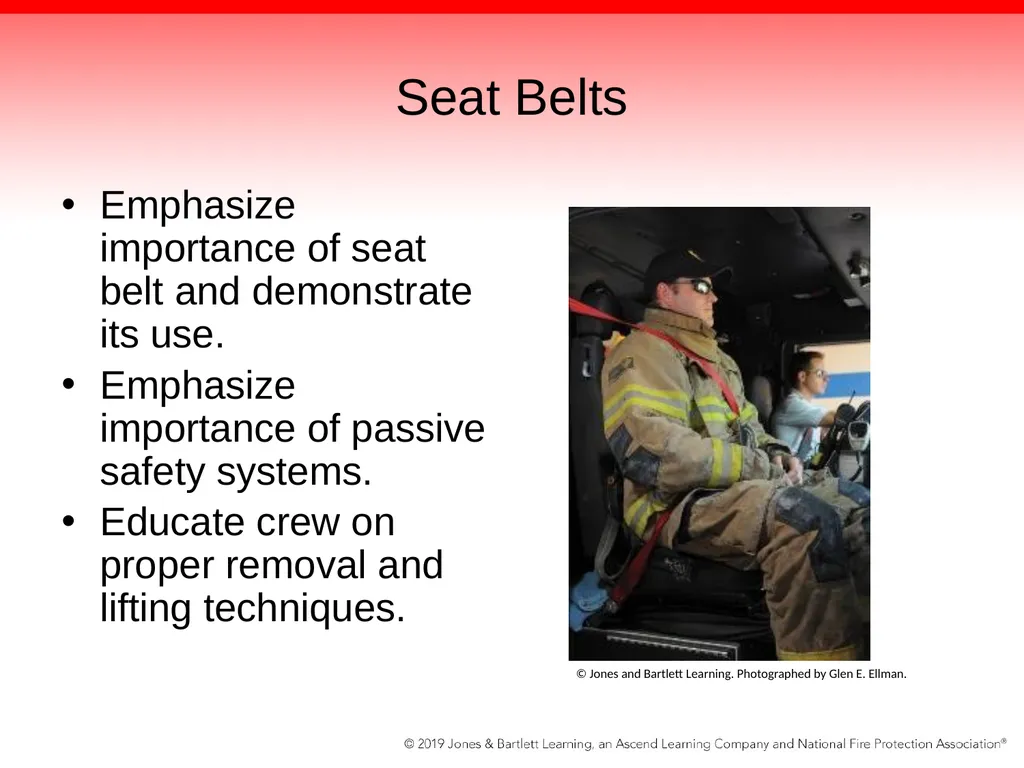
Seat Belts Emphasize importance of seat belt and demonstrate its use.
Emphasize importance of passive safety systems.
Educate crew on proper removal and lifting techniques. © Jones and Bartlett Learning. Photographed by Glen E. Ellman.<br>
Emphasize importance of passive safety systems.
Educate crew on proper removal and lifting techniques. © Jones and Bartlett Learning. Photographed by Glen E. Ellman.<br>
17
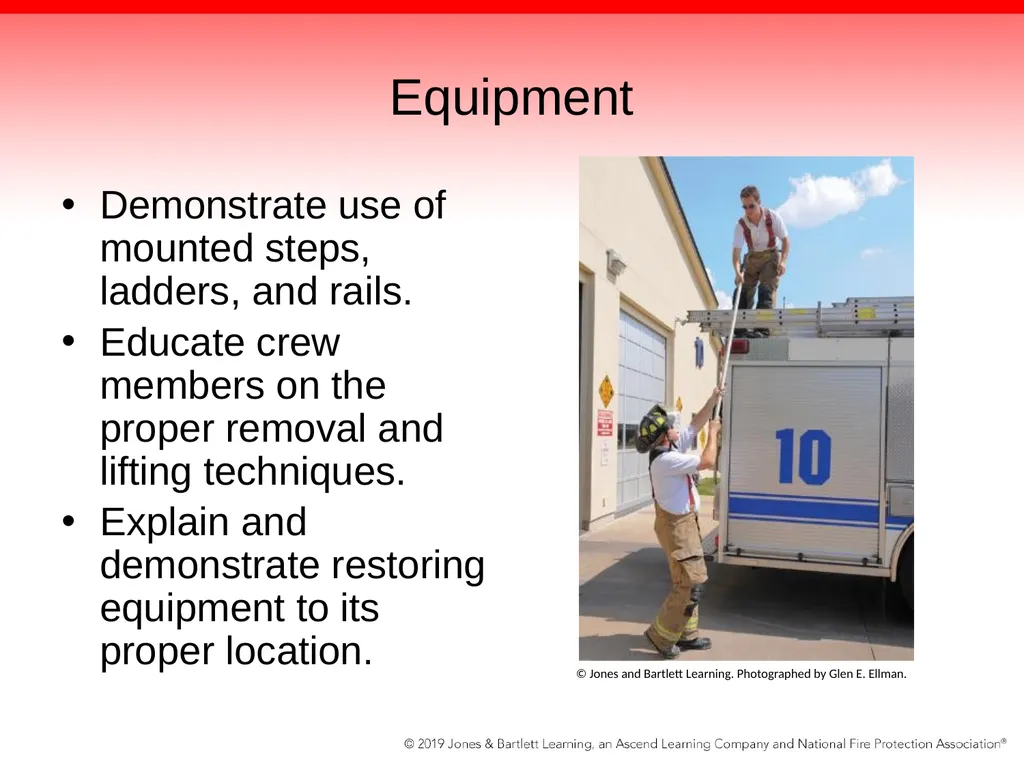
Equipment Demonstrate use of mounted steps, ladders, and rails.
Educate crew members on the proper removal and lifting techniques.
Explain and demonstrate restoring equipment to its proper location. © Jones and Bartlett Learning. Photographed by Glen E. Ellman.<br>
Educate crew members on the proper removal and lifting techniques.
Explain and demonstrate restoring equipment to its proper location. © Jones and Bartlett Learning. Photographed by Glen E. Ellman.<br>
18
Educating Crew Members Knowing the “why” makes the “how” come easy.
Knowing which information to present is the key to ensuring an effective and safe response
Address rider positioning with crew members:
Blocking the view
Riding assignments
Communication<br>
Knowing which information to present is the key to ensuring an effective and safe response
Address rider positioning with crew members:
Blocking the view
Riding assignments
Communication<br>
19
Educating Crew Members The various distractions that hinder effective communications
Sirens, engine noise, equipment noise, radio traffic
SOPs regarding emergency communications
In many cases, fire departments rely on apparatus’ air horns to signal an emergency evacuation.
Paying attention to tactical benchmarks will keep you ready to initiate life-preserving actions.<br>
Sirens, engine noise, equipment noise, radio traffic
SOPs regarding emergency communications
In many cases, fire departments rely on apparatus’ air horns to signal an emergency evacuation.
Paying attention to tactical benchmarks will keep you ready to initiate life-preserving actions.<br>
20
Trust and Team Building The best way to impart knowledge of driver/operator roles and responsibilities is to educate the crew.
Show them how you operate the aerial device.
Team building begins with confidence and finishes with trust.<br>
Show them how you operate the aerial device.
Team building begins with confidence and finishes with trust.<br>
21
Trust and Team Building Crew members must believe in your ability as a driver/operator.
Trust is built through your communications and your actions.
Building a solid team takes time and patience.
All members of the crew must be able to perform their assignments without reservation or hesitation<br>
Trust is built through your communications and your actions.
Building a solid team takes time and patience.
All members of the crew must be able to perform their assignments without reservation or hesitation<br>
22
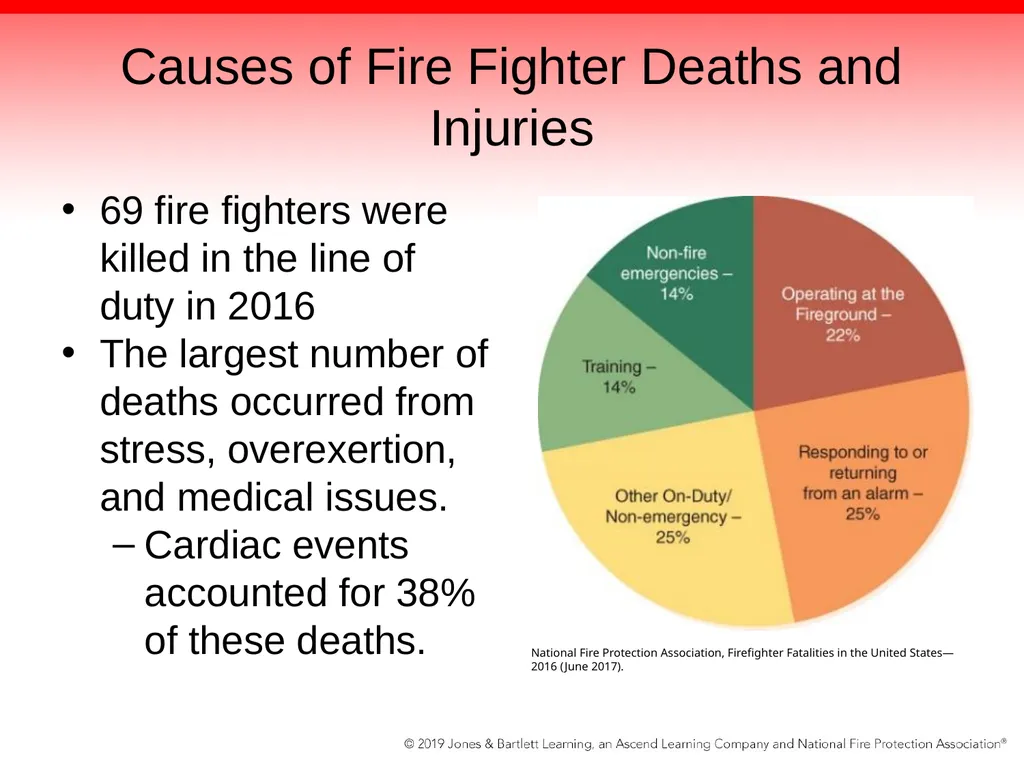
Causes of Fire Fighter Deaths and Injuries 69 fire fighters were killed in the line of duty in 2016
The largest number of deaths occurred from stress, overexertion, and medical issues.
Cardiac events accounted for 38% of these deaths. National Fire Protection Association, Firefighter Fatalities in the United States—2016 (June 2017).<br>
The largest number of deaths occurred from stress, overexertion, and medical issues.
Cardiac events accounted for 38% of these deaths. National Fire Protection Association, Firefighter Fatalities in the United States—2016 (June 2017).<br>
23
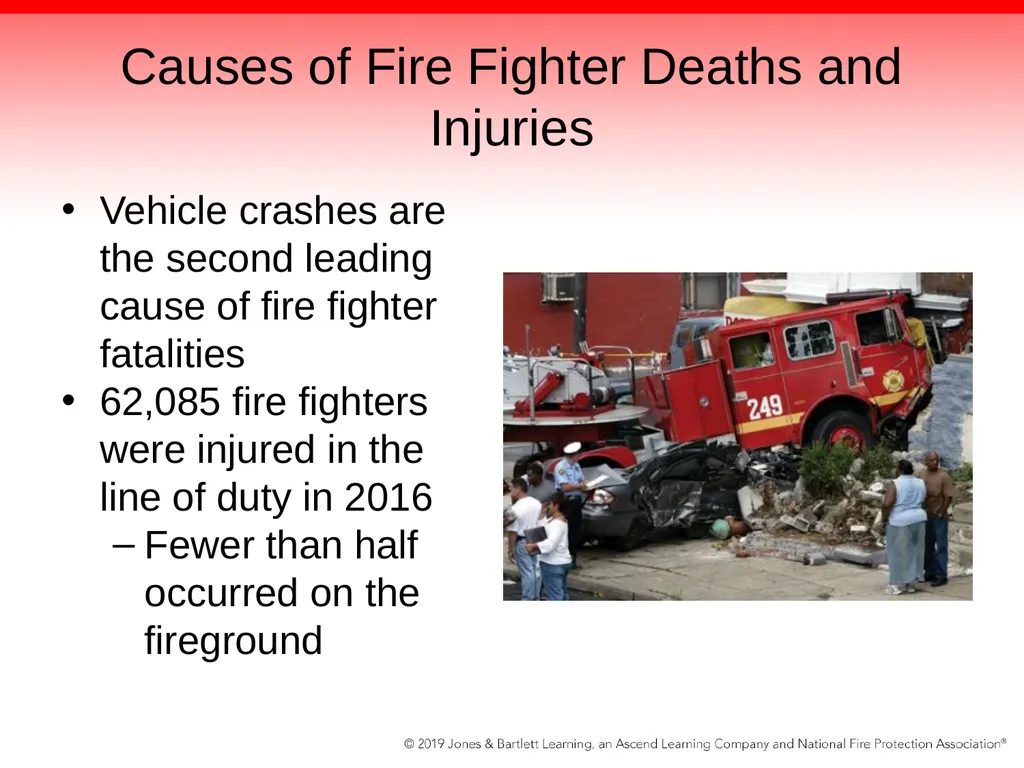
Causes of Fire Fighter Deaths and Injuries Vehicle crashes are the second leading cause of fire fighter fatalities
62,085 fire fighters were injured in the line of duty in 2016
Fewer than half occurred on the fireground<br>
62,085 fire fighters were injured in the line of duty in 2016
Fewer than half occurred on the fireground<br>
24
Reducing Fire Fighter Deaths and Injuries National Fallen Firefighters Foundation:
sponsors the annual National Fallen Firefighters Memorial Weekend.
offers support programs for family members and other survivors.
awards scholarships to fire service members’ survivors.
works to prevent line-of duty injuries and deaths.<br>
sponsors the annual National Fallen Firefighters Memorial Weekend.
offers support programs for family members and other survivors.
awards scholarships to fire service members’ survivors.
works to prevent line-of duty injuries and deaths.<br>
25
Reducing Fire Fighter Deaths and Injuries Most fire fighter injuries and deaths are preventable.
The Near-Miss Reporting System provides a method for reporting situations that could have resulted in injury or death.
The first National Firefighter Life Safety Summit convened in 2004
Everyone Goes Home Program
16 Firefighter Life Safety Initiatives<br>
The Near-Miss Reporting System provides a method for reporting situations that could have resulted in injury or death.
The first National Firefighter Life Safety Summit convened in 2004
Everyone Goes Home Program
16 Firefighter Life Safety Initiatives<br>
26
Reducing Fire Fighter Deaths and Injuries Reducing injuries and deaths requires the dedicated efforts of every fire fighter, department, and community working together.
Also requires a safety program that integrates:
Regulations
Standards
Procedures
Personnel
Training
Equipment<br>
Also requires a safety program that integrates:
Regulations
Standards
Procedures
Personnel
Training
Equipment<br>
27
Regulations, Standards, and Procedures Safety is the highest priority.
Various regulations, standards, and procedures aim to ensure a safe working environment.<br>
Various regulations, standards, and procedures aim to ensure a safe working environment.<br>
28
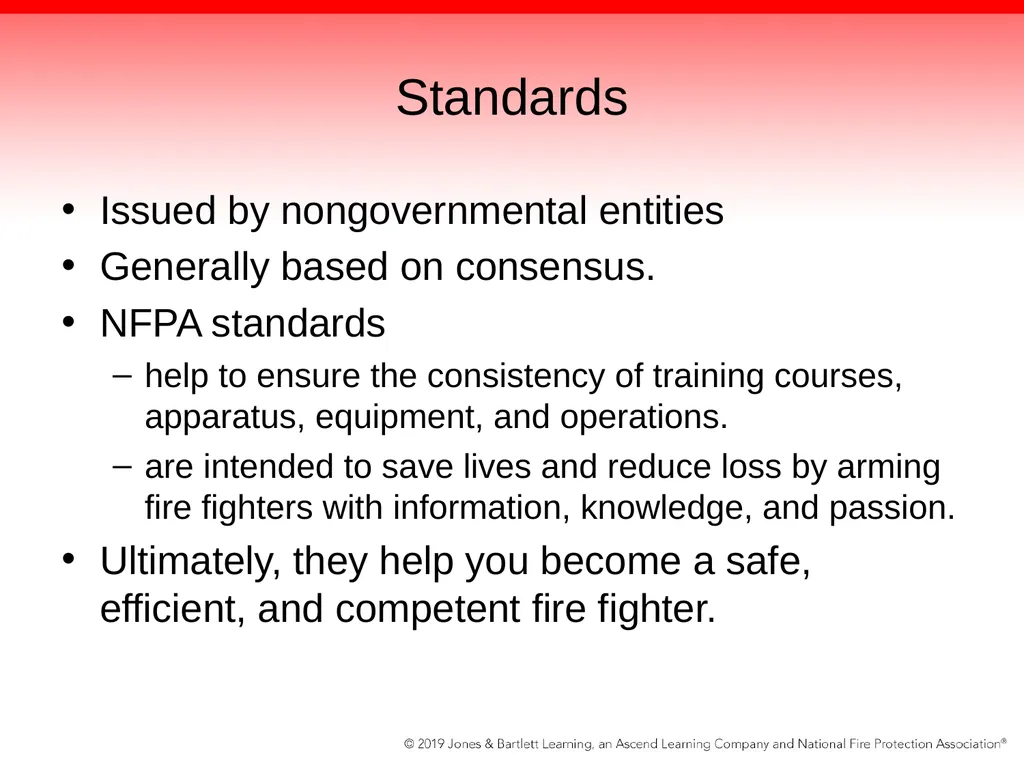
Standards Issued by nongovernmental entities
Generally based on consensus.
NFPA standards
help to ensure the consistency of training courses, apparatus, equipment, and operations.
are intended to save lives and reduce loss by arming fire fighters with information, knowledge, and passion.
Ultimately, they help you become a safe, efficient, and competent fire fighter.<br>
Generally based on consensus.
NFPA standards
help to ensure the consistency of training courses, apparatus, equipment, and operations.
are intended to save lives and reduce loss by arming fire fighters with information, knowledge, and passion.
Ultimately, they help you become a safe, efficient, and competent fire fighter.<br>
29
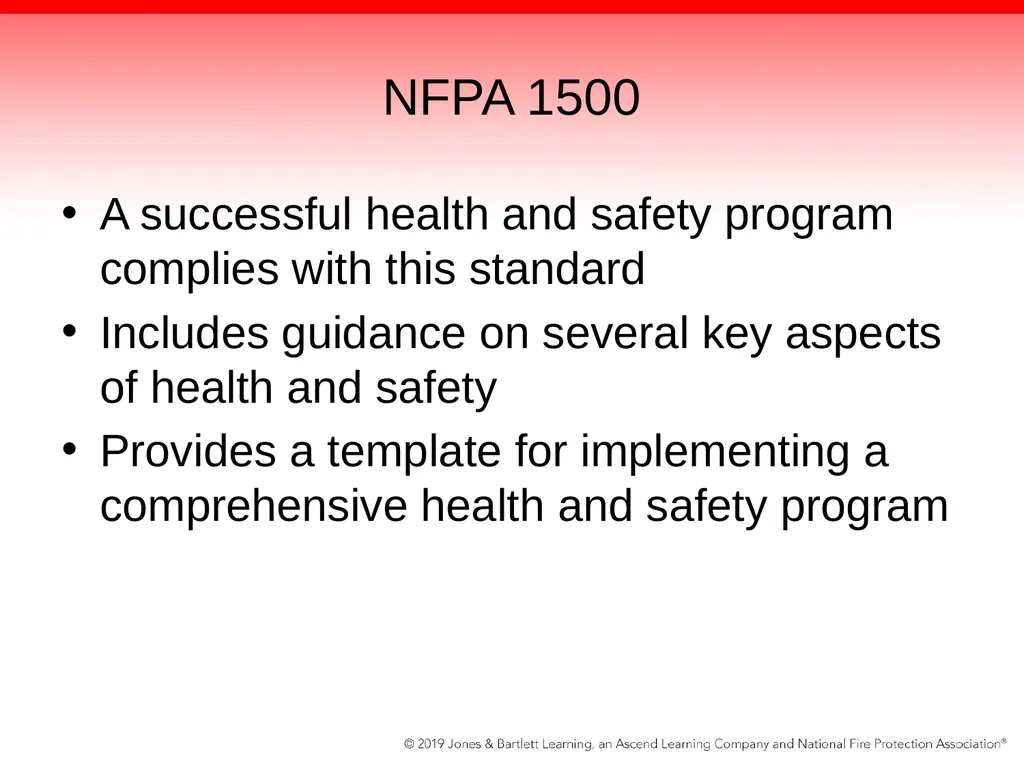
NFPA 1500 A successful health and safety program complies with this standard
Includes guidance on several key aspects of health and safety
Provides a template for implementing a comprehensive health and safety program<br>
Includes guidance on several key aspects of health and safety
Provides a template for implementing a comprehensive health and safety program<br>
30
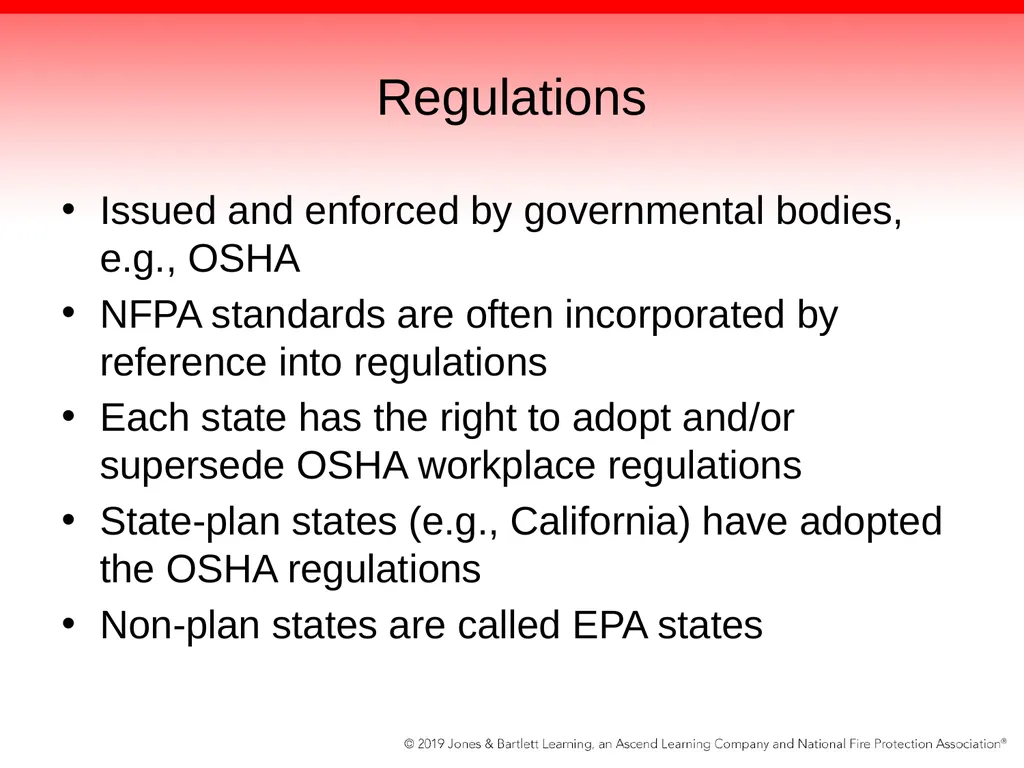
Regulations Issued and enforced by governmental bodies, e.g., OSHA
NFPA standards are often incorporated by reference into regulations
Each state has the right to adopt and/or supersede OSHA workplace regulations
State-plan states (e.g., California) have adopted the OSHA regulations
Non-plan states are called EPA states<br>
NFPA standards are often incorporated by reference into regulations
Each state has the right to adopt and/or supersede OSHA workplace regulations
State-plan states (e.g., California) have adopted the OSHA regulations
Non-plan states are called EPA states<br>
31
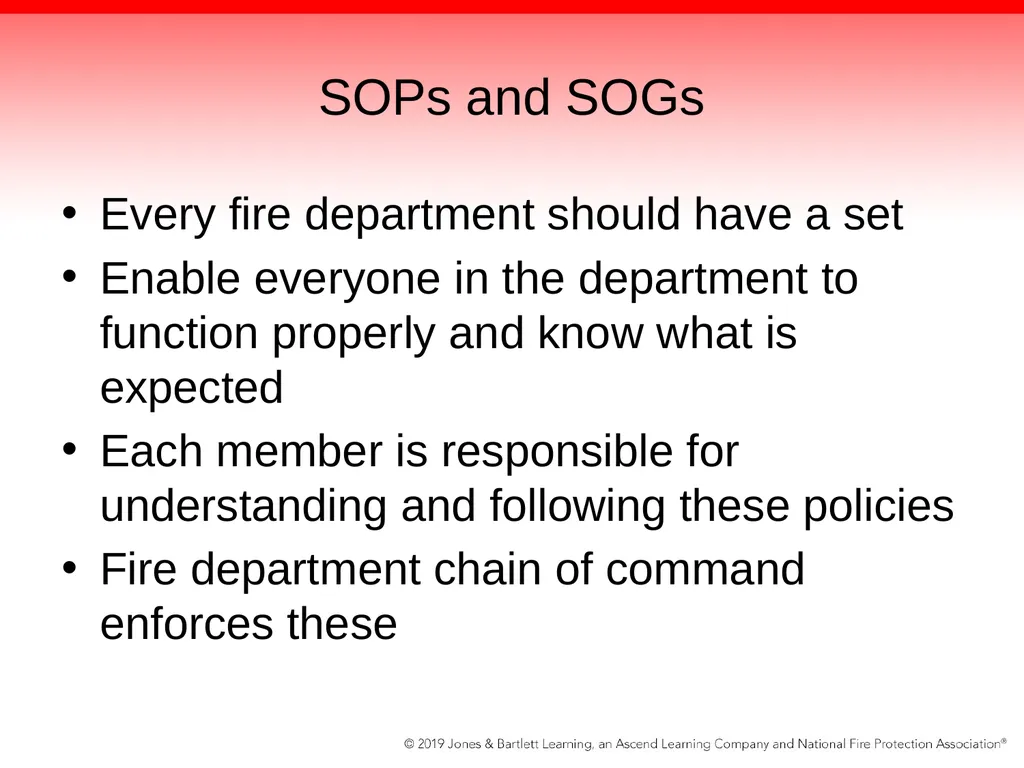
SOPs and SOGs Every fire department should have a set
Enable everyone in the department to function properly and know what is expected
Each member is responsible for understanding and following these policies
Fire department chain of command enforces these<br>
Enable everyone in the department to function properly and know what is expected
Each member is responsible for understanding and following these policies
Fire department chain of command enforces these<br>
32
Health and Safety Committee Responsible for establishing policies and monitoring fire fighter safety
Members should include representatives from every area, component, and level within the department
Health and safety officer and department physician should also be members<br>
Members should include representatives from every area, component, and level within the department
Health and safety officer and department physician should also be members<br>
33
Personnel Safety officers:
Observe operations and conditions
Evaluate risks
Work with the IC to identify hazards and ensure personnel safety
Determine when fire fighters can doff their SCBA
Teamwork is an essential element of safe emergency operations.
Freelancing has no place on the fireground.<br>
Observe operations and conditions
Evaluate risks
Work with the IC to identify hazards and ensure personnel safety
Determine when fire fighters can doff their SCBA
Teamwork is an essential element of safe emergency operations.
Freelancing has no place on the fireground.<br>
34
Training Essential for fire fighters’ safety.
Avoid sloppy practices or shortcuts that might contribute to injuries
Learn how to identify hazards and unsafe conditions
Training is just the beginning—all members must continually seek out additional courses to keep their skills current.<br>
Avoid sloppy practices or shortcuts that might contribute to injuries
Learn how to identify hazards and unsafe conditions
Training is just the beginning—all members must continually seek out additional courses to keep their skills current.<br>
35
Equipment You must know how to use equipment in the correct manner and then operate it safely at all times.
Poorly maintained equipment can create additional hazards to the user or fail to operate.
You must read and heed manufacturer warnings and instructions.
New equipment must meet applicable standards to ensure that it can perform.<br>
Poorly maintained equipment can create additional hazards to the user or fail to operate.
You must read and heed manufacturer warnings and instructions.
New equipment must meet applicable standards to ensure that it can perform.<br>
36
Personal Health and Well-Being Safety is directly related to health and fitness.
To be an effective driver/operator, you must:
exercise regularly
eat a healthy diet
get an adequate amount of sleep
avoid illnesses such as heart disease and cancer<br>
To be an effective driver/operator, you must:
exercise regularly
eat a healthy diet
get an adequate amount of sleep
avoid illnesses such as heart disease and cancer<br>
37
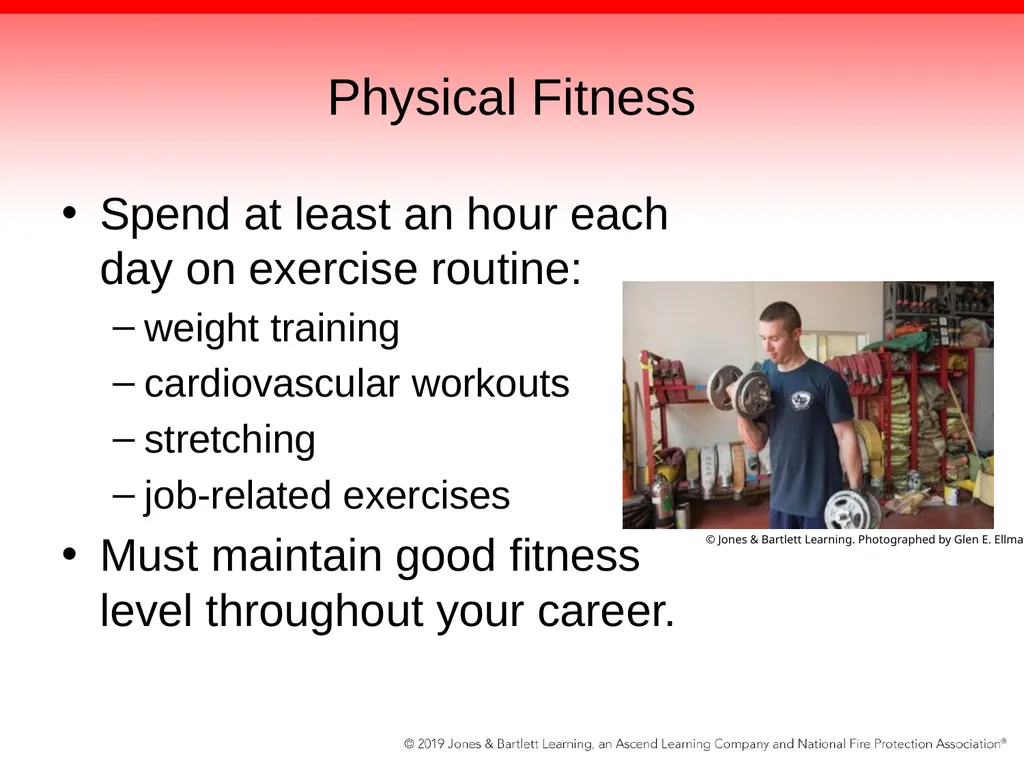
Physical Fitness Spend at least an hour each day on exercise routine:
weight training
cardiovascular workouts
stretching
job-related exercises
Must maintain good fitness level throughout your career. © Jones & Bartlett Learning. Photographed by Glen E. Ellman.<br>
weight training
cardiovascular workouts
stretching
job-related exercises
Must maintain good fitness level throughout your career. © Jones & Bartlett Learning. Photographed by Glen E. Ellman.<br>
38
Nutrition Healthy diet includes:
fruits
vegetables
healthy fats
whole grains
lean protein
Pay attention to portion sizes
Substitute healthy choices<br>
fruits
vegetables
healthy fats
whole grains
lean protein
Pay attention to portion sizes
Substitute healthy choices<br>
39
Hydration Guideline: consume 8 to 10 ounces of water for every 5 to 10 minutes of physical exertion.
Do not wait until you feel thirsty.
Fire personnel should drink up to a gallon of water each day to keep properly hydrated.
Enables muscles to work longer and reduces the risk of illness and injuries.
May reduce your chance of having a heart attack.<br>
Do not wait until you feel thirsty.
Fire personnel should drink up to a gallon of water each day to keep properly hydrated.
Enables muscles to work longer and reduces the risk of illness and injuries.
May reduce your chance of having a heart attack.<br>
40
Sleep Adequate, uninterrupted sleep helps to:
maintain alertness
prevent stress
avoid illnesses and injuries
Important to get get adequate amounts of uninterrupted sleep during your off-duty time.
Establish a consistent sleep schedule and sleep routine.<br>
maintain alertness
prevent stress
avoid illnesses and injuries
Important to get get adequate amounts of uninterrupted sleep during your off-duty time.
Establish a consistent sleep schedule and sleep routine.<br>
41
Heart Disease Leading cause of death among fire personnel
A healthy lifestyle that includes a balanced diet, weight training, and cardiovascular exercise can help reduce many risk factors for heart disease.
Research projects now under way seek to use advanced technology to improve health and safety in the fire service.<br>
A healthy lifestyle that includes a balanced diet, weight training, and cardiovascular exercise can help reduce many risk factors for heart disease.
Research projects now under way seek to use advanced technology to improve health and safety in the fire service.<br>
42
Cancer An increase in the use of synthetic products has led to an increase in the toxicity of today’s modern fires.
Cancer is the second leading cause of death among fire fighters
Can be caused by a wide variety of cancer-causing substances (carcinogens)<br>
Cancer is the second leading cause of death among fire fighters
Can be caused by a wide variety of cancer-causing substances (carcinogens)<br>
43
Cancer Carcinogens include:
exhaust from diesel engines
poisonous gases in smoke
wide variety of chemical particles
dirt and soot that become attached to a fire fighter’s turnout gear and uniform, hoods and gloves<br>
exhaust from diesel engines
poisonous gases in smoke
wide variety of chemical particles
dirt and soot that become attached to a fire fighter’s turnout gear and uniform, hoods and gloves<br>
44
Cancer Fire personnel are most likely to absorb carcinogens through their skin and through their respiratory systems.
Fire fighters have a 9 percent higher risk of cancer than the general population.
Mostly digestive, oral, respiratory and urinary cancers
Lung cancer > the amount of time spent at fires
Leukemia > the number of fire incidents to which fire fighters responded.<br>
Fire fighters have a 9 percent higher risk of cancer than the general population.
Mostly digestive, oral, respiratory and urinary cancers
Lung cancer > the amount of time spent at fires
Leukemia > the number of fire incidents to which fire fighters responded.<br>
45
Preventing Cancer Use SCBA from the initial attack to the end of overhaul.
Do gross field decontamination of PPE
Use Wet-Naps or baby wipes to remove as much soot as possible from head, neck, jaw, throat, underarms, and hands immediately and while still on the scene.
Change your clothes and wash them immediately after a fire.
Shower thoroughly after a fire.<br>
Do gross field decontamination of PPE
Use Wet-Naps or baby wipes to remove as much soot as possible from head, neck, jaw, throat, underarms, and hands immediately and while still on the scene.
Change your clothes and wash them immediately after a fire.
Shower thoroughly after a fire.<br>
46
Preventing Cancer Clean your PPE, gloves, hood, and helmet immediately after a fire.
Do not take contaminated clothes or PPE home or store it in your vehicle.
Decontaminate the interior of the fire apparatus after fires.
Keep bunker gear out of living and sleeping quarters.
Stop using tobacco products.
Use sunscreen or sunblock.<br>
Do not take contaminated clothes or PPE home or store it in your vehicle.
Decontaminate the interior of the fire apparatus after fires.
Keep bunker gear out of living and sleeping quarters.
Stop using tobacco products.
Use sunscreen or sunblock.<br>
47
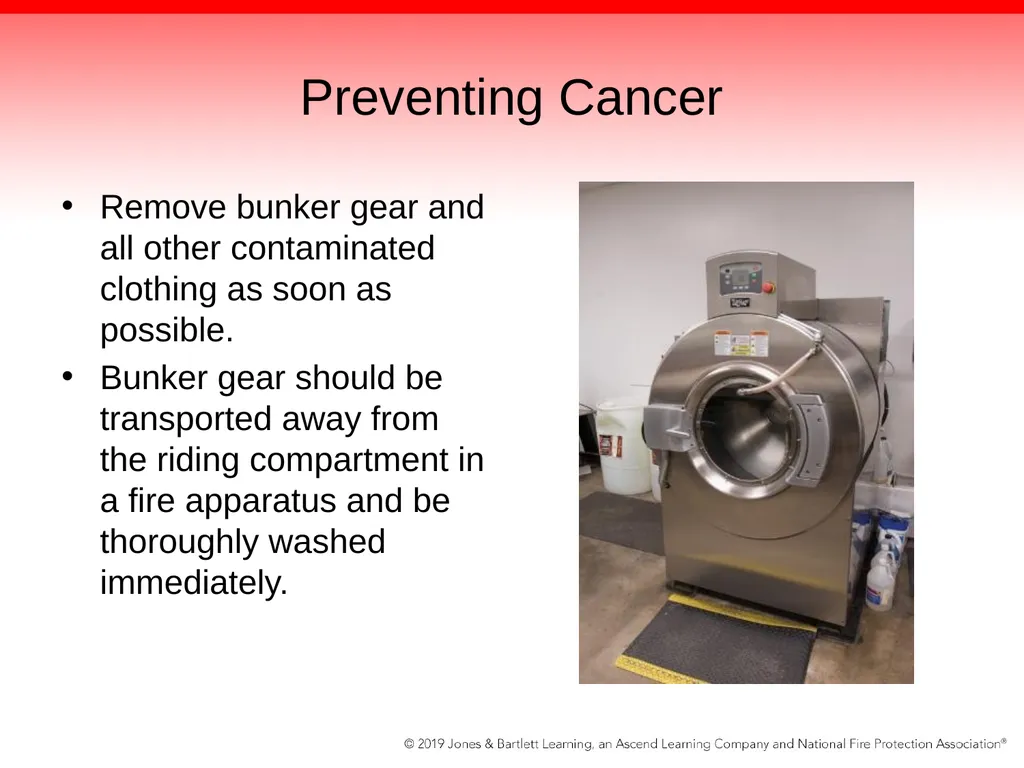
Preventing Cancer Remove bunker gear and all other contaminated clothing as soon as possible.
Bunker gear should be transported away from the riding compartment in a fire apparatus and be thoroughly washed immediately.<br>
Bunker gear should be transported away from the riding compartment in a fire apparatus and be thoroughly washed immediately.<br>
48
Tobacco Many fire departments have adopted policies that prohibit the use of tobacco products by fire personnel, both on duty and off duty.
Smoking is a major risk factor in cardiovascular disease, reduces the efficiency of the body’s respiratory system, and increases the risk of lung and other types of cancer.
You should avoid tobacco products entirely for both health and insurance reasons.<br>
Smoking is a major risk factor in cardiovascular disease, reduces the efficiency of the body’s respiratory system, and increases the risk of lung and other types of cancer.
You should avoid tobacco products entirely for both health and insurance reasons.<br>
49
Alcohol Alcohol is a mood-altering substance that can be abused.
Excessive alcohol use can damage the body and affect performance.
Driver/operators who have consumed alcohol within the previous 8 hours cannot engage in training or emergency operations.
Alcohol use increases the risk of mouth, throat, larynx, esophagus, liver, colon, and breast cancers.<br>
Excessive alcohol use can damage the body and affect performance.
Driver/operators who have consumed alcohol within the previous 8 hours cannot engage in training or emergency operations.
Alcohol use increases the risk of mouth, throat, larynx, esophagus, liver, colon, and breast cancers.<br>
50
Illicit Drug Use Has absolutely no place in the fire service.
Many fire departments have drug-testing programs to ensure that personnel do not use or abuse drugs.
The illegal use of drugs endangers your life, the lives of your team members, and the public you serve.<br>
Many fire departments have drug-testing programs to ensure that personnel do not use or abuse drugs.
The illegal use of drugs endangers your life, the lives of your team members, and the public you serve.<br>
51
Counseling and Critical Incident Stress Many fire personnel see more traumatic situations in a short time than most other citizens see in their entire lifetime.
Firefighting involves inherent stress and associated stressors such as disrupted sleep patterns.
High levels of stress can produce a variety of symptoms ranging from irritability to depression.<br>
Firefighting involves inherent stress and associated stressors such as disrupted sleep patterns.
High levels of stress can produce a variety of symptoms ranging from irritability to depression.<br>
52
Counseling and Critical Incident Stress To diminish negative effects:
get adequate sleep, consume a healthy, balanced diet, engage in adequate exercise, and maintain work/life balance.
Identify and utilize the resources that are available to assist in maintaining behavioral health.
Employee assistance programs
Resources and assistance provided by professional organizations.<br>
get adequate sleep, consume a healthy, balanced diet, engage in adequate exercise, and maintain work/life balance.
Identify and utilize the resources that are available to assist in maintaining behavioral health.
Employee assistance programs
Resources and assistance provided by professional organizations.<br>
53
Critical Incident Stress Management Critical incidents include everything from line of duty deaths to terrorism.
Normal coping mechanisms:
Exercise
Talking to friends or family
Negative reactions can happen to anyone, and vary in type and severity:
Alcohol or drug abuse
Depression<br>
Normal coping mechanisms:
Exercise
Talking to friends or family
Negative reactions can happen to anyone, and vary in type and severity:
Alcohol or drug abuse
Depression<br>
54
Critical Incident Stress Management Many times personnel do not realize they have been deeply affected.
Stress can also be cumulative (burnout)
Stages of emotional reaction include anxiety, denial/disbelief, frustration/anger, inability to function logically, remorse, grief, and reconciliation/acceptance<br>
Stress can also be cumulative (burnout)
Stages of emotional reaction include anxiety, denial/disbelief, frustration/anger, inability to function logically, remorse, grief, and reconciliation/acceptance<br>
55
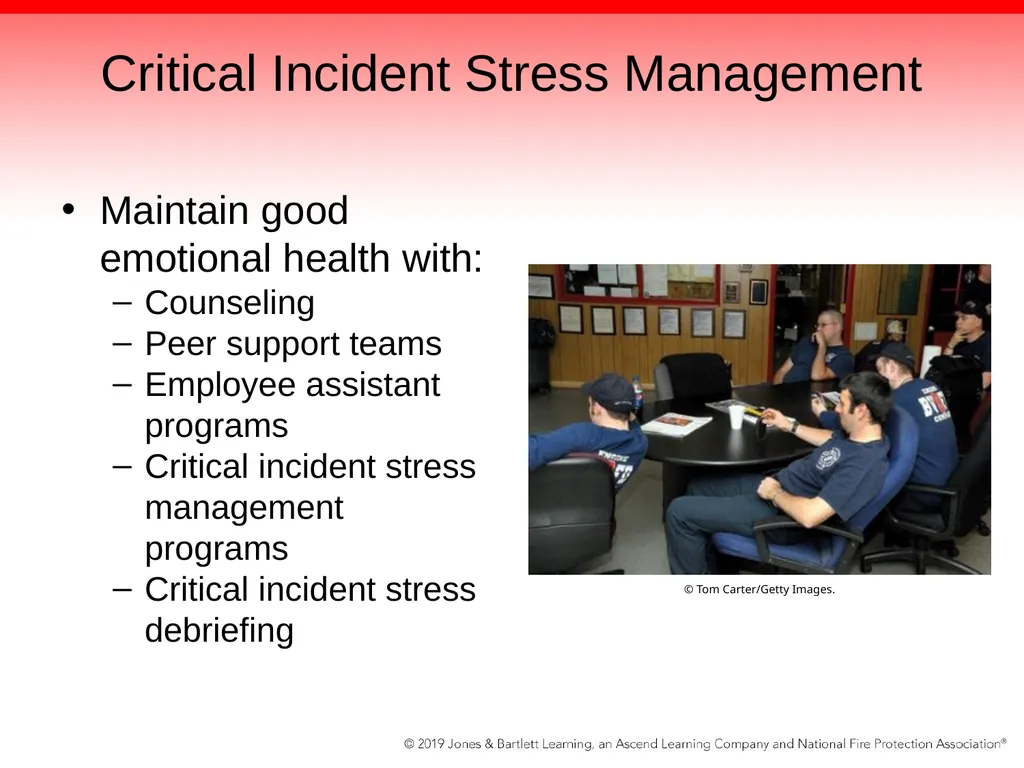
Critical Incident Stress Management Maintain good emotional health with:
Counseling
Peer support teams
Employee assistant programs
Critical incident stress management programs
Critical incident stress debriefing © Tom Carter/Getty Images.<br>
Counseling
Peer support teams
Employee assistant programs
Critical incident stress management programs
Critical incident stress debriefing © Tom Carter/Getty Images.<br>
56
Critical Incident Stress Management New fire personnel need time to develop the personal resources necessary to deal with difficult situations.
Signs that you may need assistance include
having trouble sleeping
having difficulty dealing with your thoughts or feelings.
Some departments are proactive and include training on stress.<br>
Signs that you may need assistance include
having trouble sleeping
having difficulty dealing with your thoughts or feelings.
Some departments are proactive and include training on stress.<br>
57
Critical Incident Stress Management All fire personnel should monitor themselves and other team members for signs of mental stress.
Bullying or discrimination should never be tolerated.
If you think a fellow member is struggling:
ask how they are doing.
let them know you are concerned.
encourage your coworker to seek help.
talk with your superior.<br>
Bullying or discrimination should never be tolerated.
If you think a fellow member is struggling:
ask how they are doing.
let them know you are concerned.
encourage your coworker to seek help.
talk with your superior.<br>
58
Suicide Awareness and Prevention In recent years, there have been more fire personnel suicides than line-of-duty deaths.
In 2016, there were 99 reported fire fighter suicides.
Recent estimates suggest that a fire department is three times more likely to experience a suicide in any given year than a line-of-duty death.
Organizations should discuss the negative effects of “cultural brainwashing” among department members.<br>
In 2016, there were 99 reported fire fighter suicides.
Recent estimates suggest that a fire department is three times more likely to experience a suicide in any given year than a line-of-duty death.
Organizations should discuss the negative effects of “cultural brainwashing” among department members.<br>
59
Employee Assistance Programs Fire fighters can get counseling, support, or other assistance in dealing with problems.
Some departments have qualified counselors available around the clock.
A fire officer may refer a member to an EAP if a problem starts to affect the individual’s job performance.
Members who take advantage of an EAP can do so confidentially and without fear of retribution.<br>
Some departments have qualified counselors available around the clock.
A fire officer may refer a member to an EAP if a problem starts to affect the individual’s job performance.
Members who take advantage of an EAP can do so confidentially and without fear of retribution.<br>
60
Maintaining a Safe Work Environment Can be a challenge to the newly appointed driver/operator
Experienced driver/operators should train future candidates early in their career.
Educating crew members is a major responsibility of the driver/operator.<br>
Experienced driver/operators should train future candidates early in their career.
Educating crew members is a major responsibility of the driver/operator.<br>
61
Maintaining a Safe Work Environment Educating crew members
Teach them to recognize operational errors or equipment malfunctions.
Help them understand the stressors that challenge the driver/operator on a regular basis.
Emphasize that everyone plays a role in maintaining a safe work environment.
Buy-in is what you wish to achieve.<br>
Teach them to recognize operational errors or equipment malfunctions.
Help them understand the stressors that challenge the driver/operator on a regular basis.
Emphasize that everyone plays a role in maintaining a safe work environment.
Buy-in is what you wish to achieve.<br>
62
Maintaining a Safe Work Environment Safety is embedded in all aspects of firefighting.
Apparatus and equipment inspections
Basic preventive maintenance
Regularly scheduled inspections
Routine inspections must be taken seriously.
Operational checks must be both performed and documented.<br>
Apparatus and equipment inspections
Basic preventive maintenance
Regularly scheduled inspections
Routine inspections must be taken seriously.
Operational checks must be both performed and documented.<br>
63
Maintaining a Safe Work Environment Actively promote work-safe philosophy by completing daily inspections.
Develop a routine that allows driver/operator to conduct inspection the same way every time.
Use checklists or inspection sheets
Reference operating and general service manuals
Stay abreast of newly introduced safety features.<br>
Develop a routine that allows driver/operator to conduct inspection the same way every time.
Use checklists or inspection sheets
Reference operating and general service manuals
Stay abreast of newly introduced safety features.<br>
64
Maintaining a Safe Work Environment Educate members on importance of using safety equipment.
Demonstrate how to preset, start, and operate specialized equipment.
Teach members to troubleshoot problems.
Use phrases and acronyms.
FCSP, ABDCE
Educate crew on basic mechanics of how equipment operates and functions.<br>
Demonstrate how to preset, start, and operate specialized equipment.
Teach members to troubleshoot problems.
Use phrases and acronyms.
FCSP, ABDCE
Educate crew on basic mechanics of how equipment operates and functions.<br>
65
Lead by Example Follow the rules; lead by adhering to them.
Follow and promote compliance with SOPs.
Responding to and departing from incidents
Required PPE for highway incidents
Fire apparatus positioning
General company assignments<br>
Follow and promote compliance with SOPs.
Responding to and departing from incidents
Required PPE for highway incidents
Fire apparatus positioning
General company assignments<br>
66
Lead by Example There are many critical life-preserving guidelines that you must know:
Evacuation signals
Mayday or urgent communications
Water supply
Hand signals
Understand strategies and tactics used by your department’s fire officers.<br>
Evacuation signals
Mayday or urgent communications
Water supply
Hand signals
Understand strategies and tactics used by your department’s fire officers.<br>
67
Fire Apparatus and Equipment: Functions and Limitations Understand the primary function of each fire apparatus as well as its limitations and equipment.
Communicate immediately if a problem arises that cannot be managed in the field.
Fully understand functions and limitations of the fire apparatus.
Consider different water supplies available.<br>
Communicate immediately if a problem arises that cannot be managed in the field.
Fully understand functions and limitations of the fire apparatus.
Consider different water supplies available.<br>
68
Fire Apparatus and Equipment: Safety Safety is critical to successful operation.
Operating manuals are best sources for retrieving answers to specific operational questions.
Educate crew members on limitations, established by manufacturers.
Know the challenges presented by the fire apparatus itself.<br>
Operating manuals are best sources for retrieving answers to specific operational questions.
Educate crew members on limitations, established by manufacturers.
Know the challenges presented by the fire apparatus itself.<br>
69
Fire Apparatus and Equipment: Vehicle Dynamics Weight added or subtracted will change the handling characteristics of the fire apparatus.
Understand the capabilities and limitations of the fire apparatus that you drive and operate.
Understand the equipment carried by the apparatus and the systems that support operations.<br>
Understand the capabilities and limitations of the fire apparatus that you drive and operate.
Understand the equipment carried by the apparatus and the systems that support operations.<br>
70
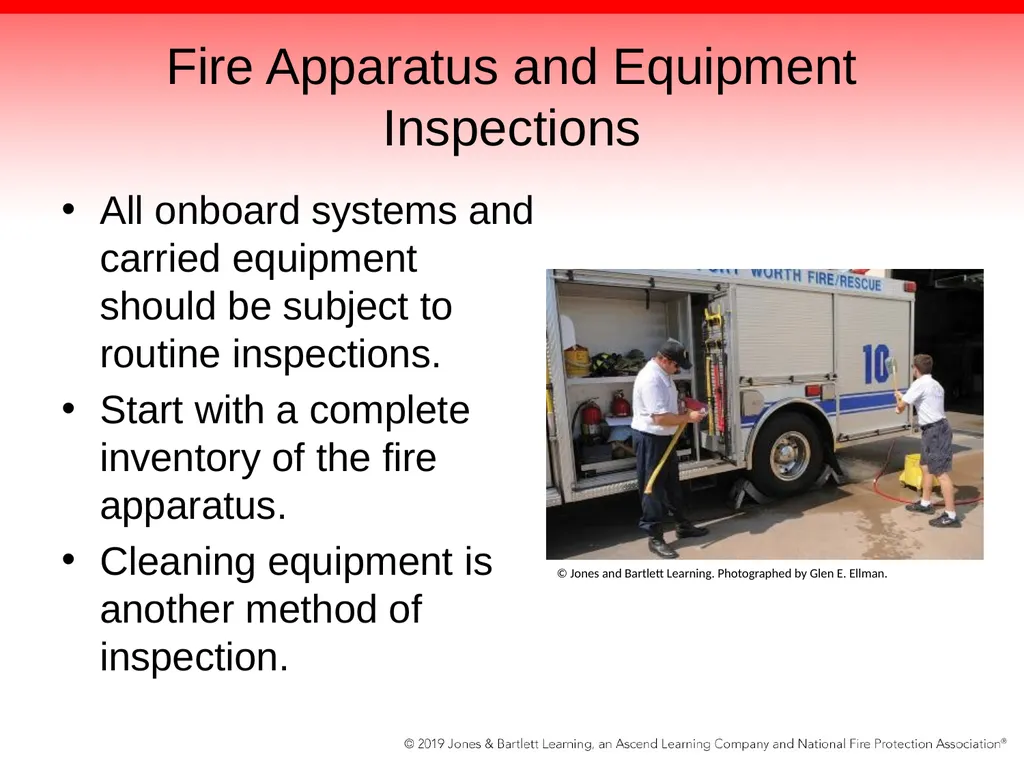
Fire Apparatus and Equipment Inspections All onboard systems and carried equipment should be subject to routine inspections.
Start with a complete inventory of the fire apparatus.
Cleaning equipment is another method of inspection. © Jones and Bartlett Learning. Photographed by Glen E. Ellman.<br>
Start with a complete inventory of the fire apparatus.
Cleaning equipment is another method of inspection. © Jones and Bartlett Learning. Photographed by Glen E. Ellman.<br>
71
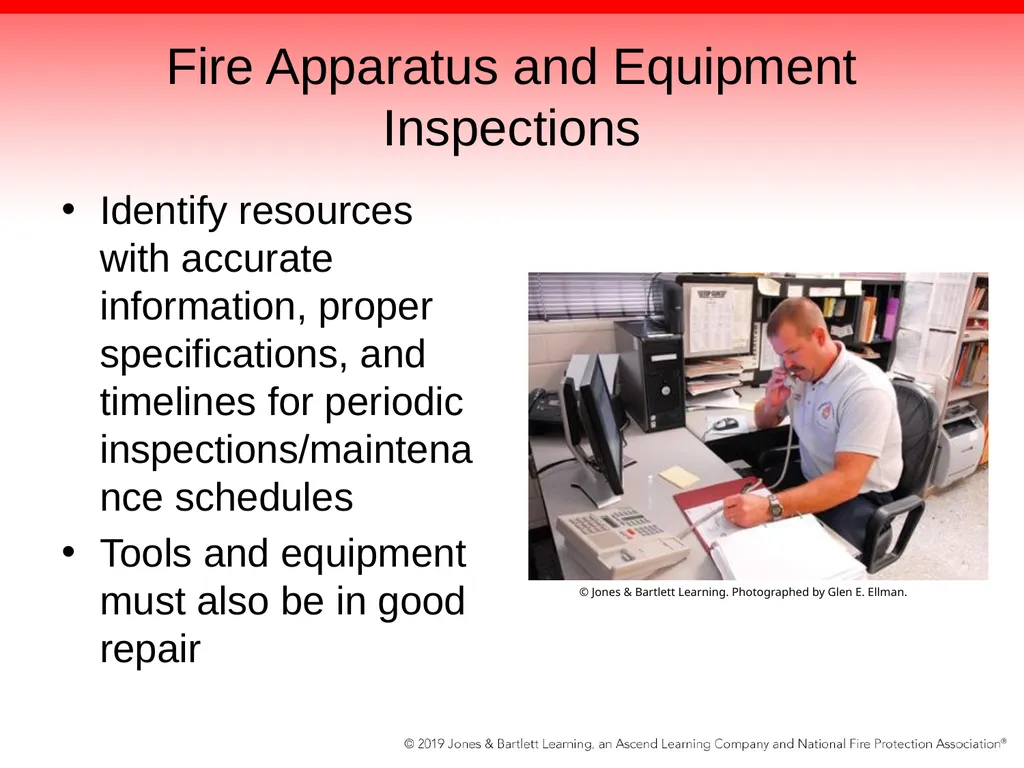
Fire Apparatus and Equipment Inspections Identify resources with accurate information, proper specifications, and timelines for periodic inspections/maintenance schedules
Tools and equipment must also be in good repair © Jones & Bartlett Learning. Photographed by Glen E. Ellman.<br>
Tools and equipment must also be in good repair © Jones & Bartlett Learning. Photographed by Glen E. Ellman.<br>
72
Safety Across the Board All fire apparatus operated in two basic ways:
Driving operations—includes all operations when the apparatus is traveling
On-scene operations—includes the operation of the apparatus and any of the apparatus equipment at the incident<br>
Driving operations—includes all operations when the apparatus is traveling
On-scene operations—includes the operation of the apparatus and any of the apparatus equipment at the incident<br>
73
Safety Across the Board Driver/operator sets the tone for the rest of the team members with your response to the incident.
Remember the mantra “it’s not my emergency.”
Always respond in a safe manner.
Effectively operate equipment at the scene.
Support the crew.<br>
Remember the mantra “it’s not my emergency.”
Always respond in a safe manner.
Effectively operate equipment at the scene.
Support the crew.<br>
74
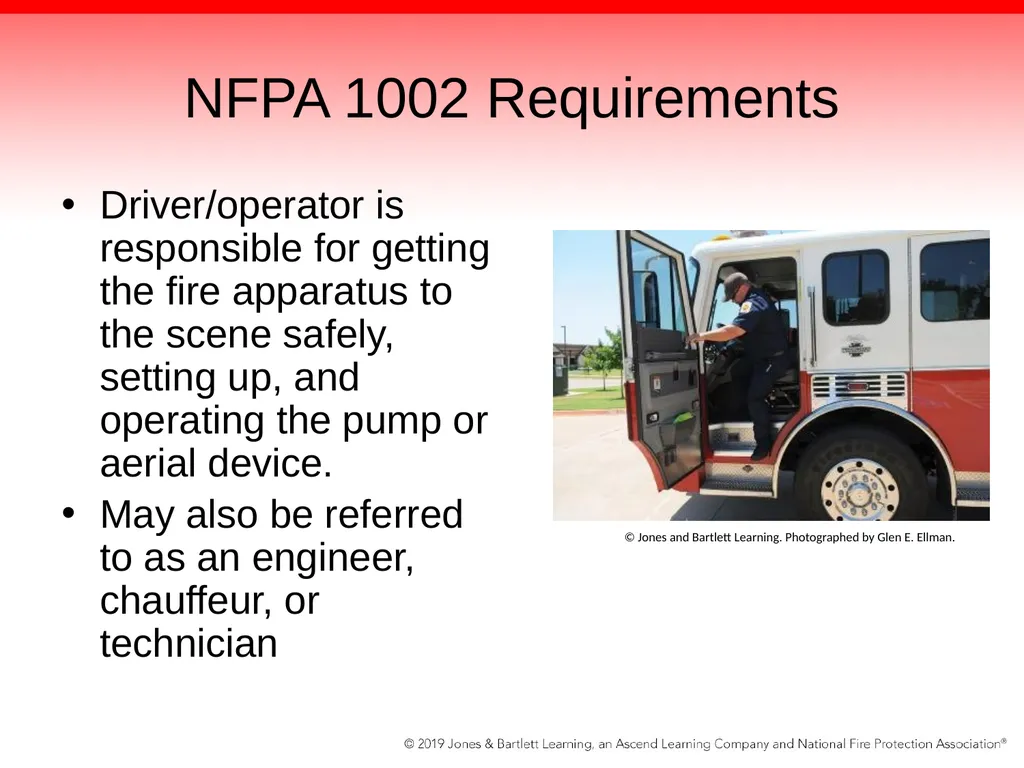
NFPA 1002 Requirements Driver/operator is responsible for getting the fire apparatus to the scene safely, setting up, and operating the pump or aerial device.
May also be referred to as an engineer, chauffeur, or technician © Jones and Bartlett Learning. Photographed by Glen E. Ellman.<br>
May also be referred to as an engineer, chauffeur, or technician © Jones and Bartlett Learning. Photographed by Glen E. Ellman.<br>
75
NFPA 1002 Requirements Operation of fire apparatus and equipment is a critical life-safety issue for all fire fighters.
Many lives are lost every year as a result of fire apparatus accidents.
Driving to and from the scene can be as dangerous as operating on the fireground.
If the equipment fails on the fireground, the consequences can be disastrous.<br>
Many lives are lost every year as a result of fire apparatus accidents.
Driving to and from the scene can be as dangerous as operating on the fireground.
If the equipment fails on the fireground, the consequences can be disastrous.<br>
76
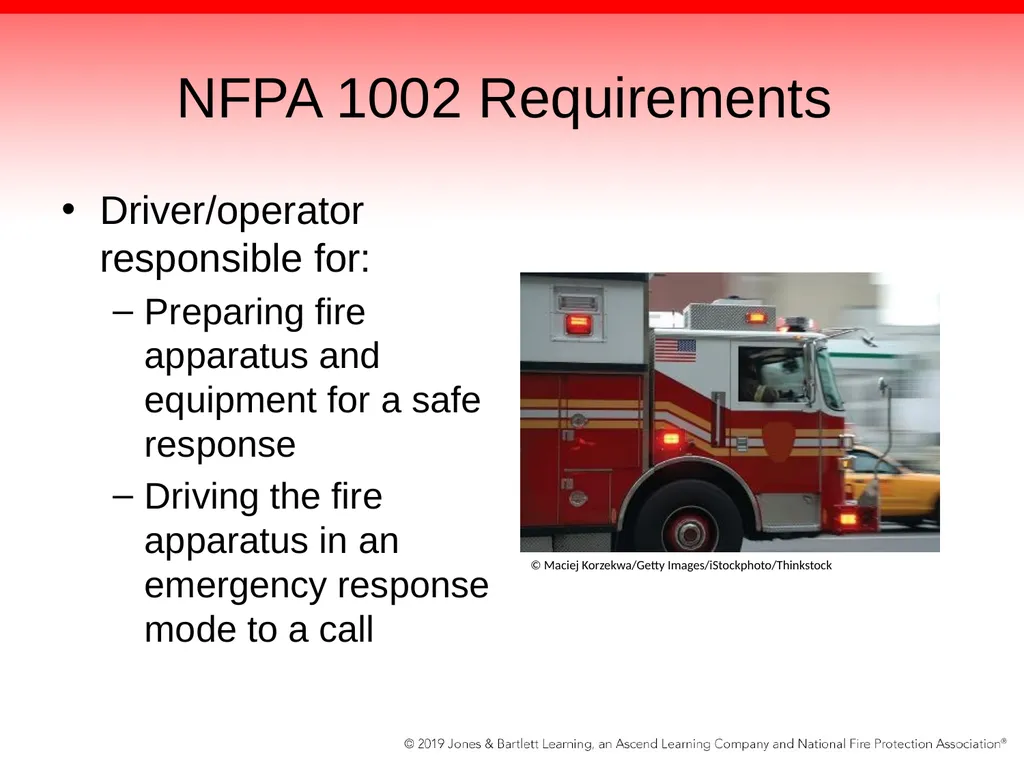
NFPA 1002 Requirements Driver/operator responsible for:
Preparing fire apparatus and equipment for a safe response
Driving the fire apparatus in an emergency response mode to a call © Maciej Korzekwa/Getty Images/iStockphoto/Thinkstock<br>
Preparing fire apparatus and equipment for a safe response
Driving the fire apparatus in an emergency response mode to a call © Maciej Korzekwa/Getty Images/iStockphoto/Thinkstock<br>
77
NFPA 1002 Requirements Driver/operator responsible for (cont’d):
Placing the fire apparatus at the scene to ensure fire fighter safety and the maximum effectiveness of the equipment
Safely and properly operating the equipment to support all operations on the fireground
Securing the equipment and safely returning the fire apparatus and members of the company to the fire station<br>
Placing the fire apparatus at the scene to ensure fire fighter safety and the maximum effectiveness of the equipment
Safely and properly operating the equipment to support all operations on the fireground
Securing the equipment and safely returning the fire apparatus and members of the company to the fire station<br>
78
NFPA 1002: General Requirements of a Driver/Operator All drivers must meet the general requirements of NFPA 1002 before they are allowed to operate a fire department vehicle.
Outlines the minimum job performance requirements (JPRs) for personnel who will drive and operate specific types of fire apparatus.<br>
Outlines the minimum job performance requirements (JPRs) for personnel who will drive and operate specific types of fire apparatus.<br>
79
NFPA 1002: General Requirements of a Driver/Operator Chapter 4: General Requirements
Chapter 5: Apparatus Equipped with a Fire Pump
Chapter 6: Apparatus Equipped with an Aerial Device
Chapter 7: Apparatus Equipped with a Tiller
Chapter 8: Wildland Fire Apparatus
Chapter 9: Aircraft Rescue and Fire-Fighting Apparatus
Chapter 10: Mobile Water Supply Apparatus<br>
Chapter 5: Apparatus Equipped with a Fire Pump
Chapter 6: Apparatus Equipped with an Aerial Device
Chapter 7: Apparatus Equipped with a Tiller
Chapter 8: Wildland Fire Apparatus
Chapter 9: Aircraft Rescue and Fire-Fighting Apparatus
Chapter 10: Mobile Water Supply Apparatus<br>
80
NFPA 1002: General Requirements of a Driver/Operator Personnel must meet those provisions that pertain to the types of apparatus they will be expected to drive and operate.
AHJ may add additional requirements.
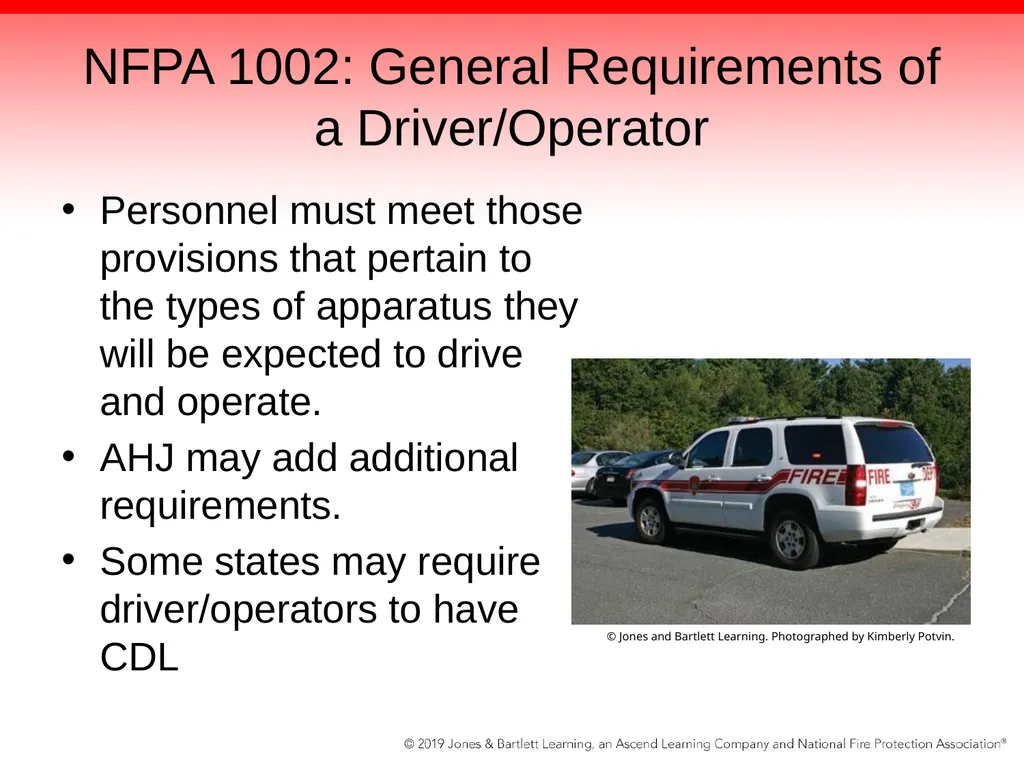
Some states may require driver/operators to have CDL © Jones and Bartlett Learning. Photographed by Kimberly Potvin.<br>
AHJ may add additional requirements.
Some states may require driver/operators to have CDL © Jones and Bartlett Learning. Photographed by Kimberly Potvin.<br>
81
NFPA 1002: General Requirements of a Driver/Operator U.S. Department of Transportation (DOT)/Ministry of Transportation (MOT) has established requirements for licensing drivers.
Each fire department is responsible for ensuring that its members are properly licensed at the appropriate level for the jurisdiction.<br>
Each fire department is responsible for ensuring that its members are properly licensed at the appropriate level for the jurisdiction.<br>
82
NFPA 1002: General Requirements of a Driver/Operator Driver/operators must meet the requirements of NFPA 1001 if they will be responsible for operating a fire pump or aerial device on the fire apparatus.
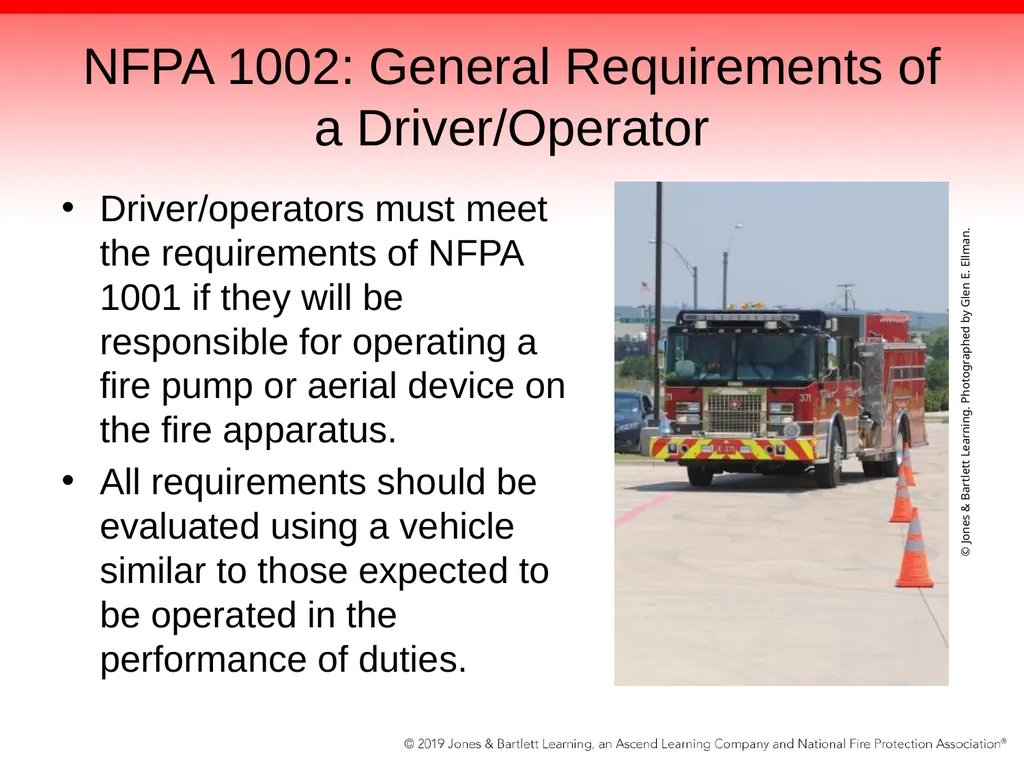
All requirements should be evaluated using a vehicle similar to those expected to be operated in the performance of duties. © Jones & Bartlett Learning. Photographed by Glen E. Ellman.<br>
All requirements should be evaluated using a vehicle similar to those expected to be operated in the performance of duties. © Jones & Bartlett Learning. Photographed by Glen E. Ellman.<br>
83
NFPA 1002: Medical and Physical Requirements of a Driver/Operator Driver is subject to medical evaluation, as required by NFPA 1500
States that the driver shall be medically evaluated and qualified for duty by a physician, taking into account risks and functions © Bilderbuch/age fotostock<br>
States that the driver shall be medically evaluated and qualified for duty by a physician, taking into account risks and functions © Bilderbuch/age fotostock<br>
84
NFPA 1002: Medical and Physical Requirements of a Driver/Operator All drivers who will engage in fire suppression should meet the medical requirements specified in Chapter 8 of NFPA 1582, Standard on Comprehensive Occupational Medical Program for Fire Departments.
Medical history review, physical examination, and several laboratory tests<br>
Medical history review, physical examination, and several laboratory tests<br>
85
Driver/Operator Training Training drivers to operate their apparatus safely and efficiently is critical to the success of any fire department.
NFPA 1451
Includes development of a driver/operator training program, including the organizational procedures for training drivers, maintaining vehicles, and identifying equipment deficiencies<br>
NFPA 1451
Includes development of a driver/operator training program, including the organizational procedures for training drivers, maintaining vehicles, and identifying equipment deficiencies<br>
86
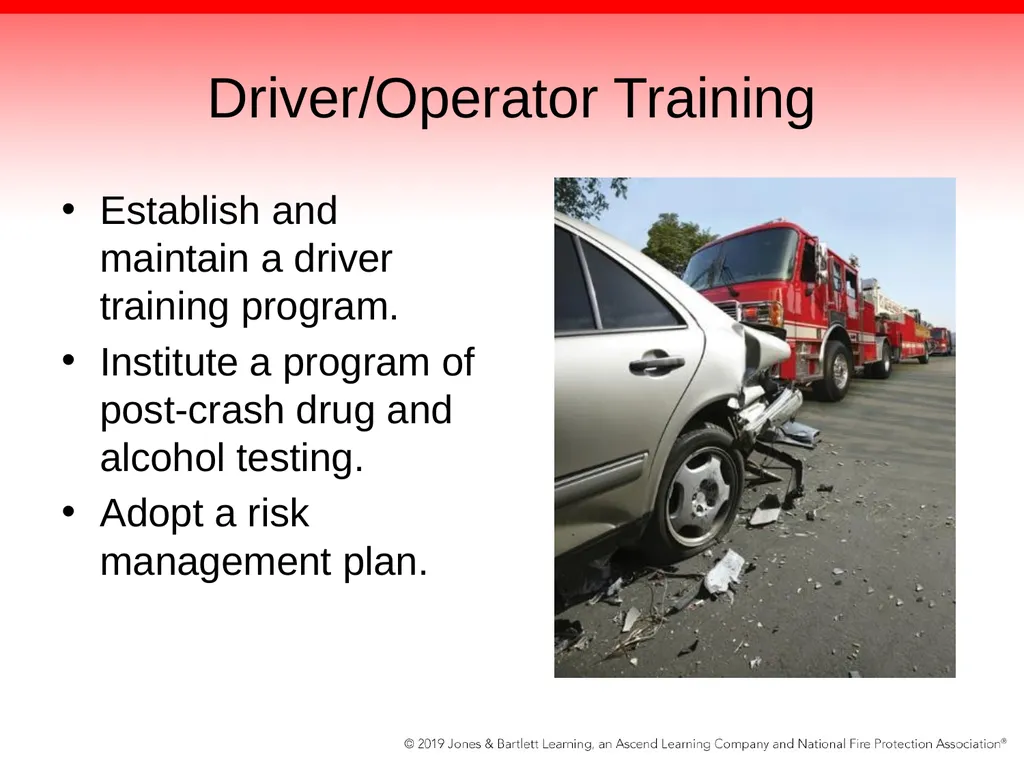
Driver/Operator Training Establish and maintain a driver training program.
Institute a program of post-crash drug and alcohol testing.
Adopt a risk management plan.<br>
Institute a program of post-crash drug and alcohol testing.
Adopt a risk management plan.<br>
87
Driver/Operator Training Evaluate the effectiveness of the vehicle training program once every 3 years.
Establish written SOPs for safe driving of, riding within, and operating of vehicles during emergency and nonemergency responses.
Ensure all members are trained to operate specific vehicles before being authorized to drive.<br>
Establish written SOPs for safe driving of, riding within, and operating of vehicles during emergency and nonemergency responses.
Ensure all members are trained to operate specific vehicles before being authorized to drive.<br>
88
Driver/Operator Training Ensure all members are reauthorized annually for all vehicles they are expected to operate.
Provide driver training for all members as often as necessary, but no less than twice each year.
Ensure all members receive training when new or unfamiliar vehicles are placed into service<br>
Provide driver training for all members as often as necessary, but no less than twice each year.
Ensure all members receive training when new or unfamiliar vehicles are placed into service<br>
89
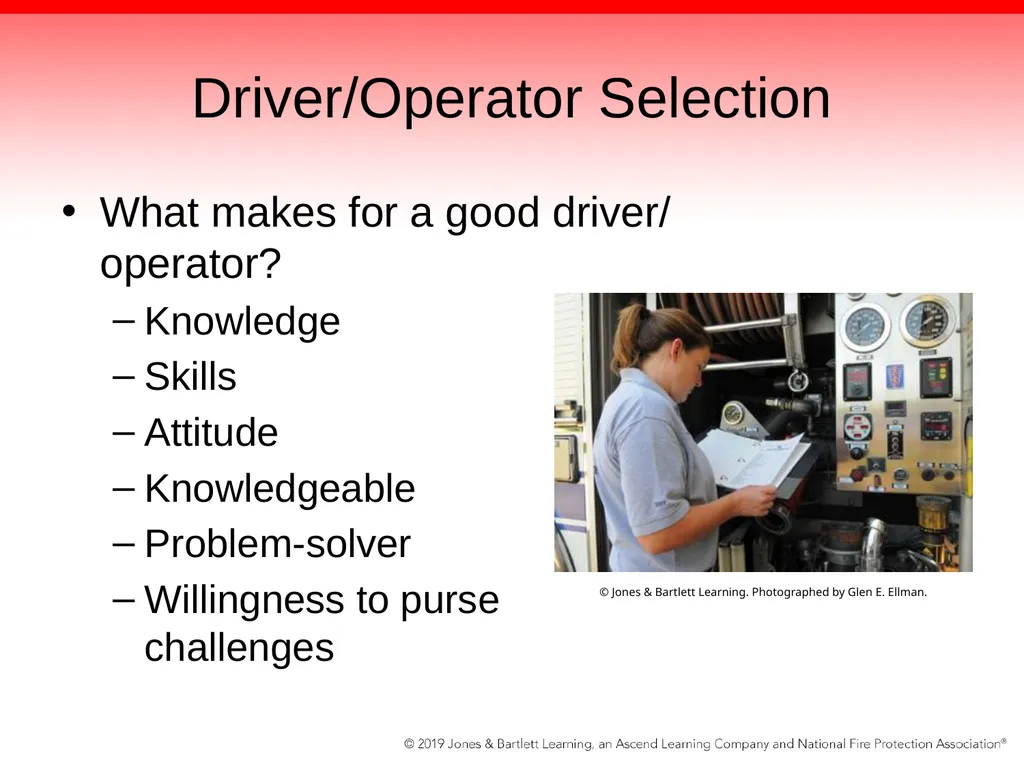
Driver/Operator Selection What makes for a good driver/ operator?
Knowledge
Skills
Attitude
Knowledgeable
Problem-solver
Willingness to purse challenges © Jones & Bartlett Learning. Photographed by Glen E. Ellman.<br>
Knowledge
Skills
Attitude
Knowledgeable
Problem-solver
Willingness to purse challenges © Jones & Bartlett Learning. Photographed by Glen E. Ellman.<br>
90
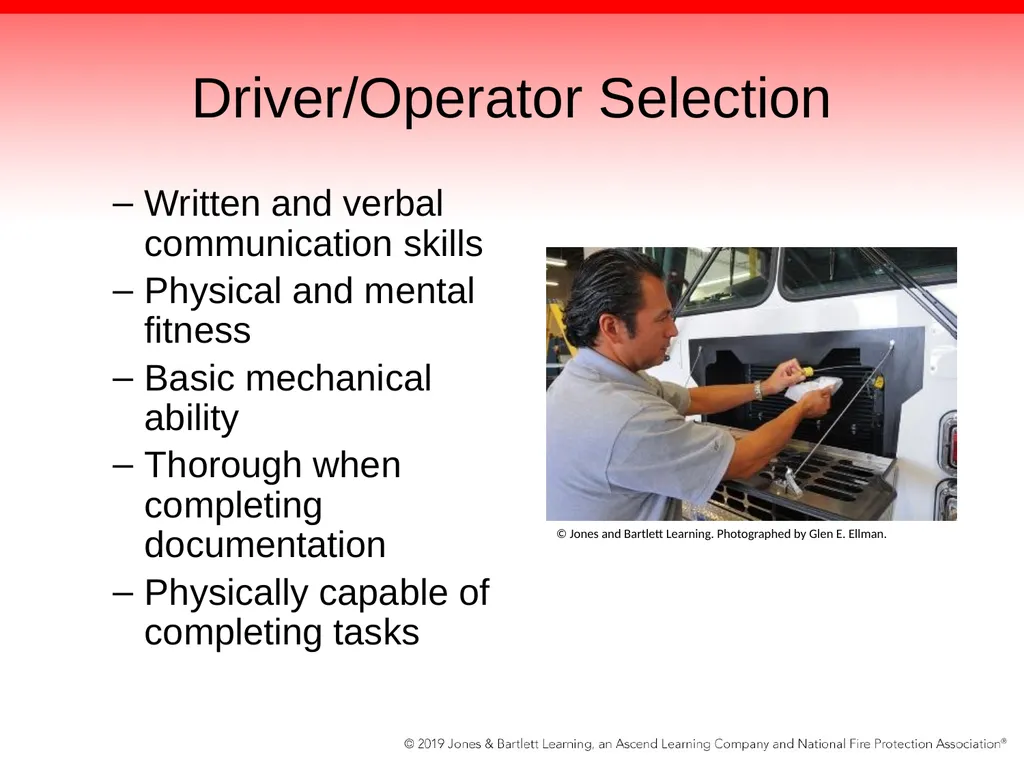
Driver/Operator Selection Written and verbal communication skills
Physical and mental fitness
Basic mechanical ability
Thorough when completing documentation
Physically capable of completing tasks © Jones and Bartlett Learning. Photographed by Glen E. Ellman.<br>
Physical and mental fitness
Basic mechanical ability
Thorough when completing documentation
Physically capable of completing tasks © Jones and Bartlett Learning. Photographed by Glen E. Ellman.<br>
91
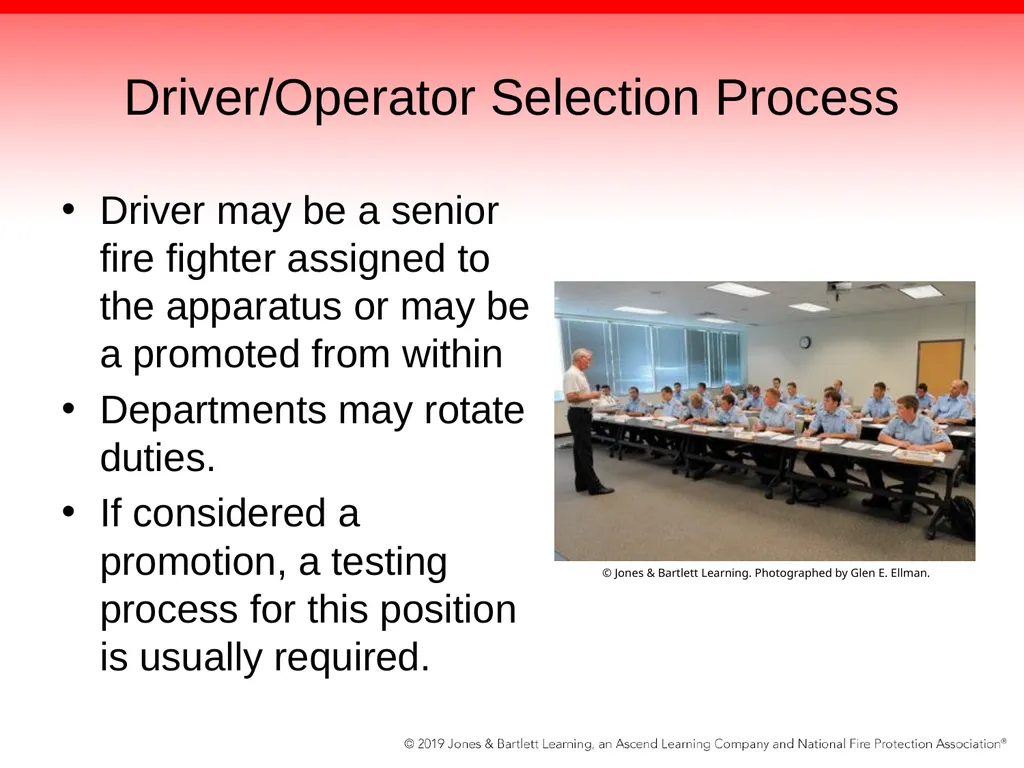
Driver/Operator Selection Process Driver may be a senior fire fighter assigned to the apparatus or may be a promoted from within
Departments may rotate duties.
If considered a promotion, a testing process for this position is usually required. © Jones & Bartlett Learning. Photographed by Glen E. Ellman.<br>
Departments may rotate duties.
If considered a promotion, a testing process for this position is usually required. © Jones & Bartlett Learning. Photographed by Glen E. Ellman.<br>
92
Summary To be successful, you must fully understand and accept the responsibilities of the job.
As a driver/operator, you have many obligations to your crew and to the community. Both internal and external expectations depend on your ability to perform your initial response assignments.
Every member of the fire department must have a strong commitment to safety and health. Safety must be fully integrated into every activity, procedure, and job description.<br>
As a driver/operator, you have many obligations to your crew and to the community. Both internal and external expectations depend on your ability to perform your initial response assignments.
Every member of the fire department must have a strong commitment to safety and health. Safety must be fully integrated into every activity, procedure, and job description.<br>
93
Summary The majority of all fire fighter deaths are caused by stress, overexertion, and medical issues.
Cardiac events account for 38 percent of these deaths.
Motor vehicle collisions are the second leading cause of fire fighter fatalities.
Always wear your seat belt each and every time you are in a motor vehicle.<br>
Cardiac events account for 38 percent of these deaths.
Motor vehicle collisions are the second leading cause of fire fighter fatalities.
Always wear your seat belt each and every time you are in a motor vehicle.<br>
94
Summary A successful safety program includes four major components: regulations, standards, and procedures; personnel; training; and equipment.
Safety and well-being are directly related to personal health and fitness.
You should eat a healthy diet, maintain a healthy weight, exercise regularly, stay hydrated, and sleep for 7 to 8 hours whenever possible.<br>
Safety and well-being are directly related to personal health and fitness.
You should eat a healthy diet, maintain a healthy weight, exercise regularly, stay hydrated, and sleep for 7 to 8 hours whenever possible.<br>
95
Summary Employee assistance programs are available to provide fire fighters with confidential counseling, support, or assistance in dealing with a problem.
As a driver/operator, you have a duty to educate other crew members on their roles and responsibilities to support your function. The driver/operator is a teacher, a mentor, a vital crew member, and a safety advocate. You must lead by example—especially in regard to safety.<br>
As a driver/operator, you have a duty to educate other crew members on their roles and responsibilities to support your function. The driver/operator is a teacher, a mentor, a vital crew member, and a safety advocate. You must lead by example—especially in regard to safety.<br>
96
Summary Compliance with standard operating procedures or guidelines is essential.
Always follow these procedures, and promote compliance among your crew members.
All fire apparatus are operated in two basic ways: driving operations and on-scene operations.<br>
Always follow these procedures, and promote compliance among your crew members.
All fire apparatus are operated in two basic ways: driving operations and on-scene operations.<br>
97
Summary The driver is responsible for the safe and efficient operation of the vehicle in both settings.
NFPA 1002 identifies the minimum requirements for a driver/operator.
NFPA 1451 identifies the requirements for a fire department’s driver training program.<br>
NFPA 1002 identifies the minimum requirements for a driver/operator.
NFPA 1451 identifies the requirements for a fire department’s driver training program.<br>