
Chapter 2: Historical and Contemporary Views of


Description: Chapter 2: Historical and Contemporary Views of the Nature-Nurture Debate: A Continuum of Perspectives for the Speech-Language Pathologist Theories of Language Acquisition Descriptive adequacy: clues about what language knowledge is
Related Topics
Download Presentation
"Chapter 2: Historical and Contemporary Views of" is the property of its rightful owner. Permission is granted to download and print the materials on this website for personal, non-commercial use only, and to display it on your personal computer provided you do not modify the materials and that you retain all copyright notices contained in the materials. By downloading content from our website, you accept the terms of this agreement.
Presentation Transcript
slide1. Chapter 2:
Historical and Contemporary Views of the Nature-Nurture Debate: A Continuum of Perspectives for the Speech-Language Pathologist<br>
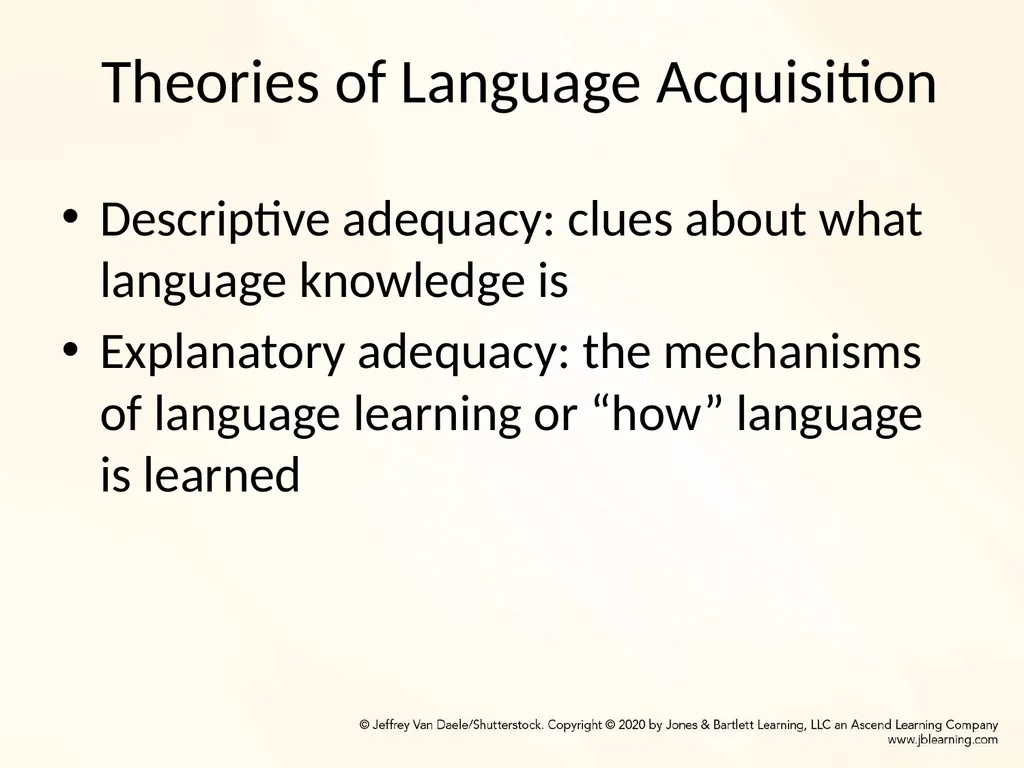
slide2. Theories of Language Acquisition Descriptive adequacy: clues about what language knowledge is
Explanatory adequacy: the mechanisms of language learning or “how” language is learned<br>
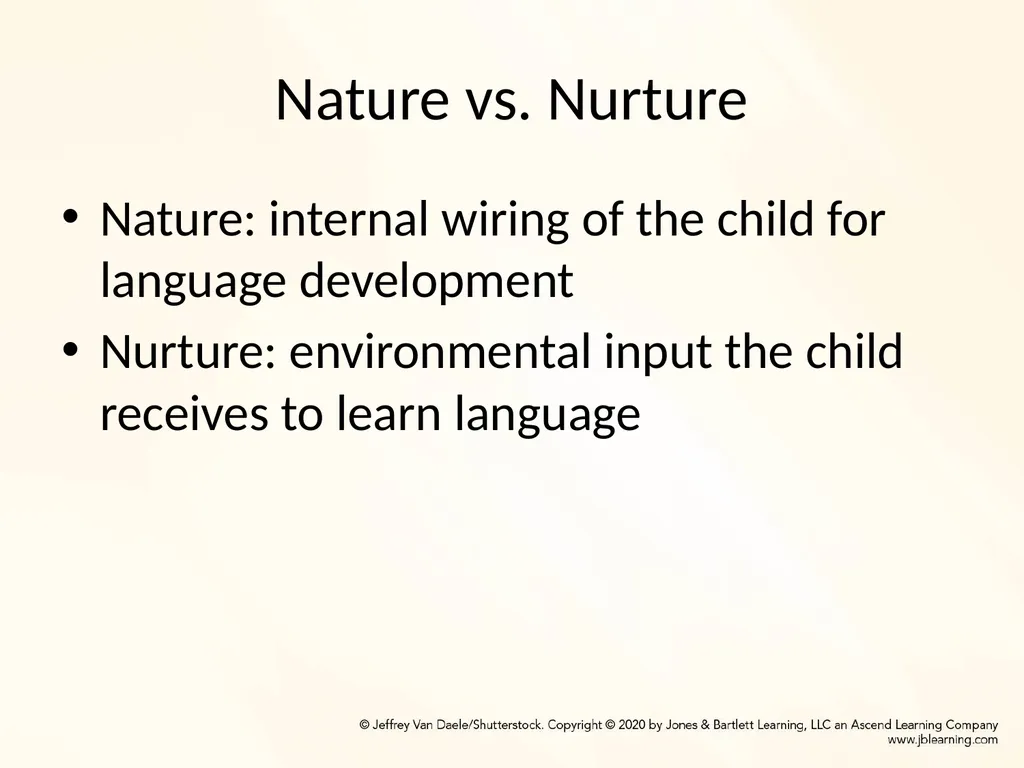
slide3. Nature vs. Nurture Nature: internal wiring of the child for language development
Nurture: environmental input the child receives to learn language<br>
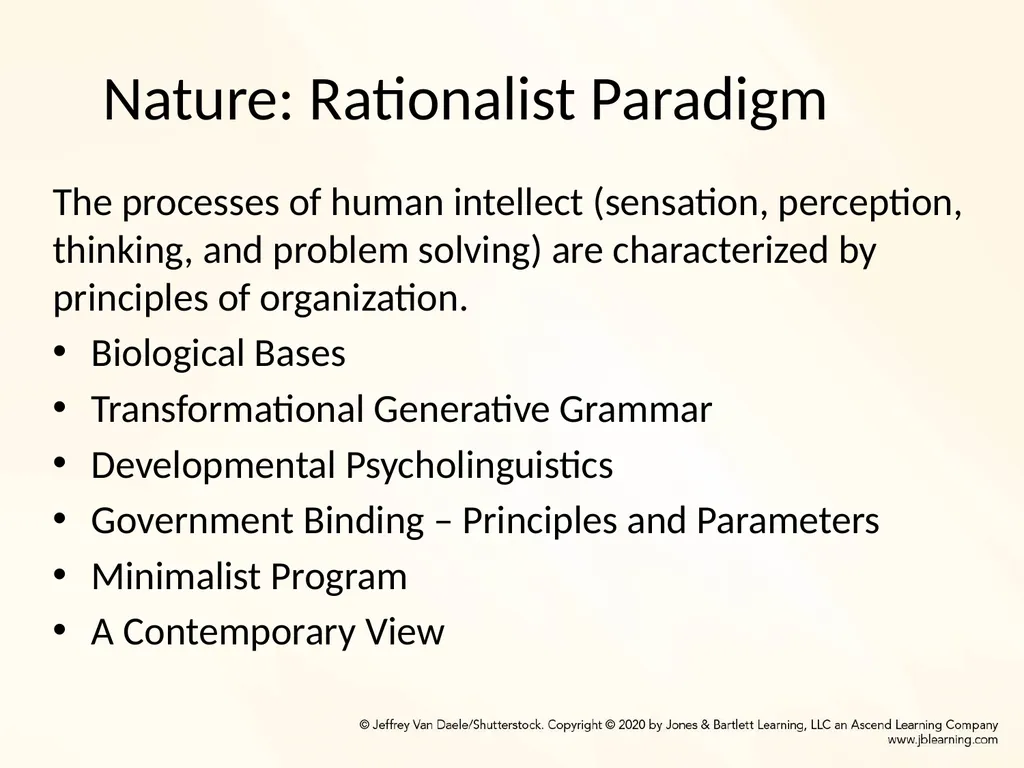
slide4. Nature: Rationalist Paradigm The processes of human intellect (sensation, perception, thinking, and problem solving) are characterized by principles of organization.
Biological Bases
Transformational Generative Grammar
Developmental Psycholinguistics
Government Binding – Principles and Parameters
Minimalist Program
A Contemporary View<br>
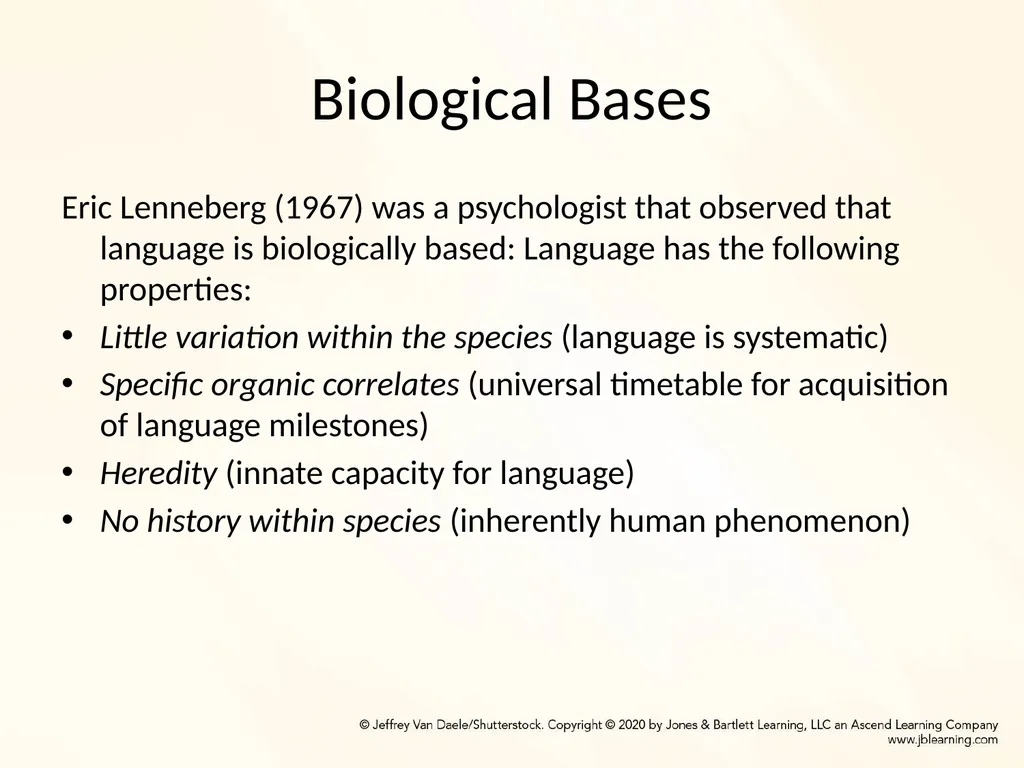
slide5. Biological Bases Eric Lenneberg (1967) was a psychologist that observed that language is biologically based: Language has the following properties:
Little variation within the species (language is systematic)
Specific organic correlates (universal timetable for acquisition of language milestones)
Heredity (innate capacity for language)
No history within species (inherently human phenomenon)<br>
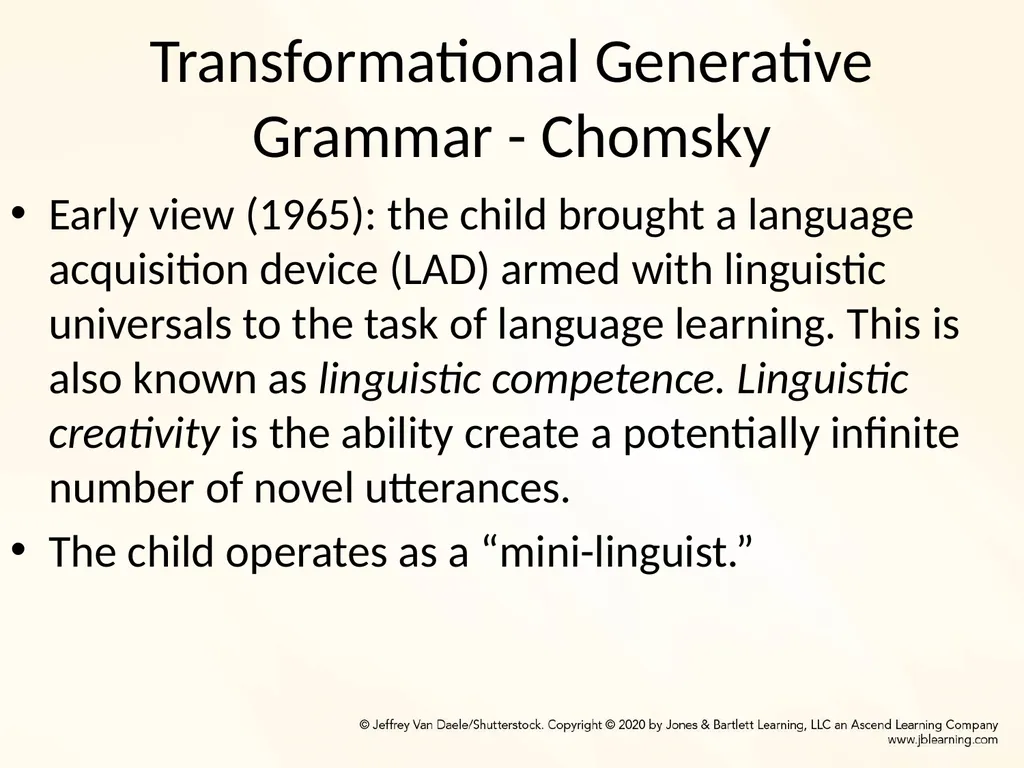
slide6. Transformational Generative Grammar - Chomsky Early view (1965): the child brought a language acquisition device (LAD) armed with linguistic universals to the task of language learning. This is also known as linguistic competence. Linguistic creativity is the ability create a potentially infinite number of novel utterances.
The child operates as a “mini-linguist.”<br>
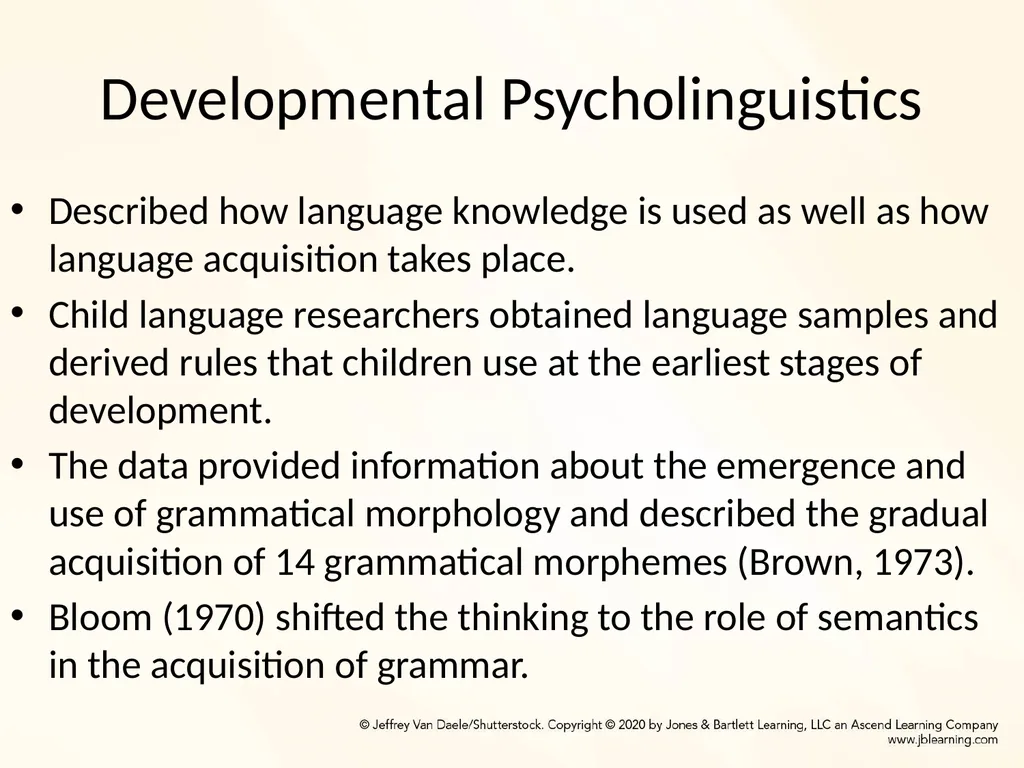
slide7. Developmental Psycholinguistics Described how language knowledge is used as well as how language acquisition takes place.
Child language researchers obtained language samples and derived rules that children use at the earliest stages of development.
The data provided information about the emergence and use of grammatical morphology and described the gradual acquisition of 14 grammatical morphemes (Brown, 1973).
Bloom (1970) shifted the thinking to the role of semantics in the acquisition of grammar.<br>
slide8. Government Binding – Principles and Parameters Chomsky (1982) – idiosyncratic patterns of particular languages were captured in “parameters,” which were set differently for different languages.<br>
slide9. Minimalist Program Chomsky (2002) scaled down the versions of the Extended Standard Theory and Government Binding Theory.
Inclusion of a level of representation for meaning and a level of representation for sound<br>
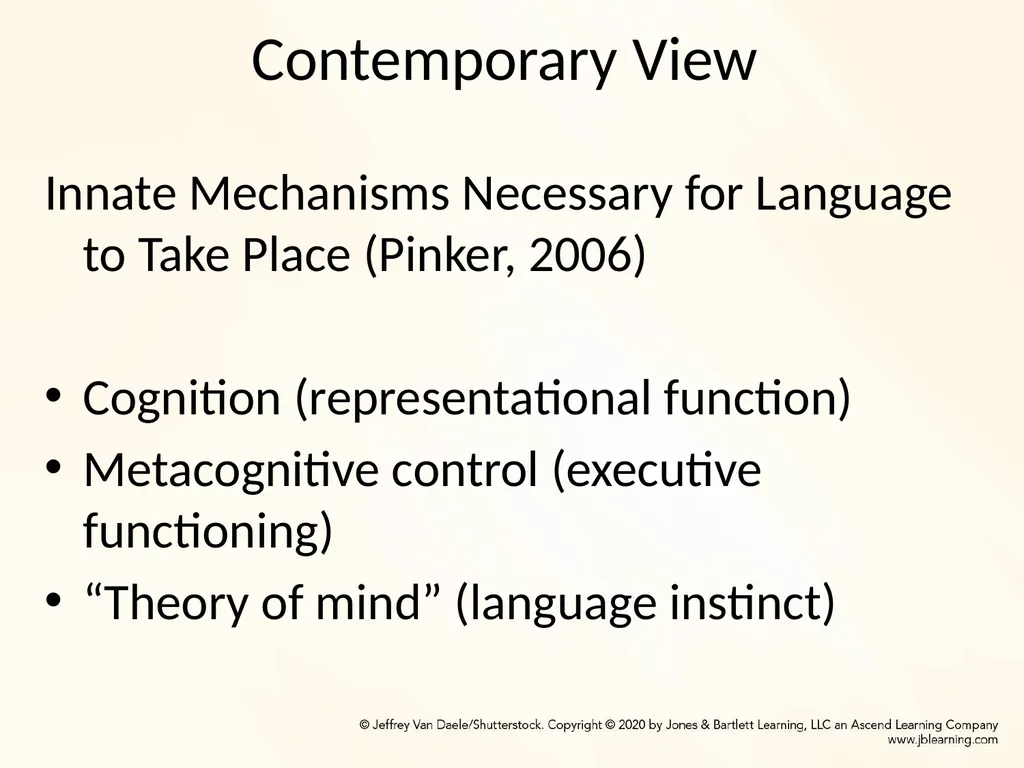
slide10. Contemporary View Innate Mechanisms Necessary for Language to Take Place (Pinker, 2006)
Cognition (representational function)
Metacognitive control (executive functioning)
“Theory of mind” (language instinct)<br>
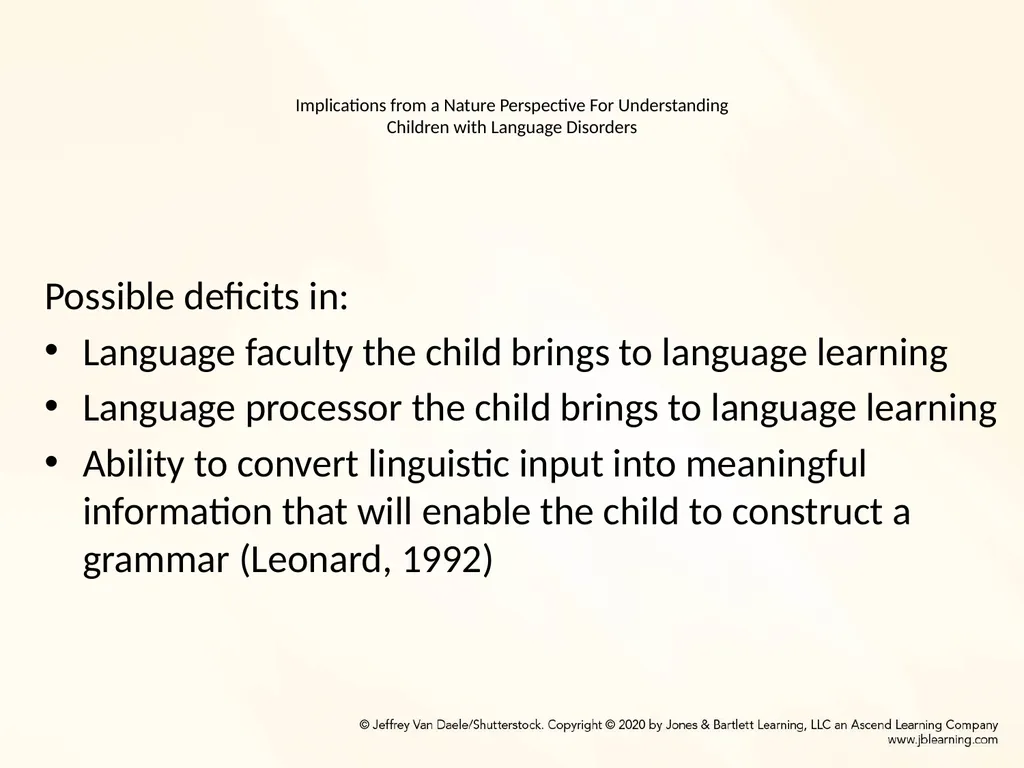
slide11. Implications from a Nature Perspective For Understanding Children with Language Disorders Possible deficits in:
Language faculty the child brings to language learning
Language processor the child brings to language learning
Ability to convert linguistic input into meaningful information that will enable the child to construct a grammar (Leonard, 1992)<br>
slide12. Nurture: Behaviorist Paradigm Classical Conditioning
Operant Conditioning<br>
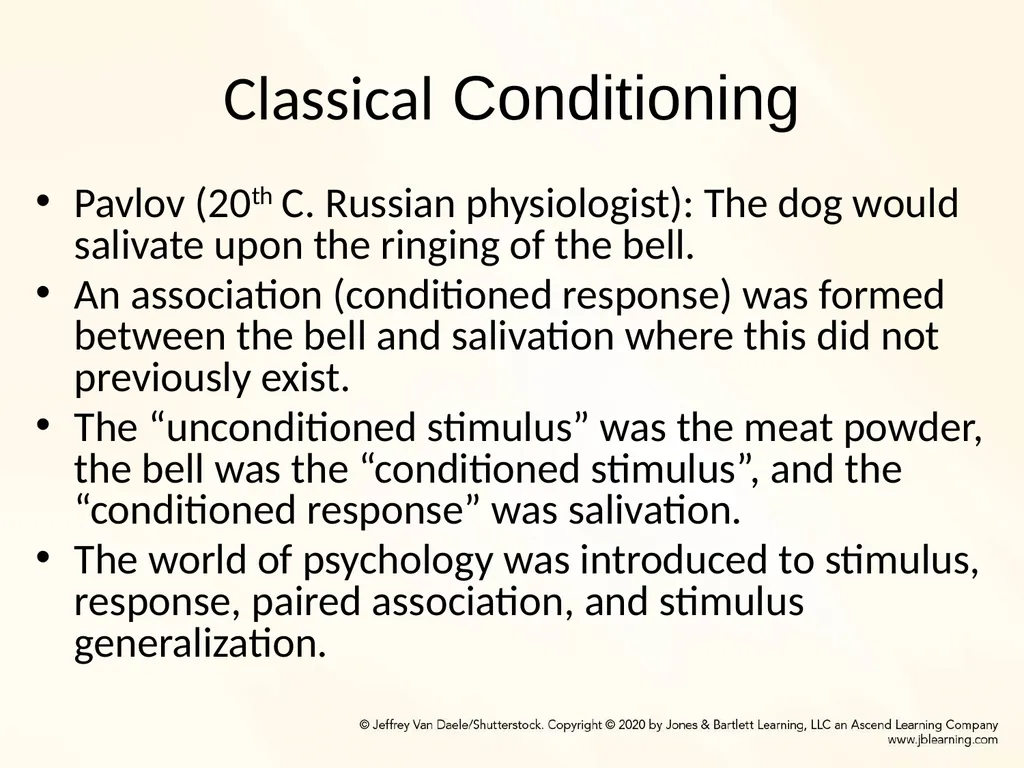
slide13. Classical Conditioning Pavlov (20th C. Russian physiologist): The dog would salivate upon the ringing of the bell.
An association (conditioned response) was formed between the bell and salivation where this did not previously exist.
The “unconditioned stimulus” was the meat powder, the bell was the “conditioned stimulus”, and the “conditioned response” was salivation.
The world of psychology was introduced to stimulus, response, paired association, and stimulus generalization.<br>
slide14. Operant Conditioning B.F. Skinner (1957) observed that the frequency of certain behaviors could be increased if positive reinforcers (or consequences) were contingent upon those behaviors
Baby cries ---- bottle<br>
slide15. Operant Conditioning (cont.) The intensity and frequency of a response will increase with reinforcement.
Language acquisition is viewed as the gradual or systematic reinforcement of desirable or target behaviors.<br>
slide16. Implications from a Nurture Perspective for Understanding, Assessing, and Treating Children with Language Disorders The impact of the behavioral paradigm on assessment and intervention has been pervasive in our field.
Behavioral observations; data driven descriptions; quantifications; measurements
ABA (Lovaas, 1977) - outgrowth of operant conditioning paradigm for language intervention<br>
slide17. Interactionist: Cognitive Interactionist Paradigm Information Processing Models
Cognitive-Constructivist Models<br>
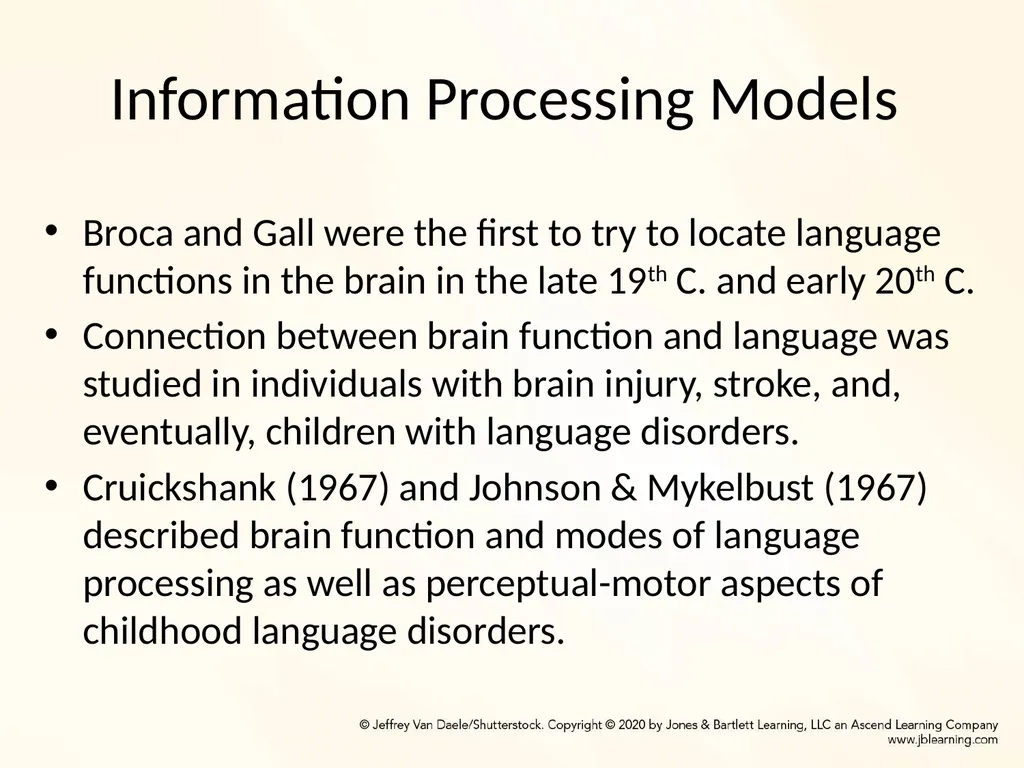
slide18. Information Processing Models Broca and Gall were the first to try to locate language functions in the brain in the late 19th C. and early 20th C.
Connection between brain function and language was studied in individuals with brain injury, stroke, and, eventually, children with language disorders.
Cruickshank (1967) and Johnson & Mykelbust (1967) described brain function and modes of language processing as well as perceptual-motor aspects of childhood language disorders.<br>
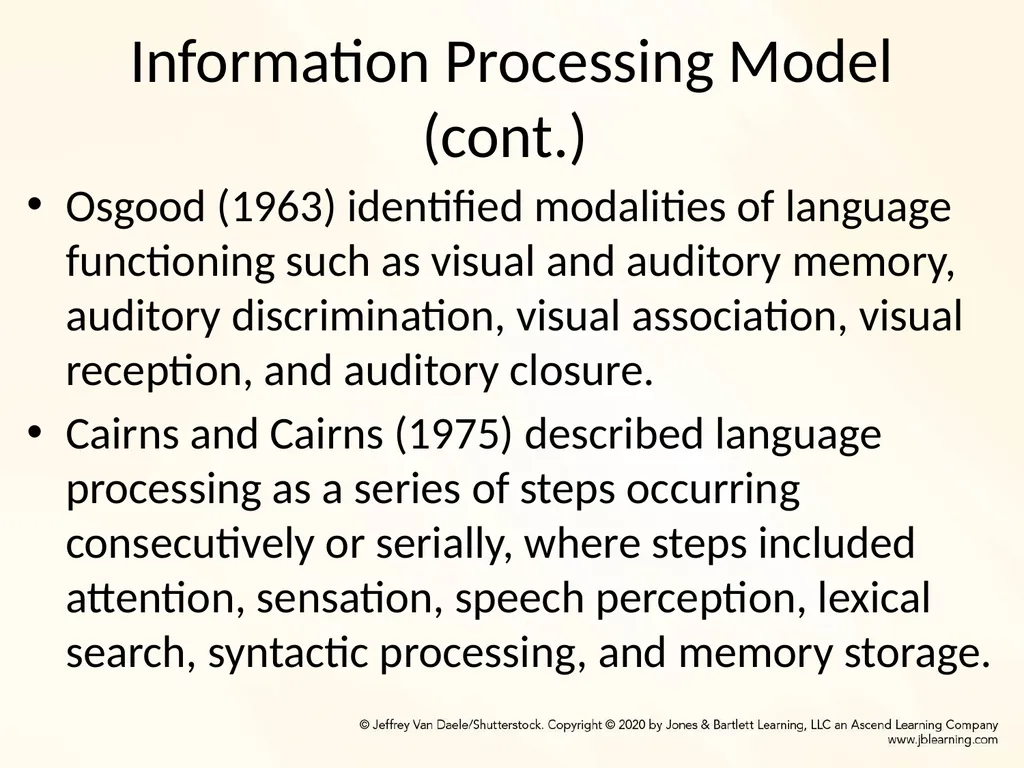
slide19. Information Processing Model (cont.) Osgood (1963) identified modalities of language functioning such as visual and auditory memory, auditory discrimination, visual association, visual reception, and auditory closure.
Cairns and Cairns (1975) described language processing as a series of steps occurring consecutively or serially, where steps included attention, sensation, speech perception, lexical search, syntactic processing, and memory storage.<br>
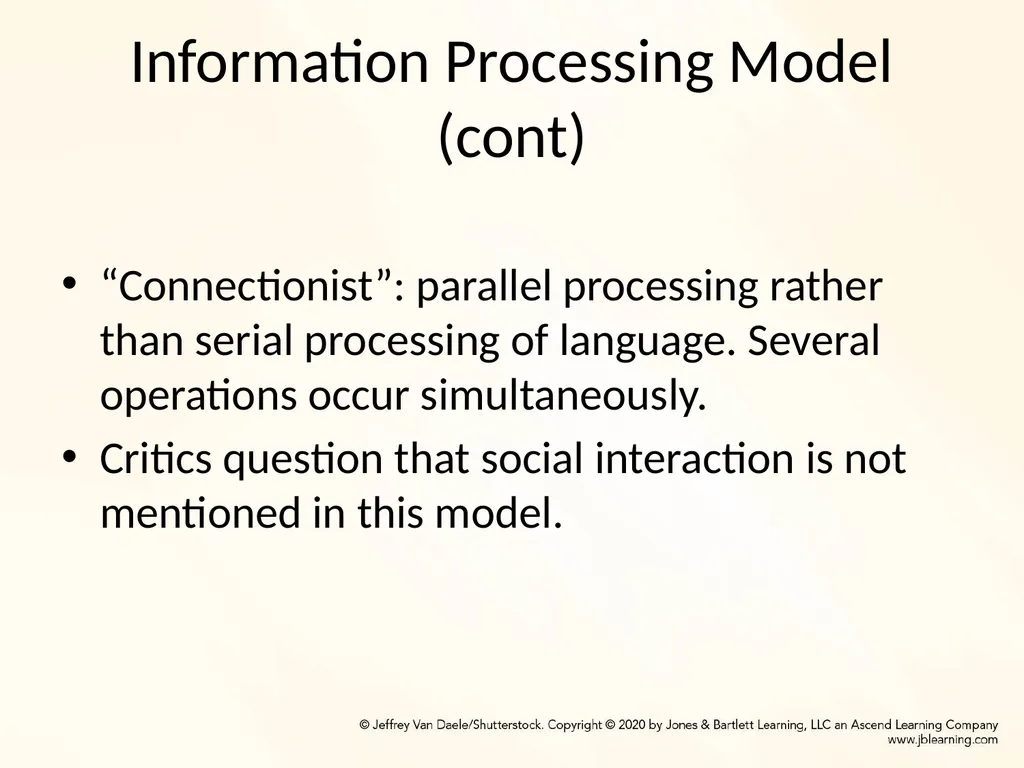
slide20. Information Processing Model (cont) “Connectionist”: parallel processing rather than serial processing of language. Several operations occur simultaneously.
Critics question that social interaction is not mentioned in this model.<br>
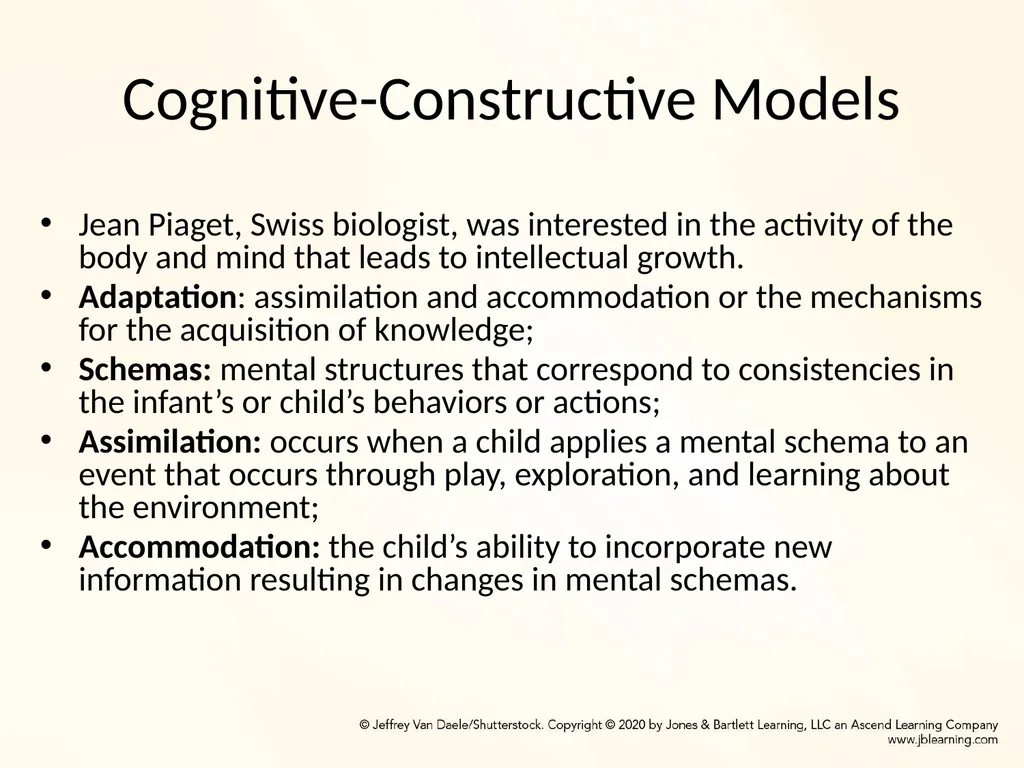
slide21. Cognitive-Constructive Models Jean Piaget, Swiss biologist, was interested in the activity of the body and mind that leads to intellectual growth.
Adaptation: assimilation and accommodation or the mechanisms for the acquisition of knowledge;
Schemas: mental structures that correspond to consistencies in the infant’s or child’s behaviors or actions;
Assimilation: occurs when a child applies a mental schema to an event that occurs through play, exploration, and learning about the environment;
Accommodation: the child’s ability to incorporate new information resulting in changes in mental schemas.<br>
slide22. Cognitive-Constructivist Model (cont.) Learning is accomplished throughout the lifespan by active participation of infants, children, and adults according to the Piagetian perspective.
Traditional Piagetian view maintains a direct relationship between cognitive prerequisites for early word learning (the sensorimotor period), which is the first ____ years of life.<br>
slide23. Implications from an Information Processing Perspective for Understanding, Assessing, and Treating Children with Language Disorders This model serves as the impetus for assessment tools that examine the different levels of language functioning (receptive, expressive, and associative) and different modalities of language (verbal, auditory, and visual)
ITPA
Fast Forward and auditory integration training<br>
slide24. Implications from a Cognitive-Constructivist Perspective for Understanding, Assessing, and Treating Children with Language Disorders Understanding, Assessing, and Treating Children with Language Disorders
Assessment of sensorimotor stages of development (object permanence, means-end behavior, and causality)
Children’s play is a rich source of information about their ideas and schemas and overall cognitive achievement.
This also help SLPs realize that teaching language through play has a critical role.<br>
slide25. Interactionist: Social Interactionist Paradigm Social-Cognitive Models
Social-Pragmatic Models
Intentionality Model<br>
slide26. Social-Cognitive Models According to Vygotsky (1986), children’s cognitive development resulted from interaction between children’s innate skills and their social experiences with peers, adults, and the culture in general.
“Zone of proximal development” – the area between what a child can accomplish independently and what he can accomplish with another person who has greater knowledge, experience, or skill in that area
“Private Speech”: when a child and an adult engage in a dialogue while collaborating on a task, the information can be stored away by the child for future use and can be used as a tool to guide and direct problem-solving and other cognitive activities.<br>
slide27. Social-Cognitive Models (cont.) Bruner (1975, 1977) suggested that when caregivers and their infants engage in joint referencing, they share a common focus of interest that contributes to language acquisition.
“Cracking the linguistic code” includes 3 mechanisms:
Indicating: (gesture, postural, vocal) to get attention
Deictic terms: Caregivers incorporate spatial and contextual cues to assist children in understanding (this, here, that, you, me).
Naming: when the child can associate a label with a referent, which is accomplished receptively before it is accomplished expressively<br>
slide28. Social-Cognitive Models (cont.) Scaffolding - caregivers facilitate language learning and dialogue. They adjust the degree of linguistic and nonlinguistic support that they offer to children as they are learning language.
Tomasello (2003) stated that pointing gestures are a critical part of the system of shared intentionality.
Pointing helps establish joint attention and serves to influence how others think, act, or feel.
Goldin-Meadow (2007) suggests that pointing at 14 months is a better predictor of lexical vocabulary than the speech of the caregiver.
Pointing could help segue into syntax (child: “eat” + point at cookie). Months later, the child will say, “eat cookie.”<br>
slide29. Social-Pragmatic Models Pragmatics is concerned with functions of language, speaker-listener roles, conversational discourse, and presupposition.
Three types of speech acts are:
Perlocutions: how listeners interpret speakers speech acts
Illocutions: the intentions of the speaker
Locutions: the meanings expressed in the utterance<br>
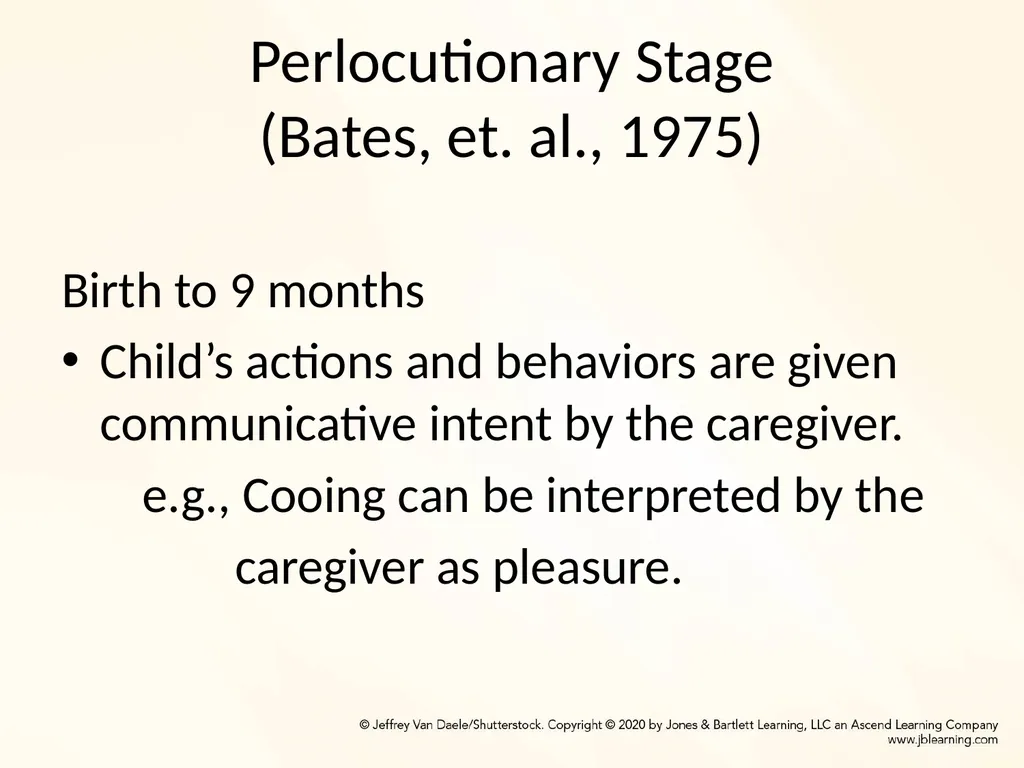
slide30. Perlocutionary Stage (Bates, et. al., 1975) Birth to 9 months
Child’s actions and behaviors are given communicative intent by the caregiver.
e.g., Cooing can be interpreted by the
caregiver as pleasure.<br>
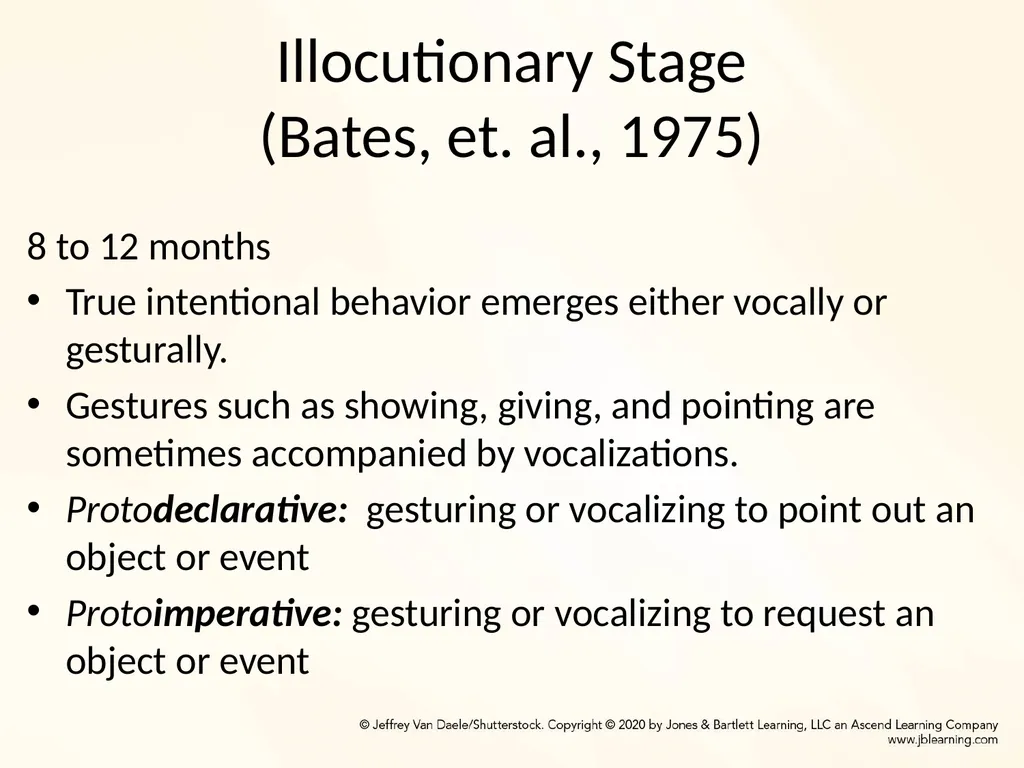
slide31. Illocutionary Stage (Bates, et. al., 1975) 8 to 12 months
True intentional behavior emerges either vocally or gesturally.
Gestures such as showing, giving, and pointing are sometimes accompanied by vocalizations.
Protodeclarative: gesturing or vocalizing to point out an object or event
Protoimperative: gesturing or vocalizing to request an object or event<br>
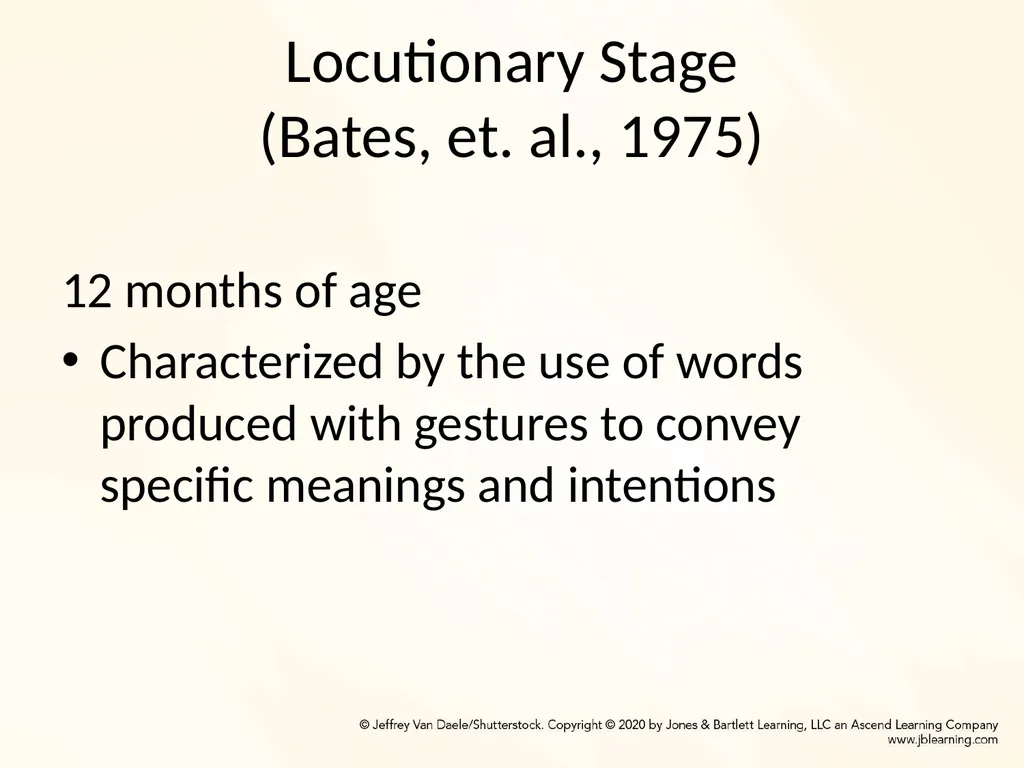
slide32. Locutionary Stage (Bates, et. al., 1975) 12 months of age
Characterized by the use of words produced with gestures to convey specific meanings and intentions<br>
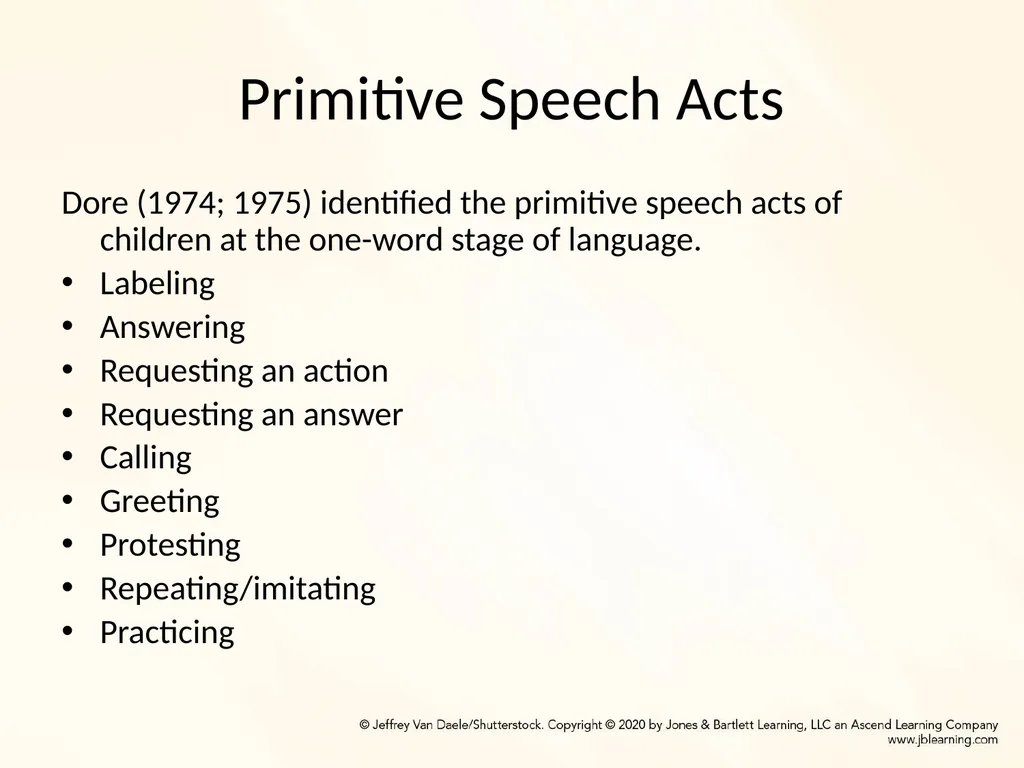
slide33. Primitive Speech Acts Dore (1974; 1975) identified the primitive speech acts of children at the one-word stage of language.
Labeling
Answering
Requesting an action
Requesting an answer
Calling
Greeting
Protesting
Repeating/imitating
Practicing<br>
slide34. Child-Directed Speech (CDS) Formerly known as “motherese”
Adults speak differently to children
Utterances directed to children are shorter in length, simpler in grammatical complexity, and slower in rate of speech
Fewer verbs, fewer tense markers, vocabulary is less diverse and more concrete
Higher fundamental frequency, exaggerated stress, wider range of intonation, and more distinct pausing
CDS makes semantics, syntactic, phonological, and pragmatic information more accessible to the young infant<br>
slide35. Implications from a Social-Cognitive and Social Pragmatic Perspective for Understanding, Assessing, and Treating Children with Language Disorders Intervention goals embraced prelinguistic precursors to language, functions of language, conversational skills, adjacency and contingency, discourse genres, communication repair, listener adaptation, and social-emotional underpinnings of language.
Social-pragmatic perspectives had a particular impact on the assessment and treatment of children with ASD.<br>
slide36. Intentionality Model A contemporary model that reflects an integrated perspective on the developmental language process
Bloom and Lahey (1978): The view of language as the integration of form (phonology, morphology, syntax), content (semantics), and use (pragmatics) was translated into assessment and intervention paradigms (Lahey, 1988).
Bloom and Tinker (2001) added two broader developmental domains to the original model: engagement (social and emotional development) & effort (cognitive development).<br>
slide37. Bloom and Tinker’s Model (2001) The child’s actions in the world (sensorimotor actions, emotional displays, play, and speech) as well as her acts of interpretation and expression of language lead to the development of new representations or the mental contents of her mind.
The child’s participation in a social world depends on and is promoted by these acts of expression and interpretation between the child and caregiver.<br>
slide38. Implications from the Intentionality Model for Understanding, Assessing, and Treating Children with Language Disorders The Bloom and Tinker (2001) Intentionality Model addresses disorders of language relative to the area/s of language that are compromised rather than from a categorical or etiological framework.
SLPs can view challenges in language from two dynamic developmental domains: effort and engagement.<br>
slide39. Science of Child Development in 2012 Language acquisition can be placed in a broader scientific and developmental context, which serves as another source for intervention implications.
National Scientific Council on the Developing Child<br>
slide40. National Research Council & Institute of Medicine, 2000 “Early experiences determine whether a child’s developing brain architecture provides a strong or weak foundation for all future learning, behavior, or health.”
Early intervention has the potential to change brain circuitry.<br>
slide41. National Research Council & Institute of Medicine, 2000, p. 8 “The interactive influences of genes and experience shape the architecture of the child’s developing brain.”
The “mutuality and reciprocity” typical in the “serve and return” nature of early interactions is key to children’s development and key in the construction of intervention goals and strategies.<br>
slide42. National Research Council & Institute of Medicine, 2000 “Brain architecture and the skills that come with development are built “from the bottom up,” with simpler developments serving as the foundations for more advanced ones.”
A solid understanding of the developmental steps within any particular domain (language, affect, cognition) and a commitment to developmentally expanding the child’s repertoire of skills is the logical implication of this finding.<br>
slide43. National Research Council & Institute of Medicine, 2000 (cont.) “Cognitive, emotional, and social capabilities are inextricably intertwined throughout the life course, and their interactive relationship develops in a continuous process over time.”
The SLP must consider other developmental domains when planning intervention.<br>
slide44. Study Questions How does the traditional nature-nurture debate relate to the study of language acquisition?
Describe how interactionist theories have influenced the field of speech-language pathology.
Describe the components of Bloom and Tinker’s (2001) intentionality model.
Discuss why it is important to use a theoretical model to understand language development in clinical practice.
With reference to a particular child, describe how this discussion of specific theories would affect your approach to assessment and/or intervention.<br>
slide2. Theories of Language Acquisition Descriptive adequacy: clues about what language knowledge is
Explanatory adequacy: the mechanisms of language learning or “how” language is learned<br>
slide3. Nature vs. Nurture Nature: internal wiring of the child for language development
Nurture: environmental input the child receives to learn language<br>
slide4. Nature: Rationalist Paradigm The processes of human intellect (sensation, perception, thinking, and problem solving) are characterized by principles of organization.
Biological Bases
Transformational Generative Grammar
Developmental Psycholinguistics
Government Binding – Principles and Parameters
Minimalist Program
A Contemporary View<br>
slide5. Biological Bases Eric Lenneberg (1967) was a psychologist that observed that language is biologically based: Language has the following properties:
Little variation within the species (language is systematic)
Specific organic correlates (universal timetable for acquisition of language milestones)
Heredity (innate capacity for language)
No history within species (inherently human phenomenon)<br>
slide6. Transformational Generative Grammar - Chomsky Early view (1965): the child brought a language acquisition device (LAD) armed with linguistic universals to the task of language learning. This is also known as linguistic competence. Linguistic creativity is the ability create a potentially infinite number of novel utterances.
The child operates as a “mini-linguist.”<br>
slide7. Developmental Psycholinguistics Described how language knowledge is used as well as how language acquisition takes place.
Child language researchers obtained language samples and derived rules that children use at the earliest stages of development.
The data provided information about the emergence and use of grammatical morphology and described the gradual acquisition of 14 grammatical morphemes (Brown, 1973).
Bloom (1970) shifted the thinking to the role of semantics in the acquisition of grammar.<br>
slide8. Government Binding – Principles and Parameters Chomsky (1982) – idiosyncratic patterns of particular languages were captured in “parameters,” which were set differently for different languages.<br>
slide9. Minimalist Program Chomsky (2002) scaled down the versions of the Extended Standard Theory and Government Binding Theory.
Inclusion of a level of representation for meaning and a level of representation for sound<br>
slide10. Contemporary View Innate Mechanisms Necessary for Language to Take Place (Pinker, 2006)
Cognition (representational function)
Metacognitive control (executive functioning)
“Theory of mind” (language instinct)<br>
slide11. Implications from a Nature Perspective For Understanding Children with Language Disorders Possible deficits in:
Language faculty the child brings to language learning
Language processor the child brings to language learning
Ability to convert linguistic input into meaningful information that will enable the child to construct a grammar (Leonard, 1992)<br>
slide12. Nurture: Behaviorist Paradigm Classical Conditioning
Operant Conditioning<br>
slide13. Classical Conditioning Pavlov (20th C. Russian physiologist): The dog would salivate upon the ringing of the bell.
An association (conditioned response) was formed between the bell and salivation where this did not previously exist.
The “unconditioned stimulus” was the meat powder, the bell was the “conditioned stimulus”, and the “conditioned response” was salivation.
The world of psychology was introduced to stimulus, response, paired association, and stimulus generalization.<br>
slide14. Operant Conditioning B.F. Skinner (1957) observed that the frequency of certain behaviors could be increased if positive reinforcers (or consequences) were contingent upon those behaviors
Baby cries ---- bottle<br>
slide15. Operant Conditioning (cont.) The intensity and frequency of a response will increase with reinforcement.
Language acquisition is viewed as the gradual or systematic reinforcement of desirable or target behaviors.<br>
slide16. Implications from a Nurture Perspective for Understanding, Assessing, and Treating Children with Language Disorders The impact of the behavioral paradigm on assessment and intervention has been pervasive in our field.
Behavioral observations; data driven descriptions; quantifications; measurements
ABA (Lovaas, 1977) - outgrowth of operant conditioning paradigm for language intervention<br>
slide17. Interactionist: Cognitive Interactionist Paradigm Information Processing Models
Cognitive-Constructivist Models<br>
slide18. Information Processing Models Broca and Gall were the first to try to locate language functions in the brain in the late 19th C. and early 20th C.
Connection between brain function and language was studied in individuals with brain injury, stroke, and, eventually, children with language disorders.
Cruickshank (1967) and Johnson & Mykelbust (1967) described brain function and modes of language processing as well as perceptual-motor aspects of childhood language disorders.<br>
slide19. Information Processing Model (cont.) Osgood (1963) identified modalities of language functioning such as visual and auditory memory, auditory discrimination, visual association, visual reception, and auditory closure.
Cairns and Cairns (1975) described language processing as a series of steps occurring consecutively or serially, where steps included attention, sensation, speech perception, lexical search, syntactic processing, and memory storage.<br>
slide20. Information Processing Model (cont) “Connectionist”: parallel processing rather than serial processing of language. Several operations occur simultaneously.
Critics question that social interaction is not mentioned in this model.<br>
slide21. Cognitive-Constructive Models Jean Piaget, Swiss biologist, was interested in the activity of the body and mind that leads to intellectual growth.
Adaptation: assimilation and accommodation or the mechanisms for the acquisition of knowledge;
Schemas: mental structures that correspond to consistencies in the infant’s or child’s behaviors or actions;
Assimilation: occurs when a child applies a mental schema to an event that occurs through play, exploration, and learning about the environment;
Accommodation: the child’s ability to incorporate new information resulting in changes in mental schemas.<br>
slide22. Cognitive-Constructivist Model (cont.) Learning is accomplished throughout the lifespan by active participation of infants, children, and adults according to the Piagetian perspective.
Traditional Piagetian view maintains a direct relationship between cognitive prerequisites for early word learning (the sensorimotor period), which is the first ____ years of life.<br>
slide23. Implications from an Information Processing Perspective for Understanding, Assessing, and Treating Children with Language Disorders This model serves as the impetus for assessment tools that examine the different levels of language functioning (receptive, expressive, and associative) and different modalities of language (verbal, auditory, and visual)
ITPA
Fast Forward and auditory integration training<br>
slide24. Implications from a Cognitive-Constructivist Perspective for Understanding, Assessing, and Treating Children with Language Disorders Understanding, Assessing, and Treating Children with Language Disorders
Assessment of sensorimotor stages of development (object permanence, means-end behavior, and causality)
Children’s play is a rich source of information about their ideas and schemas and overall cognitive achievement.
This also help SLPs realize that teaching language through play has a critical role.<br>
slide25. Interactionist: Social Interactionist Paradigm Social-Cognitive Models
Social-Pragmatic Models
Intentionality Model<br>
slide26. Social-Cognitive Models According to Vygotsky (1986), children’s cognitive development resulted from interaction between children’s innate skills and their social experiences with peers, adults, and the culture in general.
“Zone of proximal development” – the area between what a child can accomplish independently and what he can accomplish with another person who has greater knowledge, experience, or skill in that area
“Private Speech”: when a child and an adult engage in a dialogue while collaborating on a task, the information can be stored away by the child for future use and can be used as a tool to guide and direct problem-solving and other cognitive activities.<br>
slide27. Social-Cognitive Models (cont.) Bruner (1975, 1977) suggested that when caregivers and their infants engage in joint referencing, they share a common focus of interest that contributes to language acquisition.
“Cracking the linguistic code” includes 3 mechanisms:
Indicating: (gesture, postural, vocal) to get attention
Deictic terms: Caregivers incorporate spatial and contextual cues to assist children in understanding (this, here, that, you, me).
Naming: when the child can associate a label with a referent, which is accomplished receptively before it is accomplished expressively<br>
slide28. Social-Cognitive Models (cont.) Scaffolding - caregivers facilitate language learning and dialogue. They adjust the degree of linguistic and nonlinguistic support that they offer to children as they are learning language.
Tomasello (2003) stated that pointing gestures are a critical part of the system of shared intentionality.
Pointing helps establish joint attention and serves to influence how others think, act, or feel.
Goldin-Meadow (2007) suggests that pointing at 14 months is a better predictor of lexical vocabulary than the speech of the caregiver.
Pointing could help segue into syntax (child: “eat” + point at cookie). Months later, the child will say, “eat cookie.”<br>
slide29. Social-Pragmatic Models Pragmatics is concerned with functions of language, speaker-listener roles, conversational discourse, and presupposition.
Three types of speech acts are:
Perlocutions: how listeners interpret speakers speech acts
Illocutions: the intentions of the speaker
Locutions: the meanings expressed in the utterance<br>
slide30. Perlocutionary Stage (Bates, et. al., 1975) Birth to 9 months
Child’s actions and behaviors are given communicative intent by the caregiver.
e.g., Cooing can be interpreted by the
caregiver as pleasure.<br>
slide31. Illocutionary Stage (Bates, et. al., 1975) 8 to 12 months
True intentional behavior emerges either vocally or gesturally.
Gestures such as showing, giving, and pointing are sometimes accompanied by vocalizations.
Protodeclarative: gesturing or vocalizing to point out an object or event
Protoimperative: gesturing or vocalizing to request an object or event<br>
slide32. Locutionary Stage (Bates, et. al., 1975) 12 months of age
Characterized by the use of words produced with gestures to convey specific meanings and intentions<br>
slide33. Primitive Speech Acts Dore (1974; 1975) identified the primitive speech acts of children at the one-word stage of language.
Labeling
Answering
Requesting an action
Requesting an answer
Calling
Greeting
Protesting
Repeating/imitating
Practicing<br>
slide34. Child-Directed Speech (CDS) Formerly known as “motherese”
Adults speak differently to children
Utterances directed to children are shorter in length, simpler in grammatical complexity, and slower in rate of speech
Fewer verbs, fewer tense markers, vocabulary is less diverse and more concrete
Higher fundamental frequency, exaggerated stress, wider range of intonation, and more distinct pausing
CDS makes semantics, syntactic, phonological, and pragmatic information more accessible to the young infant<br>
slide35. Implications from a Social-Cognitive and Social Pragmatic Perspective for Understanding, Assessing, and Treating Children with Language Disorders Intervention goals embraced prelinguistic precursors to language, functions of language, conversational skills, adjacency and contingency, discourse genres, communication repair, listener adaptation, and social-emotional underpinnings of language.
Social-pragmatic perspectives had a particular impact on the assessment and treatment of children with ASD.<br>
slide36. Intentionality Model A contemporary model that reflects an integrated perspective on the developmental language process
Bloom and Lahey (1978): The view of language as the integration of form (phonology, morphology, syntax), content (semantics), and use (pragmatics) was translated into assessment and intervention paradigms (Lahey, 1988).
Bloom and Tinker (2001) added two broader developmental domains to the original model: engagement (social and emotional development) & effort (cognitive development).<br>
slide37. Bloom and Tinker’s Model (2001) The child’s actions in the world (sensorimotor actions, emotional displays, play, and speech) as well as her acts of interpretation and expression of language lead to the development of new representations or the mental contents of her mind.
The child’s participation in a social world depends on and is promoted by these acts of expression and interpretation between the child and caregiver.<br>
slide38. Implications from the Intentionality Model for Understanding, Assessing, and Treating Children with Language Disorders The Bloom and Tinker (2001) Intentionality Model addresses disorders of language relative to the area/s of language that are compromised rather than from a categorical or etiological framework.
SLPs can view challenges in language from two dynamic developmental domains: effort and engagement.<br>
slide39. Science of Child Development in 2012 Language acquisition can be placed in a broader scientific and developmental context, which serves as another source for intervention implications.
National Scientific Council on the Developing Child<br>
slide40. National Research Council & Institute of Medicine, 2000 “Early experiences determine whether a child’s developing brain architecture provides a strong or weak foundation for all future learning, behavior, or health.”
Early intervention has the potential to change brain circuitry.<br>
slide41. National Research Council & Institute of Medicine, 2000, p. 8 “The interactive influences of genes and experience shape the architecture of the child’s developing brain.”
The “mutuality and reciprocity” typical in the “serve and return” nature of early interactions is key to children’s development and key in the construction of intervention goals and strategies.<br>
slide42. National Research Council & Institute of Medicine, 2000 “Brain architecture and the skills that come with development are built “from the bottom up,” with simpler developments serving as the foundations for more advanced ones.”
A solid understanding of the developmental steps within any particular domain (language, affect, cognition) and a commitment to developmentally expanding the child’s repertoire of skills is the logical implication of this finding.<br>
slide43. National Research Council & Institute of Medicine, 2000 (cont.) “Cognitive, emotional, and social capabilities are inextricably intertwined throughout the life course, and their interactive relationship develops in a continuous process over time.”
The SLP must consider other developmental domains when planning intervention.<br>
slide44. Study Questions How does the traditional nature-nurture debate relate to the study of language acquisition?
Describe how interactionist theories have influenced the field of speech-language pathology.
Describe the components of Bloom and Tinker’s (2001) intentionality model.
Discuss why it is important to use a theoretical model to understand language development in clinical practice.
With reference to a particular child, describe how this discussion of specific theories would affect your approach to assessment and/or intervention.<br>