
Chapter 2 – Ohm's Law: Resistance In this chapter,
AM
Published · 29 slides · 0 views
1 / 1



Description
Chapter 2 Ohms Law: Resistance In this chapter, you will... Take look at Ohm law Use Ohms Law in circuit design. Learn how to read resistor color codes. Make use of a multimeter. Master series and parallel circuits. Your first
Related Topics
Share
Embed code
Download this presentation From Below
"Chapter 2 – Ohm's Law: Resistance In this chapter," is the property of its rightful owner. Permission is granted to download and print the materials on this website for personal, non-commercial use only, and to display it on your personal computer provided you do not modify the materials and that you retain all copyright notices contained in the materials. By downloading content from our website, you accept the terms of this agreement.
Presentation Transcript
01
Chapter 2 – Ohm's Law: Resistance In this chapter, you will...
Take look at Ohm law
Use Ohm's Law in circuit design.
Learn how to read resistor color codes.
Make use of a multimeter.
Master series and parallel circuits. Your first exploration into the world of electronics components will invariably include the humble resistor. This component is by far the simplest – a resistor impedes the flow of current. Ohm's Law is a physical law. It connects voltage, current, and resistance in a very elegant way. With Ohm's Law, you can evaluate series and parallel circuits with ease. All loads may be represented by an equivalent resistance. A load is the circuit or device being powered. Ohm's Law makes dealing with loads easy. You only need multiplication and division to calculate.<br>
02
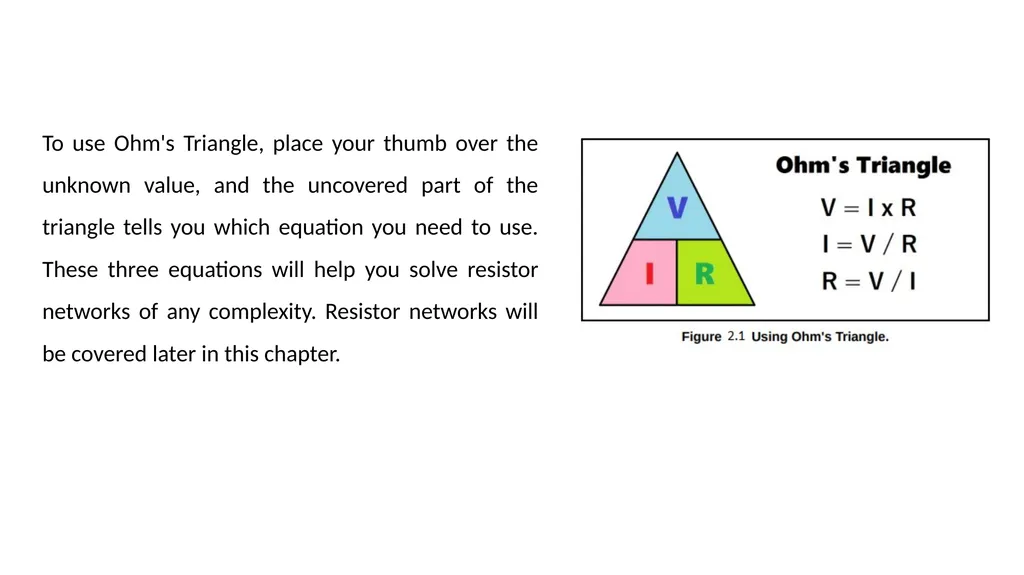
Chapter 2.1: Connecting Voltage, Current, and Resistance Together We have already discussed voltage and current in Chapter 1, which have units of volts and amperes, respectively. Resistors also have a unit of measure, and this is the ohm, represented by the Greek letter omega ( Ω ). Resistors come in a huge variety of fixed values from zero ohms all the way up to millions of ohms. Ohm's Law is a powerful tool. Using Ohm's Law, you will be able to calculate unknown values when you analyze or design circuits. For example, you might need a resistor to limit current for an LED to operate properly. Even some sensors are just specialized resistors! Ohm's Law is usually depicted as the triangle diagram shown below in Figure 2.1. Remember that capital I stands for current.<br>
03
To use Ohm's Triangle, place your thumb over the unknown value, and the uncovered part of the triangle tells you which equation you need to use. These three equations will help you solve resistor networks of any complexity. Resistor networks will be covered later in this chapter.<br>
04
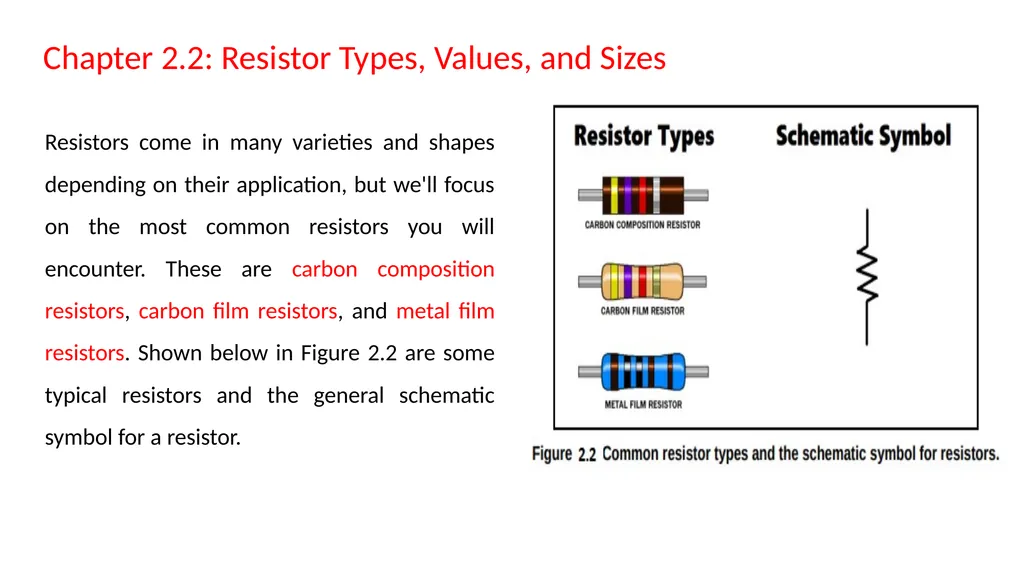
Chapter 2.2: Resistor Types, Values, and Sizes Resistors come in many varieties and shapes depending on their application, but we'll focus on the most common resistors you will encounter. These are carbon composition resistors, carbon film resistors, and metal film resistors. Shown below in Figure 2.2 are some typical resistors and the general schematic symbol for a resistor.<br>
05
Carbon Composition Resistors
An older type of resistor is the carbon composition resistor. It is made by pressing resistive material with a plastic binder into a small rod. By varying the amount of resistive material mixed with the binder, the resistance can be changed. Carbon composition resistors are cheaper to make, less accurate, and in some cases produce electrical noise. Therefore, they are mostly used for noncritical applications. Carbon composition resistors come in a cylindrical package (as opposed to the peanut shaped packages of carbon film and metal film resistors) and are usually dark brown in color. Carbon Film Resistors
Carbon film resistors are made by covering a ceramic rod with carbon film and precisely cutting it away with a laser until the desired resistance is achieved. Their construction makes them less prone to thermal effects. Therefore, they are better suited for applications where accuracy and low-noise are important. Carbon film resistors are usually beige in color, and vaguely peanut-shaped. Most commonly, they are available in tolerances of 5% (gold band,) which is fine for most applications.<br>
06
Metal Film Resistors
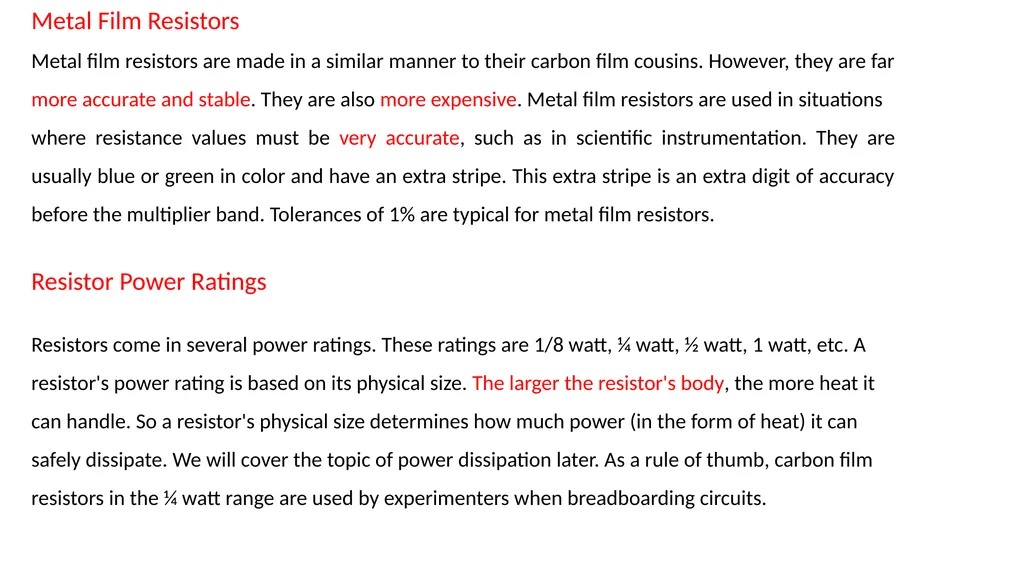
Metal film resistors are made in a similar manner to their carbon film cousins. However, they are far
more accurate and stable. They are also more expensive. Metal film resistors are used in situations
where resistance values must be very accurate, such as in scientific instrumentation. They are usually blue or green in color and have an extra stripe. This extra stripe is an extra digit of accuracy before the multiplier band. Tolerances of 1% are typical for metal film resistors. Resistor Power Ratings
Resistors come in several power ratings. These ratings are 1/8 watt, ¼ watt, ½ watt, 1 watt, etc. A
resistor's power rating is based on its physical size. The larger the resistor's body, the more heat it
can handle. So a resistor's physical size determines how much power (in the form of heat) it can
safely dissipate. We will cover the topic of power dissipation later. As a rule of thumb, carbon film
resistors in the ¼ watt range are used by experimenters when breadboarding circuits.<br>
07
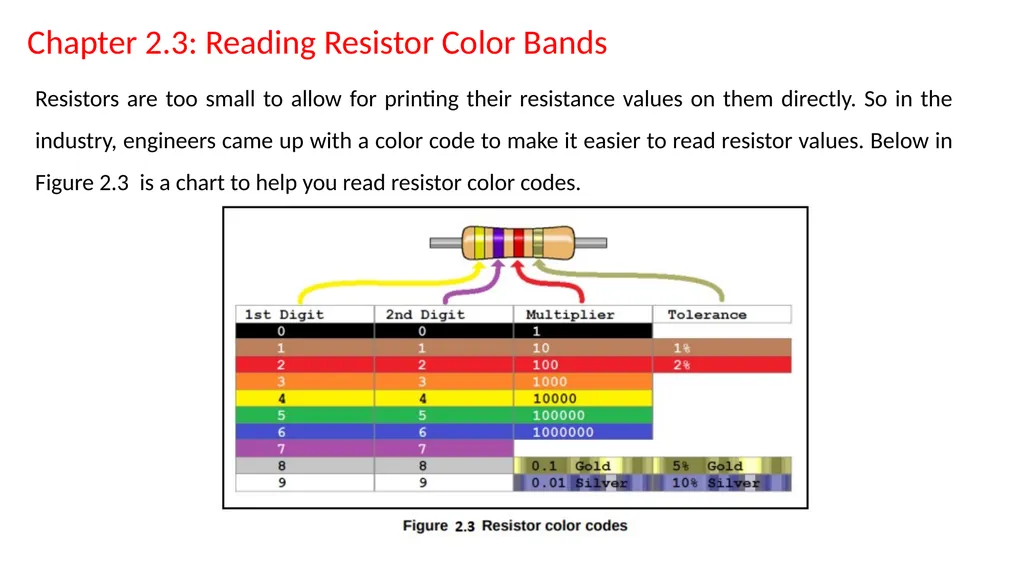
Chapter 2.3: Reading Resistor Color Bands Resistors are too small to allow for printing their resistance values on them directly. So in the industry, engineers came up with a color code to make it easier to read resistor values. Below in Figure 2.3 is a chart to help you read resistor color codes.<br>
08
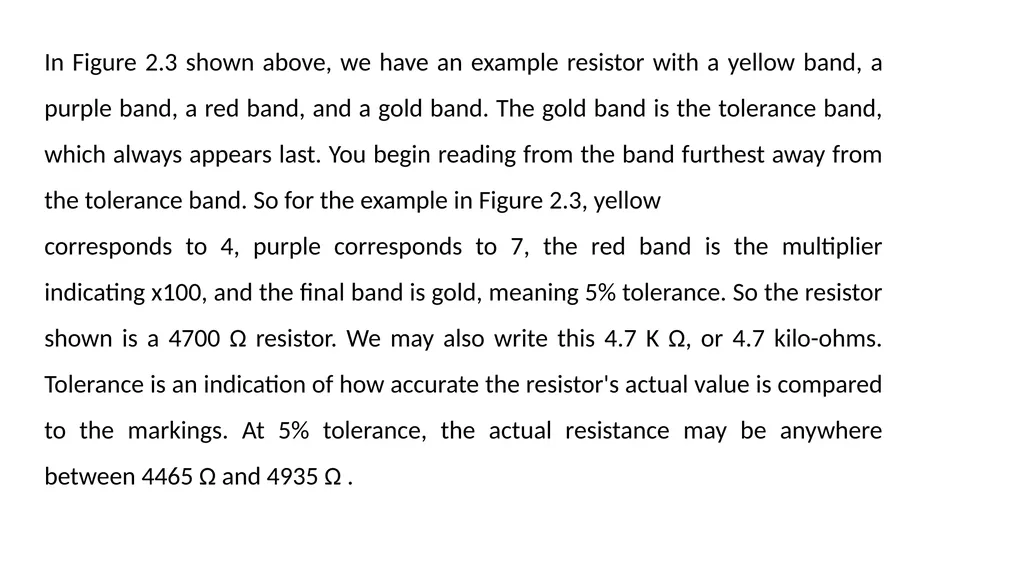
In Figure 2.3 shown above, we have an example resistor with a yellow band, a purple band, a red band, and a gold band. The gold band is the tolerance band, which always appears last. You begin reading from the band furthest away from the tolerance band. So for the example in Figure 2.3, yellow
corresponds to 4, purple corresponds to 7, the red band is the multiplier indicating x100, and the final band is gold, meaning 5% tolerance. So the resistor shown is a 4700 Ω resistor. We may also write this 4.7 K Ω, or 4.7 kilo-ohms. Tolerance is an indication of how accurate the resistor's actual value is compared to the markings. At 5% tolerance, the actual resistance may be anywhere between 4465 Ω and 4935 Ω .<br>
corresponds to 4, purple corresponds to 7, the red band is the multiplier indicating x100, and the final band is gold, meaning 5% tolerance. So the resistor shown is a 4700 Ω resistor. We may also write this 4.7 K Ω, or 4.7 kilo-ohms. Tolerance is an indication of how accurate the resistor's actual value is compared to the markings. At 5% tolerance, the actual resistance may be anywhere between 4465 Ω and 4935 Ω .<br>
09
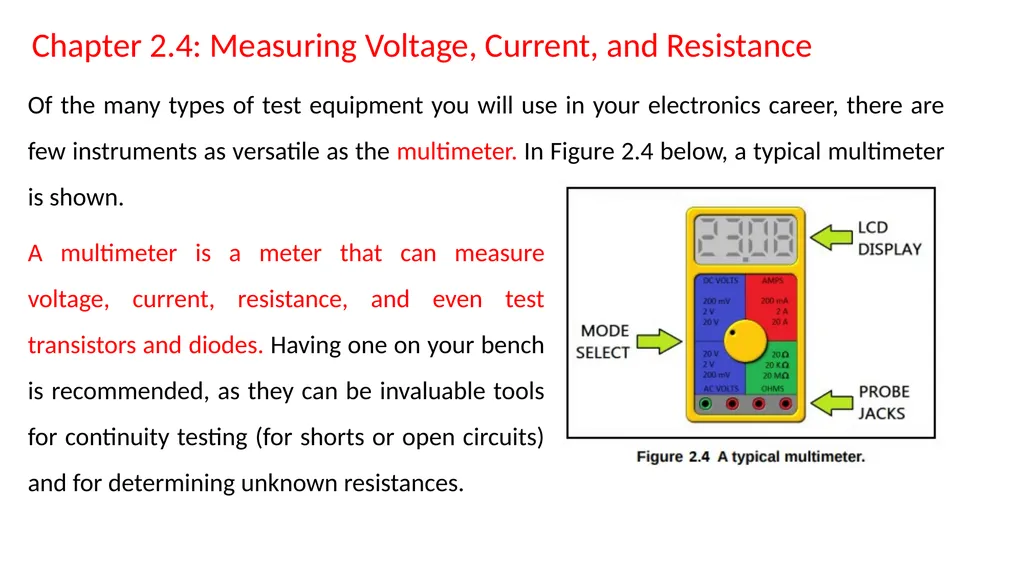
Chapter 2.4: Measuring Voltage, Current, and Resistance Of the many types of test equipment you will use in your electronics career, there are few instruments as versatile as the multimeter. In Figure 2.4 below, a typical multimeter is shown. A multimeter is a meter that can measure voltage, current, resistance, and even test transistors and diodes. Having one on your bench is recommended, as they can be invaluable tools for continuity testing (for shorts or open circuits) and for determining unknown resistances.<br>
10
Using a Multimeter to Measure Resistance
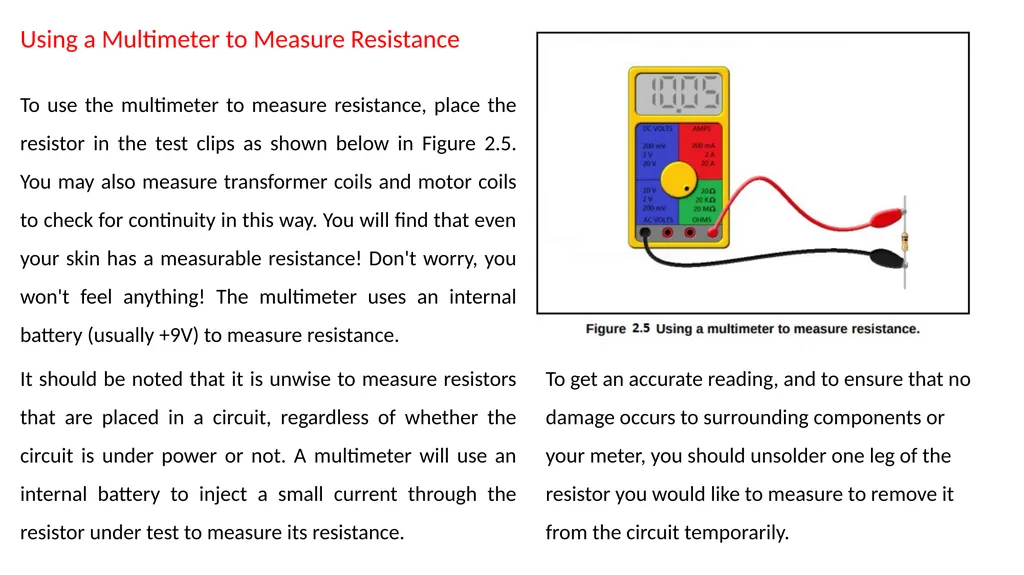
To use the multimeter to measure resistance, place the resistor in the test clips as shown below in Figure 2.5. You may also measure transformer coils and motor coils to check for continuity in this way. You will find that even your skin has a measurable resistance! Don't worry, you won't feel anything! The multimeter uses an internal battery (usually +9V) to measure resistance. It should be noted that it is unwise to measure resistors that are placed in a circuit, regardless of whether the circuit is under power or not. A multimeter will use an internal battery to inject a small current through the resistor under test to measure its resistance. To get an accurate reading, and to ensure that no damage occurs to surrounding components or your meter, you should unsolder one leg of the resistor you would like to measure to remove it from the circuit temporarily.<br>
To use the multimeter to measure resistance, place the resistor in the test clips as shown below in Figure 2.5. You may also measure transformer coils and motor coils to check for continuity in this way. You will find that even your skin has a measurable resistance! Don't worry, you won't feel anything! The multimeter uses an internal battery (usually +9V) to measure resistance. It should be noted that it is unwise to measure resistors that are placed in a circuit, regardless of whether the circuit is under power or not. A multimeter will use an internal battery to inject a small current through the resistor under test to measure its resistance. To get an accurate reading, and to ensure that no damage occurs to surrounding components or your meter, you should unsolder one leg of the resistor you would like to measure to remove it from the circuit temporarily.<br>
11
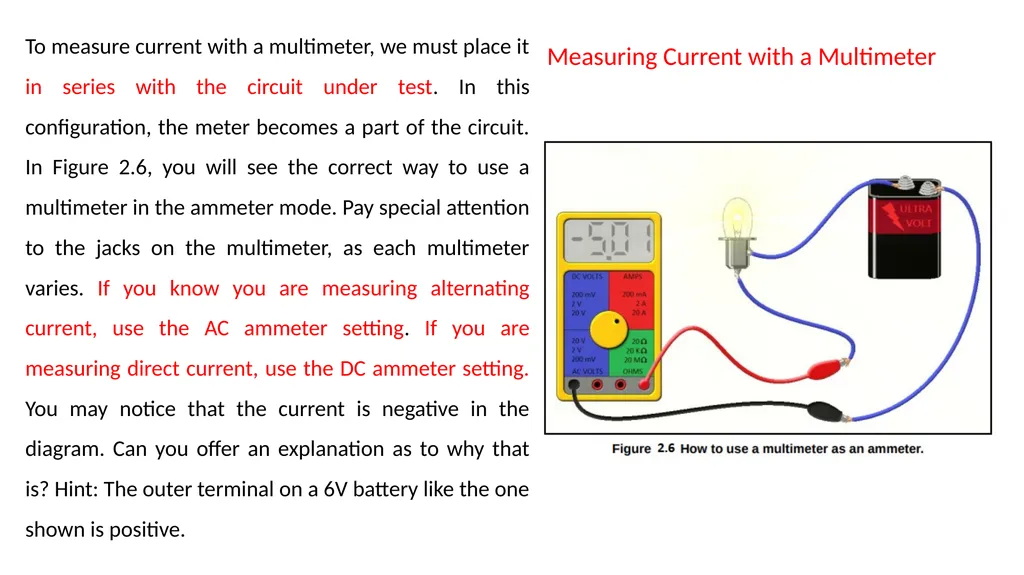
Measuring Current with a Multimeter To measure current with a multimeter, we must place it in series with the circuit under test. In this configuration, the meter becomes a part of the circuit. In Figure 2.6, you will see the correct way to use a multimeter in the ammeter mode. Pay special attention to the jacks on the multimeter, as each multimeter varies. If you know you are measuring alternating current, use the AC ammeter setting. If you are measuring direct current, use the DC ammeter setting. You may notice that the current is negative in the diagram. Can you offer an explanation as to why that is? Hint: The outer terminal on a 6V battery like the one shown is positive.<br>
12
There is usually more than one positive (red) jack for your test leads on the front panel of the multimeter. The jacks on a multimeter are fused for protecting the meter during current measurements. So make sure you are using the right jack for the circuit under test and for the current mode setting on your meter. Failure to do so may blow a fuse in the meter, or worse. For example, if you are in 10 Amp mode, use the jack marked “10 A.” And finally, be aware that if you place the test clips in the circuit backwards in DC ammeter mode, you will not hurt the meter. You will instead see a negative current indication.<br>
13
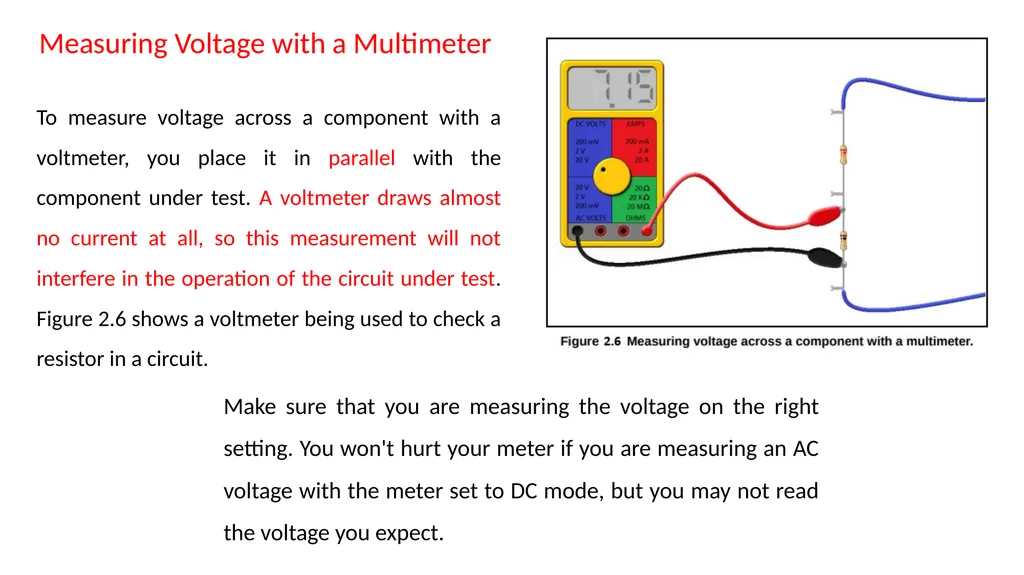
To measure voltage across a component with a voltmeter, you place it in parallel with the component under test. A voltmeter draws almost no current at all, so this measurement will not interfere in the operation of the circuit under test. Figure 2.6 shows a voltmeter being used to check a resistor in a circuit. Measuring Voltage with a Multimeter Make sure that you are measuring the voltage on the right setting. You won't hurt your meter if you are measuring an AC voltage with the meter set to DC mode, but you may not read the voltage you expect.<br>
14
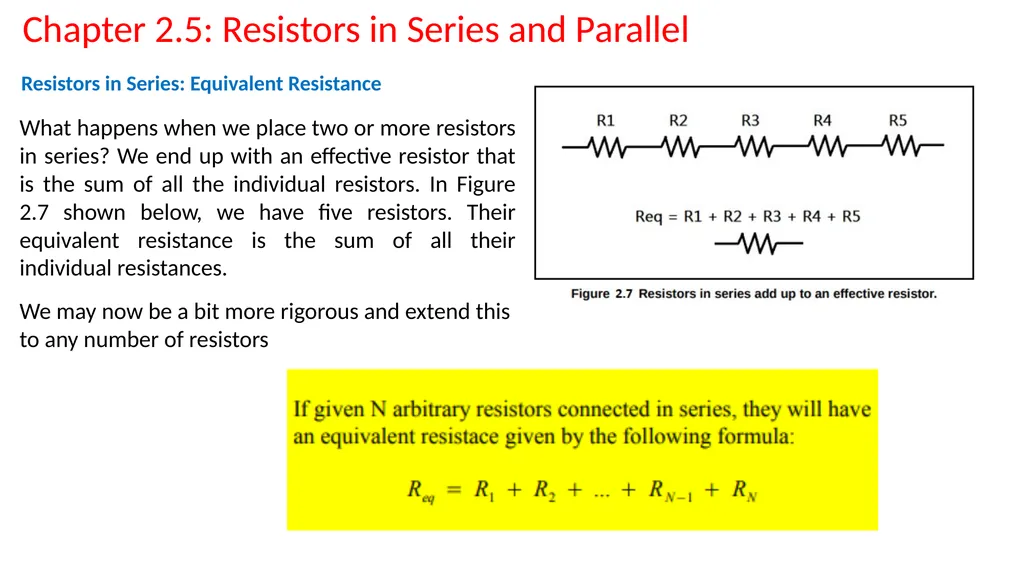
Chapter 2.5: Resistors in Series and Parallel Resistors in Series: Equivalent Resistance What happens when we place two or more resistors in series? We end up with an effective resistor that is the sum of all the individual resistors. In Figure 2.7 shown below, we have five resistors. Their equivalent resistance is the sum of all their individual resistances. We may now be a bit more rigorous and extend this to any number of resistors<br>
15
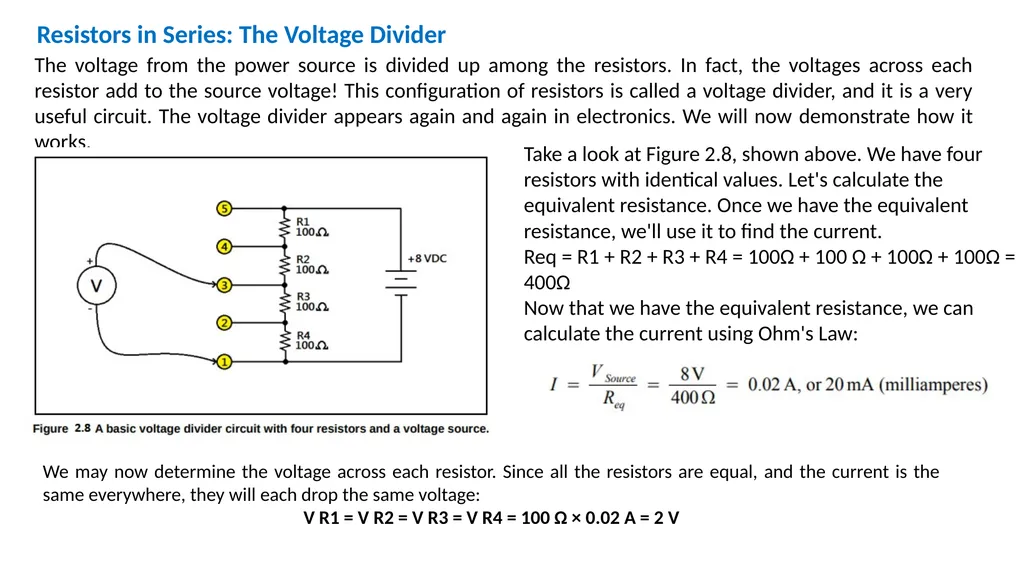
Resistors in Series: The Voltage Divider The voltage from the power source is divided up among the resistors. In fact, the voltages across each resistor add to the source voltage! This configuration of resistors is called a voltage divider, and it is a very useful circuit. The voltage divider appears again and again in electronics. We will now demonstrate how it works. Take a look at Figure 2.8, shown above. We have four resistors with identical values. Let's calculate the equivalent resistance. Once we have the equivalent resistance, we'll use it to find the current.
Req = R1 + R2 + R3 + R4 = 100Ω + 100 Ω + 100Ω + 100Ω = 400Ω
Now that we have the equivalent resistance, we can calculate the current using Ohm's Law: We may now determine the voltage across each resistor. Since all the resistors are equal, and the current is the same everywhere, they will each drop the same voltage:
V R1 = V R2 = V R3 = V R4 = 100 Ω × 0.02 A = 2 V<br>
16
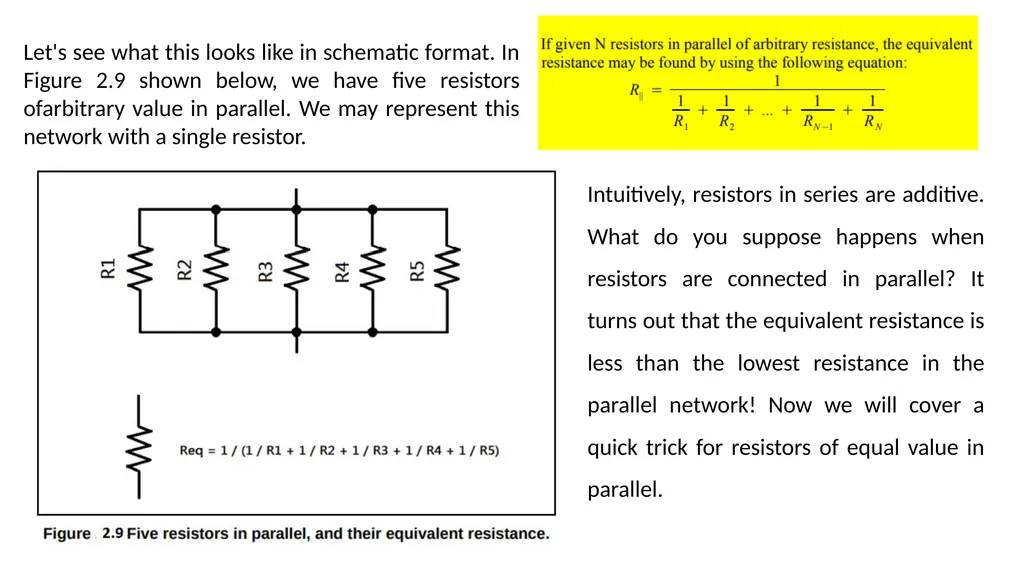
Therefore, if we measure between points 1 and 2, points 2 and 3, points 3 and 4, and points 4 and 5, we will measure 2 V every time. If we measure at points 1 and 3, what happens? We get the voltage across R4 plus the voltage across R3, or 4 V. And what about point 1 and point 4? We measure 6 V. We have divided the source voltage down to 2 V, 4 V, and 6 V if we measure with respect to point 1. Of course, the voltage between point 1 and point 5 is just 8 V, the source voltage. Resistors in Parallel: Equivalent Resistance Finding the equivalent resistance for resistors in parallel is a little trickier. Because we end up with a current divider, the approach to the problem is a little more complex. We have to take the reciprocal of the sum of the reciprocals of the resistances. Let's look at the equation for resistors in parallel.<br>
17
Let's see what this looks like in schematic format. In Figure 2.9 shown below, we have five resistors ofarbitrary value in parallel. We may represent this network with a single resistor. Intuitively, resistors in series are additive. What do you suppose happens when resistors are connected in parallel? It turns out that the equivalent resistance is less than the lowest resistance in the parallel network! Now we will cover a quick trick for resistors of equal value in parallel.<br>
18
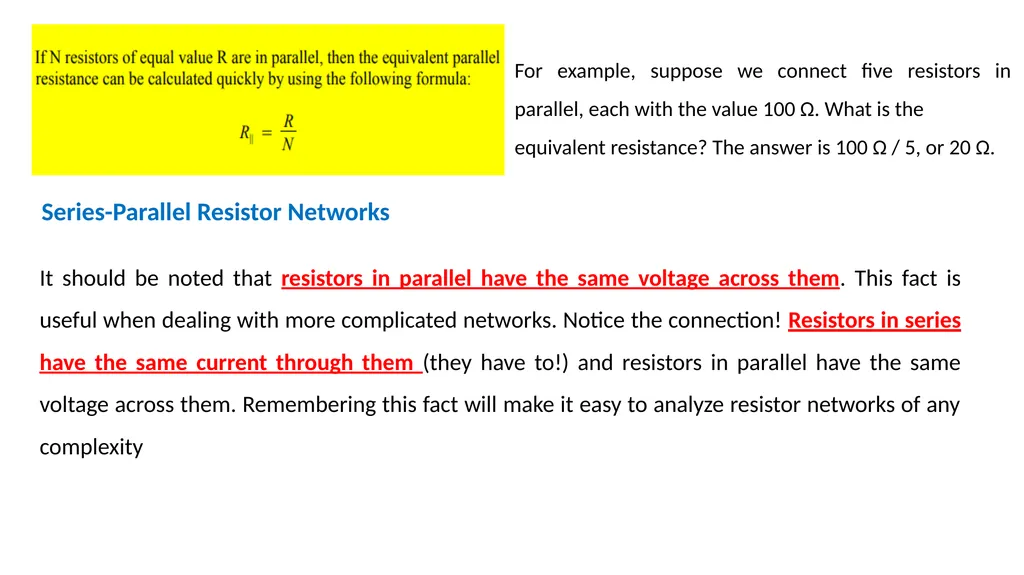
For example, suppose we connect five resistors in parallel, each with the value 100 Ω. What is the
equivalent resistance? The answer is 100 Ω / 5, or 20 Ω. Series-Parallel Resistor Networks It should be noted that resistors in parallel have the same voltage across them. This fact is useful when dealing with more complicated networks. Notice the connection! Resistors in series have the same current through them (they have to!) and resistors in parallel have the same voltage across them. Remembering this fact will make it easy to analyze resistor networks of any complexity<br>
equivalent resistance? The answer is 100 Ω / 5, or 20 Ω. Series-Parallel Resistor Networks It should be noted that resistors in parallel have the same voltage across them. This fact is useful when dealing with more complicated networks. Notice the connection! Resistors in series have the same current through them (they have to!) and resistors in parallel have the same voltage across them. Remembering this fact will make it easy to analyze resistor networks of any complexity<br>
19
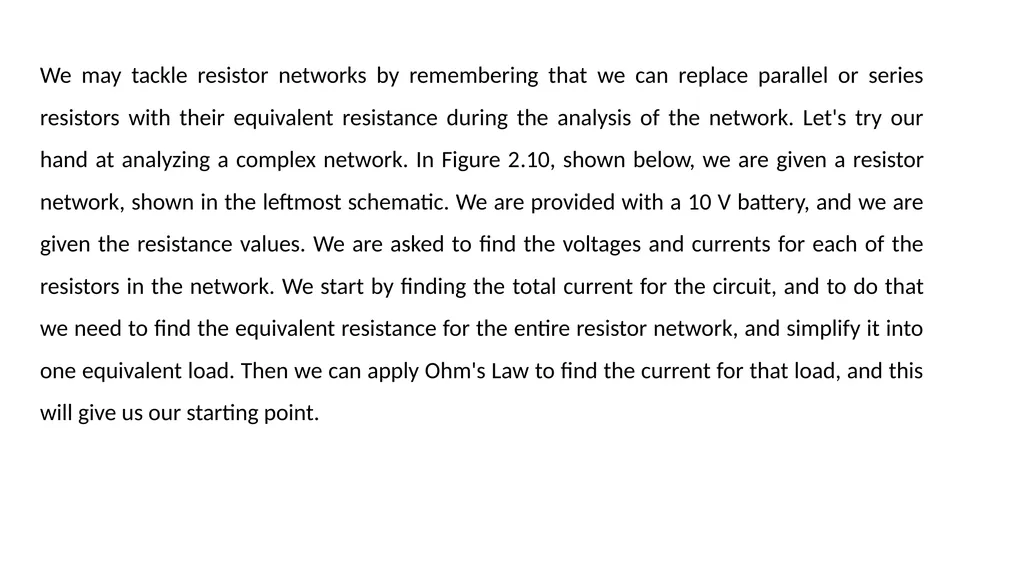
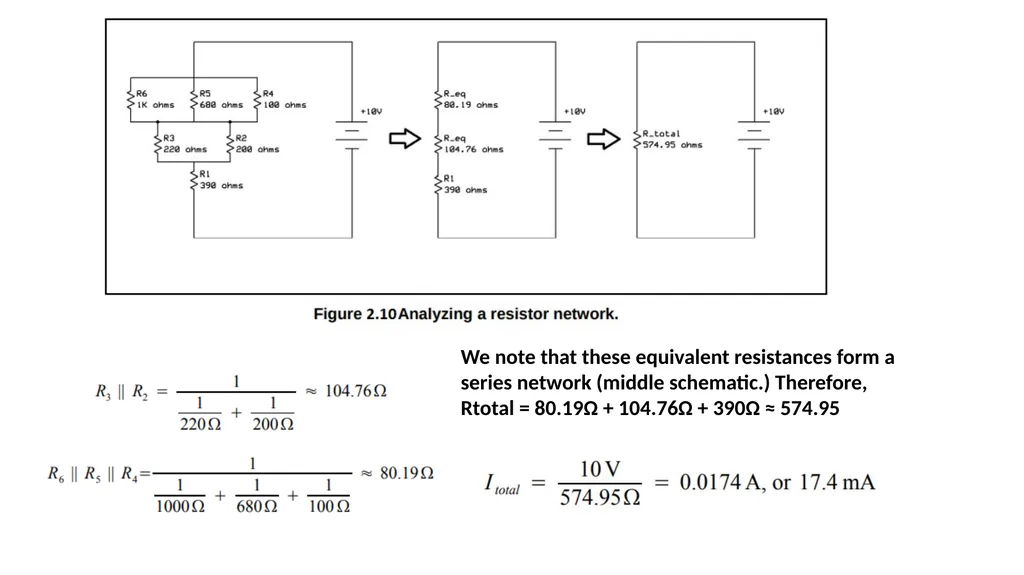
We may tackle resistor networks by remembering that we can replace parallel or series resistors with their equivalent resistance during the analysis of the network. Let's try our hand at analyzing a complex network. In Figure 2.10, shown below, we are given a resistor network, shown in the leftmost schematic. We are provided with a 10 V battery, and we are given the resistance values. We are asked to find the voltages and currents for each of the resistors in the network. We start by finding the total current for the circuit, and to do that we need to find the equivalent resistance for the entire resistor network, and simplify it into one equivalent load. Then we can apply Ohm's Law to find the current for that load, and this will give us our starting point.<br>
20
We note that these equivalent resistances form a series network (middle schematic.) Therefore,
Rtotal = 80.19Ω + 104.76Ω + 390Ω ≈ 574.95<br>
Rtotal = 80.19Ω + 104.76Ω + 390Ω ≈ 574.95<br>
21
Now that we have the total current, we can use the reduced series network (the middle schematic in
Figure 2.10) to find the voltages. Remember that parallel networks will have the same voltage. And we note that the voltages across each equivalent series resistance sum to the source voltage:
6.78 V + 1.82 V + 1.40 V = 10.0 V Now we may easily calculate the individual resistor currents by using Ohm's Law again:
I R1 = 17.4mA (which was the total current we found,) And finally, note that the sum of the currents for the individual parallel networks is the total current:<br>
22
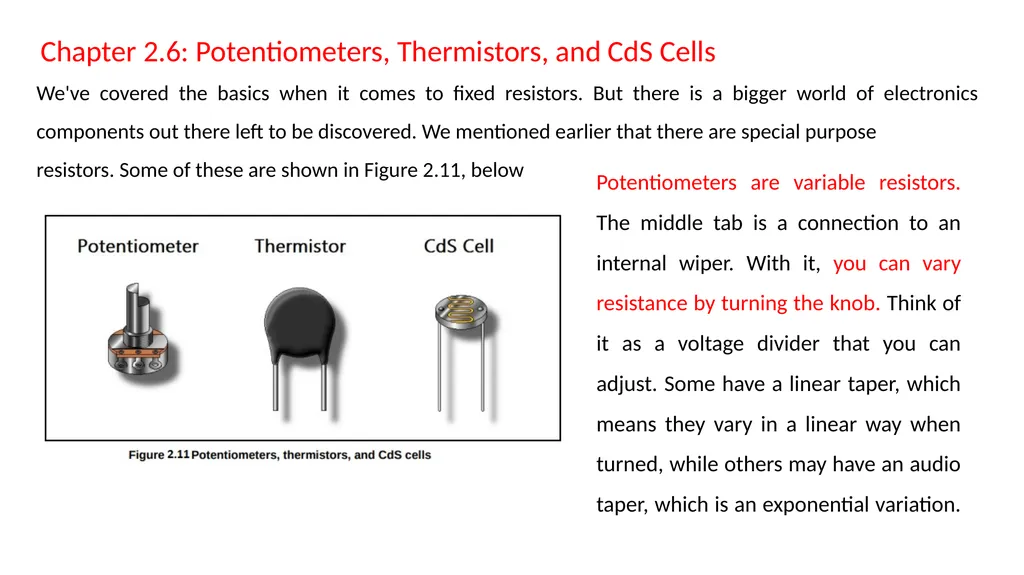
Chapter 2.6: Potentiometers, Thermistors, and CdS Cells We've covered the basics when it comes to fixed resistors. But there is a bigger world of electronics components out there left to be discovered. We mentioned earlier that there are special purpose
resistors. Some of these are shown in Figure 2.11, below Potentiometers are variable resistors. The middle tab is a connection to an internal wiper. With it, you can vary resistance by turning the knob. Think of it as a voltage divider that you can adjust. Some have a linear taper, which means they vary in a linear way when turned, while others may have an audio taper, which is an exponential variation.<br>
resistors. Some of these are shown in Figure 2.11, below Potentiometers are variable resistors. The middle tab is a connection to an internal wiper. With it, you can vary resistance by turning the knob. Think of it as a voltage divider that you can adjust. Some have a linear taper, which means they vary in a linear way when turned, while others may have an audio taper, which is an exponential variation.<br>
23
They are available in a wide range of values. They can be used as variable resistors, or even as position sensors, such as in joysticks and guitar pedals. Next in our list is the thermistor. A thermistor decreases its resistance drastically as temperature increases. This makes it an ideal thermostat. Thermistors are used as safety devices to prevent current inrush. They, too, come in a wide variety of resistances and temperature characteristics. Finally, we have a cadmium sulfide cell, or CdS cell for short. It changes resistance as light levels change, making it ideal for use as a light detector – such as in a burglar alarm or a light-game.<br>
24
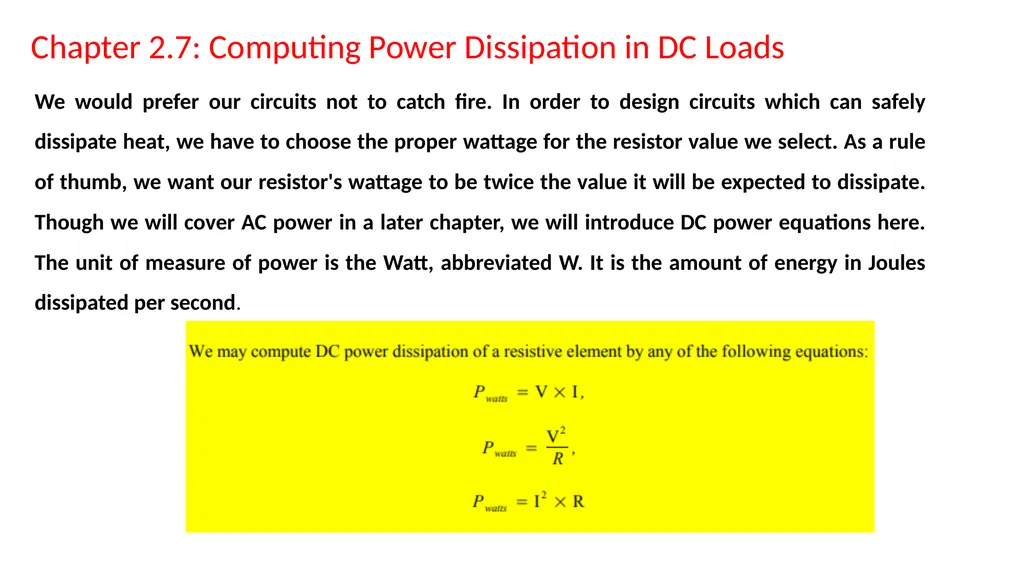
Chapter 2.7: Computing Power Dissipation in DC Loads We would prefer our circuits not to catch fire. In order to design circuits which can safely dissipate heat, we have to choose the proper wattage for the resistor value we select. As a rule of thumb, we want our resistor's wattage to be twice the value it will be expected to dissipate. Though we will cover AC power in a later chapter, we will introduce DC power equations here. The unit of measure of power is the Watt, abbreviated W. It is the amount of energy in Joules dissipated per second.<br>
25
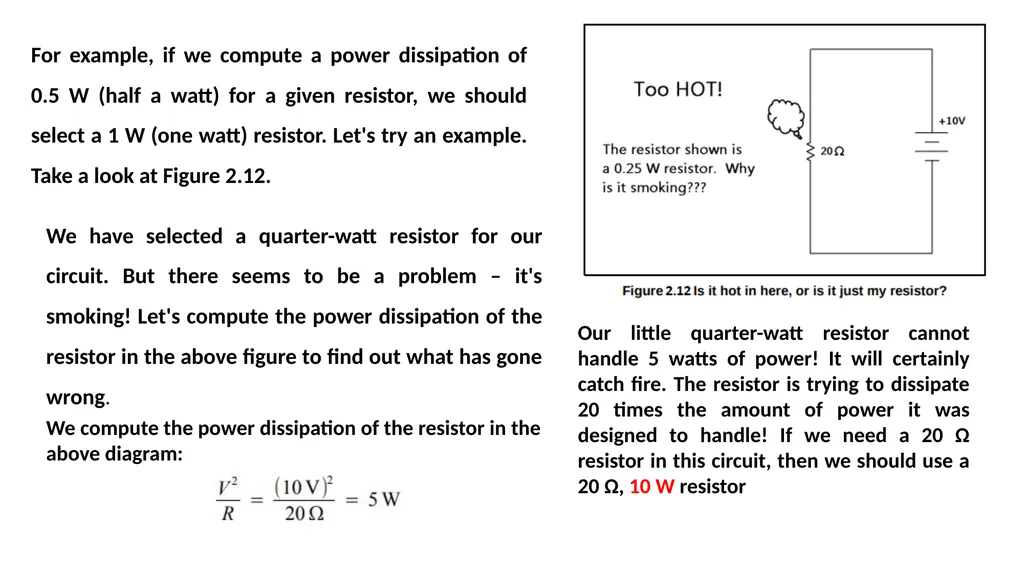
For example, if we compute a power dissipation of 0.5 W (half a watt) for a given resistor, we should select a 1 W (one watt) resistor. Let's try an example. Take a look at Figure 2.12. We have selected a quarter-watt resistor for our circuit. But there seems to be a problem – it's smoking! Let's compute the power dissipation of the resistor in the above figure to find out what has gone wrong. We compute the power dissipation of the resistor in the above diagram: Our little quarter-watt resistor cannot handle 5 watts of power! It will certainly catch fire. The resistor is trying to dissipate 20 times the amount of power it was designed to handle! If we need a 20 Ω resistor in this circuit, then we should use a 20 Ω, 10 W resistor<br>
26
Vocabulary Questions
1. A useful mathematical tool connecting voltage, current, and resistance is ________________.
2. A _____________ circuit has elements connected one after another in the same current path.
3. A ________________ circuit divides current among its branches.
4. A circuit or device under power is often referred to as the ________________.
5. A simplified resistor that has the same resistance as a resistor network: __________________.
6. A ____________________________ is a resistor made with resistive material and a binder.
7. ___________________ is a measure of resistor value accuracy.
8. ___________________ is a measure of the energy dissipated by a resistor, in Watts.
9. A ________________ is a device that can measure voltage, current, or resistance.
10. A ________________ is a variable resistor.
11. We may use a __________________ to get a fraction of the total voltage from a power supply.
12. A _________________ changes resistance drastically with changes in temperature.<br>
27
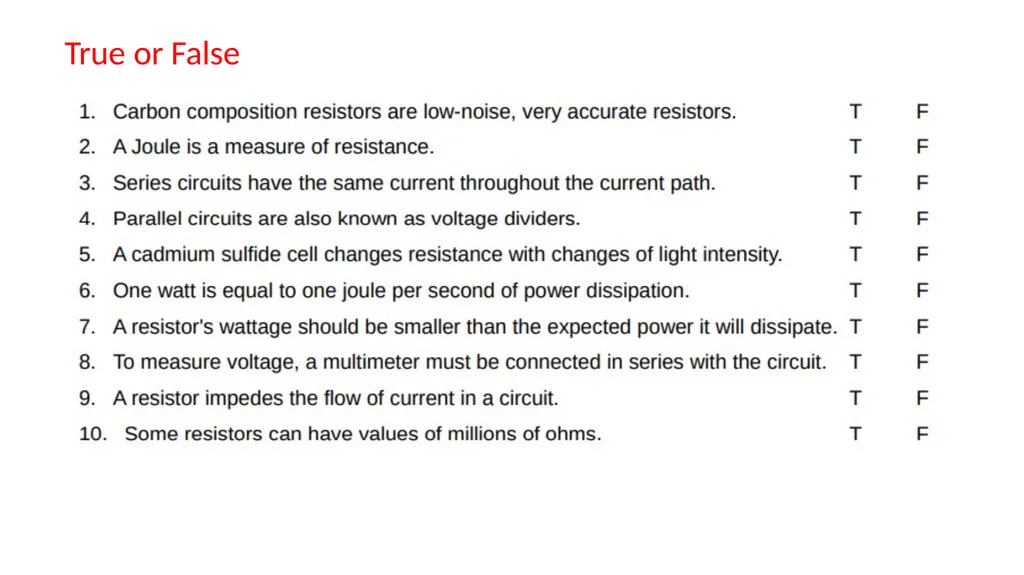
True or False<br>
28
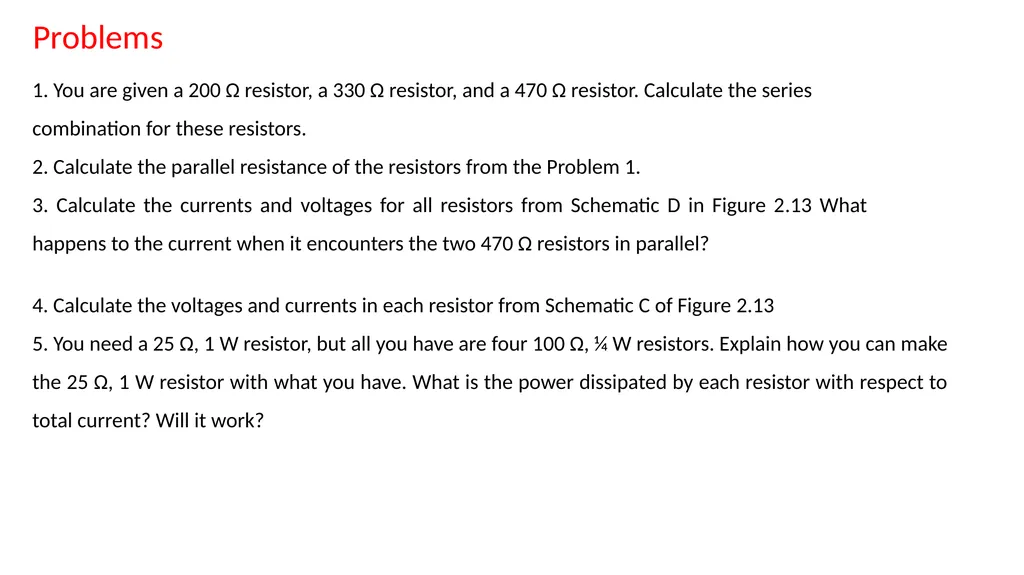
Problems 1. You are given a 200 Ω resistor, a 330 Ω resistor, and a 470 Ω resistor. Calculate the series
combination for these resistors.
2. Calculate the parallel resistance of the resistors from the Problem 1.
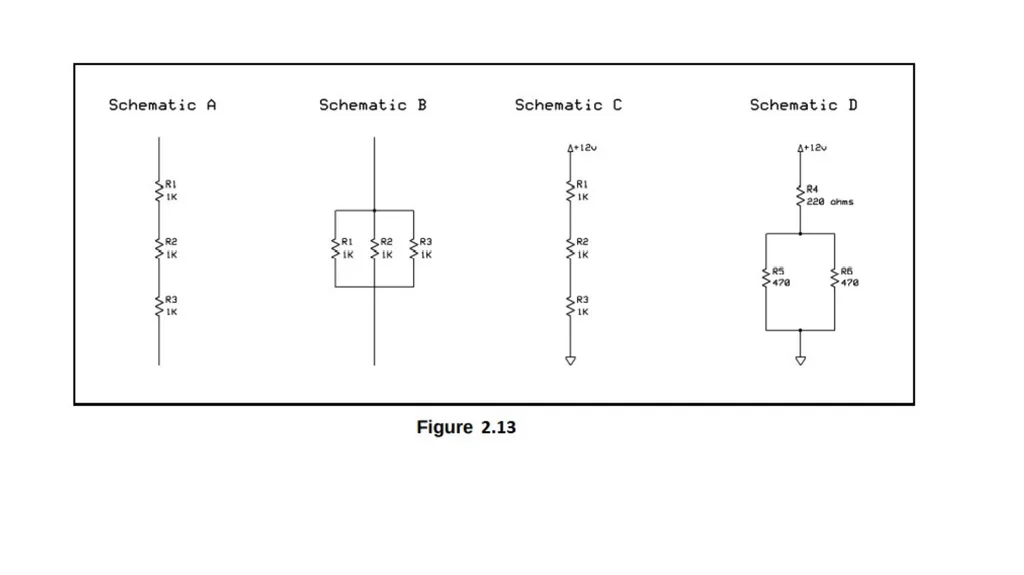
3. Calculate the currents and voltages for all resistors from Schematic D in Figure 2.13 What happens to the current when it encounters the two 470 Ω resistors in parallel? 4. Calculate the voltages and currents in each resistor from Schematic C of Figure 2.13
5. You need a 25 Ω, 1 W resistor, but all you have are four 100 Ω, ¼ W resistors. Explain how you can make the 25 Ω, 1 W resistor with what you have. What is the power dissipated by each resistor with respect to total current? Will it work?<br>