CHAPTER 2 POLYNOMIALS (1) Polynomial : The expression which contains one or more terms with non-zero coefficient is called a polynomial. A polynomial can have any number of terms. For Example: 10, a b, 7x y 5, w x y z, etc. are
"CHAPTER 2 POLYNOMIALS (1) Polynomial : The" is the property of its rightful owner. Permission is granted to
download and print the materials on this website for personal, non-commercial use only, and to display it
on your personal computer provided you do not modify the materials and that you retain all copyright
notices contained in the materials. By downloading content from our website, you accept the terms of this
agreement.
Presentation Transcript
01
CHAPTER 2 POLYNOMIALS<br>
02
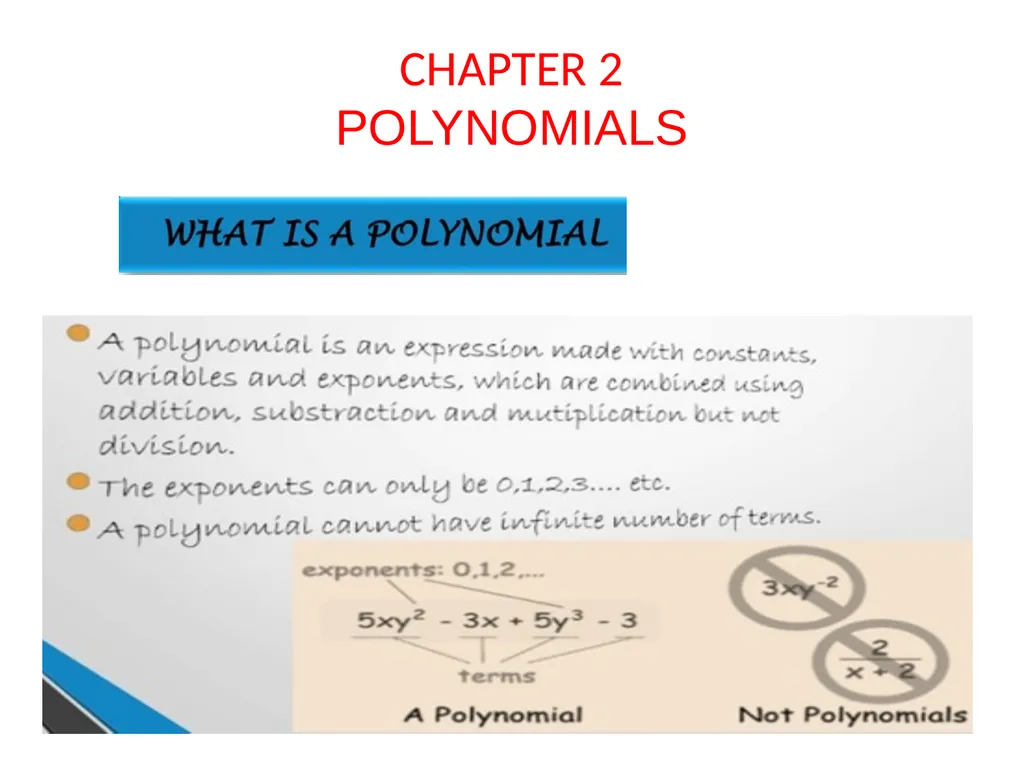
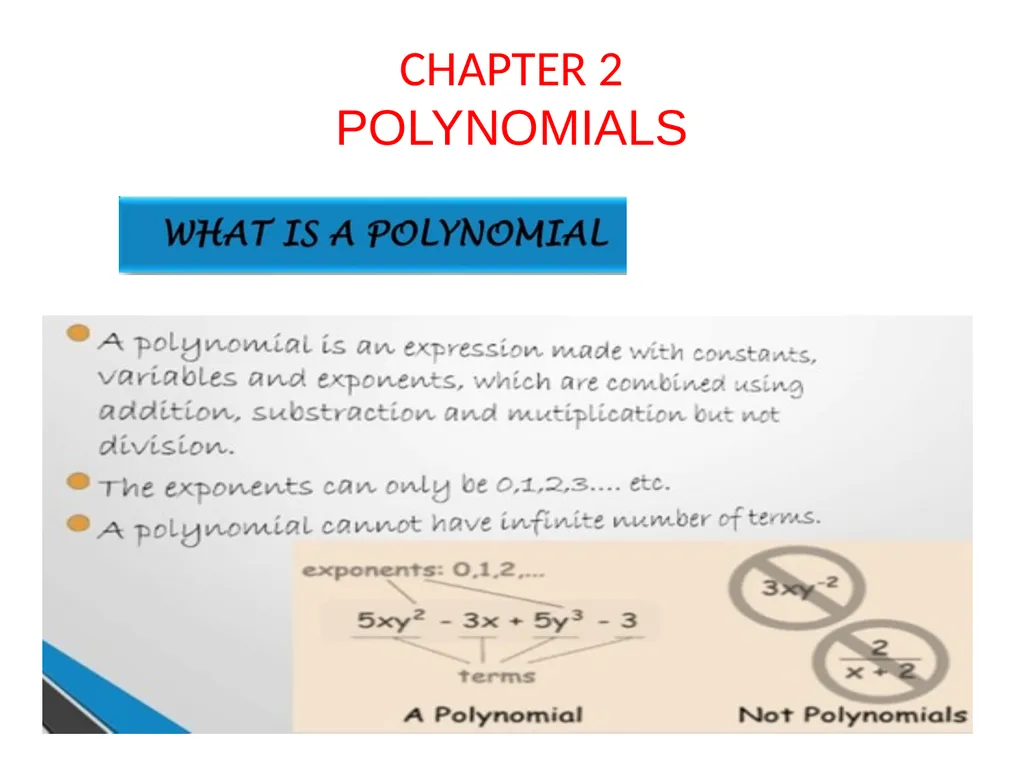
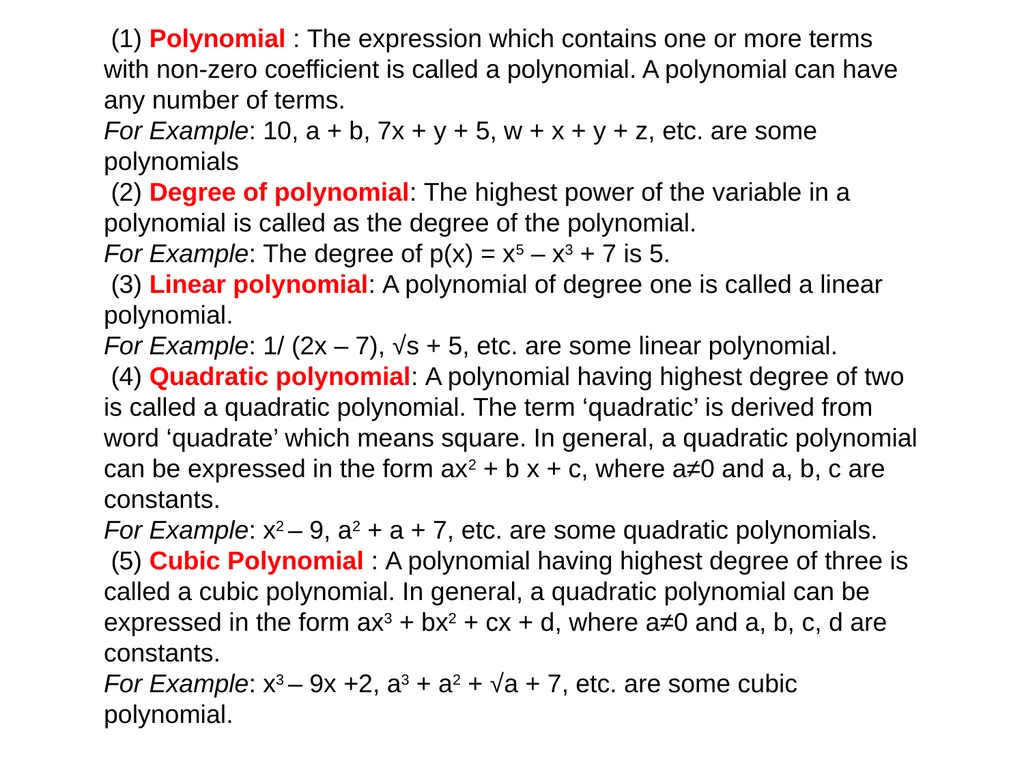
(1) Polynomial : The expression which contains one or more terms with non-zero coefficient is called a polynomial. A polynomial can have any number of terms. For Example: 10, a + b, 7x + y + 5, w + x + y + z, etc. are some polynomials
(2) Degree of polynomial: The highest power of the variable in a polynomial is called as the degree of the polynomial. For Example: The degree of p(x) = x5 – x3 + 7 is 5.
(3) Linear polynomial: A polynomial of degree one is called a linear polynomial. For Example: 1/ (2x – 7), √s + 5, etc. are some linear polynomial.
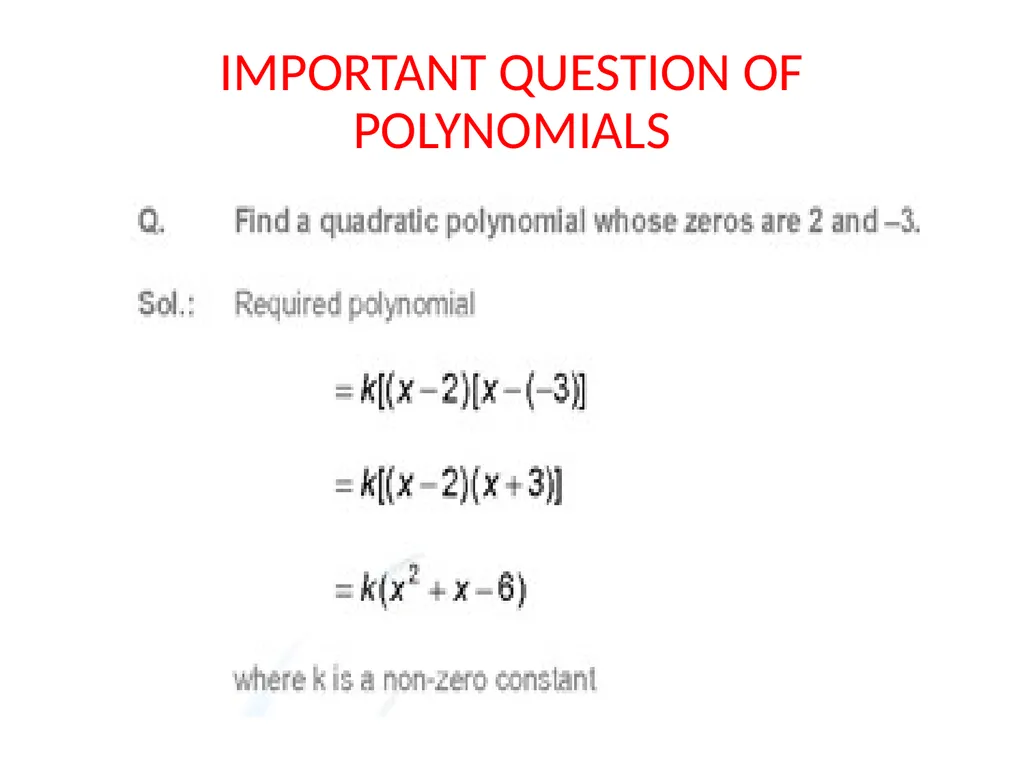
(4) Quadratic polynomial: A polynomial having highest degree of two is called a quadratic polynomial. The term ‘quadratic’ is derived from word ‘quadrate’ which means square. In general, a quadratic polynomial can be expressed in the form ax2 + b x + c, where a≠0 and a, b, c are constants. For Example: x2 – 9, a2 + a + 7, etc. are some quadratic polynomials.
(5) Cubic Polynomial : A polynomial having highest degree of three is called a cubic polynomial. In general, a quadratic polynomial can be expressed in the form ax3 + bx2 + cx + d, where a≠0 and a, b, c, d are constants. For Example: x3 – 9x +2, a3 + a2 + √a + 7, etc. are some cubic polynomial.<br>
03
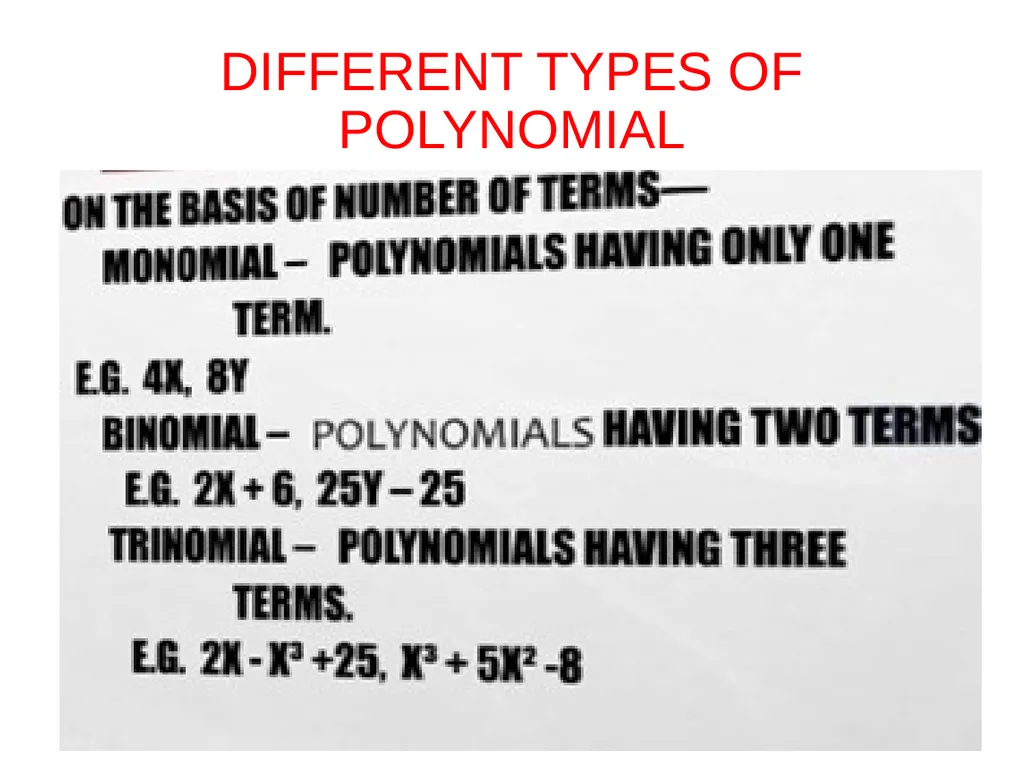
DIFFERENT TYPES OF POLYNOMIAL<br>
04
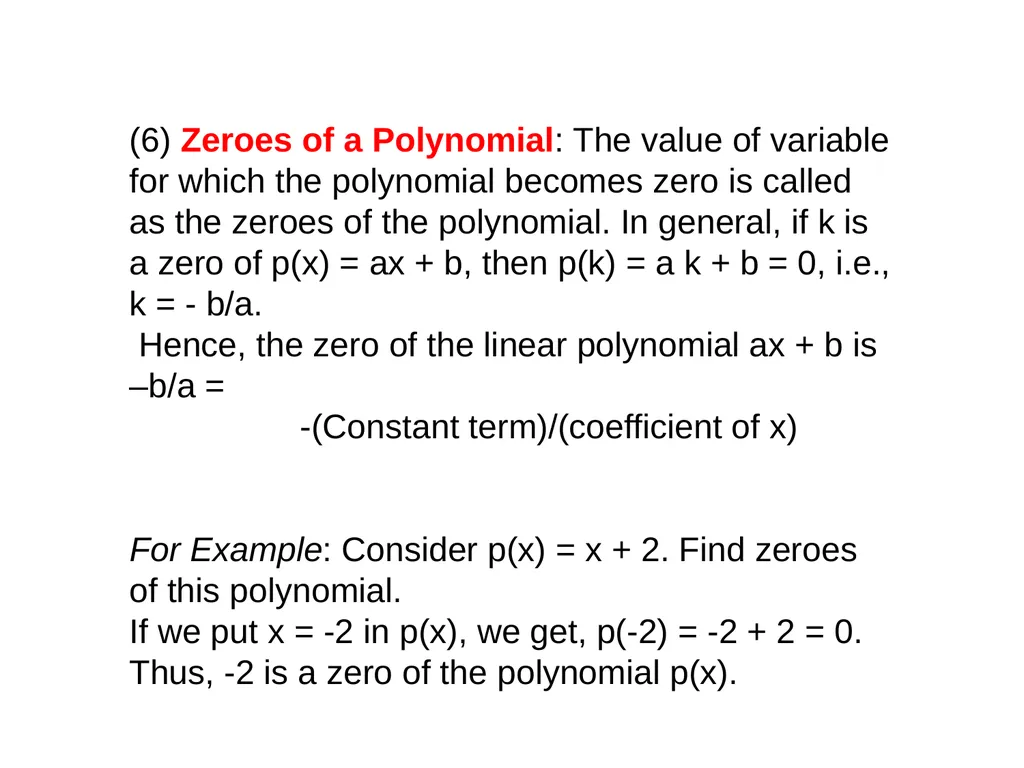
(6) Zeroes of a Polynomial: The value of variable for which the polynomial becomes zero is called as the zeroes of the polynomial. In general, if k is a zero of p(x) = ax + b, then p(k) = a k + b = 0, i.e., k = - b/a.
Hence, the zero of the linear polynomial ax + b is –b/a =
-(Constant term)/(coefficient of x)
For Example: Consider p(x) = x + 2. Find zeroes of this polynomial. If we put x = -2 in p(x), we get, p(-2) = -2 + 2 = 0. Thus, -2 is a zero of the polynomial p(x).<br>
05
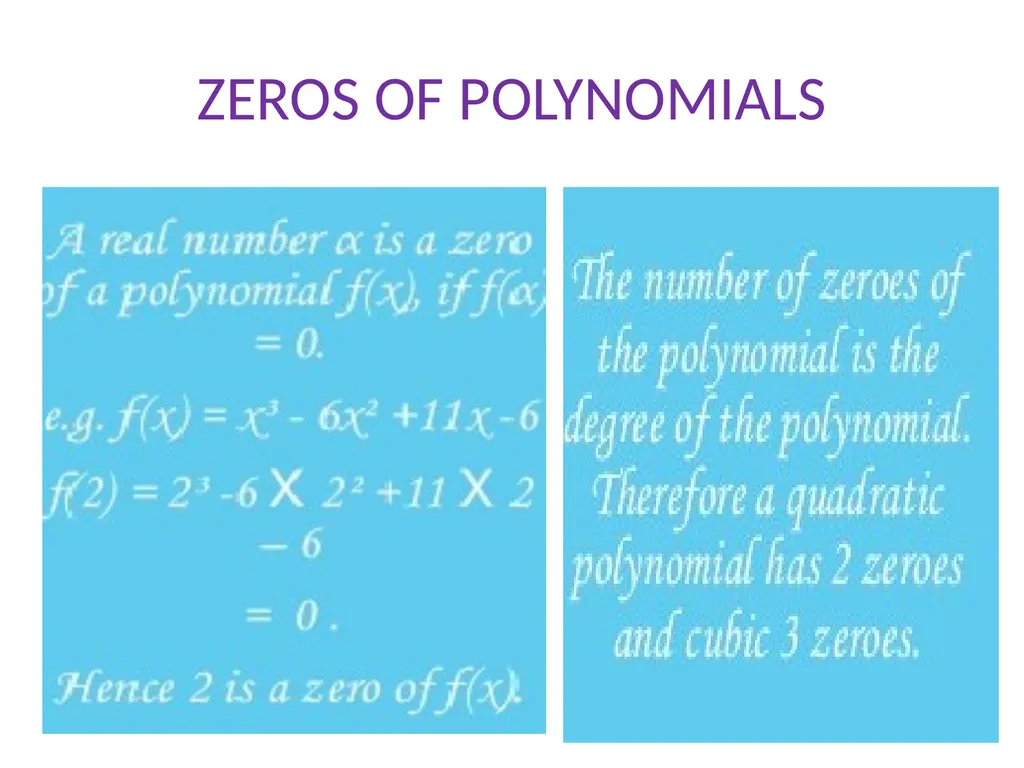
ZEROS OF POLYNOMIALS<br>
06
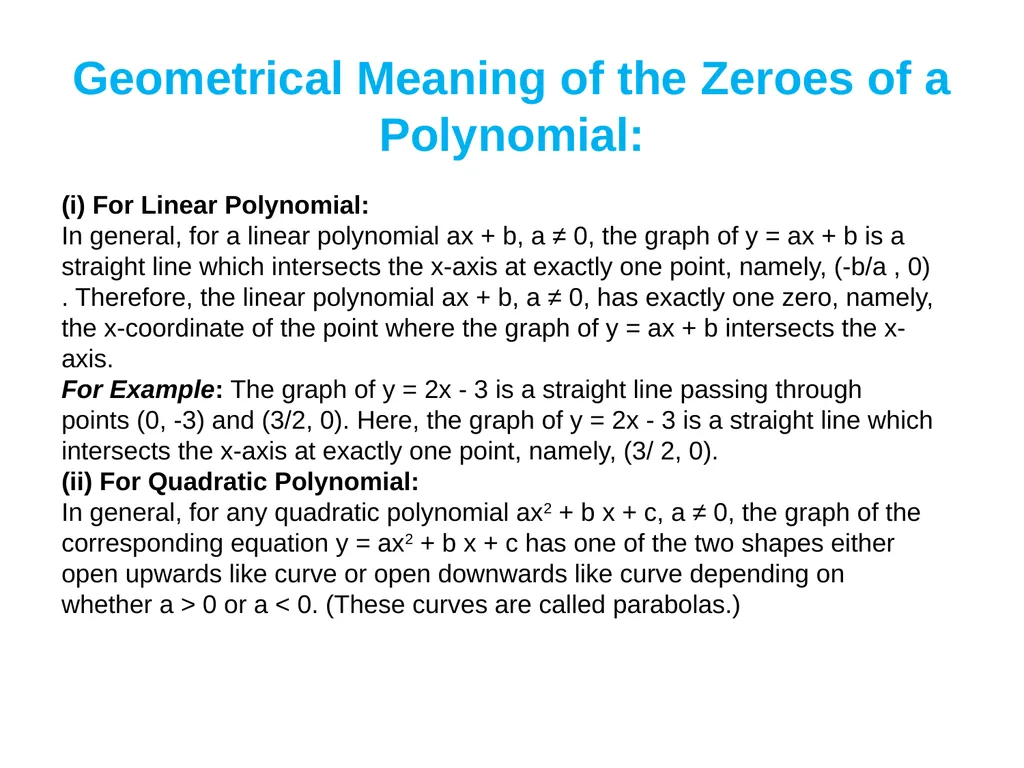
Geometrical Meaning of the Zeroes of a Polynomial: (i) For Linear Polynomial: In general, for a linear polynomial ax + b, a ≠ 0, the graph of y = ax + b is a straight line which intersects the x-axis at exactly one point, namely, (-b/a , 0) . Therefore, the linear polynomial ax + b, a ≠ 0, has exactly one zero, namely, the x-coordinate of the point where the graph of y = ax + b intersects the x-axis.
For Example: The graph of y = 2x - 3 is a straight line passing through points (0, -3) and (3/2, 0). Here, the graph of y = 2x - 3 is a straight line which intersects the x-axis at exactly one point, namely, (3/ 2, 0).
(ii) For Quadratic Polynomial: In general, for any quadratic polynomial ax2 + b x + c, a ≠ 0, the graph of the corresponding equation y = ax2 + b x + c has one of the two shapes either open upwards like curve or open downwards like curve depending on whether a > 0 or a < 0. (These curves are called parabolas.)<br>
07
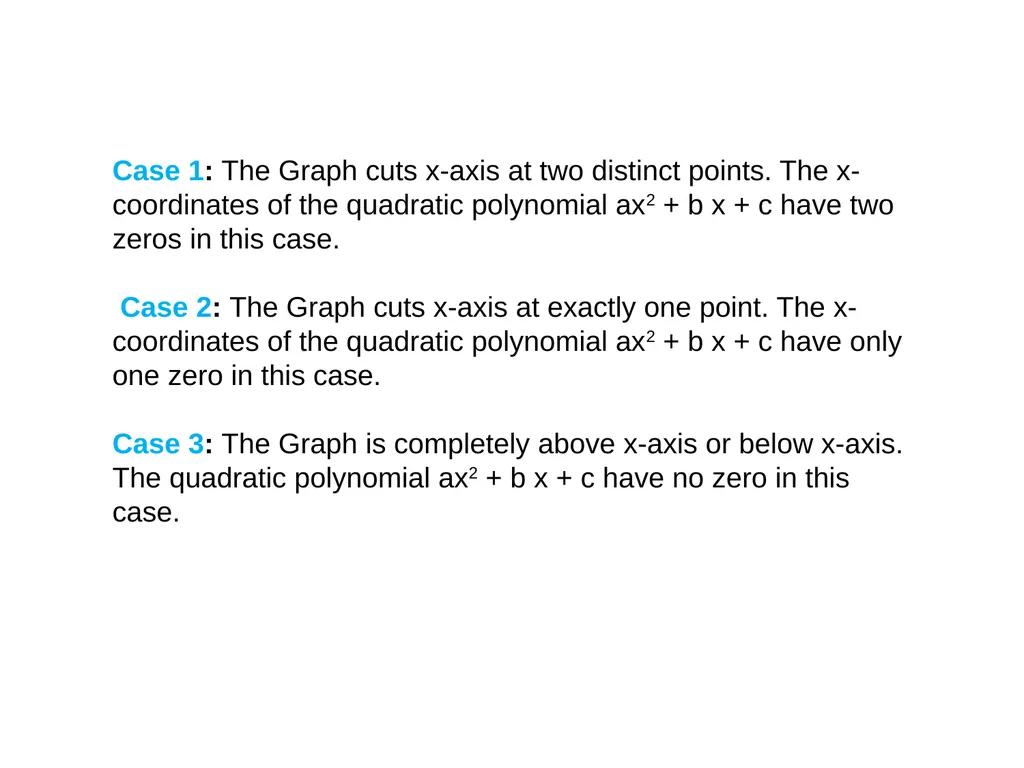
Case 1: The Graph cuts x-axis at two distinct points. The x-coordinates of the quadratic polynomial ax2 + b x + c have two zeros in this case.
Case 2: The Graph cuts x-axis at exactly one point. The x-coordinates of the quadratic polynomial ax2 + b x + c have only one zero in this case.
Case 3: The Graph is completely above x-axis or below x-axis. The quadratic polynomial ax2 + b x + c have no zero in this case.<br>
08
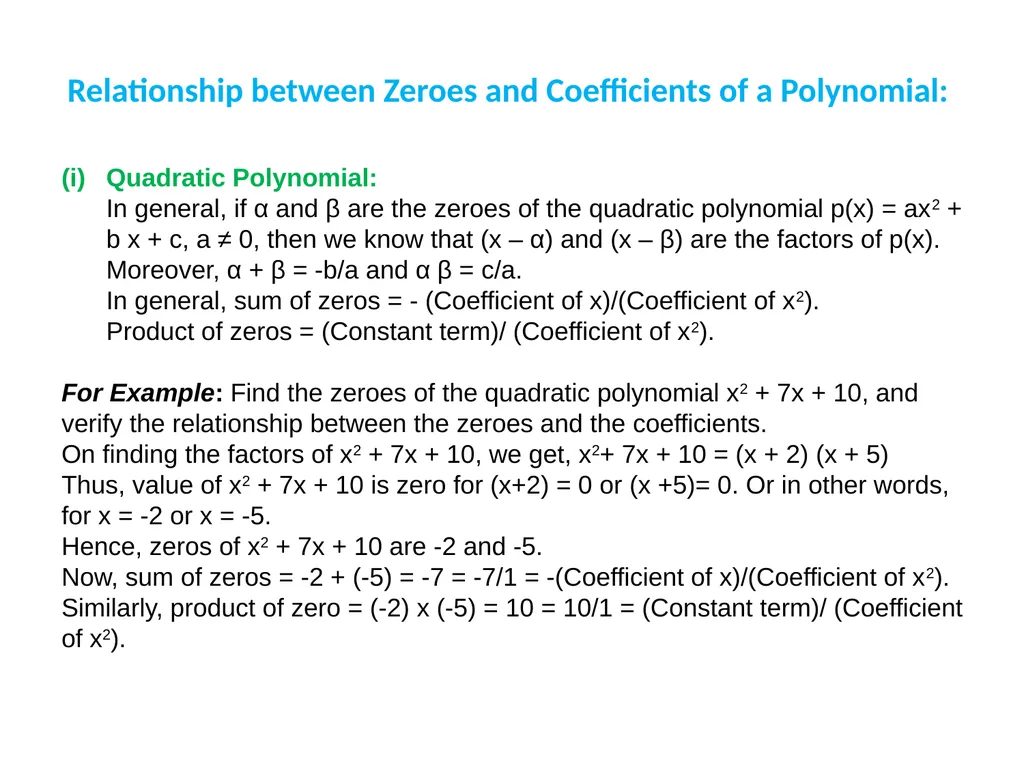
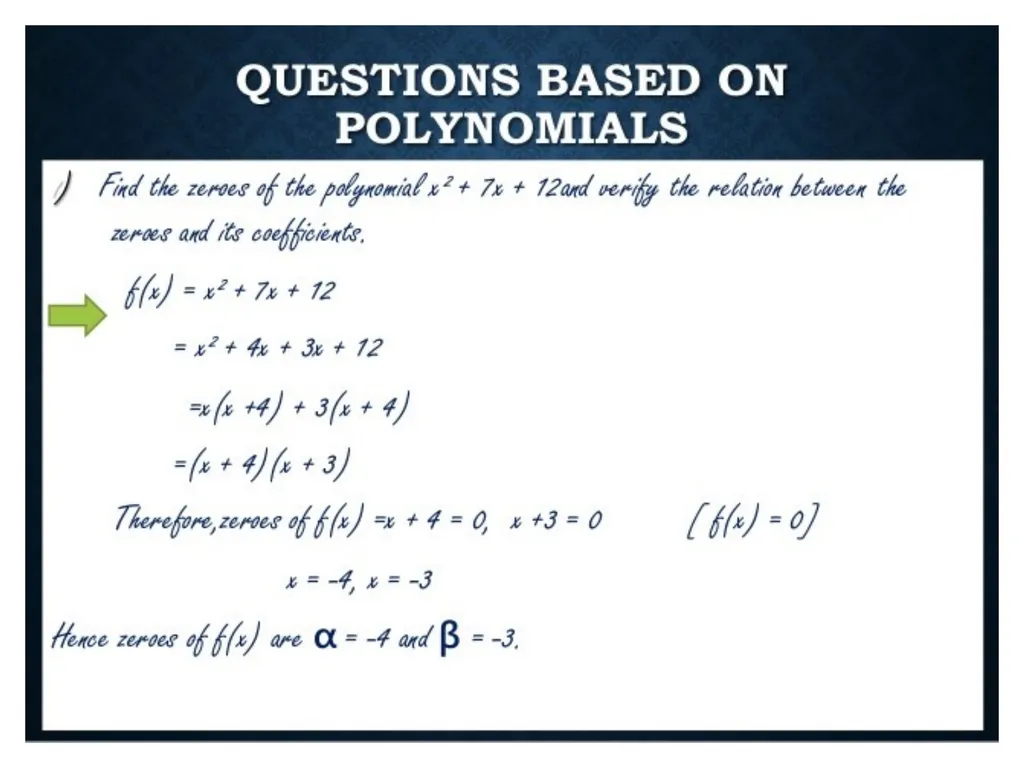
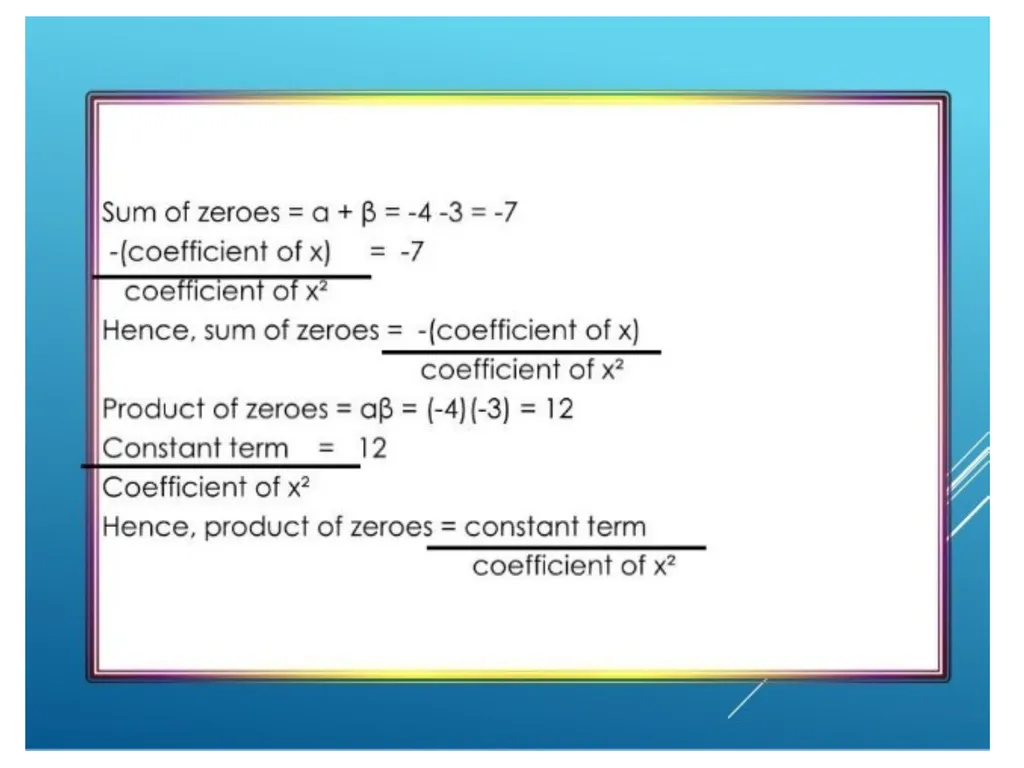
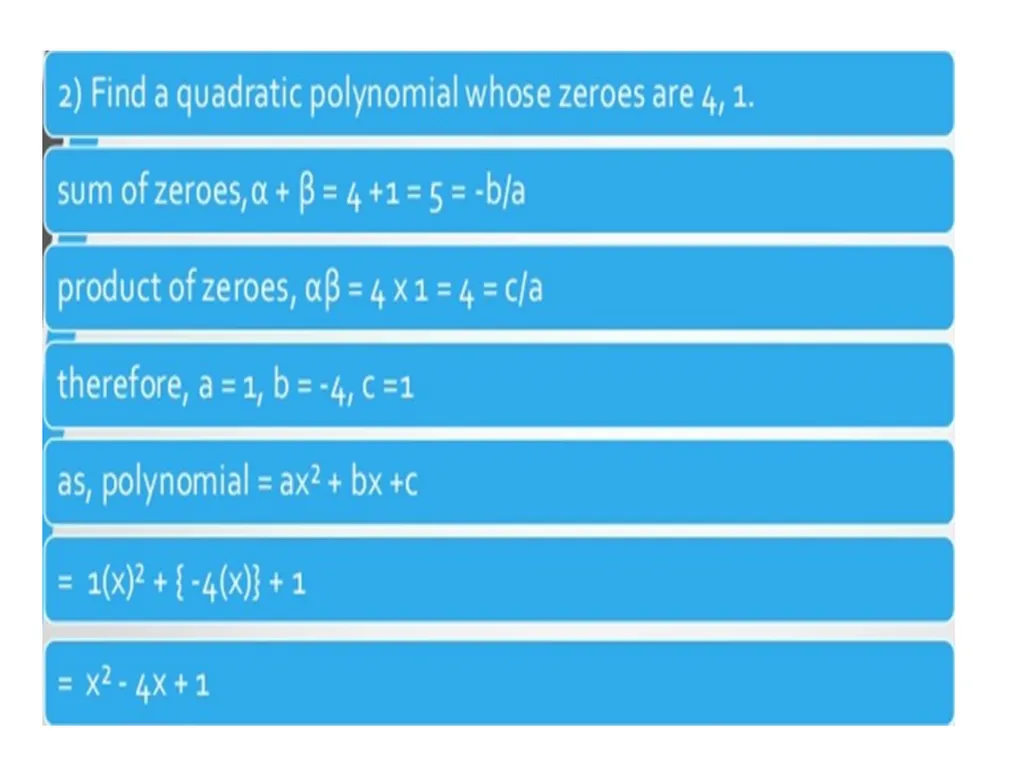
Relationship between Zeroes and Coefficients of a Polynomial: Quadratic Polynomial: In general, if α and β are the zeroes of the quadratic polynomial p(x) = ax2 + b x + c, a ≠ 0, then we know that (x – α) and (x – β) are the factors of p(x). Moreover, α + β = -b/a and α β = c/a. In general, sum of zeros = - (Coefficient of x)/(Coefficient of x2). Product of zeros = (Constant term)/ (Coefficient of x2).
For Example: Find the zeroes of the quadratic polynomial x2 + 7x + 10, and verify the relationship between the zeroes and the coefficients. On finding the factors of x2 + 7x + 10, we get, x2+ 7x + 10 = (x + 2) (x + 5) Thus, value of x2 + 7x + 10 is zero for (x+2) = 0 or (x +5)= 0. Or in other words, for x = -2 or x = -5. Hence, zeros of x2 + 7x + 10 are -2 and -5. Now, sum of zeros = -2 + (-5) = -7 = -7/1 = -(Coefficient of x)/(Coefficient of x2). Similarly, product of zero = (-2) x (-5) = 10 = 10/1 = (Constant term)/ (Coefficient of x2).<br>
09
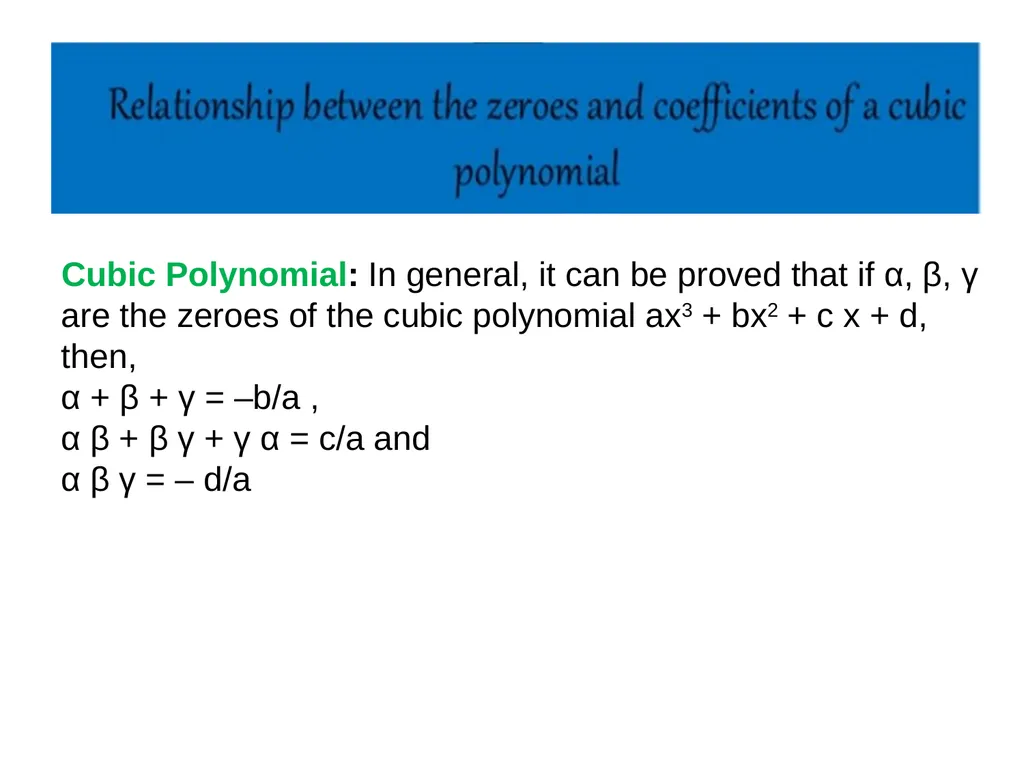
Cubic Polynomial: In general, it can be proved that if α, β, γ are the zeroes of the cubic polynomial ax3 + bx2 + c x + d, then, α + β + γ = –b/a , α β + β γ + γ α = c/a and
α β γ = – d/a<br>
10
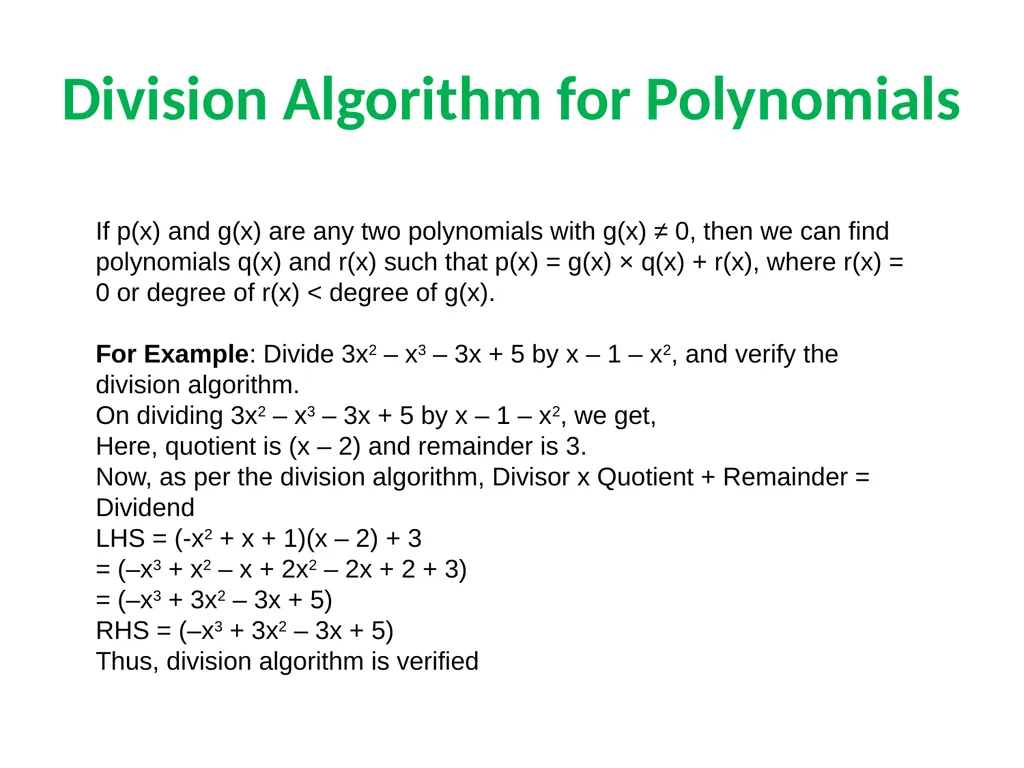
Division Algorithm for Polynomials If p(x) and g(x) are any two polynomials with g(x) ≠ 0, then we can find polynomials q(x) and r(x) such that p(x) = g(x) × q(x) + r(x), where r(x) = 0 or degree of r(x) < degree of g(x).
For Example: Divide 3x2 – x3 – 3x + 5 by x – 1 – x2, and verify the division algorithm. On dividing 3x2 – x3 – 3x + 5 by x – 1 – x2, we get,
Here, quotient is (x – 2) and remainder is 3. Now, as per the division algorithm, Divisor x Quotient + Remainder = Dividend LHS = (-x2 + x + 1)(x – 2) + 3 = (–x3 + x2 – x + 2x2 – 2x + 2 + 3) = (–x3 + 3x2 – 3x + 5) RHS = (–x3 + 3x2 – 3x + 5) Thus, division algorithm is verified<br>
11
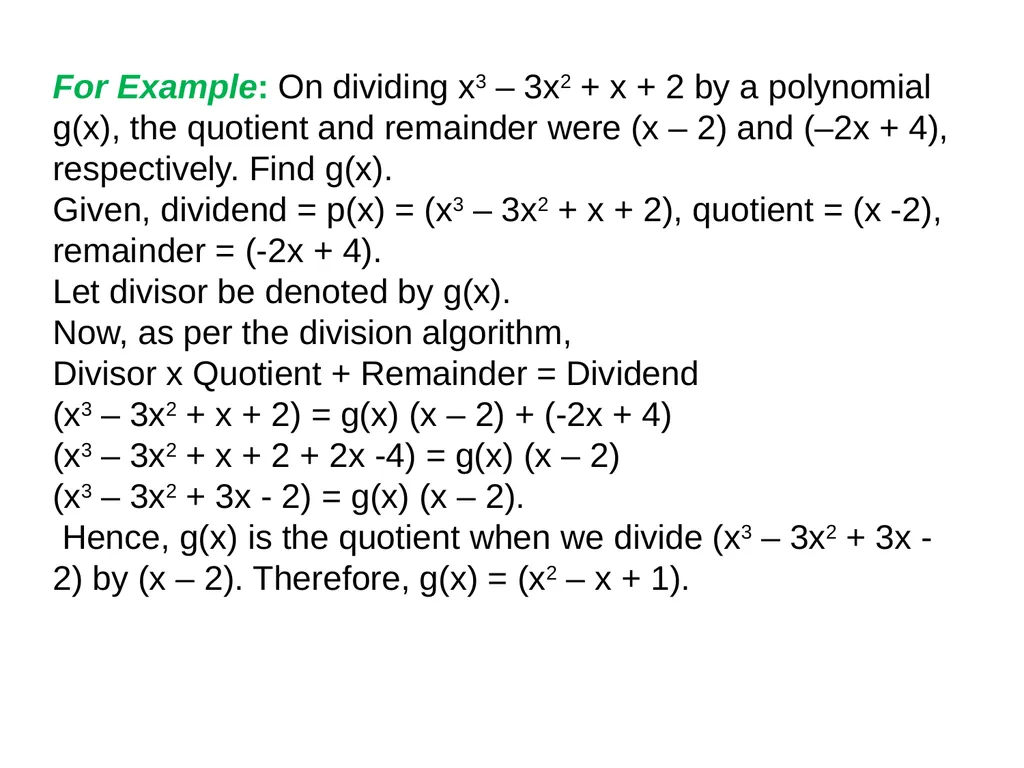
For Example: On dividing x3 – 3x2 + x + 2 by a polynomial g(x), the quotient and remainder were (x – 2) and (–2x + 4), respectively. Find g(x). Given, dividend = p(x) = (x3 – 3x2 + x + 2), quotient = (x -2), remainder = (-2x + 4). Let divisor be denoted by g(x). Now, as per the division algorithm, Divisor x Quotient + Remainder = Dividend (x3 – 3x2 + x + 2) = g(x) (x – 2) + (-2x + 4) (x3 – 3x2 + x + 2 + 2x -4) = g(x) (x – 2) (x3 – 3x2 + 3x - 2) = g(x) (x – 2).
Hence, g(x) is the quotient when we divide (x3 – 3x2 + 3x - 2) by (x – 2). Therefore, g(x) = (x2 – x + 1).<br>