
Chapter 20 Introduction to the ten







Description: Chapter 20 Introduction to the ten commandmentsChapter 20 (Expositors) The title Ten Commandments comes from Exodus 34: 28 and Deuteronomy 4: 13 Deuteronomy 4:13 13So He declared to you His covenant which He commanded you to perform,
Related Topics
Download Presentation
"Chapter 20 Introduction to the ten" is the property of its rightful owner. Permission is granted to download and print the materials on this website for personal, non-commercial use only, and to display it on your personal computer provided you do not modify the materials and that you retain all copyright notices contained in the materials. By downloading content from our website, you accept the terms of this agreement.
Presentation Transcript
slide1. Chapter 20<br>
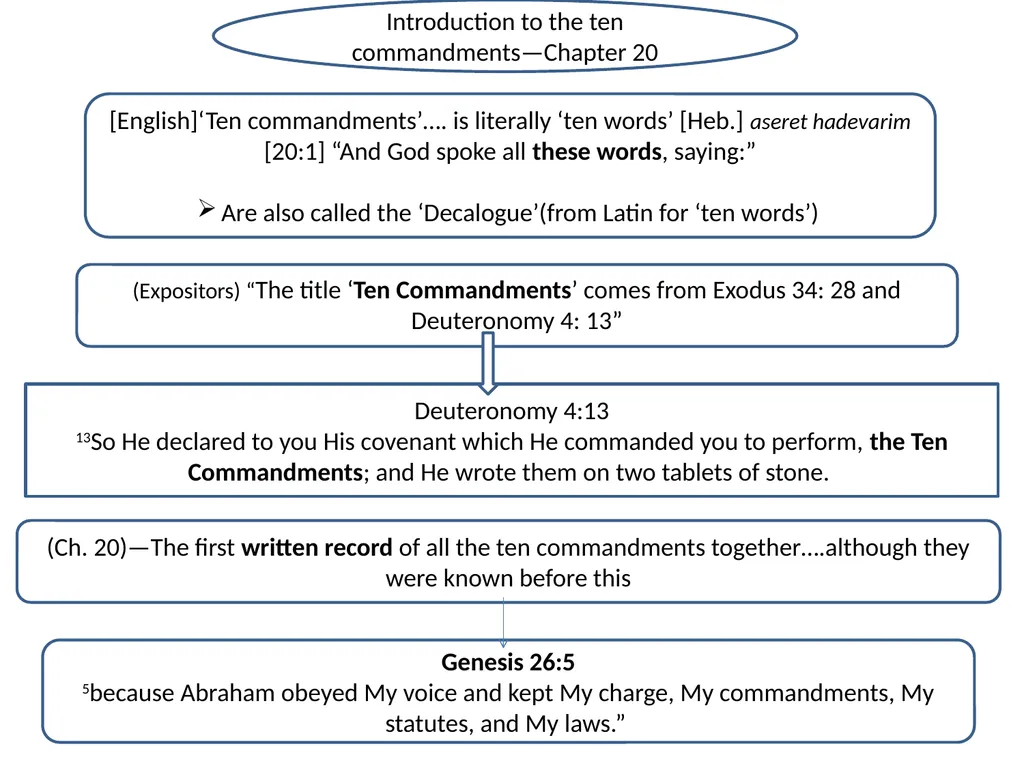
slide2. Introduction to the ten commandments—Chapter 20 (Expositors) “The title ‘Ten Commandments’ comes from Exodus 34: 28 and Deuteronomy 4: 13” Deuteronomy 4:13 13So He declared to you His covenant which He commanded you to perform, the Ten Commandments; and He wrote them on two tablets of stone. (Ch. 20)—The first written record of all the ten commandments together….although they were known before this Genesis 26:5 5because Abraham obeyed My voice and kept My charge, My commandments, My statutes, and My laws.” [English]‘Ten commandments’…. is literally ‘ten words’ [Heb.] aseret hadevarim
[20:1] “And God spoke all these words, saying:”
Are also called the ‘Decalogue’(from Latin for ‘ten words’)<br>
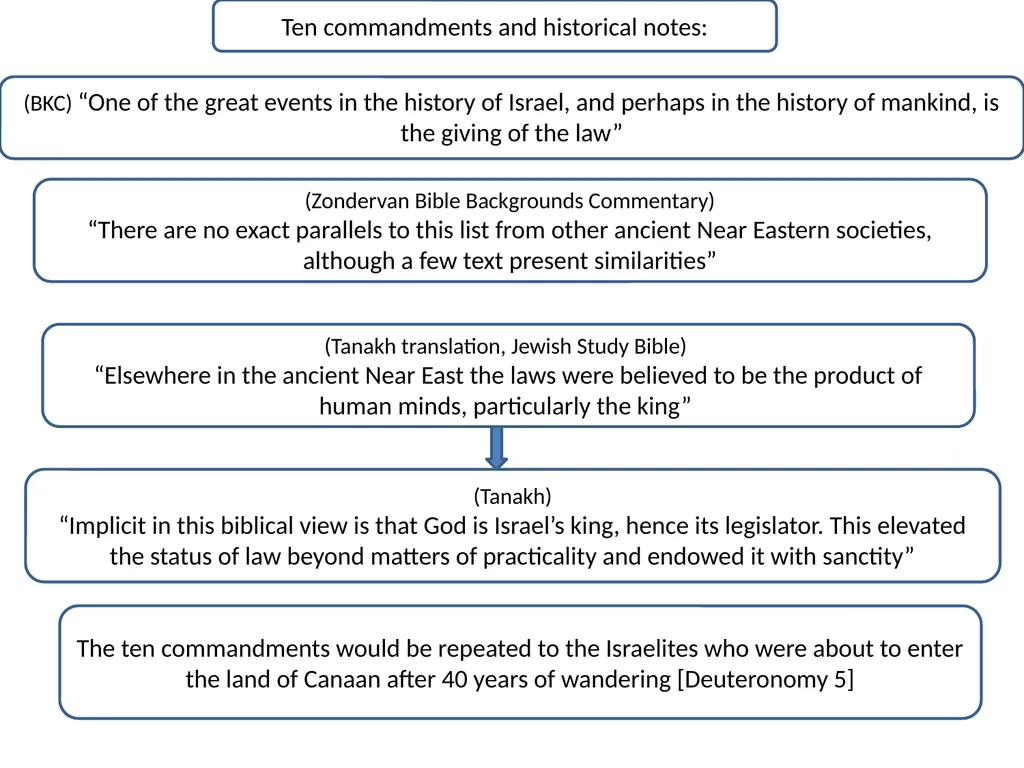
slide3. Ten commandments and historical notes: (BKC) “One of the great events in the history of Israel, and perhaps in the history of mankind, is the giving of the law” (Zondervan Bible Backgrounds Commentary)
“There are no exact parallels to this list from other ancient Near Eastern societies, although a few text present similarities” (Tanakh translation, Jewish Study Bible)
“Elsewhere in the ancient Near East the laws were believed to be the product of human minds, particularly the king” (Tanakh)
“Implicit in this biblical view is that God is Israel’s king, hence its legislator. This elevated the status of law beyond matters of practicality and endowed it with sanctity” The ten commandments would be repeated to the Israelites who were about to enter the land of Canaan after 40 years of wandering [Deuteronomy 5]<br>
slide4. (UCG booklet the Ten Commandments)
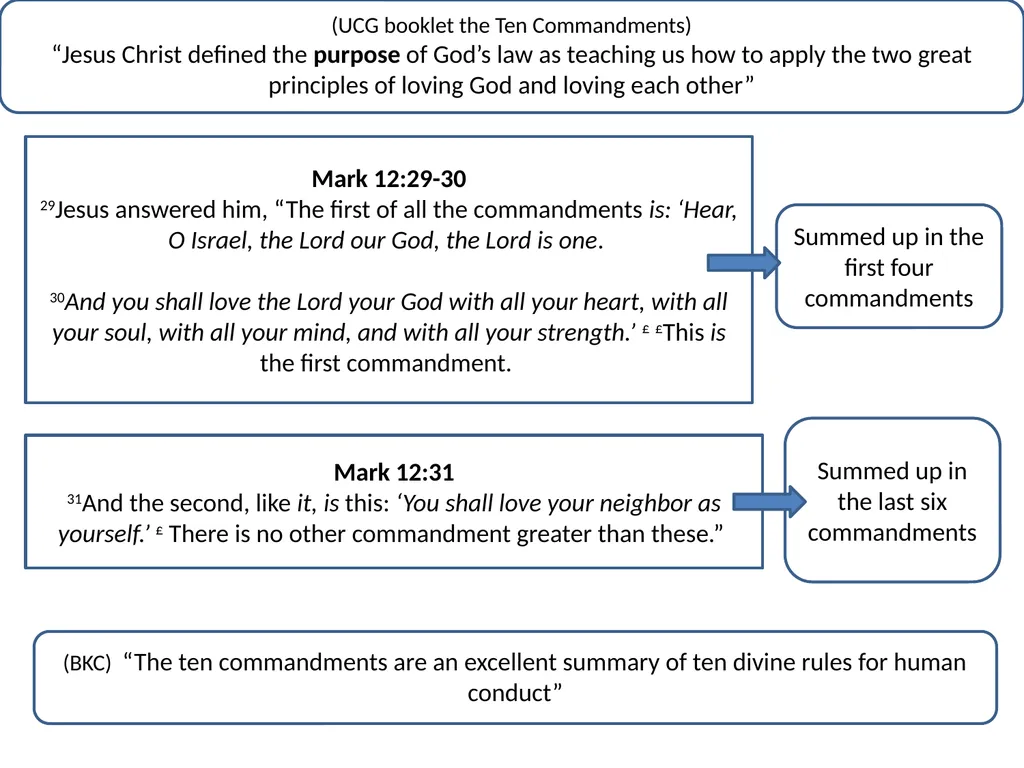
“Jesus Christ defined the purpose of God’s law as teaching us how to apply the two great principles of loving God and loving each other” Mark 12:29-30 29Jesus answered him, “The first of all the commandments is: ‘Hear, O Israel, the Lord our God, the Lord is one.
30And you shall love the Lord your God with all your heart, with all your soul, with all your mind, and with all your strength.’ £ £This is the first commandment. (BKC) “The ten commandments are an excellent summary of ten divine rules for human conduct” Mark 12:31 31And the second, like it, is this: ‘You shall love your neighbor as yourself.’ £ There is no other commandment greater than these.” Summed up in the first four commandments Summed up in the last six commandments<br>
slide5. 1And God spoke all these words, saying: Exodus 20 His relationship with His people (Expositors) “God himself is the speaker and source of these commandments” 2 “I am the Lord your God, who brought you out of the land of Egypt, out of the house of bondage. And what he had done for them (Companion) “God”= Elohim (Heb): hence of universal application. Not Jehovah, for this title would have limited the law to Israel” (Keil and Delitzch) “By bringing them out of Egypt, the house of bondage, Jehovah had proved to the Israelites that He was their God”<br>
slide6. 3 “You shall have no other gods before Me. (UCG booklet, the Ten Commandments)
“Establishing, developing and maintaining that personal relationship with the true living God is the most important commitment we can ever make.
That is the primary focus of the first commandment” (BKC) “The first of the Ten Commandments is that Israel was to worship the one true God. Worshipping false gods would be setting up rivals to Him” (Keil and Delitzch)
“other gods, literally beyond me, or in addition to me” 1st Commandment<br>
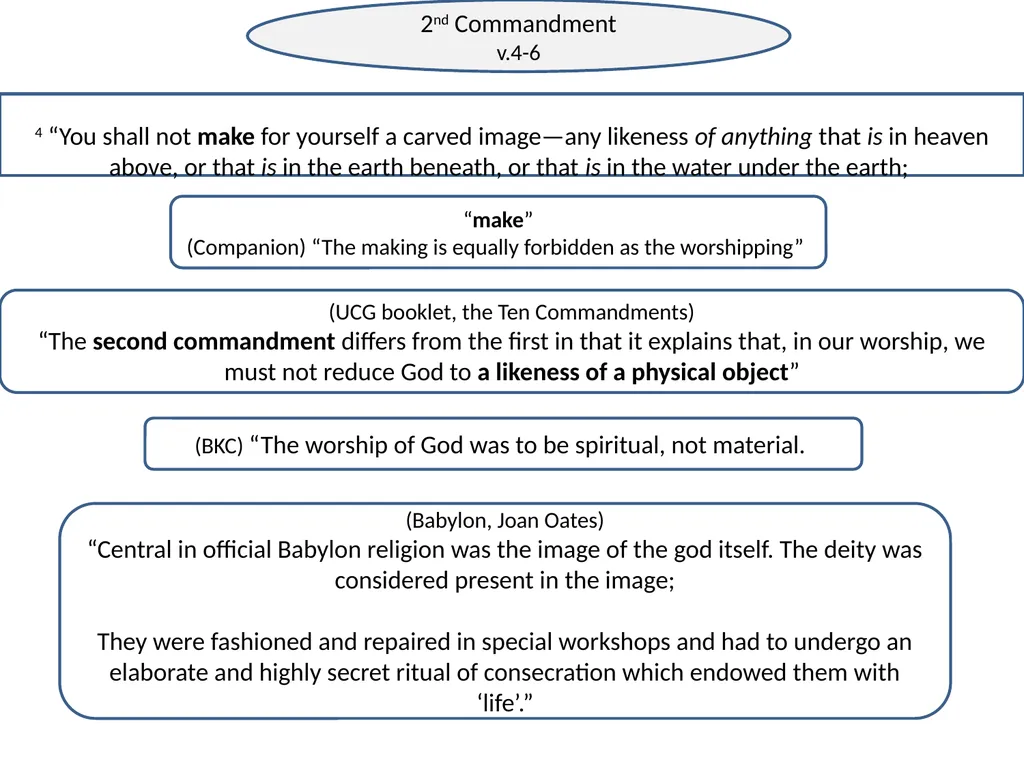
slide7. 4 “You shall not make for yourself a carved image—any likeness of anything that is in heaven above, or that is in the earth beneath, or that is in the water under the earth; (UCG booklet, the Ten Commandments)
“The second commandment differs from the first in that it explains that, in our worship, we must not reduce God to a likeness of a physical object” (BKC) “The worship of God was to be spiritual, not material. “make”
(Companion) “The making is equally forbidden as the worshipping” 2nd Commandment
v.4-6 (Babylon, Joan Oates)
“Central in official Babylon religion was the image of the god itself. The deity was considered present in the image;
They were fashioned and repaired in special workshops and had to undergo an elaborate and highly secret ritual of consecration which endowed them with ‘life’.”<br>
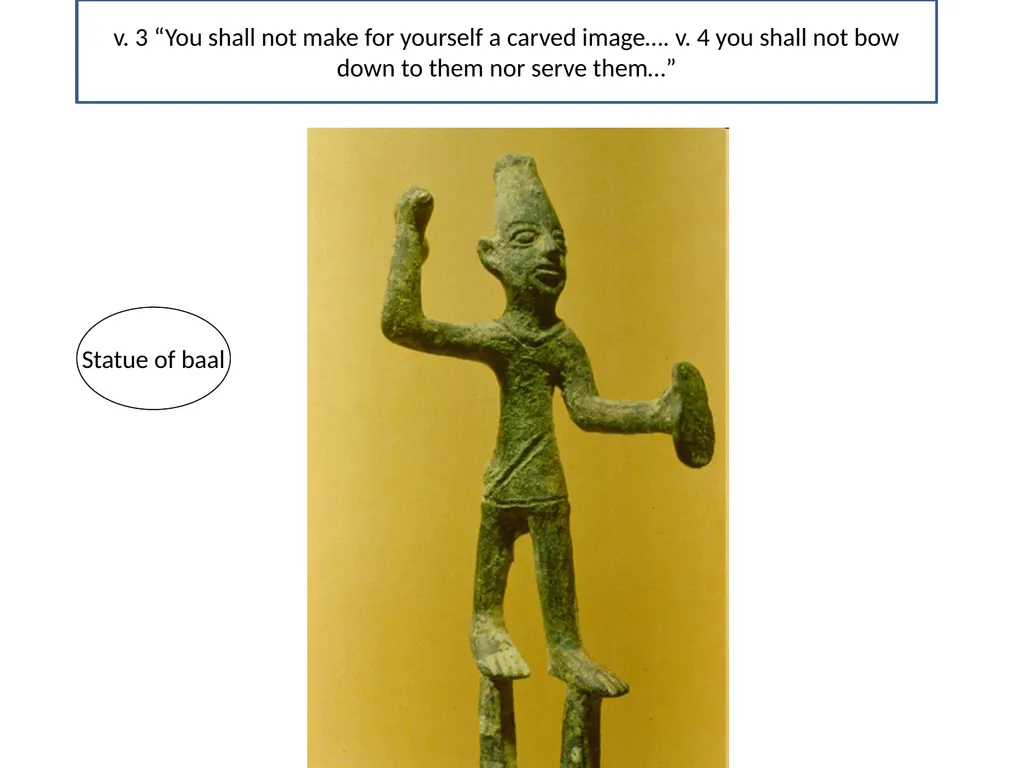
slide8. Statue of baal v. 3 “You shall not make for yourself a carved image…. v. 4 you shall not bow down to them nor serve them…”<br>
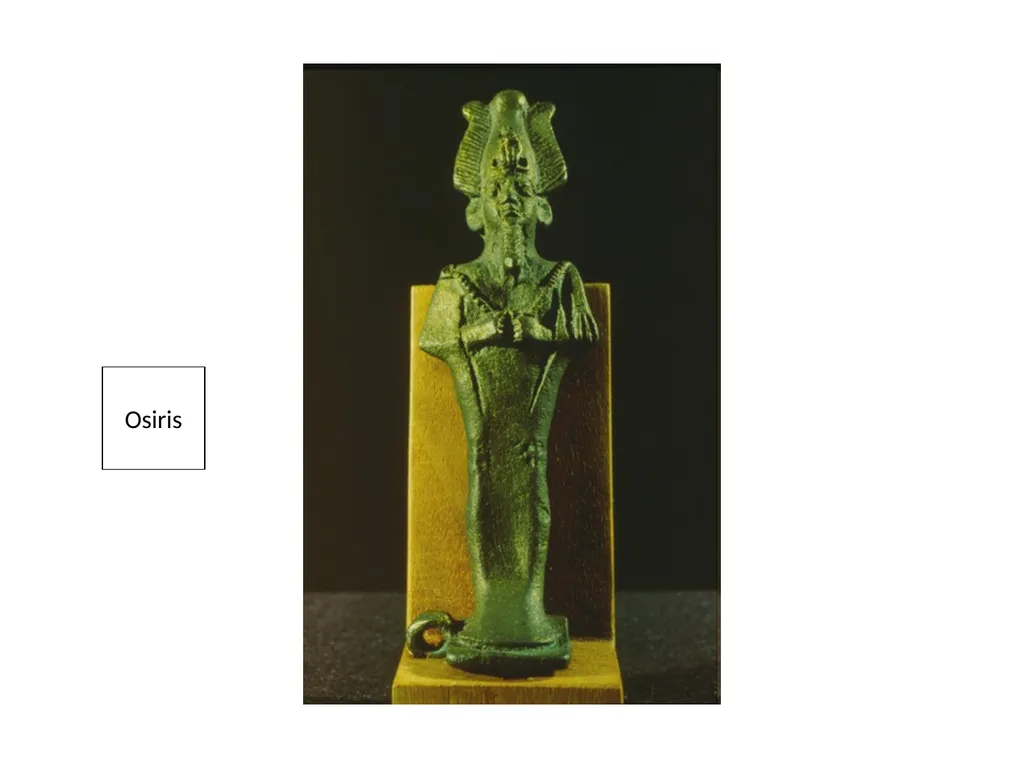
slide9. Osiris<br>
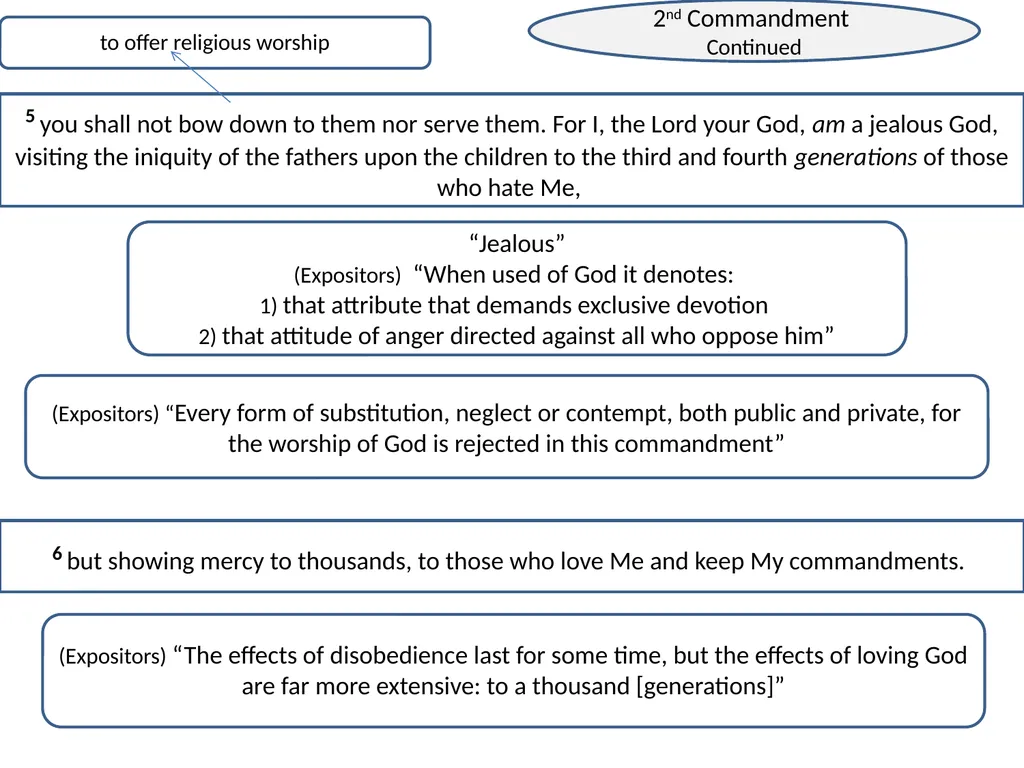
slide10. 5 you shall not bow down to them nor serve them. For I, the Lord your God, am a jealous God, visiting the iniquity of the fathers upon the children to the third and fourth generations of those who hate Me, “Jealous”
(Expositors) “When used of God it denotes:
1) that attribute that demands exclusive devotion
2) that attitude of anger directed against all who oppose him” 6 but showing mercy to thousands, to those who love Me and keep My commandments. (Expositors) “The effects of disobedience last for some time, but the effects of loving God are far more extensive: to a thousand [generations]” to offer religious worship 2nd Commandment
Continued (Expositors) “Every form of substitution, neglect or contempt, both public and private, for the worship of God is rejected in this commandment”<br>
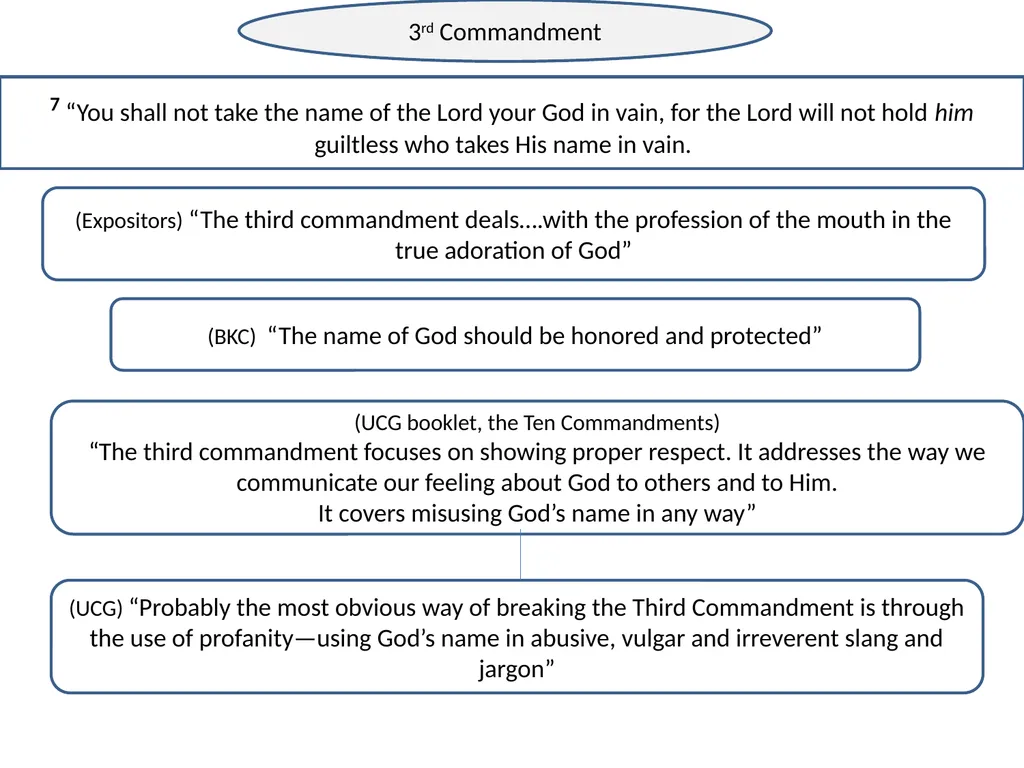
slide11. 7 “You shall not take the name of the Lord your God in vain, for the Lord will not hold him guiltless who takes His name in vain. (UCG booklet, the Ten Commandments)
“The third commandment focuses on showing proper respect. It addresses the way we communicate our feeling about God to others and to Him.
It covers misusing God’s name in any way” (Expositors) “The third commandment deals….with the profession of the mouth in the true adoration of God” (BKC) “The name of God should be honored and protected” (UCG) “Probably the most obvious way of breaking the Third Commandment is through the use of profanity—using God’s name in abusive, vulgar and irreverent slang and jargon” 3rd Commandment<br>
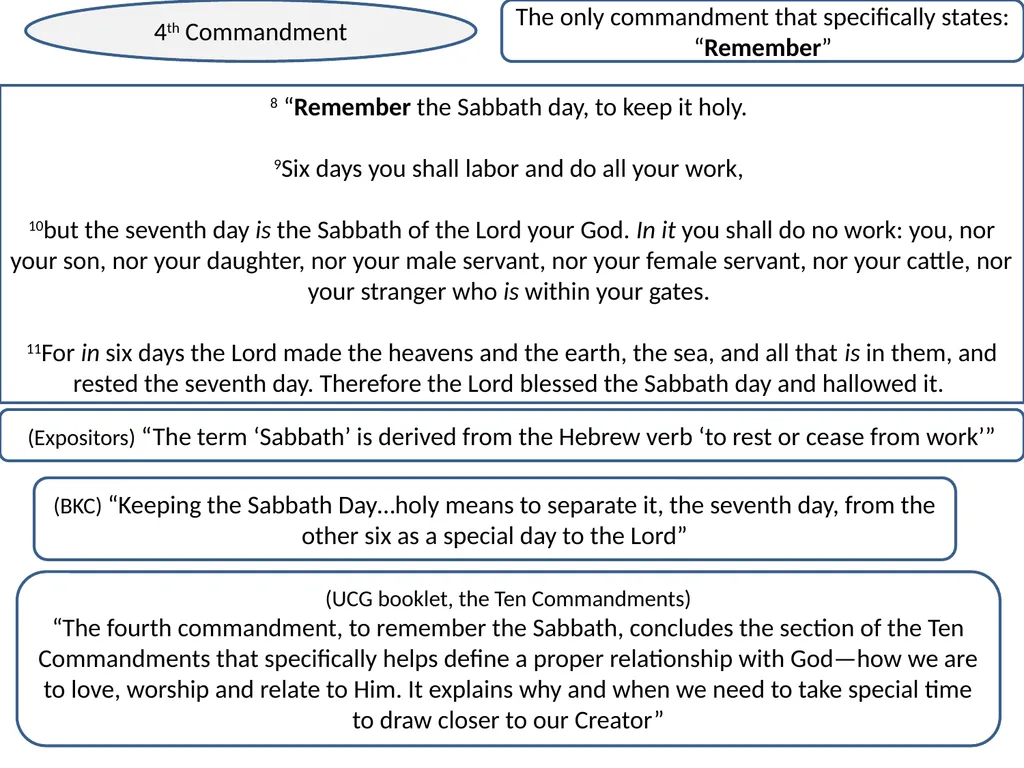
slide12. 8 “Remember the Sabbath day, to keep it holy.
9Six days you shall labor and do all your work,
10but the seventh day is the Sabbath of the Lord your God. In it you shall do no work: you, nor your son, nor your daughter, nor your male servant, nor your female servant, nor your cattle, nor your stranger who is within your gates.
11For in six days the Lord made the heavens and the earth, the sea, and all that is in them, and rested the seventh day. Therefore the Lord blessed the Sabbath day and hallowed it. The only commandment that specifically states: “Remember” (Expositors) “The term ‘Sabbath’ is derived from the Hebrew verb ‘to rest or cease from work’” (UCG booklet, the Ten Commandments)
“The fourth commandment, to remember the Sabbath, concludes the section of the Ten Commandments that specifically helps define a proper relationship with God—how we are to love, worship and relate to Him. It explains why and when we need to take special time to draw closer to our Creator” (BKC) “Keeping the Sabbath Day…holy means to separate it, the seventh day, from the other six as a special day to the Lord” 4th Commandment<br>
slide13. 12 “Honor your father and your mother, that your days may be long upon the land which the Lord your God is giving you. (UCG booklet, the Ten Commandments)
“The primary focus of the fifth commandment: the importance of learning to respect others while we are still children” (UCG) “Learning to obey this commandment helps children establish a life-time pattern of respecting proper rules, traditions, principle and laws. Honoring others should be a normal, natural habit learned during youth” (BKC) “The fifth commandment enjoins respect (honor) of parents. It implies obedience and submission to them” (UCG booklet, the Ten Commandments) “The fifth commandment introduces us to a series of commandments that define proper relationship with other people…it sets the tone for the last six” 5th Commandment<br>
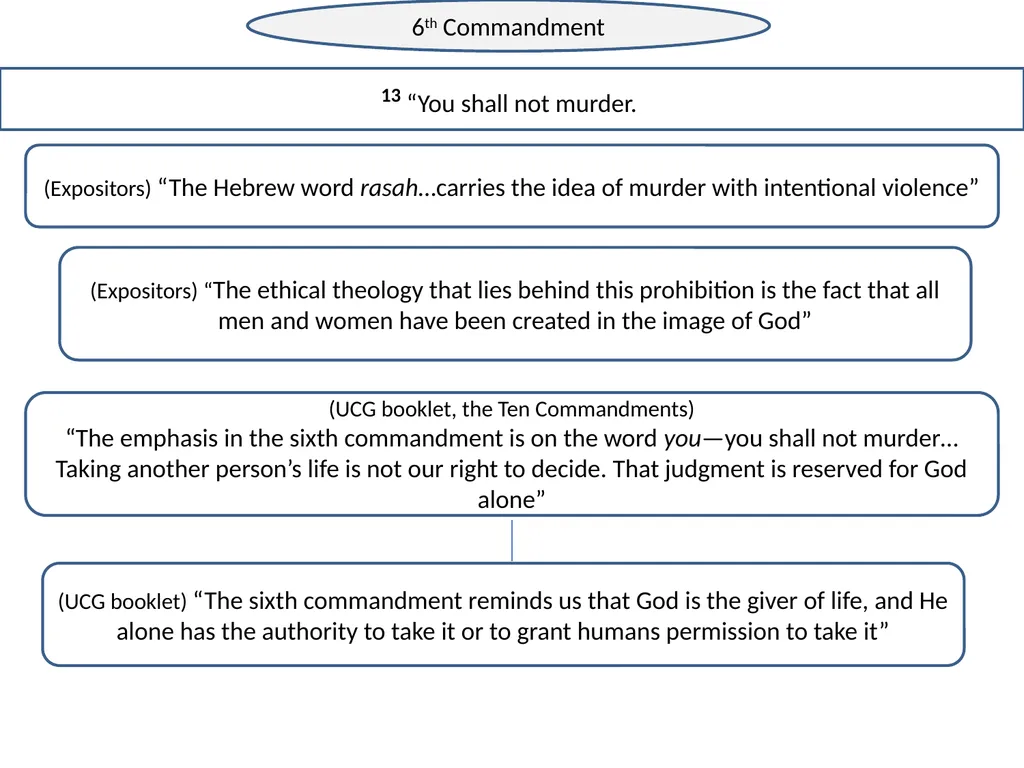
slide14. 13 “You shall not murder. (UCG booklet, the Ten Commandments)
“The emphasis in the sixth commandment is on the word you—you shall not murder…Taking another person’s life is not our right to decide. That judgment is reserved for God alone” (UCG booklet) “The sixth commandment reminds us that God is the giver of life, and He alone has the authority to take it or to grant humans permission to take it” (Expositors) “The Hebrew word rasah…carries the idea of murder with intentional violence” (Expositors) “The ethical theology that lies behind this prohibition is the fact that all men and women have been created in the image of God” 6th Commandment<br>
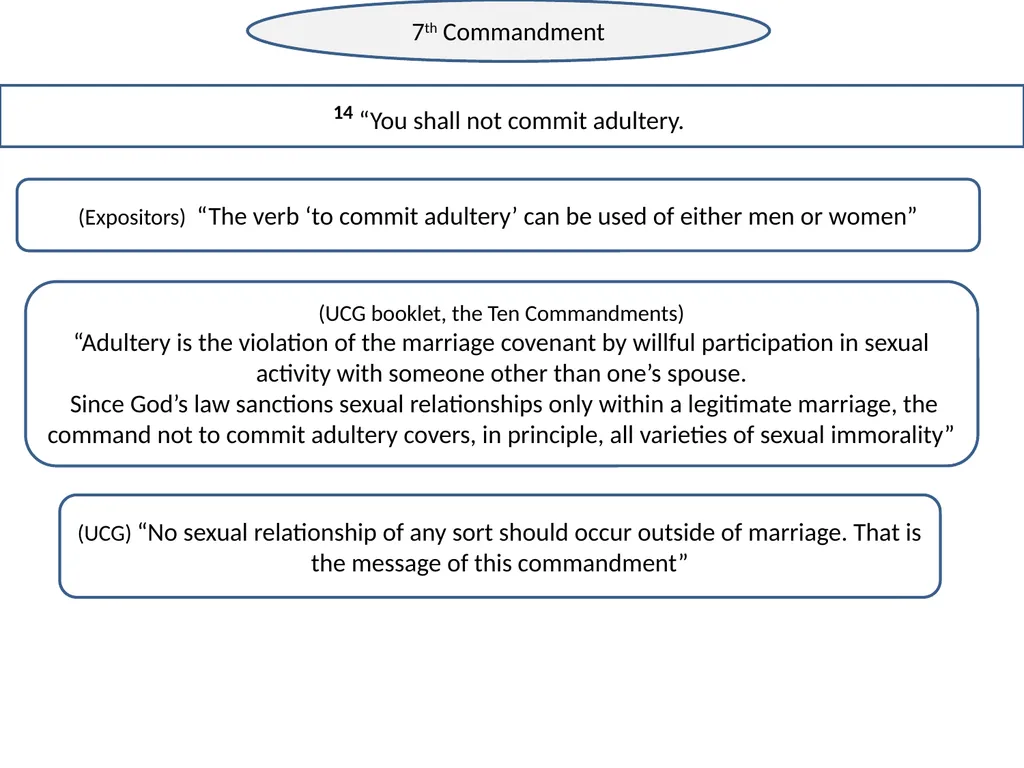
slide15. 14 “You shall not commit adultery. (UCG booklet, the Ten Commandments) “Adultery is the violation of the marriage covenant by willful participation in sexual activity with someone other than one’s spouse.
Since God’s law sanctions sexual relationships only within a legitimate marriage, the command not to commit adultery covers, in principle, all varieties of sexual immorality” (Expositors) “The verb ‘to commit adultery’ can be used of either men or women” (UCG) “No sexual relationship of any sort should occur outside of marriage. That is the message of this commandment” 7th Commandment<br>
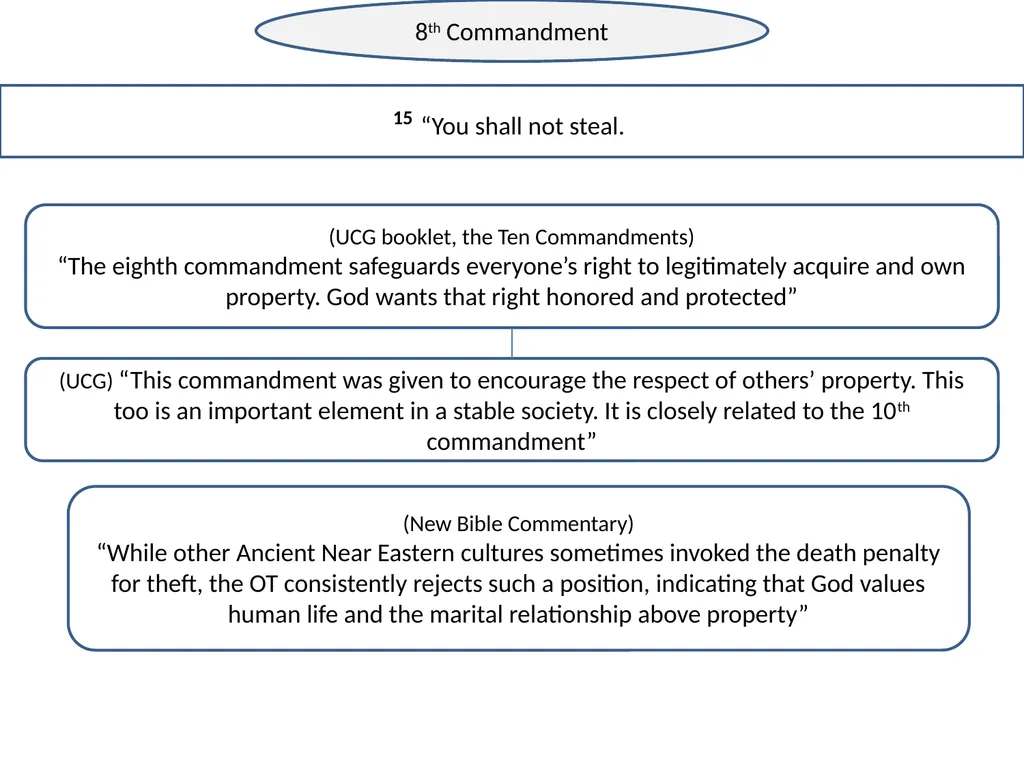
slide16. 15 “You shall not steal. (UCG booklet, the Ten Commandments)
“The eighth commandment safeguards everyone’s right to legitimately acquire and own property. God wants that right honored and protected” (UCG) “This commandment was given to encourage the respect of others’ property. This too is an important element in a stable society. It is closely related to the 10th commandment” 8th Commandment (New Bible Commentary) “While other Ancient Near Eastern cultures sometimes invoked the death penalty for theft, the OT consistently rejects such a position, indicating that God values human life and the marital relationship above property”<br>
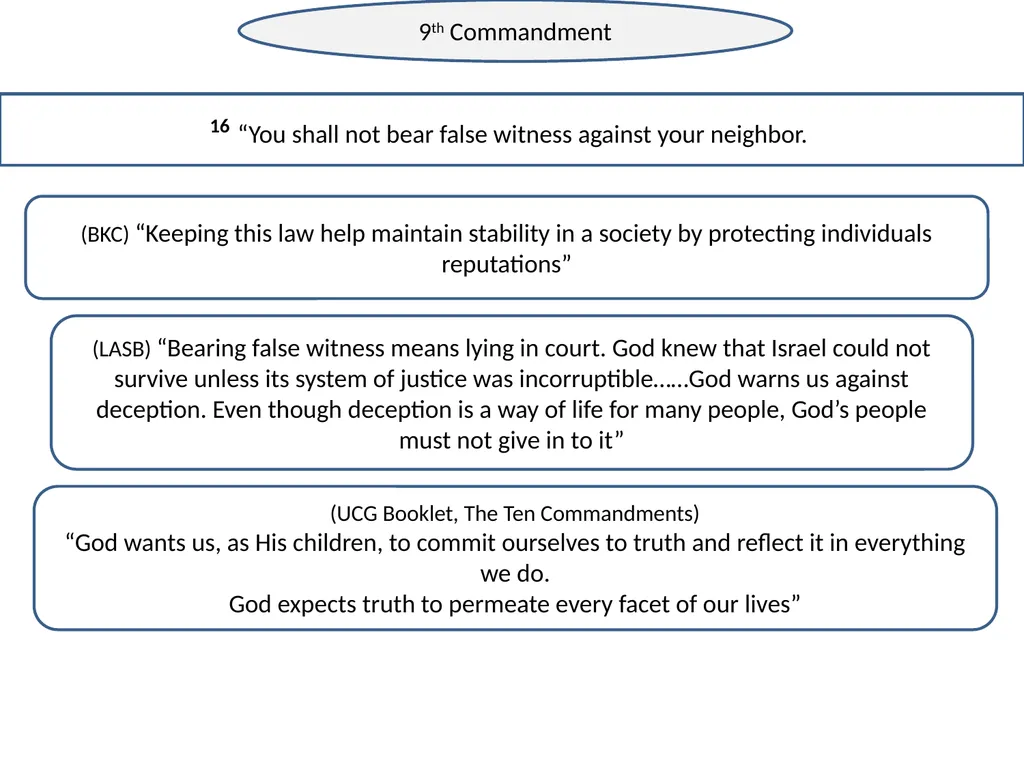
slide17. 16 “You shall not bear false witness against your neighbor. (UCG Booklet, The Ten Commandments)
“God wants us, as His children, to commit ourselves to truth and reflect it in everything we do.
God expects truth to permeate every facet of our lives” (BKC) “Keeping this law help maintain stability in a society by protecting individuals reputations” 9th Commandment (LASB) “Bearing false witness means lying in court. God knew that Israel could not survive unless its system of justice was incorruptible……God warns us against deception. Even though deception is a way of life for many people, God’s people must not give in to it”<br>
slide18. 17 “You shall not covet your neighbor’s house; you shall not covet your neighbor’s wife, nor his male servant, nor his female servant, nor his ox, nor his donkey, nor anything that is your neighbor’s.” (UCG) “Coveting—is aimed directly at the heart and mind of every human being. In prohibiting coveting, it defines not so much what we must do but how we should think” (UCG) “The focus of the tenth commandment is that we are not to illicitly desire anything that already belongs to others” (UCG booklet, the Ten Commandments)
“Covet means to crave or desire, especially in excessive or improper ways…an immoral longing for something that is not rightfully ours” 10th Commandment (LASB) “To covet is to wish to have the possessions of others. Coveting includes envy—resenting the fact that others have what you don’t”<br>
slide19. 18Now all the people witnessed the thunderings, the lightning flashes, the sound of the trumpet, and the mountain smoking; and when the people saw it, they trembled and stood afar off.
19Then they said to Moses, “You speak with us, and we will hear; but let not God speak with us, lest we die.” v. 19 They knew they needed a mediator to approach God on their behalf 20And Moses said to the people, “Do not fear; for God has come to test you, and that His fear may be before you, so that you may not sin.”
21So the people stood afar off, but Moses drew near the thick darkness where God was. v. 20 “that His fear may be before you”
(BKC) “Fear of Him would help curb their disobedience. Tragically Israel soon lost this fear of Him—a frequent theme of their history” “to test you”
(Tanakh translation, Jewish Study Bible) “Another possible translation is ‘to give you an experience (of Him)…..namely the experience would instill ‘fear of God’ a deterrent to sin” The reaction of the people<br>
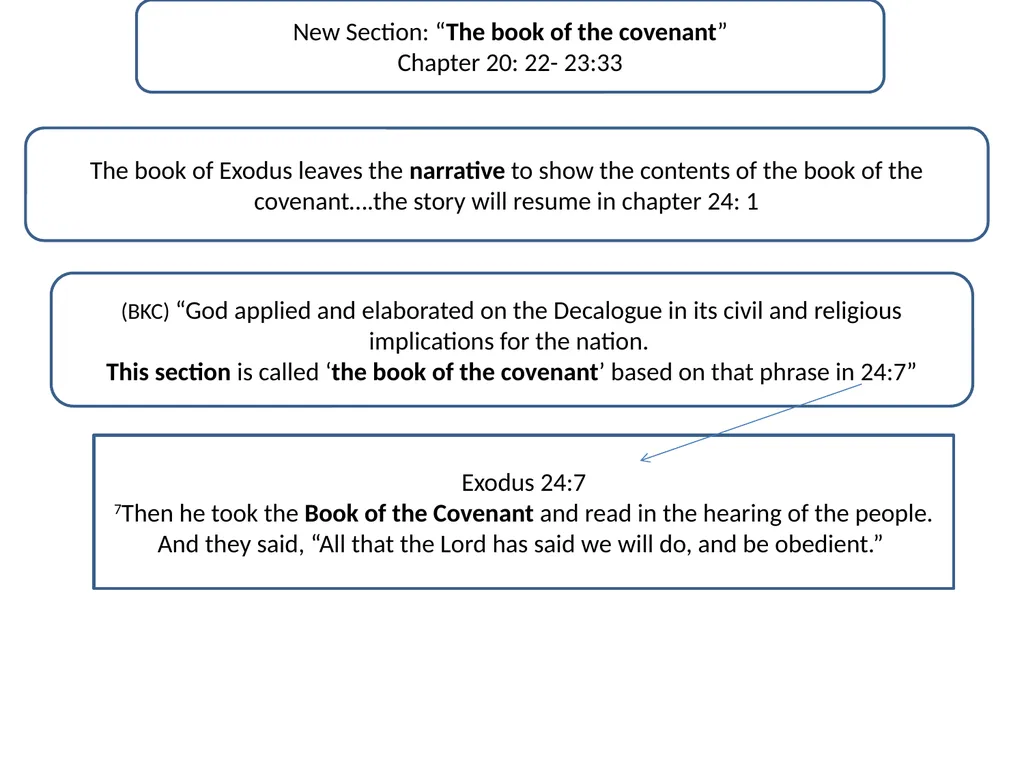
slide20. New Section: “The book of the covenant”
Chapter 20: 22- 23:33 The book of Exodus leaves the narrative to show the contents of the book of the covenant….the story will resume in chapter 24: 1 (BKC) “God applied and elaborated on the Decalogue in its civil and religious implications for the nation.
This section is called ‘the book of the covenant’ based on that phrase in 24:7” Exodus 24:7 7Then he took the Book of the Covenant and read in the hearing of the people. And they said, “All that the Lord has said we will do, and be obedient.”<br>
slide21. 22Then the Lord said to Moses, “Thus you shall say to the children of Israel: ‘You have seen that I have talked with you from heaven.
23You shall not make anything to be with Me—gods of silver or gods of gold you shall not make for yourselves. v. 23 (BKC) “The command to worship God alone, not other deities and the caution against making carved or molten idols of silver or gold, re-emphasizes the first and second commandment” The next instructions for building an altar and offering sacrifices form an essential part of the ratification of the covenant in chapter 24 v. 22-26 Instructions for the offering of sacrifices:
About idolatry and proper worship<br>
slide22. 24An altar of earth you shall make for Me, and you shall sacrifice on it your burnt offerings and your peace offerings, your sheep and your oxen. In every place where I record My name I will come to you, and I will bless you.
25And if you make Me an altar of stone, you shall not build it of hewn stone; for if you use your tool on it, you have profaned it. (BKC) “Altars with elaborate craftsmanship and elevated platforms with staircases were common in the worship of false deities” 26Nor shall you go up by steps to My altar, that your nakedness may not be exposed on it.’ (BKC) “The altar was to be unadorned by craftsmanship; it was to be of earth (natural stones), and without steps so the priests would not be indecently exposed.<br>
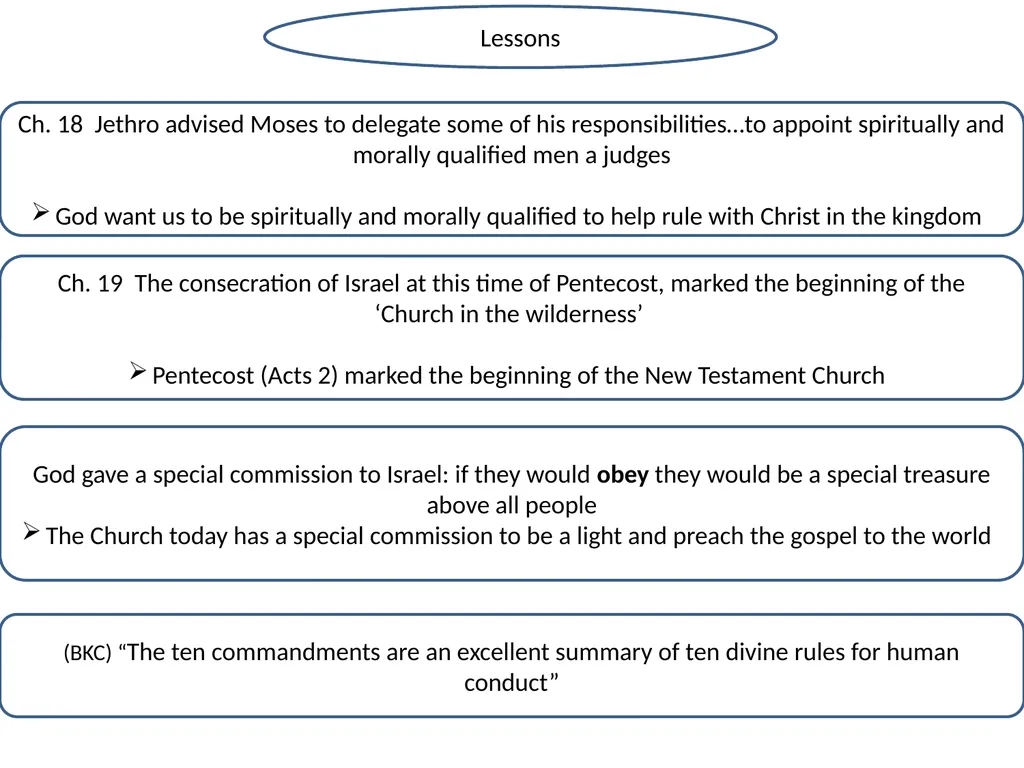
slide23. Lessons Ch. 18 Jethro advised Moses to delegate some of his responsibilities…to appoint spiritually and morally qualified men a judges
God want us to be spiritually and morally qualified to help rule with Christ in the kingdom Ch. 19 The consecration of Israel at this time of Pentecost, marked the beginning of the ‘Church in the wilderness’
Pentecost (Acts 2) marked the beginning of the New Testament Church God gave a special commission to Israel: if they would obey they would be a special treasure above all people
The Church today has a special commission to be a light and preach the gospel to the world (BKC) “The ten commandments are an excellent summary of ten divine rules for human conduct”<br>
slide2. Introduction to the ten commandments—Chapter 20 (Expositors) “The title ‘Ten Commandments’ comes from Exodus 34: 28 and Deuteronomy 4: 13” Deuteronomy 4:13 13So He declared to you His covenant which He commanded you to perform, the Ten Commandments; and He wrote them on two tablets of stone. (Ch. 20)—The first written record of all the ten commandments together….although they were known before this Genesis 26:5 5because Abraham obeyed My voice and kept My charge, My commandments, My statutes, and My laws.” [English]‘Ten commandments’…. is literally ‘ten words’ [Heb.] aseret hadevarim
[20:1] “And God spoke all these words, saying:”
Are also called the ‘Decalogue’(from Latin for ‘ten words’)<br>
slide3. Ten commandments and historical notes: (BKC) “One of the great events in the history of Israel, and perhaps in the history of mankind, is the giving of the law” (Zondervan Bible Backgrounds Commentary)
“There are no exact parallels to this list from other ancient Near Eastern societies, although a few text present similarities” (Tanakh translation, Jewish Study Bible)
“Elsewhere in the ancient Near East the laws were believed to be the product of human minds, particularly the king” (Tanakh)
“Implicit in this biblical view is that God is Israel’s king, hence its legislator. This elevated the status of law beyond matters of practicality and endowed it with sanctity” The ten commandments would be repeated to the Israelites who were about to enter the land of Canaan after 40 years of wandering [Deuteronomy 5]<br>
slide4. (UCG booklet the Ten Commandments)
“Jesus Christ defined the purpose of God’s law as teaching us how to apply the two great principles of loving God and loving each other” Mark 12:29-30 29Jesus answered him, “The first of all the commandments is: ‘Hear, O Israel, the Lord our God, the Lord is one.
30And you shall love the Lord your God with all your heart, with all your soul, with all your mind, and with all your strength.’ £ £This is the first commandment. (BKC) “The ten commandments are an excellent summary of ten divine rules for human conduct” Mark 12:31 31And the second, like it, is this: ‘You shall love your neighbor as yourself.’ £ There is no other commandment greater than these.” Summed up in the first four commandments Summed up in the last six commandments<br>
slide5. 1And God spoke all these words, saying: Exodus 20 His relationship with His people (Expositors) “God himself is the speaker and source of these commandments” 2 “I am the Lord your God, who brought you out of the land of Egypt, out of the house of bondage. And what he had done for them (Companion) “God”= Elohim (Heb): hence of universal application. Not Jehovah, for this title would have limited the law to Israel” (Keil and Delitzch) “By bringing them out of Egypt, the house of bondage, Jehovah had proved to the Israelites that He was their God”<br>
slide6. 3 “You shall have no other gods before Me. (UCG booklet, the Ten Commandments)
“Establishing, developing and maintaining that personal relationship with the true living God is the most important commitment we can ever make.
That is the primary focus of the first commandment” (BKC) “The first of the Ten Commandments is that Israel was to worship the one true God. Worshipping false gods would be setting up rivals to Him” (Keil and Delitzch)
“other gods, literally beyond me, or in addition to me” 1st Commandment<br>
slide7. 4 “You shall not make for yourself a carved image—any likeness of anything that is in heaven above, or that is in the earth beneath, or that is in the water under the earth; (UCG booklet, the Ten Commandments)
“The second commandment differs from the first in that it explains that, in our worship, we must not reduce God to a likeness of a physical object” (BKC) “The worship of God was to be spiritual, not material. “make”
(Companion) “The making is equally forbidden as the worshipping” 2nd Commandment
v.4-6 (Babylon, Joan Oates)
“Central in official Babylon religion was the image of the god itself. The deity was considered present in the image;
They were fashioned and repaired in special workshops and had to undergo an elaborate and highly secret ritual of consecration which endowed them with ‘life’.”<br>
slide8. Statue of baal v. 3 “You shall not make for yourself a carved image…. v. 4 you shall not bow down to them nor serve them…”<br>
slide9. Osiris<br>
slide10. 5 you shall not bow down to them nor serve them. For I, the Lord your God, am a jealous God, visiting the iniquity of the fathers upon the children to the third and fourth generations of those who hate Me, “Jealous”
(Expositors) “When used of God it denotes:
1) that attribute that demands exclusive devotion
2) that attitude of anger directed against all who oppose him” 6 but showing mercy to thousands, to those who love Me and keep My commandments. (Expositors) “The effects of disobedience last for some time, but the effects of loving God are far more extensive: to a thousand [generations]” to offer religious worship 2nd Commandment
Continued (Expositors) “Every form of substitution, neglect or contempt, both public and private, for the worship of God is rejected in this commandment”<br>
slide11. 7 “You shall not take the name of the Lord your God in vain, for the Lord will not hold him guiltless who takes His name in vain. (UCG booklet, the Ten Commandments)
“The third commandment focuses on showing proper respect. It addresses the way we communicate our feeling about God to others and to Him.
It covers misusing God’s name in any way” (Expositors) “The third commandment deals….with the profession of the mouth in the true adoration of God” (BKC) “The name of God should be honored and protected” (UCG) “Probably the most obvious way of breaking the Third Commandment is through the use of profanity—using God’s name in abusive, vulgar and irreverent slang and jargon” 3rd Commandment<br>
slide12. 8 “Remember the Sabbath day, to keep it holy.
9Six days you shall labor and do all your work,
10but the seventh day is the Sabbath of the Lord your God. In it you shall do no work: you, nor your son, nor your daughter, nor your male servant, nor your female servant, nor your cattle, nor your stranger who is within your gates.
11For in six days the Lord made the heavens and the earth, the sea, and all that is in them, and rested the seventh day. Therefore the Lord blessed the Sabbath day and hallowed it. The only commandment that specifically states: “Remember” (Expositors) “The term ‘Sabbath’ is derived from the Hebrew verb ‘to rest or cease from work’” (UCG booklet, the Ten Commandments)
“The fourth commandment, to remember the Sabbath, concludes the section of the Ten Commandments that specifically helps define a proper relationship with God—how we are to love, worship and relate to Him. It explains why and when we need to take special time to draw closer to our Creator” (BKC) “Keeping the Sabbath Day…holy means to separate it, the seventh day, from the other six as a special day to the Lord” 4th Commandment<br>
slide13. 12 “Honor your father and your mother, that your days may be long upon the land which the Lord your God is giving you. (UCG booklet, the Ten Commandments)
“The primary focus of the fifth commandment: the importance of learning to respect others while we are still children” (UCG) “Learning to obey this commandment helps children establish a life-time pattern of respecting proper rules, traditions, principle and laws. Honoring others should be a normal, natural habit learned during youth” (BKC) “The fifth commandment enjoins respect (honor) of parents. It implies obedience and submission to them” (UCG booklet, the Ten Commandments) “The fifth commandment introduces us to a series of commandments that define proper relationship with other people…it sets the tone for the last six” 5th Commandment<br>
slide14. 13 “You shall not murder. (UCG booklet, the Ten Commandments)
“The emphasis in the sixth commandment is on the word you—you shall not murder…Taking another person’s life is not our right to decide. That judgment is reserved for God alone” (UCG booklet) “The sixth commandment reminds us that God is the giver of life, and He alone has the authority to take it or to grant humans permission to take it” (Expositors) “The Hebrew word rasah…carries the idea of murder with intentional violence” (Expositors) “The ethical theology that lies behind this prohibition is the fact that all men and women have been created in the image of God” 6th Commandment<br>
slide15. 14 “You shall not commit adultery. (UCG booklet, the Ten Commandments) “Adultery is the violation of the marriage covenant by willful participation in sexual activity with someone other than one’s spouse.
Since God’s law sanctions sexual relationships only within a legitimate marriage, the command not to commit adultery covers, in principle, all varieties of sexual immorality” (Expositors) “The verb ‘to commit adultery’ can be used of either men or women” (UCG) “No sexual relationship of any sort should occur outside of marriage. That is the message of this commandment” 7th Commandment<br>
slide16. 15 “You shall not steal. (UCG booklet, the Ten Commandments)
“The eighth commandment safeguards everyone’s right to legitimately acquire and own property. God wants that right honored and protected” (UCG) “This commandment was given to encourage the respect of others’ property. This too is an important element in a stable society. It is closely related to the 10th commandment” 8th Commandment (New Bible Commentary) “While other Ancient Near Eastern cultures sometimes invoked the death penalty for theft, the OT consistently rejects such a position, indicating that God values human life and the marital relationship above property”<br>
slide17. 16 “You shall not bear false witness against your neighbor. (UCG Booklet, The Ten Commandments)
“God wants us, as His children, to commit ourselves to truth and reflect it in everything we do.
God expects truth to permeate every facet of our lives” (BKC) “Keeping this law help maintain stability in a society by protecting individuals reputations” 9th Commandment (LASB) “Bearing false witness means lying in court. God knew that Israel could not survive unless its system of justice was incorruptible……God warns us against deception. Even though deception is a way of life for many people, God’s people must not give in to it”<br>
slide18. 17 “You shall not covet your neighbor’s house; you shall not covet your neighbor’s wife, nor his male servant, nor his female servant, nor his ox, nor his donkey, nor anything that is your neighbor’s.” (UCG) “Coveting—is aimed directly at the heart and mind of every human being. In prohibiting coveting, it defines not so much what we must do but how we should think” (UCG) “The focus of the tenth commandment is that we are not to illicitly desire anything that already belongs to others” (UCG booklet, the Ten Commandments)
“Covet means to crave or desire, especially in excessive or improper ways…an immoral longing for something that is not rightfully ours” 10th Commandment (LASB) “To covet is to wish to have the possessions of others. Coveting includes envy—resenting the fact that others have what you don’t”<br>
slide19. 18Now all the people witnessed the thunderings, the lightning flashes, the sound of the trumpet, and the mountain smoking; and when the people saw it, they trembled and stood afar off.
19Then they said to Moses, “You speak with us, and we will hear; but let not God speak with us, lest we die.” v. 19 They knew they needed a mediator to approach God on their behalf 20And Moses said to the people, “Do not fear; for God has come to test you, and that His fear may be before you, so that you may not sin.”
21So the people stood afar off, but Moses drew near the thick darkness where God was. v. 20 “that His fear may be before you”
(BKC) “Fear of Him would help curb their disobedience. Tragically Israel soon lost this fear of Him—a frequent theme of their history” “to test you”
(Tanakh translation, Jewish Study Bible) “Another possible translation is ‘to give you an experience (of Him)…..namely the experience would instill ‘fear of God’ a deterrent to sin” The reaction of the people<br>
slide20. New Section: “The book of the covenant”
Chapter 20: 22- 23:33 The book of Exodus leaves the narrative to show the contents of the book of the covenant….the story will resume in chapter 24: 1 (BKC) “God applied and elaborated on the Decalogue in its civil and religious implications for the nation.
This section is called ‘the book of the covenant’ based on that phrase in 24:7” Exodus 24:7 7Then he took the Book of the Covenant and read in the hearing of the people. And they said, “All that the Lord has said we will do, and be obedient.”<br>
slide21. 22Then the Lord said to Moses, “Thus you shall say to the children of Israel: ‘You have seen that I have talked with you from heaven.
23You shall not make anything to be with Me—gods of silver or gods of gold you shall not make for yourselves. v. 23 (BKC) “The command to worship God alone, not other deities and the caution against making carved or molten idols of silver or gold, re-emphasizes the first and second commandment” The next instructions for building an altar and offering sacrifices form an essential part of the ratification of the covenant in chapter 24 v. 22-26 Instructions for the offering of sacrifices:
About idolatry and proper worship<br>
slide22. 24An altar of earth you shall make for Me, and you shall sacrifice on it your burnt offerings and your peace offerings, your sheep and your oxen. In every place where I record My name I will come to you, and I will bless you.
25And if you make Me an altar of stone, you shall not build it of hewn stone; for if you use your tool on it, you have profaned it. (BKC) “Altars with elaborate craftsmanship and elevated platforms with staircases were common in the worship of false deities” 26Nor shall you go up by steps to My altar, that your nakedness may not be exposed on it.’ (BKC) “The altar was to be unadorned by craftsmanship; it was to be of earth (natural stones), and without steps so the priests would not be indecently exposed.<br>
slide23. Lessons Ch. 18 Jethro advised Moses to delegate some of his responsibilities…to appoint spiritually and morally qualified men a judges
God want us to be spiritually and morally qualified to help rule with Christ in the kingdom Ch. 19 The consecration of Israel at this time of Pentecost, marked the beginning of the ‘Church in the wilderness’
Pentecost (Acts 2) marked the beginning of the New Testament Church God gave a special commission to Israel: if they would obey they would be a special treasure above all people
The Church today has a special commission to be a light and preach the gospel to the world (BKC) “The ten commandments are an excellent summary of ten divine rules for human conduct”<br>