
Chapter 27 Controlled Dangerous Substances Jeffery
PT
Published · 80 slides · 0 views
1 / 1









Description
Chapter 27 Controlled Dangerous Substances Jeffery D. Evans, Pharm.D, Associate Professor of Pharmacy Practice Objectives At the end of this presentation the student will be able to: Apply various aspects of controlled substance law to
Related Topics
Share
Embed code
Download this presentation From Below
"Chapter 27 Controlled Dangerous Substances Jeffery" is the property of its rightful owner. Permission is granted to download and print the materials on this website for personal, non-commercial use only, and to display it on your personal computer provided you do not modify the materials and that you retain all copyright notices contained in the materials. By downloading content from our website, you accept the terms of this agreement.
Presentation Transcript
01
Chapter 27 Controlled Dangerous Substances Jeffery D. Evans, Pharm.D,
Associate Professor of Pharmacy Practice<br>
Associate Professor of Pharmacy Practice<br>
02
Objectives At the end of this presentation the student will be able to:
Apply various aspects of controlled substance law to practice
Understand the interaction between the Federal CSA and the board rules for LA
Know which agents are in which class<br>
Apply various aspects of controlled substance law to practice
Understand the interaction between the Federal CSA and the board rules for LA
Know which agents are in which class<br>
03
Chapter 27 Purpose
Regulate multiple aspects of Controlled Dangerous Substances
Impose penalties for failing to comply with them.
Impact on pharmacy practice
In most areas significant. Nuclear for example is zero.<br>
Regulate multiple aspects of Controlled Dangerous Substances
Impose penalties for failing to comply with them.
Impact on pharmacy practice
In most areas significant. Nuclear for example is zero.<br>
04
Definitions (2701) Important ones (I think)
Central Fill Pharmacy
A pharmacy that fills other pharmacies medications
Controlled Dangerous Substance or Controlled Substance
Any substance deemed an CDS by the Federal or State CSA
Dispense or Dispensing
Deals with controlled substances here, but says the same thing.
<note must be labeled for use by the patient or caregiver><br>
Central Fill Pharmacy
A pharmacy that fills other pharmacies medications
Controlled Dangerous Substance or Controlled Substance
Any substance deemed an CDS by the Federal or State CSA
Dispense or Dispensing
Deals with controlled substances here, but says the same thing.
<note must be labeled for use by the patient or caregiver><br>
05
Definitions (2701) Dispenser
Notice that the word ‘pharmacist’ does not appear here
Persons
Not just humans. Any Entity is considered a person
Practitioner
Allowed to ‘prescribe and administer’ CDSs<br>
Notice that the word ‘pharmacist’ does not appear here
Persons
Not just humans. Any Entity is considered a person
Practitioner
Allowed to ‘prescribe and administer’ CDSs<br>
06
Definitions (2701) Prescription or Prescription Drug Order
Must be patient specific.
Sales Representatives or Professional Medical Representatives
Employed by a manufacturer to transfer CDSs to other CDS registrants.<br>
Must be patient specific.
Sales Representatives or Professional Medical Representatives
Employed by a manufacturer to transfer CDSs to other CDS registrants.<br>
07
What is a schedule? (2703) This section is verbatim from the LA CSA and the US CSA
Defines what makes a substance get scheduled
Defines what schedule a substance will fall into<br>
Defines what makes a substance get scheduled
Defines what schedule a substance will fall into<br>
08
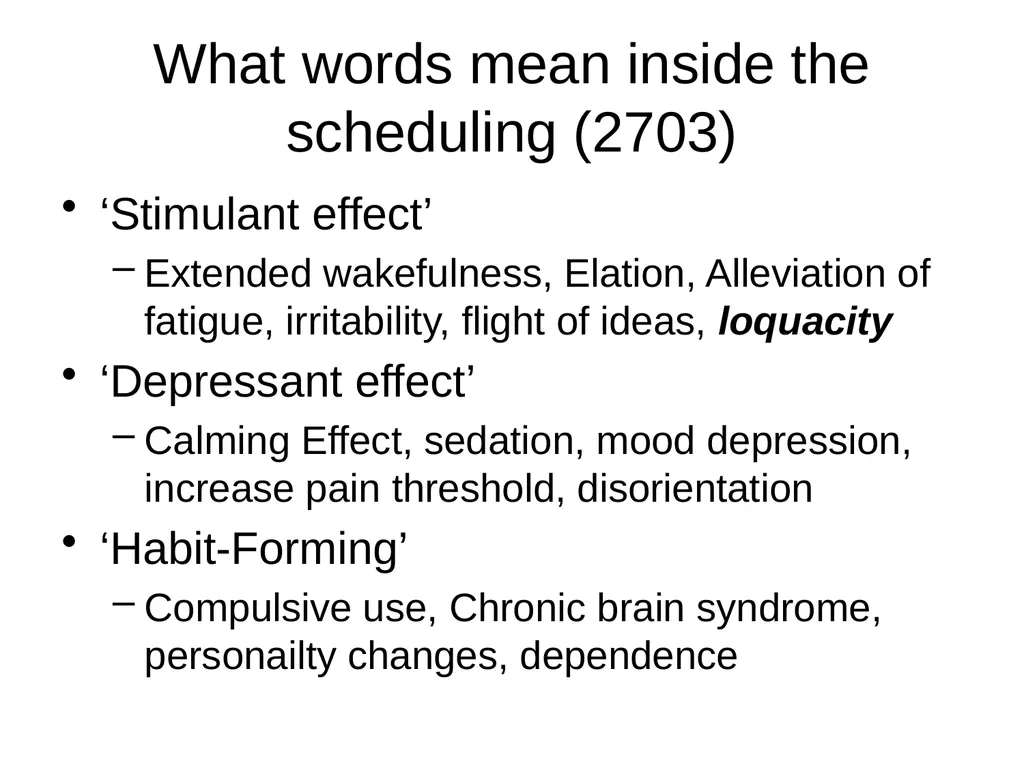
What words mean inside the scheduling (2703) ‘Stimulant effect’
Extended wakefulness, Elation, Alleviation of fatigue, irritability, flight of ideas, loquacity
‘Depressant effect’
Calming Effect, sedation, mood depression, increase pain threshold, disorientation
‘Habit-Forming’
Compulsive use, Chronic brain syndrome, personailty changes, dependence<br>
Extended wakefulness, Elation, Alleviation of fatigue, irritability, flight of ideas, loquacity
‘Depressant effect’
Calming Effect, sedation, mood depression, increase pain threshold, disorientation
‘Habit-Forming’
Compulsive use, Chronic brain syndrome, personailty changes, dependence<br>
09
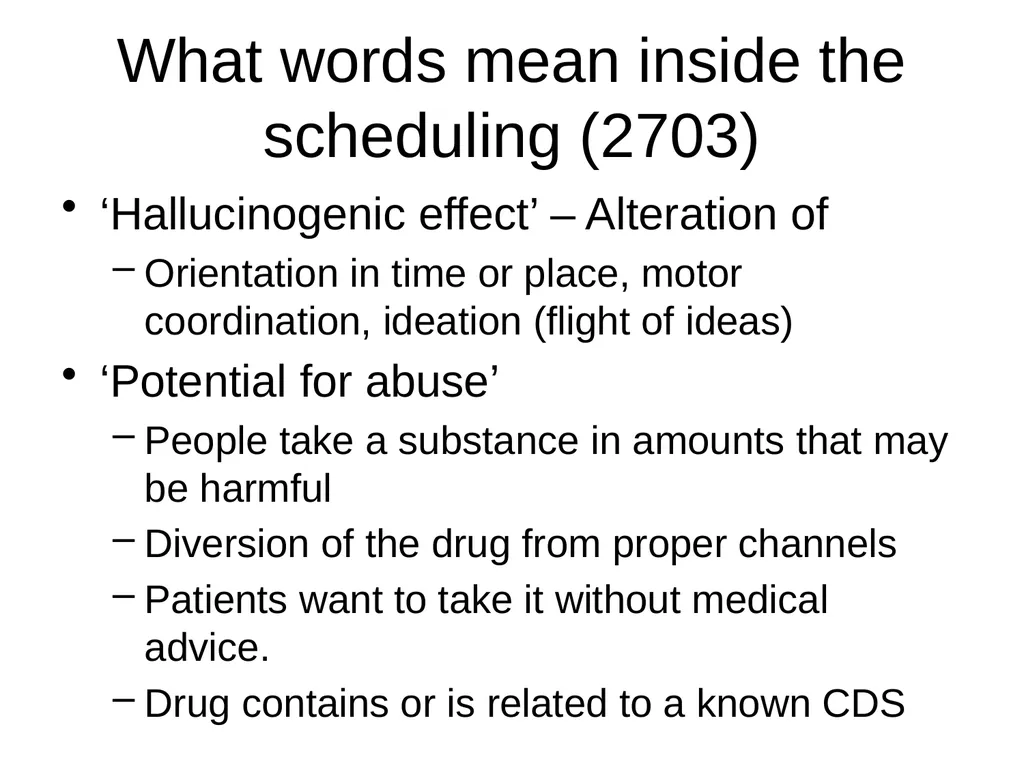
What words mean inside the scheduling (2703) ‘Hallucinogenic effect’ – Alteration of
Orientation in time or place, motor coordination, ideation (flight of ideas)
‘Potential for abuse’
People take a substance in amounts that may be harmful
Diversion of the drug from proper channels
Patients want to take it without medical advice.
Drug contains or is related to a known CDS<br>
Orientation in time or place, motor coordination, ideation (flight of ideas)
‘Potential for abuse’
People take a substance in amounts that may be harmful
Diversion of the drug from proper channels
Patients want to take it without medical advice.
Drug contains or is related to a known CDS<br>
10
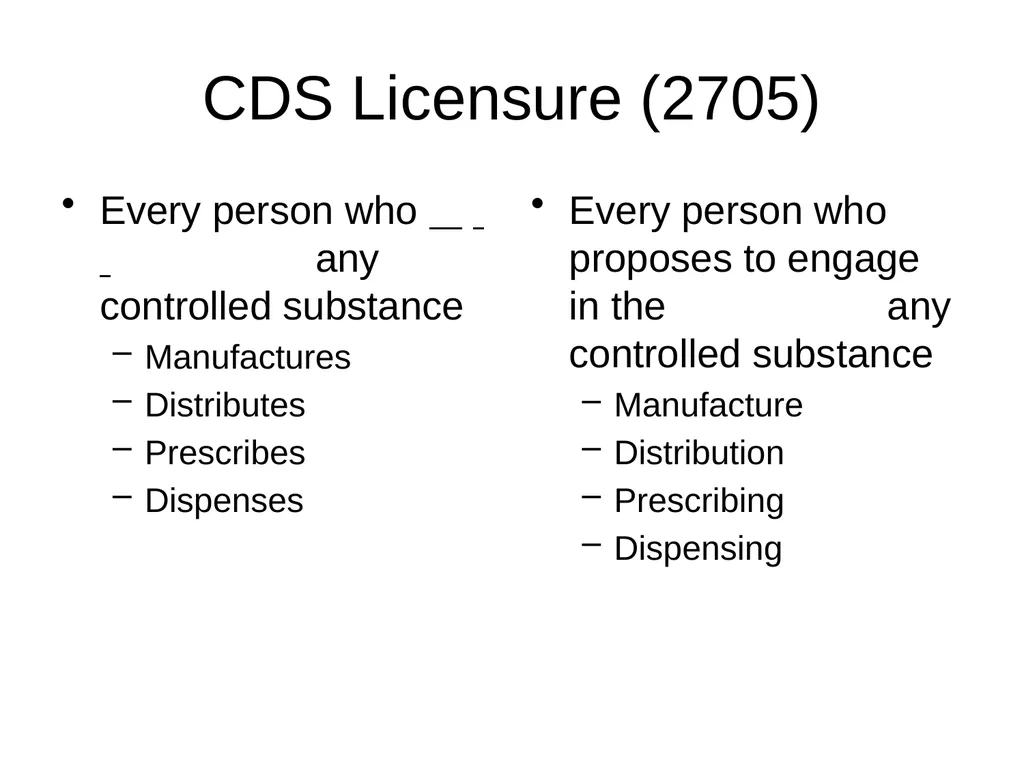
CDS Licensure (2705) Every person who any controlled substance
Manufactures
Distributes
Prescribes
Dispenses Every person who proposes to engage in the any controlled substance
Manufacture
Distribution
Prescribing
Dispensing<br>
Manufactures
Distributes
Prescribes
Dispenses Every person who proposes to engage in the any controlled substance
Manufacture
Distribution
Prescribing
Dispensing<br>
11
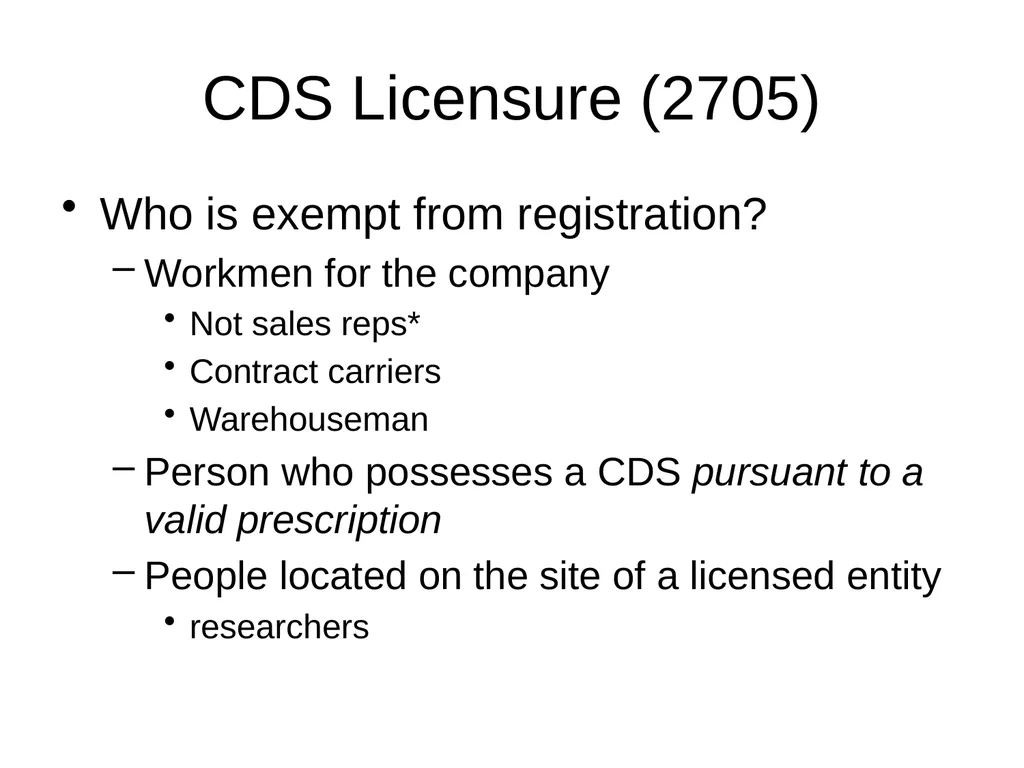
CDS Licensure (2705) Who is exempt from registration?
Workmen for the company
Not sales reps*
Contract carriers
Warehouseman
Person who possesses a CDS pursuant to a valid prescription
People located on the site of a licensed entity
researchers<br>
Workmen for the company
Not sales reps*
Contract carriers
Warehouseman
Person who possesses a CDS pursuant to a valid prescription
People located on the site of a licensed entity
researchers<br>
12
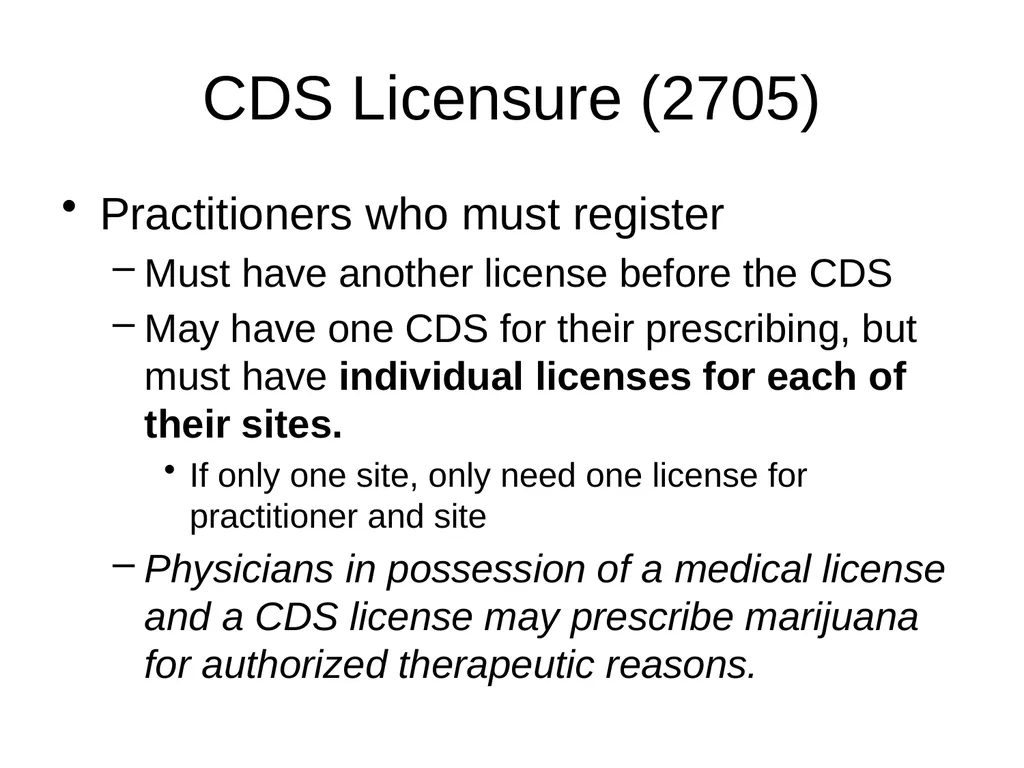
CDS Licensure (2705) Practitioners who must register
Must have another license before the CDS
May have one CDS for their prescribing, but must have individual licenses for each of their sites.
If only one site, only need one license for practitioner and site
Physicians in possession of a medical license and a CDS license may prescribe marijuana for authorized therapeutic reasons.<br>
Must have another license before the CDS
May have one CDS for their prescribing, but must have individual licenses for each of their sites.
If only one site, only need one license for practitioner and site
Physicians in possession of a medical license and a CDS license may prescribe marijuana for authorized therapeutic reasons.<br>
13
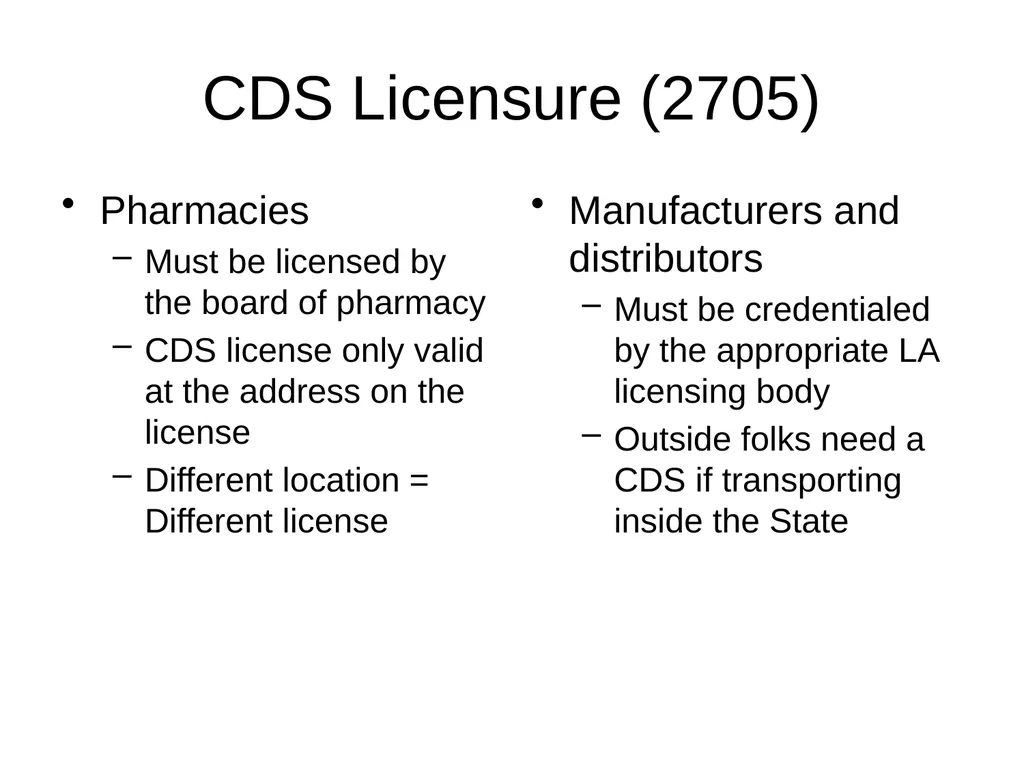
CDS Licensure (2705) Pharmacies
Must be licensed by the board of pharmacy
CDS license only valid at the address on the license
Different location = Different license Manufacturers and distributors
Must be credentialed by the appropriate LA licensing body
Outside folks need a CDS if transporting inside the State<br>
Must be licensed by the board of pharmacy
CDS license only valid at the address on the license
Different location = Different license Manufacturers and distributors
Must be credentialed by the appropriate LA licensing body
Outside folks need a CDS if transporting inside the State<br>
14
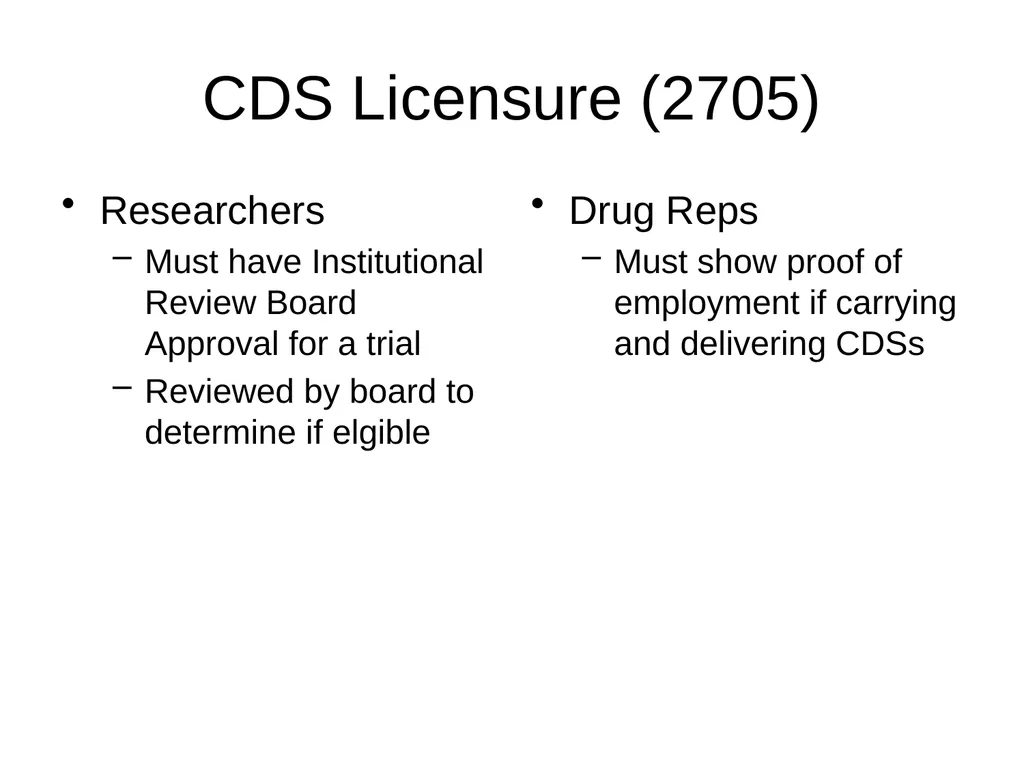
CDS Licensure (2705) Researchers
Must have Institutional Review Board Approval for a trial
Reviewed by board to determine if elgible Drug Reps
Must show proof of employment if carrying and delivering CDSs<br>
Must have Institutional Review Board Approval for a trial
Reviewed by board to determine if elgible Drug Reps
Must show proof of employment if carrying and delivering CDSs<br>
15
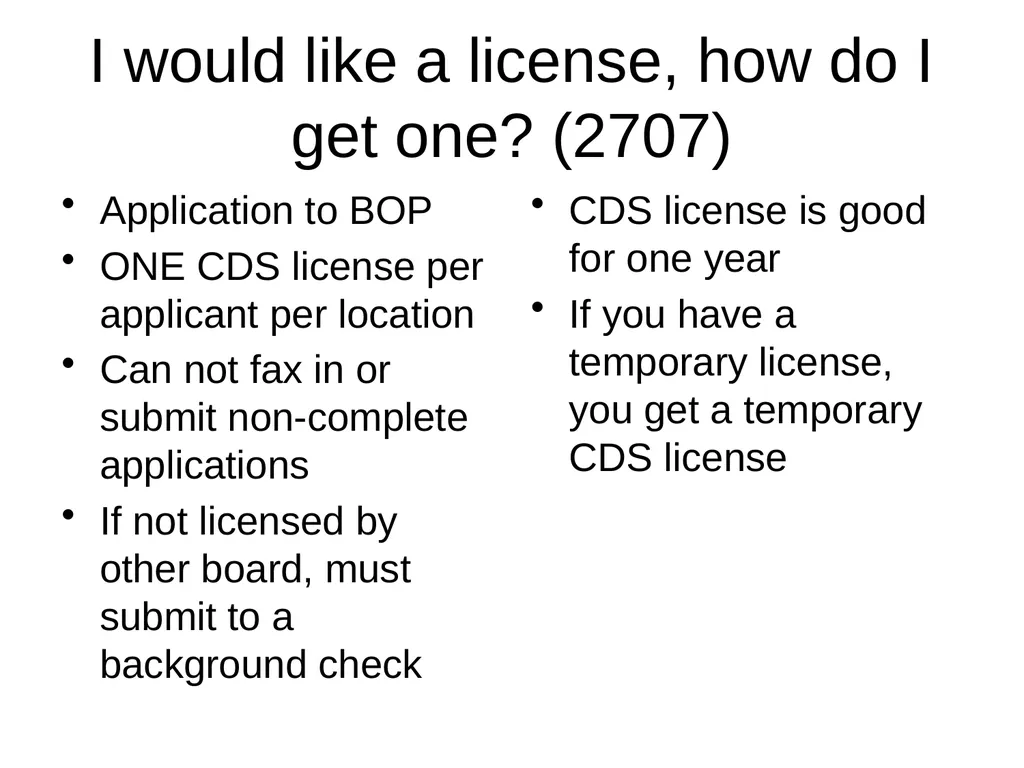
I would like a license, how do I get one? (2707) Application to BOP
ONE CDS license per applicant per location
Can not fax in or submit non-complete applications
If not licensed by other board, must submit to a background check CDS license is good for one year
If you have a temporary license, you get a temporary CDS license<br>
ONE CDS license per applicant per location
Can not fax in or submit non-complete applications
If not licensed by other board, must submit to a background check CDS license is good for one year
If you have a temporary license, you get a temporary CDS license<br>
16
I have a CDS license, how do I keep it (2707) Complete the form and pay the fees
Must be renewed prior to the expiration date.
May not fax
If expiration date is past, the licensee may not act as if they have a CDS license
If expired for 30 days, the license dies<br>
Must be renewed prior to the expiration date.
May not fax
If expiration date is past, the licensee may not act as if they have a CDS license
If expired for 30 days, the license dies<br>
17
You took my license, may I have it back (2707) If late renewal
Pay late fees + registration
If expired for
< 1year an administrative assistant may renew
1 – 5 years the board member in charge of CDS may renew
>5 years full board hearing required
If taken due to loss of other license, other license must be reinstated
Application for reinstatement secondary to board punishment, must occur to the full board<br>
Pay late fees + registration
If expired for
< 1year an administrative assistant may renew
1 – 5 years the board member in charge of CDS may renew
>5 years full board hearing required
If taken due to loss of other license, other license must be reinstated
Application for reinstatement secondary to board punishment, must occur to the full board<br>
18
What if circumstances change? (2707) CDS license is only good for the person who it was issued to
All changes of location must be provided within 10 days
If you need a new license (printed), you will pay for it
A CDS license is not transferable
New ownership needs a new CDS license<br>
All changes of location must be provided within 10 days
If you need a new license (printed), you will pay for it
A CDS license is not transferable
New ownership needs a new CDS license<br>
19
Do they have to approve my application? (2709) Short answer, no
Must be denied ‘for cause’
Any CDS issues is cause
Even if you surrender and plead not guilty, they still have cause<br>
Must be denied ‘for cause’
Any CDS issues is cause
Even if you surrender and plead not guilty, they still have cause<br>
20
So I messed up, what can happen? (2711) This is rehash of Chapter 3, thus will cover there
However, full range of punishments may occur including permanent licensure revokement<br>
However, full range of punishments may occur including permanent licensure revokement<br>
21
What will the board inspector be looking for when he stops by? (2713) Type of activity conducted
What CDSs are handled
Quantity of CDS handled
Location of licensee
Type of building and characteristics of building
Type of storage area (vault)
Adequacy of security systems
Who enters the premises (public)
Local police protection
Documentation<br>
What CDSs are handled
Quantity of CDS handled
Location of licensee
Type of building and characteristics of building
Type of storage area (vault)
Adequacy of security systems
Who enters the premises (public)
Local police protection
Documentation<br>
22
Stuff not so interesting to us (2715) This section deals with storage requirements not of a pharmacy.
Interesting to read, but not directed at Pharmacy<br>
Interesting to read, but not directed at Pharmacy<br>
23
How do I store controls in a pharmacy? (2717) Schedule I
Always in a locked, substantial cabinet
Schedules II, III, IV, and V
Store in a securely locked, substantial cabinet
May disperse such substances throughout the stock of non-controlled substances … as to obstruct theft or diversion of the CDS
People with felonies related to CDSs are not allowed near CDSs in a pharmacy<br>
Always in a locked, substantial cabinet
Schedules II, III, IV, and V
Store in a securely locked, substantial cabinet
May disperse such substances throughout the stock of non-controlled substances … as to obstruct theft or diversion of the CDS
People with felonies related to CDSs are not allowed near CDSs in a pharmacy<br>
24
What if some stuff is missing? (2717) Significant loss or theft must be reported within 1 day
How is a significant loss determined significant?
Actual quantity
Agents lost/stolen
Is the loss tied to an individual
A pattern of loss over a time period
Are the drugs candidates for diversion
Local trends and other indicators for diversion DEA Form 106 must be used to report loss<br>
How is a significant loss determined significant?
Actual quantity
Agents lost/stolen
Is the loss tied to an individual
A pattern of loss over a time period
Are the drugs candidates for diversion
Local trends and other indicators for diversion DEA Form 106 must be used to report loss<br>
25
What if a central fill pharmacy loses it? (2717) Rule is
Whoever is contracted with the carrier, is responsible for filing the loss/theft paperwork
Example
JoeBob contracts with JimBob trucking to pick up scripts from LarryBob’s Central fill pharmacy. A truck done went and got hijacked on the way from LarryBob’s to JoeBob’s. Who reports the loss?<br>
Whoever is contracted with the carrier, is responsible for filing the loss/theft paperwork
Example
JoeBob contracts with JimBob trucking to pick up scripts from LarryBob’s Central fill pharmacy. A truck done went and got hijacked on the way from LarryBob’s to JoeBob’s. Who reports the loss?<br>
26
No, not important (2719) Deals with freight forwarding facilities
I assume life FedEx or UPS<br>
I assume life FedEx or UPS<br>
27
Are there questions you should ask of new employees? (2721) Yep!
Within the past five years, have you been convicted of a felony, or within the past two years, of any misdemeanor or are you presently formally charged with committing a criminal offense? (Do not include any traffic violations, juvenile offenses or military convictions, except by general court-martial.) If the answer is yes, furnish details of conviction, offense, location, date and sentence.
In the past three years, have you ever knowingly used any narcotics, amphetamines or barbiturates, other than those prescribed to you by a physician or other authorized prescriber? If the answer is yes, furnish details.<br>
Within the past five years, have you been convicted of a felony, or within the past two years, of any misdemeanor or are you presently formally charged with committing a criminal offense? (Do not include any traffic violations, juvenile offenses or military convictions, except by general court-martial.) If the answer is yes, furnish details of conviction, offense, location, date and sentence.
In the past three years, have you ever knowingly used any narcotics, amphetamines or barbiturates, other than those prescribed to you by a physician or other authorized prescriber? If the answer is yes, furnish details.<br>
28
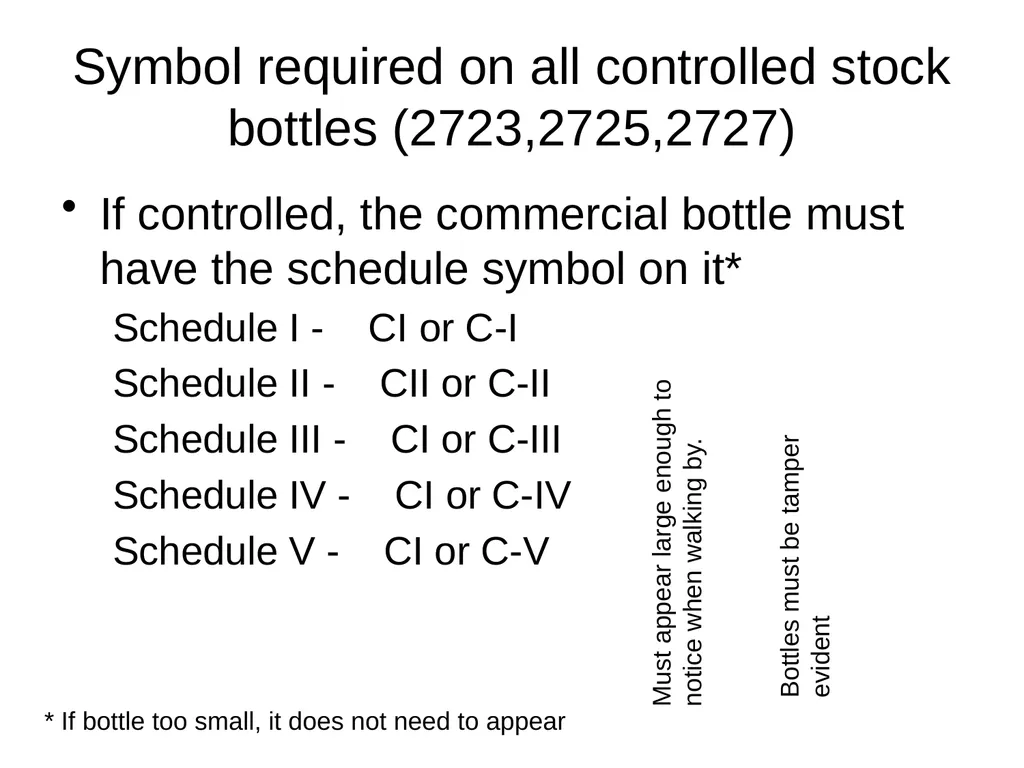
Symbol required on all controlled stock bottles (2723,2725,2727) If controlled, the commercial bottle must have the schedule symbol on it*
Schedule I - CI or C-I
Schedule II - CII or C-II
Schedule III - CI or C-III
Schedule IV - CI or C-IV
Schedule V - CI or C-V * If bottle too small, it does not need to appear Must appear large enough to notice when walking by. Bottles must be tamper evident<br>
Schedule I - CI or C-I
Schedule II - CII or C-II
Schedule III - CI or C-III
Schedule IV - CI or C-IV
Schedule V - CI or C-V * If bottle too small, it does not need to appear Must appear large enough to notice when walking by. Bottles must be tamper evident<br>
29
Exporting and importing (2729) Not really important to pharmacy
Deals with manufacturers<br>
Deals with manufacturers<br>
30
What records should I keep for CDSs? (2731) Practitioners are required to keep records for all CDSs which are dispensed
Not if they are prescribed or administered
They are required if prescribed for detox or maintenance of addiction.
If they charge for administered or dispensed meds, they must document.
Midlevels must keep documentation of what they may prescribe
Records must be kept in English, or a translator must translate within 72 hours if requested.<br>
Not if they are prescribed or administered
They are required if prescribed for detox or maintenance of addiction.
If they charge for administered or dispensed meds, they must document.
Midlevels must keep documentation of what they may prescribe
Records must be kept in English, or a translator must translate within 72 hours if requested.<br>
31
How should I store my CDS records? (2731) All records should be kept for at least two years
Records can be kept at a central location
If financial or shipping
Executed order form can not be kept at a central location
If you use special equipment, you must provide the investigator with that equipment
Prescriptions and prescription records are special<br>
Records can be kept at a central location
If financial or shipping
Executed order form can not be kept at a central location
If you use special equipment, you must provide the investigator with that equipment
Prescriptions and prescription records are special<br>
32
How do I store my prescription records? (2731) Records
Dealing with CI or CII must be stored in a different place than other records
CIII, CIV, or CV must be stored in a different location than other records
Prescriptions must be stored in one of the three following ways?
A ‘C’ in red ink of at least 1 inch in height stamped in the lower right corner
Have a CII, CIII – CV, and a non-controlled file<br>
Dealing with CI or CII must be stored in a different place than other records
CIII, CIV, or CV must be stored in a different location than other records
Prescriptions must be stored in one of the three following ways?
A ‘C’ in red ink of at least 1 inch in height stamped in the lower right corner
Have a CII, CIII – CV, and a non-controlled file<br>
33
What about records dealing with central fill pharmacies? (2731) Pharmacy must have information about each central fill pharmacy (CFP) it uses including
Name
Address
DEA Number
Pharmacy must also document that it verifies the registration of the CFP
The CFP must do the same for the pharmacies it serves<br>
Name
Address
DEA Number
Pharmacy must also document that it verifies the registration of the CFP
The CFP must do the same for the pharmacies it serves<br>
34
Should I complete an inventory? (2733) Inventories must be in hard copy
If electronic, then print
If oral, then transcribe it
Initial Inventory date
Occurs when the business first handles CDSs
Biennial Inventory
Every one, but PHARMACY, must do an inventory every OTHER year
Pharmacies must do them yearly!<br>
If electronic, then print
If oral, then transcribe it
Initial Inventory date
Occurs when the business first handles CDSs
Biennial Inventory
Every one, but PHARMACY, must do an inventory every OTHER year
Pharmacies must do them yearly!<br>
35
Any other times to do a CDS inventory? (2733) YES!
Change in Pharmacist in Charge
When old one leaves AND
When new one starts.
Substantial Loss of CDS
Theft
Lost
Closure of the Pharmacy (Permanent)<br>
Change in Pharmacist in Charge
When old one leaves AND
When new one starts.
Substantial Loss of CDS
Theft
Lost
Closure of the Pharmacy (Permanent)<br>
36
What should I count? (2733) Schedule I or II
Exact counts
Schedule III – V
If container has less than 1k doses in it
Guesstimate
If container has 1k or more doses in it
EXACT COUNT ONLY!<br>
Exact counts
Schedule III – V
If container has less than 1k doses in it
Guesstimate
If container has 1k or more doses in it
EXACT COUNT ONLY!<br>
37
What must be recorded? (2733) All of the following data must be kept in the official, written inventory
Name of substance
Not specified if Brand or Generic is expected
Finished form of the substance
e.g 10 mg tablets, 4 mg capsule
The number of units in each bottle
100 count bottle with 30 tablets in it
The number of commercial containers
3 100 count bottles<br>
Name of substance
Not specified if Brand or Generic is expected
Finished form of the substance
e.g 10 mg tablets, 4 mg capsule
The number of units in each bottle
100 count bottle with 30 tablets in it
The number of commercial containers
3 100 count bottles<br>
38
Continuing Records (2735) An odd little section
Copies verbatim from Federal CSA
But, most of the material was covered in 2733
Adds section dealing with Compounders for Narcotic Treatment Programs
Requires few extra requirements
Few pharmacists fall into this regulation
GHB dispensers
Again limited people do this
Adds a requirement that you have proof the prescriber may prescribe GHB<br>
Copies verbatim from Federal CSA
But, most of the material was covered in 2733
Adds section dealing with Compounders for Narcotic Treatment Programs
Requires few extra requirements
Few pharmacists fall into this regulation
GHB dispensers
Again limited people do this
Adds a requirement that you have proof the prescriber may prescribe GHB<br>
39
Is there anything else I should know about reports? (2737) Yes, most of this deals with manufacturers
Provides exception to ‘institutional practitioners’ who repackage
Meaning?
Most likely hospitals to allow them to not have to do all the paperwork required<br>
Provides exception to ‘institutional practitioners’ who repackage
Meaning?
Most likely hospitals to allow them to not have to do all the paperwork required<br>
40
How do I know if I have had a significant loss of a CDS? (2737) Consider these
Actual quantity lost in relation to type of business
The specific agent lost
Can the loss be tied to a specific activity or person
A pattern of losses over a time period
Random patterns?
Results of trying to stem losses
Is the drug likely gonna be diverted
Local trends for diversion<br>
Actual quantity lost in relation to type of business
The specific agent lost
Can the loss be tied to a specific activity or person
A pattern of losses over a time period
Random patterns?
Results of trying to stem losses
Is the drug likely gonna be diverted
Local trends for diversion<br>
41
What do I do if I decide the loss is significant? (2737) Notify
New Orleans Field Division Office of the DEA
Board of Pharmacy
WITHIN ONE BUSINESS DAY!
Also submit to the NOFDO DEA
A 106 form
Loss should be reported even if they are recovered.<br>
New Orleans Field Division Office of the DEA
Board of Pharmacy
WITHIN ONE BUSINESS DAY!
Also submit to the NOFDO DEA
A 106 form
Loss should be reported even if they are recovered.<br>
42
Manufacturing of CDSs (2739) This section does not apply to pharmacy practice
Strange that the Board of Pharmacy regulates industry
Be careful when compounding not to be classified as a manufacturer (more on that elsewhere!)<br>
Strange that the Board of Pharmacy regulates industry
Be careful when compounding not to be classified as a manufacturer (more on that elsewhere!)<br>
43
Distributing CDSs (2741) Note dispensing is not distributing
So most pharmacies do not need to comply
However, the ‘five percent rule’ may change that
If you sale (trade, or give) 5% or more of your annual amount of any CDS. You are a distributor and must register as one<br>
So most pharmacies do not need to comply
However, the ‘five percent rule’ may change that
If you sale (trade, or give) 5% or more of your annual amount of any CDS. You are a distributor and must register as one<br>
44
I would like to buy some CDSs, how do I make this happen? (2743) Schedule I or II
Require 222
Duplicate copies must be retained at least two years
Central fill to retail pharmacy is exempt
Electronic 222 is cool
Unique number assigned by purchaser (9 digits)
First two are year, then X, then six unique characters
11X928S29<br>
Require 222
Duplicate copies must be retained at least two years
Central fill to retail pharmacy is exempt
Electronic 222 is cool
Unique number assigned by purchaser (9 digits)
First two are year, then X, then six unique characters
11X928S29<br>
45
What about ordering CIII – CV Requires recordkeeping
But no specific form
BUT, whatever you order from must include
Name, Address and DEA license of supplier
Name of CDS
Dosage form and strength
Amount
When recieved<br>
But no specific form
BUT, whatever you order from must include
Name, Address and DEA license of supplier
Name of CDS
Dosage form and strength
Amount
When recieved<br>
46
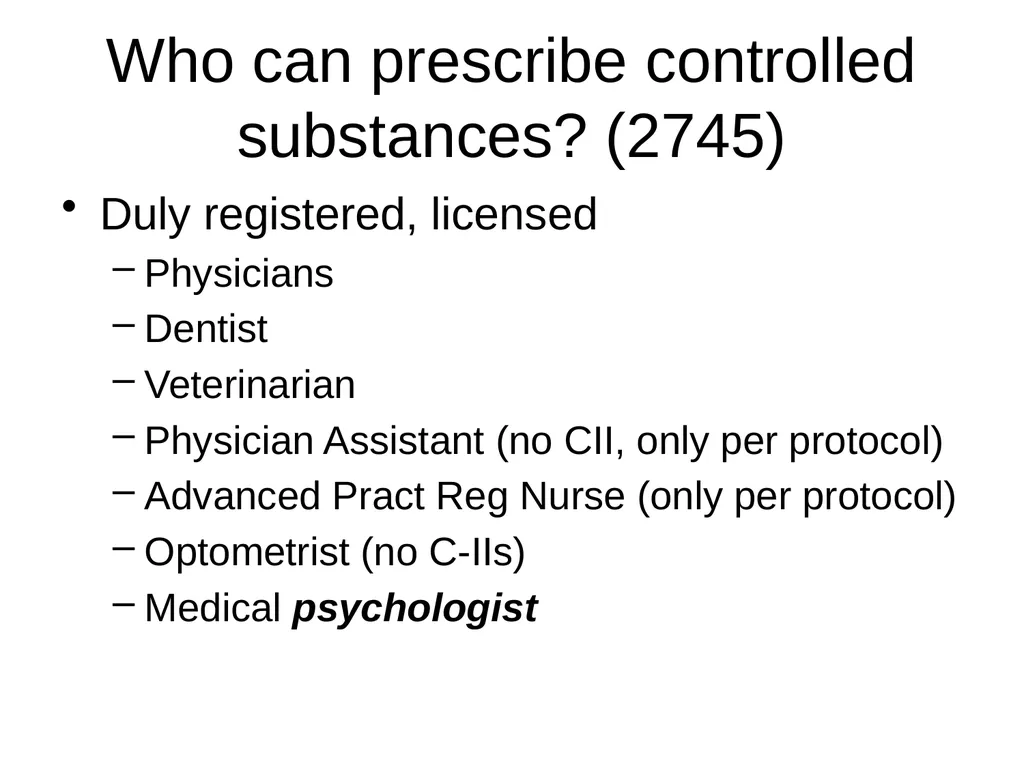
Who can prescribe controlled substances? (2745) Duly registered, licensed
Physicians
Dentist
Veterinarian
Physician Assistant (no CII, only per protocol)
Advanced Pract Reg Nurse (only per protocol)
Optometrist (no C-IIs)
Medical psychologist<br>
Physicians
Dentist
Veterinarian
Physician Assistant (no CII, only per protocol)
Advanced Pract Reg Nurse (only per protocol)
Optometrist (no C-IIs)
Medical psychologist<br>
47
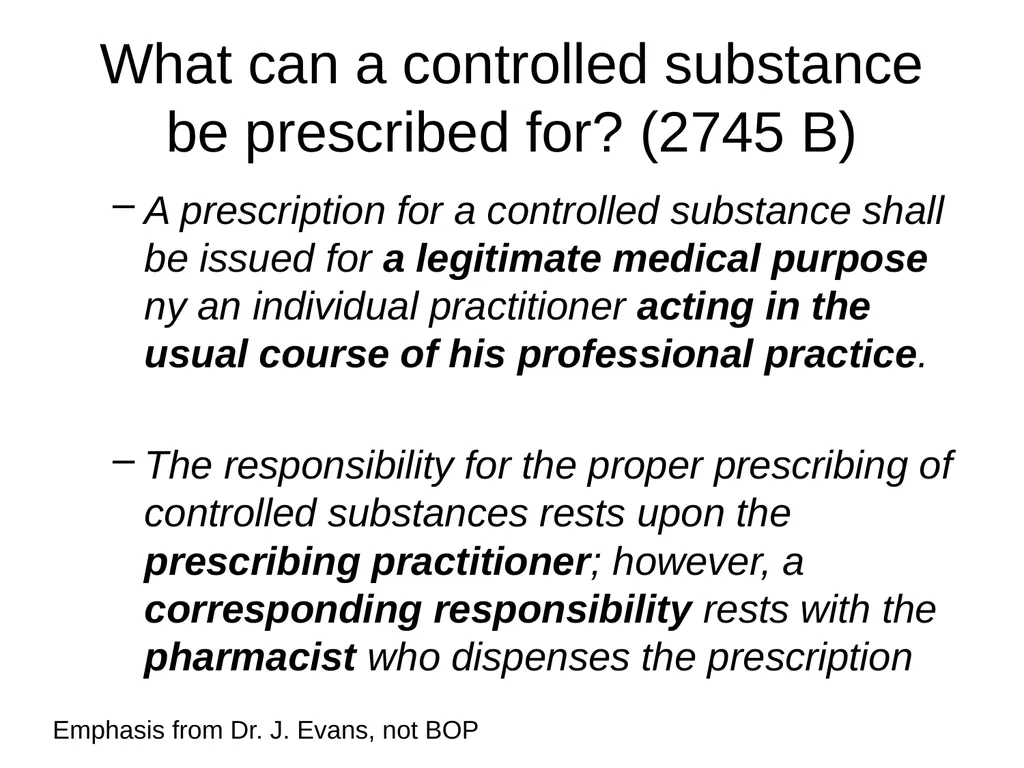
What can a controlled substance be prescribed for? (2745 B) A prescription for a controlled substance shall be issued for a legitimate medical purpose ny an individual practitioner acting in the usual course of his professional practice.
The responsibility for the proper prescribing of controlled substances rests upon the prescribing practitioner; however, a corresponding responsibility rests with the pharmacist who dispenses the prescription Emphasis from Dr. J. Evans, not BOP<br>
The responsibility for the proper prescribing of controlled substances rests upon the prescribing practitioner; however, a corresponding responsibility rests with the pharmacist who dispenses the prescription Emphasis from Dr. J. Evans, not BOP<br>
48
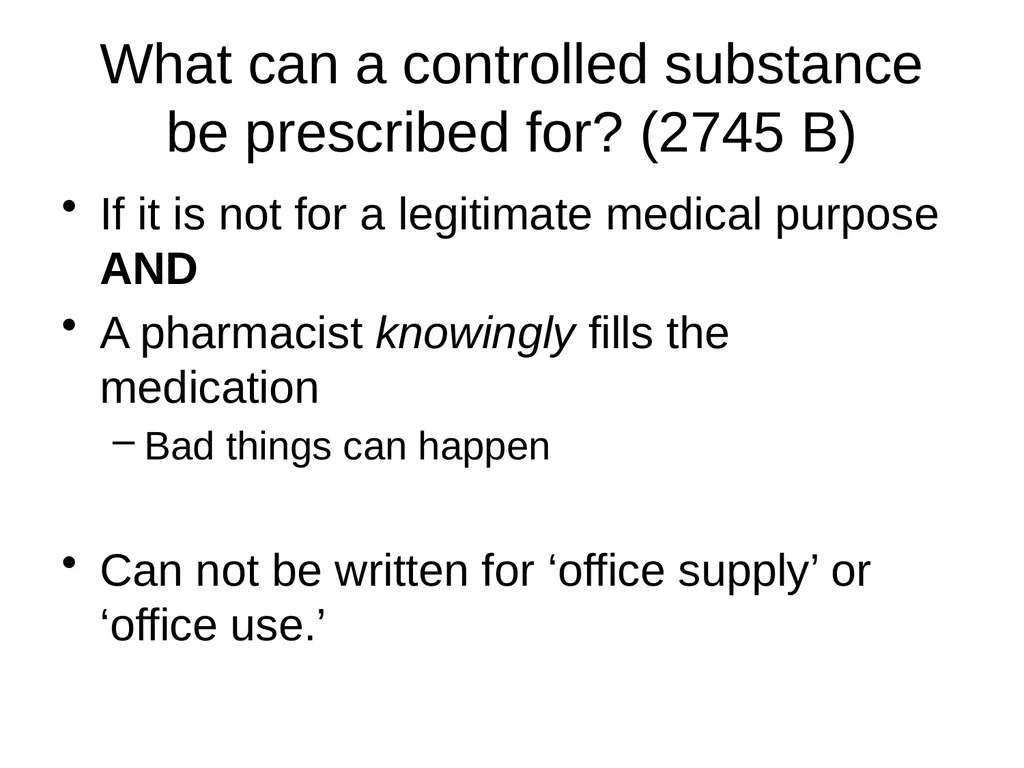
What can a controlled substance be prescribed for? (2745 B) If it is not for a legitimate medical purpose AND
A pharmacist knowingly fills the medication
Bad things can happen
Can not be written for ‘office supply’ or ‘office use.’<br>
A pharmacist knowingly fills the medication
Bad things can happen
Can not be written for ‘office supply’ or ‘office use.’<br>
49
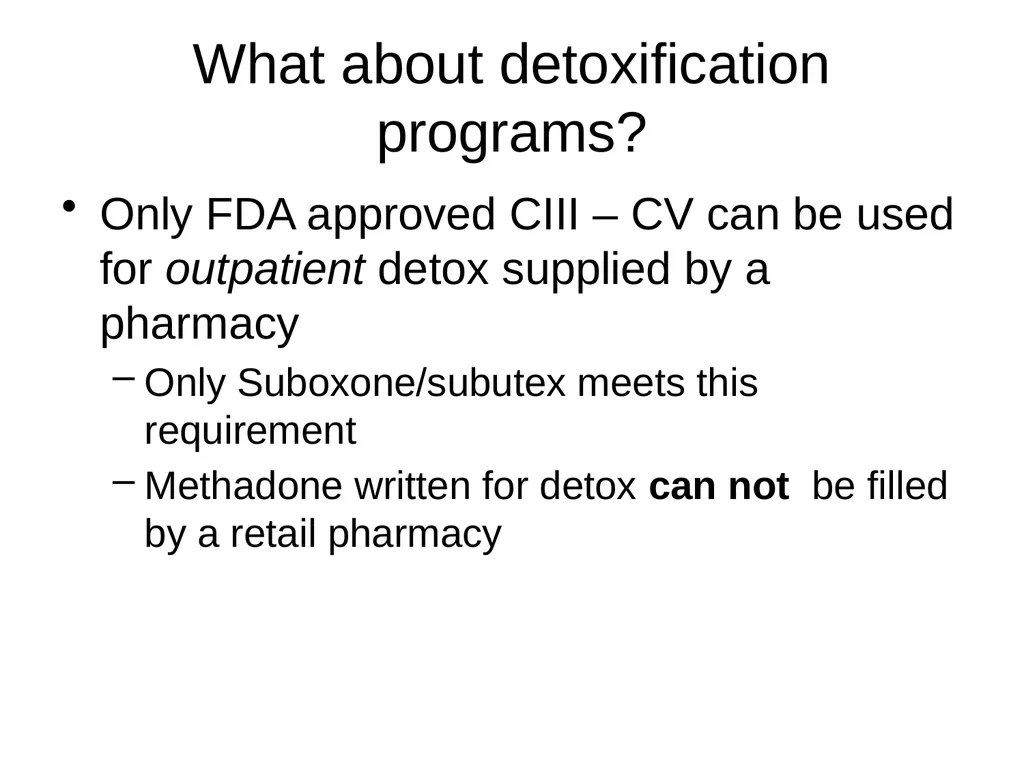
What about detoxification programs? Only FDA approved CIII – CV can be used for outpatient detox supplied by a pharmacy
Only Suboxone/subutex meets this requirement
Methadone written for detox can not be filled by a retail pharmacy<br>
Only Suboxone/subutex meets this requirement
Methadone written for detox can not be filled by a retail pharmacy<br>
50
What needs to be on a CDS Rx? (2745 C) Must be dated (for date written)
Full name AND address of patient
Drug name, strength, and dosage form
Quantity of drug prescribed
Directions for use
Name, address, telephone number and DEA number of prescriber
If for suboxone must have suboxone DEA number<br>
Full name AND address of patient
Drug name, strength, and dosage form
Quantity of drug prescribed
Directions for use
Name, address, telephone number and DEA number of prescriber
If for suboxone must have suboxone DEA number<br>
51
What about prescribers without a DEA number? (2745 C) Hospital interns/residents
Use hospital DEA PLUS unique ID for prescriber
Military Personnel
Use his service ID number<br>
Use hospital DEA PLUS unique ID for prescriber
Military Personnel
Use his service ID number<br>
52
Is there a format that must be used for CDS RXs? (2745 C) Written Rxs
Must be on a slip no smaller than 4 x 5 inches
Must be in ink or indelible pencil
Must clearly indicate who prescribed the medication
May have a max of four rxs on one script
There needs to be a pre-printed ‘Dispense as Written’ or DAW box
Refill information must be present
Printed signature line with manually signed by prescriber<br>
Must be on a slip no smaller than 4 x 5 inches
Must be in ink or indelible pencil
Must clearly indicate who prescribed the medication
May have a max of four rxs on one script
There needs to be a pre-printed ‘Dispense as Written’ or DAW box
Refill information must be present
Printed signature line with manually signed by prescriber<br>
53
What if it is an oral prescription? (2745) Not for CIIs (well not here at least)
Must be communicated to the pharmacist by an agent or employees of the prescriber.
Pharmacist will write the order down as soon possible
All requirements for information of a written Rx must be present<br>
Must be communicated to the pharmacist by an agent or employees of the prescriber.
Pharmacist will write the order down as soon possible
All requirements for information of a written Rx must be present<br>
54
Who can dispense CDS prescriptions? (2745 D) A pharmacist at a pharmacy (not any where else)
Physician, dentist or veterinarian
If they do, the CDS must be procured correctly<br>
Physician, dentist or veterinarian
If they do, the CDS must be procured correctly<br>
55
Administering Narcotic Drugs (2745 E) Not really directed at Pharmacists
But impacts the validity of a script
Practitioners may administer or provide directly, but may not prescribe a narcotic drug for detox or maintainance
Except as noted before<br>
But impacts the validity of a script
Practitioners may administer or provide directly, but may not prescribe a narcotic drug for detox or maintainance
Except as noted before<br>
56
Can you fax a CII? (2745 F) A prescription may be faxed if a written rx is turned in for the fax. However
If the patient is in a long term care facility, the fax serves as the original
If the medication will be compounded and administered directly to the patient by the prescriber
If the patient is in hospice, the pharmacist must right on the fax that the patient is a ‘hospice patient’<br>
If the patient is in a long term care facility, the fax serves as the original
If the medication will be compounded and administered directly to the patient by the prescriber
If the patient is in hospice, the pharmacist must right on the fax that the patient is a ‘hospice patient’<br>
57
Can you phone in a CII? (2745) Yes, if it is an emergency and meets the following
Quaintly is limited to the emergency period
Is immediately reduced to writing
Physician ID is verified (to best of ability)
Within 7 days, the physician must provide a written Rx for the emergency
If not received by the pharmacist, DEA must be notified
Pharmacist will attach written rx to oral/written rx<br>
Quaintly is limited to the emergency period
Is immediately reduced to writing
Physician ID is verified (to best of ability)
Within 7 days, the physician must provide a written Rx for the emergency
If not received by the pharmacist, DEA must be notified
Pharmacist will attach written rx to oral/written rx<br>
58
Electronic Prescribing of CIIs (2745) More later
Being implemented by the DEA, board just says ‘whatever they say, we are cool with.’<br>
Being implemented by the DEA, board just says ‘whatever they say, we are cool with.’<br>
59
Is there a maximum day supply for a CII? (2745) Um, no, but, well sort of
Generally recognized as 90 days
Fed CSA does not have a limit
In LA, a practitioner may write 3 rxs for a total of 90 days
Must all be dated with the correct written date
Two of them must have do not fill before dates
All CII scripts die after 6 months<br>
Generally recognized as 90 days
Fed CSA does not have a limit
In LA, a practitioner may write 3 rxs for a total of 90 days
Must all be dated with the correct written date
Two of them must have do not fill before dates
All CII scripts die after 6 months<br>
60
Can I refill a CII? (2745) No
You may partial fill them (More on this later)<br>
You may partial fill them (More on this later)<br>
61
How can C-III – CV be provided to a pharmacy? (2745 G) Written
Phone
Must be communicated to a pharmacist
Fax
As long as the fax is of the completed written prescription
Must originate from practitioner’s office
Counts as an original
Electronic
Once DEA provides and implements rule set<br>
Phone
Must be communicated to a pharmacist
Fax
As long as the fax is of the completed written prescription
Must originate from practitioner’s office
Counts as an original
Electronic
Once DEA provides and implements rule set<br>
62
Can a CIII – CV be refilled? (2745) Yes
For up to a total of 6 fills (5 refills)
DEA has clarified ‘partial fills’ don’t count
No longer than 6 months after original date
Prescriber can put other limits.
If no refills noted, then 0 refills authorized<br>
For up to a total of 6 fills (5 refills)
DEA has clarified ‘partial fills’ don’t count
No longer than 6 months after original date
Prescriber can put other limits.
If no refills noted, then 0 refills authorized<br>
63
Are there special rules for faxed in CDSs? (2747) Yes
Fax must be located in pharmacy
Must be on non-fading paper with non-fading ink
ID of prescriber must be clear on fax<br>
Fax must be located in pharmacy
Must be on non-fading paper with non-fading ink
ID of prescriber must be clear on fax<br>
64
Can a pharmacist alter a CII? (2745) Pharmacist may record on RX
Patient’s address
Drug strength
Quantity prescribed and directions for use
Pharmacist may add (without prescriber)
Patient’s address
Drug Dosage form
Prescriber’s DEA registration number<br>
Patient’s address
Drug strength
Quantity prescribed and directions for use
Pharmacist may add (without prescriber)
Patient’s address
Drug Dosage form
Prescriber’s DEA registration number<br>
65
Can a pharmacist alter a CII? (2745) A pharmacist may NEVER add/record
Patient’s name
Date of issue
Drug name (generic replacement ok)
Prescriber Signature<br>
Patient’s name
Date of issue
Drug name (generic replacement ok)
Prescriber Signature<br>
66
When is a partial fill of a CII ok? (2745) Partial fills are ok when
Normal patients pick up all of the medication with 72 hours of initial fill
Or lose remainder
Long-term care facility patient or ‘terminally ill’ patients.
Notation must be on script
Must fill entire amount within 60 days
Can not dispense more than what was written for
Each partial fill must be noted on the original script<br>
Normal patients pick up all of the medication with 72 hours of initial fill
Or lose remainder
Long-term care facility patient or ‘terminally ill’ patients.
Notation must be on script
Must fill entire amount within 60 days
Can not dispense more than what was written for
Each partial fill must be noted on the original script<br>
67
Do all records of CII partial fills have to be written? (2745) No, they may be kept by computer if
If the computer can keep all required information and is queryable
If computer under goes realtime updates<br>
If the computer can keep all required information and is queryable
If computer under goes realtime updates<br>
68
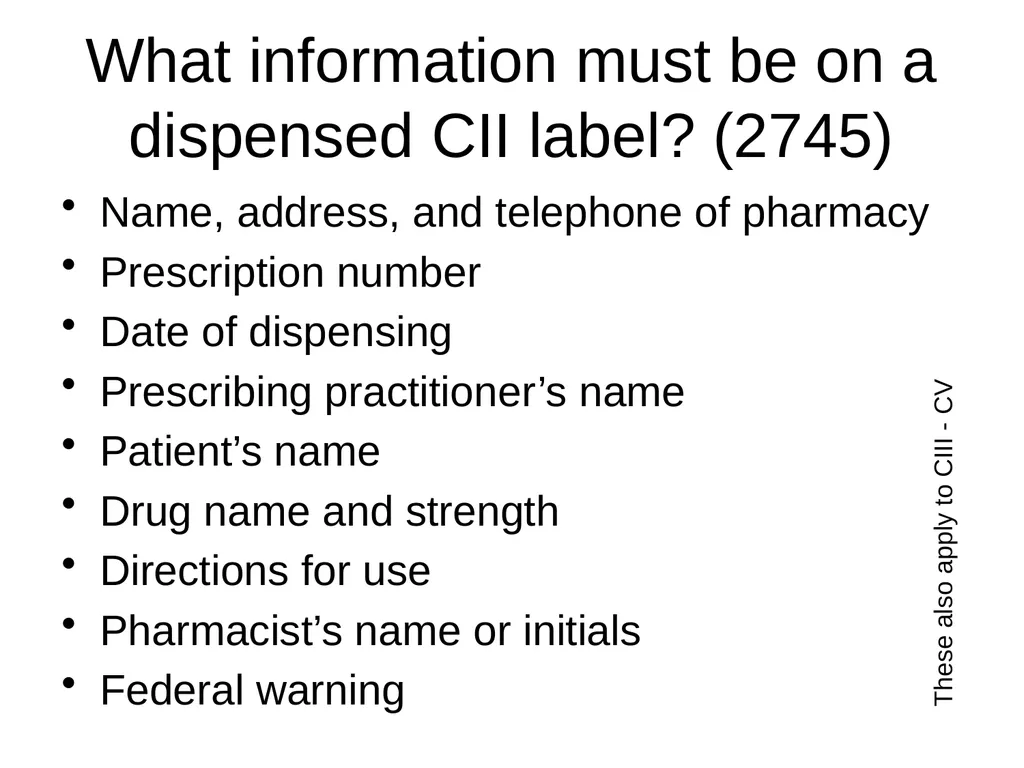
What information must be on a dispensed CII label? (2745) Name, address, and telephone of pharmacy
Prescription number
Date of dispensing
Prescribing practitioner’s name
Patient’s name
Drug name and strength
Directions for use
Pharmacist’s name or initials
Federal warning These also apply to CIII - CV<br>
Prescription number
Date of dispensing
Prescribing practitioner’s name
Patient’s name
Drug name and strength
Directions for use
Pharmacist’s name or initials
Federal warning These also apply to CIII - CV<br>
69
Do I have to cancel a CII prescription? (2745) Yes
On the front of the RX ‘deface’ the script
Place name or initials on the front of RX<br>
On the front of the RX ‘deface’ the script
Place name or initials on the front of RX<br>
70
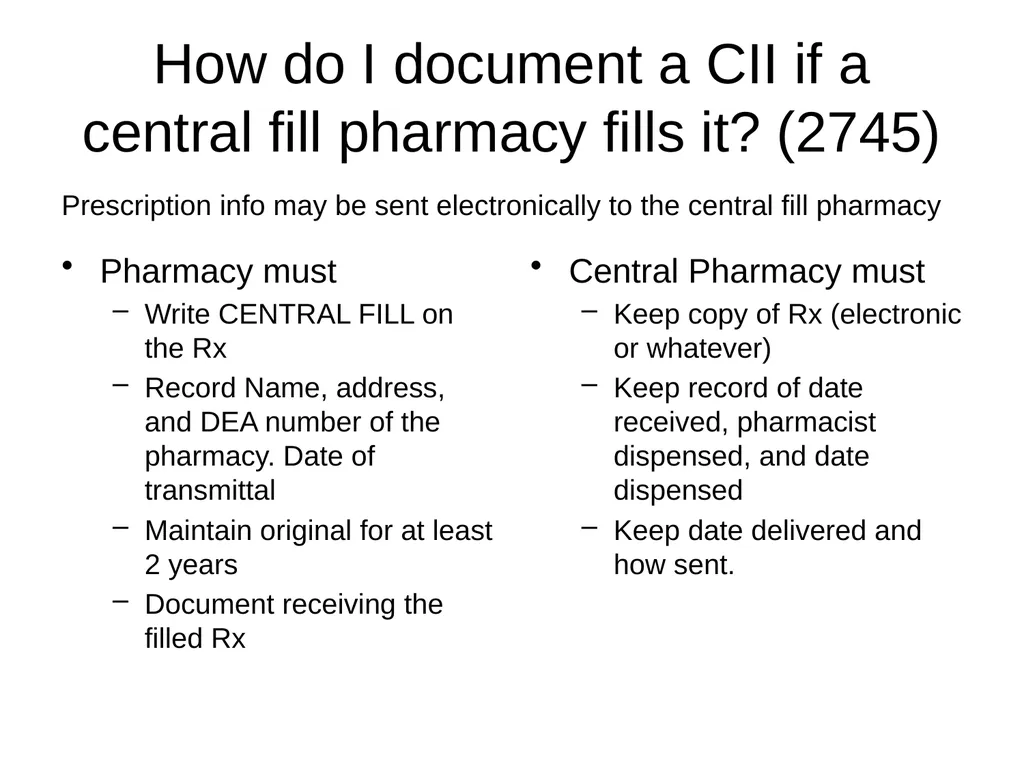
How do I document a CII if a central fill pharmacy fills it? (2745) Prescription info may be sent electronically to the central fill pharmacy Pharmacy must
Write CENTRAL FILL on the Rx
Record Name, address, and DEA number of the pharmacy. Date of transmittal
Maintain original for at least 2 years
Document receiving the filled Rx Central Pharmacy must
Keep copy of Rx (electronic or whatever)
Keep record of date received, pharmacist dispensed, and date dispensed
Keep date delivered and how sent.<br>
Write CENTRAL FILL on the Rx
Record Name, address, and DEA number of the pharmacy. Date of transmittal
Maintain original for at least 2 years
Document receiving the filled Rx Central Pharmacy must
Keep copy of Rx (electronic or whatever)
Keep record of date received, pharmacist dispensed, and date dispensed
Keep date delivered and how sent.<br>
71
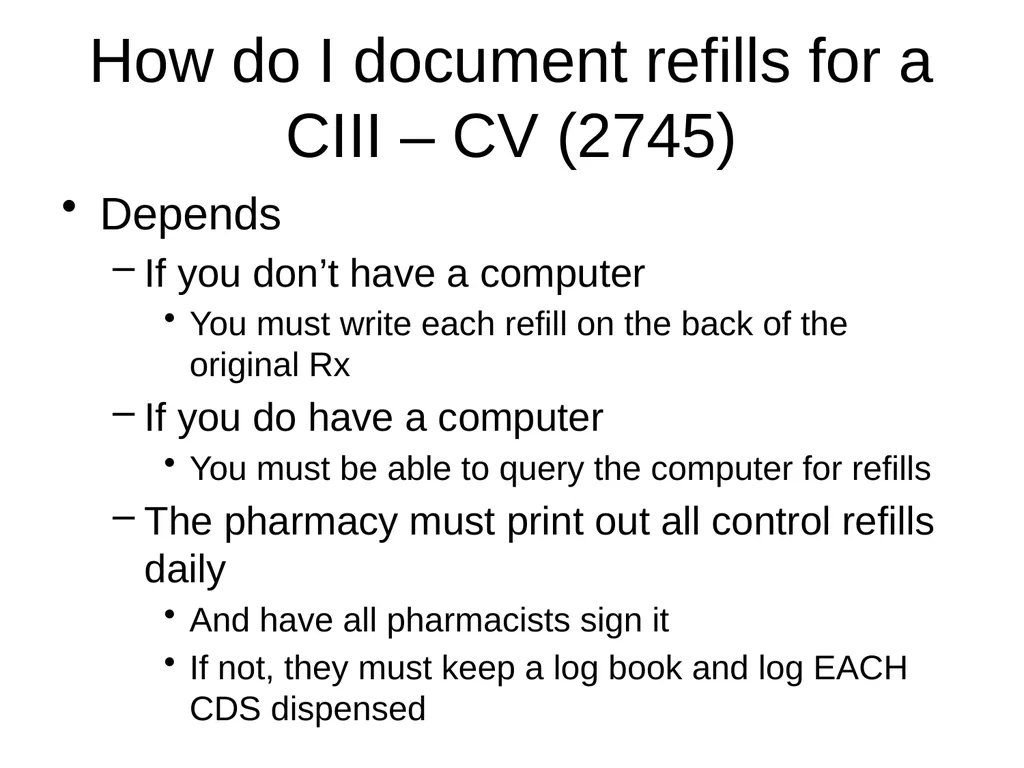
How do I document refills for a CIII – CV (2745) Depends
If you don’t have a computer
You must write each refill on the back of the original Rx
If you do have a computer
You must be able to query the computer for refills
The pharmacy must print out all control refills daily
And have all pharmacists sign it
If not, they must keep a log book and log EACH CDS dispensed<br>
If you don’t have a computer
You must write each refill on the back of the original Rx
If you do have a computer
You must be able to query the computer for refills
The pharmacy must print out all control refills daily
And have all pharmacists sign it
If not, they must keep a log book and log EACH CDS dispensed<br>
72
Are there any special requirements for institutionalized patients (2745) Yes
May not dispense more than a 34 day supply or 100 dosage units (whichever is less)
End user can not possess medication<br>
May not dispense more than a 34 day supply or 100 dosage units (whichever is less)
End user can not possess medication<br>
73
Do CIII – CV prescriptions have to be cancelled? (2745) Yes and no
No they don’t need to have a line drawn through them
Yes they MUST have the dispensing pharmacist’s name or initial<br>
No they don’t need to have a line drawn through them
Yes they MUST have the dispensing pharmacist’s name or initial<br>
74
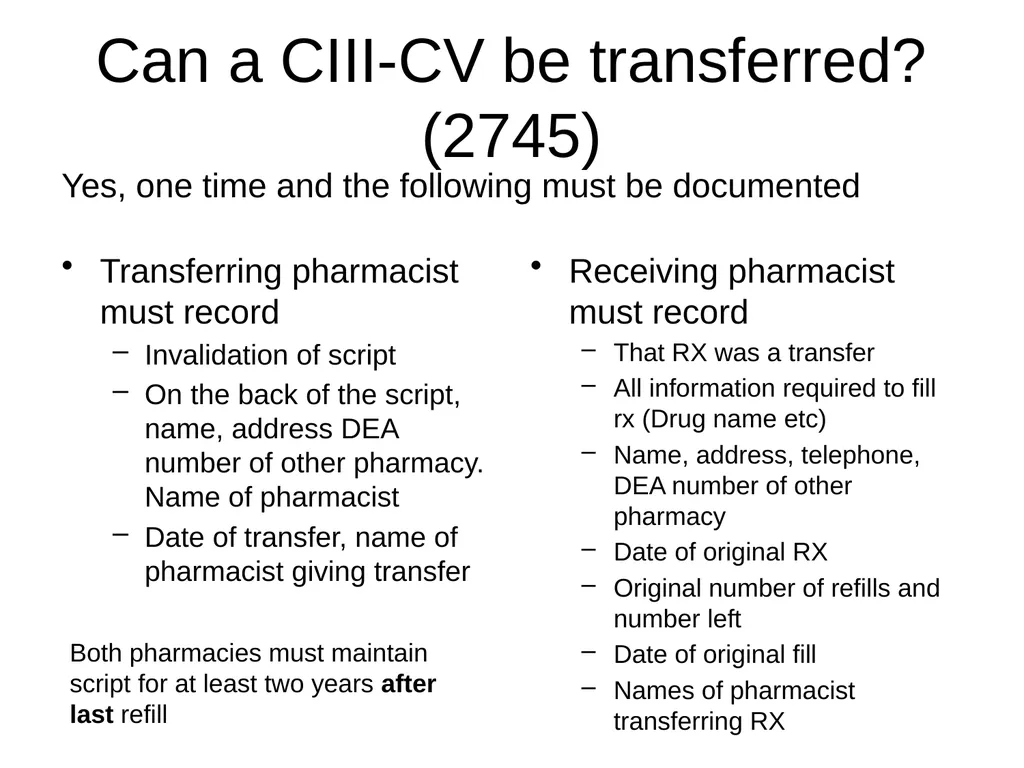
Can a CIII-CV be transferred? (2745) Yes, one time and the following must be documented Transferring pharmacist must record
Invalidation of script
On the back of the script, name, address DEA number of other pharmacy. Name of pharmacist
Date of transfer, name of pharmacist giving transfer Receiving pharmacist must record
That RX was a transfer
All information required to fill rx (Drug name etc)
Name, address, telephone, DEA number of other pharmacy
Date of original RX
Original number of refills and number left
Date of original fill
Names of pharmacist transferring RX Both pharmacies must maintain script for at least two years after last refill<br>
Invalidation of script
On the back of the script, name, address DEA number of other pharmacy. Name of pharmacist
Date of transfer, name of pharmacist giving transfer Receiving pharmacist must record
That RX was a transfer
All information required to fill rx (Drug name etc)
Name, address, telephone, DEA number of other pharmacy
Date of original RX
Original number of refills and number left
Date of original fill
Names of pharmacist transferring RX Both pharmacies must maintain script for at least two years after last refill<br>
75
Can a pharmacist dispense a CDS without a prescription? (2745) Certain C-Vs are available for OTC dispensing
Can only be sold by a pharmacist
Must be recorded in a bound record book that includes
Name and address of purchaser
Quantity and name of CDS
Date of purchase
Name ore initials of pharmacist
Central fill pharmacies may not do this<br>
Can only be sold by a pharmacist
Must be recorded in a bound record book that includes
Name and address of purchaser
Quantity and name of CDS
Date of purchase
Name ore initials of pharmacist
Central fill pharmacies may not do this<br>
76
What are the responsibilities of a pharmacist when dealing with CDSs? (2745) Primary Responsibility
Drug diversion
Possession
Any deviation in CDSs will be blamed on the PIC, owner, and/or other parties
Corresponding Responsibility
Medical purpose
Authenticity
Forged prescriptions
Altered prescriptions<br>
Drug diversion
Possession
Any deviation in CDSs will be blamed on the PIC, owner, and/or other parties
Corresponding Responsibility
Medical purpose
Authenticity
Forged prescriptions
Altered prescriptions<br>
77
How do I dispose of a CDS? (2749) Complete a DEA 41 and submit it to the Special Agent in Charge in his area
Special agent in Charge will advise to do one of four things
Transfer to a licensed person for disposal
Deliver to a DEA agent or to a DEA office
Destruct the CDS in the presence of an agent
Whatever the DEA agent says
If disposal occurs regularly, the agent may issue an umbrella approval.<br>
Special agent in Charge will advise to do one of four things
Transfer to a licensed person for disposal
Deliver to a DEA agent or to a DEA office
Destruct the CDS in the presence of an agent
Whatever the DEA agent says
If disposal occurs regularly, the agent may issue an umbrella approval.<br>
78
May I loan some CDSs to another pharmacy (2751) Yes
If CII a DEA 222 must be filled out with you as the distributor
Remember the five percent clause
CIII – CV can be done without a DEA 222
Some record of transfer should be kept
All controls must be accounted for<br>
If CII a DEA 222 must be filled out with you as the distributor
Remember the five percent clause
CIII – CV can be done without a DEA 222
Some record of transfer should be kept
All controls must be accounted for<br>
79
What actions can the board take to enforce the CDSs rules? (2753 – 2757) Inspections
Seizures
Hearings<br>
Seizures
Hearings<br>
80
Conclusions<br>