
Chapter 3: Constitutional Protections Those who
GB
Published · 67 slides · 0 views
1 / 1



Description
Chapter 3: Constitutional Protections Those who wrote our constitutions knew from history and experience that it was necessary to protect against unfounded criminal charges brought to eliminate enemies and against judges too responsive to
Related Topics
Share
Embed code
Download this presentation From Below
"Chapter 3: Constitutional Protections Those who" is the property of its rightful owner. Permission is granted to download and print the materials on this website for personal, non-commercial use only, and to display it on your personal computer provided you do not modify the materials and that you retain all copyright notices contained in the materials. By downloading content from our website, you accept the terms of this agreement.
Presentation Transcript
01
Chapter 3: Constitutional Protections Those who wrote our constitutions knew from history and experience that it was necessary to protect against unfounded criminal charges brought to eliminate enemies and against judges too responsive to the voice of higher authority.
—Duncan v. Louisiana, cited in Section 3.2 “The Due Process and Equal Protection Clauses” arbyreed – Mountain Flag – CC BY-NC 2.0..<br>
—Duncan v. Louisiana, cited in Section 3.2 “The Due Process and Equal Protection Clauses” arbyreed – Mountain Flag – CC BY-NC 2.0..<br>
02
Chapter 3: Learning Objectives Distinguish between the two types of constitutional protections.
Compare unconstitutional on its face with unconstitutional as applied.
Distinguish among different standards of judicial review.
Compare bill of attainder with ex post facto laws.
Ascertain the three types of ex post facto laws.
Define the Bill of Rights.
Define the principle of selective incorporation.
Distinguish between substantive and procedural due process.
Compare void for vagueness and overbreadth.
Ascertain the purpose of the equal protection clause as it applies to criminal laws.<br>
Compare unconstitutional on its face with unconstitutional as applied.
Distinguish among different standards of judicial review.
Compare bill of attainder with ex post facto laws.
Ascertain the three types of ex post facto laws.
Define the Bill of Rights.
Define the principle of selective incorporation.
Distinguish between substantive and procedural due process.
Compare void for vagueness and overbreadth.
Ascertain the purpose of the equal protection clause as it applies to criminal laws.<br>
03
Chapter 3: Learning Objectives Define speech under the First Amendment.
Identify five types of speech that can be governmentally regulated in spite of the First Amendment.
Ascertain the constitutional parameters for statutes that criminalize speech.
Ascertain the constitutional amendments that support a right to privacy.
Ascertain three constitutionally protected individual interests that are included in the right to privacy.
Ascertain the constitutional parameters of an individual’s right to possess a handgun under the Second Amendment.<br>
Identify five types of speech that can be governmentally regulated in spite of the First Amendment.
Ascertain the constitutional parameters for statutes that criminalize speech.
Ascertain the constitutional amendments that support a right to privacy.
Ascertain three constitutionally protected individual interests that are included in the right to privacy.
Ascertain the constitutional parameters of an individual’s right to possess a handgun under the Second Amendment.<br>
04
Chapter 3: Learning Objectives Compare an inhumane procedure with disproportionate punishment under the Eighth Amendment.
Identify the most prevalent method of execution pursuant to the death penalty.
Ascertain crime(s) that merit capital punishment.
Identify three classifications of criminal defendants who cannot be constitutionally punished by execution.
Define three-strikes laws, and ascertain if they constitute cruel and unusual punishment pursuant to the
Eighth Amendment.
Ascertain the constitutionality of sentencing enhancements under the Sixth Amendment right to a jury trial.<br>
Identify the most prevalent method of execution pursuant to the death penalty.
Ascertain crime(s) that merit capital punishment.
Identify three classifications of criminal defendants who cannot be constitutionally punished by execution.
Define three-strikes laws, and ascertain if they constitute cruel and unusual punishment pursuant to the
Eighth Amendment.
Ascertain the constitutionality of sentencing enhancements under the Sixth Amendment right to a jury trial.<br>
05
3.1 Applicability of the Constitution In addition to statutory and common-law defenses, a criminal defendant has extensive protections that are set forth in the United States Constitution. As stated earlier in this book, the federal Constitution is applicable in all criminal cases because the government is prosecuting. State constitutions typically mirror the federal Constitution because it sets the minimum standard of protection that is guaranteed to all citizens. States can and often do provide more constitutional protections to criminal defendants than the federal Constitution, as long as those state protections do not violate notions of federal supremacy. In this chapter, the federal Constitution is analyzed with reference to state constitutional protections when relevant.<br>
06
3.1 Applicability of the Constitution - Constitutional Protections Generally, two types of constitutional protections exist.
First type, a defendant can challenge the constitutionality of a criminal statute or ordinance.
Codified laws cannot conflict with or attempt to supersede the Constitution.
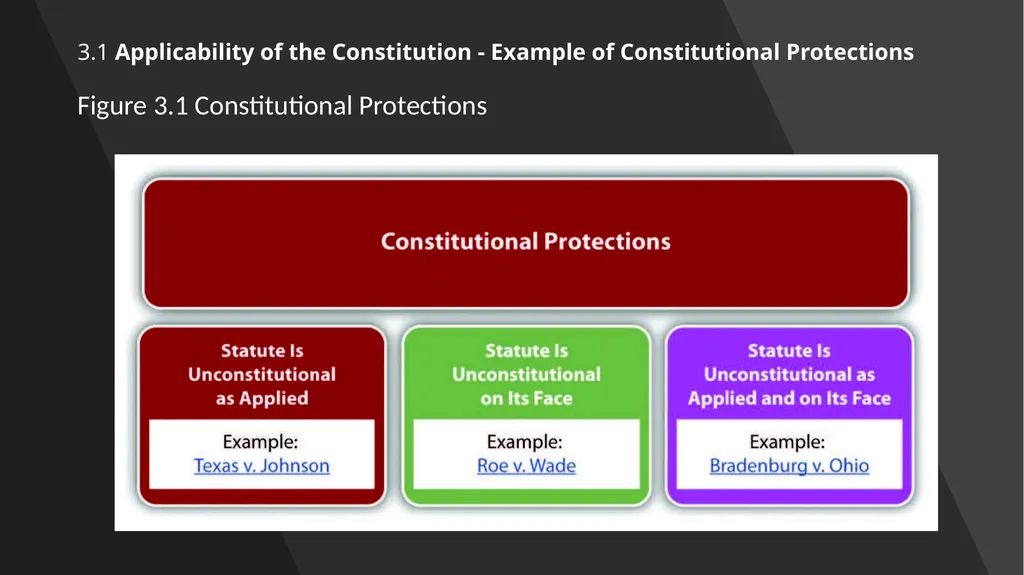
An attack on the constitutionality of a statute can be a claim that the statute is unconstitutional on its face, is unconstitutional as applied, or both.
A statute is unconstitutional on its face when its wording is unconstitutional. If a statute is unconstitutional on its face, it is invalid under any circumstances.
A statute is unconstitutional as applied when its enforcement is unconstitutional. If the statute is unconstitutional as applied, it is only unconstitutional under certain circumstances.<br>
First type, a defendant can challenge the constitutionality of a criminal statute or ordinance.
Codified laws cannot conflict with or attempt to supersede the Constitution.
An attack on the constitutionality of a statute can be a claim that the statute is unconstitutional on its face, is unconstitutional as applied, or both.
A statute is unconstitutional on its face when its wording is unconstitutional. If a statute is unconstitutional on its face, it is invalid under any circumstances.
A statute is unconstitutional as applied when its enforcement is unconstitutional. If the statute is unconstitutional as applied, it is only unconstitutional under certain circumstances.<br>
07
3.1 Applicability of the Constitution - Constitutional Protections Generally, two types of constitutional protections exist.
A second type of constitutional protection is procedural.
The defendant can protest an unconstitutional procedure that occurs during prosecution.
Procedure during prosecution includes, but is not limited to, arrest, interrogation, search, filing of charges, trial, and appeal.
The defendant can make a motion to dismiss the charges, suppress evidence, or declare a mistrial.
The defendant can also appeal and seek to reverse a conviction, among other remedies.<br>
A second type of constitutional protection is procedural.
The defendant can protest an unconstitutional procedure that occurs during prosecution.
Procedure during prosecution includes, but is not limited to, arrest, interrogation, search, filing of charges, trial, and appeal.
The defendant can make a motion to dismiss the charges, suppress evidence, or declare a mistrial.
The defendant can also appeal and seek to reverse a conviction, among other remedies.<br>
08
3.1 Applicability of the Constitution - Constitutional Protections Generally, two types of constitutional protections exist.
This book concentrates on criminal law rather than criminal procedure, so the bulk of this chapter is devoted to unconstitutional criminal statutes, rather than unconstitutional procedures.
The exception is the right to a jury trial, which is discussed shortly.<br>
This book concentrates on criminal law rather than criminal procedure, so the bulk of this chapter is devoted to unconstitutional criminal statutes, rather than unconstitutional procedures.
The exception is the right to a jury trial, which is discussed shortly.<br>
09
3.1 Applicability of the Constitution - Example of Constitutional Protections Challenging a Statute - Unconstitutional on its Face
Bill is on trial for obstructing a public sidewalk. Bill was arrested for standing in front of a restaurant’s entrance with a sign stating “will eat any and all leftovers.” The city ordinance Bill violated makes it a misdemeanor to “stand or sit on a public sidewalk with a sign.” To save money, the judge presiding over Bill’s trial declares that Bill will have a bench trial, rather than a jury trial. In this example, Bill can constitutionally attack the city ordinance for violating his freedom of speech because it prohibits holding a sign. The city ordinance appears unconstitutional on its face and as applied to Bill.<br>
Bill is on trial for obstructing a public sidewalk. Bill was arrested for standing in front of a restaurant’s entrance with a sign stating “will eat any and all leftovers.” The city ordinance Bill violated makes it a misdemeanor to “stand or sit on a public sidewalk with a sign.” To save money, the judge presiding over Bill’s trial declares that Bill will have a bench trial, rather than a jury trial. In this example, Bill can constitutionally attack the city ordinance for violating his freedom of speech because it prohibits holding a sign. The city ordinance appears unconstitutional on its face and as applied to Bill.<br>
10
3.1 Applicability of the Constitution - Example of Constitutional Protections Challenging the Procedure – Right to Jury Trial
Bill can also constitutionally attack his bench trial because he has the right to a jury trial. He could do this by making a motion to declare a mistrial, by petitioning an appellate court to halt the trial, or by appeal after a judgment of conviction.<br>
Bill can also constitutionally attack his bench trial because he has the right to a jury trial. He could do this by making a motion to declare a mistrial, by petitioning an appellate court to halt the trial, or by appeal after a judgment of conviction.<br>
11
3.1 Applicability of the Constitution - Example of Constitutional Protections Figure 3.1 Constitutional Protections<br>
12
3.1 Applicability of the Constitution - Judicial Review Courts review statutes to ensure that they conform to the Constitution pursuant to their power of judicial review. Courts generally use different standards of review when constitutional protections are at stake.
Typically, a court balances the government’s interest in regulating certain conduct against an individual’s interest in a constitutionally protected right.
This balancing of interests varies depending on the right at stake.<br>
Typically, a court balances the government’s interest in regulating certain conduct against an individual’s interest in a constitutionally protected right.
This balancing of interests varies depending on the right at stake.<br>
13
3.1 Applicability of the Constitution - Judicial Review What right is at stake?
If a constitutional right is fundamental, the court uses strict scrutiny to analyze the statute at issue.
A statute that violates or inhibits fundamental constitutional protections is presumptively invalid and can be upheld only if it uses the least restrictive means possible.
The government also must prove the statute is supported by a compelling government interest.
When the challenge is based on discrimination under the equal protection clause, the court may use a lower standard, called the rational basis test.
The rational basis test allows a statute to discriminate if the statute is rationally related to a legitimate government interest.
Most constitutional rights are considered fundamental and trigger the strict scrutiny of the courts.<br>
If a constitutional right is fundamental, the court uses strict scrutiny to analyze the statute at issue.
A statute that violates or inhibits fundamental constitutional protections is presumptively invalid and can be upheld only if it uses the least restrictive means possible.
The government also must prove the statute is supported by a compelling government interest.
When the challenge is based on discrimination under the equal protection clause, the court may use a lower standard, called the rational basis test.
The rational basis test allows a statute to discriminate if the statute is rationally related to a legitimate government interest.
Most constitutional rights are considered fundamental and trigger the strict scrutiny of the courts.<br>
14
3.1 Applicability of the Constitution - Judicial Review - Example of Strict Scrutiny Review the example regarding Bill, who was arrested essentially for standing and holding a sign. The US Supreme Court has held that freedom of speech is a fundamental right.
Thus a court reviewing the ordinance in Bill’s case will hold the ordinance presumptively invalid, unless the government can demonstrate a compelling interest in enacting it, and that it used the least restrictive means possible.
The ordinance is broadly written to include all signs, and preventing individuals from holding signs does not serve a compelling government interest, so this difficult standard will probably result in the court holding the ordinance unconstitutional.<br>
Thus a court reviewing the ordinance in Bill’s case will hold the ordinance presumptively invalid, unless the government can demonstrate a compelling interest in enacting it, and that it used the least restrictive means possible.
The ordinance is broadly written to include all signs, and preventing individuals from holding signs does not serve a compelling government interest, so this difficult standard will probably result in the court holding the ordinance unconstitutional.<br>
15
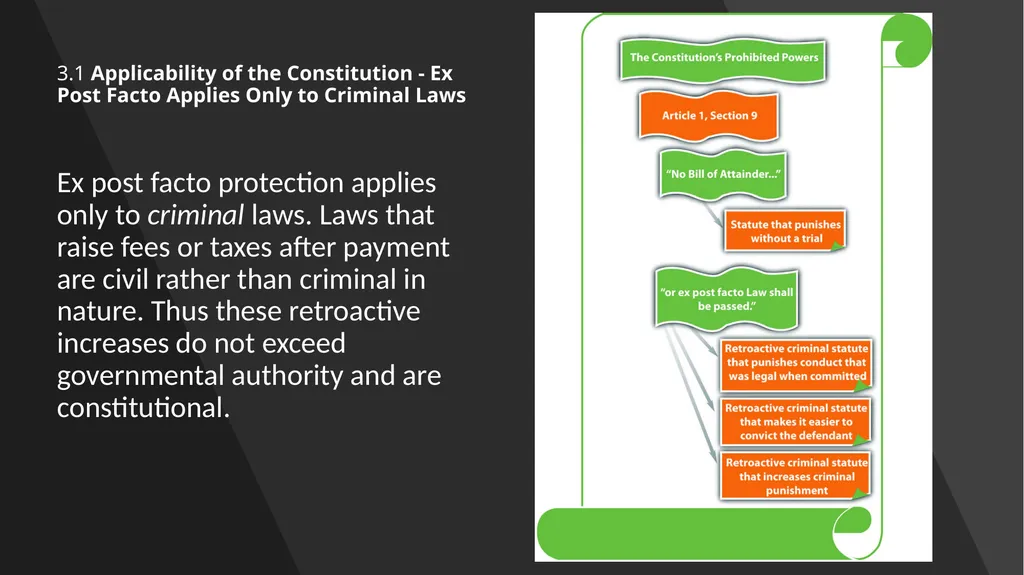
3.1 Applicability of the Constitution - The Legislative Branch’s Prohibited Powers The legislative branch cannot punish defendants without a trial or enact retroactive criminal statutes pursuant to the Constitution’s prohibition against bill of attainder and ex post facto laws. Article 1, § 9, clause 3 states, in pertinent part, “No Bill of Attainder or ex post facto Law shall be passed.”
The prohibition on bill of attainder and ex post facto laws is extended to the states in Article 1, § 10, clause 1: “No State shall…pass any Bill of Attainder, ex post facto Law.” Many state constitutions also prohibit ex post facto legislative action, mirroring the federal Constitution (Indiana Constitution, 2010).<br>
The prohibition on bill of attainder and ex post facto laws is extended to the states in Article 1, § 10, clause 1: “No State shall…pass any Bill of Attainder, ex post facto Law.” Many state constitutions also prohibit ex post facto legislative action, mirroring the federal Constitution (Indiana Constitution, 2010).<br>
16
3.1 Applicability of the Constitution - Bill of Attainder Bill of attainder is when the legislative branch of government punishes the defendant without a trial.
The drafters of the Constitution wanted to ensure that criminal defendants have a full and fair adjudication of their rights before the government imposes punishment.
Bill of attainder is usually accomplished by a statute that targets an individual or group of individuals for some type of government sanction.
Bill of attainder protection enforces separation of powers by eliminating the ability of the legislature to impose criminal punishment without a trial conducted by the judicial branch (U.S. v. Brown, 2010).<br>
The drafters of the Constitution wanted to ensure that criminal defendants have a full and fair adjudication of their rights before the government imposes punishment.
Bill of attainder is usually accomplished by a statute that targets an individual or group of individuals for some type of government sanction.
Bill of attainder protection enforces separation of powers by eliminating the ability of the legislature to impose criminal punishment without a trial conducted by the judicial branch (U.S. v. Brown, 2010).<br>
17
3.1 Applicability of the Constitution - Example of Bill of Attainder Brianne is a member of the Communist party. Brianne applies for a job as a teacher at her local elementary school and is refused, based on this statute: “Members of any subversive group, including the Communist party, cannot hold public office nor teach for a public institution.” Brianne could attack this statute as a bill of attainder.
Its provisions, targeting members of the Communist party or any other subversive group, punish by eliminating career opportunities. The members targeted are punished without a trial or any adjudication of their rights. Thus this statute allows the legislature to impose a sanction without a trial in violation of the Constitution’s prohibited powers.<br>
Its provisions, targeting members of the Communist party or any other subversive group, punish by eliminating career opportunities. The members targeted are punished without a trial or any adjudication of their rights. Thus this statute allows the legislature to impose a sanction without a trial in violation of the Constitution’s prohibited powers.<br>
18
3.1 Applicability of the Constitution - Ex Post Facto An ex post facto law punishes an individual retroactively, and severely encroaches on notions of fairness.
There are three types of ex post facto laws.
First, a law is ex post facto if it punishes behavior that occurred before the law was in effect.
Second, ex post facto laws may increase the punishment for the offense after the crime occurred.
Third, a law can be ex post facto if it increases the possibility of conviction after the crime occurred.<br>
There are three types of ex post facto laws.
First, a law is ex post facto if it punishes behavior that occurred before the law was in effect.
Second, ex post facto laws may increase the punishment for the offense after the crime occurred.
Third, a law can be ex post facto if it increases the possibility of conviction after the crime occurred.<br>
19
3.1 Applicability of the Constitution - Example of an Ex Post Facto Law Punishing Behavior Retroactively A state murder statute defines murder as the killing of a human being, born alive. The state legislature amends this statute to include the killing of a fetus, with the exception of abortion. The amendment extends the application of the statute to all criminal fetus killings that occurred before the statute was changed. This language punishes defendants for behavior that was legal when committed. If the state attempts to include this language, a court can strike the statute for violating the prohibition against ex post facto laws.<br>
20
3.1 Applicability of the Constitution - Example of an Ex Post Facto Law Increasing Punishment Retroactively In the preceding example about amending the murder statute, the state also amends the statute to increase the penalty for murder to the death penalty. Before the amendment, the penalty for murder was life in prison without the possibility of parole. The state cannot give the death penalty to defendants who committed murder before the statute was amended. This is considered ex post facto because it increases the punishment for the offense after the crime is committed.<br>
21
3.1 Applicability of the Constitution - Example of an Ex Post Facto Law Increasing the Possibility of Conviction Retroactively In the preceding example, the state amends the murder statute to remove the statute of limitations, which is the time limit on prosecution. Before the amendment, the statute of limitations was fifty years. The state cannot prosecute defendants who committed murder more than fifty years ago, pursuant to the amendment. This is considered ex post facto because it increases the chance of conviction after the crime is committed.<br>
22
3.1 Applicability of the Constitution - Changes That Benefit a Defendant Retroactively Changes that benefit a criminal defendant are not considered ex post facto and may be applied retroactively.
In the preceding example, if the state amended the murder statute to shorten the statute of limitations, this change actually benefits defendants by making it more difficult to convict them. Thus this amendment would be constitutional.<br>
In the preceding example, if the state amended the murder statute to shorten the statute of limitations, this change actually benefits defendants by making it more difficult to convict them. Thus this amendment would be constitutional.<br>
23
3.1 Applicability of the Constitution - Ex Post Facto Applies Only to Criminal Laws Ex post facto protection applies only to criminal laws. Laws that raise fees or taxes after payment are civil rather than criminal in nature. Thus these retroactive increases do not exceed governmental authority and are constitutional.<br>
24
3.2 The Due Process and Equal Protection Clauses The Bill of Rights contains most of the constitutional protections afforded to criminal defendants. The Bill of Rights is the first ten amendments to the Constitution. In addition, the Fourteenth Amendment, which was added to the Constitution after the Civil War, has a plethora of protections for criminal defendants in the due process and equal protection clauses.<br>
25
3.2 The Due Process and Equal Protection Clauses - The Meaning of Due Process of Law The due process clause states, “No person shall…be deprived of life, liberty, or property, without due process of law.” The due process clause in the Fifth Amendment applies to federal crimes and federal criminal prosecutions. The federal due process clause is mirrored in the Fourteenth Amendment, which guarantees due process of law in state criminal prosecutions.
Substantive due process protects individuals from an unreasonable loss of substantive rights, such as the right to speak freely and the right to privacy.
Procedural due process protects individuals from being criminally punished without notice and an opportunity to be heard.
Both substantive and procedural due processes ensure that individuals are not denied their life (capital punishment), liberty (incarceration), or property (forfeiture) arbitrarily.<br>
Substantive due process protects individuals from an unreasonable loss of substantive rights, such as the right to speak freely and the right to privacy.
Procedural due process protects individuals from being criminally punished without notice and an opportunity to be heard.
Both substantive and procedural due processes ensure that individuals are not denied their life (capital punishment), liberty (incarceration), or property (forfeiture) arbitrarily.<br>
26
3.2 The Due Process and Equal Protection Clauses - Void for Vagueness Void for vagueness challenges the wording of a statute under the due process clause. A statute is void for vagueness if it uses words that are indefinite or ambiguous. Statutes that are not precisely drafted do not provide notice to the public of exactly what kind of behavior is criminal. In addition, and more important, they give too much discretion to law enforcement and are unevenly enforced (U.S. v. White, 2010). With a void for vagueness challenge, the statute must be so unclear that “men of common intelligence must guess at its meaning,” (Connally v. General Construction Co., 2010) which is an objective standard.<br>
27
3.2 The Due Process and Equal Protection Clauses - Example of a Statute That Is Void for Vagueness A state legislature enacts a statute that criminalizes “inappropriate attire on public beaches.” Larry, a law enforcement officer, arrests Kathy for wearing a two-piece bathing suit at the beach because in his belief, women should wear one-piece bathing suits. Two days later, Burt, another law enforcement officer, arrests Sarah for wearing a one-piece bathing suit at the beach because in his belief, women should not be seen in public in bathing suits.
Kathy and Sarah can attack the statute on its face and as applied as void for vagueness. The term “inappropriate” is unclear and can mean different things to different people. Thus it gives too much discretion to law enforcement, is subject to uneven application, and does not give Kathy, Sarah, or the public adequate notice of what behavior is criminal.<br>
Kathy and Sarah can attack the statute on its face and as applied as void for vagueness. The term “inappropriate” is unclear and can mean different things to different people. Thus it gives too much discretion to law enforcement, is subject to uneven application, and does not give Kathy, Sarah, or the public adequate notice of what behavior is criminal.<br>
28
3.2 The Due Process and Equal Protection Clauses - Overbreadth A statute is overbroad if it criminalizes both constitutionally protected and constitutionally unprotected conduct. This challenge is different from void for vagueness, although certain statutes can be attacked on both grounds.
An overbroad statute criminalizes too much and needs to be revised to target only conduct that is outside the Constitution’s parameters.<br>
An overbroad statute criminalizes too much and needs to be revised to target only conduct that is outside the Constitution’s parameters.<br>
29
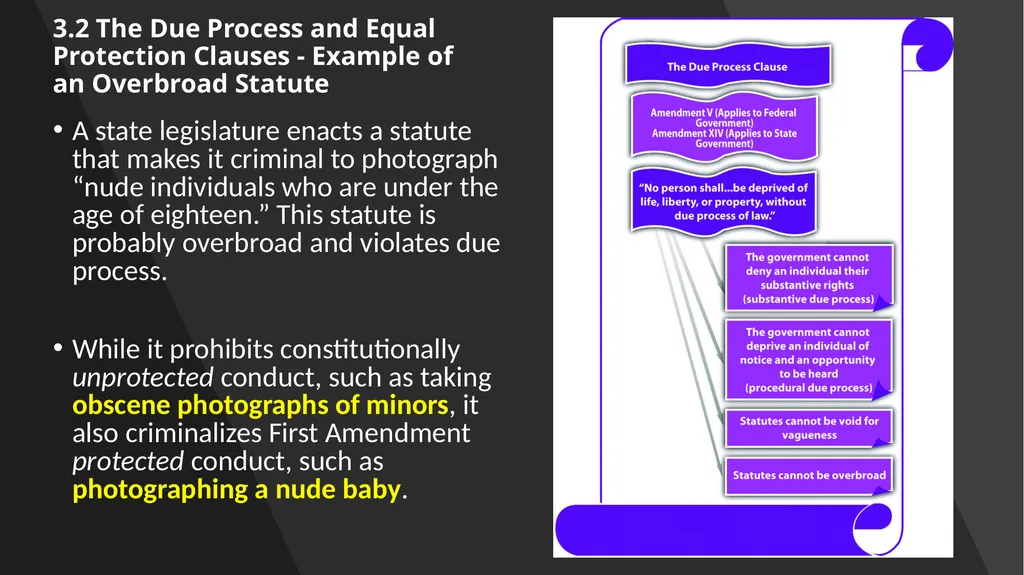
3.2 The Due Process and Equal Protection Clauses - Example of an Overbroad Statute A state legislature enacts a statute that makes it criminal to photograph “nude individuals who are under the age of eighteen.” This statute is probably overbroad and violates due process.
While it prohibits constitutionally unprotected conduct, such as taking obscene photographs of minors, it also criminalizes First Amendment protected conduct, such as photographing a nude baby.<br>
While it prohibits constitutionally unprotected conduct, such as taking obscene photographs of minors, it also criminalizes First Amendment protected conduct, such as photographing a nude baby.<br>
30
3.2 The Due Process and Equal Protection Clauses - The Equal Protection Clause The Fourteenth Amendment states in relevant part, “nor shall any State…deny to any person within its jurisdiction the equal protection of the laws.” The equal protection clause applies to the state government.
The equal protection clause prevents the state government from enacting criminal laws that discriminate in an unreasonable and unjustified manner. The Fifth Amendment due process clause prohibits the federal government from discrimination if the discrimination is so unjustifiable that it violates due process of law (Bolling v. Sharpe, 2010).<br>
The equal protection clause prevents the state government from enacting criminal laws that discriminate in an unreasonable and unjustified manner. The Fifth Amendment due process clause prohibits the federal government from discrimination if the discrimination is so unjustifiable that it violates due process of law (Bolling v. Sharpe, 2010).<br>
31
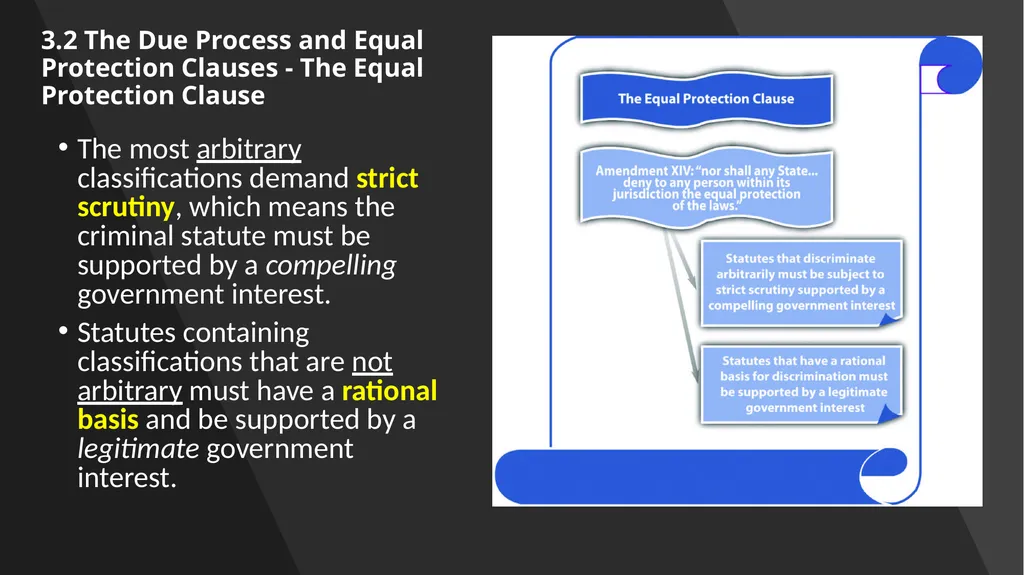
3.2 The Due Process and Equal Protection Clauses - The Equal Protection Clause The most arbitrary classifications demand strict scrutiny, which means the criminal statute must be supported by a compelling government interest.
Statutes containing classifications that are not arbitrary must have a rational basis and be supported by a legitimate government interest.<br>
Statutes containing classifications that are not arbitrary must have a rational basis and be supported by a legitimate government interest.<br>
32
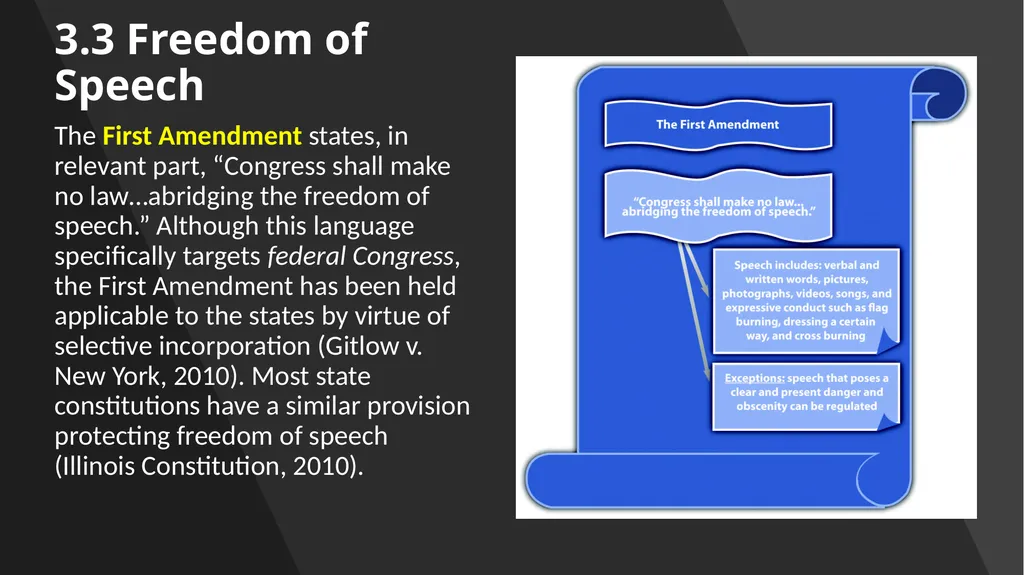
3.3 Freedom of Speech The First Amendment states, in relevant part, “Congress shall make no law…abridging the freedom of speech.” Although this language specifically targets federal Congress, the First Amendment has been held applicable to the states by virtue of selective incorporation (Gitlow v. New York, 2010). Most state constitutions have a similar provision protecting freedom of speech (Illinois Constitution, 2010).<br>
33
3.3 Freedom of Speech - Exceptions to the First Amendment’s Protection of Free Speech In general, courts have examined the history of the Constitution and the policy supporting freedom of speech when creating exceptions to its coverage. Modern decisions afford freedom of speech the strictest level of scrutiny; only a compelling government interest can justify an exception, which must use the least restrictive means possible (Sable Communis. of California, Inc. v. FCC, 2010). For the purpose of brevity, this book reviews the constitutional exceptions to free speech in statutes criminalizing fighting words, incitement to riot, hate crimes, and obscenity.<br>
34
3.3 Freedom of Speech - Fighting Words Although the First Amendment protects peaceful speech and assembly, if speech creates a clear and present danger to the public, it can be regulated (Schenck v. U.S., 2010). This includes fighting words, “those which by their very utterance inflict injury or tend to incite an immediate breach of the peace” (Chaplinsky v. New Hampshire, 2010).<br>
35
3.3 Freedom of Speech - Example of an Unconstitutional Fighting Words Statute Georgia enacted the following criminal statute: “Any person who shall, without provocation, use to or of another, and in his presence…opprobrious words or abusive language, tending to cause a breach of the peace…shall be guilty of a misdemeanor”
The Court held that the dictionary definitions of “opprobrious” and “abusive” give them greater reach than fighting words.
Thus the statute is overbroad and does not restrict its prohibition to imminent harm.
Opprobrious and abusive have various meanings, so the statute is also subject to uneven enforcement and is void for vagueness.<br>
The Court held that the dictionary definitions of “opprobrious” and “abusive” give them greater reach than fighting words.
Thus the statute is overbroad and does not restrict its prohibition to imminent harm.
Opprobrious and abusive have various meanings, so the statute is also subject to uneven enforcement and is void for vagueness.<br>
36
3.3 Freedom of Speech - Incitement to Riot Incitement to riot can also be regulated under the clear and present danger exception. Similar to fighting words, an incitement to riot statute must prohibit imminent lawless action (Brandenburg v. Ohio, 2010).Statutes that prohibit simple advocacy with no imminent threat or harm cannot withstand the First Amendment’s heightened scrutiny.<br>
37
3.3 Freedom of Speech - Example of an Unconstitutional Incitement to Riot Statute Ohio enacted a statute that criminalized “advocat[ing]…the duty, necessity, or propriety of crime, sabotage, violence, or unlawful methods of terrorism as a means of accomplishing industrial or political reform” and “voluntarily assembl[ing] with any society, group or assemblage of persons formed to teach or advocate the doctrines of criminal syndicalism”
A Ku Klux Klan leader was convicted under the statute after the media broadcast films of him leading a KKK meeting. The US Supreme Court held, “Accordingly, we are here confronted with a statute which, by its own words and as applied, purports to punish mere advocacy and to forbid, on pain of criminal punishment, assembly with others merely to advocate the described type of action. Such a statute falls within the condemnation of the First and Fourteenth Amendments” (Brandenburg v. Ohio, 2010).<br>
A Ku Klux Klan leader was convicted under the statute after the media broadcast films of him leading a KKK meeting. The US Supreme Court held, “Accordingly, we are here confronted with a statute which, by its own words and as applied, purports to punish mere advocacy and to forbid, on pain of criminal punishment, assembly with others merely to advocate the described type of action. Such a statute falls within the condemnation of the First and Fourteenth Amendments” (Brandenburg v. Ohio, 2010).<br>
38
3.3 Freedom of Speech - Hate Crimes Many states and the federal government have enacted hate crimes statutes. When hate crimes statutes criminalize speech, including expressive conduct, a First Amendment analysis is appropriate. When hate crimes statutes enhance a penalty for criminal conduct that is not expressive, the First Amendment is not applicable (Wisconsin v. Mitchell, 2010)
Hate crimes statutes that criminalize the content of speech, like a prejudicial opinion about a certain race, ethnicity, gender, sexual orientation, or religion are unconstitutional under the First Amendment (R.A.V. v. St. Paul, 2010)..<br>
Hate crimes statutes that criminalize the content of speech, like a prejudicial opinion about a certain race, ethnicity, gender, sexual orientation, or religion are unconstitutional under the First Amendment (R.A.V. v. St. Paul, 2010)..<br>
39
3.3 Freedom of Speech - Example of an Unconstitutional Statute Prohibiting Cross Burning St. Paul, Minnesota, enacted the Bias-Motivated Crime Ordinance, which prohibited the display of a symbol that a person knows or has reason to know “arouses anger, alarm or resentment in others on the basis of race, color, creed, religion or gender” (Ordinance, St. Paul, Minn., Legis. Code § 292.02 (1990)). In R.A.V. v. St. Paul, 505 U.S. 377 (1992), the US Supreme Court held that this ordinance wa unconstitutional on its face because regulation was based on the content of speech, with no additional requirement for imminent lawless action.<br>
40
3.3 Freedom of Speech - Obscenity Another exception to free speech is obscenity. Obscenity is usually conveyed by speech, such as words, pictures, photographs, songs, videos, and live performances. However, obscenity is not protected speech under the First Amendment (Roth v. United States, 2010).
In Miller v. California, 413 U.S. 15 (1973), the US Supreme Court devised a three-part test to ascertain if speech is obscene and subject to government regulation. Generally, speech is obscene if (1) the average person, applying contemporary community standards would find that the work, taken as a whole, appeals to the prurient interest in sex; (2) it depicts sexual conduct specifically defined by the applicable state law in a patently offensive way; and (3) it lacks serious literary, artistic, political, or scientific value (Miller v. California, 2010).<br>
In Miller v. California, 413 U.S. 15 (1973), the US Supreme Court devised a three-part test to ascertain if speech is obscene and subject to government regulation. Generally, speech is obscene if (1) the average person, applying contemporary community standards would find that the work, taken as a whole, appeals to the prurient interest in sex; (2) it depicts sexual conduct specifically defined by the applicable state law in a patently offensive way; and (3) it lacks serious literary, artistic, political, or scientific value (Miller v. California, 2010).<br>
41
3.3 Freedom of Speech - Example of Speech That Is Not Obscene In Jenkins v. Georgia, 418 U.S. 153 (1974), the US Supreme Court viewed the film Carnal Knowledge to determine whether the defendant could be constitutionally convicted under an obscenity statute for showing it at a local theater. The Court concluded that most of the film’s sexual content was suggestive rather than explicit, and the only direct portrayal of nudity was a woman’s bare midriff. Thus although a jury convicted the defendant after viewing the film, the Court reversed the conviction, stating that the film does not constitute the hard-core pornography that the three-part test for obscenity isolates from the First Amendment’s protection. The Court stated, “Appellant’s showing of the film ‘Carnal Knowledge’ is simply not the ‘public portrayal of hard core sexual conduct for its own sake, and for the ensuing commercial gain’ which we said was punishable in Miller, Id., at 35” (Jenkins v. Georgia, 2010).<br>
42
3.3 Freedom of Speech - Nude Dancing Statutes that regulate nude dancing have also been attacked under the First Amendment. Although the US Supreme Court has ruled that nude dancing is constitutionally protected expression, it has also upheld reasonable restrictions on nudity, such as requirements that nude dancers wear pasties and a g-string (City of Erie et al v. Pap’s A.M., 2010).<br>
43
3.3 Freedom of Speech
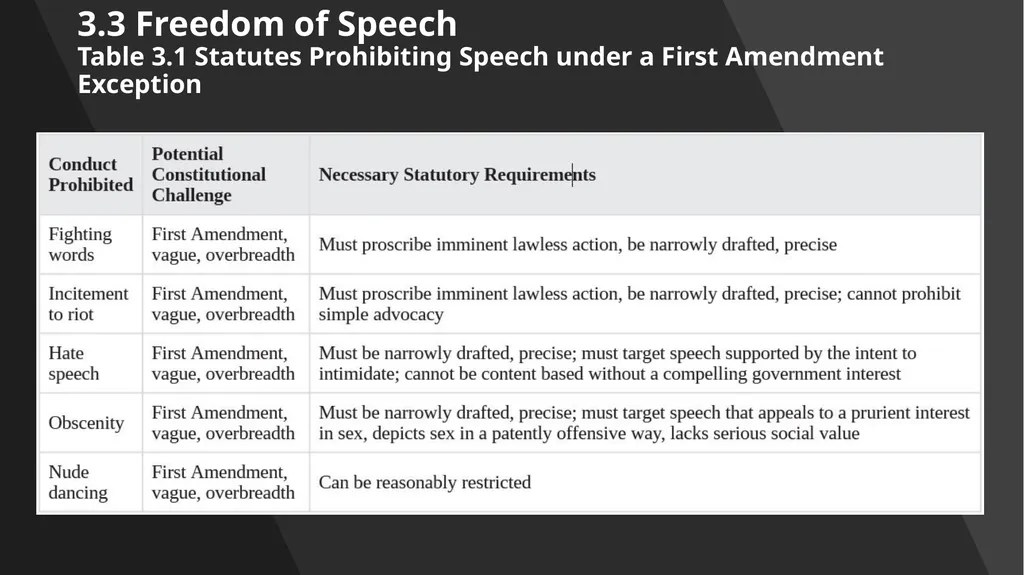
Table 3.1 Statutes Prohibiting Speech under a First Amendment Exception<br>
44
3.4 The Right to Privacy The federal Constitution does not explicitly protect privacy. However, several of the amendments in the Bill of Rights ensure and protect individual decision making and autonomy from governmental intrusion. Thus modern interpretations of the Constitution by the US Supreme Court have created a right to privacy (Griswold v. Connecticut, 2010). This right is considered fundamental and subject to strict scrutiny; only a compelling government interest can justify a statute encroaching on its protections. Many states include an explicit right to privacy in their state constitutions (Hawaii Consitution, 2010).<br>
45
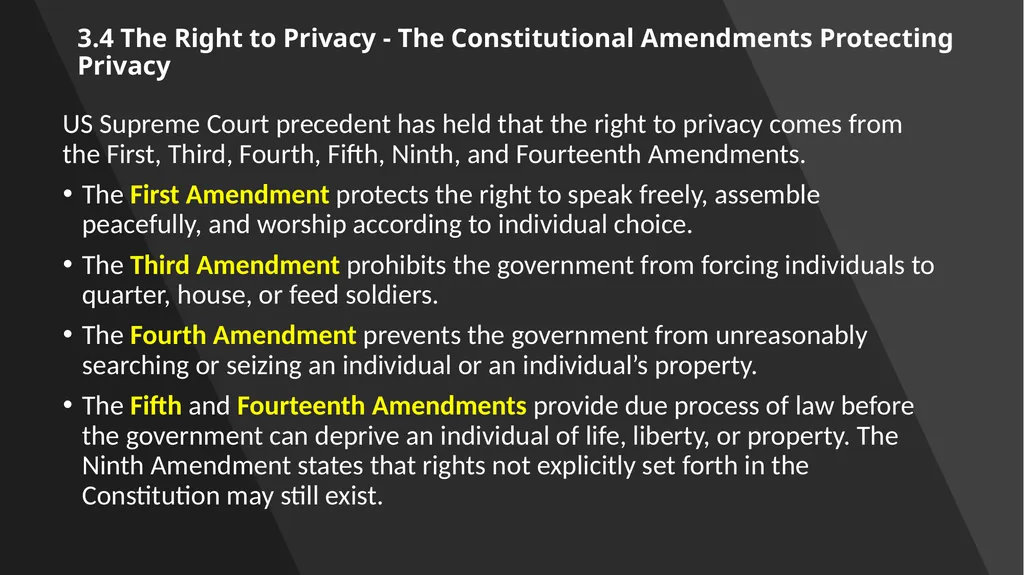
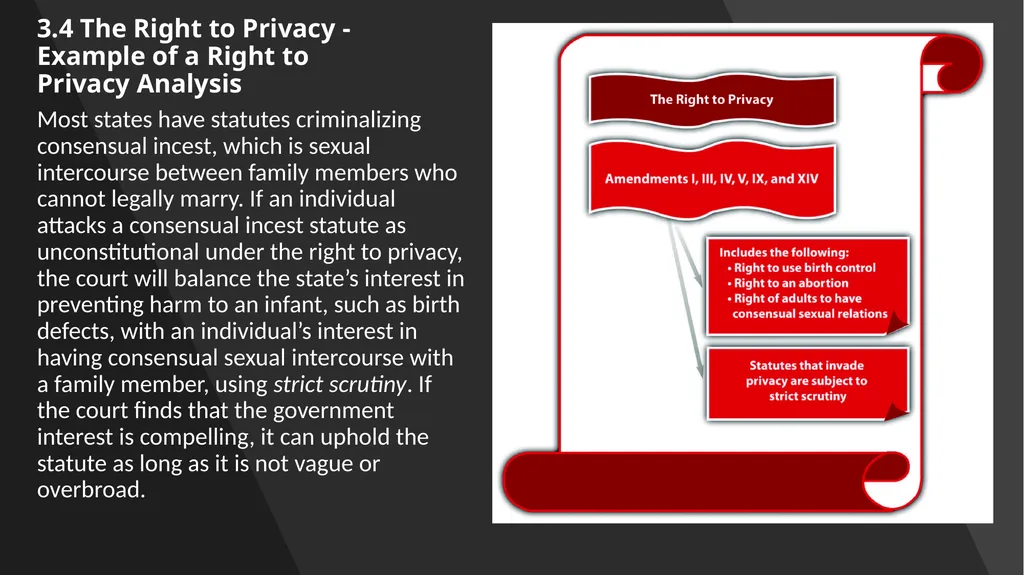
3.4 The Right to Privacy - The Constitutional Amendments Protecting Privacy US Supreme Court precedent has held that the right to privacy comes from the First, Third, Fourth, Fifth, Ninth, and Fourteenth Amendments.
The First Amendment protects the right to speak freely, assemble peacefully, and worship according to individual choice.
The Third Amendment prohibits the government from forcing individuals to quarter, house, or feed soldiers.
The Fourth Amendment prevents the government from unreasonably searching or seizing an individual or an individual’s property.
The Fifth and Fourteenth Amendments provide due process of law before the government can deprive an individual of life, liberty, or property. The Ninth Amendment states that rights not explicitly set forth in the Constitution may still exist.<br>
The First Amendment protects the right to speak freely, assemble peacefully, and worship according to individual choice.
The Third Amendment prohibits the government from forcing individuals to quarter, house, or feed soldiers.
The Fourth Amendment prevents the government from unreasonably searching or seizing an individual or an individual’s property.
The Fifth and Fourteenth Amendments provide due process of law before the government can deprive an individual of life, liberty, or property. The Ninth Amendment states that rights not explicitly set forth in the Constitution may still exist.<br>
46
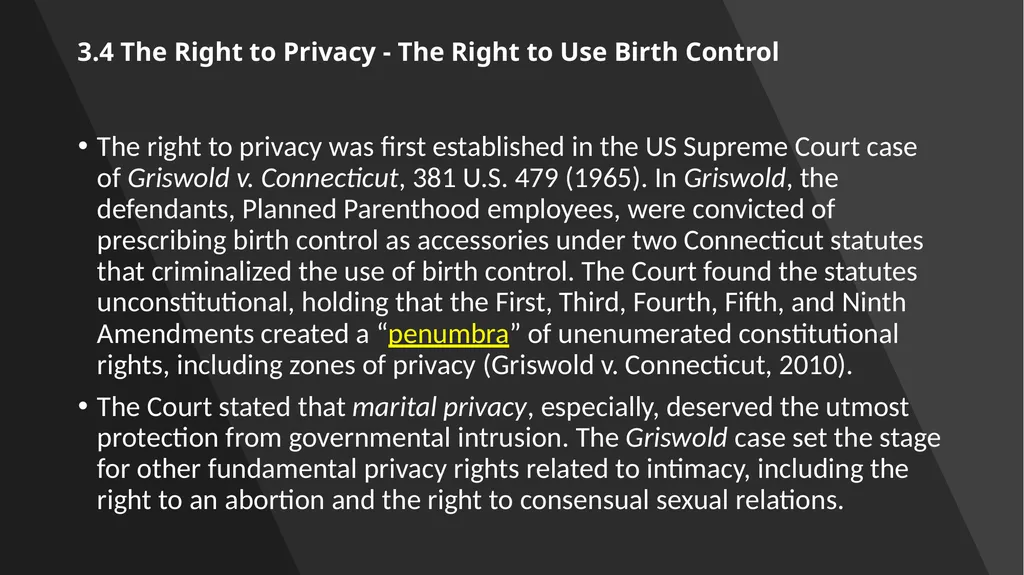
3.4 The Right to Privacy - The Right to Use Birth Control The right to privacy was first established in the US Supreme Court case of Griswold v. Connecticut, 381 U.S. 479 (1965). In Griswold, the defendants, Planned Parenthood employees, were convicted of prescribing birth control as accessories under two Connecticut statutes that criminalized the use of birth control. The Court found the statutes unconstitutional, holding that the First, Third, Fourth, Fifth, and Ninth Amendments created a “penumbra” of unenumerated constitutional rights, including zones of privacy (Griswold v. Connecticut, 2010).
The Court stated that marital privacy, especially, deserved the utmost protection from governmental intrusion. The Griswold case set the stage for other fundamental privacy rights related to intimacy, including the right to an abortion and the right to consensual sexual relations.<br>
The Court stated that marital privacy, especially, deserved the utmost protection from governmental intrusion. The Griswold case set the stage for other fundamental privacy rights related to intimacy, including the right to an abortion and the right to consensual sexual relations.<br>
47
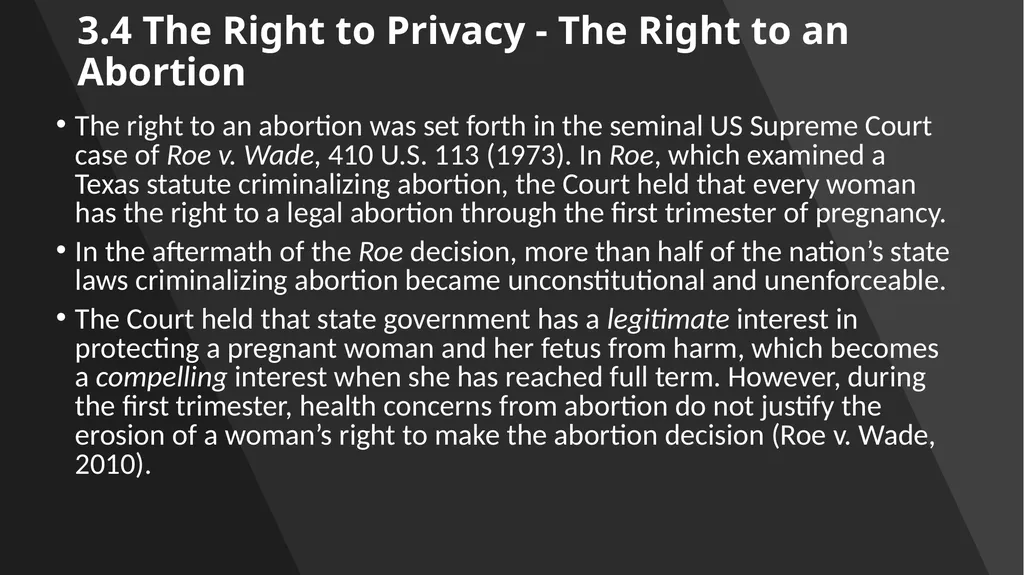
3.4 The Right to Privacy - The Right to an Abortion The right to an abortion was set forth in the seminal US Supreme Court case of Roe v. Wade, 410 U.S. 113 (1973). In Roe, which examined a Texas statute criminalizing abortion, the Court held that every woman has the right to a legal abortion through the first trimester of pregnancy.
In the aftermath of the Roe decision, more than half of the nation’s state laws criminalizing abortion became unconstitutional and unenforceable.
The Court held that state government has a legitimate interest in protecting a pregnant woman and her fetus from harm, which becomes a compelling interest when she has reached full term. However, during the first trimester, health concerns from abortion do not justify the erosion of a woman’s right to make the abortion decision (Roe v. Wade, 2010).<br>
In the aftermath of the Roe decision, more than half of the nation’s state laws criminalizing abortion became unconstitutional and unenforceable.
The Court held that state government has a legitimate interest in protecting a pregnant woman and her fetus from harm, which becomes a compelling interest when she has reached full term. However, during the first trimester, health concerns from abortion do not justify the erosion of a woman’s right to make the abortion decision (Roe v. Wade, 2010).<br>
48
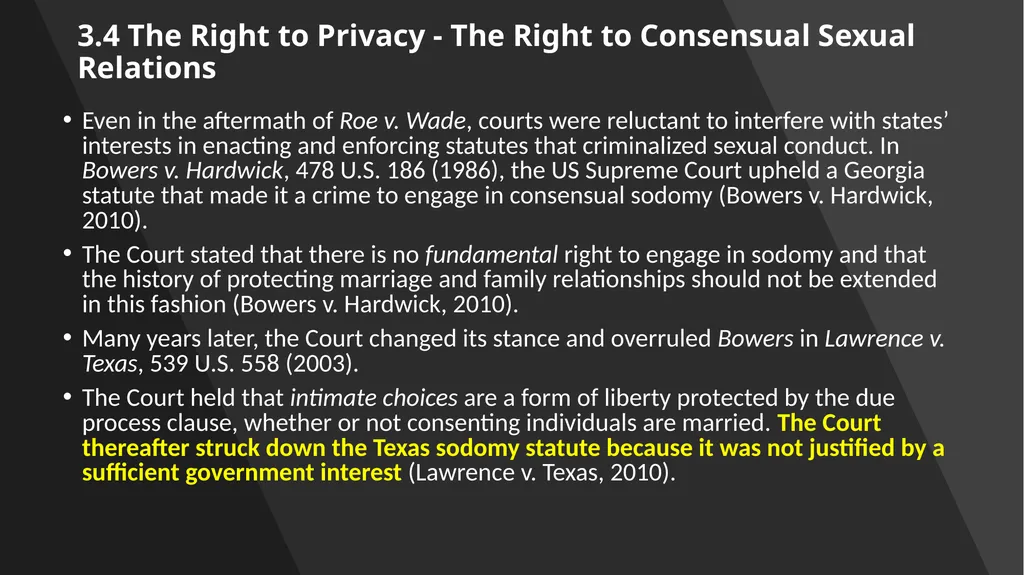
3.4 The Right to Privacy - The Right to Consensual Sexual Relations Even in the aftermath of Roe v. Wade, courts were reluctant to interfere with states’ interests in enacting and enforcing statutes that criminalized sexual conduct. In Bowers v. Hardwick, 478 U.S. 186 (1986), the US Supreme Court upheld a Georgia statute that made it a crime to engage in consensual sodomy (Bowers v. Hardwick, 2010).
The Court stated that there is no fundamental right to engage in sodomy and that the history of protecting marriage and family relationships should not be extended in this fashion (Bowers v. Hardwick, 2010).
Many years later, the Court changed its stance and overruled Bowers in Lawrence v. Texas, 539 U.S. 558 (2003).
The Court held that intimate choices are a form of liberty protected by the due process clause, whether or not consenting individuals are married. The Court thereafter struck down the Texas sodomy statute because it was not justified by a sufficient government interest (Lawrence v. Texas, 2010).<br>
The Court stated that there is no fundamental right to engage in sodomy and that the history of protecting marriage and family relationships should not be extended in this fashion (Bowers v. Hardwick, 2010).
Many years later, the Court changed its stance and overruled Bowers in Lawrence v. Texas, 539 U.S. 558 (2003).
The Court held that intimate choices are a form of liberty protected by the due process clause, whether or not consenting individuals are married. The Court thereafter struck down the Texas sodomy statute because it was not justified by a sufficient government interest (Lawrence v. Texas, 2010).<br>
49
3.4 The Right to Privacy - The Right to Consensual Sexual Relations Most states have statutes criminalizing consensual incest, which is sexual intercourse between family members who cannot legally marry.
If an individual attacks a consensual incest statute as unconstitutional under the right to privacy, the court will balance the state’s interest in preventing harm to an infant, such as birth defects, with an individual’s interest in having consensual sexual intercourse with a family member, using strict scrutiny.
If the court finds that the government interest is compelling, it can uphold the statute as long as it is not vague or overbroad.<br>
If an individual attacks a consensual incest statute as unconstitutional under the right to privacy, the court will balance the state’s interest in preventing harm to an infant, such as birth defects, with an individual’s interest in having consensual sexual intercourse with a family member, using strict scrutiny.
If the court finds that the government interest is compelling, it can uphold the statute as long as it is not vague or overbroad.<br>
50
3.4 The Right to Privacy - Example of a Right to Privacy Analysis Most states have statutes criminalizing consensual incest, which is sexual intercourse between family members who cannot legally marry. If an individual attacks a consensual incest statute as unconstitutional under the right to privacy, the court will balance the state’s interest in preventing harm to an infant, such as birth defects, with an individual’s interest in having consensual sexual intercourse with a family member, using strict scrutiny. If the court finds that the government interest is compelling, it can uphold the statute as long as it is not vague or overbroad.<br>
51
3.5 The Right to Bear Arms Although the federal Constitution specifically references a right to bear arms in the Second Amendment, the US Supreme Court has not interpreted this amendment in a significant fashion until recently.
The Second Amendment provides “[a] well regulated Militia, being necessary to the security of a free state, the right of the people to keep and bear Arms, shall not be infringed.” Many state constitutions have a similar provision (Volokh, E., 2010). In 2008, the US Supreme Court explored the Second Amendment and its effect on weapons possession in a case attacking Washington, DC, firearms legislation (District of Columbia v. Heller, 2010).<br>
The Second Amendment provides “[a] well regulated Militia, being necessary to the security of a free state, the right of the people to keep and bear Arms, shall not be infringed.” Many state constitutions have a similar provision (Volokh, E., 2010). In 2008, the US Supreme Court explored the Second Amendment and its effect on weapons possession in a case attacking Washington, DC, firearms legislation (District of Columbia v. Heller, 2010).<br>
52
3.5 The Right to Bear Arms - Example of an Appropriate Restriction on Firearms Dirk is a public middle-school janitor. Occasionally, with the permission of the principal, Dirk stays overnight in an outbuilding on campus when he works a particularly late shift. Dirk wants to keep a handgun in the outbuilding, for protection. If Dirk’s state has a statute prohibiting the possession of a handgun within one mile of any public school, Dirk cannot keep a handgun in the outbuilding for self-defense. Modern US Supreme
Court precedent holds that the Second Amendment protects an individual’s right to possess a handgun in the home for self-defense.
However, this precedent specifically exempts firearm possession near schools. Unless newer precedent expands the ruling to include firearm possession near schools, the statute in Dirk’s state is constitutional.<br>
Court precedent holds that the Second Amendment protects an individual’s right to possess a handgun in the home for self-defense.
However, this precedent specifically exempts firearm possession near schools. Unless newer precedent expands the ruling to include firearm possession near schools, the statute in Dirk’s state is constitutional.<br>
53
3.6 Excessive Punishment The prohibition against cruel and unusual punishment comes from the Eighth Amendment, which states, “Excessive bail shall not be required, nor excessive fines imposed, nor cruel and unusual punishments inflicted.” State constitutions often have similar provisions (Texas Constitution, 2010).
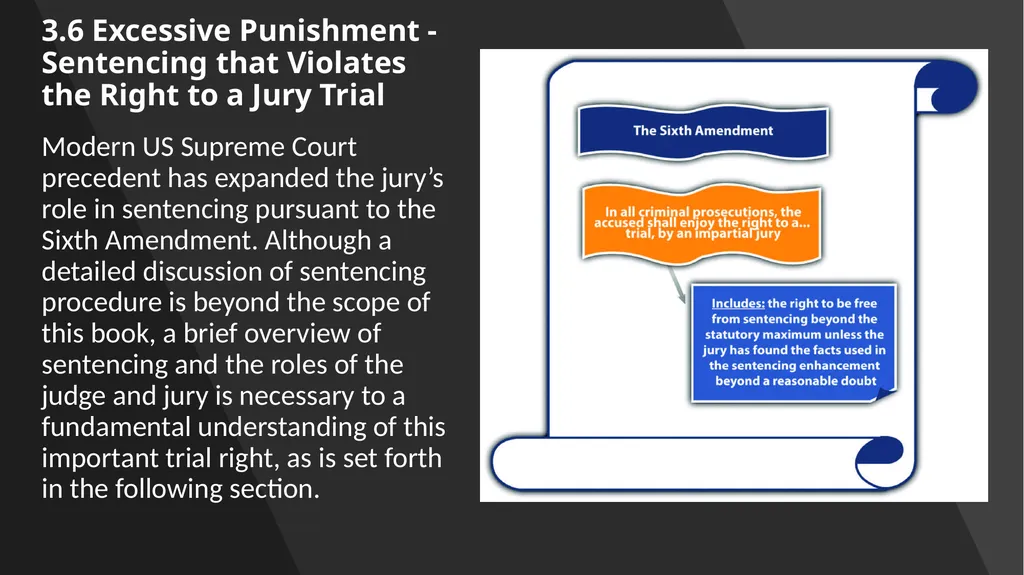
Another facet of excessive punishment is a criminal sentencing enhancement that is based on facts not found beyond a reasonable doubt by a jury. This has been held to violate the Sixth Amendment, which states, “In all criminal prosecutions, the accused shall enjoy the right to a…trial, by an impartial jury of the State and district wherein the crime shall have been committed.”<br>
Another facet of excessive punishment is a criminal sentencing enhancement that is based on facts not found beyond a reasonable doubt by a jury. This has been held to violate the Sixth Amendment, which states, “In all criminal prosecutions, the accused shall enjoy the right to a…trial, by an impartial jury of the State and district wherein the crime shall have been committed.”<br>
54
3.6 Excessive Punishment - Infliction of Cruel Punishment In general, the government must refrain from inflicting cruel or barbaric punishments on criminal defendants in violation of the Eighth Amendment. In particular, cases asserting that a criminal punishment is inhumane often focus on capital punishment, which is the death penalty.<br>
55
3.6 Excessive Punishment - Synopsis of the History of Capital Punishment The death penalty has been used as a criminal punishment since the eighteenth century BC. American death penalty law is influenced by the British because the colonists brought English common-law principles, including capital punishment, with them to the New World. The first execution in America took place in 1608, for spying.
Throughout the nineteenth and twentieth centuries, the United States fluctuated in its attitude toward capital punishment. Executions were at an all-time high in the 1930s.
However, in 1972, in the landmark decision of Furman v. Georgia, 408 U.S. 238 (1972), the US Supreme Court held that Georgia’s death penalty statute, was arbitrary and therefore authorized cruel and unusual punishment in violation of the Eighth Amendment.
Later, in 1976, the US Supreme Court case of Gregg v. Georgia, 428 U.S. 153 (1976), affirmed the procedure of a bifurcated trial, separating the guilt phase from the penalty phase for death penalty cases.<br>
Throughout the nineteenth and twentieth centuries, the United States fluctuated in its attitude toward capital punishment. Executions were at an all-time high in the 1930s.
However, in 1972, in the landmark decision of Furman v. Georgia, 408 U.S. 238 (1972), the US Supreme Court held that Georgia’s death penalty statute, was arbitrary and therefore authorized cruel and unusual punishment in violation of the Eighth Amendment.
Later, in 1976, the US Supreme Court case of Gregg v. Georgia, 428 U.S. 153 (1976), affirmed the procedure of a bifurcated trial, separating the guilt phase from the penalty phase for death penalty cases.<br>
56
3.6 Excessive Punishment - Inhumane Capital Punishment A claim that capital punishment is inhumane and therefore unconstitutional under the Eighth Amendment focuses on the method of execution.
Throughout the history of the death penalty, many methods of execution have been employed, including shooting, hanging, electrocution, the gas chamber, and lethal injection.
The current focus of the courts is lethal injection because it is one of the few methods that has not been condemned as unconstitutional.<br>
Throughout the history of the death penalty, many methods of execution have been employed, including shooting, hanging, electrocution, the gas chamber, and lethal injection.
The current focus of the courts is lethal injection because it is one of the few methods that has not been condemned as unconstitutional.<br>
57
3.6 Excessive Punishment - Disproportionate Punishment Disproportionate punishment is a different issue than inhumane punishment, but it is still within the parameters of the Eighth Amendment. Disproportionate punishment asserts that a criminal punishment is too severe for the crime.
Two criminal punishments garner many disproportionate punishment claims: capital punishment and punishment pursuant to three-strikes statutes.<br>
Two criminal punishments garner many disproportionate punishment claims: capital punishment and punishment pursuant to three-strikes statutes.<br>
58
3.6 Excessive Punishment - Capital Punishment as Disproportionate Capital punishment can be disproportionate because it is too severe for the crime or because it is too severe for the criminal defendant.
Death is the ultimate punishment, so it must be equivalent to the crime the defendant committed. The
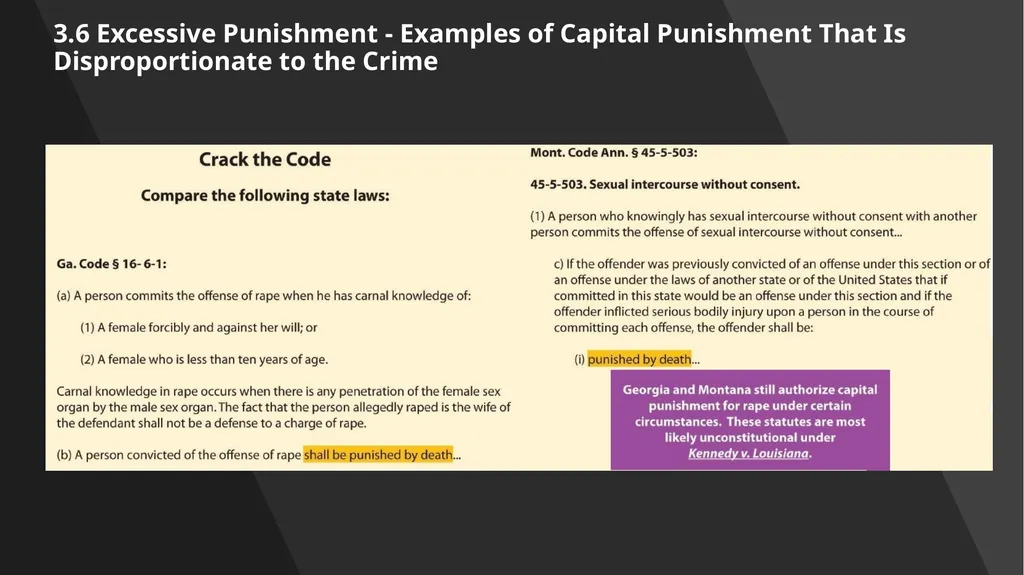
US Supreme Court has confirmed that the death penalty is too severe for most crimes. In Coker v. Georgia, 433 U.S. 584 (1977), the Court held that capital punishment is disproportionate for the crime of raping an adult woman.
Many years later in Kennedy v. Louisiana, 128 S. Ct. 2641 (2008), the Court extended the disproportionality principle to invalidate the death penalty for child rape. Kennedy maintained the distinction between crimes committed against individuals and crimes committed against the government, like treason.
The only crime against an individual that currently merits the death penalty is criminal homicide, which is the unlawful killing of one human being by another. Criminal homicide is discussed in detail in Chapter 9 “Criminal Homicide”.<br>
Death is the ultimate punishment, so it must be equivalent to the crime the defendant committed. The
US Supreme Court has confirmed that the death penalty is too severe for most crimes. In Coker v. Georgia, 433 U.S. 584 (1977), the Court held that capital punishment is disproportionate for the crime of raping an adult woman.
Many years later in Kennedy v. Louisiana, 128 S. Ct. 2641 (2008), the Court extended the disproportionality principle to invalidate the death penalty for child rape. Kennedy maintained the distinction between crimes committed against individuals and crimes committed against the government, like treason.
The only crime against an individual that currently merits the death penalty is criminal homicide, which is the unlawful killing of one human being by another. Criminal homicide is discussed in detail in Chapter 9 “Criminal Homicide”.<br>
59
3.6 Excessive Punishment - Examples of Capital Punishment That Is Disproportionate to the Crime<br>
60
3.6 Excessive Punishment - Examples of Capital Punishment That Are Disproportionate to the Criminal Defendant Recent US Supreme Court precedent has targeted specific classifications of criminal defendants for whom capital punishment is overly severe. Recent cases hold that the death penalty is cruel and unusual punishment for a criminal defendant who was a juvenile when the crime was committed (Roper v. Simmons, 2010), who is mentally ill (Ford v. Wainwright, 2010), or has an intellectual disability (Atkins v. Virginia, 2010) at the time of the scheduled execution.
Although states vary in their classifications of juveniles, the Eighth Amendment prohibits capital punishment for an individual who was under eighteen years of age when he or she committed criminal homicide.<br>
Although states vary in their classifications of juveniles, the Eighth Amendment prohibits capital punishment for an individual who was under eighteen years of age when he or she committed criminal homicide.<br>
61
3.6 Excessive Punishment - Example of Capital Punishment That Is Inhumane and
Disproportionate to the Crime and the Criminal Defendant Jerry is sentenced to death for rape. The state death penalty statute specifies death by decapitation. While on death row, Jerry begins to hear voices and is diagnosed as schizophrenic by the prison psychiatrist. The state schedules the execution anyway. In this example, the state death penalty statute is inhumane because death by decapitation is too severe a punishment for any crime. The death penalty statute is also disproportionate to the crime because execution is not a constitutional punishment for the crime of rape. Lastly, the death penalty statute is disproportionate to Jerry, the criminal defendant, because it is cruel and unusual to execute someone who is mentally ill.<br>
62
3.6 Excessive Punishment - Disproportionate Punishment Pursuant to Three-Strikes Laws California was the first state to enact a “three strikes and you’re out” law (Cal. Penal Code § 667, 2010). Generally, three-strikes statutes punish habitual offenders more harshly when they commit a second or third felony after an initial serious or violent felony (Cal. Penal Code § 667, 2010). To date, California’s three-strikes law is the toughest in the nation; it mandates a minimum twenty-five-year- to life sentence for felons convicted of a third strike. California enacted its three-strikes legislation after the kidnapping, rape, and murder of Polly Klaas by a habitual offender. Twenty-four states followed, indicating public support for the incapacitation of career criminals (Three Strikes and You’re Out, 2010).<br>
63
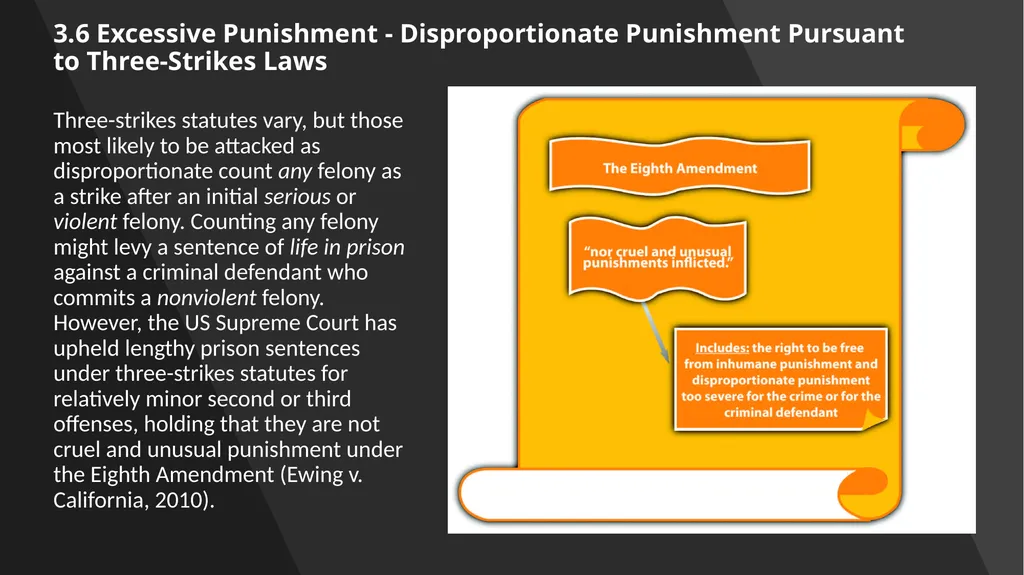
3.6 Excessive Punishment - Disproportionate Punishment Pursuant to Three-Strikes Laws Three-strikes statutes vary, but those most likely to be attacked as disproportionate count any felony as a strike after an initial serious or violent felony. Counting any felony might levy a sentence of life in prison against a criminal defendant who commits a nonviolent felony. However, the US Supreme Court has upheld lengthy prison sentences under three-strikes statutes for relatively minor second or third offenses, holding that they are not cruel and unusual punishment under the Eighth Amendment (Ewing v. California, 2010).<br>
64
3.6 Excessive Punishment - Sentencing that Violates the Right to a Jury Trial Modern US Supreme Court precedent has expanded the jury’s role in sentencing pursuant to the Sixth Amendment. Although a detailed discussion of sentencing procedure is beyond the scope of this book, a brief overview of sentencing and the roles of the judge and jury is necessary to a fundamental understanding of this important trial right, as is set forth in the following section.<br>
65
3.6 Excessive Punishment - The Role of the Judge and Jury in Sentencing Fact-Finding “The Legal System in the United States”, the trier of fact decides the facts and renders a decision on innocence or guilt using beyond a reasonable doubt as the standard for the burden of proof. The trier of fact in a criminal prosecution is almost always a jury because of the right to a jury trial in the Sixth Amendment.
Occasionally, the defendant waives the right to a jury trial and has a bench trial with a judge playing the role of trier of fact.
Generally, criminal sentencing takes place after the trial.
Although the sentencing procedure varies from state to state and from state to federal, a sentencing hearing is typically held after guilt has been determined at trial or after a guilty plea.<br>
Occasionally, the defendant waives the right to a jury trial and has a bench trial with a judge playing the role of trier of fact.
Generally, criminal sentencing takes place after the trial.
Although the sentencing procedure varies from state to state and from state to federal, a sentencing hearing is typically held after guilt has been determined at trial or after a guilty plea.<br>
66
3.6 Excessive Punishment - Sentencing Enhancement by Judges Until recently, judges could use evidence received at the sentencing hearing to enhance a sentence beyond the statutory maximum by making a determination of the new facts to a preponderance of evidence. However, in Apprendi v. New Jersey, 530 U.S. 466 (2000), the US Supreme Court held that the right to a jury trial prohibits judges from enhancing criminal sentences beyond the statutory maximum based on facts not determined by a jury beyond a reasonable doubt.
In Apprendi, the trial court enhanced the defendant’s sentence beyond the statutory maximum for possession of a firearm with an unlawful purpose under New Jersey’s hate crimes statute. Although the jury did not determine that the defendant’s crime was a hate crime, the judge accepted new evidence at sentencing that indicated the defendant’s shooting into a residence was racially motivated.<br>
In Apprendi, the trial court enhanced the defendant’s sentence beyond the statutory maximum for possession of a firearm with an unlawful purpose under New Jersey’s hate crimes statute. Although the jury did not determine that the defendant’s crime was a hate crime, the judge accepted new evidence at sentencing that indicated the defendant’s shooting into a residence was racially motivated.<br>
67
3.6 Excessive Punishment - Example of an Unconstitutional Sentence Enhancement Ross is tried and convicted by a jury of simple kidnapping. The maximum sentence for simple kidnapping is five years. At Ross’s sentencing hearing, the judge hears testimony from Ross’s kidnapping victim about the physical and mental torture Ross inflicted during the kidnapping. The victim did not testify at trial. The judge finds that the victim’s testimony is credible and rules that Ross used cruelty during the kidnapping by a preponderance of evidence. The judge thereafter enhances Ross’s sentence to eight years, based on a statutory sentencing enhancement of three years for “deliberate cruelty inflicted during the commission of a crime.” The three-year sentencing enhancement is most likely unconstitutional. Under the Sixth Amendment right to a jury trial, the jury must find deliberate cruelty beyond a reasonable doubt. A court can strike the enhancement of three years on appeal, and on remand, the trial court cannot increase the sentence beyond the five-year maximum.<br>