
Chapter 3: Ethics in IT-configured societies
KL
Published · 31 slides · 0 views
1 / 1
Description
Chapter 3: Ethics in IT-configured societies Scenarios Scenario 3.1. Google in China: Dont be evil Google( created in 1998 by Serge Brin and Larry Page) is the most popular search engine and is famous for its motto Dont be evil
Related Topics
Share
Embed code
Download this presentation From Below
"Chapter 3: Ethics in IT-configured societies" is the property of its rightful owner. Permission is granted to download and print the materials on this website for personal, non-commercial use only, and to display it on your personal computer provided you do not modify the materials and that you retain all copyright notices contained in the materials. By downloading content from our website, you accept the terms of this agreement.
Presentation Transcript
01
Chapter 3: Ethics in IT-configured societies<br>
02
Scenarios Scenario 3.1. Google in China: “ Don’t be evil”
Google( created in 1998 by Serge Brin and Larry Page) is the most popular search engine and is famous for its motto “ Don’t be evil”
However, Google was criticized for filtering particular content in some countries
France: Google filters out anti-Semitic websites to comply with national laws against hate speech<br>
Google( created in 1998 by Serge Brin and Larry Page) is the most popular search engine and is famous for its motto “ Don’t be evil”
However, Google was criticized for filtering particular content in some countries
France: Google filters out anti-Semitic websites to comply with national laws against hate speech<br>
03
The most important controversy was about Google’s entry into China where Google accepted, upon the government’s request to filter all references to Taiwan, Tibet…
As a response, Google said that “don’t be evil” also requires “don’t be illegal”→ respect the laws of the country of operation<br>
As a response, Google said that “don’t be evil” also requires “don’t be illegal”→ respect the laws of the country of operation<br>
04
Did Google do anything wrong?
Is there an ethical difference between filtering hate speech in France and filtering political speech in China?<br>
Is there an ethical difference between filtering hate speech in France and filtering political speech in China?<br>
05
Scenario 3.2. Turing doesn’t need to know
Indira is communicating with Hal by instant messages to obtain information about a software. During the exchange of messages
Indira asks herself if Hal is a human or a computer program designed to answer questions
What difference does it make whether Hal is human or not?<br>
Indira is communicating with Hal by instant messages to obtain information about a software. During the exchange of messages
Indira asks herself if Hal is a human or a computer program designed to answer questions
What difference does it make whether Hal is human or not?<br>
06
Scenario 3.3. Turnitin Dot Com
A professor at a university decides to run the papers presented by his students through a plagiarism detection system Turnitin.com to compare the papers to the content of the Web and to a database collected by the company
Did he do anything wrong?
How will widespread use of plagiarism detection system affect university environment?<br>
A professor at a university decides to run the papers presented by his students through a plagiarism detection system Turnitin.com to compare the papers to the content of the Web and to a database collected by the company
Did he do anything wrong?
How will widespread use of plagiarism detection system affect university environment?<br>
07
Introduction: IT-Configured Societies “Information society”= Society in which IT constitutes a part of the general infrastructure
Aim of the chapter: understand the role of IT in configuring ethical issues and shaping social values<br>
Aim of the chapter: understand the role of IT in configuring ethical issues and shaping social values<br>
08
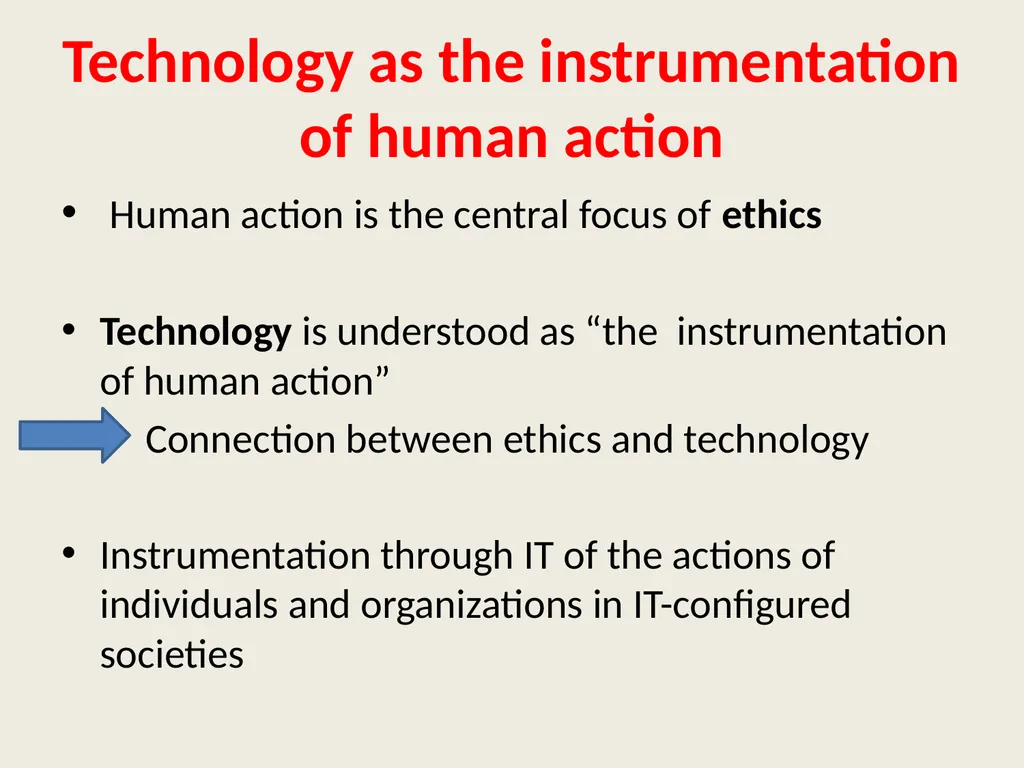
Technology as the instrumentation of human action Human action is the central focus of ethics
Technology is understood as “the instrumentation of human action”
Connection between ethics and technology
Instrumentation through IT of the actions of individuals and organizations in IT-configured societies<br>
Technology is understood as “the instrumentation of human action”
Connection between ethics and technology
Instrumentation through IT of the actions of individuals and organizations in IT-configured societies<br>
09
Thus, expansion of types of actions that could be done by individuals, especially inconceivable actions before the existence of the technology
“Sending spam”, “searching the Web” and “blogging” were inconceivable before the creation of the internet<br>
“Sending spam”, “searching the Web” and “blogging” were inconceivable before the creation of the internet<br>
10
2 advantages for ethical analysis:
Humans are the agents of actions
Detect the contribution of instrumentation to the character of human actions<br>
Humans are the agents of actions
Detect the contribution of instrumentation to the character of human actions<br>
11
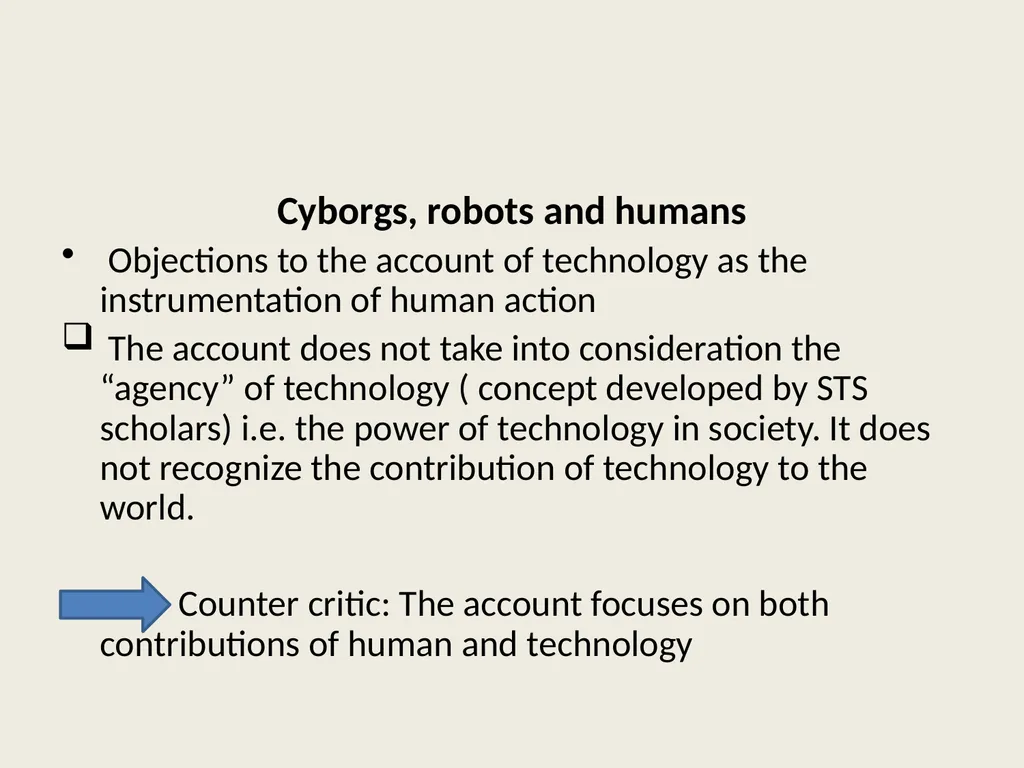
Cyborgs, robots and humans
Objections to the account of technology as the instrumentation of human action
The account does not take into consideration the “agency” of technology ( concept developed by STS scholars) i.e. the power of technology in society. It does not recognize the contribution of technology to the world.
Counter critic: The account focuses on both contributions of human and technology<br>
Objections to the account of technology as the instrumentation of human action
The account does not take into consideration the “agency” of technology ( concept developed by STS scholars) i.e. the power of technology in society. It does not recognize the contribution of technology to the world.
Counter critic: The account focuses on both contributions of human and technology<br>
12
The account keeps technology too linked to human action although IT systems have the potential to become autonomous actors.
Computer programs, bots and robots will work autonomously and humans will not understand the technology to an extent that we will qualify them as moral agents
Counter critic: It is the efforts deployed by human beings that contributed to the development of these so called “ moral agents”<br>
Computer programs, bots and robots will work autonomously and humans will not understand the technology to an extent that we will qualify them as moral agents
Counter critic: It is the efforts deployed by human beings that contributed to the development of these so called “ moral agents”<br>
13
These 2 objections rely on a main idea that technological development keeps going without human intentional activity
Technology is human-made and human activity is required for production and development of technology<br>
Technology is human-made and human activity is required for production and development of technology<br>
14
Suggestion to qualify human beings as “cyborgs”: human-technology combination
Human beings live intertwined with technology, around them and also implanted in their bodies ( heart monitors, replacement joints…)<br>
Human beings live intertwined with technology, around them and also implanted in their bodies ( heart monitors, replacement joints…)<br>
15
3 Features of IT-Configured Activities Global, Many-to-Many Scope
Expansion of the reach of individual communication through the Internet
Internet-instrumented communication has a global scope
Other means of communication have also a global scope: radio, telephone, television
Characteristics of the internet: easy, immediate, affordable and many-to-many communication<br>
Expansion of the reach of individual communication through the Internet
Internet-instrumented communication has a global scope
Other means of communication have also a global scope: radio, telephone, television
Characteristics of the internet: easy, immediate, affordable and many-to-many communication<br>
16
Distinctive identity conditions
Anonymity on the internet? Not accurate:
Monitoring of communications on the internet by service providers
Possibility to trace communications by parties that whether have a legal right or the technology to access the information<br>
Anonymity on the internet? Not accurate:
Monitoring of communications on the internet by service providers
Possibility to trace communications by parties that whether have a legal right or the technology to access the information<br>
17
2 distinctive identity conditions in internet communication
Mediation: Internet is mediated through a vast sociotechnical system
Variability of the range of available identity conditions
A person’s physical appearance, voice and facial expressions could be used to identify a person in the offline world but not on the internet
So, difference between online and offline identity conditions<br>
Mediation: Internet is mediated through a vast sociotechnical system
Variability of the range of available identity conditions
A person’s physical appearance, voice and facial expressions could be used to identify a person in the offline world but not on the internet
So, difference between online and offline identity conditions<br>
18
Reproducibility
A significant aspect of Internet communication
Electronic information is easy to copy without:
Any loss of quality or value in the reproduction
No evidence that electronic information was copied
dangerous implications for property rights and crimes<br>
A significant aspect of Internet communication
Electronic information is easy to copy without:
Any loss of quality or value in the reproduction
No evidence that electronic information was copied
dangerous implications for property rights and crimes<br>
19
Expansion of the scope of communication in time and place: endurance of messages sent
Expansion of the possibilities of disconnection between words and people: copy information by someone and claim to be theirs<br>
Expansion of the possibilities of disconnection between words and people: copy information by someone and claim to be theirs<br>
20
IT-configured Domains of life Virtuality, avatars and role-playing games
Opportunities for participation in virtual environments where players ( situated anywhere in the world) interact with one another in real time through avatars, characters created by them<br>
Opportunities for participation in virtual environments where players ( situated anywhere in the world) interact with one another in real time through avatars, characters created by them<br>
21
Confrontation between the 2nd feature of IT-configured activities and virtual games: distinctive identity conditions
Players don’t know each other in the offline world, anonymous
Players are pseudonymous since their identity is in their avatar<br>
Players don’t know each other in the offline world, anonymous
Players are pseudonymous since their identity is in their avatar<br>
22
Scenario 1.1. virtual rape: How should we think about the behavior of Bungle and/or the behavior of the person controlling Bungle?
Virtual world→ virtual punishment of Bungle?
Unclear solution
Analogy between behavior in virtual environment and harmful images as pornography and violent films in offline world<br>
Virtual world→ virtual punishment of Bungle?
Unclear solution
Analogy between behavior in virtual environment and harmful images as pornography and violent films in offline world<br>
23
Offline, individuals are held legally and morally liable for exposing pornography to adults without being warned
Bungle harmed the other players by exposing them to a level of unexpected violence
Implicitly, players adhere to social norms of behavior similar to the offline ones
Thus, the person behind Bungle broke those norms<br>
Bungle harmed the other players by exposing them to a level of unexpected violence
Implicitly, players adhere to social norms of behavior similar to the offline ones
Thus, the person behind Bungle broke those norms<br>
24
The administrator of the game had also social norms and the software was set up in a way that each player could control his own avatar
Thus, Bungle’s controller gained unauthorized access to the system and took control of characters created by others<br>
Thus, Bungle’s controller gained unauthorized access to the system and took control of characters created by others<br>
25
The player behind Bungle violated the social( thinking of other players) and technological norms( software) of the game
No final word is set to solve the virtual rape
What is your opinion about it?<br>
No final word is set to solve the virtual rape
What is your opinion about it?<br>
26
Friendship and social networking
Instrumentation of friendship in IT-configured societies through social networking sites
Can true friendships be formed online?
A study has indicated that friendships cannot be created online but existing offline ones can be maintained online<br>
Instrumentation of friendship in IT-configured societies through social networking sites
Can true friendships be formed online?
A study has indicated that friendships cannot be created online but existing offline ones can be maintained online<br>
27
Another study( Cocking and Matthews 2000) has demonstrated that real friendships could not be established and maintained online because
Internet biases main aspects of a person’s character
Internet weakens interactions with people
Open debate<br>
Internet biases main aspects of a person’s character
Internet weakens interactions with people
Open debate<br>
28
In all cases, individuals construct their identities, whether it is offline( clothing, hair cut) or online (social networking sites, information and images posted online…) by using the technical structures
Thus, the architecture of a system can make a difference in how one constructs his identity and in the conception that friends have of us<br>
Thus, the architecture of a system can make a difference in how one constructs his identity and in the conception that friends have of us<br>
29
Education and plagiarism detection
Existence of issues of plagiarism before the apparition of IT
Internet→ reproducibility and accessibility of information have increased the danger<br>
Existence of issues of plagiarism before the apparition of IT
Internet→ reproducibility and accessibility of information have increased the danger<br>
30
2 kinds of plagiarism:
Cut and paste a text and claiming it as one’s own
Cut and paste, manipulating a text and claiming it as one’s own<br>
Cut and paste a text and claiming it as one’s own
Cut and paste, manipulating a text and claiming it as one’s own<br>
31
Solution: use plagiarism detection systems as Turnitin ( scenario 3.3.)
Major issues of these systems
Reliability: Some plagiarized papers are not detected whereas some nonplagiarized papers are identified as plagiarized
Mistrust between teachers and students: teachers start to suspect a large number of papers→ mistrust → students will not develop maturity<br>
Major issues of these systems
Reliability: Some plagiarized papers are not detected whereas some nonplagiarized papers are identified as plagiarized
Mistrust between teachers and students: teachers start to suspect a large number of papers→ mistrust → students will not develop maturity<br>