
Chapter 3 Methods of Instruction Objectives (1 of
BR
Published · 146 slides · 0 views

1 / 1



Description
Chapter 3 Methods of Instruction Objectives (1 of 2) Describe methods of instruction typically used in adult and fire service education. Describe the four-step method of instruction. Explain how distance learning can enhance instruction.
Related Topics
Share
Embed code
Download this presentation From Below
"Chapter 3 Methods of Instruction Objectives (1 of" is the property of its rightful owner. Permission is granted to download and print the materials on this website for personal, non-commercial use only, and to display it on your personal computer provided you do not modify the materials and that you retain all copyright notices contained in the materials. By downloading content from our website, you accept the terms of this agreement.
Presentation Transcript
01
Chapter 3 Methods of Instruction<br>
02
Objectives
(1 of 2) Describe methods of instruction typically used in adult and fire service education.
Describe the four-step method of instruction.
Explain how distance learning can enhance instruction.
Describe communication techniques that will improve your presentation.
Explain methods for controlling the physical learning environment.<br>
Describe the four-step method of instruction.
Explain how distance learning can enhance instruction.
Describe communication techniques that will improve your presentation.
Explain methods for controlling the physical learning environment.<br>
03
Objectives
(2 of 2) Describe how to create a learning environment that facilitates the learning process.
Identify issues unique to outdoor learning environments and explain how to address them.
Identify considerations when arranging learning environments for testing functions.
Describe the effect of demographics on the learning environment.<br>
Identify issues unique to outdoor learning environments and explain how to address them.
Identify considerations when arranging learning environments for testing functions.
Describe the effect of demographics on the learning environment.<br>
04
Introduction
(1 of 2) Instructor’s responsibility to present information and have a clear understanding of course objectives
Instruction the single most important factor in students’ success
Teaching a greater impact on achievement than all other factors combined
Students decide very early whether they will like the course, its contents, the instructor, and their fellow students<br>
Instruction the single most important factor in students’ success
Teaching a greater impact on achievement than all other factors combined
Students decide very early whether they will like the course, its contents, the instructor, and their fellow students<br>
05
Introduction
(2 of 2) Sometimes, instructors forget that fire fighters are adults
Important differences in way adults and children learn
Never treat fire service students like children
Remember: although you are teaching a class, the individual may require a particular learning strategy<br>
Important differences in way adults and children learn
Never treat fire service students like children
Remember: although you are teaching a class, the individual may require a particular learning strategy<br>
06
Methods of Instruction
(1 of 6) Process of teaching material to students, or how your lesson plan will be given to students
Many different and diverse methods exist, and each applies to different types of materials as well as different types of students<br>
Many different and diverse methods exist, and each applies to different types of materials as well as different types of students<br>
07
Methods of Instruction
(2 of 6) Each student demographic and category respond differently according to how they are motivated and method(s) of instruction used.
If you are an Instructor I, the method of instruction will be identified on your lesson plan by the lesson plan developer.<br>
If you are an Instructor I, the method of instruction will be identified on your lesson plan by the lesson plan developer.<br>
08
Methods of Instruction
(3 of 6) Determining method is based on:
Experience and educational level of the students
Classroom setting or training environment
Objectives of material to be taught
Number of students to be taught<br>
Experience and educational level of the students
Classroom setting or training environment
Objectives of material to be taught
Number of students to be taught<br>
09
Methods of Instruction
(4 of 6) Instructor I: should understand the different methods of instruction and master those methods
Instructor II: develop a lesson plan and select the most appropriate and effective method to deliver material in the lesson created<br>
Instructor II: develop a lesson plan and select the most appropriate and effective method to deliver material in the lesson created<br>
10
Methods of Instruction
(5 of 6) Any level of instructor should be able to adapt a lesson plan to:
Learning environment
Audience who will receive instruction
All instructors will perform an audience analysis by looking at the demographics and adapt the lesson plan accordingly<br>
Learning environment
Audience who will receive instruction
All instructors will perform an audience analysis by looking at the demographics and adapt the lesson plan accordingly<br>
11
Methods of Instruction
(6 of 6) Ask yourself three questions:
What are the goals of the lesson?
Who is the intended audience?
What are the resources and learning environment characteristics?
Following are the most effective methods for teaching new and in-service personnel.<br>
What are the goals of the lesson?
Who is the intended audience?
What are the resources and learning environment characteristics?
Following are the most effective methods for teaching new and in-service personnel.<br>
12
Lecture
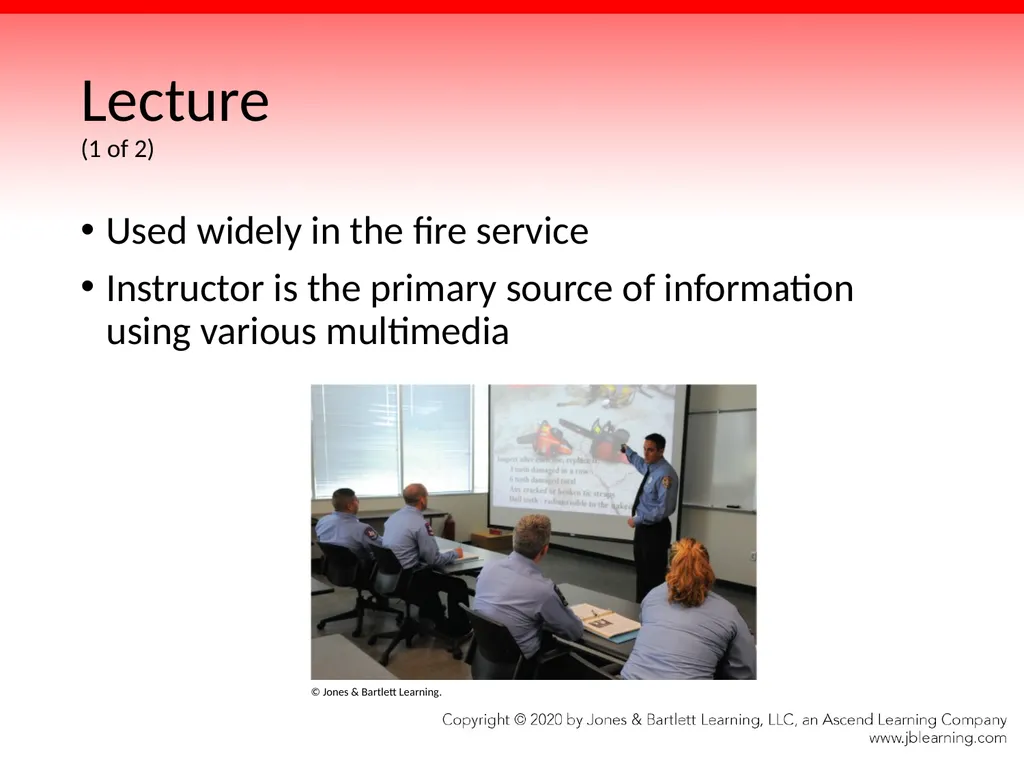
(1 of 2) Used widely in the fire service
Instructor is the primary source of information using various multimedia © Jones & Bartlett Learning.<br>
Instructor is the primary source of information using various multimedia © Jones & Bartlett Learning.<br>
13
Lecture
(2 of 2) Will be required to present an illustrative lecture in a practice teaching environment to a group of fellow students
Visual aid is important to effective communication and is probably the most common and familiar method of instruction<br>
Visual aid is important to effective communication and is probably the most common and familiar method of instruction<br>
14
Demonstration of Skill Drill
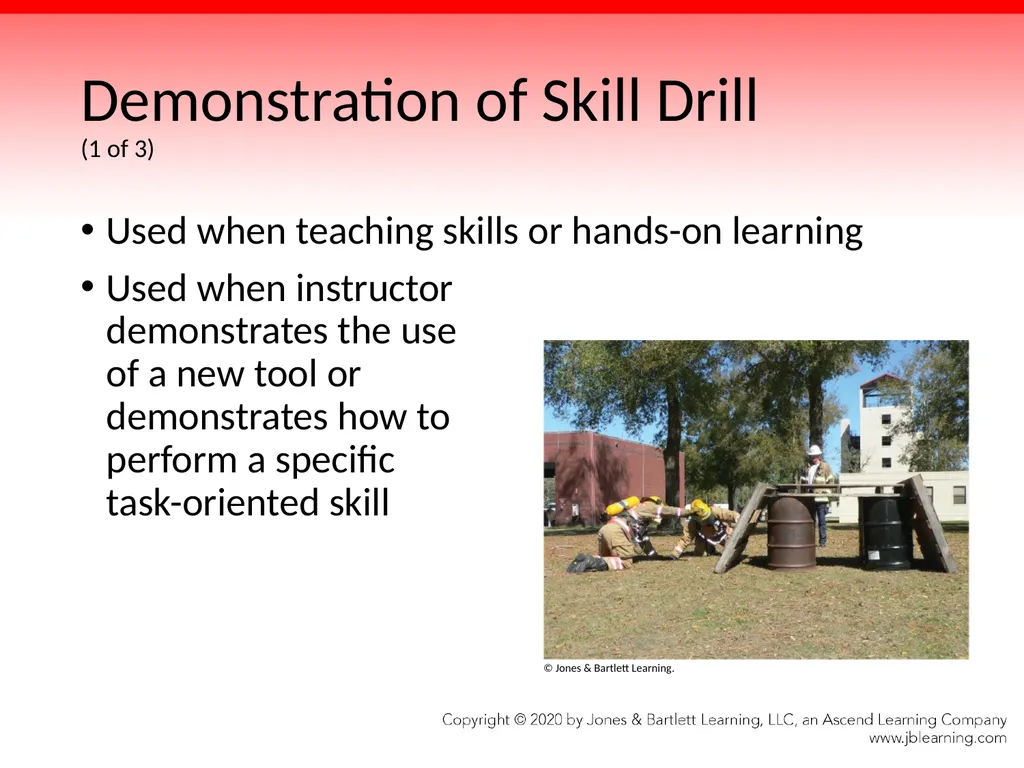
(1 of 3) Used when teaching skills or hands-on learning
Used when instructor demonstrates the use of a new tool or demonstrates how to perform a specific task-oriented skill © Jones & Bartlett Learning.<br>
Used when instructor demonstrates the use of a new tool or demonstrates how to perform a specific task-oriented skill © Jones & Bartlett Learning.<br>
15
Demonstration of Skill Drill
(2 of 3) Also known as psychomotor or hands-on method
As part of Instructor I job duty area, may be required to present a demonstrative presentation where a student will perform a task from a prepared skill sheet as part of the student instructor’s practice presentation<br>
As part of Instructor I job duty area, may be required to present a demonstrative presentation where a student will perform a task from a prepared skill sheet as part of the student instructor’s practice presentation<br>
16
Demonstration of Skill Drill
(3 of 3) Most fire fighters and other adult learners respond very well to hands-on training.
Each student can learn by actively participating.
Instructor must monitor student safety.
Personal protective equipment (PPE) use
Proper student-to-instructor ratios<br>
Each student can learn by actively participating.
Instructor must monitor student safety.
Personal protective equipment (PPE) use
Proper student-to-instructor ratios<br>
17
Discussion
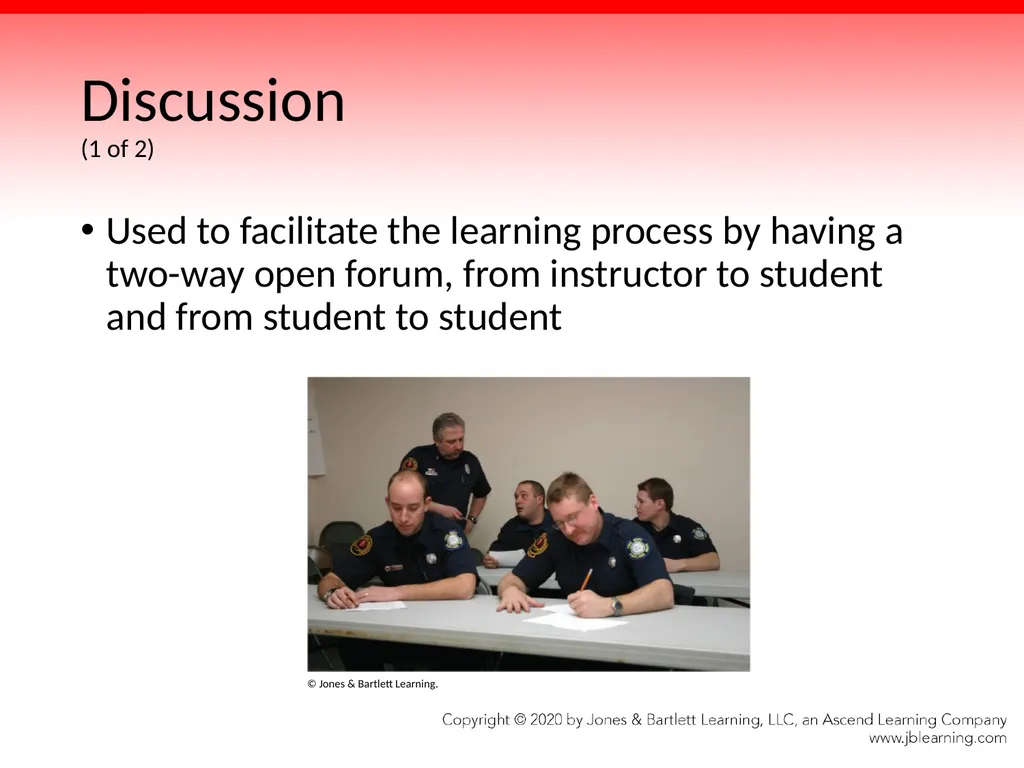
(1 of 2) Used to facilitate the learning process by having a two-way open forum, from instructor to student and from student to student © Jones & Bartlett Learning.<br>
18
Discussion
(2 of 2) Fosters interaction among the instructor and students
Instructor more of a facilitator or monitor to ensure discussion stays on track
Time keeping is an essential element
Typically used when consensus needed or when new ideas are necessary
Requires student to have some prerequisite level of topic knowledge
Most instructors use a combination of methods<br>
19
The Four-Step Method of Instruction
(1 of 6) Primary process used to relate material contained in lesson plan to students
Most basic method of instruction used in fire service<br>
Most basic method of instruction used in fire service<br>
20
The Four-Step Method of Instruction
(2 of 6) Step 1: Preparation
Motivates students to learn
Tell students why they will benefit from the class
Class may count toward required hours of training
Class may provide desired certification
Class may increase students’ knowledge of a subject.
This step is a critical motivational tool<br>
Motivates students to learn
Tell students why they will benefit from the class
Class may count toward required hours of training
Class may provide desired certification
Class may increase students’ knowledge of a subject.
This step is a critical motivational tool<br>
21
The Four-Step Method of Instruction
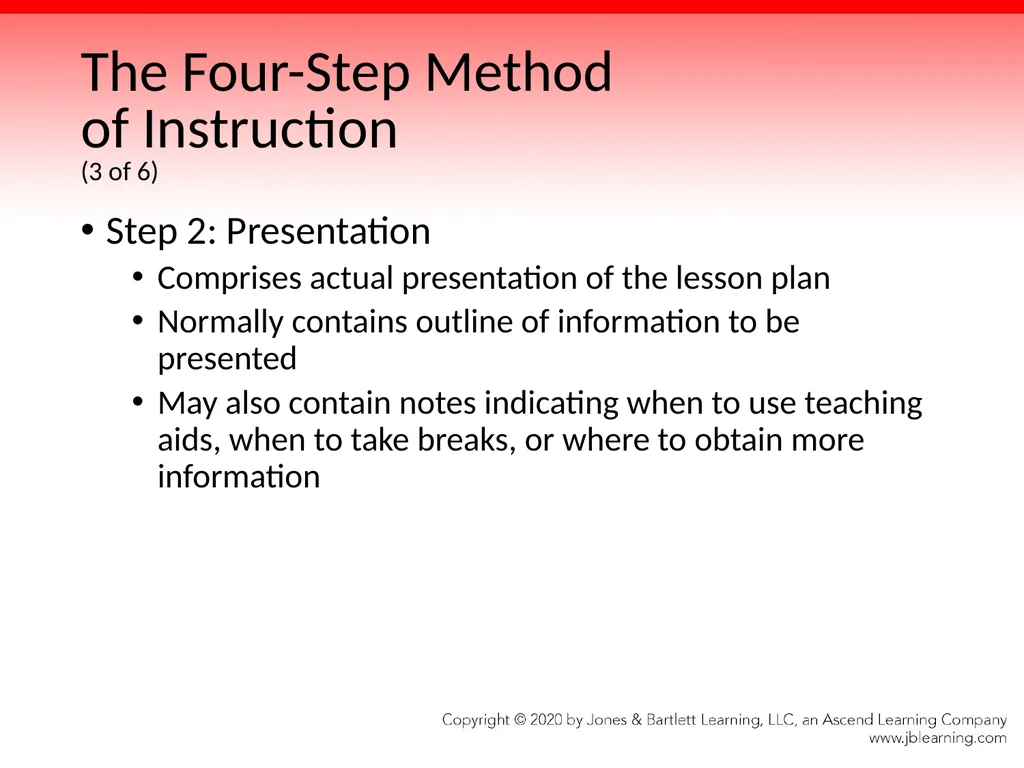
(3 of 6) Step 2: Presentation
Comprises actual presentation of the lesson plan
Normally contains outline of information to be presented
May also contain notes indicating when to use teaching aids, when to take breaks, or where to obtain more information<br>
Comprises actual presentation of the lesson plan
Normally contains outline of information to be presented
May also contain notes indicating when to use teaching aids, when to take breaks, or where to obtain more information<br>
22
The Four-Step Method of Instruction
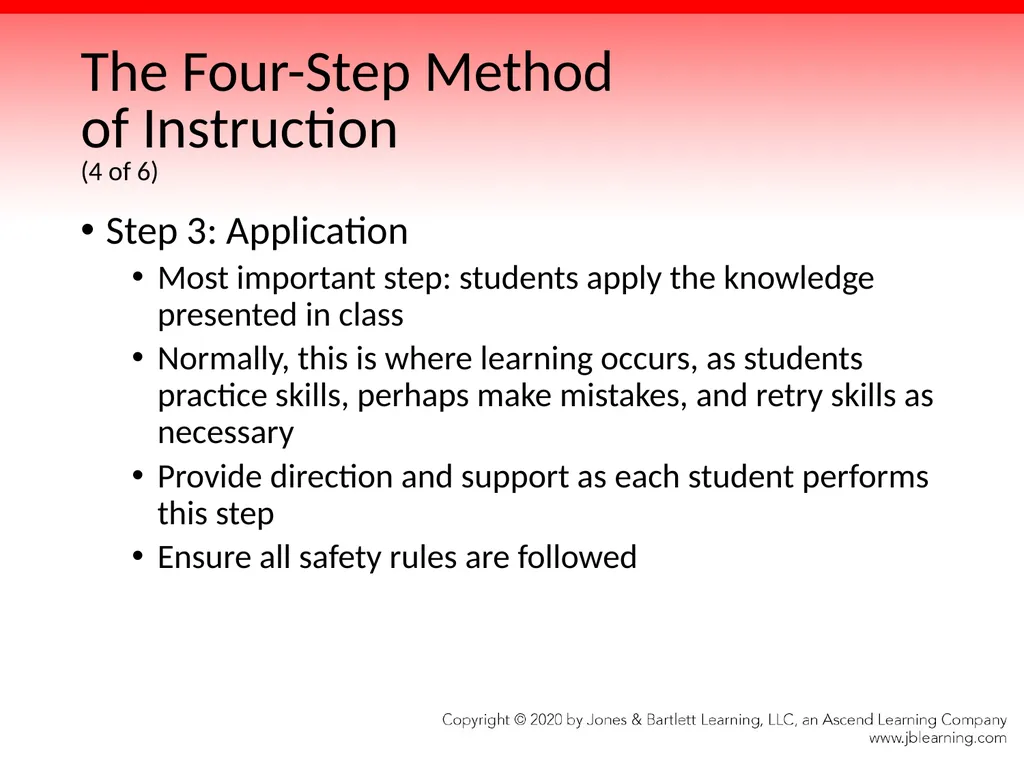
(4 of 6) Step 3: Application
Most important step: students apply the knowledge presented in class
Normally, this is where learning occurs, as students practice skills, perhaps make mistakes, and retry skills as necessary
Provide direction and support as each student performs this step
Ensure all safety rules are followed<br>
Most important step: students apply the knowledge presented in class
Normally, this is where learning occurs, as students practice skills, perhaps make mistakes, and retry skills as necessary
Provide direction and support as each student performs this step
Ensure all safety rules are followed<br>
23
The Four-Step Method of Instruction
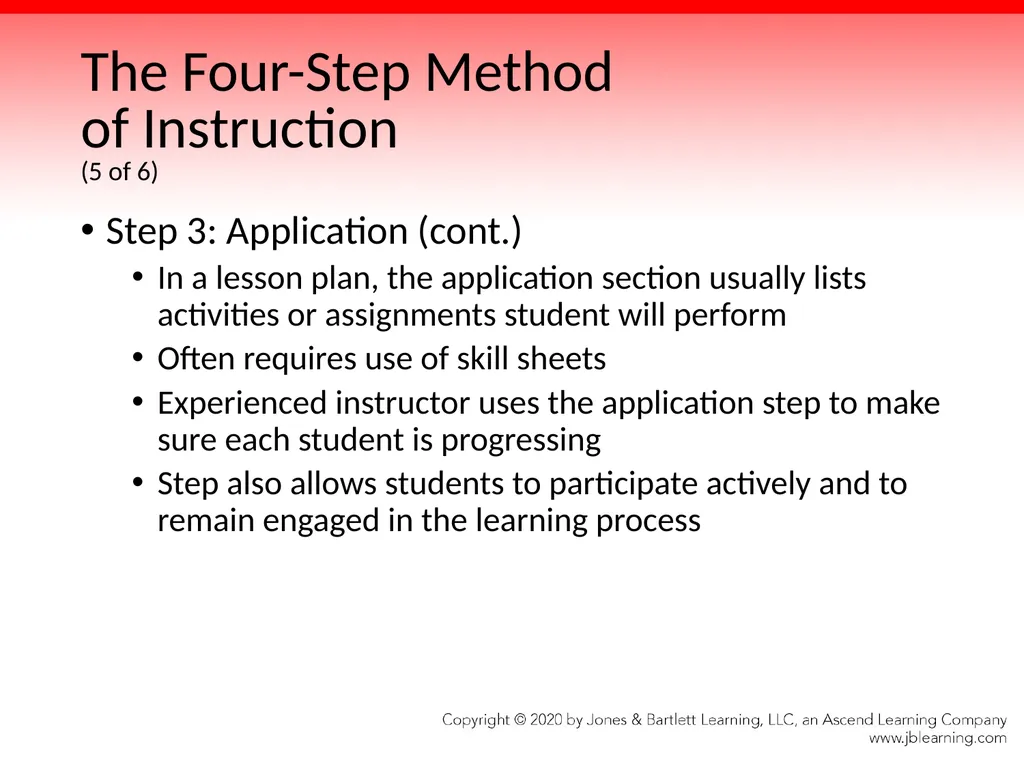
(5 of 6) Step 3: Application (cont.)
In a lesson plan, the application section usually lists activities or assignments student will perform
Often requires use of skill sheets
Experienced instructor uses the application step to make sure each student is progressing
Step also allows students to participate actively and to remain engaged in the learning process<br>
24
The Four-Step Method of Instruction
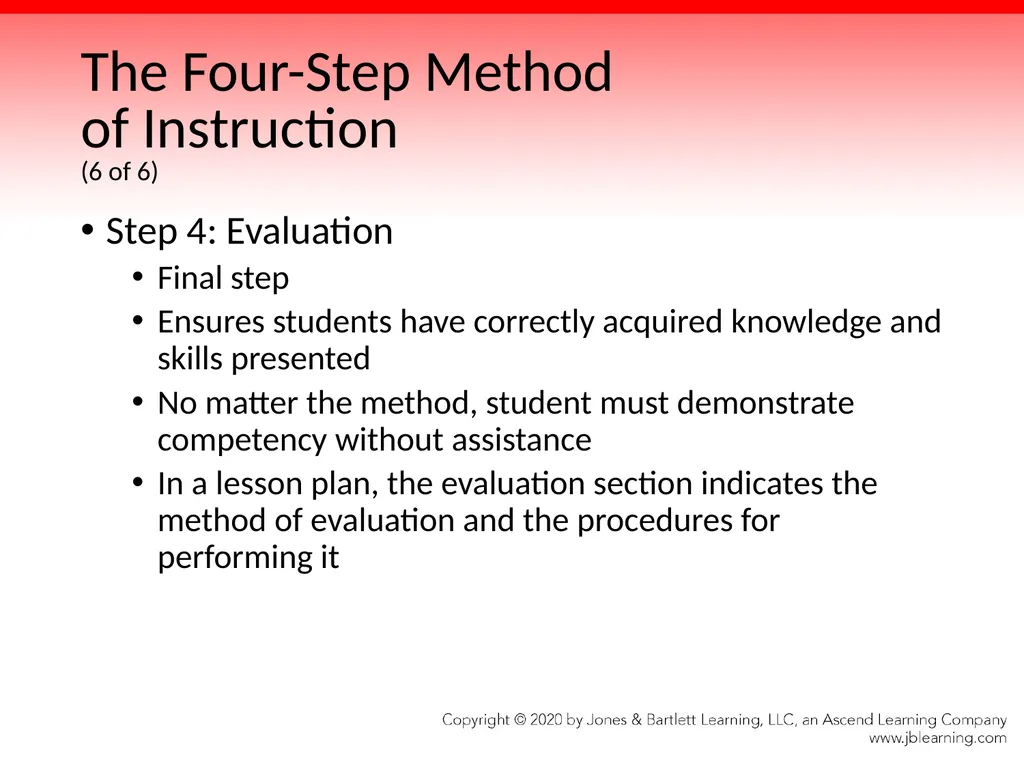
(6 of 6) Step 4: Evaluation
Final step
Ensures students have correctly acquired knowledge and skills presented
No matter the method, student must demonstrate competency without assistance
In a lesson plan, the evaluation section indicates the method of evaluation and the procedures for performing it<br>
Final step
Ensures students have correctly acquired knowledge and skills presented
No matter the method, student must demonstrate competency without assistance
In a lesson plan, the evaluation section indicates the method of evaluation and the procedures for performing it<br>
25
Pre-Course Survey and Prerequisites
(1 of 2) Pre-course survey might try to determine student:
Motivation
Educational level
Work experience
Previous training
Results can be used to adapt the lesson plan based on students’ needs<br>
Motivation
Educational level
Work experience
Previous training
Results can be used to adapt the lesson plan based on students’ needs<br>
26
Pre-Course Survey and Prerequisites
(2 of 2) After reviewing results, adjust the course material accordingly to meet needs better
Does not count toward final grade
Some programs require that students take prerequisite classes before attending certain advanced classes
Ensures students do not get into a course beyond their experience level<br>
Does not count toward final grade
Some programs require that students take prerequisite classes before attending certain advanced classes
Ensures students do not get into a course beyond their experience level<br>
27
Enhanced Instructional Methods
(1 of 8) Instructors have other tools at their disposal to enhance the learning process and increase the retention of the material being taught.
Role play
Students become part of the lesson by assuming roles and “acting out” a situation or scenario meant to reinforce material from the lesson.<br>
Role play
Students become part of the lesson by assuming roles and “acting out” a situation or scenario meant to reinforce material from the lesson.<br>
28
Enhanced Instructional Methods
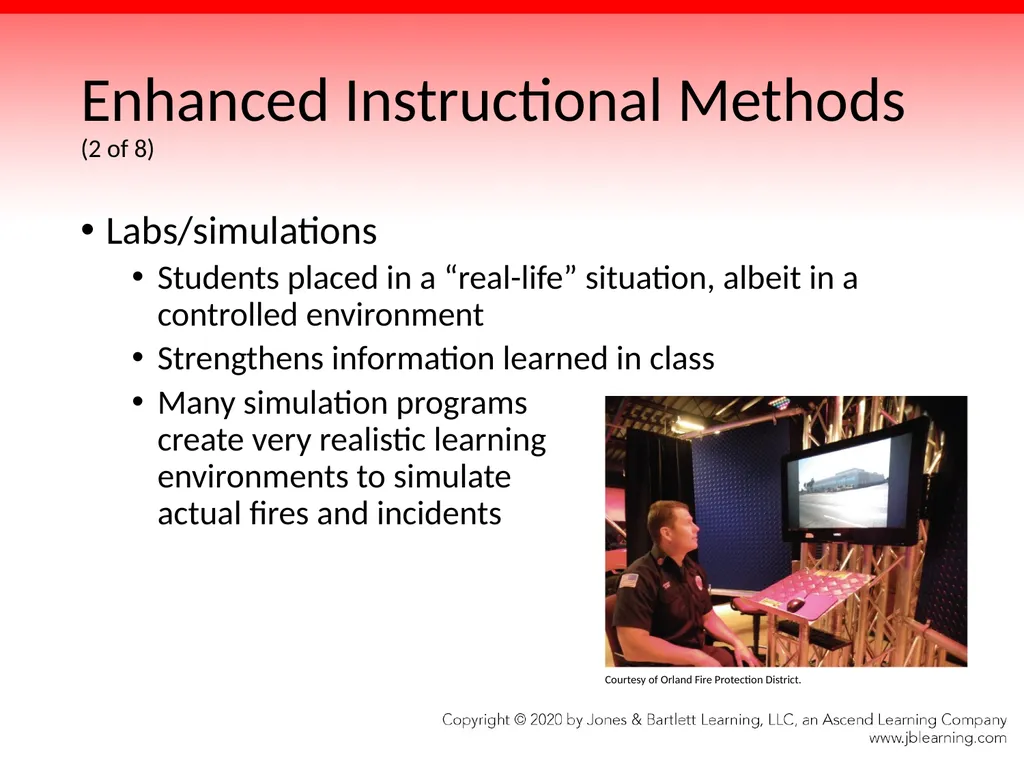
(2 of 8) Labs/simulations
Students placed in a “real-life” situation, albeit in a controlled environment
Strengthens information learned in class
Many simulation programs create very realistic learning environments to simulate actual fires and incidents Courtesy of Orland Fire Protection District.<br>
Students placed in a “real-life” situation, albeit in a controlled environment
Strengthens information learned in class
Many simulation programs create very realistic learning environments to simulate actual fires and incidents Courtesy of Orland Fire Protection District.<br>
29
Enhanced Instructional Methods
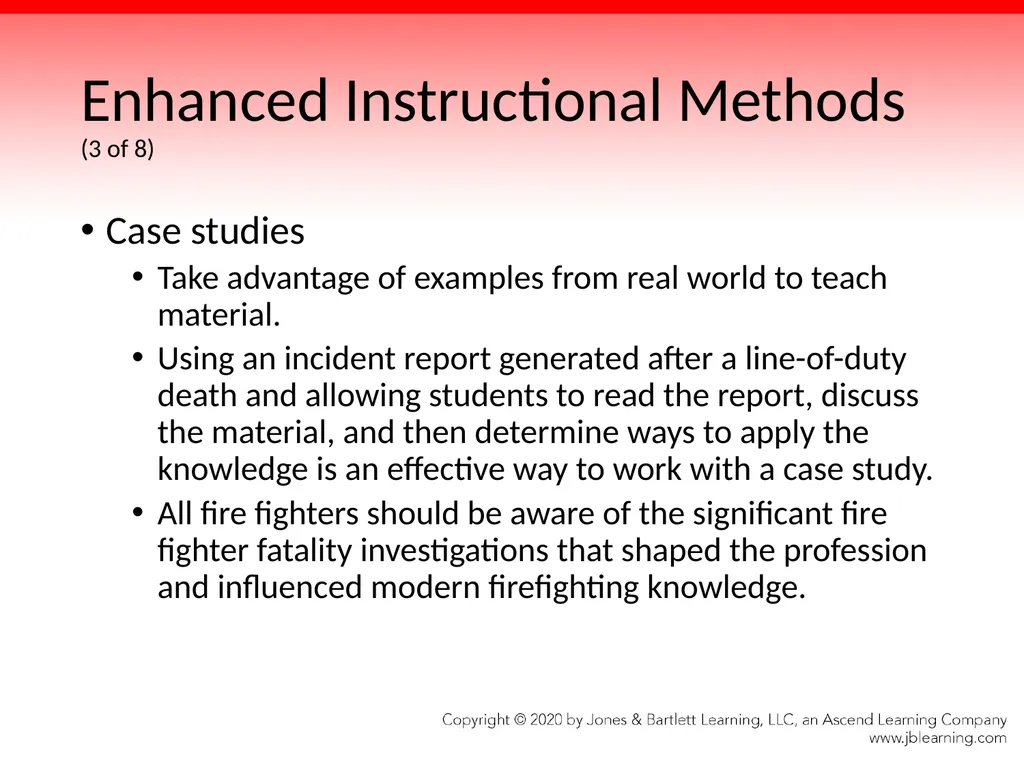
(3 of 8) Case studies
Take advantage of examples from real world to teach material.
Using an incident report generated after a line-of-duty death and allowing students to read the report, discuss the material, and then determine ways to apply the knowledge is an effective way to work with a case study.
All fire fighters should be aware of the significant fire fighter fatality investigations that shaped the profession and influenced modern firefighting knowledge.<br>
30
Enhanced Instructional Methods
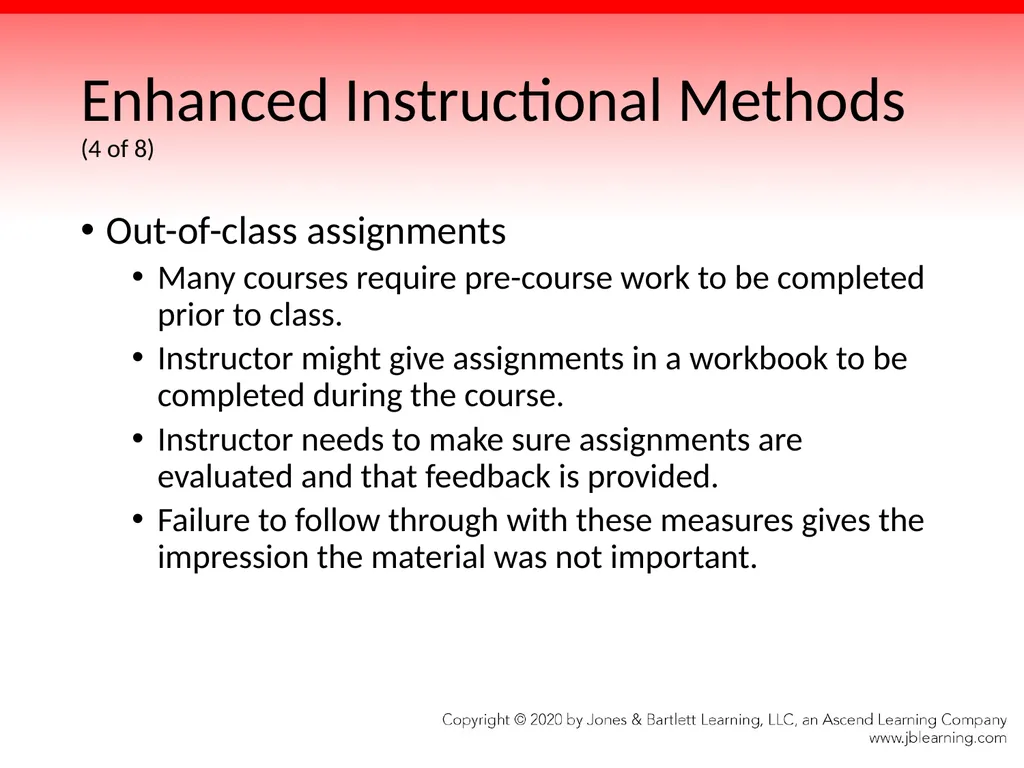
(4 of 8) Out-of-class assignments
Many courses require pre-course work to be completed prior to class.
Instructor might give assignments in a workbook to be completed during the course.
Instructor needs to make sure assignments are evaluated and that feedback is provided.
Failure to follow through with these measures gives the impression the material was not important.<br>
31
Enhanced Instructional Methods
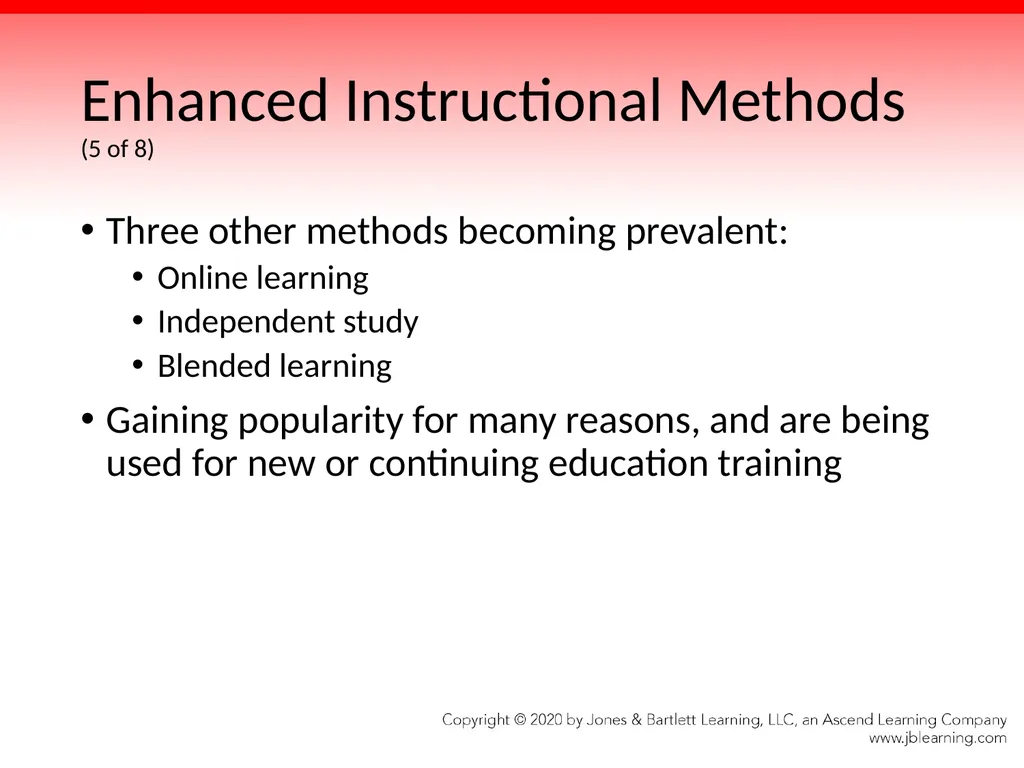
(5 of 8) Three other methods becoming prevalent:
Online learning
Independent study
Blended learning
Gaining popularity for many reasons, and are being used for new or continuing education training<br>
Online learning
Independent study
Blended learning
Gaining popularity for many reasons, and are being used for new or continuing education training<br>
32
Enhanced Instructional Methods
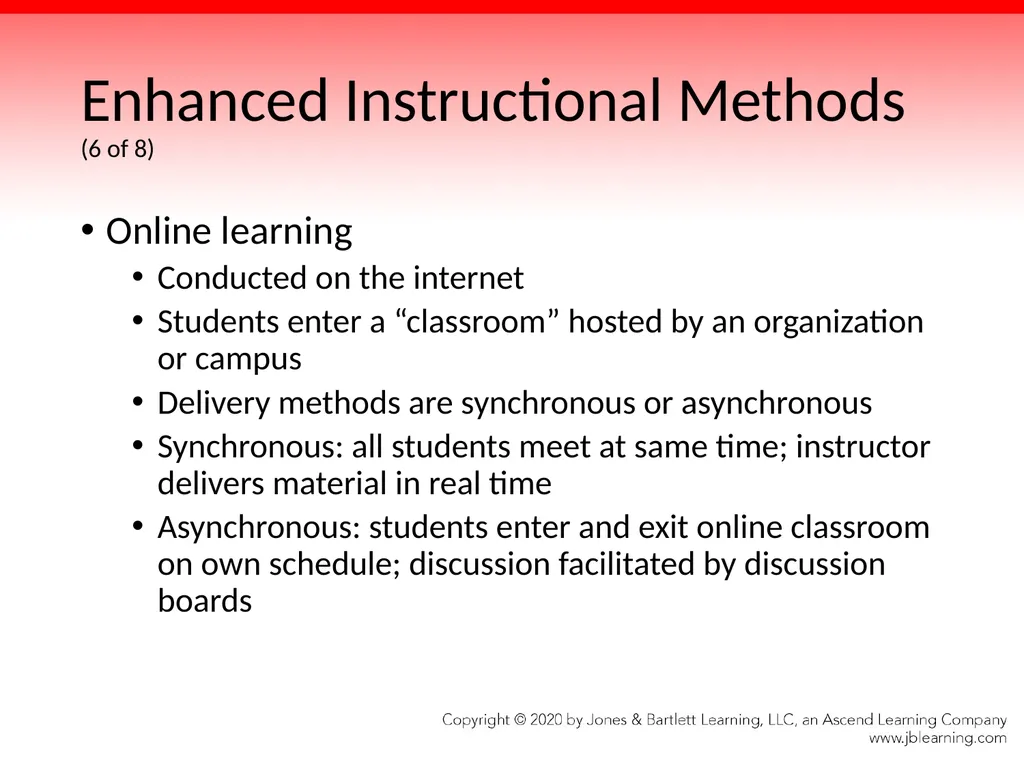
(6 of 8) Online learning
Conducted on the internet
Students enter a “classroom” hosted by an organization or campus
Delivery methods are synchronous or asynchronous
Synchronous: all students meet at same time; instructor delivers material in real time
Asynchronous: students enter and exit online classroom on own schedule; discussion facilitated by discussion boards<br>
33
Enhanced Instructional Methods
(7 of 8) Independent study
Helps students complete course material at distant locations
Students register for a course
Receive course material in the mail
Complete the assignments
Submit back to the instructor for evaluation<br>
Helps students complete course material at distant locations
Students register for a course
Receive course material in the mail
Complete the assignments
Submit back to the instructor for evaluation<br>
34
Enhanced Instructional Methods
(8 of 8) Blended learning
Combines online or independent study with face-to-face meetings with instructor
Allows for students to learn at own pace remotely
At certain benchmarks, class gathers to complete hands-on training
All of these methods of instruction are dependent on the instructor knowing how to use each method and applying them while delivering the lesson plan<br>
35
Communication Techniques
(1 of 11) Dress professionally
Students should see you as professional and recognize you instantly as subject-matter expert.
Professional appearance lays groundwork for a good first impression.<br>
Students should see you as professional and recognize you instantly as subject-matter expert.
Professional appearance lays groundwork for a good first impression.<br>
36
Communication Techniques
(2 of 11) Welcome each student
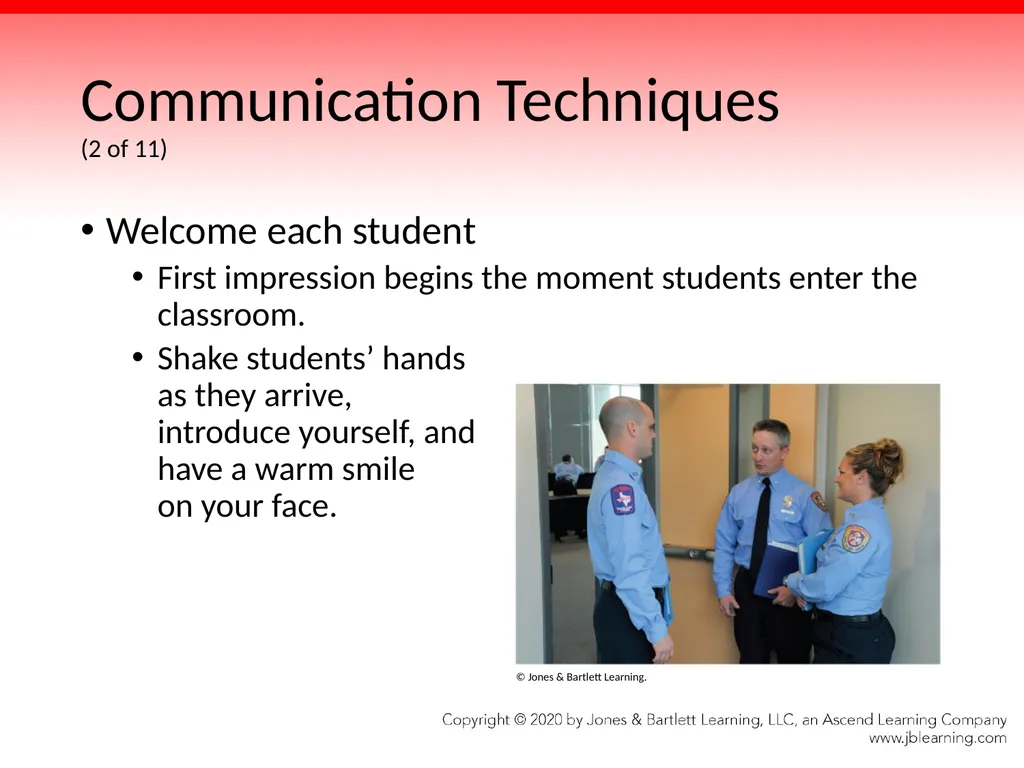
First impression begins the moment students enter the classroom.
Shake students’ hands as they arrive, introduce yourself, and have a warm smile on your face. © Jones & Bartlett Learning.<br>
First impression begins the moment students enter the classroom.
Shake students’ hands as they arrive, introduce yourself, and have a warm smile on your face. © Jones & Bartlett Learning.<br>
37
Communication Techniques
(3 of 11) Call students by name
Making every student feel important is essential to creating motivation and maintaining attention.
Most fire service courses are small enough to allow learning students’ names.
Strategies
Use name tents or cards.
Keep seating chart in front of you.
Use name association.<br>
Making every student feel important is essential to creating motivation and maintaining attention.
Most fire service courses are small enough to allow learning students’ names.
Strategies
Use name tents or cards.
Keep seating chart in front of you.
Use name association.<br>
38
Communication Techniques
(4 of 11) Use eye contact
Will help students feel you are communicating directly with them
Resist temptation to look at the wall, the clock, or over students’ heads
Lack of eye contact makes people think you are not willing to be straight with them or that you are not confident<br>
Will help students feel you are communicating directly with them
Resist temptation to look at the wall, the clock, or over students’ heads
Lack of eye contact makes people think you are not willing to be straight with them or that you are not confident<br>
39
Communication Techniques
(5 of 11) Use normal speaking voice but instill enthusiasm in the message
If you are committed to the importance of what you are teaching, then that commitment will be revealed in your voice.
Remember enthusiasm is contagious—let it show!<br>
If you are committed to the importance of what you are teaching, then that commitment will be revealed in your voice.
Remember enthusiasm is contagious—let it show!<br>
40
Communication Techniques
(6 of 11) Speak with respect
You are teaching adults.
When you are respectful, they will be respectful to you.
Use pauses when you speak
Can signal an important point or a transition
Can indicate conclusion of one topic and beginning of another
Allows opportunity to view students and visually check for comments, interest levels, or questions<br>
41
Communication Techniques
(7 of 11) Use information appropriately
Important to gauge students’ level of understanding
Make sure you speak at a knowledge and vocabulary level that students will understand
Ensure that the level of training or education is appropriate for all participants in the course<br>
Important to gauge students’ level of understanding
Make sure you speak at a knowledge and vocabulary level that students will understand
Ensure that the level of training or education is appropriate for all participants in the course<br>
42
Communication Techniques
(8 of 11) Use gestures sparingly, for emphasis
Avoid meaningless gestures: playing with things, repeatedly tapping foot, etc.
Eventually, these habits become intrusive and distracting to students<br>
Avoid meaningless gestures: playing with things, repeatedly tapping foot, etc.
Eventually, these habits become intrusive and distracting to students<br>
43
Communication Techniques
(9 of 11) Practice positive mannerisms
Can increase effectiveness in presentation of lectures and can add to verbal messages
Vary position and movement
Body language and facial expression can give support and encouragement even when not saying anything aloud<br>
Can increase effectiveness in presentation of lectures and can add to verbal messages
Vary position and movement
Body language and facial expression can give support and encouragement even when not saying anything aloud<br>
44
Communication Techniques
(10 of 11) Choose teaching aids appropriately
Technology in the classroom is simply a way to communicate and reinforce information.
Make sure writing is legible.
Provide a visual reinforcement of verbal message.
Wise use of technology can enrich and assist in teaching.
Do not rely on technology alone to teach.
Can malfunction
Always have a backup plan.<br>
45
Communication Techniques
(11 of 11) Know how to use chosen teaching aids
Communication is interrupted when technology not handled smoothly
Each time technology is mishandled it weakens the impact of the lesson.
Transition techniques during presentations
Make smooth transitions between media and verbal communication techniques.
Use media in the correct manner and use transition techniques that enhance rather than distract.<br>
46
Effective Transitions
(1 of 4) Delineation
Simplest way to make transition
Tell class that you will be covering four points, then begin by stating “point number one,” and then move to point two, three, and four, and then summarize material
Words/phrases
Use phrases such as “the next point we need to discuss,” or summarize the topic and then use a phrase like “the next step”<br>
47
Effective Transitions
(2 of 4) Pictures
Because so many of today’s lessons use PowerPoint presentations, an effective tool to use within such a presentation is the insertion of historic or unique pictures between points or topics.
This visual signal will allow you to pause and switch topics.<br>
Because so many of today’s lessons use PowerPoint presentations, an effective tool to use within such a presentation is the insertion of historic or unique pictures between points or topics.
This visual signal will allow you to pause and switch topics.<br>
48
Effective Transitions
(3 of 4) Voice
Use voice by changing your tone or pitch.
Use different volumes to emphasize change from one idea to another, or by inserting an effective pause.
Pause to draw students’ attention and develop anticipation.<br>
Use voice by changing your tone or pitch.
Use different volumes to emphasize change from one idea to another, or by inserting an effective pause.
Pause to draw students’ attention and develop anticipation.<br>
49
Effective Transitions
(4 of 4) Body language
Moving from the podium to one side of the classroom with a change in voice will clearly inform students that the topic has changed or is very important.
Make movements conscious and meaningful.
All of these techniques require practice
Not all instructors will develop all of these instruction techniques.
Goal is to develop those that work best for you.<br>
50
Effective Communication
(1 of 2) Fundamental to ensuring that students learn
Reading
The basic level of learning
Learning and communication process increases by adding additional senses<br>
Reading
The basic level of learning
Learning and communication process increases by adding additional senses<br>
51
Effective Communication
(2 of 2) Important to choose the right kind(s) of communication when preparing for class
Once selected, use methods effectively
Understanding the communication process will help you develop or adapt lesson plans based on students’ learning characteristics<br>
Once selected, use methods effectively
Understanding the communication process will help you develop or adapt lesson plans based on students’ learning characteristics<br>
52
Questioning Techniques
(1 of 5) Assess the learning process during class.
Ask students questions from material being taught.
Many lesson plans will build in questions.
It is important to ask the correct question at the correct time.
Many plans will identify the appropriate time.<br>
Ask students questions from material being taught.
Many lesson plans will build in questions.
It is important to ask the correct question at the correct time.
Many plans will identify the appropriate time.<br>
53
Questioning Techniques
(2 of 5) Another appropriate place to seek student feedback is at the end of a lesson during a summary activity.
Use a question during a presentation to:
Stimulate discussion
Bring class focus to a new topic
Break up side discussions
Challenge a disruptive student positively<br>
Use a question during a presentation to:
Stimulate discussion
Bring class focus to a new topic
Break up side discussions
Challenge a disruptive student positively<br>
54
Questioning Techniques
(3 of 5) Direct questions
Those beginning with who, what, where, when, why, or how
Meant to elicit specific information and limit discussion
Used when instructor is seeking an answer from a specific student
Important to exercise caution with this type: could be perceived as singling out a student<br>
Those beginning with who, what, where, when, why, or how
Meant to elicit specific information and limit discussion
Used when instructor is seeking an answer from a specific student
Important to exercise caution with this type: could be perceived as singling out a student<br>
55
Questioning Techniques
(4 of 5) Rhetorical questions
Usually asked to stimulate discussion or to prepare learners’ minds for a new topic
Often does not have an answer, or may have multiple answers
Open-ended questions
Varying correct answers based on the question and the situation presented
Closed-ended questions
Seeks a specific answer based on question asked<br>
56
Questioning Techniques
(5 of 5) Knowing which question to ask and when to ask very important, but dealing with a response just as important
Responding critical to maintaining a good learning environment
Instructors who make light of a student’s incorrect response can destroy a student’s desire to learn and dampen the learning environment<br>
Responding critical to maintaining a good learning environment
Instructors who make light of a student’s incorrect response can destroy a student’s desire to learn and dampen the learning environment<br>
57
Managing Disruptive Behavior
(1 of 15) Strategy for handling problematic situations will vary depending on type of behavior.
Remember that you are in charge of the classroom.
If you do not control your classroom, you are setting the stage for problems.
You may be perceived by your students, peers, and administration as being a less competent instructor.<br>
Remember that you are in charge of the classroom.
If you do not control your classroom, you are setting the stage for problems.
You may be perceived by your students, peers, and administration as being a less competent instructor.<br>
58
Managing Disruptive Behavior
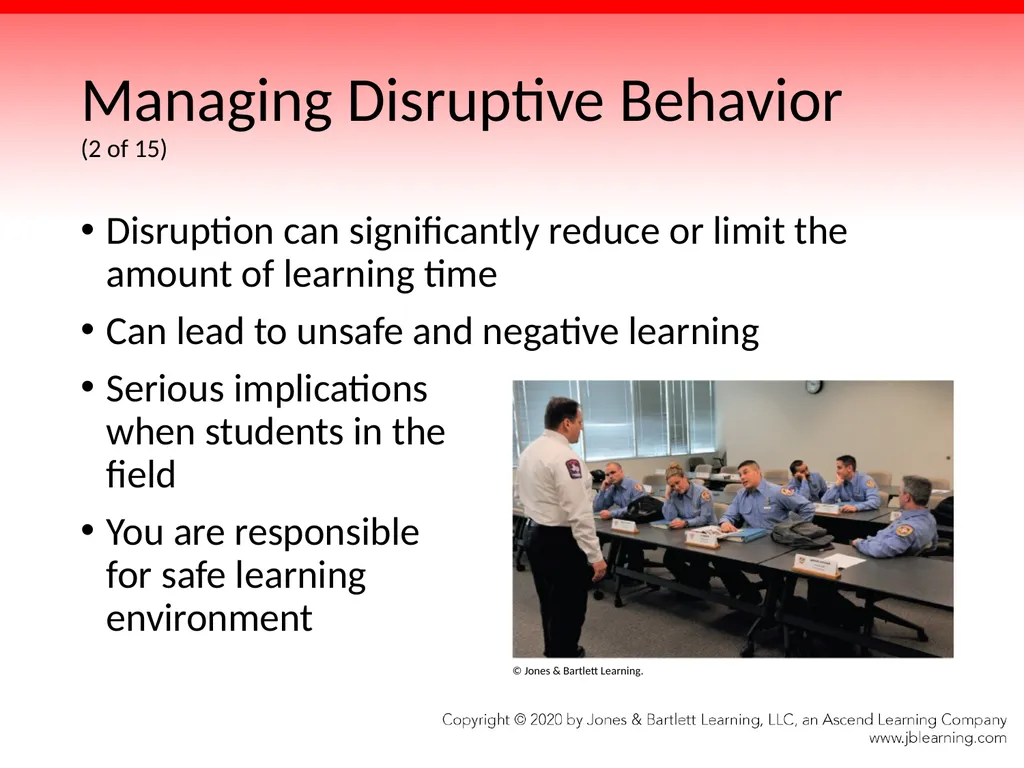
(2 of 15) Disruption can significantly reduce or limit the amount of learning time
Can lead to unsafe and negative learning
Serious implications when students in the field
You are responsible for safe learning environment © Jones & Bartlett Learning.<br>
Can lead to unsafe and negative learning
Serious implications when students in the field
You are responsible for safe learning environment © Jones & Bartlett Learning.<br>
59
Categories of Disruptive Behavior Monopolizer has a tendency to take control of classroom discussions and dominate class time.
Make certain to call on other students.
Call a break or, when a class break occurs, pull monopolizer aside and discuss concerns about his or her “over-participation.”
Position yourself between monopolizer and other students in effort to engage other students.
“Anyone other than [monopolizer] have an idea how this term applies to fire department operations?”<br>
60
Managing Disruptive Behavior
(3 of 15) Historian has some experience and wants to make sure that everyone is aware of it
Real historians have benefit of years of experience and share to help illustrate; they focus on helping
Can be disruptive if stories become distracting, in which case guide discussion back to main topic
Another way to redirect is by pairing with struggling students
Artificial historians focus on helping themselves and interject opinions and are almost always distracting<br>
61
Managing Disruptive Behavior
(4 of 15) Daydreamer preoccupied with anything other than the lesson
May have been forced to attend training class or be participating as part of job assignment
Often is focusing on life outside the classroom
May not directly disrupt students, but is more a distraction to the instructor
Try to draw into the class by using direct questioning techniques and eye contact<br>
62
Managing Disruptive Behavior
(5 of 15) Expert, or know-it-all, is a student who may become confrontational or monopolize the class in an attempt to show off, often as competitiveness
Will provide up-to-date information, factoids, applications, and case information about the topic and can easily subvert your position as the classroom authority
May have to discuss contributions to the class during a private break<br>
Will provide up-to-date information, factoids, applications, and case information about the topic and can easily subvert your position as the classroom authority
May have to discuss contributions to the class during a private break<br>
63
Managing Disruptive Behavior
(6 of 15) Class clown seeks attention by acting out or making jokes about course content, instructor, or other students
Two effective methods: ignore, or engage with a direct question
Sometimes a stern look will deflate this student
Another option: during a break, engage in conversation to get to know this student better and seek the individual’s help in setting an example<br>
Two effective methods: ignore, or engage with a direct question
Sometimes a stern look will deflate this student
Another option: during a break, engage in conversation to get to know this student better and seek the individual’s help in setting an example<br>
64
Managing Disruptive Behavior
(7 of 15) Another type of student who can be a challenge in the classroom is the gifted learner
Usually not disruptive, but becomes a challenge because seems disengaged in the learning process
Might appear to be shy or daydreaming, but in reality, usually intelligent and “bored”
Effective method to manage this behavior is to have student assist as an instructor during the course<br>
Usually not disruptive, but becomes a challenge because seems disengaged in the learning process
Might appear to be shy or daydreaming, but in reality, usually intelligent and “bored”
Effective method to manage this behavior is to have student assist as an instructor during the course<br>
65
Managing Disruptive Behavior
(8 of 15) Some behaviors clearly inappropriate in the classroom because unsafe or illegal
Actions or words that are threatening or offensive
Actions that create risks to students, instructors, or property
These behaviors must be dealt with immediately and without hesitation<br>
Actions or words that are threatening or offensive
Actions that create risks to students, instructors, or property
These behaviors must be dealt with immediately and without hesitation<br>
66
Managing Disruptive Behavior
(9 of 15) Behavioral problems arise for many reasons, ranging from complex to simple
Learn more about human behavior, behavioral problems, and causes<br>
Learn more about human behavior, behavioral problems, and causes<br>
67
Managing Disruptive Behavior
(10 of 15) May be put in position where you must deal with behaviors that are result of situations outside the instructional environment
First priority: create a positive learning environment for the whole class
Second priority: ensure existence of a positive learning environment for the individual student<br>
First priority: create a positive learning environment for the whole class
Second priority: ensure existence of a positive learning environment for the individual student<br>
68
Managing Disruptive Behavior
(11 of 15) Other disruptive behaviors:
Calling out
Asking irrelevant questions
Giving excessive examples
Students may be seeking attention from the class or from you
Some may seek to gain power by being argumentative, lying, displaying a temper, or not following instructions
Need to be dealt with quickly<br>
Calling out
Asking irrelevant questions
Giving excessive examples
Students may be seeking attention from the class or from you
Some may seek to gain power by being argumentative, lying, displaying a temper, or not following instructions
Need to be dealt with quickly<br>
69
Managing Disruptive Behavior
(12 of 15) Some problem behaviors can be easily addressed.
Hungry students need to eat.
Bored students may need a more stimulating lesson.
Understanding the sources of basic behaviors will help control the classroom.<br>
Hungry students need to eat.
Bored students may need a more stimulating lesson.
Understanding the sources of basic behaviors will help control the classroom.<br>
70
Ways To Make Positive Behavioral Change
(1 of 2) Lead by example
You set the tone for the class through your own behavior; in doing so, you set a standard for the class.
Act professional.
Take steps to prevent undesired behaviors
By preventing behavior from occurring, you will have changed it before it happens and disrupts the class.<br>
You set the tone for the class through your own behavior; in doing so, you set a standard for the class.
Act professional.
Take steps to prevent undesired behaviors
By preventing behavior from occurring, you will have changed it before it happens and disrupts the class.<br>
71
Ways To Make Positive Behavioral Change
(2 of 2) Know what to expect
By putting rules in writing, you anticipate what the behaviors may be.
Include consequences for violation and let students know what rights they have in the classroom situation.
Stick to the rules
Do not contradict the facility’s or administration’s rules.<br>
By putting rules in writing, you anticipate what the behaviors may be.
Include consequences for violation and let students know what rights they have in the classroom situation.
Stick to the rules
Do not contradict the facility’s or administration’s rules.<br>
72
Managing Disruptive Behavior
(13 of 15) Communicate
Talk to problem-causing students and explain that it is unfair for their behavior to continue to disrupt the class
Reward good and appropriate behavior
Can be done through special assignments or may be as simple as a pat on the back—publicly<br>
Talk to problem-causing students and explain that it is unfair for their behavior to continue to disrupt the class
Reward good and appropriate behavior
Can be done through special assignments or may be as simple as a pat on the back—publicly<br>
73
Managing Disruptive Behavior
(14 of 15) Act like a professional
Includes being prepared, approachable, and good natured
Do not either overreact or underreact
Some issues may bother some people and not bother others.
Problems left unaddressed seldom resolve themselves.<br>
Includes being prepared, approachable, and good natured
Do not either overreact or underreact
Some issues may bother some people and not bother others.
Problems left unaddressed seldom resolve themselves.<br>
74
Managing Disruptive Behavior
(15 of 15) Know when it is time to “clean house”
If a student continues to be disruptive after you have attempted to speak with him or her one-on-one, the time might come when the instructor requests that the student leave the class.
This should only be used when all other efforts have failed.<br>
If a student continues to be disruptive after you have attempted to speak with him or her one-on-one, the time might come when the instructor requests that the student leave the class.
This should only be used when all other efforts have failed.<br>
75
Transitioning Between Methods of Instruction
(1 of 2) When students become engaged and actively participate, the instructor can shift from a lecture format to a guided discussion.
Same effect can occur when a student has adapted to a basic skill level in a hands-on training session.
Some disconnects in learning occur when a student who has learned in high-tech environments is suddenly dropped into a fire service classroom that is a traditional lecture-based format.<br>
Same effect can occur when a student has adapted to a basic skill level in a hands-on training session.
Some disconnects in learning occur when a student who has learned in high-tech environments is suddenly dropped into a fire service classroom that is a traditional lecture-based format.<br>
76
Transitioning Between Methods of Instruction
(2 of 2) Generation Z students may easily become bored and not engaged unless the instructor is able to motivate them using many application questions and more hands-on methods.
Where chalkboard and overhead projectors are common to a Generation X student, an interactive board and flat panel are more recognizable to the Generation Z student.<br>
Where chalkboard and overhead projectors are common to a Generation X student, an interactive board and flat panel are more recognizable to the Generation Z student.<br>
77
Audience and Department Culture To be effective in teaching, you must know your audience, the message you are trying to convey, your best delivery method, and the ideal atmosphere in which to deliver your message.
This information is not always easy to come by.
You must be able to think on your feet and be prepared to take presentation in the direction it needs to go.
Remember: a good instructor always has a backup plan.<br>
This information is not always easy to come by.
You must be able to think on your feet and be prepared to take presentation in the direction it needs to go.
Remember: a good instructor always has a backup plan.<br>
78
Audience
(1 of 2) Depending on where presenting, the manner in which you share the material with your audience will change
When presenting to a diverse audience, presentation may need to be more generic
Avoid using specifics, such as the exact procedures of any one department
Consider speaking in generalities or giving examples instead of describing mandates or specific procedures
Taking the broader perspective allows each audience member to adapt the message to own department<br>
79
Audience
(2 of 2) May also need to adapt presentation style to better match the learning environment
As audience and space increase in size, the presentation loses intimacy
May have to adapt style if the larger room does not allow for personal student interaction
Avoid the phrase, “If I were you, I would do it this way”
Best instructors help lead students into making best decisions for own departments based on knowledge provided<br>
80
Department Culture
(1 of 2) When making a presentation or teaching, must also be aware of departmental culture
Every department has its own culture, based in their mission
Makes fire fighters different, yet exactly the same
Departmental culture specifies what we will do, what we can do, and what we will not do
When instructing students, must put aside personal culture<br>
Every department has its own culture, based in their mission
Makes fire fighters different, yet exactly the same
Departmental culture specifies what we will do, what we can do, and what we will not do
When instructing students, must put aside personal culture<br>
81
Department Culture
(2 of 2) If brought in to teach, separate facts from opinions
Misgivings about a technique do not automatically make approach a bad idea
Misapplication or misuse of any technique will end poorly
Must listen to culture in which instructing and adapt training accordingly
Risk management must be viewed within the context of the department’s culture so correct emphasis can be placed on the decision-making process<br>
82
The Learning Environment
(1 of 5) Whenever two fire fighters are together, one is always the instructor.
Setting, time, and subject are not important.
What is important is that you use the environment to ensure that learning takes place.
The learning environment is not always a classroom, because learning takes place in many different locations.<br>
Setting, time, and subject are not important.
What is important is that you use the environment to ensure that learning takes place.
The learning environment is not always a classroom, because learning takes place in many different locations.<br>
83
The Learning Environment
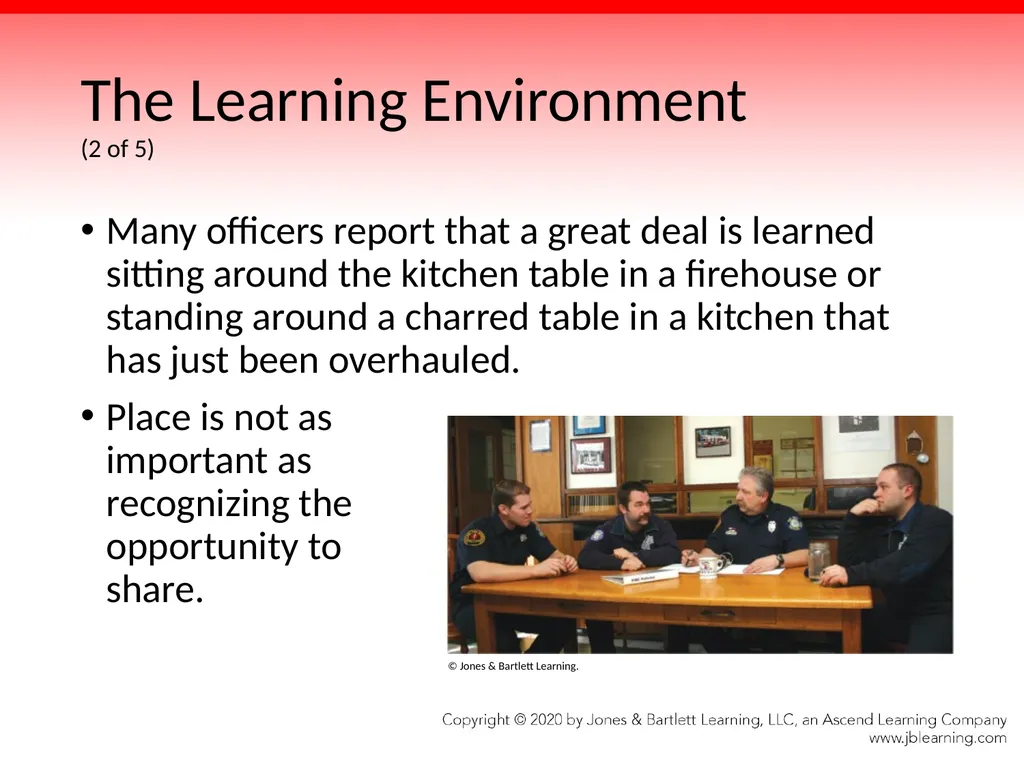
(2 of 5) Many officers report that a great deal is learned sitting around the kitchen table in a firehouse or standing around a charred table in a kitchen that has just been overhauled.
Place is not as important as recognizing the opportunity to share. © Jones & Bartlett Learning.<br>
Place is not as important as recognizing the opportunity to share. © Jones & Bartlett Learning.<br>
84
The Learning Environment
(3 of 5) Skill sets become building blocks that develop into scenarios, and scenarios move to larger-scale evolutions that are based on training as close to reality as possible.
This process encompasses a variety of learning environments that require the instructor to know how to teach in each venue.<br>
This process encompasses a variety of learning environments that require the instructor to know how to teach in each venue.<br>
85
The Learning Environment
(4 of 5) Many agencies are now using online training.
The time may come when you will present a lesson in an online environment.
Although there is no classroom to prepare or set up, you can have a big impact on how your virtual classroom is set up and how students feel in that environment.<br>
The time may come when you will present a lesson in an online environment.
Although there is no classroom to prepare or set up, you can have a big impact on how your virtual classroom is set up and how students feel in that environment.<br>
86
The Learning Environment
(5 of 5) To be an effective instructor, you need:
Solid understanding of the benefits and weaknesses of potential learning environments
Ability to select the best environment for presenting
Ensure the safety of students, yourself, and others involved
Address the environment to ensure that learning can take place<br>
Solid understanding of the benefits and weaknesses of potential learning environments
Ability to select the best environment for presenting
Ensure the safety of students, yourself, and others involved
Address the environment to ensure that learning can take place<br>
87
The Physical Environment
(1 of 5) The perfect environment is one in which all needs are met.
Basic needs are met when the classroom has enough light, the temperature is comfortable, and the seating and work space are adequate.
In the case of an outdoor classroom, it may mean shelter is available.<br>
Basic needs are met when the classroom has enough light, the temperature is comfortable, and the seating and work space are adequate.
In the case of an outdoor classroom, it may mean shelter is available.<br>
88
The Physical Environment
(2 of 5) Formal learning environment
Classroom
Learning objectives
Lesson plans
Lesson outlines
Final evaluation
Informal learning environment
Takes place every day in every location<br>
Classroom
Learning objectives
Lesson plans
Lesson outlines
Final evaluation
Informal learning environment
Takes place every day in every location<br>
89
The Physical Environment
(3 of 5) Informal learning environment
Takes place every day in every location
Controlling the learning environment is a critical task, and you should consider the following factors:
Classroom environment
Classroom setup
Safety
Lighting
Teamwork and self-actualization
Minimizing distractions<br>
Takes place every day in every location
Controlling the learning environment is a critical task, and you should consider the following factors:
Classroom environment
Classroom setup
Safety
Lighting
Teamwork and self-actualization
Minimizing distractions<br>
90
The Physical Environment
(4 of 5) Knowing where you will present is important so you can tailor presentation style to the venue.
For example, size of the room, seating in the room
Receptivity of your students will vary.
A formal training center with tables and chairs automatically puts students in the learning mind frame.
A more casual atmosphere of apparatus room puts students at ease and minimizes formality of the student–instructor relationship.
Discussion can go more in direction of students’ interests<br>
91
The Physical Environment
(5 of 5) The tailboard chat is an informal gathering of fire fighters at the back of an engine where the company talks about various subjects.
Equivalent to water cooler in an office
Puts all members of the company at ease
Can happen back at station or on scene after the call
Some instructors “simulate” a fire to reinforce learning objectives.
This is tactics and strategy training at its best<br>
Equivalent to water cooler in an office
Puts all members of the company at ease
Can happen back at station or on scene after the call
Some instructors “simulate” a fire to reinforce learning objectives.
This is tactics and strategy training at its best<br>
92
The Indoor Classroom
(1 of 11) Perhaps the most common setting for class
Most often classes start indoors and may or may not move outside to a training ground
New technology is an important consideration
Projectors and computers
Wireless internet service
Comes with possibility that student might be distracted
Problems can be addressed with policies or turning the wireless internet off<br>
93
The Indoor Classroom
(2 of 11) Temperature is very important
If a room too hot or too cold, students will focus more intently on the temperature than what being taught
Cannot make every student happy, so must go with majority opinion
If possible, lean toward keeping the room cooler versus warmer<br>
If a room too hot or too cold, students will focus more intently on the temperature than what being taught
Cannot make every student happy, so must go with majority opinion
If possible, lean toward keeping the room cooler versus warmer<br>
94
The Indoor Classroom
(3 of 11) Must provide time for breaks so students can attend to personal needs
Breaks necessary both for students and instructors
The informal conversations that take place during a break can actually enhance the learning process<br>
Breaks necessary both for students and instructors
The informal conversations that take place during a break can actually enhance the learning process<br>
95
The Indoor Classroom
(4 of 11) Arranging the classroom sets the tone for the learning process.
Ask, “Which type of learning do I want to accomplish?”<br>
Ask, “Which type of learning do I want to accomplish?”<br>
96
The Indoor Classroom
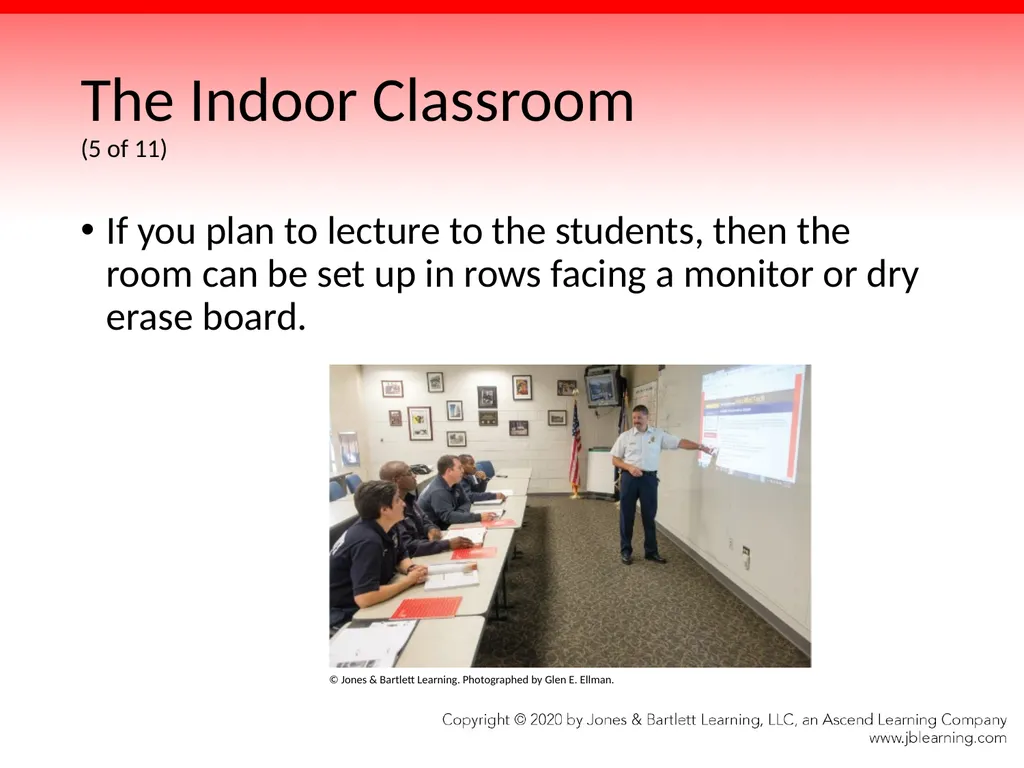
(5 of 11) If you plan to lecture to the students, then the room can be set up in rows facing a monitor or dry erase board. © Jones & Bartlett Learning. Photographed by Glen E. Ellman.<br>
97
The Indoor Classroom
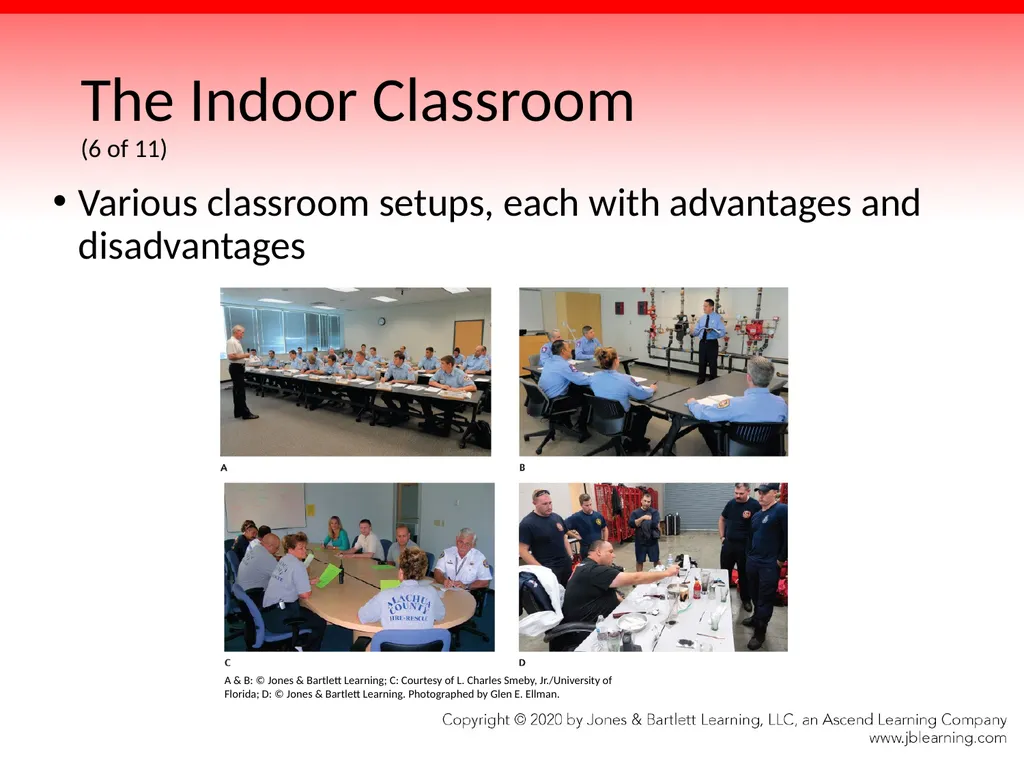
(6 of 11) Various classroom setups, each with advantages and
disadvantages A & B: © Jones & Bartlett Learning; C: Courtesy of L. Charles Smeby, Jr./University of Florida; D: © Jones & Bartlett Learning. Photographed by Glen E. Ellman.<br>
98
The Indoor Classroom
(7 of 11) After basic needs, highest needs relate to safety
Hazards are much different than on the fire ground
Physical hazards need to be controlled to ensure a safe classroom environment
Emotional safety important
Need an environment free of judgement or harassment, otherwise, don’t feel safe expressing thoughts, opinions
Your task is to support students and to help them learn from their mistakes<br>
99
The Indoor Classroom
(8 of 11) Having the proper lighting is important.
You may need to adjust lighting depending on type of presentation.
In the ideal classroom, lights will be split, allowing lights in the front of the room to be dimmed while lights in the back of the room remain on to allow students to take notes.
Podium should have a light source so that you can read your notes.<br>
100
The Indoor Classroom
(9 of 11) Minimizing distractions can be challenging
Variety of distractions available to students: phones, texting, pagers, station alarms
Avoid by asking students to turn off phones at beginning of class
If on-duty crew members in class, make arrangements with them to turn down pagers or radios<br>
Variety of distractions available to students: phones, texting, pagers, station alarms
Avoid by asking students to turn off phones at beginning of class
If on-duty crew members in class, make arrangements with them to turn down pagers or radios<br>
101
The Indoor Classroom
(10 of 11) Other distractions addressed by posting signs
Request latecomers wait until a break to join
If training occurs with on-duty crews, have a student monitor a portable radio on low volume
Outdoor training makes controlling the learning environment more difficult
Try to conduct training in an isolated place<br>
Request latecomers wait until a break to join
If training occurs with on-duty crews, have a student monitor a portable radio on low volume
Outdoor training makes controlling the learning environment more difficult
Try to conduct training in an isolated place<br>
102
The Indoor Classroom
(11 of 11) Classroom setup typically changes when students are required to take a test.
Each should have enough space to put both testing booklet and answer key on a writing surface.
Minimize wandering eyes while allowing the instructor to observe all students.
Classroom should remain quiet
If a student needs to leave the room, maintain security of the testing process.<br>
Each should have enough space to put both testing booklet and answer key on a writing surface.
Minimize wandering eyes while allowing the instructor to observe all students.
Classroom should remain quiet
If a student needs to leave the room, maintain security of the testing process.<br>
103
The Outdoor Classroom
(1 of 17) Both indoor and outdoor instruction are important to ensure students achieve the learning objectives.
The challenge is to match the environment to the learning objectives to make sure that the student is always in the correct environment to learn.<br>
The challenge is to match the environment to the learning objectives to make sure that the student is always in the correct environment to learn.<br>
104
The Outdoor Classroom
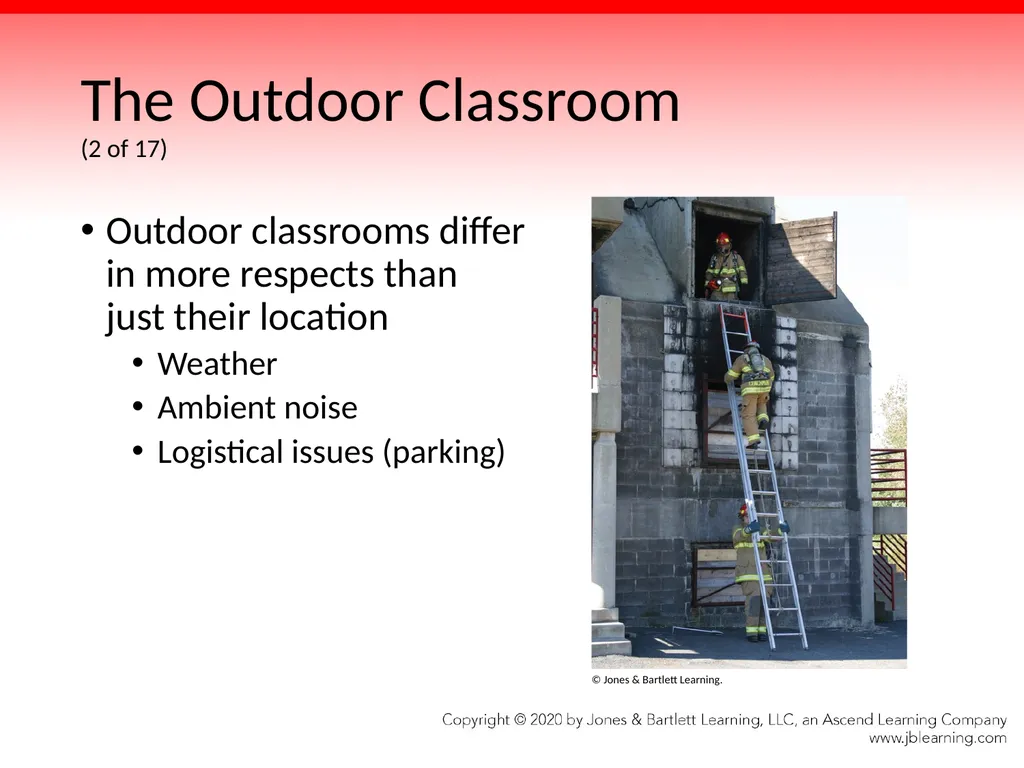
(2 of 17) Outdoor classrooms differ
in more respects than
just their location
Weather
Ambient noise
Logistical issues (parking) © Jones & Bartlett Learning.<br>
Weather
Ambient noise
Logistical issues (parking) © Jones & Bartlett Learning.<br>
105
The Outdoor Classroom
(3 of 17) The key is to plan ahead and to conduct proper pretraining assessment to ensure safe and effective learning experience.
Instructor needs to be prepared.
Outdoor classrooms can be organized on a developed training ground, such as a fixed burn building, or off-site location, such as a mountain or slope.<br>
Instructor needs to be prepared.
Outdoor classrooms can be organized on a developed training ground, such as a fixed burn building, or off-site location, such as a mountain or slope.<br>
106
The Outdoor Classroom
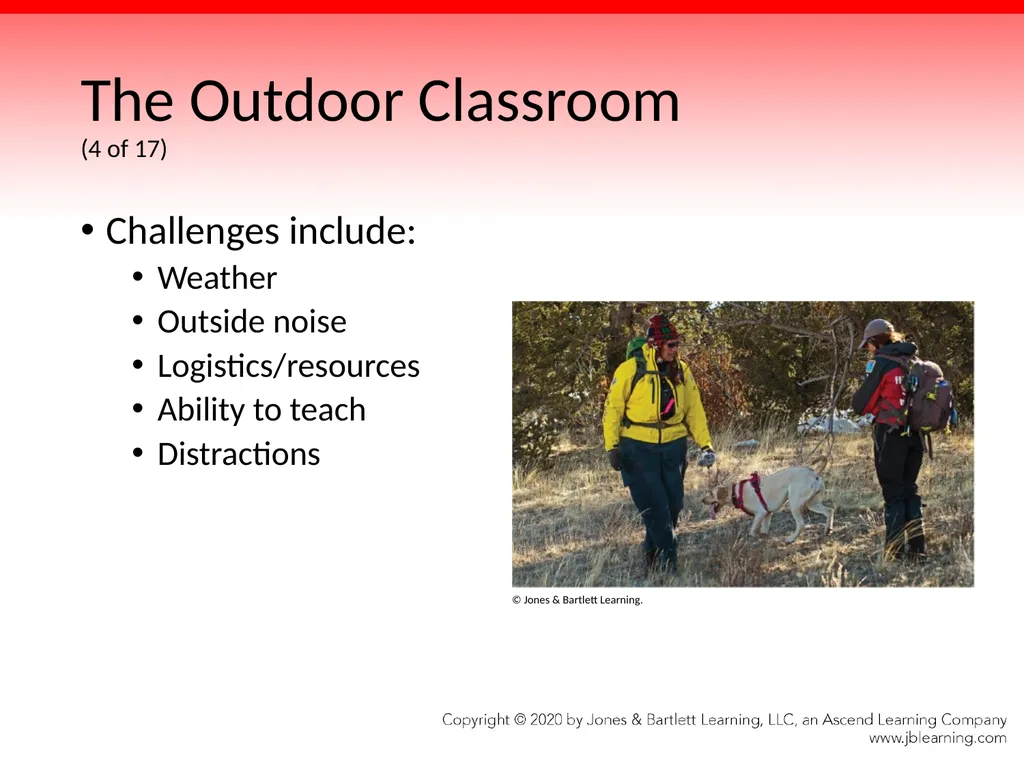
(4 of 17) Challenges include:
Weather
Outside noise
Logistics/resources
Ability to teach
Distractions © Jones & Bartlett Learning.<br>
Weather
Outside noise
Logistics/resources
Ability to teach
Distractions © Jones & Bartlett Learning.<br>
107
The Outdoor Classroom
(5 of 17) Keep groups small, so every student more closely engaged in learning process
Acquired structures present great learning opportunity, but also create difficulties<br>
Acquired structures present great learning opportunity, but also create difficulties<br>
108
The Outdoor Classroom
(6 of 17) Communicating outdoors
Can be a challenge to any instructor
Be cognizant of own safety
Taking off self-contained breathing apparatus (SCBA) to communicate in a smoke-filled environment puts you at risk and sends the message that SCBA is not important
First, gain the students’ attention and use a calm and controlled voice to communicate
Live fire training scenario is an environment in which teaching a constant process<br>
109
The Outdoor Classroom
(7 of 17) Communicating outdoors (cont.)
Need to be close enough to observe student behaviors and far enough back to observe the scene and allow students to perform and learn.
Observing students will be critical to determining whether your voice and content of your message are reaching everyone.
Observe body language.<br>
Need to be close enough to observe student behaviors and far enough back to observe the scene and allow students to perform and learn.
Observing students will be critical to determining whether your voice and content of your message are reaching everyone.
Observe body language.<br>
110
The Outdoor Classroom
(8 of 17) Safety
Should be biggest concern
Stakes are higher; attention to detail more intense
You hold students’ lives in your hands, and students need reassurance that you take this responsibility seriously
Follow NFPA 1403<br>
Should be biggest concern
Stakes are higher; attention to detail more intense
You hold students’ lives in your hands, and students need reassurance that you take this responsibility seriously
Follow NFPA 1403<br>
111
The Outdoor Classroom
(9 of 17) Make the learning environment as safe as possible.
Have the right number of personnel
In the right positions
Doing the right things
With an emphasis on safety<br>
Have the right number of personnel
In the right positions
Doing the right things
With an emphasis on safety<br>
112
The Outdoor Classroom
(10 of 17) Weather
Physical location of outdoor classroom can determine how you prepare for and handle the class.
Many departments use either a temperature/humidity (heat) index or a wind chill index as a guide when determining whether outdoor training is feasible.
NFPA 1584 offers guidelines on temperature and exertion levels.<br>
113
The Outdoor Classroom
(11 of 17) Weather (cont.)
Always have plan B in case inclement weather affects the lesson
Torrential downpours and lighting definitely reasons to seek alternative environment
Warming or cooling areas and shelter from wind, rain, or other weather phenomena necessities for students’ safety<br>
Always have plan B in case inclement weather affects the lesson
Torrential downpours and lighting definitely reasons to seek alternative environment
Warming or cooling areas and shelter from wind, rain, or other weather phenomena necessities for students’ safety<br>
114
The Outdoor Classroom
(12 of 17) Noise
In most cases, will need to project voice so all can hear without use of electronic device such as a microphone
Environmental factors such as wind can be a deterrent in allowing voice to carry
Other distractions—such as vehicle traffic, ambient noise—can add difficulty
During preplanning, look for locations in which you can present verbal information effectively
Outdoor pavilions, using apparatus as a shield, etc.<br>
115
The Outdoor Classroom
(13 of 17) When the classroom moves outdoors, the instructor must also address:
Classroom setup
Logistical arrangements
Required equipment and materials
Restroom facilities
Rehabilitation area
At established training ground, these resources are usually in place and have been designed into the facility<br>
Classroom setup
Logistical arrangements
Required equipment and materials
Restroom facilities
Rehabilitation area
At established training ground, these resources are usually in place and have been designed into the facility<br>
116
The Outdoor Classroom
(14 of 17) Real challenge comes when training moves to off-site location, need to convey all resources to that site
Take extra equipment so downtime is minimized if something breaks or additional items needed<br>
Take extra equipment so downtime is minimized if something breaks or additional items needed<br>
117
The Outdoor Classroom
(15 of 17) Contingency plans
Must have a plan B regardless of environment
Contingencies need to be considered and planned for
Some solutions are simple
Keeping a spare projector bulb around
Having a rain date
Need to be able to adjust training plan so that training plan can continue
Safety and proper delivery will always take precedence<br>
118
The Outdoor Classroom
(16 of 17) Contingency plans (cont.)
Best practice to have a set of “ready-to-go” backup drills in case the training must be stopped
Do not want to lose momentum or the opportunity to train, especially if department meets infrequently<br>
Best practice to have a set of “ready-to-go” backup drills in case the training must be stopped
Do not want to lose momentum or the opportunity to train, especially if department meets infrequently<br>
119
The Outdoor Classroom
(17 of 17) Contingency plans (cont.)
Look at training same way you approach emergency scene.
Do you have resources in place if something goes wrong?
Fire fighters must constantly plan for contingencies.
Things can and will go wrong, and having at least considered these issues allows quick adaptation to changing circumstances.<br>
Look at training same way you approach emergency scene.
Do you have resources in place if something goes wrong?
Fire fighters must constantly plan for contingencies.
Things can and will go wrong, and having at least considered these issues allows quick adaptation to changing circumstances.<br>
120
Teamwork and Self-Actualization
(1 of 2) A main focus of fire training is teamwork
Learning environment created must be one that supports crucial nature of teamwork
Important part of instruction should be providing time either before, during, or after formal instruction to allow students to network
Create environment that celebrates students’ victories as accomplished
Status and recognition are powerful motivators<br>
121
Teamwork and Self-Actualization
(2 of 2) Catch people doing things right, and recognize accomplishment
People want to be in environment where they succeed
Highest-priority need in Maslow’s hierarchy is need for self-actualization
At this level, the student able to synthesize material by taking multiple learning situations and putting them together to solve a problem
Challenge students to take your message and use it to solve a problem<br>
122
Demographics in the Learning Environment
(1 of 5) Demographics include the age, gender, marital status, family size, and educational background of a fire fighter.
Demographic considerations extend beyond issues of race and national origin; in the fire service, they require looking in a more holistic manner at everything a fire fighter brings to the department.<br>
Demographic considerations extend beyond issues of race and national origin; in the fire service, they require looking in a more holistic manner at everything a fire fighter brings to the department.<br>
123
Demographics in the Learning Environment
(2 of 5) Ask yourself:
What skills does this person bring?
Could those skills benefit others?
Is this individual highly educated, or only knows the basics?
Does this class have a mix of experienced and inexperienced students?<br>
What skills does this person bring?
Could those skills benefit others?
Is this individual highly educated, or only knows the basics?
Does this class have a mix of experienced and inexperienced students?<br>
124
Demographics in the Learning Environment
(3 of 5) These questions help grasp the basic demographics that shape the teaching approach.
Another demographic consideration unique to the fire service is different types of staffing.
Career fire fighters
Volunteer fire fighters
Combination of all of these
Paid-on-call fire fighters<br>
Another demographic consideration unique to the fire service is different types of staffing.
Career fire fighters
Volunteer fire fighters
Combination of all of these
Paid-on-call fire fighters<br>
125
Demographics in the Learning Environment
(4 of 5) Learning objectives for paid-on-call or volunteer fire fighters do not differ, but presentation to these groups does.
Training accommodations in timing must be made.
By accommodating demands of student schedules, you allow each student to focus fully on the subject at hand.<br>
Training accommodations in timing must be made.
By accommodating demands of student schedules, you allow each student to focus fully on the subject at hand.<br>
126
Demographics in the Learning Environment
(5 of 5) Gender considerations
Many qualified women have joined profession, so more appropriate to refer to students as fire fighters
Firefighting does not, according to the fire, have a gender
Although learning objectives do not change with the gender of the student, need to be cognizant of students’ gender
Be gender neutral when developing learning objectives
Key is to be respectful of all students at all times<br>
127
Offensive Language, Gestures,
and Dress
(1 of 5) Avoid offensive language.
Jokes and language of a sexual or explicit nature are unacceptable in the learning environment.
Make your point without use of profanity.
Students gain deeper respect for you when you demonstrate eloquence.<br>
Jokes and language of a sexual or explicit nature are unacceptable in the learning environment.
Make your point without use of profanity.
Students gain deeper respect for you when you demonstrate eloquence.<br>
128
Offensive Language, Gestures,
and Dress
(2 of 5) Do not participate in improper situations.
“If you hear an off-color joke and grin, you’re in.”
If you hear an offensive joke, show that you do not agree with what was said.
It is your responsibility to stop any unsafe or inappropriate behavior immediately.
Pride involves showing respect to everyone.<br>
“If you hear an off-color joke and grin, you’re in.”
If you hear an offensive joke, show that you do not agree with what was said.
It is your responsibility to stop any unsafe or inappropriate behavior immediately.
Pride involves showing respect to everyone.<br>
129
Offensive Language, Gestures,
and Dress
(3 of 5) If you offend a student, apologize in private and then in front of the class.
This will go a long way toward making amends.<br>
This will go a long way toward making amends.<br>
130
Offensive Language, Gestures,
and Dress
(4 of 5) Establish a policy that covers acceptable behavior and language
Organization should have a harassment policy that addresses these issues, including
Remedies for offenses
Reporting of incidents
Conduct
Best policy is to understand the audience to whom you are speaking<br>
Organization should have a harassment policy that addresses these issues, including
Remedies for offenses
Reporting of incidents
Conduct
Best policy is to understand the audience to whom you are speaking<br>
131
Offensive Language, Gestures,
and Dress
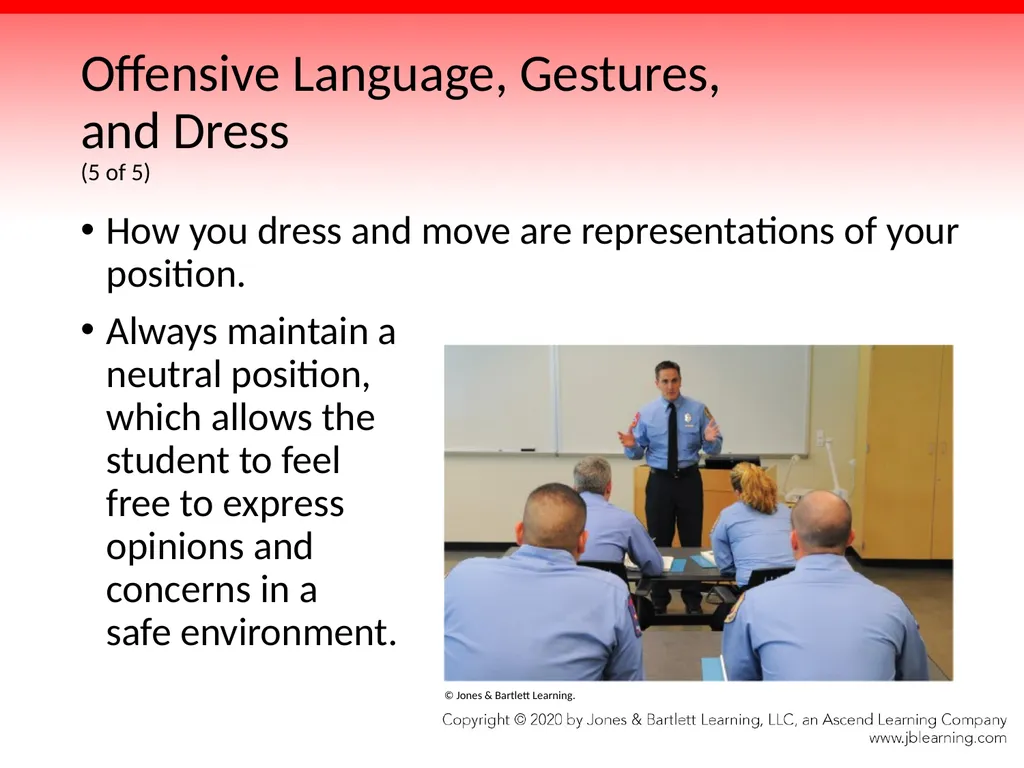
(5 of 5) How you dress and move are representations of your position.
Always maintain a neutral position, which allows the student to feel free to express opinions and concerns in a safe environment. © Jones & Bartlett Learning.<br>
Always maintain a neutral position, which allows the student to feel free to express opinions and concerns in a safe environment. © Jones & Bartlett Learning.<br>
132
Adapting the Lesson Plan Based
on Demographics
(1 of 3) Information learned as result of students’ verbal introductions may require slight modifications to the lesson plan.
Perhaps students will need to spend more time in one area of the class and less time in another.
Information gained can help you decide topic depth.
Be aware of the skill, experience, and ability levels of the members of the class to gain the best results.<br>
Perhaps students will need to spend more time in one area of the class and less time in another.
Information gained can help you decide topic depth.
Be aware of the skill, experience, and ability levels of the members of the class to gain the best results.<br>
133
Adapting the Lesson Plan Based
on Demographics
(2 of 3) If student requests you cover a certain topic, do not rewrite entire course; do keep request in mind
If time and circumstances permit, could briefly present the topic and ask if sufficient
Must be prepared either to adapt or to tell the student that topic outside scope of the class
If you indicate you will cover an area or an objective, you need to ensure that you fully address any concerns or questions about that topic<br>
134
Adapting the Lesson Plan Based
on Demographics
(3 of 3) By anticipating questions, you will be prepared to offer an opinion because you have had time to research the question and present an intelligent response.
If you do not know the answer, do not—under any circumstance—make up the answer.
Completely acceptable to say, “I do not know, but I will try to find out for you.”
Fire fighters respect honesty.<br>
If you do not know the answer, do not—under any circumstance—make up the answer.
Completely acceptable to say, “I do not know, but I will try to find out for you.”
Fire fighters respect honesty.<br>
135
Lesson Summary
(1 of 12) Adult students need realistic, practical, and knowledgeable lessons that deliver information in a variety of ways to accommodate their differing learning characteristics.
When you can communicate to students that you know the information and that you understand their unique needs and motivations, you will find that it is much easier to achieve the goal of teaching the information and having the students learn.<br>
When you can communicate to students that you know the information and that you understand their unique needs and motivations, you will find that it is much easier to achieve the goal of teaching the information and having the students learn.<br>
136
Lesson Summary
(2 of 12) Determining which method of instruction should be used to deliver information is accomplished using several factors:
The experience and educational level of the students
The classroom setting or training environment
The objectives of the material to be taught
The number of students to be taught<br>
The experience and educational level of the students
The classroom setting or training environment
The objectives of the material to be taught
The number of students to be taught<br>
137
Lesson Summary
(3 of 12) Ask yourself three basic questions when reviewing and planning for the delivery of a lesson plan:
What are the goals of the lesson?
Who is the intended audience?
What are the resources and learning environment characteristics?<br>
What are the goals of the lesson?
Who is the intended audience?
What are the resources and learning environment characteristics?<br>
138
Lesson Summary
(4 of 12) Methods of instruction vary among disciplines, but for the fire service the following are most common and effective in teaching new and in-service personnel:
Lecture
Demonstration/skill drill
Discussion
Role play
Labs/simulations
Case studies
Out-of-class assignments
Online learning, independent study, and blended learning<br>
Lecture
Demonstration/skill drill
Discussion
Role play
Labs/simulations
Case studies
Out-of-class assignments
Online learning, independent study, and blended learning<br>
139
Lesson Summary
(5 of 12) While reviewing and preparing for class with a lesson plan, the four-step method of instruction is the primary process used to relate the material contained in the lesson plan to the students.
Preparation
Presentation
Application
Evaluation<br>
Preparation
Presentation
Application
Evaluation<br>
140
Lesson Summary
(6 of 12) Five effective transition techniques are delineation, words/phrases, pictures, voice, and body language.
An important part of the learning process is to assess the knowledge gained during class. This is most commonly done by asking the students questions about the material you have presented. Several types of questions may be used:
Direct questions
Rhetorical questions
Open-ended questions
Closed-ended questions<br>
141
Lesson Summary
(7 of 12) Disruption in the classroom can significantly reduce or limit the amount of learning time for students. It can also lead to unsafe and negative learning that could have serious implications when students apply what they have learned in the field. As the instructor, you are responsible for providing a safe learning environment and proper, safe instruction to all students.
When you develop your lesson plan, it should be detailed and complete enough to achieve the identified goals and desired outcomes, yet flexible enough that it can be adjusted to meet students’ needs on the fly.<br>
When you develop your lesson plan, it should be detailed and complete enough to achieve the identified goals and desired outcomes, yet flexible enough that it can be adjusted to meet students’ needs on the fly.<br>
142
Lesson Summary
(8 of 12) Because learning can take place in many locations—such as a traditional classroom, fire-ground training facilities, or another location such as an acquired structure—you as the instructor need to be keenly aware of your environment.
When making a presentation or teaching a class, you must be aware of both the audience and their departmental culture.<br>
When making a presentation or teaching a class, you must be aware of both the audience and their departmental culture.<br>
143
Lesson Summary
(9 of 12) Some programs require that students take prerequisite classes before attending certain advanced classes. The fact that students have completed these preliminaries ensures that the students taking your course have a certain base level of training and education.
Establishing a learning environment is just as important as having a lesson plan. Without the proper environment, the learning process will be limited and can be ineffective.<br>
Establishing a learning environment is just as important as having a lesson plan. Without the proper environment, the learning process will be limited and can be ineffective.<br>
144
Lesson Summary
(10 of 12) Matching the correct classroom arrangement to the needs of the lesson plan will allow students to learn.
When presenting a lesson in an indoor classroom, consider the classroom environment and setup, safety, lighting, and ways to minimize distractions. Adjustments may need to be made for testing.<br>
When presenting a lesson in an indoor classroom, consider the classroom environment and setup, safety, lighting, and ways to minimize distractions. Adjustments may need to be made for testing.<br>
145
Lesson Summary
(11 of 12) When presenting a lesson in an outdoor classroom, considerations include communication, safety, weather, background noise, logistics, and resources.
You must have a plan B when using any environment. All potential contingencies need to be considered and planned for.<br>
You must have a plan B when using any environment. All potential contingencies need to be considered and planned for.<br>
146
Lesson Summary
(12 of 12) Understanding demographics extends beyond issues of race and national origin. In the fire service, taking demographics into account during instruction requires looking in a more holistic manner at everything a fire fighter brings to the department.<br>