
Chapter 3: Requirements Determination Learning
KB
Published · 30 slides · 0 views
1 / 1
Description
Chapter 3: Requirements Determination Learning Objectives Learn how to create a requirements definition Learn various requirements analysis techniques Learn when to use each requirements analysis techniques Learn how to gather requirements
Related Topics
Share
Embed code
Download this presentation From Below
"Chapter 3: Requirements Determination Learning" is the property of its rightful owner. Permission is granted to download and print the materials on this website for personal, non-commercial use only, and to display it on your personal computer provided you do not modify the materials and that you retain all copyright notices contained in the materials. By downloading content from our website, you accept the terms of this agreement.
Presentation Transcript
01
Chapter 3:
Requirements Determination<br>
02
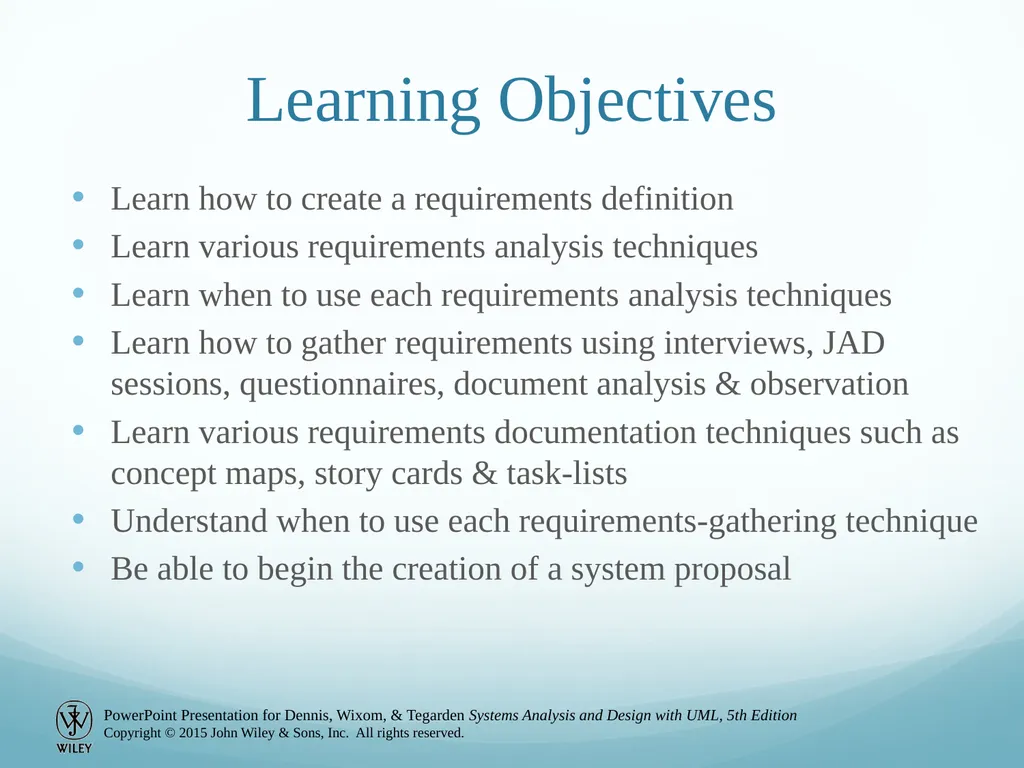
Learning Objectives Learn how to create a requirements definition
Learn various requirements analysis techniques
Learn when to use each requirements analysis techniques
Learn how to gather requirements using interviews, JAD sessions, questionnaires, document analysis & observation
Learn various requirements documentation techniques such as concept maps, story cards & task-lists
Understand when to use each requirements-gathering technique
Be able to begin the creation of a system proposal<br>
03
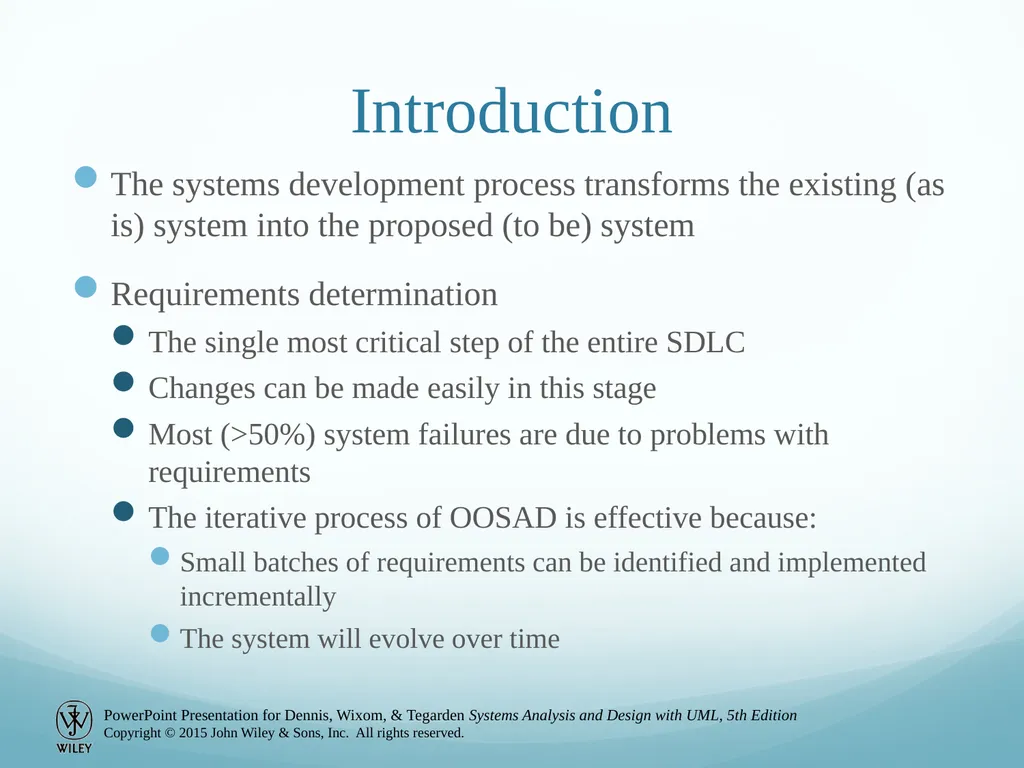
Introduction The systems development process transforms the existing (as is) system into the proposed (to be) system
Requirements determination
The single most critical step of the entire SDLC
Changes can be made easily in this stage
Most (>50%) system failures are due to problems with requirements
The iterative process of OOSAD is effective because:
Small batches of requirements can be identified and implemented incrementally
The system will evolve over time<br>
04
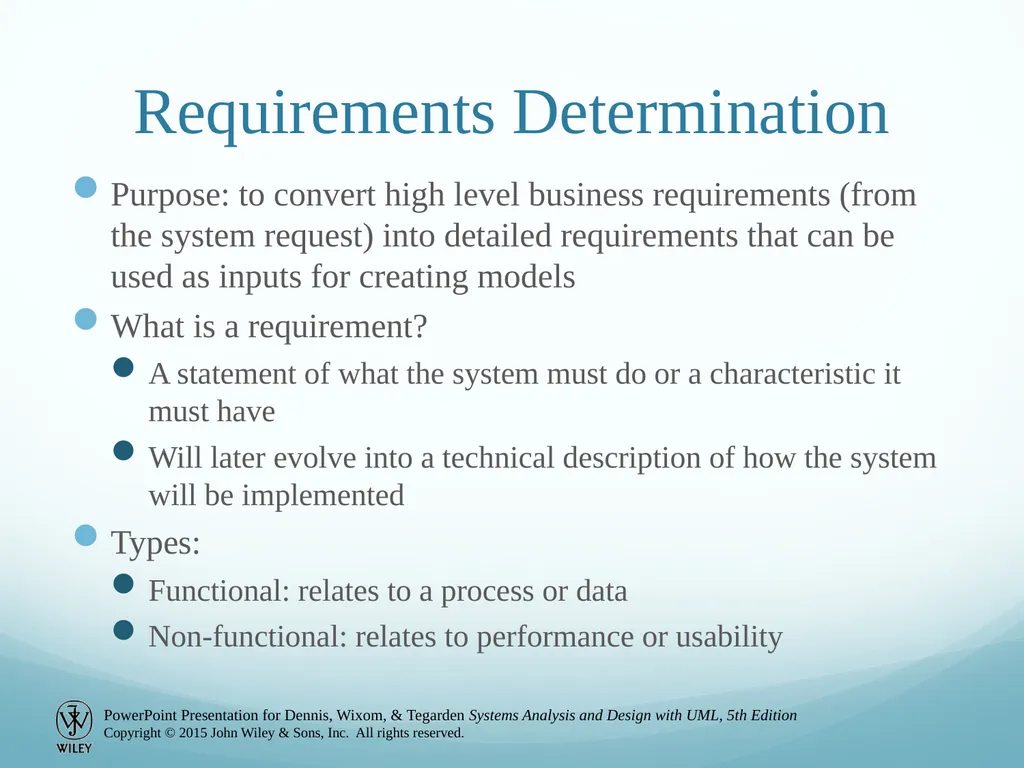
Requirements Determination Purpose: to convert high level business requirements (from the system request) into detailed requirements that can be used as inputs for creating models
What is a requirement?
A statement of what the system must do or a characteristic it must have
Will later evolve into a technical description of how the system will be implemented
Types:
Functional: relates to a process or data
Non-functional: relates to performance or usability<br>
What is a requirement?
A statement of what the system must do or a characteristic it must have
Will later evolve into a technical description of how the system will be implemented
Types:
Functional: relates to a process or data
Non-functional: relates to performance or usability<br>
05
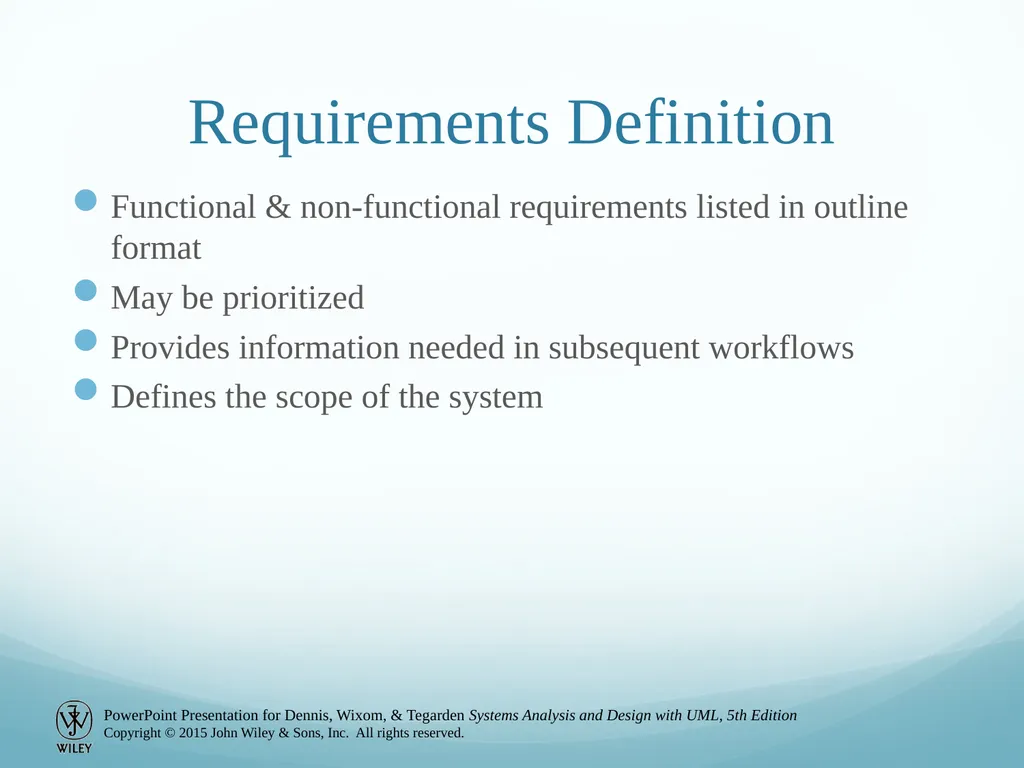
Requirements Definition Functional & non-functional requirements listed in outline format
May be prioritized
Provides information needed in subsequent workflows
Defines the scope of the system<br>
May be prioritized
Provides information needed in subsequent workflows
Defines the scope of the system<br>
06
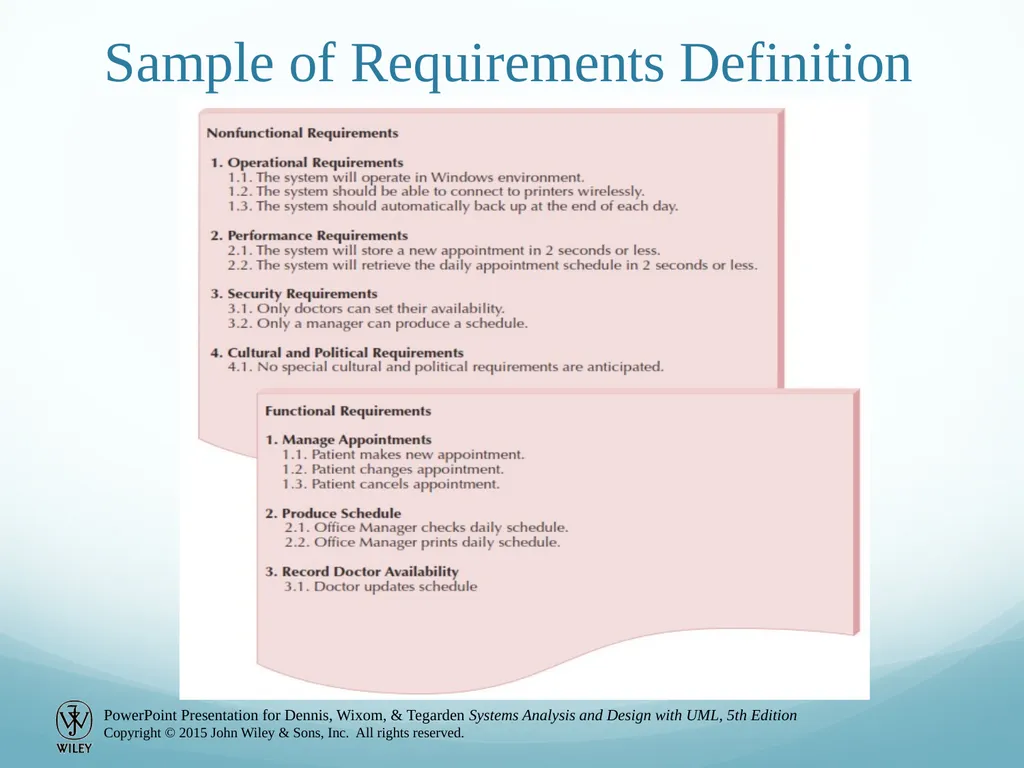
Sample of Requirements Definition<br>
07
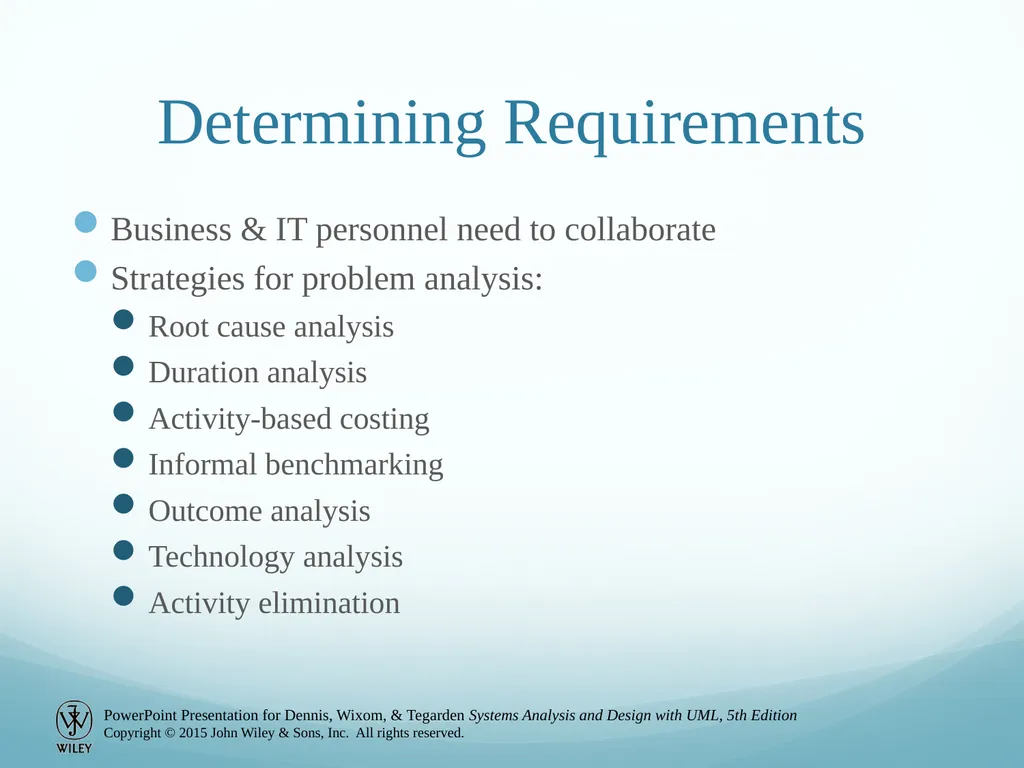
Determining Requirements Business & IT personnel need to collaborate
Strategies for problem analysis:
Root cause analysis
Duration analysis
Activity-based costing
Informal benchmarking
Outcome analysis
Technology analysis
Activity elimination<br>
Strategies for problem analysis:
Root cause analysis
Duration analysis
Activity-based costing
Informal benchmarking
Outcome analysis
Technology analysis
Activity elimination<br>
08
Determining Requirements Requirements are best determined by systems analysts and business people together
Techniques for identifying requirements
Interviews, questionnaires and/or observation
Joint application development (JAD)
Document analysis<br>
Techniques for identifying requirements
Interviews, questionnaires and/or observation
Joint application development (JAD)
Document analysis<br>
09
Creating a
Requirements Definition Determine the types of functional and non-functional requirements applicable to the project
Use requirements-gathering techniques to collect details
Analysts work with users to verify, change and prioritize each requirement
Continue this process through analysis workflow, but be careful of scope creep
Requirements that meet a need but are not within the current scope can be added to a list of future enhancements<br>
10
Problems in
Requirements Determination Analyst may not have access to the correct users
Requirements specifications may be inadequate
Some requirements may not be known in the beginning
Verifying and validating requirements can be difficult<br>
Requirements specifications may be inadequate
Some requirements may not be known in the beginning
Verifying and validating requirements can be difficult<br>
11
Requirements Analysis Strategies Problem analysis
Ask users to identify problems with the current system
Ask users how they would solve these problems
Good for improving efficiency or ease-of-use
Root cause analysis
Focus is on the cause of a problem, not its solution
Create a prioritized list of problems
Try to determine their causes
Once the causes are known, solutions can be developed<br>
12
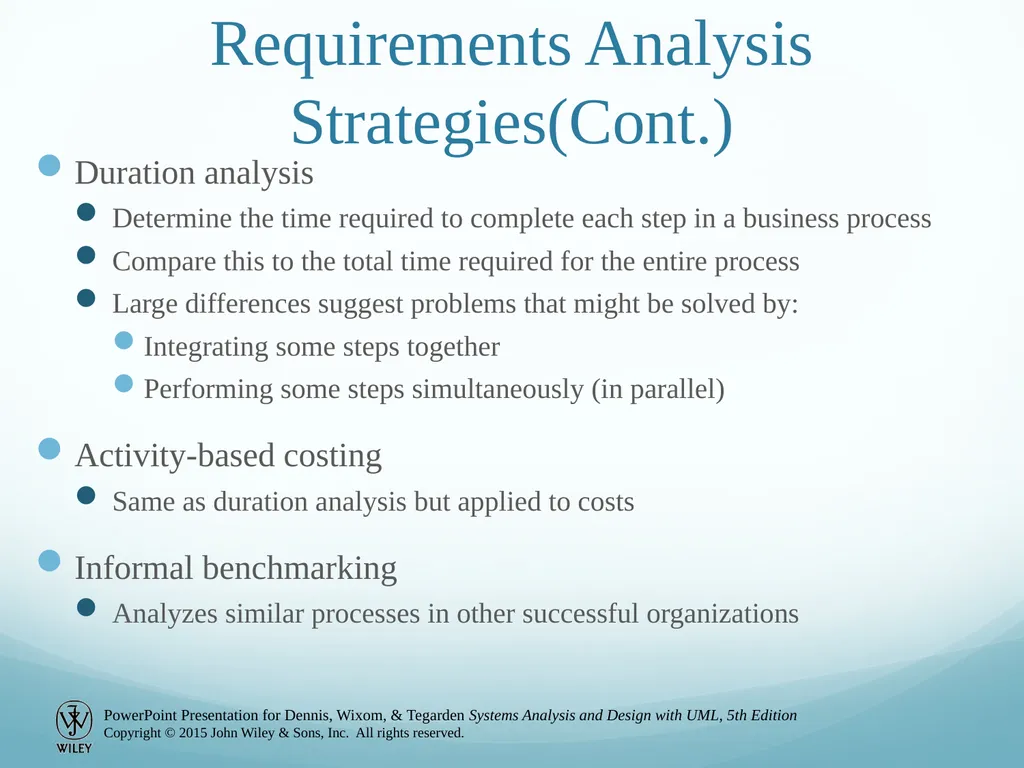
Duration analysis
Determine the time required to complete each step in a business process
Compare this to the total time required for the entire process
Large differences suggest problems that might be solved by:
Integrating some steps together
Performing some steps simultaneously (in parallel)
Activity-based costing
Same as duration analysis but applied to costs
Informal benchmarking
Analyzes similar processes in other successful organizations Requirements Analysis Strategies(Cont.)<br>
13
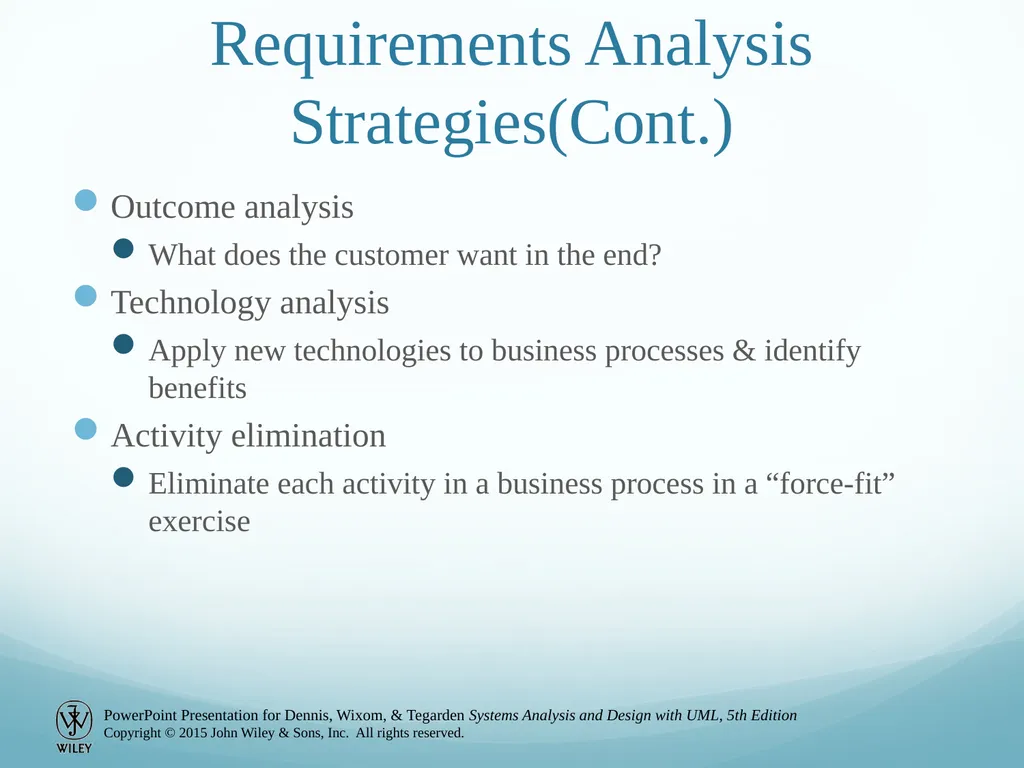
Outcome analysis
What does the customer want in the end?
Technology analysis
Apply new technologies to business processes & identify benefits
Activity elimination
Eliminate each activity in a business process in a “force-fit” exercise Requirements Analysis Strategies(Cont.)<br>
What does the customer want in the end?
Technology analysis
Apply new technologies to business processes & identify benefits
Activity elimination
Eliminate each activity in a business process in a “force-fit” exercise Requirements Analysis Strategies(Cont.)<br>
14
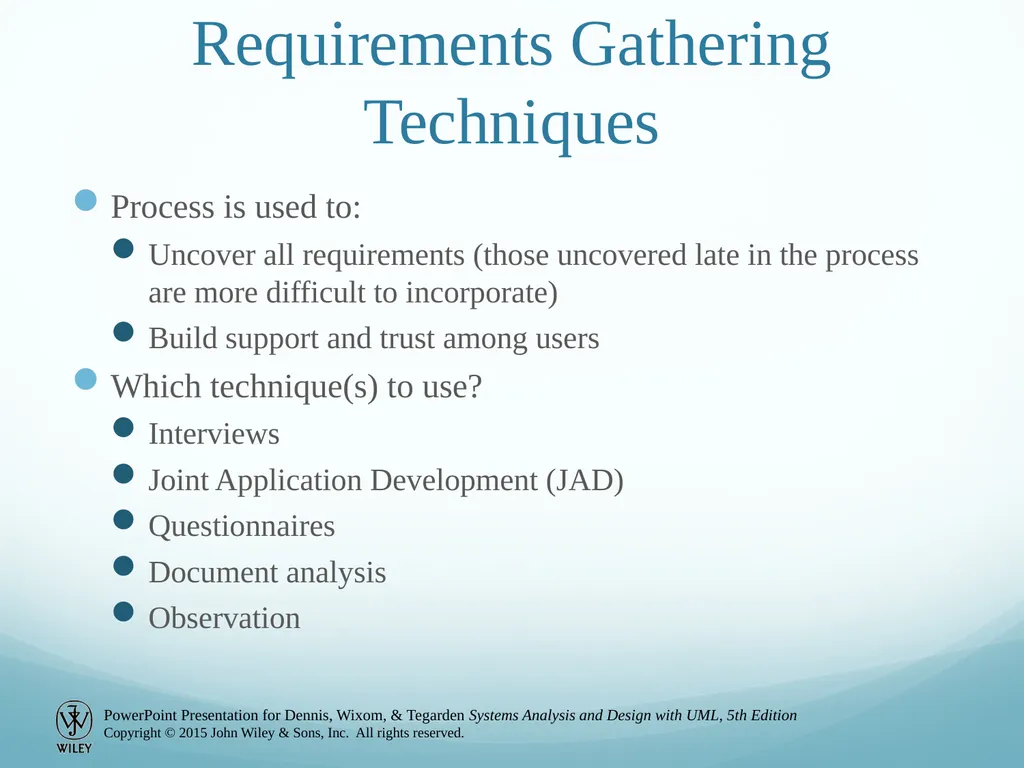
Requirements Gathering Techniques Process is used to:
Uncover all requirements (those uncovered late in the process are more difficult to incorporate)
Build support and trust among users
Which technique(s) to use?
Interviews
Joint Application Development (JAD)
Questionnaires
Document analysis
Observation<br>
Uncover all requirements (those uncovered late in the process are more difficult to incorporate)
Build support and trust among users
Which technique(s) to use?
Interviews
Joint Application Development (JAD)
Questionnaires
Document analysis
Observation<br>
15
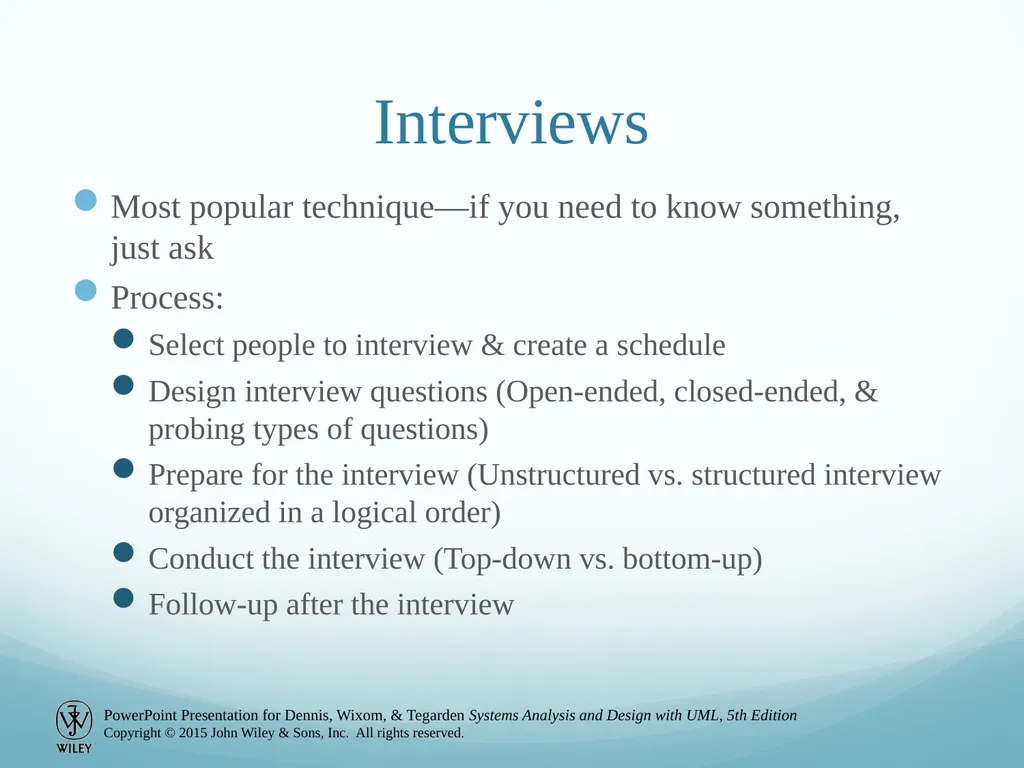
Interviews Most popular technique—if you need to know something, just ask
Process:
Select people to interview & create a schedule
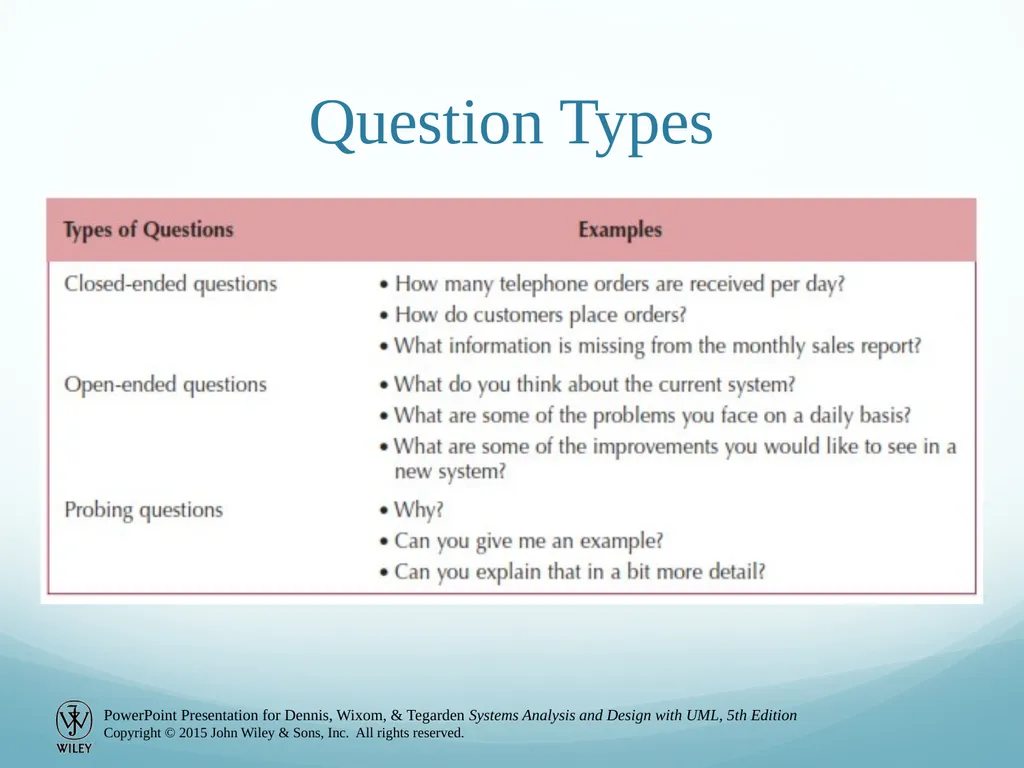
Design interview questions (Open-ended, closed-ended, & probing types of questions)
Prepare for the interview (Unstructured vs. structured interview organized in a logical order)
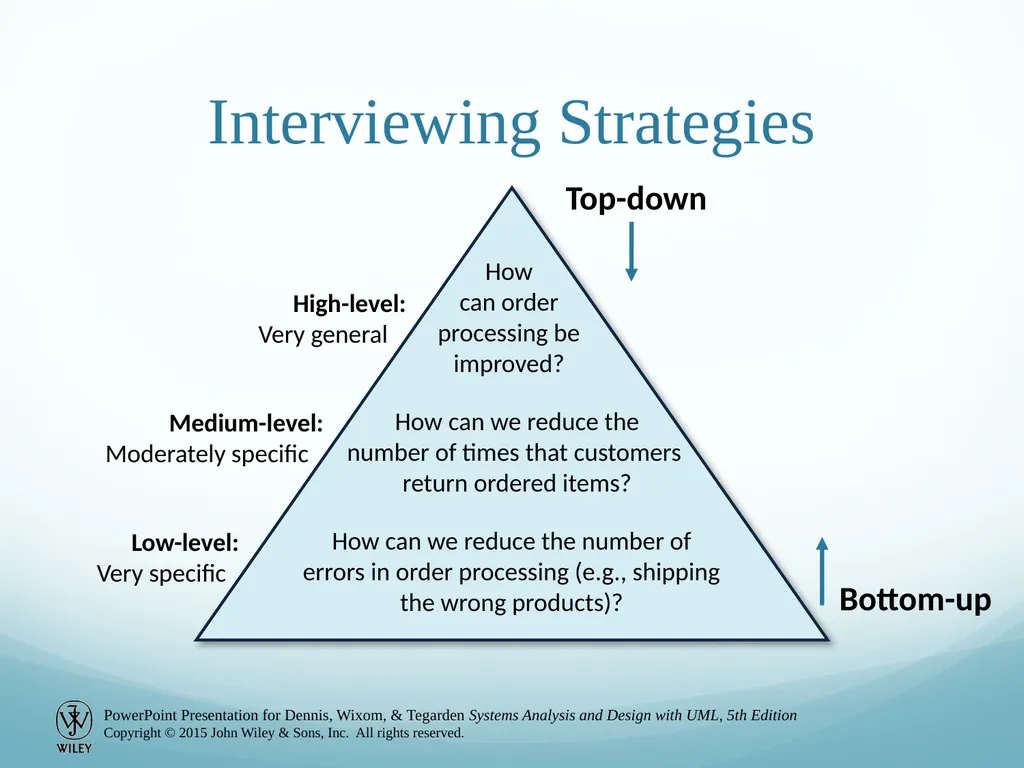
Conduct the interview (Top-down vs. bottom-up)
Follow-up after the interview<br>
16
Question Types<br>
17
Interviewing Strategies How
can order
processing be
improved? How can we reduce the
number of times that customers
return ordered items? How can we reduce the number of
errors in order processing (e.g., shipping
the wrong products)? Top-down Bottom-up High-level:
Very general Medium-level:
Moderately specific Low-level:
Very specific<br>
18
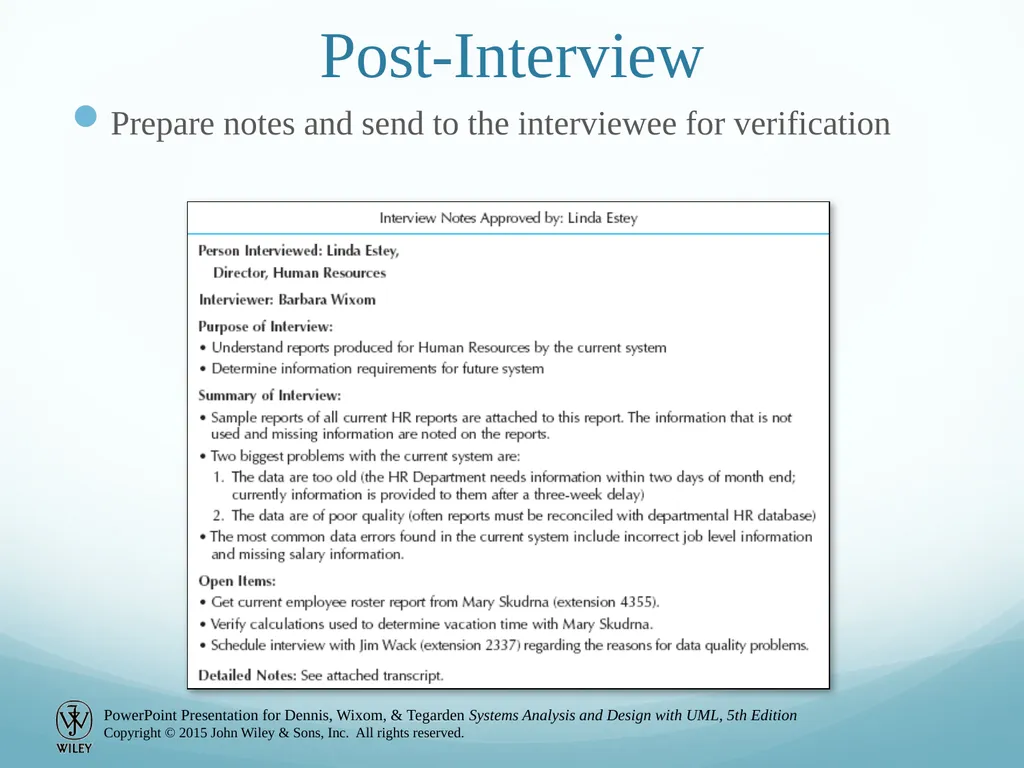
Post-Interview Prepare notes and send to the interviewee for verification<br>
19
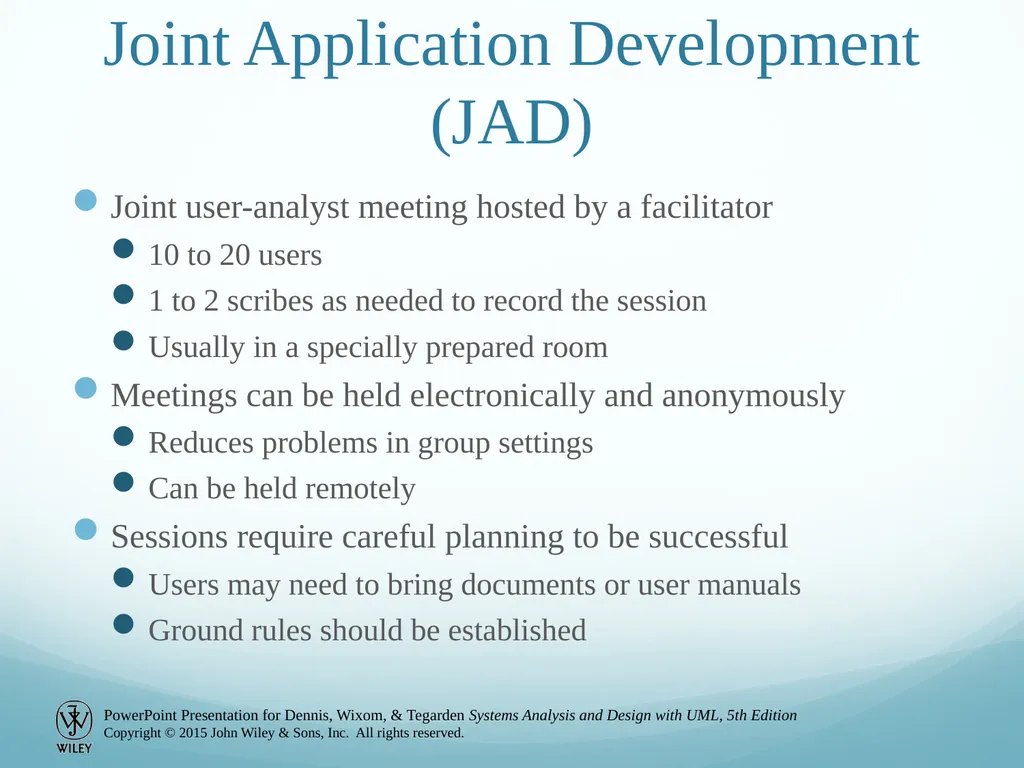
Joint Application Development (JAD) Joint user-analyst meeting hosted by a facilitator
10 to 20 users
1 to 2 scribes as needed to record the session
Usually in a specially prepared room
Meetings can be held electronically and anonymously
Reduces problems in group settings
Can be held remotely
Sessions require careful planning to be successful
Users may need to bring documents or user manuals
Ground rules should be established<br>
20
Questionnaires A set of written questions used to obtain information from individuals
May be paper based or electronic (e.g., web based)
Common uses:
Large numbers of people
Need both information and opinions
When designing for use outside the organization (customers, vendors, etc.)
Typical response rates: < 50% (paper); < 30% (Web)<br>
May be paper based or electronic (e.g., web based)
Common uses:
Large numbers of people
Need both information and opinions
When designing for use outside the organization (customers, vendors, etc.)
Typical response rates: < 50% (paper); < 30% (Web)<br>
21
Questionnaire Steps Select the participants
Identify the population
Use representative samples for large populations
Designing the questionnaire
Careful question selection
Remove ambiguities
Administering the questionnaire
Working to get good response rate
Offer an incentive (e.g., a free pen)
Questionnaire follow-up
Send results to participants
Send a thank-you<br>
22
Good Questionnaire Design Begin with non-threatening and interesting questions
Group items into logically coherent sections
No important items at the very end
Do not crowd a page with too many items
Avoid abbreviations
Avoid biased or suggestive items or terms
Number questions to avoid confusion
Pretest to identify confusing questions
Provide anonymity to respondents<br>
Group items into logically coherent sections
No important items at the very end
Do not crowd a page with too many items
Avoid abbreviations
Avoid biased or suggestive items or terms
Number questions to avoid confusion
Pretest to identify confusing questions
Provide anonymity to respondents<br>
23
Document Analysis Provides information about the “as-is” system
Review technical documents when available
Review typical user documents:
Forms
Reports
Policy manuals
Look for user additions to forms
Look for unused form elements<br>
Review technical documents when available
Review typical user documents:
Forms
Reports
Policy manuals
Look for user additions to forms
Look for unused form elements<br>
24
Observation Users/managers often don’t remember everything they do
Checks validity of information gathered in other ways
Behaviors may change when people are watched
Workers tend to be very careful when watched
Keep a low profile
Try not to interrupt or influence workers
Be careful not to ignore periodic activities
Weekly … Monthly … Annually<br>
Checks validity of information gathered in other ways
Behaviors may change when people are watched
Workers tend to be very careful when watched
Keep a low profile
Try not to interrupt or influence workers
Be careful not to ignore periodic activities
Weekly … Monthly … Annually<br>
25
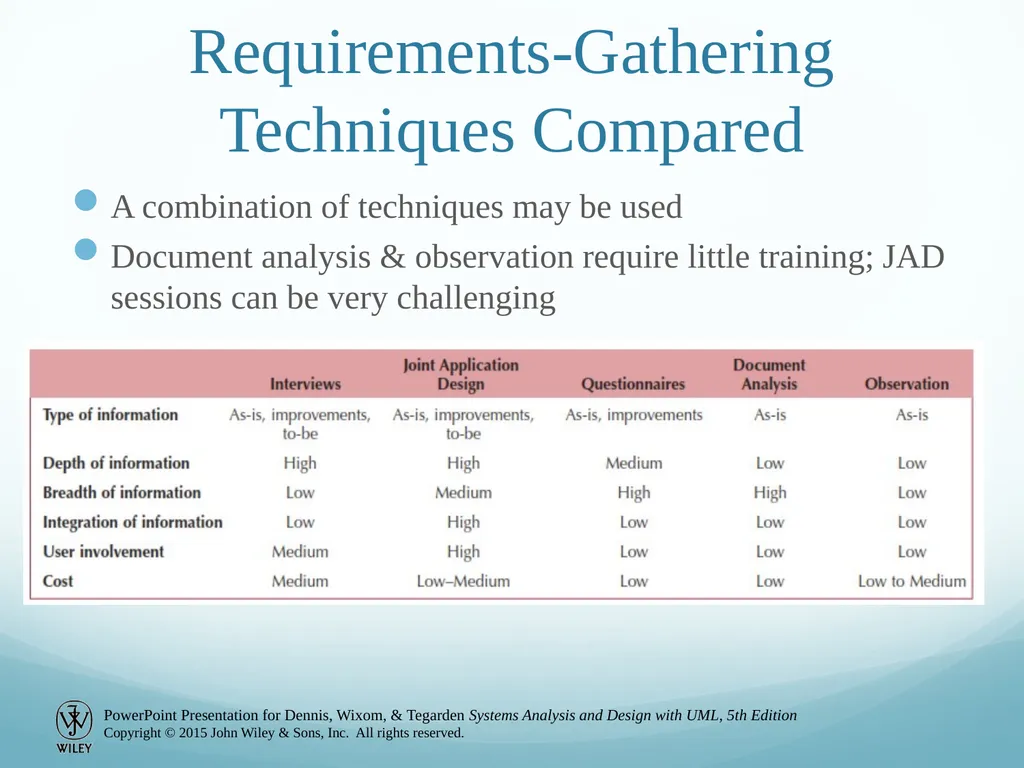
Requirements-Gathering Techniques Compared A combination of techniques may be used
Document analysis & observation require little training; JAD sessions can be very challenging<br>
Document analysis & observation require little training; JAD sessions can be very challenging<br>
26
Alternative Techniques Concept Maps
Represent meaningful relationships between concepts
Focus individuals on a small number of key ideas
User Stories, Story Cards & Task Lists
Associated with agile development methods
Very low tech, high touch, easily updatable, and very portable
Captured using story cards (index cards)
Capture both functional and nonfunctional requirements.<br>
27
Story Cards & Task Lists Capture requirement using story cards (index cards)
File card with single requirement
Each requirement (card) is discussed
How much effort is required to implement it
A task list is created for each requirement (story)
Large requirements can be split into smaller sections
The story can be prioritized by risk level and importance<br>
File card with single requirement
Each requirement (card) is discussed
How much effort is required to implement it
A task list is created for each requirement (story)
Large requirements can be split into smaller sections
The story can be prioritized by risk level and importance<br>
28
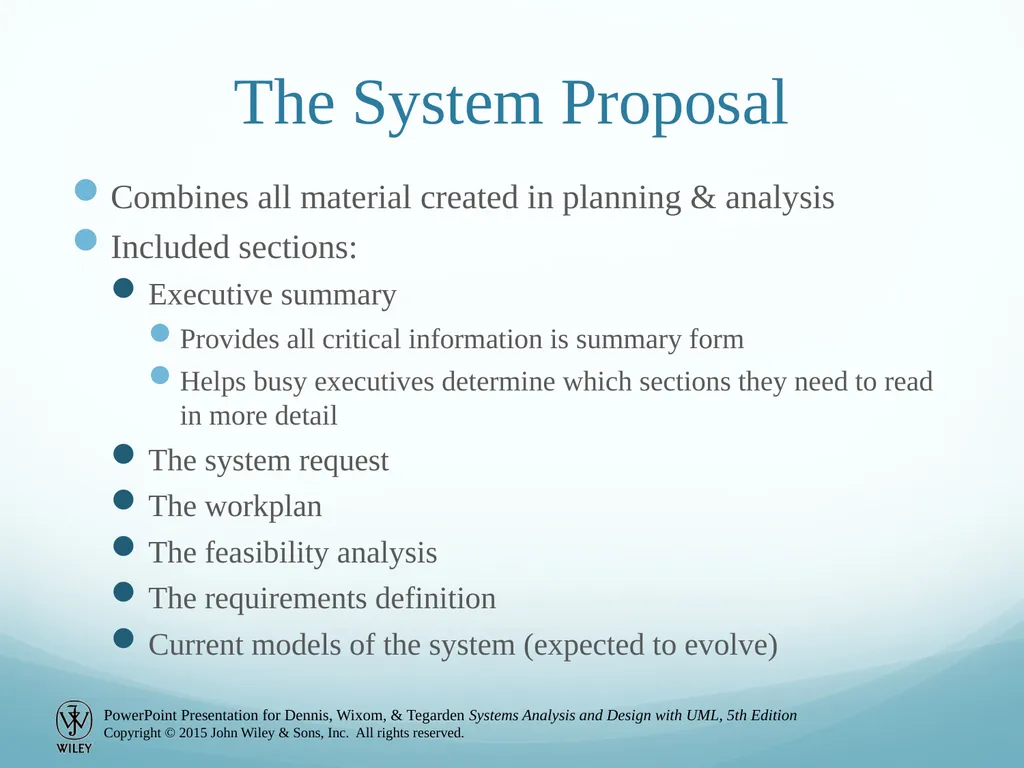
The System Proposal Combines all material created in planning & analysis
Included sections:
Executive summary
Provides all critical information is summary form
Helps busy executives determine which sections they need to read in more detail
The system request
The workplan
The feasibility analysis
The requirements definition
Current models of the system (expected to evolve)<br>
29
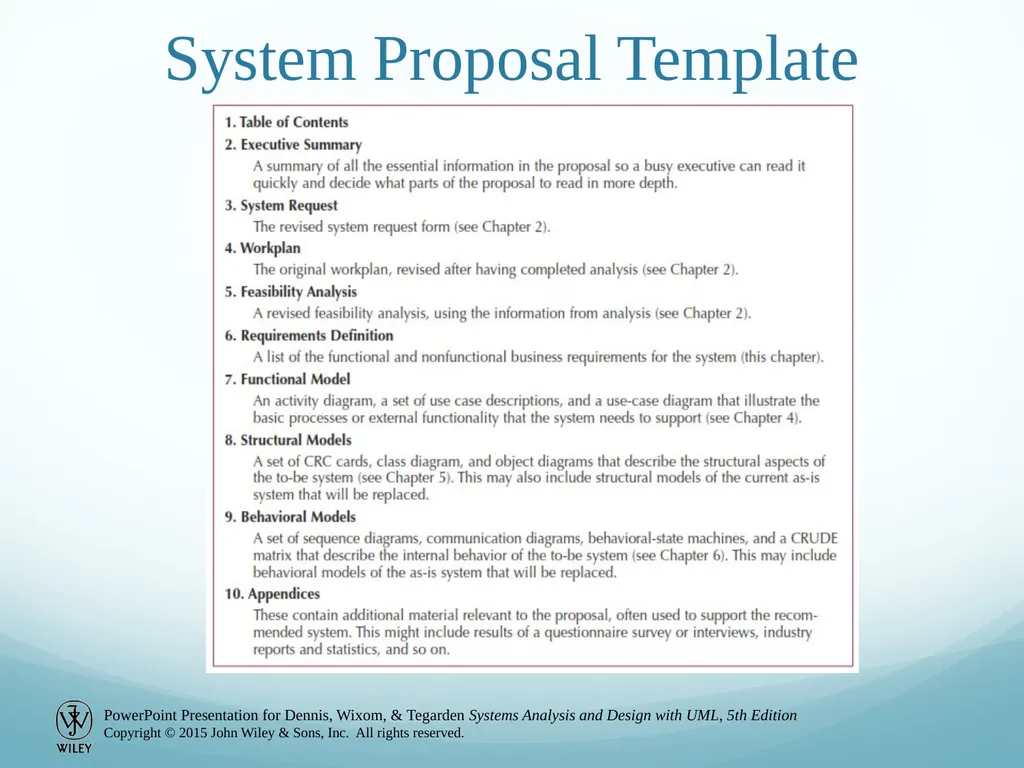
System Proposal Template<br>
30
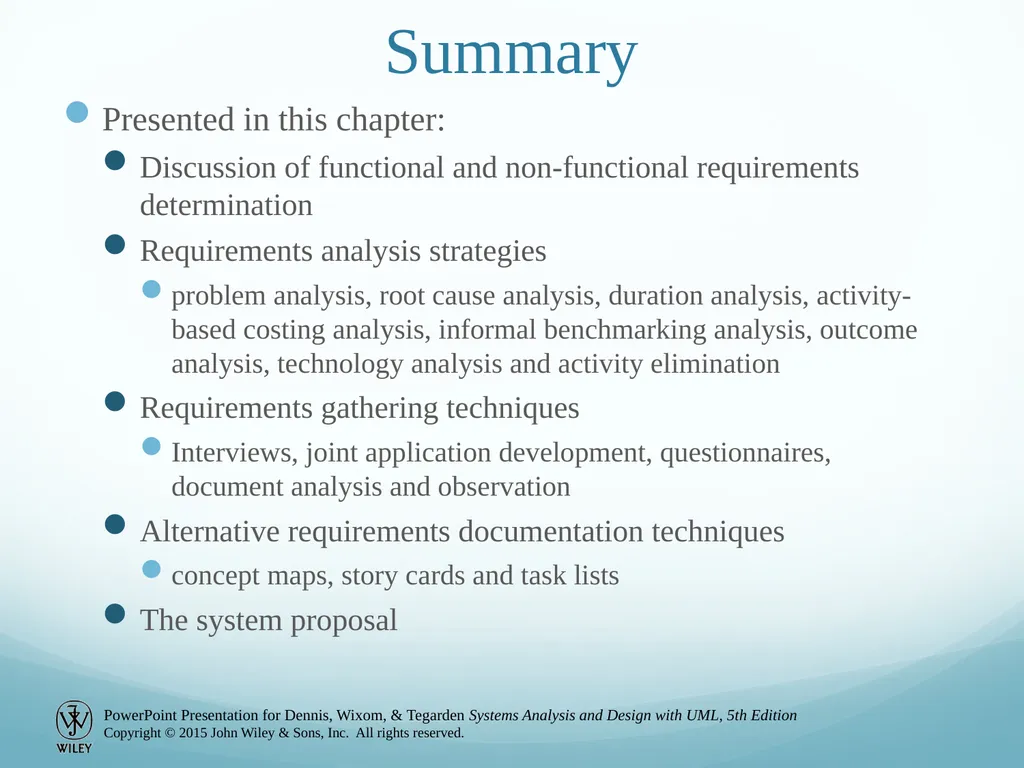
Summary Presented in this chapter:
Discussion of functional and non-functional requirements determination
Requirements analysis strategies
problem analysis, root cause analysis, duration analysis, activity-based costing analysis, informal benchmarking analysis, outcome analysis, technology analysis and activity elimination
Requirements gathering techniques
Interviews, joint application development, questionnaires, document analysis and observation
Alternative requirements documentation techniques
concept maps, story cards and task lists
The system proposal<br>