
CHAPTER 30 Pediatric Emergencies The following








Description: CHAPTER 30 Pediatric Emergencies The following presentation will utilize two symbols to identify material necessary for an OEC Technician to comprehend: Meets a Chapter Objective. This symbol will have the corresponding Objective Number
Related Topics
Download Presentation
"CHAPTER 30 Pediatric Emergencies The following" is the property of its rightful owner. Permission is granted to download and print the materials on this website for personal, non-commercial use only, and to display it on your personal computer provided you do not modify the materials and that you retain all copyright notices contained in the materials. By downloading content from our website, you accept the terms of this agreement.
Presentation Transcript
slide1. CHAPTER 30 Pediatric Emergencies<br>
slide2. The following presentation will utilize two symbols to identify material necessary for an OEC Technician to comprehend: Meets a Chapter Objective.
This symbol will have the corresponding Objective Number denoted within. Identifies a Key Term.
The Key Term will be underlined for easy identification. key term<br>
slide3. Objectives 30-1 List and describe the anatomic and physiologic differences between children and adults.
30-2 List and describe the six stages of child growth and development.
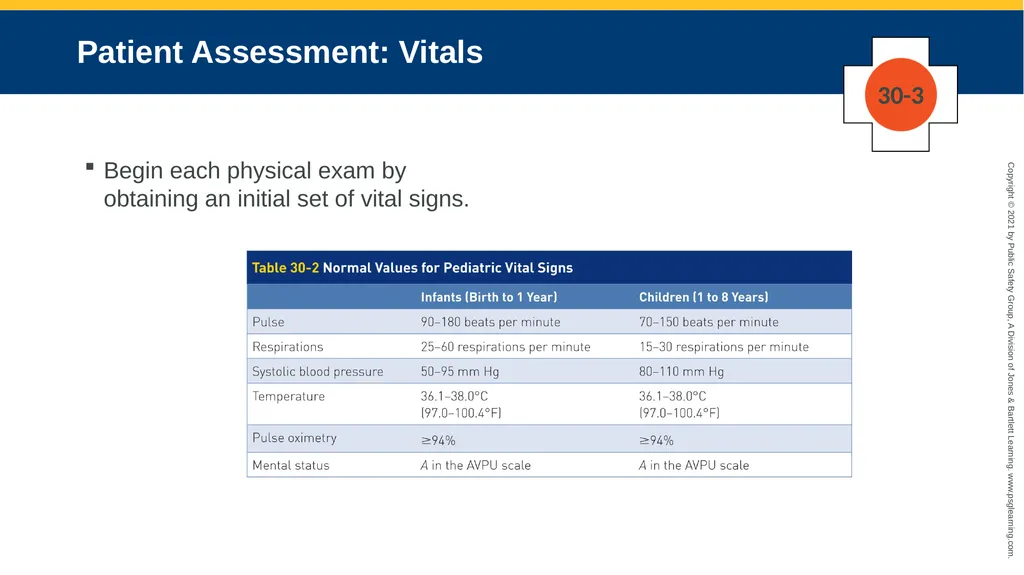
30-3 List the normal range of vital signs for each pediatric age group.
30-4 Explain and demonstrate how to communicate with a pediatric patient.
30-5 Describe the signs and symptoms of respiratory distress and failure in a child.<br>
slide4. Objectives 30-6 Identify the most common cause of cardiac arrest in pediatric patients.
30-7 List common causes of seizures in pediatric patients.
30-8 List indicators of potential child abuse and neglect.<br>
slide5. Objectives 30-9 Describe and demonstrate how to assess a pediatric patient.
30-10 Describe and demonstrate how to manage common pediatric illnesses and injuries.
30-11 Explain how to use the pediatric assessment triangle.<br>
slide6. Key Terms Child abuse
Child neglect
Epiglottitis
Fontanels
Meningitis
Pediatric assessment triangle
Shaken baby syndrome
Sudden infant death syndrome (SIDS)<br>
slide7. Chapter Overview<br>
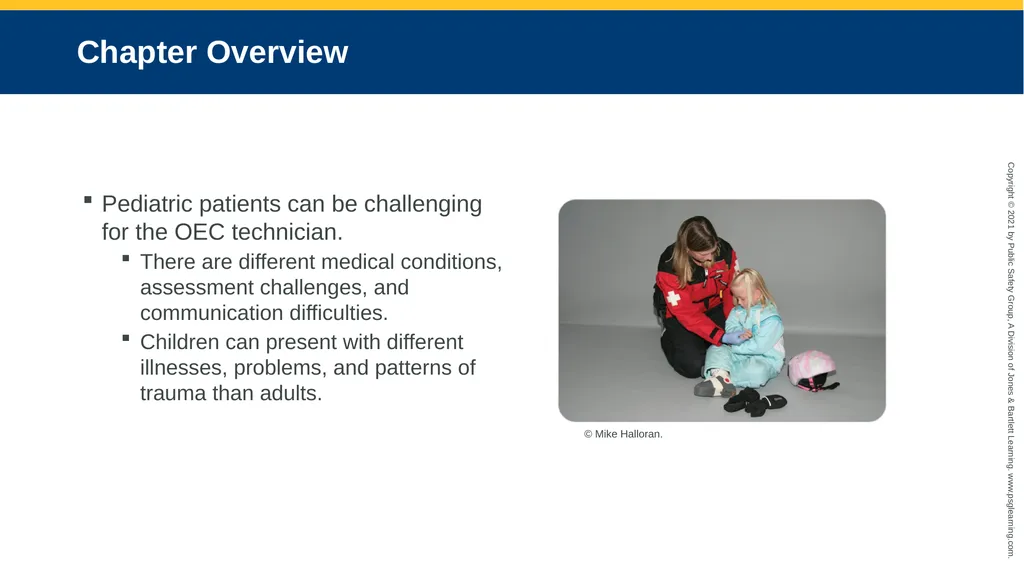
slide8. Chapter Overview Pediatric patients can be challenging for the OEC technician.
There are different medical conditions, assessment challenges, and communication difficulties.
Children can present with different illnesses, problems, and patterns of trauma than adults. © Mike Halloran.<br>
slide9. Chapter Overview A child’s unique physiology changes continually from birth to adulthood, which can make assessment and care difficult for OEC technicians.
Problems such as respiratory distress, temperature regulation, or trauma can be more difficult to manage in young patients.
A child’s ability to compensate for shock can cause a seemingly stable patient to deteriorate quickly.
This chapter defines medical conditions seen in the pediatric population.
Variations in assessment, including age-related vital signs, are provided.
The chapter describes strategies to help OEC technicians communicate with pediatric patients and their caregivers.<br>
slide10. Anatomy and Physiology<br>
slide11. Anatomy and Physiology Children are not miniature adults.
The same basic anatomy and physiology is present, but differences in understanding, size, proportion, and metabolism make pediatric patients unique.
Large variations in:
Behavior
Vital signs
The physical and emotional ability to cope with the stresses of injury and illness
These differences evolve as the child grows into a full-grown adult. 30-1<br>
slide12. Anatomy and Physiology Two of the most important anatomic differences between children and adults are:
The size of the airway
The mechanism of breathing
Differences are especially relevant in infants and younger children, who have relatively small mouths and airways.
Until approximately 8 years old, a child’s tongue is proportionally larger in relation to the oral cavity, which increases the risk of airway obstruction by the tongue. 30-1<br>
slide13. Anatomy and Physiology A child’s trachea is shorter and smaller in diameter, and it is more flexible because the tracheal cartilages have not yet fully developed.
Hyperextension of the neck can cause the trachea to become compressed or even collapsed.
Take care when opening the airway of an unresponsive child.
As children age, the oral cavity enlarges, the jaw elongates, and the tongue becomes proportionately flatter and smaller, allowing a relatively larger airway.
Larynx sits higher and more anteriorly in the neck and is funnel shaped. 30-1<br>
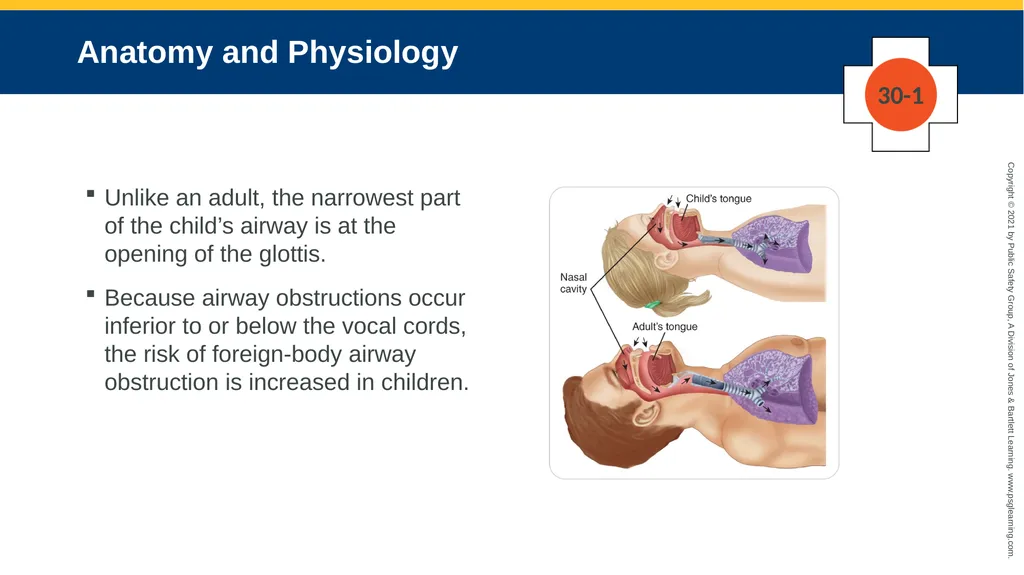
slide14. Anatomy and Physiology Unlike an adult, the narrowest part of the child’s airway is at the opening of the glottis.
Because airway obstructions occur inferior to or below the vocal cords, the risk of foreign-body airway obstruction is increased in children. 30-1<br>
slide15. Anatomy and Physiology A child’s head is proportionally larger and heavier in relation to the body than is an adult’s head.
More pronounced in younger children
As a result:
Young children are more susceptible to heat loss from the head.
During rapid deceleration, the head is propelled forward first, before the body.
Neck flexion can occur when a spine board is used.
Has implications for airway management and for maintaining a neutral cervical-spine alignment when a child’s neck is immobilized 30-1<br>
slide16. Anatomy and Physiology Children have a greater body surface area, thinner skin, and less muscle mass and body fat than adults.
Greater risk for heat loss
Faster absorption of toxins through the skin
Increased morbidity from burns
Greater risk for multiple organ injuries 30-1<br>
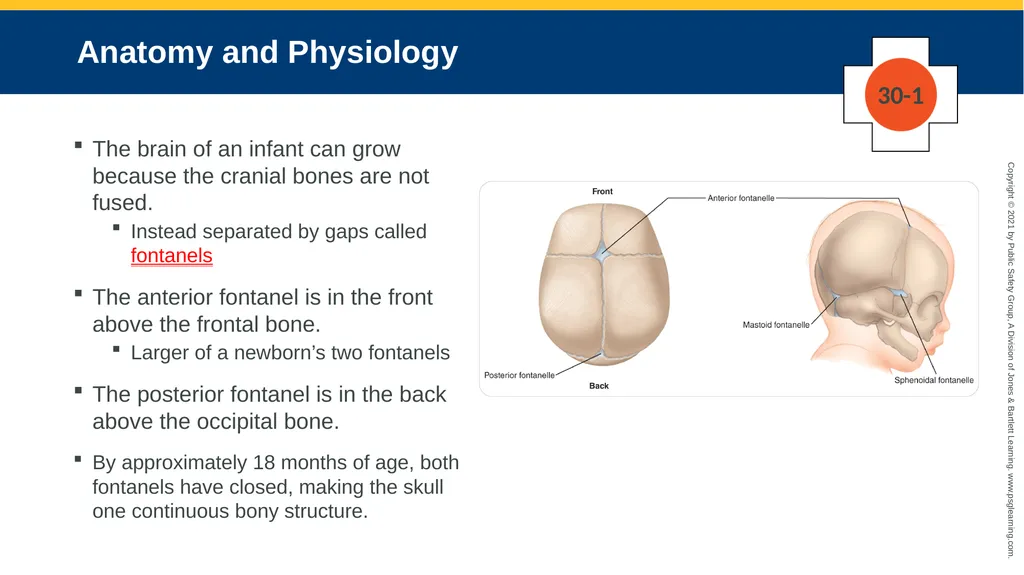
slide17. Anatomy and Physiology The brain of an infant can grow because the cranial bones are not fused.
Instead separated by gaps called fontanels
The anterior fontanel is in the front above the frontal bone.
Larger of a newborn’s two fontanels
The posterior fontanel is in the back above the occipital bone.
By approximately 18 months of age, both fontanels have closed, making the skull one continuous bony structure. 30-1<br>
slide18. Anatomy and Physiology A child’s musculoskeletal system is immature and grows rapidly, especially during the first year of life.
A child’s bones, joints, and ligaments are softer and more flexible than those of an adult.
As a result, a child’s skeletal system generally can absorb more force without breaking.
Thoracic cage also is more pliable.
Resulting in a higher rate of internal organ injury
Bones can bend without breaking (greenstick fracture). 30-1<br>
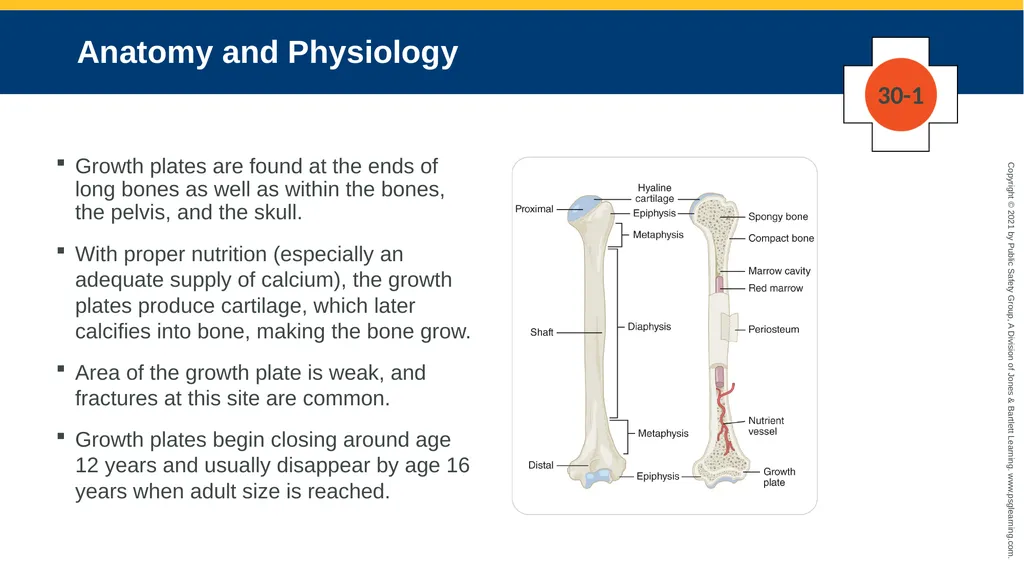
slide19. Anatomy and Physiology Growth plates are found at the ends of long bones as well as within the bones, the pelvis, and the skull.
With proper nutrition (especially an adequate supply of calcium), the growth plates produce cartilage, which later calcifies into bone, making the bone grow.
Area of the growth plate is weak, and fractures at this site are common.
Growth plates begin closing around age 12 years and usually disappear by age 16 years when adult size is reached. 30-1<br>
slide20. Anatomy and Physiology Compared to adults, children have a higher rate of metabolism (burn energy more quickly) and have fewer energy reserves.
Why children exhibit great bursts of energy followed by sudden, profound fatigue
Why children need regular meals and can consume enormous amounts of carbohydrates at once without ill effects
The younger the child, the more frequently meals are needed. 30-1<br>
slide21. Anatomy and Physiology Children and adults also differ in how they breathe.
Newborns breathe through their nose.
If a newborn’s nose becomes obstructed by mucus or a foreign body, breathing difficulty will occur quickly.
Infants and small children rely on diaphragmatic breathing (“belly breathers”) because their intercostal muscles are not yet fully developed. 30-1<br>
slide22. Anatomy and Physiology Children of all ages breathe at a faster rate than do adults.
Body’s primary response to respiratory distress is to increase the rate and effort of breathing.
Younger children start with a faster rate and effort of breathing.
They tire easily and have a higher incidence of respiratory failure.
Reason why many pediatric emergencies begin with respiratory distress 30-1<br>
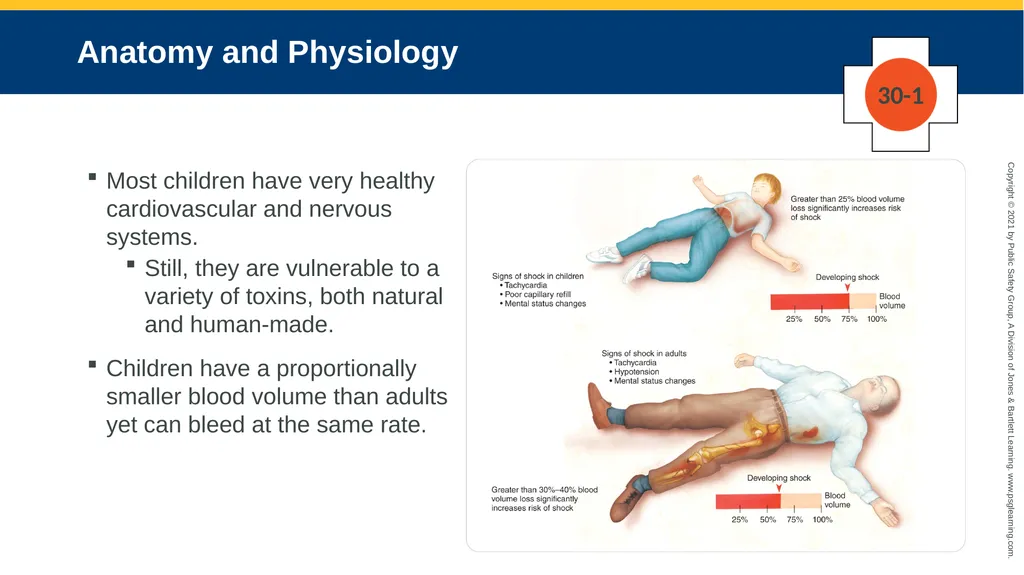
slide23. Anatomy and Physiology Most children have very healthy cardiovascular and nervous systems.
Still, they are vulnerable to a variety of toxins, both natural and human-made.
Children have a proportionally smaller blood volume than adults yet can bleed at the same rate. 30-1<br>
slide24. Anatomy and Physiology Children have a higher heart rate and lower blood pressure.
This combination enables a child to initially compensate better to shock.
The compensatory mechanisms can fail quickly, which can cause an apparently healthy child to suddenly go into life-threatening shock, often with little or no warning.
Hypovolemia, whether due to blood loss, vomiting, or diarrhea, can quickly lead to decompensated shock. 30-1<br>
slide25. Anatomy and Physiology Due to an underdeveloped hypothalamus in the brain, children have difficulty regulating body temperature, which places them at high risk for both hyperthermia and hypothermia.
Child’s temperature can rapidly rise from illnesses to 40.6°C (105°F), creating an emergent condition.
Equally important, the larger ratio of skin surface area to body mass in children (infants through school-age) can cause rapid cooling, which, when combined with a slow central nervous system response, can result in hypothermia. 30-1<br>
slide26. Human Growth and Development Between birth and the age of 18 years, humans undergo a great variety of physical, intellectual, emotional, and social changes. Language evolves from crying and grunts to organized spoken words and written communication.
The rate of change varies from child to child, but the pattern of development leading to adulthood moves through six identifiable but overlapping stages:
Newborn (neonatal) stage
Infancy
Toddler
Preschool
School-age
Adolescence
Reference Table 30-1 30-2<br>
slide27. Common Pediatric Illnesses and Injuries<br>
slide28. Common Pediatric Illnesses and Injuries Children suffer a variety of medical disorders and traumatic injuries.
Some disorders occur more frequently in certain pediatric age groups than in others.
Respiratory emergencies are common.
Airway Problems
The most common upper airway conditions that cause respiratory emergencies in children are:
Croup
Tonsillitis
Foreign-body airway obstruction
Lower airway problems such as bronchiolitis, pneumonia, and asthma can also occur. 30-5<br>
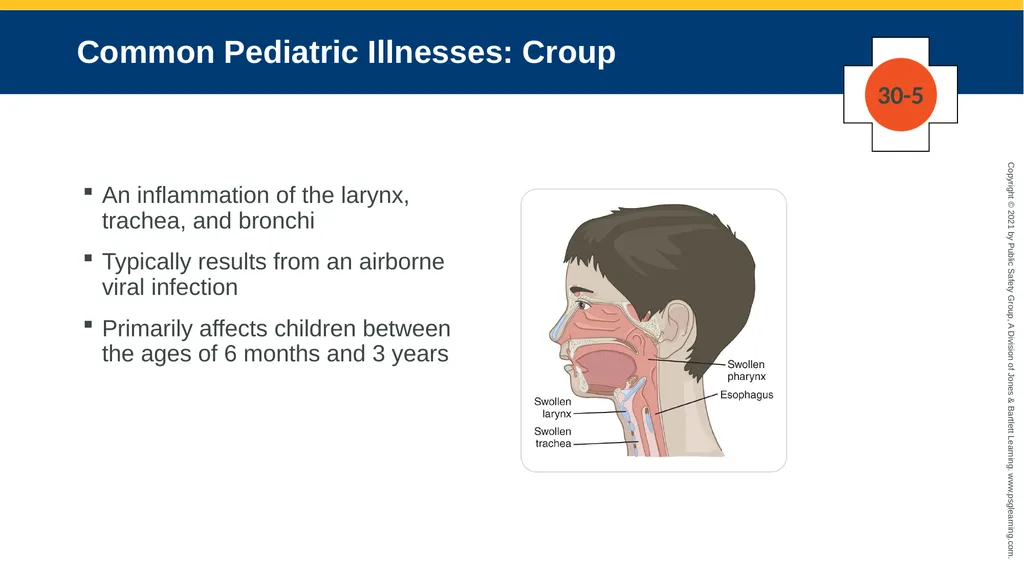
slide29. Common Pediatric Illnesses: Croup An inflammation of the larynx, trachea, and bronchi
Typically results from an airborne viral infection
Primarily affects children between the ages of 6 months and 3 years 30-5<br>
slide30. Common Pediatric Illnesses: Croup Characterized by sudden onset of a sharp, seal-like barking cough
Most cases occur in the late fall and winter and are preceded by 2 to 3 days of “cold-like” symptoms (runny nose, increased mucus production, and fever).
Although most cases are mild and resolve without complications, croup can produce severe respiratory distress.
Younger children are generally more affected due to the smaller size of the airways. 30-5<br>
slide31. Common Pediatric Illnesses: Tonsillitis An inflammation of the tonsils
A common childhood disease that primarily affects children ages 5 to 15 years
Usually results from a viral infection
Can also be caused from “strep throat,” a bacterial infection
Characterized by severe sore throat and difficulty swallowing
Rarely results in respiratory distress 30-5<br>
slide32. Common Pediatric Injuries: Foreign-Body Obstruction Small objects such as hard candy, toy parts, or coins can become lodged in a child’s airway.
Resulting in partial or complete obstruction
Young children often explore their world by placing objects in their nose or mouth.
Food is the primary cause of foreign-body airway obstruction in older children.
Is primarily due to either putting too much food in the mouth or not completely chewing food
Dislodged teeth or vomitus can also cause partial or complete airway obstruction. 30-5<br>
slide33. Common Pediatric Illnesses: Bronchiolitis Inflammation of the bronchioles caused by a viral infection
Most cases occur in children younger than 2 years.
Develops over a period of 2 to 3 days
Characterized by fever, cough, and difficulty breathing
In some cases can be severe 30-5<br>
slide34. Common Pediatric Illnesses: Pneumonia A viral or bacterial infection of the lungs that is often preceded by an upper respiratory infection, a fever, and a cough
Can occur any time of year but is most commonly encountered during the winter and spring
Children who have aspirated a foreign body or have a history of either recurring respiratory infections or chronic illnesses are at greater risk for contracting pneumonia.
Untreated, pneumonia can lead to respiratory distress, respiratory failure, and even respiratory arrest.
Similar condition when the lungs are exposed to certain chemicals 30-5<br>
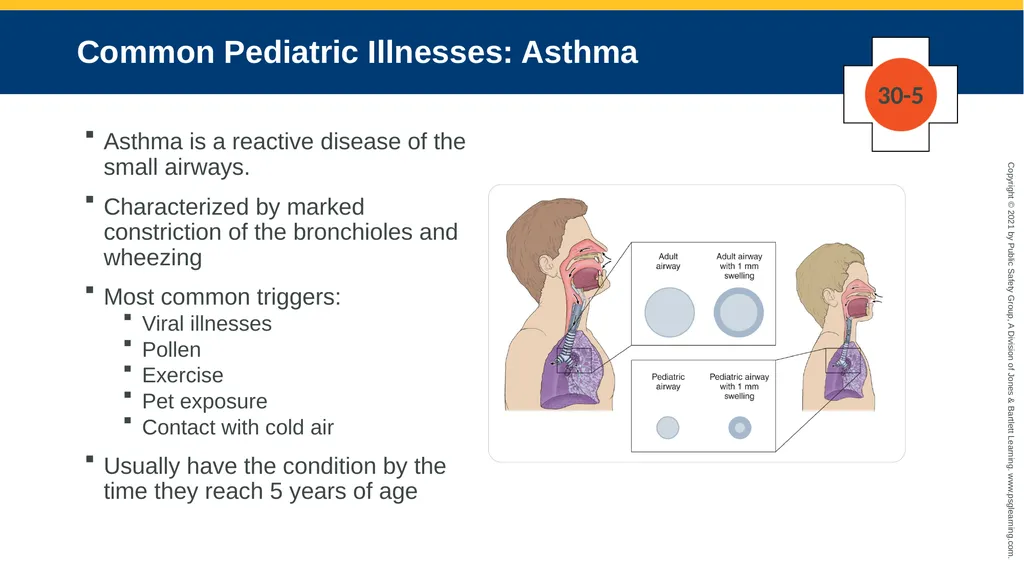
slide35. Common Pediatric Illnesses: Asthma Asthma is a reactive disease of the small airways.
Characterized by marked constriction of the bronchioles and wheezing
Most common triggers:
Viral illnesses
Pollen
Exercise
Pet exposure
Contact with cold air
Usually have the condition by the time they reach 5 years of age 30-5<br>
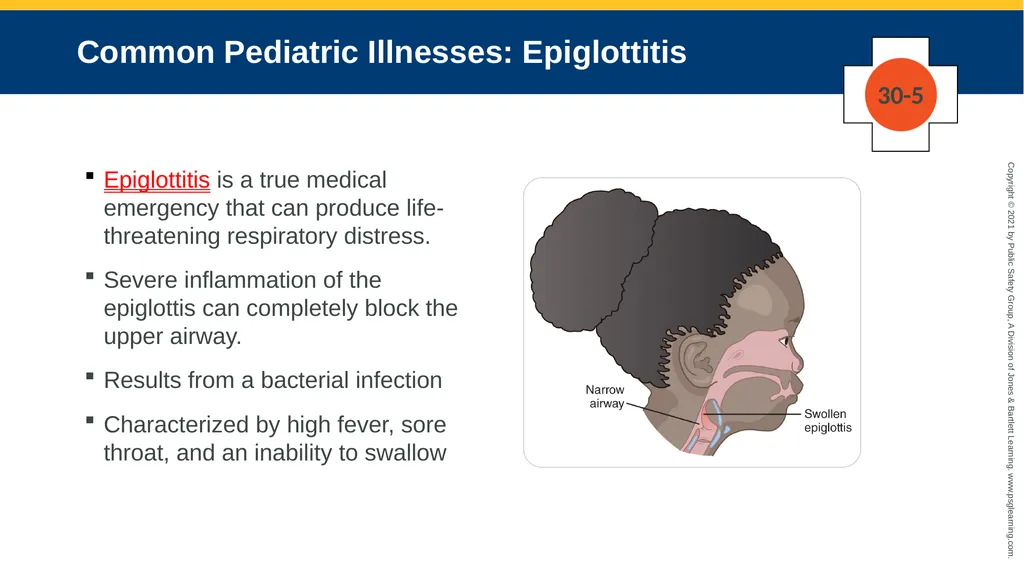
slide36. Common Pediatric Illnesses: Epiglottitis Epiglottitis is a true medical emergency that can produce life-threatening respiratory distress.
Severe inflammation of the epiglottis can completely block the upper airway.
Results from a bacterial infection
Characterized by high fever, sore throat, and an inability to swallow 30-5<br>
slide37. Common Pediatric Illnesses: Epiglottitis Hallmark is a patient who is sitting forward, is very still, and is drooling.
If not treated quickly, can result in death
Most commonly affects children ages 1 to 7 years
Still seen in nonvaccinated populations, including individuals immigrating from countries where the vaccine is not commonly administered 30-5<br>
slide38. Common Pediatric Illnesses: Respiratory Failure Respiratory failure is defined as the inability of the lungs to exchange gases properly.
True emergency that if not immediately corrected can be quickly fatal
Children are more susceptible to respiratory failure than are adults.
Children are more susceptible because:
Their immune systems are not fully developed.
Upper and lower airways are narrower and thus more easily obstructed by swelling or secretions.
The respiratory muscles are inefficient and become fatigued rapidly.
When a child has trouble breathing, the body compensates quickly by increasing the heart and respiratory rates.
The process has a potentially fatal drawback: as the heart rate dramatically increases, so do the heart’s oxygen needs. 30-5<br>
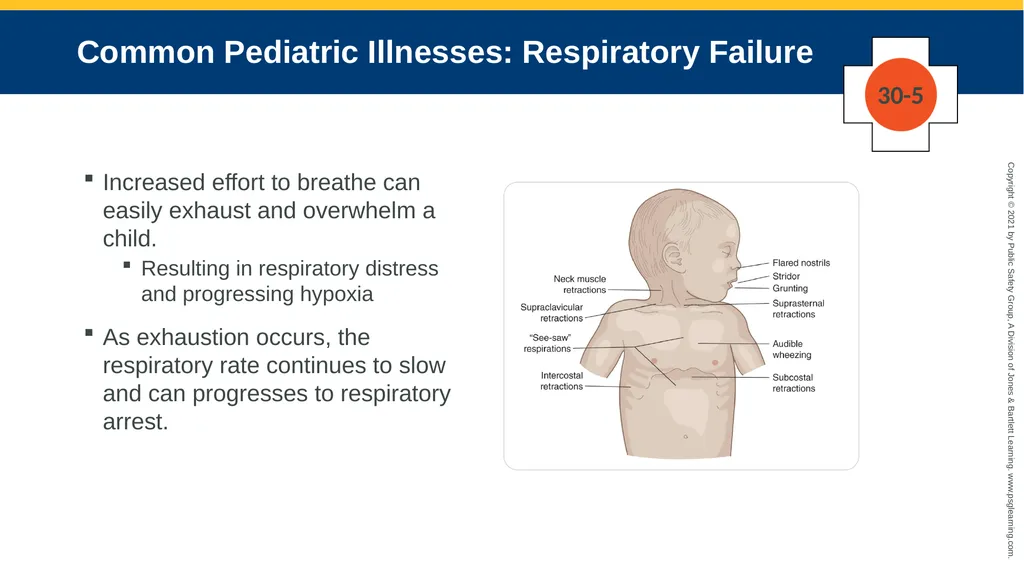
slide39. Common Pediatric Illnesses: Respiratory Failure Increased effort to breathe can easily exhaust and overwhelm a child.
Resulting in respiratory distress and progressing hypoxia
As exhaustion occurs, the respiratory rate continues to slow and can progresses to respiratory arrest. 30-5<br>
slide40. Common Pediatric Illnesses: Cardiac Arrest Most cases of cardiac arrest in children are preceded by respiratory arrest.
Development of relative bradycardia in a child with respiratory distress is an ominous sign of impending respiratory and cardiac arrest. 30-6<br>
slide41. Common Pediatric Illnesses: Seizures An electrical disturbance within the brain that results in alterations in:
Awareness
Attentiveness
Responsiveness
Behavior
Body movement
May be classified as either:
Partial (affecting one part or side of the body) or
Generalized (affecting both sides simultaneously)
Many causes of seizure include fever, hypoxia, diabetes, epilepsy, toxins, and head injury. 30-7<br>
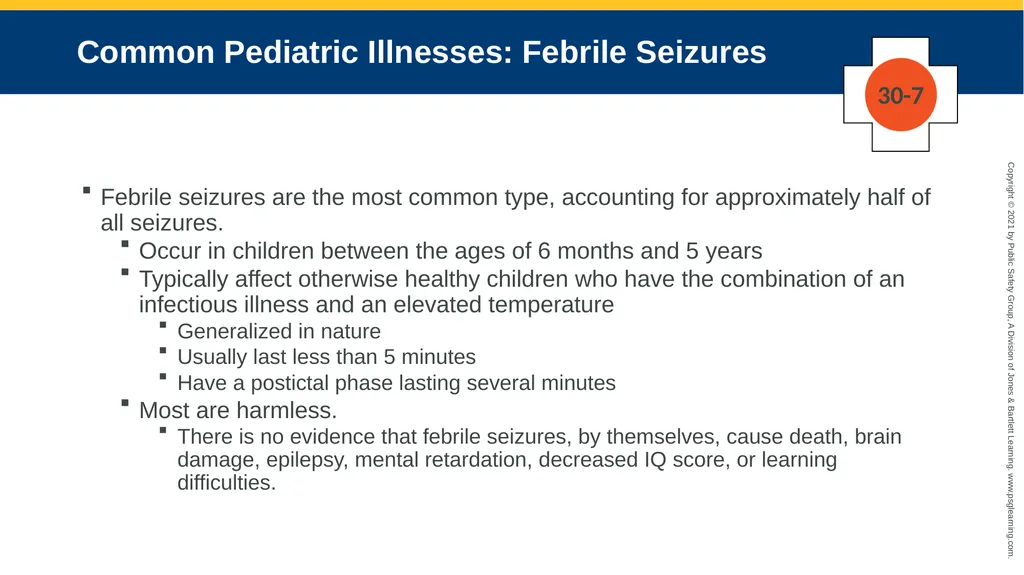
slide42. Common Pediatric Illnesses: Febrile Seizures Febrile seizures are the most common type, accounting for approximately half of all seizures.
Occur in children between the ages of 6 months and 5 years
Typically affect otherwise healthy children who have the combination of an infectious illness and an elevated temperature
Generalized in nature
Usually last less than 5 minutes
Have a postictal phase lasting several minutes
Most are harmless.
There is no evidence that febrile seizures, by themselves, cause death, brain damage, epilepsy, mental retardation, decreased IQ score, or learning difficulties. 30-7<br>
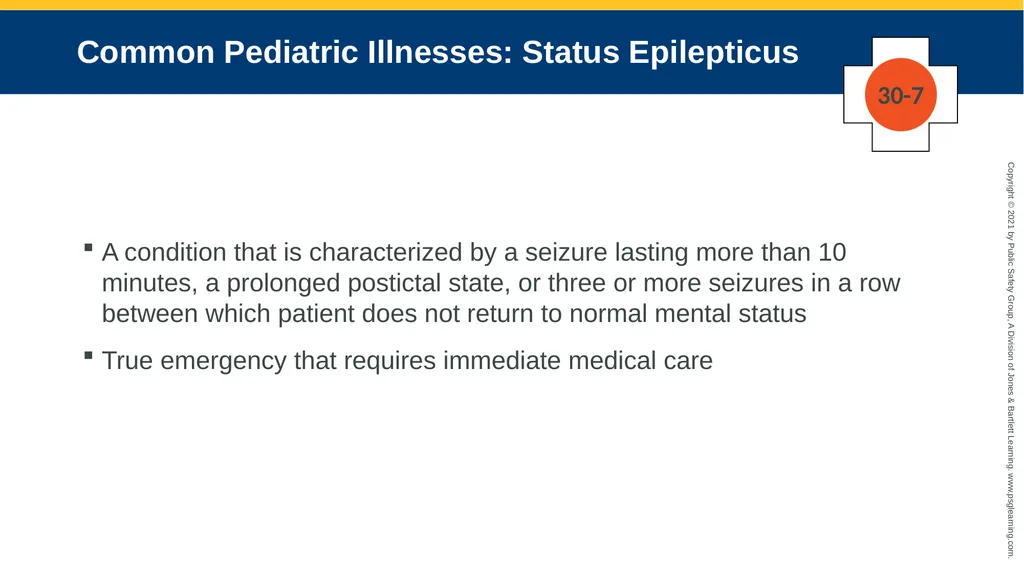
slide43. Common Pediatric Illnesses: Status Epilepticus A condition that is characterized by a seizure lasting more than 10 minutes, a prolonged postictal state, or three or more seizures in a row between which patient does not return to normal mental status
True emergency that requires immediate medical care 30-7<br>
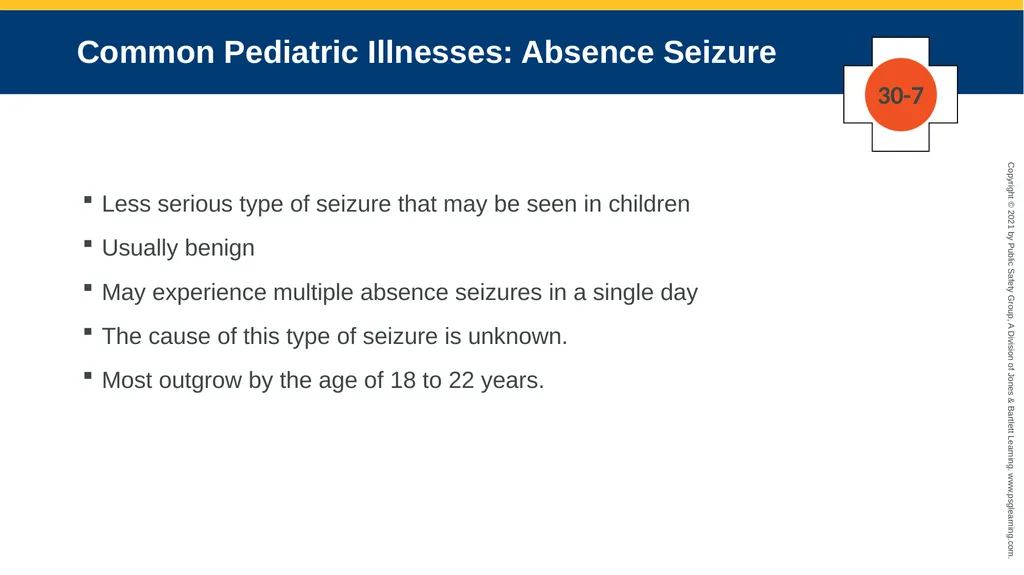
slide44. Common Pediatric Illnesses: Absence Seizure Less serious type of seizure that may be seen in children
Usually benign
May experience multiple absence seizures in a single day
The cause of this type of seizure is unknown.
Most outgrow by the age of 18 to 22 years. 30-7<br>
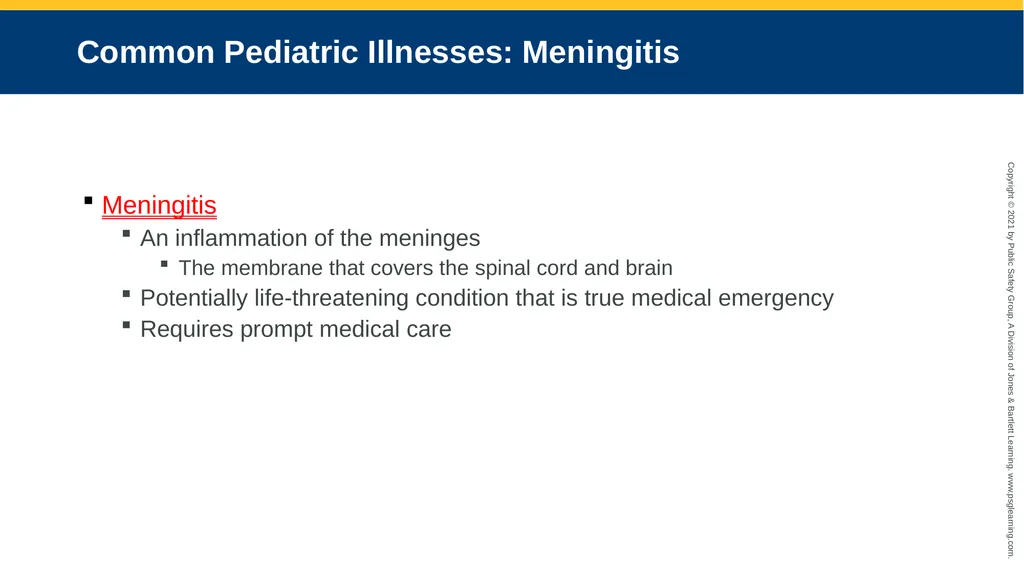
slide45. Common Pediatric Illnesses: Meningitis Meningitis
An inflammation of the meninges
The membrane that covers the spinal cord and brain
Potentially life-threatening condition that is true medical emergency
Requires prompt medical care<br>
slide46. Common Pediatric Illnesses: SIDS Sudden Infant Death Syndrome (SIDS):
An unexpected death of an infant due to undetermined causes<br>
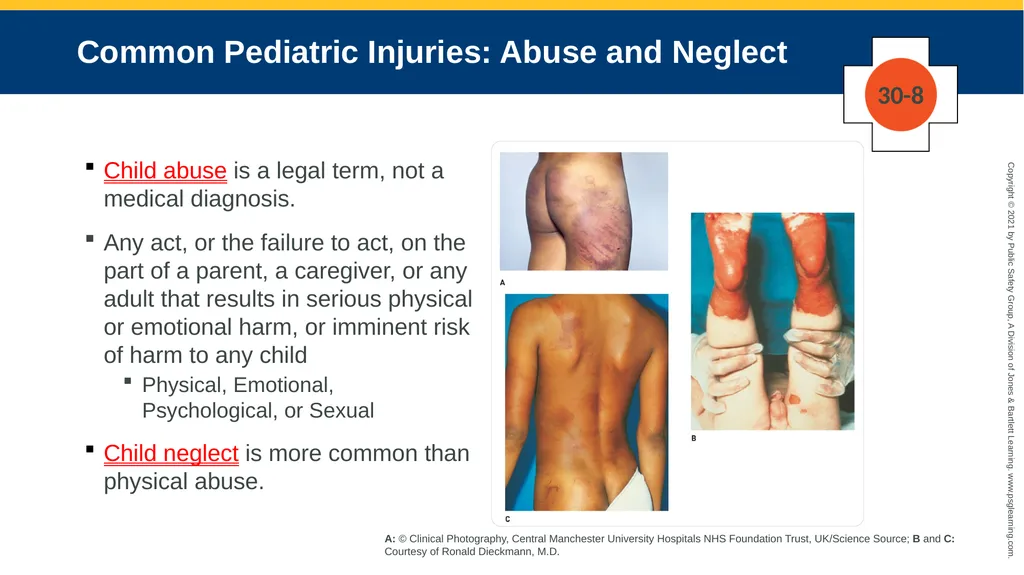
slide47. Common Pediatric Injuries: Abuse and Neglect Child abuse is a legal term, not a medical diagnosis.
Any act, or the failure to act, on the part of a parent, a caregiver, or any adult that results in serious physical or emotional harm, or imminent risk of harm to any child
Physical, Emotional, Psychological, or Sexual
Child neglect is more common than physical abuse. 30-8 A: © Clinical Photography, Central Manchester University Hospitals NHS Foundation Trust, UK/Science Source; B and C: Courtesy of Ronald Dieckmann, M.D.<br>
slide48. Common Pediatric Injuries: Shaken Baby Syndrome Shaken Baby Syndrome
A form of physical abuse
Person picks up and intentionally shakes a newborn, an infant, or a young toddler.
Ensuing “whiplash” effect causes the child’s brain to forcefully contact the bones within the skull.
Traumatic brain injury can result, often with fatal consequences.
Most cases of shaken baby syndrome are perpetrated by the child’s caregiver, babysitter, or someone close to the child.
Shaken baby syndrome should be suspected if the child is younger than 1 year old and the caregiver cannot give a plausible explanation. 30-8<br>
slide49. Common Pediatric Injuries: Abuse and Neglect Some adults may express their fear and genuine worry for an injured child by acting angry.
However, it is prudent to suspect child abuse whenever a parent or caregiver becomes verbally abusive to a child or berates the child for getting hurt.
Calling a child names such as “stupid” or “idiot”
Children who completely withdraw from or cringe at the sight of a parent or caregiver should be considered at risk. 30-8<br>
slide50. Common Pediatric Injuries: Reporting Abuse Even though child abuse is a crime in all states and provinces, the laws regarding the reporting of possible abuse vary.
Most states and provinces allow anonymous reporting to prevent retaliation.
Individuals who report suspected abuse are legally shielded from lawsuits but only if they report suspected abuse to the proper agency.
The report of abuse starts an investigation by specially trained social workers, nurses, and physicians, who look for the signs and symptoms of abuse.
Investigation is stopped if corroborating evidence is not found.
If abuse is substantiated, intervention services are implemented. 30-8<br>
slide51. Patient Assessment<br>
slide52. Assessment of The Pediatric Patient Assessment of a pediatric patient follows the same steps as that of an adult, but does require some modification:
The heart rate and respiratory rate can change very rapidly because of the child’s emotional response to injury or fear of being approached by a stranger.
Child’s crying can make assessment very difficult.
Metabolic compensation mechanisms in a child’s body can make the condition appear stable when, in fact, patient is in shock.
Must not assume that all is well with a child who does not exhibit findings of serious illness or injury
Need to carefully evaluate both the child and the mechanism of injury or nature of illness 30-9<br>
slide53. Patient Assessment: Scene Size-Up The assessment process begins with a scene size-up.
Remove all potential hazards.
Do not overlook seemingly innocuous objects such as a pencil, keys, or small objects that could become a hazard in the hands of a curious child.
If numerous potential hazards are present, consider moving a patient who does not have a spinal injury and their caregiver to a safer, more secure location.
If trauma is suspected, attempt to determine the mechanism of injury, and be sure to assess it carefully and in context with the child’s anatomy and developmental stage.
Observe proper standard precautions. 30-9<br>
slide54. Patient Assessment: Consent If a parent is present, be sure to ask for permission to assess and care for children younger than 18 years.
If there are no contraindications, leave a young child in the caregiver’s arms.
Helps both to feel more secure and in control
Many children obtain cues from their parent or caregiver that may dictate their response.
If the parent is comfortable, the child will likely be less afraid and more cooperative.
If a parent or caregiver is not present, and the child needs care, implied consent takes effect.
Always kneel or sit at the child’s level. 30-4<br>
slide55. Patient Assessment: Primary Assessment Perform a primary assessment in the usual manner.
Pay close attention to potential threats to life, especially severe bleeding, and correct any that may be present.
Because cardiac arrest in pediatric patients is generally preceded by respiratory arrest, assess the airway and respirations very carefully.
Frequently reassess the ABCDs.
If there is any evidence of ABCD-related compromise:
Treat the problem.
Request ALS assistance immediately.
Rapidly transport patient to a definitive-care facility. 30-9<br>
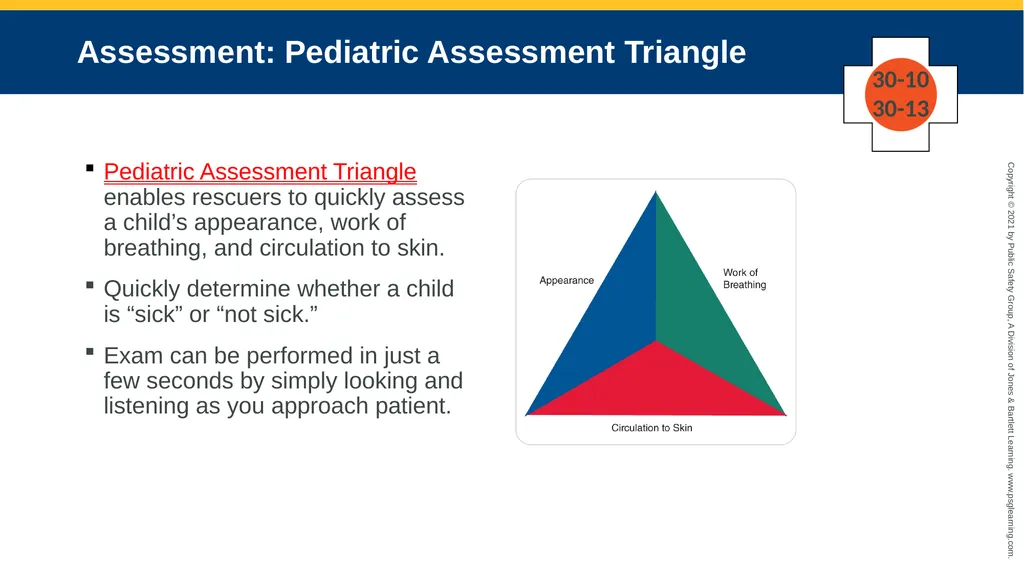
slide56. Assessment: Pediatric Assessment Triangle Pediatric Assessment Triangle enables rescuers to quickly assess a child’s appearance, work of breathing, and circulation to skin.
Quickly determine whether a child is “sick” or “not sick.”
Exam can be performed in just a few seconds by simply looking and listening as you approach patient. 30-10
30-13<br>
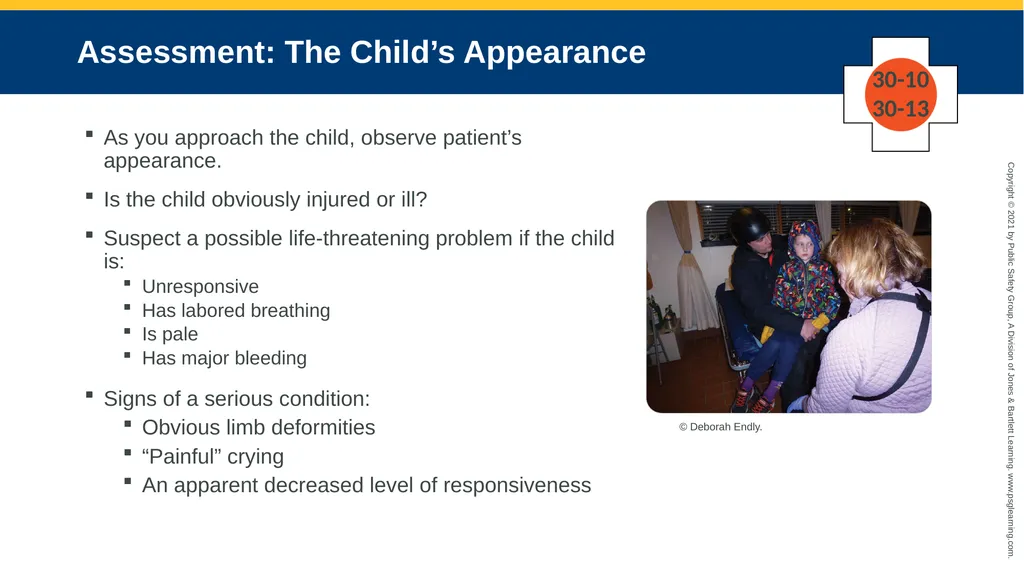
slide57. Assessment: The Child’s Appearance As you approach the child, observe patient’s appearance.
Is the child obviously injured or ill?
Suspect a possible life-threatening problem if the child is:
Unresponsive
Has labored breathing
Is pale
Has major bleeding
Signs of a serious condition:
Obvious limb deformities
“Painful” crying
An apparent decreased level of responsiveness 30-10
30-13 © Deborah Endly.<br>
slide58. Assessment: The Child’s Appearance If there are no obvious findings of major illness or injury, ask yourself:
Is the child active and moving about, or is the child quiet and sitting still?
Children who are laughing or playful are not seriously ill.
A child who sits still or is sitting forward and drooling is in a condition that warrants rapid transport.
Does the child make eye contact?
Generally a good sign if a child immediately focuses on your face and can follow your movements.
Toddlers or preschoolers who make eye contact with you, start crying, and then immediately seek their parent are probably not seriously ill.
Children who do not engage you or look at you and then refocus on themselves, have a weak cry, or are not moving should alert you to a possible serious medical condition. 30-10
30-13<br>
slide59. Assessment: The Child’s Appearance Does the child appear irritable or agitated?
Under normal conditions, a parent or caregiver should be able to console and quiet a child.
Children who are ill often cry or whine upon even small movements or changes in position and often cannot be comforted.
An infant who is paradoxically irritable—that is, one who becomes quiet when left alone but is irritable when in the caregiver’s arms—should be considered very ill.
Does the child respond to the caregiver’s voice?
A child who quiets, smiles, or appropriately responds to a caregiver’s voice is generally less ill than one who does not. 30-10
30-13<br>
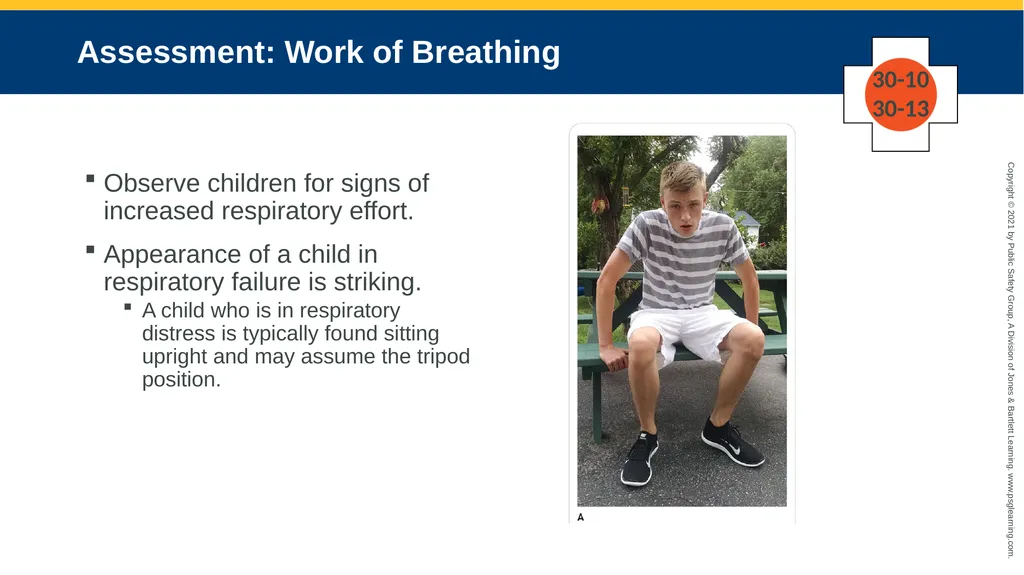
slide60. Assessment: Work of Breathing Observe children for signs of increased respiratory effort.
Appearance of a child in respiratory failure is striking.
A child who is in respiratory distress is typically found sitting upright and may assume the tripod position. 30-10
30-13<br>
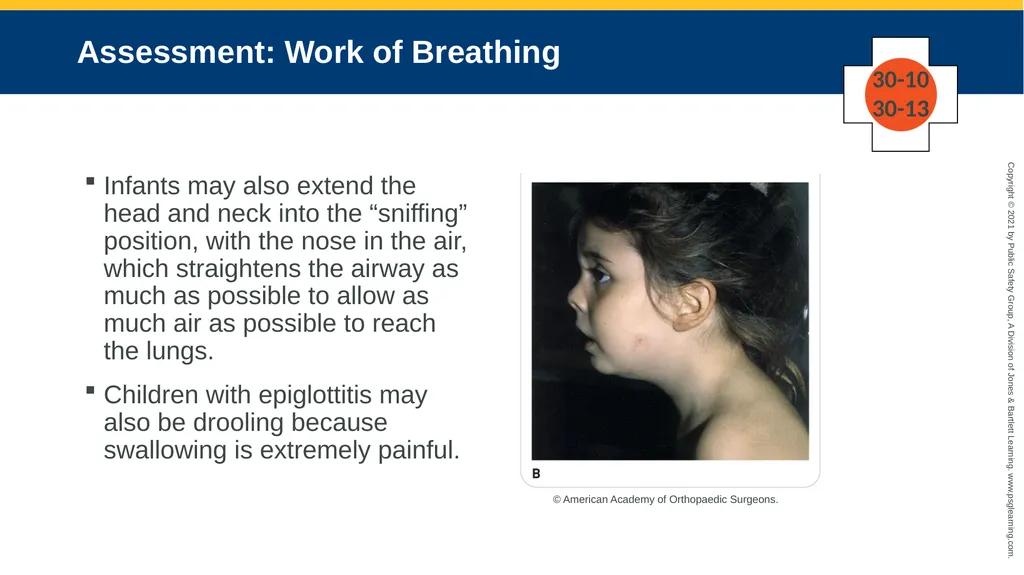
slide61. Assessment: Work of Breathing Infants may also extend the head and neck into the “sniffing” position, with the nose in the air, which straightens the airway as much as possible to allow as much air as possible to reach the lungs.
Children with epiglottitis may also be drooling because swallowing is extremely painful. 30-10
30-13 © American Academy of Orthopaedic Surgeons.<br>
slide62. Assessment: Work of Breathing Look for the use of accessory muscles and for nasal flaring.
Child’s head may bob up and down as the sternocleidomastoid muscles contract during inhalation and relax during exhalation.
Paradoxical breathing, also known as see-saw breathing, may be present.
Abdomen extends outward, and the chest collapses inward upon inhalation.
During exhalation, the opposite occurs: the abdomen sinks inward, and the chest protrudes outward.
If shirtless, look for retractions, where the soft tissues above the sternum and clavicles and between and below the ribs sink inward upon inhalation.
In older children, retraction becomes less obvious. 30-10
30-13<br>
slide63. Assessment: Work of Breathing Listen to how the child is breathing.
Respiratory sounds can vary greatly with the severity of distress, ranging from an almost inaudible sigh to wheezing or grunting.
Sounds can be heard during inhalation, exhalation, or both.
Indications of lower airway problems and severe respiratory distress:
Wheezing may be heard during inhalation or exhalation.
A high-pitched whistling sound
Grunting is heard only during exhalation.
A low-pitched sound that may sometimes resemble a whimper
Usually constant but can be intermittent
Grunting opens the smallest passages to the alveoli, maximizing gas exchange.
Stridor—high-pitched sound upon inspiration
Suggests croup 30-10
30-13<br>
slide64. Assessment: Work of Breathing Do not just ask “Is the air moving?” but “Is air moving well?”
Observe how fast the child is breathing.
Pain, anxiety, fear, excitement, and other factors can increase the respiratory rate.
The normal rate of respiration depends on the age of the child.
Crying generally indicates that air is moving in and out of the lungs well. 30-10
30-13<br>
slide65. Assessment: Circulation to the Skin Assess the child’s skin color for clues regarding the perfusion of patient’s tissues.
If poor lighting, cold environments, or dark skin make assessment more difficult, assess the sclera of the eyes, the lips, or the palms of the hands.
Skin should appear pink, not pale, mottled, gray, or blue.
If pink, the child is generally well oxygenated and has good tissue perfusion.
An exception to this rule is carbon monoxide poisoning, in which the skin may appear pink or red even though blood oxygen levels are very low. 30-10
30-13<br>
slide66. Assessment: Circulation to the Skin Paleness suggests that either the blood is poorly saturated with oxygen or circulation is poor.
Seen with excessive blood loss, respiratory distress, or heart failure
Mottled skin or gray skin also indicates poor tissue perfusion.
Cyanosis, a bluish tint to the skin and mucous membranes, is an ominous sign that indicates a serious respiratory problem or hypoxia.
Use a pulse oximeter and make sure the oxygen saturation is greater than or equal to 94%. 30-10
30-13<br>
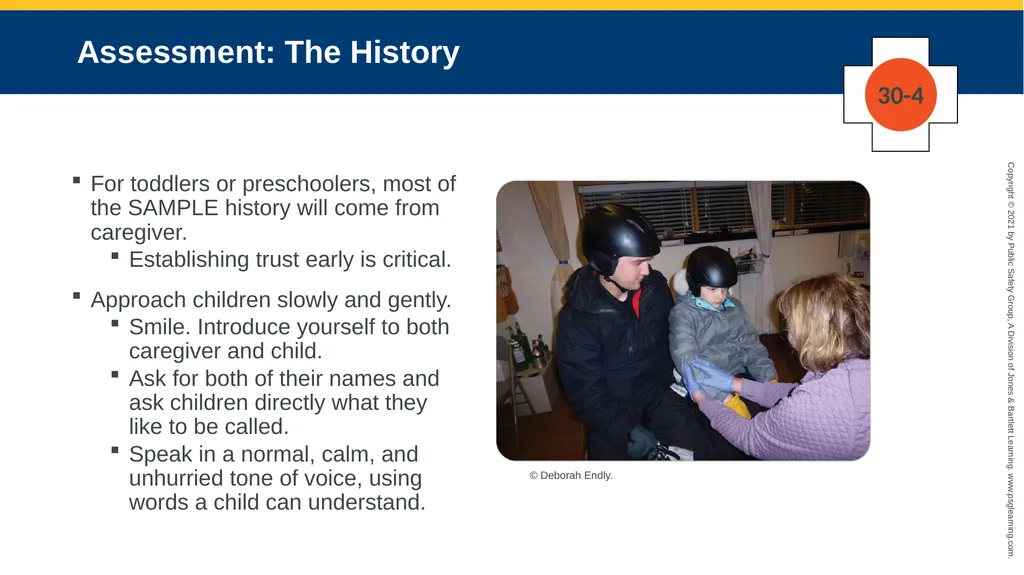
slide67. Assessment: The History For toddlers or preschoolers, most of the SAMPLE history will come from caregiver.
Establishing trust early is critical.
Approach children slowly and gently.
Smile. Introduce yourself to both caregiver and child.
Ask for both of their names and ask children directly what they like to be called.
Speak in a normal, calm, and unhurried tone of voice, using words a child can understand. 30-4 © Deborah Endly.<br>
slide68. Assessment: The History If the adult begins by telling you what happened, actively listen.
Turn your attention to the child and paraphrase this information to patient.
Acknowledges the information given by the caregiver and incorporates the child into the SAMPLE process
Alternate speaking and looking at the child and the caregiver, posing questions to both.
Modify the words you use for body parts as appropriate.
Use words such as “tummy” for preschoolers or younger school-aged children, and “belly” or “abdomen” for teens. 30-4<br>
slide69. Assessment: The History School-age children and adolescents should be treated as adults with respect to their need for respect and privacy.
If you suspect possible substance abuse, pregnancy, or other privacy issues, have your partner interview the caregiver separately while you interact with patient. 30-4<br>
slide70. Patient Assessment: Honesty and Trust Honesty:
When caring for a child, always be honest.
If something you will do will cause the child pain, say so in a kind way: “This may hurt some.”
Trust:
Is essential when interacting with a pediatric patient
Lost trust can affect other OEC technicians who may become involved in a patient’s treatment.
How you interact with children and caregivers can truly “make or break” events at the scene. 30-4<br>
slide71. Patient Assessment: Communication Explain to children and to caregivers what you are doing, step by step, before you do it.
Children younger than 6 years might not be able to explain what is wrong or localize pain.
Although it may be difficult, understand that crying is a normal way for children to cope with a frightening or stressful situation.
At all times, refrain from showing irritation or anger, even if it is difficult to do so. 30-4<br>
slide72. Assessment: Communication Try gently placing a hand on the child’s (uninjured) arm and make eye contact.
Quietly ask children if they are afraid or in pain and acknowledge.
Show understanding.
Offer honest reassurance.
Be careful not to promise something you cannot provide, such as a guarantee that nothing you do will cause pain.
Show acceptance and respect and provide reassurance that you are there to help. 30-4<br>
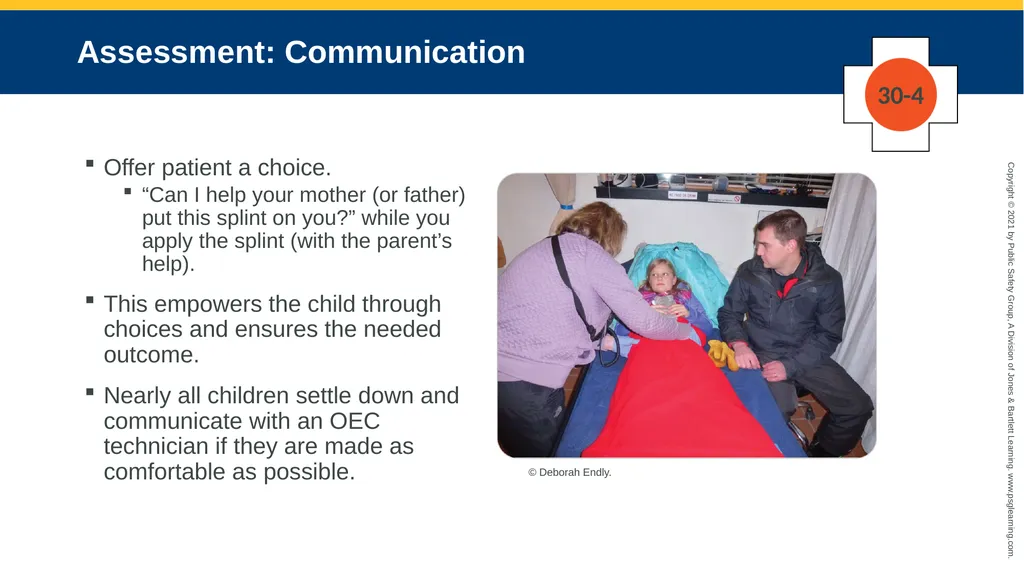
slide73. Assessment: Communication Offer patient a choice.
“Can I help your mother (or father) put this splint on you?” while you apply the splint (with the parent’s help).
This empowers the child through choices and ensures the needed outcome.
Nearly all children settle down and communicate with an OEC technician if they are made as comfortable as possible. 30-4 © Deborah Endly.<br>
slide74. Patient Assessment: Secondary Assessment When obtaining the SAMPLE history, be sure to ask when the child was last well.
Ask about the child’s normal appearance and behaviors.
Have the caregiver describe any abnormal behaviors.
Explain what the corresponding normal behaviors are. 30-10<br>
slide75. Assessment: Pain If the initial complaint is pain, assess the symptoms using the standard OPQRST mnemonic using age-appropriate words and terms.
Be sure to ask where the pain is located.
Ear or throat pain may indicate the presence of an infectious disease such as tonsillitis or epiglottitis.
Ask if the pain is associated with nausea, vomiting, or diarrhea.
How long present?
How many known episodes? 30-10<br>
slide76. Assessment If patient is very young, ask if the child has had episodes of crying, and if so, how many hours or days it has been occurring.
Ask the parents of young children about fluid intake and output.
For newborns and infants, ask how many bottles or feedings the child has had in the past 24 hours.
Ask if the feedings have been of a normal frequency and amount.
Ask if the child has experienced excessive urination or has had diarrhea.
Be sure to ask about any medications, vitamins, and nutritional supplements a pediatric patient may be taking, including over-the-counter medicines and herbal supplements. 30-10<br>
slide77. Assessment: Secondary Assessment Also ask if anything was done to help relieve the child’s symptoms before your arrival on scene.
For cases of croup, the parents may state that they placed the child next to a humidifier or took the child into the cool night air, whereupon the symptoms lessened or disappeared.
May have given the child acetaminophen to control a fever 30-10<br>
slide78. Patient Assessment: Secondary Assessment Depending on the child’s age and stage of development, you may need to use a somewhat different strategy.
Success often is directly related to the ability to effectively communicate and interact with the child and, when present, the caregivers. 30-10<br>
slide79. Patient Assessment: Secondary Assessment Modify the exam order according to the child’s age and the suspected severity of the problem.
Exam for infants can often be made easier playing “peek-a-boo” during the exam.
For preschool children, the exam may be facilitated by distracting the child with a toy or a tongue blade.
Involve the child in the exam process by allowing the child to assist.
If appropriate, infants or small children will usually feel more secure if you allow them to remain in their parent’s arms. 30-10<br>
slide80. Patient Assessment: Secondary Assessment Children are naturally curious.
Young children may be far more willing to allow you to listen to their lungs if you let them listen to their own lungs first.
Some children may become frightened if you examine their head first.
In this case, examine the trunk and extremities first, and the head and neck last.
Be aware when performing a physical exam that many children are ticklish and may flinch when their bodies are touched.
Most school-age children have been examined by a pediatrician and understand the process of a physical exam. 30-10<br>
slide81. Patient Assessment: Vitals Begin each physical exam by obtaining an initial set of vital signs. 30-3<br>
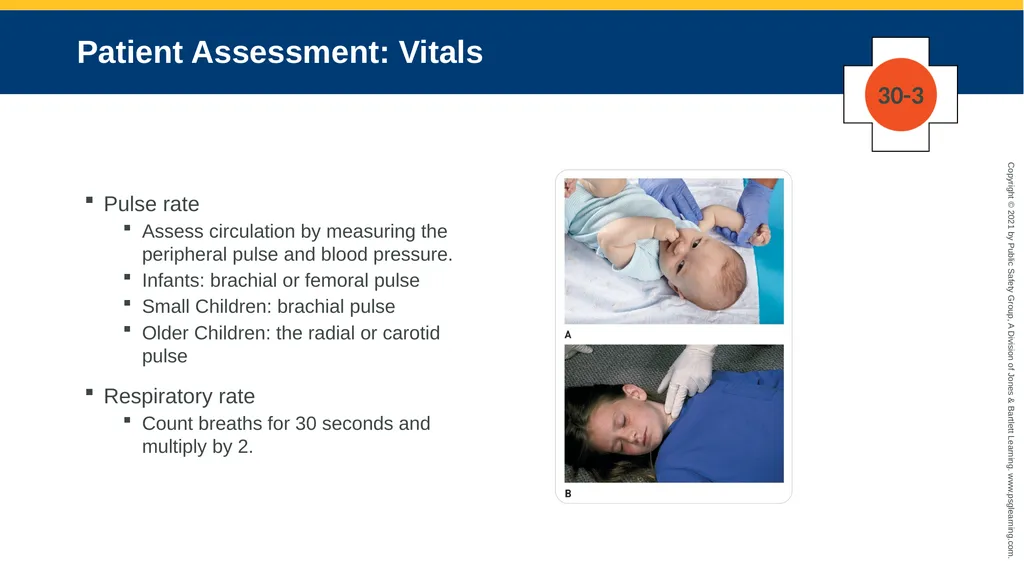
slide82. Patient Assessment: Vitals Pulse rate
Assess circulation by measuring the peripheral pulse and blood pressure.
Infants: brachial or femoral pulse
Small Children: brachial pulse
Older Children: the radial or carotid pulse
Respiratory rate
Count breaths for 30 seconds and multiply by 2. 30-3<br>
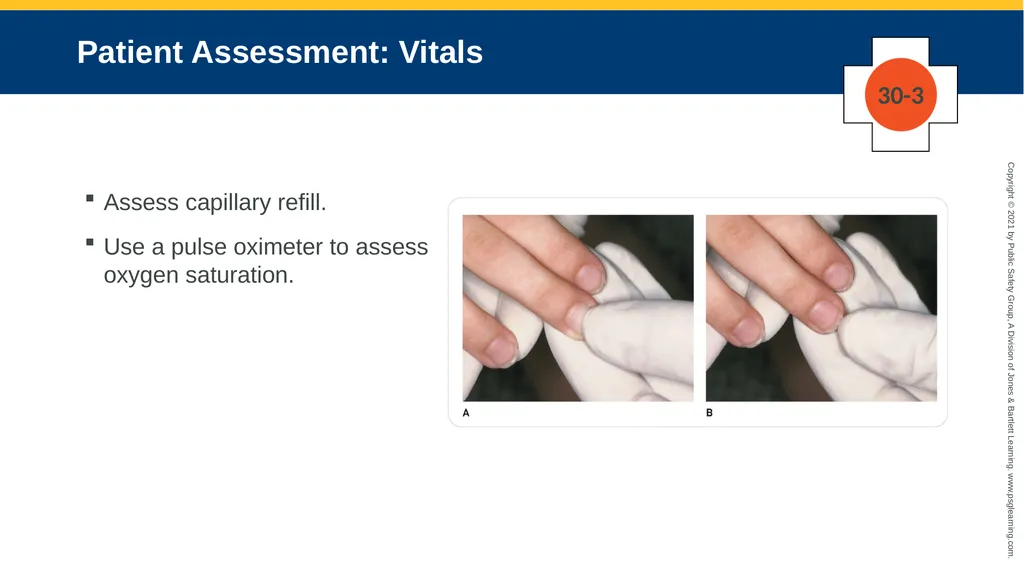
slide83. Patient Assessment: Vitals Assess capillary refill.
Use a pulse oximeter to assess oxygen saturation. 30-3<br>
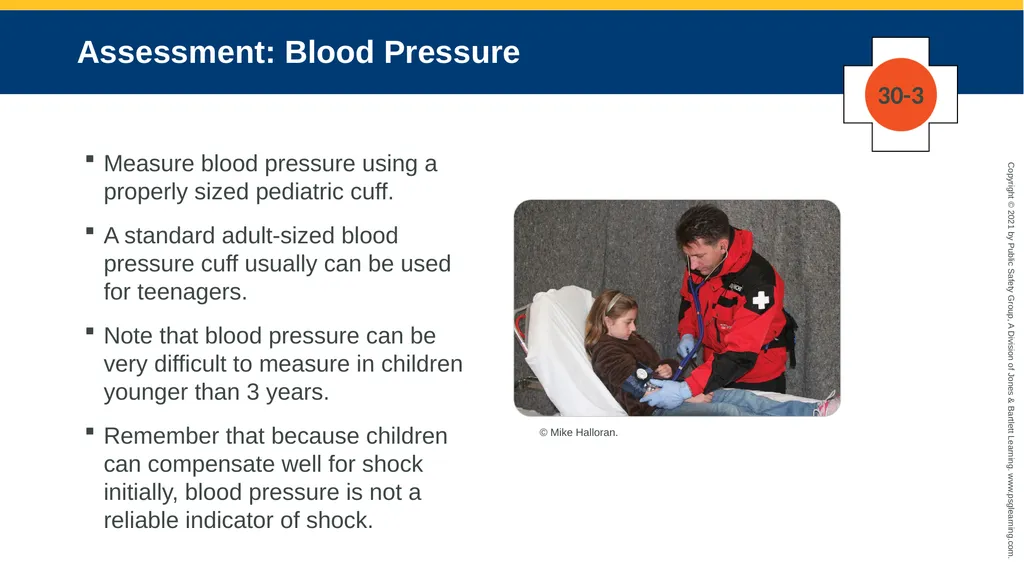
slide84. Assessment: Blood Pressure Measure blood pressure using a properly sized pediatric cuff.
A standard adult-sized blood pressure cuff usually can be used for teenagers.
Note that blood pressure can be very difficult to measure in children younger than 3 years.
Remember that because children can compensate well for shock initially, blood pressure is not a reliable indicator of shock. 30-3 © Mike Halloran.<br>
slide85. Assessment: Extremities Exam For school-age children and adolescents, perform a head-to-toe examination in the usual fashion.
For preschoolers and younger children, begin the physical exam by gently palpating the extremities.
Leave out any part that could hurt until the end of the entire exam.
Check distal sensation by gently scratching a child’s hand or foot.
Small children will withdraw the extremity if they have sensation, whereas older children can tell you they can feel you.
Assess skin color. 30-3<br>
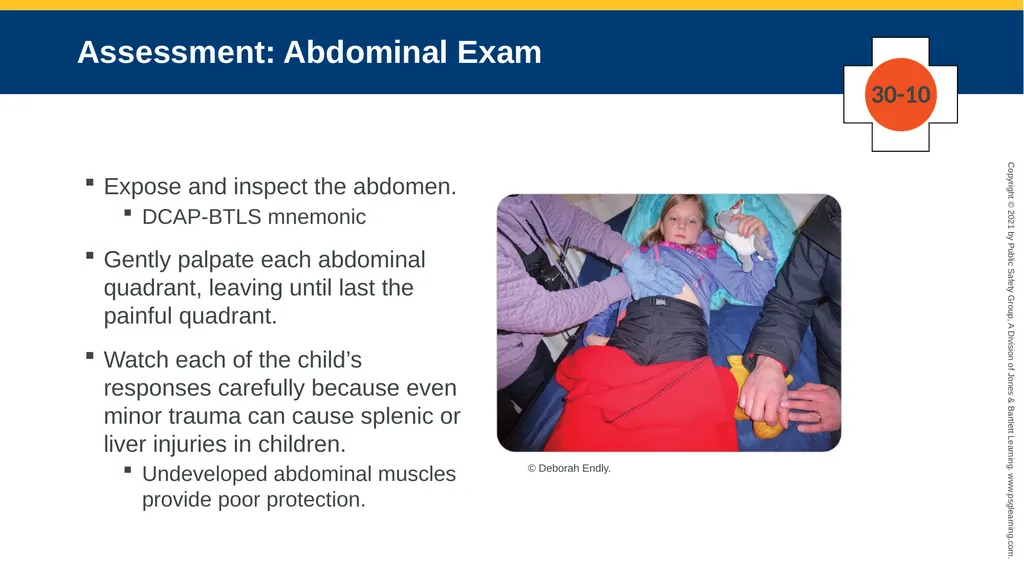
slide86. Assessment: Abdominal Exam Expose and inspect the abdomen.
DCAP-BTLS mnemonic
Gently palpate each abdominal quadrant, leaving until last the painful quadrant.
Watch each of the child’s responses carefully because even minor trauma can cause splenic or liver injuries in children.
Undeveloped abdominal muscles provide poor protection. 30-10 © Deborah Endly.<br>
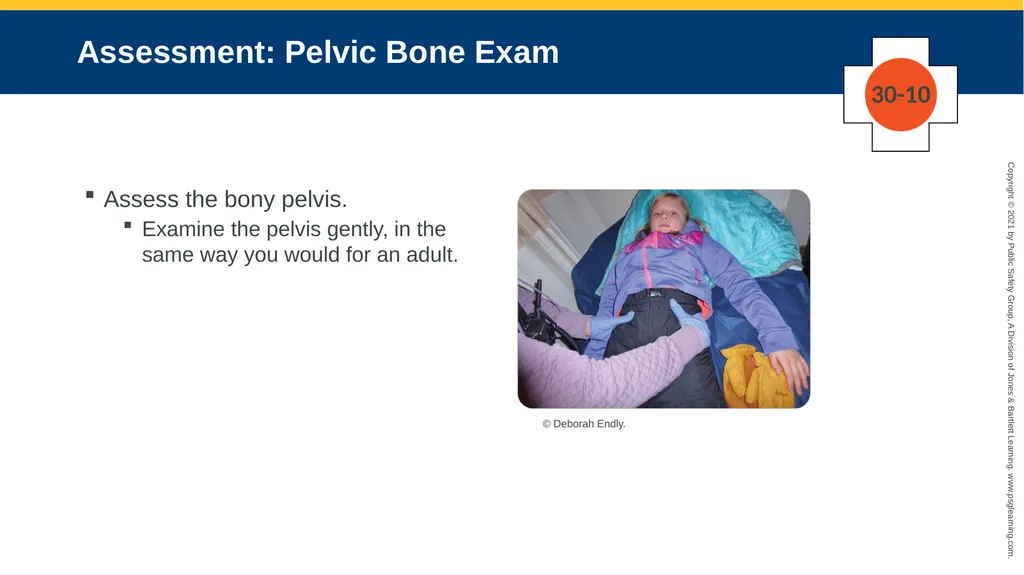
slide87. Assessment: Pelvic Bone Exam Assess the bony pelvis.
Examine the pelvis gently, in the same way you would for an adult. 30-10 © Deborah Endly.<br>
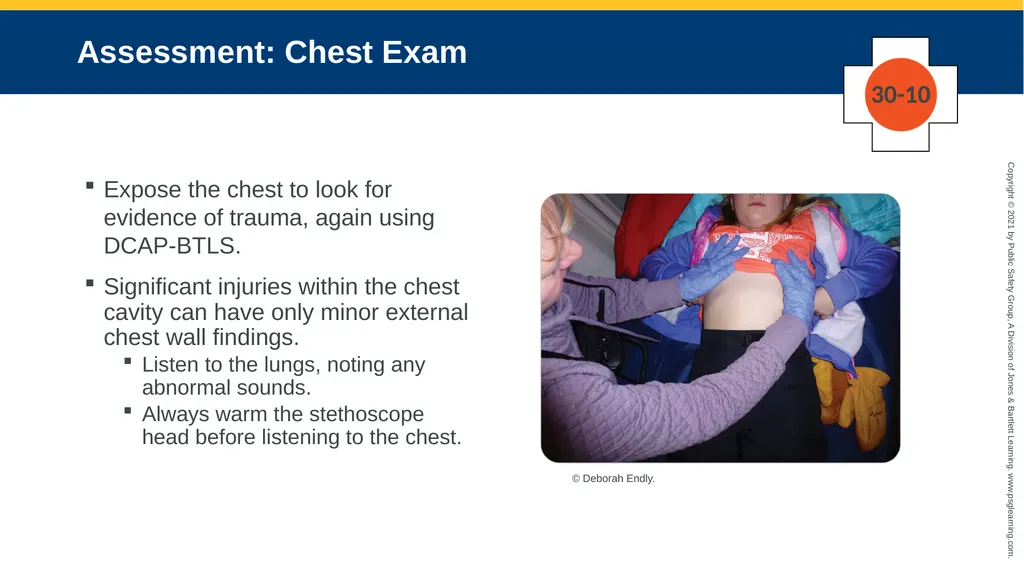
slide88. Assessment: Chest Exam Expose the chest to look for evidence of trauma, again using DCAP-BTLS.
Significant injuries within the chest cavity can have only minor external chest wall findings.
Listen to the lungs, noting any abnormal sounds.
Always warm the stethoscope head before listening to the chest. 30-10 © Deborah Endly.<br>
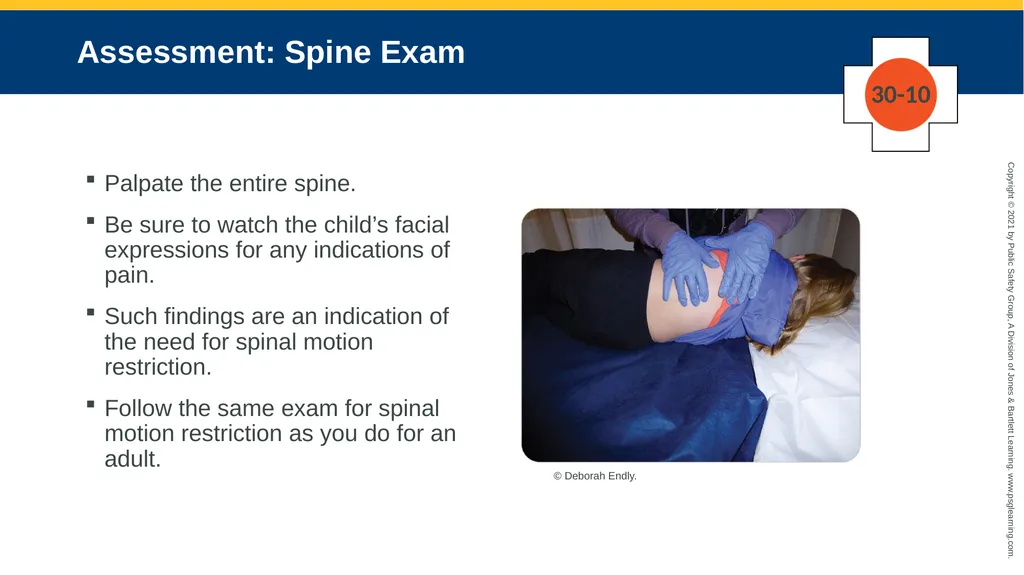
slide89. Assessment: Spine Exam Palpate the entire spine.
Be sure to watch the child’s facial expressions for any indications of pain.
Such findings are an indication of the need for spinal motion restriction.
Follow the same exam for spinal motion restriction as you do for an adult. 30-10 © Deborah Endly.<br>
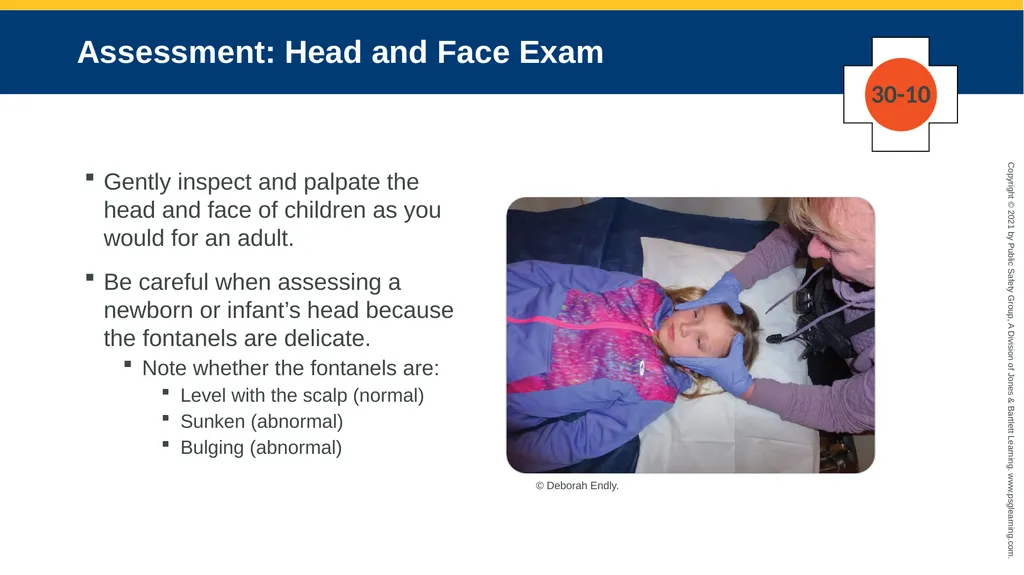
slide90. Assessment: Head and Face Exam Gently inspect and palpate the head and face of children as you would for an adult.
Be careful when assessing a newborn or infant’s head because the fontanels are delicate.
Note whether the fontanels are:
Level with the scalp (normal)
Sunken (abnormal)
Bulging (abnormal) 30-10 © Deborah Endly.<br>
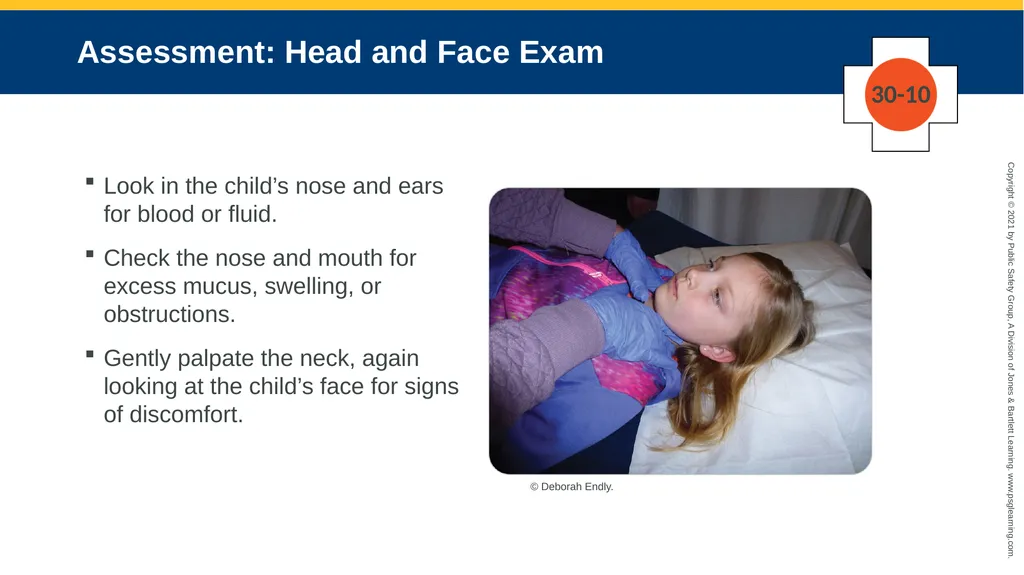
slide91. Assessment: Head and Face Exam Look in the child’s nose and ears for blood or fluid.
Check the nose and mouth for excess mucus, swelling, or obstructions.
Gently palpate the neck, again looking at the child’s face for signs of discomfort. 30-10 © Deborah Endly.<br>
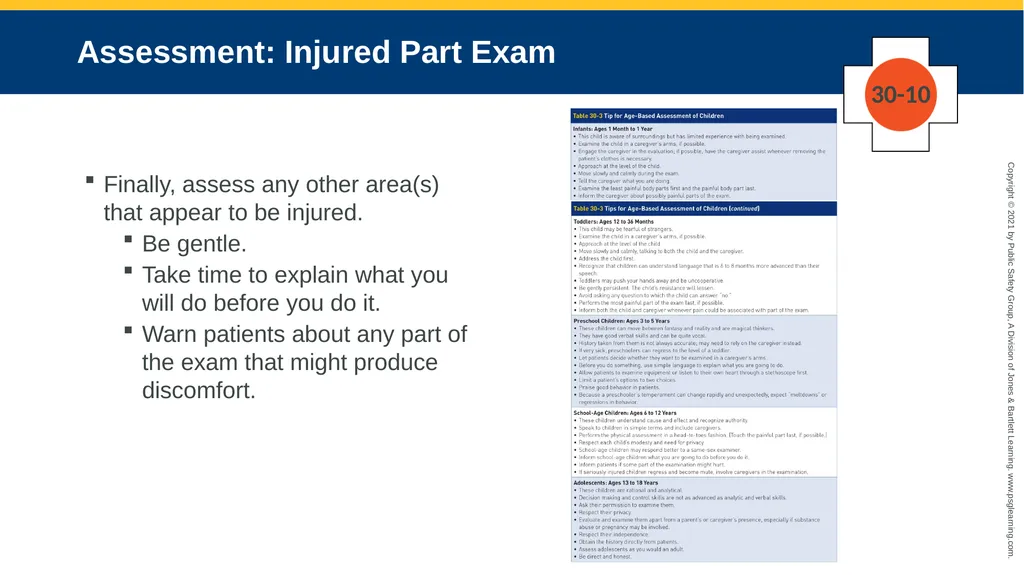
slide92. Assessment: Injured Part Exam Finally, assess any other area(s) that appear to be injured.
Be gentle.
Take time to explain what you will do before you do it.
Warn patients about any part of the exam that might produce discomfort. 30-10<br>
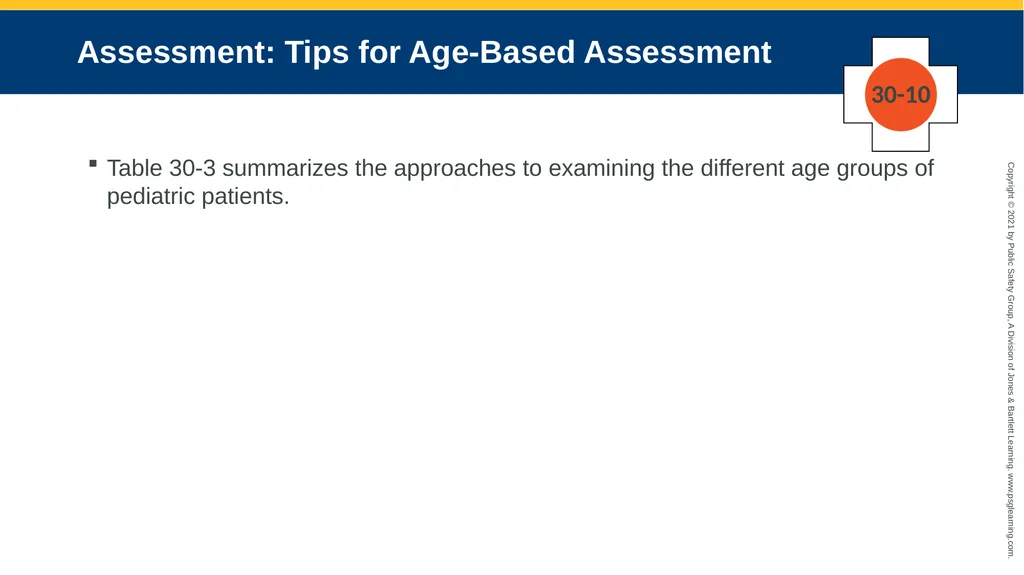
slide93. Assessment: Tips for Age-Based Assessment Table 30-3 summarizes the approaches to examining the different age groups of pediatric patients. 30-10<br>
slide94. Assessment: Reassessment Continue to monitor pediatric patients and perform frequent reassessments for valuable clues concerning whether patients are responding to care.
Respiratory and circulatory status
Level of responsiveness
Skin color
Vital signs
Never take your eyes off pediatric patients.
Assess the vital signs every 5 minutes for children who are ill or injured, and every 10 minutes for pediatric patients with no apparent problems. 30-10<br>
slide95. Management<br>
slide96. Management Basic principles for managing/treating pediatric patients are the same as treating adults.
Scene Safety:
Mitigate any hazards.
Correct any ABCD-related problems.
Children have vigorous compensatory mechanisms; however, they have a smaller compensatory reserve.
They go into shock quickly.
Children that do not appear to improve with care or appear sick, activate EMS immediately.
If shock is suspected, immediately evacuate to definitive care by ALS. 30-11<br>
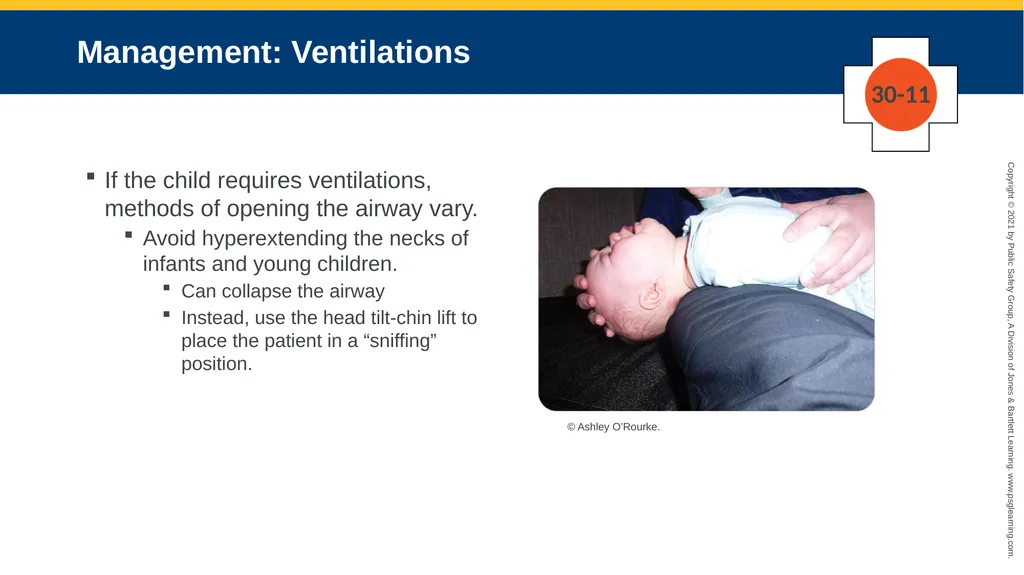
slide97. Management: Ventilations If the child requires ventilations, methods of opening the airway vary.
Avoid hyperextending the necks of infants and young children.
Can collapse the airway
Instead, use the head tilt-chin lift to place the patient in a “sniffing” position. 30-11 © Ashley O’Rourke.<br>
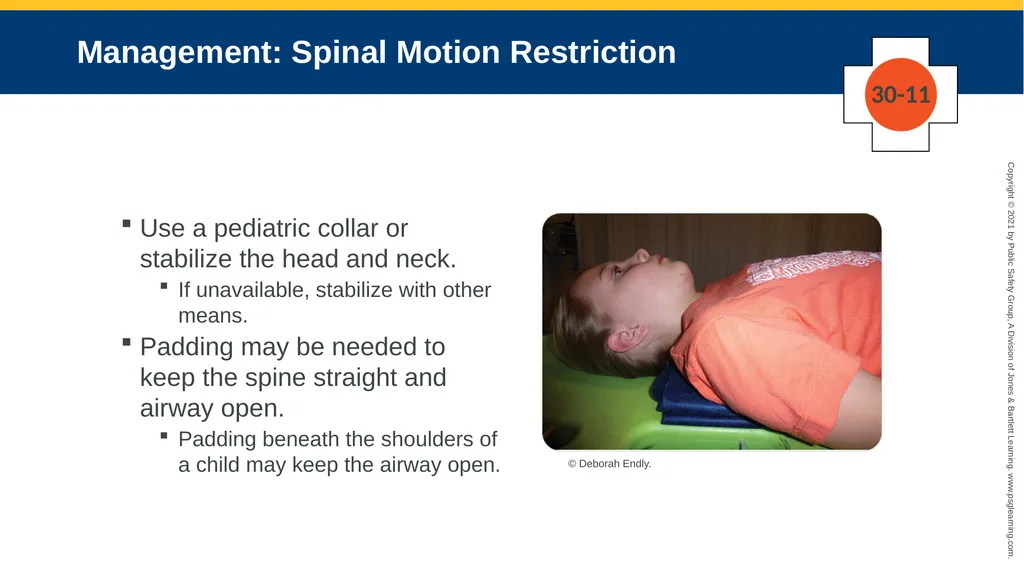
slide98. Management: Spinal Motion Restriction Use a pediatric collar or stabilize the head and neck.
If unavailable, stabilize with other means.
Padding may be needed to keep the spine straight and airway open.
Padding beneath the shoulders of a child may keep the airway open. 30-11 © Deborah Endly.<br>
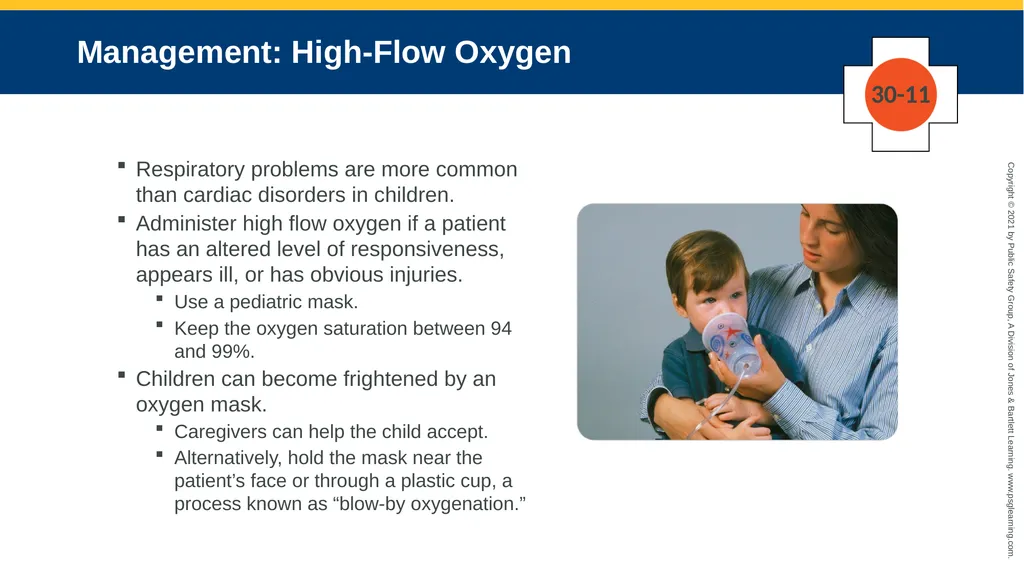
slide99. Management: High-Flow Oxygen Respiratory problems are more common than cardiac disorders in children.
Administer high flow oxygen if a patient has an altered level of responsiveness, appears ill, or has obvious injuries.
Use a pediatric mask.
Keep the oxygen saturation between 94 and 99%.
Children can become frightened by an oxygen mask.
Caregivers can help the child accept.
Alternatively, hold the mask near the patient’s face or through a plastic cup, a process known as “blow-by oxygenation.” 30-11<br>
slide100. Management: Miscellaneous Illnesses and Injuries Some pediatric airway disorders may improve with cool and/or humidified air.
For patients with suspected croup, tonsillitis, and bronchiolitis, take them outside.
Severe nausea, vomiting, and diarrhea should be rapidly transported to definitive care.
Febrile seizures are managed by focusing on reducing the fever.
Place cool cloths in both axillae (armpits), in the groin, and on the forehead.
Manage other pediatric medical- and trauma-related problems as you would for an adult and as described in other chapters. 30-11<br>
slide101. Case Study<br>
slide102. CASE PRESENTATION You are skiing down an easy slope when you notice a woman frantically waving you down. She tells you that her 8-year-old granddaughter fell and landed with her arm outstretched. You find the girl sitting cradling her arm against her jacket. She is shivering. Her grandmother tells you that her upper arm and shoulder hurt. The girl is whimpering but screams and begins to cry when you approach.
What should you do?<br>
slide103. CASE UPDATE You make the scene safe and then approach the young patient, kneeling down beside her.
You introduce yourself to her and to her grandmother and reassure both that you are there to help. You request and receive the grandmother’s permission to examine the child. Sensing her fear and pain, you ask the child her name. Although the grandmother already told you what happened, you ask the girl, “What happened?” and “Where does it hurt?” In response to your calm, caring approach, she stops crying and points with her left index finger at her upper right chest.
What should you do now?<br>
slide104. CASE OUTCOME After confirming that there are no immediate threats to life, you perform a secondary assessment, which reveals an obvious deformity over the right clavicle. The girl begins to cry again, and you ask her why. She tells you she is afraid that you will hurt her, or worse, give her a shot. You reassure her that you don’t give shots and tell her that you’d like to splint her arm, which will help take away some of the pain. You explain, however, to both the girl and her grandmother, that it might hurt when you move the arm into the splint and sling. The girl looks at her grandmother, who gives her an encouraging smile and tells you, “We’ll both be big girls.”<br>
slide105. CASE OUTCOME Other patrollers arrive, a blanket is placed underneath patient and a second one around patient to prevent hypothermia.
The grandmother holds the child’s uninjured hand while you and the other OEC technicians prepare to carefully splint, sling, and swathe the girl’s injury. You continue to talk to the girl quietly, telling her a story while you splint the arm. When you are done, she tells you it feels better.
You place the girl in a toboggan and take her to the aid room, keeping a close eye on the girl’s respirations, appearance, and vital signs. The grandmother stays with the girl. Her vital signs remain stable. An ambulance takes her to the hospital.
The next day, the child’s grandmother calls and tells you that her granddaughter did indeed suffer a broken clavicle. She thanks you for your calm, caring approach in helping the child.<br>
slide2. The following presentation will utilize two symbols to identify material necessary for an OEC Technician to comprehend: Meets a Chapter Objective.
This symbol will have the corresponding Objective Number denoted within. Identifies a Key Term.
The Key Term will be underlined for easy identification. key term<br>
slide3. Objectives 30-1 List and describe the anatomic and physiologic differences between children and adults.
30-2 List and describe the six stages of child growth and development.
30-3 List the normal range of vital signs for each pediatric age group.
30-4 Explain and demonstrate how to communicate with a pediatric patient.
30-5 Describe the signs and symptoms of respiratory distress and failure in a child.<br>
slide4. Objectives 30-6 Identify the most common cause of cardiac arrest in pediatric patients.
30-7 List common causes of seizures in pediatric patients.
30-8 List indicators of potential child abuse and neglect.<br>
slide5. Objectives 30-9 Describe and demonstrate how to assess a pediatric patient.
30-10 Describe and demonstrate how to manage common pediatric illnesses and injuries.
30-11 Explain how to use the pediatric assessment triangle.<br>
slide6. Key Terms Child abuse
Child neglect
Epiglottitis
Fontanels
Meningitis
Pediatric assessment triangle
Shaken baby syndrome
Sudden infant death syndrome (SIDS)<br>
slide7. Chapter Overview<br>
slide8. Chapter Overview Pediatric patients can be challenging for the OEC technician.
There are different medical conditions, assessment challenges, and communication difficulties.
Children can present with different illnesses, problems, and patterns of trauma than adults. © Mike Halloran.<br>
slide9. Chapter Overview A child’s unique physiology changes continually from birth to adulthood, which can make assessment and care difficult for OEC technicians.
Problems such as respiratory distress, temperature regulation, or trauma can be more difficult to manage in young patients.
A child’s ability to compensate for shock can cause a seemingly stable patient to deteriorate quickly.
This chapter defines medical conditions seen in the pediatric population.
Variations in assessment, including age-related vital signs, are provided.
The chapter describes strategies to help OEC technicians communicate with pediatric patients and their caregivers.<br>
slide10. Anatomy and Physiology<br>
slide11. Anatomy and Physiology Children are not miniature adults.
The same basic anatomy and physiology is present, but differences in understanding, size, proportion, and metabolism make pediatric patients unique.
Large variations in:
Behavior
Vital signs
The physical and emotional ability to cope with the stresses of injury and illness
These differences evolve as the child grows into a full-grown adult. 30-1<br>
slide12. Anatomy and Physiology Two of the most important anatomic differences between children and adults are:
The size of the airway
The mechanism of breathing
Differences are especially relevant in infants and younger children, who have relatively small mouths and airways.
Until approximately 8 years old, a child’s tongue is proportionally larger in relation to the oral cavity, which increases the risk of airway obstruction by the tongue. 30-1<br>
slide13. Anatomy and Physiology A child’s trachea is shorter and smaller in diameter, and it is more flexible because the tracheal cartilages have not yet fully developed.
Hyperextension of the neck can cause the trachea to become compressed or even collapsed.
Take care when opening the airway of an unresponsive child.
As children age, the oral cavity enlarges, the jaw elongates, and the tongue becomes proportionately flatter and smaller, allowing a relatively larger airway.
Larynx sits higher and more anteriorly in the neck and is funnel shaped. 30-1<br>
slide14. Anatomy and Physiology Unlike an adult, the narrowest part of the child’s airway is at the opening of the glottis.
Because airway obstructions occur inferior to or below the vocal cords, the risk of foreign-body airway obstruction is increased in children. 30-1<br>
slide15. Anatomy and Physiology A child’s head is proportionally larger and heavier in relation to the body than is an adult’s head.
More pronounced in younger children
As a result:
Young children are more susceptible to heat loss from the head.
During rapid deceleration, the head is propelled forward first, before the body.
Neck flexion can occur when a spine board is used.
Has implications for airway management and for maintaining a neutral cervical-spine alignment when a child’s neck is immobilized 30-1<br>
slide16. Anatomy and Physiology Children have a greater body surface area, thinner skin, and less muscle mass and body fat than adults.
Greater risk for heat loss
Faster absorption of toxins through the skin
Increased morbidity from burns
Greater risk for multiple organ injuries 30-1<br>
slide17. Anatomy and Physiology The brain of an infant can grow because the cranial bones are not fused.
Instead separated by gaps called fontanels
The anterior fontanel is in the front above the frontal bone.
Larger of a newborn’s two fontanels
The posterior fontanel is in the back above the occipital bone.
By approximately 18 months of age, both fontanels have closed, making the skull one continuous bony structure. 30-1<br>
slide18. Anatomy and Physiology A child’s musculoskeletal system is immature and grows rapidly, especially during the first year of life.
A child’s bones, joints, and ligaments are softer and more flexible than those of an adult.
As a result, a child’s skeletal system generally can absorb more force without breaking.
Thoracic cage also is more pliable.
Resulting in a higher rate of internal organ injury
Bones can bend without breaking (greenstick fracture). 30-1<br>
slide19. Anatomy and Physiology Growth plates are found at the ends of long bones as well as within the bones, the pelvis, and the skull.
With proper nutrition (especially an adequate supply of calcium), the growth plates produce cartilage, which later calcifies into bone, making the bone grow.
Area of the growth plate is weak, and fractures at this site are common.
Growth plates begin closing around age 12 years and usually disappear by age 16 years when adult size is reached. 30-1<br>
slide20. Anatomy and Physiology Compared to adults, children have a higher rate of metabolism (burn energy more quickly) and have fewer energy reserves.
Why children exhibit great bursts of energy followed by sudden, profound fatigue
Why children need regular meals and can consume enormous amounts of carbohydrates at once without ill effects
The younger the child, the more frequently meals are needed. 30-1<br>
slide21. Anatomy and Physiology Children and adults also differ in how they breathe.
Newborns breathe through their nose.
If a newborn’s nose becomes obstructed by mucus or a foreign body, breathing difficulty will occur quickly.
Infants and small children rely on diaphragmatic breathing (“belly breathers”) because their intercostal muscles are not yet fully developed. 30-1<br>
slide22. Anatomy and Physiology Children of all ages breathe at a faster rate than do adults.
Body’s primary response to respiratory distress is to increase the rate and effort of breathing.
Younger children start with a faster rate and effort of breathing.
They tire easily and have a higher incidence of respiratory failure.
Reason why many pediatric emergencies begin with respiratory distress 30-1<br>
slide23. Anatomy and Physiology Most children have very healthy cardiovascular and nervous systems.
Still, they are vulnerable to a variety of toxins, both natural and human-made.
Children have a proportionally smaller blood volume than adults yet can bleed at the same rate. 30-1<br>
slide24. Anatomy and Physiology Children have a higher heart rate and lower blood pressure.
This combination enables a child to initially compensate better to shock.
The compensatory mechanisms can fail quickly, which can cause an apparently healthy child to suddenly go into life-threatening shock, often with little or no warning.
Hypovolemia, whether due to blood loss, vomiting, or diarrhea, can quickly lead to decompensated shock. 30-1<br>
slide25. Anatomy and Physiology Due to an underdeveloped hypothalamus in the brain, children have difficulty regulating body temperature, which places them at high risk for both hyperthermia and hypothermia.
Child’s temperature can rapidly rise from illnesses to 40.6°C (105°F), creating an emergent condition.
Equally important, the larger ratio of skin surface area to body mass in children (infants through school-age) can cause rapid cooling, which, when combined with a slow central nervous system response, can result in hypothermia. 30-1<br>
slide26. Human Growth and Development Between birth and the age of 18 years, humans undergo a great variety of physical, intellectual, emotional, and social changes. Language evolves from crying and grunts to organized spoken words and written communication.
The rate of change varies from child to child, but the pattern of development leading to adulthood moves through six identifiable but overlapping stages:
Newborn (neonatal) stage
Infancy
Toddler
Preschool
School-age
Adolescence
Reference Table 30-1 30-2<br>
slide27. Common Pediatric Illnesses and Injuries<br>
slide28. Common Pediatric Illnesses and Injuries Children suffer a variety of medical disorders and traumatic injuries.
Some disorders occur more frequently in certain pediatric age groups than in others.
Respiratory emergencies are common.
Airway Problems
The most common upper airway conditions that cause respiratory emergencies in children are:
Croup
Tonsillitis
Foreign-body airway obstruction
Lower airway problems such as bronchiolitis, pneumonia, and asthma can also occur. 30-5<br>
slide29. Common Pediatric Illnesses: Croup An inflammation of the larynx, trachea, and bronchi
Typically results from an airborne viral infection
Primarily affects children between the ages of 6 months and 3 years 30-5<br>
slide30. Common Pediatric Illnesses: Croup Characterized by sudden onset of a sharp, seal-like barking cough
Most cases occur in the late fall and winter and are preceded by 2 to 3 days of “cold-like” symptoms (runny nose, increased mucus production, and fever).
Although most cases are mild and resolve without complications, croup can produce severe respiratory distress.
Younger children are generally more affected due to the smaller size of the airways. 30-5<br>
slide31. Common Pediatric Illnesses: Tonsillitis An inflammation of the tonsils
A common childhood disease that primarily affects children ages 5 to 15 years
Usually results from a viral infection
Can also be caused from “strep throat,” a bacterial infection
Characterized by severe sore throat and difficulty swallowing
Rarely results in respiratory distress 30-5<br>
slide32. Common Pediatric Injuries: Foreign-Body Obstruction Small objects such as hard candy, toy parts, or coins can become lodged in a child’s airway.
Resulting in partial or complete obstruction
Young children often explore their world by placing objects in their nose or mouth.
Food is the primary cause of foreign-body airway obstruction in older children.
Is primarily due to either putting too much food in the mouth or not completely chewing food
Dislodged teeth or vomitus can also cause partial or complete airway obstruction. 30-5<br>
slide33. Common Pediatric Illnesses: Bronchiolitis Inflammation of the bronchioles caused by a viral infection
Most cases occur in children younger than 2 years.
Develops over a period of 2 to 3 days
Characterized by fever, cough, and difficulty breathing
In some cases can be severe 30-5<br>
slide34. Common Pediatric Illnesses: Pneumonia A viral or bacterial infection of the lungs that is often preceded by an upper respiratory infection, a fever, and a cough
Can occur any time of year but is most commonly encountered during the winter and spring
Children who have aspirated a foreign body or have a history of either recurring respiratory infections or chronic illnesses are at greater risk for contracting pneumonia.
Untreated, pneumonia can lead to respiratory distress, respiratory failure, and even respiratory arrest.
Similar condition when the lungs are exposed to certain chemicals 30-5<br>
slide35. Common Pediatric Illnesses: Asthma Asthma is a reactive disease of the small airways.
Characterized by marked constriction of the bronchioles and wheezing
Most common triggers:
Viral illnesses
Pollen
Exercise
Pet exposure
Contact with cold air
Usually have the condition by the time they reach 5 years of age 30-5<br>
slide36. Common Pediatric Illnesses: Epiglottitis Epiglottitis is a true medical emergency that can produce life-threatening respiratory distress.
Severe inflammation of the epiglottis can completely block the upper airway.
Results from a bacterial infection
Characterized by high fever, sore throat, and an inability to swallow 30-5<br>
slide37. Common Pediatric Illnesses: Epiglottitis Hallmark is a patient who is sitting forward, is very still, and is drooling.
If not treated quickly, can result in death
Most commonly affects children ages 1 to 7 years
Still seen in nonvaccinated populations, including individuals immigrating from countries where the vaccine is not commonly administered 30-5<br>
slide38. Common Pediatric Illnesses: Respiratory Failure Respiratory failure is defined as the inability of the lungs to exchange gases properly.
True emergency that if not immediately corrected can be quickly fatal
Children are more susceptible to respiratory failure than are adults.
Children are more susceptible because:
Their immune systems are not fully developed.
Upper and lower airways are narrower and thus more easily obstructed by swelling or secretions.
The respiratory muscles are inefficient and become fatigued rapidly.
When a child has trouble breathing, the body compensates quickly by increasing the heart and respiratory rates.
The process has a potentially fatal drawback: as the heart rate dramatically increases, so do the heart’s oxygen needs. 30-5<br>
slide39. Common Pediatric Illnesses: Respiratory Failure Increased effort to breathe can easily exhaust and overwhelm a child.
Resulting in respiratory distress and progressing hypoxia
As exhaustion occurs, the respiratory rate continues to slow and can progresses to respiratory arrest. 30-5<br>
slide40. Common Pediatric Illnesses: Cardiac Arrest Most cases of cardiac arrest in children are preceded by respiratory arrest.
Development of relative bradycardia in a child with respiratory distress is an ominous sign of impending respiratory and cardiac arrest. 30-6<br>
slide41. Common Pediatric Illnesses: Seizures An electrical disturbance within the brain that results in alterations in:
Awareness
Attentiveness
Responsiveness
Behavior
Body movement
May be classified as either:
Partial (affecting one part or side of the body) or
Generalized (affecting both sides simultaneously)
Many causes of seizure include fever, hypoxia, diabetes, epilepsy, toxins, and head injury. 30-7<br>
slide42. Common Pediatric Illnesses: Febrile Seizures Febrile seizures are the most common type, accounting for approximately half of all seizures.
Occur in children between the ages of 6 months and 5 years
Typically affect otherwise healthy children who have the combination of an infectious illness and an elevated temperature
Generalized in nature
Usually last less than 5 minutes
Have a postictal phase lasting several minutes
Most are harmless.
There is no evidence that febrile seizures, by themselves, cause death, brain damage, epilepsy, mental retardation, decreased IQ score, or learning difficulties. 30-7<br>
slide43. Common Pediatric Illnesses: Status Epilepticus A condition that is characterized by a seizure lasting more than 10 minutes, a prolonged postictal state, or three or more seizures in a row between which patient does not return to normal mental status
True emergency that requires immediate medical care 30-7<br>
slide44. Common Pediatric Illnesses: Absence Seizure Less serious type of seizure that may be seen in children
Usually benign
May experience multiple absence seizures in a single day
The cause of this type of seizure is unknown.
Most outgrow by the age of 18 to 22 years. 30-7<br>
slide45. Common Pediatric Illnesses: Meningitis Meningitis
An inflammation of the meninges
The membrane that covers the spinal cord and brain
Potentially life-threatening condition that is true medical emergency
Requires prompt medical care<br>
slide46. Common Pediatric Illnesses: SIDS Sudden Infant Death Syndrome (SIDS):
An unexpected death of an infant due to undetermined causes<br>
slide47. Common Pediatric Injuries: Abuse and Neglect Child abuse is a legal term, not a medical diagnosis.
Any act, or the failure to act, on the part of a parent, a caregiver, or any adult that results in serious physical or emotional harm, or imminent risk of harm to any child
Physical, Emotional, Psychological, or Sexual
Child neglect is more common than physical abuse. 30-8 A: © Clinical Photography, Central Manchester University Hospitals NHS Foundation Trust, UK/Science Source; B and C: Courtesy of Ronald Dieckmann, M.D.<br>
slide48. Common Pediatric Injuries: Shaken Baby Syndrome Shaken Baby Syndrome
A form of physical abuse
Person picks up and intentionally shakes a newborn, an infant, or a young toddler.
Ensuing “whiplash” effect causes the child’s brain to forcefully contact the bones within the skull.
Traumatic brain injury can result, often with fatal consequences.
Most cases of shaken baby syndrome are perpetrated by the child’s caregiver, babysitter, or someone close to the child.
Shaken baby syndrome should be suspected if the child is younger than 1 year old and the caregiver cannot give a plausible explanation. 30-8<br>
slide49. Common Pediatric Injuries: Abuse and Neglect Some adults may express their fear and genuine worry for an injured child by acting angry.
However, it is prudent to suspect child abuse whenever a parent or caregiver becomes verbally abusive to a child or berates the child for getting hurt.
Calling a child names such as “stupid” or “idiot”
Children who completely withdraw from or cringe at the sight of a parent or caregiver should be considered at risk. 30-8<br>
slide50. Common Pediatric Injuries: Reporting Abuse Even though child abuse is a crime in all states and provinces, the laws regarding the reporting of possible abuse vary.
Most states and provinces allow anonymous reporting to prevent retaliation.
Individuals who report suspected abuse are legally shielded from lawsuits but only if they report suspected abuse to the proper agency.
The report of abuse starts an investigation by specially trained social workers, nurses, and physicians, who look for the signs and symptoms of abuse.
Investigation is stopped if corroborating evidence is not found.
If abuse is substantiated, intervention services are implemented. 30-8<br>
slide51. Patient Assessment<br>
slide52. Assessment of The Pediatric Patient Assessment of a pediatric patient follows the same steps as that of an adult, but does require some modification:
The heart rate and respiratory rate can change very rapidly because of the child’s emotional response to injury or fear of being approached by a stranger.
Child’s crying can make assessment very difficult.
Metabolic compensation mechanisms in a child’s body can make the condition appear stable when, in fact, patient is in shock.
Must not assume that all is well with a child who does not exhibit findings of serious illness or injury
Need to carefully evaluate both the child and the mechanism of injury or nature of illness 30-9<br>
slide53. Patient Assessment: Scene Size-Up The assessment process begins with a scene size-up.
Remove all potential hazards.
Do not overlook seemingly innocuous objects such as a pencil, keys, or small objects that could become a hazard in the hands of a curious child.
If numerous potential hazards are present, consider moving a patient who does not have a spinal injury and their caregiver to a safer, more secure location.
If trauma is suspected, attempt to determine the mechanism of injury, and be sure to assess it carefully and in context with the child’s anatomy and developmental stage.
Observe proper standard precautions. 30-9<br>
slide54. Patient Assessment: Consent If a parent is present, be sure to ask for permission to assess and care for children younger than 18 years.
If there are no contraindications, leave a young child in the caregiver’s arms.
Helps both to feel more secure and in control
Many children obtain cues from their parent or caregiver that may dictate their response.
If the parent is comfortable, the child will likely be less afraid and more cooperative.
If a parent or caregiver is not present, and the child needs care, implied consent takes effect.
Always kneel or sit at the child’s level. 30-4<br>
slide55. Patient Assessment: Primary Assessment Perform a primary assessment in the usual manner.
Pay close attention to potential threats to life, especially severe bleeding, and correct any that may be present.
Because cardiac arrest in pediatric patients is generally preceded by respiratory arrest, assess the airway and respirations very carefully.
Frequently reassess the ABCDs.
If there is any evidence of ABCD-related compromise:
Treat the problem.
Request ALS assistance immediately.
Rapidly transport patient to a definitive-care facility. 30-9<br>
slide56. Assessment: Pediatric Assessment Triangle Pediatric Assessment Triangle enables rescuers to quickly assess a child’s appearance, work of breathing, and circulation to skin.
Quickly determine whether a child is “sick” or “not sick.”
Exam can be performed in just a few seconds by simply looking and listening as you approach patient. 30-10
30-13<br>
slide57. Assessment: The Child’s Appearance As you approach the child, observe patient’s appearance.
Is the child obviously injured or ill?
Suspect a possible life-threatening problem if the child is:
Unresponsive
Has labored breathing
Is pale
Has major bleeding
Signs of a serious condition:
Obvious limb deformities
“Painful” crying
An apparent decreased level of responsiveness 30-10
30-13 © Deborah Endly.<br>
slide58. Assessment: The Child’s Appearance If there are no obvious findings of major illness or injury, ask yourself:
Is the child active and moving about, or is the child quiet and sitting still?
Children who are laughing or playful are not seriously ill.
A child who sits still or is sitting forward and drooling is in a condition that warrants rapid transport.
Does the child make eye contact?
Generally a good sign if a child immediately focuses on your face and can follow your movements.
Toddlers or preschoolers who make eye contact with you, start crying, and then immediately seek their parent are probably not seriously ill.
Children who do not engage you or look at you and then refocus on themselves, have a weak cry, or are not moving should alert you to a possible serious medical condition. 30-10
30-13<br>
slide59. Assessment: The Child’s Appearance Does the child appear irritable or agitated?
Under normal conditions, a parent or caregiver should be able to console and quiet a child.
Children who are ill often cry or whine upon even small movements or changes in position and often cannot be comforted.
An infant who is paradoxically irritable—that is, one who becomes quiet when left alone but is irritable when in the caregiver’s arms—should be considered very ill.
Does the child respond to the caregiver’s voice?
A child who quiets, smiles, or appropriately responds to a caregiver’s voice is generally less ill than one who does not. 30-10
30-13<br>
slide60. Assessment: Work of Breathing Observe children for signs of increased respiratory effort.
Appearance of a child in respiratory failure is striking.
A child who is in respiratory distress is typically found sitting upright and may assume the tripod position. 30-10
30-13<br>
slide61. Assessment: Work of Breathing Infants may also extend the head and neck into the “sniffing” position, with the nose in the air, which straightens the airway as much as possible to allow as much air as possible to reach the lungs.
Children with epiglottitis may also be drooling because swallowing is extremely painful. 30-10
30-13 © American Academy of Orthopaedic Surgeons.<br>
slide62. Assessment: Work of Breathing Look for the use of accessory muscles and for nasal flaring.
Child’s head may bob up and down as the sternocleidomastoid muscles contract during inhalation and relax during exhalation.
Paradoxical breathing, also known as see-saw breathing, may be present.
Abdomen extends outward, and the chest collapses inward upon inhalation.
During exhalation, the opposite occurs: the abdomen sinks inward, and the chest protrudes outward.
If shirtless, look for retractions, where the soft tissues above the sternum and clavicles and between and below the ribs sink inward upon inhalation.
In older children, retraction becomes less obvious. 30-10
30-13<br>
slide63. Assessment: Work of Breathing Listen to how the child is breathing.
Respiratory sounds can vary greatly with the severity of distress, ranging from an almost inaudible sigh to wheezing or grunting.
Sounds can be heard during inhalation, exhalation, or both.
Indications of lower airway problems and severe respiratory distress:
Wheezing may be heard during inhalation or exhalation.
A high-pitched whistling sound
Grunting is heard only during exhalation.
A low-pitched sound that may sometimes resemble a whimper
Usually constant but can be intermittent
Grunting opens the smallest passages to the alveoli, maximizing gas exchange.
Stridor—high-pitched sound upon inspiration
Suggests croup 30-10
30-13<br>
slide64. Assessment: Work of Breathing Do not just ask “Is the air moving?” but “Is air moving well?”
Observe how fast the child is breathing.
Pain, anxiety, fear, excitement, and other factors can increase the respiratory rate.
The normal rate of respiration depends on the age of the child.
Crying generally indicates that air is moving in and out of the lungs well. 30-10
30-13<br>
slide65. Assessment: Circulation to the Skin Assess the child’s skin color for clues regarding the perfusion of patient’s tissues.
If poor lighting, cold environments, or dark skin make assessment more difficult, assess the sclera of the eyes, the lips, or the palms of the hands.
Skin should appear pink, not pale, mottled, gray, or blue.
If pink, the child is generally well oxygenated and has good tissue perfusion.
An exception to this rule is carbon monoxide poisoning, in which the skin may appear pink or red even though blood oxygen levels are very low. 30-10
30-13<br>
slide66. Assessment: Circulation to the Skin Paleness suggests that either the blood is poorly saturated with oxygen or circulation is poor.
Seen with excessive blood loss, respiratory distress, or heart failure
Mottled skin or gray skin also indicates poor tissue perfusion.
Cyanosis, a bluish tint to the skin and mucous membranes, is an ominous sign that indicates a serious respiratory problem or hypoxia.
Use a pulse oximeter and make sure the oxygen saturation is greater than or equal to 94%. 30-10
30-13<br>
slide67. Assessment: The History For toddlers or preschoolers, most of the SAMPLE history will come from caregiver.
Establishing trust early is critical.
Approach children slowly and gently.
Smile. Introduce yourself to both caregiver and child.
Ask for both of their names and ask children directly what they like to be called.
Speak in a normal, calm, and unhurried tone of voice, using words a child can understand. 30-4 © Deborah Endly.<br>
slide68. Assessment: The History If the adult begins by telling you what happened, actively listen.
Turn your attention to the child and paraphrase this information to patient.
Acknowledges the information given by the caregiver and incorporates the child into the SAMPLE process
Alternate speaking and looking at the child and the caregiver, posing questions to both.
Modify the words you use for body parts as appropriate.
Use words such as “tummy” for preschoolers or younger school-aged children, and “belly” or “abdomen” for teens. 30-4<br>
slide69. Assessment: The History School-age children and adolescents should be treated as adults with respect to their need for respect and privacy.
If you suspect possible substance abuse, pregnancy, or other privacy issues, have your partner interview the caregiver separately while you interact with patient. 30-4<br>
slide70. Patient Assessment: Honesty and Trust Honesty:
When caring for a child, always be honest.
If something you will do will cause the child pain, say so in a kind way: “This may hurt some.”
Trust:
Is essential when interacting with a pediatric patient
Lost trust can affect other OEC technicians who may become involved in a patient’s treatment.
How you interact with children and caregivers can truly “make or break” events at the scene. 30-4<br>
slide71. Patient Assessment: Communication Explain to children and to caregivers what you are doing, step by step, before you do it.
Children younger than 6 years might not be able to explain what is wrong or localize pain.
Although it may be difficult, understand that crying is a normal way for children to cope with a frightening or stressful situation.
At all times, refrain from showing irritation or anger, even if it is difficult to do so. 30-4<br>
slide72. Assessment: Communication Try gently placing a hand on the child’s (uninjured) arm and make eye contact.
Quietly ask children if they are afraid or in pain and acknowledge.
Show understanding.
Offer honest reassurance.
Be careful not to promise something you cannot provide, such as a guarantee that nothing you do will cause pain.
Show acceptance and respect and provide reassurance that you are there to help. 30-4<br>
slide73. Assessment: Communication Offer patient a choice.
“Can I help your mother (or father) put this splint on you?” while you apply the splint (with the parent’s help).
This empowers the child through choices and ensures the needed outcome.
Nearly all children settle down and communicate with an OEC technician if they are made as comfortable as possible. 30-4 © Deborah Endly.<br>
slide74. Patient Assessment: Secondary Assessment When obtaining the SAMPLE history, be sure to ask when the child was last well.
Ask about the child’s normal appearance and behaviors.
Have the caregiver describe any abnormal behaviors.
Explain what the corresponding normal behaviors are. 30-10<br>
slide75. Assessment: Pain If the initial complaint is pain, assess the symptoms using the standard OPQRST mnemonic using age-appropriate words and terms.
Be sure to ask where the pain is located.
Ear or throat pain may indicate the presence of an infectious disease such as tonsillitis or epiglottitis.
Ask if the pain is associated with nausea, vomiting, or diarrhea.
How long present?
How many known episodes? 30-10<br>
slide76. Assessment If patient is very young, ask if the child has had episodes of crying, and if so, how many hours or days it has been occurring.
Ask the parents of young children about fluid intake and output.
For newborns and infants, ask how many bottles or feedings the child has had in the past 24 hours.
Ask if the feedings have been of a normal frequency and amount.
Ask if the child has experienced excessive urination or has had diarrhea.
Be sure to ask about any medications, vitamins, and nutritional supplements a pediatric patient may be taking, including over-the-counter medicines and herbal supplements. 30-10<br>
slide77. Assessment: Secondary Assessment Also ask if anything was done to help relieve the child’s symptoms before your arrival on scene.
For cases of croup, the parents may state that they placed the child next to a humidifier or took the child into the cool night air, whereupon the symptoms lessened or disappeared.
May have given the child acetaminophen to control a fever 30-10<br>
slide78. Patient Assessment: Secondary Assessment Depending on the child’s age and stage of development, you may need to use a somewhat different strategy.
Success often is directly related to the ability to effectively communicate and interact with the child and, when present, the caregivers. 30-10<br>
slide79. Patient Assessment: Secondary Assessment Modify the exam order according to the child’s age and the suspected severity of the problem.
Exam for infants can often be made easier playing “peek-a-boo” during the exam.
For preschool children, the exam may be facilitated by distracting the child with a toy or a tongue blade.
Involve the child in the exam process by allowing the child to assist.
If appropriate, infants or small children will usually feel more secure if you allow them to remain in their parent’s arms. 30-10<br>
slide80. Patient Assessment: Secondary Assessment Children are naturally curious.
Young children may be far more willing to allow you to listen to their lungs if you let them listen to their own lungs first.
Some children may become frightened if you examine their head first.
In this case, examine the trunk and extremities first, and the head and neck last.
Be aware when performing a physical exam that many children are ticklish and may flinch when their bodies are touched.
Most school-age children have been examined by a pediatrician and understand the process of a physical exam. 30-10<br>
slide81. Patient Assessment: Vitals Begin each physical exam by obtaining an initial set of vital signs. 30-3<br>
slide82. Patient Assessment: Vitals Pulse rate
Assess circulation by measuring the peripheral pulse and blood pressure.
Infants: brachial or femoral pulse
Small Children: brachial pulse
Older Children: the radial or carotid pulse
Respiratory rate
Count breaths for 30 seconds and multiply by 2. 30-3<br>
slide83. Patient Assessment: Vitals Assess capillary refill.
Use a pulse oximeter to assess oxygen saturation. 30-3<br>
slide84. Assessment: Blood Pressure Measure blood pressure using a properly sized pediatric cuff.
A standard adult-sized blood pressure cuff usually can be used for teenagers.
Note that blood pressure can be very difficult to measure in children younger than 3 years.
Remember that because children can compensate well for shock initially, blood pressure is not a reliable indicator of shock. 30-3 © Mike Halloran.<br>
slide85. Assessment: Extremities Exam For school-age children and adolescents, perform a head-to-toe examination in the usual fashion.
For preschoolers and younger children, begin the physical exam by gently palpating the extremities.
Leave out any part that could hurt until the end of the entire exam.
Check distal sensation by gently scratching a child’s hand or foot.
Small children will withdraw the extremity if they have sensation, whereas older children can tell you they can feel you.
Assess skin color. 30-3<br>
slide86. Assessment: Abdominal Exam Expose and inspect the abdomen.
DCAP-BTLS mnemonic
Gently palpate each abdominal quadrant, leaving until last the painful quadrant.
Watch each of the child’s responses carefully because even minor trauma can cause splenic or liver injuries in children.
Undeveloped abdominal muscles provide poor protection. 30-10 © Deborah Endly.<br>
slide87. Assessment: Pelvic Bone Exam Assess the bony pelvis.
Examine the pelvis gently, in the same way you would for an adult. 30-10 © Deborah Endly.<br>
slide88. Assessment: Chest Exam Expose the chest to look for evidence of trauma, again using DCAP-BTLS.
Significant injuries within the chest cavity can have only minor external chest wall findings.
Listen to the lungs, noting any abnormal sounds.
Always warm the stethoscope head before listening to the chest. 30-10 © Deborah Endly.<br>
slide89. Assessment: Spine Exam Palpate the entire spine.
Be sure to watch the child’s facial expressions for any indications of pain.
Such findings are an indication of the need for spinal motion restriction.
Follow the same exam for spinal motion restriction as you do for an adult. 30-10 © Deborah Endly.<br>
slide90. Assessment: Head and Face Exam Gently inspect and palpate the head and face of children as you would for an adult.
Be careful when assessing a newborn or infant’s head because the fontanels are delicate.
Note whether the fontanels are:
Level with the scalp (normal)
Sunken (abnormal)
Bulging (abnormal) 30-10 © Deborah Endly.<br>
slide91. Assessment: Head and Face Exam Look in the child’s nose and ears for blood or fluid.
Check the nose and mouth for excess mucus, swelling, or obstructions.
Gently palpate the neck, again looking at the child’s face for signs of discomfort. 30-10 © Deborah Endly.<br>
slide92. Assessment: Injured Part Exam Finally, assess any other area(s) that appear to be injured.
Be gentle.
Take time to explain what you will do before you do it.
Warn patients about any part of the exam that might produce discomfort. 30-10<br>
slide93. Assessment: Tips for Age-Based Assessment Table 30-3 summarizes the approaches to examining the different age groups of pediatric patients. 30-10<br>
slide94. Assessment: Reassessment Continue to monitor pediatric patients and perform frequent reassessments for valuable clues concerning whether patients are responding to care.
Respiratory and circulatory status
Level of responsiveness
Skin color
Vital signs
Never take your eyes off pediatric patients.
Assess the vital signs every 5 minutes for children who are ill or injured, and every 10 minutes for pediatric patients with no apparent problems. 30-10<br>
slide95. Management<br>
slide96. Management Basic principles for managing/treating pediatric patients are the same as treating adults.
Scene Safety:
Mitigate any hazards.
Correct any ABCD-related problems.
Children have vigorous compensatory mechanisms; however, they have a smaller compensatory reserve.
They go into shock quickly.
Children that do not appear to improve with care or appear sick, activate EMS immediately.
If shock is suspected, immediately evacuate to definitive care by ALS. 30-11<br>
slide97. Management: Ventilations If the child requires ventilations, methods of opening the airway vary.
Avoid hyperextending the necks of infants and young children.
Can collapse the airway
Instead, use the head tilt-chin lift to place the patient in a “sniffing” position. 30-11 © Ashley O’Rourke.<br>
slide98. Management: Spinal Motion Restriction Use a pediatric collar or stabilize the head and neck.
If unavailable, stabilize with other means.
Padding may be needed to keep the spine straight and airway open.
Padding beneath the shoulders of a child may keep the airway open. 30-11 © Deborah Endly.<br>
slide99. Management: High-Flow Oxygen Respiratory problems are more common than cardiac disorders in children.
Administer high flow oxygen if a patient has an altered level of responsiveness, appears ill, or has obvious injuries.
Use a pediatric mask.
Keep the oxygen saturation between 94 and 99%.
Children can become frightened by an oxygen mask.
Caregivers can help the child accept.
Alternatively, hold the mask near the patient’s face or through a plastic cup, a process known as “blow-by oxygenation.” 30-11<br>
slide100. Management: Miscellaneous Illnesses and Injuries Some pediatric airway disorders may improve with cool and/or humidified air.
For patients with suspected croup, tonsillitis, and bronchiolitis, take them outside.
Severe nausea, vomiting, and diarrhea should be rapidly transported to definitive care.
Febrile seizures are managed by focusing on reducing the fever.
Place cool cloths in both axillae (armpits), in the groin, and on the forehead.
Manage other pediatric medical- and trauma-related problems as you would for an adult and as described in other chapters. 30-11<br>
slide101. Case Study<br>
slide102. CASE PRESENTATION You are skiing down an easy slope when you notice a woman frantically waving you down. She tells you that her 8-year-old granddaughter fell and landed with her arm outstretched. You find the girl sitting cradling her arm against her jacket. She is shivering. Her grandmother tells you that her upper arm and shoulder hurt. The girl is whimpering but screams and begins to cry when you approach.
What should you do?<br>
slide103. CASE UPDATE You make the scene safe and then approach the young patient, kneeling down beside her.
You introduce yourself to her and to her grandmother and reassure both that you are there to help. You request and receive the grandmother’s permission to examine the child. Sensing her fear and pain, you ask the child her name. Although the grandmother already told you what happened, you ask the girl, “What happened?” and “Where does it hurt?” In response to your calm, caring approach, she stops crying and points with her left index finger at her upper right chest.
What should you do now?<br>
slide104. CASE OUTCOME After confirming that there are no immediate threats to life, you perform a secondary assessment, which reveals an obvious deformity over the right clavicle. The girl begins to cry again, and you ask her why. She tells you she is afraid that you will hurt her, or worse, give her a shot. You reassure her that you don’t give shots and tell her that you’d like to splint her arm, which will help take away some of the pain. You explain, however, to both the girl and her grandmother, that it might hurt when you move the arm into the splint and sling. The girl looks at her grandmother, who gives her an encouraging smile and tells you, “We’ll both be big girls.”<br>
slide105. CASE OUTCOME Other patrollers arrive, a blanket is placed underneath patient and a second one around patient to prevent hypothermia.
The grandmother holds the child’s uninjured hand while you and the other OEC technicians prepare to carefully splint, sling, and swathe the girl’s injury. You continue to talk to the girl quietly, telling her a story while you splint the arm. When you are done, she tells you it feels better.
You place the girl in a toboggan and take her to the aid room, keeping a close eye on the girl’s respirations, appearance, and vital signs. The grandmother stays with the girl. Her vital signs remain stable. An ambulance takes her to the hospital.
The next day, the child’s grandmother calls and tells you that her granddaughter did indeed suffer a broken clavicle. She thanks you for your calm, caring approach in helping the child.<br>