
CHAPTER 31 Geriatric Emergencies The following
PT
Published · 74 slides · 0 views
1 / 1
Description
CHAPTER 31 Geriatric Emergencies The following presentation will utilize two symbols to identify material necessary for an OEC Technician to comprehend: Meets a Chapter Objective. This symbol will have the corresponding Objective Number
Related Topics
Share
Embed code
Download this presentation From Below
"CHAPTER 31 Geriatric Emergencies The following" is the property of its rightful owner. Permission is granted to download and print the materials on this website for personal, non-commercial use only, and to display it on your personal computer provided you do not modify the materials and that you retain all copyright notices contained in the materials. By downloading content from our website, you accept the terms of this agreement.
Presentation Transcript
01
CHAPTER 31 Geriatric Emergencies<br>
02
The following presentation will utilize two symbols to identify material necessary for an OEC Technician to comprehend: Meets a Chapter Objective.
This symbol will have the corresponding Objective Number denoted within. Identifies a Key Term.
The Key Term will be underlined for easy identification. key term<br>
This symbol will have the corresponding Objective Number denoted within. Identifies a Key Term.
The Key Term will be underlined for easy identification. key term<br>
03
Objectives 31-1 Describe physical changes that occur to six body systems with aging.
31-2 Describe effective methods for communicating with geriatric patients.
31-3 Describe the effects of the following illnesses and diseases on geriatric patients:
Cardiovascular and respiratory disease
Neurologic diseases
Gastrointestinal diseases
Altered mental status<br>
31-2 Describe effective methods for communicating with geriatric patients.
31-3 Describe the effects of the following illnesses and diseases on geriatric patients:
Cardiovascular and respiratory disease
Neurologic diseases
Gastrointestinal diseases
Altered mental status<br>
04
Objectives 31-4 Describe how medications can affect the results of an assessment of geriatric patients.
31-5 Explain why the following traumatic conditions/injuries are different in geriatric patients: falls, hip and pelvic fractures, traumatic brain injury, and cervical spine injury.
31-6 Explain how the management of geriatric patients is different than that of other patients.<br>
31-5 Explain why the following traumatic conditions/injuries are different in geriatric patients: falls, hip and pelvic fractures, traumatic brain injury, and cervical spine injury.
31-6 Explain how the management of geriatric patients is different than that of other patients.<br>
05
Key Terms Geriatric
Kyphosis
Lordosis
Osteoporosis
Polypharmacy
Scoliosis
Vital capacity<br>
Kyphosis
Lordosis
Osteoporosis
Polypharmacy
Scoliosis
Vital capacity<br>
06
Chapter Overview<br>
07
Chapter Overview Seniors represent a fast-growing population segment in the United States.
This group is growing as the baby boomer generation retires.
Senior is defined as a person who is 65 years of age or older.
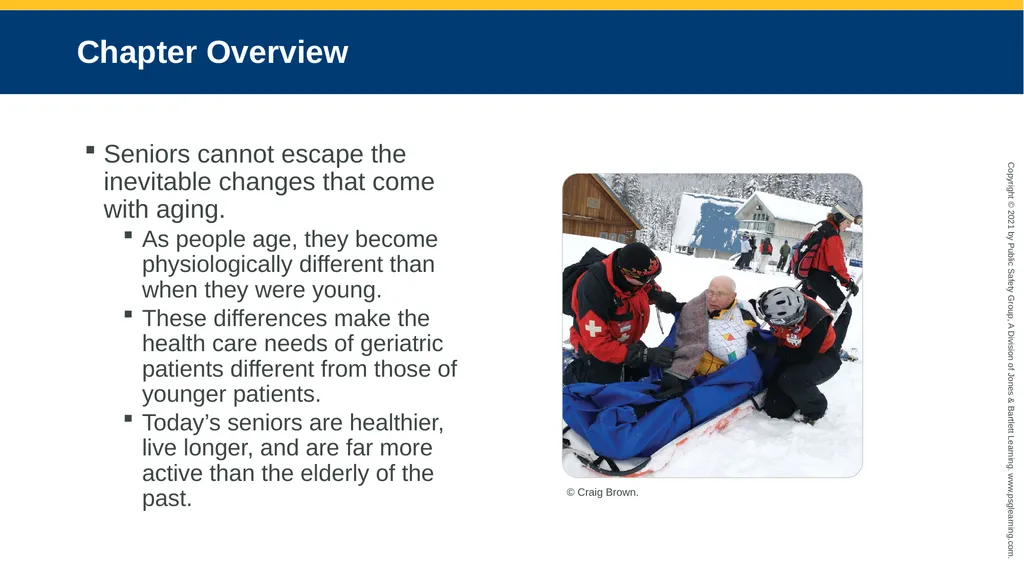
A larger number of seniors are enjoying outdoor activities during all seasons.
Many are bicycle and snow sports enthusiasts.
Almost half a million people older than 65 years are participating in snow sports.<br>
08
Chapter Overview Seniors cannot escape the inevitable changes that come with aging.
As people age, they become physiologically different than when they were young.
These differences make the health care needs of geriatric patients different from those of younger patients.
Today’s seniors are healthier, live longer, and are far more active than the elderly of the past. © Craig Brown.<br>
09
Chapter Overview OEC Technicians need a fundamental understanding of:
The aging process and geriatric physiology
Knowledge of medications and their affects
The ability to effectively communicate with this population
Being able to modify your assessment and management techniques, looking for and reporting elder abuse, and understanding advance directives are important for an OEC technician.<br>
10
Physiological Changes of Aging<br>
11
Physiological Changes of Aging The aging process makes geriatric patients different from younger patients.
Changes that occur with aging can alter the body’s response to various medical disorders and traumatic injuries.
However:
Age-related changes do not always make the elderly frail or helpless.
Many maintain an active lifestyle that includes participating in and enjoying a variety of outdoor activities. 31-1<br>
12
Aging: Neurologic Changes As the body ages, changes within the nervous system make the brain and peripheral nerves less effective at processing data and transmitting impulses between various parts of the body.
Changes can seriously affect the body’s ability to respond to disease or trauma.
Total number of brain cells decreases, causing the brain to shrink in size.
By age 85 years, total brain weight can be reduced by as much as 10%. 31-1<br>
Changes can seriously affect the body’s ability to respond to disease or trauma.
Total number of brain cells decreases, causing the brain to shrink in size.
By age 85 years, total brain weight can be reduced by as much as 10%. 31-1<br>
13
Aging: Neurologic Changes Cerebral blood flow is reduced.
Decreases the amount of glucose and oxygen that reaches brain cells
Nerve impulses are slowed.
Resulting in slowed reflexes, longer reaction times, and reduced perception of stimuli such as light, sound, and pain
Reduced vision and hearing acuity
May not see hazards or hear warnings until it is too late
Inner ear balance organs may be less effective.
Causing older people to fall more easily
Reduction of pain perception with age
May underestimate the seriousness of their injuries 31-1<br>
14
Aging: Cardiovascular Changes Geriatric patient’s cardiovascular responses to stress, illness, or injury are less effective than those of younger patients.
As the heart ages, the walls of the ventricles become less effective at pumping blood.
Heart rate may become irregular due to changes in electrical conductivity.
Beta-blockers slow the heart rate intentionally and do not allow the heart rate to increase during stress caused by acute blood loss or shock. 31-1<br>
15
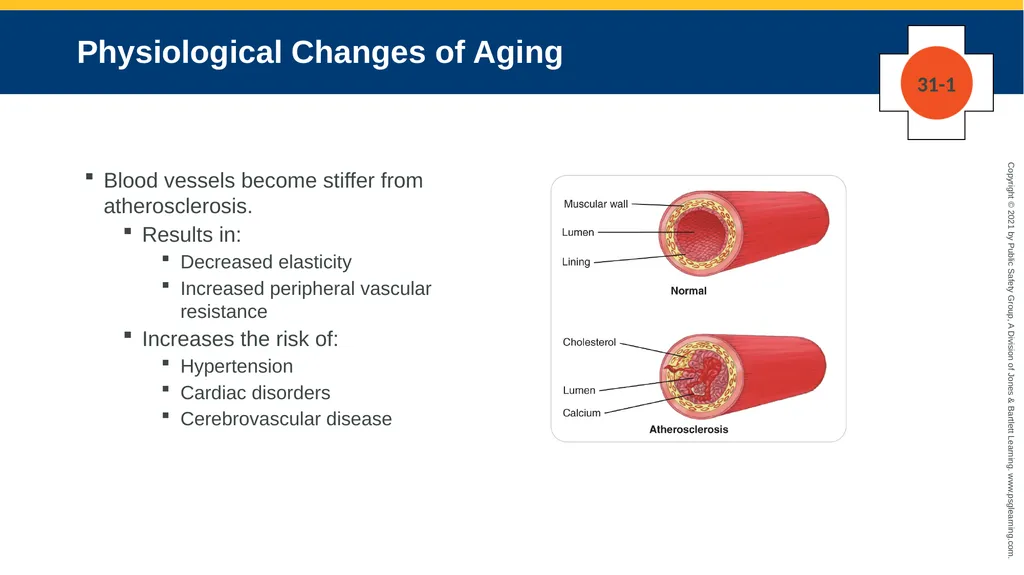
Physiological Changes of Aging Blood vessels become stiffer from atherosclerosis.
Results in:
Decreased elasticity
Increased peripheral vascular resistance
Increases the risk of:
Hypertension
Cardiac disorders
Cerebrovascular disease 31-1<br>
Results in:
Decreased elasticity
Increased peripheral vascular resistance
Increases the risk of:
Hypertension
Cardiac disorders
Cerebrovascular disease 31-1<br>
16
Aging: Respiratory Changes Changes include:
Decreased elasticity of the lungs
Changes in the way the body senses and responds to oxygen and carbon dioxide levels within the blood
Vital capacity is the maximum amount of air a person can take in in one breath.
A healthy 90-year-old has approximately half the lung capacity of a healthy 30-year-old.
Changes in respiratory function ultimately affect the way geriatric patients respond to stress to maintain a life-sustaining oxygen concentration. 31-1<br>
17
Aging: Gastrointestinal Changes Sense of smell and the abundance of taste buds decline with age.
Food becomes less appealing.
Gums and teeth deteriorate.
Increases the risk of malnutrition due to the inability to chew food and the resulting disinterest in eating
Gag reflex decreases with age.
Increases an older patient’s risk of aspiration
Risk is especially with Parkinson disease or who have had a stroke. 31-1<br>
18
Aging: Gastrointestinal Changes Normal function slows throughout the GI tract.
Often resulting in constipation
Function of the liver and pancreas is reduced.
The secretion of gastric buffers and digestive enzymes declines.
Causes a marked decrease in digestion that slows the rate of absorption of nutrients, water, and oral medications
Older patients are at higher risk for various gastrointestinal disorders, including obstruction, ulcers, diverticulitis, and perforations. 31-1<br>
19
Aging: Kidney Changes Kidneys become less effective at filtering waste products, toxins, and medicines out of the blood.
Can result in prolonged effects of medications
Kidney function decreases by 30% to 40%, which can alter water balance and electrolyte levels within the body.
Urine production and excretion are affected as well. 31-1<br>
Can result in prolonged effects of medications
Kidney function decreases by 30% to 40%, which can alter water balance and electrolyte levels within the body.
Urine production and excretion are affected as well. 31-1<br>
20
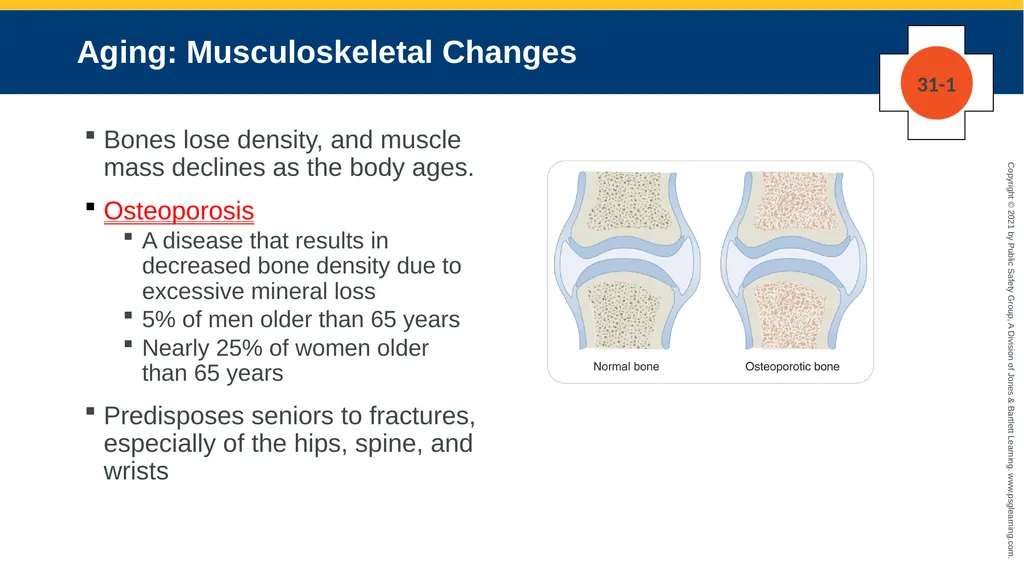
Aging: Musculoskeletal Changes Bones lose density, and muscle mass declines as the body ages.
Osteoporosis
A disease that results in decreased bone density due to excessive mineral loss
5% of men older than 65 years
Nearly 25% of women older than 65 years
Predisposes seniors to fractures, especially of the hips, spine, and wrists 31-1<br>
Osteoporosis
A disease that results in decreased bone density due to excessive mineral loss
5% of men older than 65 years
Nearly 25% of women older than 65 years
Predisposes seniors to fractures, especially of the hips, spine, and wrists 31-1<br>
21
Aging: Musculoskeletal Changes The alignment of the spine may become altered with increasing age, causing spinal curvatures.
Scoliosis is an abnormal lateral curvature of the spine that causes the spine to curve in an “S” shape.
Kyphosis is an abnormal curvature, usually in the upper thoracic spine, that produces a “humpback” appearance.
Lordosis causes “swayback,” or excessive inward curvature of the lumbar spine.
Scoliosis and kyphosis can affect lung function, whereas lordosis causes lower back pain.
Spinal motion restriction may be more difficult. 31-1<br>
22
Aging: Musculoskeletal Changes Aging also causes changes in ligaments.
Become stiffer and less flexible
Predisposing the ligaments to rupture
Cartilage degenerates due to the loss of water.
Results in degenerative arthritis in the joints
Muscle tissue becomes more susceptible to injury.
Muscles atrophy.
Rib cage becomes stiff and the respiratory muscles lose strength, contributing to a decrease in lung function. 31-1<br>
23
Aging: Integumentary Changes Skin thins by as much as 20%.
Skin loses elasticity.
More susceptible to tearing and other dermatologic injuries
Decreased fat content under the skin
Decreased insulation predisposes the body to bruising and hypothermia.
Fewer sweat glands
Risk of hyperthermia is increased because the body is less effective at cooling itself. 31-1<br>
24
Aging: Endocrine Changes Endocrine function also diminishes because the pancreas becomes less effective in regulating blood glucose. 31-1<br>
25
Common Geriatric Conditions<br>
26
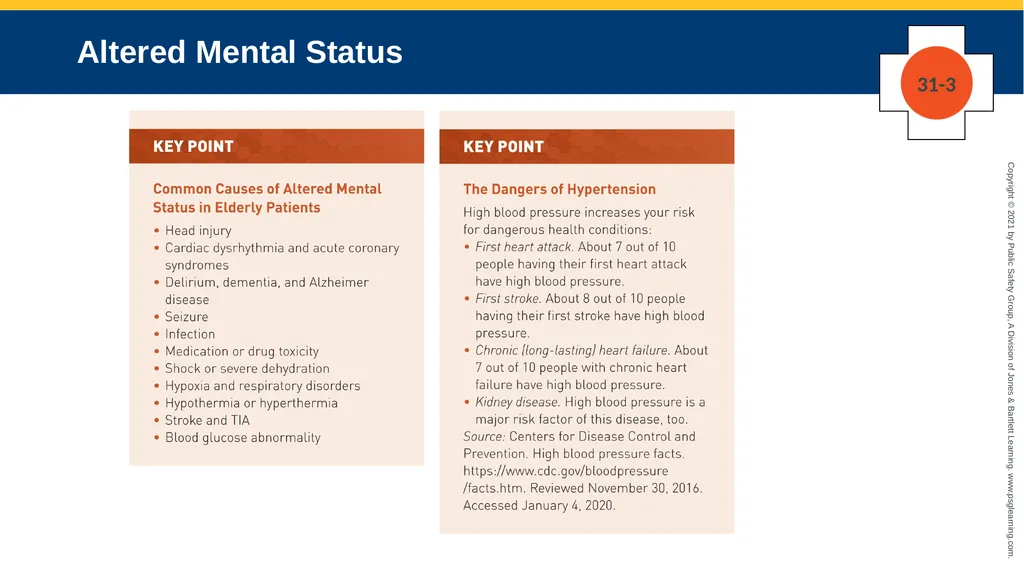
Altered Mental Status 31-3<br>
27
Hypertension Clinically defined as a blood pressure greater than 130 / 80 mmHg
Blood pressure increases as we age.
Physicians urge older individuals to keep blood pressure below the recommended normal values.
Major risk factor for such diseases as myocardial infarction and stroke. 31-3<br>
Blood pressure increases as we age.
Physicians urge older individuals to keep blood pressure below the recommended normal values.
Major risk factor for such diseases as myocardial infarction and stroke. 31-3<br>
28
Myocardial Infarction Incidence increases with age.
Aggravated by risk factors:
Uncontrolled hypertension
High cholesterol
Diabetes
Smoking
Obesity
Strong family history of coronary artery disease 31-3<br>
Aggravated by risk factors:
Uncontrolled hypertension
High cholesterol
Diabetes
Smoking
Obesity
Strong family history of coronary artery disease 31-3<br>
29
Myocardial Infarction Chest pain is the most common symptom and is often accompanied by:
Pain or numbness in the jaw or left arm
Shortness of breath
Nausea
Diaphoresis (heavy sweating)
In seniors, signs and symptoms of an MI may not be straightforward.
Weakness/general feeling of unease
Neck or back pain
Upper abdominal pain
Mild chest discomfort 31-3<br>
Pain or numbness in the jaw or left arm
Shortness of breath
Nausea
Diaphoresis (heavy sweating)
In seniors, signs and symptoms of an MI may not be straightforward.
Weakness/general feeling of unease
Neck or back pain
Upper abdominal pain
Mild chest discomfort 31-3<br>
30
Congestive Heart Failure A condition in which the heart cannot pump enough blood to meet the needs of the body’s other organs
Can be a result of:
Ineffective pumping by either the right or left ventricle or both
Long standing hypertension
A previous heart attach that damaged the heart muscle
Physical exertion can aggravate the condition, as can ascending to high altitude. 31-3<br>
Can be a result of:
Ineffective pumping by either the right or left ventricle or both
Long standing hypertension
A previous heart attach that damaged the heart muscle
Physical exertion can aggravate the condition, as can ascending to high altitude. 31-3<br>
31
Syncope A brief loss of responsiveness due to an inadequate amount of oxygen reaching the brain.
A common disorder
Should be considered a life-threatening event in seniors until proven otherwise
Often stems from other medical conditions, such as:
Irregular heart rhythm
Sudden drop in blood pressure
Stroke or Transient Ischemic Attack 31-3<br>
A common disorder
Should be considered a life-threatening event in seniors until proven otherwise
Often stems from other medical conditions, such as:
Irregular heart rhythm
Sudden drop in blood pressure
Stroke or Transient Ischemic Attack 31-3<br>
32
Stroke A reduction in blood flow to the brain tissue resulting from narrowing, blockage, or rupture of a cerebral artery in the brain
Older patients have the highest risk for stroke.
May initially present with only mild confusion or altered mental status
Transient Ischemic Attacks
A variant of a stroke
Short duration and complete resolution of symptoms
Increased risk for developing a serious stroke 31-3<br>
Older patients have the highest risk for stroke.
May initially present with only mild confusion or altered mental status
Transient Ischemic Attacks
A variant of a stroke
Short duration and complete resolution of symptoms
Increased risk for developing a serious stroke 31-3<br>
33
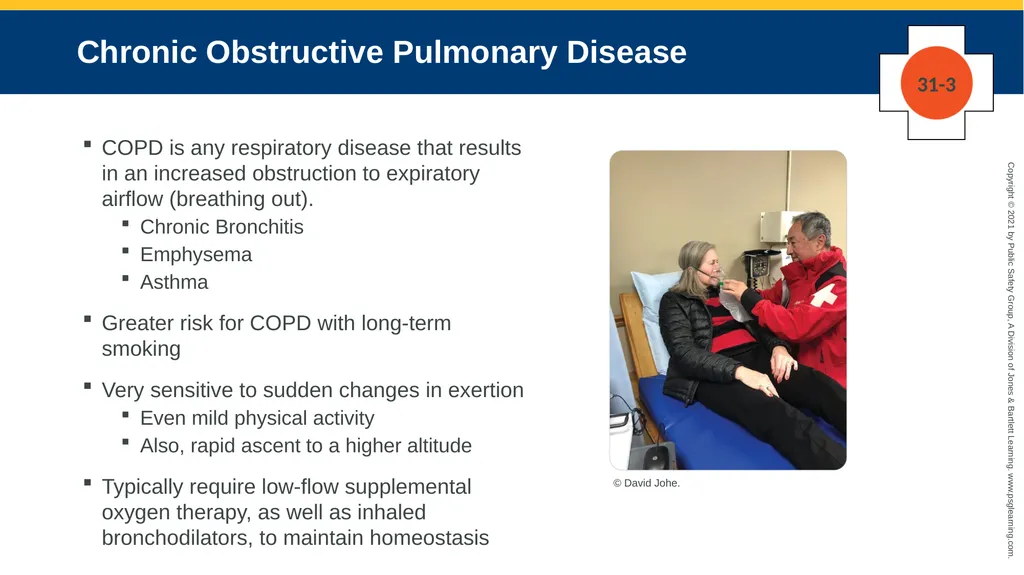
Chronic Obstructive Pulmonary Disease COPD is any respiratory disease that results in an increased obstruction to expiratory airflow (breathing out).
Chronic Bronchitis
Emphysema
Asthma
Greater risk for COPD with long-term smoking
Very sensitive to sudden changes in exertion
Even mild physical activity
Also, rapid ascent to a higher altitude
Typically require low-flow supplemental oxygen therapy, as well as inhaled bronchodilators, to maintain homeostasis 31-3 © David Johe.<br>
34
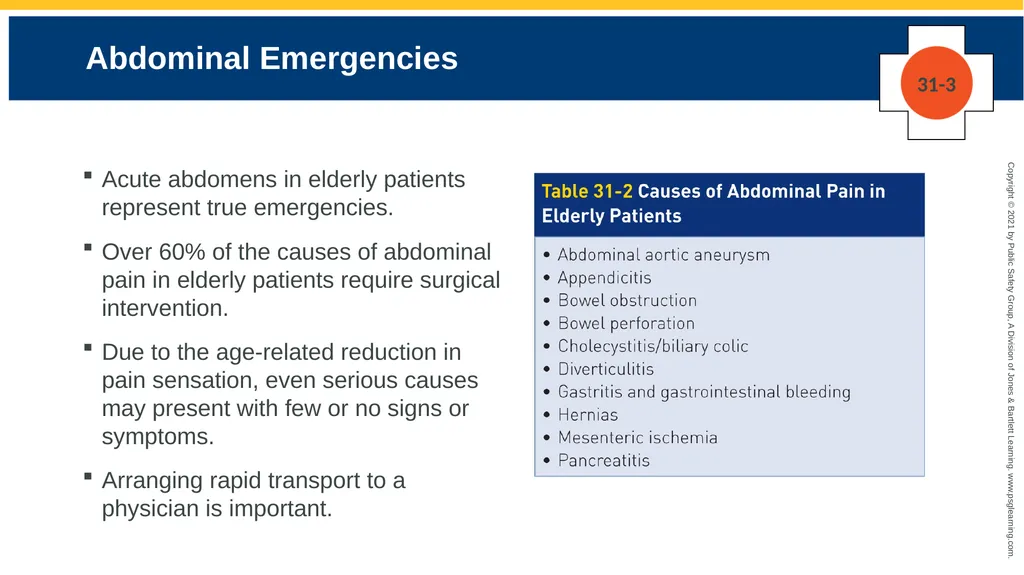
Abdominal Emergencies Acute abdomens in elderly patients represent true emergencies.
Over 60% of the causes of abdominal pain in elderly patients require surgical intervention.
Due to the age-related reduction in pain sensation, even serious causes may present with few or no signs or symptoms.
Arranging rapid transport to a physician is important. 31-3<br>
Over 60% of the causes of abdominal pain in elderly patients require surgical intervention.
Due to the age-related reduction in pain sensation, even serious causes may present with few or no signs or symptoms.
Arranging rapid transport to a physician is important. 31-3<br>
35
Medication Use in the Elderly<br>
36
Medication Use in The Elderly The average geriatric person, not in a nursing home, takes five or more medications weekly.
Concurrent use of multiple medications, known as polypharmacy, is common among older patients because they often have multiple, coexisting medical conditions.
Taking medications in combination can cause a host of adverse reactions and can significantly affect assessment findings. 31-4<br>
Concurrent use of multiple medications, known as polypharmacy, is common among older patients because they often have multiple, coexisting medical conditions.
Taking medications in combination can cause a host of adverse reactions and can significantly affect assessment findings. 31-4<br>
37
Medication Use in The Elderly Always ask geriatric patients about their use of herbal supplements and over-the-counter medications; some seniors may not consider them true “medications” and may not mention them unless directly asked.
Ask elderly patients directly if they share medications with friends or family because they may not readily admit to this practice.
Because of cost, many older patients do not take prescribed medicines, or take only part of the prescribed dosage.
Unfortunately, elderly patients may not know the names of all the medications they take.
If not, ask what each medication is used for. 31-4<br>
38
Common Heart Medications in the Elderly Hypertension: some of the most commonly prescribed classes of medications among older patients
Few examples:
Beta-blockers
Calcium channel blockers
Diuretics 31-4<br>
Few examples:
Beta-blockers
Calcium channel blockers
Diuretics 31-4<br>
39
Common Heart Medications: Beta-Blockers Manage cardiac arrhythmias
Lower blood pressure
Function:
Make the heart contract more efficiently
Decrease the blood pressure
Slow the pulse rate
Highly effective in reducing the amount of stress placed on the heart
Can adversely affect the body’s compensatory mechanisms when the body is stressed or in shock
Common beta-blockers include: metoprolol (Lopressor), propranolol (Inderal), and atenolol (Tenormin). 31-4<br>
40
Common Heart Medications: Calcium Channel Blockers Reduce heart rate, blood pressure, and (to a lesser degree) heart contractility
Can potentially counteract the normal compensating mechanisms during stress or trauma
Examples: diltiazem (Cardizem), nifedipine (Procardia), verapamil (Isoptin), and amlodipine (Norvasc) 31-4<br>
Can potentially counteract the normal compensating mechanisms during stress or trauma
Examples: diltiazem (Cardizem), nifedipine (Procardia), verapamil (Isoptin), and amlodipine (Norvasc) 31-4<br>
41
Common Heart Medications: Diuretics Decrease the volume of circulating fluid within the cardiovascular system
Reduces blood pressure
Treats heart failure
Helps with pedal edema
By causing the kidneys to excrete more urine, diuretics alter the body’s fluid and electrolyte balance.
Elderly patients who take these medications are more susceptible to hypotension, dizziness, syncope, and slower heart rates and may exhibit shock faster due to a lower blood volume.
Common diuretics include hydrochlorothiazide (HCTZ), triamterene (Dyazide), and furosemide (Lasix). 31-4<br>
42
Common Medications: Anticoagulants Blood “thinners” are another class of medications that deserve special attention.
Called anticoagulants because they stop blood from coagulating
Commonly prescribed to patients with a history of mechanical heart valve replacement, an irregular heartbeat, or blood clots in the legs or lungs
Can increase or prolong trauma-related bleeding
Even a nosebleed or a traumatic brain injury could have disastrous consequences due to uncontrolled bleeding.
Blunt abdominal trauma may have increased internal abdominal bleeding caused by a blood-thinning medication. 31-4<br>
43
Medication Use in The Elderly Common blood thinners include warfarin (Coumadin), clopidogrel (Plavix), dabigatran (Pradaxa), apixaban (Eliquis), rivaroxaban (Xarelto), and enoxaparin (Lovenox).
Aspirin has blood-thinning properties also.
Some antibiotics and herbal supplements can affect anticoagulants, prolonging bleeding time.
Many trauma systems recommend that patients on blood thinners who have any significant mechanism of injury be transported DIRECTLY to a trauma center, where the large quantities of blood products often needed by such patients are available. 31-4<br>
44
Trauma Considerations in Elderly Patients<br>
45
Trauma Considerations in Elderly Patients Geriatric patients have higher mortality rates compared with those of younger patients.
Mortality rate of seniors from traumatic brain and spinal cord injuries is higher than that of patients younger than 65 years, and rises with age.
As an independent risk factor, age presents the greatest increase in risk for a poor outcome of trauma cases.<br>
Mortality rate of seniors from traumatic brain and spinal cord injuries is higher than that of patients younger than 65 years, and rises with age.
As an independent risk factor, age presents the greatest increase in risk for a poor outcome of trauma cases.<br>
46
Trauma Considerations in Elderly Patients Assessment of seniors can be particularly difficult.
A relatively minor complaint could be a life-threatening injury.
Trivial mechanism of injury can lull OEC technicians into thinking that nothing is wrong with the patient.
Other factors, including underlying disease and medication use (especially “blood thinners”), must be considered in trauma.<br>
A relatively minor complaint could be a life-threatening injury.
Trivial mechanism of injury can lull OEC technicians into thinking that nothing is wrong with the patient.
Other factors, including underlying disease and medication use (especially “blood thinners”), must be considered in trauma.<br>
47
Trauma Considerations: Falls Higher incidence of inadvertent falls than other age groups
Among the more common serious traumatic injuries from falls are:
Pelvic and hip fractures
Traumatic brain injury
Rib fractures
Cervical spine injury
Falls cause 12% of all deaths in the geriatric population, both directly and indirectly. 31-5<br>
Among the more common serious traumatic injuries from falls are:
Pelvic and hip fractures
Traumatic brain injury
Rib fractures
Cervical spine injury
Falls cause 12% of all deaths in the geriatric population, both directly and indirectly. 31-5<br>
48
Trauma Considerations: Falls Many falls are caused by an underlying medical condition that may be unknown to the patient.
Do not automatically assume that a fall was due to clumsiness or inattentiveness.
Must evaluate not only the injuries related to a fall but also the potential CAUSE of the fall.
Example: Syncopal episode
Red flags that suggest this possibility include:
Palpitations
Chest pain
Lightheadedness
Dizziness before the fall 31-5<br>
49
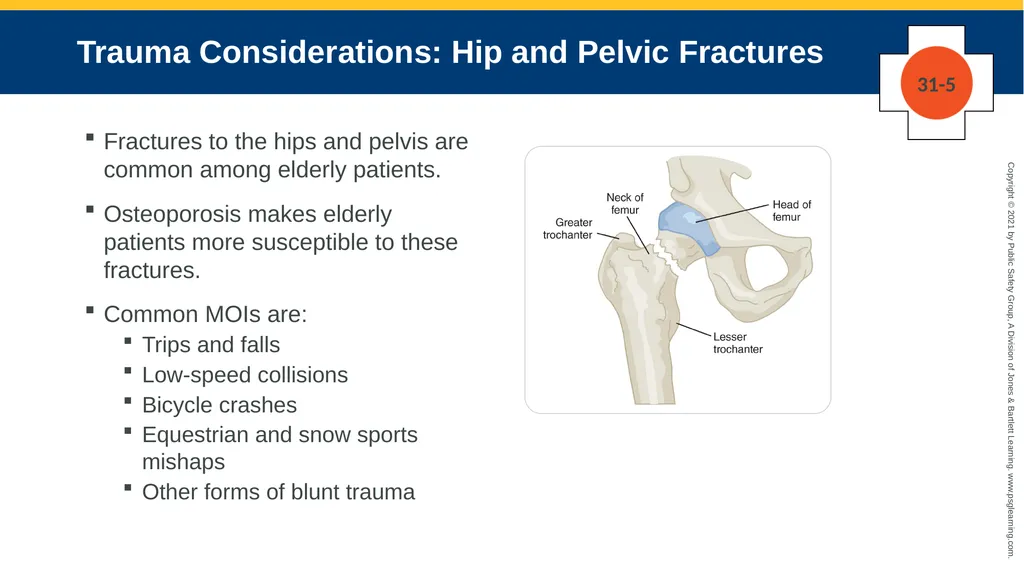
Trauma Considerations: Hip and Pelvic Fractures Fractures to the hips and pelvis are common among elderly patients.
Osteoporosis makes elderly patients more susceptible to these fractures.
Common MOIs are:
Trips and falls
Low-speed collisions
Bicycle crashes
Equestrian and snow sports mishaps
Other forms of blunt trauma 31-5<br>
Osteoporosis makes elderly patients more susceptible to these fractures.
Common MOIs are:
Trips and falls
Low-speed collisions
Bicycle crashes
Equestrian and snow sports mishaps
Other forms of blunt trauma 31-5<br>
50
Trauma Considerations: Hip and Pelvic Fractures Older patients have more bleeding complications from hip and pelvic fractures.
Hip or pelvic fracture must be considered when evaluating hypotensive geriatric patients who have an altered mental status in the absence of obvious evidence of external bleeding, chest or abdominal trauma, or other long-bone fractures. 31-5<br>
Hip or pelvic fracture must be considered when evaluating hypotensive geriatric patients who have an altered mental status in the absence of obvious evidence of external bleeding, chest or abdominal trauma, or other long-bone fractures. 31-5<br>
51
Trauma Considerations: Traumatic Brain Injury Two major age-related changes put geriatric patients at greater risk of traumatic brain injury:
The dura mater (lining around the brain) becomes more adherent to the skull.
The brain shrinks in size.
Combination of these two changes increases the space between the outside of the brain and the inside of the skull, allowing for more brain movement within the skull.
Deceleration head trauma can cause brain injury.
Use of warfarin or other blood-thinning medications and the presence of chronic medical conditions dramatically increase the risk of bleeding within the skull.
Why an older person who experiences apparently minor head trauma may have a severe traumatic brain injury 31-5<br>
52
Trauma Considerations: Traumatic Brain Injury The typical symptoms associated with traumatic brain injuries may not be readily apparent in geriatric patients.
Maintain a high level of suspicion of brain injury in any geriatric patient who has suffered a head injury.
Pay especially close attention to any changes in the patient’s level of responsiveness. 31-5<br>
Maintain a high level of suspicion of brain injury in any geriatric patient who has suffered a head injury.
Pay especially close attention to any changes in the patient’s level of responsiveness. 31-5<br>
53
Trauma Considerations: Cervical Spine Injury Significant injuries to the cervical spine deserve special consideration among seniors because fracture patterns tend to:
Involve more than one level of the spine
Are frequently unstable
Often accompany head trauma
High cervical injuries at the C1 to C2 region as a result of:
Weakened neck muscles
Osteoporosis
Devastating cervical spine injury and paralysis in geriatric patients from:
Trauma during skiing or biking
Also from simply falling from a standing or seated position 31-5<br>
54
Communicating with Elderly Patients<br>
55
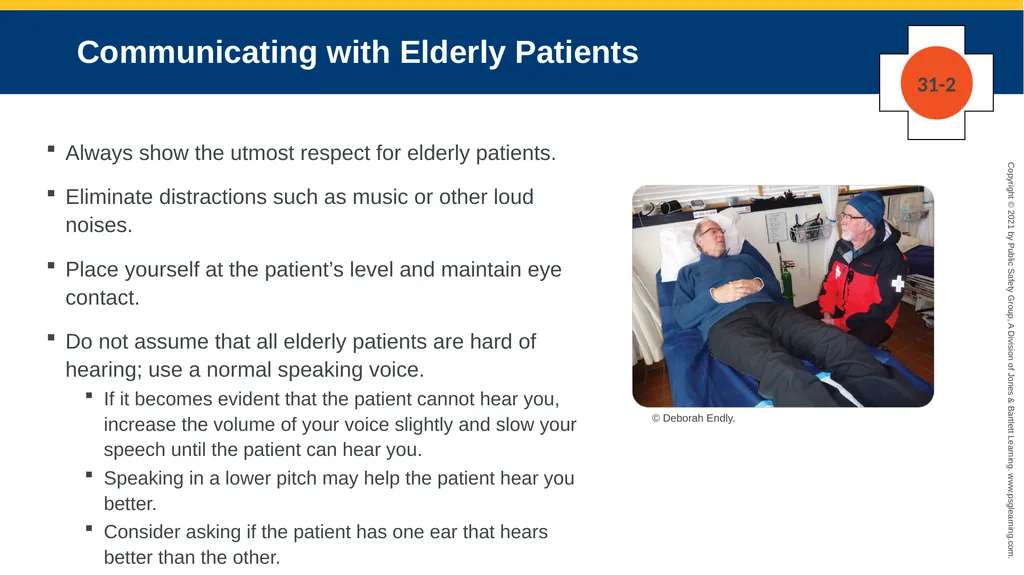
Communicating with Elderly Patients Always show the utmost respect for elderly patients.
Eliminate distractions such as music or other loud noises.
Place yourself at the patient’s level and maintain eye contact.
Do not assume that all elderly patients are hard of hearing; use a normal speaking voice.
If it becomes evident that the patient cannot hear you, increase the volume of your voice slightly and slow your speech until the patient can hear you.
Speaking in a lower pitch may help the patient hear you better.
Consider asking if the patient has one ear that hears better than the other. 31-2 © Deborah Endly.<br>
56
Communicating with Elderly Patients Independence is very important to seniors.
Allow elderly patients to remain in control of their bodies.
Obtain their consent before assessing or treating them.
Always use “Mr.,” “Mrs.,” or “Ms.” followed by their last name.
Avoid using a nickname or a first name unless the patient requests it.
Interaction may take on a more casual tone, but you should not be the one to initiate.
Also avoid terms such as “hon” or “sweetie.” 31-2<br>
57
Communicating with Elderly Patients Be clear and purposeful in your conversations with patients.
Speak directly to the patient.
Do not direct your questions to a patient’s family or friends as if the patient were not there.
If a patient is unable to speak or comprehend and family or friends are present, designate one person to speak on the patient’s behalf. 31-2<br>
Speak directly to the patient.
Do not direct your questions to a patient’s family or friends as if the patient were not there.
If a patient is unable to speak or comprehend and family or friends are present, designate one person to speak on the patient’s behalf. 31-2<br>
58
Communicating with Elderly Patients When obtaining a history, ask questions that are easy to answer, not open-ended questions.
Patients may struggle to provide a prompt, focused answer to open-ended requests.
Closed-ended questions can be answered easily and are useful for clarifying specific points or obtaining specific information. 31-2<br>
Patients may struggle to provide a prompt, focused answer to open-ended requests.
Closed-ended questions can be answered easily and are useful for clarifying specific points or obtaining specific information. 31-2<br>
59
Communicating with Elderly Patients Use good listening skills to understand a patient’s complaints or symptoms.
If a patient denies having “chest pain” and instead describes it as “discomfort,” confirm your understanding by saying something like, “Is the discomfort like someone is sitting on your chest?”
As your exam progresses, continue to refer to the symptom as “discomfort.”
Whenever possible, use lay terms instead of complex medical terminology. 31-2<br>
60
Management<br>
61
Management of Geriatric Emergencies Management of geriatric patients is typically more complicated than that of younger patients.
Complex medical histories
Use of multiple medications
Age-related physiological changes
Management may be different because of the effects of aging on the body.
Example: Changes in the curvature of the cervical and thoracic spine can make it much more difficult to immobilize using standard practices and equipment. 31-6<br>
62
Management of Geriatric Emergencies Some medications can reduce the body’s ability to compensate during stress or shock.
Combinations of medications may cause drug interactions, further confusing the clinical picture.
Aging can present communication challenges by reducing the ability of seniors to hear, see, and process information. 31-6<br>
Combinations of medications may cause drug interactions, further confusing the clinical picture.
Aging can present communication challenges by reducing the ability of seniors to hear, see, and process information. 31-6<br>
63
Management of Geriatric Emergencies Delays in treatment may cause their condition to worsen more than would be expected for younger patients.
Geriatric patients often require more aggressive treatment to mitigate complications related to poor cardiac output, respiratory distress, blood loss, or shock.
Maintain a high index of suspicion for injury and disease.
If something does not seem right, refer or transport elderly patients to a higher level of care.
Should you identify a life-threatening problem while your transportation is on scene, interrupt the secondary assessment, provide immediate appropriate emergent care for the problem, and transport the patient to a higher level of care.
Example: It is important to get anyone who is having a stroke to a hospital as soon as possible. 31-6<br>
64
Management: Primary Assessment As for any patient, initial management of geriatric patients centers on correcting all life-threatening problems discovered during the primary assessment.
Aggressively manage airway and breathing concerns as soon as they are identified.
Control external bleeding.
Direct pressure is often all that is needed, even for those on blood thinners.
Control of bleeding may take longer than normal.
Use a tourniquet or hemostatic dressing for severe bleeding. 31-6<br>
65
Management: AVPU Even minor alterations in a patient’s level of responsiveness may indicate underlying cerebral hypoxia.
When at higher altitudes or as a result of rigorous physical activity
The use of supplemental oxygen can be very beneficial.
Treat with the appropriate airway adjunct and high-flow oxygen, keeping the oxygen saturation between 94 and 99%. 31-6<br>
When at higher altitudes or as a result of rigorous physical activity
The use of supplemental oxygen can be very beneficial.
Treat with the appropriate airway adjunct and high-flow oxygen, keeping the oxygen saturation between 94 and 99%. 31-6<br>
66
Management: Spinal Motion Restriction A spinal column abnormality, osteoporosis, or other degenerative spine disease can make cervical collar placement or long spine board immobilization difficult in elderly patients.
Use towels, jackets, or other material to fill any voids (including the back of the head).
Pad bony prominences to reduce overall movement, make the patient more comfortable, and reduce the incidence of pressure sores. 31-6<br>
Use towels, jackets, or other material to fill any voids (including the back of the head).
Pad bony prominences to reduce overall movement, make the patient more comfortable, and reduce the incidence of pressure sores. 31-6<br>
67
Management of Geriatric Emergencies Treat the specific medical disorders encountered in the order of severity, giving precedence to those that negatively affect the ABCDs.
Examples:
Asthma
Assist with a personal inhaler, if state and local protocols allow.
Chest Pain and History of Heart Attack
Assist in taking own nitroglycerin tablet or aspirin, if permitted. 31-6<br>
Examples:
Asthma
Assist with a personal inhaler, if state and local protocols allow.
Chest Pain and History of Heart Attack
Assist in taking own nitroglycerin tablet or aspirin, if permitted. 31-6<br>
68
Management of Geriatric Emergencies Dress and bandage all soft-tissue injuries in the usual manner.
Splint and stabilize obvious fractures.
Stabilize pelvic fractures by carefully binding the pelvic girdle.
Treat a dislocated artificial joint in the same way you would treat any dislocated joint. 31-6<br>
Splint and stabilize obvious fractures.
Stabilize pelvic fractures by carefully binding the pelvic girdle.
Treat a dislocated artificial joint in the same way you would treat any dislocated joint. 31-6<br>
69
Management: Shock Aggressively manage hypotension and shock by placing the patient in a supine position.
Classic signs of shock may not be evident due to the physiological changes of aging or medication use.
Keep patients warm by covering them with a blanket.
Transport patients who require further evaluation or additional treatment to an emergency care facility. 31-6<br>
Classic signs of shock may not be evident due to the physiological changes of aging or medication use.
Keep patients warm by covering them with a blanket.
Transport patients who require further evaluation or additional treatment to an emergency care facility. 31-6<br>
70
Management: Hypertension Because hypertension affects many seniors, it is important to recognize that any abnormally high blood pressure warrants further investigation.
Urgent evaluation by a physician required if:
Systolic blood pressure reading of 200 mm Hg or more
Diastolic blood pressure of greater than 120 mm Hg 31-6<br>
Urgent evaluation by a physician required if:
Systolic blood pressure reading of 200 mm Hg or more
Diastolic blood pressure of greater than 120 mm Hg 31-6<br>
71
Case Study<br>
72
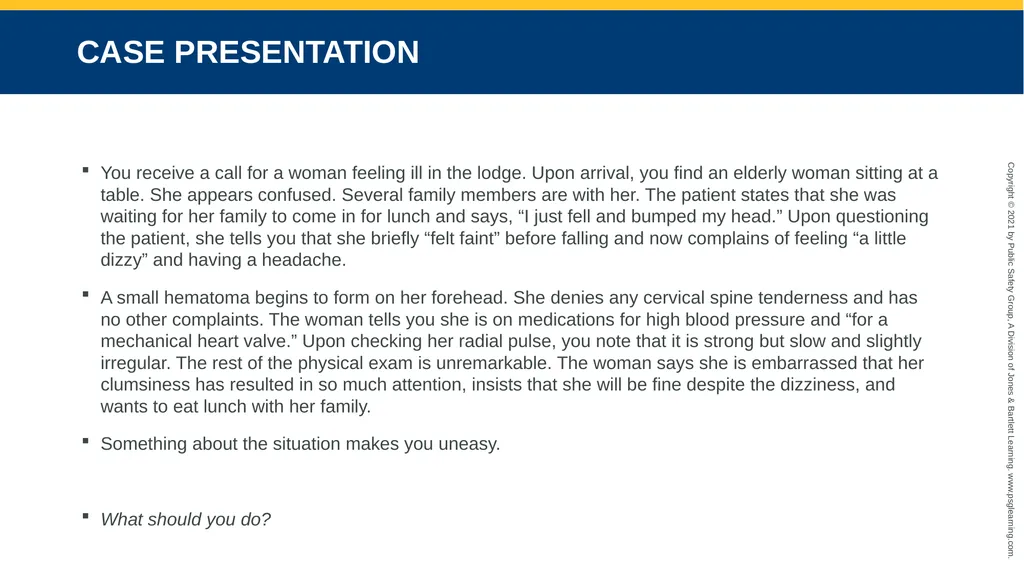
CASE PRESENTATION You receive a call for a woman feeling ill in the lodge. Upon arrival, you find an elderly woman sitting at a table. She appears confused. Several family members are with her. The patient states that she was waiting for her family to come in for lunch and says, “I just fell and bumped my head.” Upon questioning the patient, she tells you that she briefly “felt faint” before falling and now complains of feeling “a little dizzy” and having a headache.
A small hematoma begins to form on her forehead. She denies any cervical spine tenderness and has no other complaints. The woman tells you she is on medications for high blood pressure and “for a mechanical heart valve.” Upon checking her radial pulse, you note that it is strong but slow and slightly irregular. The rest of the physical exam is unremarkable. The woman says she is embarrassed that her clumsiness has resulted in so much attention, insists that she will be fine despite the dizziness, and wants to eat lunch with her family.
Something about the situation makes you uneasy.
What should you do?<br>
73
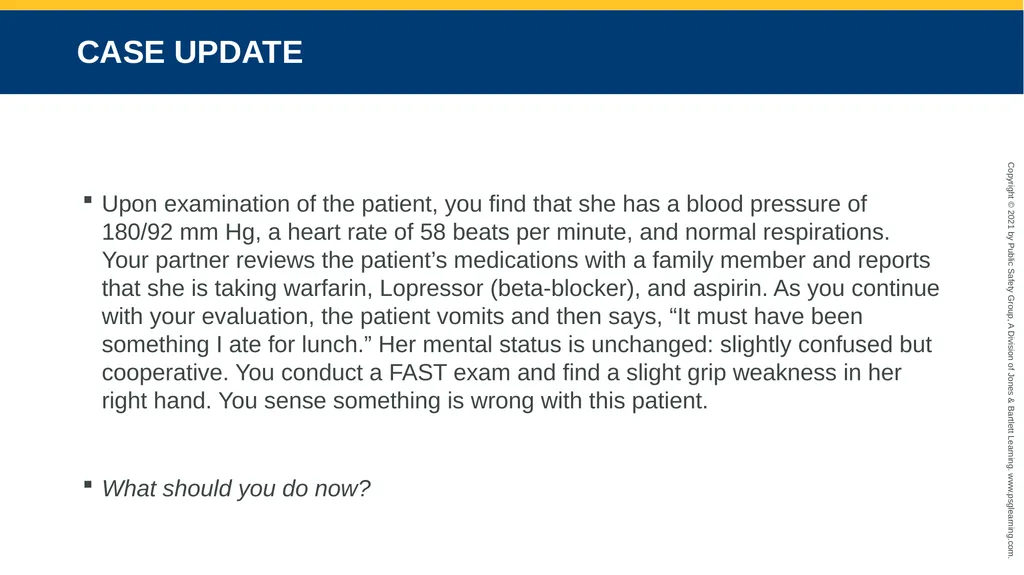
CASE UPDATE Upon examination of the patient, you find that she has a blood pressure of 180/92 mm Hg, a heart rate of 58 beats per minute, and normal respirations. Your partner reviews the patient’s medications with a family member and reports that she is taking warfarin, Lopressor (beta-blocker), and aspirin. As you continue with your evaluation, the patient vomits and then says, “It must have been something I ate for lunch.” Her mental status is unchanged: slightly confused but cooperative. You conduct a FAST exam and find a slight grip weakness in her right hand. You sense something is wrong with this patient.
What should you do now?<br>
What should you do now?<br>
74
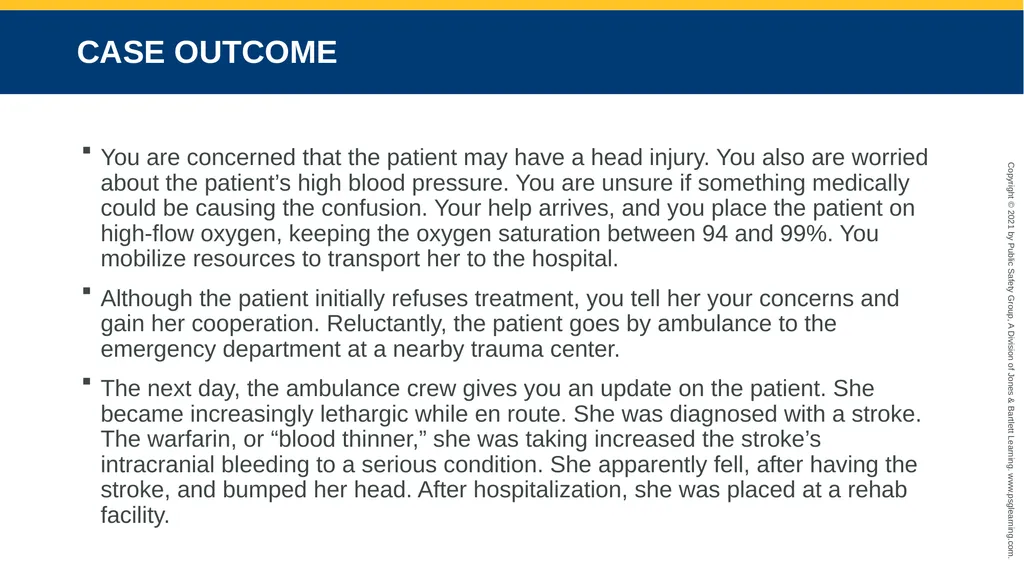
CASE OUTCOME You are concerned that the patient may have a head injury. You also are worried about the patient’s high blood pressure. You are unsure if something medically could be causing the confusion. Your help arrives, and you place the patient on high-flow oxygen, keeping the oxygen saturation between 94 and 99%. You mobilize resources to transport her to the hospital.
Although the patient initially refuses treatment, you tell her your concerns and gain her cooperation. Reluctantly, the patient goes by ambulance to the emergency department at a nearby trauma center.
The next day, the ambulance crew gives you an update on the patient. She became increasingly lethargic while en route. She was diagnosed with a stroke. The warfarin, or “blood thinner,” she was taking increased the stroke’s intracranial bleeding to a serious condition. She apparently fell, after having the stroke, and bumped her head. After hospitalization, she was placed at a rehab facility.<br>