
Chapter 4: Intellectual Property Department of

Description: Chapter 4: Intellectual Property Department of Chemistry, GC Paonta Sahib What is Intellectual Property Property is ownership of any asset Property can be Moveable Property Immoveable property Department of Chemistry, GC Paonta Sahib
Related Topics
Download Presentation
"Chapter 4: Intellectual Property Department of" is the property of its rightful owner. Permission is granted to download and print the materials on this website for personal, non-commercial use only, and to display it on your personal computer provided you do not modify the materials and that you retain all copyright notices contained in the materials. By downloading content from our website, you accept the terms of this agreement.
Presentation Transcript
slide1. Chapter 4: Intellectual Property Department of Chemistry, GC Paonta Sahib<br>
slide2. What is Intellectual Property Property is ownership of any asset
Property can be
Moveable Property
Immoveable property Department of Chemistry, GC Paonta Sahib<br>
slide3. Charactistics of Intellectual Property Creation of human mind (Intellect)
Intangible property
Exclusive rights given by statutes
Attended with limitations and exceptions
Time-bound
Territorial Department of Chemistry, GC Paonta Sahib<br>
slide4. Definition of Intellectual Property “Intellectual Property shall include the rights relating to literary, artistic and scientific works, performances of performing artists, phonograms, and broadcasts, inventions in all fields of human endeavour, scientific discoveries, Industrial designs, trademarks, service marks and commercial names and designations, protection against unfair competition and all other rights resulting from intellectual activity in the industrial, scientific, literary or artistic fields.” Department of Chemistry, GC Paonta Sahib<br>
slide5. Why is it important to protect Intellectual Property Rights Capital expenditure for new products
R and D
Marketing and advertisement
No free loaders
Maintaining loyal followers
profit Department of Chemistry, GC Paonta Sahib<br>
slide6. Types of Intellectual Property Copyright and Related Rights
Industrial Property
Patents
Industrial Designs
Trade Marks Department of Chemistry, GC Paonta Sahib<br>
slide7. The Laws For Intellectual Property Protection Copyright Act 1987
Trademarks Act 1976
Patent Act 1983
Industrial Design Act 1996
Geographical Indications Act 2000
Law of Tort
-passing-off
Confidential information Department of Chemistry, GC Paonta Sahib<br>
slide8. Copyright Copyright is granted in case of literary works (including computer programs, tables and compilations including computer databases which may be expressed in words, codes, schemes or in any other form, including a machine readable medium), dramatic, musical and artistic works, cinematographic films and sound recordings. Copyright law protects expressions of ideas rather than the ideas themselves. Under section 13 of the Copyright Act 1957, copyright protection is conferred on literary works, dramatic works, musical works, artistic works, cinematograph films and sound recording. For example, books, computer programs are protected under the Act as literary works. Department of Chemistry, GC Paonta Sahib<br>
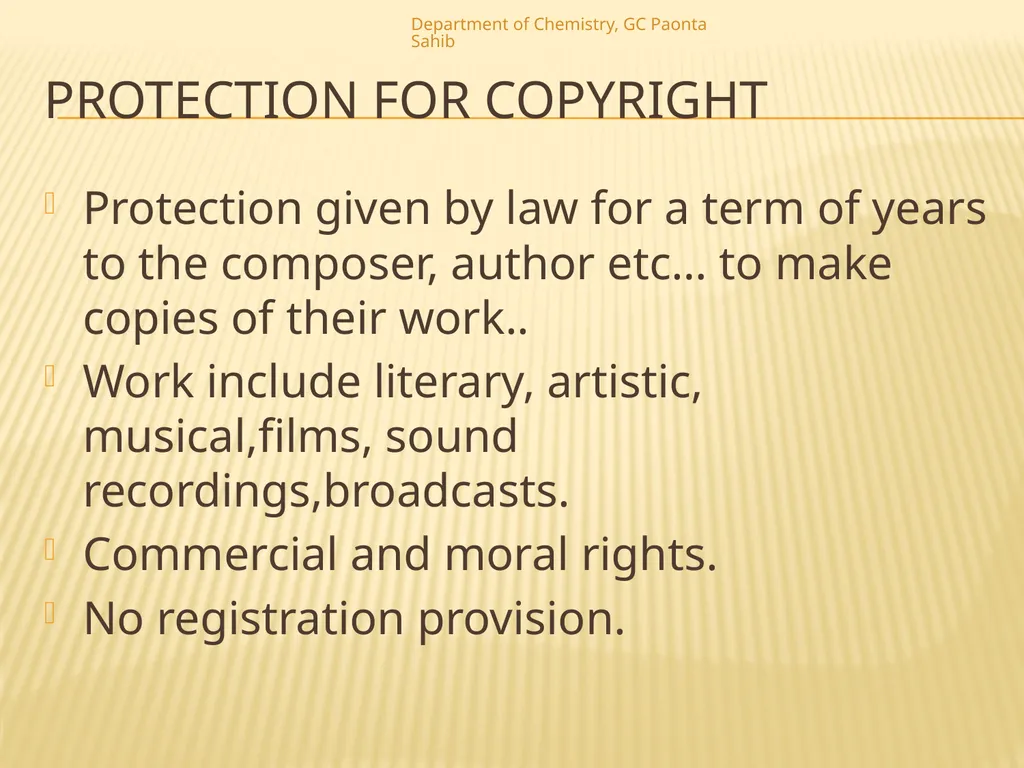
slide9. Protection for Copyright Protection given by law for a term of years to the composer, author etc… to make copies of their work..
Work include literary, artistic, musical,films, sound recordings,broadcasts.
Commercial and moral rights.
No registration provision. Department of Chemistry, GC Paonta Sahib<br>
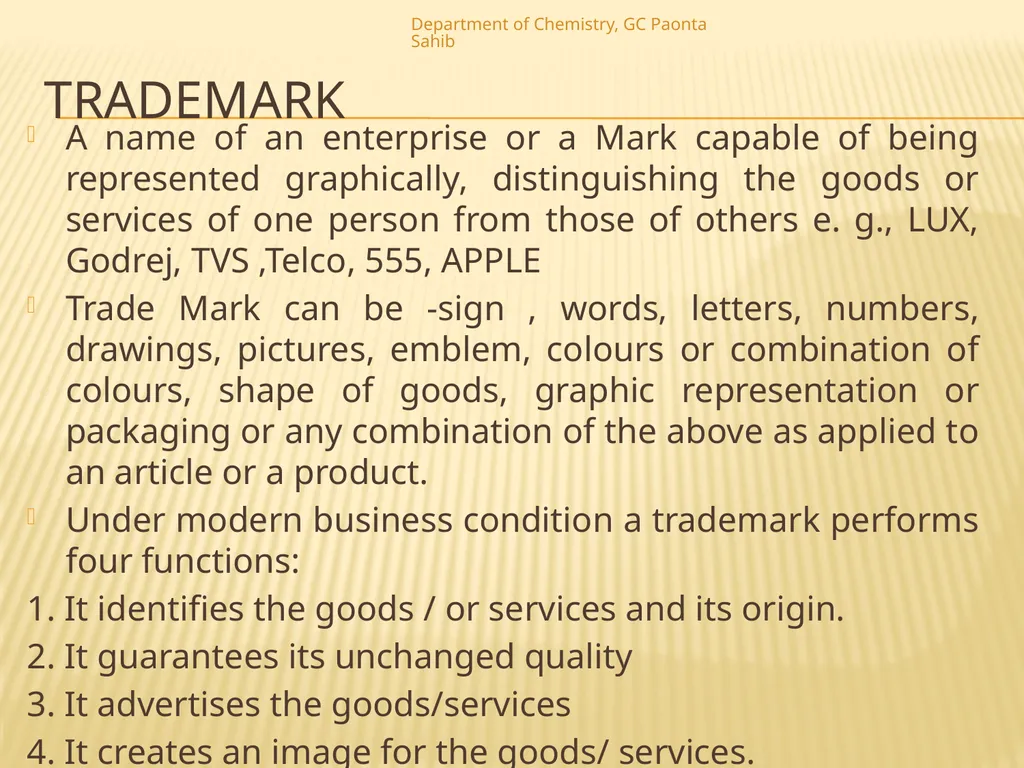
slide10. Trademark A name of an enterprise or a Mark capable of being represented graphically, distinguishing the goods or services of one person from those of others e. g., LUX, Godrej, TVS ,Telco, 555, APPLE
Trade Mark can be -sign , words, letters, numbers, drawings, pictures, emblem, colours or combination of colours, shape of goods, graphic representation or packaging or any combination of the above as applied to an article or a product.
Under modern business condition a trademark performs four functions:
1. It identifies the goods / or services and its origin.
2. It guarantees its unchanged quality
3. It advertises the goods/services
4. It creates an image for the goods/ services. Department of Chemistry, GC Paonta Sahib<br>
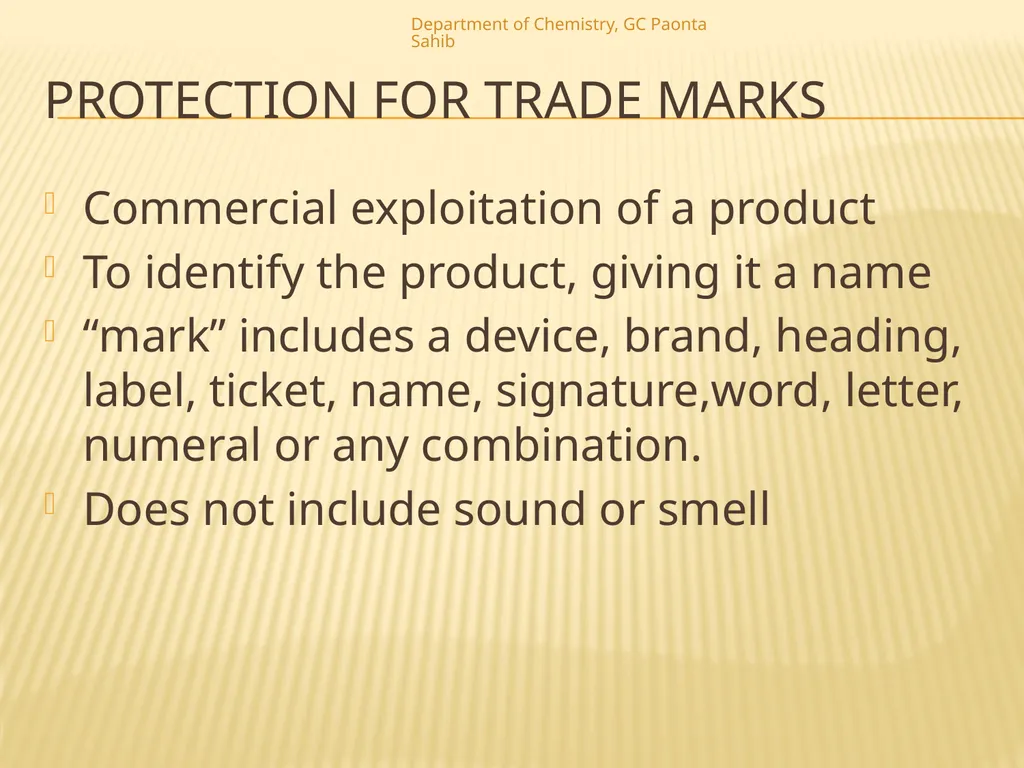
slide11. Protection for trade marks Commercial exploitation of a product
To identify the product, giving it a name
“mark” includes a device, brand, heading, label, ticket, name, signature,word, letter, numeral or any combination.
Does not include sound or smell Department of Chemistry, GC Paonta Sahib<br>
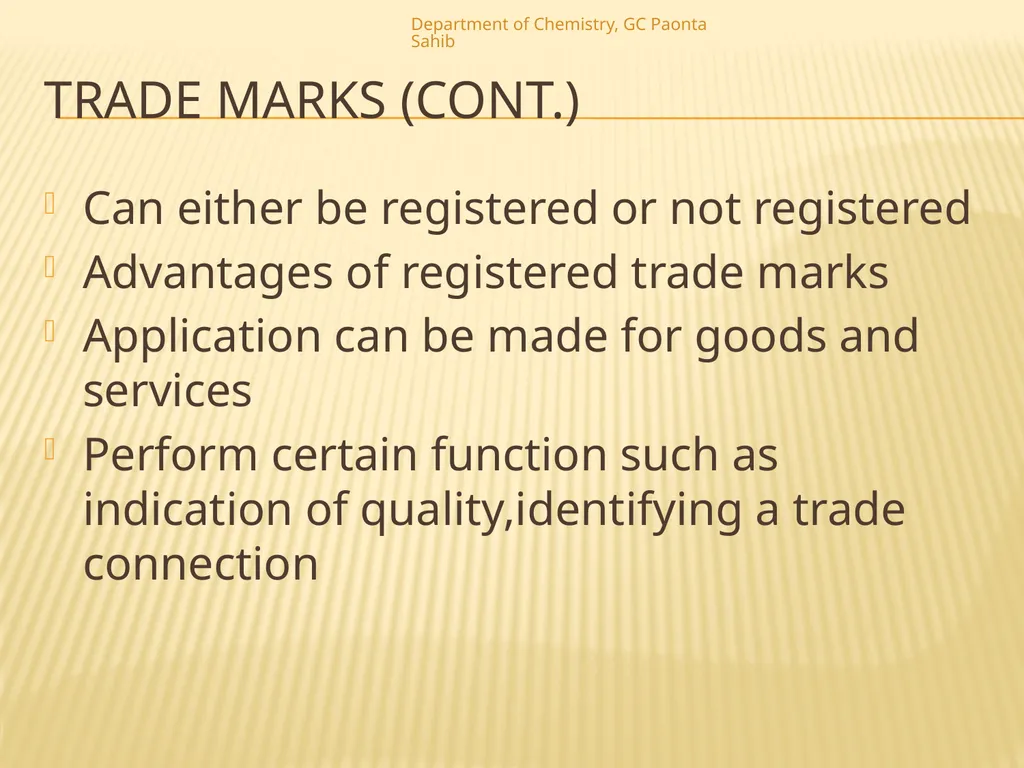
slide12. Trade marks (cont.) Can either be registered or not registered
Advantages of registered trade marks
Application can be made for goods and services
Perform certain function such as indication of quality,identifying a trade connection Department of Chemistry, GC Paonta Sahib<br>
slide13. Patent The Patents Act, 1970 deals with the patenting of inventions. A person claiming to be an inventor, applies to the controller of Patents, for patent rights. If the application is successful, the person gets a patent right for a certain number of years. During this period nobody can use the invention without the permission of that person. Department of Chemistry, GC Paonta Sahib<br>
slide14. Protection for patent Basic idea of granting a patent
“ the applicant applied to the government for the right of patent and in return for the monopoly given he must disclose everything about the invention in the patent document” ( the description)
Duration 20 years. Department of Chemistry, GC Paonta Sahib<br>
slide15. Patent (cont.) Patent for invention
Patent can be applied for a product or a process.
Patentable invention must be new,involves an inventive step and industrially applicable
Priority date- first to file Department of Chemistry, GC Paonta Sahib<br>
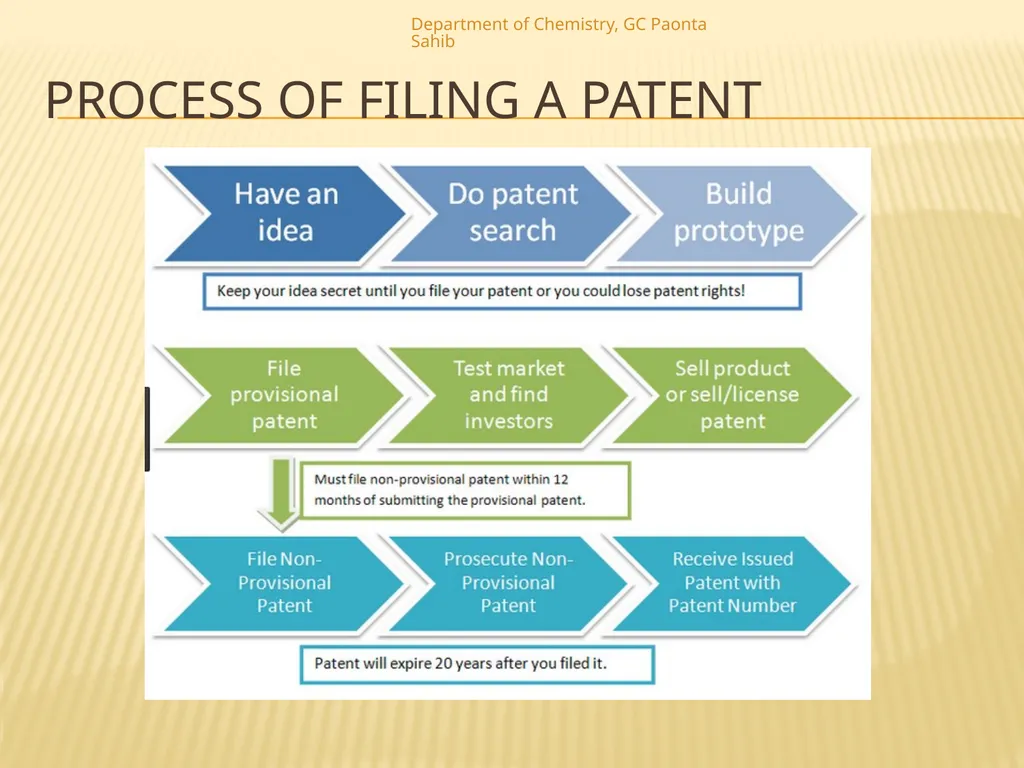
slide16. Process of filing a Patent Department of Chemistry, GC Paonta Sahib<br>
slide17. Protection for industrial designs Protection for industrial designs that are new or original
Design are feature of shape, configuration, pattern or ornament
The design must be applied to an article
The design must be applied by an industrial process.
Appeal to the eye. Department of Chemistry, GC Paonta Sahib<br>
slide18. Intellectual Property infringement Primary infringement
- who does or causes
-making the product
Secondary infringement
- commercial activities
- selling,distribution for sale etc Department of Chemistry, GC Paonta Sahib<br>
slide19. Thank you Department of Chemistry, GC Paonta Sahib<br>
slide2. What is Intellectual Property Property is ownership of any asset
Property can be
Moveable Property
Immoveable property Department of Chemistry, GC Paonta Sahib<br>
slide3. Charactistics of Intellectual Property Creation of human mind (Intellect)
Intangible property
Exclusive rights given by statutes
Attended with limitations and exceptions
Time-bound
Territorial Department of Chemistry, GC Paonta Sahib<br>
slide4. Definition of Intellectual Property “Intellectual Property shall include the rights relating to literary, artistic and scientific works, performances of performing artists, phonograms, and broadcasts, inventions in all fields of human endeavour, scientific discoveries, Industrial designs, trademarks, service marks and commercial names and designations, protection against unfair competition and all other rights resulting from intellectual activity in the industrial, scientific, literary or artistic fields.” Department of Chemistry, GC Paonta Sahib<br>
slide5. Why is it important to protect Intellectual Property Rights Capital expenditure for new products
R and D
Marketing and advertisement
No free loaders
Maintaining loyal followers
profit Department of Chemistry, GC Paonta Sahib<br>
slide6. Types of Intellectual Property Copyright and Related Rights
Industrial Property
Patents
Industrial Designs
Trade Marks Department of Chemistry, GC Paonta Sahib<br>
slide7. The Laws For Intellectual Property Protection Copyright Act 1987
Trademarks Act 1976
Patent Act 1983
Industrial Design Act 1996
Geographical Indications Act 2000
Law of Tort
-passing-off
Confidential information Department of Chemistry, GC Paonta Sahib<br>
slide8. Copyright Copyright is granted in case of literary works (including computer programs, tables and compilations including computer databases which may be expressed in words, codes, schemes or in any other form, including a machine readable medium), dramatic, musical and artistic works, cinematographic films and sound recordings. Copyright law protects expressions of ideas rather than the ideas themselves. Under section 13 of the Copyright Act 1957, copyright protection is conferred on literary works, dramatic works, musical works, artistic works, cinematograph films and sound recording. For example, books, computer programs are protected under the Act as literary works. Department of Chemistry, GC Paonta Sahib<br>
slide9. Protection for Copyright Protection given by law for a term of years to the composer, author etc… to make copies of their work..
Work include literary, artistic, musical,films, sound recordings,broadcasts.
Commercial and moral rights.
No registration provision. Department of Chemistry, GC Paonta Sahib<br>
slide10. Trademark A name of an enterprise or a Mark capable of being represented graphically, distinguishing the goods or services of one person from those of others e. g., LUX, Godrej, TVS ,Telco, 555, APPLE
Trade Mark can be -sign , words, letters, numbers, drawings, pictures, emblem, colours or combination of colours, shape of goods, graphic representation or packaging or any combination of the above as applied to an article or a product.
Under modern business condition a trademark performs four functions:
1. It identifies the goods / or services and its origin.
2. It guarantees its unchanged quality
3. It advertises the goods/services
4. It creates an image for the goods/ services. Department of Chemistry, GC Paonta Sahib<br>
slide11. Protection for trade marks Commercial exploitation of a product
To identify the product, giving it a name
“mark” includes a device, brand, heading, label, ticket, name, signature,word, letter, numeral or any combination.
Does not include sound or smell Department of Chemistry, GC Paonta Sahib<br>
slide12. Trade marks (cont.) Can either be registered or not registered
Advantages of registered trade marks
Application can be made for goods and services
Perform certain function such as indication of quality,identifying a trade connection Department of Chemistry, GC Paonta Sahib<br>
slide13. Patent The Patents Act, 1970 deals with the patenting of inventions. A person claiming to be an inventor, applies to the controller of Patents, for patent rights. If the application is successful, the person gets a patent right for a certain number of years. During this period nobody can use the invention without the permission of that person. Department of Chemistry, GC Paonta Sahib<br>
slide14. Protection for patent Basic idea of granting a patent
“ the applicant applied to the government for the right of patent and in return for the monopoly given he must disclose everything about the invention in the patent document” ( the description)
Duration 20 years. Department of Chemistry, GC Paonta Sahib<br>
slide15. Patent (cont.) Patent for invention
Patent can be applied for a product or a process.
Patentable invention must be new,involves an inventive step and industrially applicable
Priority date- first to file Department of Chemistry, GC Paonta Sahib<br>
slide16. Process of filing a Patent Department of Chemistry, GC Paonta Sahib<br>
slide17. Protection for industrial designs Protection for industrial designs that are new or original
Design are feature of shape, configuration, pattern or ornament
The design must be applied to an article
The design must be applied by an industrial process.
Appeal to the eye. Department of Chemistry, GC Paonta Sahib<br>
slide18. Intellectual Property infringement Primary infringement
- who does or causes
-making the product
Secondary infringement
- commercial activities
- selling,distribution for sale etc Department of Chemistry, GC Paonta Sahib<br>
slide19. Thank you Department of Chemistry, GC Paonta Sahib<br>