
Chapter 4: Project Integration Management

Description: Chapter 4: Project Integration Management Information Technology Project Management, Eighth Edition Note: See the text itself for full citations. Project managers must coordinate all of the other knowledge areas throughout a projects life
Related Topics
Download Presentation
"Chapter 4: Project Integration Management" is the property of its rightful owner. Permission is granted to download and print the materials on this website for personal, non-commercial use only, and to display it on your personal computer provided you do not modify the materials and that you retain all copyright notices contained in the materials. By downloading content from our website, you accept the terms of this agreement.
Presentation Transcript
slide1. Chapter 4:
Project Integration Management Information Technology Project Management, Eighth Edition Note: See the text itself for full citations.<br>
slide2. Project managers must coordinate all of the other knowledge areas throughout a project’s life cycle
Many new project managers have trouble looking at the “big picture” and want to focus on too many details (See opening case for a real example)
Project integration management is not the same thing as software integration Information Technology Project Management, Eighth Edition 2 The Key to Overall Project Success: Good Project Integration Management<br>
slide3. 1. Developing the project charter involves working with stakeholders to create the document that formally authorizes a project—the charter.
2. Developing the project management plan involves coordinating all planning efforts to create a consistent, coherent document—the project management plan.
3. Directing and managing project work involves carrying out the project management plan by performing the activities included in it. Information Technology Project Management, Eighth Edition 3 Project Integration Management Processes<br>
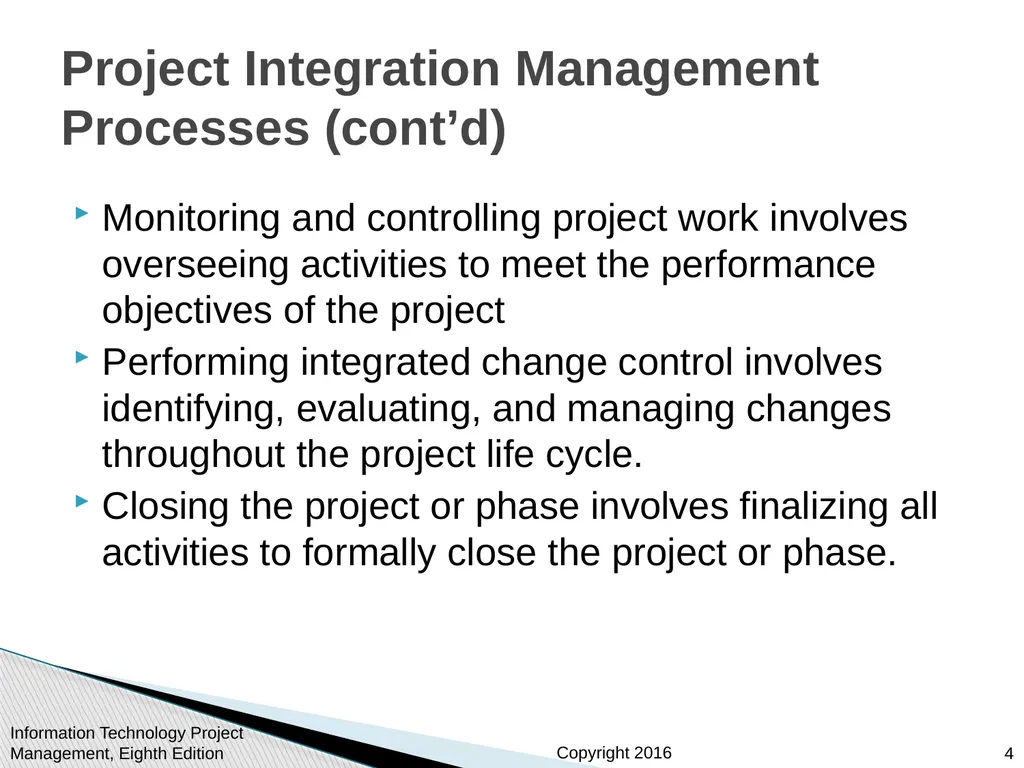
slide4. Monitoring and controlling project work involves overseeing activities to meet the performance objectives of the project
Performing integrated change control involves identifying, evaluating, and managing changes throughout the project life cycle.
Closing the project or phase involves finalizing all activities to formally close the project or phase. Information Technology Project Management, Eighth Edition 4 Project Integration Management Processes (cont’d)<br>
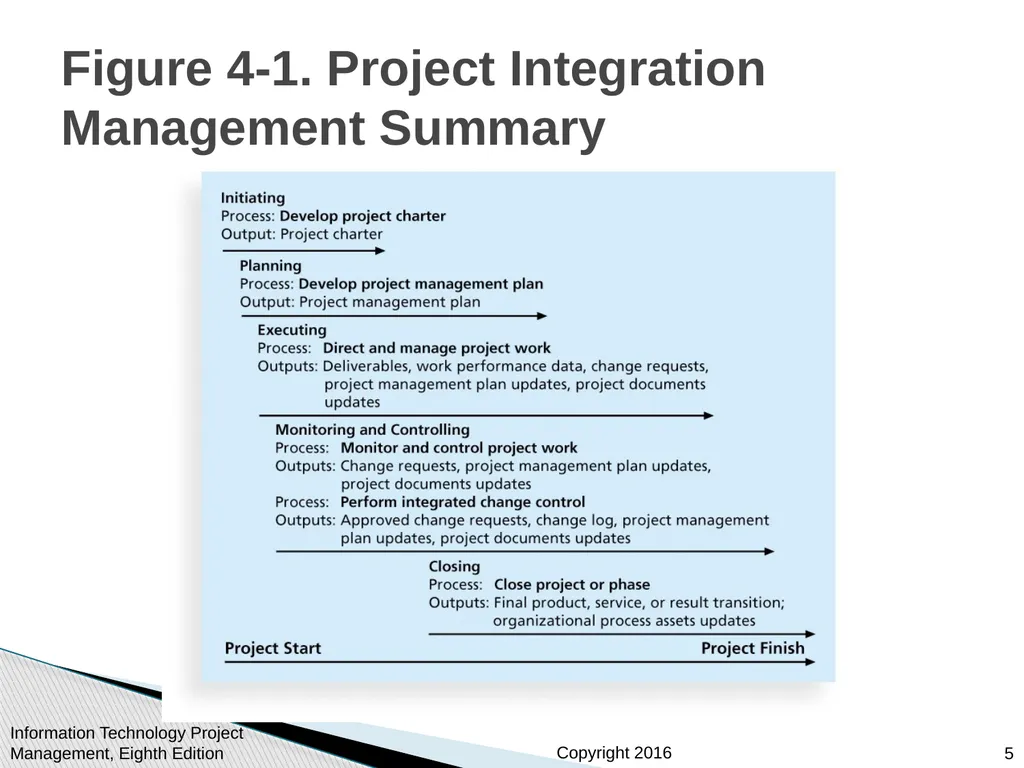
slide5. Information Technology Project Management, Eighth Edition 5 Figure 4-1. Project Integration Management Summary<br>
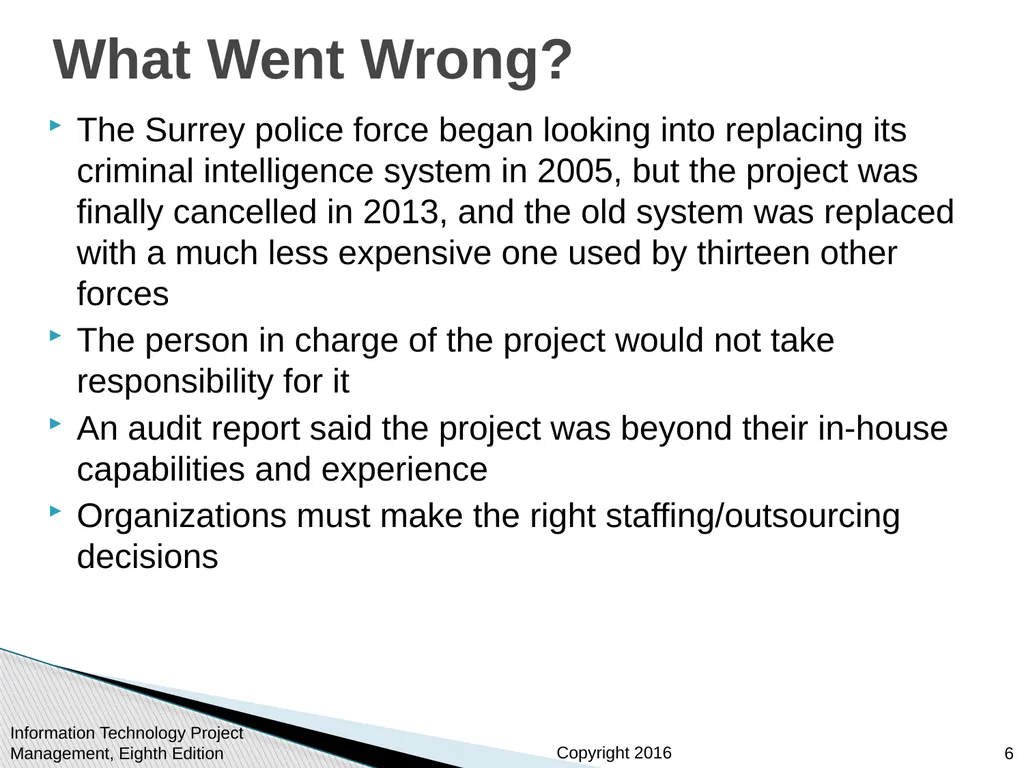
slide6. The Surrey police force began looking into replacing its criminal intelligence system in 2005, but the project was finally cancelled in 2013, and the old system was replaced with a much less expensive one used by thirteen other forces
The person in charge of the project would not take responsibility for it
An audit report said the project was beyond their in-house capabilities and experience
Organizations must make the right staffing/outsourcing decisions Information Technology Project Management, Eighth Edition 6 What Went Wrong?<br>
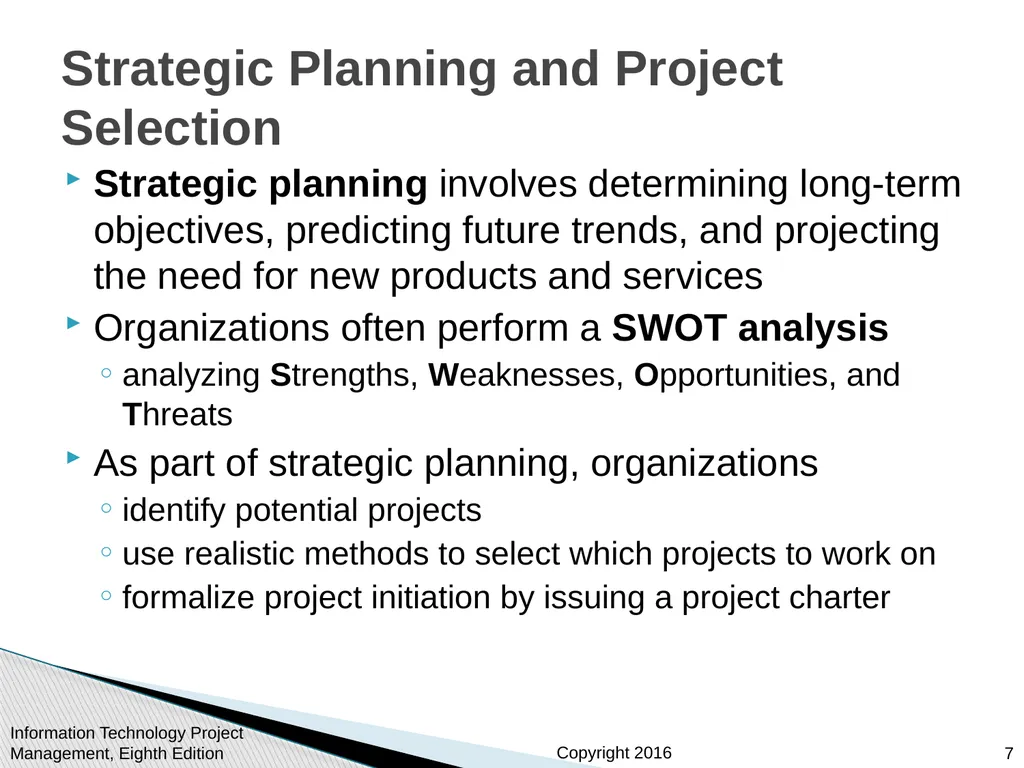
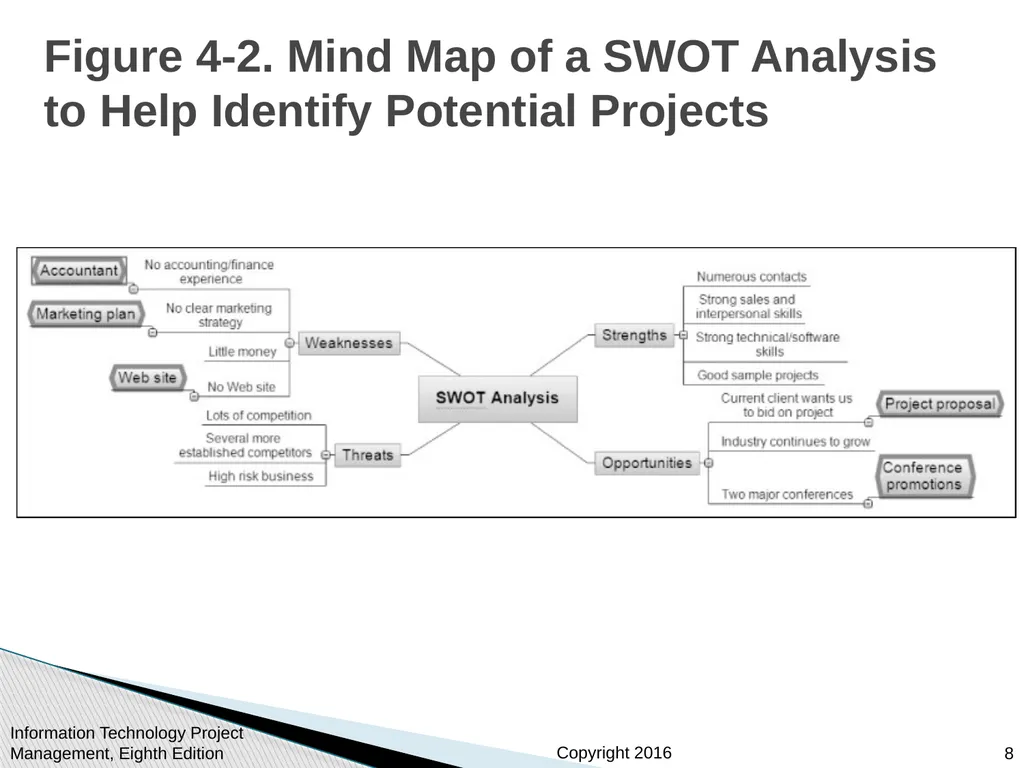
slide7. Strategic planning involves determining long-term objectives, predicting future trends, and projecting the need for new products and services
Organizations often perform a SWOT analysis
analyzing Strengths, Weaknesses, Opportunities, and Threats
As part of strategic planning, organizations
identify potential projects
use realistic methods to select which projects to work on
formalize project initiation by issuing a project charter Information Technology Project Management, Eighth Edition 7 Strategic Planning and Project Selection<br>
slide8. Information Technology Project Management, Eighth Edition 8 Figure 4-2. Mind Map of a SWOT Analysis to Help Identify Potential Projects<br>
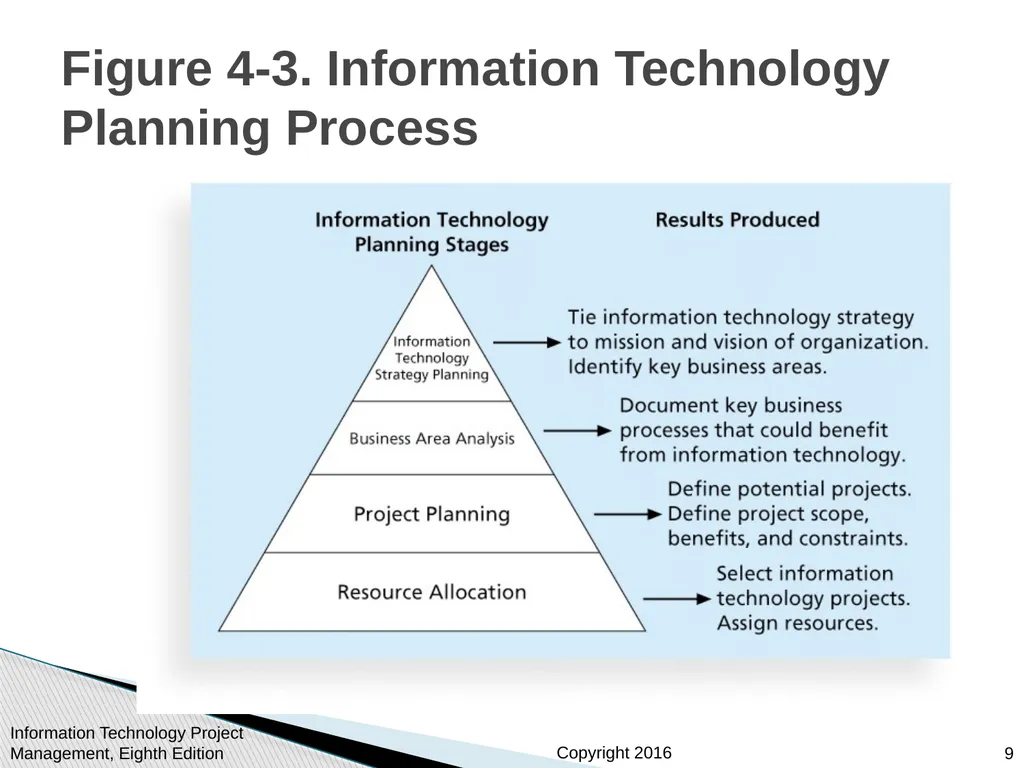
slide9. Information Technology Project Management, Eighth Edition 9 Figure 4-3. Information Technology Planning Process<br>
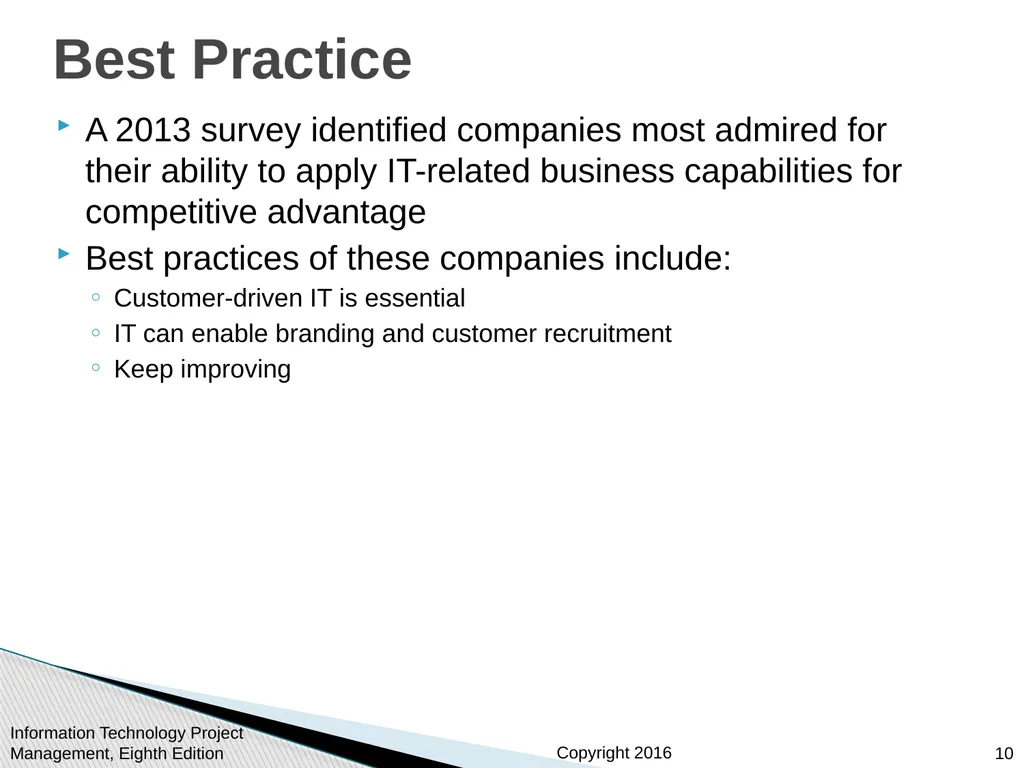
slide10. A 2013 survey identified companies most admired for their ability to apply IT-related business capabilities for competitive advantage
Best practices of these companies include:
Customer-driven IT is essential
IT can enable branding and customer recruitment
Keep improving Information Technology Project Management, Eighth Edition 10 Best Practice<br>
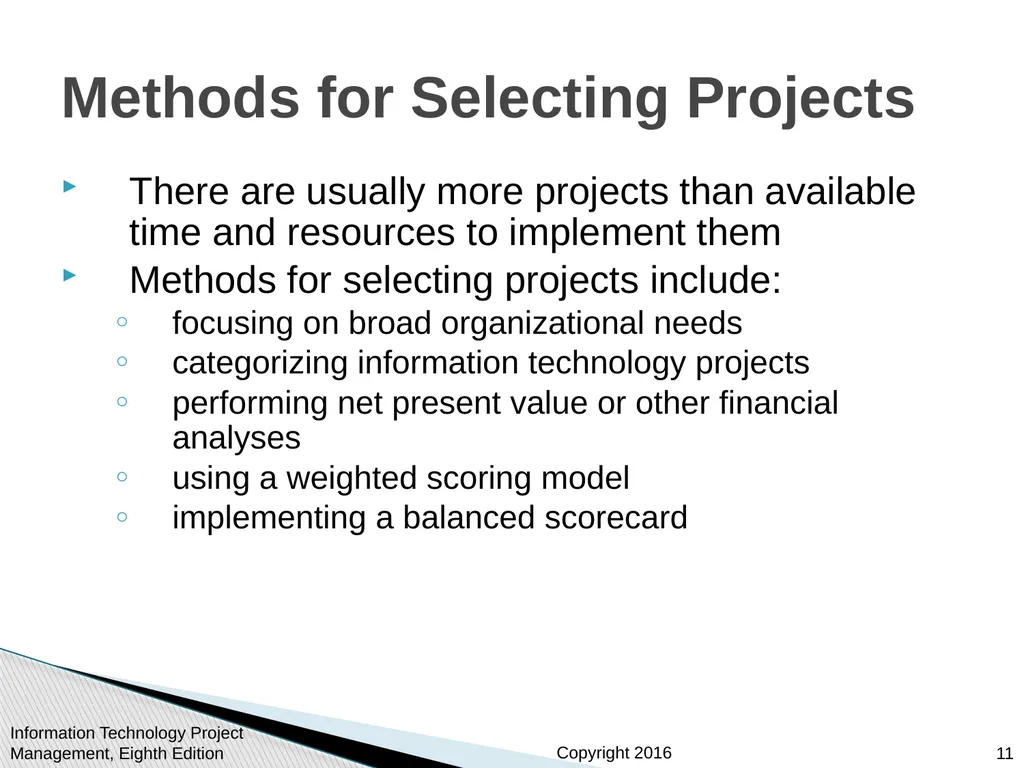
slide11. There are usually more projects than available time and resources to implement them
Methods for selecting projects include:
focusing on broad organizational needs
categorizing information technology projects
performing net present value or other financial analyses
using a weighted scoring model
implementing a balanced scorecard Information Technology Project Management, Eighth Edition 11 Methods for Selecting Projects<br>
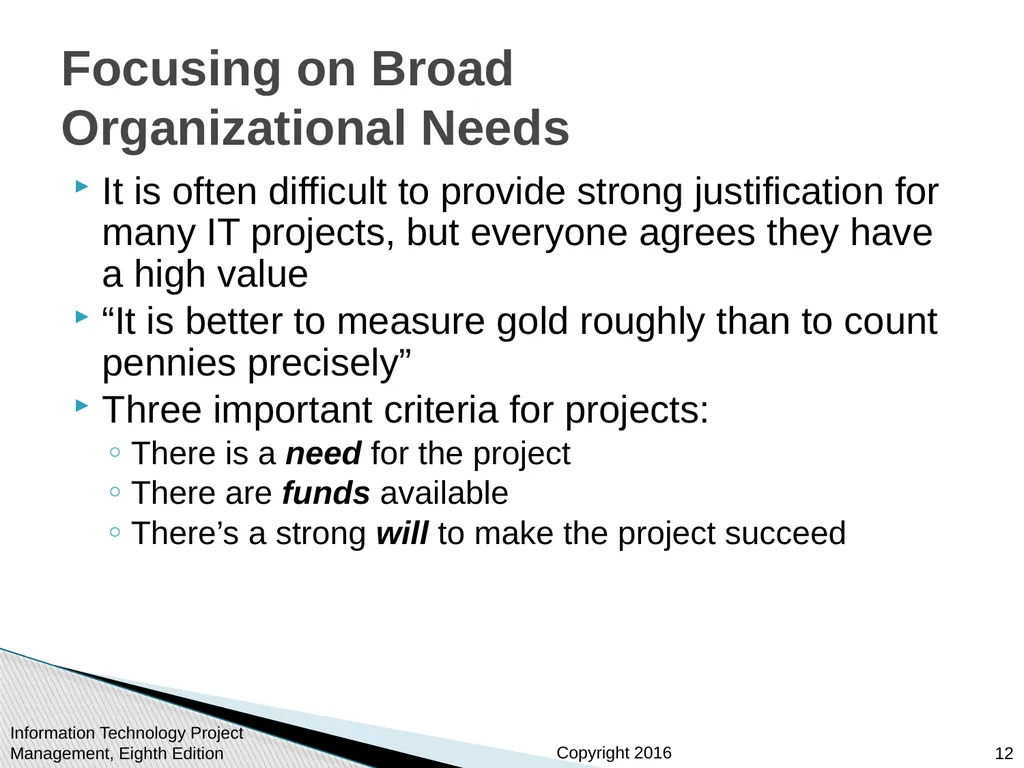
slide12. It is often difficult to provide strong justification for many IT projects, but everyone agrees they have a high value
“It is better to measure gold roughly than to count pennies precisely”
Three important criteria for projects:
There is a need for the project
There are funds available
There’s a strong will to make the project succeed Information Technology Project Management, Eighth Edition 12 Focusing on Broad Organizational Needs<br>
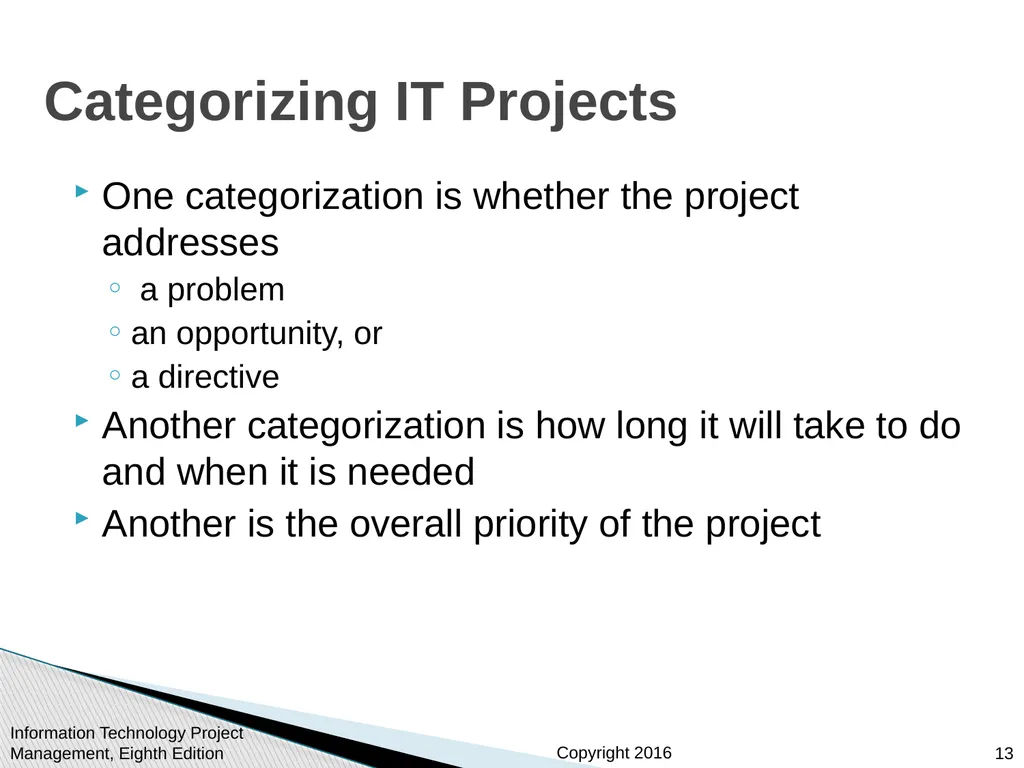
slide13. One categorization is whether the project addresses
a problem
an opportunity, or
a directive
Another categorization is how long it will take to do and when it is needed
Another is the overall priority of the project Information Technology Project Management, Eighth Edition 13 Categorizing IT Projects<br>
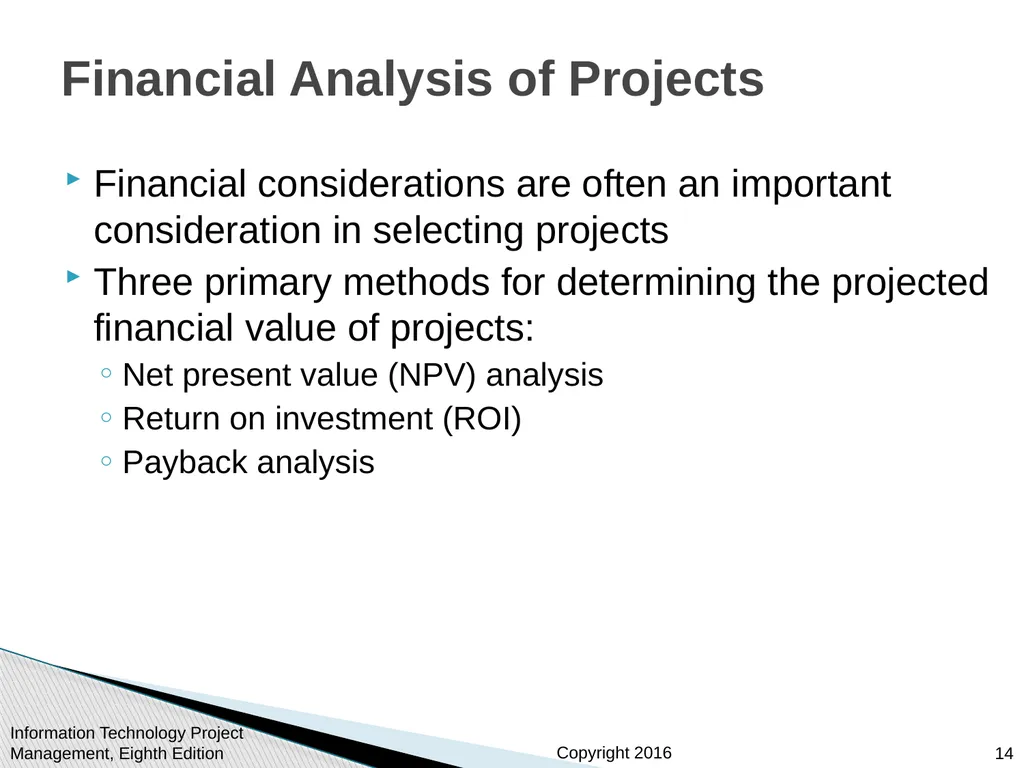
slide14. Financial considerations are often an important consideration in selecting projects
Three primary methods for determining the projected financial value of projects:
Net present value (NPV) analysis
Return on investment (ROI)
Payback analysis Information Technology Project Management, Eighth Edition 14 Financial Analysis of Projects<br>
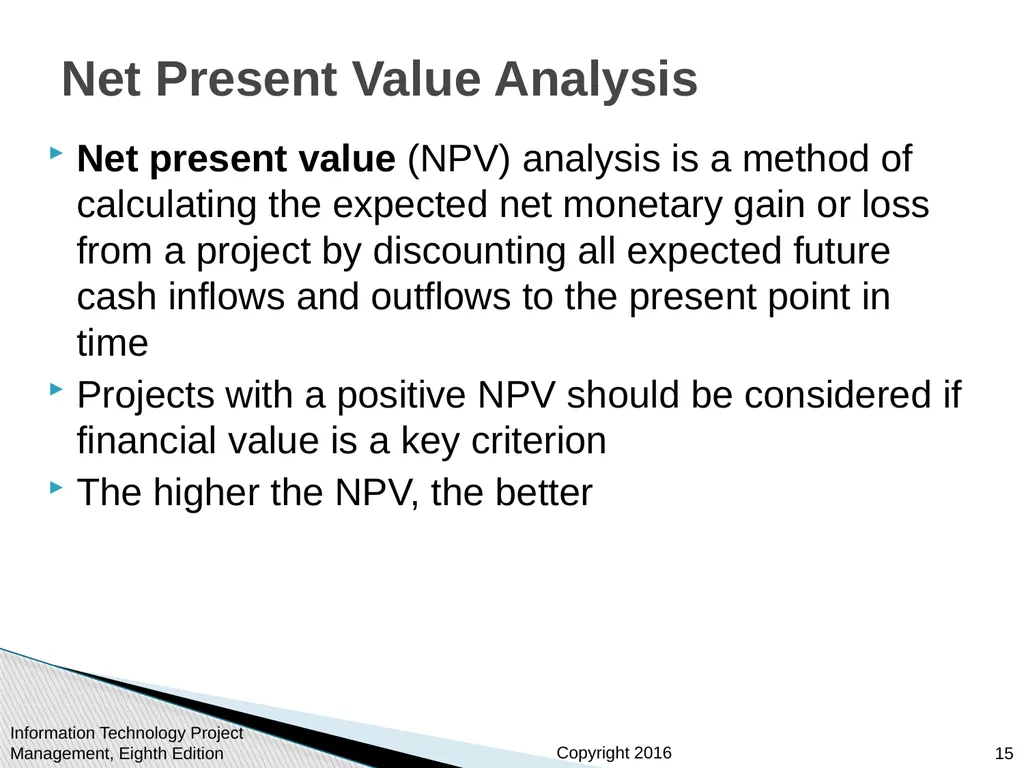
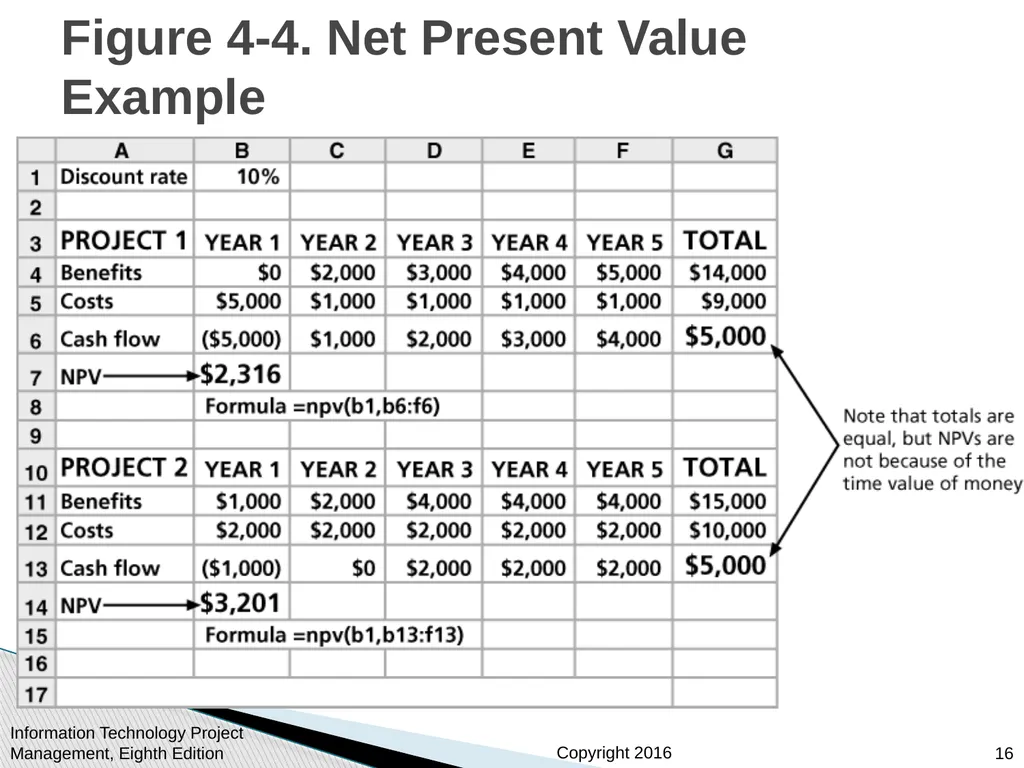
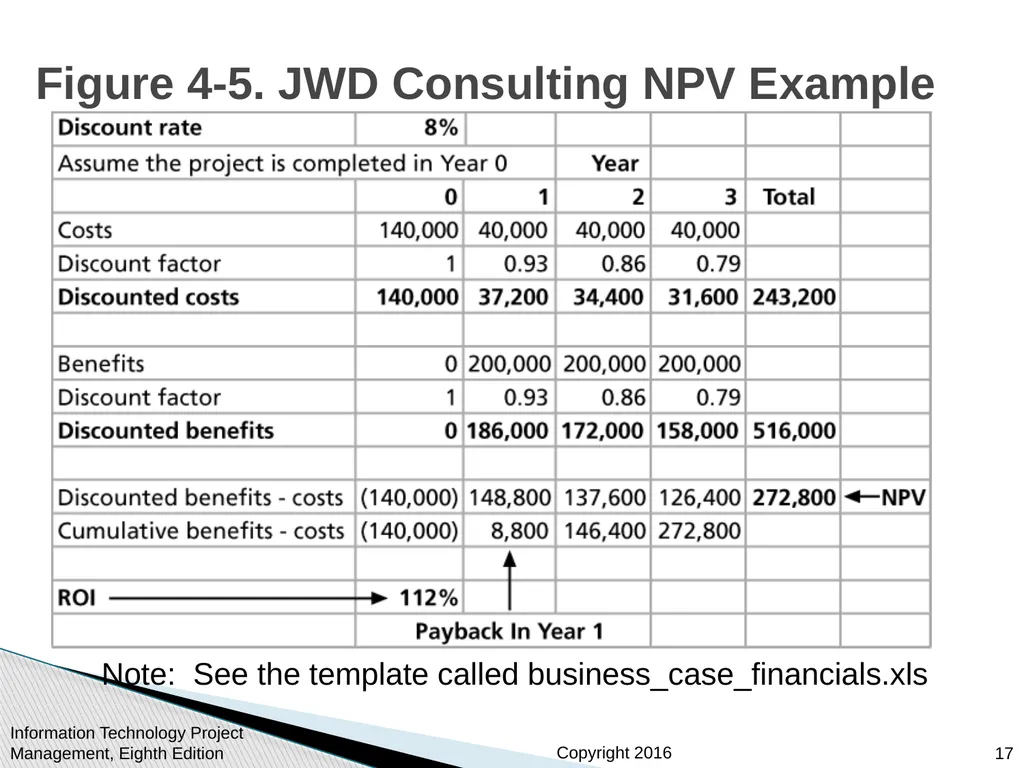
slide15. Net present value (NPV) analysis is a method of calculating the expected net monetary gain or loss from a project by discounting all expected future cash inflows and outflows to the present point in time
Projects with a positive NPV should be considered if financial value is a key criterion
The higher the NPV, the better Information Technology Project Management, Eighth Edition 15 Net Present Value Analysis<br>
slide16. Information Technology Project Management, Eighth Edition 16 Figure 4-4. Net Present Value Example<br>
slide17. Information Technology Project Management, Eighth Edition 17 Figure 4-5. JWD Consulting NPV Example Note: See the template called business_case_financials.xls<br>
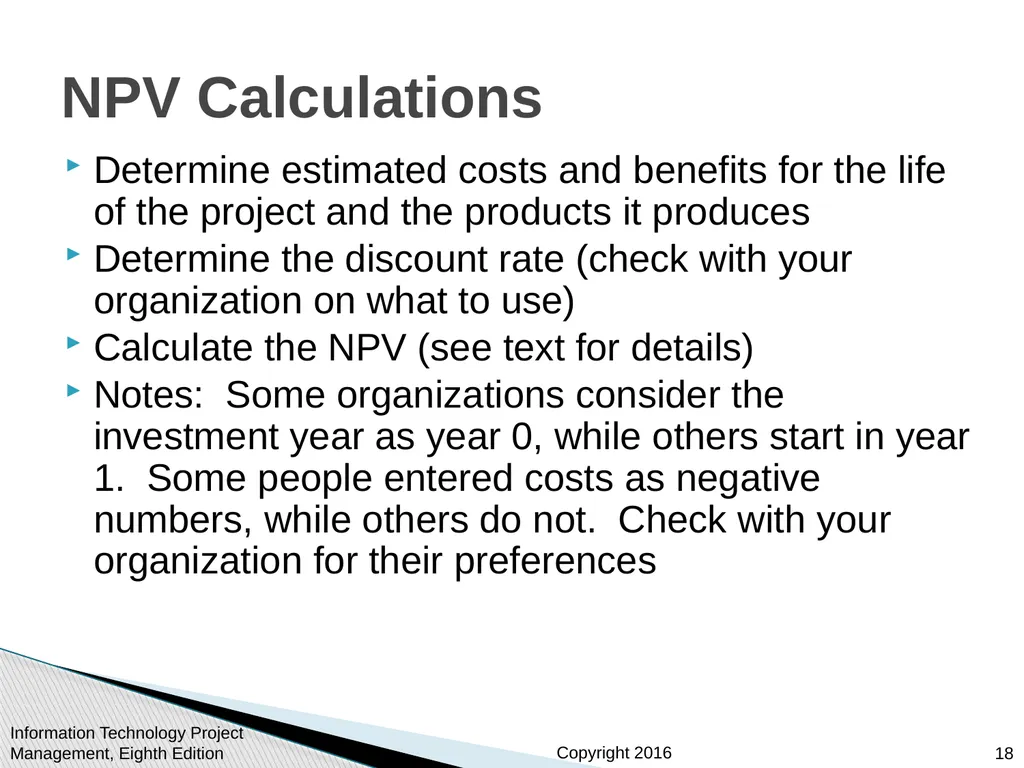
slide18. Determine estimated costs and benefits for the life of the project and the products it produces
Determine the discount rate (check with your organization on what to use)
Calculate the NPV (see text for details)
Notes: Some organizations consider the investment year as year 0, while others start in year 1. Some people entered costs as negative numbers, while others do not. Check with your organization for their preferences Information Technology Project Management, Eighth Edition 18 NPV Calculations<br>
slide19. Return on investment (ROI) is calculated by subtracting the project costs from the benefits and then dividing by the costs
ROI = (total discounted benefits - total discounted costs) / discounted costs
The higher the ROI, the better
Many organizations have a required rate of return or minimum acceptable rate of return on investment for projects
Internal rate of return (IRR) can by calculated by finding the discount rate that makes the NPV equal to zero Information Technology Project Management, Eighth Edition 19 Return on Investment<br>
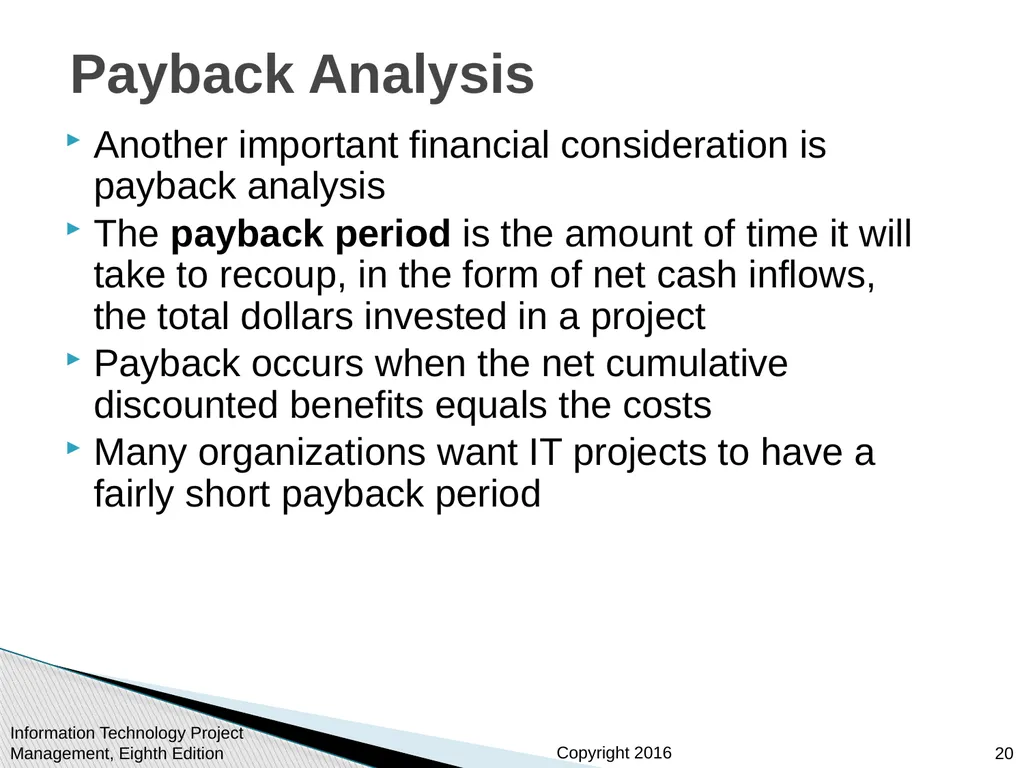
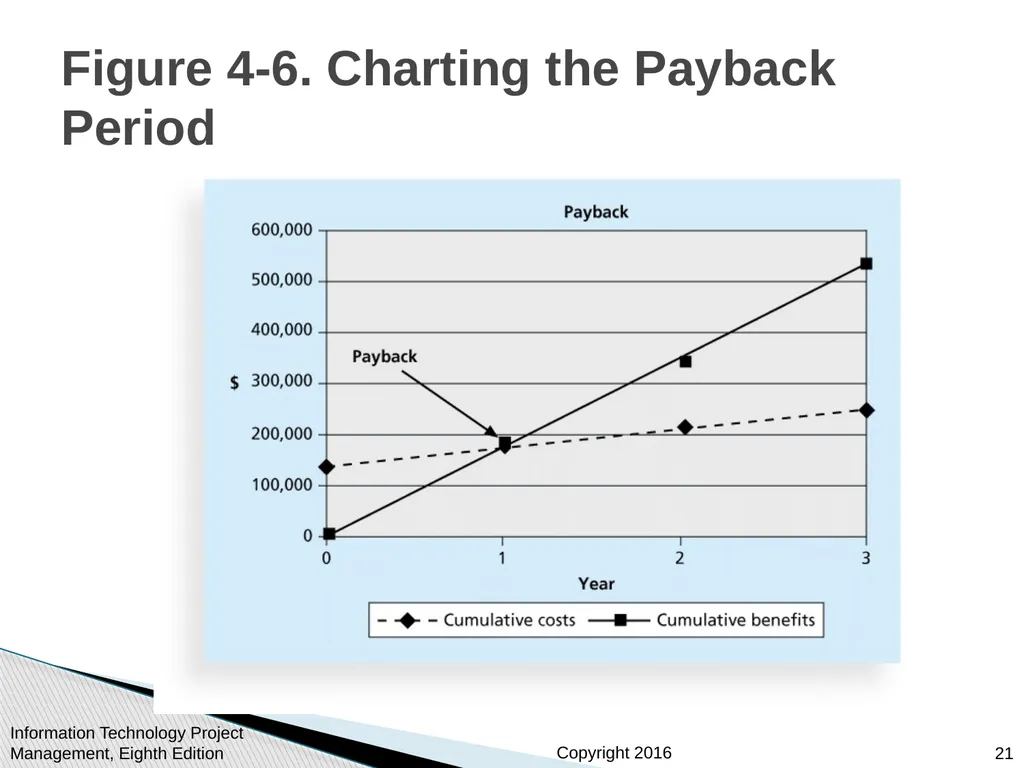
slide20. Another important financial consideration is payback analysis
The payback period is the amount of time it will take to recoup, in the form of net cash inflows, the total dollars invested in a project
Payback occurs when the net cumulative discounted benefits equals the costs
Many organizations want IT projects to have a fairly short payback period Information Technology Project Management, Eighth Edition 20 Payback Analysis<br>
slide21. Information Technology Project Management, Eighth Edition 21 Figure 4-6. Charting the Payback Period<br>
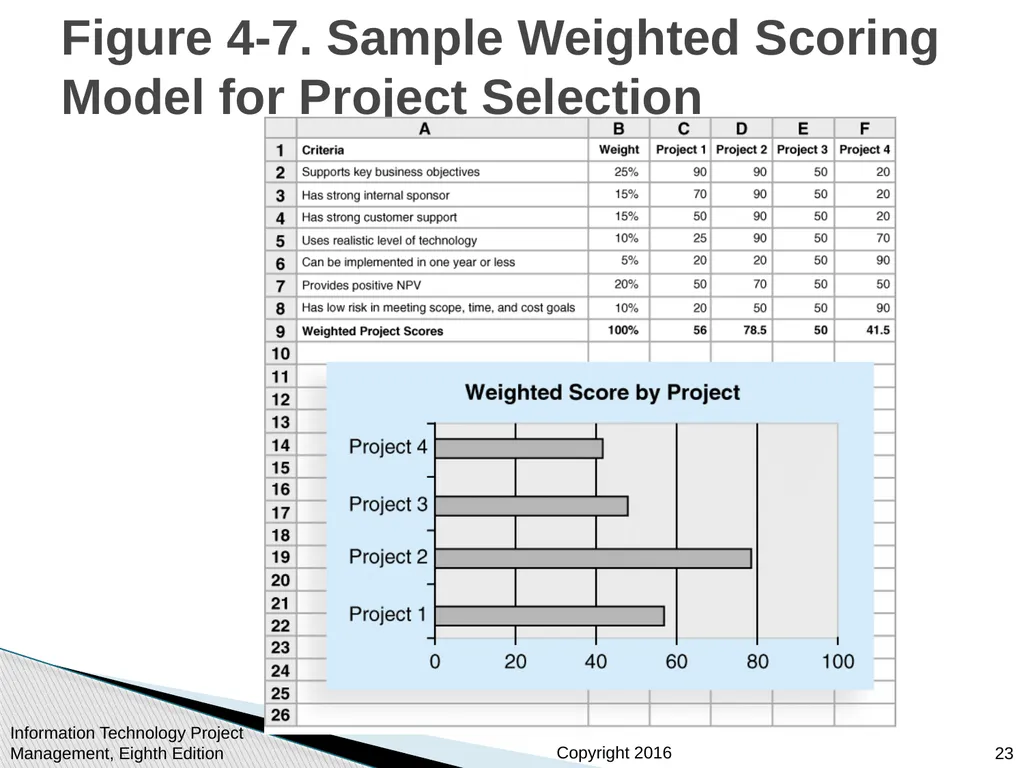
slide22. A weighted scoring model is a tool that provides a systematic process for selecting projects based on many criteria
Identify criteria important to the project selection process
Assign weights (percentages) to each criterion so they add up to 100%
Assign scores to each criterion for each project
Multiply the scores by the weights and get the total weighted scores
The higher the weighted score, the better Information Technology Project Management, Eighth Edition 22 Weighted Scoring Model<br>
slide23. Information Technology Project Management, Eighth Edition 23 Figure 4-7. Sample Weighted Scoring Model for Project Selection<br>
slide24. Drs. Robert Kaplan and David Norton developed this approach to help select and manage projects that align with business strategy
A balanced scorecard
is a methodology that converts an organization’s value drivers, such as customer service, innovation, operational efficiency, and financial performance, to a series of defined metrics
See www.balancedscorecard.org for more information Information Technology Project Management, Eighth Edition 24 Implementing a Balanced Scorecard<br>
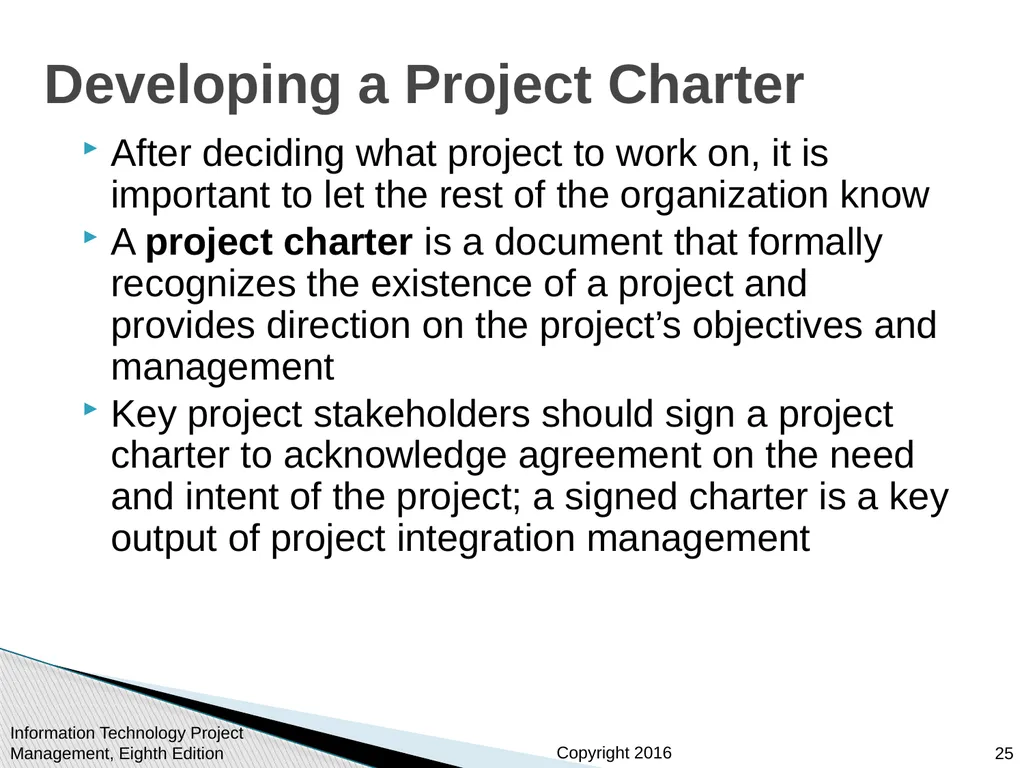
slide25. After deciding what project to work on, it is important to let the rest of the organization know
A project charter is a document that formally recognizes the existence of a project and provides direction on the project’s objectives and management
Key project stakeholders should sign a project charter to acknowledge agreement on the need and intent of the project; a signed charter is a key output of project integration management Information Technology Project Management, Eighth Edition 25 Developing a Project Charter<br>
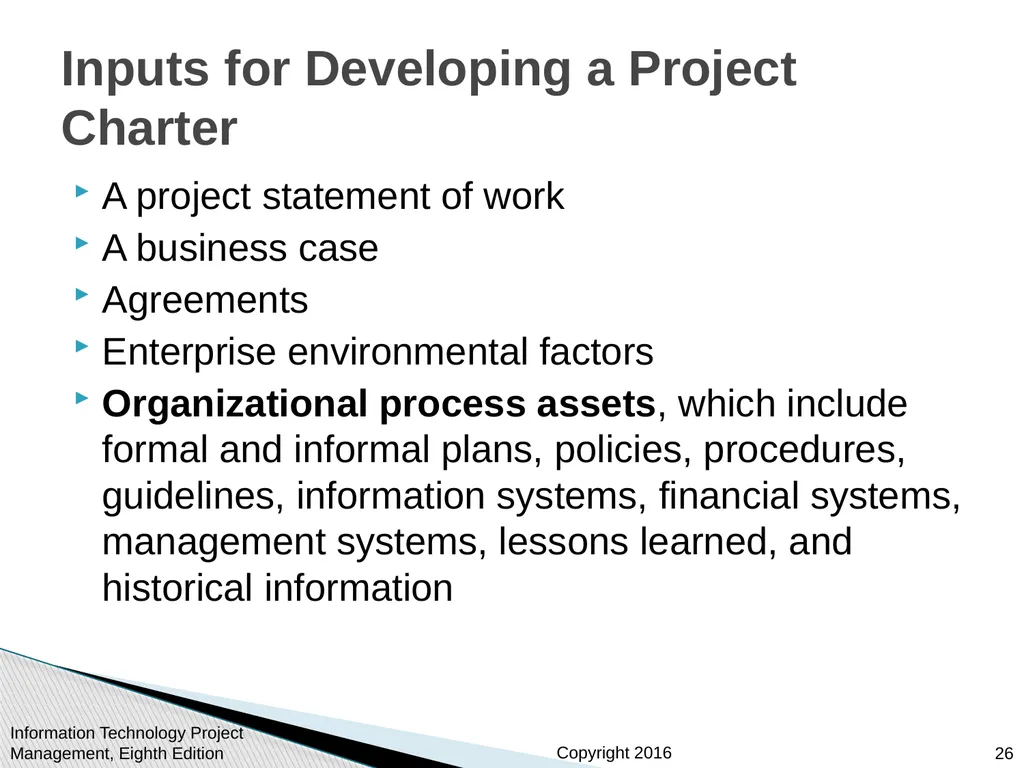
slide26. A project statement of work
A business case
Agreements
Enterprise environmental factors
Organizational process assets, which include formal and informal plans, policies, procedures, guidelines, information systems, financial systems, management systems, lessons learned, and historical information Information Technology Project Management, Eighth Edition 26 Inputs for Developing a Project Charter<br>
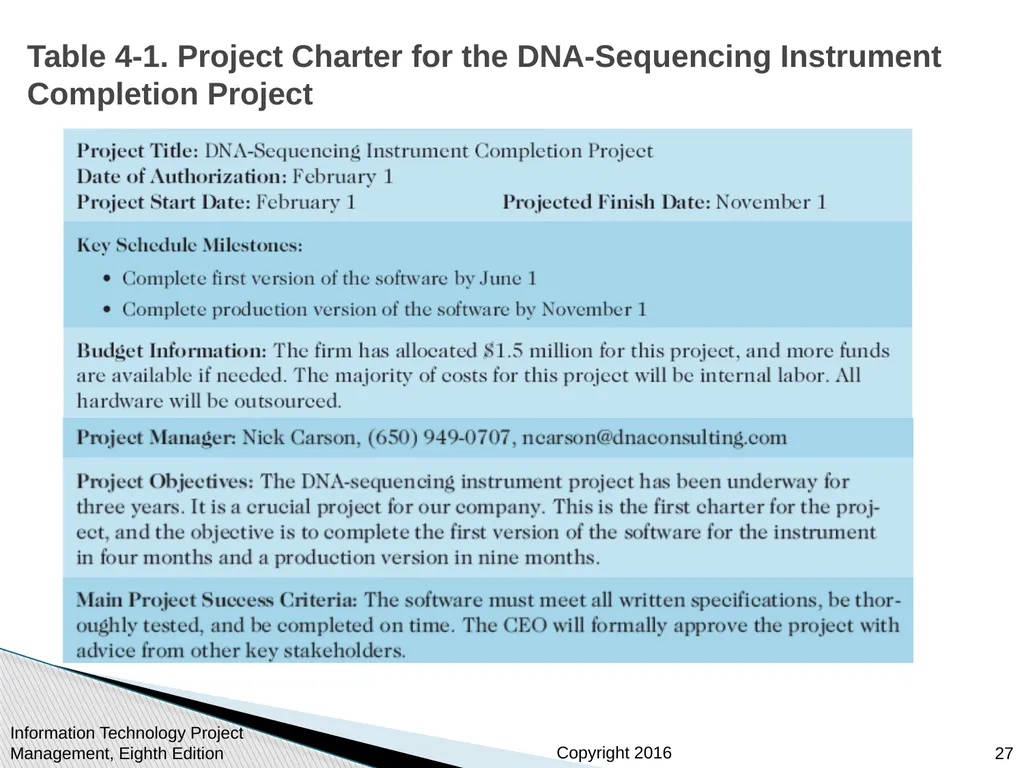
slide27. Information Technology Project Management, Eighth Edition 27 Table 4-1. Project Charter for the DNA-Sequencing Instrument Completion Project<br>
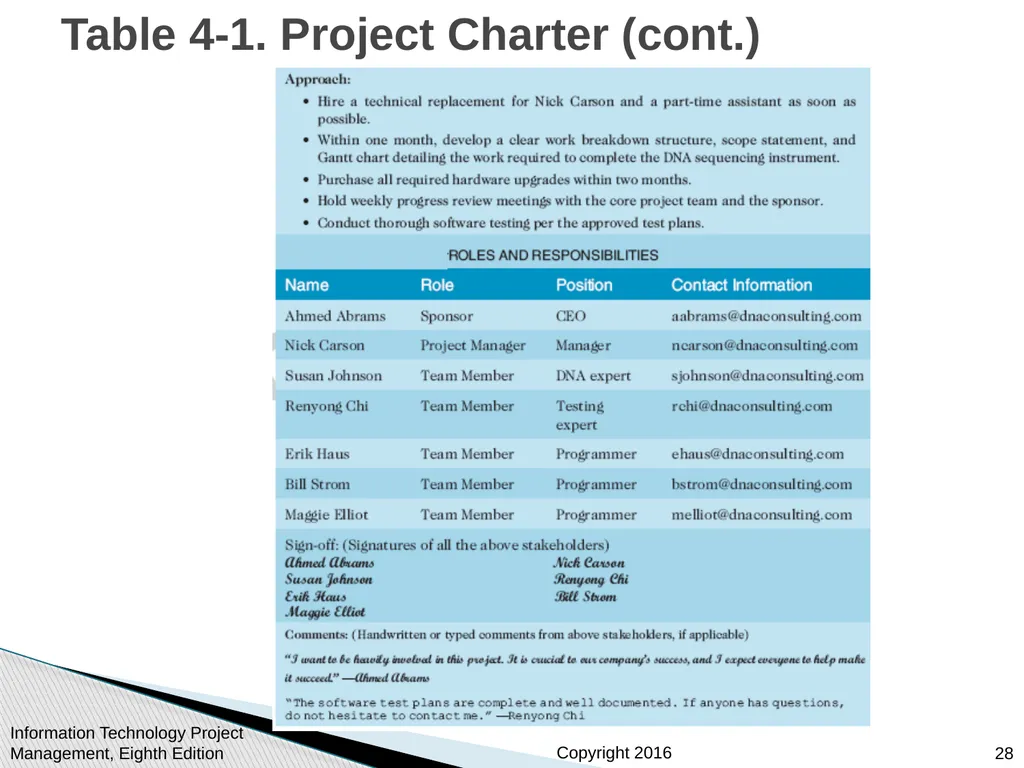
slide28. Information Technology Project Management, Eighth Edition 28 Table 4-1. Project Charter (cont.)<br>
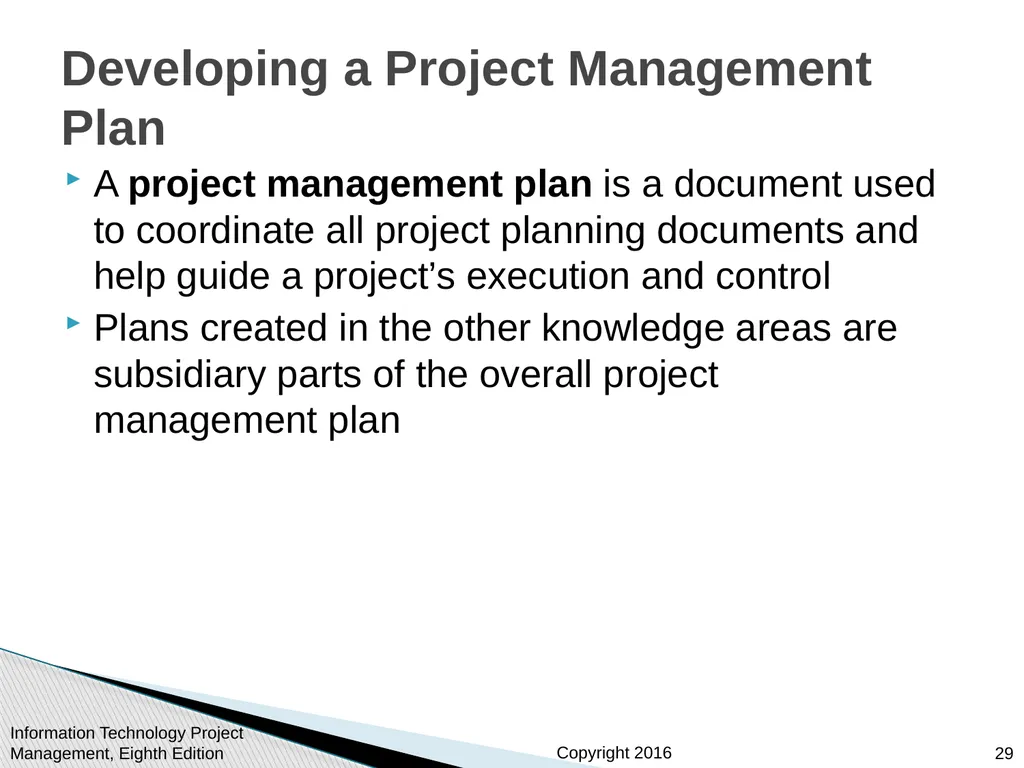
slide29. A project management plan is a document used to coordinate all project planning documents and help guide a project’s execution and control
Plans created in the other knowledge areas are subsidiary parts of the overall project management plan Information Technology Project Management, Eighth Edition 29 Developing a Project Management Plan<br>
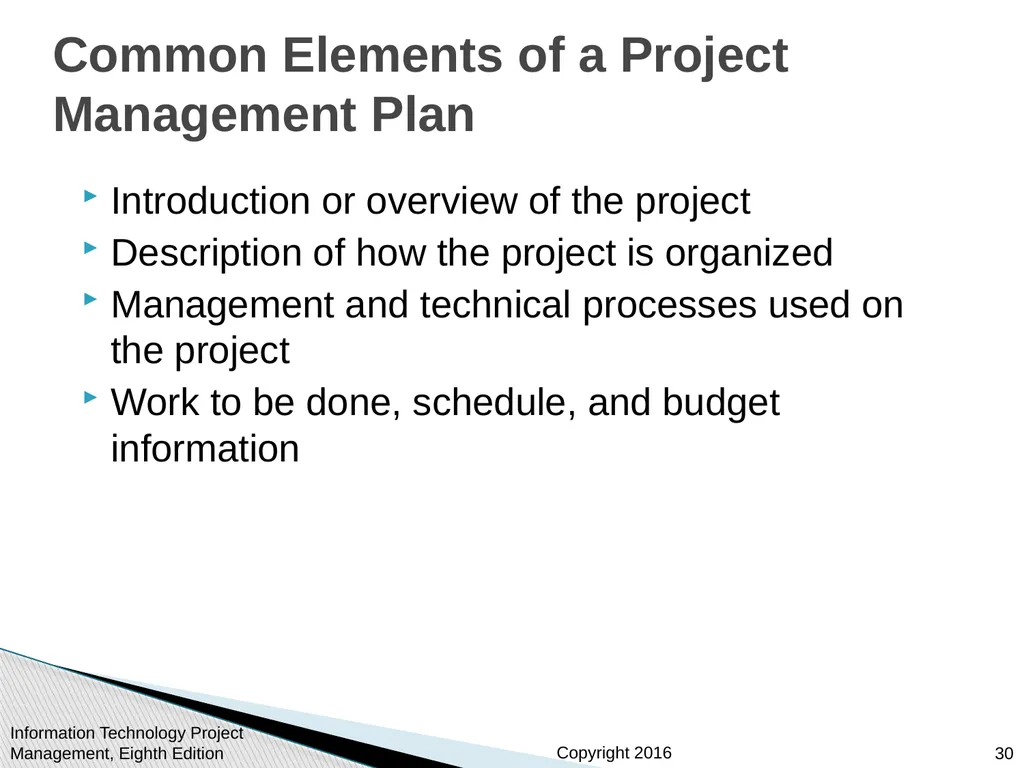
slide30. Introduction or overview of the project
Description of how the project is organized
Management and technical processes used on the project
Work to be done, schedule, and budget information Information Technology Project Management, Eighth Edition 30 Common Elements of a Project Management Plan<br>
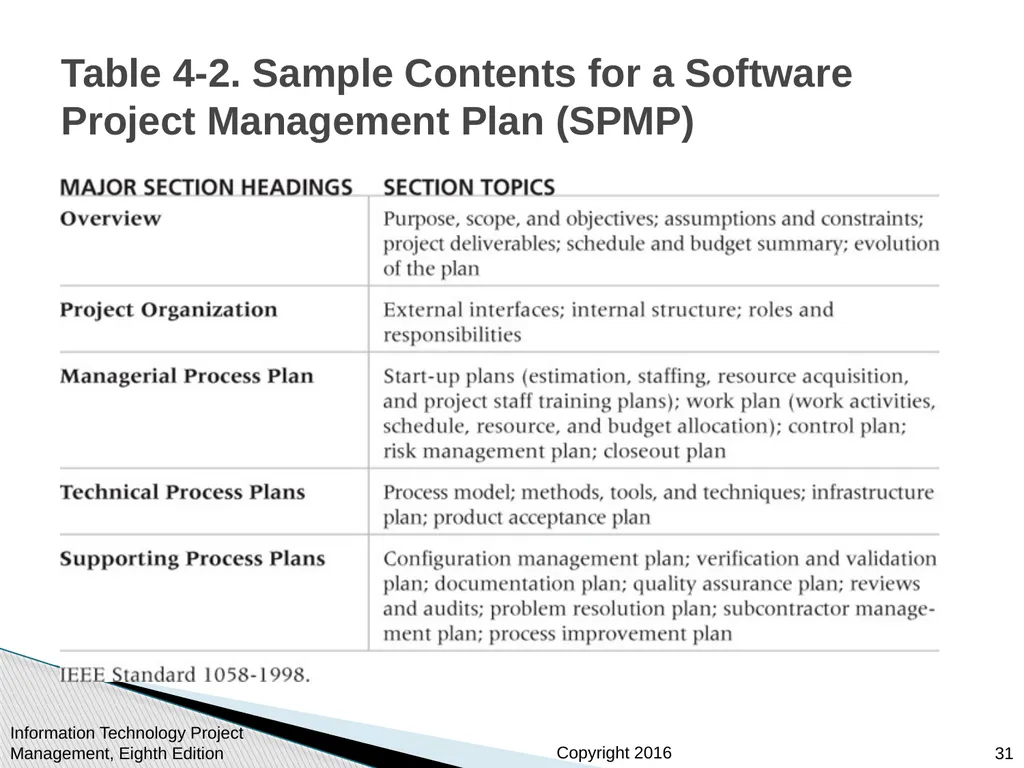
slide31. Information Technology Project Management, Eighth Edition 31 Table 4-2. Sample Contents for a Software Project Management Plan (SPMP)<br>
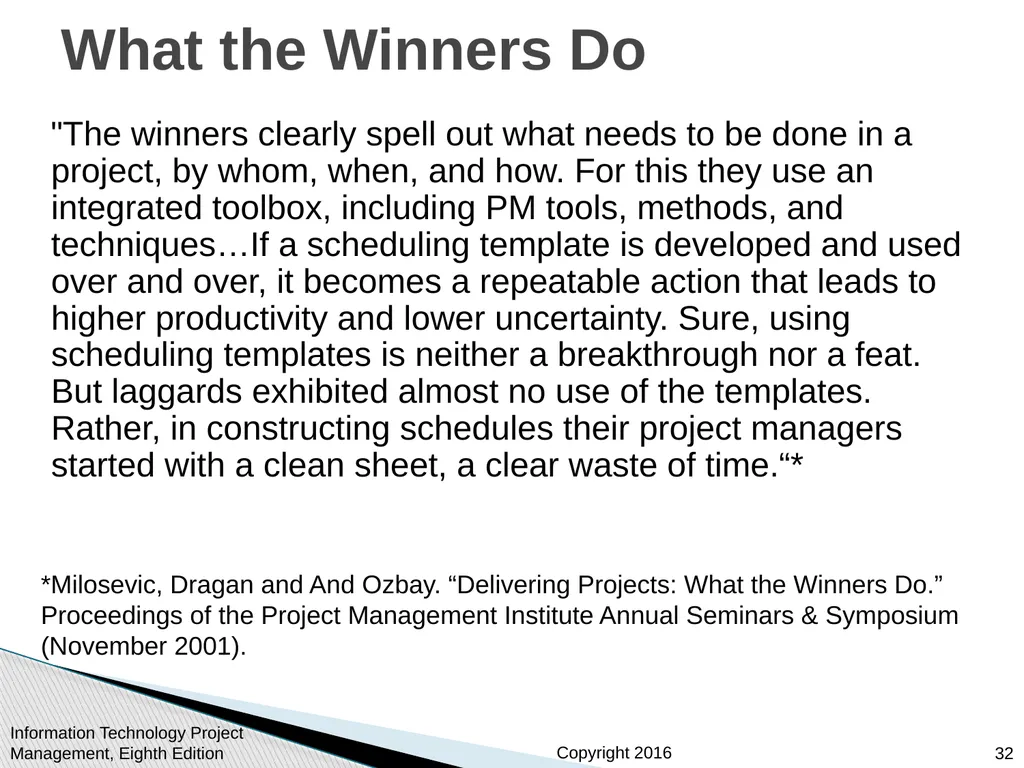
slide32. "The winners clearly spell out what needs to be done in a project, by whom, when, and how. For this they use an integrated toolbox, including PM tools, methods, and techniques…If a scheduling template is developed and used over and over, it becomes a repeatable action that leads to higher productivity and lower uncertainty. Sure, using scheduling templates is neither a breakthrough nor a feat. But laggards exhibited almost no use of the templates. Rather, in constructing schedules their project managers started with a clean sheet, a clear waste of time.“* Information Technology Project Management, Eighth Edition 32 What the Winners Do *Milosevic, Dragan and And Ozbay. “Delivering Projects: What the Winners Do.” Proceedings of the Project Management Institute Annual Seminars & Symposium (November 2001).<br>
slide33. Involves managing and performing the work described in the project management plan
The majority of time and money is usually spent on execution
The application area of the project directly affects project execution because the products of the project are produced during execution Information Technology Project Management, Eighth Edition 33 Directing and Managing Project Work<br>
slide34. Project planning and execution are intertwined and inseparable activities
Those who will do the work should help to plan the work
Project managers must solicit input from the team to develop realistic plans Information Technology Project Management, Eighth Edition 34 Coordinating Planning and Execution<br>
slide35. Project managers must lead by example to demonstrate the importance of creating and then following good project plans
Organizational culture can help project execution by
providing guidelines and templates
tracking performance based on plans
Project managers may still need to break the rules to meet project goals, and senior managers must support those actions Information Technology Project Management, Eighth Edition 35 Providing Leadership and a Supportive Culture<br>
slide36. 2015 PMI report found that only 12 percent of organizations were considered to be high performers
Percentage remained unchanged in past few years
Organizations must make major cultural changes to improve Information Technology Project Management, Eighth Edition 36 What Went Right?<br>
slide37. It is often helpful for IT project managers to have prior technical experience
On small projects, the project manager may be required to perform some of the technical work or mentor team members to complete the projects
On large projects, the project manager must understand the business and application area of the project Information Technology Project Management, Eighth Edition 37 Capitalizing on Product, Business, and Application Area Knowledge<br>
slide38. Expert judgment: Experts can help project managers and their teams make many decisions related to project execution
Meetings: Meetings allow people to develop relationships, pick up on important body language or tone of voice, and have a dialogue to help resolve problems.
Project management information systems: There are hundreds of project management software products available on the market today, and many organizations are moving toward powerful enterprise project management systems that are accessible via the Internet
See the What Went Right? example of Kuala Lumpur’s Integrated Transport Information System on p. 169 Information Technology Project Management, Eighth Edition 38 Project Execution Tools and Techniques<br>
slide39. Changes are inevitable on most projects, so it’s important to develop and follow a process to monitor and control changes
Monitoring project work includes collecting, measuring, and disseminating performance information
A baseline is the approved project management plan plus approved changes Information Technology Project Management, Eighth Edition 39 Monitoring and Controlling Project Work<br>
slide40. The 2002 Olympic Winter Games and Paralympics took five years to plan and cost more than $1.9 billion. PMI awarded the Salt Lake Organizing Committee (SLOC) the Project of the Year award for delivering world-class games.
Four years before the Games began, the SLOC used a Primavera software-based system with a cascading color-coded WBS to integrate planning…The SLOC also used an Executive Roadmap, a one-page list of the top 100 Games-wide activities, to keep executives apprised of progress. Activities were tied to detailed project information within each department’s schedule. A 90-day highlighter showed which managers were accountable for each integrated activity.
Fraser Bullock, SLOC Chief Operating Officer and Chief, said, “We knew when we were on and off schedule and where we had to apply additional resources. The interrelation of the functions meant they could not run in isolation—it was a smoothly running machine.”* Information Technology Project Management, Eighth Edition 40 Media Snapshot *Foti, Ross, “The Best Winter Olympics, Period,” PM Network (January 2004) 23.<br>
slide41. Three main objectives are:
Influencing the factors that create changes to ensure that changes are beneficial
Determining that a change has occurred
Managing actual changes as they occur Information Technology Project Management, Eighth Edition 41 Performing Integrated Change Control<br>
slide42. Former view: The project team should strive to do exactly what was planned on time and within budget
Problem: Stakeholders rarely agreed up-front on the project scope, and time and cost estimates were inaccurate
Modern view: Project management is a process of constant communication and negotiation
Solution: Changes are often beneficial, and the project team should plan for them Information Technology Project Management, Eighth Edition 42 Change Control on Information Technology Projects<br>
slide43. A change control system is a formal, documented process that describes when and how official project documents and work may be changed
Describes who is authorized to make changes and how to make them Information Technology Project Management, Eighth Edition 43 Change Control System<br>
slide44. A change control board is a formal group of people responsible for approving or rejecting changes on a project
CCBs provide guidelines for preparing change requests, evaluate change requests, and manage the implementation of approved changes
Includes stakeholders from the entire organization Information Technology Project Management, Eighth Edition 44 Change Control Board (CCB)<br>
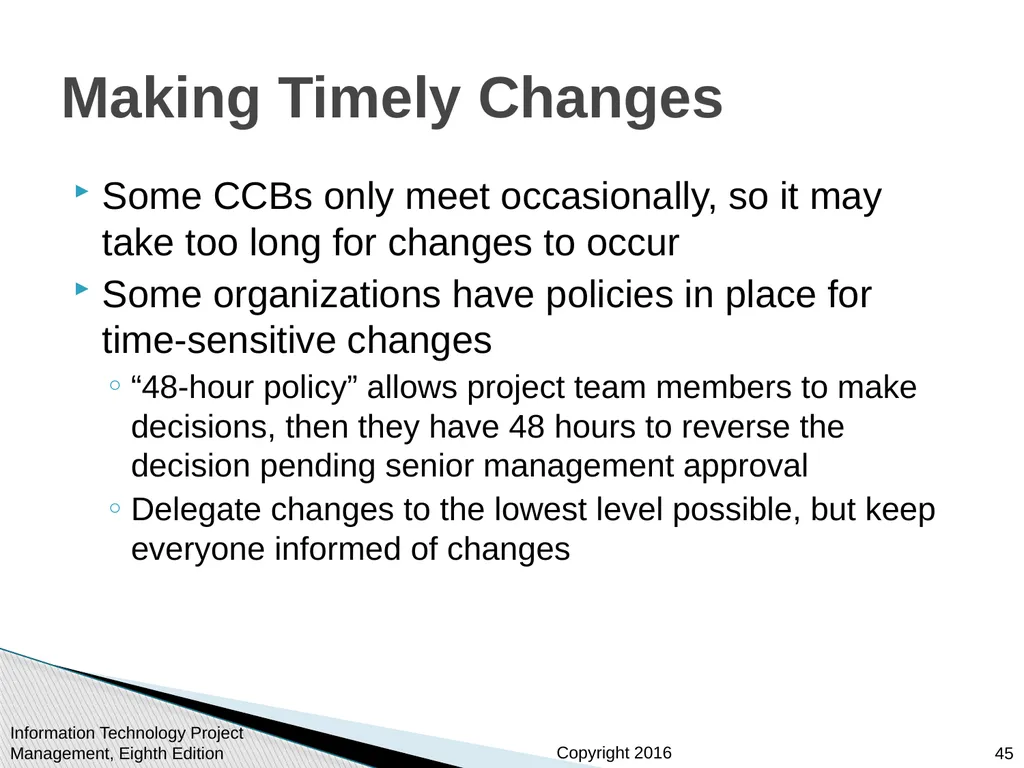
slide45. Some CCBs only meet occasionally, so it may take too long for changes to occur
Some organizations have policies in place for time-sensitive changes
“48-hour policy” allows project team members to make decisions, then they have 48 hours to reverse the decision pending senior management approval
Delegate changes to the lowest level possible, but keep everyone informed of changes Information Technology Project Management, Eighth Edition 45 Making Timely Changes<br>
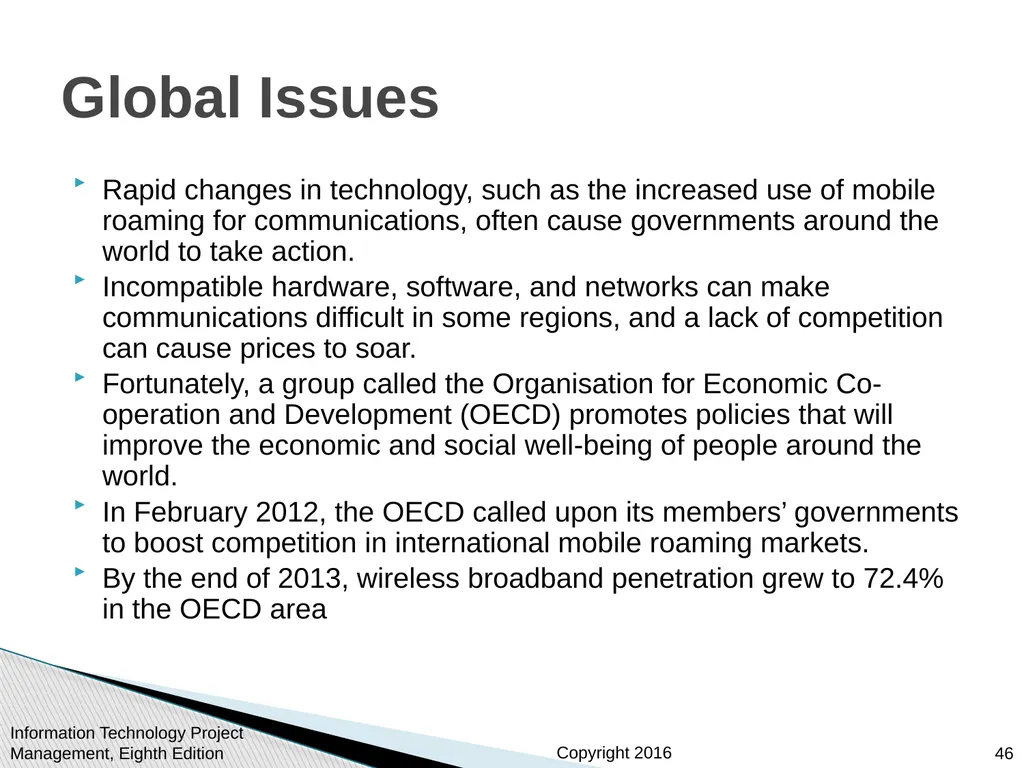
slide46. Rapid changes in technology, such as the increased use of mobile roaming for communications, often cause governments around the world to take action.
Incompatible hardware, software, and networks can make communications difficult in some regions, and a lack of competition can cause prices to soar.
Fortunately, a group called the Organisation for Economic Co-operation and Development (OECD) promotes policies that will improve the economic and social well-being of people around the world.
In February 2012, the OECD called upon its members’ governments to boost competition in international mobile roaming markets.
By the end of 2013, wireless broadband penetration grew to 72.4% in the OECD area Information Technology Project Management, Eighth Edition 46 Global Issues<br>
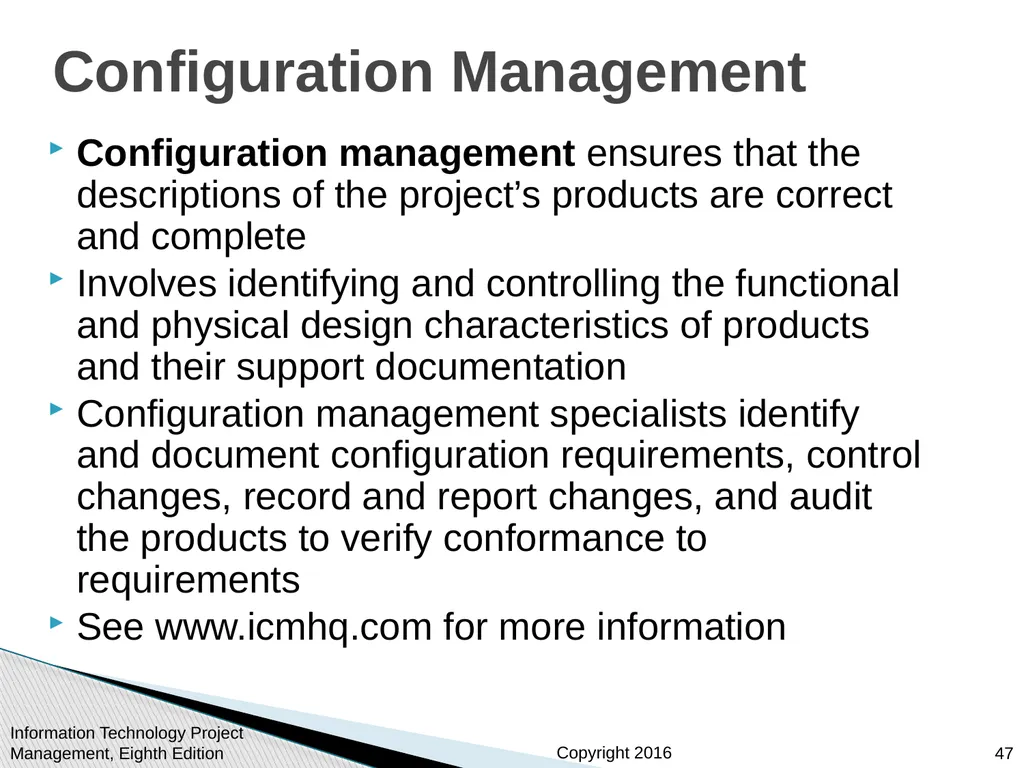
slide47. Configuration management ensures that the descriptions of the project’s products are correct and complete
Involves identifying and controlling the functional and physical design characteristics of products and their support documentation
Configuration management specialists identify and document configuration requirements, control changes, record and report changes, and audit the products to verify conformance to requirements
See www.icmhq.com for more information Information Technology Project Management, Eighth Edition 47 Configuration Management<br>
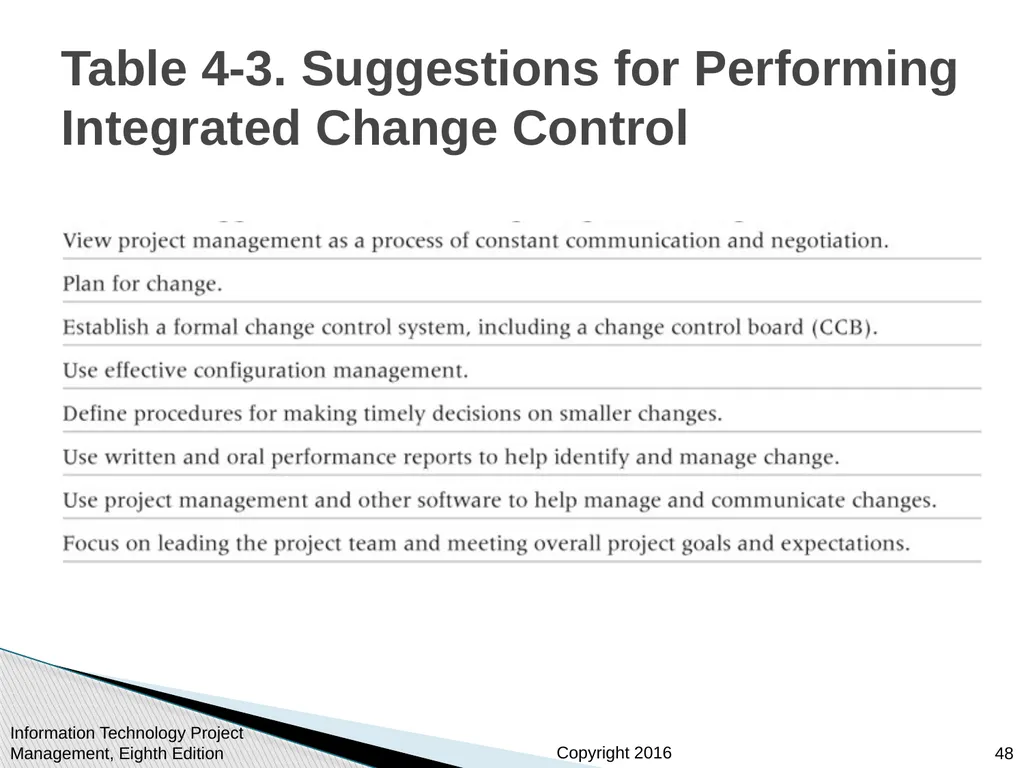
slide48. Information Technology Project Management, Eighth Edition 48 Table 4-3. Suggestions for Performing Integrated Change Control<br>
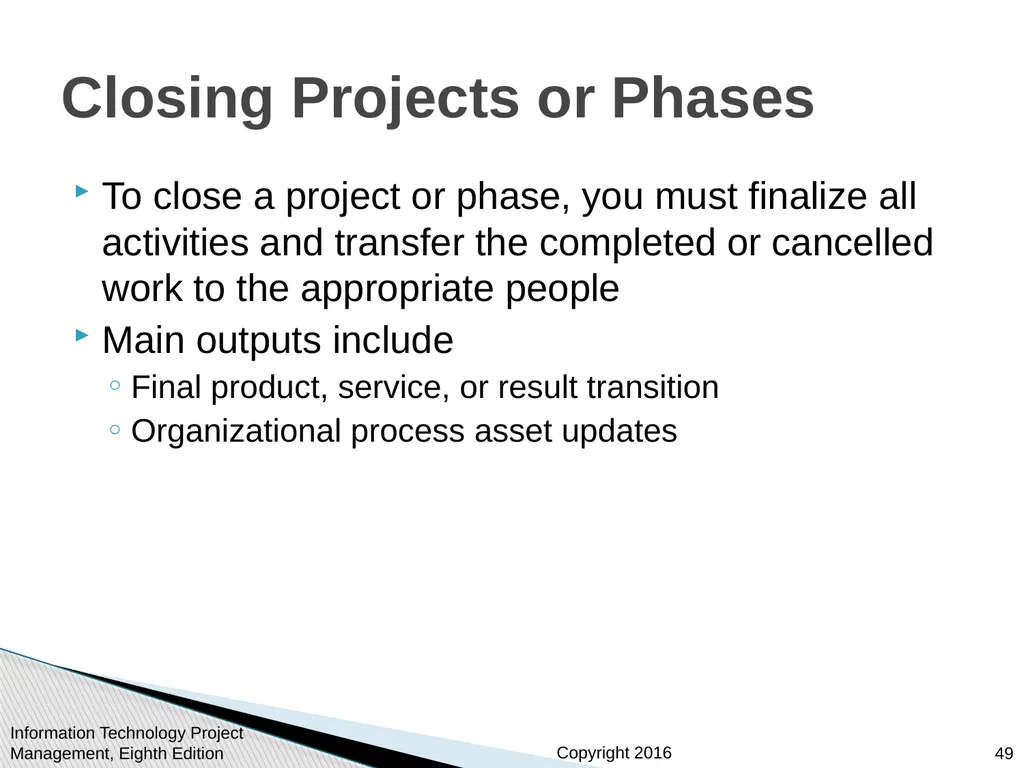
slide49. To close a project or phase, you must finalize all activities and transfer the completed or cancelled work to the appropriate people
Main outputs include
Final product, service, or result transition
Organizational process asset updates Information Technology Project Management, Eighth Edition 49 Closing Projects or Phases<br>
slide50. Several types of software can be used to assist in project integration management
Documents can be created with word processing software
Presentations are created with presentation software
Tracking can be done with spreadsheets or databases
Communication software can facilitate communications
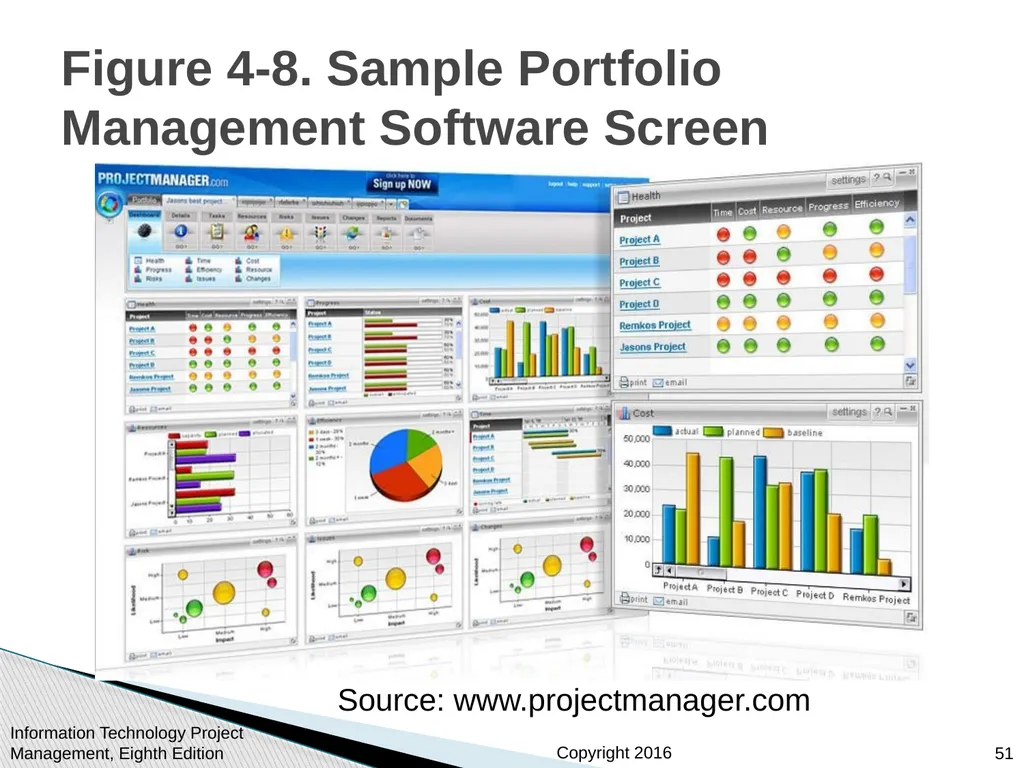
Project management software can pull everything together and show detailed and summarized information Information Technology Project Management, Eighth Edition 50 Using Software to Assist in Project Integration Management<br>
slide51. Information Technology Project Management, Eighth Edition 51 Figure 4-8. Sample Portfolio Management Software Screen Source: www.projectmanager.com<br>
slide52. Project integration management involves coordinating all of the other knowledge areas throughout a project’s life cycle
Main processes include
Develop the project charter
Develop the project management plan
Direct and manage project execution
Monitor and control project work
Perform integrated change control
Close the project or phase Information Technology Project Management, Eighth Edition 52 Chapter Summary<br>
slide2. Project managers must coordinate all of the other knowledge areas throughout a project’s life cycle
Many new project managers have trouble looking at the “big picture” and want to focus on too many details (See opening case for a real example)
Project integration management is not the same thing as software integration Information Technology Project Management, Eighth Edition 2 The Key to Overall Project Success: Good Project Integration Management<br>
slide3. 1. Developing the project charter involves working with stakeholders to create the document that formally authorizes a project—the charter.
2. Developing the project management plan involves coordinating all planning efforts to create a consistent, coherent document—the project management plan.
3. Directing and managing project work involves carrying out the project management plan by performing the activities included in it. Information Technology Project Management, Eighth Edition 3 Project Integration Management Processes<br>
slide4. Monitoring and controlling project work involves overseeing activities to meet the performance objectives of the project
Performing integrated change control involves identifying, evaluating, and managing changes throughout the project life cycle.
Closing the project or phase involves finalizing all activities to formally close the project or phase. Information Technology Project Management, Eighth Edition 4 Project Integration Management Processes (cont’d)<br>
slide5. Information Technology Project Management, Eighth Edition 5 Figure 4-1. Project Integration Management Summary<br>
slide6. The Surrey police force began looking into replacing its criminal intelligence system in 2005, but the project was finally cancelled in 2013, and the old system was replaced with a much less expensive one used by thirteen other forces
The person in charge of the project would not take responsibility for it
An audit report said the project was beyond their in-house capabilities and experience
Organizations must make the right staffing/outsourcing decisions Information Technology Project Management, Eighth Edition 6 What Went Wrong?<br>
slide7. Strategic planning involves determining long-term objectives, predicting future trends, and projecting the need for new products and services
Organizations often perform a SWOT analysis
analyzing Strengths, Weaknesses, Opportunities, and Threats
As part of strategic planning, organizations
identify potential projects
use realistic methods to select which projects to work on
formalize project initiation by issuing a project charter Information Technology Project Management, Eighth Edition 7 Strategic Planning and Project Selection<br>
slide8. Information Technology Project Management, Eighth Edition 8 Figure 4-2. Mind Map of a SWOT Analysis to Help Identify Potential Projects<br>
slide9. Information Technology Project Management, Eighth Edition 9 Figure 4-3. Information Technology Planning Process<br>
slide10. A 2013 survey identified companies most admired for their ability to apply IT-related business capabilities for competitive advantage
Best practices of these companies include:
Customer-driven IT is essential
IT can enable branding and customer recruitment
Keep improving Information Technology Project Management, Eighth Edition 10 Best Practice<br>
slide11. There are usually more projects than available time and resources to implement them
Methods for selecting projects include:
focusing on broad organizational needs
categorizing information technology projects
performing net present value or other financial analyses
using a weighted scoring model
implementing a balanced scorecard Information Technology Project Management, Eighth Edition 11 Methods for Selecting Projects<br>
slide12. It is often difficult to provide strong justification for many IT projects, but everyone agrees they have a high value
“It is better to measure gold roughly than to count pennies precisely”
Three important criteria for projects:
There is a need for the project
There are funds available
There’s a strong will to make the project succeed Information Technology Project Management, Eighth Edition 12 Focusing on Broad Organizational Needs<br>
slide13. One categorization is whether the project addresses
a problem
an opportunity, or
a directive
Another categorization is how long it will take to do and when it is needed
Another is the overall priority of the project Information Technology Project Management, Eighth Edition 13 Categorizing IT Projects<br>
slide14. Financial considerations are often an important consideration in selecting projects
Three primary methods for determining the projected financial value of projects:
Net present value (NPV) analysis
Return on investment (ROI)
Payback analysis Information Technology Project Management, Eighth Edition 14 Financial Analysis of Projects<br>
slide15. Net present value (NPV) analysis is a method of calculating the expected net monetary gain or loss from a project by discounting all expected future cash inflows and outflows to the present point in time
Projects with a positive NPV should be considered if financial value is a key criterion
The higher the NPV, the better Information Technology Project Management, Eighth Edition 15 Net Present Value Analysis<br>
slide16. Information Technology Project Management, Eighth Edition 16 Figure 4-4. Net Present Value Example<br>
slide17. Information Technology Project Management, Eighth Edition 17 Figure 4-5. JWD Consulting NPV Example Note: See the template called business_case_financials.xls<br>
slide18. Determine estimated costs and benefits for the life of the project and the products it produces
Determine the discount rate (check with your organization on what to use)
Calculate the NPV (see text for details)
Notes: Some organizations consider the investment year as year 0, while others start in year 1. Some people entered costs as negative numbers, while others do not. Check with your organization for their preferences Information Technology Project Management, Eighth Edition 18 NPV Calculations<br>
slide19. Return on investment (ROI) is calculated by subtracting the project costs from the benefits and then dividing by the costs
ROI = (total discounted benefits - total discounted costs) / discounted costs
The higher the ROI, the better
Many organizations have a required rate of return or minimum acceptable rate of return on investment for projects
Internal rate of return (IRR) can by calculated by finding the discount rate that makes the NPV equal to zero Information Technology Project Management, Eighth Edition 19 Return on Investment<br>
slide20. Another important financial consideration is payback analysis
The payback period is the amount of time it will take to recoup, in the form of net cash inflows, the total dollars invested in a project
Payback occurs when the net cumulative discounted benefits equals the costs
Many organizations want IT projects to have a fairly short payback period Information Technology Project Management, Eighth Edition 20 Payback Analysis<br>
slide21. Information Technology Project Management, Eighth Edition 21 Figure 4-6. Charting the Payback Period<br>
slide22. A weighted scoring model is a tool that provides a systematic process for selecting projects based on many criteria
Identify criteria important to the project selection process
Assign weights (percentages) to each criterion so they add up to 100%
Assign scores to each criterion for each project
Multiply the scores by the weights and get the total weighted scores
The higher the weighted score, the better Information Technology Project Management, Eighth Edition 22 Weighted Scoring Model<br>
slide23. Information Technology Project Management, Eighth Edition 23 Figure 4-7. Sample Weighted Scoring Model for Project Selection<br>
slide24. Drs. Robert Kaplan and David Norton developed this approach to help select and manage projects that align with business strategy
A balanced scorecard
is a methodology that converts an organization’s value drivers, such as customer service, innovation, operational efficiency, and financial performance, to a series of defined metrics
See www.balancedscorecard.org for more information Information Technology Project Management, Eighth Edition 24 Implementing a Balanced Scorecard<br>
slide25. After deciding what project to work on, it is important to let the rest of the organization know
A project charter is a document that formally recognizes the existence of a project and provides direction on the project’s objectives and management
Key project stakeholders should sign a project charter to acknowledge agreement on the need and intent of the project; a signed charter is a key output of project integration management Information Technology Project Management, Eighth Edition 25 Developing a Project Charter<br>
slide26. A project statement of work
A business case
Agreements
Enterprise environmental factors
Organizational process assets, which include formal and informal plans, policies, procedures, guidelines, information systems, financial systems, management systems, lessons learned, and historical information Information Technology Project Management, Eighth Edition 26 Inputs for Developing a Project Charter<br>
slide27. Information Technology Project Management, Eighth Edition 27 Table 4-1. Project Charter for the DNA-Sequencing Instrument Completion Project<br>
slide28. Information Technology Project Management, Eighth Edition 28 Table 4-1. Project Charter (cont.)<br>
slide29. A project management plan is a document used to coordinate all project planning documents and help guide a project’s execution and control
Plans created in the other knowledge areas are subsidiary parts of the overall project management plan Information Technology Project Management, Eighth Edition 29 Developing a Project Management Plan<br>
slide30. Introduction or overview of the project
Description of how the project is organized
Management and technical processes used on the project
Work to be done, schedule, and budget information Information Technology Project Management, Eighth Edition 30 Common Elements of a Project Management Plan<br>
slide31. Information Technology Project Management, Eighth Edition 31 Table 4-2. Sample Contents for a Software Project Management Plan (SPMP)<br>
slide32. "The winners clearly spell out what needs to be done in a project, by whom, when, and how. For this they use an integrated toolbox, including PM tools, methods, and techniques…If a scheduling template is developed and used over and over, it becomes a repeatable action that leads to higher productivity and lower uncertainty. Sure, using scheduling templates is neither a breakthrough nor a feat. But laggards exhibited almost no use of the templates. Rather, in constructing schedules their project managers started with a clean sheet, a clear waste of time.“* Information Technology Project Management, Eighth Edition 32 What the Winners Do *Milosevic, Dragan and And Ozbay. “Delivering Projects: What the Winners Do.” Proceedings of the Project Management Institute Annual Seminars & Symposium (November 2001).<br>
slide33. Involves managing and performing the work described in the project management plan
The majority of time and money is usually spent on execution
The application area of the project directly affects project execution because the products of the project are produced during execution Information Technology Project Management, Eighth Edition 33 Directing and Managing Project Work<br>
slide34. Project planning and execution are intertwined and inseparable activities
Those who will do the work should help to plan the work
Project managers must solicit input from the team to develop realistic plans Information Technology Project Management, Eighth Edition 34 Coordinating Planning and Execution<br>
slide35. Project managers must lead by example to demonstrate the importance of creating and then following good project plans
Organizational culture can help project execution by
providing guidelines and templates
tracking performance based on plans
Project managers may still need to break the rules to meet project goals, and senior managers must support those actions Information Technology Project Management, Eighth Edition 35 Providing Leadership and a Supportive Culture<br>
slide36. 2015 PMI report found that only 12 percent of organizations were considered to be high performers
Percentage remained unchanged in past few years
Organizations must make major cultural changes to improve Information Technology Project Management, Eighth Edition 36 What Went Right?<br>
slide37. It is often helpful for IT project managers to have prior technical experience
On small projects, the project manager may be required to perform some of the technical work or mentor team members to complete the projects
On large projects, the project manager must understand the business and application area of the project Information Technology Project Management, Eighth Edition 37 Capitalizing on Product, Business, and Application Area Knowledge<br>
slide38. Expert judgment: Experts can help project managers and their teams make many decisions related to project execution
Meetings: Meetings allow people to develop relationships, pick up on important body language or tone of voice, and have a dialogue to help resolve problems.
Project management information systems: There are hundreds of project management software products available on the market today, and many organizations are moving toward powerful enterprise project management systems that are accessible via the Internet
See the What Went Right? example of Kuala Lumpur’s Integrated Transport Information System on p. 169 Information Technology Project Management, Eighth Edition 38 Project Execution Tools and Techniques<br>
slide39. Changes are inevitable on most projects, so it’s important to develop and follow a process to monitor and control changes
Monitoring project work includes collecting, measuring, and disseminating performance information
A baseline is the approved project management plan plus approved changes Information Technology Project Management, Eighth Edition 39 Monitoring and Controlling Project Work<br>
slide40. The 2002 Olympic Winter Games and Paralympics took five years to plan and cost more than $1.9 billion. PMI awarded the Salt Lake Organizing Committee (SLOC) the Project of the Year award for delivering world-class games.
Four years before the Games began, the SLOC used a Primavera software-based system with a cascading color-coded WBS to integrate planning…The SLOC also used an Executive Roadmap, a one-page list of the top 100 Games-wide activities, to keep executives apprised of progress. Activities were tied to detailed project information within each department’s schedule. A 90-day highlighter showed which managers were accountable for each integrated activity.
Fraser Bullock, SLOC Chief Operating Officer and Chief, said, “We knew when we were on and off schedule and where we had to apply additional resources. The interrelation of the functions meant they could not run in isolation—it was a smoothly running machine.”* Information Technology Project Management, Eighth Edition 40 Media Snapshot *Foti, Ross, “The Best Winter Olympics, Period,” PM Network (January 2004) 23.<br>
slide41. Three main objectives are:
Influencing the factors that create changes to ensure that changes are beneficial
Determining that a change has occurred
Managing actual changes as they occur Information Technology Project Management, Eighth Edition 41 Performing Integrated Change Control<br>
slide42. Former view: The project team should strive to do exactly what was planned on time and within budget
Problem: Stakeholders rarely agreed up-front on the project scope, and time and cost estimates were inaccurate
Modern view: Project management is a process of constant communication and negotiation
Solution: Changes are often beneficial, and the project team should plan for them Information Technology Project Management, Eighth Edition 42 Change Control on Information Technology Projects<br>
slide43. A change control system is a formal, documented process that describes when and how official project documents and work may be changed
Describes who is authorized to make changes and how to make them Information Technology Project Management, Eighth Edition 43 Change Control System<br>
slide44. A change control board is a formal group of people responsible for approving or rejecting changes on a project
CCBs provide guidelines for preparing change requests, evaluate change requests, and manage the implementation of approved changes
Includes stakeholders from the entire organization Information Technology Project Management, Eighth Edition 44 Change Control Board (CCB)<br>
slide45. Some CCBs only meet occasionally, so it may take too long for changes to occur
Some organizations have policies in place for time-sensitive changes
“48-hour policy” allows project team members to make decisions, then they have 48 hours to reverse the decision pending senior management approval
Delegate changes to the lowest level possible, but keep everyone informed of changes Information Technology Project Management, Eighth Edition 45 Making Timely Changes<br>
slide46. Rapid changes in technology, such as the increased use of mobile roaming for communications, often cause governments around the world to take action.
Incompatible hardware, software, and networks can make communications difficult in some regions, and a lack of competition can cause prices to soar.
Fortunately, a group called the Organisation for Economic Co-operation and Development (OECD) promotes policies that will improve the economic and social well-being of people around the world.
In February 2012, the OECD called upon its members’ governments to boost competition in international mobile roaming markets.
By the end of 2013, wireless broadband penetration grew to 72.4% in the OECD area Information Technology Project Management, Eighth Edition 46 Global Issues<br>
slide47. Configuration management ensures that the descriptions of the project’s products are correct and complete
Involves identifying and controlling the functional and physical design characteristics of products and their support documentation
Configuration management specialists identify and document configuration requirements, control changes, record and report changes, and audit the products to verify conformance to requirements
See www.icmhq.com for more information Information Technology Project Management, Eighth Edition 47 Configuration Management<br>
slide48. Information Technology Project Management, Eighth Edition 48 Table 4-3. Suggestions for Performing Integrated Change Control<br>
slide49. To close a project or phase, you must finalize all activities and transfer the completed or cancelled work to the appropriate people
Main outputs include
Final product, service, or result transition
Organizational process asset updates Information Technology Project Management, Eighth Edition 49 Closing Projects or Phases<br>
slide50. Several types of software can be used to assist in project integration management
Documents can be created with word processing software
Presentations are created with presentation software
Tracking can be done with spreadsheets or databases
Communication software can facilitate communications
Project management software can pull everything together and show detailed and summarized information Information Technology Project Management, Eighth Edition 50 Using Software to Assist in Project Integration Management<br>
slide51. Information Technology Project Management, Eighth Edition 51 Figure 4-8. Sample Portfolio Management Software Screen Source: www.projectmanager.com<br>
slide52. Project integration management involves coordinating all of the other knowledge areas throughout a project’s life cycle
Main processes include
Develop the project charter
Develop the project management plan
Direct and manage project execution
Monitor and control project work
Perform integrated change control
Close the project or phase Information Technology Project Management, Eighth Edition 52 Chapter Summary<br>