
Chapter 4 – Requirements Engineering Chapter 4 –
TG
Published · 54 slides · 0 views
1 / 1
Description
Chapter 4 Requirements Engineering Chapter 4 Requirements Engineering 1 CS709 September 19, 2017 Ian Sommerville, Software Engineering, 10th Edition Pearson Education, Addison-Wesley Note: These are a slightly modified version of
Related Topics
Share
Embed code
Download this presentation From Below
"Chapter 4 – Requirements Engineering Chapter 4 –" is the property of its rightful owner. Permission is granted to download and print the materials on this website for personal, non-commercial use only, and to display it on your personal computer provided you do not modify the materials and that you retain all copyright notices contained in the materials. By downloading content from our website, you accept the terms of this agreement.
Presentation Transcript
01
Chapter 4 – Requirements Engineering Chapter 4 – Requirements Engineering 1 CS709 September 19, 2017 Ian Sommerville,
Software Engineering, 10th Edition
Pearson Education, Addison-Wesley Note: These are a slightly modified version of Chapter 4 slides available from the author’s site http://iansommerville.com/software-engineering-book/<br>
Software Engineering, 10th Edition
Pearson Education, Addison-Wesley Note: These are a slightly modified version of Chapter 4 slides available from the author’s site http://iansommerville.com/software-engineering-book/<br>
02
Topics covered Functional and non-functional requirements
Requirements engineering processes
Requirements elicitation
Requirements specification
Requirements validation
Requirements change Chapter 4 Requirements Engineering 2<br>
Requirements engineering processes
Requirements elicitation
Requirements specification
Requirements validation
Requirements change Chapter 4 Requirements Engineering 2<br>
03
Requirements engineering The process of establishing the services that a customer requires from a system and the constraints under which it operates and is developed.
The system requirements are the descriptions of the system services and constraints that are generated during the requirements engineering process.
Translation – Figure out what a system needs to do, write it down. Chapter 4 Requirements Engineering 3<br>
The system requirements are the descriptions of the system services and constraints that are generated during the requirements engineering process.
Translation – Figure out what a system needs to do, write it down. Chapter 4 Requirements Engineering 3<br>
04
What is a requirement? Some function or characteristic that must exist in a project
It may range from a high-level abstract statement to an extremely detailed description of a function Chapter 4 Requirements Engineering 4<br>
It may range from a high-level abstract statement to an extremely detailed description of a function Chapter 4 Requirements Engineering 4<br>
05
Types of requirement User requirements
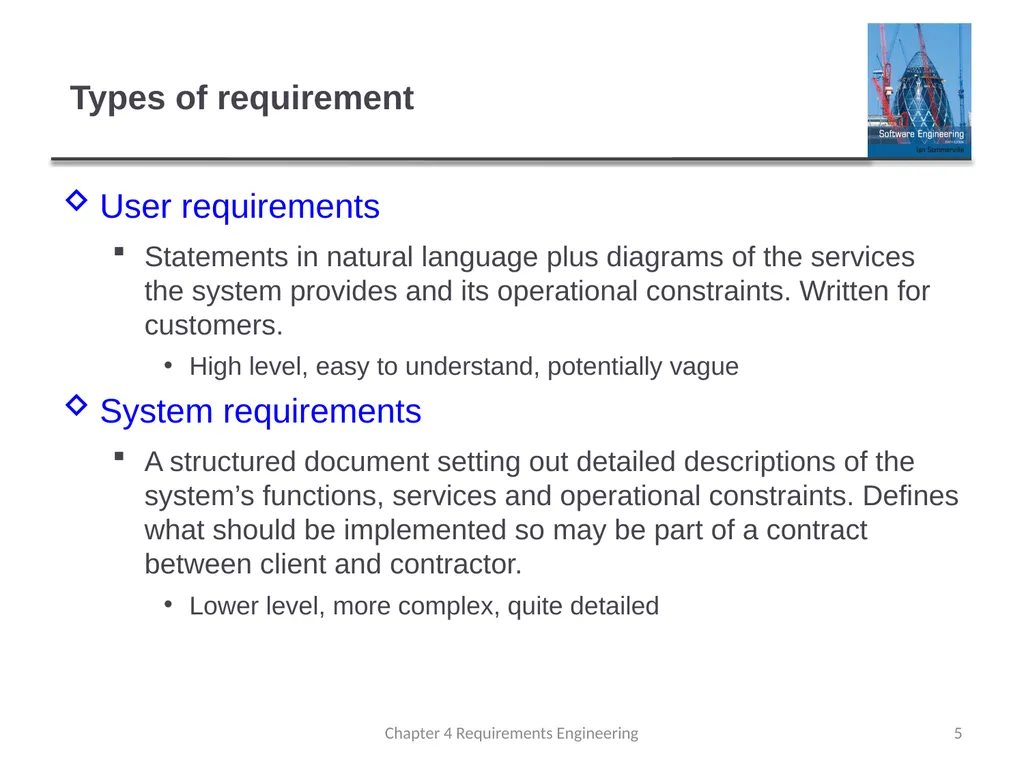
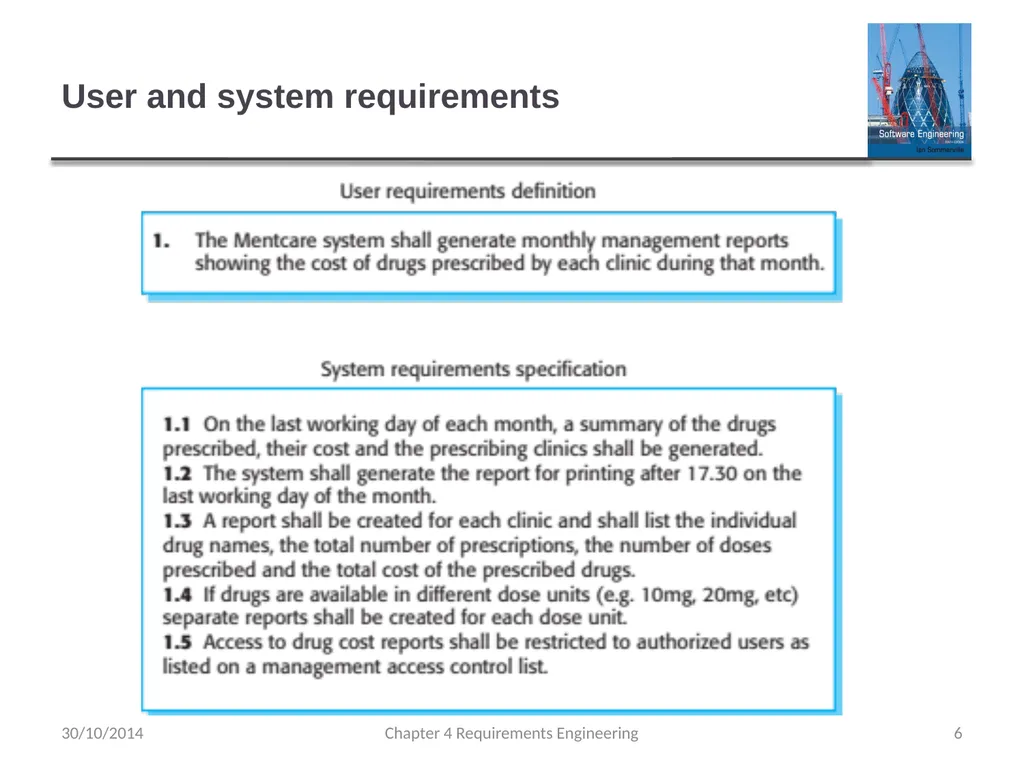
Statements in natural language plus diagrams of the services the system provides and its operational constraints. Written for customers.
High level, easy to understand, potentially vague
System requirements
A structured document setting out detailed descriptions of the system’s functions, services and operational constraints. Defines what should be implemented so may be part of a contract between client and contractor.
Lower level, more complex, quite detailed Chapter 4 Requirements Engineering 5<br>
06
User and system requirements Chapter 4 Requirements Engineering 6 30/10/2014<br>
07
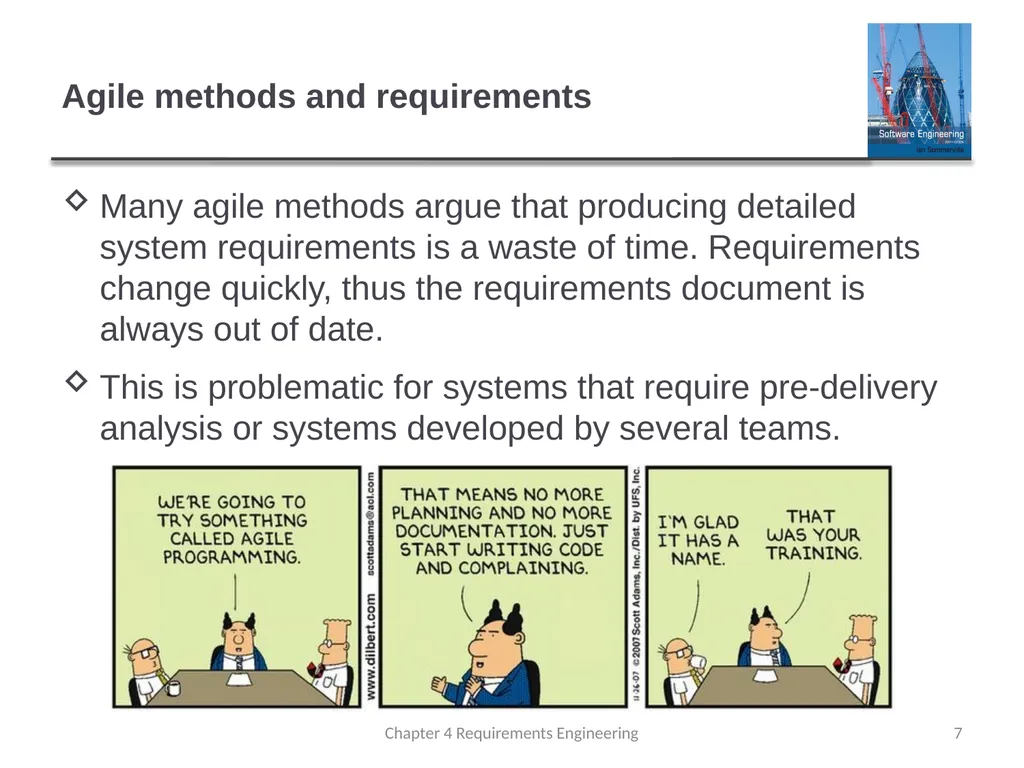
Agile methods and requirements Many agile methods argue that producing detailed system requirements is a waste of time. Requirements change quickly, thus the requirements document is always out of date.
This is problematic for systems that require pre-delivery analysis or systems developed by several teams. Chapter 4 Requirements Engineering 7<br>
This is problematic for systems that require pre-delivery analysis or systems developed by several teams. Chapter 4 Requirements Engineering 7<br>
08
Functional and non-functional requirements Chapter 4 Requirements Engineering 8<br>
09
Functional and non-functional requirements Functional requirements
Statements of services the system should provide, how the system should react to particular inputs and how the system should behave in particular situations
What the user sees, how they interact with the system, what the system does
May state what the system should not do
Non-functional requirements
Constraints on the services or functions offered by the system such as timing constraints, constraints on the development process, standards, etc.
Behind the scenes, inform functional requirements
Often apply to the system as a whole rather than individual features or services Chapter 4 Requirements Engineering 9<br>
10
Functional requirements Describe functionality or system services
Depend on the type of software, expected users and the type of system where the software is used
Functional user requirements may be high-level statements of what the system should do
Functional system requirements should describe the system services in detail Chapter 4 Requirements Engineering 10<br>
11
Requirements imprecision Problems arise when functional requirements are not precisely stated
Ambiguous requirements may be interpreted in different ways by developers and users Chapter 4 Requirements Engineering 11<br>
Ambiguous requirements may be interpreted in different ways by developers and users Chapter 4 Requirements Engineering 11<br>
12
Requirements completeness and consistency In principle, requirements should be both complete and consistent
Complete
They should include descriptions of all functions required
Consistent
There should be no conflicts or contradictions in the descriptions of the system facilities Chapter 4 Requirements Engineering 12<br>
Complete
They should include descriptions of all functions required
Consistent
There should be no conflicts or contradictions in the descriptions of the system facilities Chapter 4 Requirements Engineering 12<br>
13
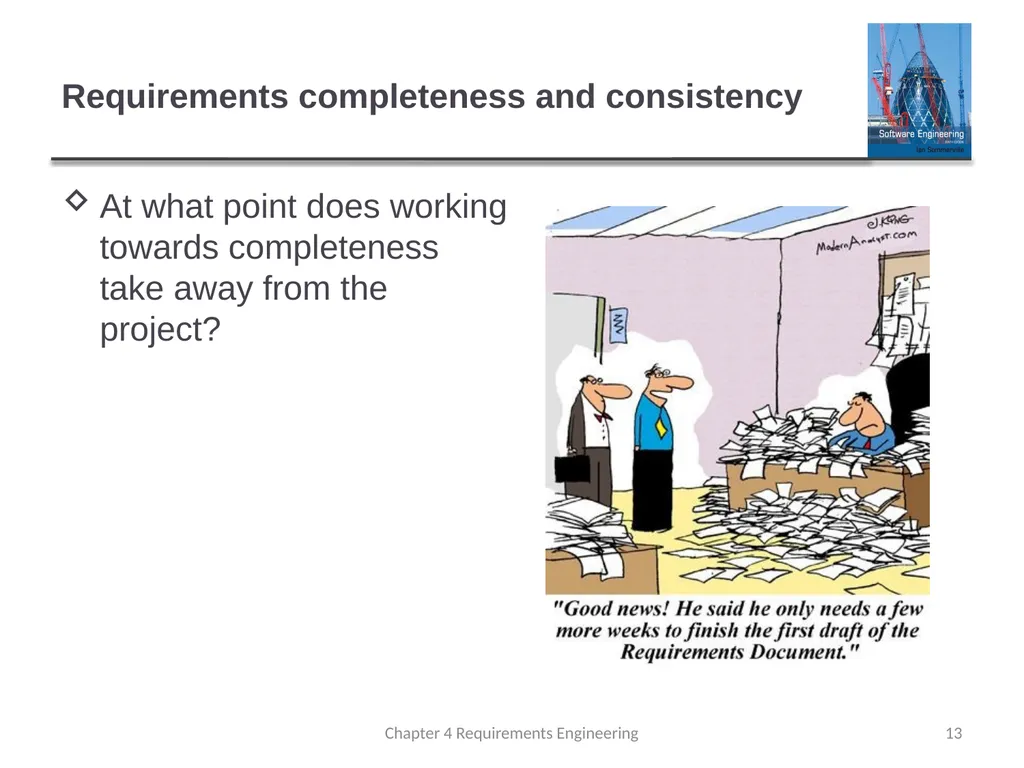
Requirements completeness and consistency Chapter 4 Requirements Engineering 13 At what point does working towards completeness take away from the project?<br>
14
Non-functional requirements These define system properties and constraints e.g. reliability, response time and storage requirements, platform, etc.
Process requirements may also be specified mandating a particular IDE, programming language or development method
Non-functional requirements may be more critical than functional requirements. If these are not met, the system may be useless.
They may also force functional requirements. For instance a mobile application will require a touch based UI, a 3DS project may be limited in complexity versus a console game, etc. Chapter 4 Requirements Engineering 14<br>
15
Non-functional requirements implementation Non-functional requirements may affect the overall architecture of a system rather than the individual components
For example, to ensure that performance requirements are met, you may have to organize the system to minimize communications between components Chapter 4 Requirements Engineering 15<br>
For example, to ensure that performance requirements are met, you may have to organize the system to minimize communications between components Chapter 4 Requirements Engineering 15<br>
16
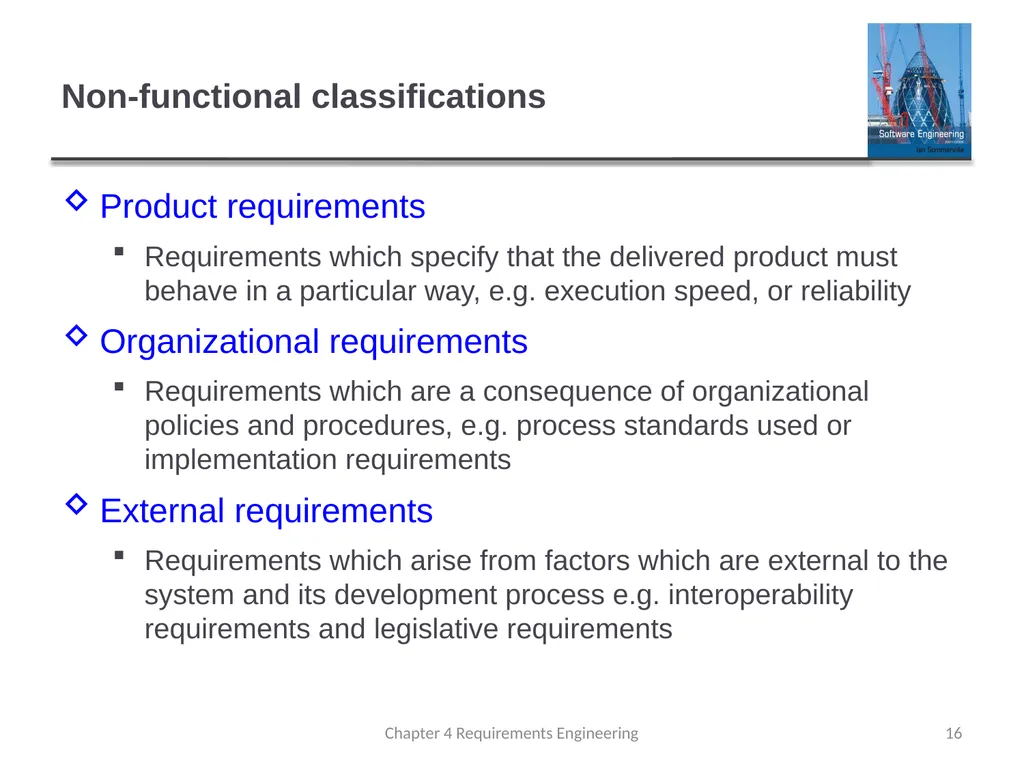
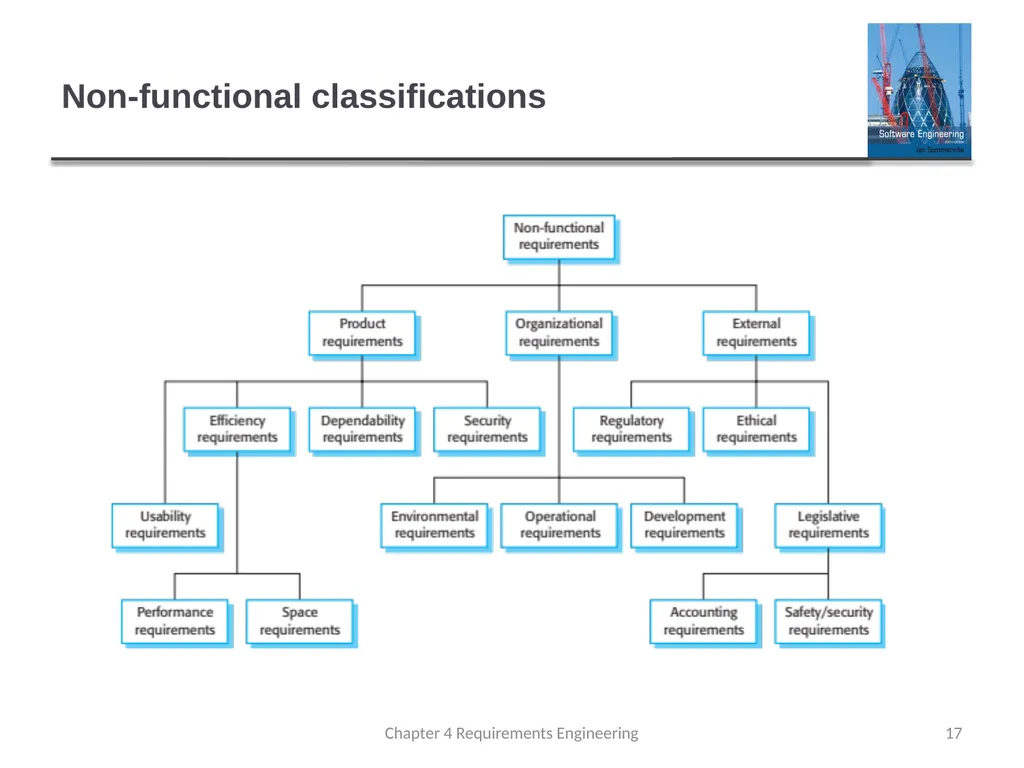
Non-functional classifications Product requirements
Requirements which specify that the delivered product must behave in a particular way, e.g. execution speed, or reliability
Organizational requirements
Requirements which are a consequence of organizational policies and procedures, e.g. process standards used or implementation requirements
External requirements
Requirements which arise from factors which are external to the system and its development process e.g. interoperability requirements and legislative requirements Chapter 4 Requirements Engineering 16<br>
17
Non-functional classifications Chapter 4 Requirements Engineering 17<br>
18
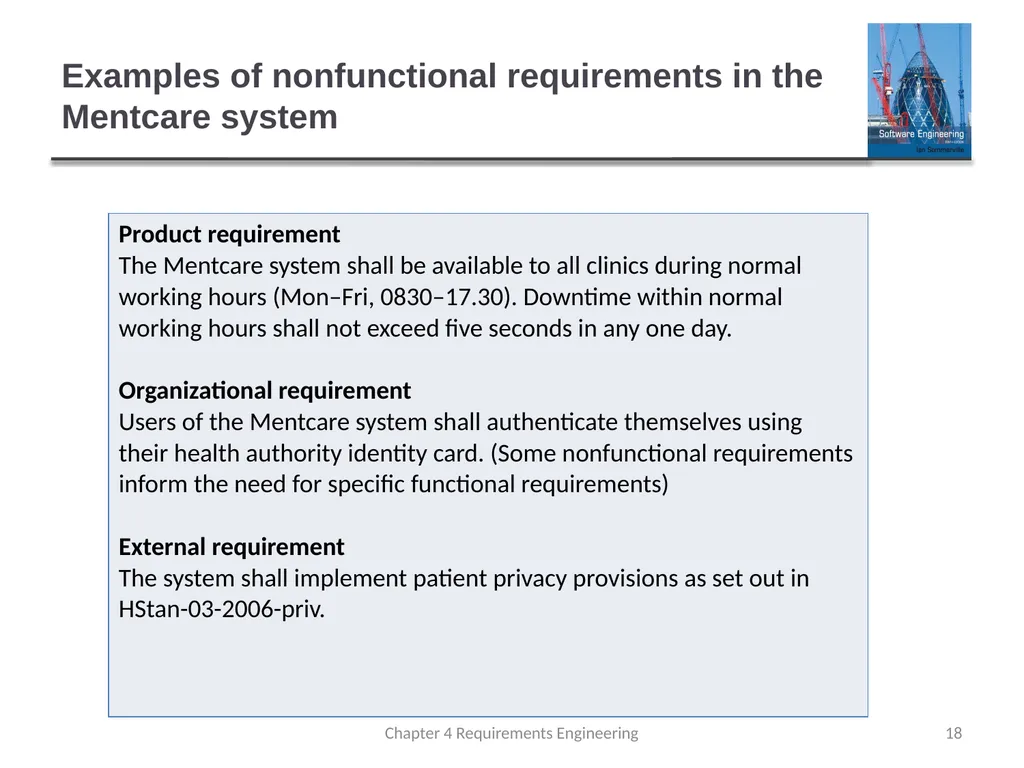
Examples of nonfunctional requirements in the Mentcare system Chapter 4 Requirements Engineering 18<br>
19
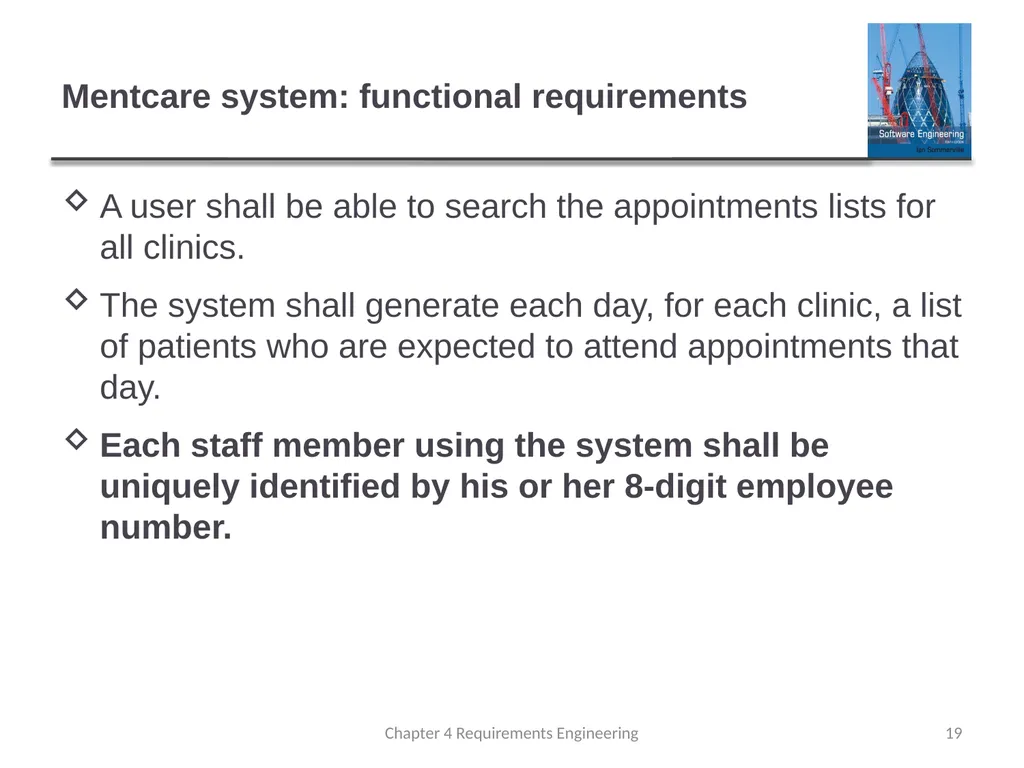
Mentcare system: functional requirements A user shall be able to search the appointments lists for all clinics.
The system shall generate each day, for each clinic, a list of patients who are expected to attend appointments that day.
Each staff member using the system shall be uniquely identified by his or her 8-digit employee number. Chapter 4 Requirements Engineering 19<br>
The system shall generate each day, for each clinic, a list of patients who are expected to attend appointments that day.
Each staff member using the system shall be uniquely identified by his or her 8-digit employee number. Chapter 4 Requirements Engineering 19<br>
20
Non-functional classifications Usability – Disability, Language, Age, Education Level, Experience with Similar Software, Handedness, and other Chapter 4 Requirements Engineering 20<br>
21
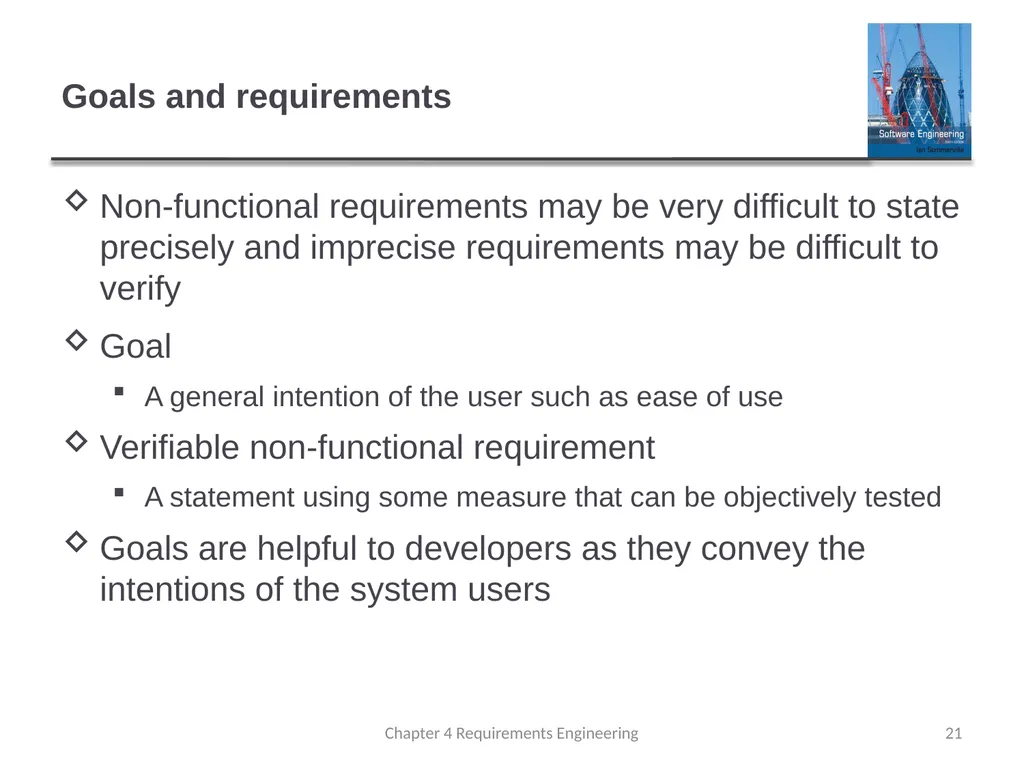
Goals and requirements Non-functional requirements may be very difficult to state precisely and imprecise requirements may be difficult to verify
Goal
A general intention of the user such as ease of use
Verifiable non-functional requirement
A statement using some measure that can be objectively tested
Goals are helpful to developers as they convey the intentions of the system users Chapter 4 Requirements Engineering 21<br>
Goal
A general intention of the user such as ease of use
Verifiable non-functional requirement
A statement using some measure that can be objectively tested
Goals are helpful to developers as they convey the intentions of the system users Chapter 4 Requirements Engineering 21<br>
22
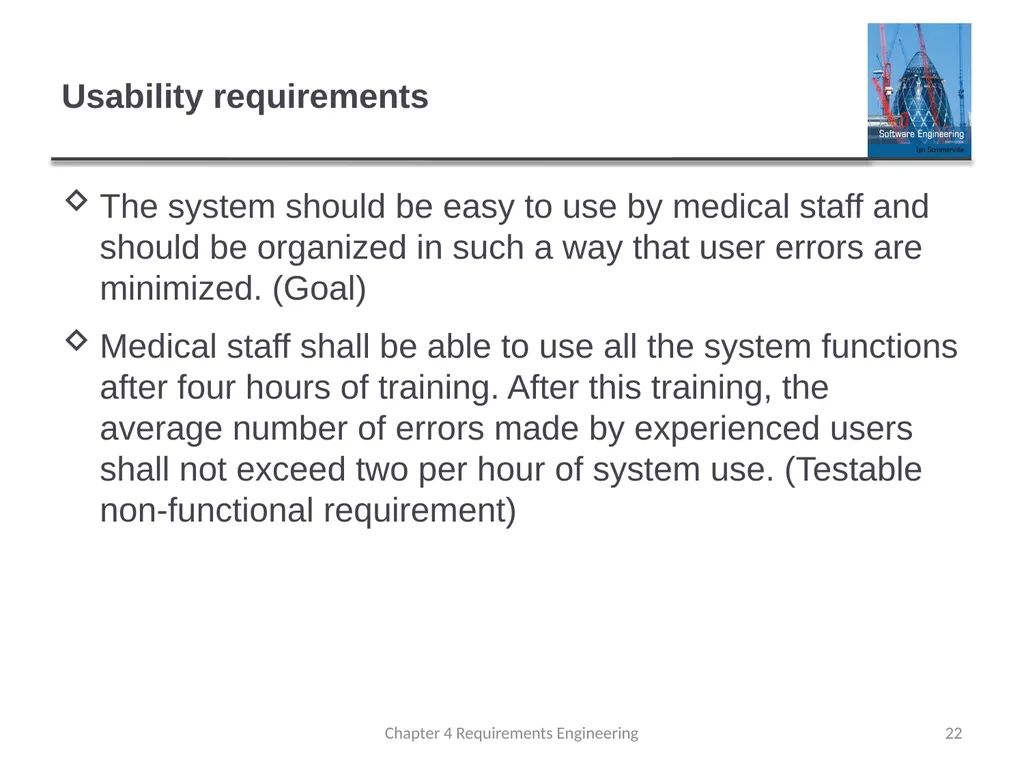
Usability requirements The system should be easy to use by medical staff and should be organized in such a way that user errors are minimized. (Goal)
Medical staff shall be able to use all the system functions after four hours of training. After this training, the average number of errors made by experienced users shall not exceed two per hour of system use. (Testable non-functional requirement) Chapter 4 Requirements Engineering 22<br>
Medical staff shall be able to use all the system functions after four hours of training. After this training, the average number of errors made by experienced users shall not exceed two per hour of system use. (Testable non-functional requirement) Chapter 4 Requirements Engineering 22<br>
23
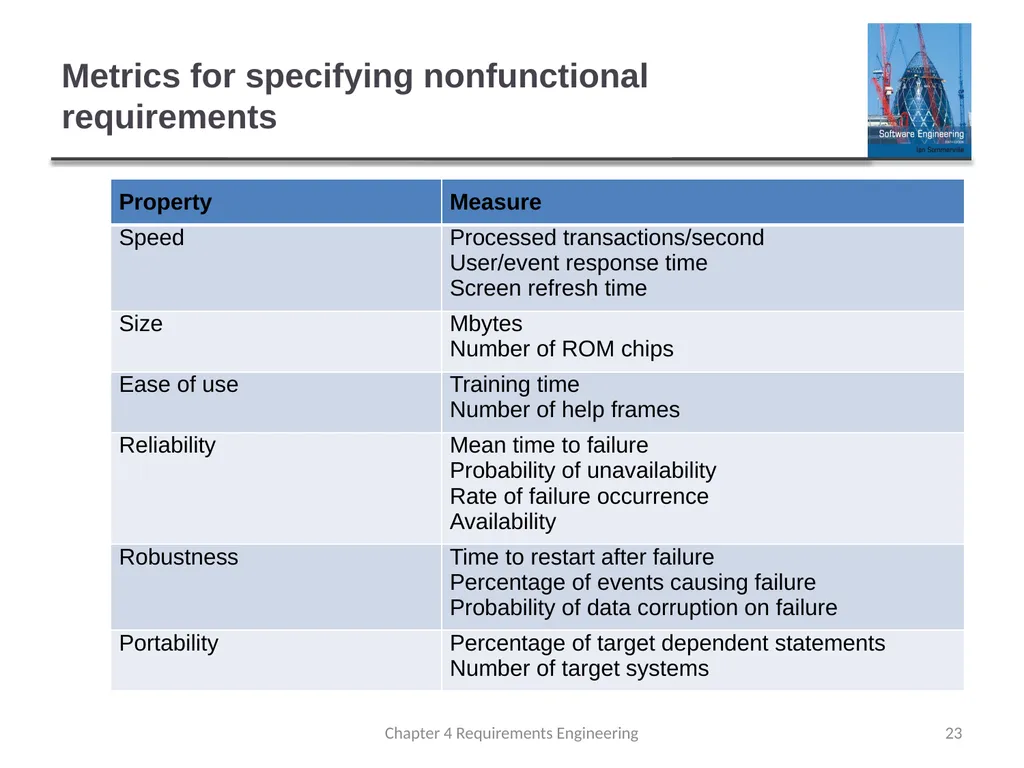
Metrics for specifying nonfunctional requirements Chapter 4 Requirements Engineering 23<br>
24
Requirements – First Person Shooter Game Name some requirements for a generic futuristic first person shooter game, both functional and nonfunctional Chapter 4 Requirements Engineering 24<br>
25
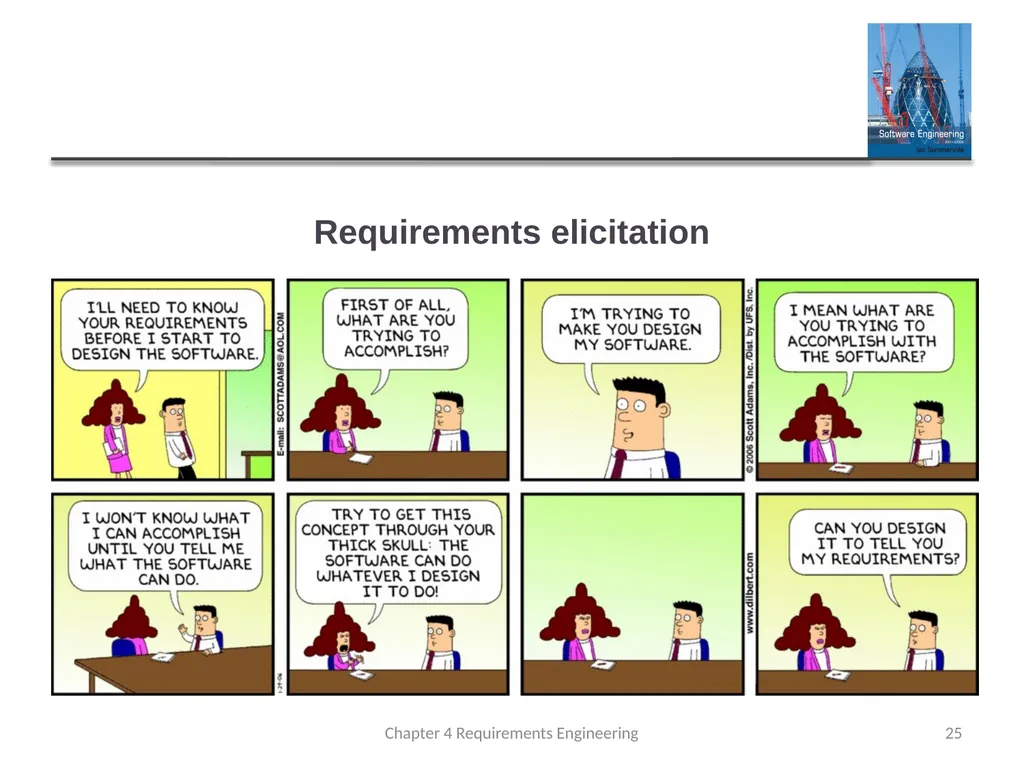
Requirements elicitation Chapter 4 Requirements Engineering 25<br>
26
Requirements elicitation and analysis Sometimes called requirements elicitation or requirements discovery
Involves technical staff working with customers to find out about the application domain, the services that the system should provide and the system’s operational constraints.
May involve end-users, managers, engineers involved in maintenance, domain experts, trade unions, and other. These are called stakeholders.
Find requirements! Chapter 4 Requirements Engineering 26<br>
27
Requirements elicitation Software engineers work with a range of system stakeholders to find out about the application domain, the services that the system should provide, the required system performance, hardware constraints, other systems.
Stages include:
Requirements discovery,
Requirements classification and organization,
Requirements prioritization and negotiation,
Requirements specification. Chapter 4 Requirements Engineering 27<br>
Stages include:
Requirements discovery,
Requirements classification and organization,
Requirements prioritization and negotiation,
Requirements specification. Chapter 4 Requirements Engineering 27<br>
28
Problems of requirements elicitation Stakeholders don’t know what they really want
Stakeholders express requirements in their own terms
Different stakeholders may have conflicting requirements
Organizational and political factors may influence the system requirements
The requirements change during the analysis process. New stakeholders may emerge and the business environment may change. Chapter 4 Requirements Engineering 28<br>
29
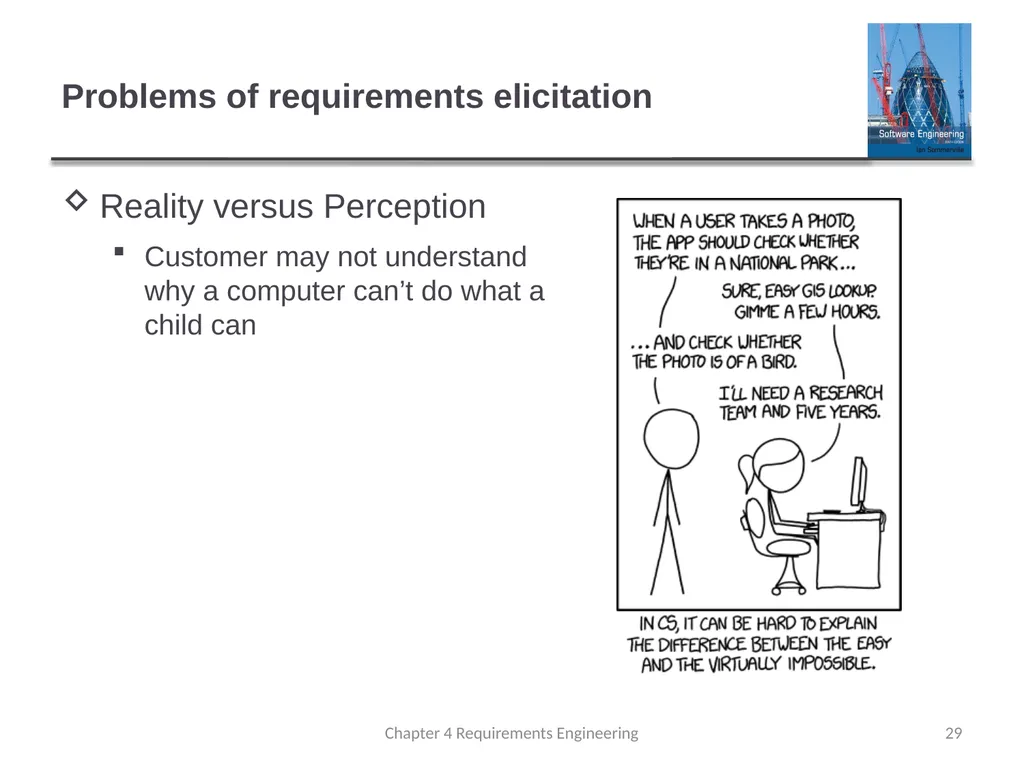
Problems of requirements elicitation Reality versus Perception
Customer may not understand why a computer can’t do what a child can Chapter 4 Requirements Engineering 29<br>
Customer may not understand why a computer can’t do what a child can Chapter 4 Requirements Engineering 29<br>
30
Requirements discovery - Interviewing Formal or informal interviews with stakeholders are part of most RE processes
Types of interview
Closed interviews based on pre-determined list of questions
Open interviews where various issues are explored with stakeholders
Effective interviewing
Be open-minded, avoid pre-conceived ideas about the requirements and be willing to listen to stakeholders
Prompt the interviewee to get discussions going using a springboard question, a requirements proposal, or by working together on a prototype system Chapter 4 Requirements Engineering 30 30/10/2014<br>
31
Problems with interviews Application specialists may use language to describe their work that isn’t easy for the requirements engineer to understand.
Every profession has it’s own language
Interviews are not good for understanding domain requirements
Requirements engineers cannot understand specific domain terminology (see above)
Some domain knowledge is so familiar that people find it hard to articulate or think that it isn’t worth articulating
The odd case that is unlikely to come up in an interview Chapter 4 Requirements Engineering 31 30/10/2014<br>
32
Requirements discovery - Ethnography A social scientist spends a considerable time observing and analyzing how people actually work
People do not have to explain or articulate their work
Social and organizational factors of importance may be observed
Ethnographic studies have shown that work is usually richer and more complex than suggested by simple system models
Time consuming Chapter 4 Requirements Engineering 32<br>
People do not have to explain or articulate their work
Social and organizational factors of importance may be observed
Ethnographic studies have shown that work is usually richer and more complex than suggested by simple system models
Time consuming Chapter 4 Requirements Engineering 32<br>
33
Stories and scenarios Scenarios and user stories are real-life examples of how a system can be used
Stories and scenarios are a description of how a system may be used for a particular task
Because they are based on a practical situation, stakeholders can relate to them and can comment on their situation with respect to the story. Chapter 4 Requirements Engineering 33<br>
Stories and scenarios are a description of how a system may be used for a particular task
Because they are based on a practical situation, stakeholders can relate to them and can comment on their situation with respect to the story. Chapter 4 Requirements Engineering 33<br>
34
Scenarios A structured form of user story
Scenarios should include
A description of the starting situation;
A description of the normal flow of events;
A description of what can go wrong;
Information about other concurrent activities;
A description of the state when the scenario finishes. Chapter 4 Requirements Engineering 34<br>
Scenarios should include
A description of the starting situation;
A description of the normal flow of events;
A description of what can go wrong;
Information about other concurrent activities;
A description of the state when the scenario finishes. Chapter 4 Requirements Engineering 34<br>
35
Requirements specification Chapter 4 Requirements Engineering 35<br>
36
Requirements specification The process of writing down the user and system requirements in a requirements document
User requirements have to be understandable by end-users and customers who do not have a technical background
System requirements are more detailed requirements and may include more technical information
The requirements may be part of a contract for the system development
It is therefore important that these are as complete as possible Chapter 4 Requirements Engineering 36<br>
37
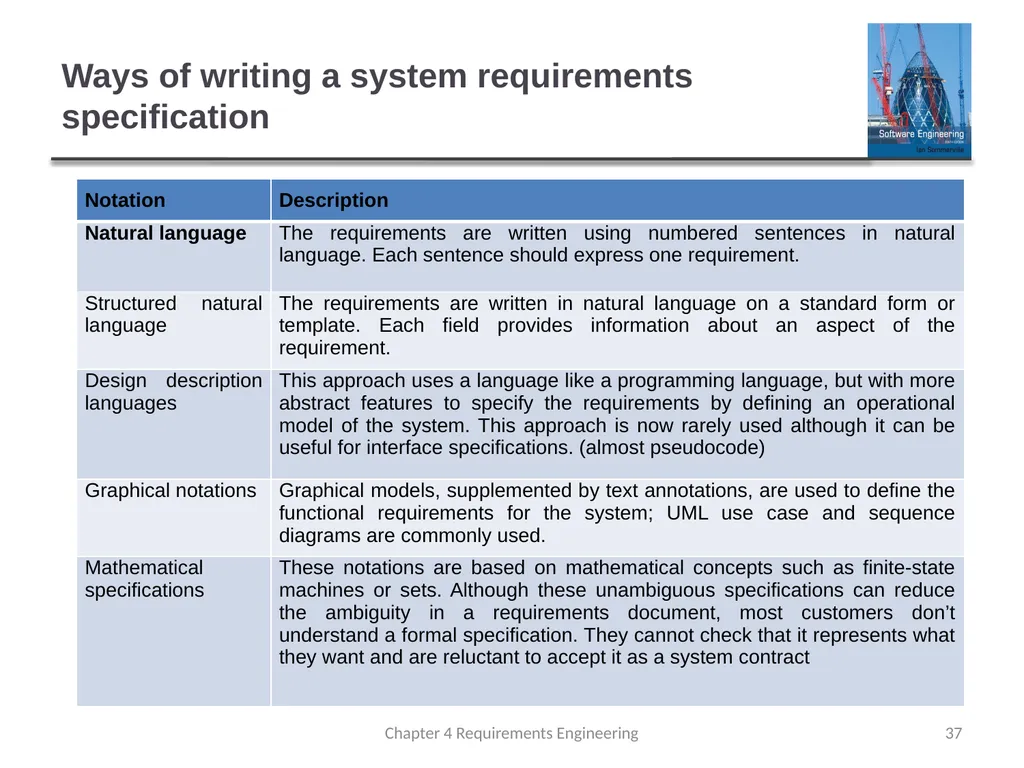
Ways of writing a system requirements specification Chapter 4 Requirements Engineering 37<br>
38
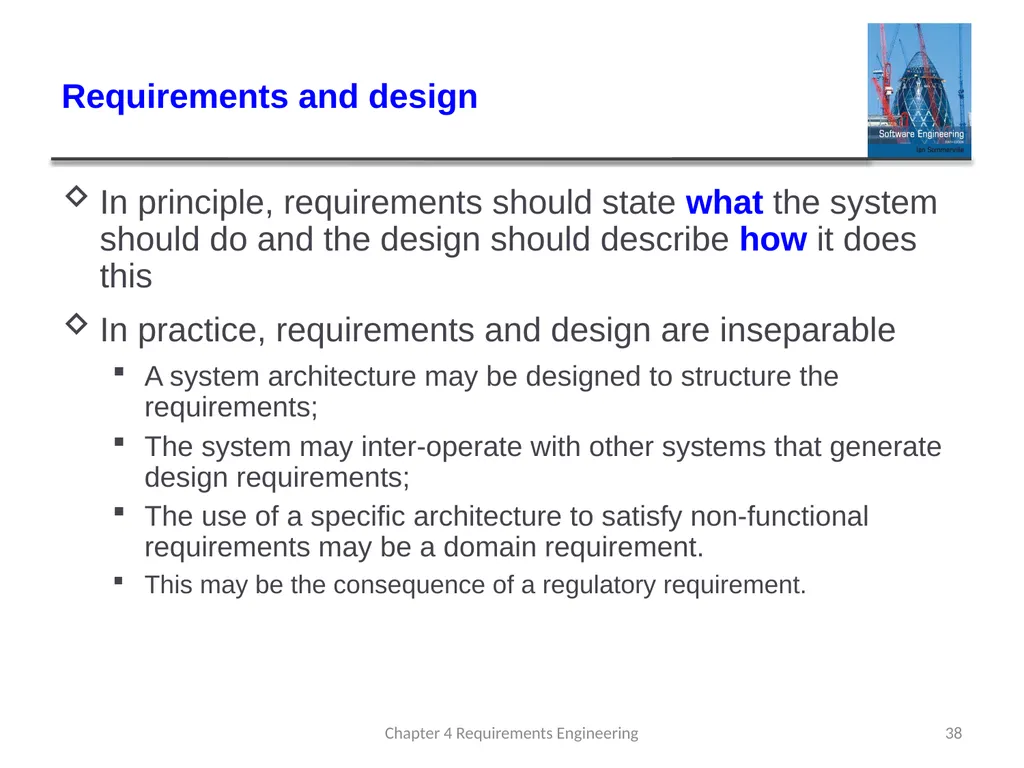
Requirements and design In principle, requirements should state what the system should do and the design should describe how it does this
In practice, requirements and design are inseparable
A system architecture may be designed to structure the requirements;
The system may inter-operate with other systems that generate design requirements;
The use of a specific architecture to satisfy non-functional requirements may be a domain requirement.
This may be the consequence of a regulatory requirement. Chapter 4 Requirements Engineering 38<br>
39
Natural language specification Requirements are written as natural language sentences supplemented by diagrams and tables
Used for writing requirements because it is expressive, intuitive and universal. This means that the requirements can be understood by users and customers. Chapter 4 Requirements Engineering 39<br>
Used for writing requirements because it is expressive, intuitive and universal. This means that the requirements can be understood by users and customers. Chapter 4 Requirements Engineering 39<br>
40
Problems with natural language Lack of clarity
Precision is difficult without making the document difficult to read
Requirements confusion
Functional and non-functional requirements tend to be mixed-up
Requirements amalgamation
Several different requirements may be expressed together Chapter 4 Requirements Engineering 40<br>
Precision is difficult without making the document difficult to read
Requirements confusion
Functional and non-functional requirements tend to be mixed-up
Requirements amalgamation
Several different requirements may be expressed together Chapter 4 Requirements Engineering 40<br>
41
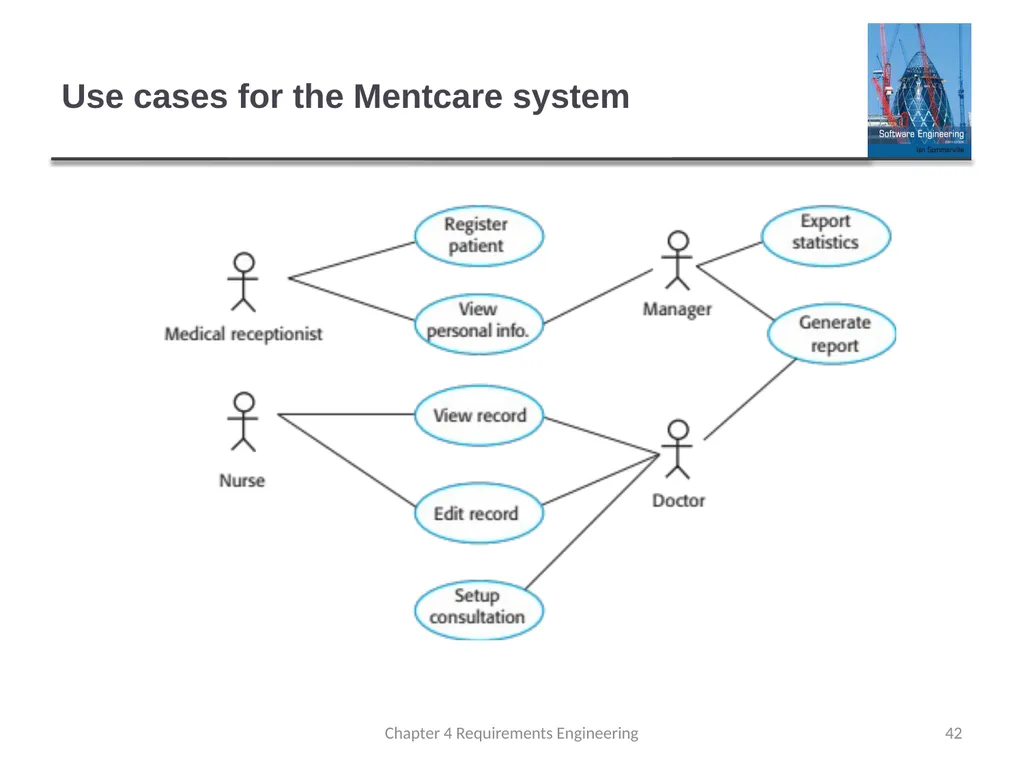
Use cases Use-cases are a kind of scenario that are included in the UML
Use cases identify the actors in an interaction and which describe the interaction itself
A set of use cases should describe all possible interactions with the system
High-level graphical model supplemented by more detailed tabular description (see Chapter 5)
UML sequence diagrams may be used to add detail to use-cases by showing the sequence of event processing in the system Chapter 4 Requirements Engineering 41<br>
42
Use cases for the Mentcare system Chapter 4 Requirements Engineering 42<br>
43
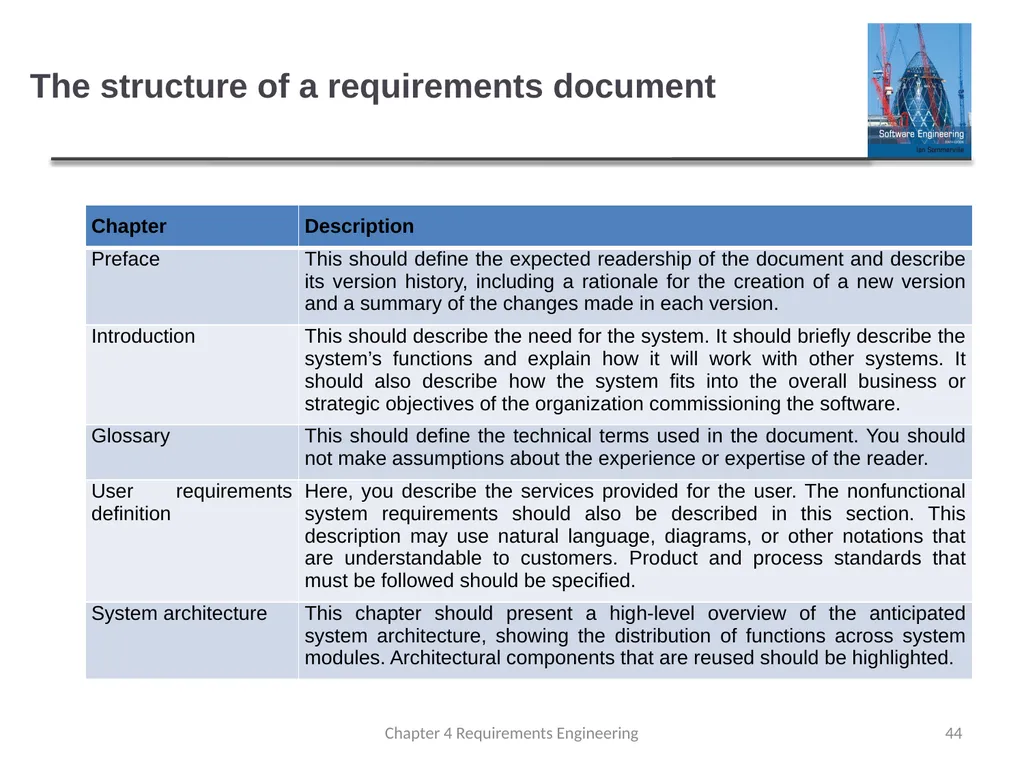
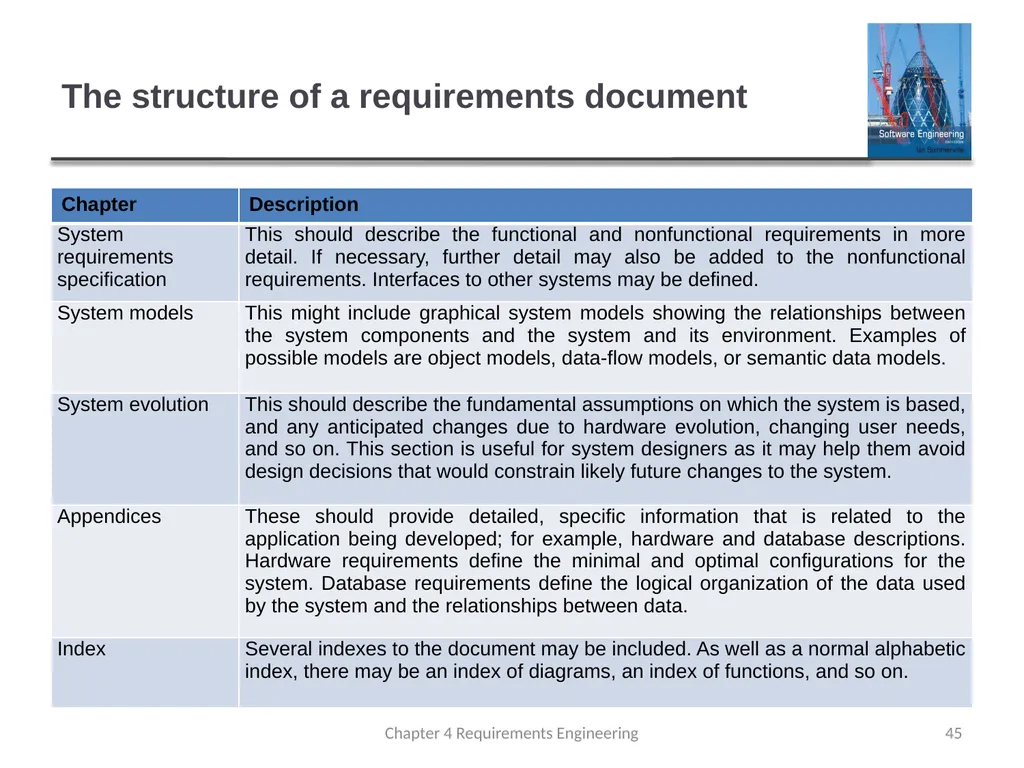
The software requirements document The software requirements document is the official statement of what is required of the system developers
Should include both a definition of user requirements and a specification of the system requirements
It is NOT a design document. As far as possible, it should set of WHAT the system should do rather than HOW it should do it. Chapter 4 Requirements Engineering 43<br>
Should include both a definition of user requirements and a specification of the system requirements
It is NOT a design document. As far as possible, it should set of WHAT the system should do rather than HOW it should do it. Chapter 4 Requirements Engineering 43<br>
44
The structure of a requirements document Chapter 4 Requirements Engineering 44<br>
45
The structure of a requirements document Chapter 4 Requirements Engineering 45<br>
46
Requirements validation Chapter 4 Requirements Engineering 46<br>
47
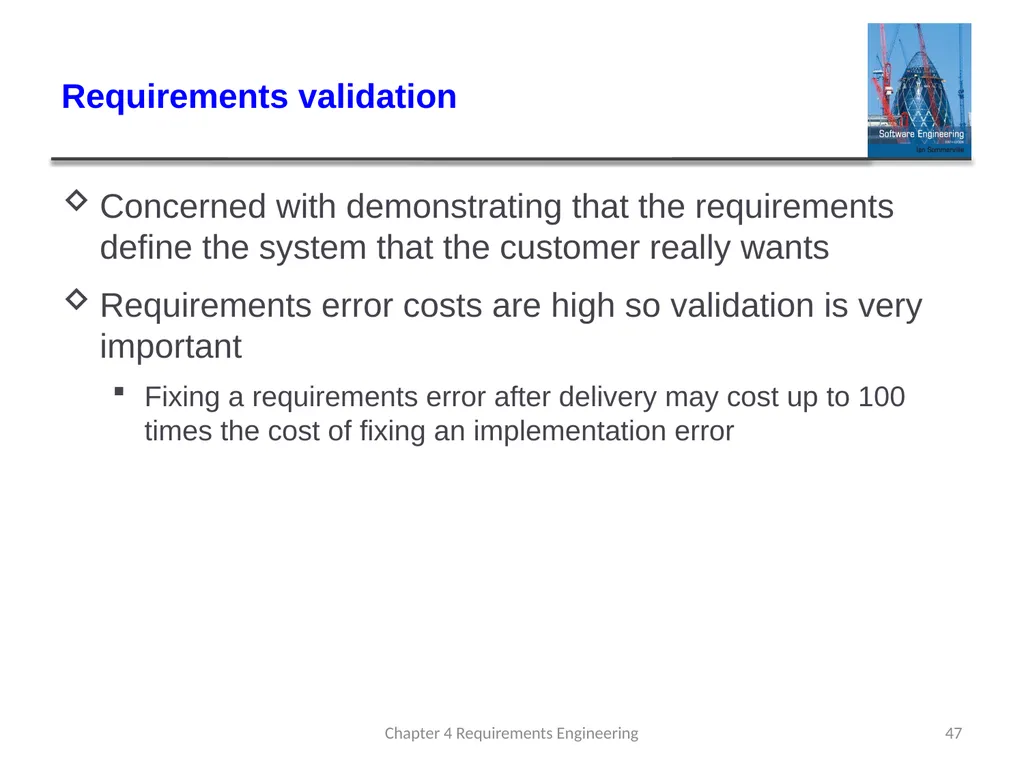
Requirements validation Concerned with demonstrating that the requirements define the system that the customer really wants
Requirements error costs are high so validation is very important
Fixing a requirements error after delivery may cost up to 100 times the cost of fixing an implementation error Chapter 4 Requirements Engineering 47<br>
Requirements error costs are high so validation is very important
Fixing a requirements error after delivery may cost up to 100 times the cost of fixing an implementation error Chapter 4 Requirements Engineering 47<br>
48
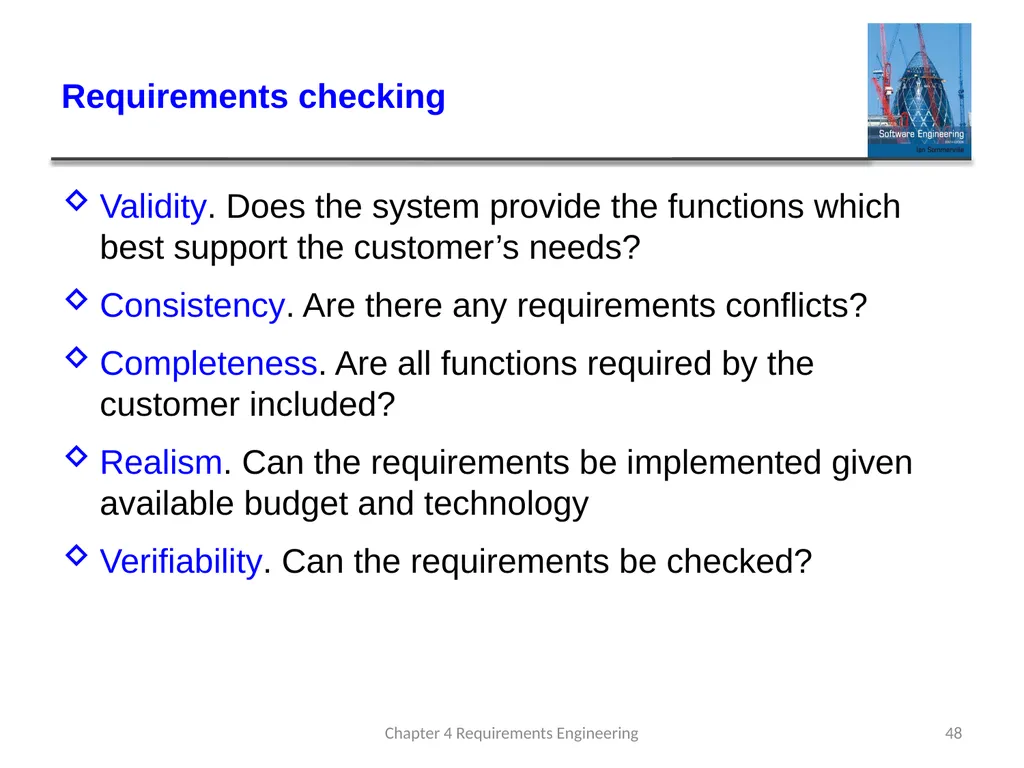
Requirements checking Validity. Does the system provide the functions which best support the customer’s needs?
Consistency. Are there any requirements conflicts?
Completeness. Are all functions required by the customer included?
Realism. Can the requirements be implemented given available budget and technology
Verifiability. Can the requirements be checked? Chapter 4 Requirements Engineering 48<br>
Consistency. Are there any requirements conflicts?
Completeness. Are all functions required by the customer included?
Realism. Can the requirements be implemented given available budget and technology
Verifiability. Can the requirements be checked? Chapter 4 Requirements Engineering 48<br>
49
Requirements change Chapter 4 Requirements Engineering 49<br>
50
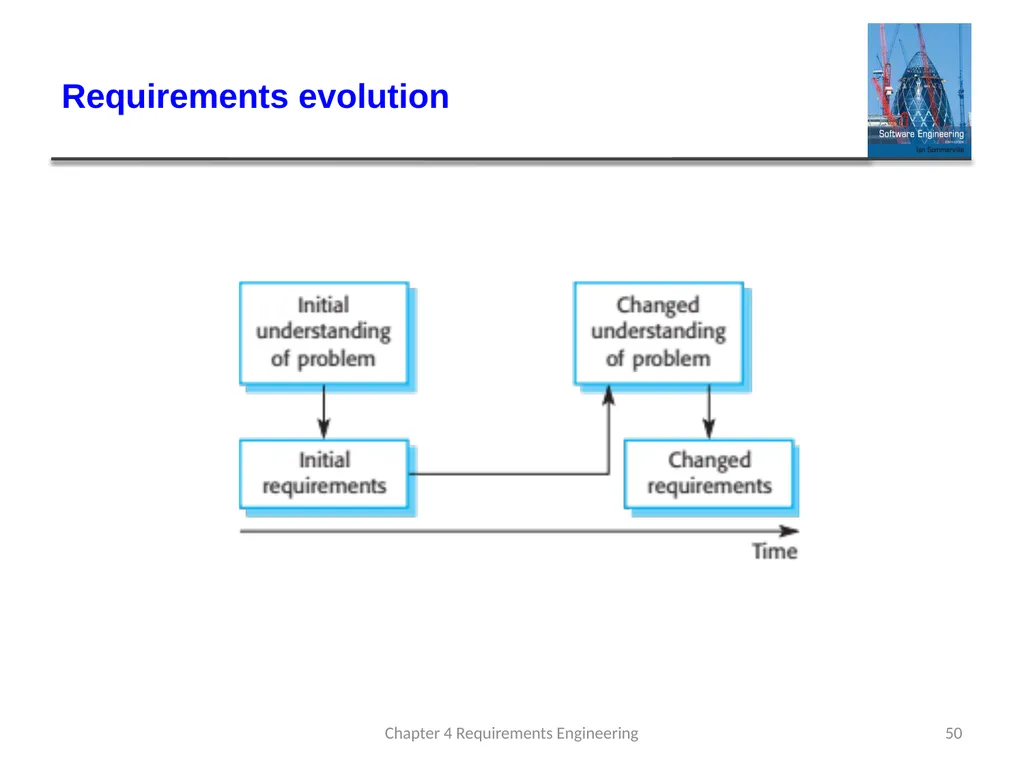
Requirements evolution Chapter 4 Requirements Engineering 50<br>
51
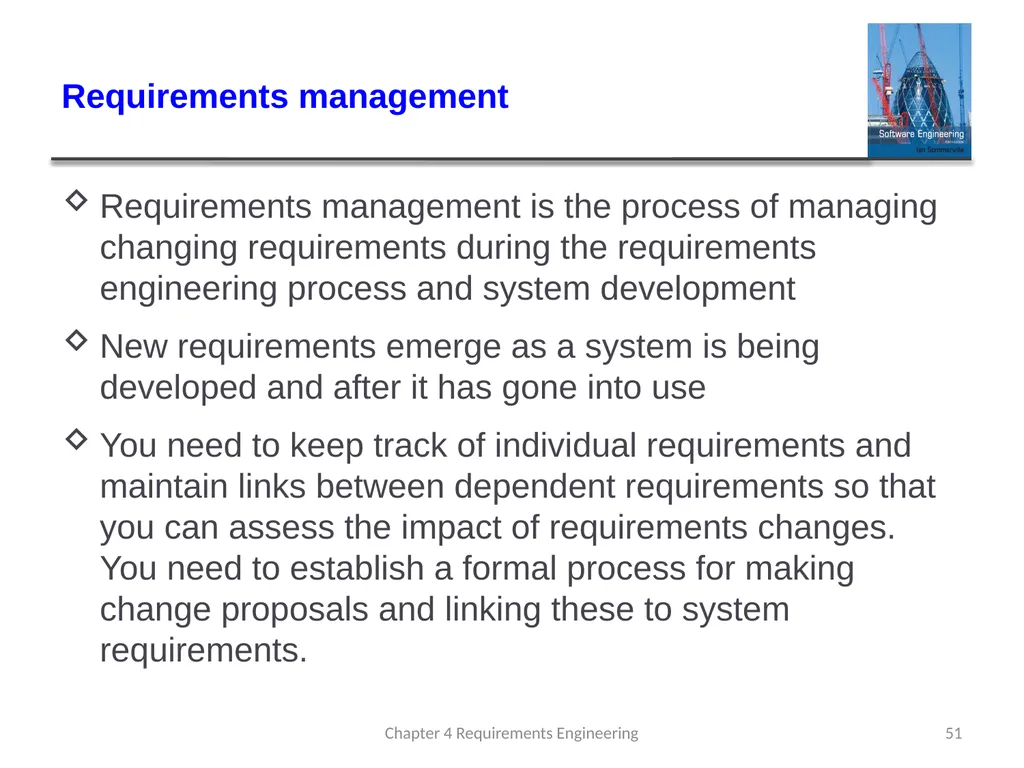
Requirements management Requirements management is the process of managing changing requirements during the requirements engineering process and system development
New requirements emerge as a system is being developed and after it has gone into use
You need to keep track of individual requirements and maintain links between dependent requirements so that you can assess the impact of requirements changes. You need to establish a formal process for making change proposals and linking these to system requirements. Chapter 4 Requirements Engineering 51<br>
52
Key points Requirements for a software system set out what the system should do and define constraints on its operation and implementation
Functional requirements are statements of the services that the system must provide or are descriptions of how some computations must be carried out
Non-functional requirements often constrain the system being developed and the development process being used
They often relate to the emergent properties of the system and therefore apply to the system as a whole Chapter 4 Requirements Engineering 52<br>
53
Key points The requirements engineering process is an iterative process that includes requirements elicitation, specification and validation
You can use a range of techniques for requirements elicitation including interviews and ethnography. User stories and scenarios may be used to facilitate discussions.
Requirements specification is the process of formally documenting the user and system requirements and creating a software requirements document Chapter 4 Requirements Engineering 53<br>
54
Key points The software requirements document is an agreed statement of the system requirements. It should be organized so that both system customers and software developers can use it.
Requirements validation is the process of checking the requirements for validity, consistency, completeness, realism and verifiability
Business, organizational and technical changes inevitably lead to changes to the requirements for a software system. Requirements management is the process of managing and controlling these changes. Chapter 4 Requirements Engineering 54<br>