
Chapter 5 Currency Derivatives Jeff Madura,
KL
Published · 42 slides · 0 views

1 / 1
Description
Chapter 5 Currency Derivatives Jeff Madura, International Financial Management, 14th Edition. 2021 Cengage. All Rights Reserved. May not be scanned, copied or duplicated, or posted to a publicly accessible website, in whole or in part.
Related Topics
Share
Embed code
Download this presentation From Below
"Chapter 5 Currency Derivatives Jeff Madura," is the property of its rightful owner. Permission is granted to download and print the materials on this website for personal, non-commercial use only, and to display it on your personal computer provided you do not modify the materials and that you retain all copyright notices contained in the materials. By downloading content from our website, you accept the terms of this agreement.
Presentation Transcript
01
Chapter 5 Currency Derivatives Jeff Madura, International Financial Management, 14th Edition. © 2021 Cengage. All Rights Reserved. May not be scanned, copied or duplicated, or posted to a publicly accessible website, in whole or in part.<br>
02
Chapter Objectives Describe the characteristics and use of forward contracts.
Describe the characteristics and use of currency futures contracts.
Describe the characteristics and use of currency call option contracts.
Describe the characteristics and use of currency put option contracts. 2<br>
Describe the characteristics and use of currency futures contracts.
Describe the characteristics and use of currency call option contracts.
Describe the characteristics and use of currency put option contracts. 2<br>
03
What is a Currency Derivative? A currency derivative is a contract whose price is derived from the value of an underlying currency.
Examples include forwards/futures contracts and options contracts.
Derivatives are used by M N Cs to:
Speculate on future exchange rate movements
Hedge exposure to exchange rate risk 3<br>
Examples include forwards/futures contracts and options contracts.
Derivatives are used by M N Cs to:
Speculate on future exchange rate movements
Hedge exposure to exchange rate risk 3<br>
04
Forward Market (1 of 5) A forward contract is an agreement between a corporation and a financial institution:
To exchange a specified amount of currency
At a specified exchange rate called the forward rate
On a specified date in the future 4<br>
To exchange a specified amount of currency
At a specified exchange rate called the forward rate
On a specified date in the future 4<br>
05
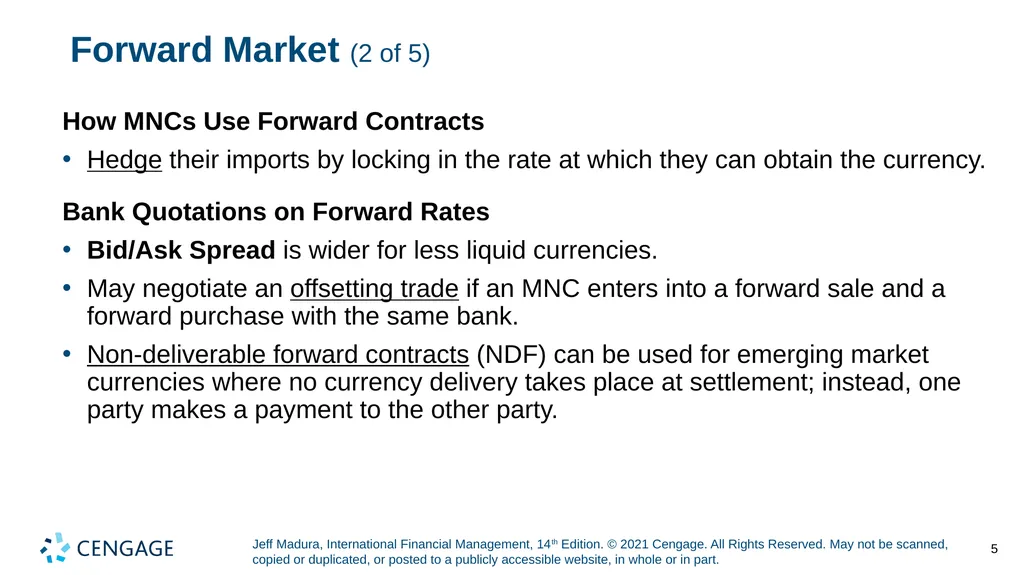
Forward Market (2 of 5) How M N Cs Use Forward Contracts
Hedge their imports by locking in the rate at which they can obtain the currency. Bank Quotations on Forward Rates
Bid/Ask Spread is wider for less liquid currencies.
May negotiate an offsetting trade if an M N C enters into a forward sale and a forward purchase with the same bank.
Non-deliverable forward contracts (N D F) can be used for emerging market currencies where no currency delivery takes place at settlement; instead, one party makes a payment to the other party. 5<br>
Hedge their imports by locking in the rate at which they can obtain the currency. Bank Quotations on Forward Rates
Bid/Ask Spread is wider for less liquid currencies.
May negotiate an offsetting trade if an M N C enters into a forward sale and a forward purchase with the same bank.
Non-deliverable forward contracts (N D F) can be used for emerging market currencies where no currency delivery takes place at settlement; instead, one party makes a payment to the other party. 5<br>
06
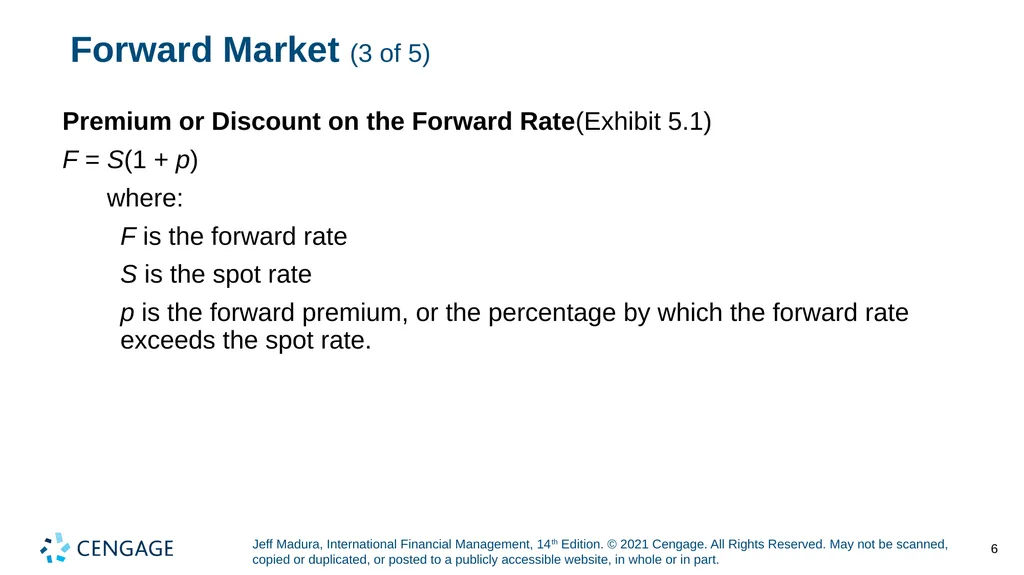
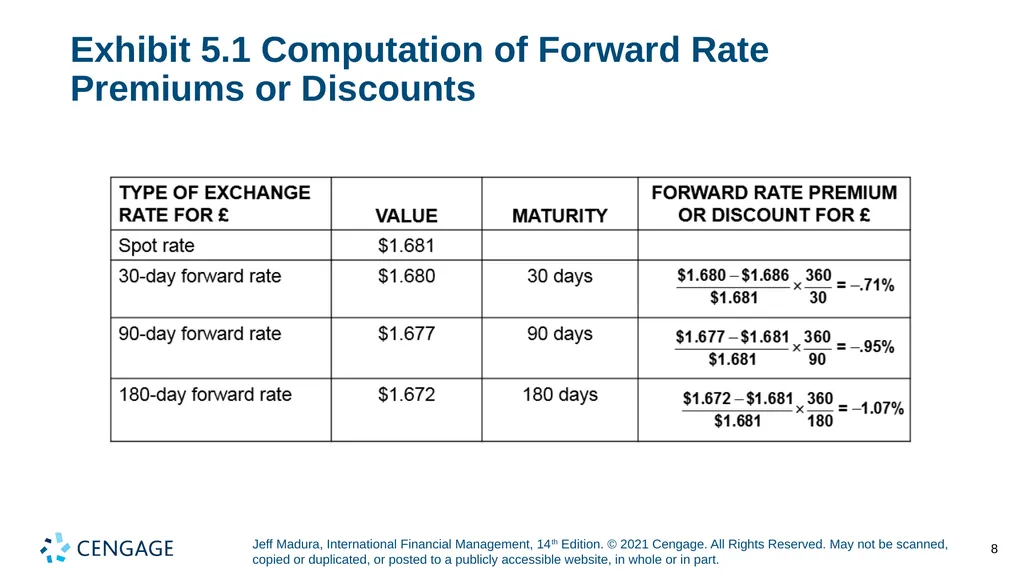
Forward Market (3 of 5) Premium or Discount on the Forward Rate(Exhibit 5.1)
F = S(1 + p)
where:
F is the forward rate
S is the spot rate
p is the forward premium, or the percentage by which the forward rate exceeds the spot rate. 6<br>
F = S(1 + p)
where:
F is the forward rate
S is the spot rate
p is the forward premium, or the percentage by which the forward rate exceeds the spot rate. 6<br>
07
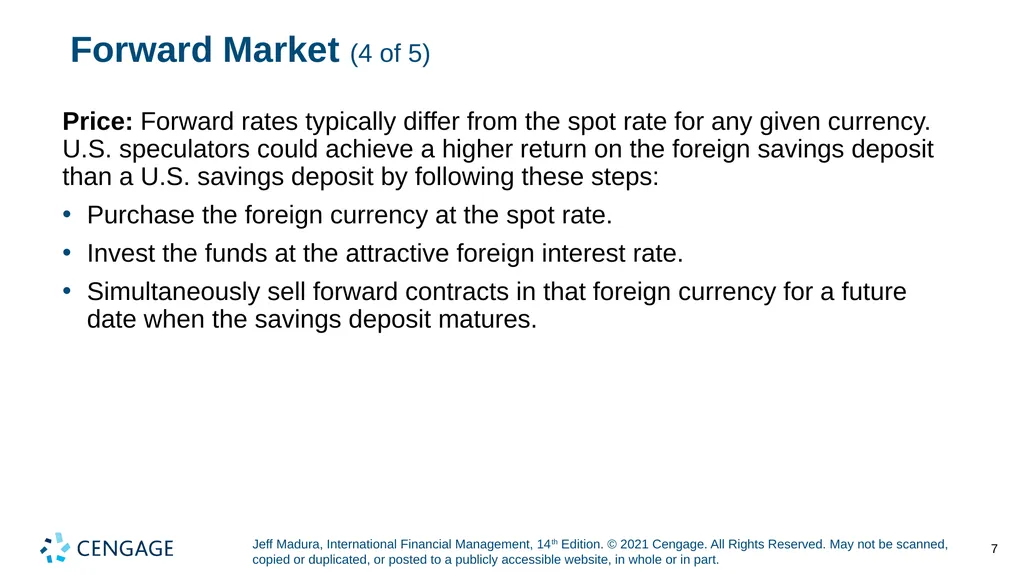
Forward Market (4 of 5) Price: Forward rates typically differ from the spot rate for any given currency. U.S. speculators could achieve a higher return on the foreign savings deposit than a U.S. savings deposit by following these steps:
Purchase the foreign currency at the spot rate.
Invest the funds at the attractive foreign interest rate.
Simultaneously sell forward contracts in that foreign currency for a future date when the savings deposit matures. 7<br>
Purchase the foreign currency at the spot rate.
Invest the funds at the attractive foreign interest rate.
Simultaneously sell forward contracts in that foreign currency for a future date when the savings deposit matures. 7<br>
08
Exhibit 5.1 Computation of Forward Rate Premiums or Discounts 8<br>
09
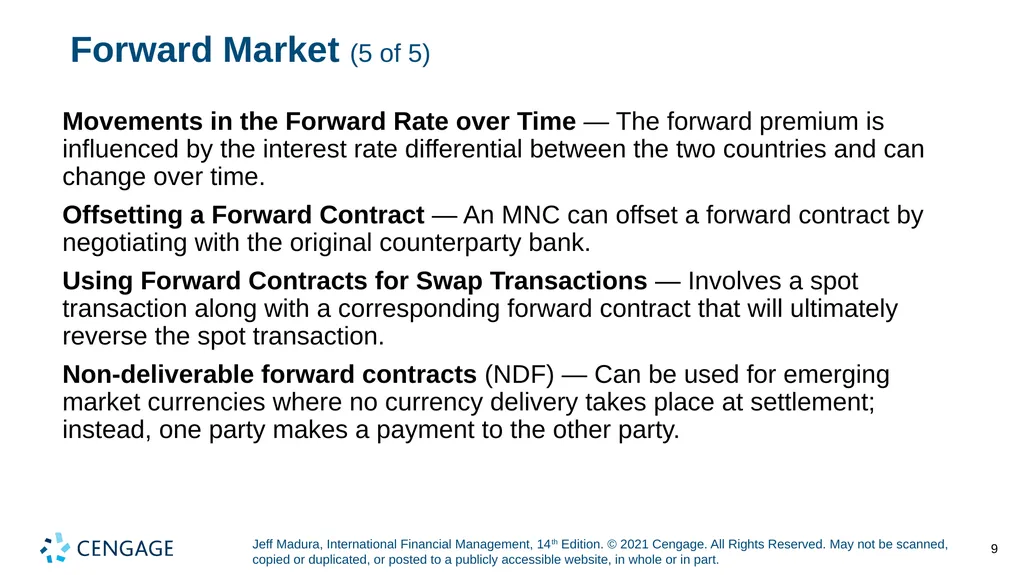
Forward Market (5 of 5) Movements in the Forward Rate over Time — The forward premium is influenced by the interest rate differential between the two countries and can change over time.
Offsetting a Forward Contract — An M N C can offset a forward contract by negotiating with the original counterparty bank.
Using Forward Contracts for Swap Transactions — Involves a spot transaction along with a corresponding forward contract that will ultimately reverse the spot transaction.
Non-deliverable forward contracts (N D F) — Can be used for emerging market currencies where no currency delivery takes place at settlement; instead, one party makes a payment to the other party. 9<br>
Offsetting a Forward Contract — An M N C can offset a forward contract by negotiating with the original counterparty bank.
Using Forward Contracts for Swap Transactions — Involves a spot transaction along with a corresponding forward contract that will ultimately reverse the spot transaction.
Non-deliverable forward contracts (N D F) — Can be used for emerging market currencies where no currency delivery takes place at settlement; instead, one party makes a payment to the other party. 9<br>
10
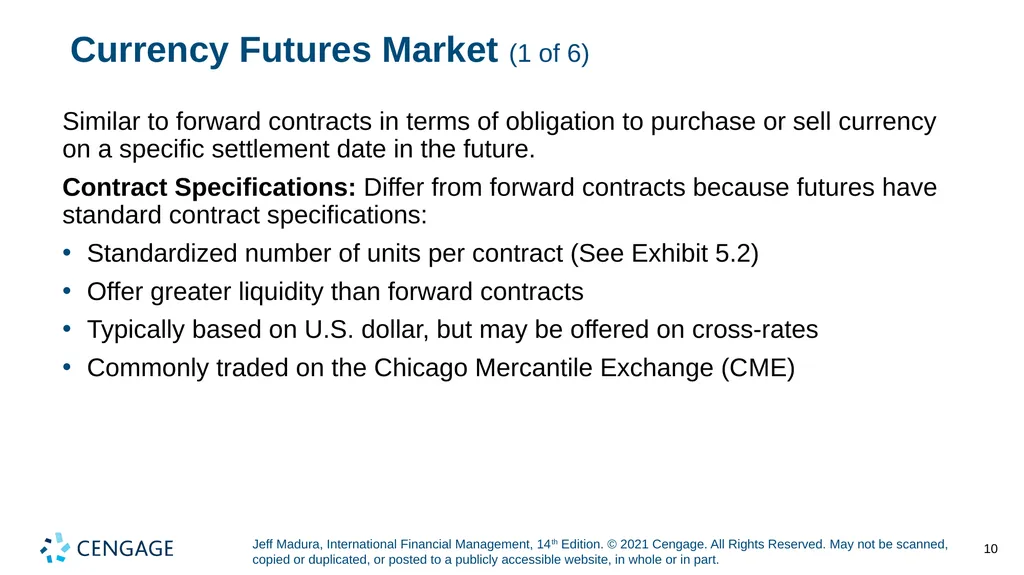
Currency Futures Market (1 of 6) Similar to forward contracts in terms of obligation to purchase or sell currency on a specific settlement date in the future.
Contract Specifications: Differ from forward contracts because futures have standard contract specifications:
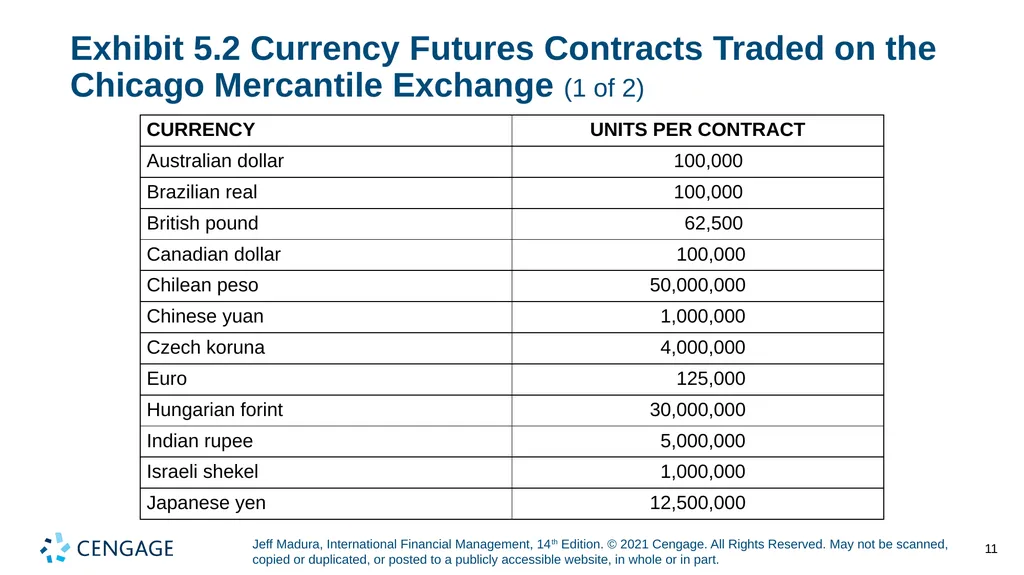
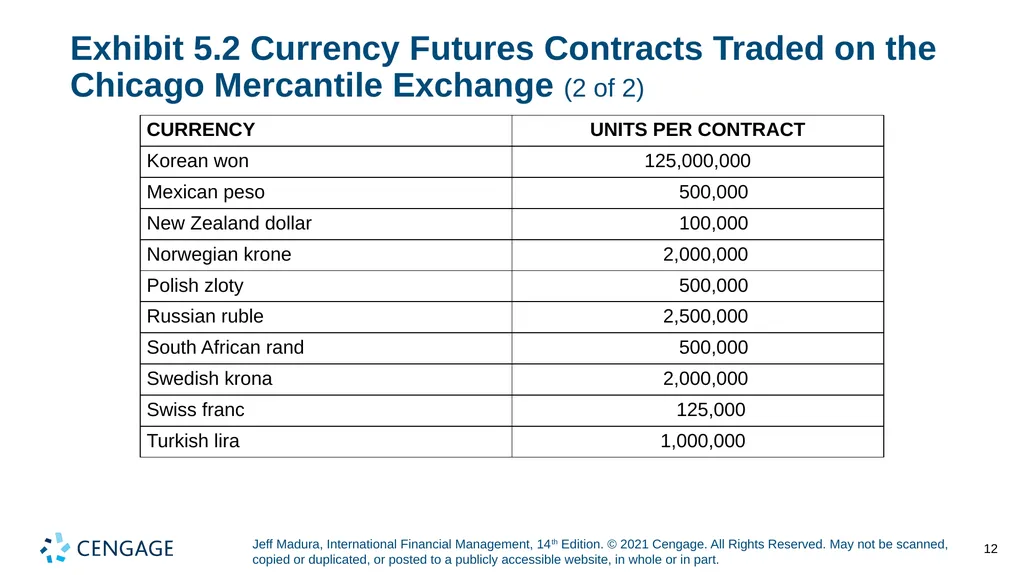
Standardized number of units per contract (See Exhibit 5.2)
Offer greater liquidity than forward contracts
Typically based on U.S. dollar, but may be offered on cross-rates
Commonly traded on the Chicago Mercantile Exchange (C M E) 10<br>
Contract Specifications: Differ from forward contracts because futures have standard contract specifications:
Standardized number of units per contract (See Exhibit 5.2)
Offer greater liquidity than forward contracts
Typically based on U.S. dollar, but may be offered on cross-rates
Commonly traded on the Chicago Mercantile Exchange (C M E) 10<br>
11
Exhibit 5.2 Currency Futures Contracts Traded on the Chicago Mercantile Exchange (1 of 2) 11<br>
12
Exhibit 5.2 Currency Futures Contracts Traded on the Chicago Mercantile Exchange (2 of 2) 12<br>
13
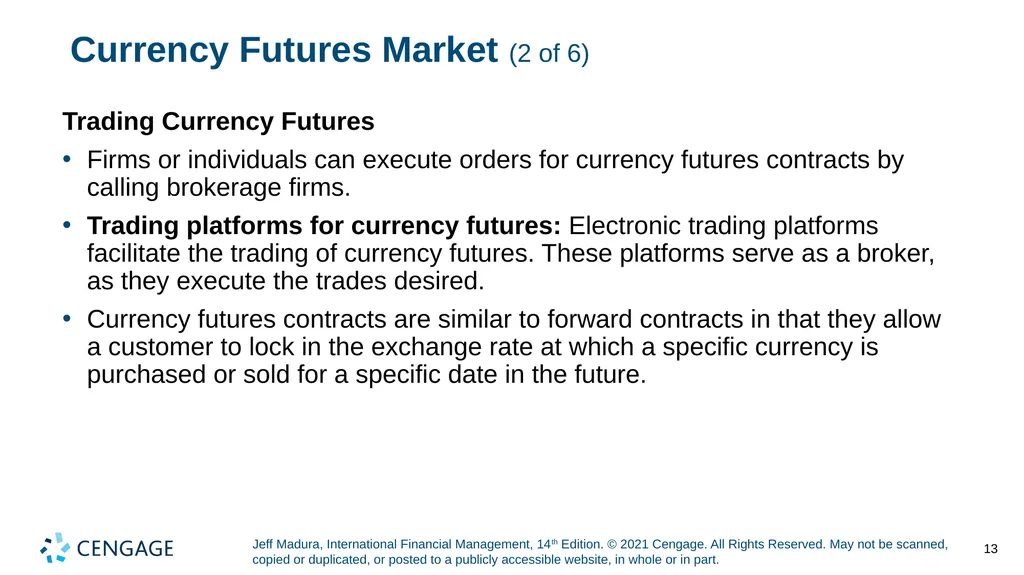
Currency Futures Market (2 of 6) Trading Currency Futures
Firms or individuals can execute orders for currency futures contracts by calling brokerage firms.
Trading platforms for currency futures: Electronic trading platforms facilitate the trading of currency futures. These platforms serve as a broker, as they execute the trades desired.
Currency futures contracts are similar to forward contracts in that they allow a customer to lock in the exchange rate at which a specific currency is purchased or sold for a specific date in the future. 13<br>
Firms or individuals can execute orders for currency futures contracts by calling brokerage firms.
Trading platforms for currency futures: Electronic trading platforms facilitate the trading of currency futures. These platforms serve as a broker, as they execute the trades desired.
Currency futures contracts are similar to forward contracts in that they allow a customer to lock in the exchange rate at which a specific currency is purchased or sold for a specific date in the future. 13<br>
14
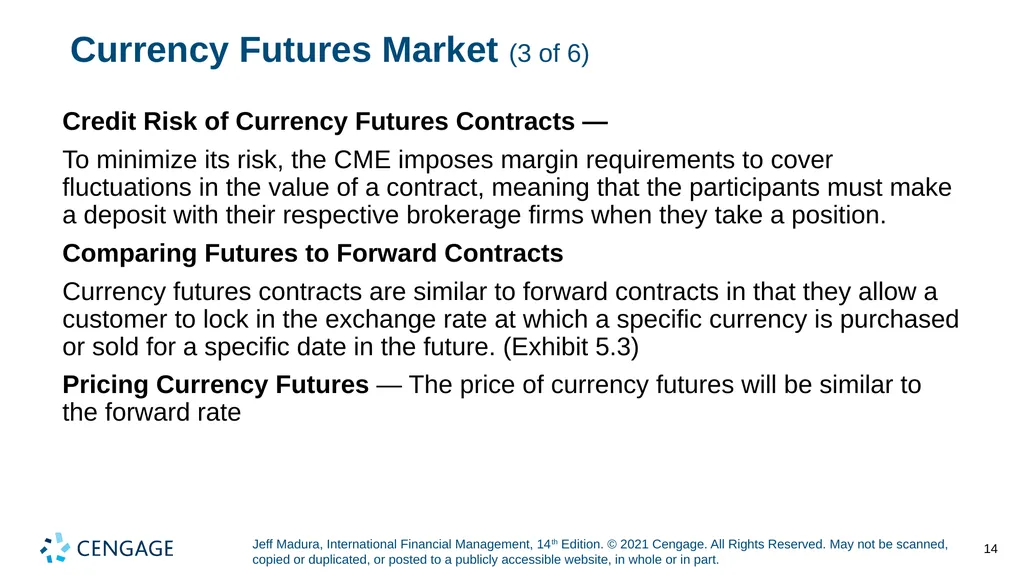
Currency Futures Market (3 of 6) Credit Risk of Currency Futures Contracts —
To minimize its risk, the C M E imposes margin requirements to cover fluctuations in the value of a contract, meaning that the participants must make a deposit with their respective brokerage firms when they take a position.
Comparing Futures to Forward Contracts
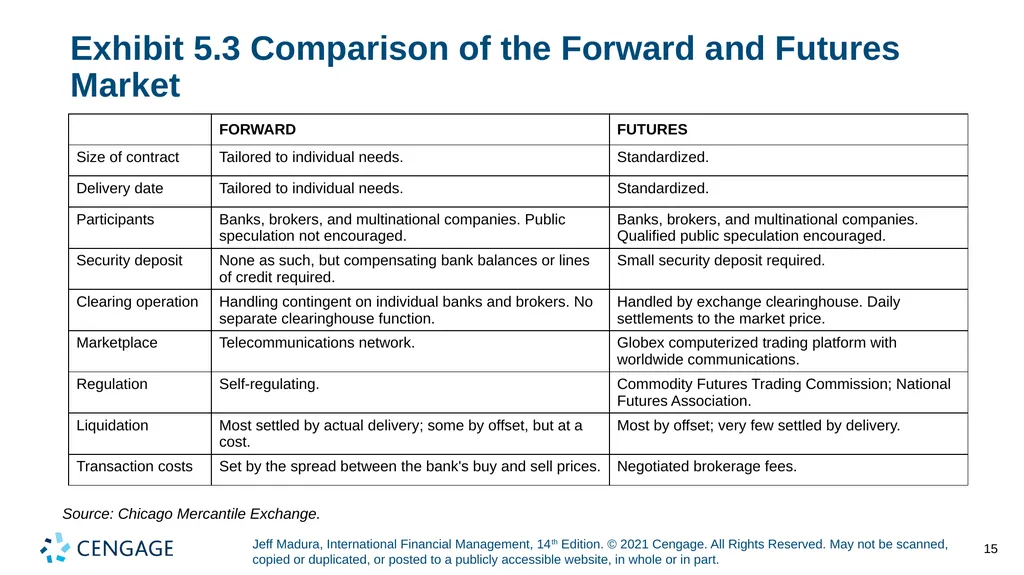
Currency futures contracts are similar to forward contracts in that they allow a customer to lock in the exchange rate at which a specific currency is purchased or sold for a specific date in the future. (Exhibit 5.3)
Pricing Currency Futures — The price of currency futures will be similar to the forward rate 14<br>
To minimize its risk, the C M E imposes margin requirements to cover fluctuations in the value of a contract, meaning that the participants must make a deposit with their respective brokerage firms when they take a position.
Comparing Futures to Forward Contracts
Currency futures contracts are similar to forward contracts in that they allow a customer to lock in the exchange rate at which a specific currency is purchased or sold for a specific date in the future. (Exhibit 5.3)
Pricing Currency Futures — The price of currency futures will be similar to the forward rate 14<br>
15
Exhibit 5.3 Comparison of the Forward and Futures Market Source: Chicago Mercantile Exchange. 15<br>
16
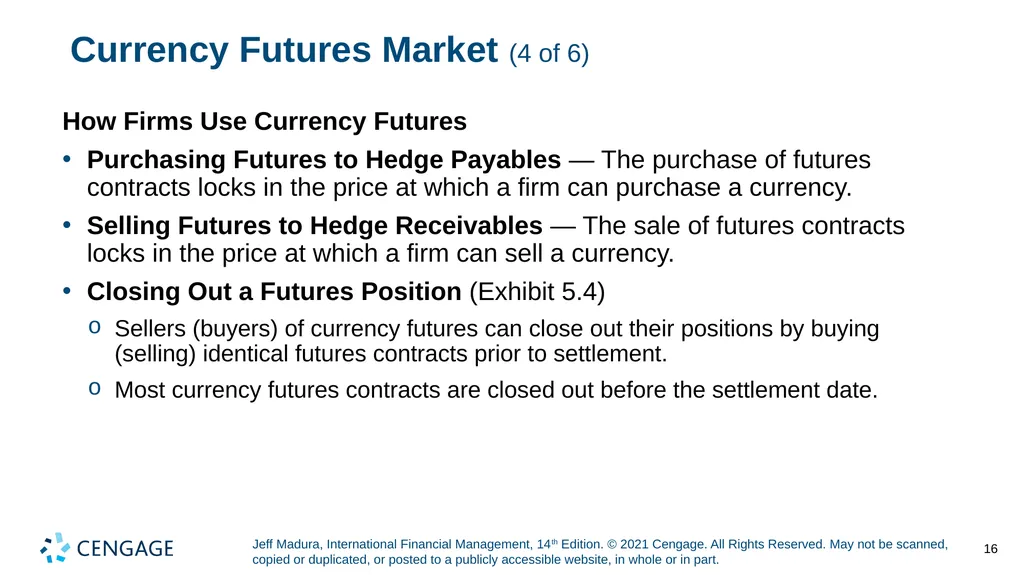
Currency Futures Market (4 of 6) How Firms Use Currency Futures
Purchasing Futures to Hedge Payables — The purchase of futures contracts locks in the price at which a firm can purchase a currency.
Selling Futures to Hedge Receivables — The sale of futures contracts locks in the price at which a firm can sell a currency.
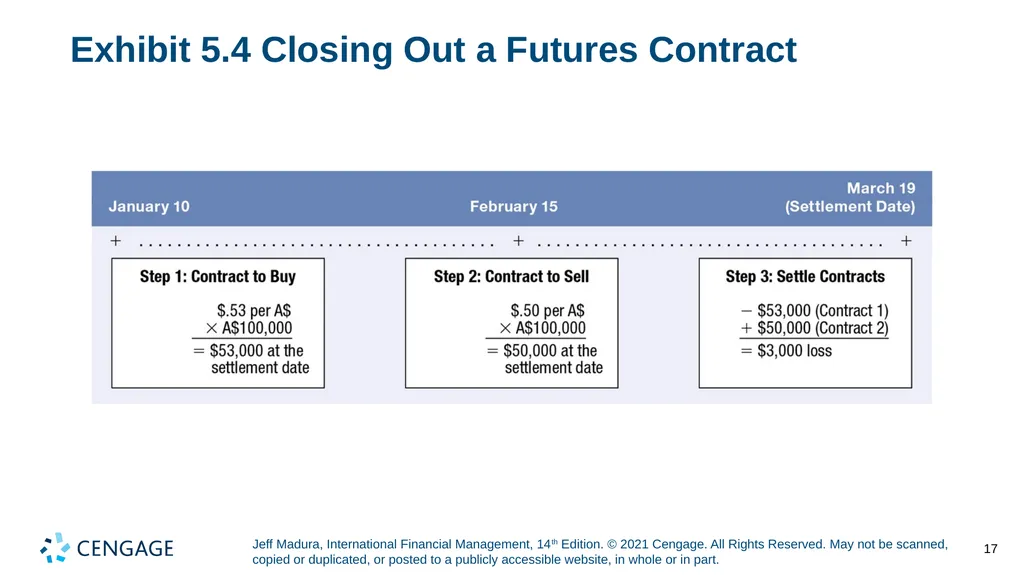
Closing Out a Futures Position (Exhibit 5.4)
Sellers (buyers) of currency futures can close out their positions by buying (selling) identical futures contracts prior to settlement.
Most currency futures contracts are closed out before the settlement date. 16<br>
Purchasing Futures to Hedge Payables — The purchase of futures contracts locks in the price at which a firm can purchase a currency.
Selling Futures to Hedge Receivables — The sale of futures contracts locks in the price at which a firm can sell a currency.
Closing Out a Futures Position (Exhibit 5.4)
Sellers (buyers) of currency futures can close out their positions by buying (selling) identical futures contracts prior to settlement.
Most currency futures contracts are closed out before the settlement date. 16<br>
17
Exhibit 5.4 Closing Out a Futures Contract 17<br>
18
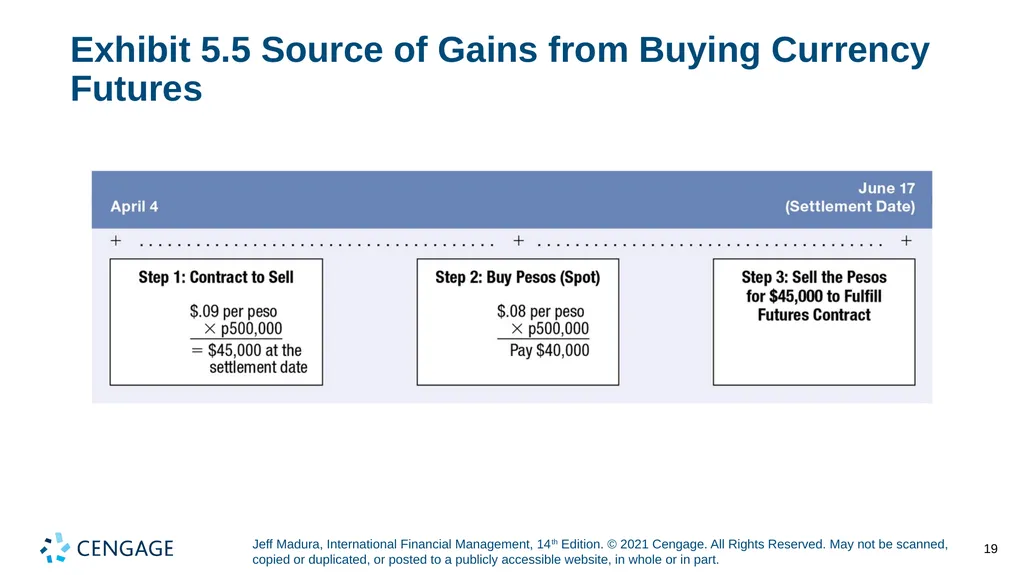
Currency Futures Market (5 of 6) Speculation with Currency Futures (Exhibit 5.5)
Currency futures contracts are sometimes purchased by speculators attempting to capitalize on their expectation of a currency’s future movement.
Currency futures are often sold by speculators who expect that the spot rate of a currency will be less than the rate at which they would be obligated to sell it. 18<br>
Currency futures contracts are sometimes purchased by speculators attempting to capitalize on their expectation of a currency’s future movement.
Currency futures are often sold by speculators who expect that the spot rate of a currency will be less than the rate at which they would be obligated to sell it. 18<br>
19
Exhibit 5.5 Source of Gains from Buying Currency Futures 19<br>
20
Currency Futures Market (6 of 6) Speculation with Currency Futures (continued)
Efficiency of the currency futures market
If the currency futures market is efficient, the futures price should reflect all available information.
Thus, the continual use of a particular strategy to take positions in currency futures contracts should not lead to abnormal profits.
Research has found that the currency futures market may be inefficient. However, the patterns are not necessarily observable until after they occur, which means that it may be difficult to consistently generate abnormal profits from speculating in currency futures. 20<br>
Efficiency of the currency futures market
If the currency futures market is efficient, the futures price should reflect all available information.
Thus, the continual use of a particular strategy to take positions in currency futures contracts should not lead to abnormal profits.
Research has found that the currency futures market may be inefficient. However, the patterns are not necessarily observable until after they occur, which means that it may be difficult to consistently generate abnormal profits from speculating in currency futures. 20<br>
21
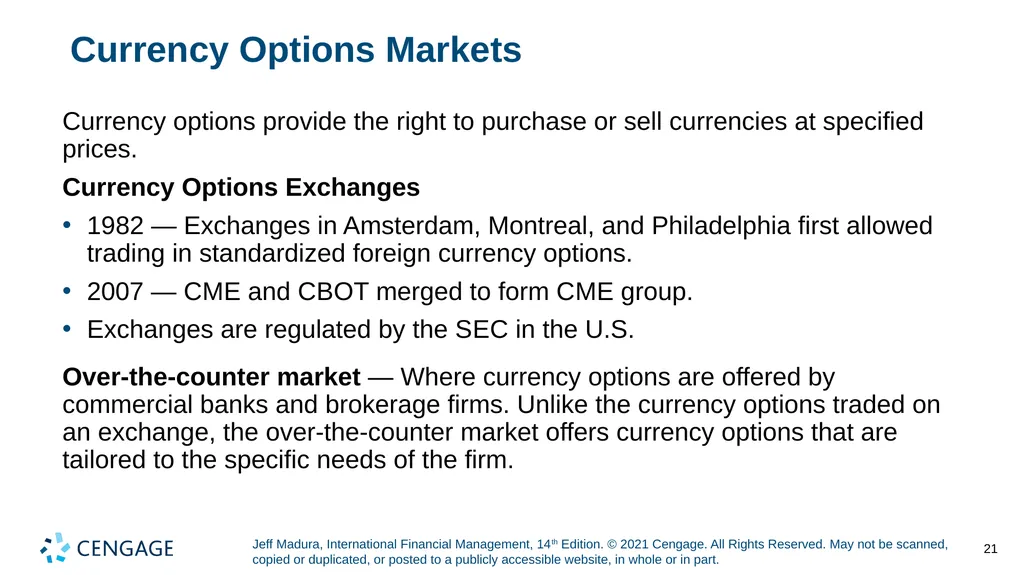
Currency Options Markets Currency options provide the right to purchase or sell currencies at specified prices.
Currency Options Exchanges
19 82 — Exchanges in Amsterdam, Montreal, and Philadelphia first allowed trading in standardized foreign currency options.
2007 — C M E and C B O T merged to form C M E group.
Exchanges are regulated by the S E C in the U.S. Over-the-counter market — Where currency options are offered by commercial banks and brokerage firms. Unlike the currency options traded on an exchange, the over-the-counter market offers currency options that are tailored to the specific needs of the firm. 21<br>
Currency Options Exchanges
19 82 — Exchanges in Amsterdam, Montreal, and Philadelphia first allowed trading in standardized foreign currency options.
2007 — C M E and C B O T merged to form C M E group.
Exchanges are regulated by the S E C in the U.S. Over-the-counter market — Where currency options are offered by commercial banks and brokerage firms. Unlike the currency options traded on an exchange, the over-the-counter market offers currency options that are tailored to the specific needs of the firm. 21<br>
22
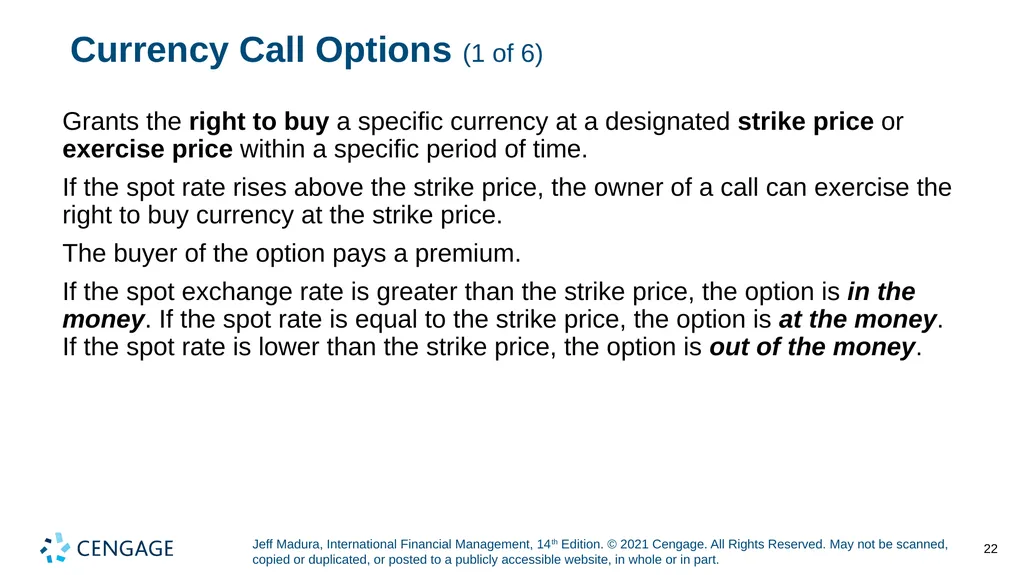
Currency Call Options (1 of 6) Grants the right to buy a specific currency at a designated strike price or exercise price within a specific period of time.
If the spot rate rises above the strike price, the owner of a call can exercise the right to buy currency at the strike price.
The buyer of the option pays a premium.
If the spot exchange rate is greater than the strike price, the option is in the money. If the spot rate is equal to the strike price, the option is at the money. If the spot rate is lower than the strike price, the option is out of the money. 22<br>
If the spot rate rises above the strike price, the owner of a call can exercise the right to buy currency at the strike price.
The buyer of the option pays a premium.
If the spot exchange rate is greater than the strike price, the option is in the money. If the spot rate is equal to the strike price, the option is at the money. If the spot rate is lower than the strike price, the option is out of the money. 22<br>
23
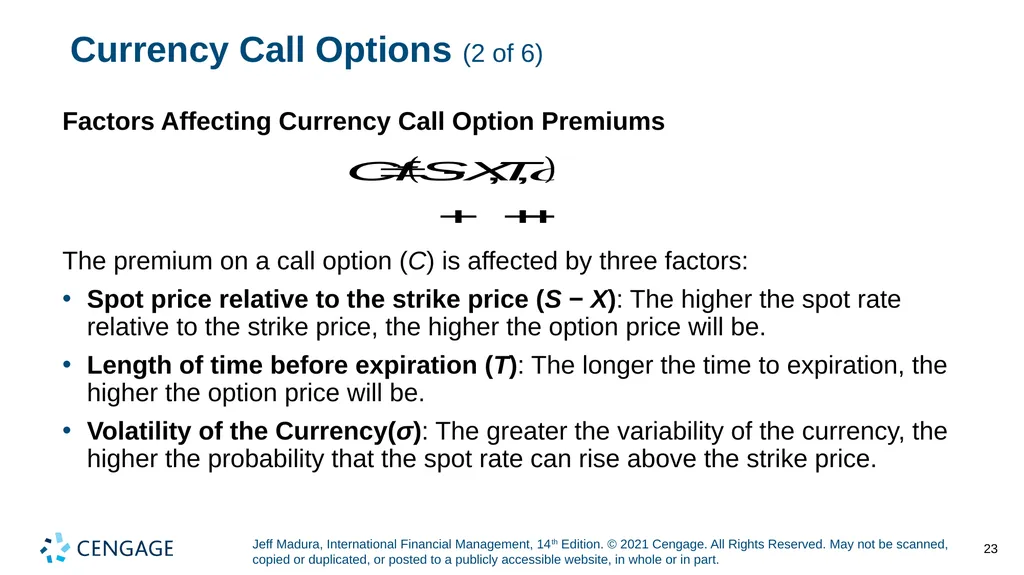
Currency Call Options (2 of 6) Factors Affecting Currency Call Option Premiums The premium on a call option (C) is affected by three factors:
Spot price relative to the strike price (S − X): The higher the spot rate relative to the strike price, the higher the option price will be.
Length of time before expiration (T): The longer the time to expiration, the higher the option price will be.
Volatility of the Currency(σ): The greater the variability of the currency, the higher the probability that the spot rate can rise above the strike price. 23<br>
Spot price relative to the strike price (S − X): The higher the spot rate relative to the strike price, the higher the option price will be.
Length of time before expiration (T): The longer the time to expiration, the higher the option price will be.
Volatility of the Currency(σ): The greater the variability of the currency, the higher the probability that the spot rate can rise above the strike price. 23<br>
24
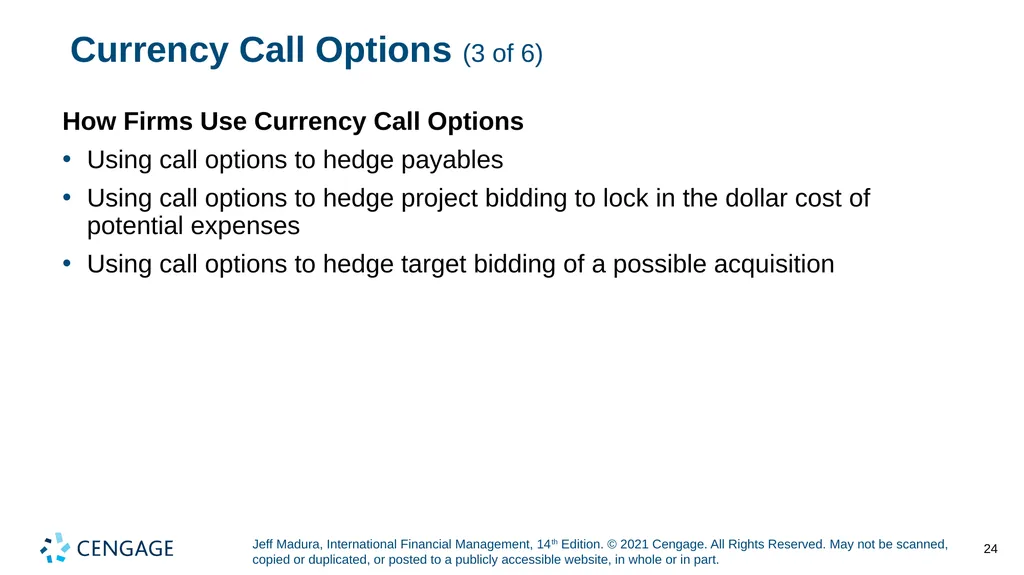
Currency Call Options (3 of 6) How Firms Use Currency Call Options
Using call options to hedge payables
Using call options to hedge project bidding to lock in the dollar cost of potential expenses
Using call options to hedge target bidding of a possible acquisition 24<br>
Using call options to hedge payables
Using call options to hedge project bidding to lock in the dollar cost of potential expenses
Using call options to hedge target bidding of a possible acquisition 24<br>
25
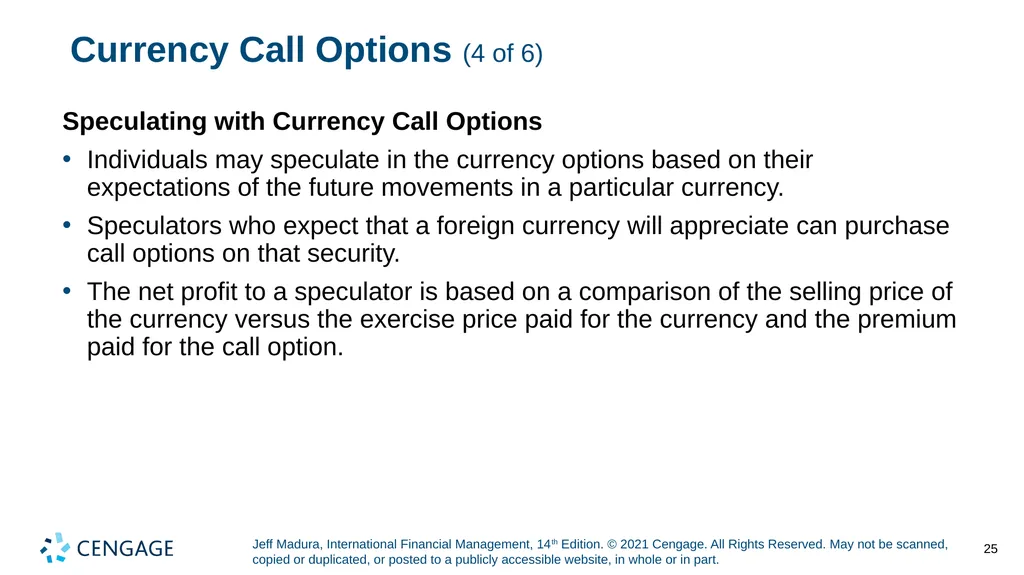
Currency Call Options (4 of 6) Speculating with Currency Call Options
Individuals may speculate in the currency options based on their expectations of the future movements in a particular currency.
Speculators who expect that a foreign currency will appreciate can purchase call options on that security.
The net profit to a speculator is based on a comparison of the selling price of the currency versus the exercise price paid for the currency and the premium paid for the call option. 25<br>
Individuals may speculate in the currency options based on their expectations of the future movements in a particular currency.
Speculators who expect that a foreign currency will appreciate can purchase call options on that security.
The net profit to a speculator is based on a comparison of the selling price of the currency versus the exercise price paid for the currency and the premium paid for the call option. 25<br>
26
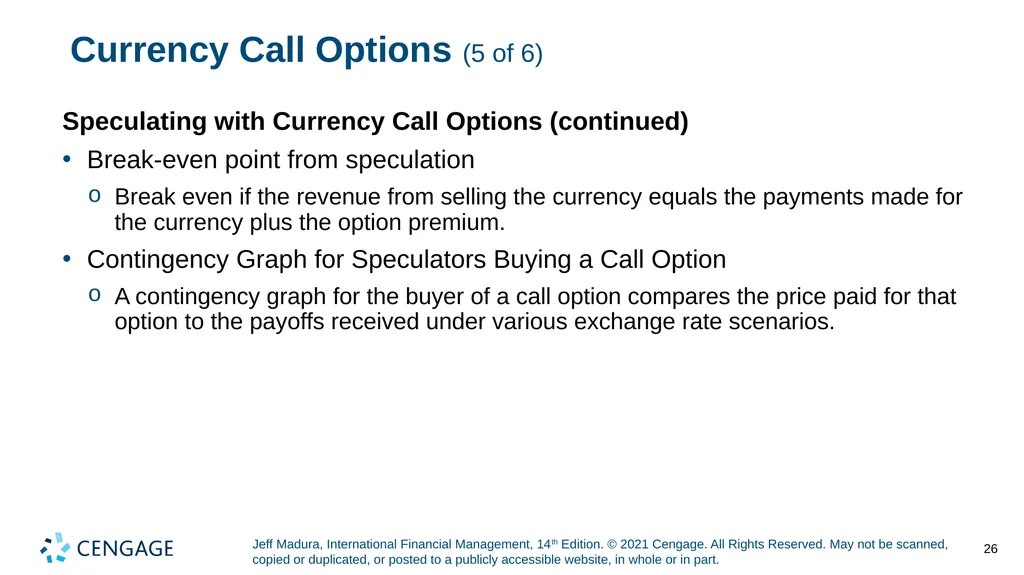
Currency Call Options (5 of 6) Speculating with Currency Call Options (continued)
Break-even point from speculation
Break even if the revenue from selling the currency equals the payments made for the currency plus the option premium.
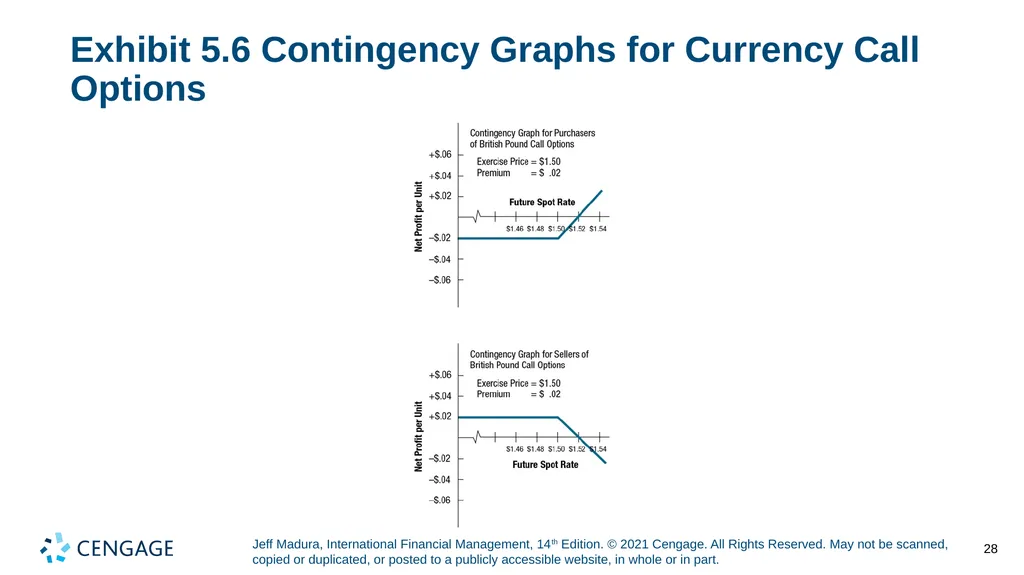
Contingency Graph for Speculators Buying a Call Option
A contingency graph for the buyer of a call option compares the price paid for that option to the payoffs received under various exchange rate scenarios. 26<br>
Break-even point from speculation
Break even if the revenue from selling the currency equals the payments made for the currency plus the option premium.
Contingency Graph for Speculators Buying a Call Option
A contingency graph for the buyer of a call option compares the price paid for that option to the payoffs received under various exchange rate scenarios. 26<br>
27
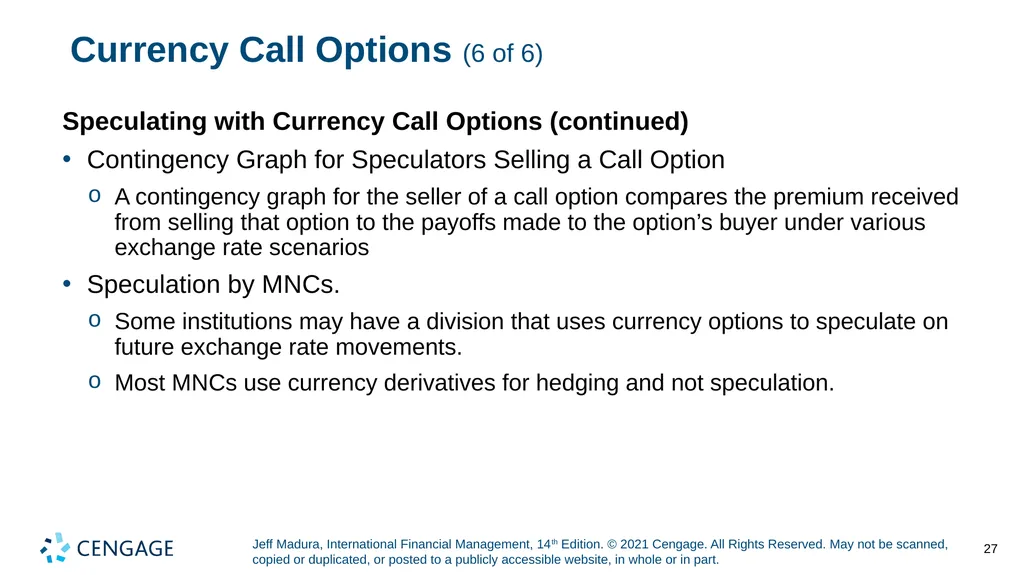
Currency Call Options (6 of 6) Speculating with Currency Call Options (continued)
Contingency Graph for Speculators Selling a Call Option
A contingency graph for the seller of a call option compares the premium received from selling that option to the payoffs made to the option’s buyer under various exchange rate scenarios
Speculation by M N Cs.
Some institutions may have a division that uses currency options to speculate on future exchange rate movements.
Most M N Cs use currency derivatives for hedging and not speculation. 27<br>
Contingency Graph for Speculators Selling a Call Option
A contingency graph for the seller of a call option compares the premium received from selling that option to the payoffs made to the option’s buyer under various exchange rate scenarios
Speculation by M N Cs.
Some institutions may have a division that uses currency options to speculate on future exchange rate movements.
Most M N Cs use currency derivatives for hedging and not speculation. 27<br>
28
Exhibit 5.6 Contingency Graphs for Currency Call Options 28<br>
29
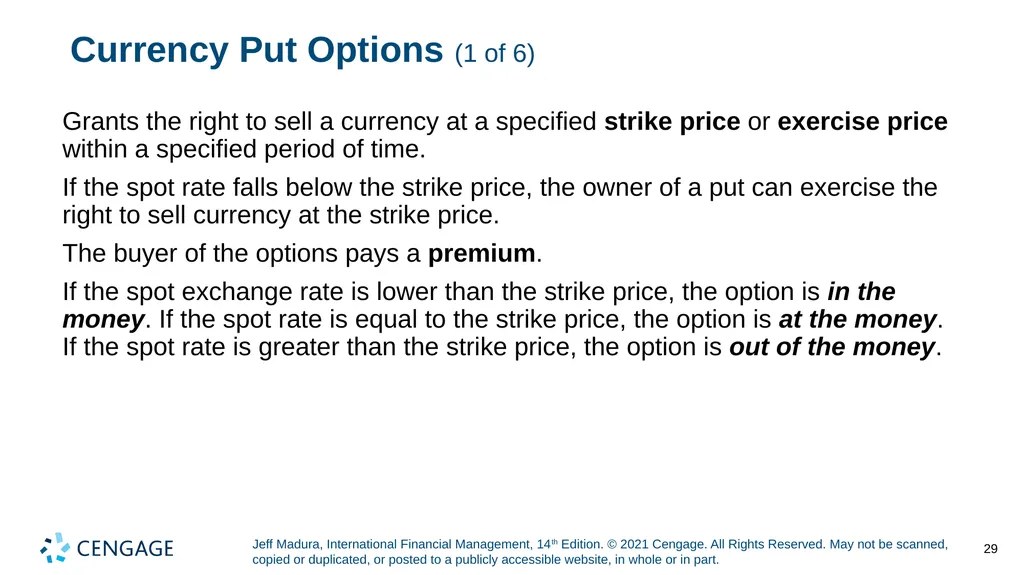
Currency Put Options (1 of 6) Grants the right to sell a currency at a specified strike price or exercise price within a specified period of time.
If the spot rate falls below the strike price, the owner of a put can exercise the right to sell currency at the strike price.
The buyer of the options pays a premium.
If the spot exchange rate is lower than the strike price, the option is in the money. If the spot rate is equal to the strike price, the option is at the money. If the spot rate is greater than the strike price, the option is out of the money. 29<br>
If the spot rate falls below the strike price, the owner of a put can exercise the right to sell currency at the strike price.
The buyer of the options pays a premium.
If the spot exchange rate is lower than the strike price, the option is in the money. If the spot rate is equal to the strike price, the option is at the money. If the spot rate is greater than the strike price, the option is out of the money. 29<br>
30
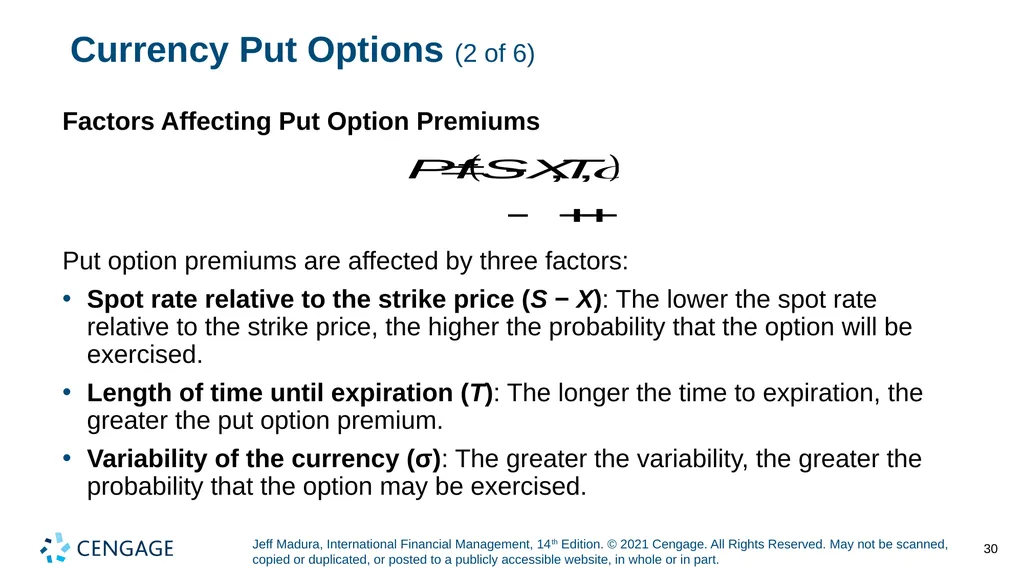
Currency Put Options (2 of 6) Factors Affecting Put Option Premiums Put option premiums are affected by three factors:
Spot rate relative to the strike price (S − X): The lower the spot rate relative to the strike price, the higher the probability that the option will be exercised.
Length of time until expiration (T): The longer the time to expiration, the greater the put option premium.
Variability of the currency (σ): The greater the variability, the greater the probability that the option may be exercised. 30<br>
Spot rate relative to the strike price (S − X): The lower the spot rate relative to the strike price, the higher the probability that the option will be exercised.
Length of time until expiration (T): The longer the time to expiration, the greater the put option premium.
Variability of the currency (σ): The greater the variability, the greater the probability that the option may be exercised. 30<br>
31
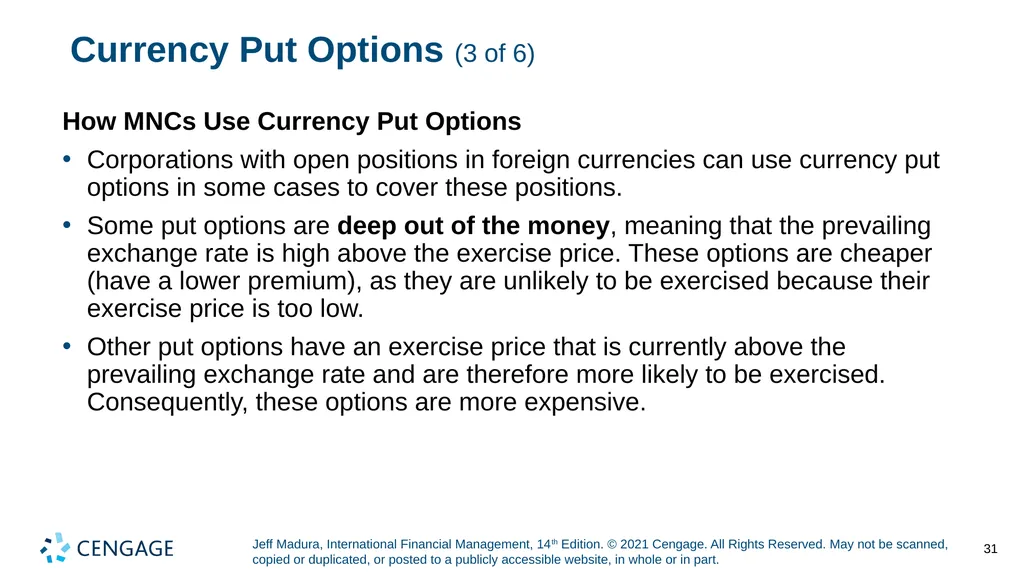
Currency Put Options (3 of 6) How M N Cs Use Currency Put Options
Corporations with open positions in foreign currencies can use currency put options in some cases to cover these positions.
Some put options are deep out of the money, meaning that the prevailing exchange rate is high above the exercise price. These options are cheaper (have a lower premium), as they are unlikely to be exercised because their exercise price is too low.
Other put options have an exercise price that is currently above the prevailing exchange rate and are therefore more likely to be exercised. Consequently, these options are more expensive. 31<br>
Corporations with open positions in foreign currencies can use currency put options in some cases to cover these positions.
Some put options are deep out of the money, meaning that the prevailing exchange rate is high above the exercise price. These options are cheaper (have a lower premium), as they are unlikely to be exercised because their exercise price is too low.
Other put options have an exercise price that is currently above the prevailing exchange rate and are therefore more likely to be exercised. Consequently, these options are more expensive. 31<br>
32
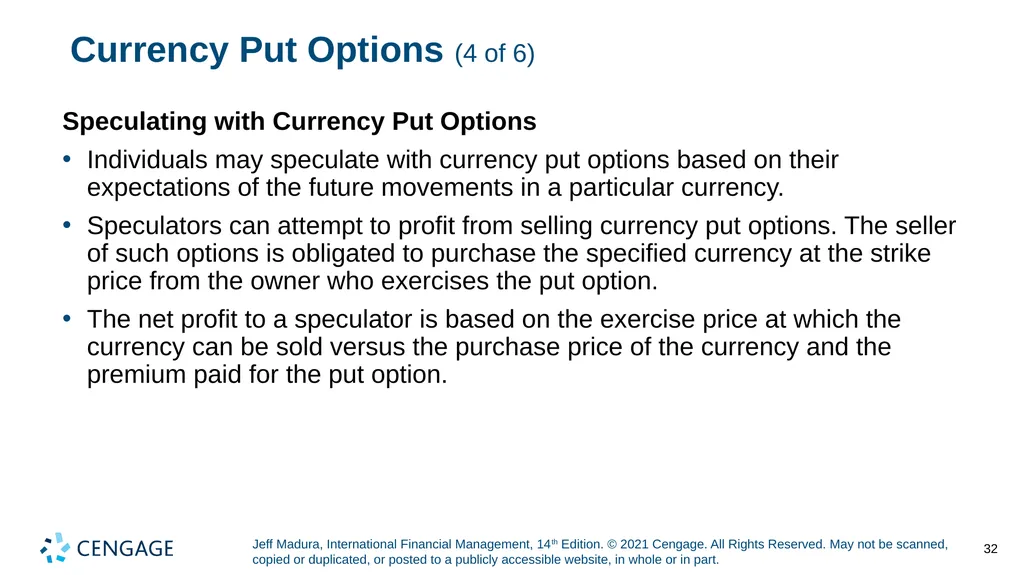
Currency Put Options (4 of 6) Speculating with Currency Put Options
Individuals may speculate with currency put options based on their expectations of the future movements in a particular currency.
Speculators can attempt to profit from selling currency put options. The seller of such options is obligated to purchase the specified currency at the strike price from the owner who exercises the put option.
The net profit to a speculator is based on the exercise price at which the currency can be sold versus the purchase price of the currency and the premium paid for the put option. 32<br>
Individuals may speculate with currency put options based on their expectations of the future movements in a particular currency.
Speculators can attempt to profit from selling currency put options. The seller of such options is obligated to purchase the specified currency at the strike price from the owner who exercises the put option.
The net profit to a speculator is based on the exercise price at which the currency can be sold versus the purchase price of the currency and the premium paid for the put option. 32<br>
33
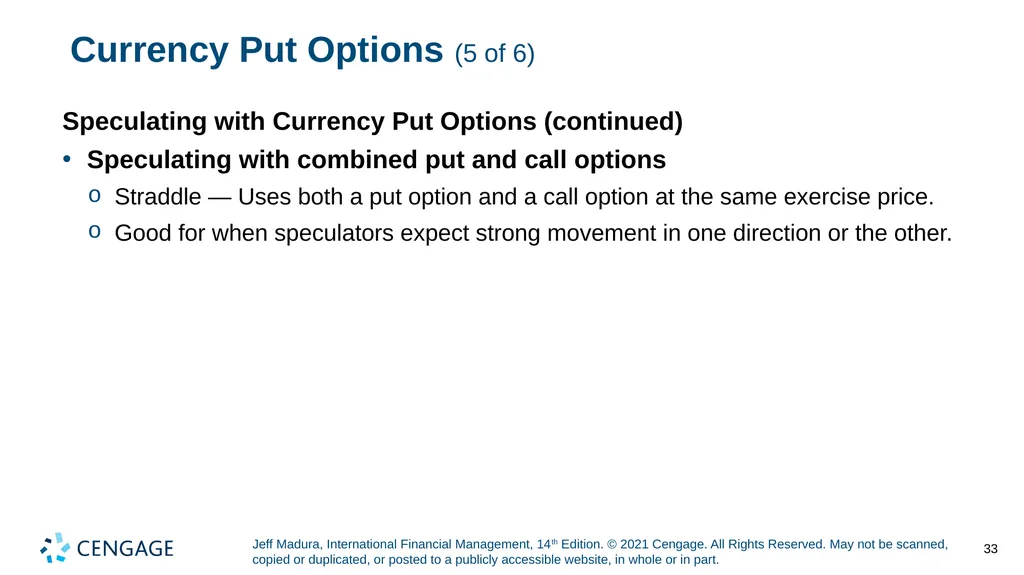
Currency Put Options (5 of 6) Speculating with Currency Put Options (continued)
Speculating with combined put and call options
Straddle — Uses both a put option and a call option at the same exercise price.
Good for when speculators expect strong movement in one direction or the other. 33<br>
Speculating with combined put and call options
Straddle — Uses both a put option and a call option at the same exercise price.
Good for when speculators expect strong movement in one direction or the other. 33<br>
34
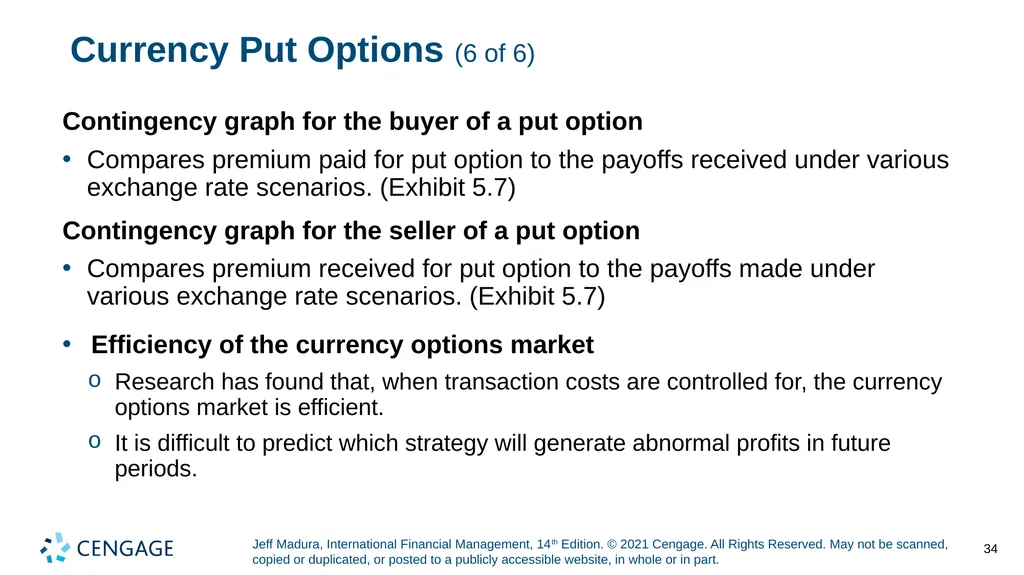
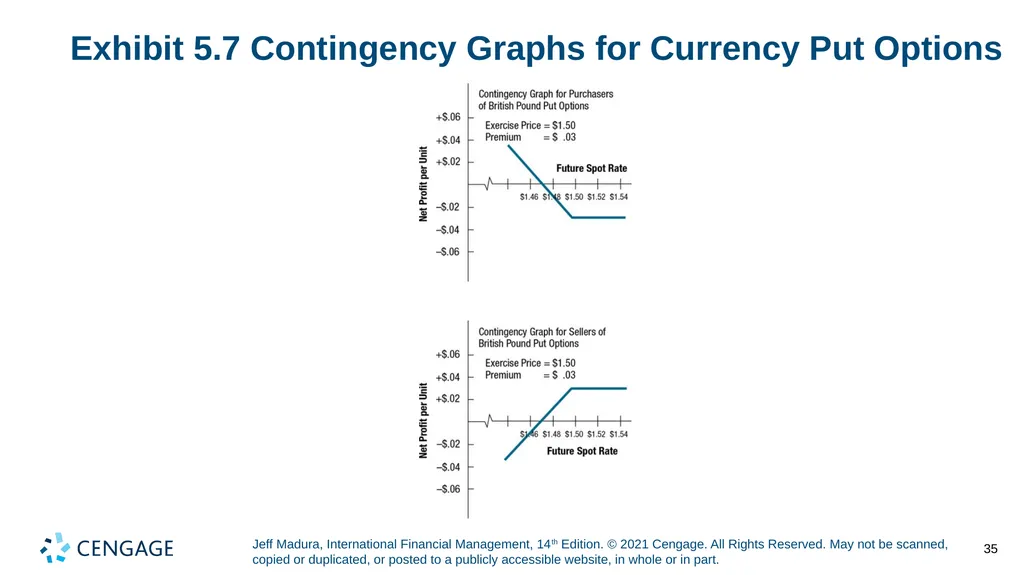
Currency Put Options (6 of 6) Contingency graph for the buyer of a put option
Compares premium paid for put option to the payoffs received under various exchange rate scenarios. (Exhibit 5.7) Contingency graph for the seller of a put option
Compares premium received for put option to the payoffs made under various exchange rate scenarios. (Exhibit 5.7) Efficiency of the currency options market
Research has found that, when transaction costs are controlled for, the currency options market is efficient.
It is difficult to predict which strategy will generate abnormal profits in future periods. 34<br>
Compares premium paid for put option to the payoffs received under various exchange rate scenarios. (Exhibit 5.7) Contingency graph for the seller of a put option
Compares premium received for put option to the payoffs made under various exchange rate scenarios. (Exhibit 5.7) Efficiency of the currency options market
Research has found that, when transaction costs are controlled for, the currency options market is efficient.
It is difficult to predict which strategy will generate abnormal profits in future periods. 34<br>
35
Exhibit 5.7 Contingency Graphs for Currency Put Options 35<br>
36
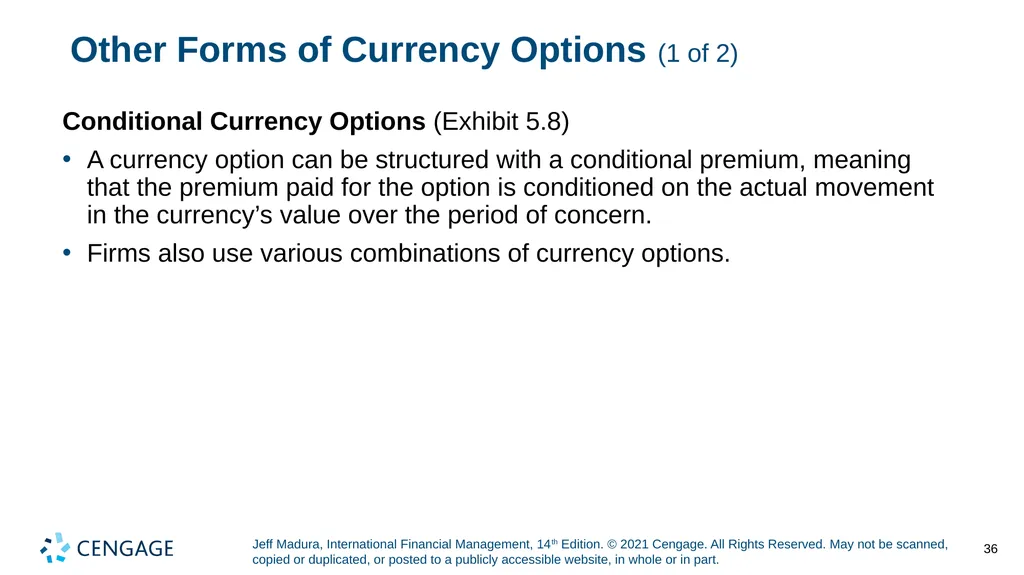
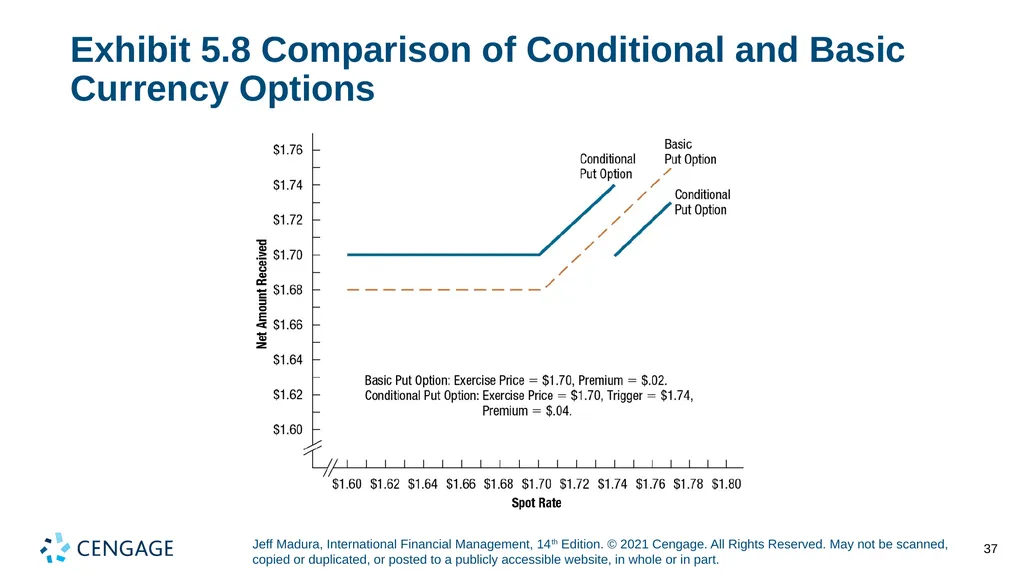
Other Forms of Currency Options (1 of 2) Conditional Currency Options (Exhibit 5.8)
A currency option can be structured with a conditional premium, meaning that the premium paid for the option is conditioned on the actual movement in the currency’s value over the period of concern.
Firms also use various combinations of currency options. 36<br>
A currency option can be structured with a conditional premium, meaning that the premium paid for the option is conditioned on the actual movement in the currency’s value over the period of concern.
Firms also use various combinations of currency options. 36<br>
37
Exhibit 5.8 Comparison of Conditional and Basic Currency Options 37<br>
38
Other Forms of Currency Options (2 of 2) European Currency Options
European-style currency options must be exercised on the expiration date if they are to be exercised at all.
They do not offer as much flexibility; however, this is not relevant to some situations.
If European-style options are available for the same expiration date as American-style options and can be purchased for a slightly lower premium, some corporations may prefer them for hedging. 38<br>
European-style currency options must be exercised on the expiration date if they are to be exercised at all.
They do not offer as much flexibility; however, this is not relevant to some situations.
If European-style options are available for the same expiration date as American-style options and can be purchased for a slightly lower premium, some corporations may prefer them for hedging. 38<br>
39
Summary (1 of 4) A forward contract specifies a standard volume of a particular currency to be exchanged on a particular date. Such a contract can be purchased by a firm to hedge payables or sold by a firm to hedge receivables. A currency futures contract can be purchased by speculators who expect the currency to appreciate; it can also be sold by speculators who expect the currency to depreciate. If the currency depreciates then the futures contract declines, allowing those speculators to benefit when they close out their positions. 39<br>
40
Summary (2 of 4) Futures contracts on a particular currency can be purchased by corporations that have payables in that currency and wish to hedge against the possible appreciation of that currency. Conversely, these contracts can be sold by corporations that have receivables in that currency and wish to hedge against the possible depreciation of that currency and wish to hedge against its possible depreciation. 40<br>
41
Summary (3 of 4) Call options allow the right to purchase a specified currency at a specified exchange rate by a specified expiration date. They are used by M N Cs to hedge future payables. They are commonly purchased by speculators who expect that the underlying currency will appreciate.
Put options allow the right to sell a specified currency at a specified exchange rate by a specified expiration date. They are used by M N Cs to hedge future receivables. They are commonly purchased by speculators who expect that the underlying currency will depreciate. 41<br>
Put options allow the right to sell a specified currency at a specified exchange rate by a specified expiration date. They are used by M N Cs to hedge future receivables. They are commonly purchased by speculators who expect that the underlying currency will depreciate. 41<br>
42
Summary (4 of 4) Call options on a specific currency can be purchased by speculators who expect that currency to appreciate. Put options on a specific currency can be purchased by speculators who expect that currency to depreciate. 42<br>