Chapter 5: Non-Democracies and Democratic Backsliding OER materials provided with support from the Academic Senate for California Community Colleges (ASCCC) Open Educational Resources Initiative (OERI) Chapter Outline Section 5.1: What are
"Chapter 5: Non-Democracies and Democratic" is the property of its rightful owner. Permission is granted to
download and print the materials on this website for personal, non-commercial use only, and to display it
on your personal computer provided you do not modify the materials and that you retain all copyright
notices contained in the materials. By downloading content from our website, you accept the terms of this
agreement.
Presentation Transcript
01
Chapter 5: Non-Democracies and Democratic Backsliding OER materials provided with support from the Academic Senate for California Community Colleges (ASCCC) Open Educational Resources Initiative (OERI)<br>
02
Chapter Outline Section #5.1: What are non-democracies?
Section #5.2: Strategies for staying in power
Section #5.3: Varieties of non-democracy
Section #5.4: Democratic backsliding
Section #5.5: Comparative Case Study - Russia’s evolution over time<br>
03
5.1: What are non-democracies?<br>
04
5.1 What are non-democracies? Non-democracy: Government in which citizens are denied meaningful institutional channels for making choices about their collective well-being
These include:
Limited political accountability for political elites
Limited to no competition for political office
Weak to no protection of individual civil and political liberties<br>
05
5.2: Strategies for staying in power<br>
06
5.2 Strategies for staying in power Leaders of non-democracies remain in power through a combination of “sticks, carrots, and ideas”
These are evident in certain key institutions
Institutions: Shared practices, norms, and organizations or “rules of the game”<br>
07
5.2.1 Institutions of non-democracies: Carrots To co-opt opposition
Examples: Rigged elections in which opposition parties may compete (but not win); Legislatures in which opposition parties may take seats (but not be a meaningful check on rulers)
Patronage networks
To distribute resources to loyalists
Broad-based clientelism
To “buy off” the loyalties of the general population<br>
08
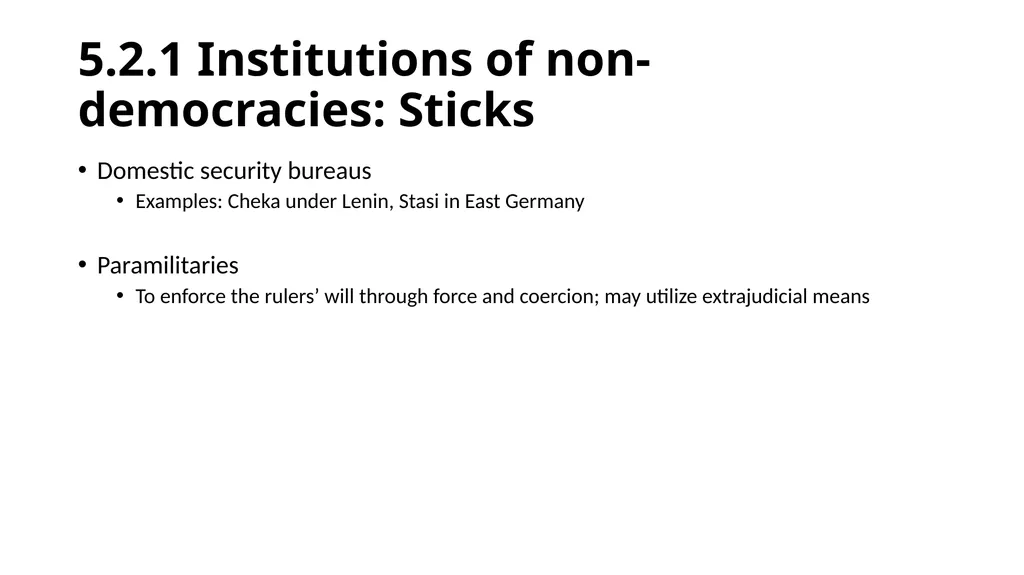
5.2.1 Institutions of non-democracies: Sticks Domestic security bureaus
Examples: Cheka under Lenin, Stasi in East Germany
Paramilitaries
To enforce the rulers’ will through force and coercion; may utilize extrajudicial means<br>
09
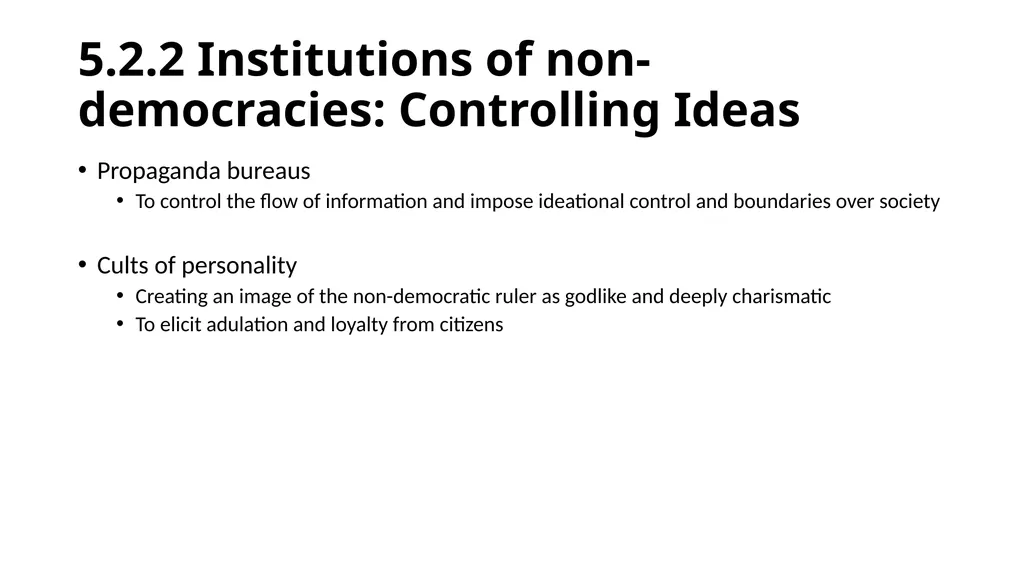
5.2.2 Institutions of non-democracies: Controlling Ideas Propaganda bureaus
To control the flow of information and impose ideational control and boundaries over society
Cults of personality
Creating an image of the non-democratic ruler as godlike and deeply charismatic
To elicit adulation and loyalty from citizens<br>
10
5.3: Varieties of non-democracy<br>
11
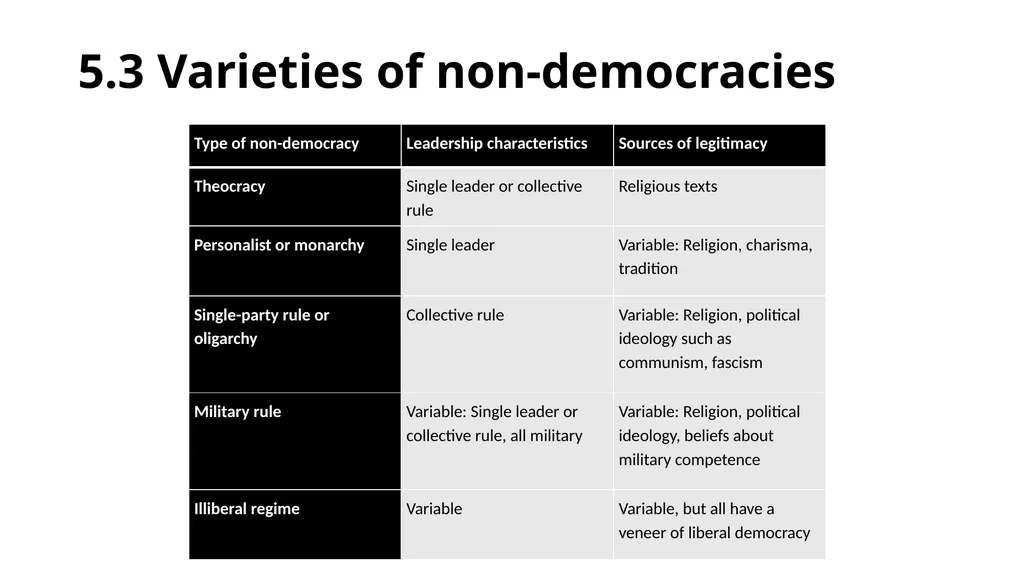
5.3 Varieties of non-democracies<br>
12
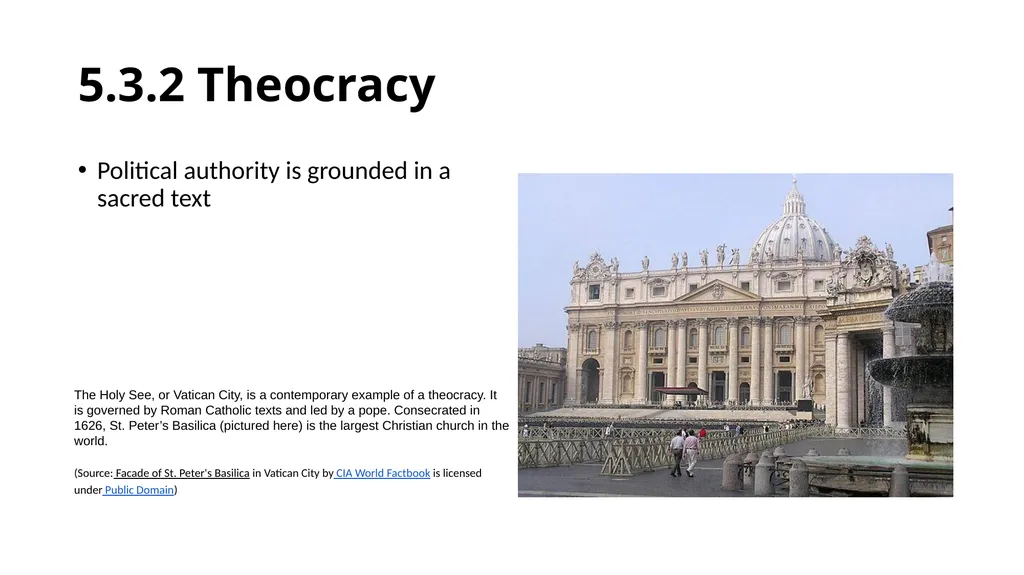
5.3.2 Theocracy Political authority is grounded in a sacred text The Holy See, or Vatican City, is a contemporary example of a theocracy. It is governed by Roman Catholic texts and led by a pope. Consecrated in 1626, St. Peter’s Basilica (pictured here) is the largest Christian church in the world.
(Source: Facade of St. Peter's Basilica in Vatican City by CIA World Factbook is licensed under Public Domain)<br>
13
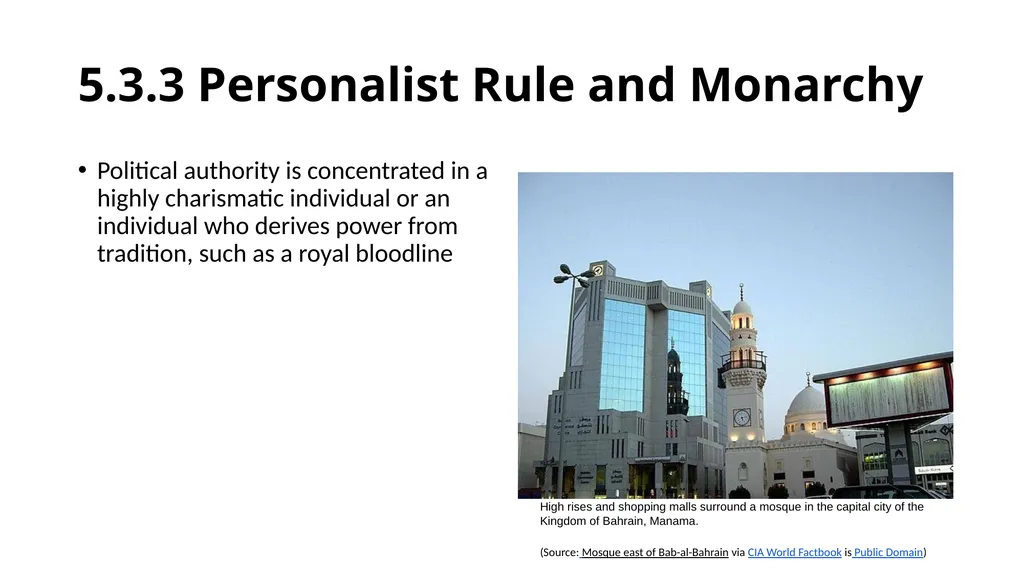
5.3.3 Personalist Rule and Monarchy Political authority is concentrated in a highly charismatic individual or an individual who derives power from tradition, such as a royal bloodline High rises and shopping malls surround a mosque in the capital city of the Kingdom of Bahrain, Manama.
(Source: Mosque east of Bab-al-Bahrain via CIA World Factbook is Public Domain)<br>
14
5.3.4 Single-Party Rule and Oligarchy Oligarchy is a non-democracy characterized by collective rule
Single-party rule is a non-democracy ruled by the members of a political party<br>
15
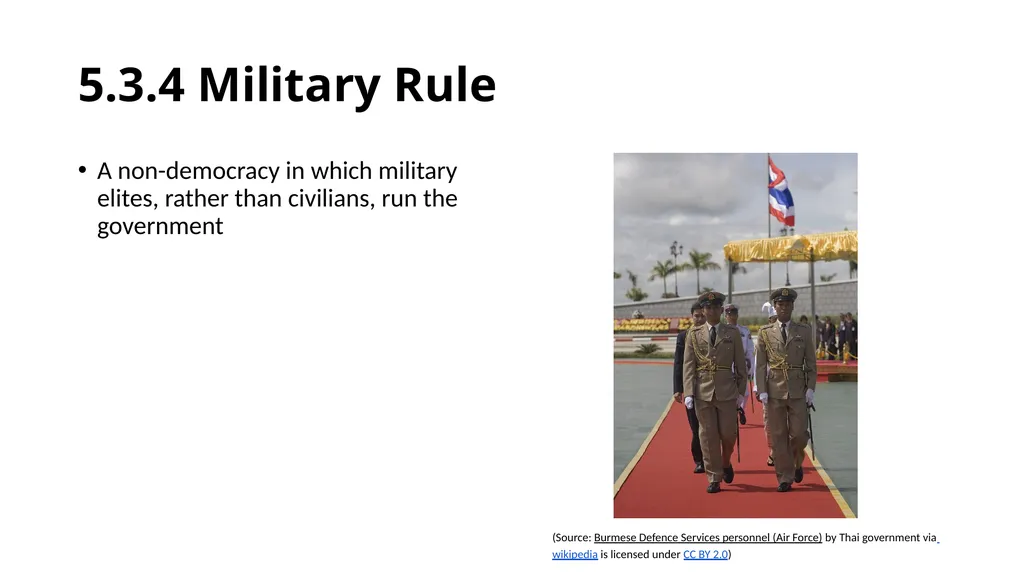
5.3.4 Military Rule A non-democracy in which military elites, rather than civilians, run the government (Source: Burmese Defence Services personnel (Air Force) by Thai government via wikipedia is licensed under CC BY 2.0)<br>
16
5.3.6 Illiberal and Hybrid Non-Democracies Illiberal regime: Mix of liberal and illiberal institutions
These regimes have some of the characteristics of liberal democracies, but many institutions are also illiberal
Hybrid regime: Mix of two or more of the non-democratic types discussed previously<br>
17
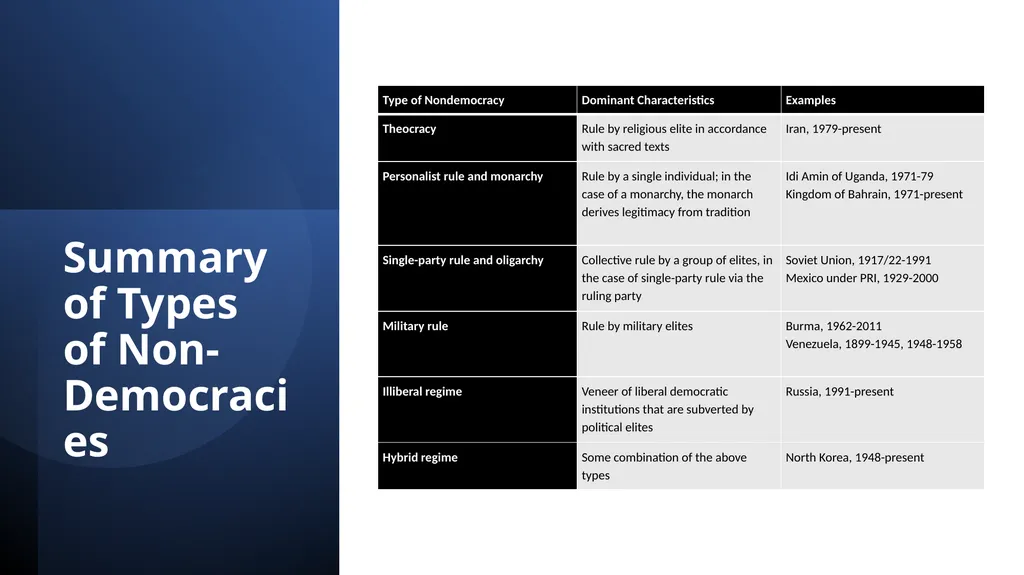
Summary of Types of Non-Democracies<br>
18
5.4: Democratic backsliding<br>
19
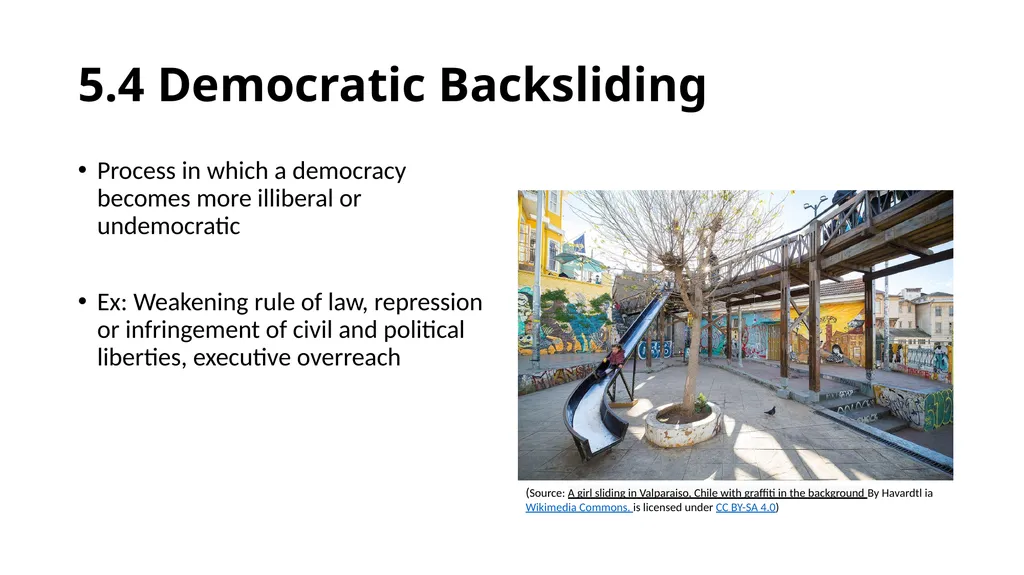
5.4 Democratic Backsliding Process in which a democracy becomes more illiberal or undemocratic
Ex: Weakening rule of law, repression or infringement of civil and political liberties, executive overreach (Source: A girl sliding in Valparaiso, Chile with graffiti in the background By Havardtl ia Wikimedia Commons. is licensed under CC BY-SA 4.0)<br>
20
Why do we get democratic backsliding? Institutional explanations
Cultural explanations
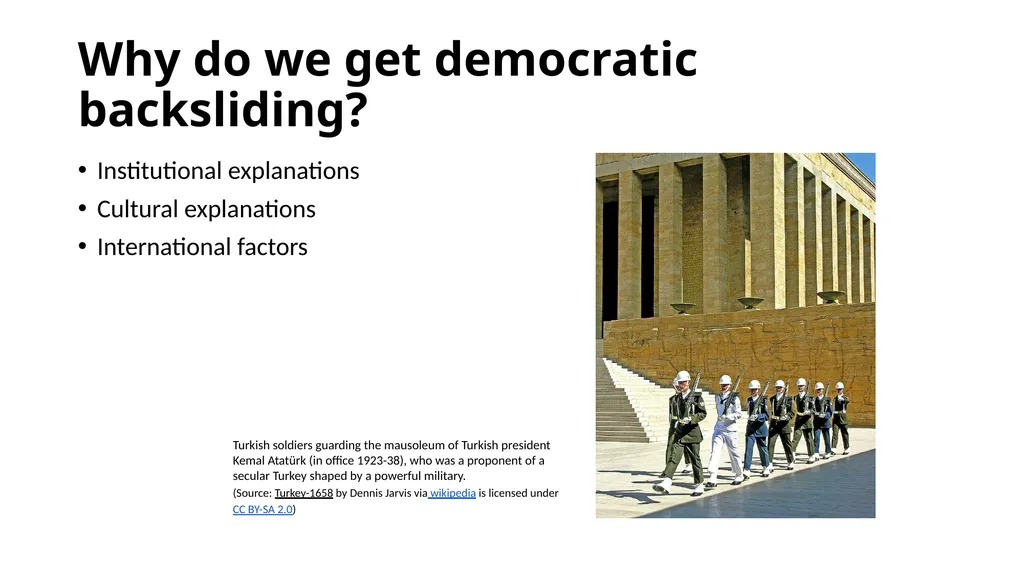
International factors Turkish soldiers guarding the mausoleum of Turkish president Kemal Atatürk (in office 1923-38), who was a proponent of a secular Turkey shaped by a powerful military.
(Source: Turkey-1658 by Dennis Jarvis via wikipedia is licensed under CC BY-SA 2.0)<br>
21
5.5: Case Study - Russia’s evolution over time<br>
22
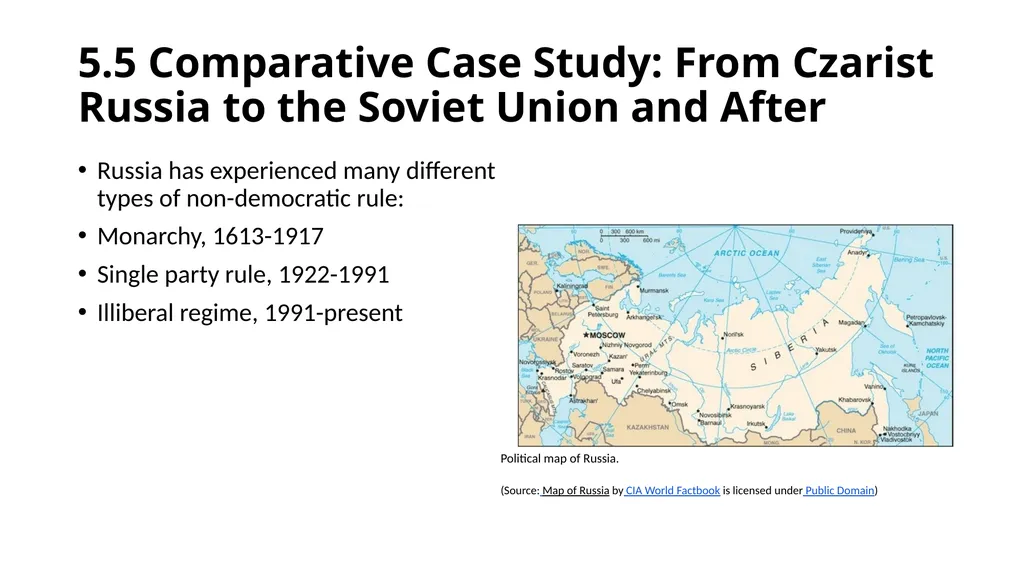
5.5 Comparative Case Study: From Czarist Russia to the Soviet Union and After Russia has experienced many different types of non-democratic rule:
Monarchy, 1613-1917
Single party rule, 1922-1991
Illiberal regime, 1991-present Political map of Russia.
(Source: Map of Russia by CIA World Factbook is licensed under Public Domain)<br>
23
Summary Non-democracies are characterized by their limited institutions of political accountability, limited political competition, and limited individual liberties
While there is great variety in this category of regimes, non-democracies often rely on a common bundle of strategies, or “carrots, sticks, and ideas”, to stay in power.
Typologies can help us make sense of the many non-democracies in the world, past and present.
Democratic backsliding highlights how countries can become more non-democratic over time.<br>