
Chapter 5 Variety Development Strategy and Stage
FD
Published · 34 slides · 0 views
1 / 1
Description
Chapter 5 Variety Development Strategy and Stage Plan Rowland Chirwa The Business of Plant Breeding: Market-led approaches to new variety design in Africa Chapter 5 Variety Development Strategy and Stage Plan Rowland Chirwa Chitedze
Related Topics
Share
Embed code
Download this presentation From Below
"Chapter 5 Variety Development Strategy and Stage" is the property of its rightful owner. Permission is granted to download and print the materials on this website for personal, non-commercial use only, and to display it on your personal computer provided you do not modify the materials and that you retain all copyright notices contained in the materials. By downloading content from our website, you accept the terms of this agreement.
Presentation Transcript
01
Chapter 5
Variety Development Strategy and Stage Plan
Rowland Chirwa The Business of Plant Breeding:
Market-led approaches to new variety design in Africa<br>
Variety Development Strategy and Stage Plan
Rowland Chirwa The Business of Plant Breeding:
Market-led approaches to new variety design in Africa<br>
02
Chapter 5
Variety Development Strategy
and Stage Plan Rowland Chirwa
Chitedze Agricultural Research Station
P.O. Box 158, Lilongwe, Malawi<br>
Chitedze Agricultural Research Station
P.O. Box 158, Lilongwe, Malawi<br>
03
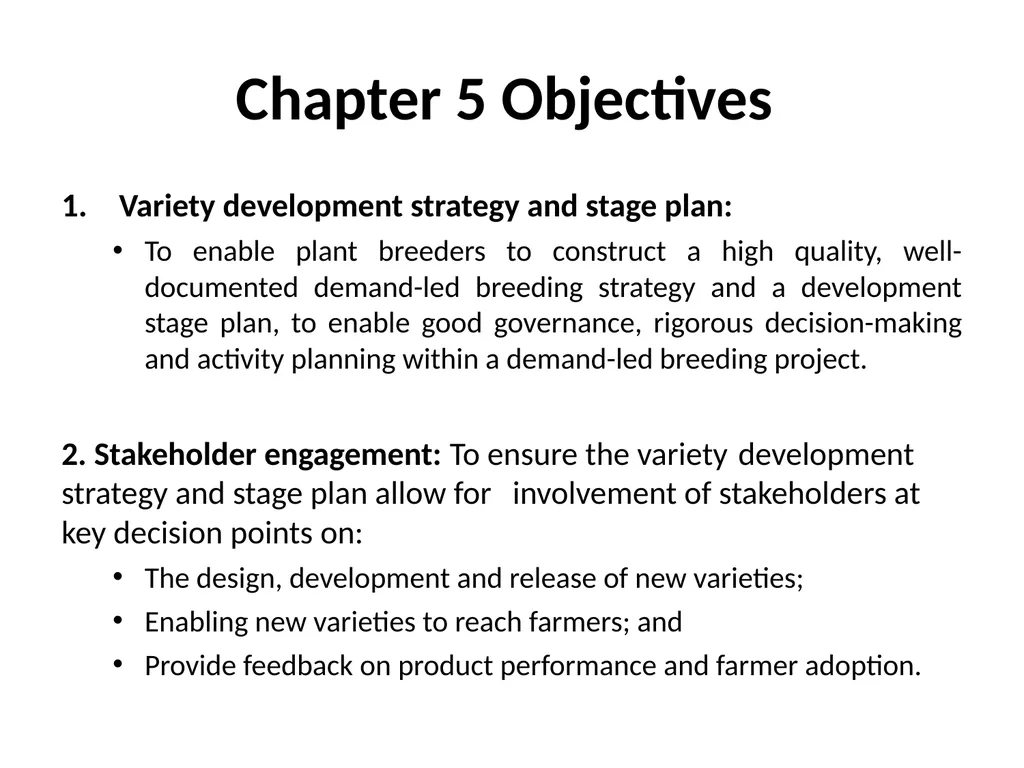
Chapter 5 Objectives Variety development strategy and stage plan:
To enable plant breeders to construct a high quality, well-documented demand-led breeding strategy and a development stage plan, to enable good governance, rigorous decision-making and activity planning within a demand-led breeding project.
2. Stakeholder engagement: To ensure the variety development strategy and stage plan allow for involvement of stakeholders at key decision points on:
The design, development and release of new varieties;
Enabling new varieties to reach farmers; and
Provide feedback on product performance and farmer adoption.<br>
To enable plant breeders to construct a high quality, well-documented demand-led breeding strategy and a development stage plan, to enable good governance, rigorous decision-making and activity planning within a demand-led breeding project.
2. Stakeholder engagement: To ensure the variety development strategy and stage plan allow for involvement of stakeholders at key decision points on:
The design, development and release of new varieties;
Enabling new varieties to reach farmers; and
Provide feedback on product performance and farmer adoption.<br>
04
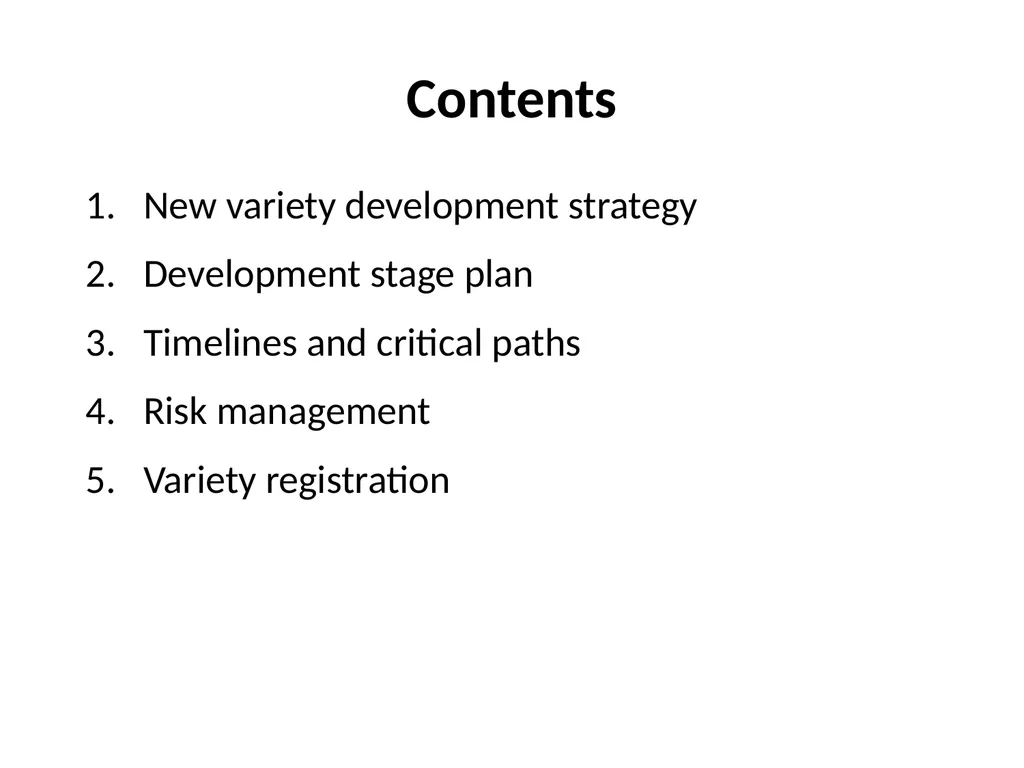
Contents New variety development strategy
Development stage plan
Timelines and critical paths
Risk management
Variety registration<br>
Development stage plan
Timelines and critical paths
Risk management
Variety registration<br>
05
1. Variety Development Strategy<br>
06
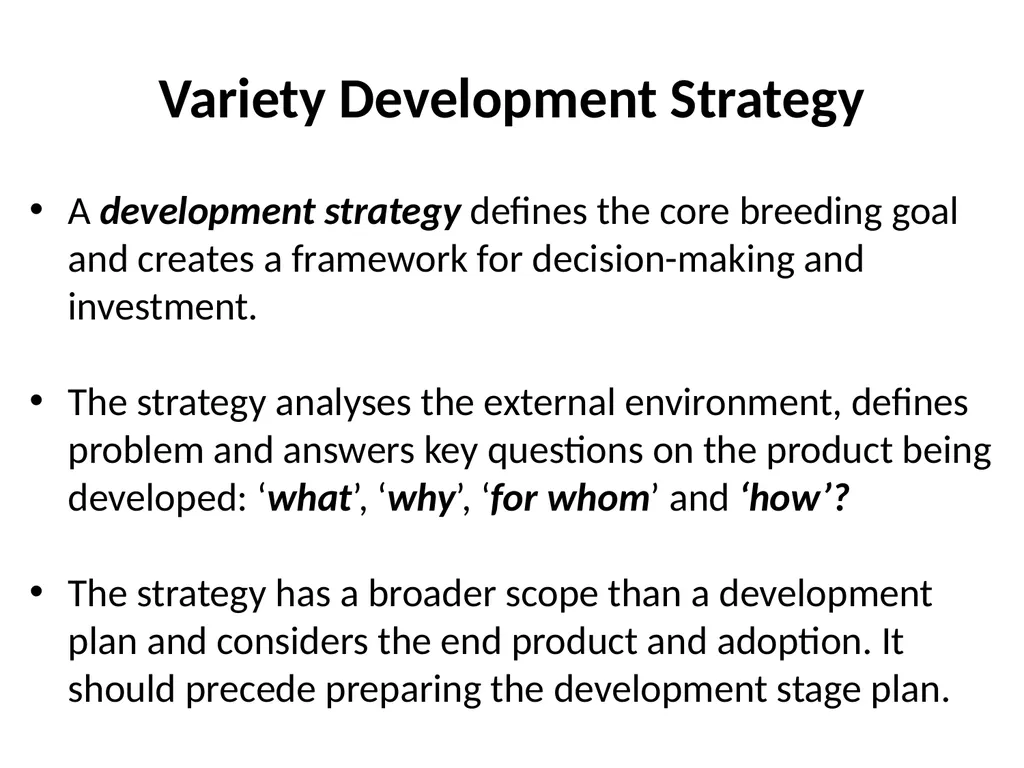
Variety Development Strategy A development strategy defines the core breeding goal and creates a framework for decision-making and investment.
The strategy analyses the external environment, defines problem and answers key questions on the product being developed: ‘what’, ‘why’, ‘for whom’ and ‘how’?
The strategy has a broader scope than a development plan and considers the end product and adoption. It should precede preparing the development stage plan.<br>
The strategy analyses the external environment, defines problem and answers key questions on the product being developed: ‘what’, ‘why’, ‘for whom’ and ‘how’?
The strategy has a broader scope than a development plan and considers the end product and adoption. It should precede preparing the development stage plan.<br>
07
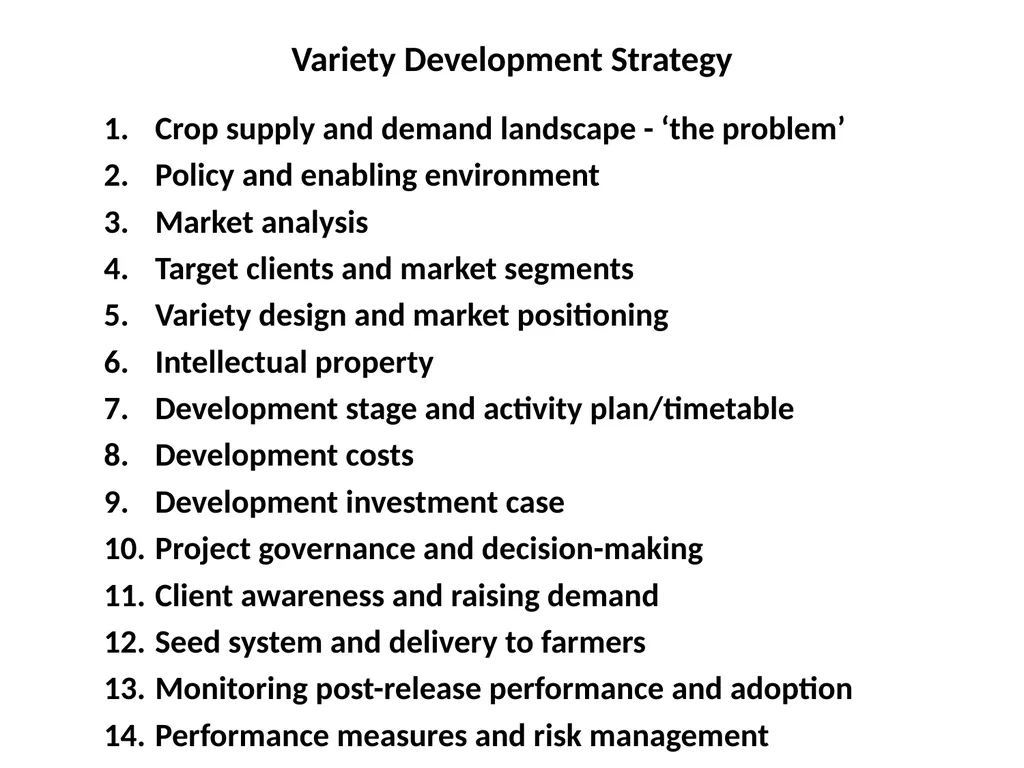
Variety Development Strategy Crop supply and demand landscape - ‘the problem’
Policy and enabling environment
Market analysis
Target clients and market segments
Variety design and market positioning
Intellectual property
Development stage and activity plan/timetable
Development costs
Development investment case
Project governance and decision-making
Client awareness and raising demand
Seed system and delivery to farmers
Monitoring post-release performance and adoption
Performance measures and risk management<br>
Policy and enabling environment
Market analysis
Target clients and market segments
Variety design and market positioning
Intellectual property
Development stage and activity plan/timetable
Development costs
Development investment case
Project governance and decision-making
Client awareness and raising demand
Seed system and delivery to farmers
Monitoring post-release performance and adoption
Performance measures and risk management<br>
08
Group exercise – Development Strategy What should a variety development strategy contain?
Why does each component matter in a demand-led breeding programme?
What are the benefits of creating a development strategy?<br>
Why does each component matter in a demand-led breeding programme?
What are the benefits of creating a development strategy?<br>
09
2. Development Stage Plan<br>
10
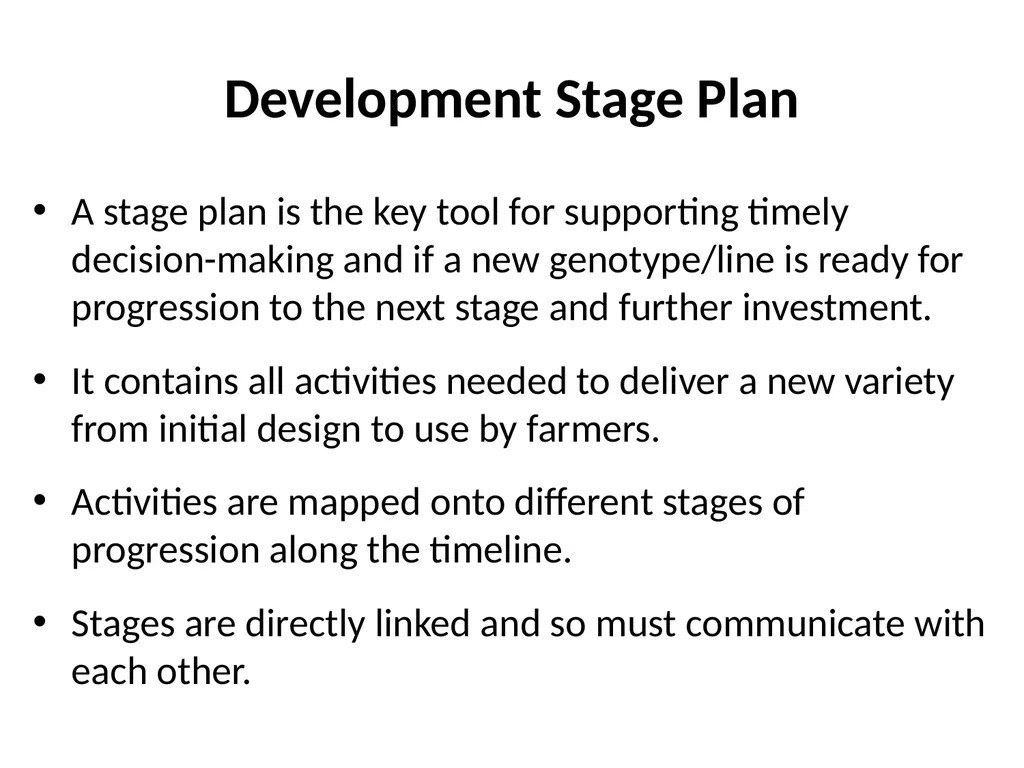
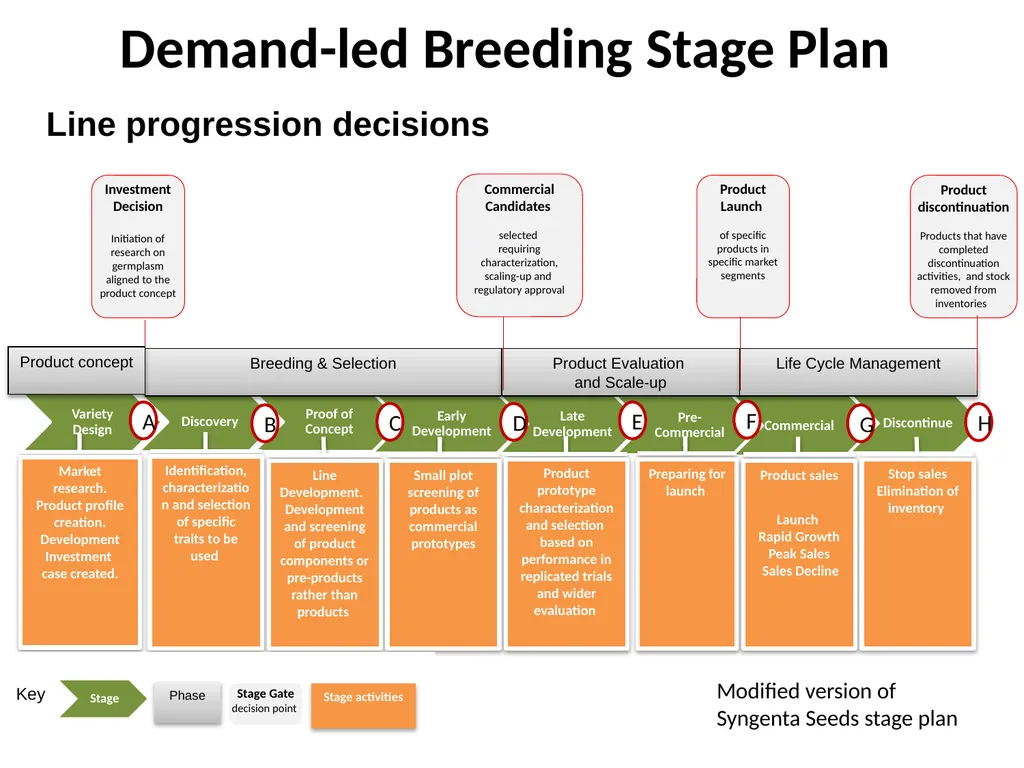
Development Stage Plan A stage plan is the key tool for supporting timely decision-making and if a new genotype/line is ready for progression to the next stage and further investment.
It contains all activities needed to deliver a new variety from initial design to use by farmers.
Activities are mapped onto different stages of progression along the timeline.
Stages are directly linked and so must communicate with each other.<br>
It contains all activities needed to deliver a new variety from initial design to use by farmers.
Activities are mapped onto different stages of progression along the timeline.
Stages are directly linked and so must communicate with each other.<br>
11
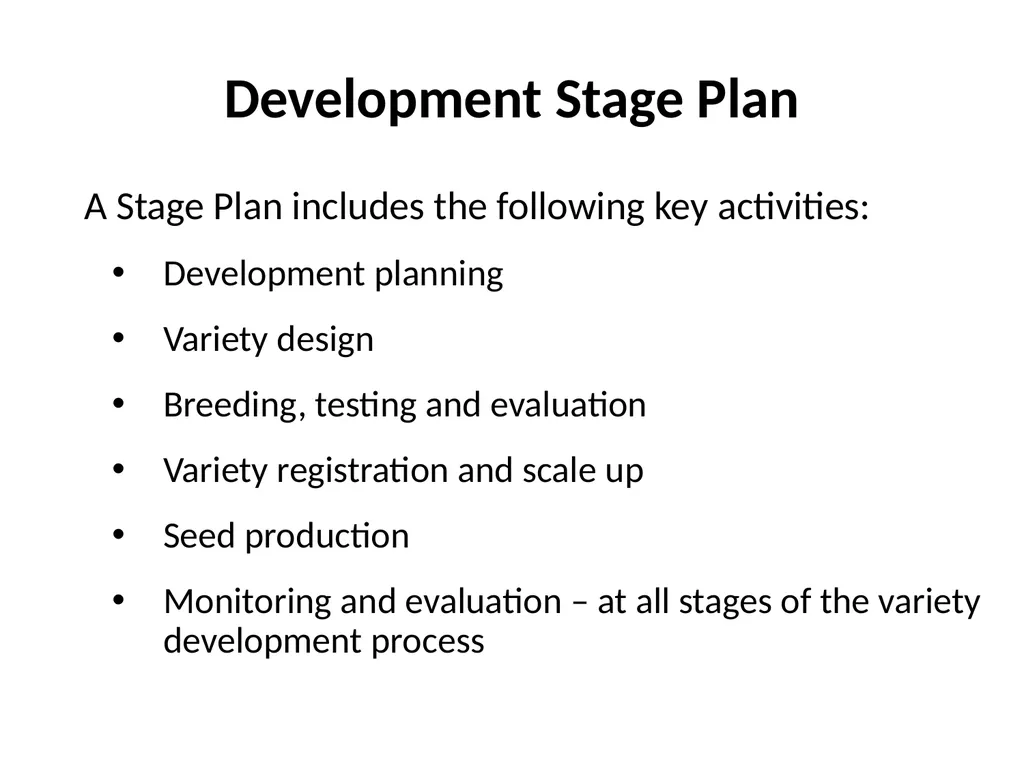
Development Stage Plan A Stage Plan includes the following key activities:
Development planning
Variety design
Breeding, testing and evaluation
Variety registration and scale up
Seed production
Monitoring and evaluation – at all stages of the variety development process<br>
Development planning
Variety design
Breeding, testing and evaluation
Variety registration and scale up
Seed production
Monitoring and evaluation – at all stages of the variety development process<br>
12
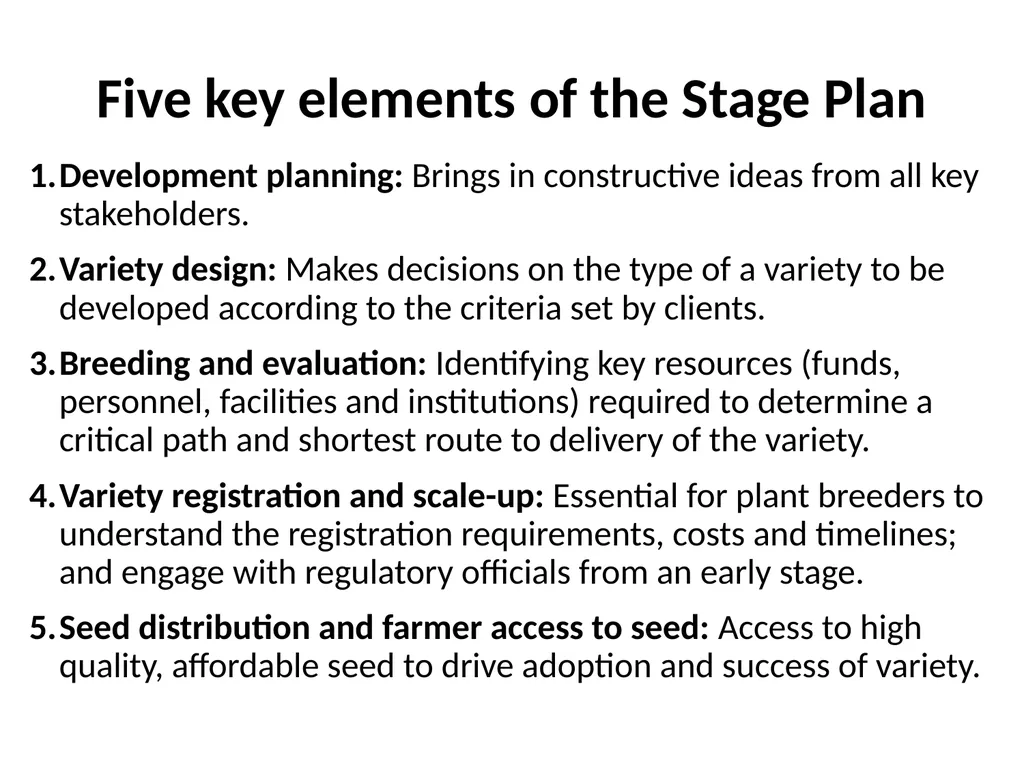
Five key elements of the Stage Plan Development planning: Brings in constructive ideas from all key stakeholders.
Variety design: Makes decisions on the type of a variety to be developed according to the criteria set by clients.
Breeding and evaluation: Identifying key resources (funds, personnel, facilities and institutions) required to determine a critical path and shortest route to delivery of the variety.
Variety registration and scale-up: Essential for plant breeders to understand the registration requirements, costs and timelines; and engage with regulatory officials from an early stage.
Seed distribution and farmer access to seed: Access to high quality, affordable seed to drive adoption and success of variety.<br>
Variety design: Makes decisions on the type of a variety to be developed according to the criteria set by clients.
Breeding and evaluation: Identifying key resources (funds, personnel, facilities and institutions) required to determine a critical path and shortest route to delivery of the variety.
Variety registration and scale-up: Essential for plant breeders to understand the registration requirements, costs and timelines; and engage with regulatory officials from an early stage.
Seed distribution and farmer access to seed: Access to high quality, affordable seed to drive adoption and success of variety.<br>
13
Demand-led Breeding Stage Plan Discovery Modified version of
Syngenta Seeds stage plan Line progression decisions<br>
14
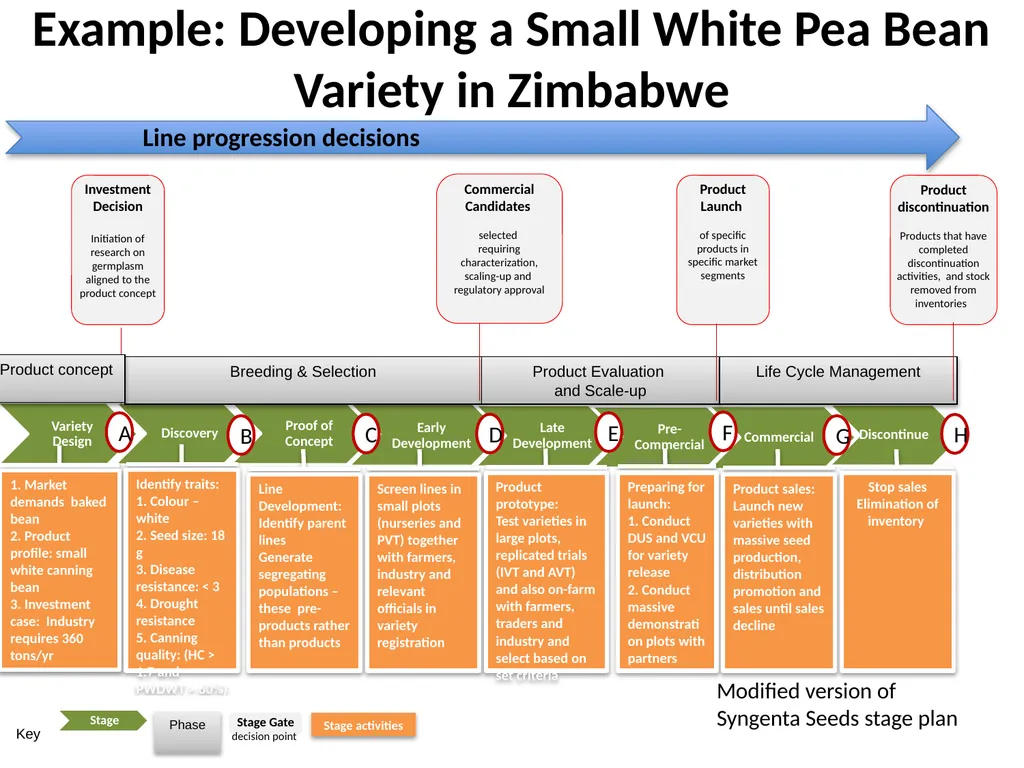
Example: Developing a Small White Pea Bean Variety in Zimbabwe Discovery Modified version of
Syngenta Seeds stage plan Line progression decisions<br>
15
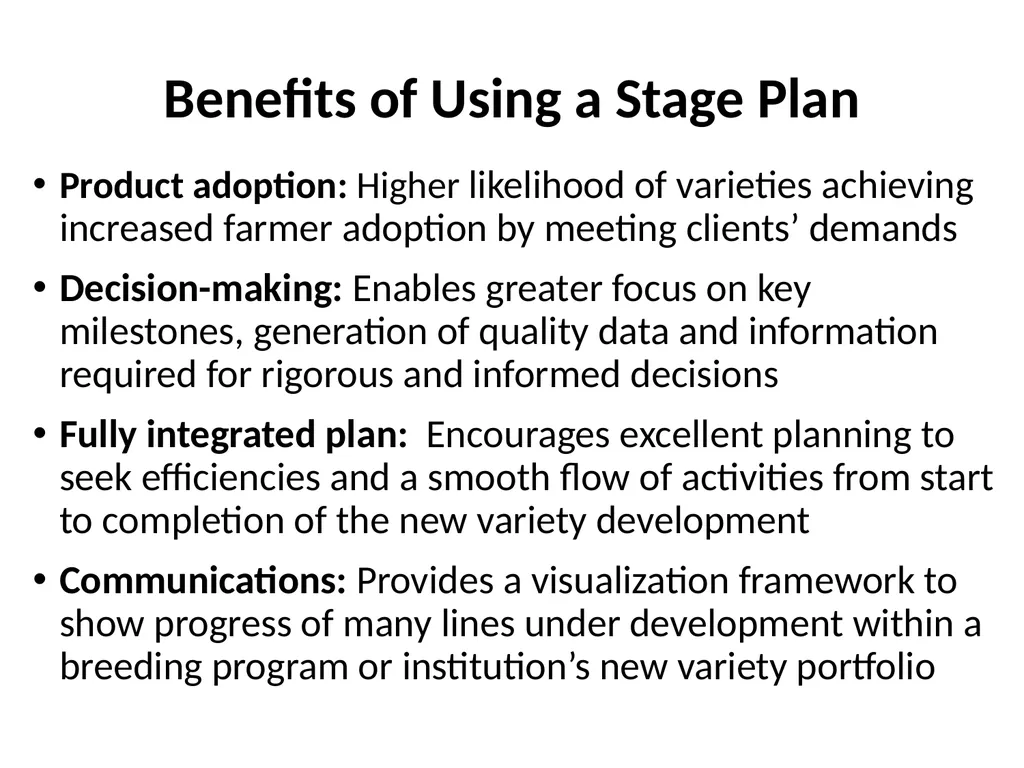
Benefits of Using a Stage Plan Product adoption: Higher likelihood of varieties achieving increased farmer adoption by meeting clients’ demands
Decision-making: Enables greater focus on key milestones, generation of quality data and information required for rigorous and informed decisions
Fully integrated plan: Encourages excellent planning to seek efficiencies and a smooth flow of activities from start to completion of the new variety development
Communications: Provides a visualization framework to show progress of many lines under development within a breeding program or institution’s new variety portfolio<br>
Decision-making: Enables greater focus on key milestones, generation of quality data and information required for rigorous and informed decisions
Fully integrated plan: Encourages excellent planning to seek efficiencies and a smooth flow of activities from start to completion of the new variety development
Communications: Provides a visualization framework to show progress of many lines under development within a breeding program or institution’s new variety portfolio<br>
16
Summary of Development Stage Plan Essential planning process for all breeding programmes.
Contains all activities needed to deliver a new variety from initial design to use by farmers - mapped at all the different stages of progression along the timeline.
Useful not only to organise activities but also to gain inputs, support and “pull through” from clients at critical timings in the variety development process.
Important for effective communications amongst client groups and experts from different disciplines, both within each stage and across the stages.
Key tool to support timely decision-making and if a new genotype/line is ready for progression to the next stage and merits further investment.<br>
Contains all activities needed to deliver a new variety from initial design to use by farmers - mapped at all the different stages of progression along the timeline.
Useful not only to organise activities but also to gain inputs, support and “pull through” from clients at critical timings in the variety development process.
Important for effective communications amongst client groups and experts from different disciplines, both within each stage and across the stages.
Key tool to support timely decision-making and if a new genotype/line is ready for progression to the next stage and merits further investment.<br>
17
Group Discussion –
Development Stage Plan In your breeding programmes, who makes the decisions and how are the decisions made to progress germplasm - from creating crosses, through varietal release, up to final de-registering the variety from production?
At which points in the stage plan should clients, management and investors be involved in decision making?<br>
At which points in the stage plan should clients, management and investors be involved in decision making?<br>
18
3. Timelines and Critical Paths<br>
19
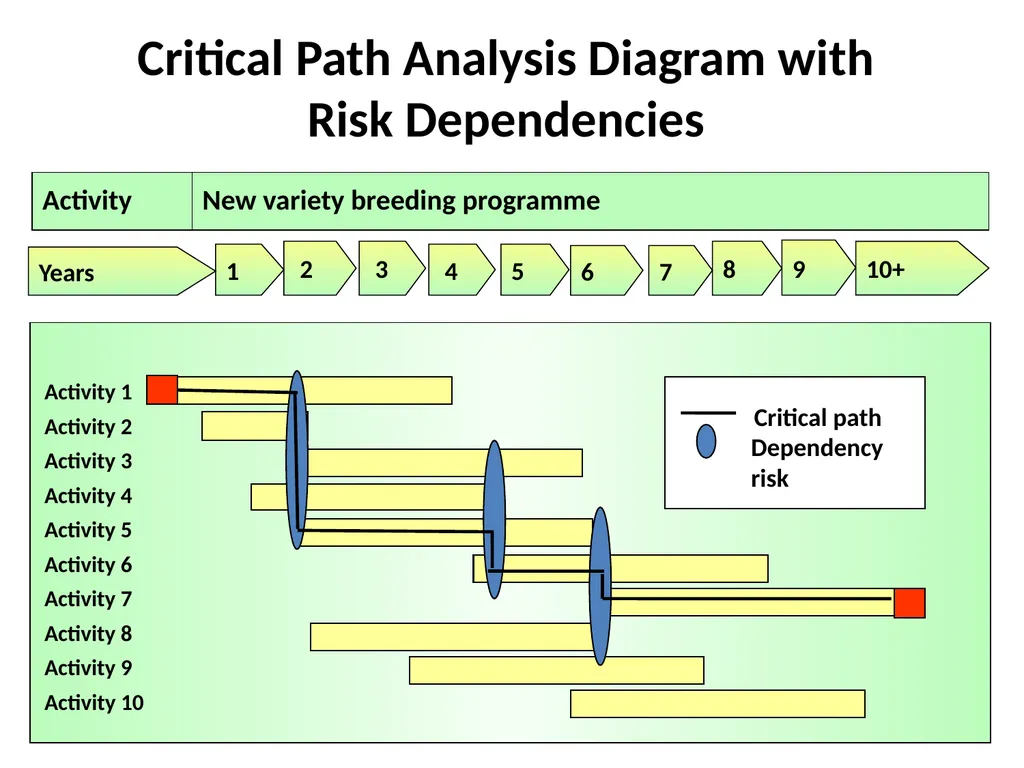
What is a Critical Path? Definition: The variety development stage plan has a series of steps to design, create and deliver the new variety to farmers. The shortest possible route from design to delivery is called the “critical path”<br>
20
Critical Path Analysis Diagram with
Risk Dependencies<br>
21
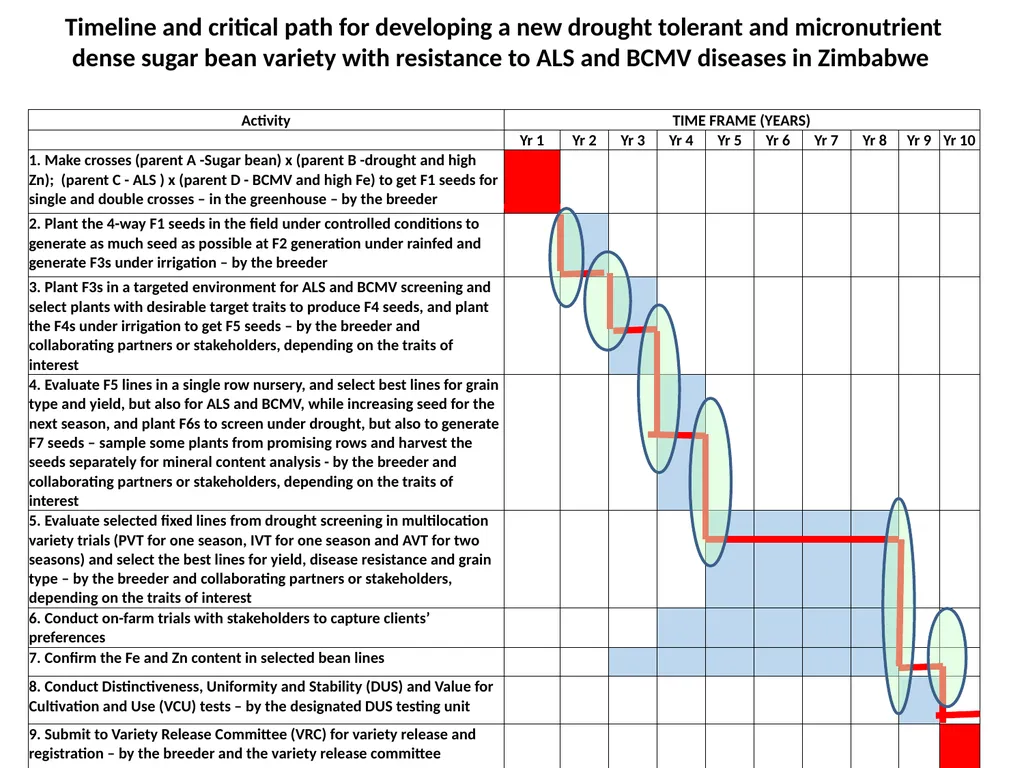
Timeline and critical path for developing a new drought tolerant and micronutrient dense sugar bean variety with resistance to ALS and BCMV diseases in Zimbabwe<br>
22
Importance of Timelines and Critical Path Understand the timelines and associated costs to develop and register a new variety.
Clear understanding about critical paths and approaches to risk reduction.
Develop risk mitigation strategies.
Understand costs and rewards associated with risks.
Critical path analysis and pro-active risk management will help breeding team to develop new varieties that meet farmer and value chain needs in a timely and cost-effective manner.<br>
Clear understanding about critical paths and approaches to risk reduction.
Develop risk mitigation strategies.
Understand costs and rewards associated with risks.
Critical path analysis and pro-active risk management will help breeding team to develop new varieties that meet farmer and value chain needs in a timely and cost-effective manner.<br>
23
4. Risk Management<br>
24
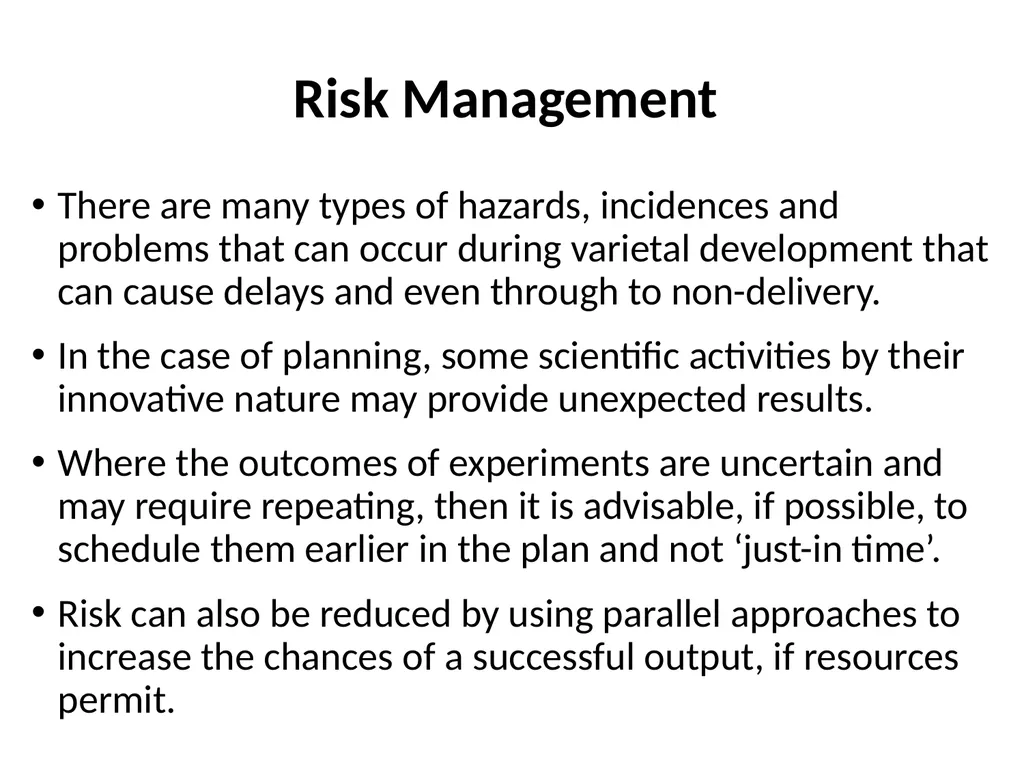
Risk Management There are many types of hazards, incidences and problems that can occur during varietal development that can cause delays and even through to non-delivery.
In the case of planning, some scientific activities by their innovative nature may provide unexpected results.
Where the outcomes of experiments are uncertain and may require repeating, then it is advisable, if possible, to schedule them earlier in the plan and not ‘just-in time’.
Risk can also be reduced by using parallel approaches to increase the chances of a successful output, if resources permit.<br>
In the case of planning, some scientific activities by their innovative nature may provide unexpected results.
Where the outcomes of experiments are uncertain and may require repeating, then it is advisable, if possible, to schedule them earlier in the plan and not ‘just-in time’.
Risk can also be reduced by using parallel approaches to increase the chances of a successful output, if resources permit.<br>
25
Risk Quantification<br>
26
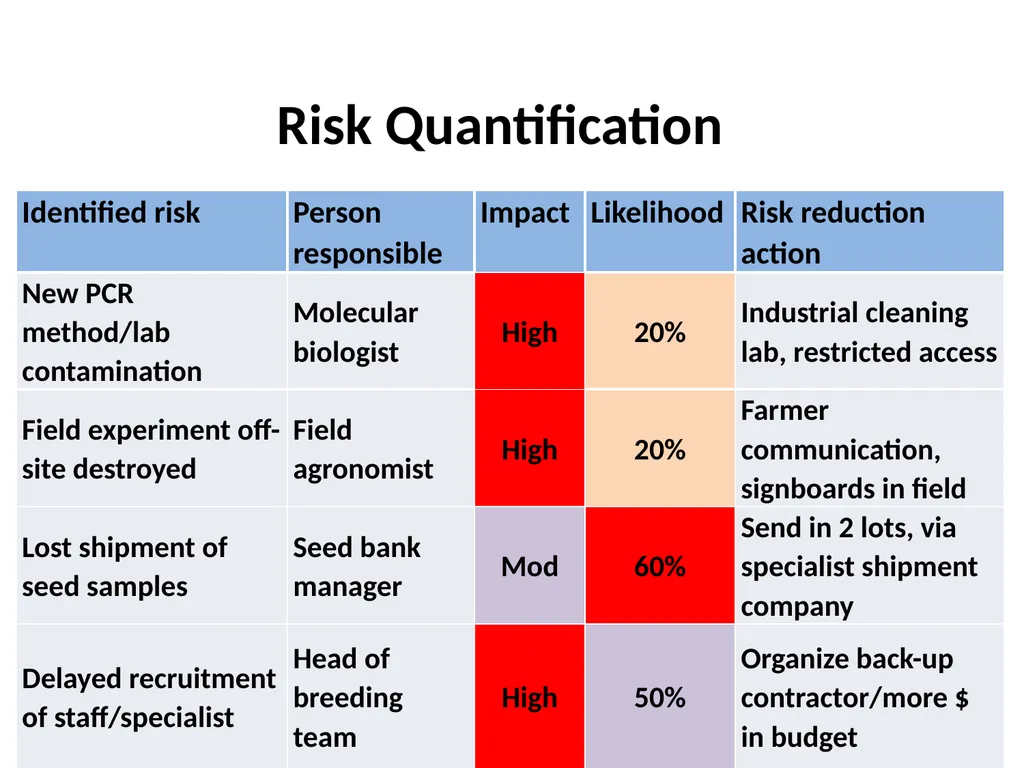
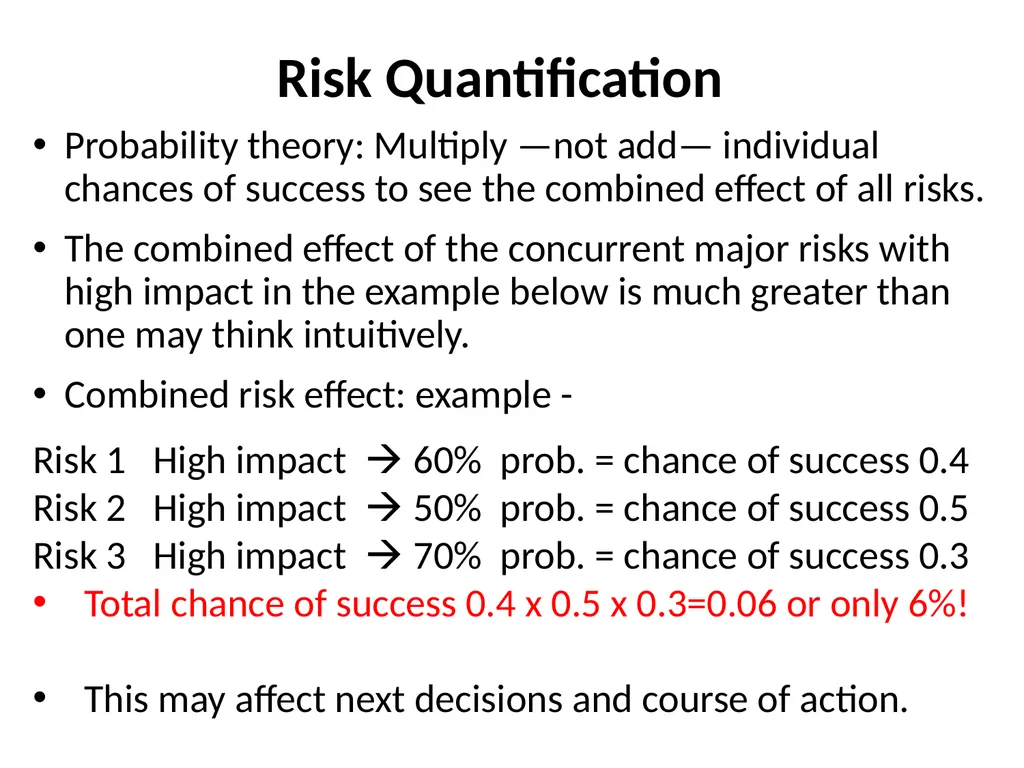
Risk Quantification Probability theory: Multiply —not add— individual chances of success to see the combined effect of all risks.
The combined effect of the concurrent major risks with high impact in the example below is much greater than one may think intuitively.
Combined risk effect: example -
Risk 1 High impact 60% prob. = chance of success 0.4
Risk 2 High impact 50% prob. = chance of success 0.5
Risk 3 High impact 70% prob. = chance of success 0.3
Total chance of success 0.4 x 0.5 x 0.3=0.06 or only 6%!
This may affect next decisions and course of action.<br>
The combined effect of the concurrent major risks with high impact in the example below is much greater than one may think intuitively.
Combined risk effect: example -
Risk 1 High impact 60% prob. = chance of success 0.4
Risk 2 High impact 50% prob. = chance of success 0.5
Risk 3 High impact 70% prob. = chance of success 0.3
Total chance of success 0.4 x 0.5 x 0.3=0.06 or only 6%!
This may affect next decisions and course of action.<br>
27
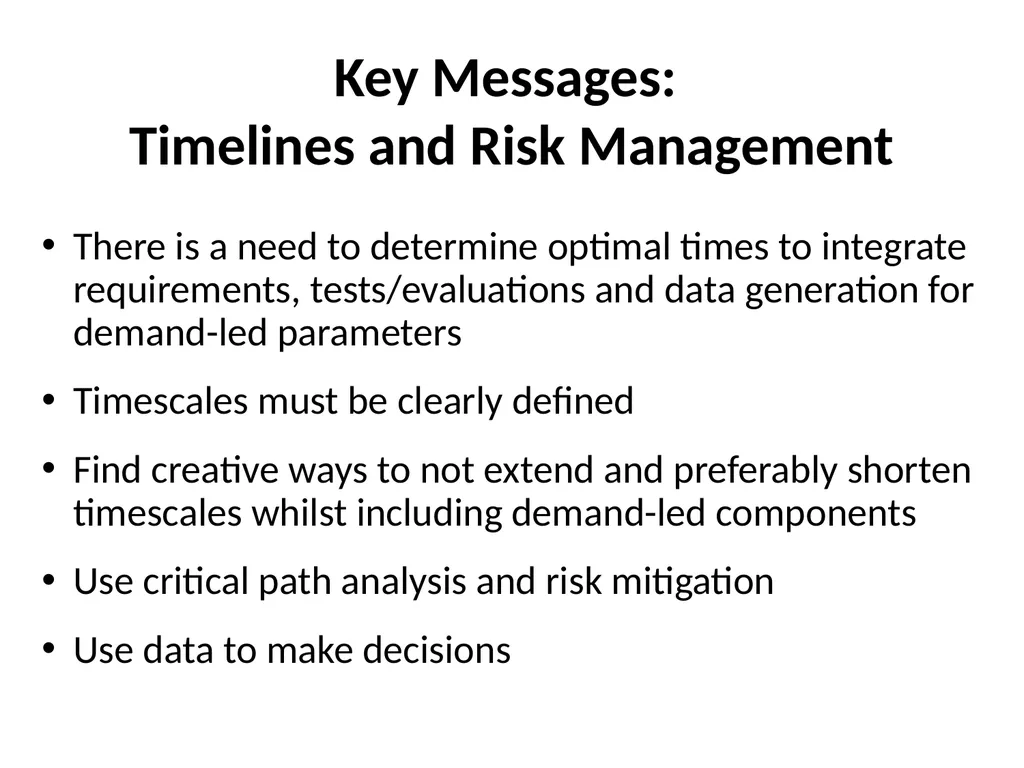
Key Messages:
Timelines and Risk Management There is a need to determine optimal times to integrate requirements, tests/evaluations and data generation for demand-led parameters
Timescales must be clearly defined
Find creative ways to not extend and preferably shorten timescales whilst including demand-led components
Use critical path analysis and risk mitigation
Use data to make decisions<br>
Timescales must be clearly defined
Find creative ways to not extend and preferably shorten timescales whilst including demand-led components
Use critical path analysis and risk mitigation
Use data to make decisions<br>
28
Group Exercise:
Timelines and Critical Paths What are the biggest risks in your breeding programme?
How do you mitigate against these risks?<br>
How do you mitigate against these risks?<br>
29
5. Variety Registration<br>
30
4. Variety Registration Current knowledge of registration system and release requirements is essential, at national and regional levels.
Timelines and costs.
Can one help to speed up the registration process by engaging with the regulatory officials?<br>
Timelines and costs.
Can one help to speed up the registration process by engaging with the regulatory officials?<br>
31
Demand-led Variety Registration Consumer traits and regulatory hurdles.
Demand-led breeding is complex and can take longer - so a smooth registration process is a key factor.
Regional harmonization may influence market size and subsequent investment decisions.
Demand-led variety registration may be influenced by international regulations such as UPOV, breeders’ rights and national registration agencies.<br>
Demand-led breeding is complex and can take longer - so a smooth registration process is a key factor.
Regional harmonization may influence market size and subsequent investment decisions.
Demand-led variety registration may be influenced by international regulations such as UPOV, breeders’ rights and national registration agencies.<br>
32
Demand-led Variety Registration In each country, National Variety Registration Committee (NVRC ) makes a decision to release or reject a new variety, based on data compiled in the release proposal
Some countries charge a fee, others do not, for tests
Ideally, release is based on merit/uniqueness of variety
Uniqueness of a variety that addresses demand-led traits should be considered sufficient to distinguish a new variety from others and give it merit for release<br>
Some countries charge a fee, others do not, for tests
Ideally, release is based on merit/uniqueness of variety
Uniqueness of a variety that addresses demand-led traits should be considered sufficient to distinguish a new variety from others and give it merit for release<br>
33
Demand-led Variety Registration Some countries require yield improvement vs benchmark
Thus the need for yield gain vs consumer demand-led traits issues need to be clarified at the variety design stage
The fact that each country has its own Seed Act makes it costly for seed companies to release and market new varieties in different countries in sub-Saharan Africa
One way to reduce registration costs is to harmonize variety registration regulations across countries, in regional sub groupings (e.g. SADC and COMESA countries)<br>
Thus the need for yield gain vs consumer demand-led traits issues need to be clarified at the variety design stage
The fact that each country has its own Seed Act makes it costly for seed companies to release and market new varieties in different countries in sub-Saharan Africa
One way to reduce registration costs is to harmonize variety registration regulations across countries, in regional sub groupings (e.g. SADC and COMESA countries)<br>
34
Chapter 5
Variety Development Strategy and Stage Plan
Rowland Chirwa The Business of Plant Breeding:
Market-led approaches to new variety design in Africa<br>
Variety Development Strategy and Stage Plan
Rowland Chirwa The Business of Plant Breeding:
Market-led approaches to new variety design in Africa<br>