02
To relate microscopic propertied to macroscopic properties, we need Statistics and Quantum behavior We have followed the following logic:
1. Statistical treatment of isolated systems: multiplicity entropy the 2nd Law.
2. Thermodynamic treatment of systems in contact with the heat reservoir the minimum free energy principle. However, the link between Free Energies and the process of counting of accessible microstates was not straightforward. In previous chapters, we had to rely on experimental data Ideally, we should be able to “all thermodynamics quantities” from 1st law and 2nd Law of thermodynamics starting from microscopic models. For example, 2-state paramagnetism, the Einstein solid, ideal gas. Now we will study more complicated models and we will develop more powerful theoretical tools to deal with complicated systems<br>
04
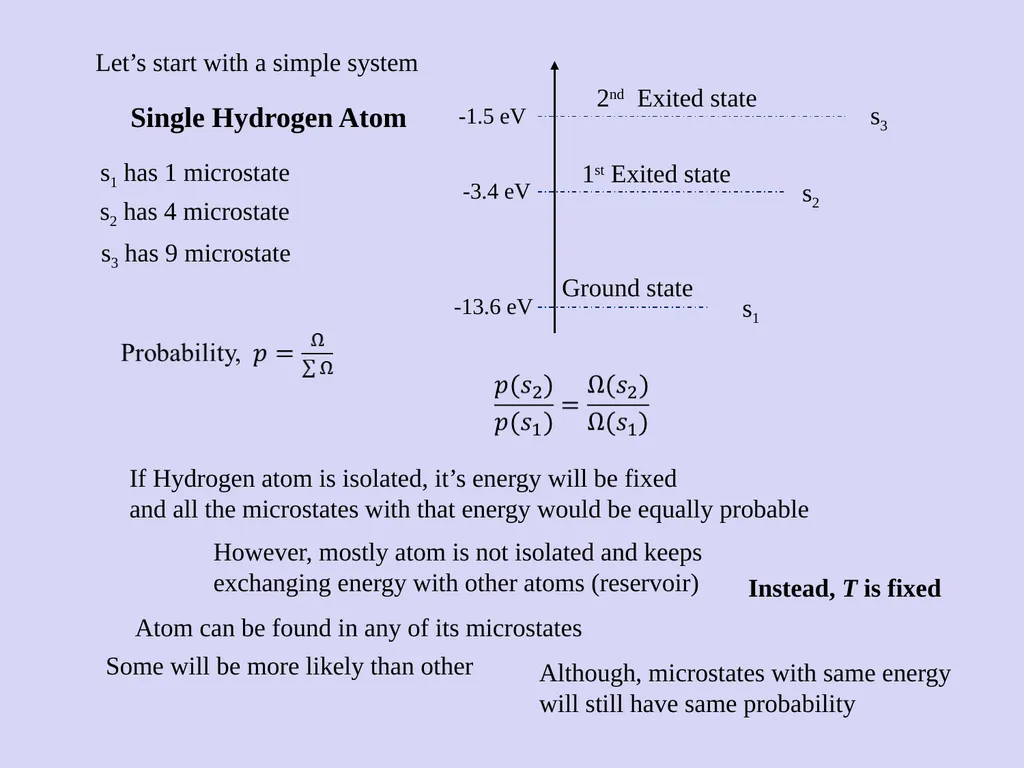
Let’s start with a simple system Single Hydrogen Atom s1 has 1 microstate s2 has 4 microstate s3 has 9 microstate If Hydrogen atom is isolated, it’s energy will be fixed
and all the microstates with that energy would be equally probable However, mostly atom is not isolated and keeps exchanging energy with other atoms (reservoir) Instead, T is fixed Atom can be found in any of its microstates Some will be more likely than other Although, microstates with same energy will still have same probability<br>
05
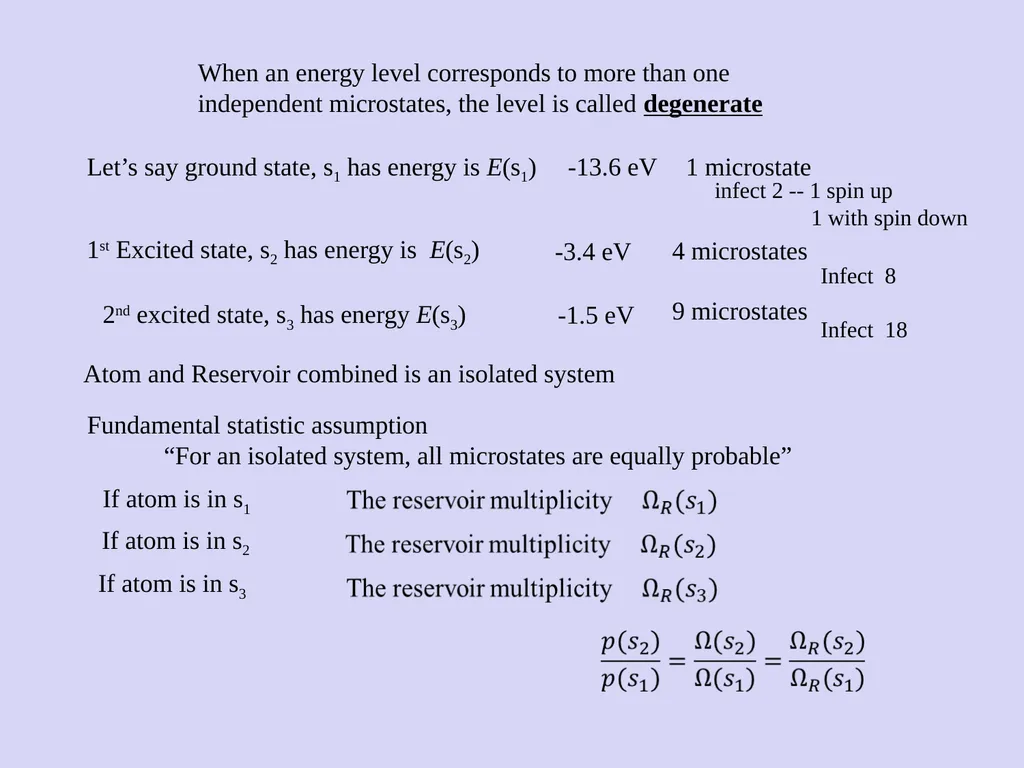
When an energy level corresponds to more than one independent microstates, the level is called degenerate Let’s say ground state, s1 has energy is E(s1) -13.6 eV 1 microstate infect 2 -- 1 spin up
1 with spin down 1st Excited state, s2 has energy is E(s2) -3.4 eV 4 microstates 2nd excited state, s3 has energy E(s3) -1.5 eV 9 microstates Infect 8 Infect 18 Atom and Reservoir combined is an isolated system Fundamental statistic assumption
“For an isolated system, all microstates are equally probable” If atom is in s1 If atom is in s2 If atom is in s3<br>
06
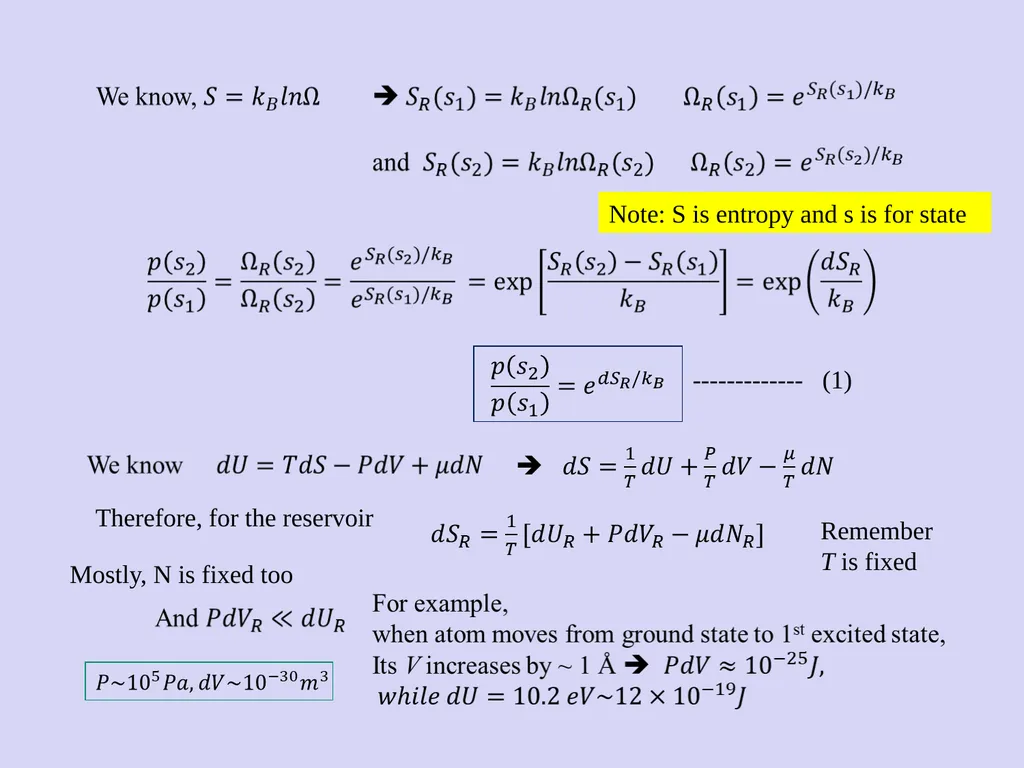
------------- (1) Therefore, for the reservoir Remember T is fixed Mostly, N is fixed too Note: S is entropy and s is for state<br>
07
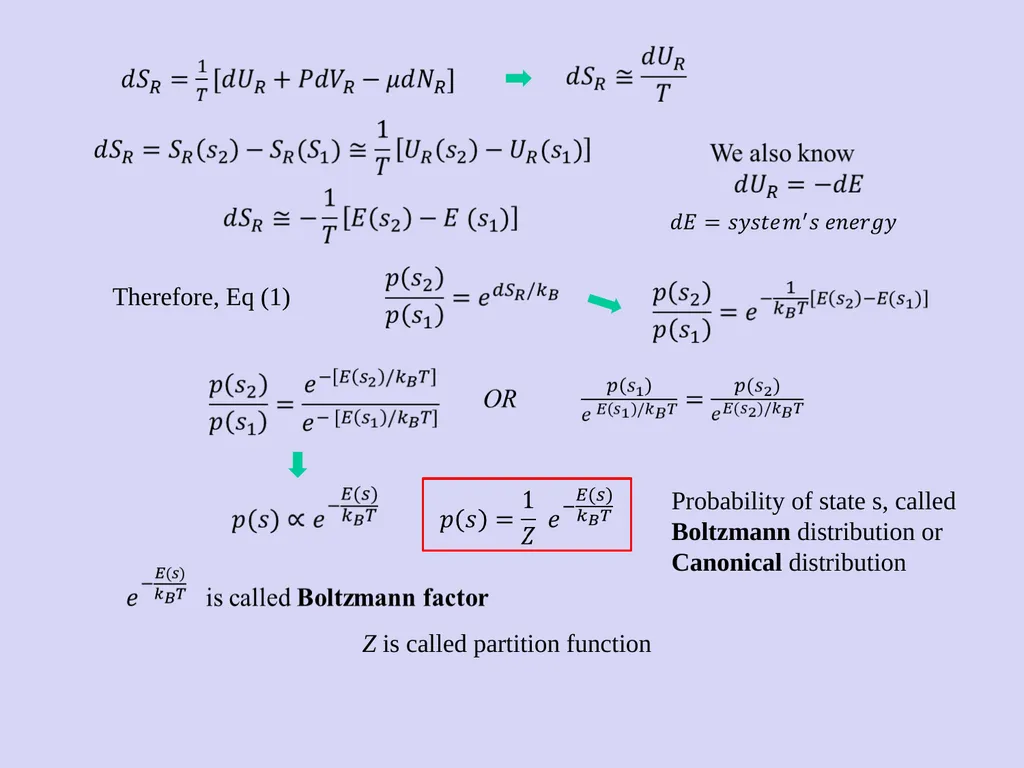
Therefore, Eq (1) Probability of state s, called Boltzmann distribution or
Canonical distribution Z is called partition function<br>
08
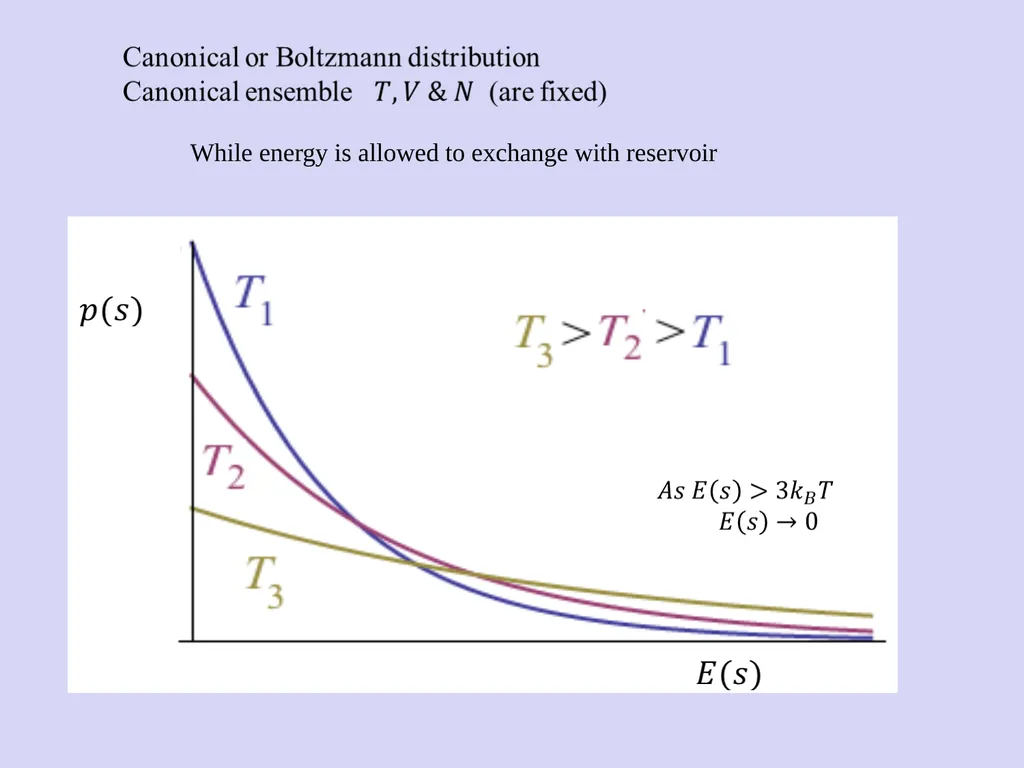
While energy is allowed to exchange with reservoir<br>
09
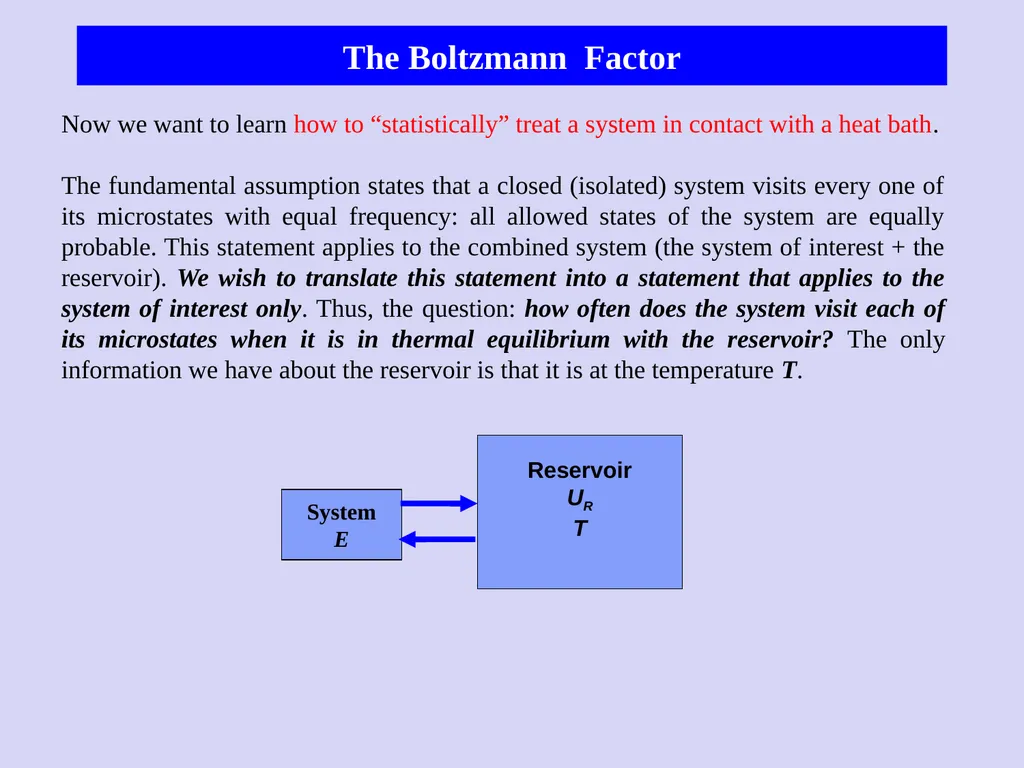
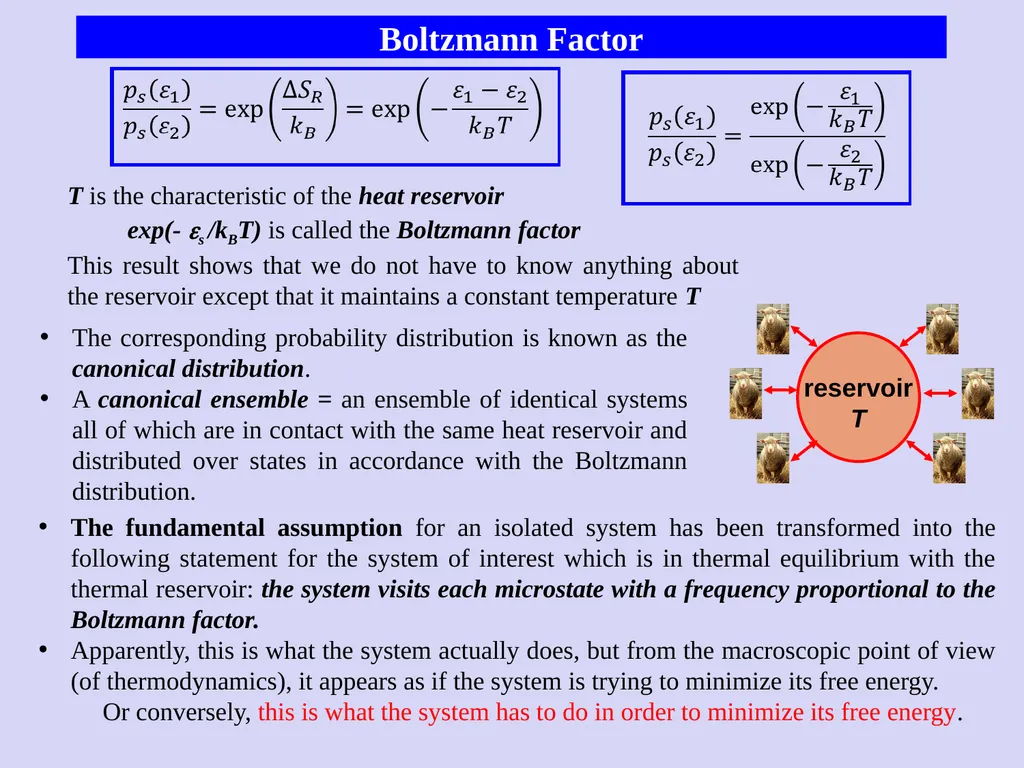
Boltzmann Factor This result shows that we do not have to know anything about the reservoir except that it maintains a constant temperature T The corresponding probability distribution is known as the canonical distribution.
A canonical ensemble = an ensemble of identical systems all of which are in contact with the same heat reservoir and distributed over states in accordance with the Boltzmann distribution. T is the characteristic of the heat reservoir The fundamental assumption for an isolated system has been transformed into the following statement for the system of interest which is in thermal equilibrium with the thermal reservoir: the system visits each microstate with a frequency proportional to the Boltzmann factor.
Apparently, this is what the system actually does, but from the macroscopic point of view (of thermodynamics), it appears as if the system is trying to minimize its free energy.
Or conversely, this is what the system has to do in order to minimize its free energy. exp(- s /kBT) is called the Boltzmann factor<br>
10
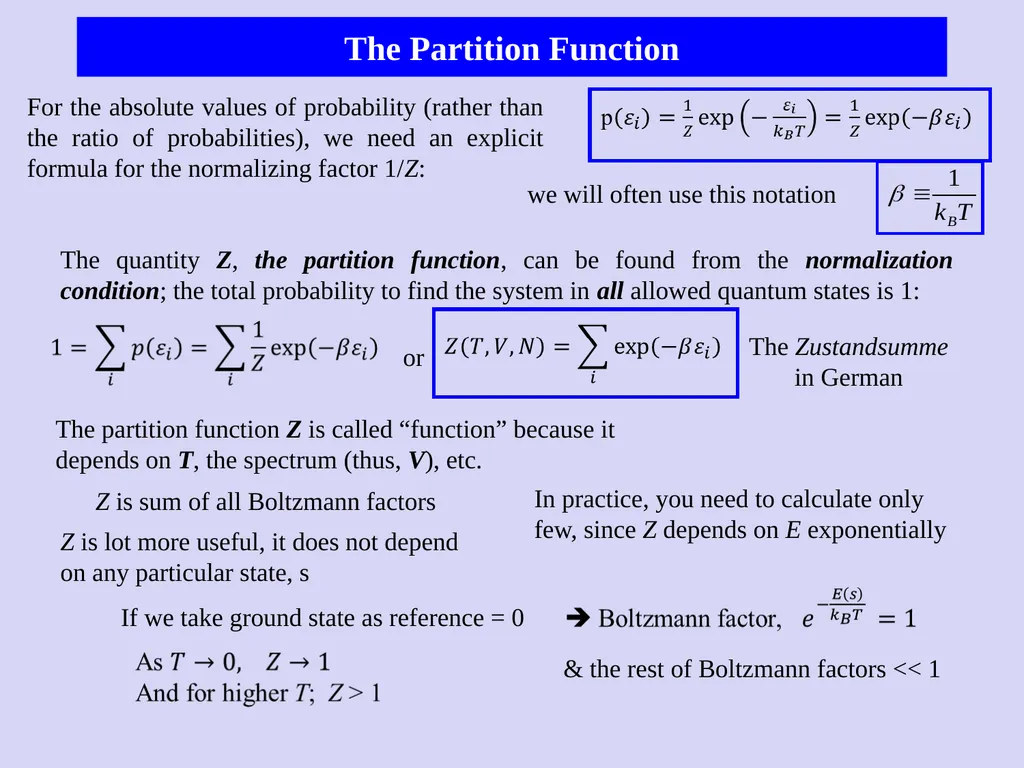
The Partition Function The partition function Z is called “function” because it depends on T, the spectrum (thus, V), etc. For the absolute values of probability (rather than the ratio of probabilities), we need an explicit formula for the normalizing factor 1/Z: The quantity Z, the partition function, can be found from the normalization condition; the total probability to find the system in all allowed quantum states is 1: or The Zustandsumme
in German we will often use this notation Z is sum of all Boltzmann factors In practice, you need to calculate only few, since Z depends on E exponentially Z is lot more useful, it does not depend on any particular state, s If we take ground state as reference = 0 & the rest of Boltzmann factors << 1<br>
11
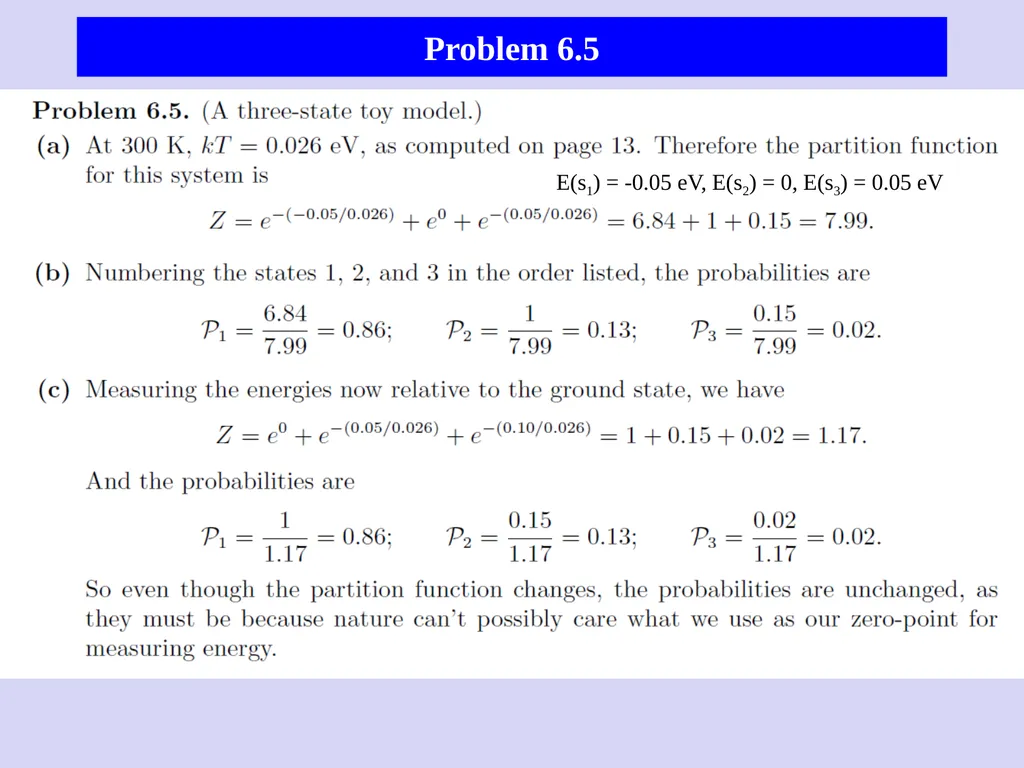
Problem 6.5 E(s1) = -0.05 eV, E(s2) = 0, E(s3) = 0.05 eV<br>
12
Thermal excitation of atoms p. 226 Simple Application of Boltzmann factor Consider atom of Hydrogen in sun atmosphere (T ~ 5800 K) Comparing probability of finding the atom in first excited state, s2 with ground state, s1 E(s1) = -13.6 eV
E(s2) = -3.4 eV = 10.2 eV For 109 (1 Billion) atoms in ground state, only 1.4 atoms will be in 1st excited state on sun’s surface. But since 1st excited state has 4 microstates equally probable, therefore total number in 1st excited state will be (4*1.4) = 5.6 for every billion in ground state.<br>
13
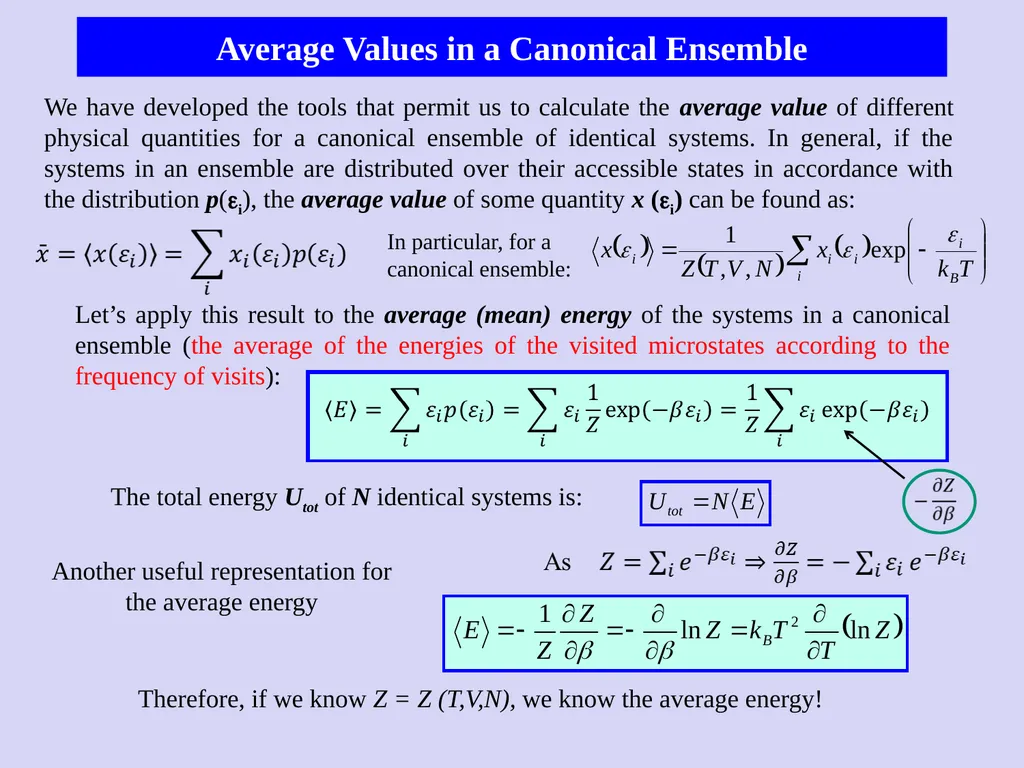
Average Values in a Canonical Ensemble We have developed the tools that permit us to calculate the average value of different physical quantities for a canonical ensemble of identical systems. In general, if the systems in an ensemble are distributed over their accessible states in accordance with the distribution p(i), the average value of some quantity x (i) can be found as: The total energy Utot of N identical systems is: Another useful representation for the average energy Let’s apply this result to the average (mean) energy of the systems in a canonical ensemble (the average of the energies of the visited microstates according to the frequency of visits): In particular, for a
canonical ensemble: Therefore, if we know Z = Z (T,V,N), we know the average energy!<br>
14
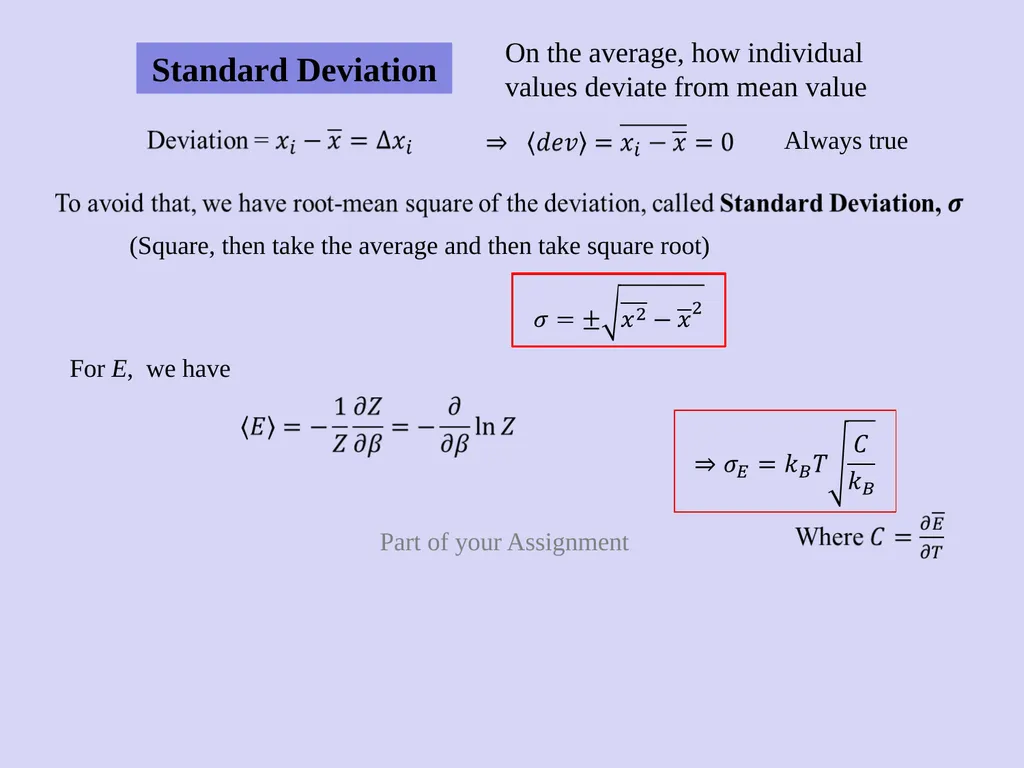
Standard Deviation On the average, how individual values deviate from mean value Always true (Square, then take the average and then take square root) For E, we have Part of your Assignment<br>
15
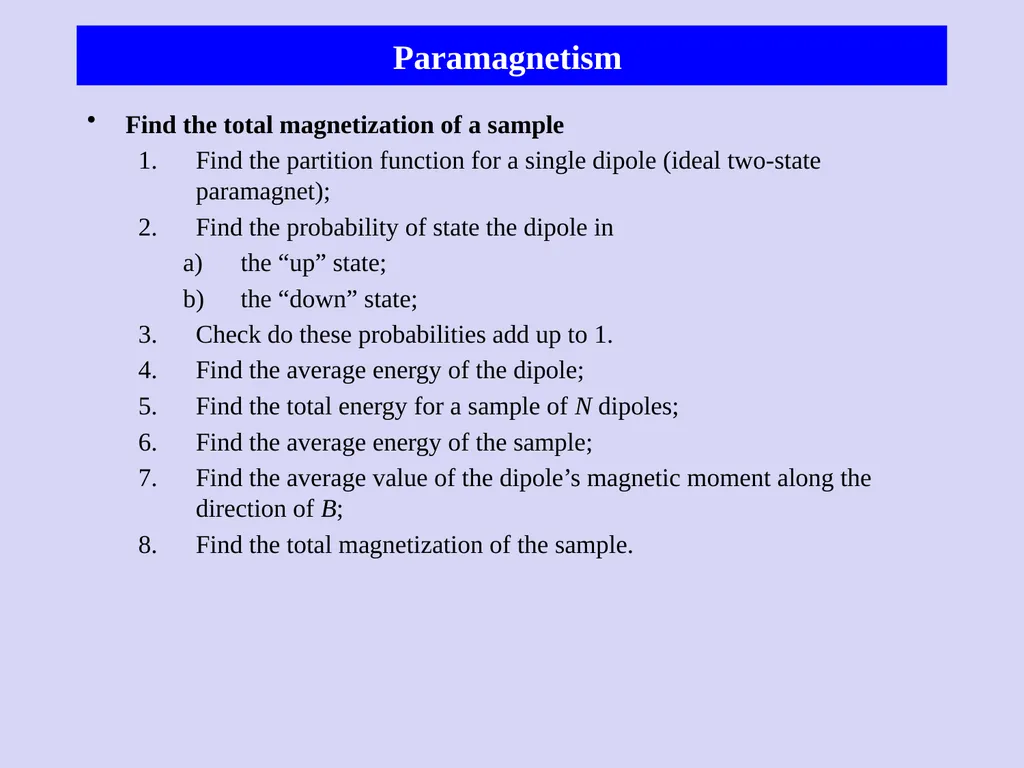
Find the total magnetization of a sample
Find the partition function for a single dipole (ideal two-state paramagnet);
Find the probability of state the dipole in
the “up” state;
the “down” state;
Check do these probabilities add up to 1.
Find the average energy of the dipole;
Find the total energy for a sample of N dipoles;
Find the average energy of the sample;
Find the average value of the dipole’s magnetic moment along the direction of B;
Find the total magnetization of the sample. Paramagnetism<br>
16
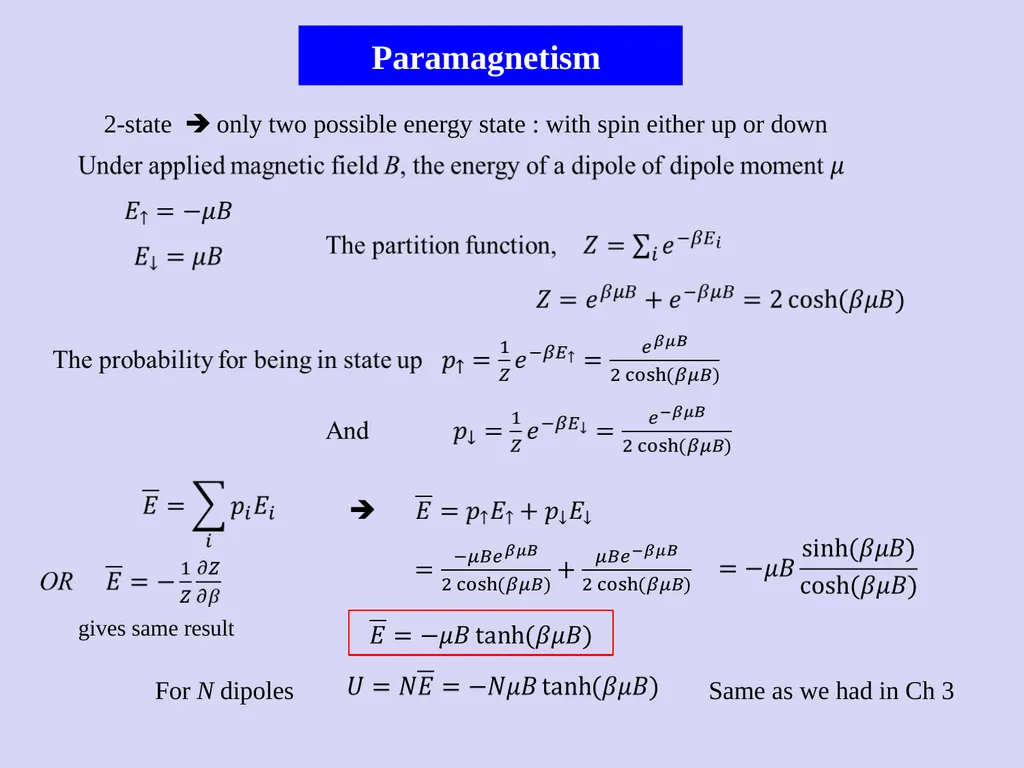
Paramagnetism 2-state only two possible energy state : with spin either up or down For N dipoles Same as we had in Ch 3 gives same result<br>
17
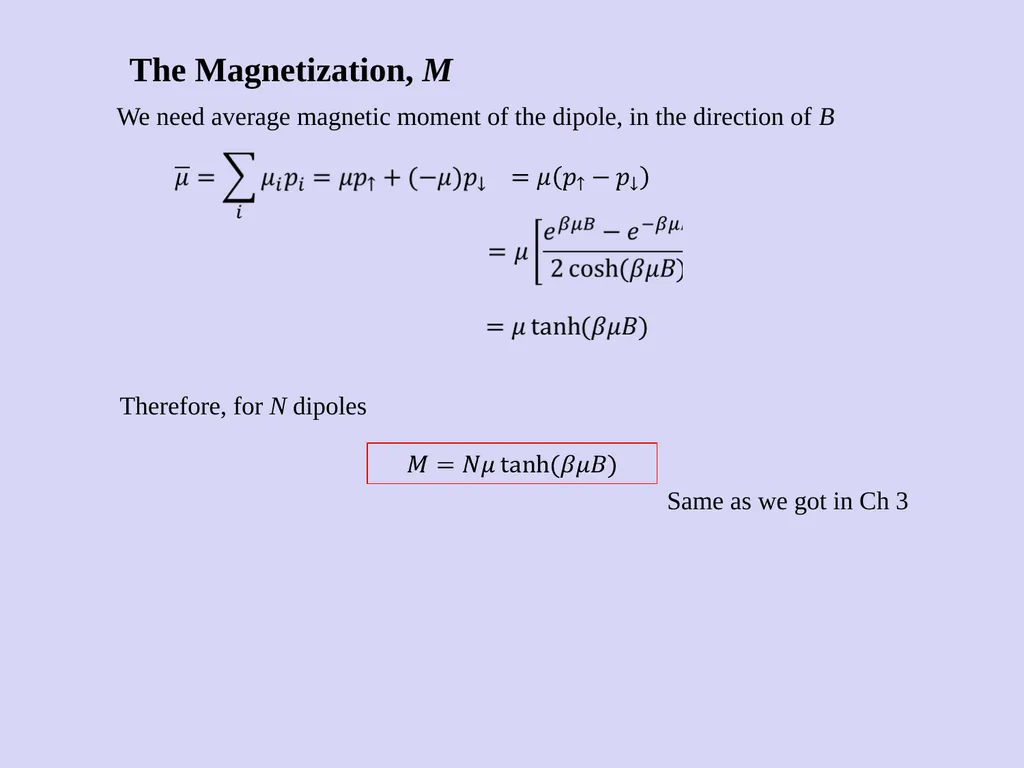
The Magnetization, M We need average magnetic moment of the dipole, in the direction of B Therefore, for N dipoles Same as we got in Ch 3<br>
18
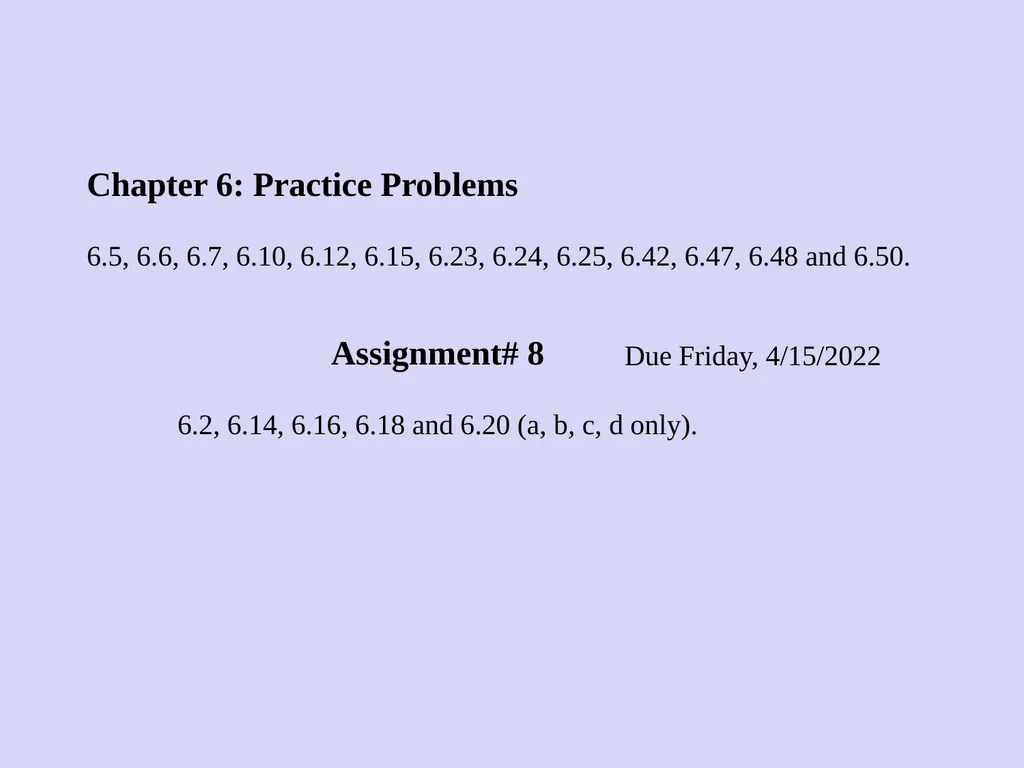
Chapter 6: Practice Problems
6.5, 6.6, 6.7, 6.10, 6.12, 6.15, 6.23, 6.24, 6.25, 6.42, 6.47, 6.48 and 6.50. Assignment# 8
6.2, 6.14, 6.16, 6.18 and 6.20 (a, b, c, d only). Due Friday, 4/15/2022<br>