Chapter 6: The Structure of Matter Section 2: Ionic and Covalent Bonding Objectives Why do atoms form bonds? How do ionic bonds form? What do atoms joined by covalent bonds share? What gives metals their distinctive properties? How are
"Chapter 6: The Structure of Matter Section 2:" is the property of its rightful owner. Permission is granted to
download and print the materials on this website for personal, non-commercial use only, and to display it
on your personal computer provided you do not modify the materials and that you retain all copyright
notices contained in the materials. By downloading content from our website, you accept the terms of this
agreement.
Presentation Transcript
01
Chapter 6: The Structure of Matter Section 2: Ionic and Covalent Bonding<br>
02
Objectives Why do atoms form bonds?
How do ionic bonds form?
What do atoms joined by covalent bonds share?
What gives metals their distinctive properties?
How are polyatomic ions similar to other ions?<br>
03
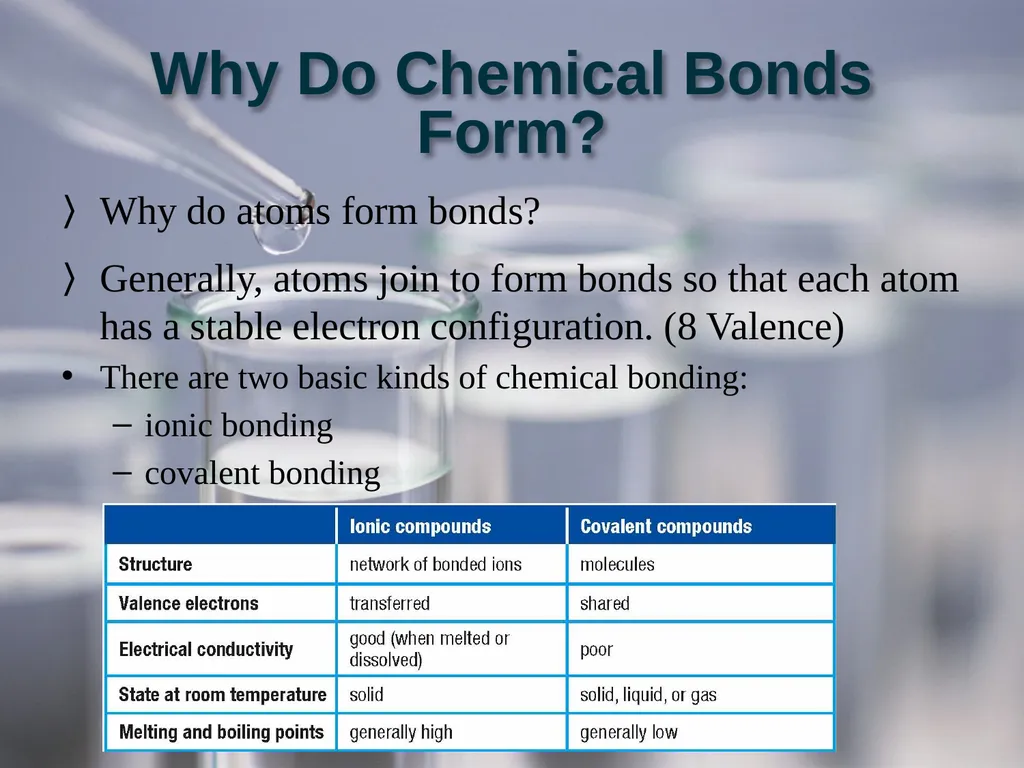
Why Do Chemical Bonds Form? Why do atoms form bonds?
Generally, atoms join to form bonds so that each atom has a stable electron configuration. (8 Valence)
There are two basic kinds of chemical bonding:
ionic bonding
covalent bonding<br>
04
Ionic Bonds How do ionic bonds form?
Ionic bonds form from the attractions between oppositely charged ions.
ionic bonds: the attractive force between oppositely charged ions, which form when electrons are transferred from one atom to another<br>
05
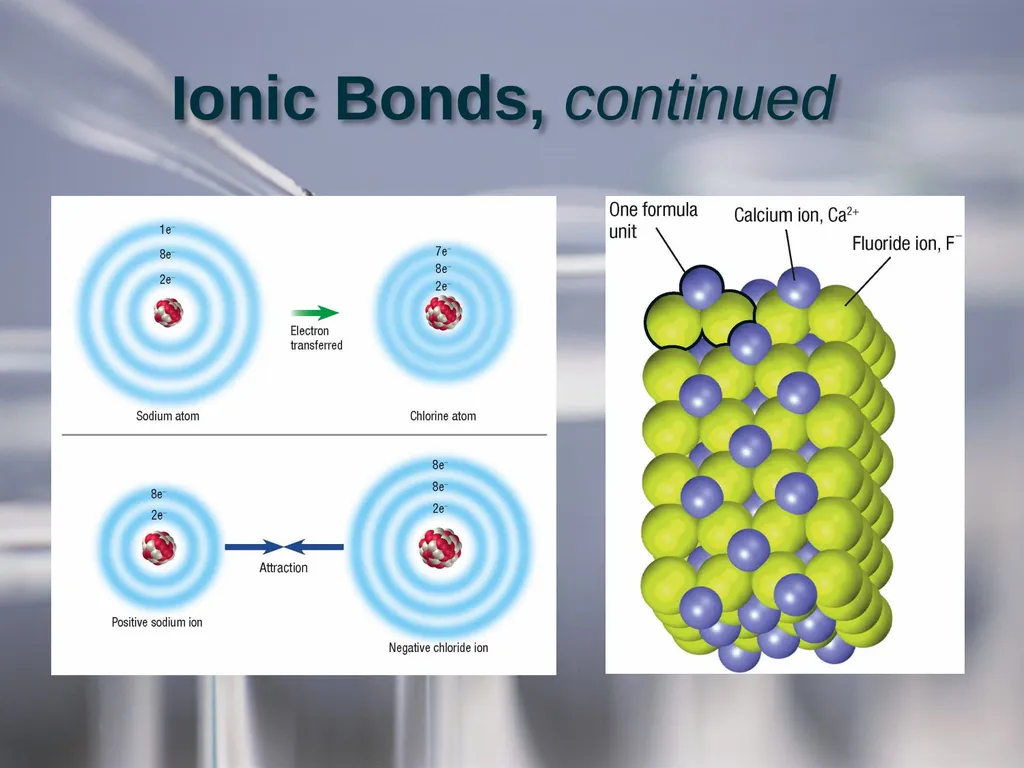
Ionic Bonds, continued Ionic bonds are formed by the transfer of electrons.
Two atoms tend to form an ionic bond when one atom has more attraction for electrons than the other.
Ionic compounds are in the form of networks, not molecules.
A formula unit is the smallest ratio of ions in ionic compounds.
When melted or dissolved in water, ionic compounds conduct electricity.<br>
06
Ionic Bonds, continued<br>
07
Covalent Bonds What do atoms joined by covalent bonds share?
Atoms joined by covalent bonds share electrons.
covalent bond: a bond formed when atoms share one or more pairs of electrons.
Compounds that are networks of bonded atoms, such as silicon dioxide, are also covalently bonded.
Covalent bonds usually form between nonmetal atoms.
Covalent compounds can be solids, liquids, or gases.
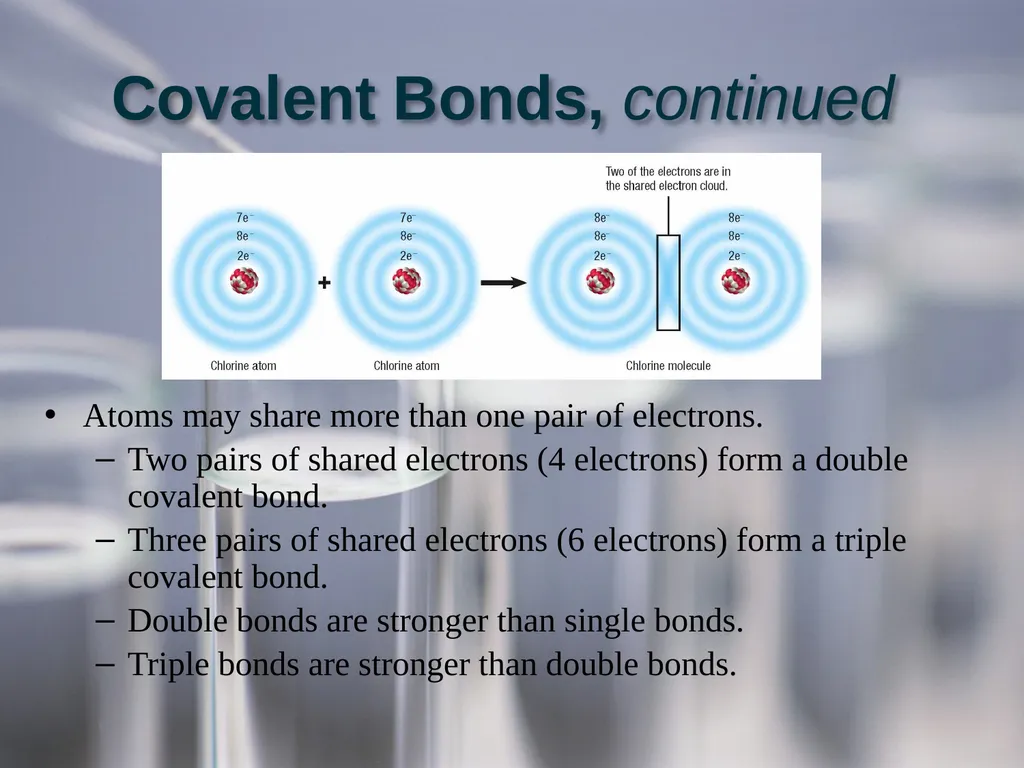
In a chlorine molecule, Cl2, the atoms share two electrons.
They are joined by one covalent bond.<br>
08
Covalent Bonds, continued Atoms may share more than one pair of electrons.
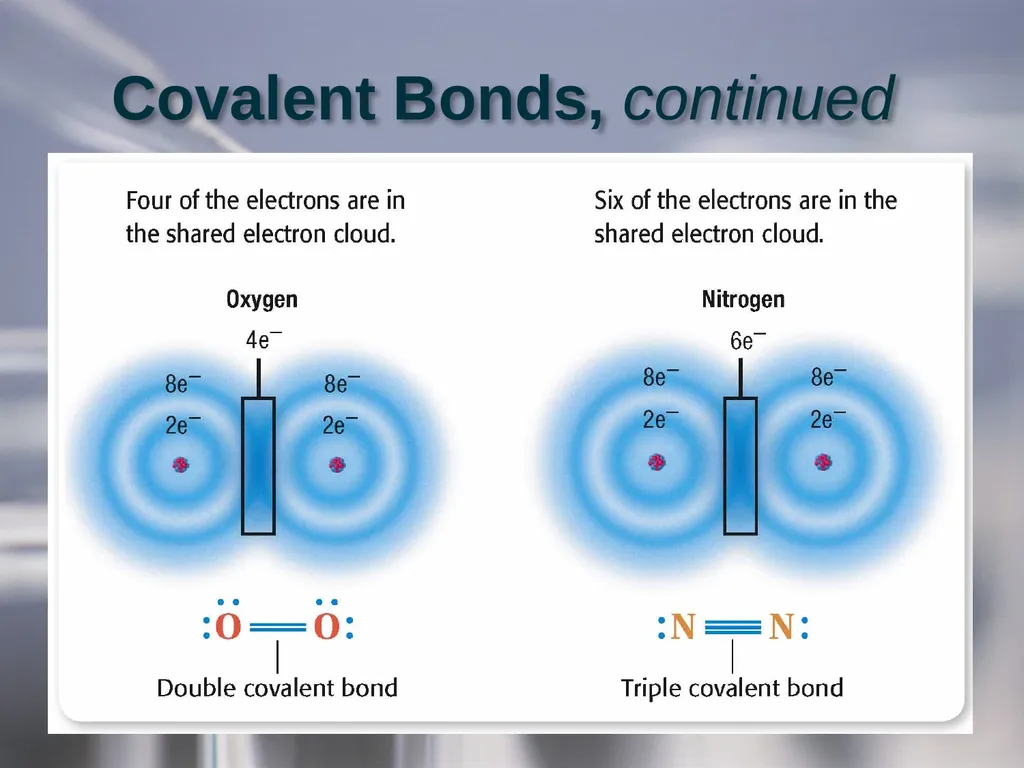
Two pairs of shared electrons (4 electrons) form a double covalent bond.
Three pairs of shared electrons (6 electrons) form a triple covalent bond.
Double bonds are stronger than single bonds.
Triple bonds are stronger than double bonds.<br>
09
Covalent Bonds, continued<br>
10
Covalent Bonds, continued Atoms do not always share electrons equally.
nonpolar covalent bonds: bonds in which electrons are shared equally
When two atoms of different elements share electrons, the electrons are not shared equally.
polar covalent bond: a bond in which there is an unequal sharing of electrons.
Electrons tend to be more attracted to atoms of elements that are located farther to the right and closer to the top of the periodic table.<br>
11
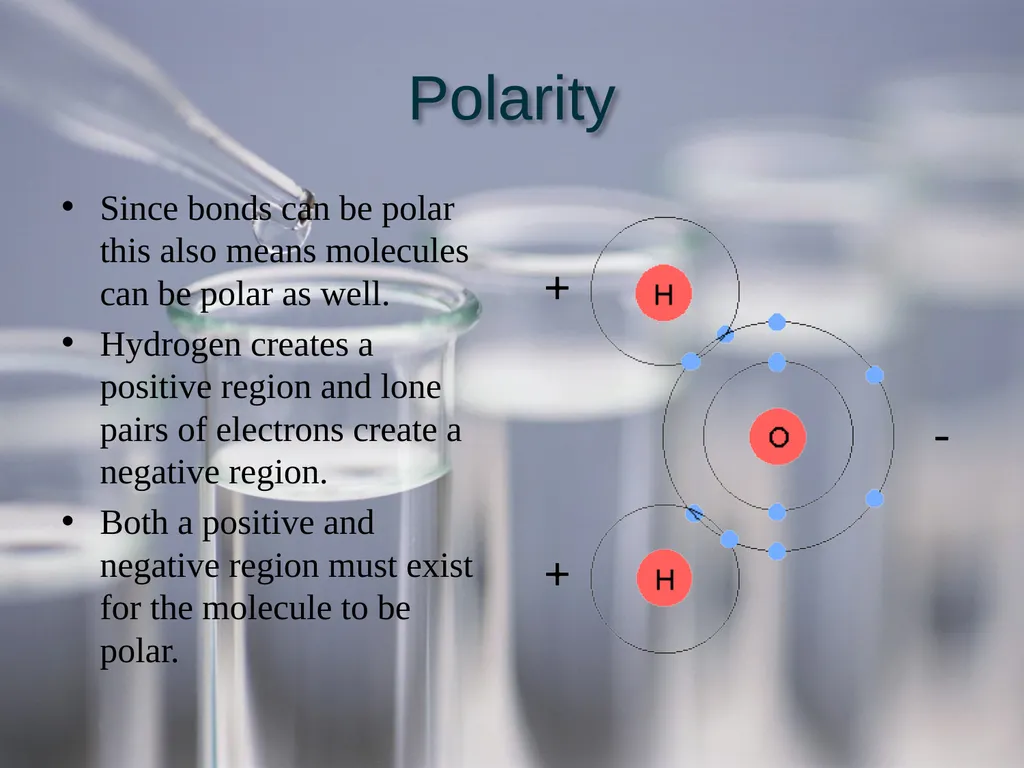
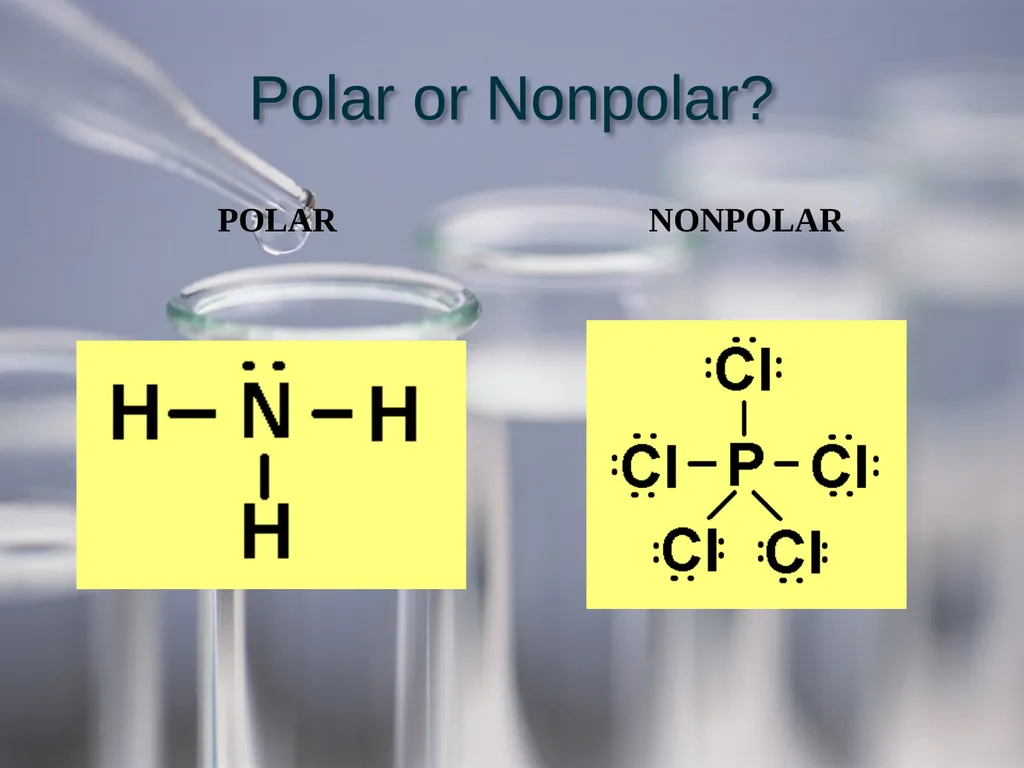
Polarity Since bonds can be polar this also means molecules can be polar as well.
Hydrogen creates a positive region and lone pairs of electrons create a negative region.
Both a positive and negative region must exist for the molecule to be polar.<br>
12
Polar or Nonpolar? POLAR NONPOLAR<br>
13
Metallic Bonds What gives metals their distinctive properties?
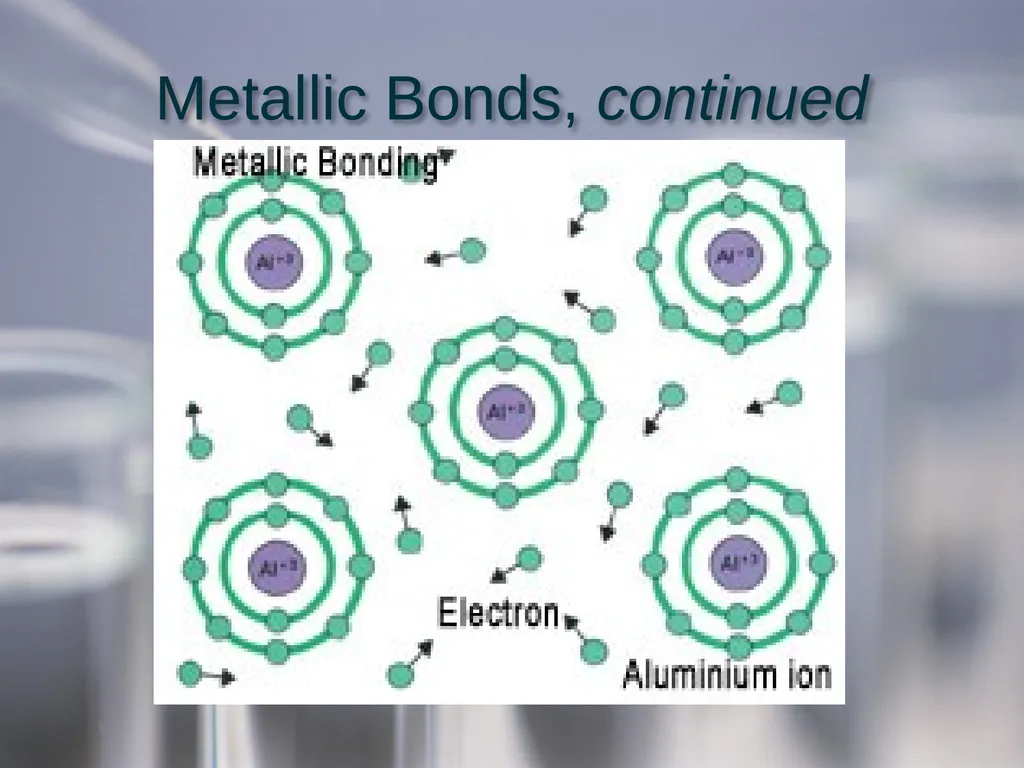
Metals are flexible and conduct electric current well because their atoms and electrons can move freely throughout a metal’s packed structure.
metallic bond: a bond formed by the attraction between positively charged metal ions and the electrons around them<br>
14
Metallic Bonds, continued<br>
15
Polyatomic Ions How are polyatomic ions similar to other ions?
A polyatomic ion acts as a single unit in a compound, just as ions that consist of a single atom do.
polyatomic ion: an ion made of two or more covalently bonded atoms<br>
16
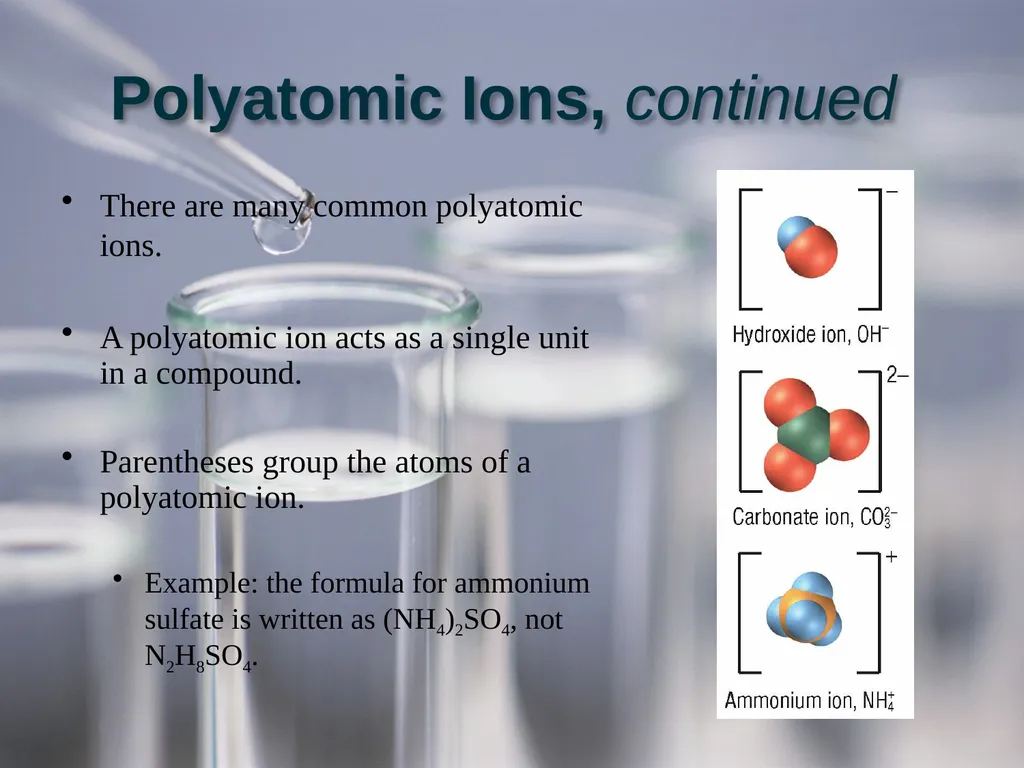
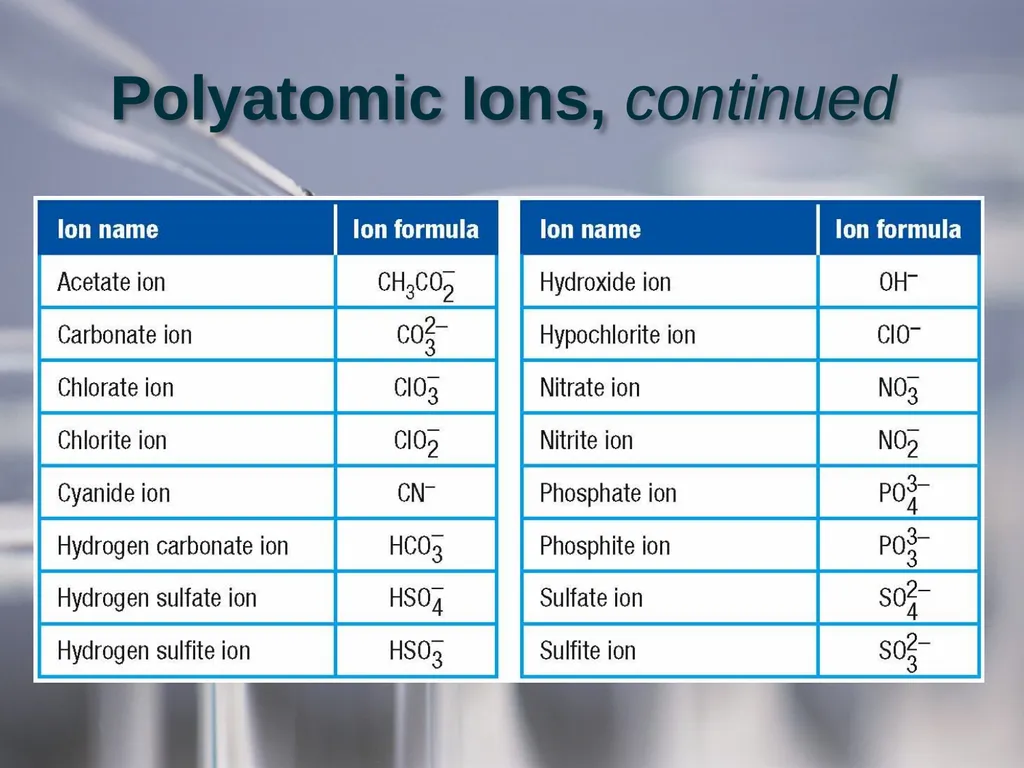
Polyatomic Ions, continued There are many common polyatomic ions.
A polyatomic ion acts as a single unit in a compound.
Parentheses group the atoms of a polyatomic ion.
Example: the formula for ammonium sulfate is written as (NH4)2SO4, not N2H8SO4.<br>
17
Polyatomic Ions, continued Some names pf polyatomic anions relate to their oxygen content.
An -ate ending is used to name an ion with more oxygen atoms.
Examples: sulfate (SO42–), nitrate (NO3–), chlorate (ClO3–)
An -ite ending is used to name an ion with fewer oxygen atoms.
Examples: sulfite (SO32–), nitrite (NO2–), chlorite (ClO2–)<br>
18
Polyatomic Ions, continued<br>
19
Knowing the Bond? The key to identifying the bond type from the formula is knowing what types of elements the compound contains.
Ionic (Bond between a metal and nonmetal or polyatomic ion)
Covalent (Bond between two or more nonmetals)
Metallic (Bond between two or more metals)<br>