
Chapter 7 Grounded theory Mills J, Birks M and
MT
Published · 30 slides · 0 views

1 / 1
Description
Chapter 7 Grounded theory Mills J, Birks M and Hoare K. (2014). In: Mills J and Birks M (eds) Qualitative methodologies: A practical guide. London: Sage Publications Learning objectives Discuss the historical, philosophical and
Related Topics
Share
Embed code
Download this presentation From Below
"Chapter 7 Grounded theory Mills J, Birks M and" is the property of its rightful owner. Permission is granted to download and print the materials on this website for personal, non-commercial use only, and to display it on your personal computer provided you do not modify the materials and that you retain all copyright notices contained in the materials. By downloading content from our website, you accept the terms of this agreement.
Presentation Transcript
01
Chapter 7
Grounded theory Mills J, Birks M and Hoare K. (2014). In: Mills J and Birks M (eds) Qualitative methodologies: A practical guide. London: Sage Publications<br>
02
Learning objectives Discuss the historical, philosophical and methodological underpinnings of traditional, evolved and constructivist grounded theory
Examine the position of the researcher and its relationship to philosophical and methodological alignment in a grounded theory study
Identify various sources of data for use in grounded theory studies
Outline the process of analysis in grounded theory research<br>
Examine the position of the researcher and its relationship to philosophical and methodological alignment in a grounded theory study
Identify various sources of data for use in grounded theory studies
Outline the process of analysis in grounded theory research<br>
03
History of the methodology 1960s – Glaser and Strauss develop grounded theory process
Theory developed inductively from data
1970s – Glaser develops and promotes the use of 18 sociological coding families to assist researchers to integrate their grounded theory<br>
Theory developed inductively from data
1970s – Glaser develops and promotes the use of 18 sociological coding families to assist researchers to integrate their grounded theory<br>
04
History of the methodology 1980s – Strauss writes about links between symbolic interactionism and grounded theory methods (Strauss, 1987)
1990s – Strauss and Corbin suggest a number of concrete strategies for using grounded theory methods (Strauss and Corbin, 1990)
Glaser views Strauss and Corbin’s book as contradicting the fundamental premise of inductive grounded theory<br>
1990s – Strauss and Corbin suggest a number of concrete strategies for using grounded theory methods (Strauss and Corbin, 1990)
Glaser views Strauss and Corbin’s book as contradicting the fundamental premise of inductive grounded theory<br>
05
History of the methodology 1996 – Strauss dies
Corbin continues Strauss’ work and 2nd & 3rd editions of their 1990 text are published (Corbin & Strauss, 1998; 2008)
Second generation of grounded theorists includes Charmaz and Clarke<br>
Corbin continues Strauss’ work and 2nd & 3rd editions of their 1990 text are published (Corbin & Strauss, 1998; 2008)
Second generation of grounded theorists includes Charmaz and Clarke<br>
06
History of the methodology Charmaz mentored by both Glaser and Strauss at University of California, San Francisco
Rethinks the possibilities of using a different philosophical approach for grounded theory
Develops the genre of constructivist grounded theory<br>
Rethinks the possibilities of using a different philosophical approach for grounded theory
Develops the genre of constructivist grounded theory<br>
07
History of the methodology Clarke, brings grounded theory “around the postmodern turn” using situational analysis
Situational analysis uses three cartographic approaches: situational maps, social world/arenas maps & positional maps
Concerns with power relations, context and action<br>
Situational analysis uses three cartographic approaches: situational maps, social world/arenas maps & positional maps
Concerns with power relations, context and action<br>
08
Philosophical underpinnings Three genres of grounded theory:
Traditional – underpinned by post-positivism and associated with Glaser
Evolved – founded on symbolic interactionism and associated with Strauss and Corbin
Constructivist – roots in constructivism and associated with Charmaz<br>
Traditional – underpinned by post-positivism and associated with Glaser
Evolved – founded on symbolic interactionism and associated with Strauss and Corbin
Constructivist – roots in constructivism and associated with Charmaz<br>
09
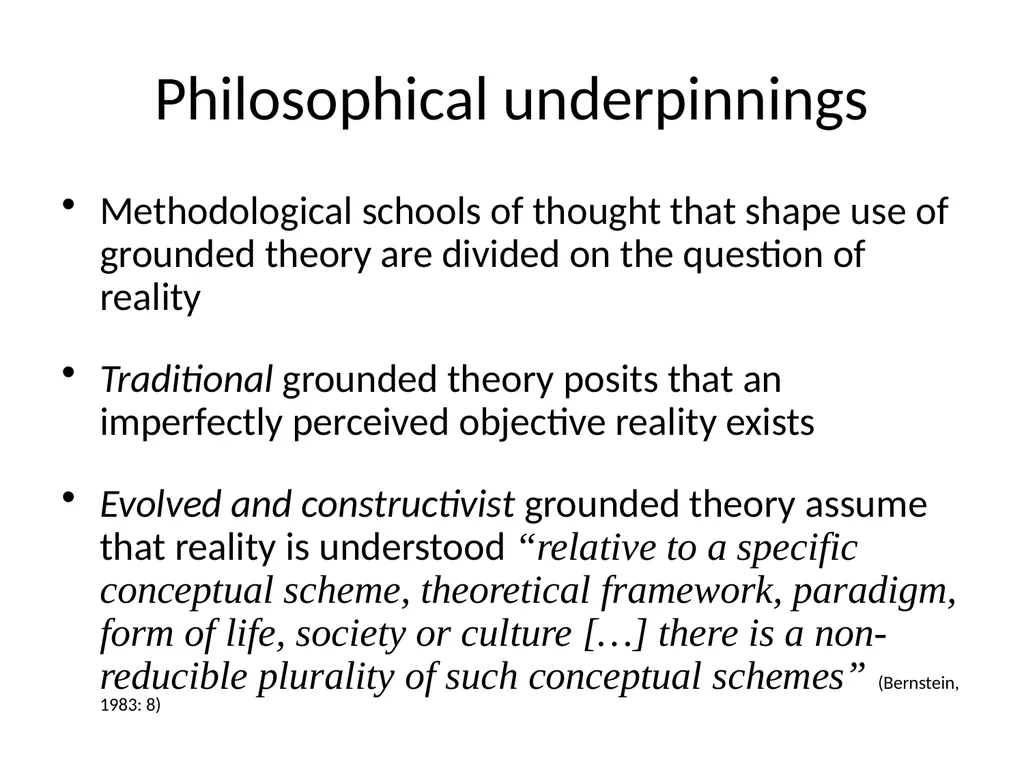
Philosophical underpinnings Methodological schools of thought that shape use of grounded theory are divided on the question of reality
Traditional grounded theory posits that an imperfectly perceived objective reality exists
Evolved and constructivist grounded theory assume that reality is understood “relative to a specific conceptual scheme, theoretical framework, paradigm, form of life, society or culture […] there is a non-reducible plurality of such conceptual schemes” (Bernstein, 1983: 8)<br>
10
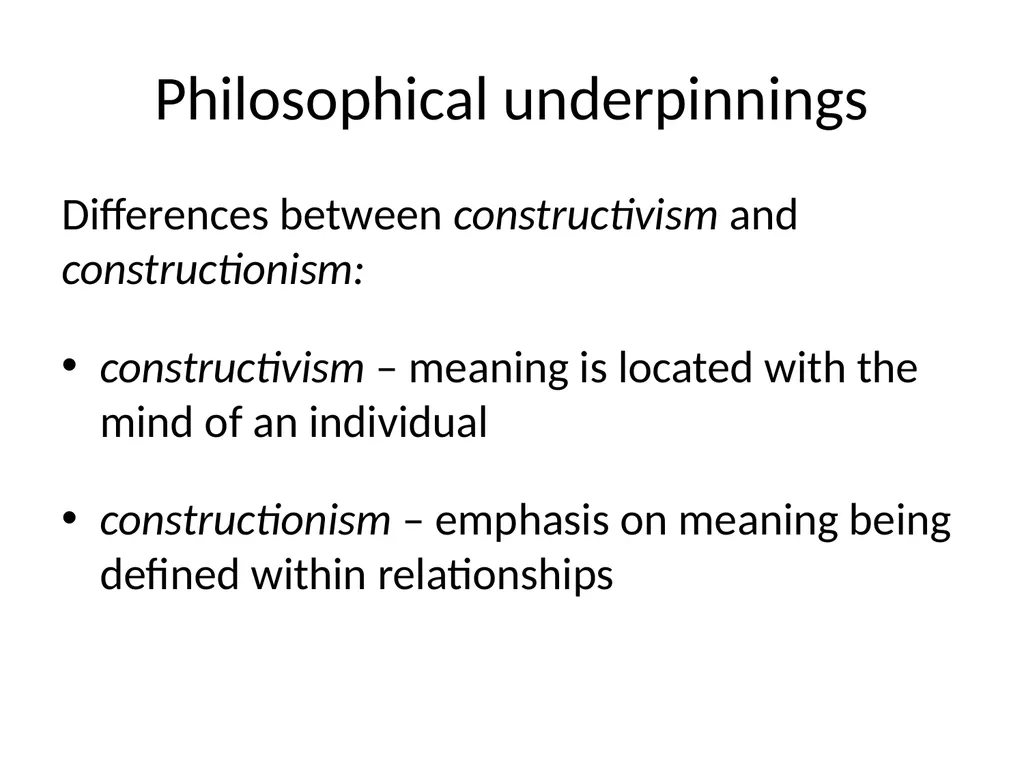
Philosophical underpinnings Differences between constructivism and constructionism:
constructivism – meaning is located with the mind of an individual
constructionism – emphasis on meaning being defined within relationships<br>
constructivism – meaning is located with the mind of an individual
constructionism – emphasis on meaning being defined within relationships<br>
11
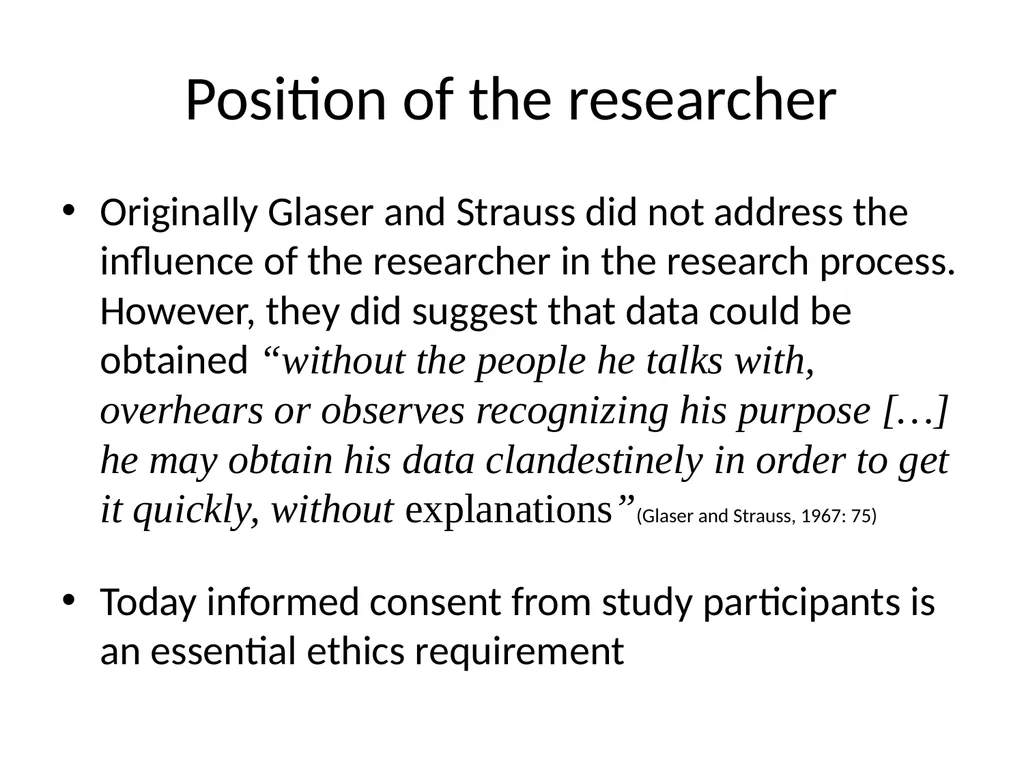
Position of the researcher Originally Glaser and Strauss did not address the influence of the researcher in the research process. However, they did suggest that data could be obtained “without the people he talks with, overhears or observes recognizing his purpose […] he may obtain his data clandestinely in order to get it quickly, without explanations”(Glaser and Strauss, 1967: 75)
Today informed consent from study participants is an essential ethics requirement<br>
Today informed consent from study participants is an essential ethics requirement<br>
12
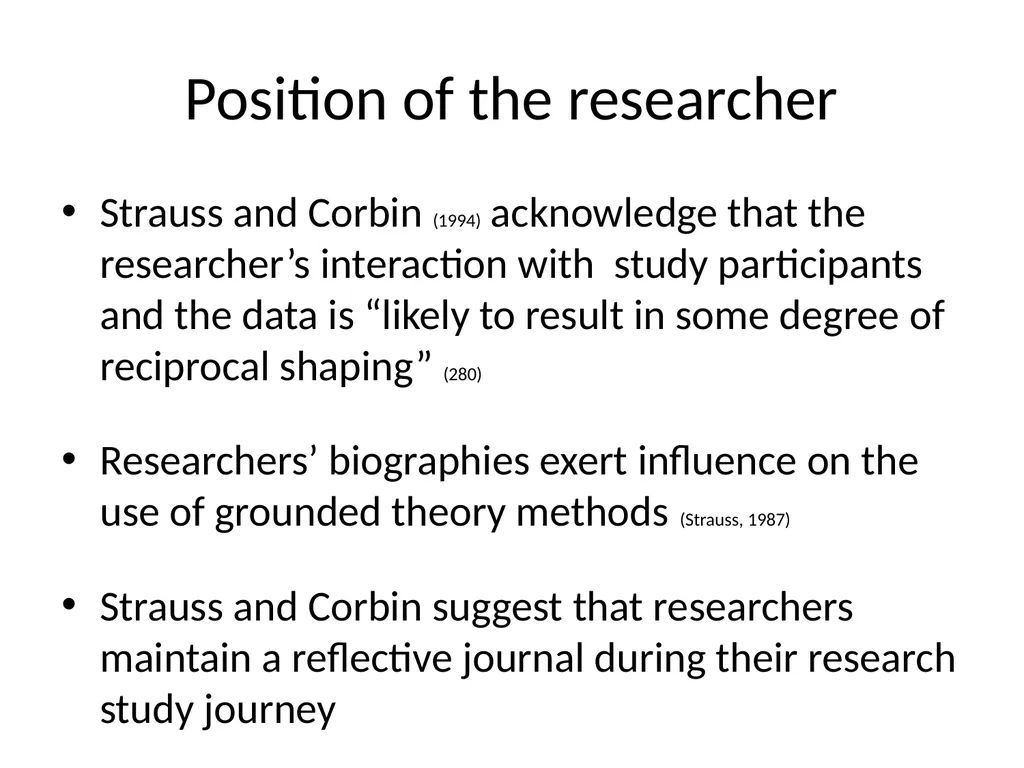
Position of the researcher Strauss and Corbin (1994) acknowledge that the researcher’s interaction with study participants and the data is “likely to result in some degree of reciprocal shaping” (280)
Researchers’ biographies exert influence on the use of grounded theory methods (Strauss, 1987)
Strauss and Corbin suggest that researchers maintain a reflective journal during their research study journey<br>
Researchers’ biographies exert influence on the use of grounded theory methods (Strauss, 1987)
Strauss and Corbin suggest that researchers maintain a reflective journal during their research study journey<br>
13
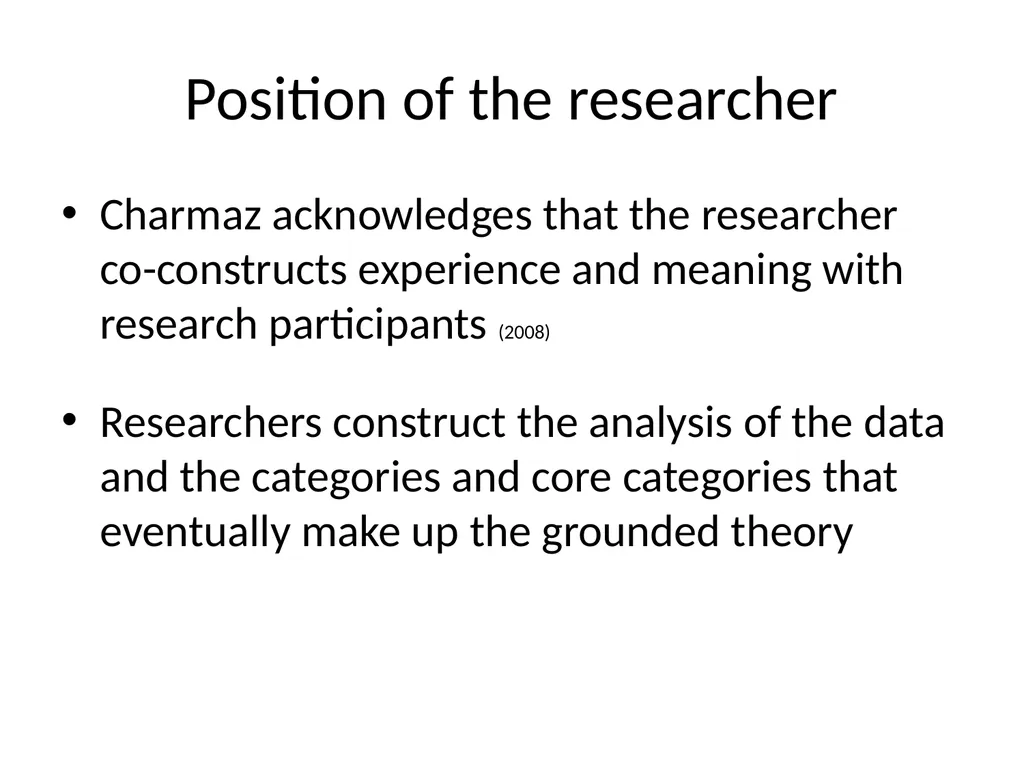
Position of the researcher Charmaz acknowledges that the researcher co-constructs experience and meaning with research participants (2008)
Researchers construct the analysis of the data and the categories and core categories that eventually make up the grounded theory<br>
Researchers construct the analysis of the data and the categories and core categories that eventually make up the grounded theory<br>
14
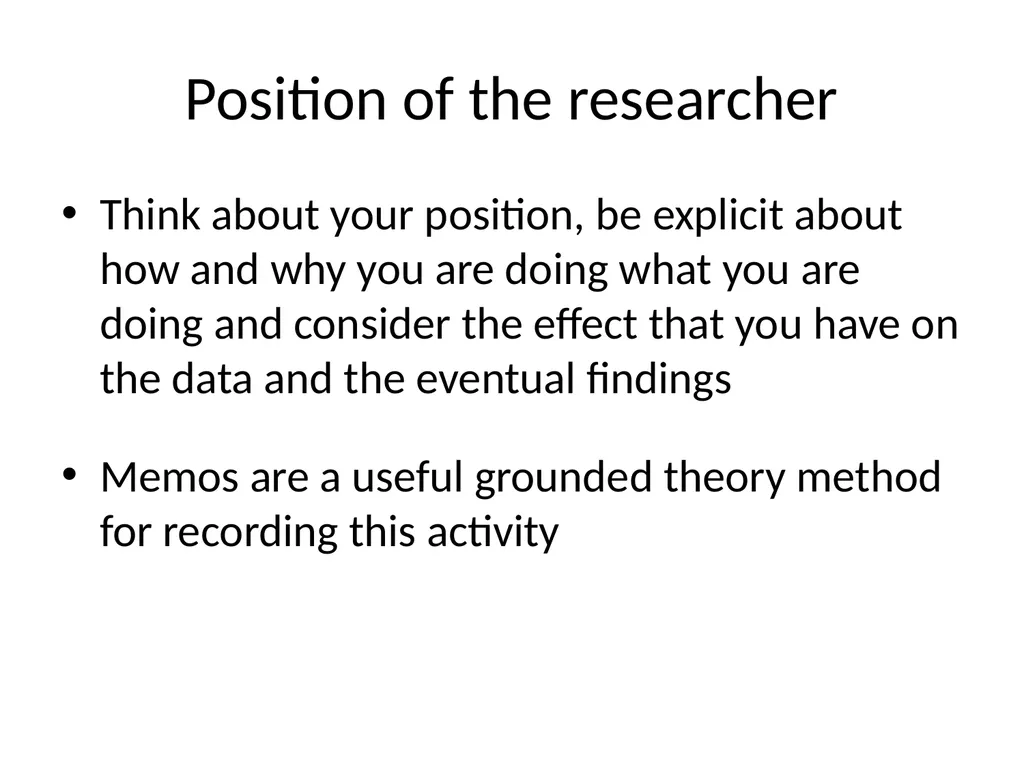
Position of the researcher Think about your position, be explicit about how and why you are doing what you are doing and consider the effect that you have on the data and the eventual findings
Memos are a useful grounded theory method for recording this activity<br>
Memos are a useful grounded theory method for recording this activity<br>
15
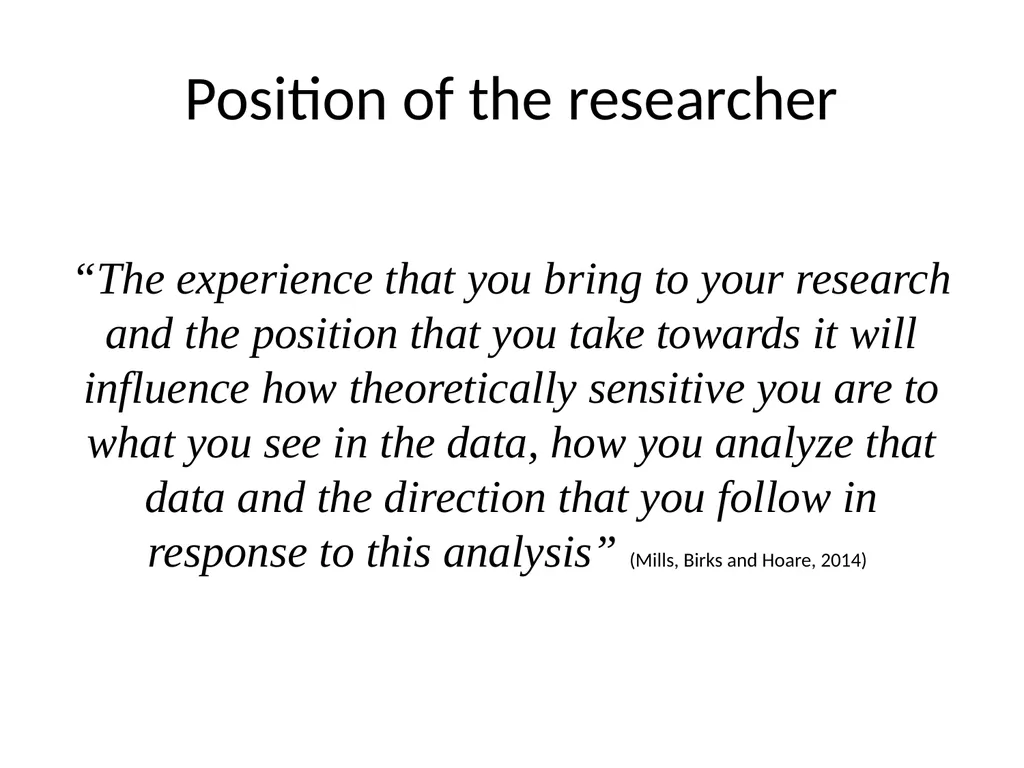
Position of the researcher “The experience that you bring to your research and the position that you take towards it will influence how theoretically sensitive you are to what you see in the data, how you analyze that data and the direction that you follow in response to this analysis” (Mills, Birks and Hoare, 2014)<br>
16
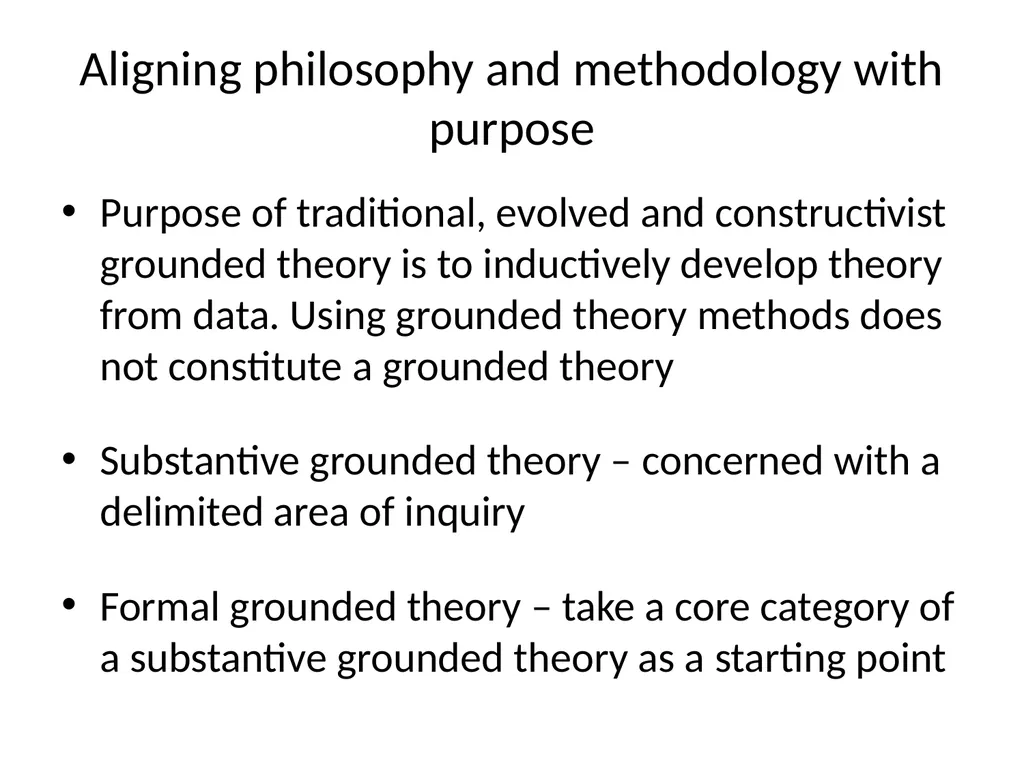
Aligning philosophy and methodology with purpose Purpose of traditional, evolved and constructivist grounded theory is to inductively develop theory from data. Using grounded theory methods does not constitute a grounded theory
Substantive grounded theory – concerned with a delimited area of inquiry
Formal grounded theory – take a core category of a substantive grounded theory as a starting point<br>
Substantive grounded theory – concerned with a delimited area of inquiry
Formal grounded theory – take a core category of a substantive grounded theory as a starting point<br>
17
Data generation and collection Depending on your philosophical and methodological position, how you interact with participants to elicit data, will depend on whether you consider yourself either:
an objective instrument of data collection from participants
a subjective active participant in data generation with participants<br>
an objective instrument of data collection from participants
a subjective active participant in data generation with participants<br>
18
Data generation and collection Similar to other qualitative research methodologies – documents, literature, questionnaires, surveys, fieldnotes, interviews
Memos are an important strategy for logging research activities, recording decision making processes and for progressing analytical procedures (Birks et al., 2009)<br>
Memos are an important strategy for logging research activities, recording decision making processes and for progressing analytical procedures (Birks et al., 2009)<br>
19
Data generation and collection Characterized by concurrent data collection and analysis
Initial purposive sampling of participants
Theoretical sampling to determine where, when and how to collect further data to inform the developing theory<br>
Initial purposive sampling of participants
Theoretical sampling to determine where, when and how to collect further data to inform the developing theory<br>
20
Analysis of data Grounded theory data analysis incorporates:
concurrent data collection & analysis
theoretical sampling
theoretical sensitivity
memoing
constant comparison<br>
concurrent data collection & analysis
theoretical sampling
theoretical sensitivity
memoing
constant comparison<br>
21
Analysis of data Three phases of data analysis:
initial
intermediate
advanced<br>
initial
intermediate
advanced<br>
22
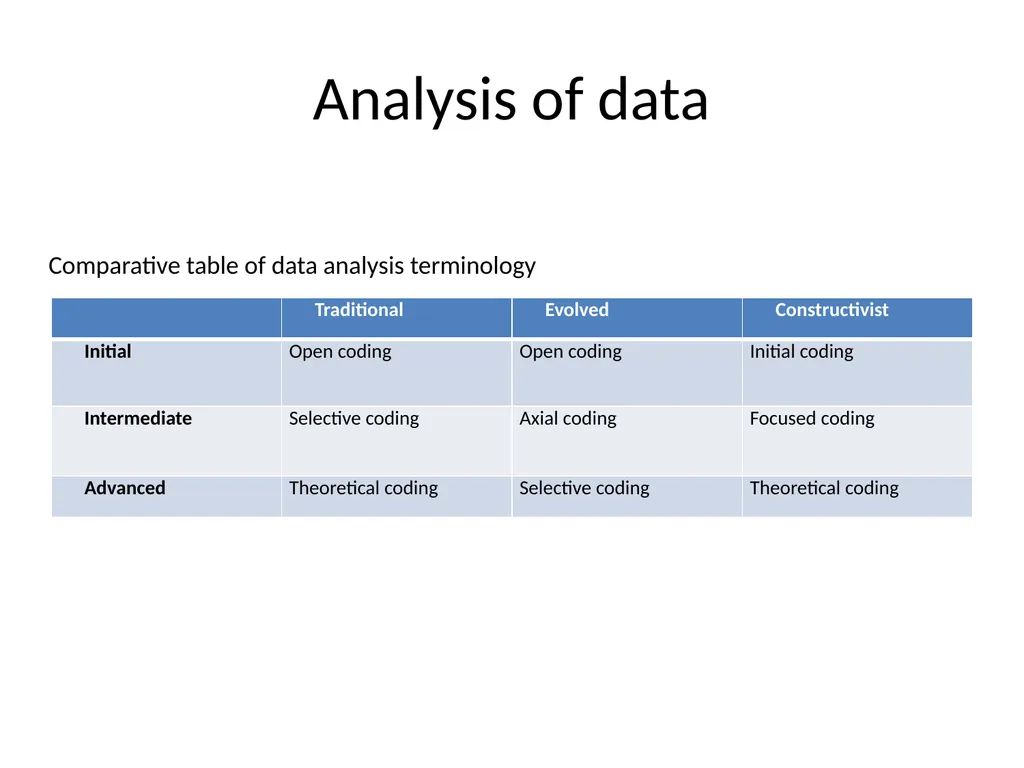
Analysis of data Comparative table of data analysis terminology<br>
23
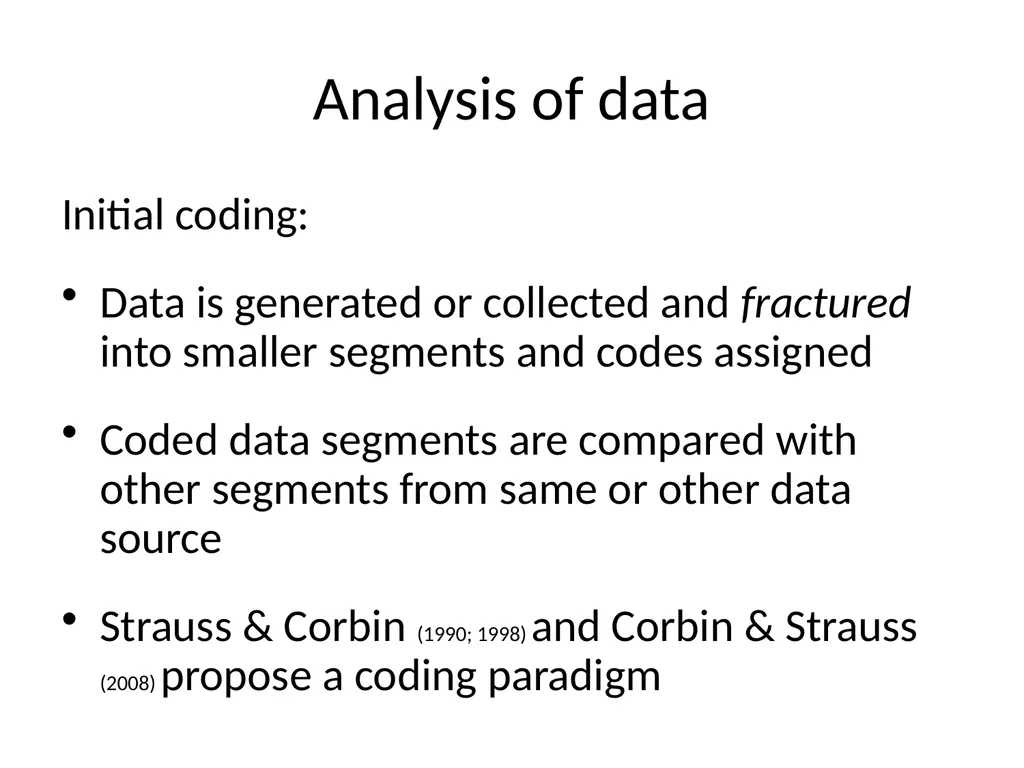
Analysis of data Initial coding:
Data is generated or collected and fractured into smaller segments and codes assigned
Coded data segments are compared with other segments from same or other data source
Strauss & Corbin (1990; 1998) and Corbin & Strauss (2008) propose a coding paradigm<br>
Data is generated or collected and fractured into smaller segments and codes assigned
Coded data segments are compared with other segments from same or other data source
Strauss & Corbin (1990; 1998) and Corbin & Strauss (2008) propose a coding paradigm<br>
24
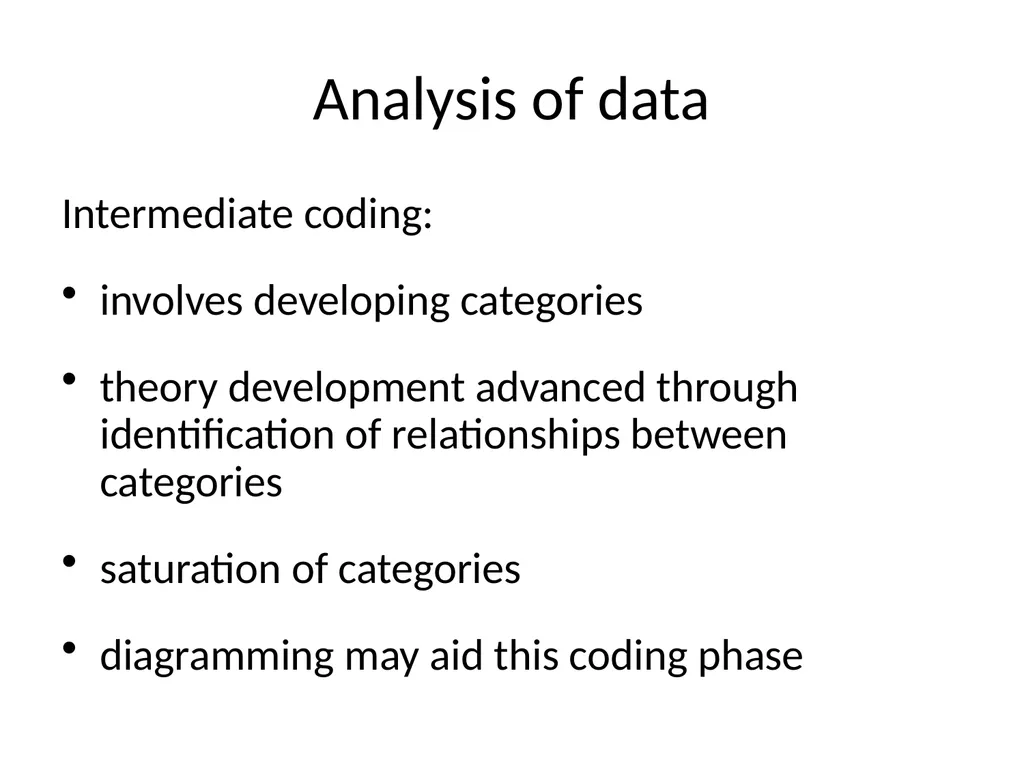
Analysis of data Intermediate coding:
involves developing categories
theory development advanced through identification of relationships between categories
saturation of categories
diagramming may aid this coding phase<br>
involves developing categories
theory development advanced through identification of relationships between categories
saturation of categories
diagramming may aid this coding phase<br>
25
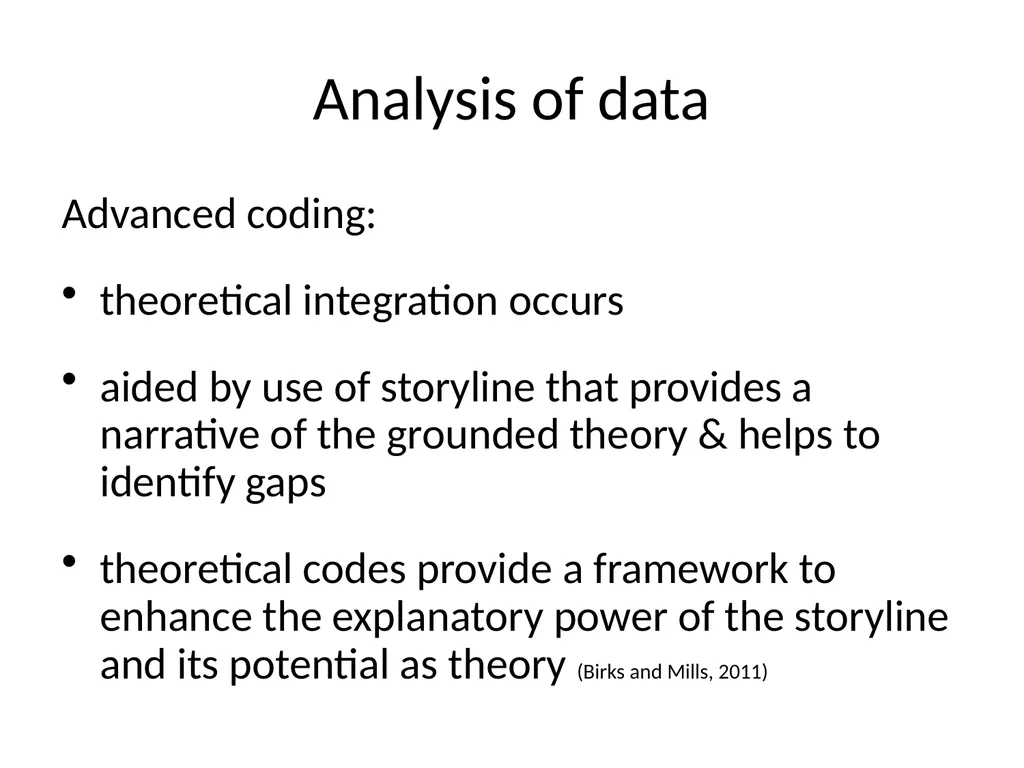
Analysis of data Advanced coding:
theoretical integration occurs
aided by use of storyline that provides a narrative of the grounded theory & helps to identify gaps
theoretical codes provide a framework to enhance the explanatory power of the storyline and its potential as theory (Birks and Mills, 2011)<br>
theoretical integration occurs
aided by use of storyline that provides a narrative of the grounded theory & helps to identify gaps
theoretical codes provide a framework to enhance the explanatory power of the storyline and its potential as theory (Birks and Mills, 2011)<br>
26
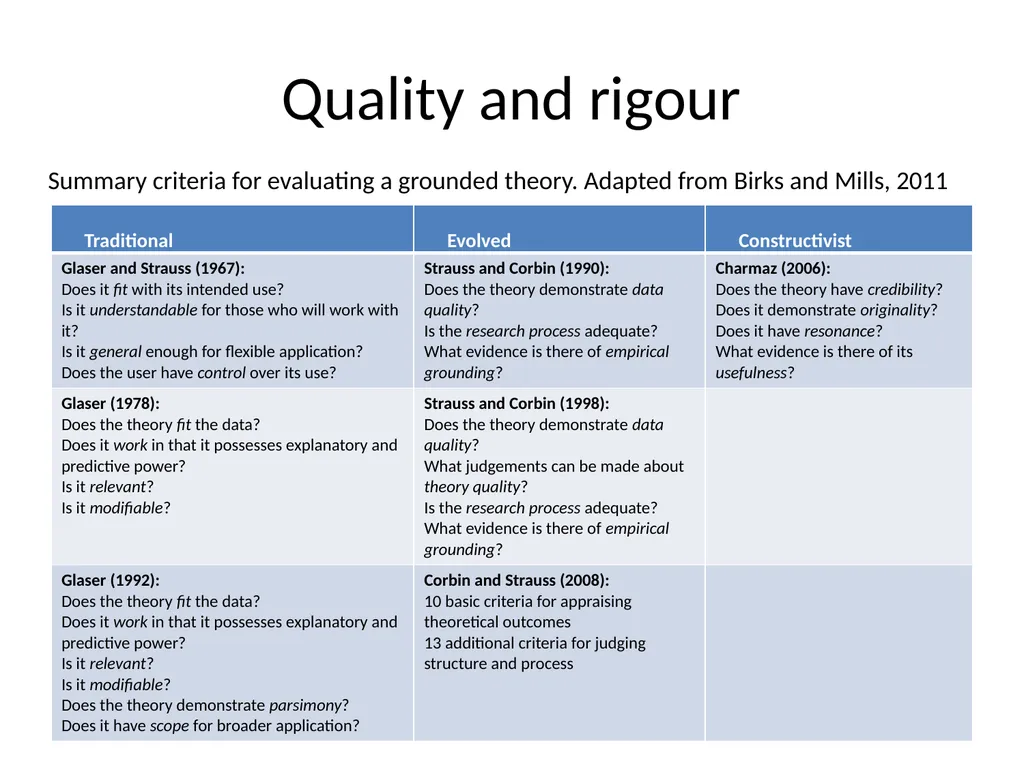
Quality and rigour Summary criteria for evaluating a grounded theory. Adapted from Birks and Mills, 2011<br>
27
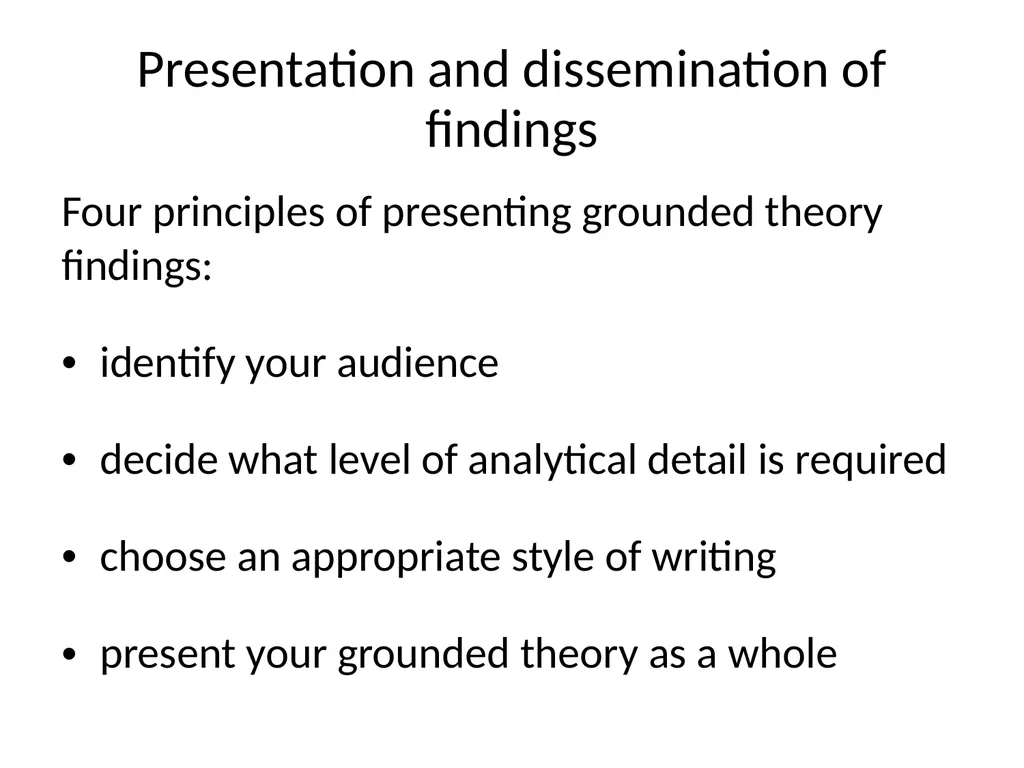
Presentation and dissemination of findings Four principles of presenting grounded theory findings:
identify your audience
decide what level of analytical detail is required
choose an appropriate style of writing
present your grounded theory as a whole<br>
identify your audience
decide what level of analytical detail is required
choose an appropriate style of writing
present your grounded theory as a whole<br>
28
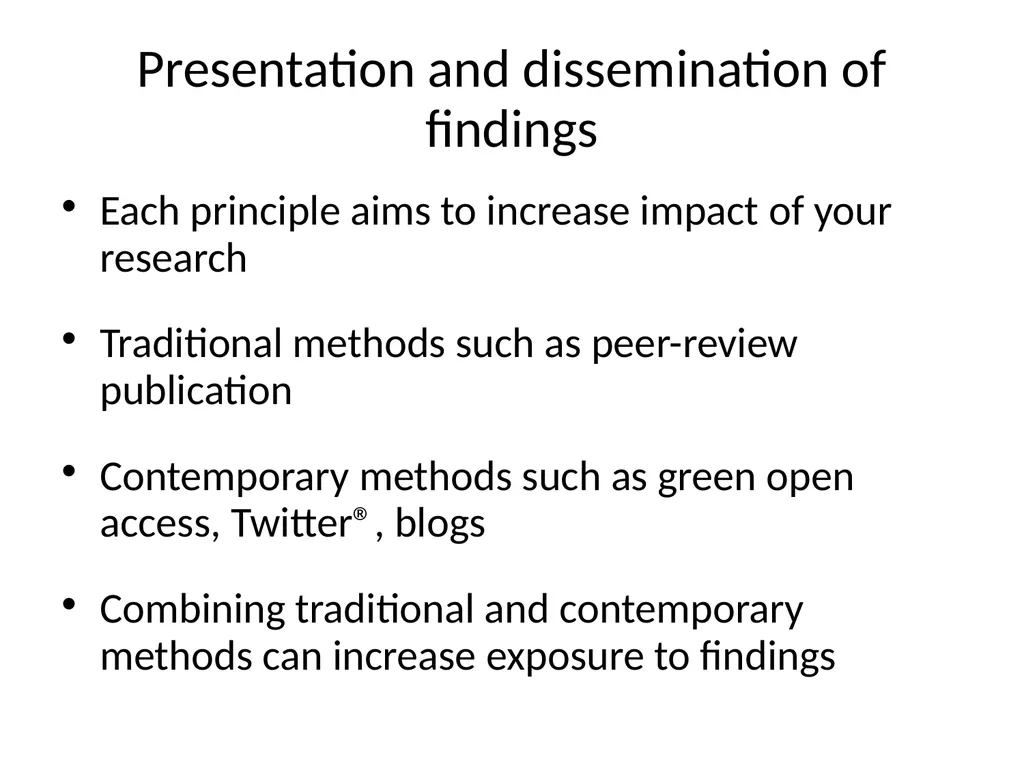
Presentation and dissemination of findings Each principle aims to increase impact of your research
Traditional methods such as peer-review publication
Contemporary methods such as green open access, Twitter®, blogs
Combining traditional and contemporary methods can increase exposure to findings<br>
Traditional methods such as peer-review publication
Contemporary methods such as green open access, Twitter®, blogs
Combining traditional and contemporary methods can increase exposure to findings<br>
29
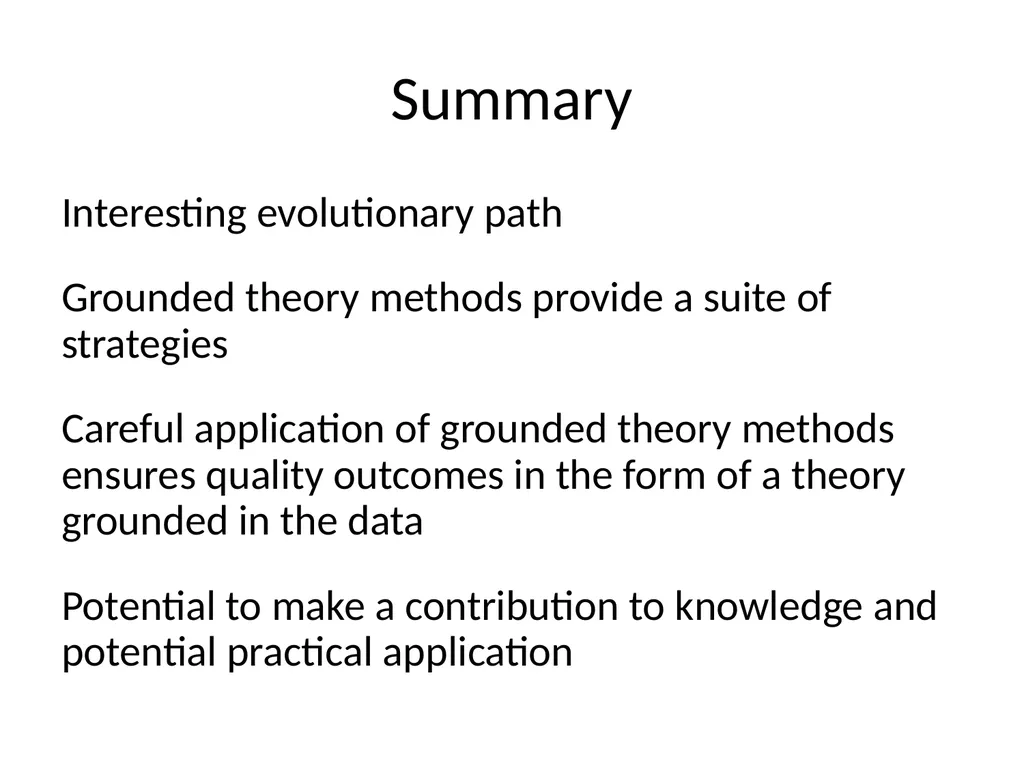
Summary Interesting evolutionary path
Grounded theory methods provide a suite of strategies
Careful application of grounded theory methods ensures quality outcomes in the form of a theory grounded in the data
Potential to make a contribution to knowledge and potential practical application<br>
Grounded theory methods provide a suite of strategies
Careful application of grounded theory methods ensures quality outcomes in the form of a theory grounded in the data
Potential to make a contribution to knowledge and potential practical application<br>
30
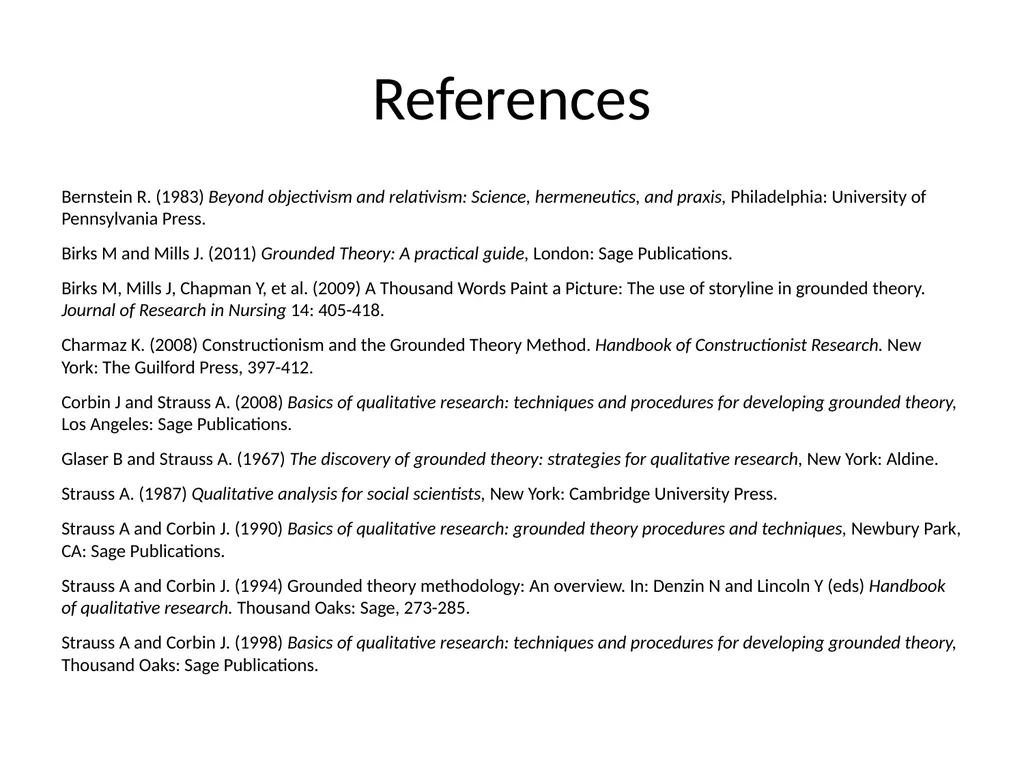
References Bernstein R. (1983) Beyond objectivism and relativism: Science, hermeneutics, and praxis, Philadelphia: University of Pennsylvania Press.
Birks M and Mills J. (2011) Grounded Theory: A practical guide, London: Sage Publications.
Birks M, Mills J, Chapman Y, et al. (2009) A Thousand Words Paint a Picture: The use of storyline in grounded theory. Journal of Research in Nursing 14: 405-418.
Charmaz K. (2008) Constructionism and the Grounded Theory Method. Handbook of Constructionist Research. New York: The Guilford Press, 397-412.
Corbin J and Strauss A. (2008) Basics of qualitative research: techniques and procedures for developing grounded theory, Los Angeles: Sage Publications.
Glaser B and Strauss A. (1967) The discovery of grounded theory: strategies for qualitative research, New York: Aldine.
Strauss A. (1987) Qualitative analysis for social scientists, New York: Cambridge University Press.
Strauss A and Corbin J. (1990) Basics of qualitative research: grounded theory procedures and techniques, Newbury Park, CA: Sage Publications.
Strauss A and Corbin J. (1994) Grounded theory methodology: An overview. In: Denzin N and Lincoln Y (eds) Handbook of qualitative research. Thousand Oaks: Sage, 273-285.
Strauss A and Corbin J. (1998) Basics of qualitative research: techniques and procedures for developing grounded theory, Thousand Oaks: Sage Publications.<br>