
Chapter 7: Promoting Services and Educating
JO
Published · 38 slides · 0 views
1 / 1
Description
Chapter 7: Promoting Services and Educating Customers Overview of Chapter 7 Role of Marketing Communications Challenges of Services Communications Marketing Communications Planning The Marketing Communications Mix Role of Corporate Design
Related Topics
Share
Embed code
Download this presentation From Below
"Chapter 7: Promoting Services and Educating" is the property of its rightful owner. Permission is granted to download and print the materials on this website for personal, non-commercial use only, and to display it on your personal computer provided you do not modify the materials and that you retain all copyright notices contained in the materials. By downloading content from our website, you accept the terms of this agreement.
Presentation Transcript
01
Chapter 7:
Promoting Services and Educating Customers<br>
Promoting Services and Educating Customers<br>
02
Overview of Chapter 7 Role of Marketing Communications
Challenges of Services Communications
Marketing Communications Planning
The Marketing Communications Mix
Role of Corporate Design
Integrating Marketing Communications<br>
Challenges of Services Communications
Marketing Communications Planning
The Marketing Communications Mix
Role of Corporate Design
Integrating Marketing Communications<br>
03
Role of Marketing Communications<br>
04
Specific Roles of Marketing Communications Position and differentiate service
Help customer evaluate offerings and highlight differences that matter
Promote contribution of personnel and backstage operations
Add value through communication content
Facilitate customer involvement in production
Stimulate or dampen demand to match capacity<br>
Help customer evaluate offerings and highlight differences that matter
Promote contribution of personnel and backstage operations
Add value through communication content
Facilitate customer involvement in production
Stimulate or dampen demand to match capacity<br>
05
Help Customers to Evaluate Service Offerings Customers may have difficulty distinguishing one firm from another
Provide tangible clues related to service performance
Some performance attributes lend themselves better to advertising than others
e.g., Airlines
Firm’s expertise is hidden in low-contact services
Need to illustrate equipment, procedures, employee activities that take place backstage<br>
Provide tangible clues related to service performance
Some performance attributes lend themselves better to advertising than others
e.g., Airlines
Firm’s expertise is hidden in low-contact services
Need to illustrate equipment, procedures, employee activities that take place backstage<br>
06
Promote Contributions of
Service Personnel Frontline personnel are central to service delivery in high-contact services
Make the service more tangible and personalized
Show customers work performed behind the scenes to ensure good delivery
To enhance trust, highlight expertise and commitment of employees
Advertisements must be realistic
Messages help set customers’ expectations
Service personnel should be informed about the content of new advertising campaigns or brochures before launch<br>
Make the service more tangible and personalized
Show customers work performed behind the scenes to ensure good delivery
To enhance trust, highlight expertise and commitment of employees
Advertisements must be realistic
Messages help set customers’ expectations
Service personnel should be informed about the content of new advertising campaigns or brochures before launch<br>
07
Facilitate Customer Involvement in Production Customers are actively involved in service production; they need training to perform well
Show service delivery in action
Television and videos engage viewer
e.g., Dentists showing patients videos of surgical procedures before surgery
Streaming videos on web and podcasts are new channels to reach active customers<br>
Show service delivery in action
Television and videos engage viewer
e.g., Dentists showing patients videos of surgical procedures before surgery
Streaming videos on web and podcasts are new channels to reach active customers<br>
08
Stimulate or Dampen Demand to
Match Capacity Live service performances are time-specific and can’t be stored for resale at a later date
Advertising and sales promotions can change timing of customer use
Examples of demand management strategies:
Reducing usage during peak demand periods
Stimulating demand during off-peak period<br>
Advertising and sales promotions can change timing of customer use
Examples of demand management strategies:
Reducing usage during peak demand periods
Stimulating demand during off-peak period<br>
09
Challenges of Services Communications<br>
10
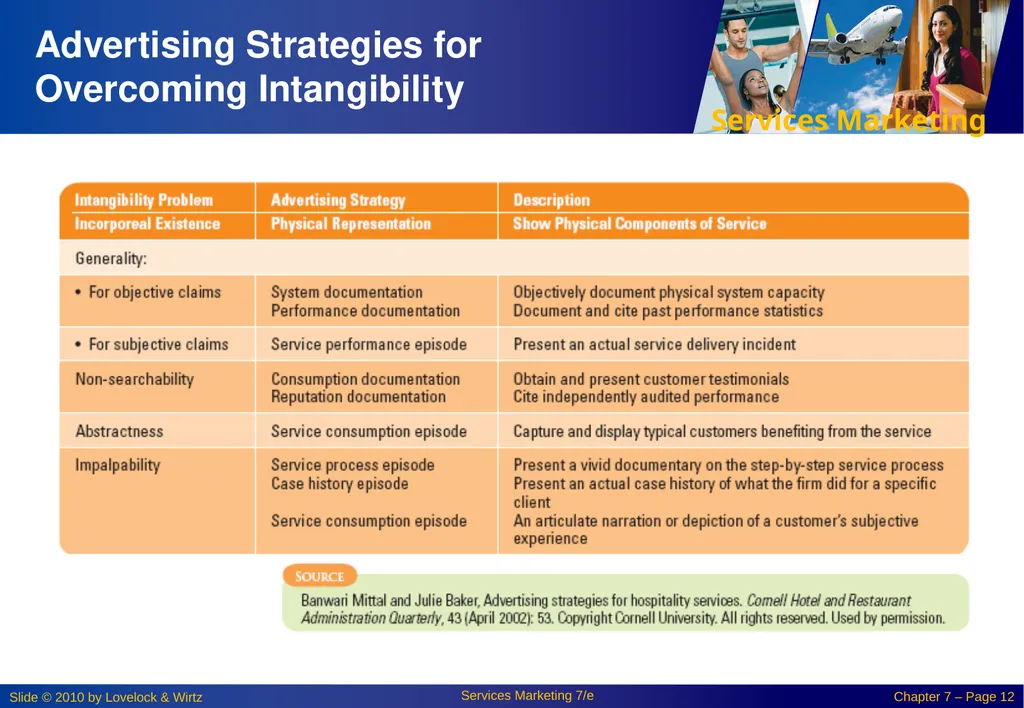
Overcoming Problems of Intangibility Intangibility creates 4 problems:
Generality
- Items that comprise a class of objects, persons, or events
Abstractness
- No one-to-one correspondence with physical objects
Non-searchability
- Cannot be searched or inspected before purchase
Mental impalpability
- Customers find it hard to grasp benefits of complex, multi-dimensional new offerings<br>
Generality
- Items that comprise a class of objects, persons, or events
Abstractness
- No one-to-one correspondence with physical objects
Non-searchability
- Cannot be searched or inspected before purchase
Mental impalpability
- Customers find it hard to grasp benefits of complex, multi-dimensional new offerings<br>
11
To overcome intangibility
Use tangible cues in advertising
Use metaphors
Tangible metaphors help to communicate benefits of service offerings, e.g.,
Allstate – “You’re in good hands”
Prudential Insurance – uses Rock of Gibraltar as symbol of corporate strength
Metaphors communicate value propositions more dramatically and emphasize key points of difference Overcoming Problems of Intangibility<br>
Use tangible cues in advertising
Use metaphors
Tangible metaphors help to communicate benefits of service offerings, e.g.,
Allstate – “You’re in good hands”
Prudential Insurance – uses Rock of Gibraltar as symbol of corporate strength
Metaphors communicate value propositions more dramatically and emphasize key points of difference Overcoming Problems of Intangibility<br>
12
Advertising Strategies for
Overcoming Intangibility<br>
13
Marketing Communications Planning<br>
14
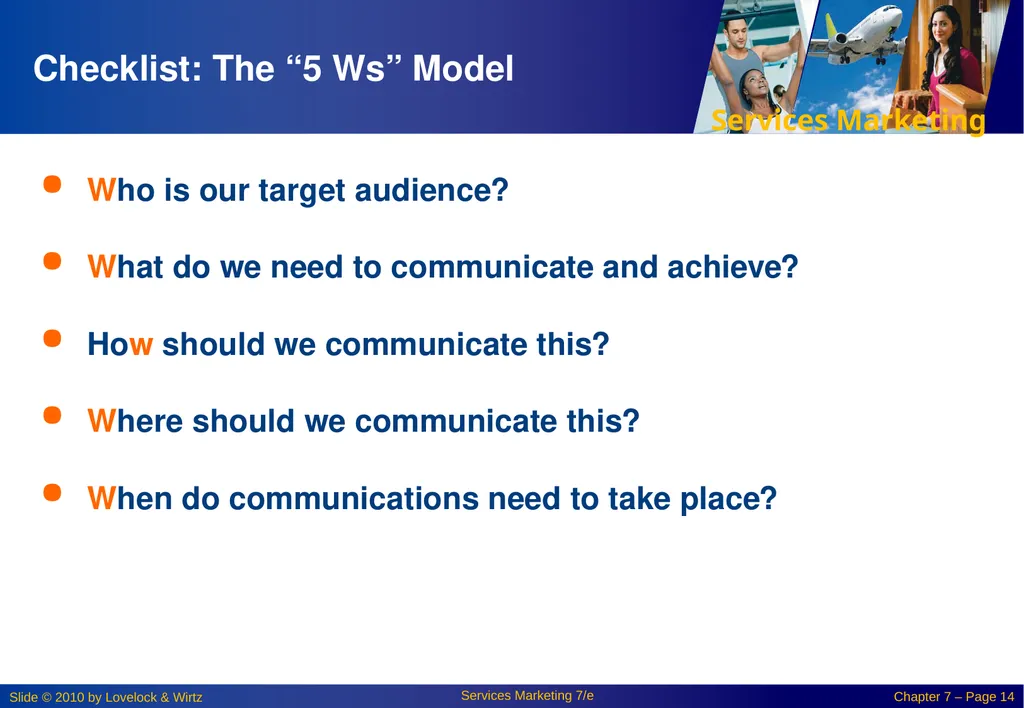
Checklist: The “5 Ws” Model Who is our target audience?
What do we need to communicate and achieve?
How should we communicate this?
Where should we communicate this?
When do communications need to take place?<br>
What do we need to communicate and achieve?
How should we communicate this?
Where should we communicate this?
When do communications need to take place?<br>
15
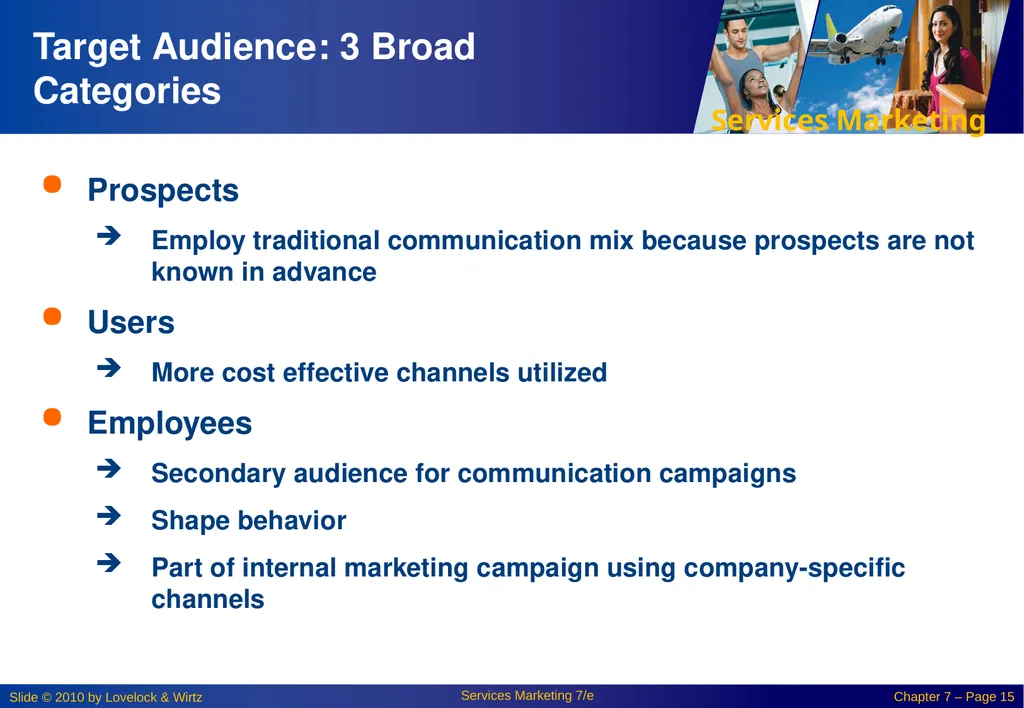
Target Audience: 3 Broad Categories Prospects
Employ traditional communication mix because prospects are not known in advance
Users
More cost effective channels utilized
Employees
Secondary audience for communication campaigns
Shape behavior
Part of internal marketing campaign using company-specific channels<br>
Employ traditional communication mix because prospects are not known in advance
Users
More cost effective channels utilized
Employees
Secondary audience for communication campaigns
Shape behavior
Part of internal marketing campaign using company-specific channels<br>
16
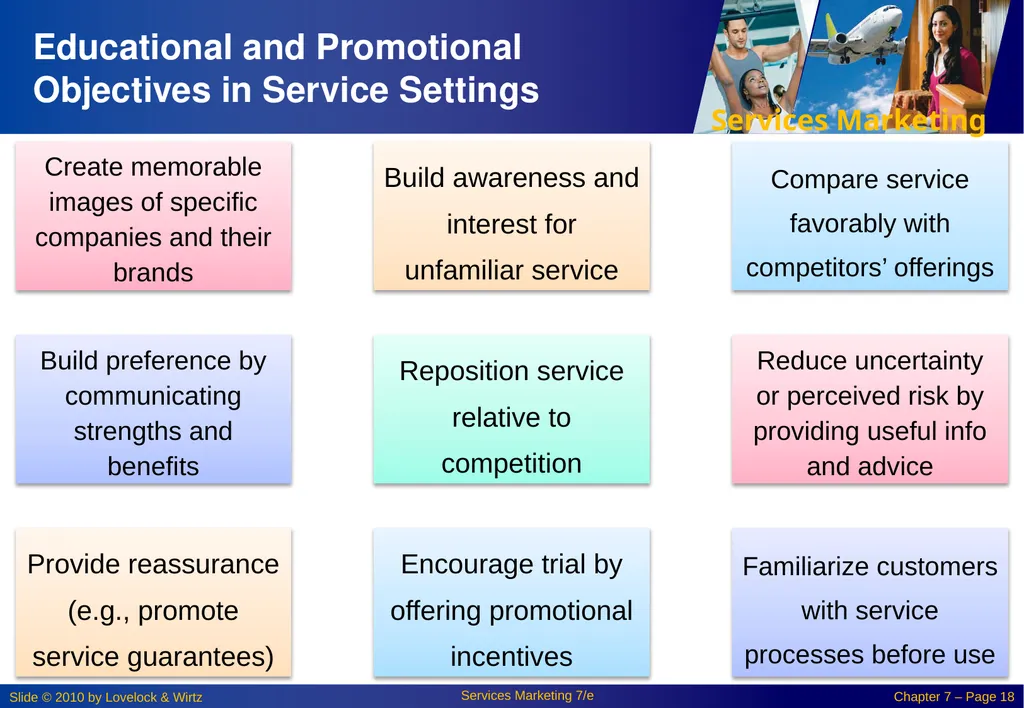
Educational and Promotional Objectives in Service Settings Create memorable images of specific companies and their brands
Build awareness and interest for unfamiliar service
Compare service favorably with competitors’ offerings
Build preference by communicating strengths and benefits
Reposition service relative to competition
Reduce uncertainty or perceived risk by providing useful info and advice<br>
Build awareness and interest for unfamiliar service
Compare service favorably with competitors’ offerings
Build preference by communicating strengths and benefits
Reposition service relative to competition
Reduce uncertainty or perceived risk by providing useful info and advice<br>
17
Educational and Promotional Objectives in Service Settings Provide reassurance (e.g., promote service guarantees)
Encourage trial by offering promotional incentives
Familiarize customers with service processes before use
Teach customers how to use a service to best advantage
Stimulate demand in off-peak, discourage during peak
Recognize and reward valued customers and employees<br>
Encourage trial by offering promotional incentives
Familiarize customers with service processes before use
Teach customers how to use a service to best advantage
Stimulate demand in off-peak, discourage during peak
Recognize and reward valued customers and employees<br>
18
Educational and Promotional Objectives in Service Settings<br>
19
The Marketing Communications Mix<br>
20
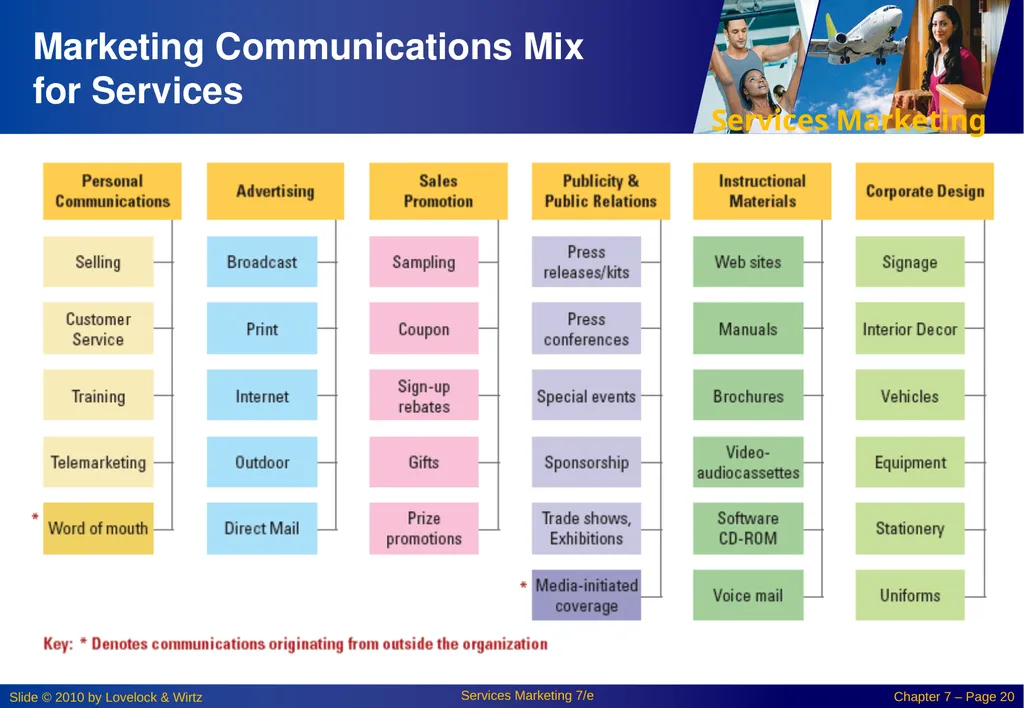
Marketing Communications Mix
for Services<br>
21
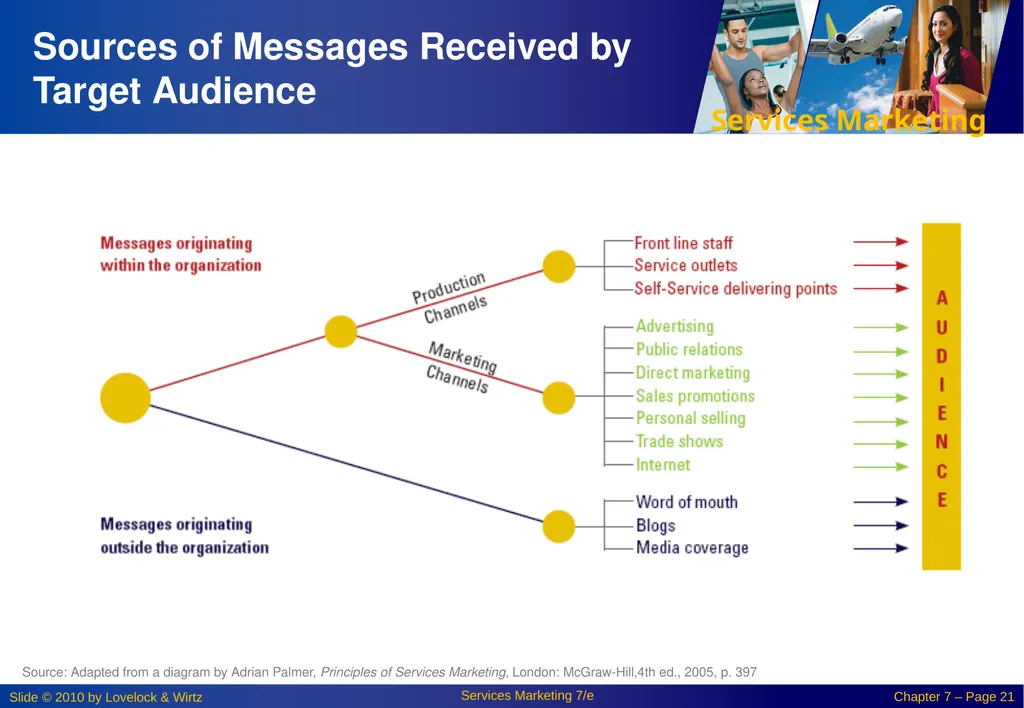
Sources of Messages Received by
Target Audience Source: Adapted from a diagram by Adrian Palmer, Principles of Services Marketing, London: McGraw-Hill,4th ed., 2005, p. 397<br>
22
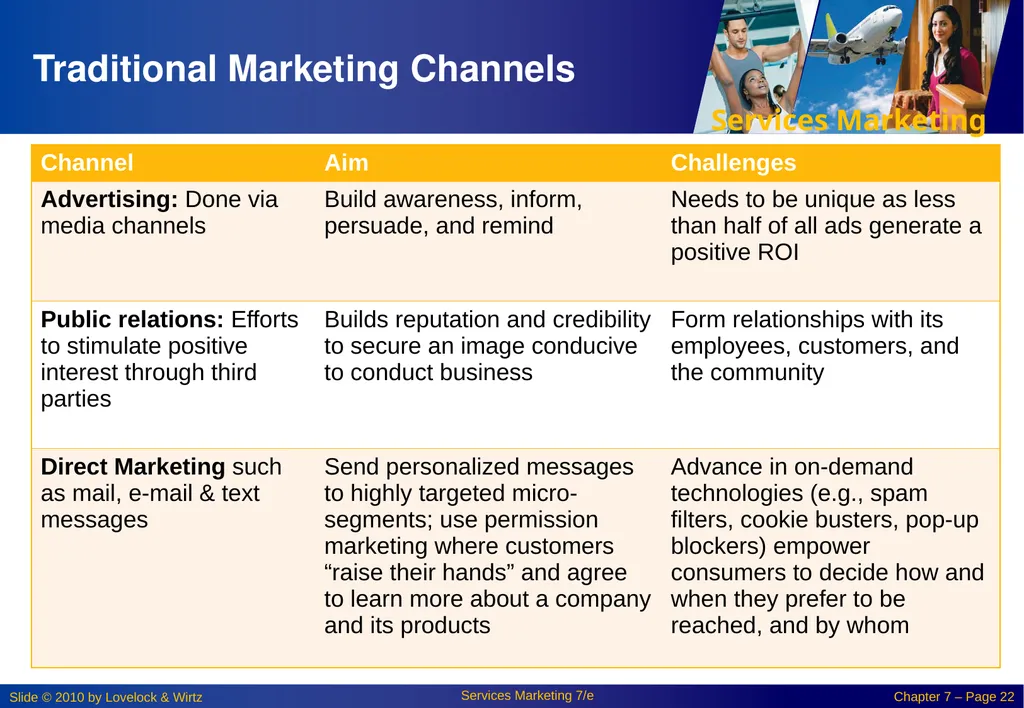
Traditional Marketing Channels<br>
23
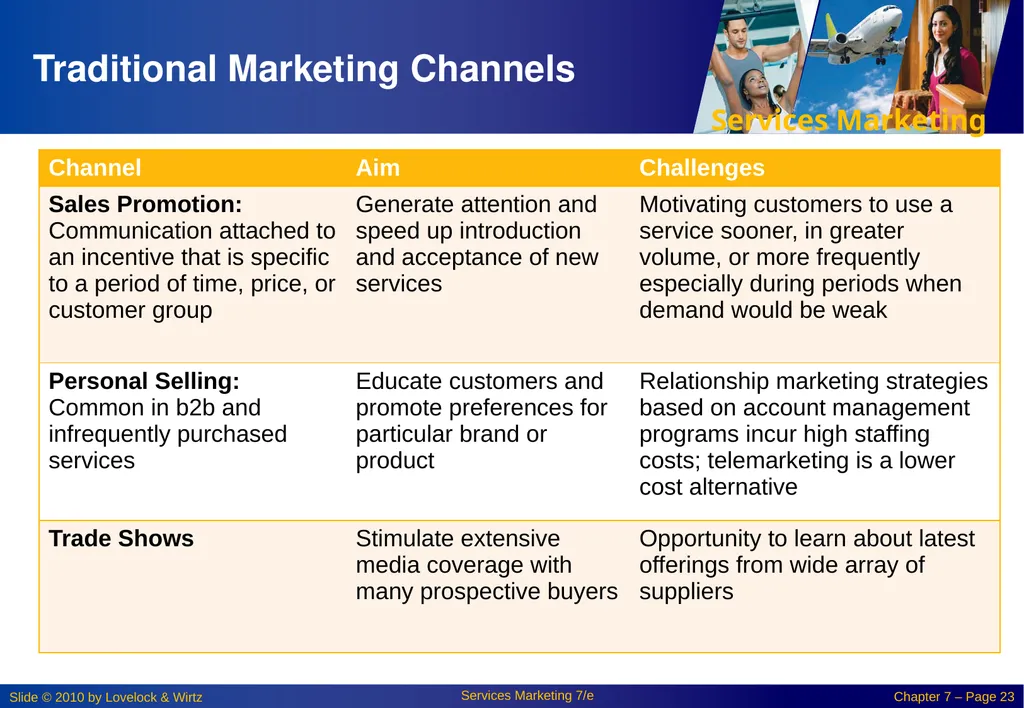
Traditional Marketing Channels<br>
24
Internet Marketing Offers Powerful Opportunities Supplement traditional marketing channels at a reasonable cost
Part of an integrated, well-designed communications strategy
Can market through the company’s own website or through online advertising<br>
Part of an integrated, well-designed communications strategy
Can market through the company’s own website or through online advertising<br>
25
Website Design Considerations Used for a variety of communication tasks
Promoting consumer awareness and interest
Providing information and consultation
Facilitating 2-way communication
Stimulating product trial
Enabling customers to place orders
Design should address attributes that affect website “stickiness”
High in quality content
Ease of use
Quick to download
Frequency of update
Memorable Web address helps attract visitors to the site<br>
Promoting consumer awareness and interest
Providing information and consultation
Facilitating 2-way communication
Stimulating product trial
Enabling customers to place orders
Design should address attributes that affect website “stickiness”
High in quality content
Ease of use
Quick to download
Frequency of update
Memorable Web address helps attract visitors to the site<br>
26
Effective Advertising on Internet:
Banner Advertising Banner Advertising: Placing advertising banners and buttons on portals such as Yahoo and other firms’ websites to draw online traffic to own site
Easy for advertisers to measure how many visits to its own website are generated by click-throughs
Limitations
Obtaining many exposures does not necessarily lead to increase in awareness, preference, or sales
Fraudulent click-throughs designed to boost apparent effectiveness<br>
Easy for advertisers to measure how many visits to its own website are generated by click-throughs
Limitations
Obtaining many exposures does not necessarily lead to increase in awareness, preference, or sales
Fraudulent click-throughs designed to boost apparent effectiveness<br>
27
Effective Advertising on Internet:
Search Engine Advertising Search Engine Advertising (Reverse broadcast network): search engines let advertisers know exactly what consumer wants through their keyword search
Target relevant messages directly to desired consumers
Advertising options:
Pay for targeted placement of ads to relevant keyword searches
Sponsor a short text message with a click-through link
Buy top rankings in the display of search results
E.g., Google – The New Online Marketing Powerhouse via Adsense and Adwords<br>
Target relevant messages directly to desired consumers
Advertising options:
Pay for targeted placement of ads to relevant keyword searches
Sponsor a short text message with a click-through link
Buy top rankings in the display of search results
E.g., Google – The New Online Marketing Powerhouse via Adsense and Adwords<br>
28
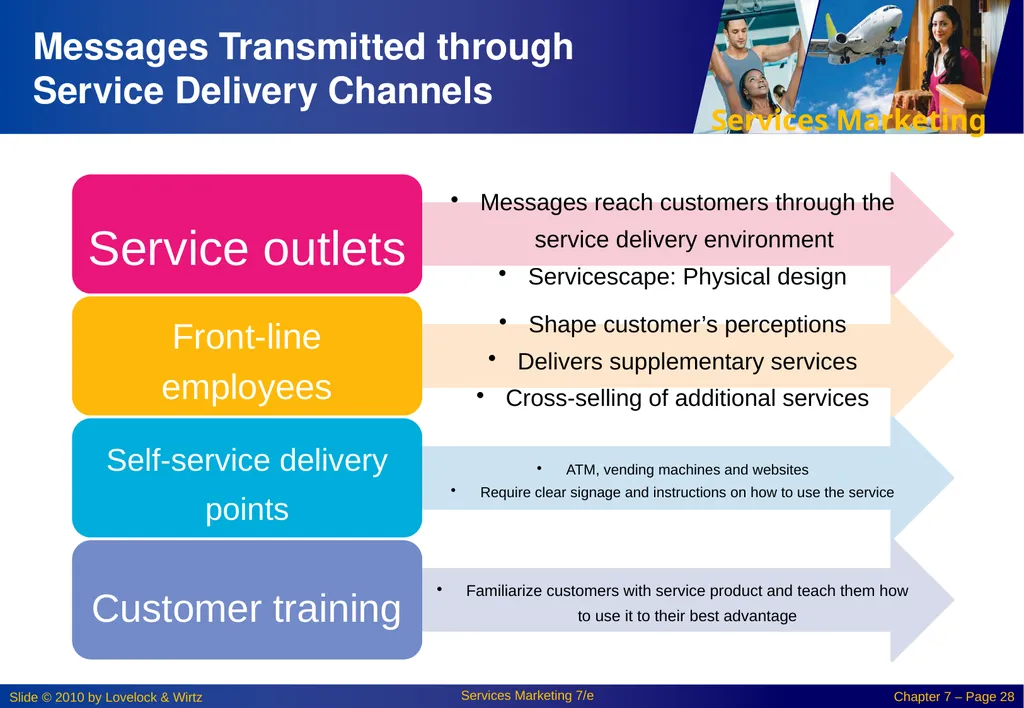
Messages Transmitted through
Service Delivery Channels<br>
29
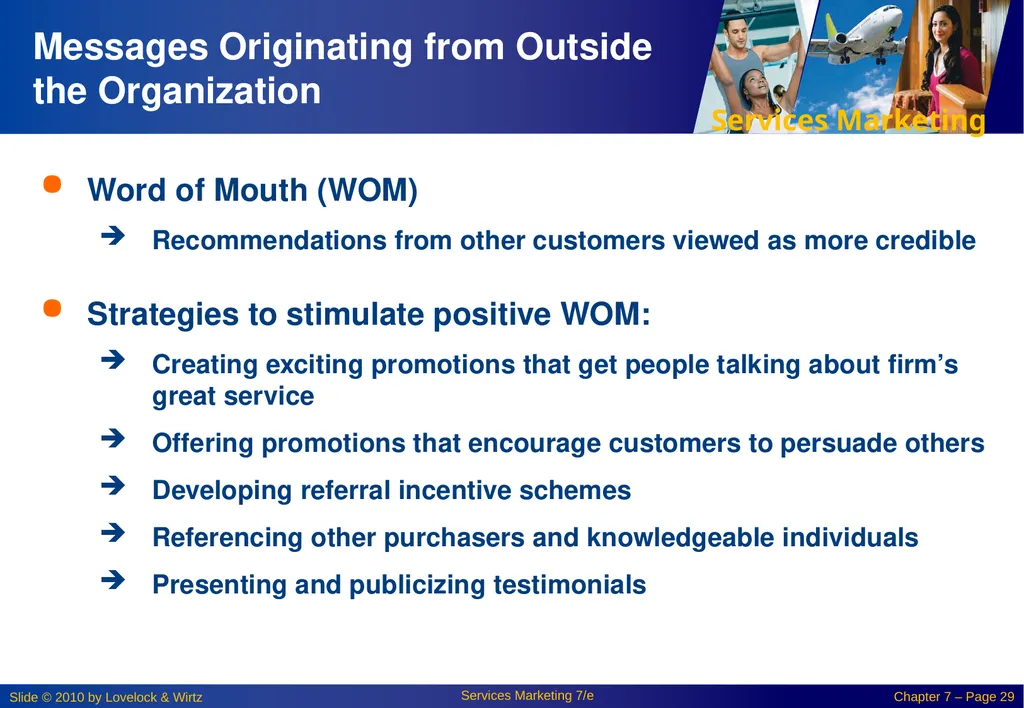
Messages Originating from Outside the Organization Word of Mouth (WOM)
Recommendations from other customers viewed as more credible
Strategies to stimulate positive WOM:
Creating exciting promotions that get people talking about firm’s great service
Offering promotions that encourage customers to persuade others
Developing referral incentive schemes
Referencing other purchasers and knowledgeable individuals
Presenting and publicizing testimonials<br>
Recommendations from other customers viewed as more credible
Strategies to stimulate positive WOM:
Creating exciting promotions that get people talking about firm’s great service
Offering promotions that encourage customers to persuade others
Developing referral incentive schemes
Referencing other purchasers and knowledgeable individuals
Presenting and publicizing testimonials<br>
30
Messages Originating from Outside the Organization Blogs – A new type of online WOM
Twitter
Media Coverage
Compares, contrasts service offerings from competing organizations
Advice on “best buys”<br>
Media Coverage
Compares, contrasts service offerings from competing organizations
Advice on “best buys”<br>
31
Ethical Issues in Communication Poor internal communications between operations and marketing personnel concerning level of service performance
Deliberately exaggerated promises to secure sales
Deceptive promotions
Unwanted intrusion by aggressive marketers into people’s personal lives<br>
Deliberately exaggerated promises to secure sales
Deceptive promotions
Unwanted intrusion by aggressive marketers into people’s personal lives<br>
32
Role of Corporate Design<br>
33
Strategies for Corporate Design Many service firms employ a unified and distinctive visual appearance for all tangible elements
e.g., Logos, uniforms, physical facilities
Provide a recognizable theme linking all the firm’s operations use of physical evidence
e.g., BP’s bright green and yellow service stations
Use of trademarked symbol as primary logo, with name secondary
McDonald’s “Golden Arches”<br>
e.g., Logos, uniforms, physical facilities
Provide a recognizable theme linking all the firm’s operations use of physical evidence
e.g., BP’s bright green and yellow service stations
Use of trademarked symbol as primary logo, with name secondary
McDonald’s “Golden Arches”<br>
34
Strategies for Corporate Design International companies need to select designs carefully to avoid conveying a culturally inappropriate message
Easily recognizable corporate symbols important for international marketers in markets where:
Local language is not written in Roman Script
Significant portion of population is illiterate<br>
Easily recognizable corporate symbols important for international marketers in markets where:
Local language is not written in Roman Script
Significant portion of population is illiterate<br>
35
FedEx: Use of Company Name In
Corporate Design Created “FedEx Family of companies” consisting of subbrands for different services; carried its positive FedEx Express image to other, often low cost services. FedEx Express
FedEx Ground
FedEx Home Delivery
FedEx Freight
FedEx Custom Critical
FedEx Supply Chain Services
FedEx Kinko’s Each subbrand has different color scheme for second word to create differentiation for subbrands, e.g.,
Express is red/orange
Ground is green<br>
FedEx Ground
FedEx Home Delivery
FedEx Freight
FedEx Custom Critical
FedEx Supply Chain Services
FedEx Kinko’s Each subbrand has different color scheme for second word to create differentiation for subbrands, e.g.,
Express is red/orange
Ground is green<br>
36
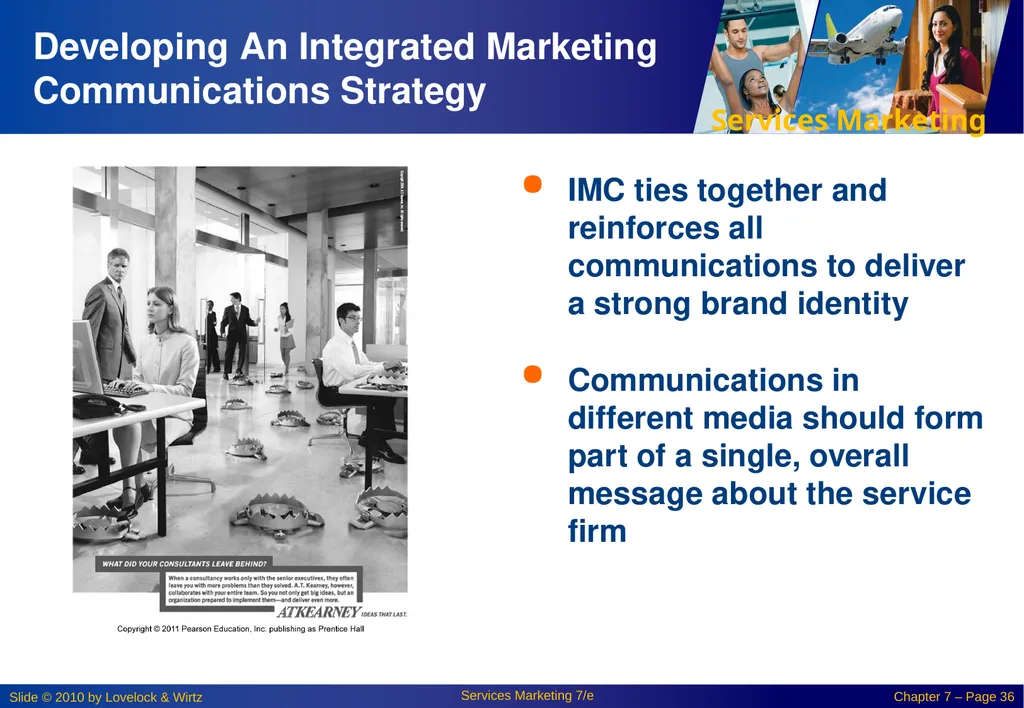
Developing An Integrated Marketing Communications Strategy IMC ties together and reinforces all communications to deliver a strong brand identity
Communications in different media should form part of a single, overall message about the service firm<br>
Communications in different media should form part of a single, overall message about the service firm<br>
37
Summary Marketing communications adds value through its content
Overcome problems of intangibility – use metaphors to communicate value proposition
Communication planning involves knowing (5Ws)
Marketing communications originate from within the organization through production and marketing channels<br>
Overcome problems of intangibility – use metaphors to communicate value proposition
Communication planning involves knowing (5Ws)
Marketing communications originate from within the organization through production and marketing channels<br>
38
Summary Service delivery channels include
Service outlets
Front-line employees
Self-service delivery points
Marketing communications originating from outside organization include
Word of mouth
Blogs
Twitter
Media coverage
Corporate design strategies are part and parcel of communication mix<br>
Service outlets
Front-line employees
Self-service delivery points
Marketing communications originating from outside organization include
Word of mouth
Blogs
Media coverage
Corporate design strategies are part and parcel of communication mix<br>