
CHAPTER 7 Roles and Responsibilities of the Cath
OM
Published · 27 slides · 0 views

1 / 1

Description
CHAPTER 7 Roles and Responsibilities of the Cath Lab Team Learning Objectives Determine the primary team roles of the invasive cardiovascular laboratory team. Describe the tasks required to set up a cath lab for a patients arrival.
Related Topics
Share
Embed code
Download this presentation From Below
"CHAPTER 7 Roles and Responsibilities of the Cath" is the property of its rightful owner. Permission is granted to download and print the materials on this website for personal, non-commercial use only, and to display it on your personal computer provided you do not modify the materials and that you retain all copyright notices contained in the materials. By downloading content from our website, you accept the terms of this agreement.
Presentation Transcript
01
CHAPTER 7 Roles and Responsibilities of the Cath Lab Team<br>
02
Learning Objectives Determine the primary team roles of the invasive cardiovascular laboratory team.
Describe the tasks required to set up a cath lab for a patient’s arrival.
Understand how to prep a patient’s access site.
Appreciate the wide range of tasks that the members of a cath lab team must perform during an endovascular procedure.
Understand how to care for a patient during a diagnostic or interventional procedure.<br>
03
Procedural Guidelines The procedures discussed in this presentation are an educational guide only.
Products’ instructions for use must be followed and adequate in-service education must be provided before a novice can perform a procedure.<br>
04
Cath Lab Staff All ICVL support staff members should be certified in:
Basic life support (BLS)
Advanced cardiac life support (ACLS)
Pediatric advanced life support (PALS) if pediatric studies are performed
All members of the team must understand the roles of the other members of the support team, especially in an emergency.
All team members, including physicians, need to be active participants in preprocedure huddles, timeouts, and all phases of the procedure.
Ultimately, the responsibility of the procedural outcome lies with the physician.<br>
05
Monitor/Recorder (1 of 2) Patient demographic information
All hemodynamic data
All medications administered
All catheters and other equipment used
Angiographic views
Complications
IV infusion volume
Contrast medium dose administered to the patient
Fluoroscopy time for the procedure<br>
06
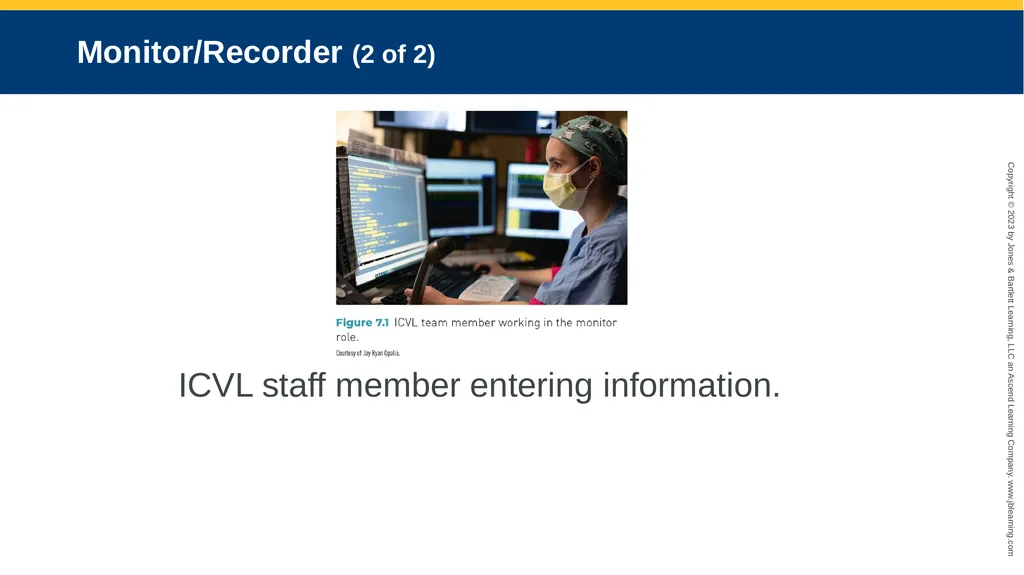
Monitor/Recorder (2 of 2) ICVL staff member entering information.<br>
07
Scrub Assistant (1 of 3) Directly aids the attending physician at the procedure table.
Dons a lead apron, surgical gown, and gloves.
Prepares the access site(s) and drapes the patient.
Sets up contrast medium and saline delivery lines.
Sets up and organizes the sterile instrumentation table.
Prepares sheath, catheters, guide wires, and other invasive equipment.
Assists the physician with catheter and wire exchanges and placement of interventional devices.<br>
08
Scrub Assistant (2 of 3) Properly identify all drugs on the table, preferably with a sterile label.
Always preflush catheters and store them lengthwise on the table.
Never thread a needle over a guide wire.
Prep the manifold or power injector tubing.
Manage catheters and syringes to ensure that no air is injected.
Flush catheters between each contrast injection.
Make sure each device is compatible with the sheath and the procedure.
Anticipate the physician’s and patient’s needs.
Always maintain aseptic technique.<br>
09
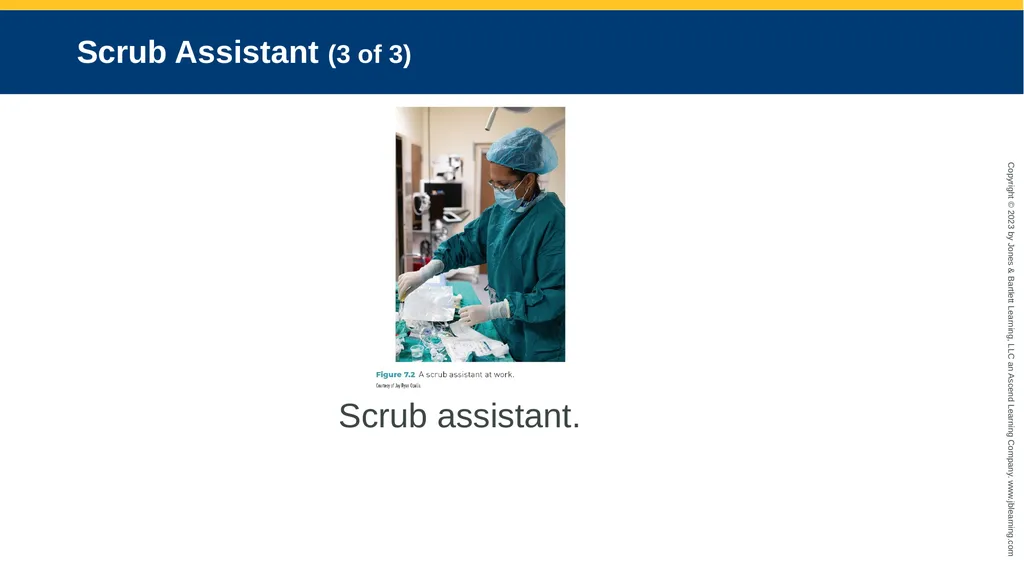
Scrub Assistant (3 of 3) Scrub assistant.<br>
10
Circulator (1 of 2) Assists the flow of the procedure from outside the sterile field.
Wears a lead apron.
Responsible for the direct assessment of the patient.
Inserts a peripheral IV line if the patient has not yet been cannulated.
Retrieves, opens, and hands off additional sterile supplies to scrub team.
Handles all nonsterile equipment.
Administers the necessary medications.
Monitors the patient’s O2 saturation continually and adjusts oxygen therapy.<br>
11
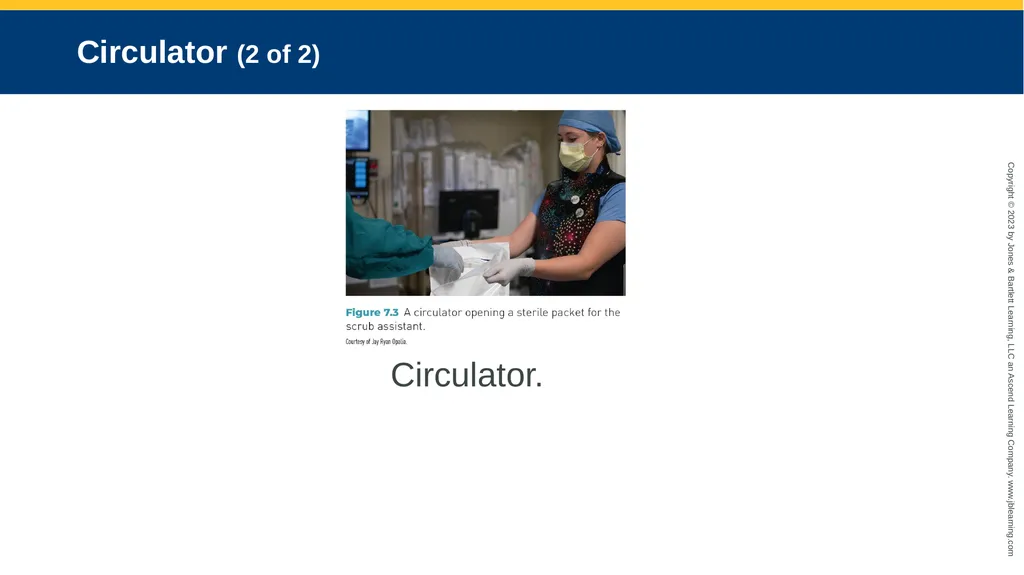
Circulator (2 of 2) Circulator.<br>
12
Team The best patient care is given when staff members are trained and competent to work comfortably in each job area in the lab.
Cumulative or overuse injuries caused by repeatedly using the same group of muscles for the same job are diminished when the roles are rotated.<br>
13
Procedure Preparation Imaging and recording systems are switched on and warmed up.
Review stock levels.
Review the patient and the procedure schedule.
Clean and prepare the procedure table.
Clean and prepare the trolley used for the sterile procedural equipment.
Mechanical or power contrast injectors are turned on and loaded.
The defibrillator should be tested and left on all day.
Emergency supplies should be stocked and readily available.<br>
14
Procedural Trolley Two basins, one with 500 mL of saline solution and one with heparin
Bowl or cup for local anesthetic
Surgical skin prep applicator(s)
Various syringes and needles
Sterile drapes to cover the patient to maintain a sterile area
#11- or #15-scalpel blade
Percutaneous access needle for cannulating the artery
Manifold setup with attached lines<br>
15
Patient Preparation (1 of 2) Consent form should be signed prior to any sedation being given.
Check lab results.
Position the patient on the table.
Check that the cannula is in position and the IV line is working.
Measure diabetic patients’ blood glucose levels.
Confirm allergic reactions.
Attach pulse oximetry and noninvasive blood pressure monitoring.
Attach ECG electrodes.
Keep the patient warm.<br>
16
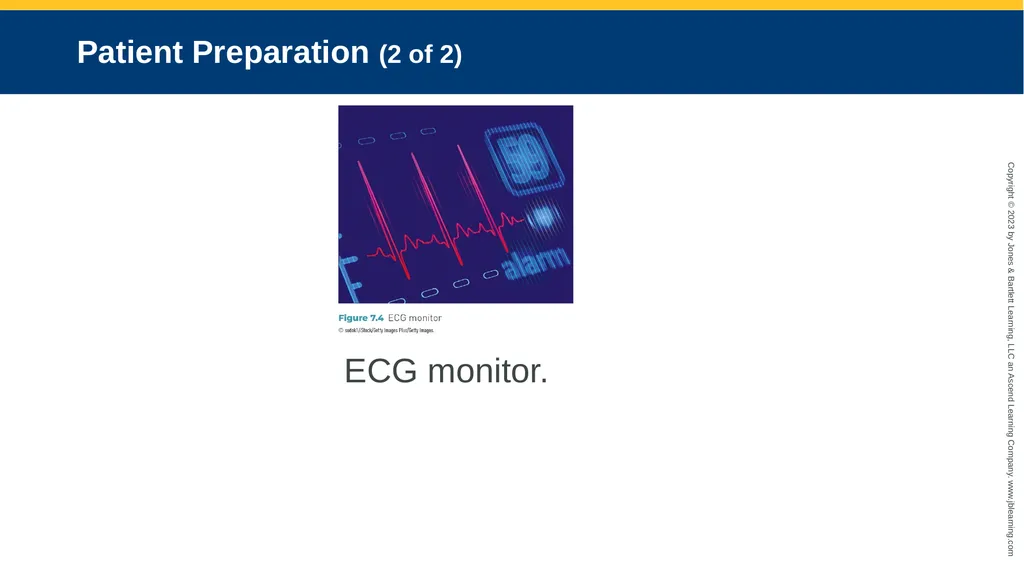
Patient Preparation (2 of 2) ECG monitor.<br>
17
Patient Instructions Ask patients if they need to urinate before they enter the laboratory.
Describe the X-ray system, the monitors, and the equipment to the patient.
Tell the patient to:
Keep their hands behind their head.
Move as little as possible during filming.
Breathe in deeply and hold their breath as an angiography run is filmed.
Breathe normally again when the angiography run has finished.
Tell you if they feel unwell or are in pain.<br>
18
Puncture Site Preparation The area to be prepped should have a radius of at least 5 cm from the intended point of insertion.
Puncture site disinfection is most often done with a chlorhexidine prep.
Begin where the intended puncture will be and move outwards.
A Betadine solution requires three preps.
The skin should be completely dry prior to placing the sterile drapes.<br>
19
System Preparation The lead shield should be covered with sterile plastic covers.
The blood pressure manifold should be plugged in, flushed, and zero calibrated.
X-ray tubes may also be covered with sterile covers.
The X-ray gantry is brought into position.
Connect the power injector to the manifold and flush.<br>
20
Material Handling Once removed from the package and from the patient, all catheters and wires must be flushed, wiped, and looped carefully and slowly.
Be methodical.
Wear appropriate personal protection.<br>
21
Monitor Continuously During Procedure Blood pressure (noninvasive and invasive hemodynamics)
ECG (rate, rhythm, ST segment changes)
Oxygen saturation
Contrast medium volume
Heparinized saline volume
Run/flow of the procedure
Patient status<br>
22
Angiography Before each injection, verify the contrast volume, injection rate, and maximum injection pressure.
Inform the patient to breathe in and hold their breath.
The contrast medium injection should begin shortly after filming has begun.
When the film run is finished, tell the patient to breathe normally.<br>
23
Procedure Completion Wear gloves while packing up the table and the room after each patient.
Confirm total contrast medium volume and infusion volume.
Remove all catheters from patient’s body, leaving the sheath(s) in place.
Move the X-ray equipment and monitors away from the patient.
Disconnect the contrast medium and the pressure monitoring lines.
Take the sterile drape off the patient carefully.
Help the patient into their hospital gown.
Transfer the patient into the bed, legs remaining straight.
The bed is then taken to the waiting area or to a unit.<br>
24
Sheath Care Sheath care can be performed in the recovery area adjacent to the cath lab or on the ward following the procedure.
If the sheath is not to be removed immediately following the procedure:
Clean the puncture site area with saline, then dry.
Place nonvented sterile caps on the sheath’s sidearm.
Cover the area with a sterile dressing.<br>
25
Following the Procedure Carefully transfer all needles or blades on the equipment table to the sharps container.
All disposable material is wrapped into the sterile drapes and placed in medical trash receptacles.
The lab is cleaned.
The necessary material is prepared for the next procedure.
The next patient is then brought into the lab.<br>
26
Patient Information When the sheath will be removed
Which body parts can and cannot be moved, and for how long
The importance of observing motion restrictions
Signs of bleeding at the puncture site, such as wetness or stickiness
Inform a staff member immediately of any changes.
Rehydrate to help flush the contrast media out of the body.<br>
27
End of the Day Dispose of all waste.
Thoroughly clean the cath lab and recovery area.
Restock the cath lab and recovery area material.
Restock the emergency trolley.
Check restricted medication.
Prepare the cath lab for any emergency procedures that may take place during the night.
Perform information system backups where required.<br>