
CHAPTER 8 Fire Fighter Tools and Equipment
AS
Published · 72 slides · 0 views
1 / 1
Description
CHAPTER 8 Fire Fighter Tools and Equipment Knowledge Objectives Describe the general purposes of tools and equipment. Describe the safety considerations for the use of tools and equipment. Describe why it is important to use tools and
Related Topics
Share
Embed code
Download this presentation From Below
"CHAPTER 8 Fire Fighter Tools and Equipment" is the property of its rightful owner. Permission is granted to download and print the materials on this website for personal, non-commercial use only, and to display it on your personal computer provided you do not modify the materials and that you retain all copyright notices contained in the materials. By downloading content from our website, you accept the terms of this agreement.
Presentation Transcript
01
CHAPTER 8 Fire Fighter Tools and Equipment<br>
02
Knowledge Objectives Describe the general purposes of tools and equipment.
Describe the safety considerations for the use of tools and equipment.
Describe why it is important to use tools and equipment effectively.
Describe why it is important to know where tools are stored.
List and describe tools and equipment that are used for rotating.<br>
Describe the safety considerations for the use of tools and equipment.
Describe why it is important to use tools and equipment effectively.
Describe why it is important to know where tools are stored.
List and describe tools and equipment that are used for rotating.<br>
03
Knowledge Objectives List and describe tools and equipment that are used for pushing or pulling.
List and describe tools and equipment that are used for prying or spreading.
List and describe tools and equipment that are used for striking.
List and describe tools and equipment that are used for cutting.
Describe the tools used in response and scene size-up activities.<br>
List and describe tools and equipment that are used for prying or spreading.
List and describe tools and equipment that are used for striking.
List and describe tools and equipment that are used for cutting.
Describe the tools used in response and scene size-up activities.<br>
04
Knowledge Objectives Describe the tools used in a forcible entry.
Describe the tools used during an interior attack.
Describe the tools used in search and rescue operations.
Describe the tools used during ventilation operations.
Describe the tools used during salvage and overhaul operations.<br>
Describe the tools used during an interior attack.
Describe the tools used in search and rescue operations.
Describe the tools used during ventilation operations.
Describe the tools used during salvage and overhaul operations.<br>
05
Knowledge Objectives Describe the importance of properly maintaining tools and equipment.
List supplies needed to clean and inspect hand tools.
Explain the importance of replacing tools in their assigned locations.
Identify procedures, including reporting requirements, for removing a damaged tool from service.<br>
List supplies needed to clean and inspect hand tools.
Explain the importance of replacing tools in their assigned locations.
Identify procedures, including reporting requirements, for removing a damaged tool from service.<br>
06
Skills Objective Clean and inspect hand tools.<br>
07
Introduction Tools and equipment are used for a wide range of activities.
Fire fighters must know how to use tools and equipment
Effectively
Efficiently
Safely
In dark, limited visibility environments
The same tools may be used in different ways during each phase of operations.<br>
Fire fighters must know how to use tools and equipment
Effectively
Efficiently
Safely
In dark, limited visibility environments
The same tools may be used in different ways during each phase of operations.<br>
08
General Considerations Hand tools
Extend or multiply body actions
Increase task effectiveness
Use simple machine principles
Power tools
Powered by electric motors or internal combustion engines
Faster and more efficient<br>
Extend or multiply body actions
Increase task effectiveness
Use simple machine principles
Power tools
Powered by electric motors or internal combustion engines
Faster and more efficient<br>
09
Safety Safety is the prime consideration for use of tools and equipment.
Safe equipment avoids unintentional injury.
Requires the use of proper, approved personal protective equipment (PPE).<br>
Safe equipment avoids unintentional injury.
Requires the use of proper, approved personal protective equipment (PPE).<br>
10
Conditions of Use/
Operating Conditions The best way to learn how to use tools and equipment properly is under optimal conditions of visibility and safety.
In the beginning, you must be able to see what you are doing and practise without endangering yourself and others.
As proficiency increases, practise using tools and equipment under more realistic working conditions.<br>
In the beginning, you must be able to see what you are doing and practise without endangering yourself and others.
As proficiency increases, practise using tools and equipment under more realistic working conditions.<br>
11
Conditions of Use/
Operating Conditions Eventually, you must be able to use tools and equipment safely and effectively when darkness or smoke decreases visibility.
You must be able to work safely in hazardous areas, where you are surrounded by noise, while wearing all of your PPE and using SCBA.
Many departments require fire fighters to practice certain skills and evolutions in total darkness or with their face masks covered to simulate the darkness of actual fires.<br>
You must be able to work safely in hazardous areas, where you are surrounded by noise, while wearing all of your PPE and using SCBA.
Many departments require fire fighters to practice certain skills and evolutions in total darkness or with their face masks covered to simulate the darkness of actual fires.<br>
12
Effective Use Understand the problem and select the right tool for the job.
Understand the capabilities and limitations of each tool to maximize its effectiveness.
Complete task safely and quickly.
It is also important to pace yourself.
Many are surprised by the strength and energy required for tasks.
Maintain a continuous program of physical fitness.<br>
Understand the capabilities and limitations of each tool to maximize its effectiveness.
Complete task safely and quickly.
It is also important to pace yourself.
Many are surprised by the strength and energy required for tasks.
Maintain a continuous program of physical fitness.<br>
13
Effective Use You will learn which tools are used during various fire-ground operations.
Fire department may have SOPs that specify tools and equipment needed for specific situations.
Your company officer is responsible for telling you which tools to bring along.
Some carry a selection of tools and equipment in their pockets.<br>
Fire department may have SOPs that specify tools and equipment needed for specific situations.
Your company officer is responsible for telling you which tools to bring along.
Some carry a selection of tools and equipment in their pockets.<br>
14
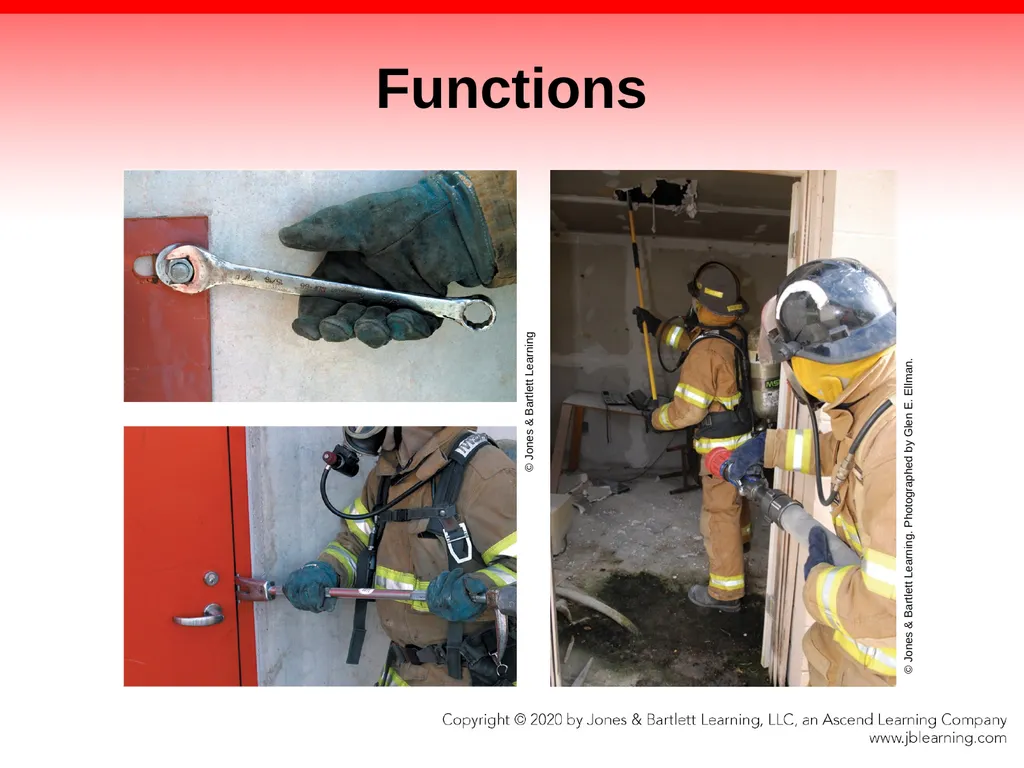
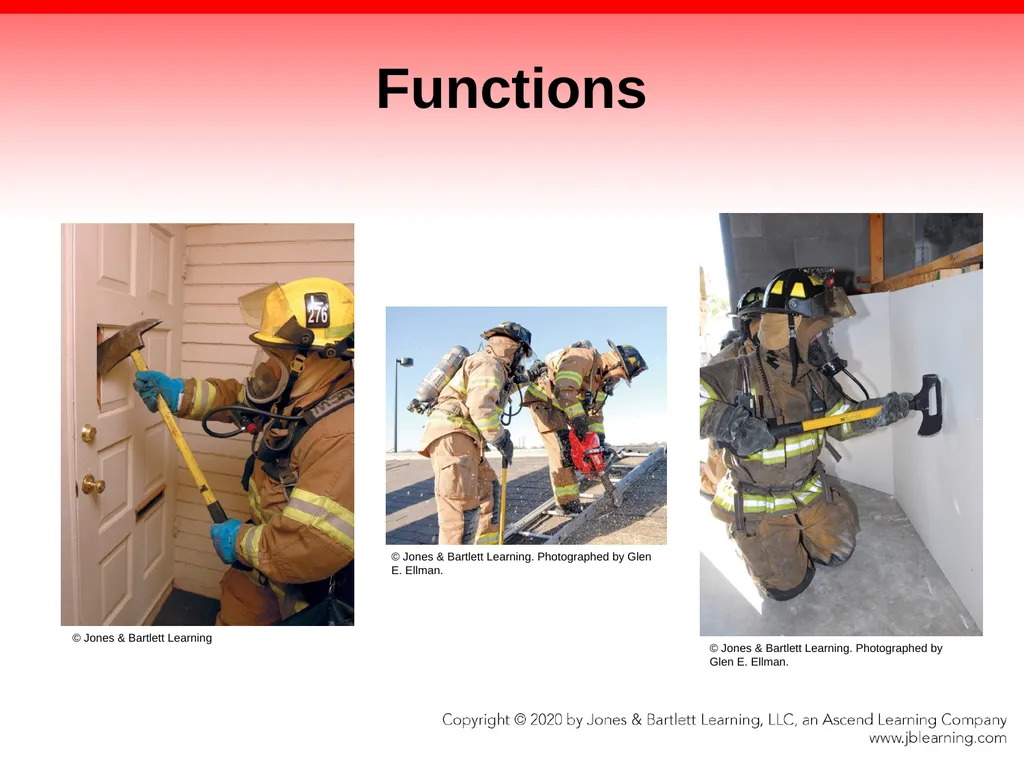
Functions A company carries a number of tools and different types of equipment. Often, the easiest way to learn is to group them by function.
Categories:
Rotating
Pushing or pulling
Prying or spreading
Striking
Cutting
Multiple use<br>
Categories:
Rotating
Pushing or pulling
Prying or spreading
Striking
Cutting
Multiple use<br>
15
Functions © Jones & Bartlett Learning © Jones & Bartlett Learning. Photographed by Glen E. Ellman.<br>
16
Functions © Jones & Bartlett Learning © Jones & Bartlett Learning. Photographed by Glen E. Ellman. © Jones & Bartlett Learning. Photographed by Glen E. Ellman.<br>
17
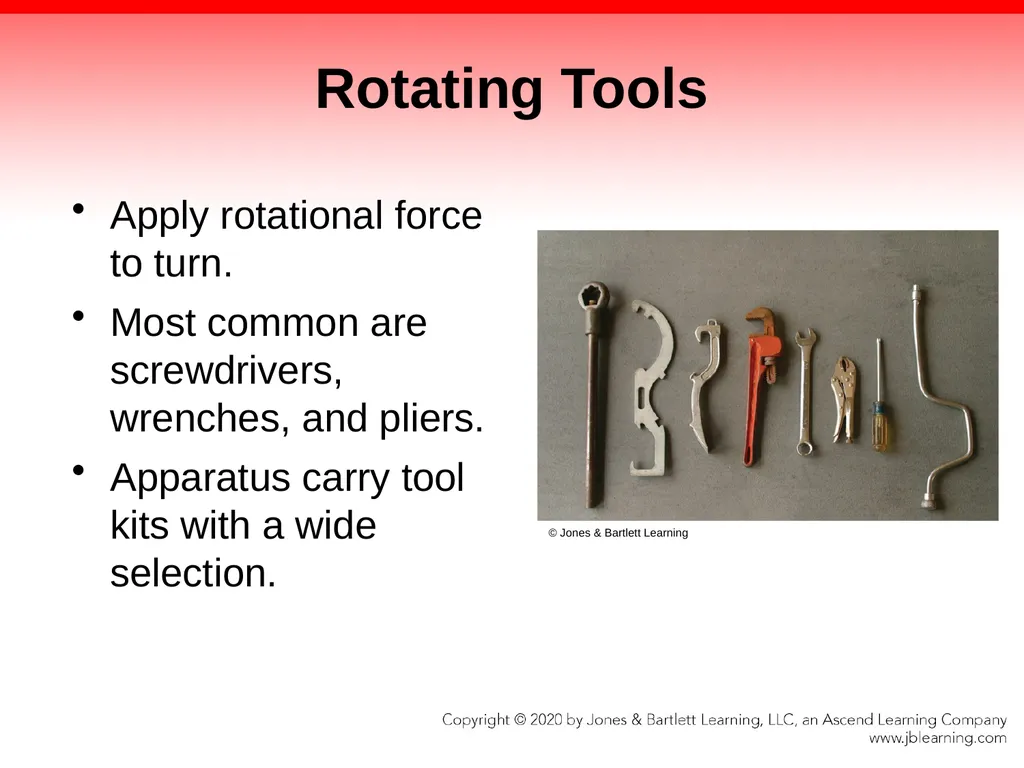
Rotating Tools Apply rotational force to turn.
Most common are screwdrivers, wrenches, and pliers.
Apparatus carry tool kits with a wide selection. © Jones & Bartlett Learning<br>
Most common are screwdrivers, wrenches, and pliers.
Apparatus carry tool kits with a wide selection. © Jones & Bartlett Learning<br>
18
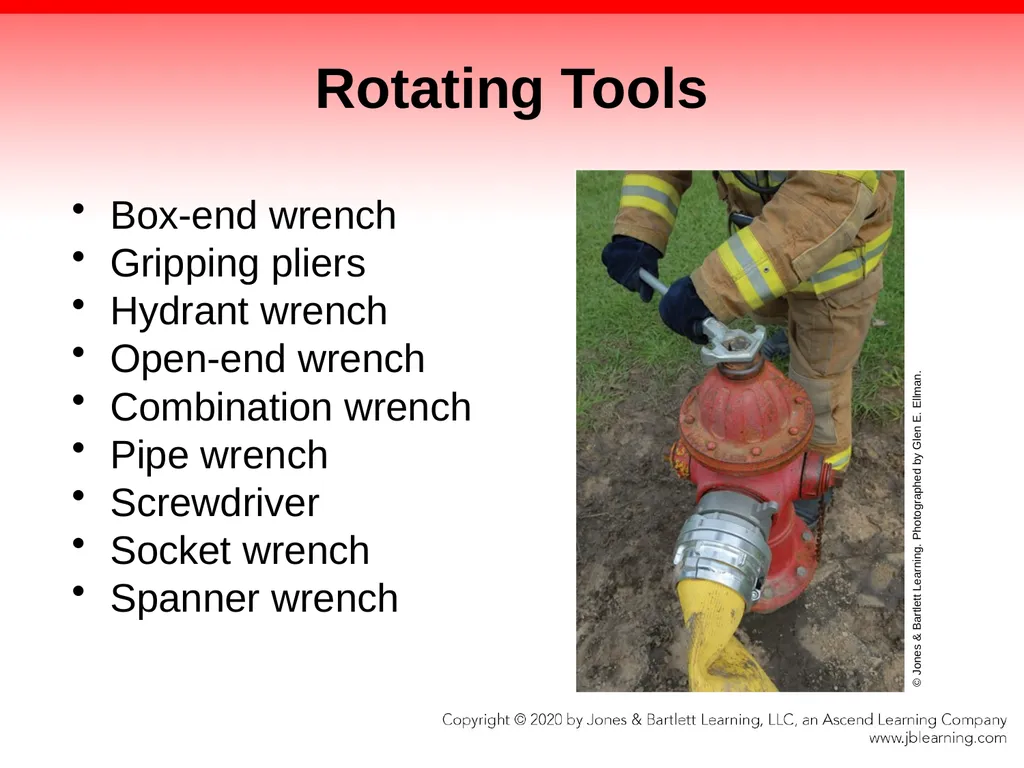
Rotating Tools Box-end wrench
Gripping pliers
Hydrant wrench
Open-end wrench
Combination wrench
Pipe wrench
Screwdriver
Socket wrench
Spanner wrench © Jones & Bartlett Learning. Photographed by Glen E. Ellman.<br>
Gripping pliers
Hydrant wrench
Open-end wrench
Combination wrench
Pipe wrench
Screwdriver
Socket wrench
Spanner wrench © Jones & Bartlett Learning. Photographed by Glen E. Ellman.<br>
19
Common Rotating Tools Assembling and disassembling are basic mechanical skills.
Most fire apparatus carry a tool kit with a selection of tools.
A screwdriver with interchangeable heads is sometimes more useful than a selection of screwdrivers.
Pliers and wrenches come in a variety of shapes and sizes.<br>
Most fire apparatus carry a tool kit with a selection of tools.
A screwdriver with interchangeable heads is sometimes more useful than a selection of screwdrivers.
Pliers and wrenches come in a variety of shapes and sizes.<br>
20
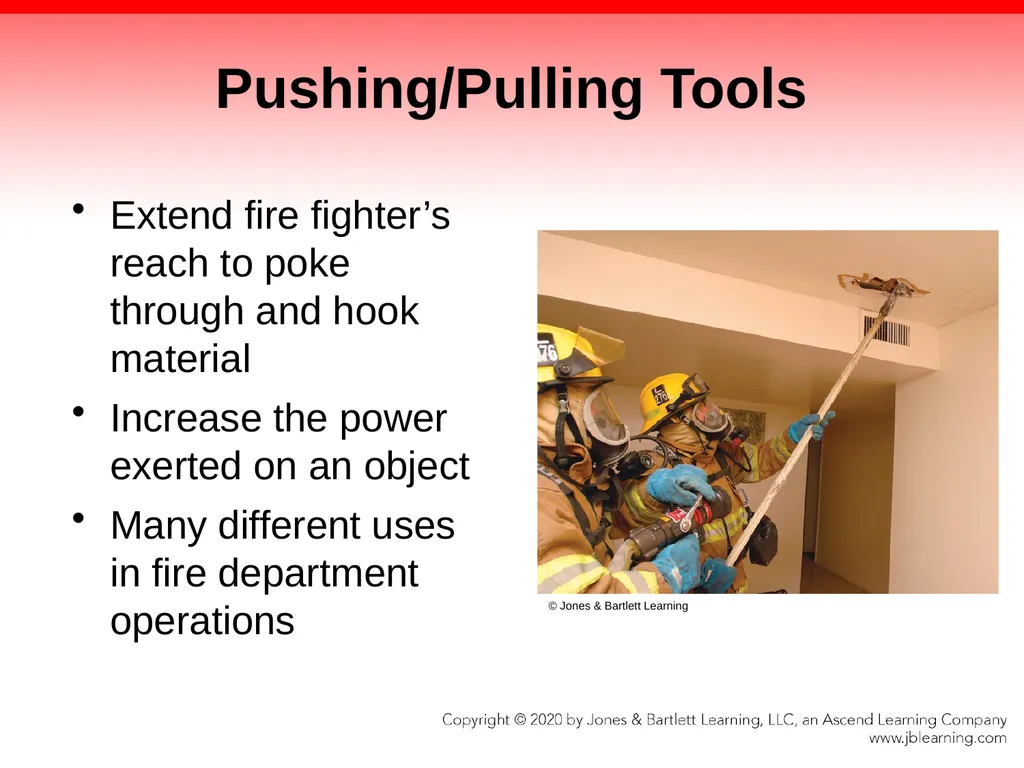
Pushing/Pulling Tools Extend fire fighter’s reach to poke through and hook material
Increase the power exerted on an object
Many different uses in fire department operations © Jones & Bartlett Learning<br>
Increase the power exerted on an object
Many different uses in fire department operations © Jones & Bartlett Learning<br>
21
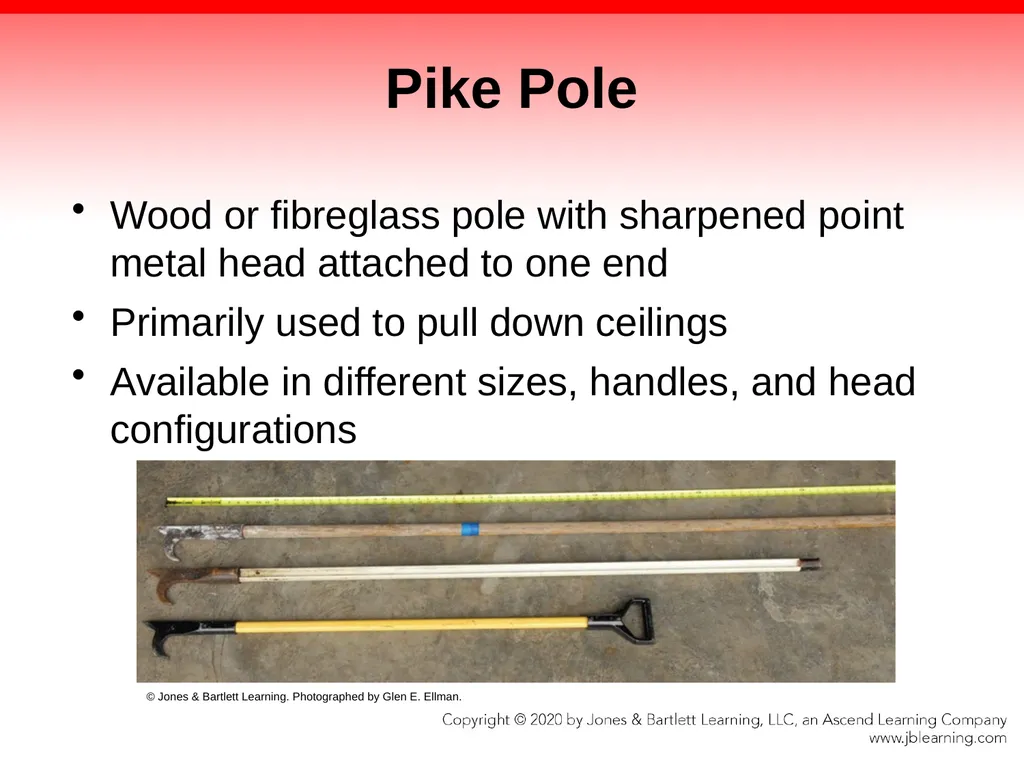
Pike Pole Wood or fibreglass pole with sharpened point metal head attached to one end
Primarily used to pull down ceilings
Available in different sizes, handles, and head configurations © Jones & Bartlett Learning. Photographed by Glen E. Ellman.<br>
Primarily used to pull down ceilings
Available in different sizes, handles, and head configurations © Jones & Bartlett Learning. Photographed by Glen E. Ellman.<br>
22
Pike Pole Most common size: 1-2 m (4-6 ft), for use on 3-m-high (10-ft) ceilings
The different head designs are intended for different types of ceilings and come in a variety of configurations.
Many fire departments use one type of pike pole for plaster ceilings and another for drywall ceilings.<br>
The different head designs are intended for different types of ceilings and come in a variety of configurations.
Many fire departments use one type of pike pole for plaster ceilings and another for drywall ceilings.<br>
23
Common Pushing/Pulling Tools Ceiling hook
Clemens hook
Drywall hook
Multipurpose hook
Plaster hook
Roofman’s hook
San Francisco hook<br>
Clemens hook
Drywall hook
Multipurpose hook
Plaster hook
Roofman’s hook
San Francisco hook<br>
24
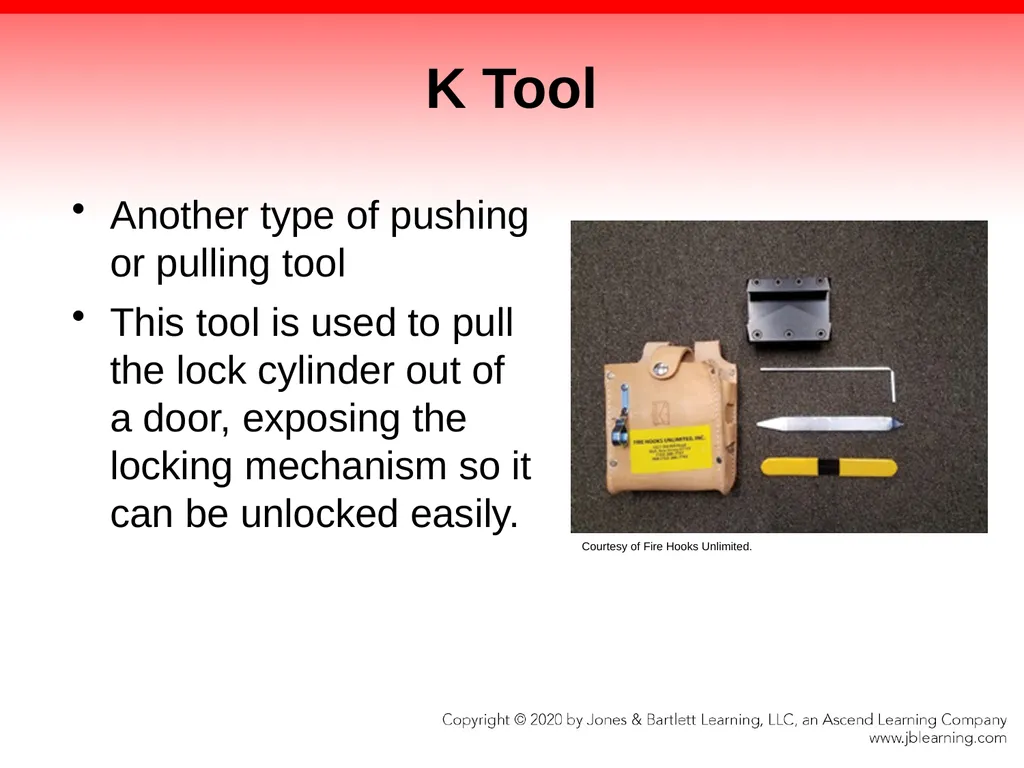
K Tool Another type of pushing or pulling tool
This tool is used to pull the lock cylinder out of a door, exposing the locking mechanism so it can be unlocked easily. Courtesy of Fire Hooks Unlimited.<br>
This tool is used to pull the lock cylinder out of a door, exposing the locking mechanism so it can be unlocked easily. Courtesy of Fire Hooks Unlimited.<br>
25
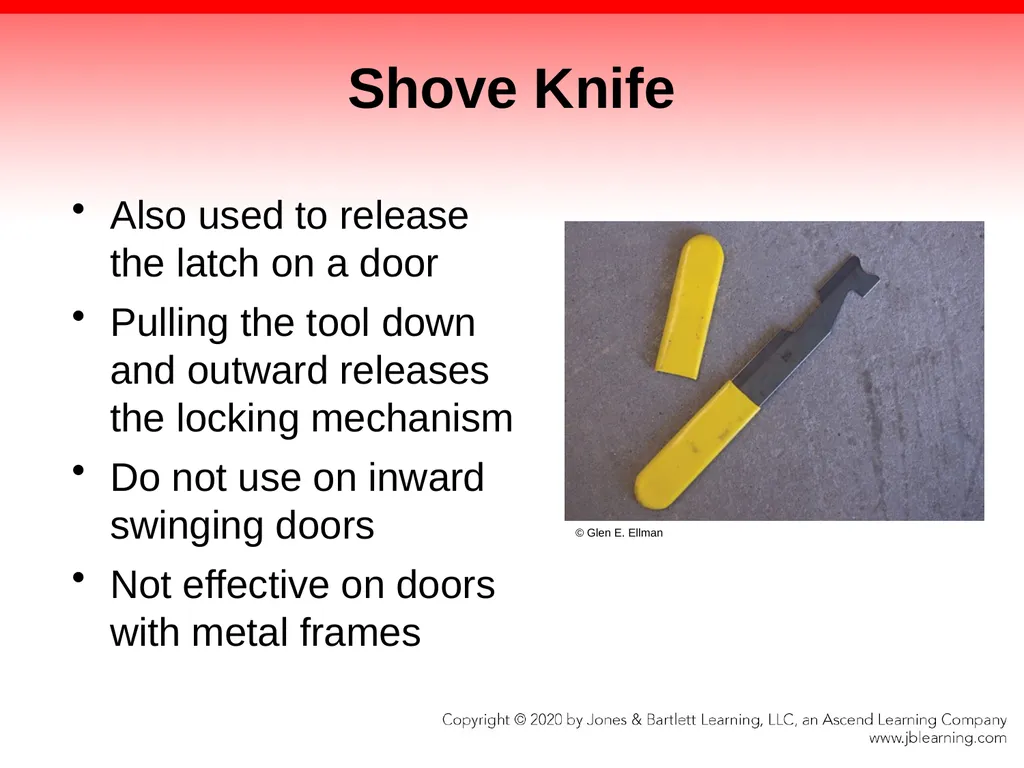
Shove Knife Also used to release the latch on a door
Pulling the tool down and outward releases the locking mechanism
Do not use on inward swinging doors
Not effective on doors with metal frames © Glen E. Ellman<br>
Pulling the tool down and outward releases the locking mechanism
Do not use on inward swinging doors
Not effective on doors with metal frames © Glen E. Ellman<br>
26
Prying/Spreading Tools These tools may be as simple as a pry bar or as mechanically complex as a hydraulic spreader.
They also come in several variations for different applications.
Halligan tool
This tool incorporates a sharp tapered pick, a blade, and a fork or claw.
It can be used for forcible entry applications.<br>
They also come in several variations for different applications.
Halligan tool
This tool incorporates a sharp tapered pick, a blade, and a fork or claw.
It can be used for forcible entry applications.<br>
27
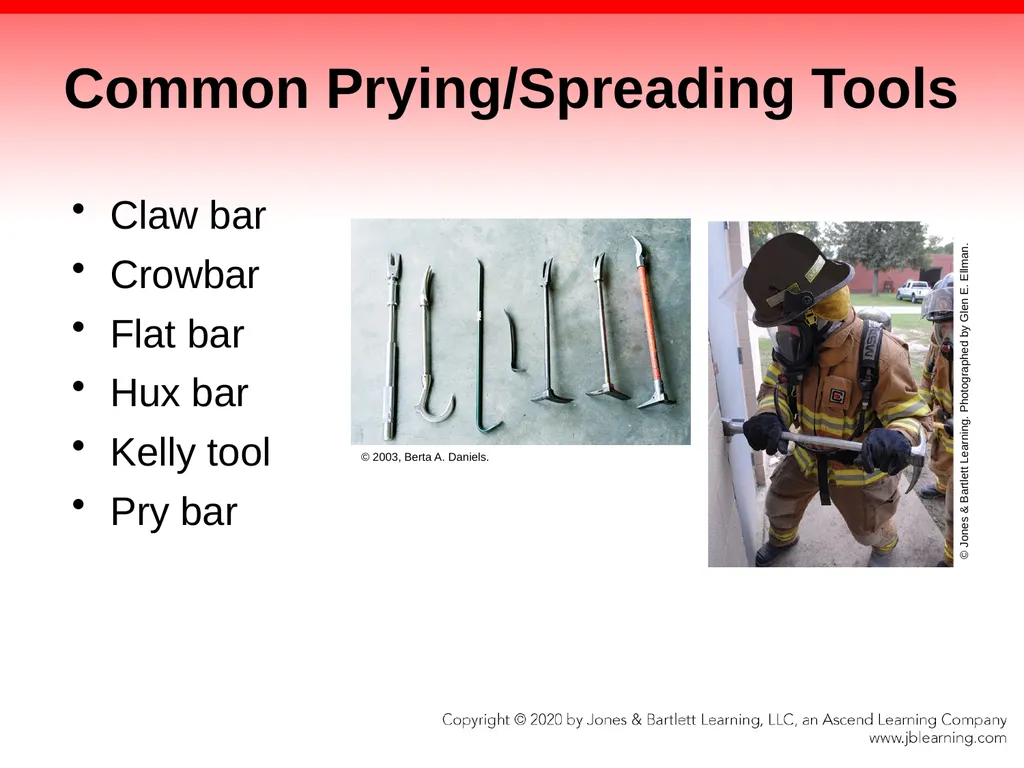
Common Prying/Spreading Tools Claw bar
Crowbar
Flat bar
Hux bar
Kelly tool
Pry bar © 2003, Berta A. Daniels. © Jones & Bartlett Learning. Photographed by Glen E. Ellman.<br>
Crowbar
Flat bar
Hux bar
Kelly tool
Pry bar © 2003, Berta A. Daniels. © Jones & Bartlett Learning. Photographed by Glen E. Ellman.<br>
28
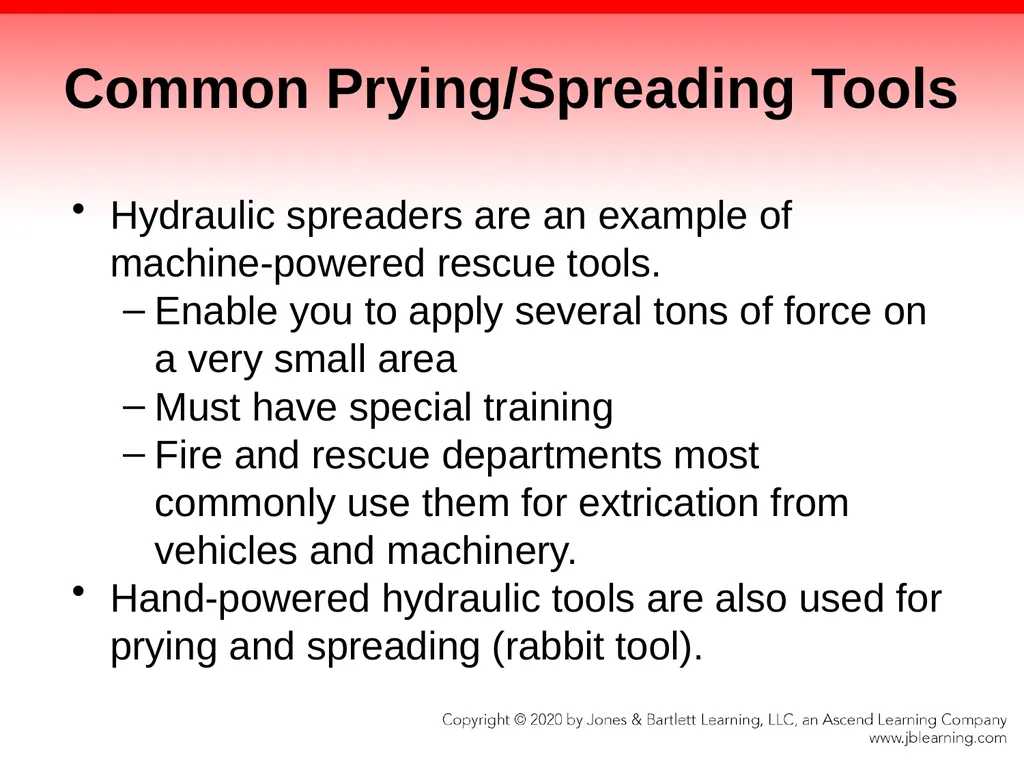
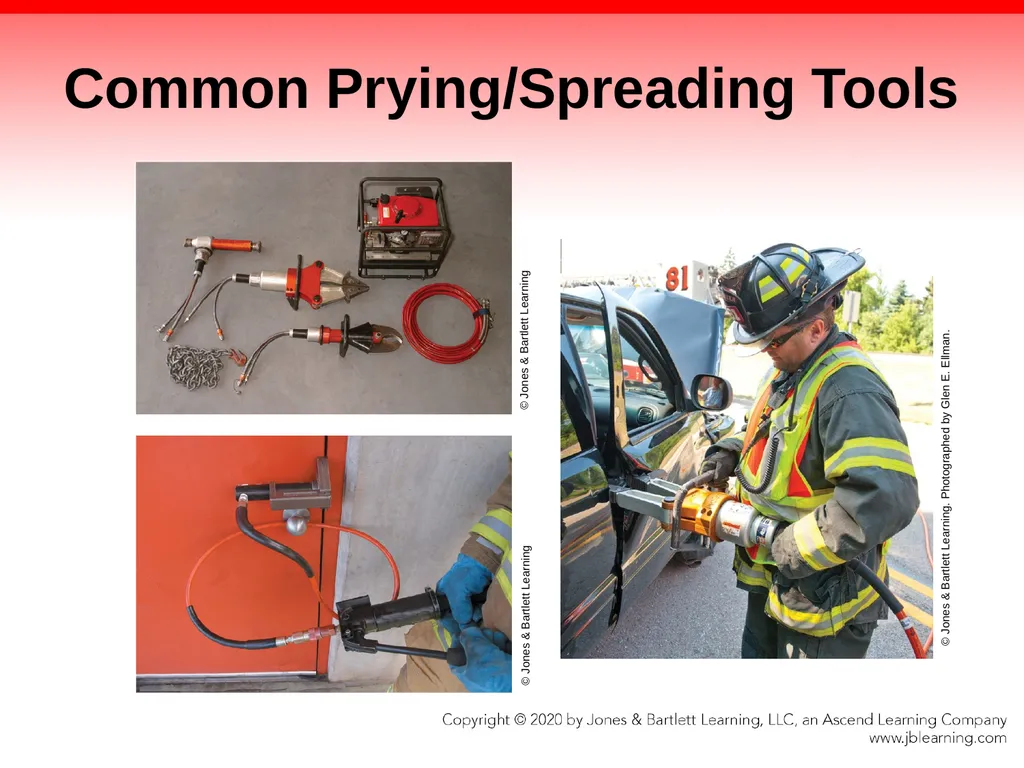
Common Prying/Spreading Tools Hydraulic spreaders are an example of machine-powered rescue tools.
Enable you to apply several tons of force on a very small area
Must have special training
Fire and rescue departments most commonly use them for extrication from vehicles and machinery.
Hand-powered hydraulic tools are also used for prying and spreading (rabbit tool).<br>
Enable you to apply several tons of force on a very small area
Must have special training
Fire and rescue departments most commonly use them for extrication from vehicles and machinery.
Hand-powered hydraulic tools are also used for prying and spreading (rabbit tool).<br>
29
Common Prying/Spreading Tools © Jones & Bartlett Learning © Jones & Bartlett Learning © Jones & Bartlett Learning. Photographed by Glen E. Ellman.<br>
30
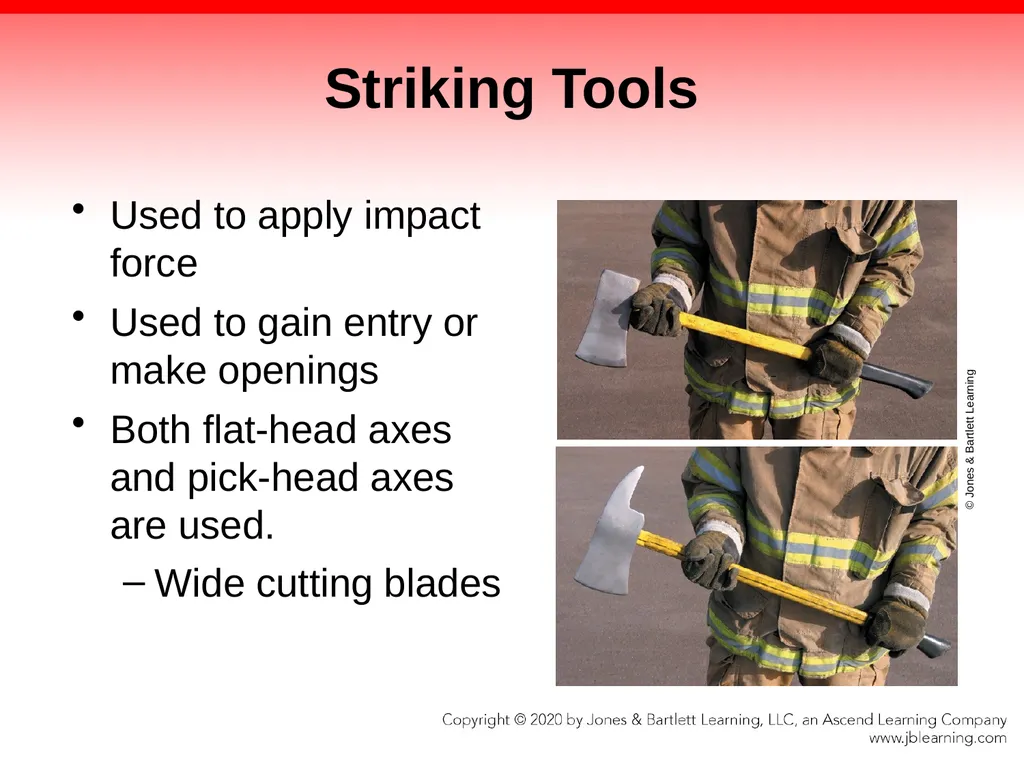
Striking Tools Used to apply impact force
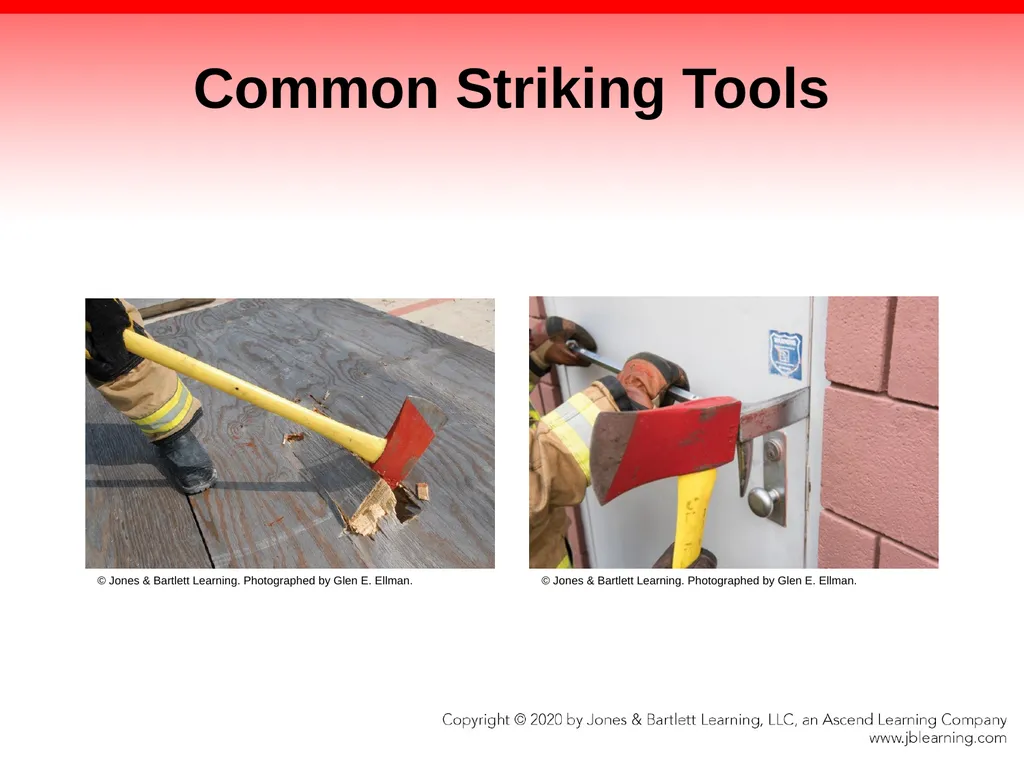
Used to gain entry or make openings
Both flat-head axes and pick-head axes are used.
Wide cutting blades © Jones & Bartlett Learning<br>
Used to gain entry or make openings
Both flat-head axes and pick-head axes are used.
Wide cutting blades © Jones & Bartlett Learning<br>
31
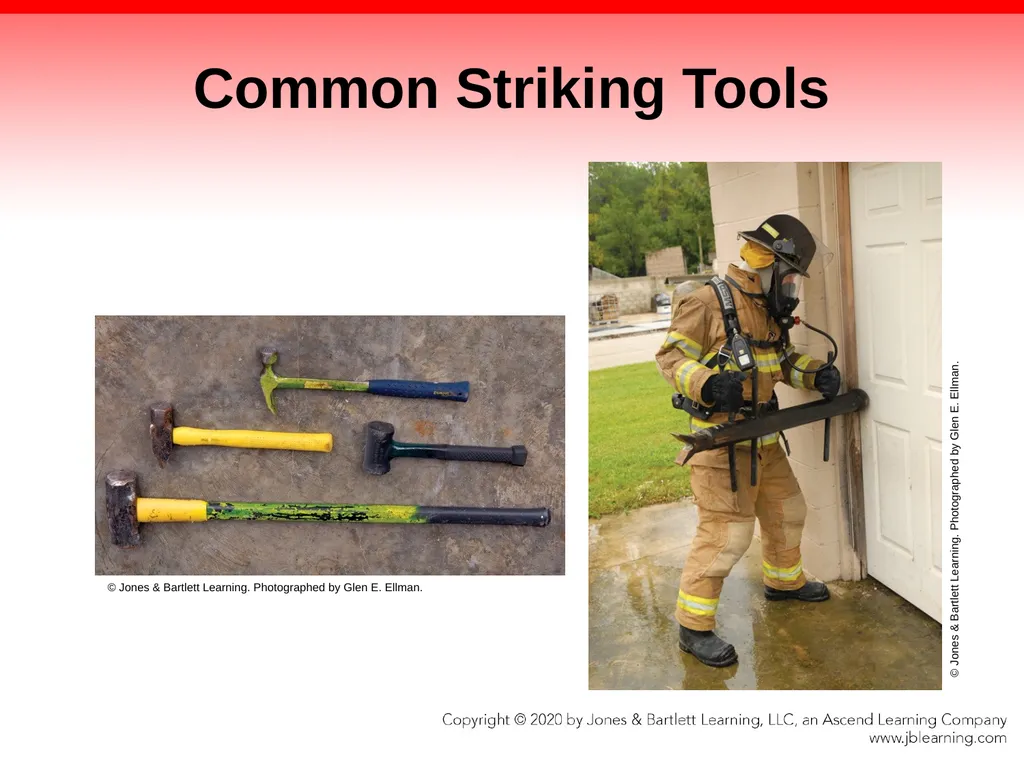
Common Striking Tools © Jones & Bartlett Learning. Photographed by Glen E. Ellman. © Jones & Bartlett Learning. Photographed by Glen E. Ellman.<br>
32
Common Striking Tools Hammer
Mallet
Maul
Sledgehammer
Battering ram
Chisel
Spring-loaded centre punch<br>
Mallet
Maul
Sledgehammer
Battering ram
Chisel
Spring-loaded centre punch<br>
33
Common Striking Tools © Jones & Bartlett Learning. Photographed by Glen E. Ellman. © Jones & Bartlett Learning. Photographed by Glen E. Ellman.<br>
34
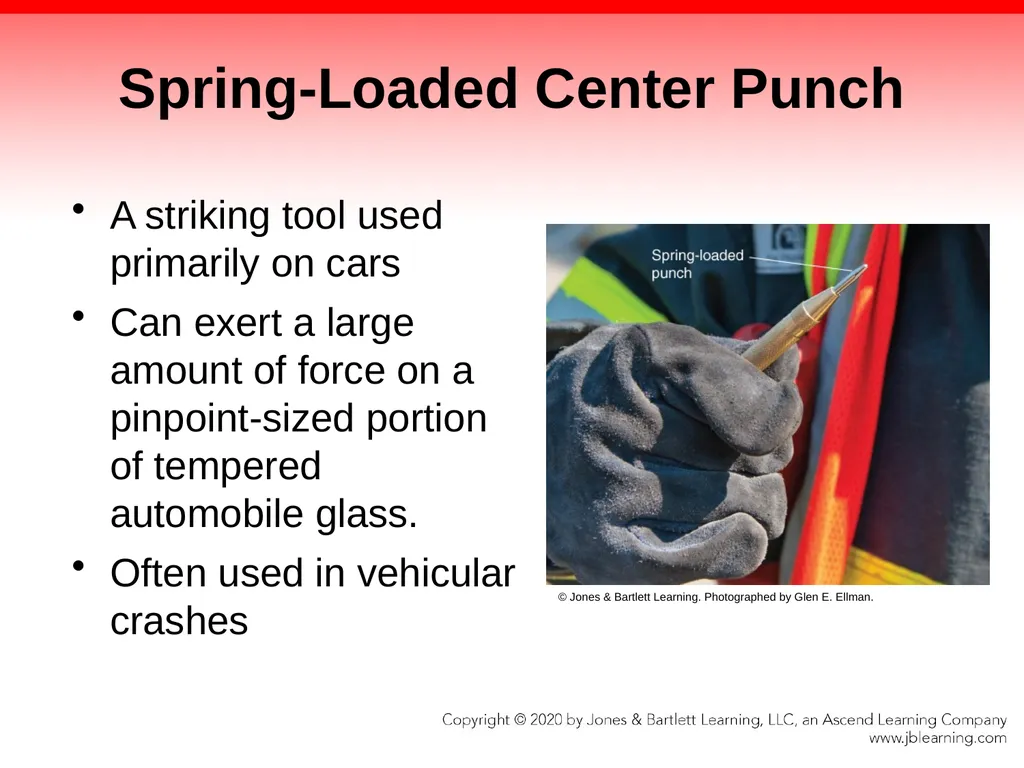
Spring-Loaded Center Punch A striking tool used primarily on cars
Can exert a large amount of force on a pinpoint-sized portion of tempered automobile glass.
Often used in vehicular crashes © Jones & Bartlett Learning. Photographed by Glen E. Ellman.<br>
Can exert a large amount of force on a pinpoint-sized portion of tempered automobile glass.
Often used in vehicular crashes © Jones & Bartlett Learning. Photographed by Glen E. Ellman.<br>
35
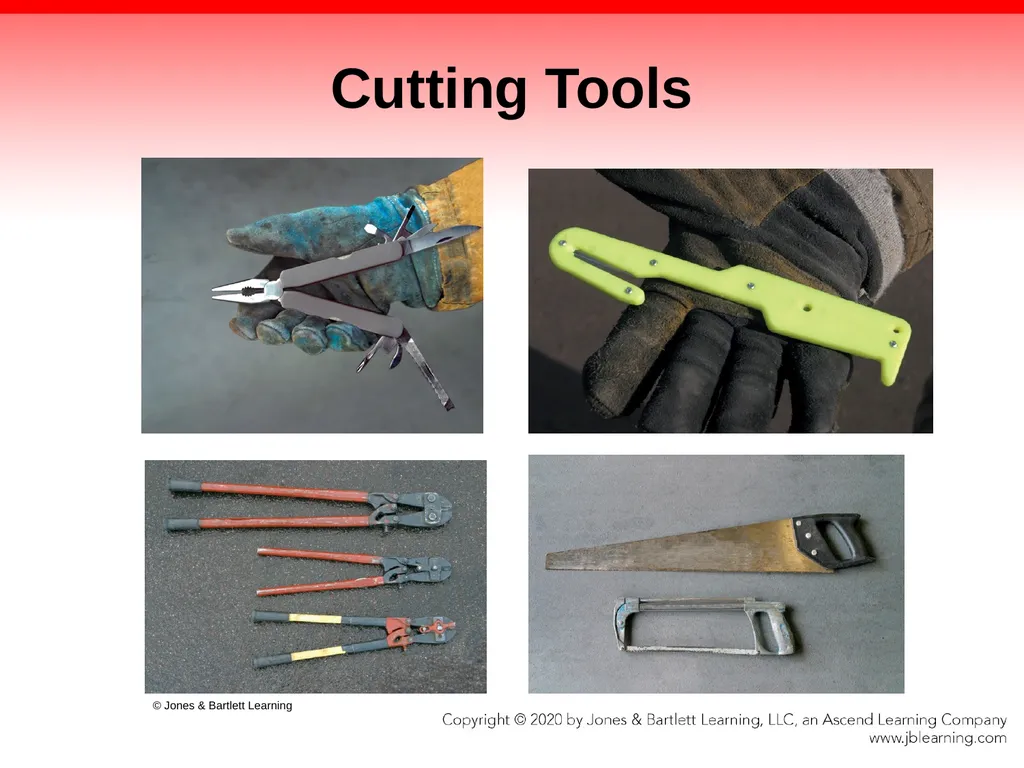
Cutting Tools Sharp edge to sever an object
Range from knives to saws and torches
Each is designed for certain materials.
Fire fighters can be injured and tools ruined if used incorrectly.<br>
Range from knives to saws and torches
Each is designed for certain materials.
Fire fighters can be injured and tools ruined if used incorrectly.<br>
36
Cutting Tools © Jones & Bartlett Learning<br>
37
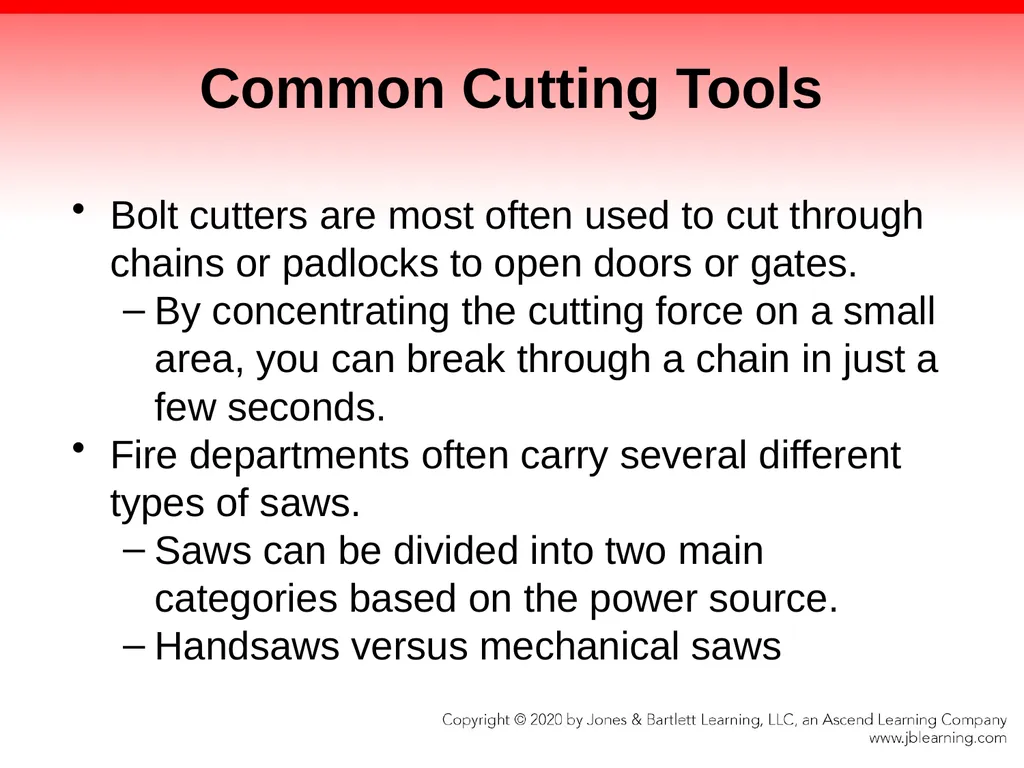
Common Cutting Tools Bolt cutters are most often used to cut through chains or padlocks to open doors or gates.
By concentrating the cutting force on a small area, you can break through a chain in just a few seconds.
Fire departments often carry several different types of saws.
Saws can be divided into two main categories based on the power source.
Handsaws versus mechanical saws<br>
By concentrating the cutting force on a small area, you can break through a chain in just a few seconds.
Fire departments often carry several different types of saws.
Saws can be divided into two main categories based on the power source.
Handsaws versus mechanical saws<br>
38
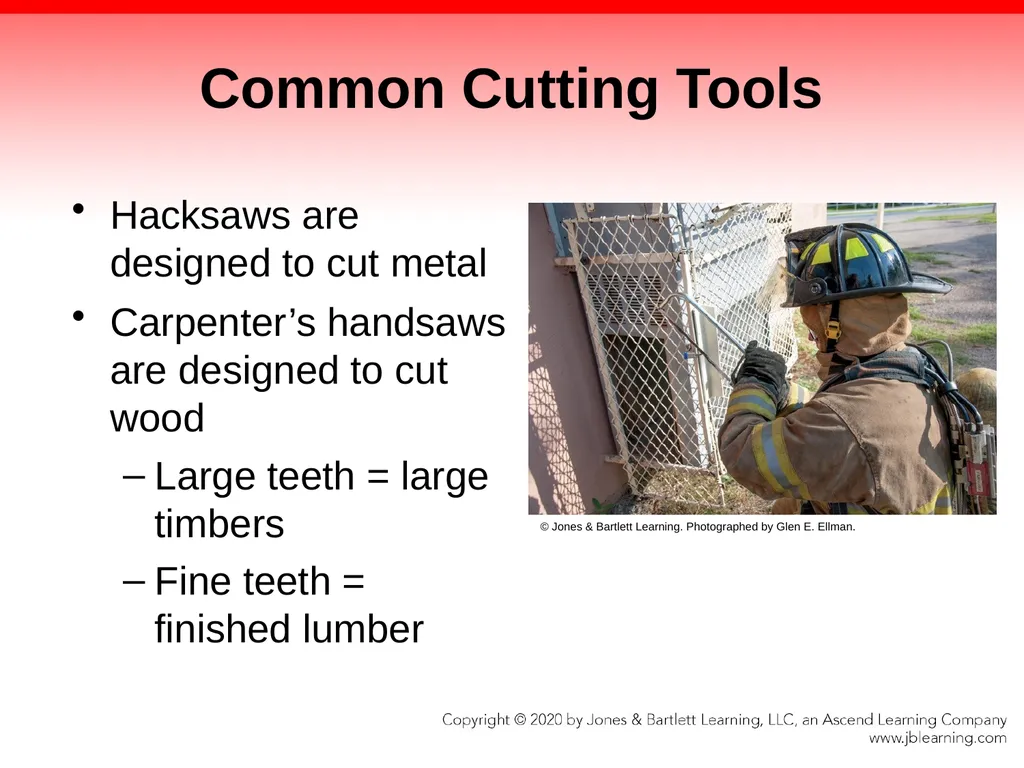
Common Cutting Tools Hacksaws are designed to cut metal
Carpenter’s handsaws are designed to cut wood
Large teeth = large timbers
Fine teeth = finished lumber © Jones & Bartlett Learning. Photographed by Glen E. Ellman.<br>
Carpenter’s handsaws are designed to cut wood
Large teeth = large timbers
Fine teeth = finished lumber © Jones & Bartlett Learning. Photographed by Glen E. Ellman.<br>
39
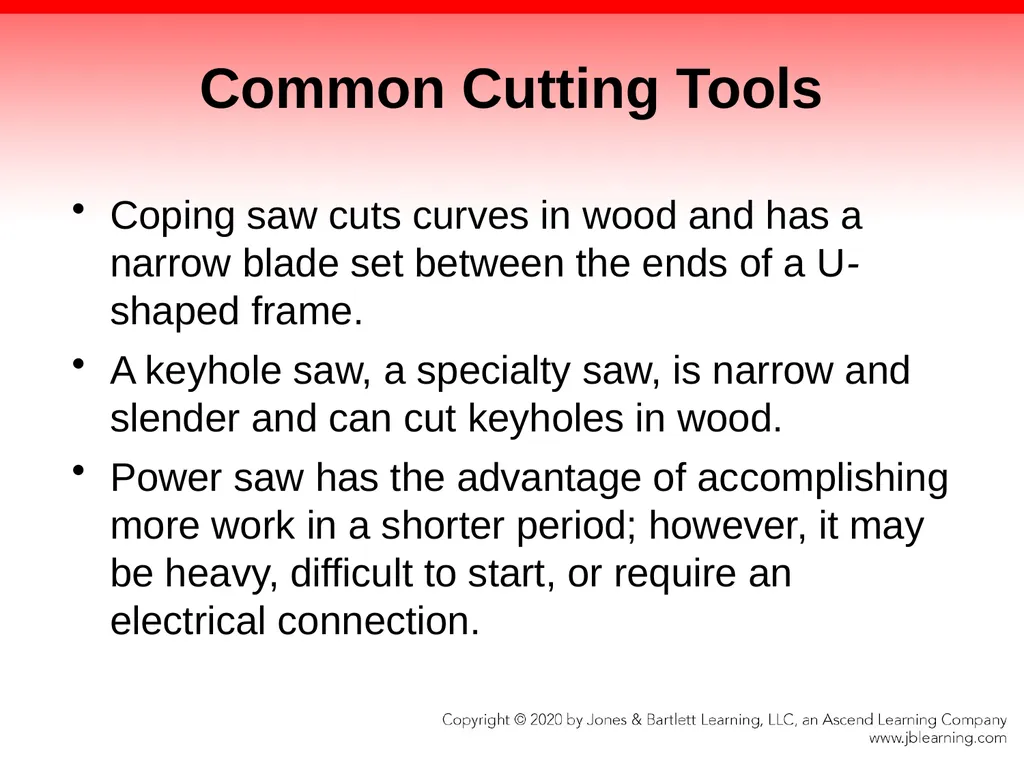
Common Cutting Tools Coping saw cuts curves in wood and has a narrow blade set between the ends of a U-shaped frame.
A keyhole saw, a specialty saw, is narrow and slender and can cut keyholes in wood.
Power saw has the advantage of accomplishing more work in a shorter period; however, it may be heavy, difficult to start, or require an electrical connection.<br>
A keyhole saw, a specialty saw, is narrow and slender and can cut keyholes in wood.
Power saw has the advantage of accomplishing more work in a shorter period; however, it may be heavy, difficult to start, or require an electrical connection.<br>
40
Mechanical Saws Three main types
Chain, rotary, reciprocating
Faster than handsaws
Conserve fire fighter energy
Require proper training<br>
Chain, rotary, reciprocating
Faster than handsaws
Conserve fire fighter energy
Require proper training<br>
41
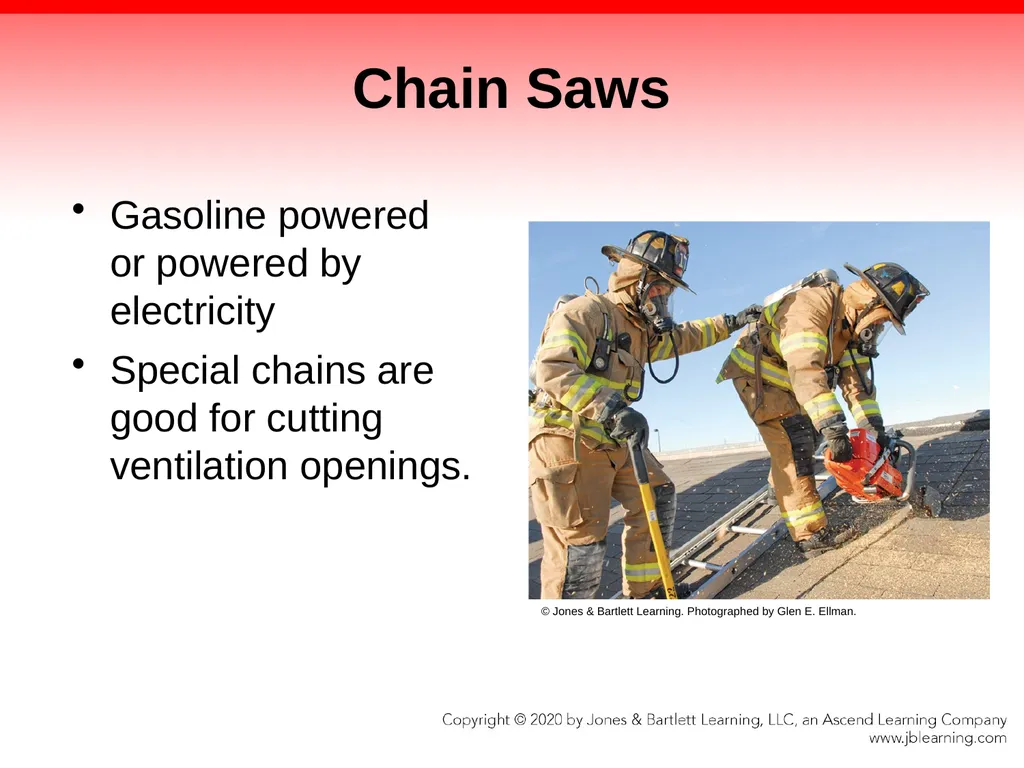
Chain Saws Gasoline powered or powered by electricity
Special chains are good for cutting ventilation openings. © Jones & Bartlett Learning. Photographed by Glen E. Ellman.<br>
Special chains are good for cutting ventilation openings. © Jones & Bartlett Learning. Photographed by Glen E. Ellman.<br>
42
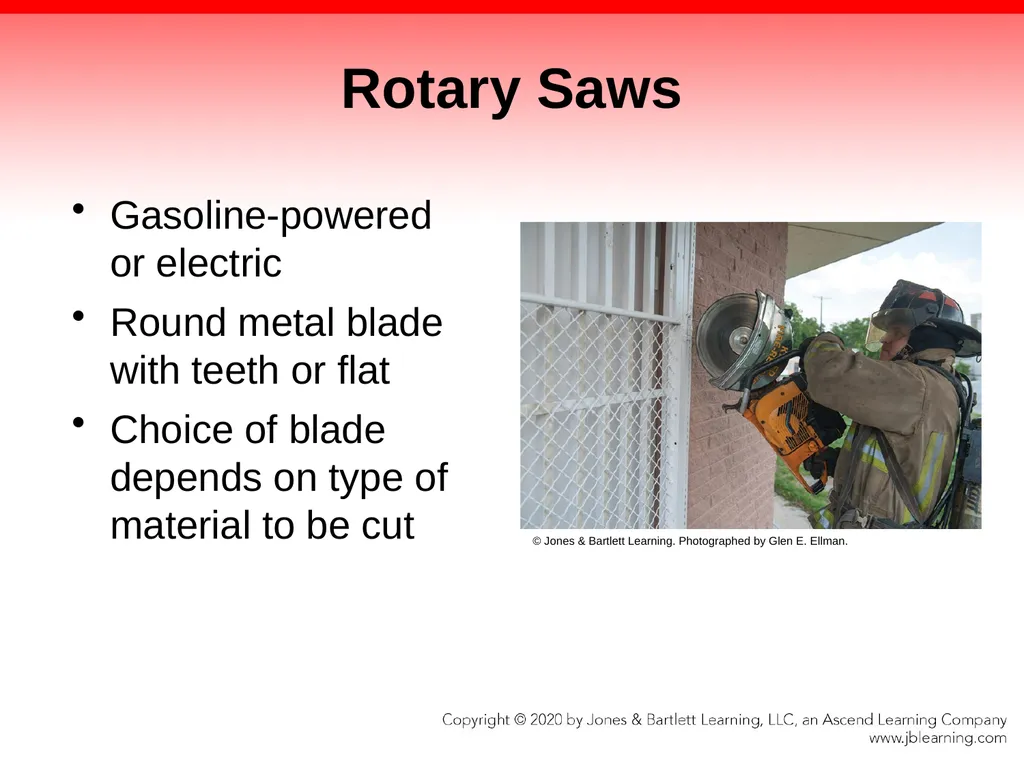
Rotary Saws Gasoline-powered or electric
Round metal blade with teeth or flat
Choice of blade depends on type of material to be cut © Jones & Bartlett Learning. Photographed by Glen E. Ellman.<br>
Round metal blade with teeth or flat
Choice of blade depends on type of material to be cut © Jones & Bartlett Learning. Photographed by Glen E. Ellman.<br>
43
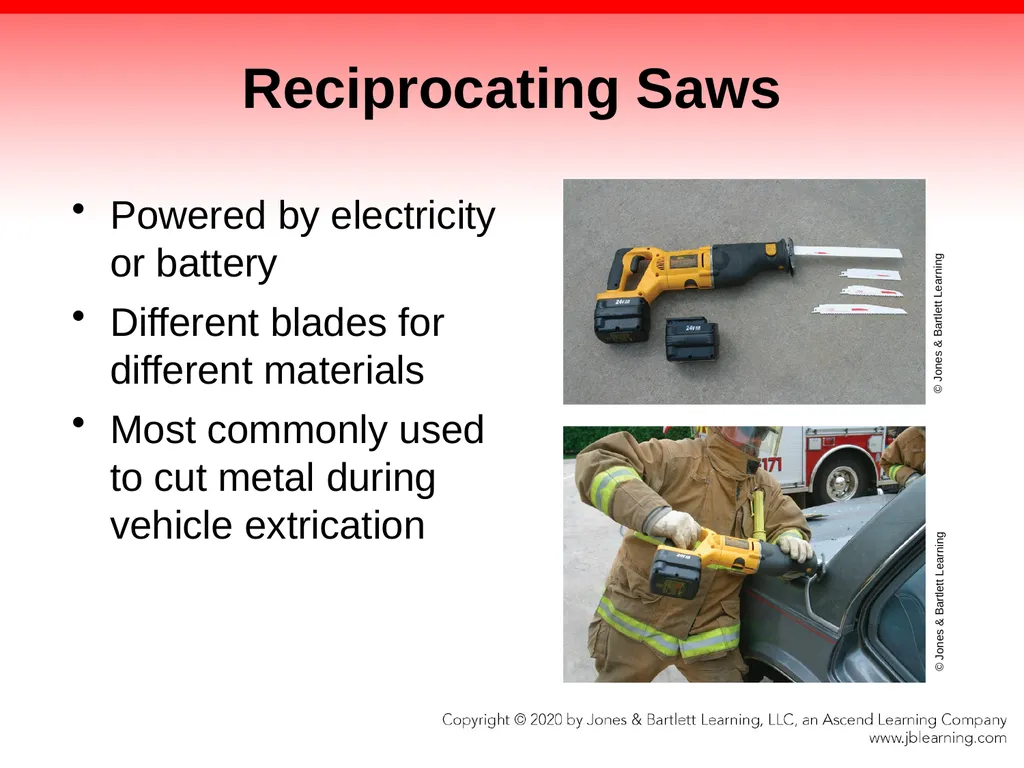
Reciprocating Saws Powered by electricity or battery
Different blades for different materials
Most commonly used to cut metal during vehicle extrication © Jones & Bartlett Learning © Jones & Bartlett Learning<br>
Different blades for different materials
Most commonly used to cut metal during vehicle extrication © Jones & Bartlett Learning © Jones & Bartlett Learning<br>
44
Hydraulic Shears Often used with hydraulic spreaders and rams in automobile extrication.
The same hydraulic power source can be used with all three types of tools.
Can cut quickly through metal posts and bars.<br>
The same hydraulic power source can be used with all three types of tools.
Can cut quickly through metal posts and bars.<br>
45
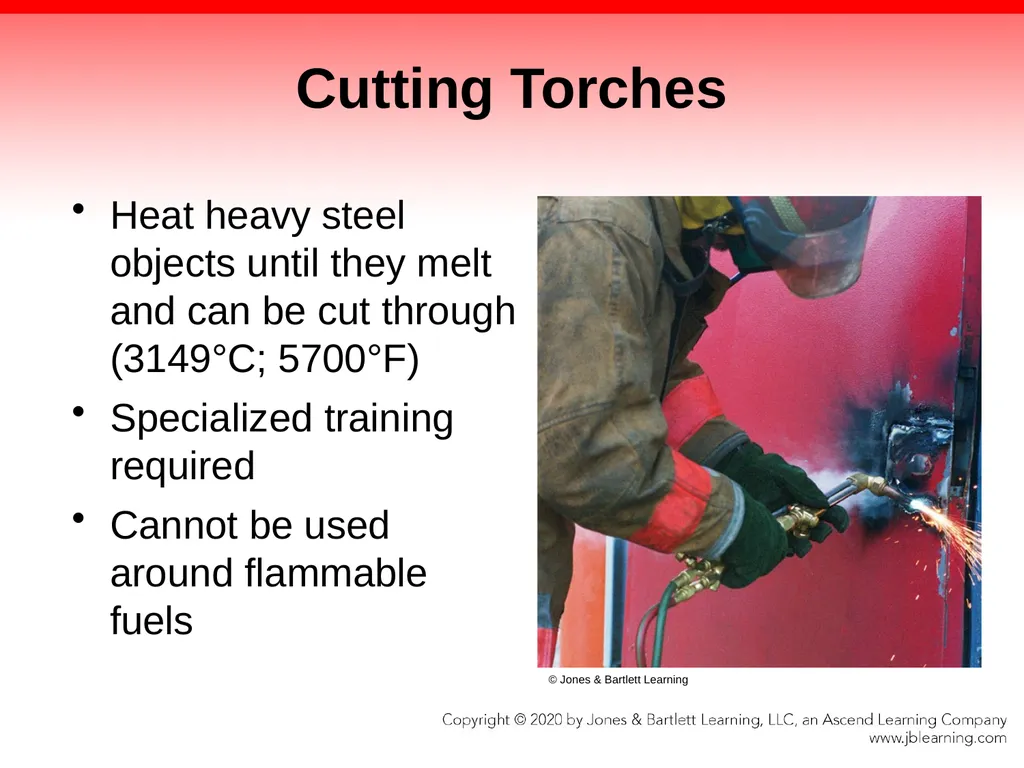
Cutting Torches Heat heavy steel objects until they melt and can be cut through (3149°C; 5700°F)
Specialized training required
Cannot be used around flammable fuels © Jones & Bartlett Learning<br>
Specialized training required
Cannot be used around flammable fuels © Jones & Bartlett Learning<br>
46
Multiple-Function Tools Certain tools are designed to perform multiple functions, thus reducing the total number of tools needed to achieve a goal.
One example is a flat-head axe because it can be used as either a cutting or a striking tool.
There are combination tools that can be used to cut, pry, strike, and turn off utilities.<br>
One example is a flat-head axe because it can be used as either a cutting or a striking tool.
There are combination tools that can be used to cut, pry, strike, and turn off utilities.<br>
47
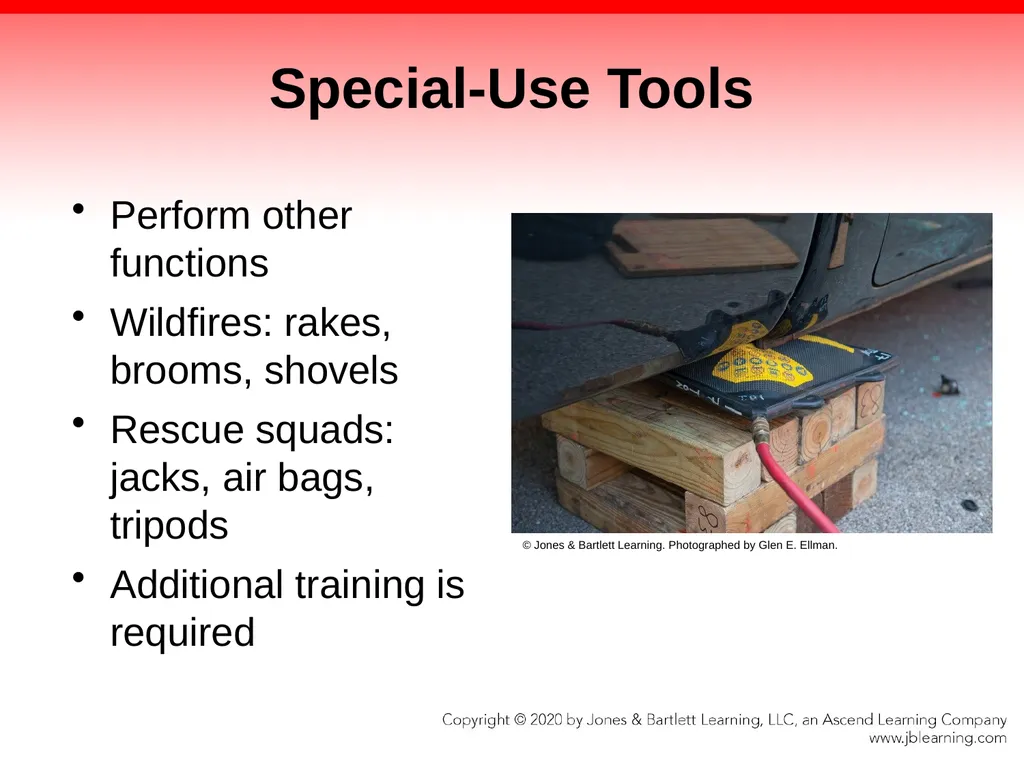
Special-Use Tools Perform other functions
Wildfires: rakes, brooms, shovels
Rescue squads: jacks, air bags, tripods
Additional training is required © Jones & Bartlett Learning. Photographed by Glen E. Ellman.<br>
Wildfires: rakes, brooms, shovels
Rescue squads: jacks, air bags, tripods
Additional training is required © Jones & Bartlett Learning. Photographed by Glen E. Ellman.<br>
48
Phases of Use Each phase of an operation may require the use of certain types of tools and equipment.
Basic phase of fire suppression
Response/size-up
Forcible entry
Interior attack
Search and rescue
Rapid intervention
Ventilation
Salvage
Overhaul<br>
Basic phase of fire suppression
Response/size-up
Forcible entry
Interior attack
Search and rescue
Rapid intervention
Ventilation
Salvage
Overhaul<br>
49
Response and Size-Up
Tools and Equipment Consider information from dispatch.
May indicate the nature and gravity of the situation and problems that might arise
Begin considering tools and equipment needed.
On arrival, company officer will size-up and develop action plans following SOPs.
Will determine the tools needed<br>
May indicate the nature and gravity of the situation and problems that might arise
Begin considering tools and equipment needed.
On arrival, company officer will size-up and develop action plans following SOPs.
Will determine the tools needed<br>
50
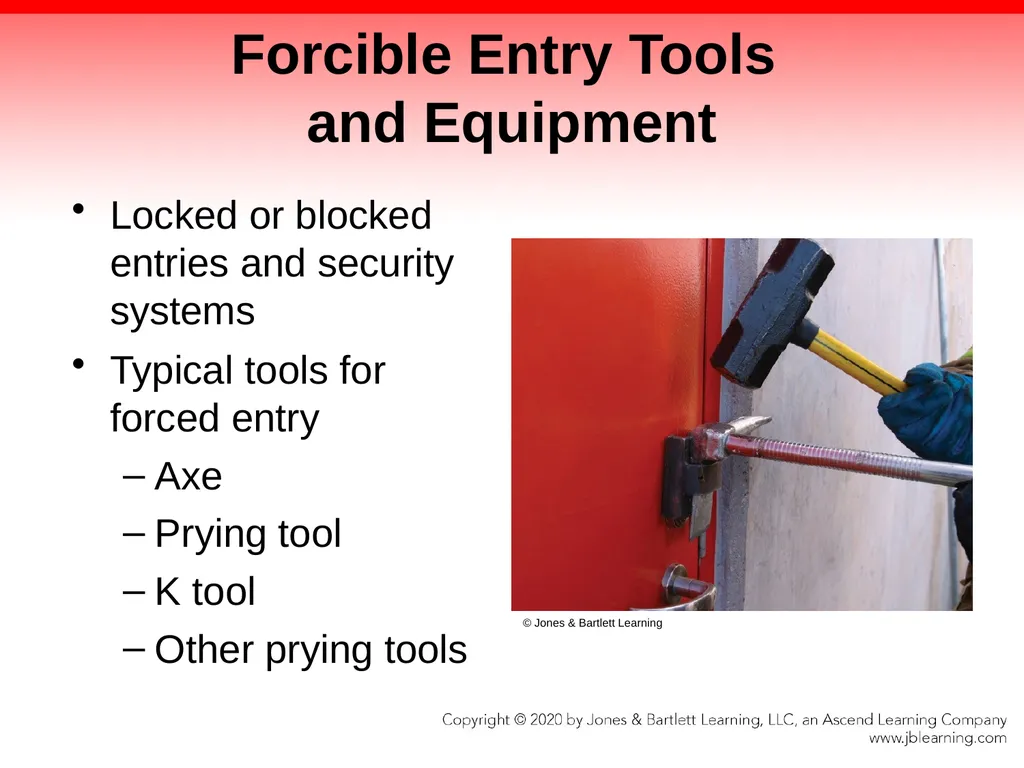
Forcible Entry Tools
and Equipment Locked or blocked entries and security systems
Typical tools for forced entry
Axe
Prying tool
K tool
Other prying tools © Jones & Bartlett Learning<br>
Typical tools for forced entry
Axe
Prying tool
K tool
Other prying tools © Jones & Bartlett Learning<br>
51
Forcible Entry Tools
and Equipment Sometimes the easiest or only way to gain access is to use cutting tools.
Although this is a destructive process, it is justified when required to save lives/property.
Many techniques can be used; the exact tool needed will depend on the method of entry and the type of obstacle.
Because experience usually determines the best way to gain entry in each situation, rely on the orders and advice of others.<br>
Although this is a destructive process, it is justified when required to save lives/property.
Many techniques can be used; the exact tool needed will depend on the method of entry and the type of obstacle.
Because experience usually determines the best way to gain entry in each situation, rely on the orders and advice of others.<br>
52
Interior Firefighting Tools and Equipment Involves multiple tasks performed simultaneously or in rapid succession
Combined operations (ops)
Specialized tools should be carried for particular assignments.
A basic set of tools includes a prying, striking, cutting, and pushing tool, and a hand light.<br>
Combined operations (ops)
Specialized tools should be carried for particular assignments.
A basic set of tools includes a prying, striking, cutting, and pushing tool, and a hand light.<br>
53
Search and Rescue Tools and Equipment Same basic hand tools as interior attack team
Hand light or flashlight
Portable radio
Thermal imaging devices
Hose lines
Ladders
Search rope(s)
Tubular webbing or short rope
Chalk, crayons, markers, paint, or masking tape for marking doors<br>
Hand light or flashlight
Portable radio
Thermal imaging devices
Hose lines
Ladders
Search rope(s)
Tubular webbing or short rope
Chalk, crayons, markers, paint, or masking tape for marking doors<br>
54
Rapid Intervention Tools and Equipment Ready for immediate assistance to lost, trapped, or injured fire fighters.
Need standard tools plus extra equipment to
Find and gain access to a fire fighter in trouble
Extricate a fire fighter who is trapped
Provide breathing air for a fire fighter who has experienced an SCBA failure or run out of air
Remove an injured or unconscious fire fighter from the building<br>
Need standard tools plus extra equipment to
Find and gain access to a fire fighter in trouble
Extricate a fire fighter who is trapped
Provide breathing air for a fire fighter who has experienced an SCBA failure or run out of air
Remove an injured or unconscious fire fighter from the building<br>
55
Rapid Intervention Tools and Equipment All of this equipment should be staged.
Special equipment includes:
Thermal imaging device
Additional portable lighting
Search ropes
Prying tools
Striking tools
Cutting tools, including a power saw
SCBA and spare air cylinders
Litter or patient packaging device<br>
Special equipment includes:
Thermal imaging device
Additional portable lighting
Search ropes
Prying tools
Striking tools
Cutting tools, including a power saw
SCBA and spare air cylinders
Litter or patient packaging device<br>
56
Ventilation Tools and Equipment Similar to forcible entry
Power saws and axes are common.
Unlocked or easily released windows and doors should be opened normally.
Locked or jammed windows and doors may have to be broken or forced open.
It may also be necessary to make interior openings so contaminated air can reach the exterior openings.<br>
Power saws and axes are common.
Unlocked or easily released windows and doors should be opened normally.
Locked or jammed windows and doors may have to be broken or forced open.
It may also be necessary to make interior openings so contaminated air can reach the exterior openings.<br>
57
Ventilation Tools and Equipment Fire fighters can also use mechanical ventilation.
Fans are often used either to remove smoke from a building or to introduce fresh air into a structure.
Negative-pressure fans (smoke ejectors) draw contaminated air out of a building.
Positive-pressure fans blow fresh air into a building to force contaminated air out.<br>
Fans are often used either to remove smoke from a building or to introduce fresh air into a structure.
Negative-pressure fans (smoke ejectors) draw contaminated air out of a building.
Positive-pressure fans blow fresh air into a building to force contaminated air out.<br>
58
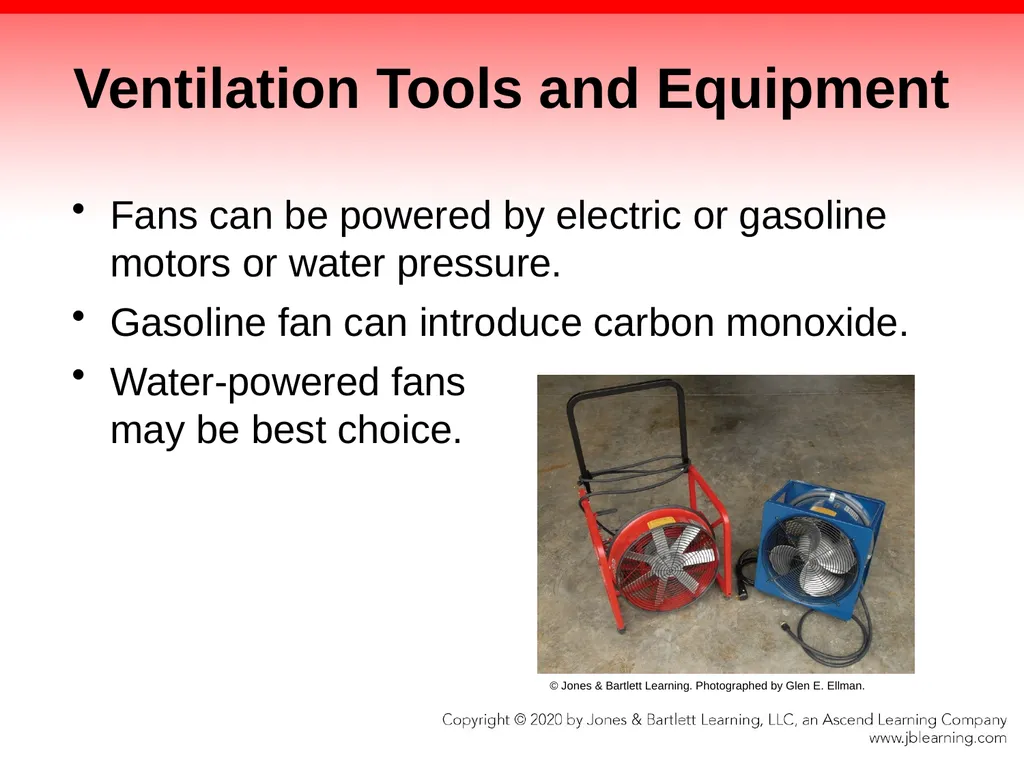
Ventilation Tools and Equipment Fans can be powered by electric or gasoline motors or water pressure.
Gasoline fan can introduce carbon monoxide.
Water-powered fans may be best choice. © Jones & Bartlett Learning. Photographed by Glen E. Ellman.<br>
Gasoline fan can introduce carbon monoxide.
Water-powered fans may be best choice. © Jones & Bartlett Learning. Photographed by Glen E. Ellman.<br>
59
Salvage and Overhaul Tools and Equipment The purpose of salvage and overhaul is to
Protect property and belongings from damage.
Ensure that all hidden fires are extinguished.
Burned debris must be removed, and potential hot spots in enclosed spaces behind walls, above ceilings, and under floors must be exposed.
Both tasks can be accomplished using simple hand tools.<br>
Protect property and belongings from damage.
Ensure that all hidden fires are extinguished.
Burned debris must be removed, and potential hot spots in enclosed spaces behind walls, above ceilings, and under floors must be exposed.
Both tasks can be accomplished using simple hand tools.<br>
60
Salvage and Overhaul Tools and Equipment Tools used include
Salvage covers and floor runners
Sprinkler shut-off tools
Water-removal equipment (water vacuums)
Ventilation equipment (fans, power blowers)
Pushing tools (pike poles of varying lengths)
Prying tools (Halligan tool)<br>
Salvage covers and floor runners
Sprinkler shut-off tools
Water-removal equipment (water vacuums)
Ventilation equipment (fans, power blowers)
Pushing tools (pike poles of varying lengths)
Prying tools (Halligan tool)<br>
61
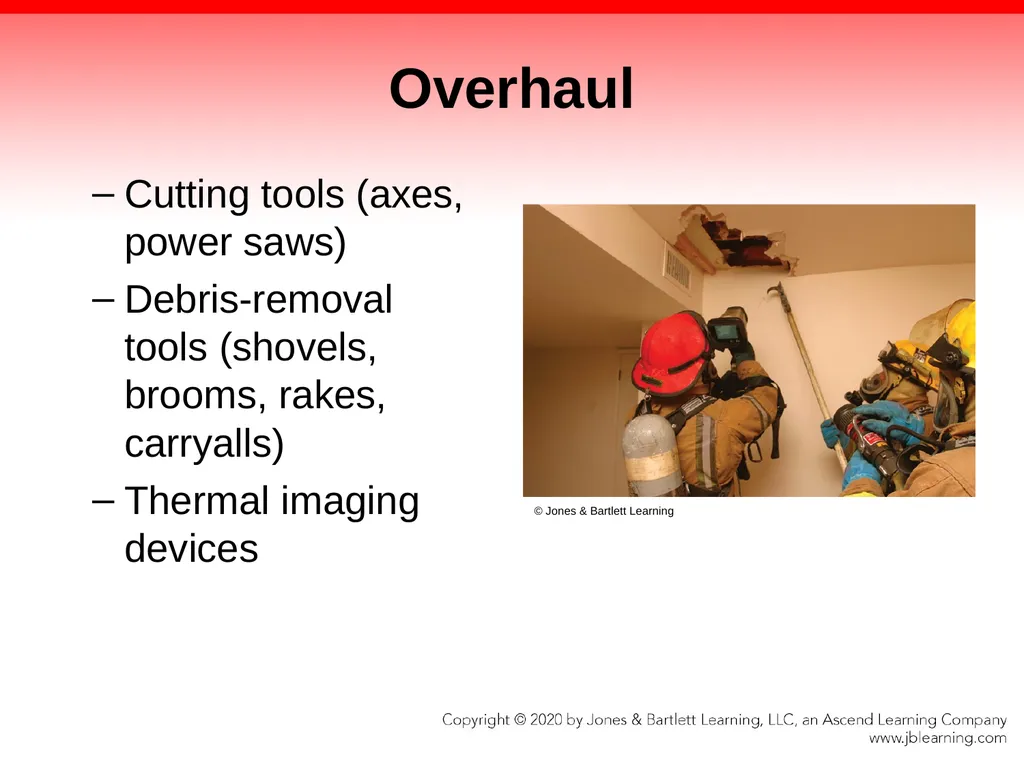
Overhaul Cutting tools (axes, power saws)
Debris-removal tools (shovels, brooms, rakes, carryalls)
Thermal imaging devices © Jones & Bartlett Learning<br>
Debris-removal tools (shovels, brooms, rakes, carryalls)
Thermal imaging devices © Jones & Bartlett Learning<br>
62
Maintenance Tools and equipment must be maintained to ensure readiness.
Tools and equipment must be ready for use before you respond to an emergency incident.
Follow manufacturer's instructions for cleaning and maintenance.
Use equipment only for its intended purpose.<br>
Tools and equipment must be ready for use before you respond to an emergency incident.
Follow manufacturer's instructions for cleaning and maintenance.
Use equipment only for its intended purpose.<br>
63
Cleaning and Inspecting Hand Tools Remove all dirt and debris.
If appropriate, use soap and water.
Learn how to use cleaning solutions.
Inspect for damage.
Avoid painting tools.
Keep markings to a minimum.
Return tools to their proper location.
Follow department procedures.<br>
If appropriate, use soap and water.
Learn how to use cleaning solutions.
Inspect for damage.
Avoid painting tools.
Keep markings to a minimum.
Return tools to their proper location.
Follow department procedures.<br>
64
Summary Tools and equipment are used in almost all fire suppression and rescue operations.
Hand tools are used to extend or multiply the actions of your body and to increase your effectiveness in performing specific functions.
Power tools and equipment use an external source of power and are faster and more efficient than hand tools.
Always wear PPE when using tools or equipment.<br>
Hand tools are used to extend or multiply the actions of your body and to increase your effectiveness in performing specific functions.
Power tools and equipment use an external source of power and are faster and more efficient than hand tools.
Always wear PPE when using tools or equipment.<br>
65
Summary Most tools fit into the following functional categories:
Rotating tools
Prying or spreading tools
Pushing or pulling tools
Striking tools
Cutting tools
Multiple-use tools<br>
Rotating tools
Prying or spreading tools
Pushing or pulling tools
Striking tools
Cutting tools
Multiple-use tools<br>
66
Summary The following forcible entry tools are used to gain entrance to a locked building:
Prying tools
Axe
Sledgehammer
Hammer or mallet
Chisel or punch
K tool or shove knife
Saw
Bolt cutter
Battering ram
Hydraulic door opener
Hydraulic rescue tool<br>
Prying tools
Axe
Sledgehammer
Hammer or mallet
Chisel or punch
K tool or shove knife
Saw
Bolt cutter
Battering ram
Hydraulic door opener
Hydraulic rescue tool<br>
67
Summary The interior attack team is responsible for advancing a hose line, finding the fire, and applying water to extinguish the flames. The members of this team need the following basic tools:
Prying tool
Striking tool
Cutting tool
Pushing/pulling tool
Strong hand light or portable light<br>
Prying tool
Striking tool
Cutting tool
Pushing/pulling tool
Strong hand light or portable light<br>
68
Summary A search and rescue team should carry the same basic hand tools as the interior attack team, as well as the following:
Hand light or flashlight
Portable radio
Thermal imaging devices
Hose lines
Ladders
Search rope(s) and webbing
Chalk, crayons, felt tip markers, spray paint, or masking tape<br>
Hand light or flashlight
Portable radio
Thermal imaging devices
Hose lines
Ladders
Search rope(s) and webbing
Chalk, crayons, felt tip markers, spray paint, or masking tape<br>
69
Summary An RIC should carry the following special equipment:
Thermal imaging device
Portable lighting
Search ropes
Prying tools
Striking tools
Cutting tools, including a power saw
SCBA or spare air cylinders<br>
Thermal imaging device
Portable lighting
Search ropes
Prying tools
Striking tools
Cutting tools, including a power saw
SCBA or spare air cylinders<br>
70
Summary The objective of ventilation is to provide openings so that fresh air can enter a burning structure and hot gases and products of combustion can escape from the building. The following special equipment is needed for ventilation:
Pulling and cutting tools
Cutting tools
Negative-pressure fans (smoke ejectors)
Positive-pressure fans<br>
Pulling and cutting tools
Cutting tools
Negative-pressure fans (smoke ejectors)
Positive-pressure fans<br>
71
Summary The purpose of salvage and overhaul is to protect property and belongings from damage and ensure that all hidden fires are extinguished. The following tools are used:
Salvage covers and floor runners
Sprinkler shut-off tools
Water-removal equipment
Ventilation equipment
Pushing, prying, cutting, debris-removal tools
Thermal imaging devices<br>
Salvage covers and floor runners
Sprinkler shut-off tools
Water-removal equipment
Ventilation equipment
Pushing, prying, cutting, debris-removal tools
Thermal imaging devices<br>
72
Summary All tools and equipment must be properly maintained so that they will be ready for use when they are needed. This means you must keep equipment clean and free from rust, keep cutting blades sharpened, and keep fuel tanks filled.<br>