
CHAPTER 8 Lifting and Moving Patients National EMS
CP
Published · 101 slides · 0 views

1 / 1

Description
CHAPTER 8 Lifting and Moving Patients National EMS Education Standard Competencies EMS Operations Knowledge of operational roles and responsibilities to ensure patient, public, and personnel safety. Introduction In the course of a call, you
Related Topics
Share
Embed code
Download this presentation From Below
"CHAPTER 8 Lifting and Moving Patients National EMS" is the property of its rightful owner. Permission is granted to download and print the materials on this website for personal, non-commercial use only, and to display it on your personal computer provided you do not modify the materials and that you retain all copyright notices contained in the materials. By downloading content from our website, you accept the terms of this agreement.
Presentation Transcript
01
CHAPTER 8 Lifting and Moving Patients<br>
02
National EMS Education Standard Competencies EMS Operations
Knowledge of operational roles and responsibilities to ensure patient, public, and personnel safety.<br>
Knowledge of operational roles and responsibilities to ensure patient, public, and personnel safety.<br>
03
Introduction In the course of a call, you will have to move patients to provide emergency medical care and transport.
To move patients without injury, you need to learn the proper techniques.
Knowledge of proper body mechanics and a power grip is important.<br>
To move patients without injury, you need to learn the proper techniques.
Knowledge of proper body mechanics and a power grip is important.<br>
04
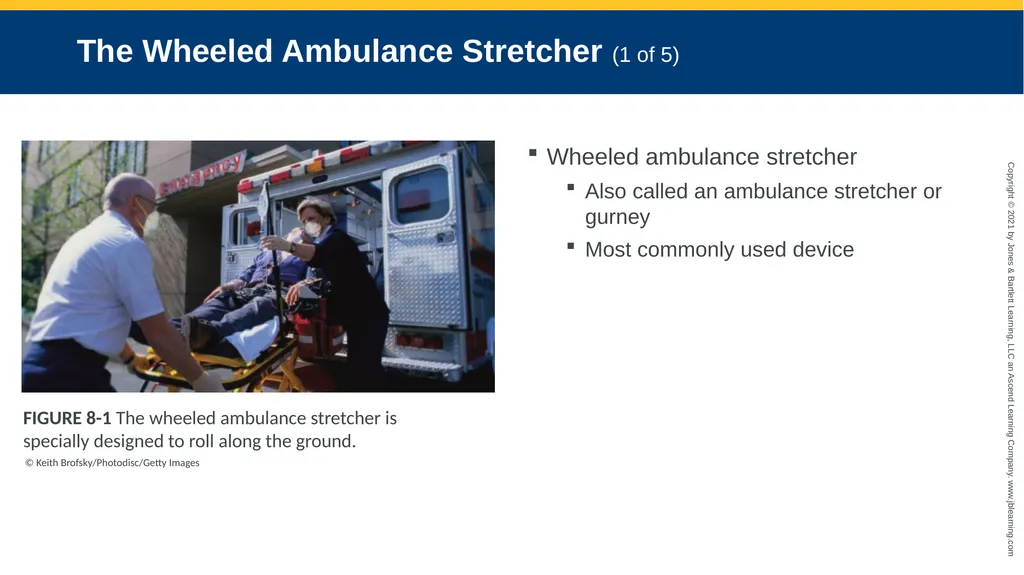
The Wheeled Ambulance Stretcher (1 of 5) Wheeled ambulance stretcher
Also called an ambulance stretcher or gurney
Most commonly used device FIGURE 8-1 The wheeled ambulance stretcher is specially designed to roll along the ground. © Keith Brofsky/Photodisc/Getty Images<br>
Also called an ambulance stretcher or gurney
Most commonly used device FIGURE 8-1 The wheeled ambulance stretcher is specially designed to roll along the ground. © Keith Brofsky/Photodisc/Getty Images<br>
05
The Wheeled Ambulance Stretcher (2 of 5) The wheeled ambulance stretcher weighs 40–145 lb.
Generally not taken up or down stairs or where the patient must be carried for any significant distance<br>
Generally not taken up or down stairs or where the patient must be carried for any significant distance<br>
06
The Wheeled Ambulance Stretcher (3 of 5) Moving a patient by rolling, using a stretcher or other wheeled device, is preferred when the situation allows and helps prevent injuries from carrying.
Before going on a call, familiarize yourself with the specific features of the stretcher your ambulance carries.<br>
Before going on a call, familiarize yourself with the specific features of the stretcher your ambulance carries.<br>
07
The Wheeled Ambulance Stretcher (4 of 5) General features
Head end and foot end
Strong metal frame to which all other parts are attached
Hinges at center allow for elevation of head/back.
Guardrails prevent the patient from rolling out.<br>
Head end and foot end
Strong metal frame to which all other parts are attached
Hinges at center allow for elevation of head/back.
Guardrails prevent the patient from rolling out.<br>
08
The Wheeled Ambulance Stretcher (5 of 5) General features (cont’d)
Undercarriage frame allows adjustment to any height.
Mattress must be fluid resistant.
The patient is secured with straps.
Help protect the patient from further injury.<br>
Undercarriage frame allows adjustment to any height.
Mattress must be fluid resistant.
The patient is secured with straps.
Help protect the patient from further injury.<br>
09
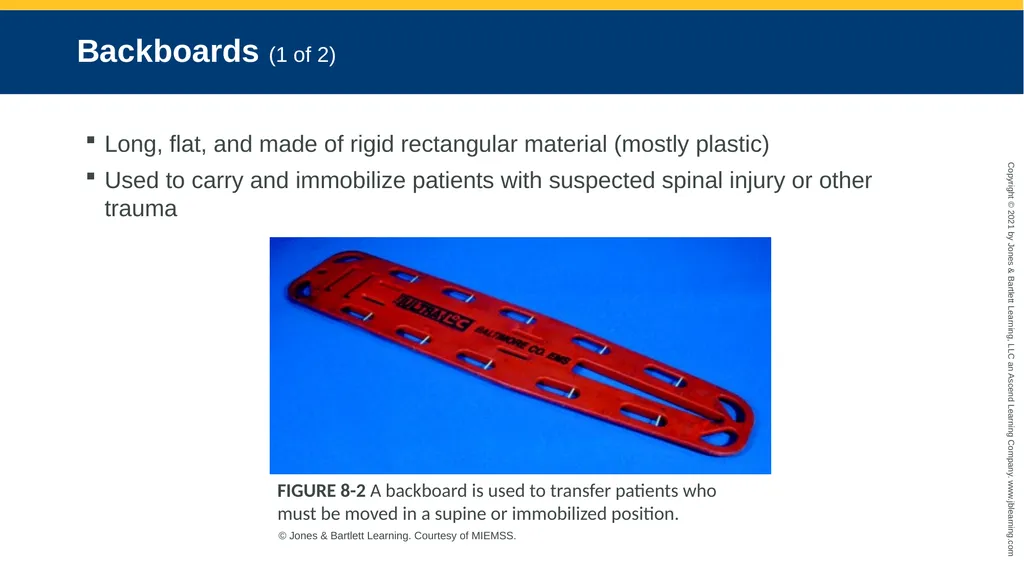
Backboards (1 of 2) Long, flat, and made of rigid rectangular material (mostly plastic)
Used to carry and immobilize patients with suspected spinal injury or other trauma FIGURE 8-2 A backboard is used to transfer patients who
must be moved in a supine or immobilized position. © Jones & Bartlett Learning. Courtesy of MIEMSS.<br>
Used to carry and immobilize patients with suspected spinal injury or other trauma FIGURE 8-2 A backboard is used to transfer patients who
must be moved in a supine or immobilized position. © Jones & Bartlett Learning. Courtesy of MIEMSS.<br>
10
Backboards (2 of 2) Commonly used for patients found lying down
Used to move patients out of awkward places
6–7 feet long
Holes serve as handles and as a place to secure straps.<br>
Used to move patients out of awkward places
6–7 feet long
Holes serve as handles and as a place to secure straps.<br>
11
Moving and Positioning the Patient (1 of 2) When you move a patient, take care that injury does not occur:
To you
To your team
To the patient
Patient lifting and moving are technical skills that require repeated training and practice.<br>
To you
To your team
To the patient
Patient lifting and moving are technical skills that require repeated training and practice.<br>
12
Moving and Positioning the Patient (2 of 2) Using proper body mechanics and maintaining physical fitness greatly reduce the chance of injury.
Move patients in an orderly, planned, and unhurried manner.
Master the skills necessary for the equipment you will be using.<br>
Move patients in an orderly, planned, and unhurried manner.
Master the skills necessary for the equipment you will be using.<br>
13
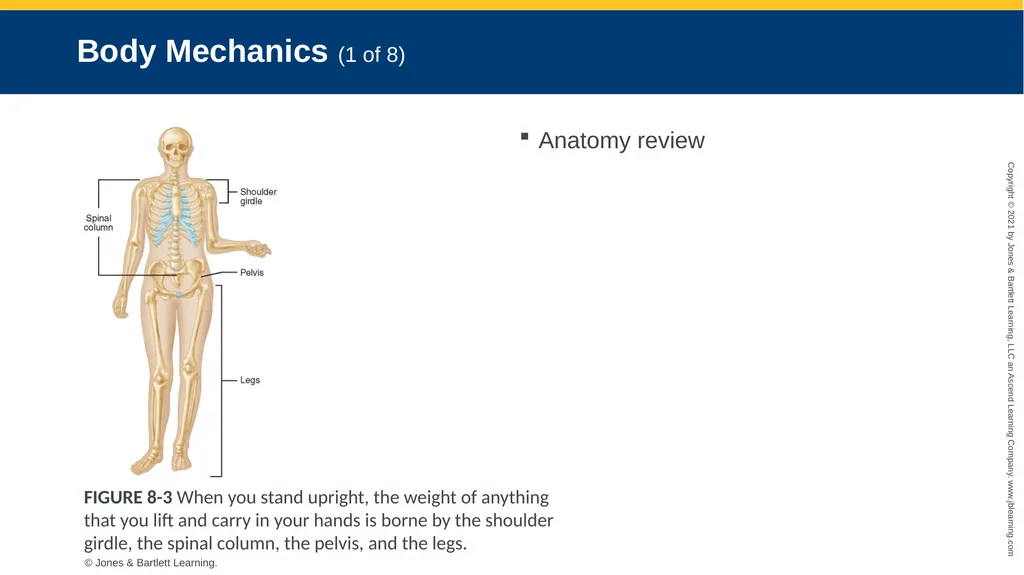
Body Mechanics (1 of 8) Anatomy review FIGURE 8-3 When you stand upright, the weight of anything that you lift and carry in your hands is borne by the shoulder girdle, the spinal column, the pelvis, and the legs. © Jones & Bartlett Learning.<br>
14
Body Mechanics (2 of 8) Lifting position
Shoulder girdle should be aligned over pelvis.
Hands should be held close to legs.
Force then goes essentially straight down spinal column.
Very little strain occurs.<br>
Shoulder girdle should be aligned over pelvis.
Hands should be held close to legs.
Force then goes essentially straight down spinal column.
Very little strain occurs.<br>
15
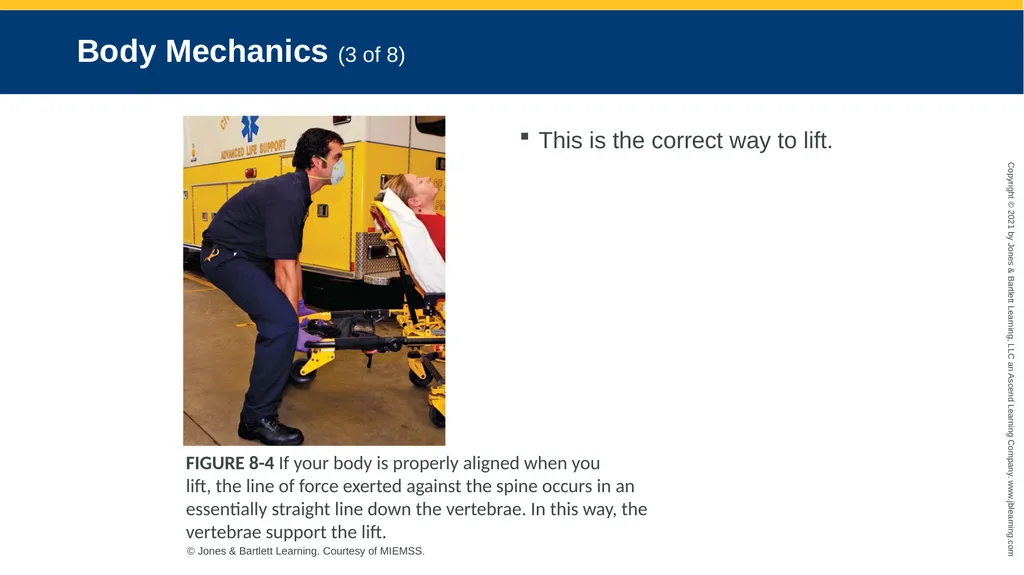
Body Mechanics (3 of 8) This is the correct way to lift. FIGURE 8-4 If your body is properly aligned when you
lift, the line of force exerted against the spine occurs in an
essentially straight line down the vertebrae. In this way, the
vertebrae support the lift. © Jones & Bartlett Learning. Courtesy of MIEMSS.<br>
lift, the line of force exerted against the spine occurs in an
essentially straight line down the vertebrae. In this way, the
vertebrae support the lift. © Jones & Bartlett Learning. Courtesy of MIEMSS.<br>
16
Body Mechanics (4 of 8) You may injure your back:
If you lift while leaning forward
If you lift with your back straight but bent significantly forward at the hips<br>
If you lift while leaning forward
If you lift with your back straight but bent significantly forward at the hips<br>
17
Body Mechanics (5 of 8) Lifting technique
Legs should be spread about 15 inches apart (shoulder width).
Place feet so the center of gravity is balanced.
With your back held upright, bring your upper body down by bending the legs.
Grasp the patient/stretcher.<br>
Legs should be spread about 15 inches apart (shoulder width).
Place feet so the center of gravity is balanced.
With your back held upright, bring your upper body down by bending the legs.
Grasp the patient/stretcher.<br>
18
Body Mechanics (6 of 8) Lifting technique (cont’d)
Lift the patient by raising your upper body and arms and straightening your legs until standing.
Keep the weight close to your body.
Keep your arms the same distance apart.<br>
Lift the patient by raising your upper body and arms and straightening your legs until standing.
Keep the weight close to your body.
Keep your arms the same distance apart.<br>
19
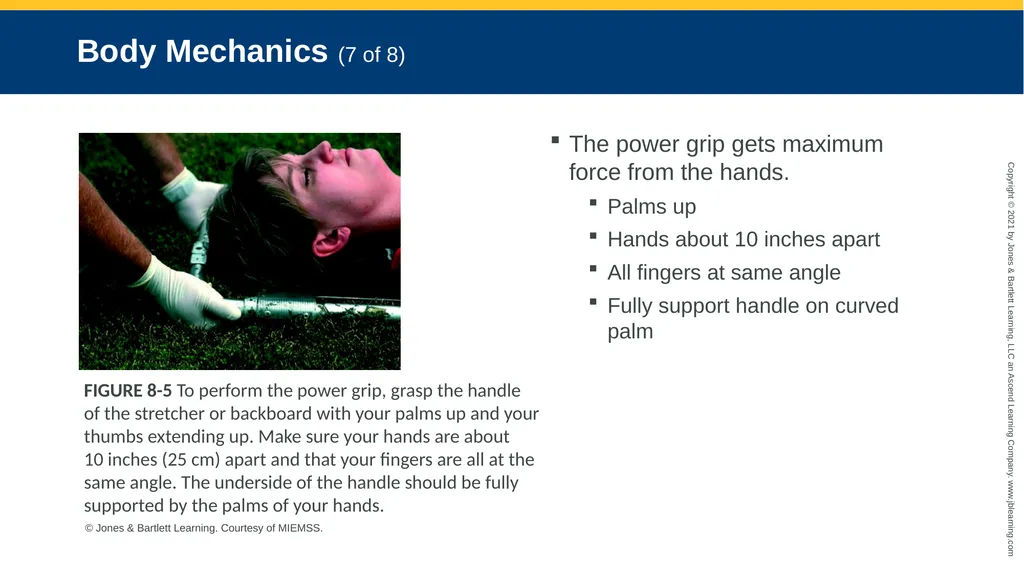
Body Mechanics (7 of 8) The power grip gets maximum force from the hands.
Palms up
Hands about 10 inches apart
All fingers at same angle
Fully support handle on curved palm FIGURE 8-5 To perform the power grip, grasp the handle
of the stretcher or backboard with your palms up and your
thumbs extending up. Make sure your hands are about
10 inches (25 cm) apart and that your fingers are all at the
same angle. The underside of the handle should be fully
supported by the palms of your hands. © Jones & Bartlett Learning. Courtesy of MIEMSS.<br>
Palms up
Hands about 10 inches apart
All fingers at same angle
Fully support handle on curved palm FIGURE 8-5 To perform the power grip, grasp the handle
of the stretcher or backboard with your palms up and your
thumbs extending up. Make sure your hands are about
10 inches (25 cm) apart and that your fingers are all at the
same angle. The underside of the handle should be fully
supported by the palms of your hands. © Jones & Bartlett Learning. Courtesy of MIEMSS.<br>
20
Body Mechanics (8 of 8) When directly lifting a patient, tightly grip the patient in a place and manner that will ensure that you will not lose your grasp on the patient.<br>
21
Principles of Safe Reaching and Pulling (1 of 6) Body drag
The same body mechanics and principles apply to moving, lifting, and carrying a patient.
Keep your back locked by tightening your abdominal muscles.
Kneel.
Extend your arms no more than 15–20 inches in front of you.
Alternate between pulling the patient by flexing your arms and repositioning yourself.<br>
The same body mechanics and principles apply to moving, lifting, and carrying a patient.
Keep your back locked by tightening your abdominal muscles.
Kneel.
Extend your arms no more than 15–20 inches in front of you.
Alternate between pulling the patient by flexing your arms and repositioning yourself.<br>
22
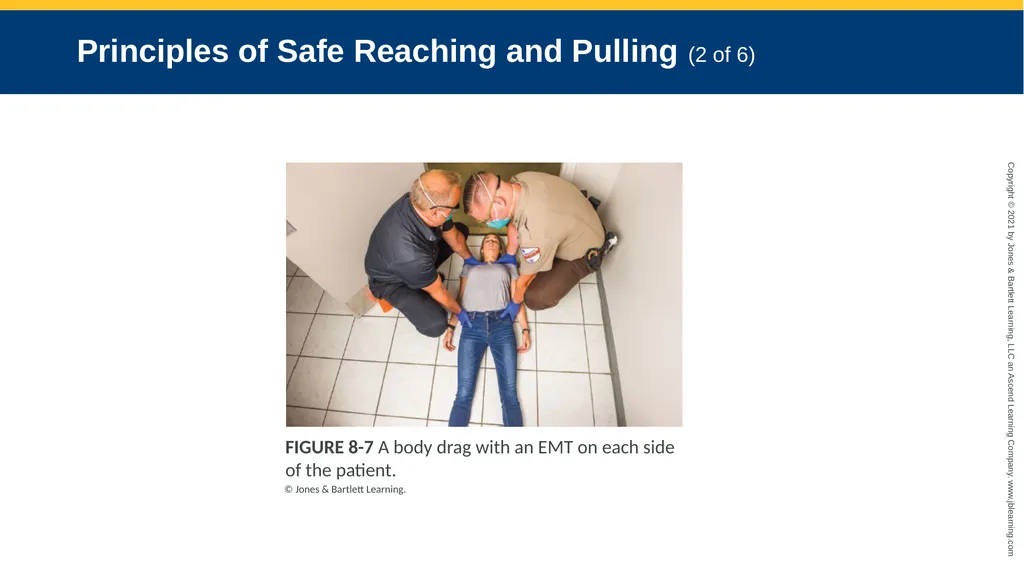
Principles of Safe Reaching and Pulling (2 of 6) FIGURE 8-7 A body drag with an EMT on each side of the patient. © Jones & Bartlett Learning.<br>
23
Principles of Safe Reaching and Pulling (3 of 6) To drag a patient across a bed:
Kneel on the bed to avoid reaching beyond the recommended distance.
Drag the patient to within 15–20 inches.
Complete the drag while standing at the side of the bed.
Use the sheet or blanket under the patient rather than dragging the patient by his or her clothing.<br>
Kneel on the bed to avoid reaching beyond the recommended distance.
Drag the patient to within 15–20 inches.
Complete the drag while standing at the side of the bed.
Use the sheet or blanket under the patient rather than dragging the patient by his or her clothing.<br>
24
Principles of Safe Reaching and Pulling (4 of 6) In the hospital, transfer the patient from the stretcher to a bed with a body drag.
The stretcher should be the same height or slightly higher than the bed.
You and a partner should kneel on the bed and drag in increments.<br>
The stretcher should be the same height or slightly higher than the bed.
You and a partner should kneel on the bed and drag in increments.<br>
25
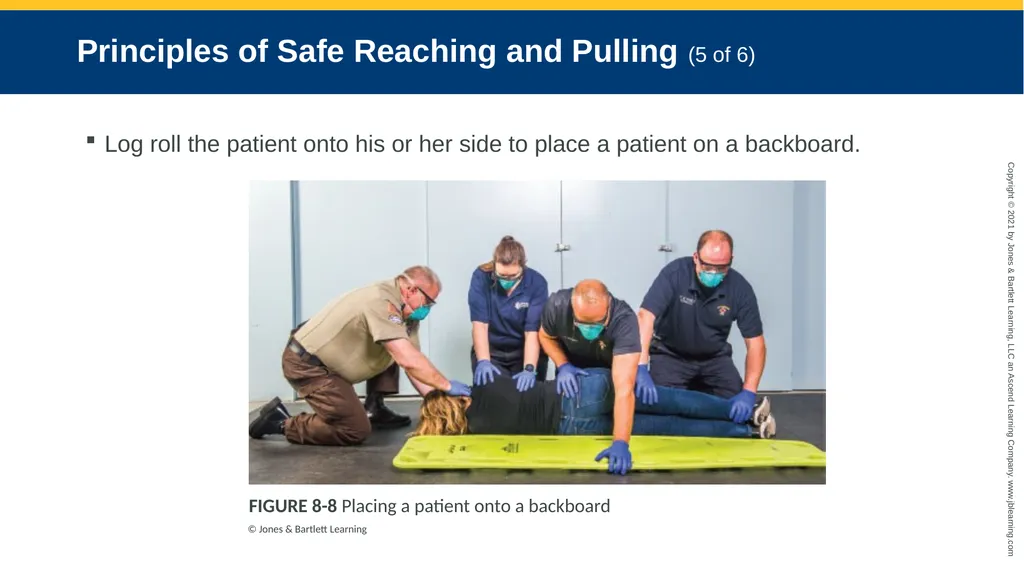
Principles of Safe Reaching and Pulling (5 of 6) Log roll the patient onto his or her side to place a patient on a backboard. FIGURE 8-8 Placing a patient onto a backboard © Jones & Bartlett Learning<br>
26
Principles of Safe Reaching and Pulling (6 of 6) Log rolling (cont’d)
Kneel as close to the patient’s side as possible.
Keep your back straight and lean solely from the hips.
Roll the patient without stopping until the patient is resting on his or her side and braced against your thighs.
Pulling toward you allows your legs to prevent the patient from rolling over completely.<br>
Kneel as close to the patient’s side as possible.
Keep your back straight and lean solely from the hips.
Roll the patient without stopping until the patient is resting on his or her side and braced against your thighs.
Pulling toward you allows your legs to prevent the patient from rolling over completely.<br>
27
Principles of Safe Lifting and Carrying (1 of 11) Whenever possible, use a device that can be rolled.
When a wheeled device is not available, make sure that you understand and follow the guidelines for carrying a patient on a stretcher.<br>
When a wheeled device is not available, make sure that you understand and follow the guidelines for carrying a patient on a stretcher.<br>
28
Principles of Safe Lifting and Carrying (2 of 11) Patient weight
Estimate the patient’s weight before lifting.
Adults often weigh 120–220 lb.
Two EMTs should be able to safely lift this weight.
Try to use four providers to lift when possible.
More stability
Requires less strength<br>
Estimate the patient’s weight before lifting.
Adults often weigh 120–220 lb.
Two EMTs should be able to safely lift this weight.
Try to use four providers to lift when possible.
More stability
Requires less strength<br>
29
Principles of Safe Lifting and Carrying (3 of 11) Patient weight (cont’d)
Do not attempt to lift a patient who weighs more than 250 lb with fewer than four providers.
Know the weight limitations of the equipment and how to handle patients who exceed the weight limitations.
Special bariatric techniques and equipment are used when patients weigh more than 350 lb (159 kg).<br>
Do not attempt to lift a patient who weighs more than 250 lb with fewer than four providers.
Know the weight limitations of the equipment and how to handle patients who exceed the weight limitations.
Special bariatric techniques and equipment are used when patients weigh more than 350 lb (159 kg).<br>
30
Principles of Safe Lifting and Carrying (4 of 11) Lifting and carrying a patient on a backboard or stretcher
More of the patient’s weight rests on the head half of the device than on the foot half.
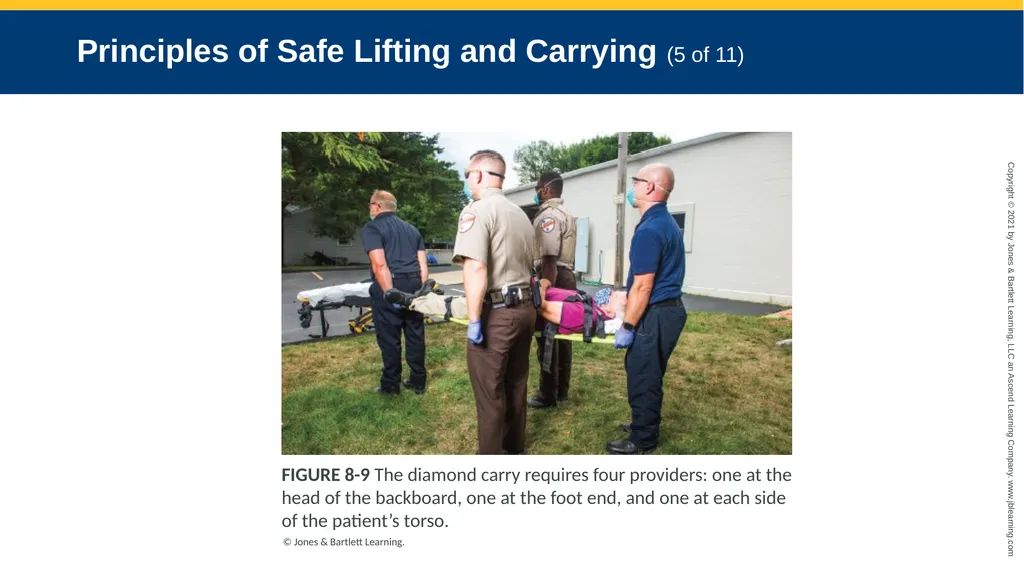
The diamond carry and the one-handed carry use one EMT at the head and the foot, and one on each side of the patient’s torso.<br>
More of the patient’s weight rests on the head half of the device than on the foot half.
The diamond carry and the one-handed carry use one EMT at the head and the foot, and one on each side of the patient’s torso.<br>
31
Principles of Safe Lifting and Carrying (5 of 11) FIGURE 8-9 The diamond carry requires four providers: one at the head of the backboard, one at the foot end, and one at each side of the patient’s torso. © Jones & Bartlett Learning.<br>
32
Principles of Safe Lifting and Carrying (6 of 11) Lifting and carrying a patient on a backboard or stretcher (cont’d)
Use four providers—one provider at each corner of the stretcher to provide an even lift.
When rolling the wheeled ambulance stretcher, make sure that it is in the fully elevated position.<br>
Use four providers—one provider at each corner of the stretcher to provide an even lift.
When rolling the wheeled ambulance stretcher, make sure that it is in the fully elevated position.<br>
33
Principles of Safe Lifting and Carrying (7 of 11) Moving a patient with a stair chair
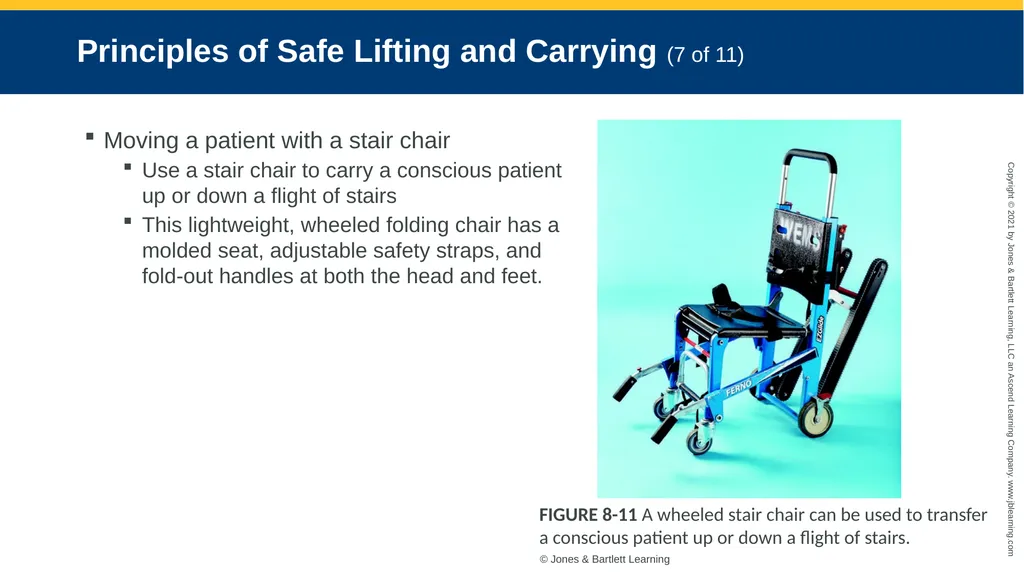
Use a stair chair to carry a conscious patient up or down a flight of stairs
This lightweight, wheeled folding chair has a molded seat, adjustable safety straps, and fold-out handles at both the head and feet. FIGURE 8-11 A wheeled stair chair can be used to transfer
a conscious patient up or down a flight of stairs. © Jones & Bartlett Learning<br>
Use a stair chair to carry a conscious patient up or down a flight of stairs
This lightweight, wheeled folding chair has a molded seat, adjustable safety straps, and fold-out handles at both the head and feet. FIGURE 8-11 A wheeled stair chair can be used to transfer
a conscious patient up or down a flight of stairs. © Jones & Bartlett Learning<br>
34
Principles of Safe Lifting and Carrying (8 of 11) Moving a patient on stairs with a stretcher
A backboard should be used instead for a patient who:
Is unresponsive
Must be moved in supine position
Must be immobilized<br>
A backboard should be used instead for a patient who:
Is unresponsive
Must be moved in supine position
Must be immobilized<br>
35
Principles of Safe Lifting and Carrying (9 of 11) Moving a patient on stairs with a stretcher (cont’d)
Carry the patient on the backboard down to the prepared stretcher.
Place the strongest EMTs at the head and foot ends, with the taller person at the foot end.
Place both the backboard and the patient on the stretcher; secure both to the stretcher with additional straps.<br>
Carry the patient on the backboard down to the prepared stretcher.
Place the strongest EMTs at the head and foot ends, with the taller person at the foot end.
Place both the backboard and the patient on the stretcher; secure both to the stretcher with additional straps.<br>
36
Principles of Safe Lifting and Carrying (10 of 11) Loading a wheeled stretcher into an ambulance
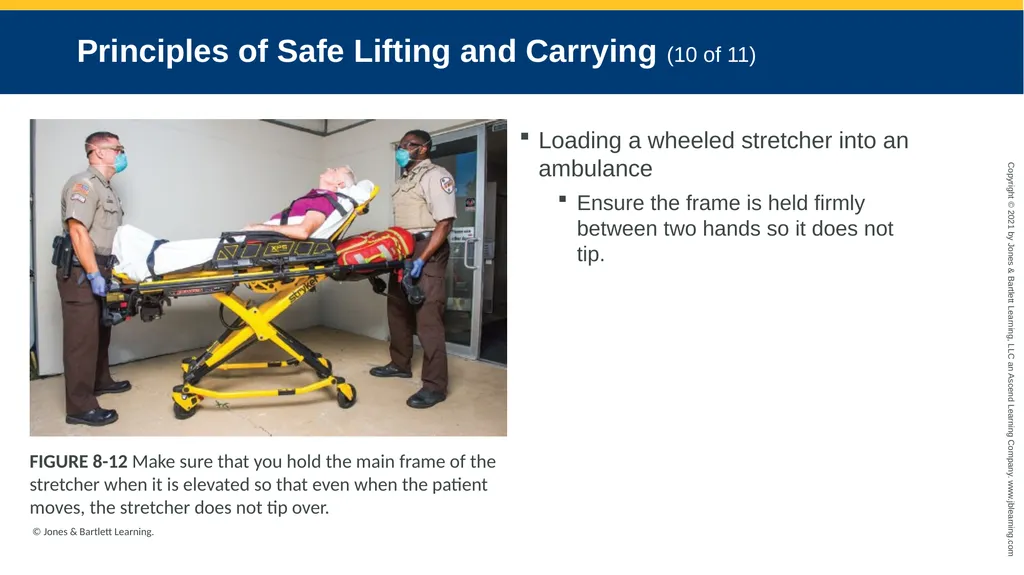
Ensure the frame is held firmly between two hands so it does not tip. FIGURE 8-12 Make sure that you hold the main frame of the stretcher when it is elevated so that even when the patient moves, the stretcher does not tip over. © Jones & Bartlett Learning.<br>
Ensure the frame is held firmly between two hands so it does not tip. FIGURE 8-12 Make sure that you hold the main frame of the stretcher when it is elevated so that even when the patient moves, the stretcher does not tip over. © Jones & Bartlett Learning.<br>
37
Principles of Safe Lifting and Carrying (11 of 11) Loading a wheeled stretcher into an ambulance (cont’d)
Newer models are self-loading, allowing you to push the stretcher into the ambulance.
Other models need to be lowered and lifted to the height of the floor of ambulance.
Clamps in the ambulance hold the stretcher in place.<br>
Newer models are self-loading, allowing you to push the stretcher into the ambulance.
Other models need to be lowered and lifted to the height of the floor of ambulance.
Clamps in the ambulance hold the stretcher in place.<br>
38
Directions and Commands (1 of 3) Team actions must be coordinated.
Team leader
Indicates where each team member should be
Rapidly describes the sequence of steps to perform before lifting<br>
Team leader
Indicates where each team member should be
Rapidly describes the sequence of steps to perform before lifting<br>
39
Directions and Commands (2 of 3) Preparatory commands are used.
Example:
Team leader says, “All ready to stop,” to get team’s attention.
Team leader says, “Stop!” in a louder voice.
Countdowns are also used.<br>
Example:
Team leader says, “All ready to stop,” to get team’s attention.
Team leader says, “Stop!” in a louder voice.
Countdowns are also used.<br>
40
Directions and Commands (3 of 3) Carefully plan ahead.
Select the methods that will involve the least amount of lifting and carrying.
Consider whether there is an option that will cause less strain.<br>
Select the methods that will involve the least amount of lifting and carrying.
Consider whether there is an option that will cause less strain.<br>
41
Emergency Moves (1 of 5) Use when there is potential for danger.
Use when you cannot properly assess the patient or provide immediate care because of the patient’s location or position.<br>
Use when you cannot properly assess the patient or provide immediate care because of the patient’s location or position.<br>
42
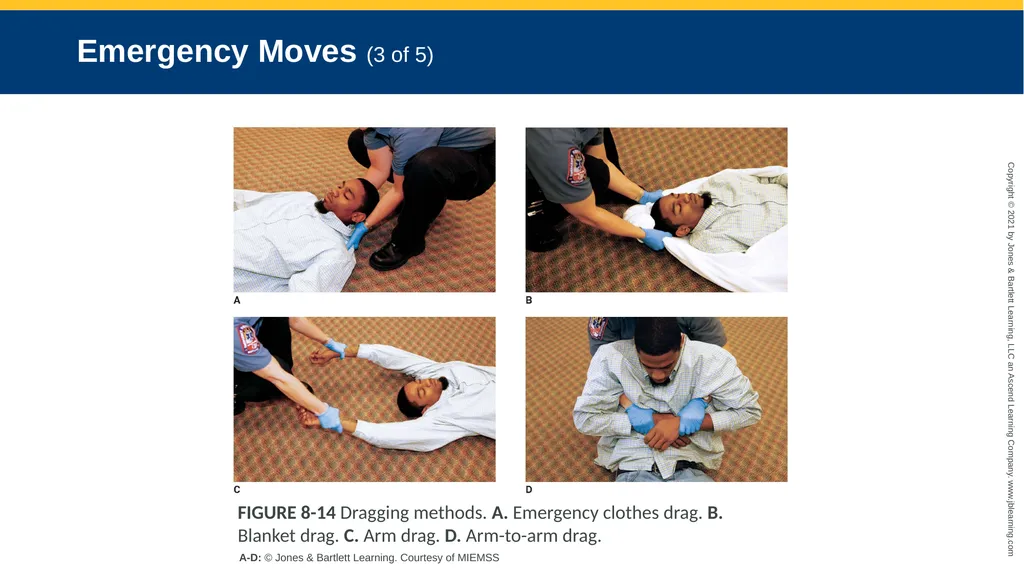
Emergency Moves (2 of 5) Use techniques to help prevent aggravation of patient spinal injury.
Clothes drag
Blanket drag
Arm drag
Arm-to-arm drag<br>
Clothes drag
Blanket drag
Arm drag
Arm-to-arm drag<br>
43
Emergency Moves (3 of 5) FIGURE 8-14 Dragging methods. A. Emergency clothes drag. B. Blanket drag. C. Arm drag. D. Arm-to-arm drag. A-D: © Jones & Bartlett Learning. Courtesy of MIEMSS<br>
44
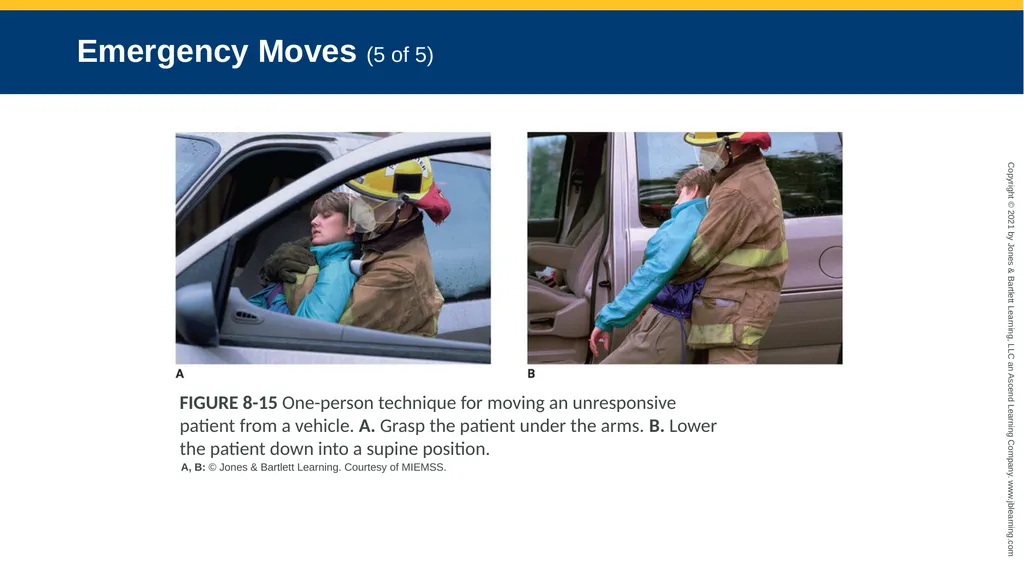
Emergency Moves (4 of 5) To remove an unconscious patient from a vehicle alone:
Move the patient’s legs clear of the pedals.
Rotate the patient so the back is toward the open car door.
Place your arms through the armpits and support the head against your body.
Drag the patient from the seat to a safe location.<br>
Move the patient’s legs clear of the pedals.
Rotate the patient so the back is toward the open car door.
Place your arms through the armpits and support the head against your body.
Drag the patient from the seat to a safe location.<br>
45
Emergency Moves (5 of 5) FIGURE 8-15 One-person technique for moving an unresponsive patient from a vehicle. A. Grasp the patient under the arms. B. Lower the patient down into a supine position. A, B: © Jones & Bartlett Learning. Courtesy of MIEMSS.<br>
46
Urgent Moves (1 of 2) Necessary to move patient:
With altered level of consciousness
With inadequate ventilation
In shock
In extreme weather conditions
Rapid extrication technique requires a team of knowledgeable EMTs.<br>
With altered level of consciousness
With inadequate ventilation
In shock
In extreme weather conditions
Rapid extrication technique requires a team of knowledgeable EMTs.<br>
47
Urgent Moves (2 of 2) Rapid extrication technique should be used only if urgency exists.
The patient can be moved within 1 minute.
This techniques increases the risk of damage if the patient has a spinal injury.
Look at all options before using an urgent move.<br>
The patient can be moved within 1 minute.
This techniques increases the risk of damage if the patient has a spinal injury.
Look at all options before using an urgent move.<br>
48
Nonurgent Moves (1 of 4) Used when both the scene and the patient are stable
Carefully plan how to move the patient.
Team leader should plan the move.
Personnel
Obstacles identified
Equipment
Procedure and path<br>
Carefully plan how to move the patient.
Team leader should plan the move.
Personnel
Obstacles identified
Equipment
Procedure and path<br>
49
Nonurgent Moves (2 of 4) Choose between:
Direct ground lift
For patients with no suspected spinal injury who are supine
Patients who need to be carried over some distance
EMTs stand side by side to lift and carry the patients.<br>
Direct ground lift
For patients with no suspected spinal injury who are supine
Patients who need to be carried over some distance
EMTs stand side by side to lift and carry the patients.<br>
50
Nonurgent Moves (3 of 4) Extremity lift
For those patients with no suspected spinal injury who are supine or sitting
Helpful when the patient is in a small space
One EMT is at the patient’s head and the other at the patient’s feet.
Coordinate moves verbally.<br>
For those patients with no suspected spinal injury who are supine or sitting
Helpful when the patient is in a small space
One EMT is at the patient’s head and the other at the patient’s feet.
Coordinate moves verbally.<br>
51
Nonurgent Moves (4 of 4) Transfer moves
Direct carry
Move supine patient from bed to stretcher using a direct carry method
Draw sheet method
Move patient from bed to stretcher using a sheet or blanket
Scoop stretcher<br>
Direct carry
Move supine patient from bed to stretcher using a direct carry method
Draw sheet method
Move patient from bed to stretcher using a sheet or blanket
Scoop stretcher<br>
52
Geriatrics (1 of 2) Most patients transported by EMS are geriatric patients.
Skeletal changes may cause brittle bones, rigidity, and spinal curvatures that present special challenges.
Allay the patient’s fears with a sympathetic and compassionate approach.<br>
Skeletal changes may cause brittle bones, rigidity, and spinal curvatures that present special challenges.
Allay the patient’s fears with a sympathetic and compassionate approach.<br>
53
Geriatrics (2 of 2) Kyphosis Spondylosis © Dr. P. Marazzi/Photo Researchers, Inc. © Dr. P. Marazzi/Photo Researchers, Inc.<br>
54
Bariatrics (1 of 2) Refers to management of obesity
76 million US adults are obese.
30–40% of adults are obese.
Approximately 17% of children are obese.
Back injuries account for the largest number of missed days of work.<br>
76 million US adults are obese.
30–40% of adults are obese.
Approximately 17% of children are obese.
Back injuries account for the largest number of missed days of work.<br>
55
Bariatrics (2 of 2) Stretchers and equipment are being produced with higher capacities.
Does not address danger to users of that equipment
Mechanical ambulance lifts are uncommon in the United States.<br>
Does not address danger to users of that equipment
Mechanical ambulance lifts are uncommon in the United States.<br>
56
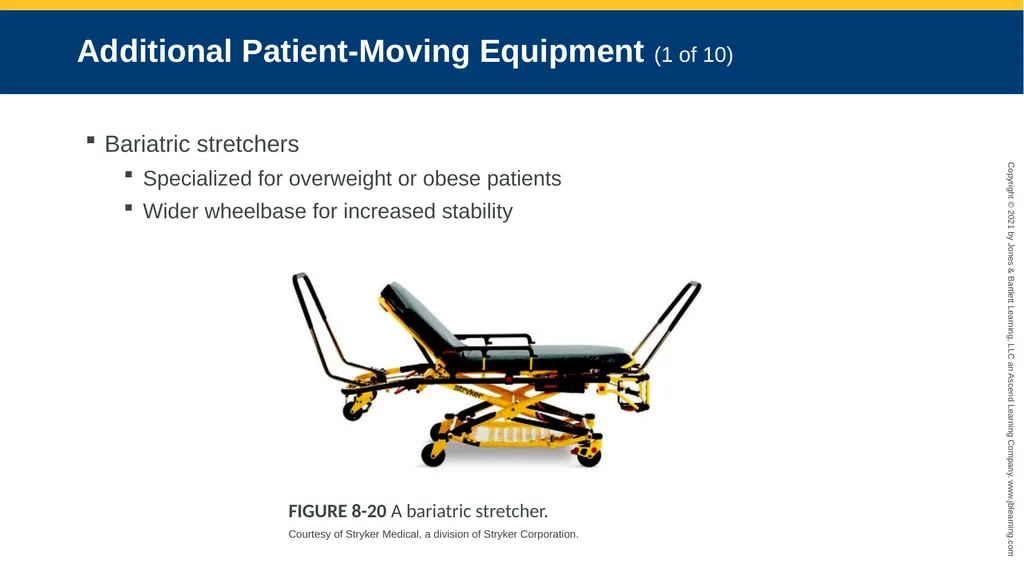
Additional Patient-Moving Equipment (1 of 10) Bariatric stretchers
Specialized for overweight or obese patients
Wider wheelbase for increased stability FIGURE 8-20 A bariatric stretcher. Courtesy of Stryker Medical, a division of Stryker Corporation.<br>
Specialized for overweight or obese patients
Wider wheelbase for increased stability FIGURE 8-20 A bariatric stretcher. Courtesy of Stryker Medical, a division of Stryker Corporation.<br>
57
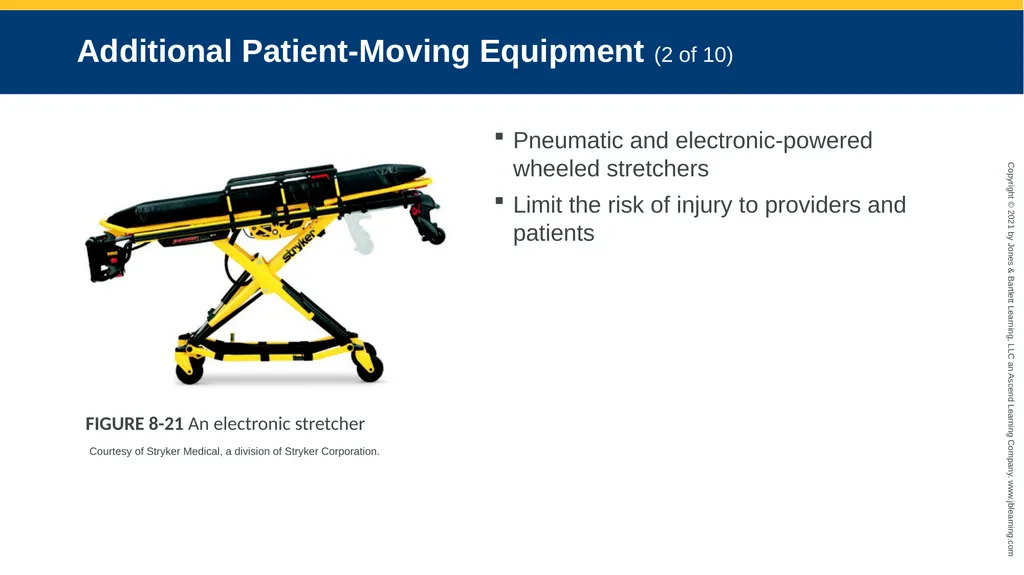
Additional Patient-Moving Equipment (2 of 10) Pneumatic and electronic-powered wheeled stretchers
Limit the risk of injury to providers and patients FIGURE 8-21 An electronic stretcher Courtesy of Stryker Medical, a division of Stryker Corporation.<br>
Limit the risk of injury to providers and patients FIGURE 8-21 An electronic stretcher Courtesy of Stryker Medical, a division of Stryker Corporation.<br>
58
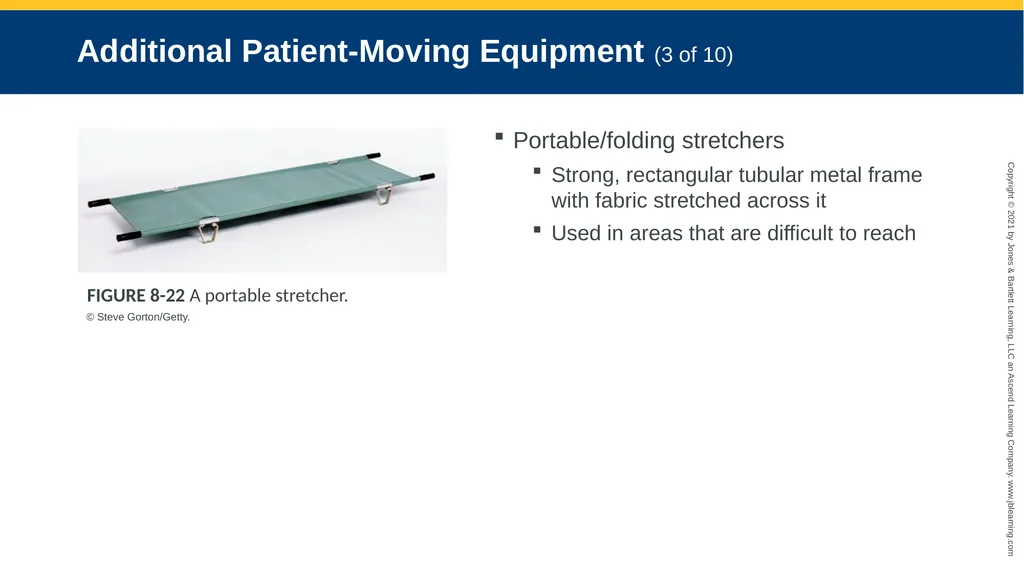
Additional Patient-Moving Equipment (3 of 10) Portable/folding stretchers
Strong, rectangular tubular metal frame with fabric stretched across it
Used in areas that are difficult to reach FIGURE 8-22 A portable stretcher. © Steve Gorton/Getty.<br>
Strong, rectangular tubular metal frame with fabric stretched across it
Used in areas that are difficult to reach FIGURE 8-22 A portable stretcher. © Steve Gorton/Getty.<br>
59
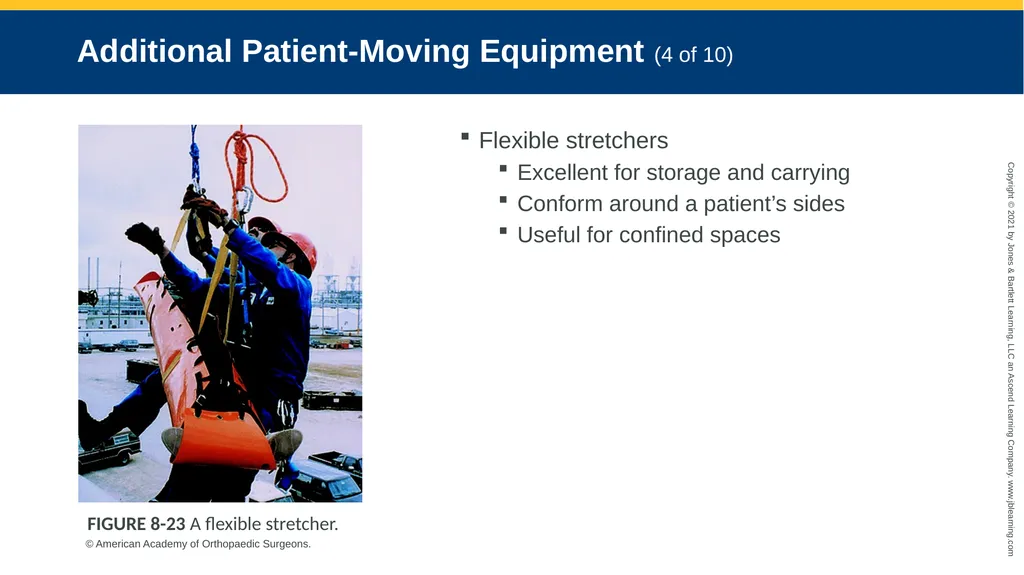
Additional Patient-Moving Equipment (4 of 10) Flexible stretchers
Excellent for storage and carrying
Conform around a patient’s sides
Useful for confined spaces FIGURE 8-23 A flexible stretcher. © American Academy of Orthopaedic Surgeons.<br>
Excellent for storage and carrying
Conform around a patient’s sides
Useful for confined spaces FIGURE 8-23 A flexible stretcher. © American Academy of Orthopaedic Surgeons.<br>
60
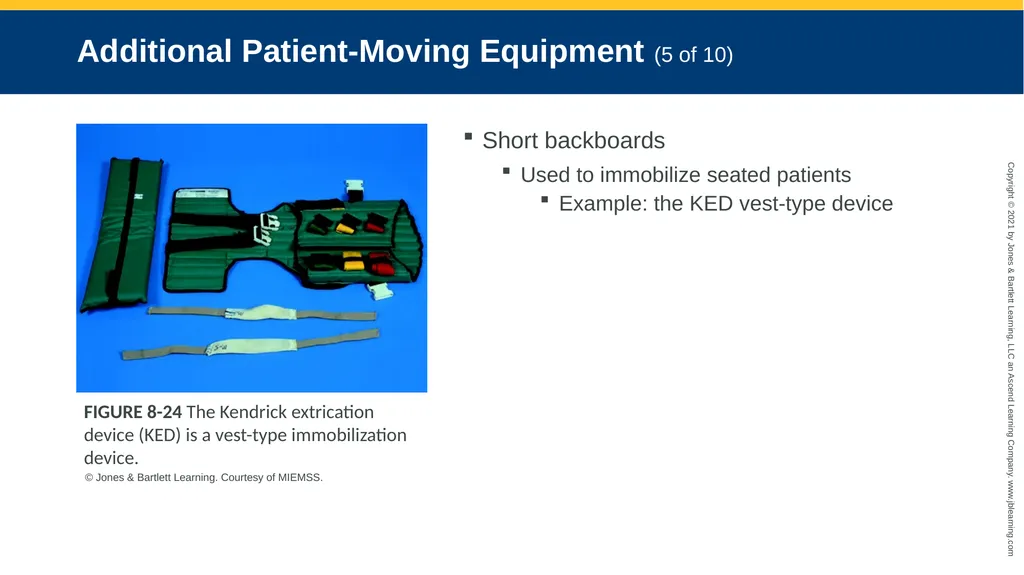
Additional Patient-Moving Equipment (5 of 10) Short backboards
Used to immobilize seated patients
Example: the KED vest-type device FIGURE 8-24 The Kendrick extrication device (KED) is a vest-type immobilization device. © Jones & Bartlett Learning. Courtesy of MIEMSS.<br>
Used to immobilize seated patients
Example: the KED vest-type device FIGURE 8-24 The Kendrick extrication device (KED) is a vest-type immobilization device. © Jones & Bartlett Learning. Courtesy of MIEMSS.<br>
61
Additional Patient-Moving Equipment (6 of 10) Vacuum mattresses
Alternative to backboards for immobilizing geriatric and pediatric patients
Air is removed from the device, allowing it to mold around the patient.
Provides immobilization, comfort, and thermal insulation<br>
Alternative to backboards for immobilizing geriatric and pediatric patients
Air is removed from the device, allowing it to mold around the patient.
Provides immobilization, comfort, and thermal insulation<br>
62
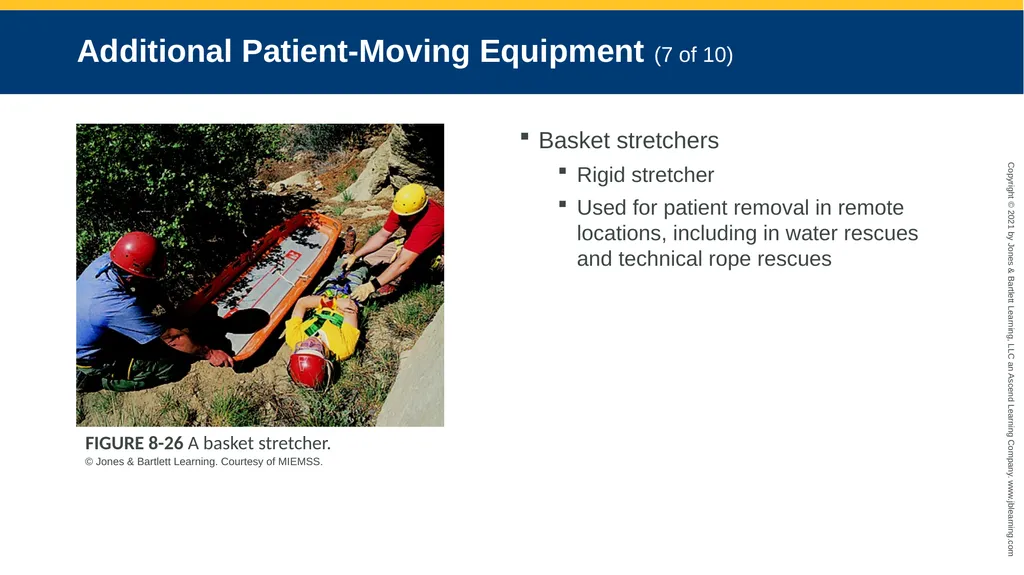
Additional Patient-Moving Equipment (7 of 10) Basket stretchers
Rigid stretcher
Used for patient removal in remote locations, including in water rescues and technical rope rescues FIGURE 8-26 A basket stretcher. © Jones & Bartlett Learning. Courtesy of MIEMSS.<br>
Rigid stretcher
Used for patient removal in remote locations, including in water rescues and technical rope rescues FIGURE 8-26 A basket stretcher. © Jones & Bartlett Learning. Courtesy of MIEMSS.<br>
63
Additional Patient-Moving Equipment (8 of 10) Basket stretchers (cont’d)
If the patient has a spinal injury, secure the patient to the backboard and place it inside the basket stretcher to carry the patient out of the location.
When you return to ambulance, lift the backboard out of basket stretcher and place it on the wheeled stretcher.<br>
If the patient has a spinal injury, secure the patient to the backboard and place it inside the basket stretcher to carry the patient out of the location.
When you return to ambulance, lift the backboard out of basket stretcher and place it on the wheeled stretcher.<br>
64
Additional Patient-Moving Equipment (9 of 10) Scoop stretchers
Splits into two or four pieces
Pieces fit around patient who is lying on flat surface, and then reconnect.
Both sides of the patient must be accessible.
The patient must be stabilized and secured on a scoop stretcher.<br>
Splits into two or four pieces
Pieces fit around patient who is lying on flat surface, and then reconnect.
Both sides of the patient must be accessible.
The patient must be stabilized and secured on a scoop stretcher.<br>
65
Additional Patient-Moving Equipment (10 of 10) Neonatal isolette
Neonates cannot be transported on a wheeled stretcher.
The isolette keeps the neonate warm, and protects the child from noise, draft, infection, and excess handling.
The isolette may be secured to a wheeled ambulance stretcher or freestanding.<br>
Neonates cannot be transported on a wheeled stretcher.
The isolette keeps the neonate warm, and protects the child from noise, draft, infection, and excess handling.
The isolette may be secured to a wheeled ambulance stretcher or freestanding.<br>
66
Decontamination Decontaminate equipment after use for:
Your safety
The safety of the crew
The safety of the patient
Preventing the spread of disease<br>
Your safety
The safety of the crew
The safety of the patient
Preventing the spread of disease<br>
67
Patient Positioning (1 of 2) Proper position depends on the chief complaint.
A patient reporting chest pain or respiratory distress should be placed in a position of comfort—typically a Fowler or semi-Fowler position.
Patients in shock should be placed supine.<br>
A patient reporting chest pain or respiratory distress should be placed in a position of comfort—typically a Fowler or semi-Fowler position.
Patients in shock should be placed supine.<br>
68
Patient Positioning (2 of 2) Proper position (cont’d)
Patients in late stages of pregnancy should be positioned and transported on their left side.
An unresponsive patient with no suspected spinal injury should be placed in the recovery position.
A patient who is nauseated or vomiting should be transported in a position of comfort.<br>
Patients in late stages of pregnancy should be positioned and transported on their left side.
An unresponsive patient with no suspected spinal injury should be placed in the recovery position.
A patient who is nauseated or vomiting should be transported in a position of comfort.<br>
69
Medical Restraints (1 of 2) Evaluate for correctible causes of combativeness.
Head injury, hypoxia, hypoglycemia
Follow local protocols.
Restraint requires five personnel.
Restrain the patient in a supine position.
Positional asphyxia may develop in the prone position.<br>
Head injury, hypoxia, hypoglycemia
Follow local protocols.
Restraint requires five personnel.
Restrain the patient in a supine position.
Positional asphyxia may develop in the prone position.<br>
70
Medical Restraints (2 of 2) Apply a restraint to each extremity.
Assess ABCs, mental status, and distal circulation after restraints are applied.
Document all information.<br>
Assess ABCs, mental status, and distal circulation after restraints are applied.
Document all information.<br>
71
Personnel Considerations Questions to ask before moving patient:
Am I physically strong enough to lift/move this patient?
Is there adequate room to get the proper stance to lift the patient?
Do I need additional personnel for lifting assistance?
Injured EMTs cannot help anyone.<br>
Am I physically strong enough to lift/move this patient?
Is there adequate room to get the proper stance to lift the patient?
Do I need additional personnel for lifting assistance?
Injured EMTs cannot help anyone.<br>
72
Review What is the first rule of lifting?
Twist slowly when you lift.
Keep your back in a straight position.
Bend at the waist to pick something up.
Use your arms to do most of the lifting.<br>
Twist slowly when you lift.
Keep your back in a straight position.
Bend at the waist to pick something up.
Use your arms to do most of the lifting.<br>
73
Review Answer: B
Rationale: The first rule of lifting is to always keep your back in a straight, upright, position and use the powerful muscles of your thighs. Never twist while lifting.<br>
Rationale: The first rule of lifting is to always keep your back in a straight, upright, position and use the powerful muscles of your thighs. Never twist while lifting.<br>
74
Review What is the first rule of lifting?
Twist slowly when you lift. Rationale: You should never twist your back.
Keep your back in a straight position. Rationale: Correct answer
Bend at the waist to pick something up. Rationale: You should never bend at the waist. Your back should be properly maintained in an upright position.
Use your arms to do most of the lifting. Rationale: Use your leg muscles since they are well developed and very strong.<br>
Twist slowly when you lift. Rationale: You should never twist your back.
Keep your back in a straight position. Rationale: Correct answer
Bend at the waist to pick something up. Rationale: You should never bend at the waist. Your back should be properly maintained in an upright position.
Use your arms to do most of the lifting. Rationale: Use your leg muscles since they are well developed and very strong.<br>
75
Review When lifting a stretcher using the power lift, you should:
bend at the hips, knees, back, and arms.
bend at the waist and keep your back straight.
place your hands palms up on the litter handle.
place your hands palms down on the litter's side bars.<br>
bend at the hips, knees, back, and arms.
bend at the waist and keep your back straight.
place your hands palms up on the litter handle.
place your hands palms down on the litter's side bars.<br>
76
Review Answer: C
Rationale: When lifting any heavy object, your hands should be facing palms up; this provides better lifting power and is not as stressful on the wrists.<br>
Rationale: When lifting any heavy object, your hands should be facing palms up; this provides better lifting power and is not as stressful on the wrists.<br>
77
Review When lifting a stretcher using the power lift, you should:
bend at the hips, knees, back, and arms. Rationale: When lifting, keep your back and arms straight. Always bend at the knees.
bend at the waist and keep your back straight. Rationale: When lifting, always keep your back straight. Never bend at the waist.
place your hands palms up on the litter handle. Rationale: Correct answer
place your hands palms down on the litter's side bars. Rationale: Your hands have the greatest strength when your palms are facing up.<br>
bend at the hips, knees, back, and arms. Rationale: When lifting, keep your back and arms straight. Always bend at the knees.
bend at the waist and keep your back straight. Rationale: When lifting, always keep your back straight. Never bend at the waist.
place your hands palms up on the litter handle. Rationale: Correct answer
place your hands palms down on the litter's side bars. Rationale: Your hands have the greatest strength when your palms are facing up.<br>
78
Review It is impractical to apply a vest-type extrication device on a critically injured patient to remove him or her from a wrecked vehicle because it:
takes too long to correctly apply.
does not fully immobilize the spine.
cannot be used on patients who are in their car.
does not provide adequate stabilization.<br>
takes too long to correctly apply.
does not fully immobilize the spine.
cannot be used on patients who are in their car.
does not provide adequate stabilization.<br>
79
Review Answer: A
Rationale: It takes several minutes to correctly apply a vest-type extrication device. This is too much time to waste when treating a critically injured patient. A long backboard would be more appropriate. Vest-type immobilization devices, when applied correctly, provide adequate spinal stabilization and are ideal to use in stable patients who need to be removed from their vehicle.<br>
Rationale: It takes several minutes to correctly apply a vest-type extrication device. This is too much time to waste when treating a critically injured patient. A long backboard would be more appropriate. Vest-type immobilization devices, when applied correctly, provide adequate spinal stabilization and are ideal to use in stable patients who need to be removed from their vehicle.<br>
80
Review It is impractical to apply a vest-type extrication device on a critically injured patient to remove him or her from a wrecked vehicle because it:
takes too long to correctly apply. Rationale: Correct answer
does not fully immobilize the spine. Rationale: When applied correctly, the vest provides adequate immobilization of the spine.
cannot be used on patients who are in their car. Rationale: When a patient is stable, the vest is a beneficial device for vehicle extrications.
does not provide adequate stabilization. Rationale: The vest provides adequate stabilization of the spine.<br>
takes too long to correctly apply. Rationale: Correct answer
does not fully immobilize the spine. Rationale: When applied correctly, the vest provides adequate immobilization of the spine.
cannot be used on patients who are in their car. Rationale: When a patient is stable, the vest is a beneficial device for vehicle extrications.
does not provide adequate stabilization. Rationale: The vest provides adequate stabilization of the spine.<br>
81
Review Proper guidelines for correct reaching include all of the following, EXCEPT:
avoiding twisting your back.
avoiding hyperextension of your back.
keeping the back in a locked-in position.
reaching no more than 30 inches in front of your body.<br>
avoiding twisting your back.
avoiding hyperextension of your back.
keeping the back in a locked-in position.
reaching no more than 30 inches in front of your body.<br>
82
Review Answer: D
Rationale: When reaching, you should keep your back in a locked-in position and avoid twisting or hyperextending your back. Do not reach more than 15–20 inches in front of your body.<br>
Rationale: When reaching, you should keep your back in a locked-in position and avoid twisting or hyperextending your back. Do not reach more than 15–20 inches in front of your body.<br>
83
Review Proper guidelines for correct reaching include all of the following, EXCEPT:
avoiding twisting your back. Rationale: Never twist your back while reaching or lifting.
avoiding hyperextension of your back. Rationale: Never bend or hyperextend your back.
keeping the back in a locked-in position. Rationale: Always keep your back straight in a locked position.
reaching no more than 30 inches in front of your body. Rationale: Correct answer<br>
avoiding twisting your back. Rationale: Never twist your back while reaching or lifting.
avoiding hyperextension of your back. Rationale: Never bend or hyperextend your back.
keeping the back in a locked-in position. Rationale: Always keep your back straight in a locked position.
reaching no more than 30 inches in front of your body. Rationale: Correct answer<br>
84
Review An injured hang glider is trapped at the top of a large mountain and must be evacuated to the ground. The terrain is very rough and uneven. Which of the following devices would be the safest and most appropriate to use?
Stair chair
Stokes basket
Scoop stretcher
Long backboard<br>
Stair chair
Stokes basket
Scoop stretcher
Long backboard<br>
85
Review Answer: B
Rationale: A basket stretcher, also called a Stokes basket, should be used to carry patients over rough or uneven terrain that is inaccessible by ambulance. Its closed-ended sides protect the patient from falling out of the device.<br>
Rationale: A basket stretcher, also called a Stokes basket, should be used to carry patients over rough or uneven terrain that is inaccessible by ambulance. Its closed-ended sides protect the patient from falling out of the device.<br>
86
Review An injured hang glider is trapped at the top of a large mountain and must be evacuated to the ground. The terrain is very rough and uneven. Which of the following devices would be the safest and most appropriate to use?
Stair chair Rationale: This is used to transfer a patient up and down stairs.
Stokes basket Rationale: Correct answer
Scoop stretcher Rationale: This is designed to split into two or four pieces. The EMT must have access to both sides of the patient, and the patient should be lying on a relatively flat surface.
Long backboard Rationale: There is no protection for the patient from falling off or out of the device.<br>
Stair chair Rationale: This is used to transfer a patient up and down stairs.
Stokes basket Rationale: Correct answer
Scoop stretcher Rationale: This is designed to split into two or four pieces. The EMT must have access to both sides of the patient, and the patient should be lying on a relatively flat surface.
Long backboard Rationale: There is no protection for the patient from falling off or out of the device.<br>
87
Review When two EMTs are lifting a patient on a long backboard, they should:
lift the patient from the sides of the board.
make every attempt to lift with their backs.
position the strongest EMT at the foot of the board.
position the strongest EMT at the head of the board.<br>
lift the patient from the sides of the board.
make every attempt to lift with their backs.
position the strongest EMT at the foot of the board.
position the strongest EMT at the head of the board.<br>
88
Review Answer: D
Rationale: Since more than half of the patient's weight is distributed to the head end of a backboard or stretcher, you should always ensure that the strongest EMT is at that position. This will reduce the risk of injury to less strong personnel as well as the risk of dropping the patient.<br>
Rationale: Since more than half of the patient's weight is distributed to the head end of a backboard or stretcher, you should always ensure that the strongest EMT is at that position. This will reduce the risk of injury to less strong personnel as well as the risk of dropping the patient.<br>
89
Review When two EMTs are lifting a patient on a long backboard, they should:
lift the patient from the sides of the board. Rationale: This may cause the backboard to tip since the upper torso is heavier.
make every attempt to lift with their backs. Rationale: Never lift with your back. Always use your legs.
position the strongest EMT at the foot of the board. Rationale: The strongest EMT should be at the patient’s head, where the patient’s weight is greater.
position the strongest EMT at the head of the board. Rationale: Correct answer<br>
lift the patient from the sides of the board. Rationale: This may cause the backboard to tip since the upper torso is heavier.
make every attempt to lift with their backs. Rationale: Never lift with your back. Always use your legs.
position the strongest EMT at the foot of the board. Rationale: The strongest EMT should be at the patient’s head, where the patient’s weight is greater.
position the strongest EMT at the head of the board. Rationale: Correct answer<br>
90
Review Which of the following techniques is considered to be an emergency move?
Extremity lift
Supine transfer
Firefighter's drag
Direct ground lift<br>
Extremity lift
Supine transfer
Firefighter's drag
Direct ground lift<br>
91
Review Answer: C
Rationale: The firefighter's drag is a one-person technique that is used when a patient must be removed from a life-threatening situation immediately.<br>
Rationale: The firefighter's drag is a one-person technique that is used when a patient must be removed from a life-threatening situation immediately.<br>
92
Review Which of the following techniques is considered to be an emergency move?
Extremity lift Rationale: This is a nonurgent move, helpful in narrow spaces.
Supine transfer Rationale: This is not considered to be an emergency move.
Firefighter's drag Rationale: Correct answer
Direct ground lift Rationale: This is a nonurgent move, used to carry a patient over long distances to the cot.<br>
Extremity lift Rationale: This is a nonurgent move, helpful in narrow spaces.
Supine transfer Rationale: This is not considered to be an emergency move.
Firefighter's drag Rationale: Correct answer
Direct ground lift Rationale: This is a nonurgent move, used to carry a patient over long distances to the cot.<br>
93
Review To extract a patient from the basement of a building, you must transport the patient up a flight of stairs. In doing this, you must ensure that:
the elevated head of the backboard goes first.
the backboard with the elevated foot end goes first.
the backboard is slightly tilted to the left to distribute weight.
the patient's feet are higher than his or her head, whichever end is carried first.<br>
the elevated head of the backboard goes first.
the backboard with the elevated foot end goes first.
the backboard is slightly tilted to the left to distribute weight.
the patient's feet are higher than his or her head, whichever end is carried first.<br>
94
Review Answer: A
Rationale: When you carry a patient upstairs or up an incline, you must ensure that the elevated head of the backboard or stretcher goes first. This will help to equally distribute the weight.<br>
Rationale: When you carry a patient upstairs or up an incline, you must ensure that the elevated head of the backboard or stretcher goes first. This will help to equally distribute the weight.<br>
95
Review To extract a patient from the basement of a building, you must transport the patient up a flight of stairs. In doing this, you must ensure that:
the elevated head of the backboard goes first. Rationale: Correct answer
the backboard with the elevated foot end goes first. Rationale: Always try to carry the head higher to distribute the weight.
the backboard is slightly tilted to the left to distribute weight. Rationale: Backboards are designed to carry a patient flat, and the weight is best distributed when the head is slightly elevated.
the patient's feet are higher than his or her head, whichever end is carried first. Rationale: Carries are easier with the patient’s head first and elevated for distribution of the patient’s weight.<br>
the elevated head of the backboard goes first. Rationale: Correct answer
the backboard with the elevated foot end goes first. Rationale: Always try to carry the head higher to distribute the weight.
the backboard is slightly tilted to the left to distribute weight. Rationale: Backboards are designed to carry a patient flat, and the weight is best distributed when the head is slightly elevated.
the patient's feet are higher than his or her head, whichever end is carried first. Rationale: Carries are easier with the patient’s head first and elevated for distribution of the patient’s weight.<br>
96
Review If an injured patient needs to be moved but is not in immediate danger from fire or building collapse, you should first:
order the equipment you need for extrication.
check the patient’s airway, breathing, and circulation.
remove the patient with the rapid extrication technique.
determine the number of people you will need to move the patient.<br>
order the equipment you need for extrication.
check the patient’s airway, breathing, and circulation.
remove the patient with the rapid extrication technique.
determine the number of people you will need to move the patient.<br>
97
Review Answer: B
Rationale: The only time your attention should be directed away from the primary assessment of the patient is when the patient’s life or your life is in immediate danger.<br>
Rationale: The only time your attention should be directed away from the primary assessment of the patient is when the patient’s life or your life is in immediate danger.<br>
98
Review If an injured patient needs to be moved but is not in immediate danger from fire or building collapse, you should first:
order the equipment you need for extrication. Rationale: This is not the first thing you should do.
check the patient’s airway, breathing, and circulation. Rationale: Correct answer
remove the patient with the rapid extrication technique. Rationale: The patient is not in immediate danger, so this is not needed.
determine the number of people you will need to move the patient. Rationale: After the ABCs have been checked, the EMT can then determine the safest method of extrication.<br>
order the equipment you need for extrication. Rationale: This is not the first thing you should do.
check the patient’s airway, breathing, and circulation. Rationale: Correct answer
remove the patient with the rapid extrication technique. Rationale: The patient is not in immediate danger, so this is not needed.
determine the number of people you will need to move the patient. Rationale: After the ABCs have been checked, the EMT can then determine the safest method of extrication.<br>
99
Review The rapid extrication technique is a:
nonurgent move to remove a patient from a vehicle.
technique used to transfer a patient from a bed to a stretcher.
technique used to lift a patient with no suspected spinal injury onto a stretcher.
technique used to quickly remove a patient from a vehicle and onto a backboard.<br>
nonurgent move to remove a patient from a vehicle.
technique used to transfer a patient from a bed to a stretcher.
technique used to lift a patient with no suspected spinal injury onto a stretcher.
technique used to quickly remove a patient from a vehicle and onto a backboard.<br>
100
Review Answer: D
Rationale: With the rapid extrication technique, a seriously injured patient can be moved from a sitting position in a vehicle to a supine position on a backboard while protecting the spine at the same time.<br>
Rationale: With the rapid extrication technique, a seriously injured patient can be moved from a sitting position in a vehicle to a supine position on a backboard while protecting the spine at the same time.<br>
101
Review The rapid extrication technique is a:
nonurgent move to remove a patient from a vehicle. Rationale: This technique is considered to be an urgent move.
technique used to transfer a patient from a bed to a stretcher. Rationale: This technique is used to move a patient from a vehicle to a backboard.
technique used to lift a patient with no suspected spinal injury onto a stretcher. Rationale: This is not a lifting technique. The patient is placed on a backboard, not a stretcher.
technique used to quickly remove a patient from a vehicle and onto a backboard. Rationale: Correct answer<br>
nonurgent move to remove a patient from a vehicle. Rationale: This technique is considered to be an urgent move.
technique used to transfer a patient from a bed to a stretcher. Rationale: This technique is used to move a patient from a vehicle to a backboard.
technique used to lift a patient with no suspected spinal injury onto a stretcher. Rationale: This is not a lifting technique. The patient is placed on a backboard, not a stretcher.
technique used to quickly remove a patient from a vehicle and onto a backboard. Rationale: Correct answer<br>