
Chapter 8 Wetting Agents and Mucoactive Drugs
CS
Published · 39 slides · 0 views

1 / 1




Description
Chapter 8 Wetting Agents and Mucoactive Drugs Airway Mucus (1 of 2) Inflammation causes mucus hyperproduction and retention Normal mucus: 97 water, 3 solids Prevents dehydration of airway Protects airway from inhaled particles Aids
Related Topics
Share
Embed code
Download this presentation From Below
"Chapter 8 Wetting Agents and Mucoactive Drugs" is the property of its rightful owner. Permission is granted to download and print the materials on this website for personal, non-commercial use only, and to display it on your personal computer provided you do not modify the materials and that you retain all copyright notices contained in the materials. By downloading content from our website, you accept the terms of this agreement.
Presentation Transcript
01
Chapter 8 Wetting Agents and Mucoactive Drugs<br>
02
Airway Mucus (1 of 2) Inflammation causes mucus hyperproduction and retention
Normal mucus:
97% water, 3% solids
Prevents dehydration of airway
Protects airway from inhaled particles
Aids clearance of particles and pollutants<br>
Normal mucus:
97% water, 3% solids
Prevents dehydration of airway
Protects airway from inhaled particles
Aids clearance of particles and pollutants<br>
03
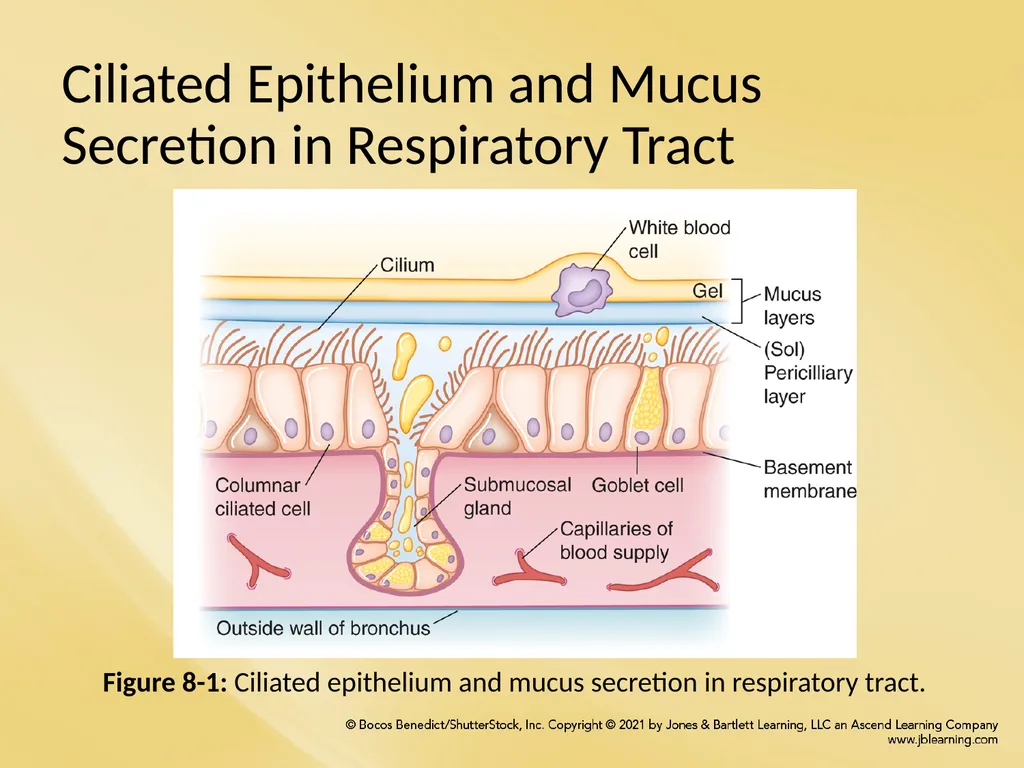
Airway Mucus (2 of 2) Secretory (goblet) cells
Produce mucus on airway surface
Submucosal glands
Produce mucin in large, cartilaginous airways
Cilia in lower airways
Drive mucus from airways
Mucus also cleared by cough<br>
Produce mucus on airway surface
Submucosal glands
Produce mucin in large, cartilaginous airways
Cilia in lower airways
Drive mucus from airways
Mucus also cleared by cough<br>
04
Phlegm Mucus secretions in states of inflammation
Contains:
Inflammatory cells
Bacteria
DNA
Called sputum when expectorated<br>
Contains:
Inflammatory cells
Bacteria
DNA
Called sputum when expectorated<br>
05
Ciliated Epithelium and Mucus Secretion in Respiratory Tract Figure 8-1: Ciliated epithelium and mucus secretion in respiratory tract.<br>
06
Diseases Associated with Mucous Dysfunction Asthma
Increased gel-like mucus production
COPD
Increased mucus production and secretion through goblet cell hypertrophy and metaplasia
Cystic fibrosis (CF)
Impaired mucociliary clearance
Mucus hypersecretion<br>
Increased gel-like mucus production
COPD
Increased mucus production and secretion through goblet cell hypertrophy and metaplasia
Cystic fibrosis (CF)
Impaired mucociliary clearance
Mucus hypersecretion<br>
07
Mucoactive Medications Encourage mucus clearance
Categorized by mechanism of action:
Bland aerosols
Expectorants
Mucolytics
Mucokinetic
Secondary treatment
Primary treatment: adequate hydration<br>
Categorized by mechanism of action:
Bland aerosols
Expectorants
Mucolytics
Mucokinetic
Secondary treatment
Primary treatment: adequate hydration<br>
08
Bland Aerosols (1 of 3) Provide humidification with saline solutions
Administered with:
Large-volume nebulizer
Small-volume nebulizer (as diluent)
Appropriate for patients requiring humidification of respiratory tract<br>
Administered with:
Large-volume nebulizer
Small-volume nebulizer (as diluent)
Appropriate for patients requiring humidification of respiratory tract<br>
09
Bland Aerosols (2 of 3) May be used for:
Upper airway edema
Thinning agent
Sputum induction
Contraindications:
Bronchoconstriction
Airway hyperresponsiveness<br>
Upper airway edema
Thinning agent
Sputum induction
Contraindications:
Bronchoconstriction
Airway hyperresponsiveness<br>
10
Bland Aerosols (3 of 3) Complications:
Bronchospasm
Bronchoconstriction
Infection
Overhydration
Airway edema<br>
Bronchospasm
Bronchoconstriction
Infection
Overhydration
Airway edema<br>
11
Bland Aerosol Agents Normal saline (NS)
0.9% sodium chloride (NaCl)
Hypotonic saline
Most commonly 0.45% NaCl (half-NS)
Hypertonic saline
Most commonly 3%, 5%, 7%, or 10% NaCl solutions
Sterile distilled water<br>
0.9% sodium chloride (NaCl)
Hypotonic saline
Most commonly 0.45% NaCl (half-NS)
Hypertonic saline
Most commonly 3%, 5%, 7%, or 10% NaCl solutions
Sterile distilled water<br>
12
Normal Saline Same osmotic pressure as body fluids
Most common agent to dilute bronchodilator drugs
Unlikely to cause bronchospasm
Sodium content important consideration for cardiac patients
Sterile distilled water may be preferred<br>
Most common agent to dilute bronchodilator drugs
Unlikely to cause bronchospasm
Sodium content important consideration for cardiac patients
Sterile distilled water may be preferred<br>
13
Hypotonic Saline Osmotic pressure less than body fluids
0.45% NaCl (half-NS) most common
Indications:
Use in large-volume nebulizers when patient cannot tolerate sterile distilled water
Diluent in case of severe salt restriction<br>
0.45% NaCl (half-NS) most common
Indications:
Use in large-volume nebulizers when patient cannot tolerate sterile distilled water
Diluent in case of severe salt restriction<br>
14
Hypertonic Saline Osmotic pressure greater than body fluids
Most common solutions:
3%, 5%, 7%, and 10% NaCl
Used primarily for sputum induction
Hypertonic saline solution in aerosol form
Irritates airway
Hygroscopic in nature (attract humidity)<br>
Most common solutions:
3%, 5%, 7%, and 10% NaCl
Used primarily for sputum induction
Hypertonic saline solution in aerosol form
Irritates airway
Hygroscopic in nature (attract humidity)<br>
15
Use of Hypertonic Saline in CF Patients 7% NaCl solution
Highly effective in mobilizing secretions to reduce frequency and severity of pulmonary infections
May cause acute decrease in FEV1
Regular use demonstrated to:
Preserve lung function
Decrease acute exacerbations in CF<br>
Highly effective in mobilizing secretions to reduce frequency and severity of pulmonary infections
May cause acute decrease in FEV1
Regular use demonstrated to:
Preserve lung function
Decrease acute exacerbations in CF<br>
16
Sterile Distilled Water Uses:
Agent for large-volume nebulizers for humidification of respiratory tract
Diluent for SVN treatments with bronchodilators or other potent drugs
Aerosolized form may cause bronchospasm in patients with reactive airway disease
Half-NS may be better agent for humidification<br>
Agent for large-volume nebulizers for humidification of respiratory tract
Diluent for SVN treatments with bronchodilators or other potent drugs
Aerosolized form may cause bronchospasm in patients with reactive airway disease
Half-NS may be better agent for humidification<br>
17
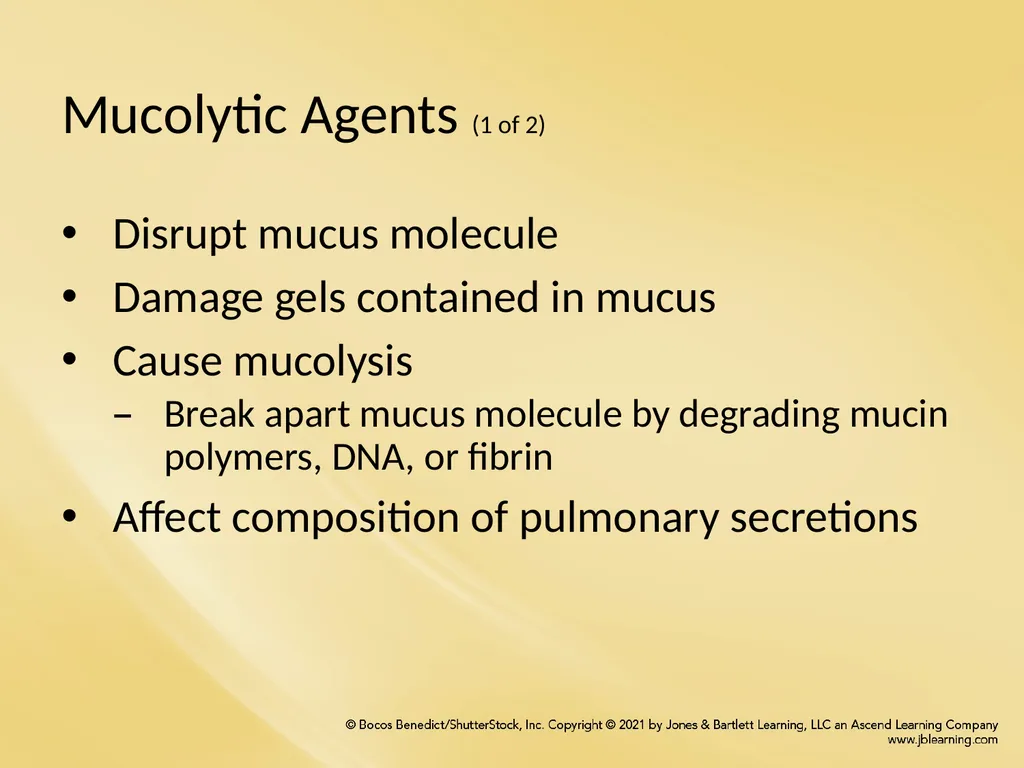
Mucolytic Agents (1 of 2) Disrupt mucus molecule
Damage gels contained in mucus
Cause mucolysis
Break apart mucus molecule by degrading mucin polymers, DNA, or fibrin
Affect composition of pulmonary secretions<br>
Damage gels contained in mucus
Cause mucolysis
Break apart mucus molecule by degrading mucin polymers, DNA, or fibrin
Affect composition of pulmonary secretions<br>
18
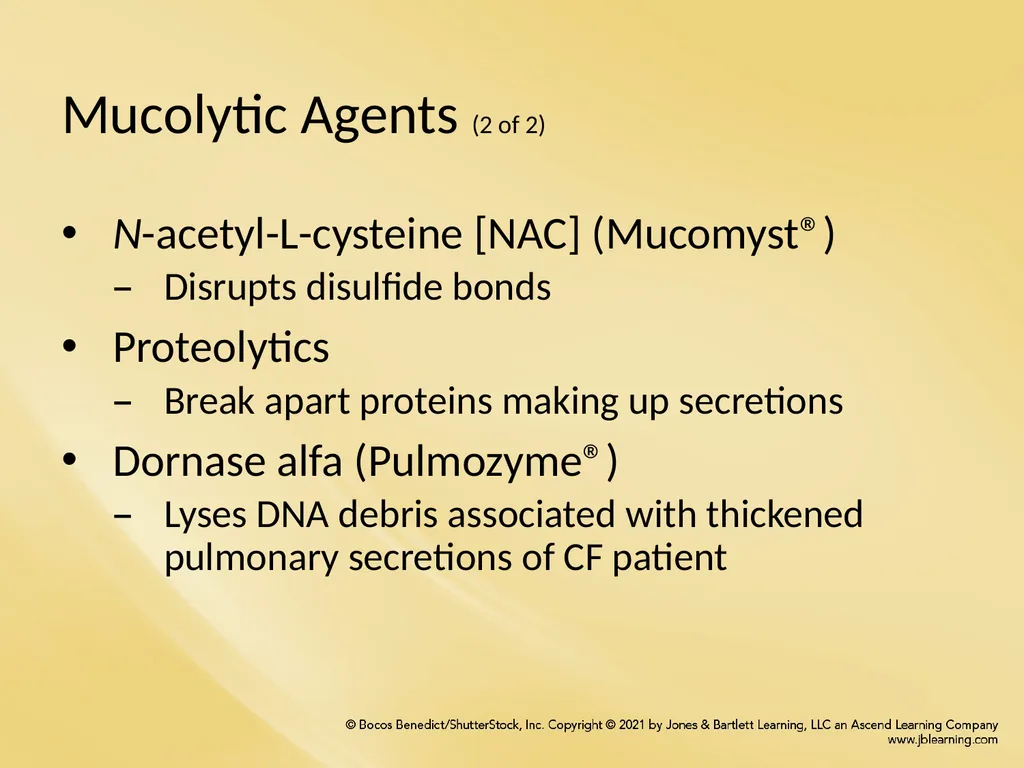
Mucolytic Agents (2 of 2) N-acetyl-L-cysteine [NAC] (Mucomyst®)
Disrupts disulfide bonds
Proteolytics
Break apart proteins making up secretions
Dornase alfa (Pulmozyme®)
Lyses DNA debris associated with thickened pulmonary secretions of CF patient<br>
Disrupts disulfide bonds
Proteolytics
Break apart proteins making up secretions
Dornase alfa (Pulmozyme®)
Lyses DNA debris associated with thickened pulmonary secretions of CF patient<br>
19
Dornase Alfa (Pulmozyme) (1 of 3) Approved only for CF patients
Reduces viscosity and adhesiveness of infected sputum
Selectively cleaves DNA in sputum
Improves pulmonary function
May reduce risk of bacterial infection<br>
Reduces viscosity and adhesiveness of infected sputum
Selectively cleaves DNA in sputum
Improves pulmonary function
May reduce risk of bacterial infection<br>
20
Dornase Alfa (Pulmozyme) (2 of 3) Figure 8-2: (A) Simplified structure of a mucus molecule. (B) Mucolytic action
of dornase alfa.<br>
of dornase alfa.<br>
21
Dornase Alfa (Pulmozyme) (3 of 3) Only proven effective for CF
Contraindicated in patients with known hypersensitivity to dornase alfa or Chinese hamster ovary cell products
CF patients should continue other therapies while receiving dornase alfa
Other aerosol medications should never be mixed in same SVN with Pulmozyme<br>
Contraindicated in patients with known hypersensitivity to dornase alfa or Chinese hamster ovary cell products
CF patients should continue other therapies while receiving dornase alfa
Other aerosol medications should never be mixed in same SVN with Pulmozyme<br>
22
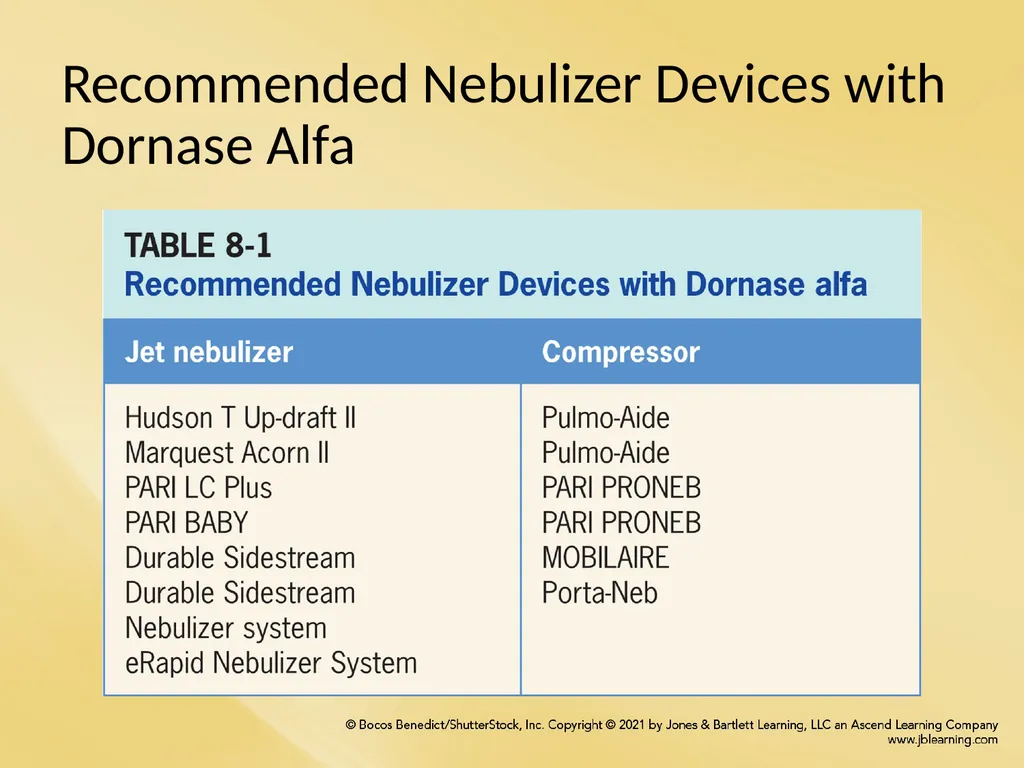
Recommended Nebulizer Devices with Dornase Alfa<br>
23
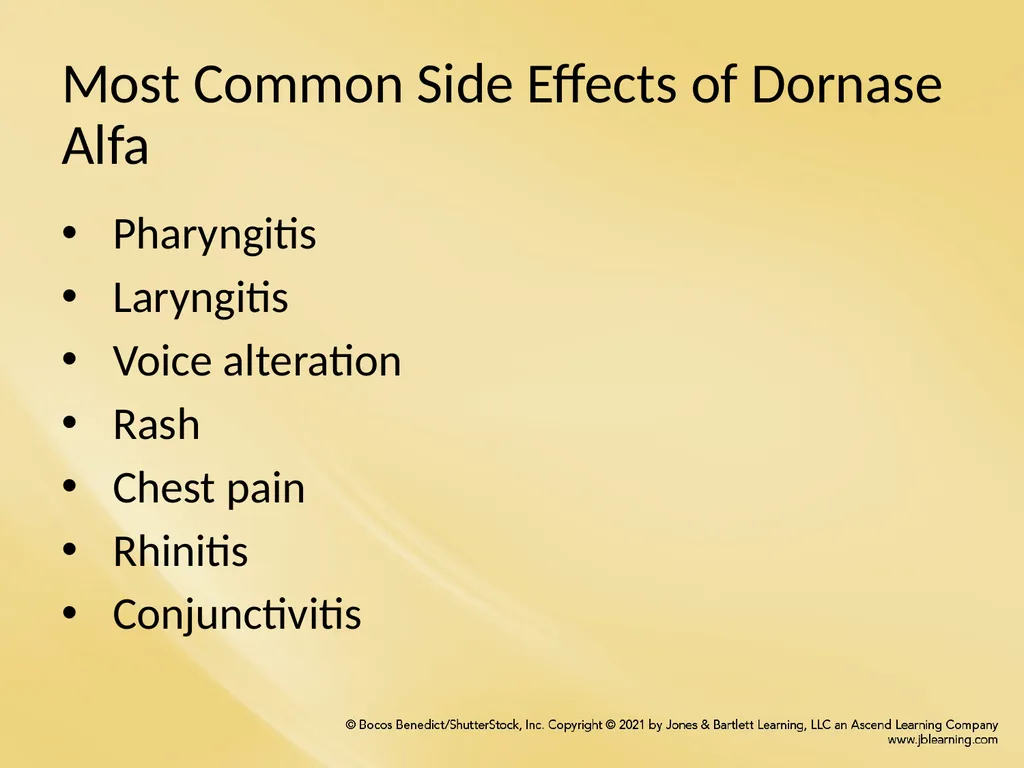
Most Common Side Effects of Dornase Alfa Pharyngitis
Laryngitis
Voice alteration
Rash
Chest pain
Rhinitis
Conjunctivitis<br>
Laryngitis
Voice alteration
Rash
Chest pain
Rhinitis
Conjunctivitis<br>
24
N-Acetylcysteine (NAC) (1 of 4) Antioxidant used to treat liver injury resulting from acetaminophen overdose
Also used as mucolytic
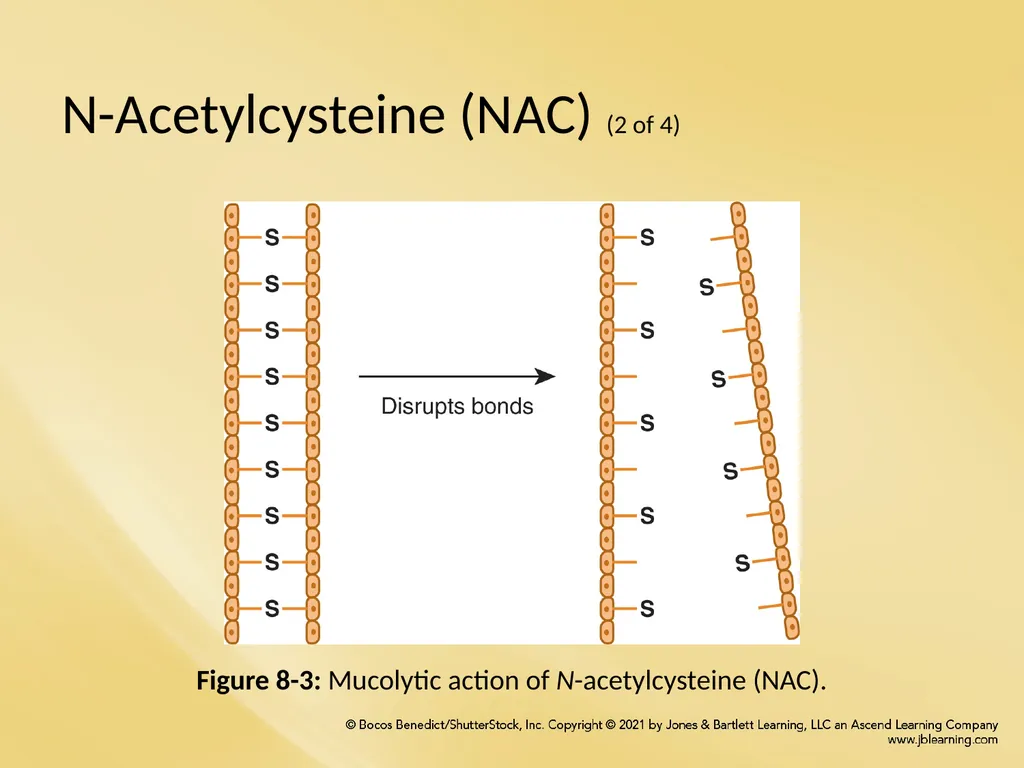
Hydrolyzes and breaks apart sulfide bonds found in mucin
Not recommended to improve airway clearance<br>
Also used as mucolytic
Hydrolyzes and breaks apart sulfide bonds found in mucin
Not recommended to improve airway clearance<br>
25
N-Acetylcysteine (NAC) (2 of 4) Figure 8-3: Mucolytic action of N-acetylcysteine (NAC).<br>
26
N-Acetylcysteine (NAC) (3 of 4) May cause increased amount of liquefied secretions after administration
May require suction equipment
Therapist should remain with patient 10–15 minutes after administration
May stimulate bronchospasm
Administer aerosolized bronchodilator first<br>
May require suction equipment
Therapist should remain with patient 10–15 minutes after administration
May stimulate bronchospasm
Administer aerosolized bronchodilator first<br>
27
N-Acetylcysteine (NAC) (4 of 4) Incompatible with inhaled amphotericin B, tetracycline, erythromycin, and ampicillin
May have corrosive effect on metal parts
May irritate mucosal membranes of oropharynx
Has distinct, somewhat offensive odor, but no taste<br>
May have corrosive effect on metal parts
May irritate mucosal membranes of oropharynx
Has distinct, somewhat offensive odor, but no taste<br>
28
Nonrespiratory Use of N-Acetylcysteine Effective antidote for acetaminophen overdose when administered IV, orally, or by nasogastric tube
Prevents kidney damage occurring secondary to clearance of IV contrast dye material
Order may be routed to RCP
Department may have primary in-house supply<br>
Prevents kidney damage occurring secondary to clearance of IV contrast dye material
Order may be routed to RCP
Department may have primary in-house supply<br>
29
Mucokinetic Agents Increase movement of mucous
β2-agonists
May increase ciliary beat frequency
Surfactant
May improve cough clearance by improving expiratory airflow<br>
β2-agonists
May increase ciliary beat frequency
Surfactant
May improve cough clearance by improving expiratory airflow<br>
30
β2-Adrenergic Agents Clinical effects controversial
Increases cyclic adenosine monophosphates
Also increases secretion production
Little mucociliary clearance effect in patients with asthma and bronchitis
Studies show modest but not long-lasting benefit to increase mucociliary clearance<br>
Increases cyclic adenosine monophosphates
Also increases secretion production
Little mucociliary clearance effect in patients with asthma and bronchitis
Studies show modest but not long-lasting benefit to increase mucociliary clearance<br>
31
Surfactant Can increase mucociliary clearance and decrease airway inflammation
Research indicates aerosolized surfactant improves lung function and sputum clearance in patients with chronic bronchitis
Ambroxol not approved in United States
May improve lung function and decrease exacerbations in patients with COPD<br>
Research indicates aerosolized surfactant improves lung function and sputum clearance in patients with chronic bronchitis
Ambroxol not approved in United States
May improve lung function and decrease exacerbations in patients with COPD<br>
32
Expectorants and Bronchorrhea Agents (1 of 2) Bronchorrhea
Condition associated with excess thin, watery pulmonary secretions
Can be induced by expectorants
Expectorants
Increase amount of fluid in respiratory tract
Stimulate mucus discharge with cough<br>
Condition associated with excess thin, watery pulmonary secretions
Can be induced by expectorants
Expectorants
Increase amount of fluid in respiratory tract
Stimulate mucus discharge with cough<br>
33
Expectorants and Bronchorrhea Agents (2 of 2) Hypertonic saline for sputum induction
Primary clinical application of bronchorrheic agents in respiratory care
Saturated solution of potassium iodide (SSKI)
Administered in oral forms, not aerosolized
Not demonstrated effective for stimulating airway fluid secretion<br>
Primary clinical application of bronchorrheic agents in respiratory care
Saturated solution of potassium iodide (SSKI)
Administered in oral forms, not aerosolized
Not demonstrated effective for stimulating airway fluid secretion<br>
34
Guaifenesin (1 of 2) Stimulates increased mucus production
Maintains airway fluid layer
Thought to decrease viscosity and adhesiveness of secretions
Shown to inhibit cough receptor sensitivity
Active ingredient in remedies such as Mucinex® and Robitussin®<br>
Maintains airway fluid layer
Thought to decrease viscosity and adhesiveness of secretions
Shown to inhibit cough receptor sensitivity
Active ingredient in remedies such as Mucinex® and Robitussin®<br>
35
Guaifenesin (2 of 2) Shown to improve symptoms of cough, chest congestion, and mucus thickness in patients with upper respiratory tract infections
Common side effects:
Headache, dizziness, and nausea/vomiting at high doses
Kidney stone formation in excessive doses<br>
Common side effects:
Headache, dizziness, and nausea/vomiting at high doses
Kidney stone formation in excessive doses<br>
36
Mannitol Inhaled form being investigated for controlling mucus and improving pulmonary function in CF and bronchiectasis patients
Shown to change physical properties of mucus associated with CF and non-CF bronchiectasis
Inhaled form not currently approved in United States<br>
Shown to change physical properties of mucus associated with CF and non-CF bronchiectasis
Inhaled form not currently approved in United States<br>
37
Sodium Bicarbonate (1 of 3) Alters pH and disrupts stability of mucopolysaccharide strands
Not demonstrated to dissolve sputum
May be useful in tracheal irrigation for patients with artificial airways
Usually well-tolerated and inexpensive<br>
Not demonstrated to dissolve sputum
May be useful in tracheal irrigation for patients with artificial airways
Usually well-tolerated and inexpensive<br>
38
Sodium Bicarbonate (2 of 3) Contraindications
Severe sodium-restricted diet
Severe preexisting metabolic alkalosis
Few side effects or hazards
May be administered as frequently as necessary to promote mucokinesis
Mix at bedside before administration when used in conjunction with bronchodilator<br>
Severe sodium-restricted diet
Severe preexisting metabolic alkalosis
Few side effects or hazards
May be administered as frequently as necessary to promote mucokinesis
Mix at bedside before administration when used in conjunction with bronchodilator<br>
39
Sodium Bicarbonate (3 of 3) May alter stability of solution when mixed with sympathomimetic drug
May reduce potency of catecholamine-type bronchodilators
Effect less pronounced when used with noncatecholamine β-adrenergic bronchodilators<br>
May reduce potency of catecholamine-type bronchodilators
Effect less pronounced when used with noncatecholamine β-adrenergic bronchodilators<br>