Chapter 9 Overview of Alternating Treatments Designs BackgroundOverview Alternating Treatments Designs (ATD) requires the rapid alternation of two or more distinct treatments while their effects on a single target behavior are noted. ATD
"Chapter 9 Overview of Alternating Treatments" is the property of its rightful owner. Permission is granted to
download and print the materials on this website for personal, non-commercial use only, and to display it
on your personal computer provided you do not modify the materials and that you retain all copyright
notices contained in the materials. By downloading content from our website, you accept the terms of this
agreement.
Presentation Transcript
01
Chapter 9 Overview of Alternating Treatments Designs<br>
02
Background/Overview Alternating Treatments Designs (ATD) requires the “rapid alternation of two or more distinct treatments while their effects on a single target behavior are noted.”
ATD does not require the collection of baseline data. However, when possible it should be collected.<br>
03
Background/Overview Two important points
The presentation of the treatments should be counterbalanced (presented the same number of times).
The subjects should be able to discriminate between or among the treatment conditions.<br>
04
Three types of ATD Alternating treatments without baseline
Baseline followed by alternating treatments
Baseline followed by alternating treatments with a final treatment phase.<br>
05
Alternating Treatments w/o Baseline This treatment can be implemented immediately.
This design should actually include a type of baseline data by having a no-treatment phase as one of the alternating treatments (Alternating treatments with a control condition design).<br>
06
Baseline Followed by ATD Two situations when gathering a baseline should not continue.
When the nature of the target behavior is severely ethical (Self-abusive behaviors).
When the data trend is moving in a countertherapeutic direction.<br>
07
Baseline Followed by ATD Four steps to follow:
Carefully define the independent and dependent variables.
Determine a schedule for counterbalancing the presentation of the treatments.
Collect baseline data for the dependent variable for a number of sessions (baseline phase does not have to be stable before introducing the treatment).
Introduce treatments in their predetermined order.<br>
08
Baseline Followed by ATD and a Final Treatment Phase It is important to continue the most effective treatment.
Therefore, one would collect baseline, introduce alternating treatments, then continue the study using the most effective treatment.<br>
09
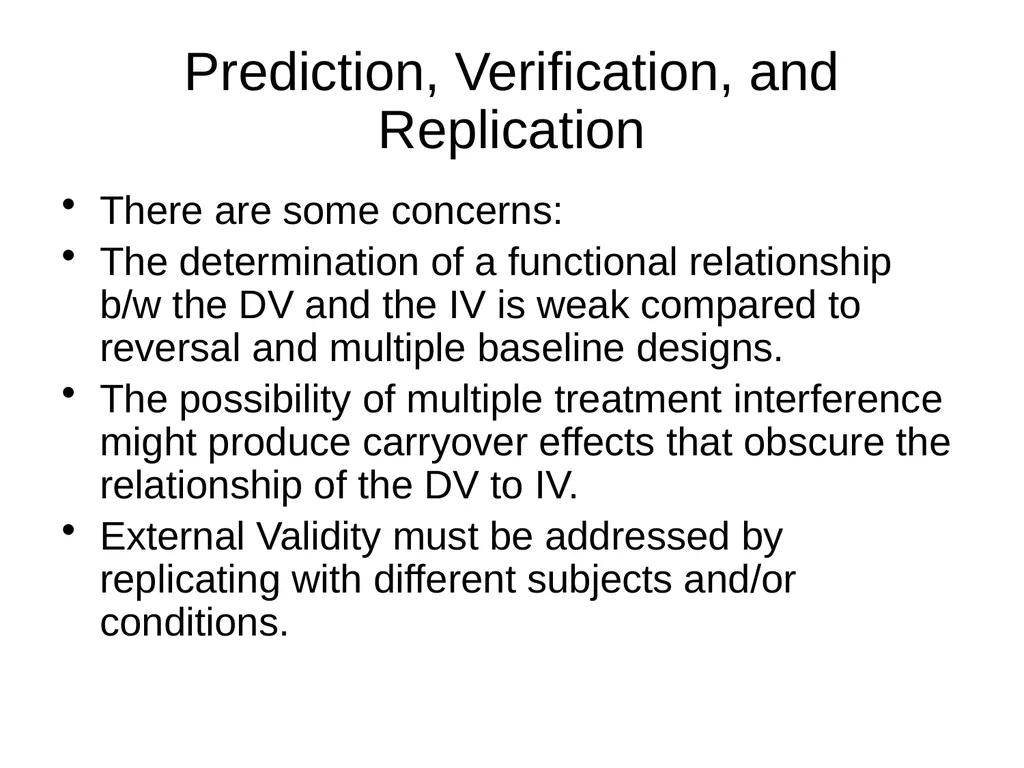
Prediction, Verification, and Replication There are some concerns:
The determination of a functional relationship b/w the DV and the IV is weak compared to reversal and multiple baseline designs.
The possibility of multiple treatment interference might produce carryover effects that obscure the relationship of the DV to IV.
External Validity must be addressed by replicating with different subjects and/or conditions.<br>
10
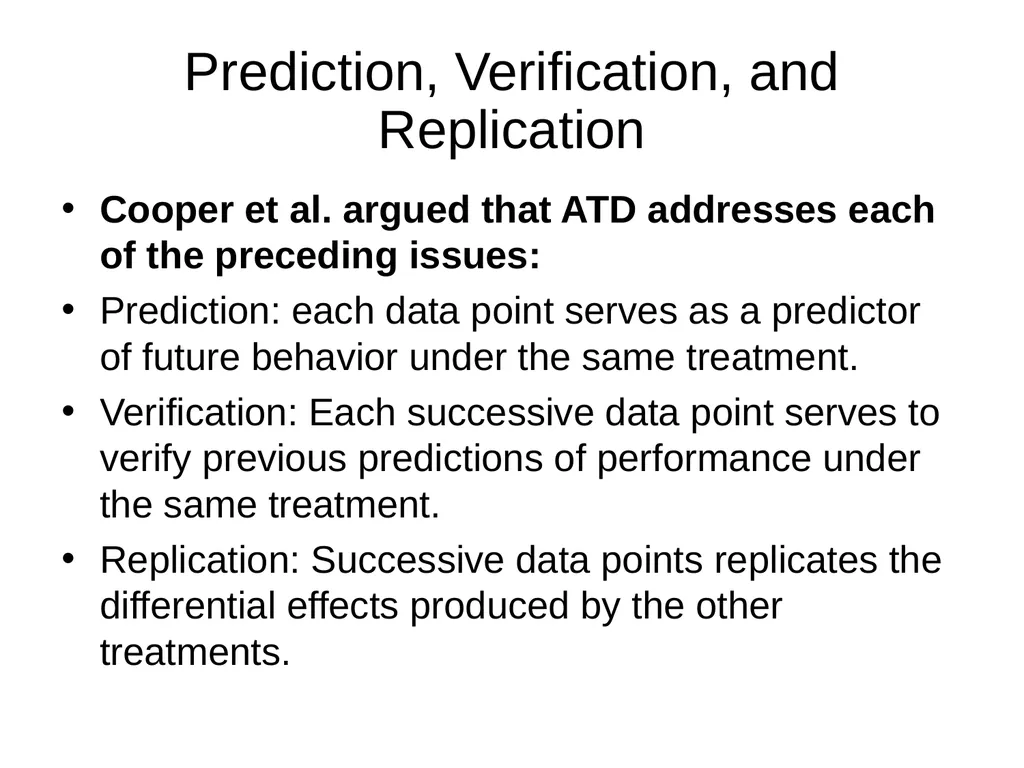
Prediction, Verification, and Replication Cooper et al. argued that ATD addresses each of the preceding issues:
Prediction: each data point serves as a predictor of future behavior under the same treatment.
Verification: Each successive data point serves to verify previous predictions of performance under the same treatment.
Replication: Successive data points replicates the differential effects produced by the other treatments.<br>
11
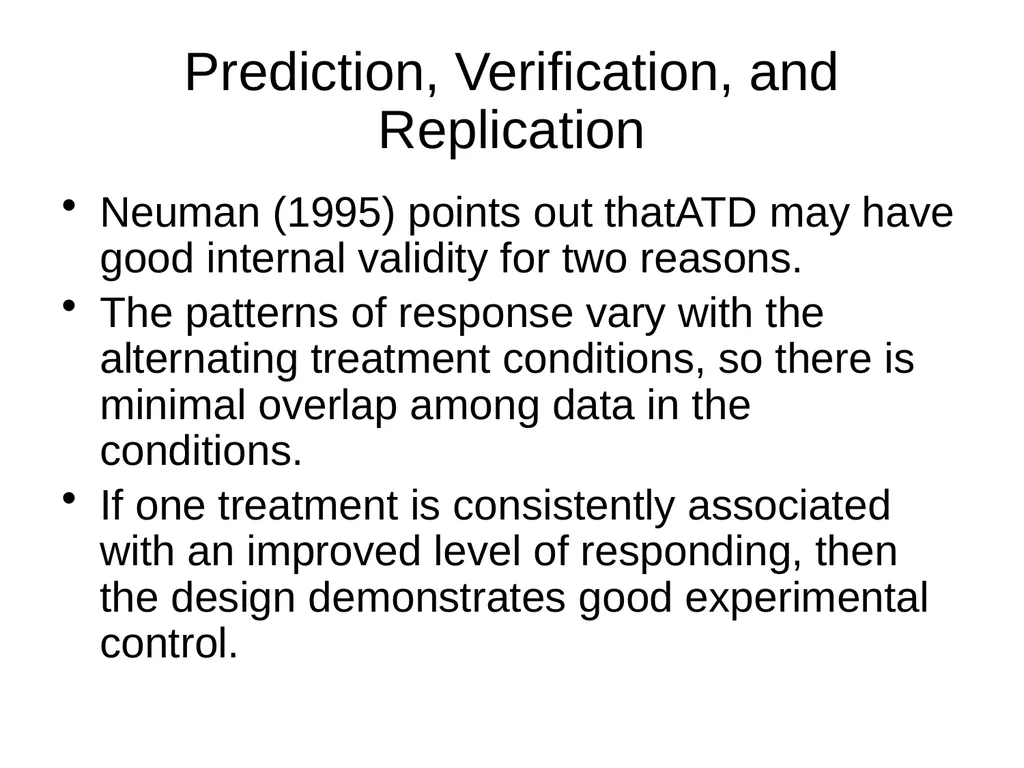
Prediction, Verification, and Replication Neuman (1995) points out thatATD may have good internal validity for two reasons.
The patterns of response vary with the alternating treatment conditions, so there is minimal overlap among data in the conditions.
If one treatment is consistently associated with an improved level of responding, then the design demonstrates good experimental control.<br>
12
Important The choice to use ATD, or any other design, should be based on a careful match of the dependent and the independent variables.<br>
13
Advantages of ATD When you want to determine the relative effectiveness of more than one treatment on a given behavior.
When baseline data are either unavailable or unstable.
When the treatments are sufficiently different from each other.
When the subjects can discriminate the treatment conditions.
When the effects of sequencing the interventions might obscure the results.<br>
14
Disadvantages of ATD When the treatments might interact and obscure results.
When the subjects cannot discriminate the treatment conditions.
When the treatments typically produce slow behavior changes.
When the treatments need to be administered over a continuous period of time to be effective.
When it becomes difficult to counterbalance the various aspects of the study.<br>
15
Adaptations of ATD Simultaneous Treatment Design
This is rare in professional literature
Treatment conditions are presented at the same time.
Requires more skill, planning, and organization that the use of other designs.
It is difficult to systematically analyze the effects of several interventions presented at the same time.<br>
16
Adaptations of ATD Adapted Alternating Treatments Design
Each intervention is applied to different behaviors that are considered to be of equal response difficulty but functionally independent.
The process of equating behaviors can be time consuming and problematic.<br>