
Chapter Eighteen Creating Competitive Advantage



Description: Chapter Eighteen Creating Competitive Advantage Creating Competitive Advantage Competitor Analysis Competitive Strategies Balancing Customer and Competitor Orientations Topic Outline Competitive advantages require delivering more value and
Related Topics
Download Presentation
"Chapter Eighteen Creating Competitive Advantage" is the property of its rightful owner. Permission is granted to download and print the materials on this website for personal, non-commercial use only, and to display it on your personal computer provided you do not modify the materials and that you retain all copyright notices contained in the materials. By downloading content from our website, you accept the terms of this agreement.
Presentation Transcript
slide1. Chapter Eighteen Creating Competitive Advantage<br>
slide2. Creating Competitive Advantage Competitor Analysis
Competitive Strategies
Balancing Customer and Competitor Orientations Topic Outline<br>
slide3. Competitive advantages require delivering more value and satisfaction to target consumers than competitors do
Competitive marketing strategies are how companies analyze their competitors and develop value-based strategies for profitable customer relationships Today’s Companies<br>
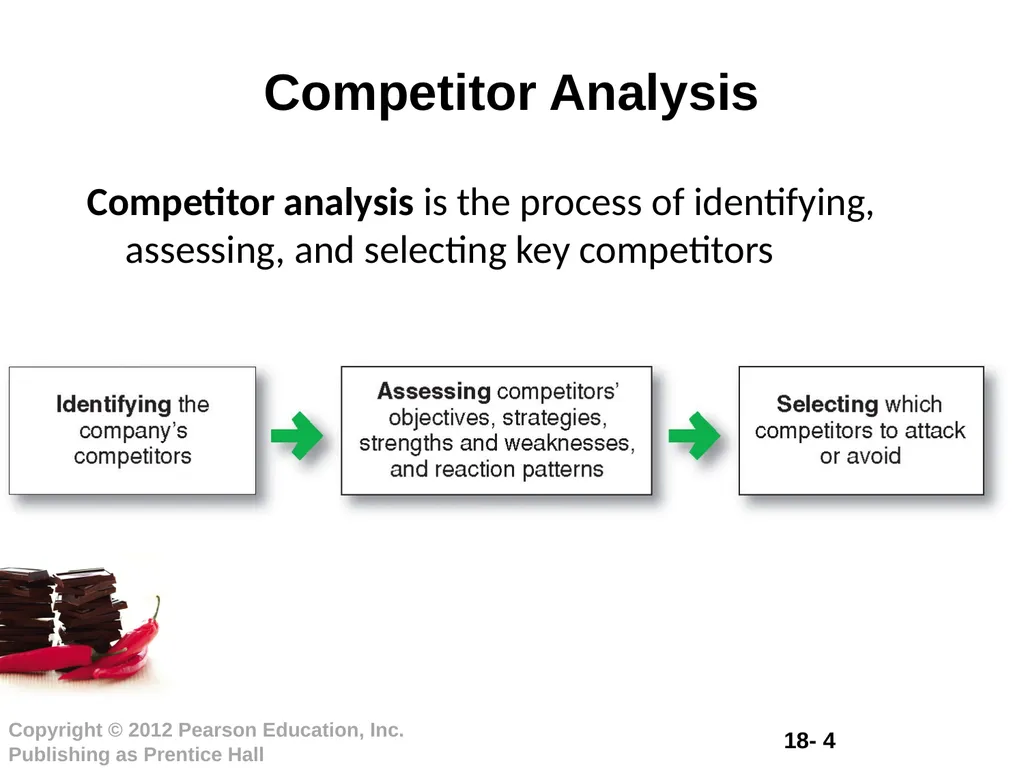
slide4. Competitor analysis is the process of identifying, assessing, and selecting key competitors Competitor Analysis<br>
slide5. Competitor Analysis Competitors can include:
All firms making the same product or class of products
All firms making products that supply the same service
All firms competing for the same consumer dollars Identifying Competitors<br>
slide6. Competitor Analysis Assessing Competitors<br>
slide7. Competitor Analysis Assessing Competitors<br>
slide8. Competitor Analysis Customer value analysis determines the benefits that target customers’ value and how customers rate the relative value of various competitors’ offers
Identification of major attributes that customers value and the importance of these values
Assessment of the company’s and competitors’ performance on the valued attributes Selecting Competitors to Attack and Avoid<br>
slide9. Competitor Analysis Strong or weak competitors
Close or distant competitors
Good or bad competitors Selecting Competitors to Attack and Avoid<br>
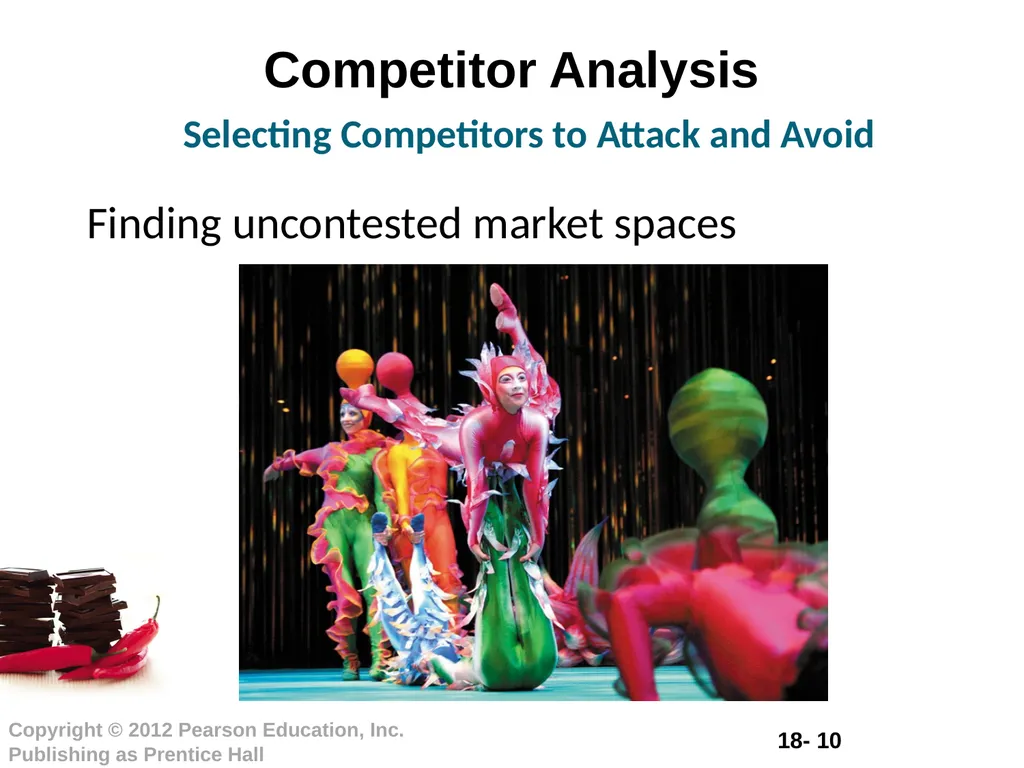
slide10. Competitor Analysis Finding uncontested market spaces Selecting Competitors to Attack and Avoid<br>
slide11. Competitor Analysis Identifies competitive information and the best sources of this information
Continually collects information
Checks information for validity and reliability
Interprets information
Organizes information
Sends key information to relevant decision makers
Responds to inquiries about competitors Designing a Competitive Intelligence System<br>
slide12. Competitive Strategies Entrepreneurial marketing involves visualizing an opportunity and constructing and implementing flexible strategies
Formulated marketing involves developing formal marketing strategies and following them closely
Intrepreneurial marketing involves the attempt to reestablish an internal entrepreneurial spirit and refresh marketing strategies and approaches Approaches to Marketing Strategy<br>
slide13. Competitive Strategies Michael Porter’s four basic
competitive positioning strategies Basic Competitive Strategies<br>
slide14. Competitive Strategies Overall cost leadership strategy:
a company achieves the lowest production and distribution costs and allows it to lower its prices and gain market share Basic Competitive Strategies<br>
slide15. Competitive Strategies Differentiation strategy is when a company concentrates on creating a highly differentiated product line and marketing program so it comes across as an industry class leader
Focus strategy is when a company focuses its effort on serving few market segments well rather than going after the whole market Basic Competitive Strategies<br>
slide16. Competitive Strategies A company that pursued a clear strategy would achieve superior performance
Companies without a clear strategy, “middle of the road”, would not succeed
No clear strategy is Basic Competitive Strategies<br>
slide17. Competitive Strategies Michael Treacy and Fred Wiersema suggest companies can gain leadership positions by delivering superior value to their customers in three strategies or “value disciplines:”
Operational excellence
Customer intimacy
Product leadership Basic Competitive Strategies<br>
slide18. Competitive Strategies Operational excellence refers to a company providing value by leading its industry in price and convenience by reducing costs and creating a lean and efficient value delivery system Basic Competitive Strategies<br>
slide19. Competitive Strategies Customer intimacy refers to a company providing superior value by segmenting markets and tailoring products or services to match the needs of the targeted customers Basic Competitive Strategies<br>
slide20. Competitive Strategies Product leadership refers to a company providing superior value by offering a continuous stream of leading-edge products or services. Product leaders are open to new ideas and solutions and bring them quickly to the market. Basic Competitive Strategies<br>
slide21. Competitive Strategies Competitive Positions<br>
slide22. Competitive Strategies Market leader is the firm with the largest market share and leads the market price changes, product innovations, distribution coverage, and promotion spending
Market challengers are firms fighting to increase market share Competitive Positions<br>
slide23. Competitive Strategies Market followers are firms that want to hold onto their market share
Market nichers are firms that serve small market segments not being pursued by other firms Competitive Positions<br>
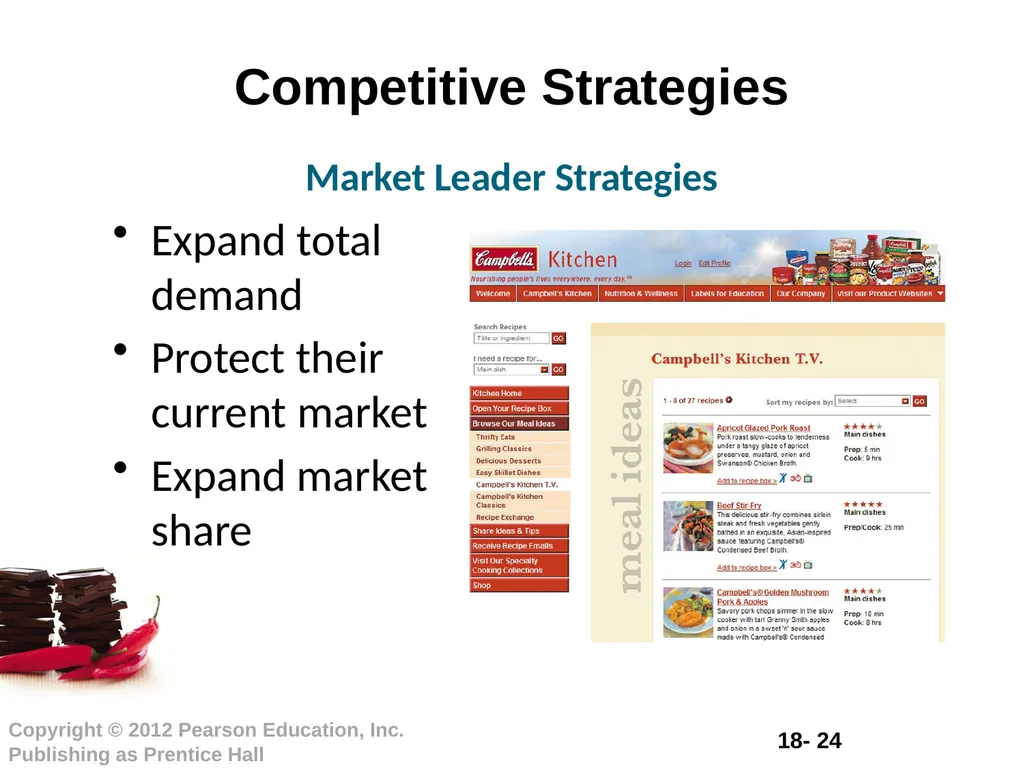
slide24. Competitive Strategies Expand total demand
Protect their current market
Expand market share Market Leader Strategies<br>
slide25. Competitive Strategies Expand total demand by developing:
New users
New uses
More usage of its products Market Leader Strategies
Expanding Total Demand<br>
slide26. Competitive Strategies Protect current market by:
Fixing or preventing weaknesses that provide opportunities to competitors
Maintain consistent prices that provide value
Keep strong customer relationships
Continuous innovation Market Leader Strategies
Protecting Market Share<br>
slide27. Competitive Strategies Expand market share by:
Increasing profitability with increasing market share in served markets
Producing high-quality products
Creating good service experiences
Building close relationships Market Leader Strategies
Expanding Market Share<br>
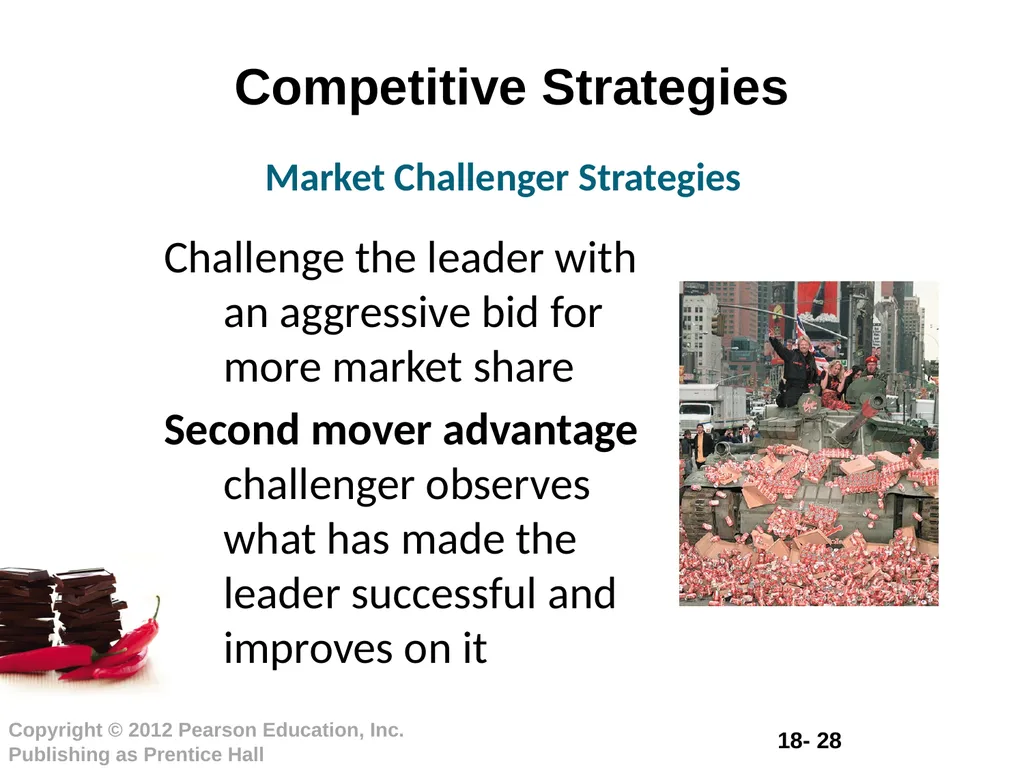
slide28. Competitive Strategies Challenge the leader with an aggressive bid for more market share
Second mover advantage challenger observes what has made the leader successful and improves on it Market Challenger Strategies<br>
slide29. Competitive Strategies Play along with competitors and not rock the boat
Copy or improve on leader’s products and programs with less investment
Brings distinctive advantages
Must keep costs and prices low or quality and services high Market Follower Strategies<br>
slide30. Competitive Strategies Ideal market niche is big enough to be profitable with high growth potential and has little interest from competitors
Key to market niching is specialization
Market
Customer
Product
Marketing mix Market Nicher Strategies<br>
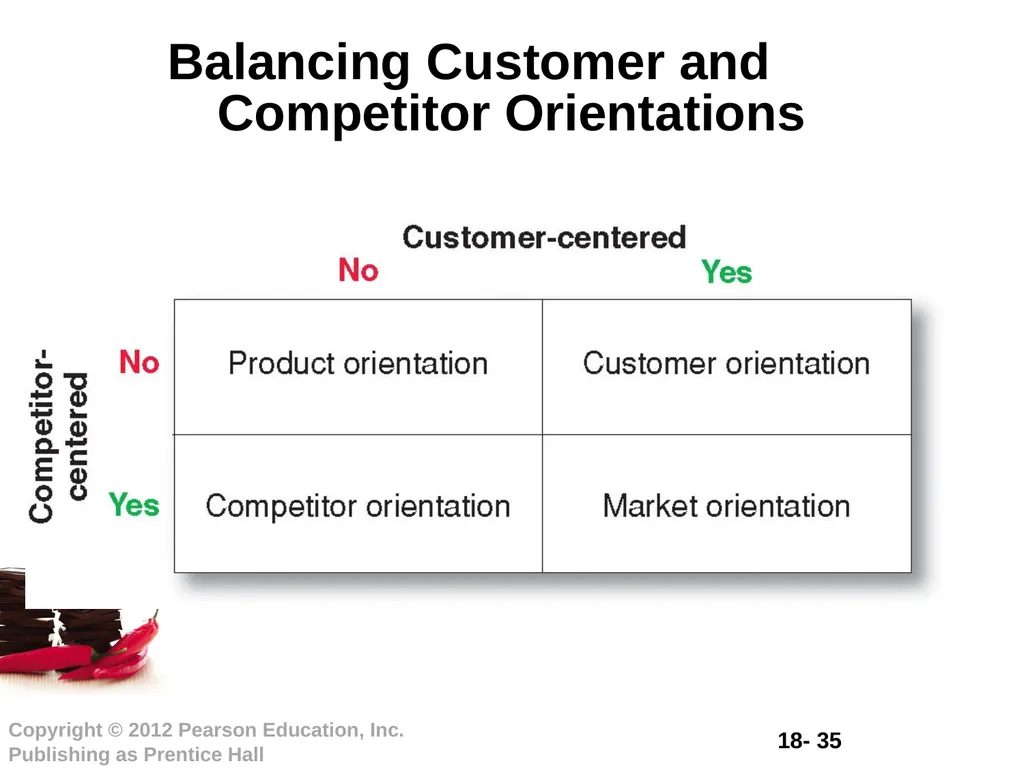
slide31. Balancing Customer and Competitor Orientations Companies need to continuously adapt strategies to changes in the competitive environment
Competitor-centered company
Customer-centered company
Market-centered company<br>
slide32. Balancing Customer and Competitor Orientations Competitor-centered company spends most of its time tracking competitor’s moves and market shares and trying to find ways to counter them
Advantage is that the company is a fighter
Disadvantage is that the company is reactive<br>
slide33. Balancing Customer and Competitor Orientations Customer-centered company spends most of its time focusing on customer developments in designing strategies
Provides a better position than competitor-centered company to identify opportunities and build customer relationships<br>
slide34. Balancing Customer and Competitor Orientations Market-centered company spends most of its time focusing on both competitor and customer developments in designing strategies<br>
slide35. Balancing Customer and Competitor Orientations<br>
slide36. All rights reserved. No part of this publication may be reproduced, stored in a retrieval system, or transmitted, in any form or by any means, electronic, mechanical, photocopying, recording, or otherwise, without the prior written permission of the publisher. Printed in the United States of America. Copyright © 2012 Pearson Education, Inc.
Publishing as Prentice Hall<br>
slide2. Creating Competitive Advantage Competitor Analysis
Competitive Strategies
Balancing Customer and Competitor Orientations Topic Outline<br>
slide3. Competitive advantages require delivering more value and satisfaction to target consumers than competitors do
Competitive marketing strategies are how companies analyze their competitors and develop value-based strategies for profitable customer relationships Today’s Companies<br>
slide4. Competitor analysis is the process of identifying, assessing, and selecting key competitors Competitor Analysis<br>
slide5. Competitor Analysis Competitors can include:
All firms making the same product or class of products
All firms making products that supply the same service
All firms competing for the same consumer dollars Identifying Competitors<br>
slide6. Competitor Analysis Assessing Competitors<br>
slide7. Competitor Analysis Assessing Competitors<br>
slide8. Competitor Analysis Customer value analysis determines the benefits that target customers’ value and how customers rate the relative value of various competitors’ offers
Identification of major attributes that customers value and the importance of these values
Assessment of the company’s and competitors’ performance on the valued attributes Selecting Competitors to Attack and Avoid<br>
slide9. Competitor Analysis Strong or weak competitors
Close or distant competitors
Good or bad competitors Selecting Competitors to Attack and Avoid<br>
slide10. Competitor Analysis Finding uncontested market spaces Selecting Competitors to Attack and Avoid<br>
slide11. Competitor Analysis Identifies competitive information and the best sources of this information
Continually collects information
Checks information for validity and reliability
Interprets information
Organizes information
Sends key information to relevant decision makers
Responds to inquiries about competitors Designing a Competitive Intelligence System<br>
slide12. Competitive Strategies Entrepreneurial marketing involves visualizing an opportunity and constructing and implementing flexible strategies
Formulated marketing involves developing formal marketing strategies and following them closely
Intrepreneurial marketing involves the attempt to reestablish an internal entrepreneurial spirit and refresh marketing strategies and approaches Approaches to Marketing Strategy<br>
slide13. Competitive Strategies Michael Porter’s four basic
competitive positioning strategies Basic Competitive Strategies<br>
slide14. Competitive Strategies Overall cost leadership strategy:
a company achieves the lowest production and distribution costs and allows it to lower its prices and gain market share Basic Competitive Strategies<br>
slide15. Competitive Strategies Differentiation strategy is when a company concentrates on creating a highly differentiated product line and marketing program so it comes across as an industry class leader
Focus strategy is when a company focuses its effort on serving few market segments well rather than going after the whole market Basic Competitive Strategies<br>
slide16. Competitive Strategies A company that pursued a clear strategy would achieve superior performance
Companies without a clear strategy, “middle of the road”, would not succeed
No clear strategy is Basic Competitive Strategies<br>
slide17. Competitive Strategies Michael Treacy and Fred Wiersema suggest companies can gain leadership positions by delivering superior value to their customers in three strategies or “value disciplines:”
Operational excellence
Customer intimacy
Product leadership Basic Competitive Strategies<br>
slide18. Competitive Strategies Operational excellence refers to a company providing value by leading its industry in price and convenience by reducing costs and creating a lean and efficient value delivery system Basic Competitive Strategies<br>
slide19. Competitive Strategies Customer intimacy refers to a company providing superior value by segmenting markets and tailoring products or services to match the needs of the targeted customers Basic Competitive Strategies<br>
slide20. Competitive Strategies Product leadership refers to a company providing superior value by offering a continuous stream of leading-edge products or services. Product leaders are open to new ideas and solutions and bring them quickly to the market. Basic Competitive Strategies<br>
slide21. Competitive Strategies Competitive Positions<br>
slide22. Competitive Strategies Market leader is the firm with the largest market share and leads the market price changes, product innovations, distribution coverage, and promotion spending
Market challengers are firms fighting to increase market share Competitive Positions<br>
slide23. Competitive Strategies Market followers are firms that want to hold onto their market share
Market nichers are firms that serve small market segments not being pursued by other firms Competitive Positions<br>
slide24. Competitive Strategies Expand total demand
Protect their current market
Expand market share Market Leader Strategies<br>
slide25. Competitive Strategies Expand total demand by developing:
New users
New uses
More usage of its products Market Leader Strategies
Expanding Total Demand<br>
slide26. Competitive Strategies Protect current market by:
Fixing or preventing weaknesses that provide opportunities to competitors
Maintain consistent prices that provide value
Keep strong customer relationships
Continuous innovation Market Leader Strategies
Protecting Market Share<br>
slide27. Competitive Strategies Expand market share by:
Increasing profitability with increasing market share in served markets
Producing high-quality products
Creating good service experiences
Building close relationships Market Leader Strategies
Expanding Market Share<br>
slide28. Competitive Strategies Challenge the leader with an aggressive bid for more market share
Second mover advantage challenger observes what has made the leader successful and improves on it Market Challenger Strategies<br>
slide29. Competitive Strategies Play along with competitors and not rock the boat
Copy or improve on leader’s products and programs with less investment
Brings distinctive advantages
Must keep costs and prices low or quality and services high Market Follower Strategies<br>
slide30. Competitive Strategies Ideal market niche is big enough to be profitable with high growth potential and has little interest from competitors
Key to market niching is specialization
Market
Customer
Product
Marketing mix Market Nicher Strategies<br>
slide31. Balancing Customer and Competitor Orientations Companies need to continuously adapt strategies to changes in the competitive environment
Competitor-centered company
Customer-centered company
Market-centered company<br>
slide32. Balancing Customer and Competitor Orientations Competitor-centered company spends most of its time tracking competitor’s moves and market shares and trying to find ways to counter them
Advantage is that the company is a fighter
Disadvantage is that the company is reactive<br>
slide33. Balancing Customer and Competitor Orientations Customer-centered company spends most of its time focusing on customer developments in designing strategies
Provides a better position than competitor-centered company to identify opportunities and build customer relationships<br>
slide34. Balancing Customer and Competitor Orientations Market-centered company spends most of its time focusing on both competitor and customer developments in designing strategies<br>
slide35. Balancing Customer and Competitor Orientations<br>
slide36. All rights reserved. No part of this publication may be reproduced, stored in a retrieval system, or transmitted, in any form or by any means, electronic, mechanical, photocopying, recording, or otherwise, without the prior written permission of the publisher. Printed in the United States of America. Copyright © 2012 Pearson Education, Inc.
Publishing as Prentice Hall<br>