Chapter four Schematic conventions 2052021 A schema A schema is a mental representation of a typical instance. ... In the 1980s, schema theory became an important component of discourse analysis (Sanford and Garrod 1981), reading theory
"Chapter four Schematic conventions 20/5/2021 A" is the property of its rightful owner. Permission is granted to
download and print the materials on this website for personal, non-commercial use only, and to display it
on your personal computer provided you do not modify the materials and that you retain all copyright
notices contained in the materials. By downloading content from our website, you accept the terms of this
agreement.
Presentation Transcript
01
Chapter four Schematic conventions
20/5/2021<br>
02
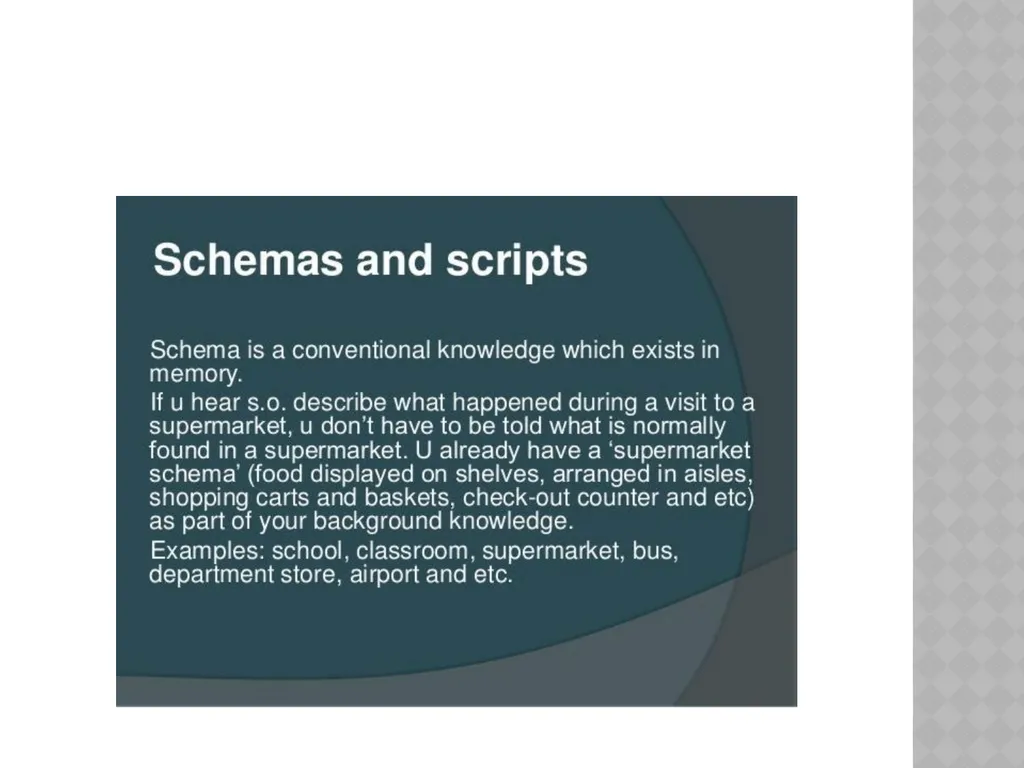
A schema A schema is a mental representation of a typical instance. ... In the 1980s, schema theory became an important component of discourse analysis (Sanford and Garrod 1981), reading theory (Carrell and Eisterhold 1983), and applied linguistics (Widdowson 1983, 1984)<br>
03
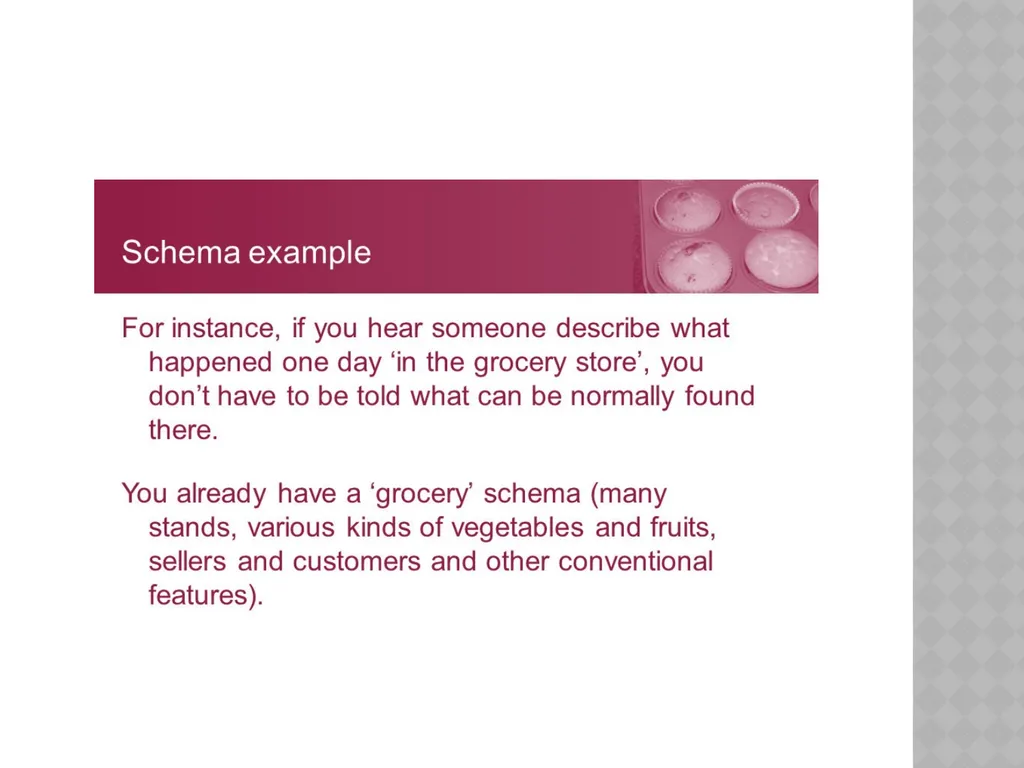
What is the concept of schema? Schema, in social science, mental structures that an individual uses to organize knowledge and guide cognitive processes and behaviour. People use schemata (the plural of schema) to categorize objects and events based on common elements and characteristics and thus interpret and predict the world<br>
04
Schema theory suggests that people understand texts and experiences by comparing them with stereotypical mental representations of similar cases. ... Building upon this framework, relevant AI work on text processing is discussed, evaluated, and applied to literary and non-literary discourse<br>
05
What is schema theory in linguistics? Simply put, schema theory states that all knowledge is organized into units. Within these units of knowledge, or schemata, is stored information. A schema, then, is a generalized description or a conceptual system for understanding knowledge-how knowledge is represented and how it is used<br>
06
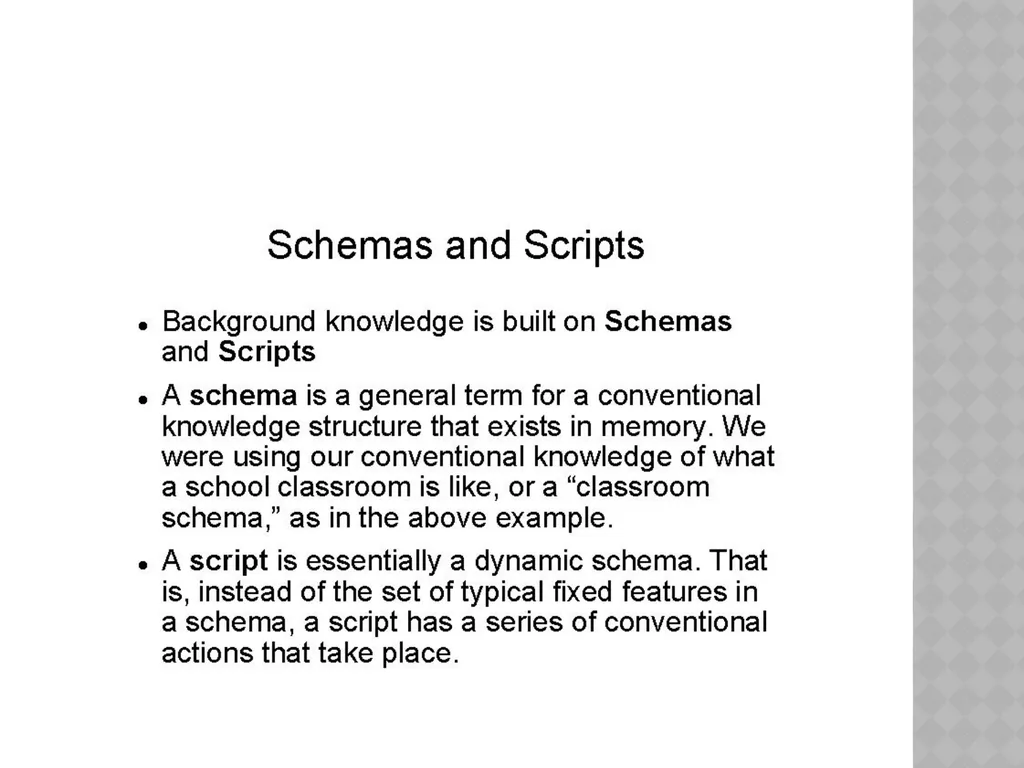
What is schema and script in ؟discourse analysis Schema and script are two terms that comprise the background knowledge. Schema and script tells us what is actually the real situation and what are the actions. Schema is conventional knowledge which exists in memory. Script is essentially a dynamic schema in which conventional action takes place<br>
07
What is the role of schema? Schemas are mental models, or frameworks, which organize information in the mind and represent generalized knowledge about events, situations, objects, actions and feelings. ... The role of prior knowledge in learning is a core feature of constructivist theories of learning – one kind of cognitive approach to learning<br>
08
Schematas (ideational constructs) are frames of reference.
.<br>
09
Examples Examples of such schema would be those that inform the everyday routines we follow when meeting or greeting people, or the different transactions we carry out in service encounters-buying a train ticket, checking in at a hotel, making enquiries over the phone, and so on..<br>
10
The customary ways of doing these things are so familiar to us that we take them for granted, until we discover, that they do not always apply and other people, from different cultures or social groups, follow rather different schematic conventions of behavior<br>
11
Frames and cultural assumptions These schemata are cultural, taken-for-granted constructs, and they become so firmly entrenched in our consciousness that we often find it difficult to envisage any alternative ways of thinking.<br>
12
Our cultural background creates our frame of reference. Our frame of reference or attitude set is that unique set of beliefs, attitudes, values, and past experiences that create a set way of looking and perceiving the world. And it is our frame of reference which forms the basis for how we interpret messages that we receive.
.<br>
13
Sometimes we will hear a message, but not pay very much attention to it. We may have been busy or perhaps thought the information was not that important. At some later time someone asks us about the information and we pass along what we thought we heard, often filling in what we believe to be the information, even if what we fill in is inaccurate. We are not trying to mislead intentionally; we are just applying closure. The information we fill in comes from our cultural knowledge<br>
14
Grouping, however, can lead to stereotyping and prejudice. This occurs when we start treating the individuals as if they have only characteristics of the group. When we start thinking that all Arabs and Muslims are terrorists or that all Americans are loud and obnoxious, we are carry grouping to an illogical extreme. We then find it very difficult to communicate with people from those groups. It is important to be aware of how you group things, especially people, so that you do not stereotype them to the point that you have trouble interacting with them.<br>