
Chapter Six Morphology Overview Defining
TF
Published · 17 slides · 0 views
1 / 1
Description
Chapter Six Morphology Overview Defining Morphology Morpheme Free and Bound Morphemes Derivational Morphemes Inflectional Morphemes Morphological Description Morphs Allomorphs Defining Morphology In many languages, what appear to be a
Related Topics
Share
Embed code
Download this presentation From Below
"Chapter Six Morphology Overview Defining" is the property of its rightful owner. Permission is granted to download and print the materials on this website for personal, non-commercial use only, and to display it on your personal computer provided you do not modify the materials and that you retain all copyright notices contained in the materials. By downloading content from our website, you accept the terms of this agreement.
Presentation Transcript
01
Chapter Six
Morphology<br>
02
Overview Defining Morphology
Morpheme
Free and Bound Morphemes
Derivational Morphemes
Inflectional Morphemes
Morphological Description
Morphs & Allomorphs<br>
Morpheme
Free and Bound Morphemes
Derivational Morphemes
Inflectional Morphemes
Morphological Description
Morphs & Allomorphs<br>
03
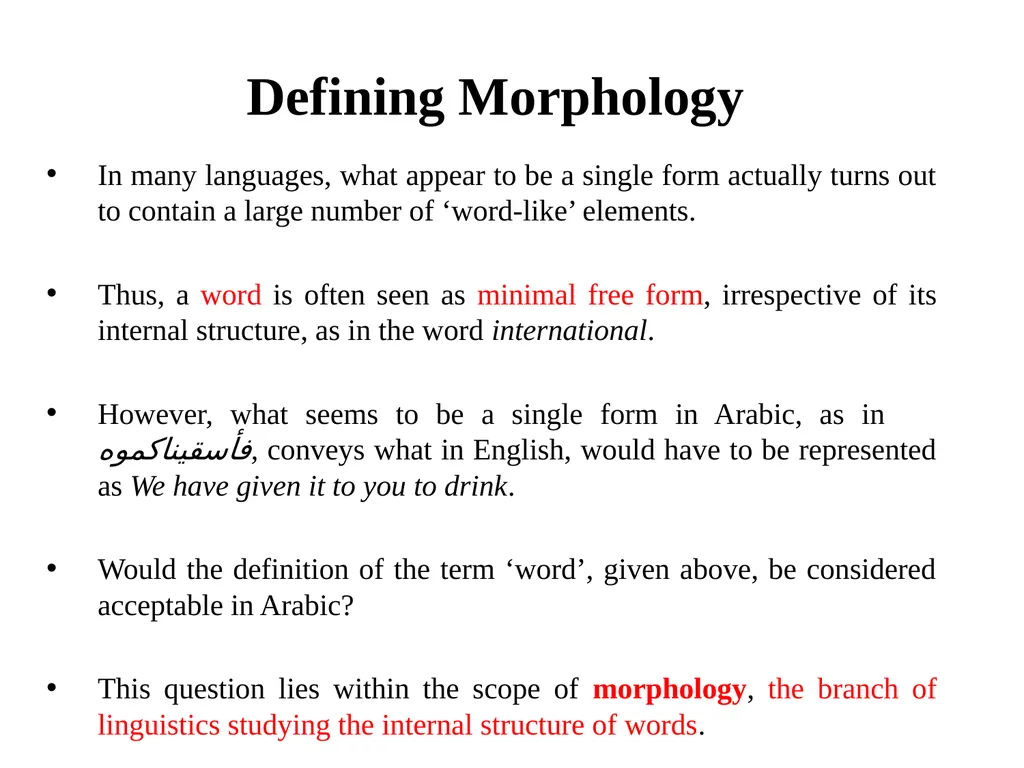
Defining Morphology In many languages, what appear to be a single form actually turns out to contain a large number of ‘word-like’ elements.
Thus, a word is often seen as minimal free form, irrespective of its internal structure, as in the word international.
However, what seems to be a single form in Arabic, as in فأسقيناكموه, conveys what in English, would have to be represented as We have given it to you to drink.
Would the definition of the term ‘word’, given above, be considered acceptable in Arabic?
This question lies within the scope of morphology, the branch of linguistics studying the internal structure of words.<br>
Thus, a word is often seen as minimal free form, irrespective of its internal structure, as in the word international.
However, what seems to be a single form in Arabic, as in فأسقيناكموه, conveys what in English, would have to be represented as We have given it to you to drink.
Would the definition of the term ‘word’, given above, be considered acceptable in Arabic?
This question lies within the scope of morphology, the branch of linguistics studying the internal structure of words.<br>
04
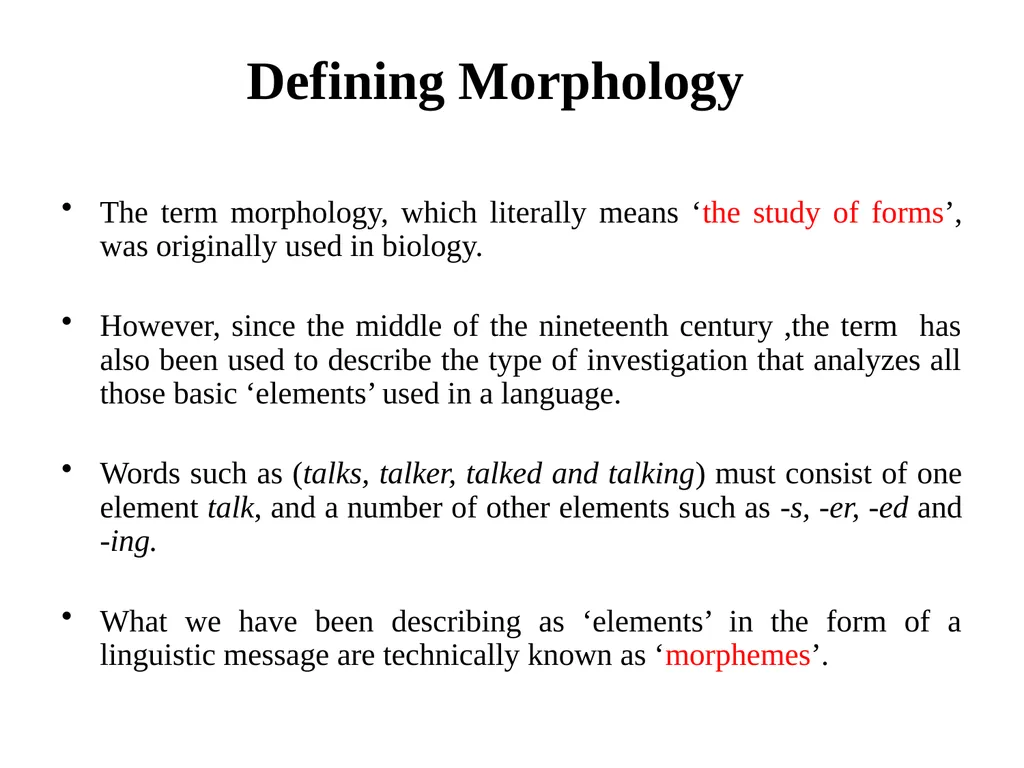
The term morphology, which literally means ‘the study of forms’, was originally used in biology.
However, since the middle of the nineteenth century ,the term has also been used to describe the type of investigation that analyzes all those basic ‘elements’ used in a language.
Words such as (talks, talker, talked and talking) must consist of one element talk, and a number of other elements such as -s, -er, -ed and -ing.
What we have been describing as ‘elements’ in the form of a linguistic message are technically known as ‘morphemes’. Defining Morphology<br>
However, since the middle of the nineteenth century ,the term has also been used to describe the type of investigation that analyzes all those basic ‘elements’ used in a language.
Words such as (talks, talker, talked and talking) must consist of one element talk, and a number of other elements such as -s, -er, -ed and -ing.
What we have been describing as ‘elements’ in the form of a linguistic message are technically known as ‘morphemes’. Defining Morphology<br>
05
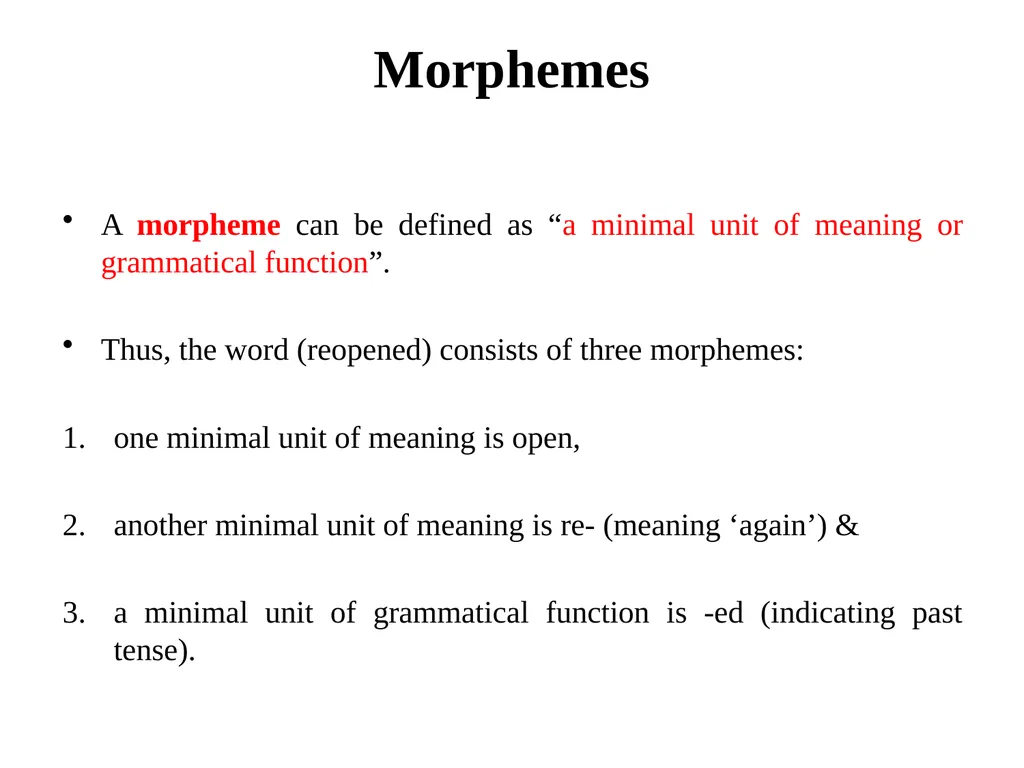
Morphemes A morpheme can be defined as “a minimal unit of meaning or grammatical function”.
Thus, the word (reopened) consists of three morphemes:
one minimal unit of meaning is open,
another minimal unit of meaning is re- (meaning ‘again’) &
a minimal unit of grammatical function is -ed (indicating past tense).<br>
Thus, the word (reopened) consists of three morphemes:
one minimal unit of meaning is open,
another minimal unit of meaning is re- (meaning ‘again’) &
a minimal unit of grammatical function is -ed (indicating past tense).<br>
06
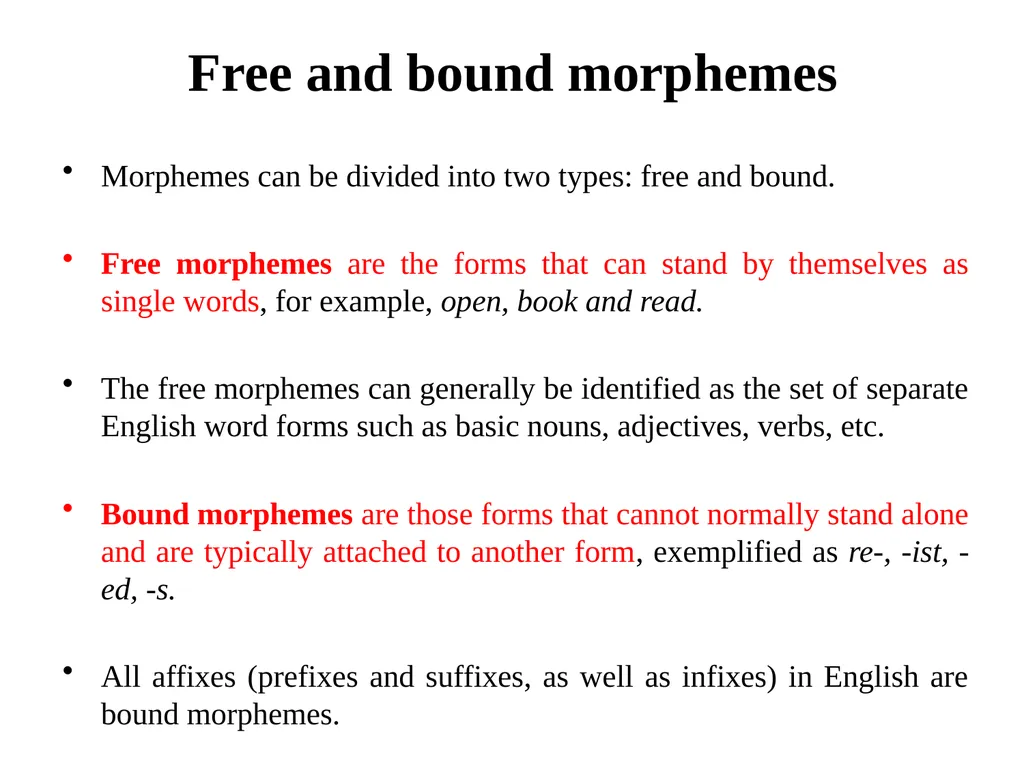
Free and bound morphemes Morphemes can be divided into two types: free and bound.
Free morphemes are the forms that can stand by themselves as single words, for example, open, book and read.
The free morphemes can generally be identified as the set of separate English word forms such as basic nouns, adjectives, verbs, etc.
Bound morphemes are those forms that cannot normally stand alone and are typically attached to another form, exemplified as re-, -ist, -ed, -s.
All affixes (prefixes and suffixes, as well as infixes) in English are bound morphemes.<br>
Free morphemes are the forms that can stand by themselves as single words, for example, open, book and read.
The free morphemes can generally be identified as the set of separate English word forms such as basic nouns, adjectives, verbs, etc.
Bound morphemes are those forms that cannot normally stand alone and are typically attached to another form, exemplified as re-, -ist, -ed, -s.
All affixes (prefixes and suffixes, as well as infixes) in English are bound morphemes.<br>
07
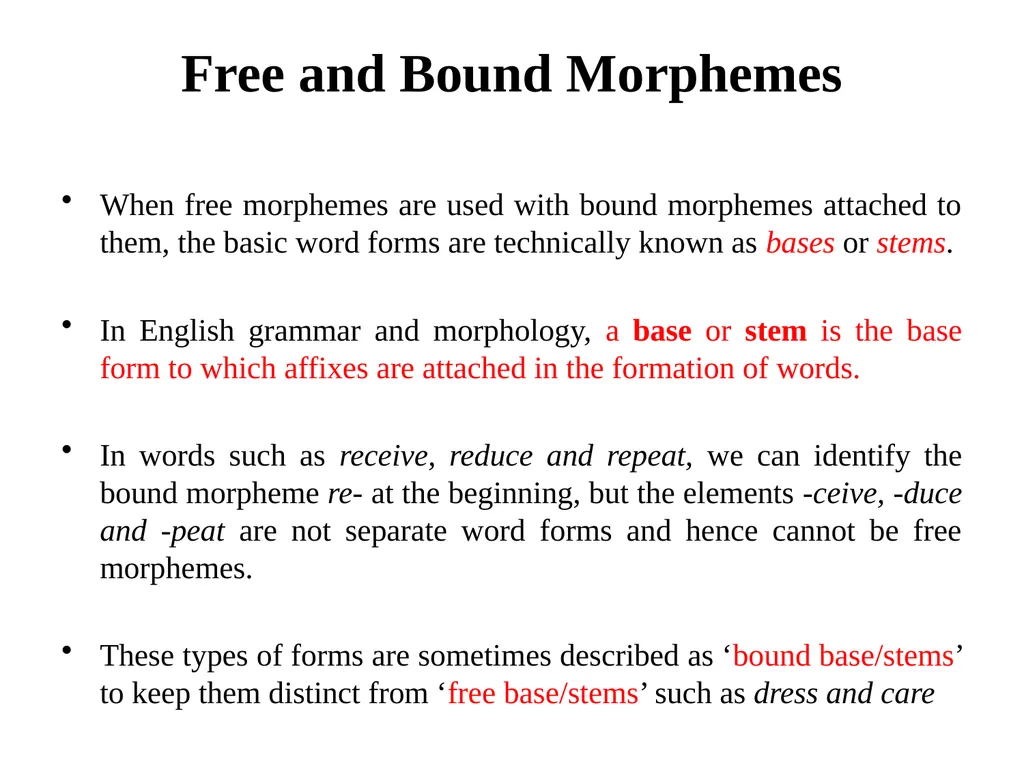
Free and Bound Morphemes When free morphemes are used with bound morphemes attached to them, the basic word forms are technically known as bases or stems.
In English grammar and morphology, a base or stem is the base form to which affixes are attached in the formation of words.
In words such as receive, reduce and repeat, we can identify the bound morpheme re- at the beginning, but the elements -ceive, -duce and -peat are not separate word forms and hence cannot be free morphemes.
These types of forms are sometimes described as ‘bound base/stems’ to keep them distinct from ‘free base/stems’ such as dress and care<br>
In English grammar and morphology, a base or stem is the base form to which affixes are attached in the formation of words.
In words such as receive, reduce and repeat, we can identify the bound morpheme re- at the beginning, but the elements -ceive, -duce and -peat are not separate word forms and hence cannot be free morphemes.
These types of forms are sometimes described as ‘bound base/stems’ to keep them distinct from ‘free base/stems’ such as dress and care<br>
08
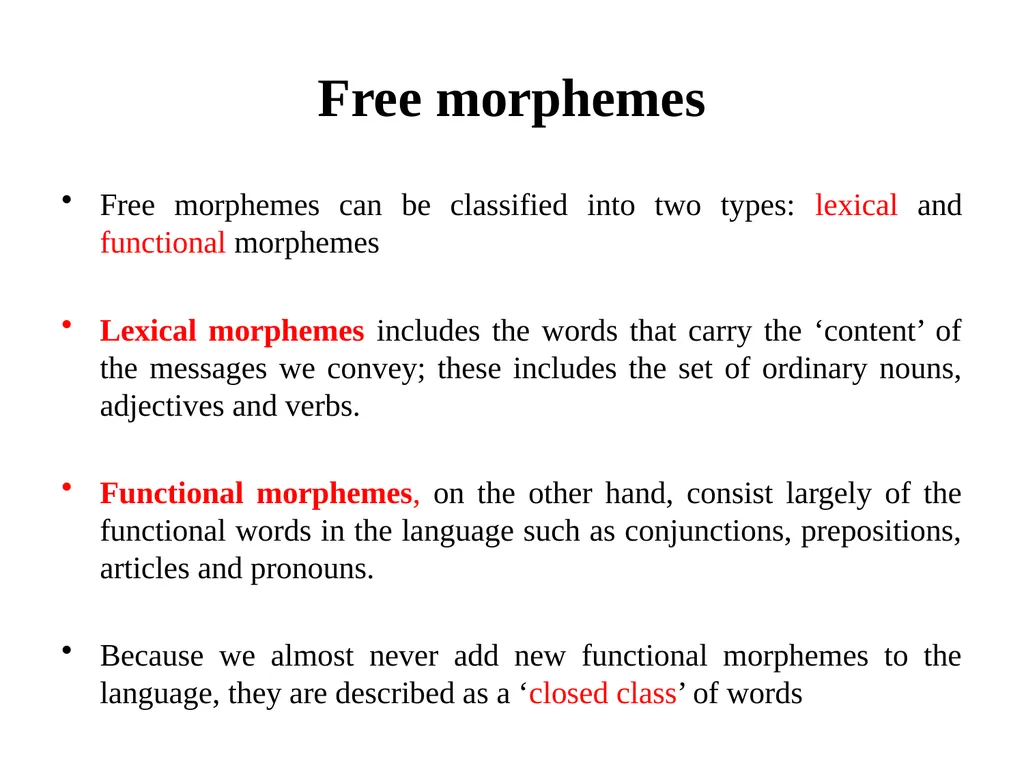
Free morphemes Free morphemes can be classified into two types: lexical and functional morphemes
Lexical morphemes includes the words that carry the ‘content’ of the messages we convey; these includes the set of ordinary nouns, adjectives and verbs.
Functional morphemes, on the other hand, consist largely of the functional words in the language such as conjunctions, prepositions, articles and pronouns.
Because we almost never add new functional morphemes to the language, they are described as a ‘closed class’ of words<br>
Lexical morphemes includes the words that carry the ‘content’ of the messages we convey; these includes the set of ordinary nouns, adjectives and verbs.
Functional morphemes, on the other hand, consist largely of the functional words in the language such as conjunctions, prepositions, articles and pronouns.
Because we almost never add new functional morphemes to the language, they are described as a ‘closed class’ of words<br>
09
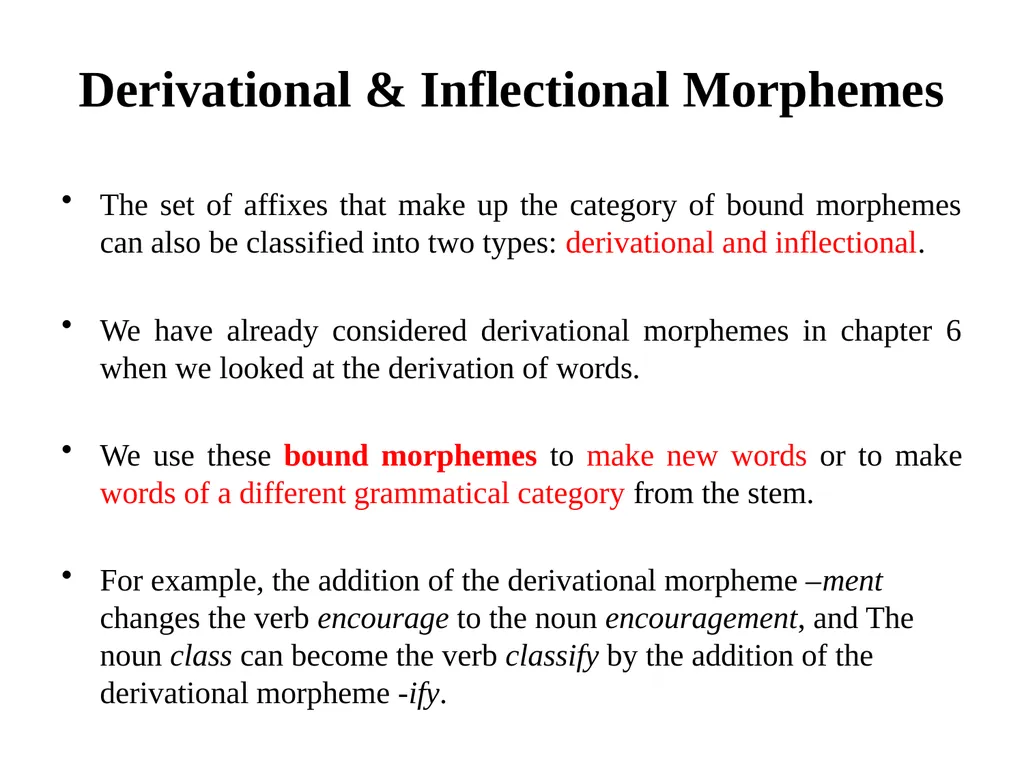
Derivational & Inflectional Morphemes The set of affixes that make up the category of bound morphemes can also be classified into two types: derivational and inflectional.
We have already considered derivational morphemes in chapter 6 when we looked at the derivation of words.
We use these bound morphemes to make new words or to make words of a different grammatical category from the stem.
For example, the addition of the derivational morpheme –ment changes the verb encourage to the noun encouragement, and The noun class can become the verb classify by the addition of the derivational morpheme -ify.<br>
We have already considered derivational morphemes in chapter 6 when we looked at the derivation of words.
We use these bound morphemes to make new words or to make words of a different grammatical category from the stem.
For example, the addition of the derivational morpheme –ment changes the verb encourage to the noun encouragement, and The noun class can become the verb classify by the addition of the derivational morpheme -ify.<br>
10
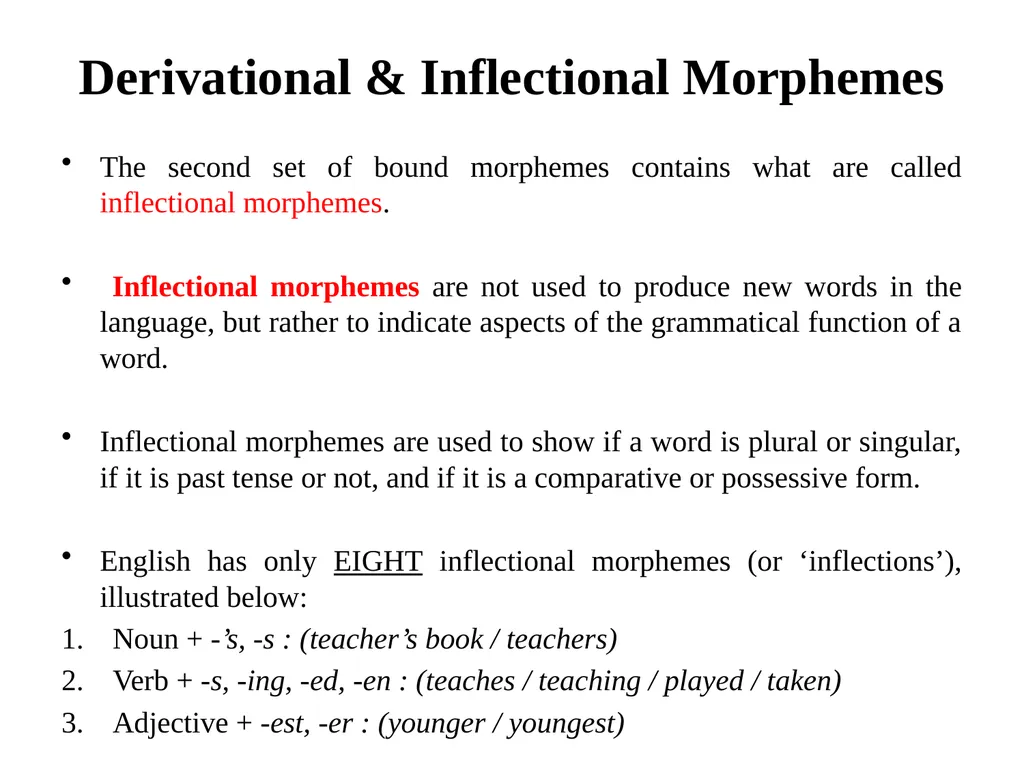
Derivational & Inflectional Morphemes The second set of bound morphemes contains what are called inflectional morphemes.
Inflectional morphemes are not used to produce new words in the language, but rather to indicate aspects of the grammatical function of a word.
Inflectional morphemes are used to show if a word is plural or singular, if it is past tense or not, and if it is a comparative or possessive form.
English has only EIGHT inflectional morphemes (or ‘inflections’), illustrated below:
Noun + -’s, -s : (teacher’s book / teachers)
Verb + -s, -ing, -ed, -en : (teaches / teaching / played / taken)
Adjective + -est, -er : (younger / youngest)<br>
Inflectional morphemes are not used to produce new words in the language, but rather to indicate aspects of the grammatical function of a word.
Inflectional morphemes are used to show if a word is plural or singular, if it is past tense or not, and if it is a comparative or possessive form.
English has only EIGHT inflectional morphemes (or ‘inflections’), illustrated below:
Noun + -’s, -s : (teacher’s book / teachers)
Verb + -s, -ing, -ed, -en : (teaches / teaching / played / taken)
Adjective + -est, -er : (younger / youngest)<br>
11
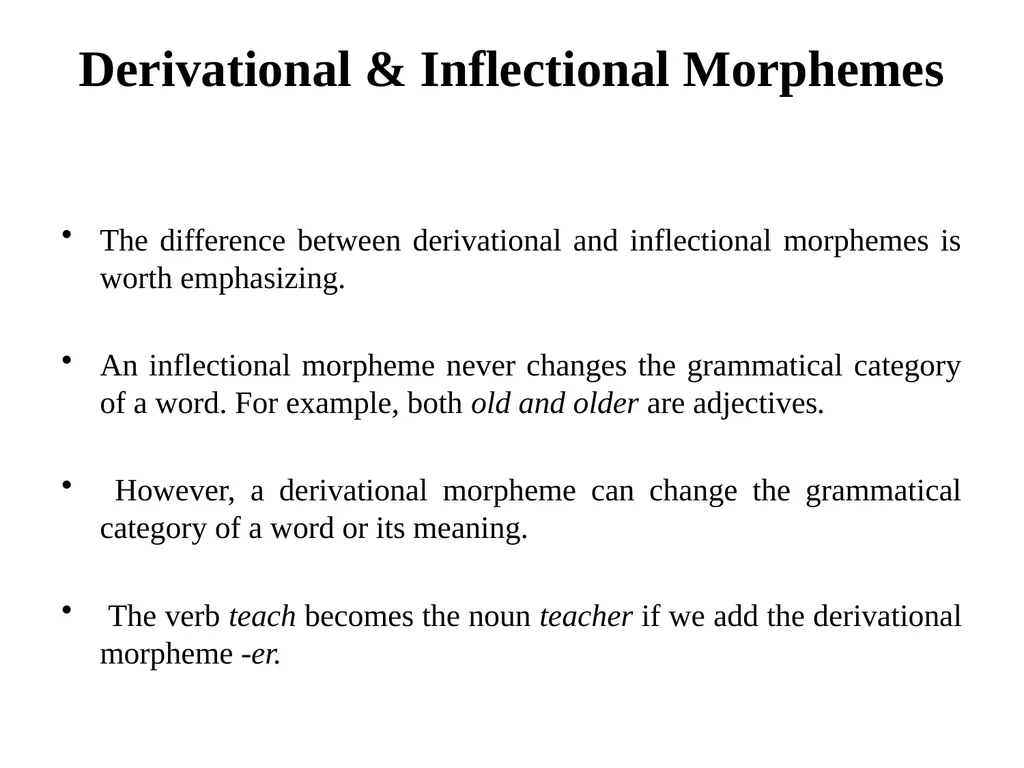
Derivational & Inflectional Morphemes The difference between derivational and inflectional morphemes is worth emphasizing.
An inflectional morpheme never changes the grammatical category of a word. For example, both old and older are adjectives.
However, a derivational morpheme can change the grammatical category of a word or its meaning.
The verb teach becomes the noun teacher if we add the derivational morpheme -er.<br>
An inflectional morpheme never changes the grammatical category of a word. For example, both old and older are adjectives.
However, a derivational morpheme can change the grammatical category of a word or its meaning.
The verb teach becomes the noun teacher if we add the derivational morpheme -er.<br>
12
Whenever there is a derivational suffix and an inflectional suffix used together, the derivational suffix always precedes the inflectional suffix.
Armed with all these terms for different types of morphemes, we can now take most sentences of English apart and list all the “elements.”
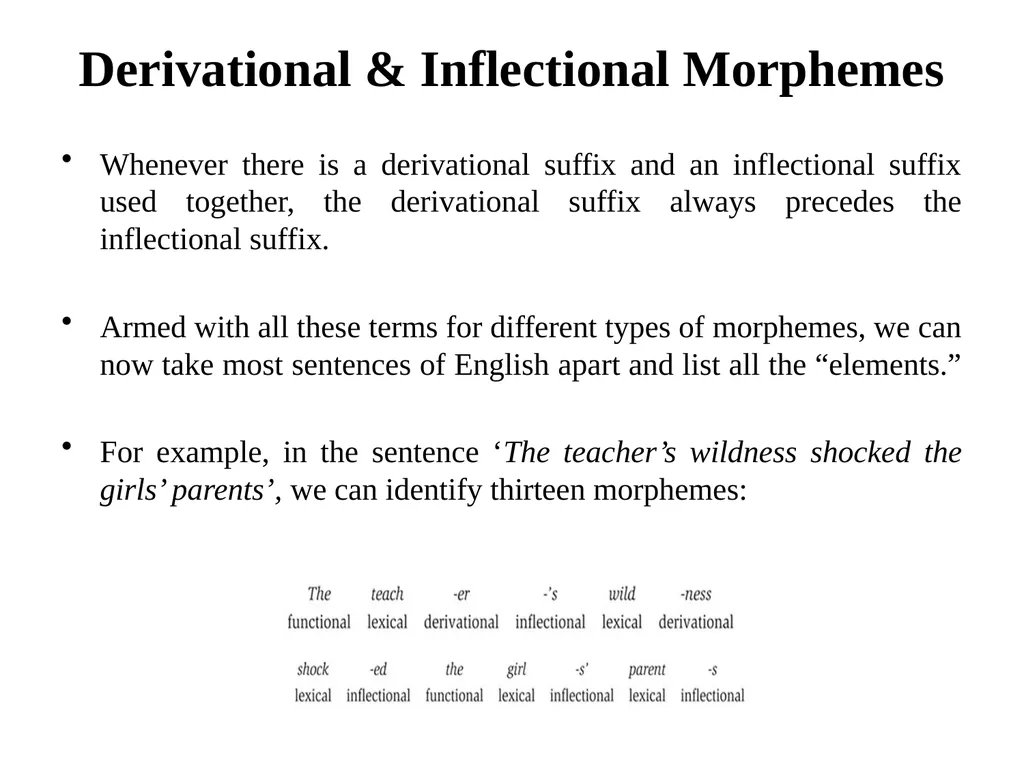
For example, in the sentence ‘The teacher’s wildness shocked the girls’ parents’, we can identify thirteen morphemes: Derivational & Inflectional Morphemes<br>
Armed with all these terms for different types of morphemes, we can now take most sentences of English apart and list all the “elements.”
For example, in the sentence ‘The teacher’s wildness shocked the girls’ parents’, we can identify thirteen morphemes: Derivational & Inflectional Morphemes<br>
13
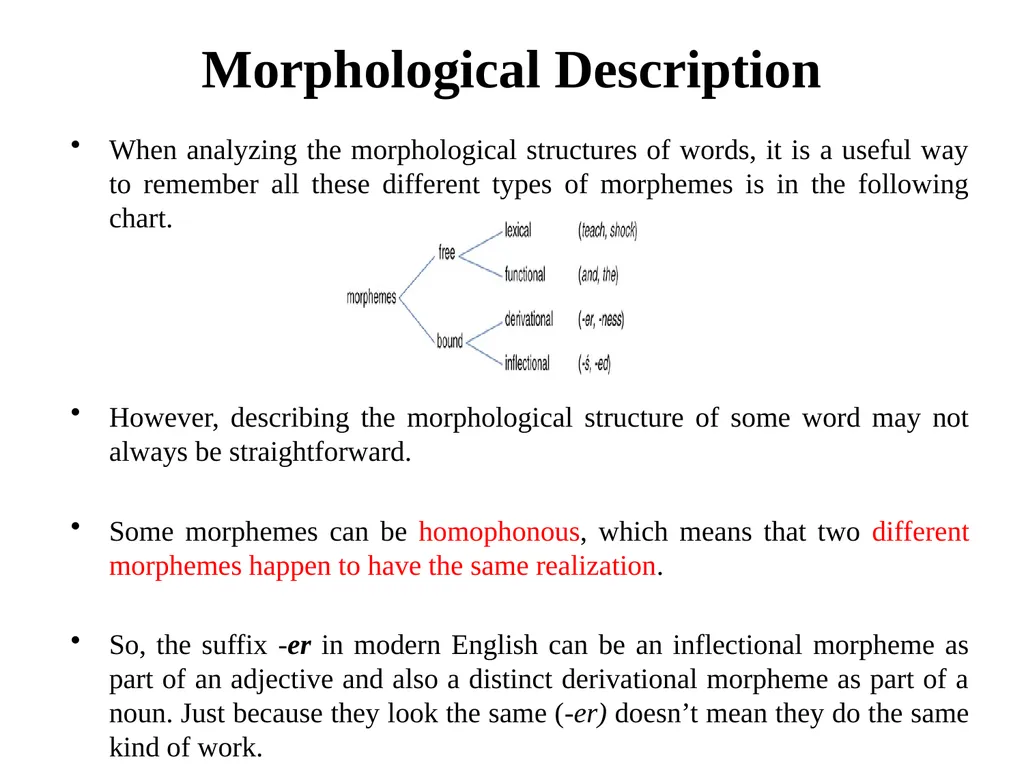
When analyzing the morphological structures of words, it is a useful way to remember all these different types of morphemes is in the following chart.
However, describing the morphological structure of some word may not always be straightforward.
Some morphemes can be homophonous, which means that two different morphemes happen to have the same realization.
So, the suffix -er in modern English can be an inflectional morpheme as part of an adjective and also a distinct derivational morpheme as part of a noun. Just because they look the same (-er) doesn’t mean they do the same kind of work. Morphological Description<br>
However, describing the morphological structure of some word may not always be straightforward.
Some morphemes can be homophonous, which means that two different morphemes happen to have the same realization.
So, the suffix -er in modern English can be an inflectional morpheme as part of an adjective and also a distinct derivational morpheme as part of a noun. Just because they look the same (-er) doesn’t mean they do the same kind of work. Morphological Description<br>
14
Another problem one may encounter when analyzing some morphemes is that they may have different realizations.
So far, we have only considered examples of English words in which the different morphemes are easily identifiable as separate elements.
The inflectional morpheme -s is added to car and we get the plural cars.
What is the inflectional morpheme that makes sheep the plural of sheep, or men the plural of man?
One way to describe more regular differences in inflectional morphemes is by proposing variation in morphological realization rules (draw an analogy with processes already noted in phonology). Morphological Description<br>
So far, we have only considered examples of English words in which the different morphemes are easily identifiable as separate elements.
The inflectional morpheme -s is added to car and we get the plural cars.
What is the inflectional morpheme that makes sheep the plural of sheep, or men the plural of man?
One way to describe more regular differences in inflectional morphemes is by proposing variation in morphological realization rules (draw an analogy with processes already noted in phonology). Morphological Description<br>
15
Morphs and allomorphs Just as we treated ‘phones’ as the actual phonetic realization of ‘phonemes’, so we can propose morphs ‘as the actual forms used to realize morphemes’.
For example, the form cars consists of two morphs, car + -s, realizing a lexical morpheme and an inflectional morpheme (‘plural’). The form buses also consists of two morphs (bus + -es), realizing a lexical morpheme and an inflectional morpheme (‘plural’).
So there are at least two morphs (-s and -es) used to realize the inflectional morpheme ‘plural’.
Just as we noted that there were ‘allophones’ of a particular phoneme, so we can recognize the existence of allomorphs as ‘the actual realizations of a particular morpheme’.<br>
For example, the form cars consists of two morphs, car + -s, realizing a lexical morpheme and an inflectional morpheme (‘plural’). The form buses also consists of two morphs (bus + -es), realizing a lexical morpheme and an inflectional morpheme (‘plural’).
So there are at least two morphs (-s and -es) used to realize the inflectional morpheme ‘plural’.
Just as we noted that there were ‘allophones’ of a particular phoneme, so we can recognize the existence of allomorphs as ‘the actual realizations of a particular morpheme’.<br>
16
Take the ‘plural’ morpheme: note that it can be attached to a number of lexical morphemes to produce structures like:
‘cat + s = plural’,
‘bus + es = plural’
‘sheep + Zero= plural’
and ‘man + /e/ = plural’.
In each of these examples, the actual forms of the morphs that result from the ‘plural’ are different, but they are all allomorphs of the one morpheme.
So, in addition to -s and -es, another allomorph of ‘plural’ in English seems to be a zero-morph because the plural form of sheep is actually ‘sheep + Ø’.
When we look at ‘man + plural’, we have a vowel change in the word (æ → ε) as the morph that produces the so-called ‘irregular’ plural form men. Morphs and allomorphs<br>
‘cat + s = plural’,
‘bus + es = plural’
‘sheep + Zero= plural’
and ‘man + /e/ = plural’.
In each of these examples, the actual forms of the morphs that result from the ‘plural’ are different, but they are all allomorphs of the one morpheme.
So, in addition to -s and -es, another allomorph of ‘plural’ in English seems to be a zero-morph because the plural form of sheep is actually ‘sheep + Ø’.
When we look at ‘man + plural’, we have a vowel change in the word (æ → ε) as the morph that produces the so-called ‘irregular’ plural form men. Morphs and allomorphs<br>
17
Questions & Discussions How many morphemes are there in the word terrorists?
What kind of morpheme is the suffix in slowly?
What are the functional morphemes in the following sentence? When she walked into the room, the doctor asked me if I had a sore throat or an annoying cough.
List the bound morphemes in these words: fearlessly, happier, misleads, previewer, shortening, unreconstructed.
Which of these words has a bound base/stem: consist, deceive, introduce, repeat?
Which word(s) in the following sentence would you put in a closed class and which in an open class? Bob brought hot donuts to class.
What is the difference between the -er morphemes in the words smaller and singer?
Discuss why describing the morphological structure of some words may not always be straightforward.<br>
What kind of morpheme is the suffix in slowly?
What are the functional morphemes in the following sentence? When she walked into the room, the doctor asked me if I had a sore throat or an annoying cough.
List the bound morphemes in these words: fearlessly, happier, misleads, previewer, shortening, unreconstructed.
Which of these words has a bound base/stem: consist, deceive, introduce, repeat?
Which word(s) in the following sentence would you put in a closed class and which in an open class? Bob brought hot donuts to class.
What is the difference between the -er morphemes in the words smaller and singer?
Discuss why describing the morphological structure of some words may not always be straightforward.<br>