
Chattel Slavery: Corroborating Evidence LESSON
MT
Published · 17 slides · 0 views
1 / 1


Description
Chattel Slavery: Corroborating Evidence LESSON GOALS: Interpret claims and facts about American slavery. Understand that historical claims can have both evidence that supports them, and evidence that contradict them. Analyze and explain
Related Topics
Share
Embed code
Download this presentation From Below
"Chattel Slavery: Corroborating Evidence LESSON" is the property of its rightful owner. Permission is granted to download and print the materials on this website for personal, non-commercial use only, and to display it on your personal computer provided you do not modify the materials and that you retain all copyright notices contained in the materials. By downloading content from our website, you accept the terms of this agreement.
Presentation Transcript
01
Chattel Slavery:
Corroborating Evidence<br>
Corroborating Evidence<br>
02
LESSON GOALS: Interpret claims and facts about American slavery.
Understand that historical claims can have both evidence that supports them, and evidence that contradict them.
Analyze and explain which pieces of evidence corroborates claims and which pieces of evidence contradict claims.<br>
Understand that historical claims can have both evidence that supports them, and evidence that contradict them.
Analyze and explain which pieces of evidence corroborates claims and which pieces of evidence contradict claims.<br>
03
Corroborating and Contradicting Claims and Evidence Analyze the information on the following claims slides. What do they tell us about chattel slavery in the United States and in North Carolina?
Analyze the information on the corresponding evidence slides. Does the evidence support or contradict the claim? Why might it be contradictory sometimes?
Use the lesson chart to record your answers and observations.<br>
Analyze the information on the corresponding evidence slides. Does the evidence support or contradict the claim? Why might it be contradictory sometimes?
Use the lesson chart to record your answers and observations.<br>
04
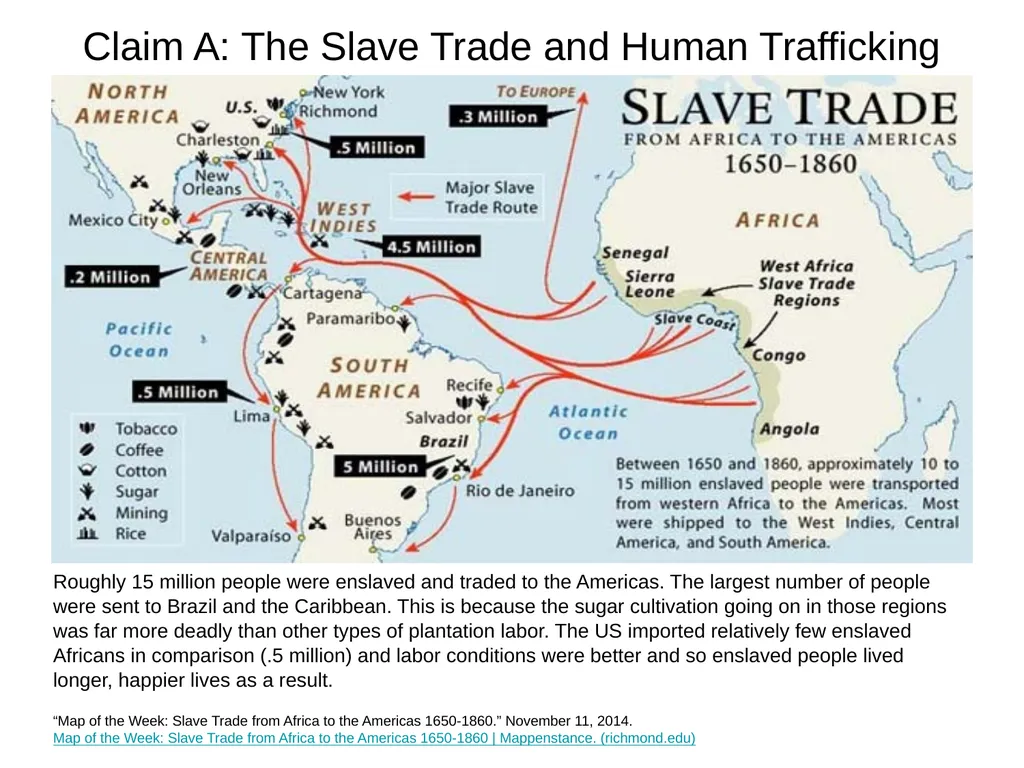
Claim A: The Slave Trade and Human Trafficking Roughly 15 million people were enslaved and traded to the Americas. The largest number of people were sent to Brazil and the Caribbean. This is because the sugar cultivation going on in those regions was far more deadly than other types of plantation labor. The US imported relatively few enslaved Africans in comparison (.5 million) and labor conditions were better and so enslaved people lived longer, happier lives as a result.
“Map of the Week: Slave Trade from Africa to the Americas 1650-1860.” November 11, 2014. Map of the Week: Slave Trade from Africa to the Americas 1650-1860 | Mappenstance. (richmond.edu)<br>
“Map of the Week: Slave Trade from Africa to the Americas 1650-1860.” November 11, 2014. Map of the Week: Slave Trade from Africa to the Americas 1650-1860 | Mappenstance. (richmond.edu)<br>
05
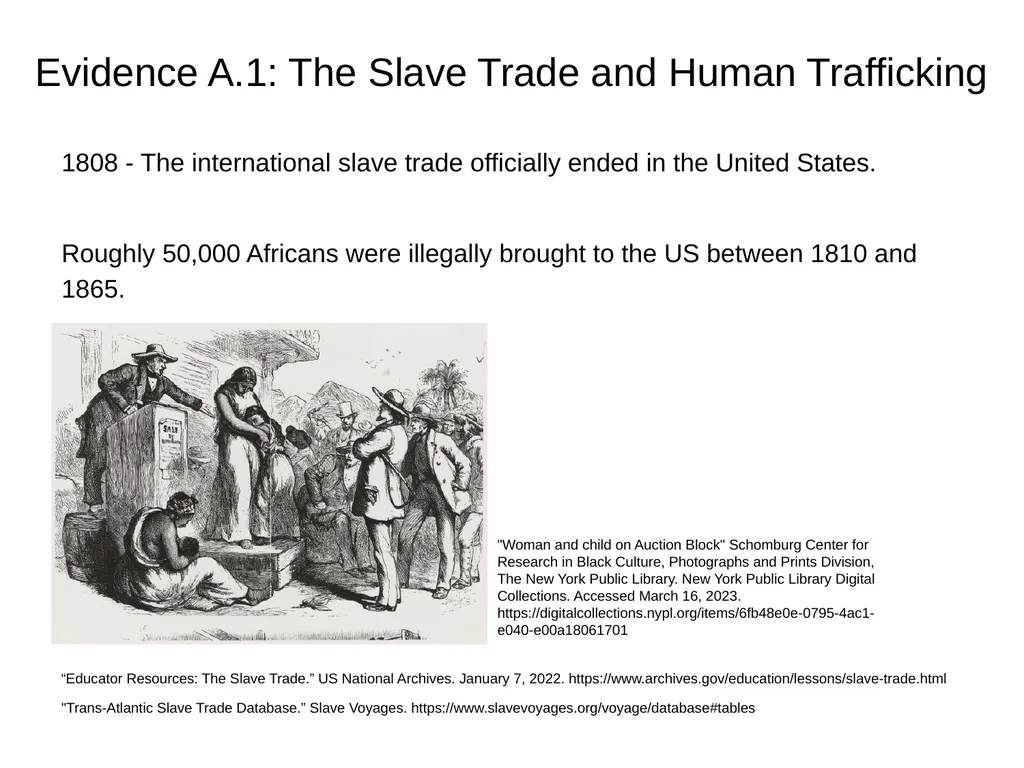
Evidence A.1: The Slave Trade and Human Trafficking 1808 - The international slave trade officially ended in the United States.
Roughly 50,000 Africans were illegally brought to the US between 1810 and 1865. "Woman and child on Auction Block" Schomburg Center for Research in Black Culture, Photographs and Prints Division, The New York Public Library. New York Public Library Digital Collections. Accessed March 16, 2023. https://digitalcollections.nypl.org/items/6fb48e0e-0795-4ac1-e040-e00a18061701 “Educator Resources: The Slave Trade.” US National Archives. January 7, 2022. https://www.archives.gov/education/lessons/slave-trade.html
"Trans-Atlantic Slave Trade Database.” Slave Voyages. https://www.slavevoyages.org/voyage/database#tables<br>
Roughly 50,000 Africans were illegally brought to the US between 1810 and 1865. "Woman and child on Auction Block" Schomburg Center for Research in Black Culture, Photographs and Prints Division, The New York Public Library. New York Public Library Digital Collections. Accessed March 16, 2023. https://digitalcollections.nypl.org/items/6fb48e0e-0795-4ac1-e040-e00a18061701 “Educator Resources: The Slave Trade.” US National Archives. January 7, 2022. https://www.archives.gov/education/lessons/slave-trade.html
"Trans-Atlantic Slave Trade Database.” Slave Voyages. https://www.slavevoyages.org/voyage/database#tables<br>
06
Evidence A.2: The Slave Trade and Human Trafficking “The ban of 1808 did basically stop the importation of slaves from Africa or from the West Indies. There was some smuggling of slaves. After that, all the way up to the Civil War, the ban was not totally enforced, but it certainly ended what had been before then an open, legal and fairly large slave trade.
But in this country, of course, slavery lasted another 50 or more years. It actually grew significantly after the slave trade was ended, because in this country, unlike many others, the slave population reproduced itself just by natural increase. And so the slave population continued to grow. Slavery became more and more prominent economically with the rise of the Cotton Kingdom in the Deep South, and it took a civil war, as, of course, we know, to get rid of slavery.
But there were many Southerners who wanted to ban the slave trade, particularly in the upper South, in Virginia. Virginia, by the early 19th century, was already exporting slaves to other states. And once the slave trade was abolished, Virginia became a major source of the internal slave trade.
As slavery expanded into the South and the Southwest, the Alabama, Mississippi, et cetera, where did they get those slaves from after Africans couldn't be brought in? They were gotten from the upper South. And so there were a lot of people even within the South who didn't want the competition of the African slave trade because their livelihood it was based on selling slaves within the United States.” Eric Foner. End of slave trade meant New Normal for America. NPR. (2008, January 10). Retrieved December 27, 2021, from https://www.npr.org/templates/story/story.php?storyId=17988106<br>
But in this country, of course, slavery lasted another 50 or more years. It actually grew significantly after the slave trade was ended, because in this country, unlike many others, the slave population reproduced itself just by natural increase. And so the slave population continued to grow. Slavery became more and more prominent economically with the rise of the Cotton Kingdom in the Deep South, and it took a civil war, as, of course, we know, to get rid of slavery.
But there were many Southerners who wanted to ban the slave trade, particularly in the upper South, in Virginia. Virginia, by the early 19th century, was already exporting slaves to other states. And once the slave trade was abolished, Virginia became a major source of the internal slave trade.
As slavery expanded into the South and the Southwest, the Alabama, Mississippi, et cetera, where did they get those slaves from after Africans couldn't be brought in? They were gotten from the upper South. And so there were a lot of people even within the South who didn't want the competition of the African slave trade because their livelihood it was based on selling slaves within the United States.” Eric Foner. End of slave trade meant New Normal for America. NPR. (2008, January 10). Retrieved December 27, 2021, from https://www.npr.org/templates/story/story.php?storyId=17988106<br>
07
Evidence A.3: The Slave Trade and Human Trafficking “There is no such thing as a “good master” as there is no good aspect of owning people.”
“Throughout history terms have been use to soften the reality of slavery. Words such as trading and Middle Passage, do not appropriately describe the full horrors encountered by those surviving under the system of slavery in this country.”
“Loyal Slave - The myth of the loyal slave was crucial to the social justification of the system of enslavement. By disregarding the agency of enslaved people, slaveholders could support an argument that enslaved people would not be capable of living in freedom. This sentiment was prevalent in the conversation of the day and in popular culture, including “Gone With the Wind.”” “Language Reference for Supporting Dialogue at Arlington House, The Robert E. Lee Memorial.” and “Non-Negotiable Statements: Key Truths of Arlington House, The Robert E. Lee Memorial .” June 27, 2022. Visitor Expectations and Language Resource - Arlington House, The Robert E. Lee Memorial (U.S. National Park Service) (nps.gov)<br>
“Throughout history terms have been use to soften the reality of slavery. Words such as trading and Middle Passage, do not appropriately describe the full horrors encountered by those surviving under the system of slavery in this country.”
“Loyal Slave - The myth of the loyal slave was crucial to the social justification of the system of enslavement. By disregarding the agency of enslaved people, slaveholders could support an argument that enslaved people would not be capable of living in freedom. This sentiment was prevalent in the conversation of the day and in popular culture, including “Gone With the Wind.”” “Language Reference for Supporting Dialogue at Arlington House, The Robert E. Lee Memorial.” and “Non-Negotiable Statements: Key Truths of Arlington House, The Robert E. Lee Memorial .” June 27, 2022. Visitor Expectations and Language Resource - Arlington House, The Robert E. Lee Memorial (U.S. National Park Service) (nps.gov)<br>
08
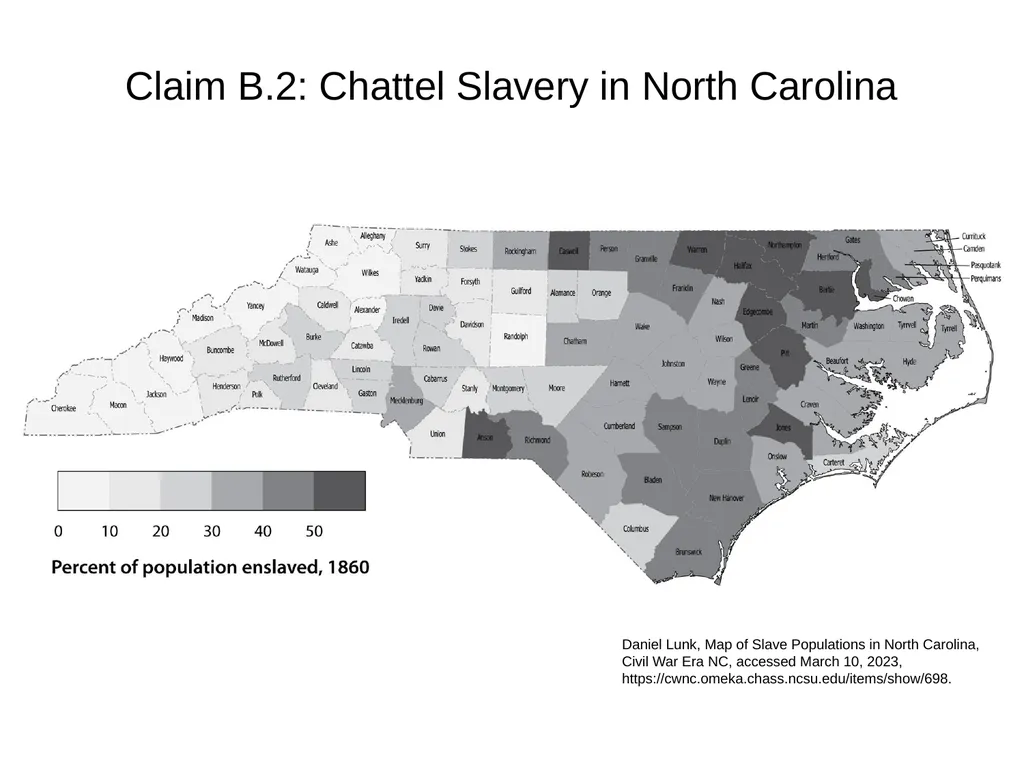
Claim B.1: Chattel Slavery in North Carolina By 1860 one-third of North Carolina’s population was made up of enslaved people.
Only 2% of North Carolina owned more than 50 enslaved persons.
Most of the enslaved were in the Piedmont and Coastal regions, where the larger plantations were.
Enslaved workers cultivated cotton, tobacco, and rice.
The enslaved also worked in coastal naval yards.<br>
Only 2% of North Carolina owned more than 50 enslaved persons.
Most of the enslaved were in the Piedmont and Coastal regions, where the larger plantations were.
Enslaved workers cultivated cotton, tobacco, and rice.
The enslaved also worked in coastal naval yards.<br>
09
Claim B.2: Chattel Slavery in North Carolina Daniel Lunk, Map of Slave Populations in North Carolina, Civil War Era NC, accessed March 10, 2023, https://cwnc.omeka.chass.ncsu.edu/items/show/698.<br>
10
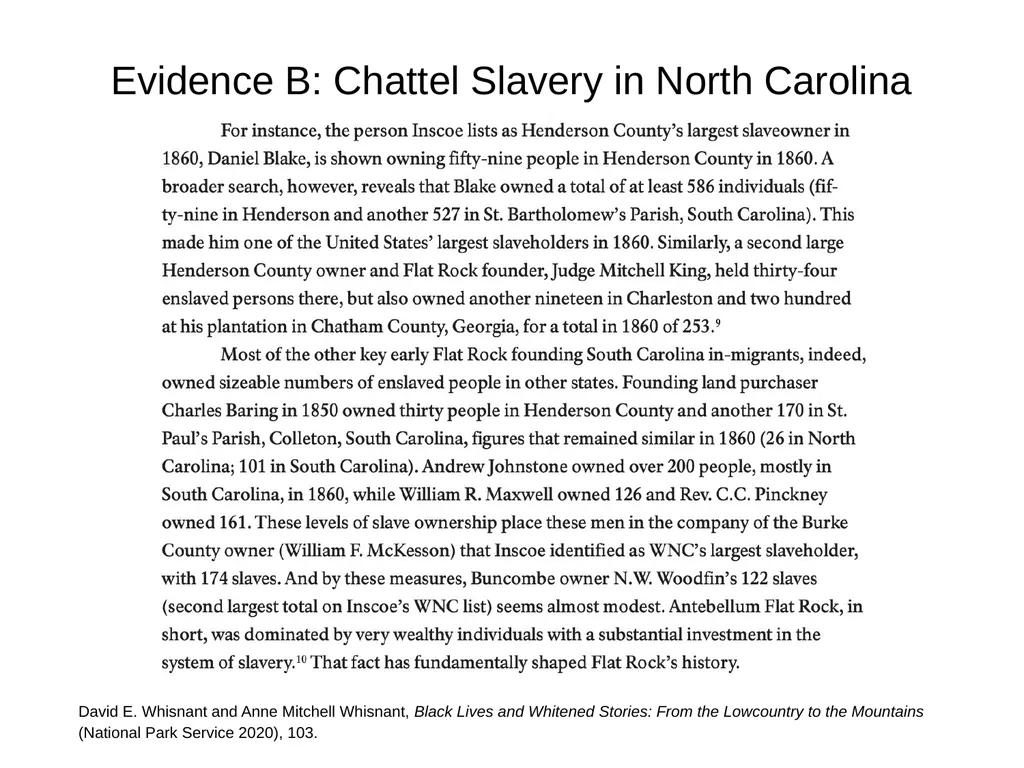
Evidence B: Chattel Slavery in North Carolina David E. Whisnant and Anne Mitchell Whisnant, Black Lives and Whitened Stories: From the Lowcountry to the Mountains (National Park Service 2020), 103.<br>
11
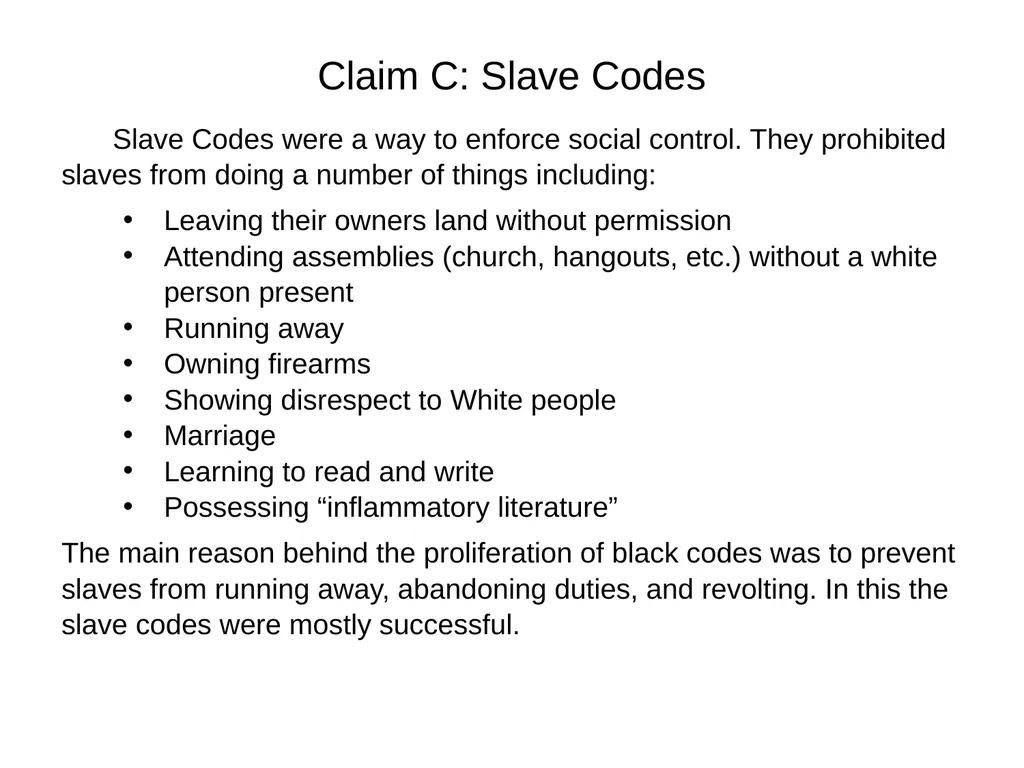
Claim C: Slave Codes Slave Codes were a way to enforce social control. They prohibited slaves from doing a number of things including:
Leaving their owners land without permission
Attending assemblies (church, hangouts, etc.) without a white person present
Running away
Owning firearms
Showing disrespect to White people
Marriage
Learning to read and write
Possessing “inflammatory literature”
The main reason behind the proliferation of black codes was to prevent slaves from running away, abandoning duties, and revolting. In this the slave codes were mostly successful.<br>
Leaving their owners land without permission
Attending assemblies (church, hangouts, etc.) without a white person present
Running away
Owning firearms
Showing disrespect to White people
Marriage
Learning to read and write
Possessing “inflammatory literature”
The main reason behind the proliferation of black codes was to prevent slaves from running away, abandoning duties, and revolting. In this the slave codes were mostly successful.<br>
12
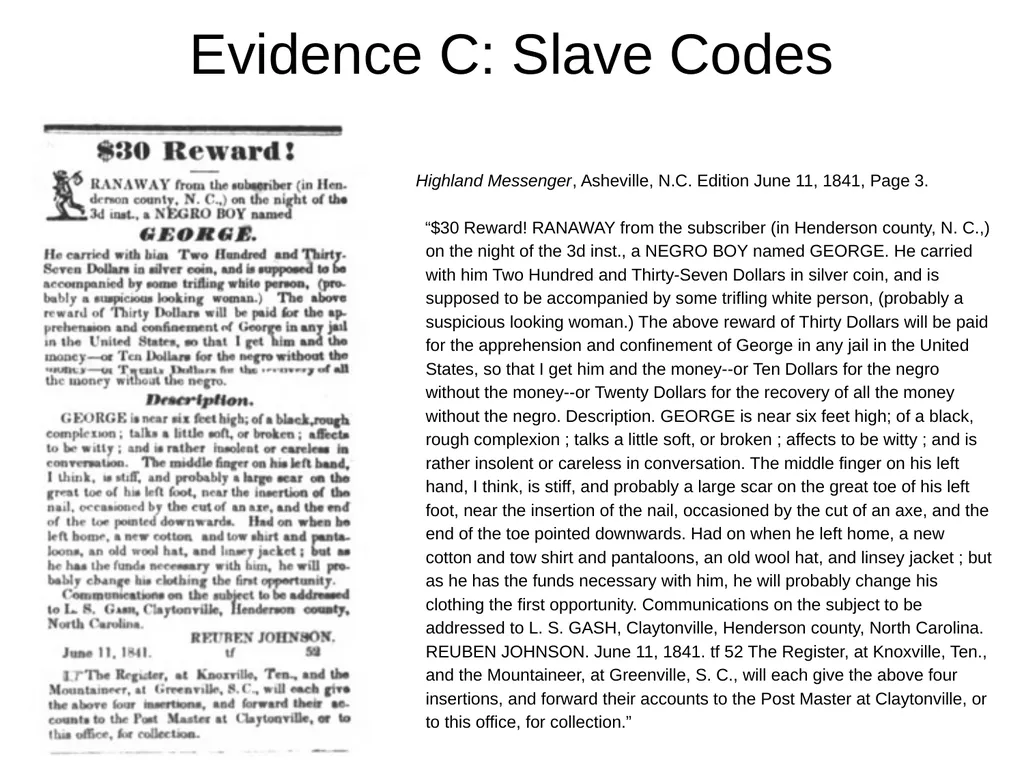
Evidence C: Slave Codes Highland Messenger, Asheville, N.C. Edition June 11, 1841, Page 3.
“$30 Reward! RANAWAY from the subscriber (in Henderson county, N. C.,) on the night of the 3d inst., a NEGRO BOY named GEORGE. He carried with him Two Hundred and Thirty-Seven Dollars in silver coin, and is supposed to be accompanied by some trifling white person, (probably a suspicious looking woman.) The above reward of Thirty Dollars will be paid for the apprehension and confinement of George in any jail in the United States, so that I get him and the money--or Ten Dollars for the negro without the money--or Twenty Dollars for the recovery of all the money without the negro. Description. GEORGE is near six feet high; of a black, rough complexion ; talks a little soft, or broken ; affects to be witty ; and is rather insolent or careless in conversation. The middle finger on his left hand, I think, is stiff, and probably a large scar on the great toe of his left foot, near the insertion of the nail, occasioned by the cut of an axe, and the end of the toe pointed downwards. Had on when he left home, a new cotton and tow shirt and pantaloons, an old wool hat, and linsey jacket ; but as he has the funds necessary with him, he will probably change his clothing the first opportunity. Communications on the subject to be addressed to L. S. GASH, Claytonville, Henderson county, North Carolina. REUBEN JOHNSON. June 11, 1841. tf 52 The Register, at Knoxville, Ten., and the Mountaineer, at Greenville, S. C., will each give the above four insertions, and forward their accounts to the Post Master at Claytonville, or to this office, for collection.”<br>
“$30 Reward! RANAWAY from the subscriber (in Henderson county, N. C.,) on the night of the 3d inst., a NEGRO BOY named GEORGE. He carried with him Two Hundred and Thirty-Seven Dollars in silver coin, and is supposed to be accompanied by some trifling white person, (probably a suspicious looking woman.) The above reward of Thirty Dollars will be paid for the apprehension and confinement of George in any jail in the United States, so that I get him and the money--or Ten Dollars for the negro without the money--or Twenty Dollars for the recovery of all the money without the negro. Description. GEORGE is near six feet high; of a black, rough complexion ; talks a little soft, or broken ; affects to be witty ; and is rather insolent or careless in conversation. The middle finger on his left hand, I think, is stiff, and probably a large scar on the great toe of his left foot, near the insertion of the nail, occasioned by the cut of an axe, and the end of the toe pointed downwards. Had on when he left home, a new cotton and tow shirt and pantaloons, an old wool hat, and linsey jacket ; but as he has the funds necessary with him, he will probably change his clothing the first opportunity. Communications on the subject to be addressed to L. S. GASH, Claytonville, Henderson county, North Carolina. REUBEN JOHNSON. June 11, 1841. tf 52 The Register, at Knoxville, Ten., and the Mountaineer, at Greenville, S. C., will each give the above four insertions, and forward their accounts to the Post Master at Claytonville, or to this office, for collection.”<br>
13
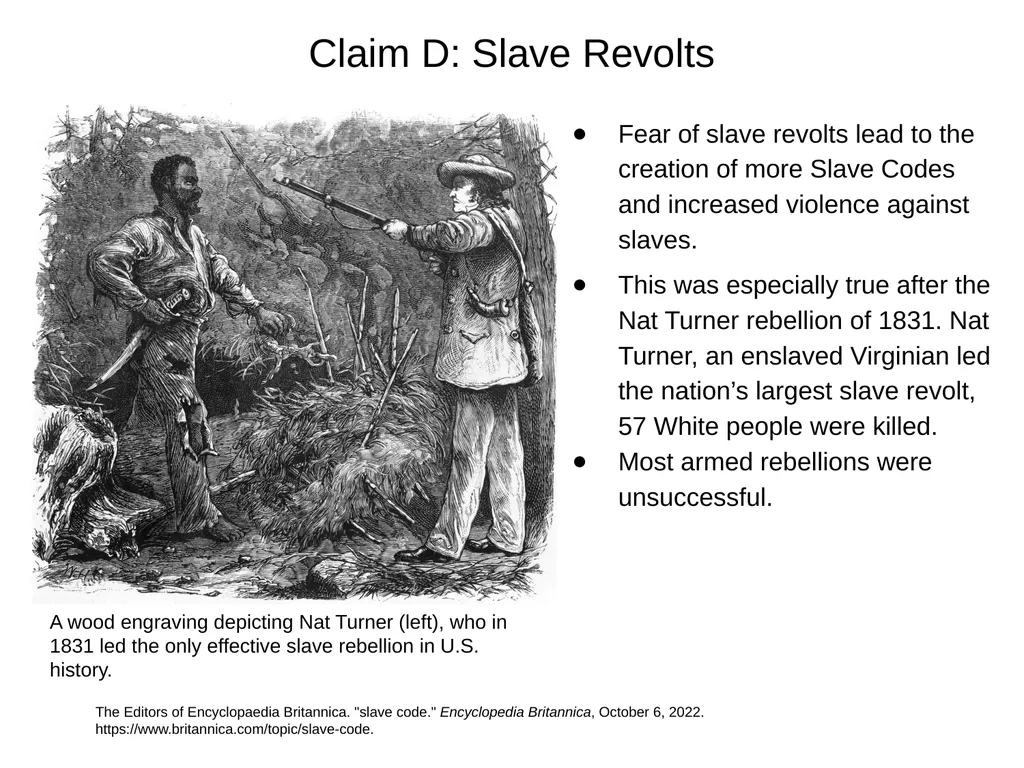
Claim D: Slave Revolts Fear of slave revolts lead to the creation of more Slave Codes and increased violence against slaves.
This was especially true after the Nat Turner rebellion of 1831. Nat Turner, an enslaved Virginian led the nation’s largest slave revolt, 57 White people were killed.
Most armed rebellions were unsuccessful. A wood engraving depicting Nat Turner (left), who in 1831 led the only effective slave rebellion in U.S. history. The Editors of Encyclopaedia Britannica. "slave code." Encyclopedia Britannica, October 6, 2022. https://www.britannica.com/topic/slave-code.<br>
This was especially true after the Nat Turner rebellion of 1831. Nat Turner, an enslaved Virginian led the nation’s largest slave revolt, 57 White people were killed.
Most armed rebellions were unsuccessful. A wood engraving depicting Nat Turner (left), who in 1831 led the only effective slave rebellion in U.S. history. The Editors of Encyclopaedia Britannica. "slave code." Encyclopedia Britannica, October 6, 2022. https://www.britannica.com/topic/slave-code.<br>
14
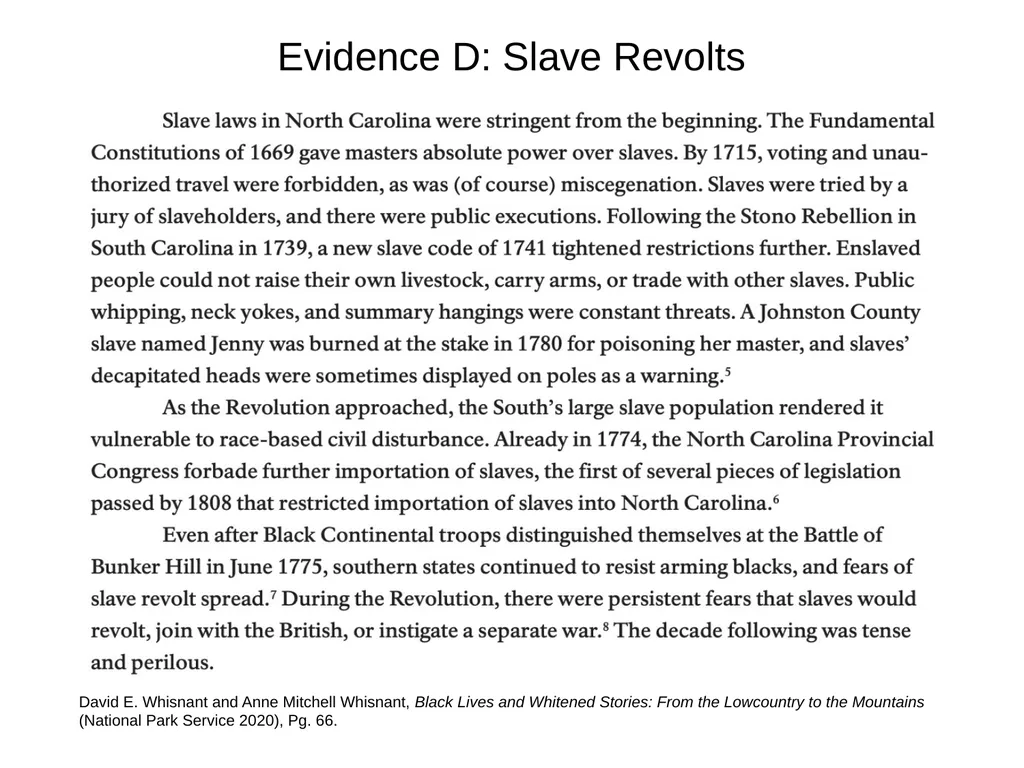
Evidence D: Slave Revolts David E. Whisnant and Anne Mitchell Whisnant, Black Lives and Whitened Stories: From the Lowcountry to the Mountains (National Park Service 2020), Pg. 66.<br>
15
Claim E: Chattel Slavery and Christianity As families were often separated for sale to other plantations, slaves often took comfort in religion.
Slaves worshiped in White controlled churches, mainly Baptist and Methodist. "Church Service at Plantation, South Carolina, 1863", Slavery Images: A Visual Record of the African Slave Trade and Slave Life in the Early African Diaspora, accessed March 9, 2023, http://www.slaveryimages.org/s/slaveryimages/item/1853<br>
Slaves worshiped in White controlled churches, mainly Baptist and Methodist. "Church Service at Plantation, South Carolina, 1863", Slavery Images: A Visual Record of the African Slave Trade and Slave Life in the Early African Diaspora, accessed March 9, 2023, http://www.slaveryimages.org/s/slaveryimages/item/1853<br>
16
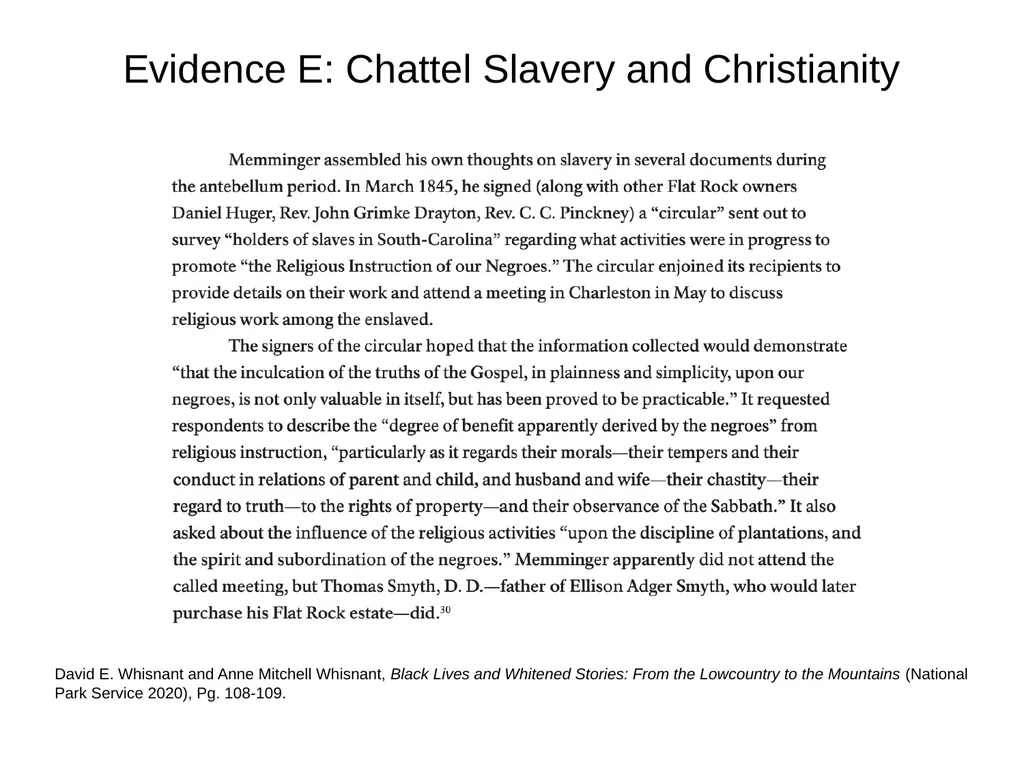
Evidence E: Chattel Slavery and Christianity David E. Whisnant and Anne Mitchell Whisnant, Black Lives and Whitened Stories: From the Lowcountry to the Mountains (National Park Service 2020), Pg. 108-109.<br>
17
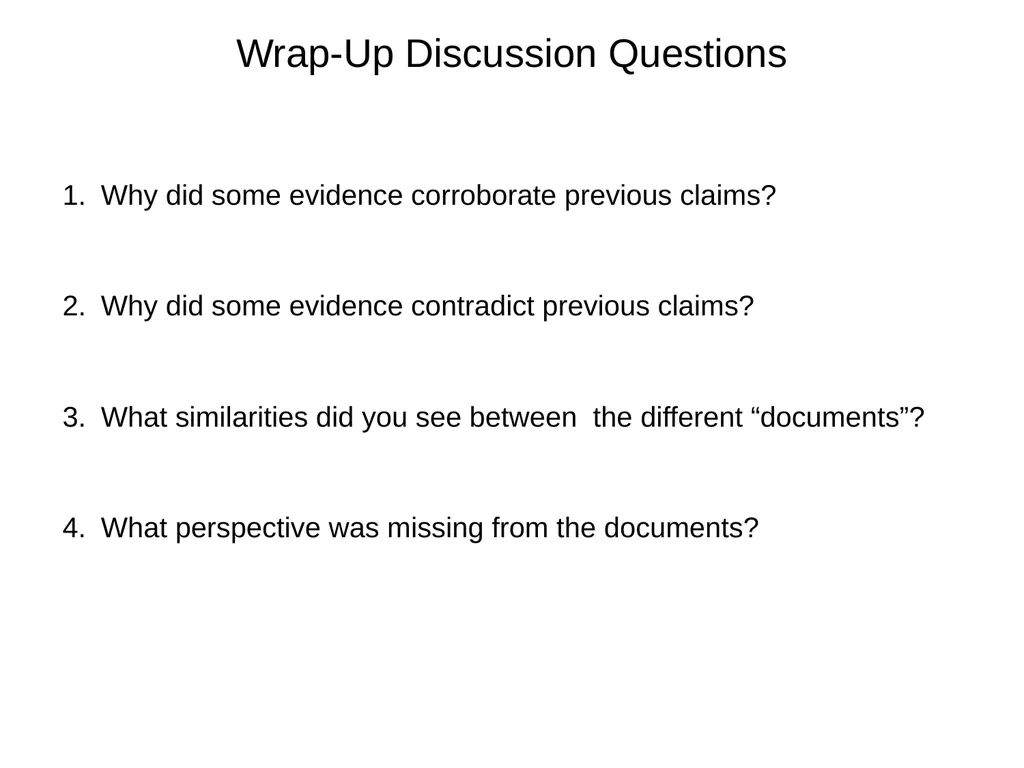
Wrap-Up Discussion Questions Why did some evidence corroborate previous claims?
Why did some evidence contradict previous claims?
What similarities did you see between the different “documents”?
What perspective was missing from the documents?<br>
Why did some evidence contradict previous claims?
What similarities did you see between the different “documents”?
What perspective was missing from the documents?<br>