CHE 1031: General Chemistry I Electrochemistry
Description: CHE 1031: General Chemistry I Electrochemistry 5.1: Galvanic cells (aka voltaic cells) 5.2: Standard reduction potentials 5.3: Batteries fuel cells 5.4: Corrosion 5. Electrochemistry 5.1: Galvanic (aka voltaic) cells Use cell notation to
Related Topics
Download Presentation
"CHE 1031: General Chemistry I Electrochemistry" is the property of its rightful owner. Permission is granted to download and print the materials on this website for personal, non-commercial use only, and to display it on your personal computer provided you do not modify the materials and that you retain all copyright notices contained in the materials. By downloading content from our website, you accept the terms of this agreement.
Presentation Transcript
slide1. CHE 1031: General Chemistry I Electrochemistry
5.1: Galvanic cells (aka voltaic cells)
5.2: Standard reduction potentials
5.3: Batteries & fuel cells
5.4: Corrosion<br>
slide2. 5. Electrochemistry 5.1: Galvanic (aka voltaic) cells
Use cell notation to describe galvanic cells
Describe the basic components of galvanic cells<br>
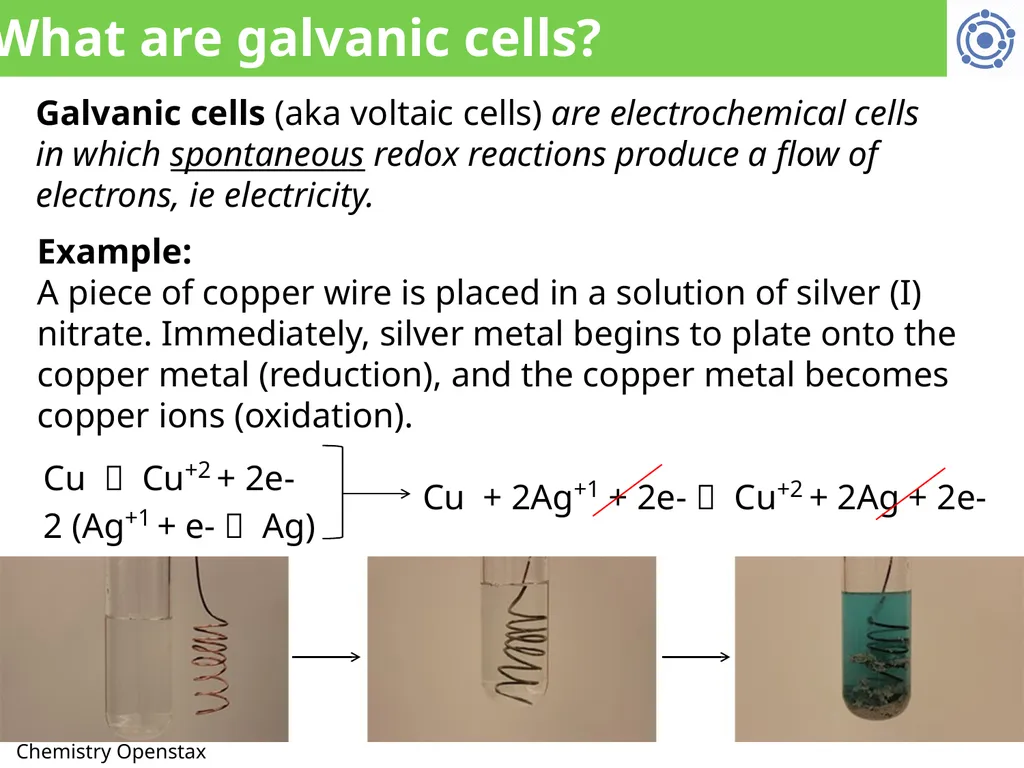
slide3. What are galvanic cells? Galvanic cells (aka voltaic cells) are electrochemical cells in which spontaneous redox reactions produce a flow of electrons, ie electricity. Aristotle Example:
A piece of copper wire is placed in a solution of silver (I) nitrate. Immediately, silver metal begins to plate onto the copper metal (reduction), and the copper metal becomes copper ions (oxidation). Wright’s gas pump experiments Chemistry Openstax Cu Cu+2 + 2e-
2 (Ag+1 + e- Ag) Cu + 2Ag+1 + 2e- Cu+2 + 2Ag + 2e-<br>
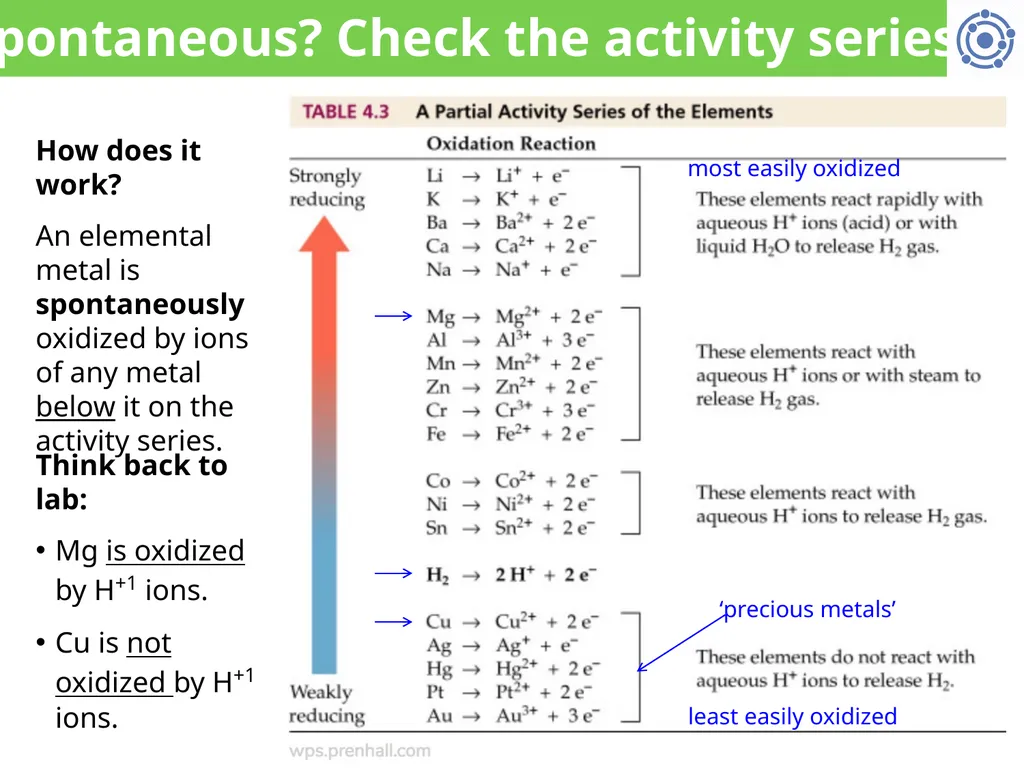
slide4. Spontaneous? Check the activity series How does it work?
An elemental metal is spontaneously oxidized by ions of any metal below it on the activity series. Aristotle most easily oxidized least easily oxidized Think back to lab:
Mg is oxidized by H+1 ions.
Cu is not oxidized by H+1 ions. ‘precious metals’<br>
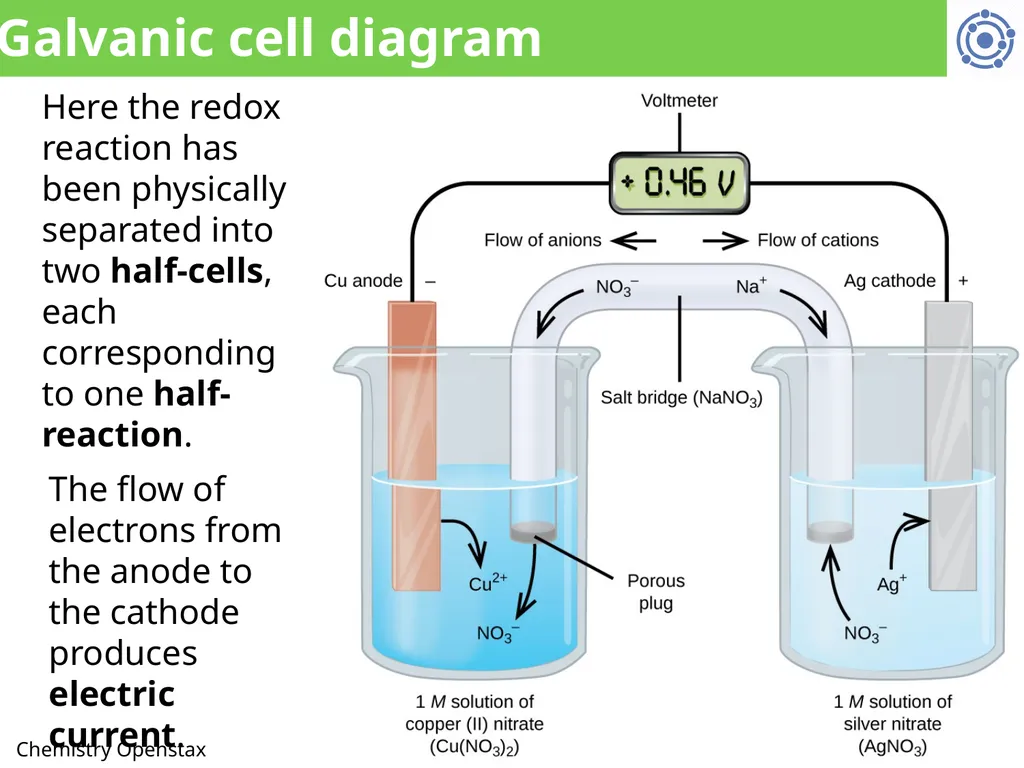
slide5. Galvanic cell diagram Here the redox reaction has been physically separated into two half-cells, each corresponding to one half-reaction. Chemistry Openstax The flow of electrons from the anode to the cathode produces electric current.<br>
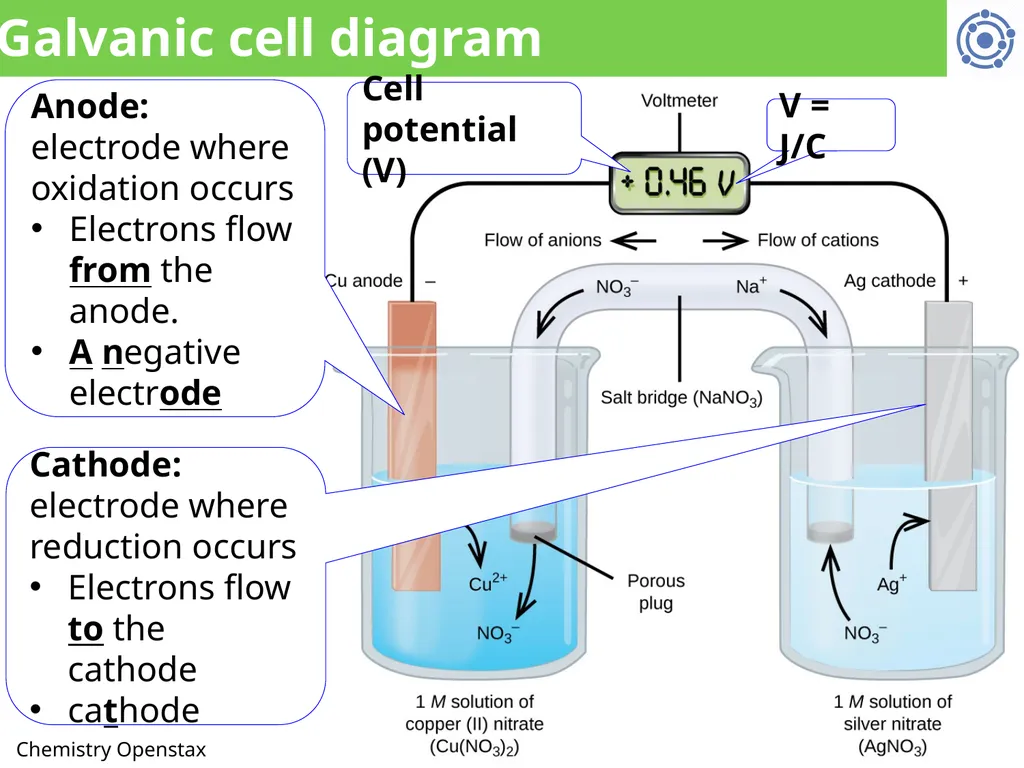
slide6. Galvanic cell diagram Chemistry Openstax Anode: electrode where oxidation occurs
Electrons flow from the anode.
A negative electrode Cathode: electrode where reduction occurs
Electrons flow to the cathode
cathode Cell potential (V) V = J/C<br>
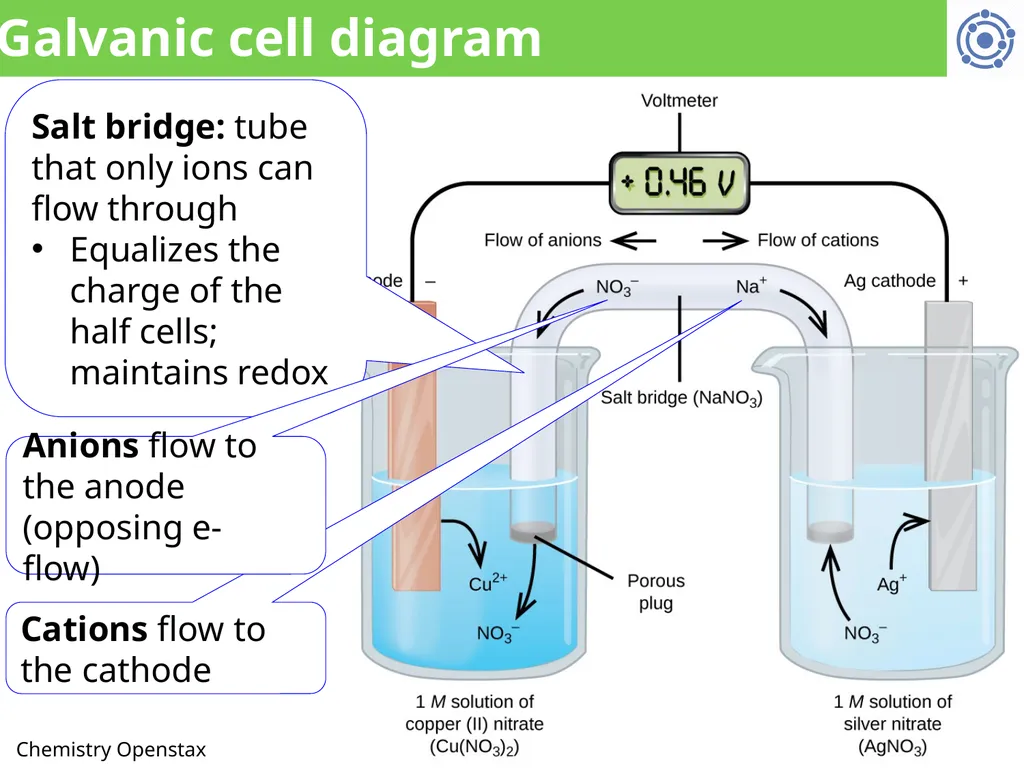
slide7. Galvanic cell diagram Chemistry Openstax Salt bridge: tube that only ions can flow through
Equalizes the charge of the half cells; maintains redox Cations flow to the cathode Anions flow to the anode (opposing e- flow)<br>
slide8. Galvanic cell recap To summarize what’s going on in a galvanic cell: Electrons flow from the anode to the cathode. The flow of electrons is harvested as electricity. The anode slowly degrades as its metal atoms ionize. The cathode grows as ions are deposited on it as atoms. The salt bridge allows cations to flow to the cathode.This keeps the cathode from becoming so negative that electrons won’t flow to it. The salt bridge allows anions to flow to the anode.This keeps the anode from becoming too positive as it loses electrons. Without the salt bridge the flow of electrons would stop!<br>
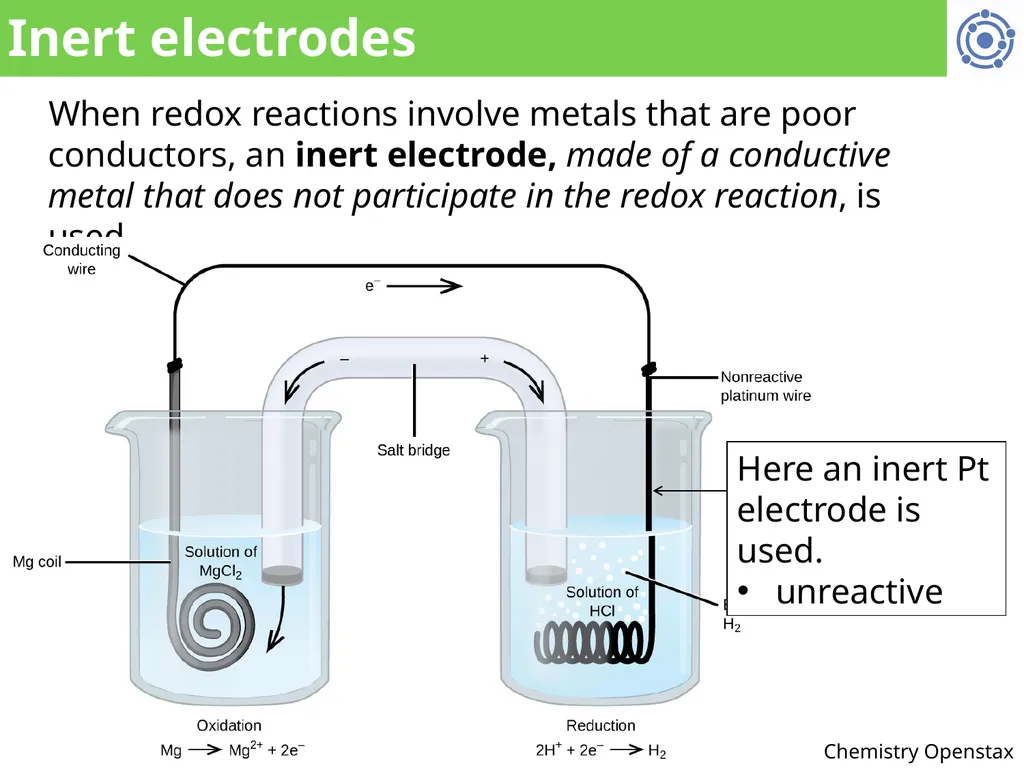
slide9. Inert electrodes When redox reactions involve metals that are poor conductors, an inert electrode, made of a conductive metal that does not participate in the redox reaction, is used. Chemistry Openstax Here an inert Pt electrode is used.
unreactive<br>
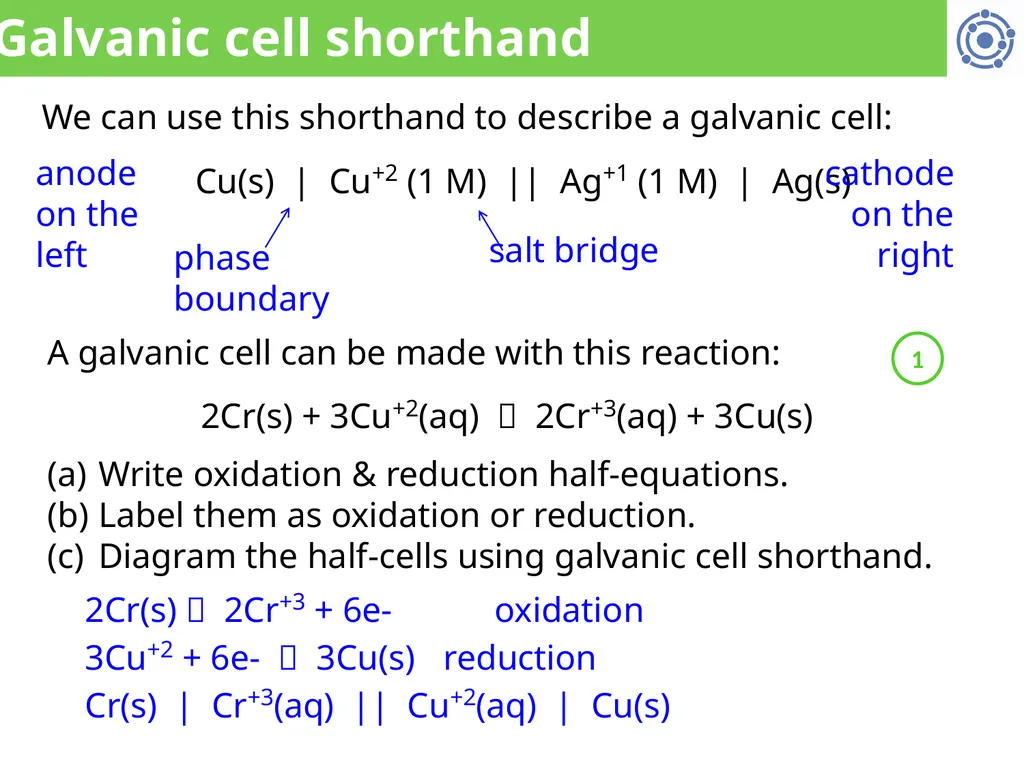
slide10. Galvanic cell shorthand We can use this shorthand to describe a galvanic cell:
Cu(s) | Cu+2 (1 M) || Ag+1 (1 M) | Ag(s) anode on the left cathode on the right salt bridge phase boundary A galvanic cell can be made with this reaction:
2Cr(s) + 3Cu+2(aq) 2Cr+3(aq) + 3Cu(s)
Write oxidation & reduction half-equations.
Label them as oxidation or reduction.
Diagram the half-cells using galvanic cell shorthand. 2Cr(s) 2Cr+3 + 6e- oxidation
3Cu+2 + 6e- 3Cu(s) reduction
Cr(s) | Cr+3(aq) || Cu+2(aq) | Cu(s) 1<br>
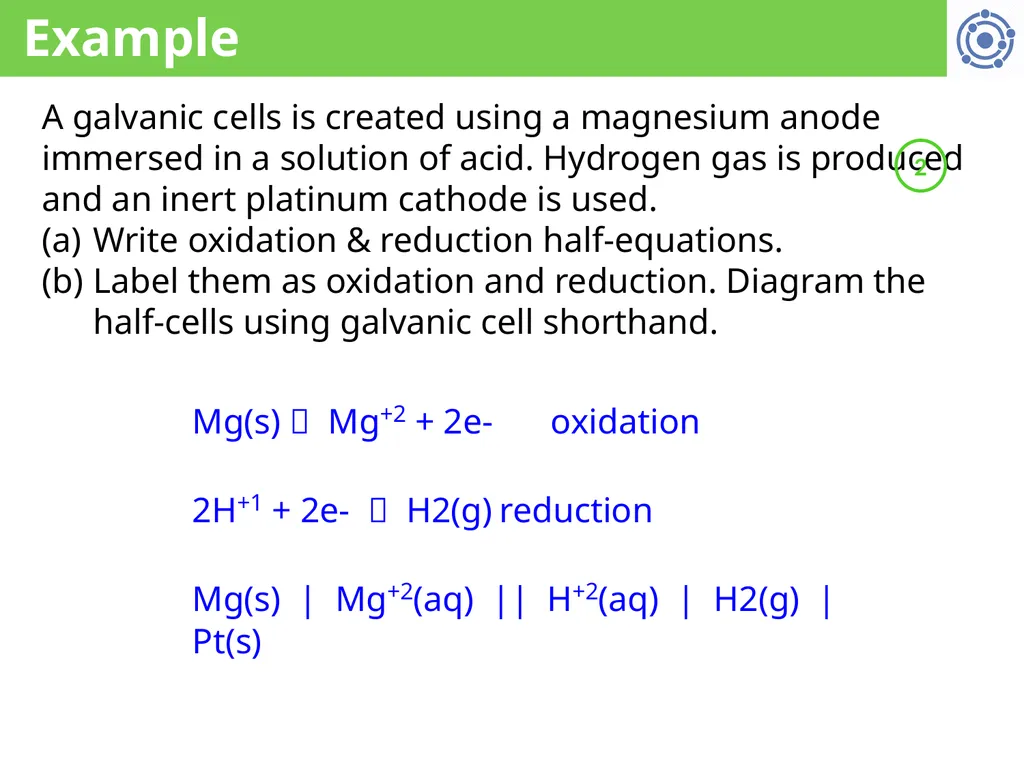
slide11. Example A galvanic cells is created using a magnesium anode immersed in a solution of acid. Hydrogen gas is produced and an inert platinum cathode is used.
Write oxidation & reduction half-equations.
Label them as oxidation and reduction. Diagram the half-cells using galvanic cell shorthand. Mg(s) Mg+2 + 2e- oxidation
2H+1 + 2e- H2(g) reduction
Mg(s) | Mg+2(aq) || H+2(aq) | H2(g) | Pt(s) 2<br>
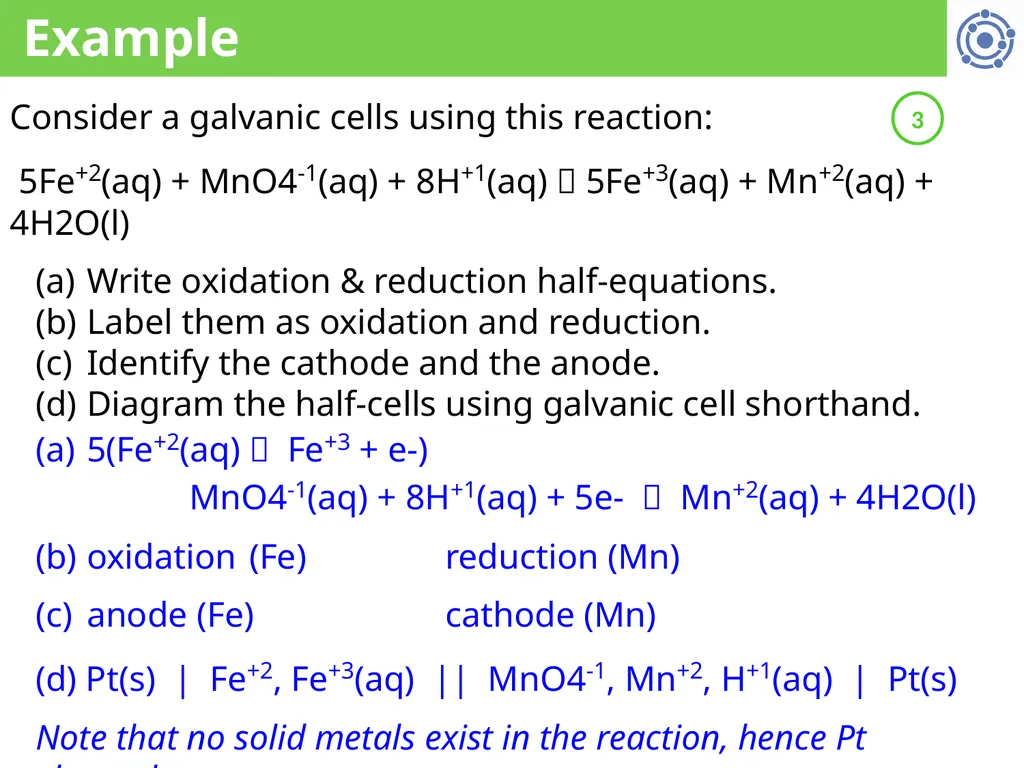
slide12. Example Consider a galvanic cells using this reaction:

5Fe+2(aq) + MnO4-1(aq) + 8H+1(aq) 5Fe+3(aq) + Mn+2(aq) + 4H2O(l)
Write oxidation & reduction half-equations.
Label them as oxidation and reduction.
Identify the cathode and the anode.
Diagram the half-cells using galvanic cell shorthand. 5(Fe+2(aq) Fe+3 + e-)
MnO4-1(aq) + 8H+1(aq) + 5e- Mn+2(aq) + 4H2O(l)
oxidation (Fe) reduction (Mn)
anode (Fe) cathode (Mn)
(d) Pt(s) | Fe+2, Fe+3(aq) || MnO4-1, Mn+2, H+1(aq) | Pt(s)
Note that no solid metals exist in the reaction, hence Pt electrodes. 3<br>
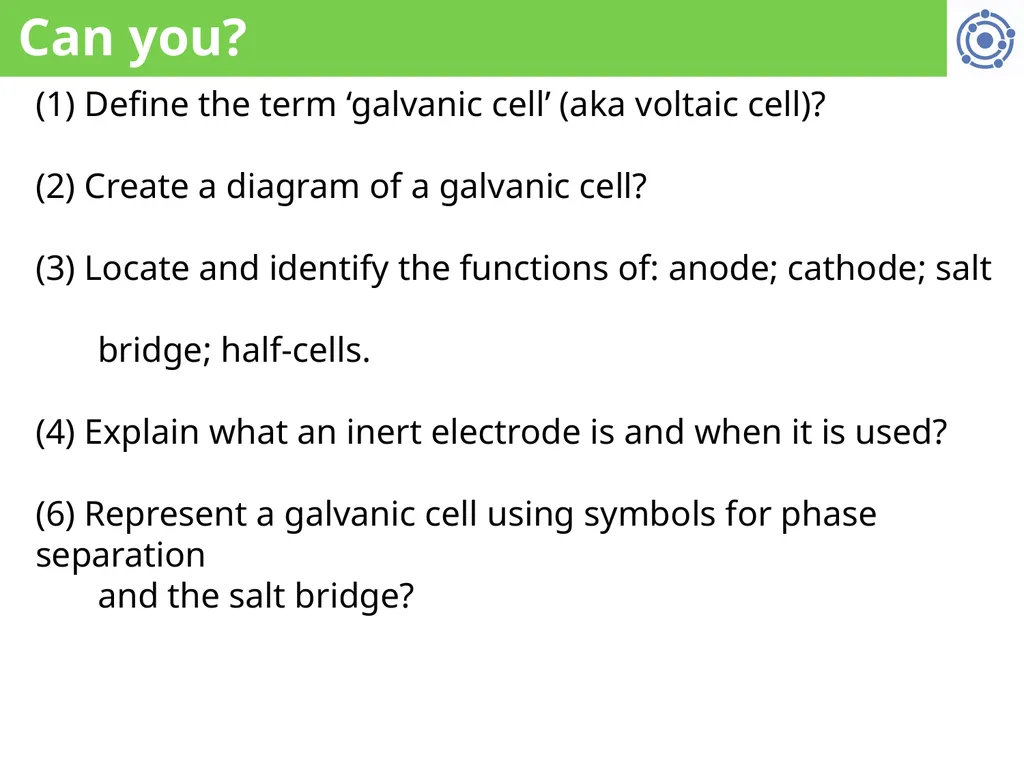
slide13. Can you? (1) Define the term ‘galvanic cell’ (aka voltaic cell)?
(2) Create a diagram of a galvanic cell?
(3) Locate and identify the functions of: anode; cathode; salt bridge; half-cells.
(4) Explain what an inert electrode is and when it is used?
(6) Represent a galvanic cell using symbols for phase separation and the salt bridge?<br>
5.1: Galvanic cells (aka voltaic cells)
5.2: Standard reduction potentials
5.3: Batteries & fuel cells
5.4: Corrosion<br>
slide2. 5. Electrochemistry 5.1: Galvanic (aka voltaic) cells
Use cell notation to describe galvanic cells
Describe the basic components of galvanic cells<br>
slide3. What are galvanic cells? Galvanic cells (aka voltaic cells) are electrochemical cells in which spontaneous redox reactions produce a flow of electrons, ie electricity. Aristotle Example:
A piece of copper wire is placed in a solution of silver (I) nitrate. Immediately, silver metal begins to plate onto the copper metal (reduction), and the copper metal becomes copper ions (oxidation). Wright’s gas pump experiments Chemistry Openstax Cu Cu+2 + 2e-
2 (Ag+1 + e- Ag) Cu + 2Ag+1 + 2e- Cu+2 + 2Ag + 2e-<br>
slide4. Spontaneous? Check the activity series How does it work?
An elemental metal is spontaneously oxidized by ions of any metal below it on the activity series. Aristotle most easily oxidized least easily oxidized Think back to lab:
Mg is oxidized by H+1 ions.
Cu is not oxidized by H+1 ions. ‘precious metals’<br>
slide5. Galvanic cell diagram Here the redox reaction has been physically separated into two half-cells, each corresponding to one half-reaction. Chemistry Openstax The flow of electrons from the anode to the cathode produces electric current.<br>
slide6. Galvanic cell diagram Chemistry Openstax Anode: electrode where oxidation occurs
Electrons flow from the anode.
A negative electrode Cathode: electrode where reduction occurs
Electrons flow to the cathode
cathode Cell potential (V) V = J/C<br>
slide7. Galvanic cell diagram Chemistry Openstax Salt bridge: tube that only ions can flow through
Equalizes the charge of the half cells; maintains redox Cations flow to the cathode Anions flow to the anode (opposing e- flow)<br>
slide8. Galvanic cell recap To summarize what’s going on in a galvanic cell: Electrons flow from the anode to the cathode. The flow of electrons is harvested as electricity. The anode slowly degrades as its metal atoms ionize. The cathode grows as ions are deposited on it as atoms. The salt bridge allows cations to flow to the cathode.This keeps the cathode from becoming so negative that electrons won’t flow to it. The salt bridge allows anions to flow to the anode.This keeps the anode from becoming too positive as it loses electrons. Without the salt bridge the flow of electrons would stop!<br>
slide9. Inert electrodes When redox reactions involve metals that are poor conductors, an inert electrode, made of a conductive metal that does not participate in the redox reaction, is used. Chemistry Openstax Here an inert Pt electrode is used.
unreactive<br>
slide10. Galvanic cell shorthand We can use this shorthand to describe a galvanic cell:
Cu(s) | Cu+2 (1 M) || Ag+1 (1 M) | Ag(s) anode on the left cathode on the right salt bridge phase boundary A galvanic cell can be made with this reaction:
2Cr(s) + 3Cu+2(aq) 2Cr+3(aq) + 3Cu(s)
Write oxidation & reduction half-equations.
Label them as oxidation or reduction.
Diagram the half-cells using galvanic cell shorthand. 2Cr(s) 2Cr+3 + 6e- oxidation
3Cu+2 + 6e- 3Cu(s) reduction
Cr(s) | Cr+3(aq) || Cu+2(aq) | Cu(s) 1<br>
slide11. Example A galvanic cells is created using a magnesium anode immersed in a solution of acid. Hydrogen gas is produced and an inert platinum cathode is used.
Write oxidation & reduction half-equations.
Label them as oxidation and reduction. Diagram the half-cells using galvanic cell shorthand. Mg(s) Mg+2 + 2e- oxidation
2H+1 + 2e- H2(g) reduction
Mg(s) | Mg+2(aq) || H+2(aq) | H2(g) | Pt(s) 2<br>
slide12. Example Consider a galvanic cells using this reaction:
5Fe+2(aq) + MnO4-1(aq) + 8H+1(aq) 5Fe+3(aq) + Mn+2(aq) + 4H2O(l)
Write oxidation & reduction half-equations.
Label them as oxidation and reduction.
Identify the cathode and the anode.
Diagram the half-cells using galvanic cell shorthand. 5(Fe+2(aq) Fe+3 + e-)
MnO4-1(aq) + 8H+1(aq) + 5e- Mn+2(aq) + 4H2O(l)
oxidation (Fe) reduction (Mn)
anode (Fe) cathode (Mn)
(d) Pt(s) | Fe+2, Fe+3(aq) || MnO4-1, Mn+2, H+1(aq) | Pt(s)
Note that no solid metals exist in the reaction, hence Pt electrodes. 3<br>
slide13. Can you? (1) Define the term ‘galvanic cell’ (aka voltaic cell)?
(2) Create a diagram of a galvanic cell?
(3) Locate and identify the functions of: anode; cathode; salt bridge; half-cells.
(4) Explain what an inert electrode is and when it is used?
(6) Represent a galvanic cell using symbols for phase separation and the salt bridge?<br>