
CHE412 Process Dynamics and Control BSc (Engg)

Description: CHE412 Process Dynamics and Control BSc (Engg) Chemical Engineering (7th Semester) Dr Waheed Afzal Associate Professor of Chemical Engineering wa.icetpu.edu.pk Institute of Chemical Engineering and Technology University of the Punjab,
Related Topics
Download Presentation
"CHE412 Process Dynamics and Control BSc (Engg)" is the property of its rightful owner. Permission is granted to download and print the materials on this website for personal, non-commercial use only, and to display it on your personal computer provided you do not modify the materials and that you retain all copyright notices contained in the materials. By downloading content from our website, you accept the terms of this agreement.
Presentation Transcript
slide1. CHE412 Process Dynamics and Control
BSc (Engg) Chemical Engineering (7th Semester)
Dr Waheed Afzal
Associate Professor of Chemical Engineering
wa.icet@pu.edu.pk
Institute of Chemical Engineering and Technology
University of the Punjab, Lahore 1<br>
slide2. 2 George Stephanopoulos. Chemical process control. Englewood Cliffs, New Jersey: Prentice-Hall, 1984
Donald R. Coughanowr and Steven E. LeBlanc. Process Systems Analysis and Control. McGraw-Hill Science/Engineering/Math, 2008
William L Luyben. Process modeling, simulation and control for chemical engineers. 2nd Edition, McGraw-Hill Higher Education, 1996
Don Green and Robert Perry. Perry's Chemical Engineers' Handbook, Eighth Edition McGraw-Hill, New York, 2007
Dale E. Seborg, Thomas F. Edgar, and Duncan A. Mellichamp. Process dynamics & control. 2nd Edition, Wiley. com, 2004.
Lecture Notes/ Handouts Text/ Reference Books<br>
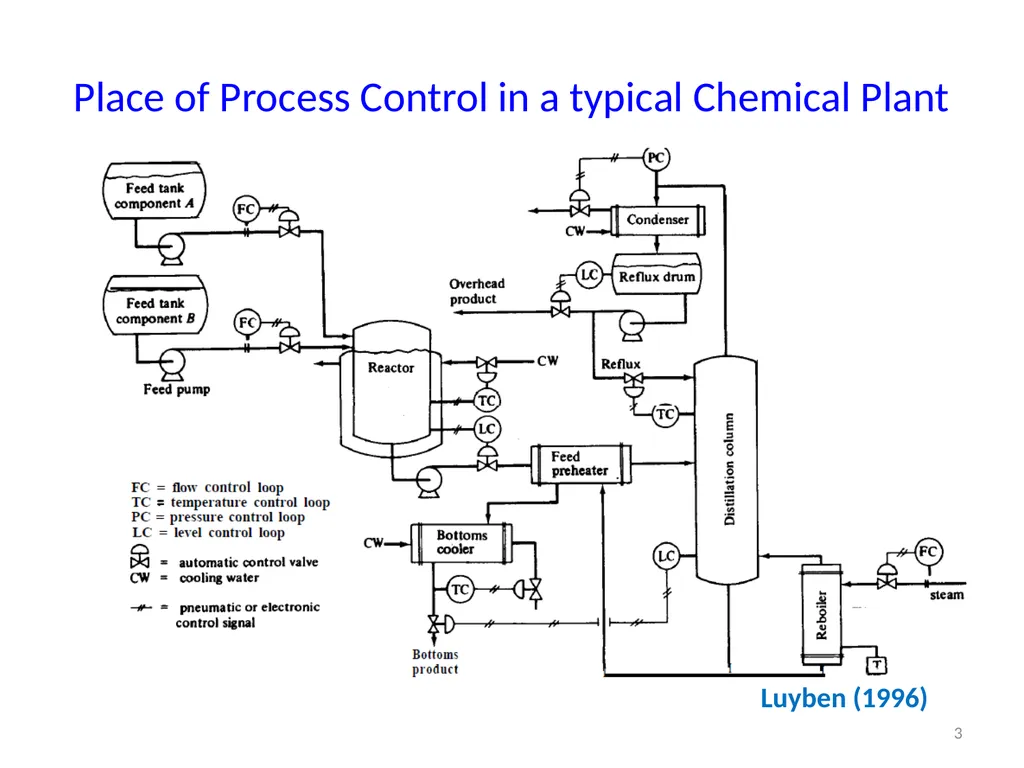
slide3. Place of Process Control in a typical Chemical Plant 3 Luyben (1996)<br>
slide4. Need of a Control Safety:
Equipment and Personnel
Production Specifications:
Quality and Quantity
Environmental Regulations:
Effluents
Operational Constraints:
Distillation columns (flooding, weeping); Tanks (overflow, drying), Catalytic reactor (maximum temperature, pressure)
Economics:
Minimum operating cost, maximum profits 4<br>
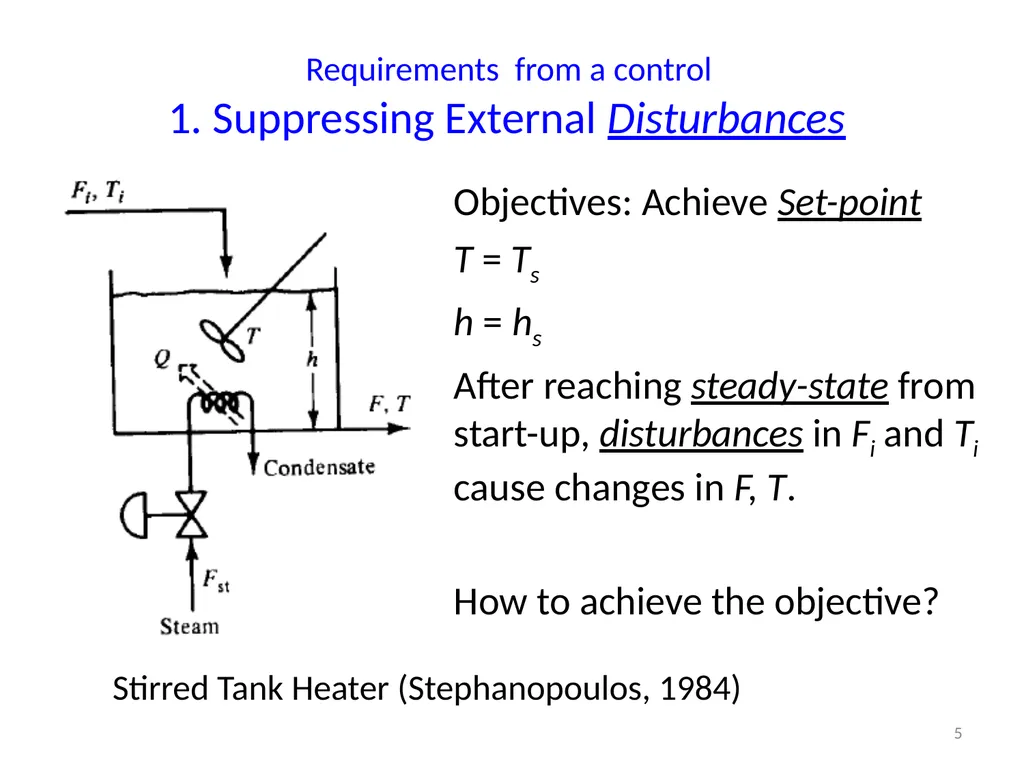
slide5. Requirements from a control 1. Suppressing External Disturbances 5 Objectives: Achieve Set-point
T = Ts
h = hs
After reaching steady-state from start-up, disturbances in Fi and Ti cause changes in F, T.
How to achieve the objective? Stirred Tank Heater (Stephanopoulos, 1984)<br>
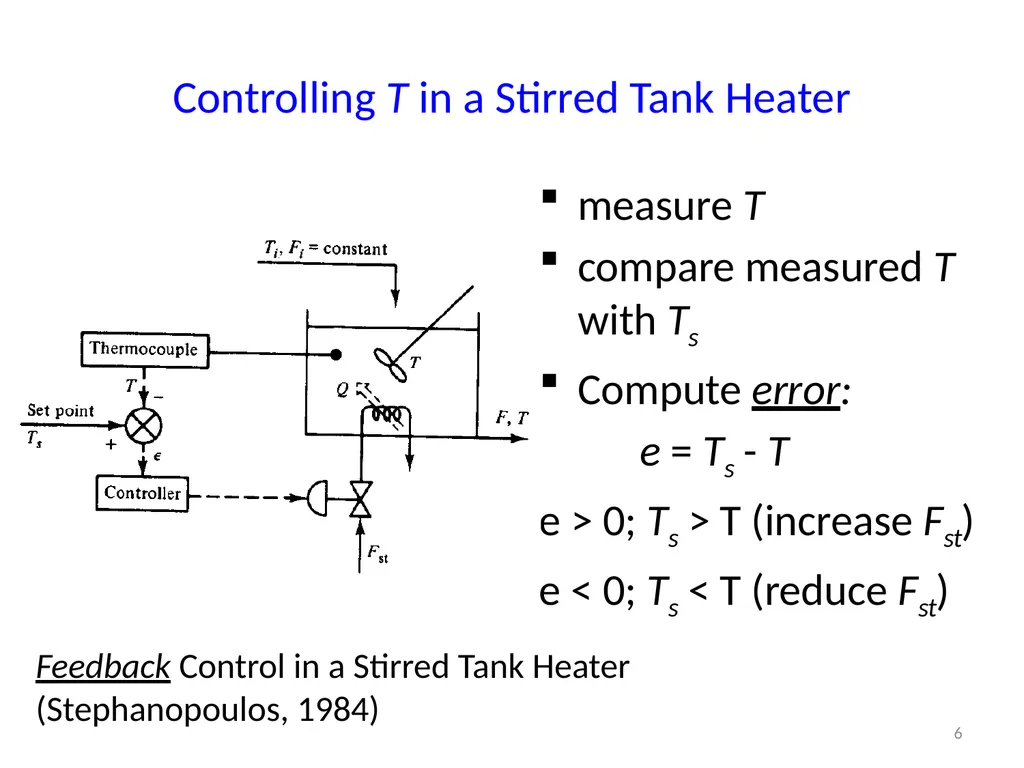
slide6. Controlling T in a Stirred Tank Heater 6 measure T
compare measured T with Ts
Compute error:
e = Ts - T
e > 0; Ts > T (increase Fst)
e < 0; Ts < T (reduce Fst) Feedback Control in a Stirred Tank Heater
(Stephanopoulos, 1984)<br>
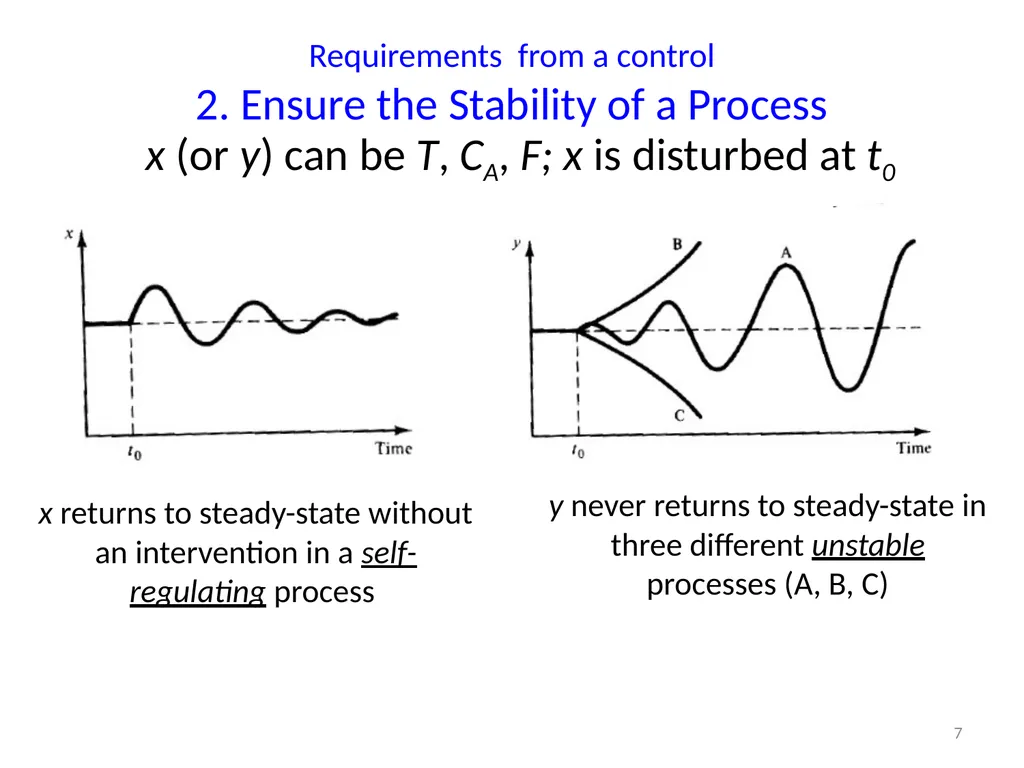
slide7. Requirements from a control 2. Ensure the Stability of a Process x (or y) can be T, CA, F; x is disturbed at t0 7 x returns to steady-state without an intervention in a self-regulating process y never returns to steady-state in three different unstable processes (A, B, C)<br>
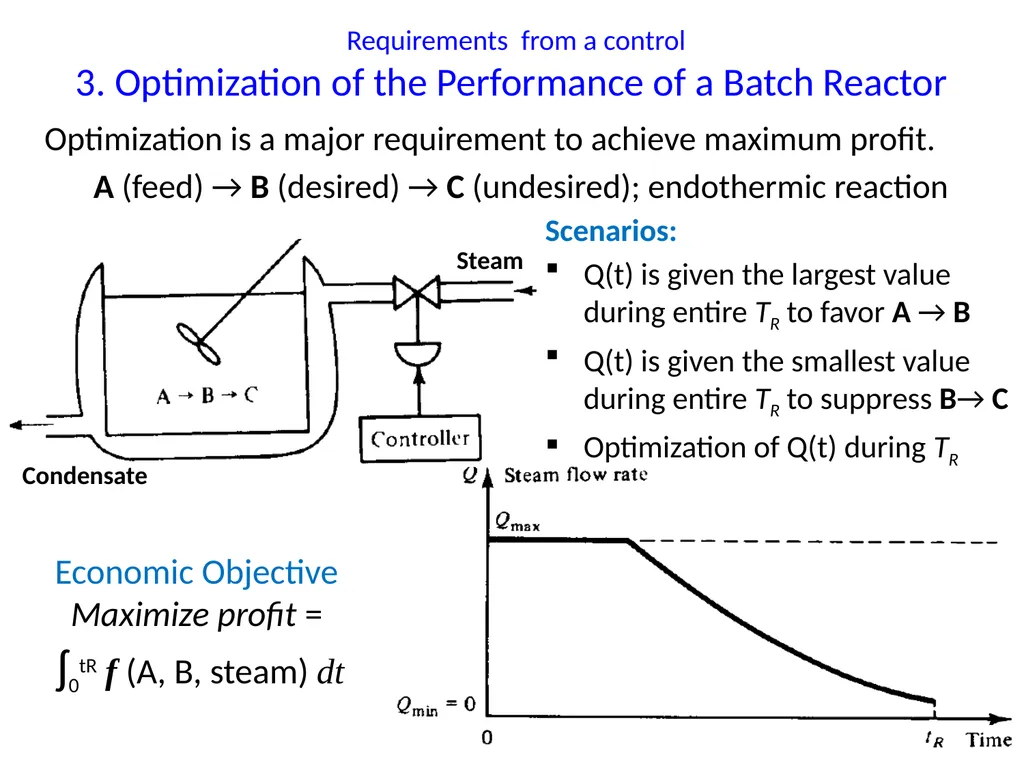
slide8. Requirements from a control 3. Optimization of the Performance of a Batch Reactor Optimization is a major requirement to achieve maximum profit.
A (feed) → B (desired) → C (undesired); endothermic reaction 8 Scenarios:
Q(t) is given the largest value during entire TR to favor A → B
Q(t) is given the smallest value during entire TR to suppress B→ C
Optimization of Q(t) during TR Economic Objective
Maximize profit =
ʃ0tR f (A, B, steam) dt<br>
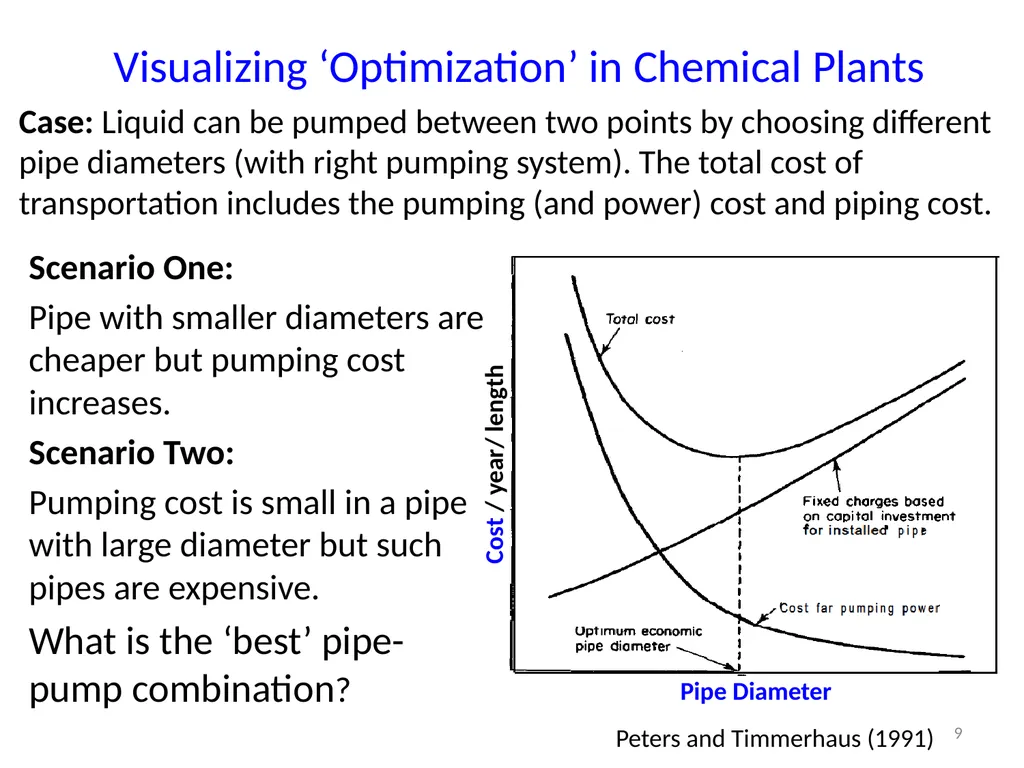
slide9. Visualizing ‘Optimization’ in Chemical Plants Case: Liquid can be pumped between two points by choosing different pipe diameters (with right pumping system). The total cost of transportation includes the pumping (and power) cost and piping cost. 9 Scenario One:
Pipe with smaller diameters are cheaper but pumping cost increases.
Scenario Two:
Pumping cost is small in a pipe with large diameter but such pipes are expensive.
What is the ‘best’ pipe-pump combination? Peters and Timmerhaus (1991)<br>
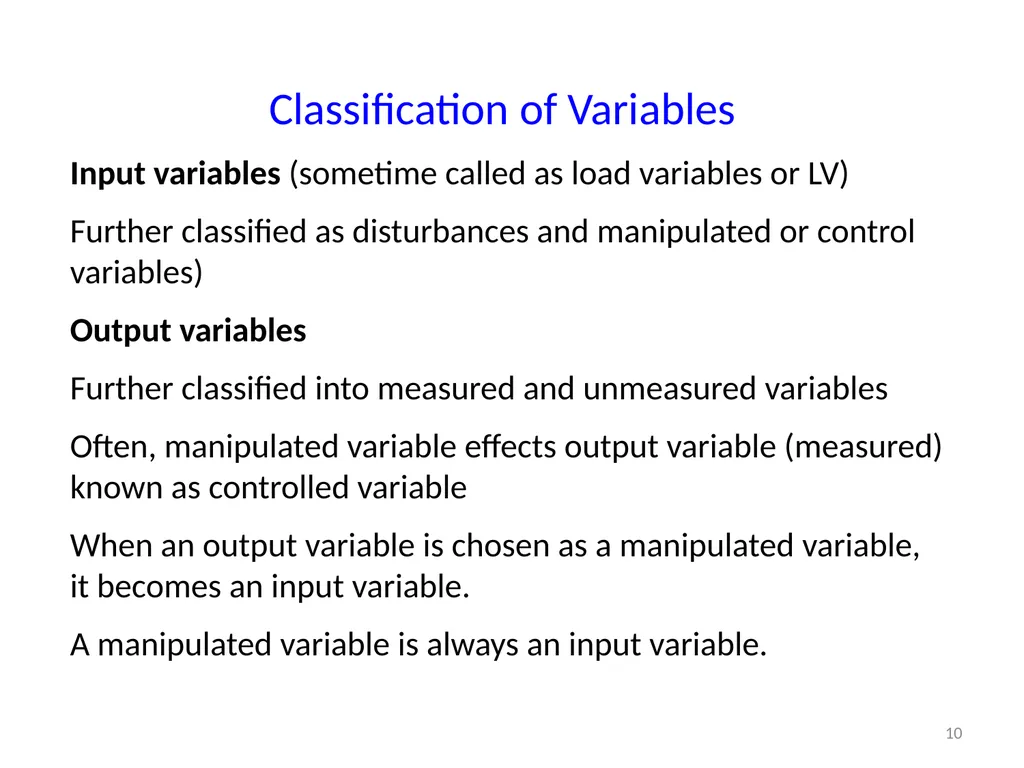
slide10. 10 Classification of Variables Input variables (sometime called as load variables or LV)
Further classified as disturbances and manipulated or control variables)
Output variables
Further classified into measured and unmeasured variables
Often, manipulated variable effects output variable (measured) known as controlled variable
When an output variable is chosen as a manipulated variable, it becomes an input variable.
A manipulated variable is always an input variable.<br>
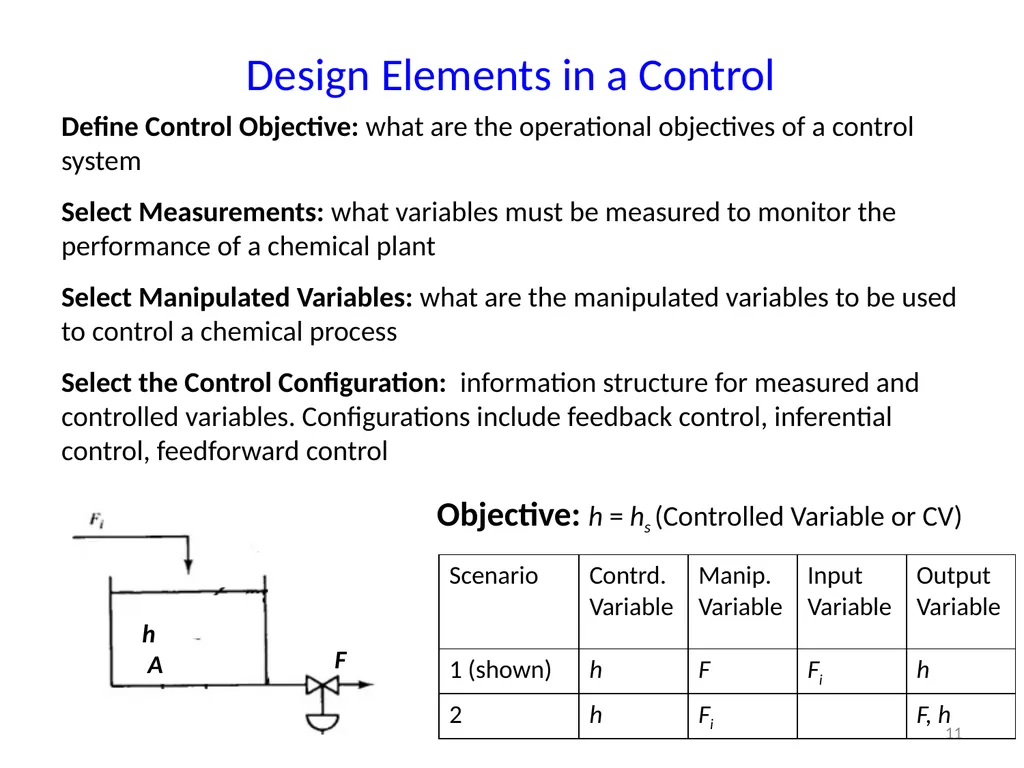
slide11. 11 Design Elements in a Control Objective: h = hs (Controlled Variable or CV) Define Control Objective: what are the operational objectives of a control system
Select Measurements: what variables must be measured to monitor the performance of a chemical plant
Select Manipulated Variables: what are the manipulated variables to be used to control a chemical process
Select the Control Configuration: information structure for measured and controlled variables. Configurations include feedback control, inferential control, feedforward control<br>
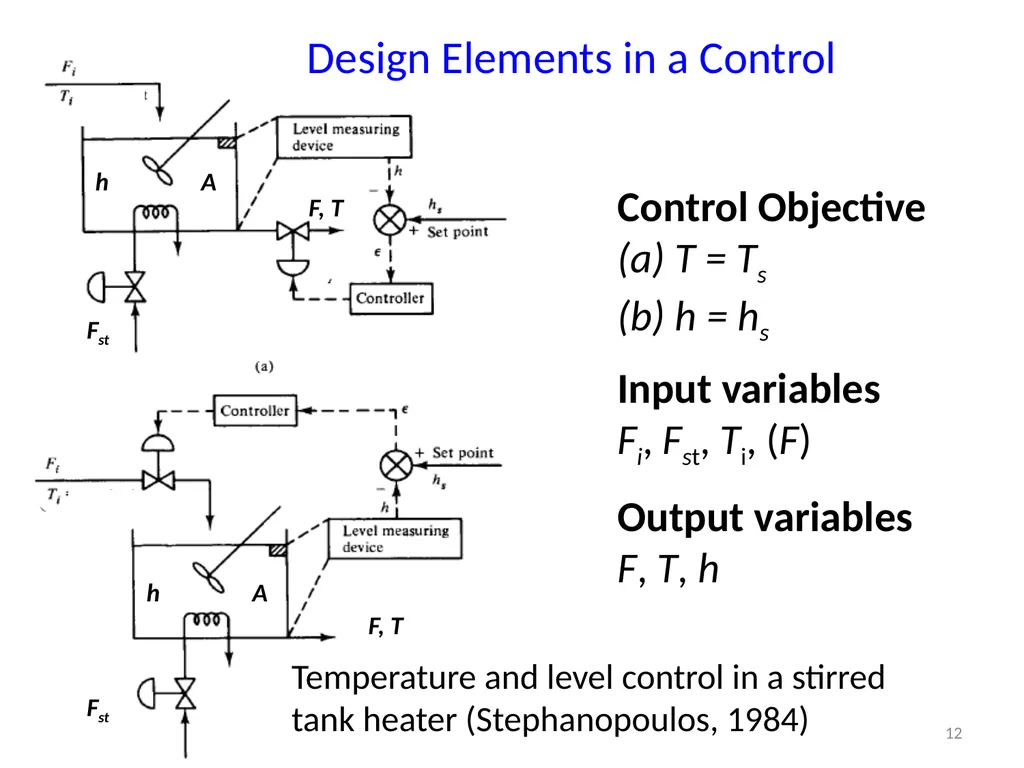
slide12. 12 Input variables
Fi, Fst, Ti, (F) Output variables
F, T, h Control Objective
(a) T = Ts
(b) h = hs Temperature and level control in a stirred tank heater (Stephanopoulos, 1984) Design Elements in a Control<br>
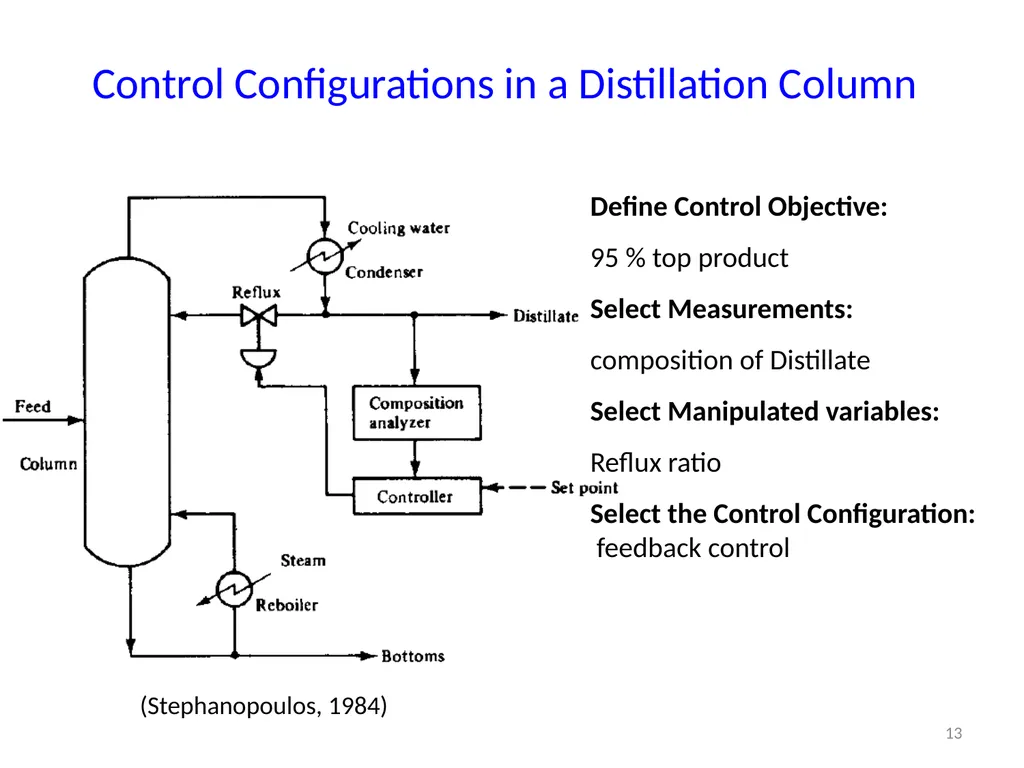
slide13. 13 Control Configurations in a Distillation Column Define Control Objective:
95 % top product
Select Measurements:
composition of Distillate
Select Manipulated variables:
Reflux ratio
Select the Control Configuration: feedback control (Stephanopoulos, 1984)<br>
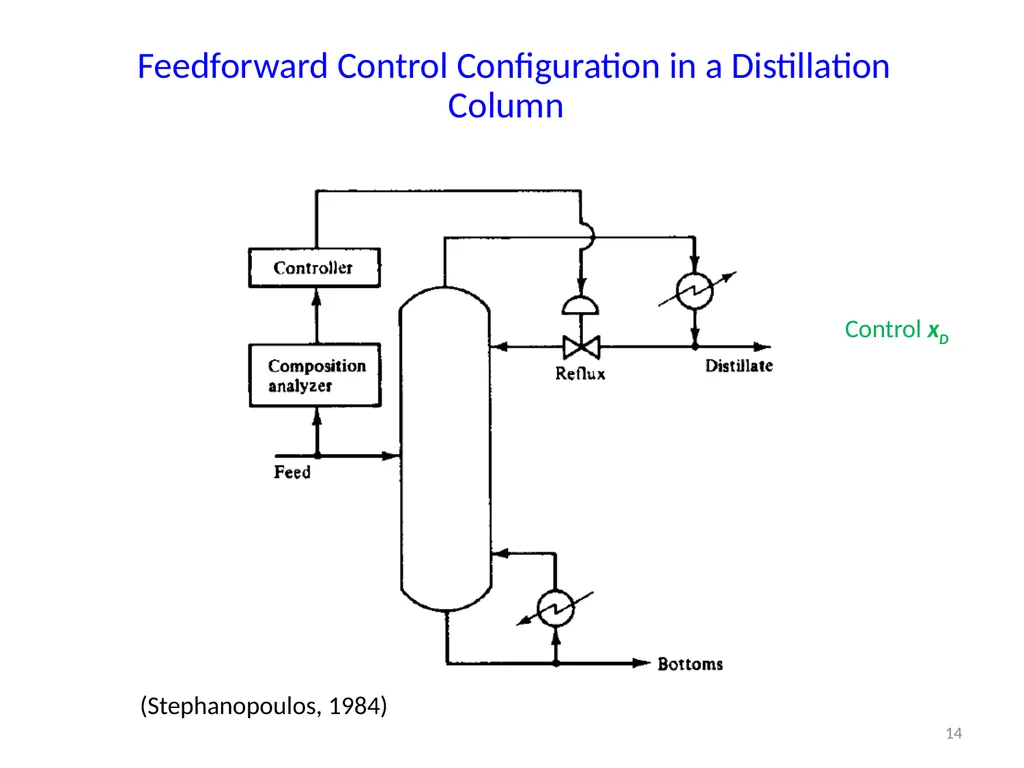
slide14. 14 Feedforward Control Configuration in a Distillation Column (Stephanopoulos, 1984) Control xD<br>
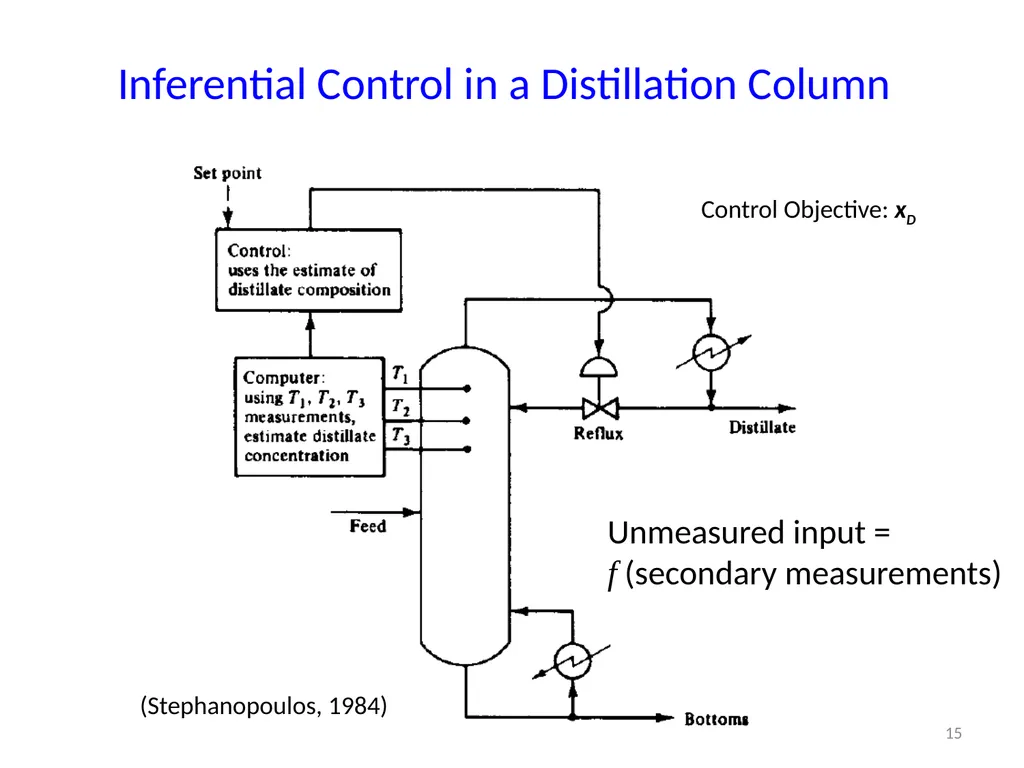
slide15. 15 Inferential Control in a Distillation Column (Stephanopoulos, 1984) Control Objective: xD Unmeasured input =
f (secondary measurements)<br>
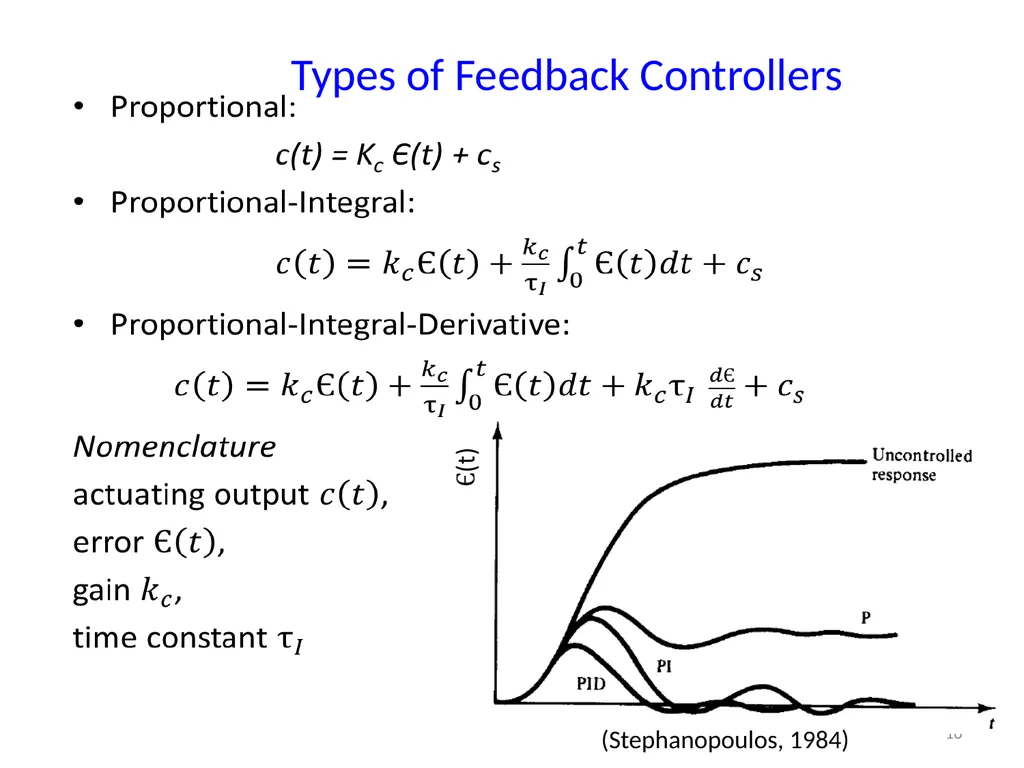
slide16. 16 Types of Feedback Controllers (Stephanopoulos, 1984)<br>
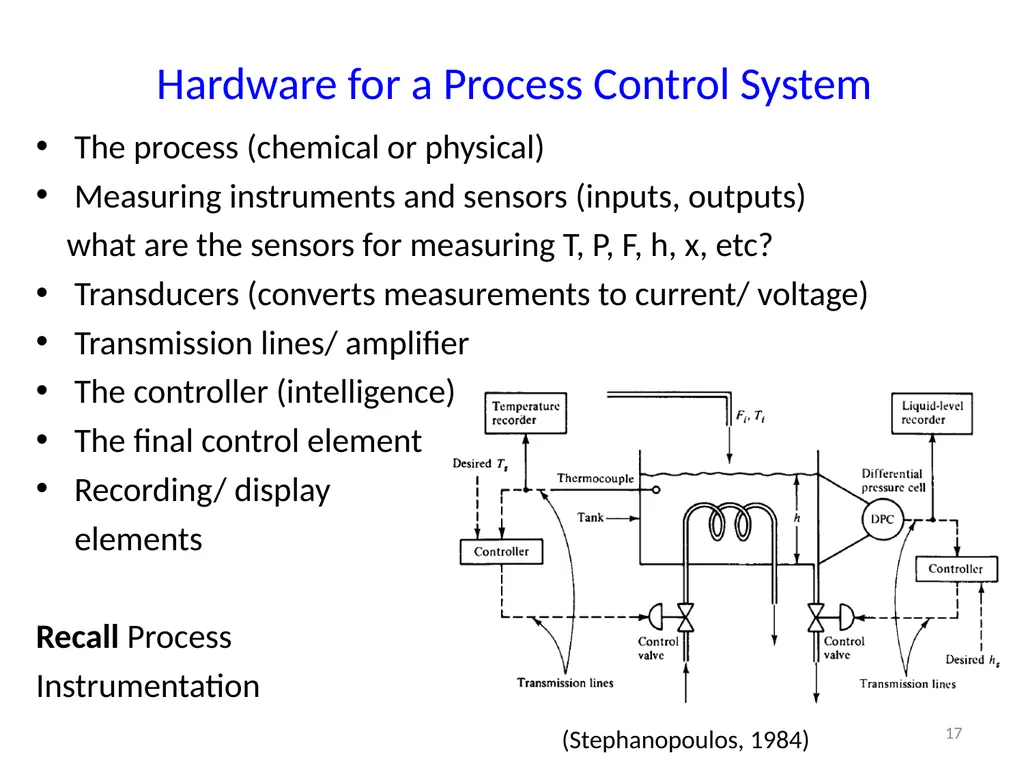
slide17. The process (chemical or physical)
Measuring instruments and sensors (inputs, outputs)
what are the sensors for measuring T, P, F, h, x, etc?
Transducers (converts measurements to current/ voltage)
Transmission lines/ amplifier
The controller (intelligence)
The final control element
Recording/ display
elements
Recall Process
Instrumentation 17 Hardware for a Process Control System (Stephanopoulos, 1984)<br>
slide18. Week 1 Weekly Take-Home Assignment Introduction to Process Dynamics and Control
Chapter 1-3, Pages 1-41 (Stephanopoulos, 1984) 18 Problems for Part I (page 36-41) PI.1 to 1.10 of Stephanopoulos (1984)
Submit before Friday Curriculum and handouts are posted at:
http://faculty.waheed-afzal1.pu.edu.pk/<br>
slide2. 2 George Stephanopoulos. Chemical process control. Englewood Cliffs, New Jersey: Prentice-Hall, 1984
Donald R. Coughanowr and Steven E. LeBlanc. Process Systems Analysis and Control. McGraw-Hill Science/Engineering/Math, 2008
William L Luyben. Process modeling, simulation and control for chemical engineers. 2nd Edition, McGraw-Hill Higher Education, 1996
Don Green and Robert Perry. Perry's Chemical Engineers' Handbook, Eighth Edition McGraw-Hill, New York, 2007
Dale E. Seborg, Thomas F. Edgar, and Duncan A. Mellichamp. Process dynamics & control. 2nd Edition, Wiley. com, 2004.
Lecture Notes/ Handouts Text/ Reference Books<br>
slide3. Place of Process Control in a typical Chemical Plant 3 Luyben (1996)<br>
slide4. Need of a Control Safety:
Equipment and Personnel
Production Specifications:
Quality and Quantity
Environmental Regulations:
Effluents
Operational Constraints:
Distillation columns (flooding, weeping); Tanks (overflow, drying), Catalytic reactor (maximum temperature, pressure)
Economics:
Minimum operating cost, maximum profits 4<br>
slide5. Requirements from a control 1. Suppressing External Disturbances 5 Objectives: Achieve Set-point
T = Ts
h = hs
After reaching steady-state from start-up, disturbances in Fi and Ti cause changes in F, T.
How to achieve the objective? Stirred Tank Heater (Stephanopoulos, 1984)<br>
slide6. Controlling T in a Stirred Tank Heater 6 measure T
compare measured T with Ts
Compute error:
e = Ts - T
e > 0; Ts > T (increase Fst)
e < 0; Ts < T (reduce Fst) Feedback Control in a Stirred Tank Heater
(Stephanopoulos, 1984)<br>
slide7. Requirements from a control 2. Ensure the Stability of a Process x (or y) can be T, CA, F; x is disturbed at t0 7 x returns to steady-state without an intervention in a self-regulating process y never returns to steady-state in three different unstable processes (A, B, C)<br>
slide8. Requirements from a control 3. Optimization of the Performance of a Batch Reactor Optimization is a major requirement to achieve maximum profit.
A (feed) → B (desired) → C (undesired); endothermic reaction 8 Scenarios:
Q(t) is given the largest value during entire TR to favor A → B
Q(t) is given the smallest value during entire TR to suppress B→ C
Optimization of Q(t) during TR Economic Objective
Maximize profit =
ʃ0tR f (A, B, steam) dt<br>
slide9. Visualizing ‘Optimization’ in Chemical Plants Case: Liquid can be pumped between two points by choosing different pipe diameters (with right pumping system). The total cost of transportation includes the pumping (and power) cost and piping cost. 9 Scenario One:
Pipe with smaller diameters are cheaper but pumping cost increases.
Scenario Two:
Pumping cost is small in a pipe with large diameter but such pipes are expensive.
What is the ‘best’ pipe-pump combination? Peters and Timmerhaus (1991)<br>
slide10. 10 Classification of Variables Input variables (sometime called as load variables or LV)
Further classified as disturbances and manipulated or control variables)
Output variables
Further classified into measured and unmeasured variables
Often, manipulated variable effects output variable (measured) known as controlled variable
When an output variable is chosen as a manipulated variable, it becomes an input variable.
A manipulated variable is always an input variable.<br>
slide11. 11 Design Elements in a Control Objective: h = hs (Controlled Variable or CV) Define Control Objective: what are the operational objectives of a control system
Select Measurements: what variables must be measured to monitor the performance of a chemical plant
Select Manipulated Variables: what are the manipulated variables to be used to control a chemical process
Select the Control Configuration: information structure for measured and controlled variables. Configurations include feedback control, inferential control, feedforward control<br>
slide12. 12 Input variables
Fi, Fst, Ti, (F) Output variables
F, T, h Control Objective
(a) T = Ts
(b) h = hs Temperature and level control in a stirred tank heater (Stephanopoulos, 1984) Design Elements in a Control<br>
slide13. 13 Control Configurations in a Distillation Column Define Control Objective:
95 % top product
Select Measurements:
composition of Distillate
Select Manipulated variables:
Reflux ratio
Select the Control Configuration: feedback control (Stephanopoulos, 1984)<br>
slide14. 14 Feedforward Control Configuration in a Distillation Column (Stephanopoulos, 1984) Control xD<br>
slide15. 15 Inferential Control in a Distillation Column (Stephanopoulos, 1984) Control Objective: xD Unmeasured input =
f (secondary measurements)<br>
slide16. 16 Types of Feedback Controllers (Stephanopoulos, 1984)<br>
slide17. The process (chemical or physical)
Measuring instruments and sensors (inputs, outputs)
what are the sensors for measuring T, P, F, h, x, etc?
Transducers (converts measurements to current/ voltage)
Transmission lines/ amplifier
The controller (intelligence)
The final control element
Recording/ display
elements
Recall Process
Instrumentation 17 Hardware for a Process Control System (Stephanopoulos, 1984)<br>
slide18. Week 1 Weekly Take-Home Assignment Introduction to Process Dynamics and Control
Chapter 1-3, Pages 1-41 (Stephanopoulos, 1984) 18 Problems for Part I (page 36-41) PI.1 to 1.10 of Stephanopoulos (1984)
Submit before Friday Curriculum and handouts are posted at:
http://faculty.waheed-afzal1.pu.edu.pk/<br>