Cheese making information sheet How is cheese
Description: Cheese making information sheet How is cheese made? Cheese is made from milk which is pasteurised (heated to kill bacteria). The milk proteins are denatured and coagulated by the addition of an enzyme (rennet) and acid. In industry, the
Related Topics
Download Presentation
"Cheese making information sheet How is cheese" is the property of its rightful owner. Permission is granted to download and print the materials on this website for personal, non-commercial use only, and to display it on your personal computer provided you do not modify the materials and that you retain all copyright notices contained in the materials. By downloading content from our website, you accept the terms of this agreement.
Presentation Transcript
slide1. Cheese making information sheet How is cheese made?
Cheese is made from milk which is pasteurised (heated to kill bacteria).
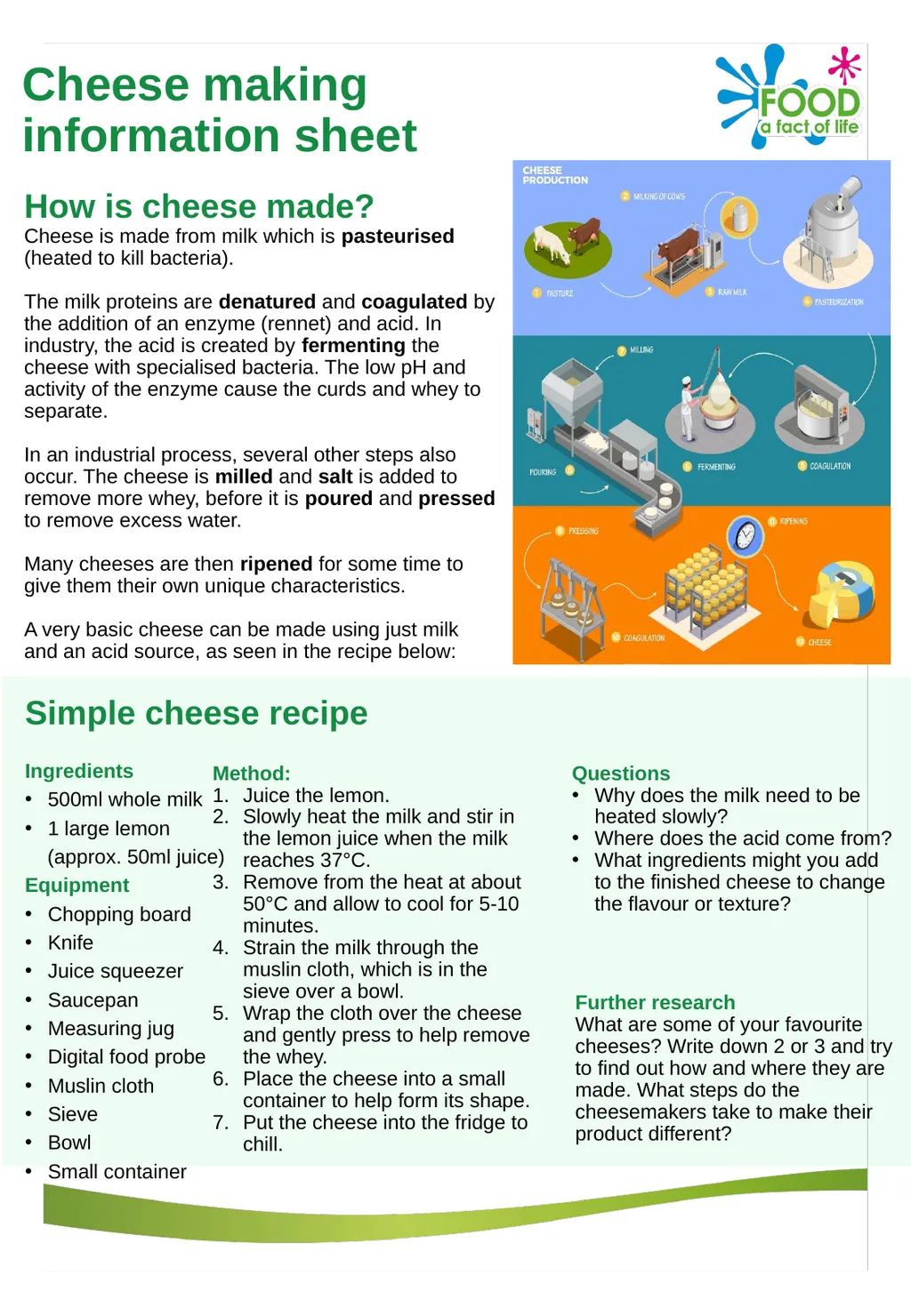
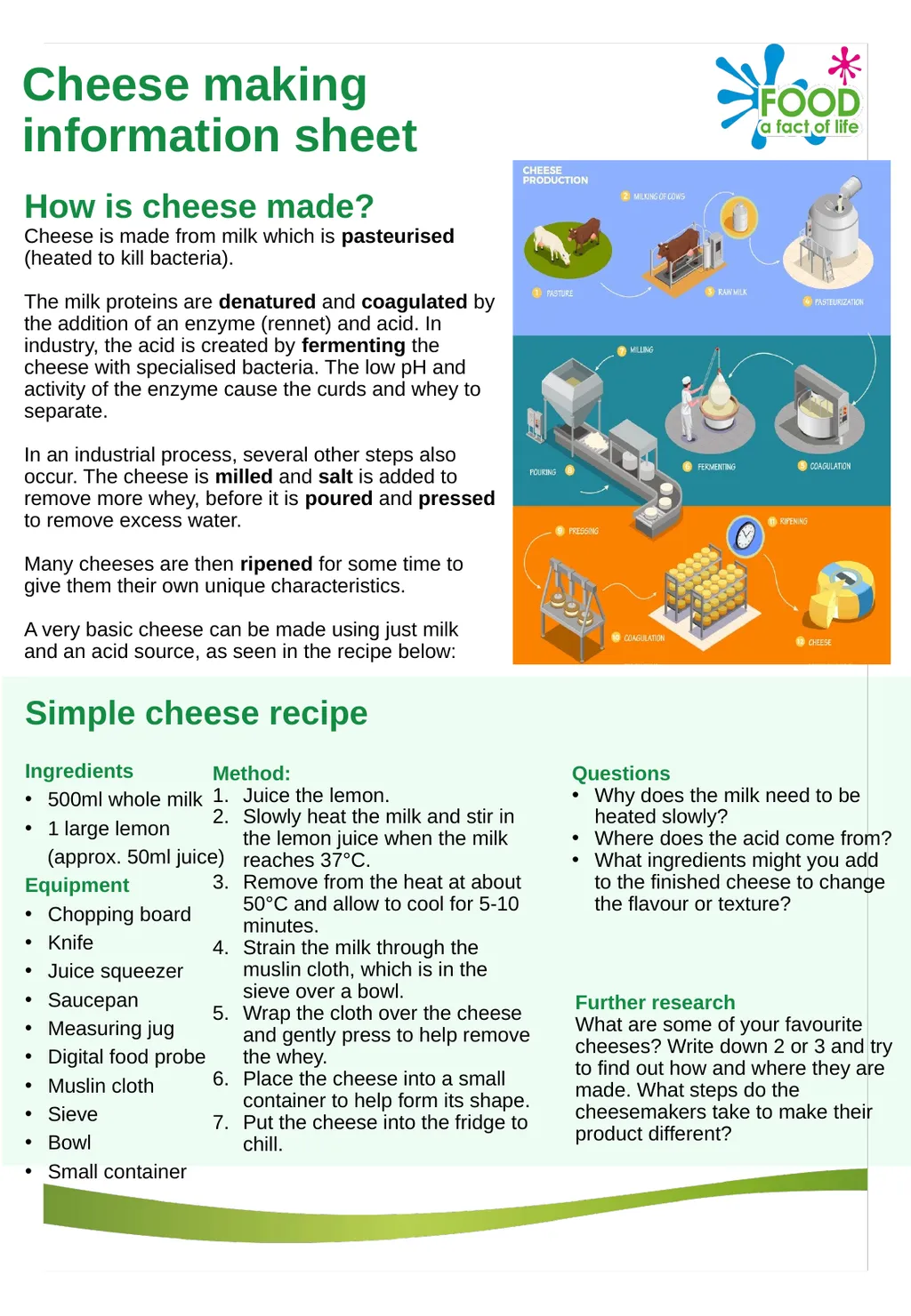
The milk proteins are denatured and coagulated by the addition of an enzyme (rennet) and acid. In industry, the acid is created by fermenting the cheese with specialised bacteria. The low pH and activity of the enzyme cause the curds and whey to separate.
In an industrial process, several other steps also occur. The cheese is milled and salt is added to remove more whey, before it is poured and pressed to remove excess water.
Many cheeses are then ripened for some time to give them their own unique characteristics.
A very basic cheese can be made using just milk and an acid source, as seen in the recipe below: Simple cheese recipe
Ingredients
500ml whole milk
1 large lemon
(approx. 50ml juice)
Equipment
Chopping board
Knife
Juice squeezer
Saucepan
Measuring jug
Digital food probe
Muslin cloth
Sieve
Bowl
Small container Method:
Juice the lemon.
Slowly heat the milk and stir in the lemon juice when the milk reaches 37°C.
Remove from the heat at about 50°C and allow to cool for 5-10 minutes.
Strain the milk through the muslin cloth, which is in the sieve over a bowl.
Wrap the cloth over the cheese and gently press to help remove the whey.
Place the cheese into a small container to help form its shape.
Put the cheese into the fridge to chill. Questions
Why does the milk need to be heated slowly?
Where does the acid come from?
What ingredients might you add to the finished cheese to change the flavour or texture? Further research
What are some of your favourite cheeses? Write down 2 or 3 and try to find out how and where they are made. What steps do the cheesemakers take to make their product different?<br>
slide2. Toasting breadinformation sheet What happens to bread when you toast it?
Toasting bread might seem like a pretty ordinary thing to do. But believe it or not, there’s a whole lot of science going on in your toaster.
There are three main reactions that occur when bread is toasted:
Dextrinisation occurs when long-chain carbohydrates known as starches are broken down by the dry heat. The heat breaks these chains into shorter molecules called dextrins. Too much dextrinisation can break these down even more, causing the toast to burn.
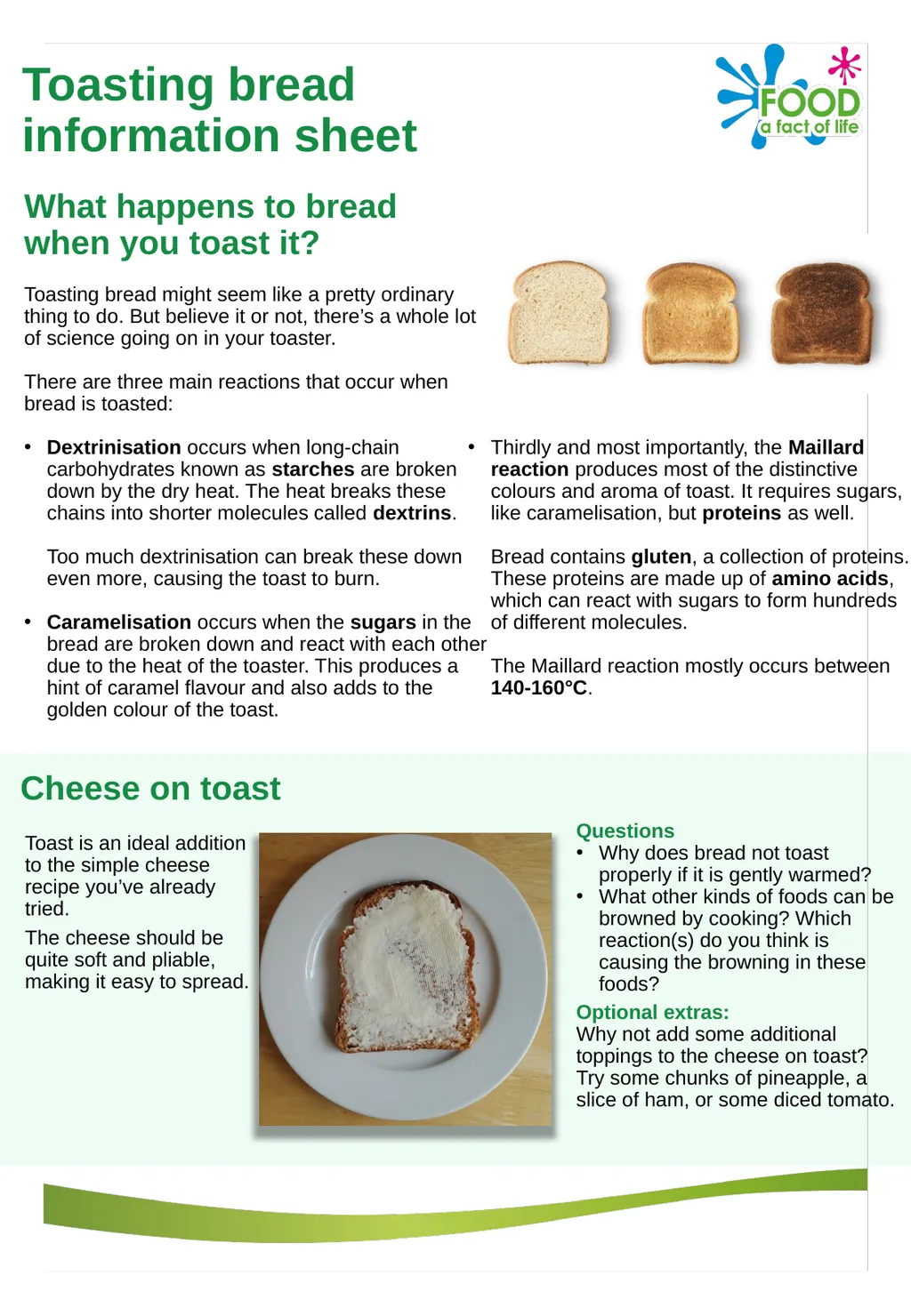
Caramelisation occurs when the sugars in the bread are broken down and react with each other due to the heat of the toaster. This produces a hint of caramel flavour and also adds to the golden colour of the toast. Toast is an ideal addition to the simple cheese recipe you’ve already tried.
The cheese should be quite soft and pliable, making it easy to spread. Questions
Why does bread not toast properly if it is gently warmed?
What other kinds of foods can be browned by cooking? Which reaction(s) do you think is causing the browning in these foods? Optional extras:
Why not add some additional toppings to the cheese on toast? Try some chunks of pineapple, a slice of ham, or some diced tomato. Thirdly and most importantly, the Maillard reaction produces most of the distinctive colours and aroma of toast. It requires sugars, like caramelisation, but proteins as well. Bread contains gluten, a collection of proteins.These proteins are made up of amino acids, which can react with sugars to form hundreds of different molecules. The Maillard reaction mostly occurs between 140-160°C. Cheese on toast<br>

Cheese is made from milk which is pasteurised (heated to kill bacteria).
The milk proteins are denatured and coagulated by the addition of an enzyme (rennet) and acid. In industry, the acid is created by fermenting the cheese with specialised bacteria. The low pH and activity of the enzyme cause the curds and whey to separate.
In an industrial process, several other steps also occur. The cheese is milled and salt is added to remove more whey, before it is poured and pressed to remove excess water.
Many cheeses are then ripened for some time to give them their own unique characteristics.
A very basic cheese can be made using just milk and an acid source, as seen in the recipe below: Simple cheese recipe
Ingredients
500ml whole milk
1 large lemon
(approx. 50ml juice)
Equipment
Chopping board
Knife
Juice squeezer
Saucepan
Measuring jug
Digital food probe
Muslin cloth
Sieve
Bowl
Small container Method:
Juice the lemon.
Slowly heat the milk and stir in the lemon juice when the milk reaches 37°C.
Remove from the heat at about 50°C and allow to cool for 5-10 minutes.
Strain the milk through the muslin cloth, which is in the sieve over a bowl.
Wrap the cloth over the cheese and gently press to help remove the whey.
Place the cheese into a small container to help form its shape.
Put the cheese into the fridge to chill. Questions
Why does the milk need to be heated slowly?
Where does the acid come from?
What ingredients might you add to the finished cheese to change the flavour or texture? Further research
What are some of your favourite cheeses? Write down 2 or 3 and try to find out how and where they are made. What steps do the cheesemakers take to make their product different?<br>
slide2. Toasting breadinformation sheet What happens to bread when you toast it?
Toasting bread might seem like a pretty ordinary thing to do. But believe it or not, there’s a whole lot of science going on in your toaster.
There are three main reactions that occur when bread is toasted:
Dextrinisation occurs when long-chain carbohydrates known as starches are broken down by the dry heat. The heat breaks these chains into shorter molecules called dextrins. Too much dextrinisation can break these down even more, causing the toast to burn.
Caramelisation occurs when the sugars in the bread are broken down and react with each other due to the heat of the toaster. This produces a hint of caramel flavour and also adds to the golden colour of the toast. Toast is an ideal addition to the simple cheese recipe you’ve already tried.
The cheese should be quite soft and pliable, making it easy to spread. Questions
Why does bread not toast properly if it is gently warmed?
What other kinds of foods can be browned by cooking? Which reaction(s) do you think is causing the browning in these foods? Optional extras:
Why not add some additional toppings to the cheese on toast? Try some chunks of pineapple, a slice of ham, or some diced tomato. Thirdly and most importantly, the Maillard reaction produces most of the distinctive colours and aroma of toast. It requires sugars, like caramelisation, but proteins as well. Bread contains gluten, a collection of proteins.These proteins are made up of amino acids, which can react with sugars to form hundreds of different molecules. The Maillard reaction mostly occurs between 140-160°C. Cheese on toast<br>