
Chemistry-Biology Interface Program Quantitative
Description: Chemistry-Biology Interface Program Quantitative and Chemical Biology Earn a PhD in the best of both worlds: Graduate training in chemical and physical biology iuqcb.indiana.edu IUQCB Graduate Training at Indiana University, Bloomington:
Related Topics
Download Presentation
"Chemistry-Biology Interface Program Quantitative" is the property of its rightful owner. Permission is granted to download and print the materials on this website for personal, non-commercial use only, and to display it on your personal computer provided you do not modify the materials and that you retain all copyright notices contained in the materials. By downloading content from our website, you accept the terms of this agreement.
Presentation Transcript
slide1. Chemistry-Biology Interface Program
Quantitative and Chemical Biology Earn a PhD in the best of both worlds:
Graduate training in chemical and physical biology iuqcb.indiana.edu @IUQCB Graduate Training at Indiana University, Bloomington: NIGMS (T32 GM131944; formerly GM109825)
IU College of Arts and Sciences<br>
slide2. What is QCB? A National Institutes of Health (NIH)-funded graduate training program that provides value-added educational opportunities to students in nearly all areas of chemistry who chose a graduate advisor who is also a trainer in the program.
Program objective: To provide a broad, interdisciplinary graduate training experience on the biological side of chemistry, superimposed on deep, disciplinary training in your major (e.g., organic, inorganic, analytical, materials, ChemBiol).
Provides exposure to the diversity of the QCB student cohort and presents real opportunities for collaboration and integration. Also, formal leadership opportunities. GOAL: Help prepare you for a career that will likely span traditional disciplines.<br>
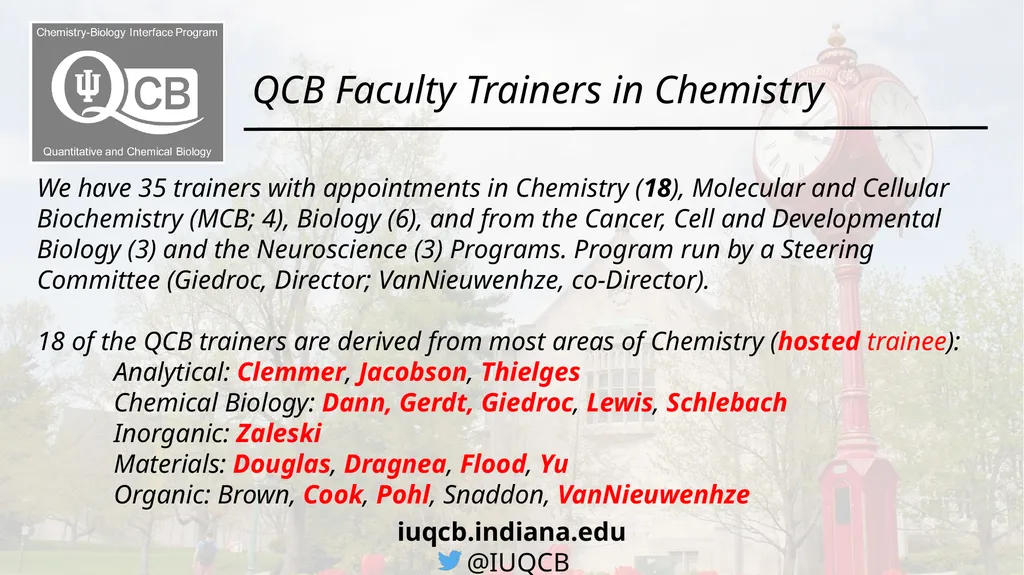
slide3. We have 35 trainers with appointments in Chemistry (18), Molecular and Cellular Biochemistry (MCB; 4), Biology (6), and from the Cancer, Cell and Developmental Biology (3) and the Neuroscience (3) Programs. Program run by a Steering Committee (Giedroc, Director; VanNieuwenhze, co-Director).
18 of the QCB trainers are derived from most areas of Chemistry (hosted trainee):
Analytical: Clemmer, Jacobson, Thielges
Chemical Biology: Dann, Gerdt, Giedroc, Lewis, Schlebach
Inorganic: Zaleski
Materials: Douglas, Dragnea, Flood, Yu
Organic: Brown, Cook, Pohl, Snaddon, VanNieuwenhze QCB Faculty Trainers in Chemistry<br>
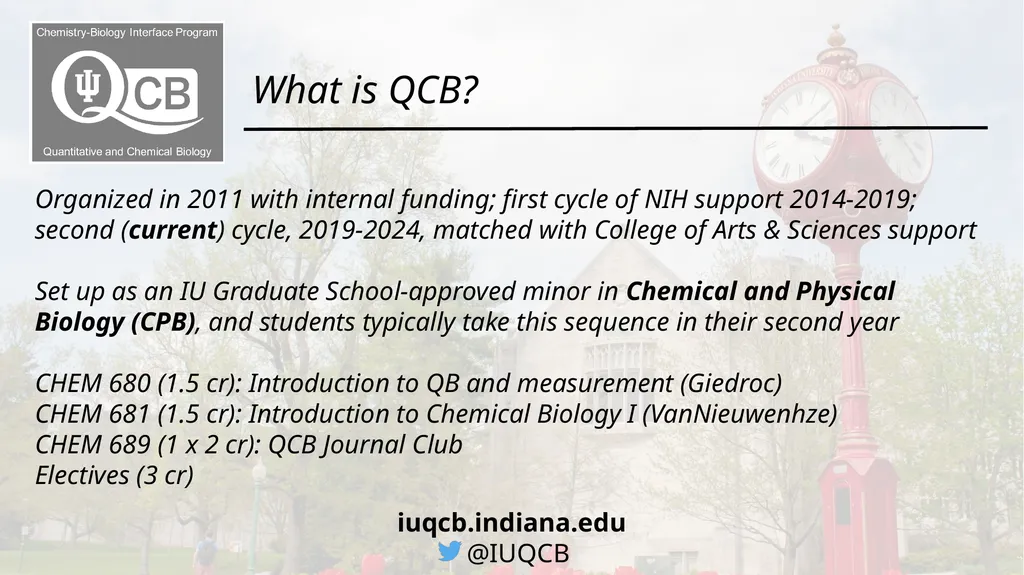
slide4. Organized in 2011 with internal funding; first cycle of NIH support 2014-2019; second (current) cycle, 2019-2024, matched with College of Arts & Sciences support
Set up as an IU Graduate School-approved minor in Chemical and Physical Biology (CPB), and students typically take this sequence in their second year
CHEM 680 (1.5 cr): Introduction to QB and measurement (Giedroc)
CHEM 681 (1.5 cr): Introduction to Chemical Biology I (VanNieuwenhze)
CHEM 689 (1 x 2 cr): QCB Journal Club
Electives (3 cr) What is QCB?<br>
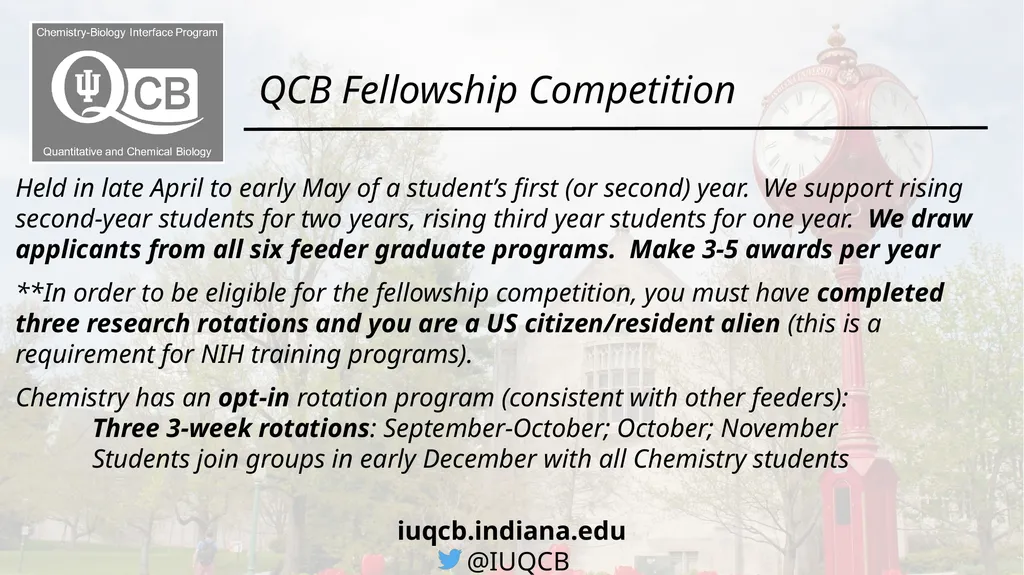
slide5. QCB Fellowship Competition Held in late April to early May of a student’s first (or second) year. We support rising second-year students for two years, rising third year students for one year. We draw applicants from all six feeder graduate programs. Make 3-5 awards per year
**In order to be eligible for the fellowship competition, you must have completed three research rotations and you are a US citizen/resident alien (this is a requirement for NIH training programs).
Chemistry has an opt-in rotation program (consistent with other feeders):
Three 3-week rotations: September-October; October; November
Students join groups in early December with all Chemistry students<br>
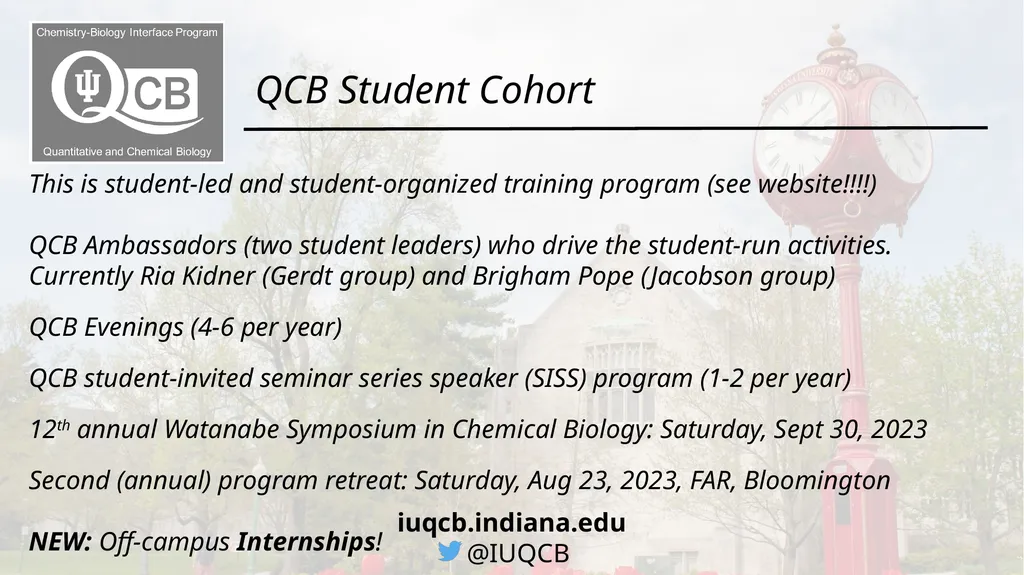
slide6. QCB Student Cohort This is student-led and student-organized training program (see website!!!!)
QCB Ambassadors (two student leaders) who drive the student-run activities. Currently Ria Kidner (Gerdt group) and Brigham Pope (Jacobson group)
QCB Evenings (4-6 per year)
QCB student-invited seminar series speaker (SISS) program (1-2 per year)
12th annual Watanabe Symposium in Chemical Biology: Saturday, Sept 30, 2023
Second (annual) program retreat: Saturday, Aug 23, 2023, FAR, Bloomington
NEW: Off-campus Internships!<br>
slide7. Questions? David Giedroc, giedroc@iu.edu
Mike VanNieuwenhze, mvannieu@iu.edu
Administrative support
Maria Sievers Perotti: sieversm@iu.edu
QCB Ambassadors (AY23)
Ria Kidner: rqkidner@iu.edu
Brigham Pope: blpope@iu.edu<br>
Quantitative and Chemical Biology Earn a PhD in the best of both worlds:
Graduate training in chemical and physical biology iuqcb.indiana.edu @IUQCB Graduate Training at Indiana University, Bloomington: NIGMS (T32 GM131944; formerly GM109825)
IU College of Arts and Sciences<br>
slide2. What is QCB? A National Institutes of Health (NIH)-funded graduate training program that provides value-added educational opportunities to students in nearly all areas of chemistry who chose a graduate advisor who is also a trainer in the program.
Program objective: To provide a broad, interdisciplinary graduate training experience on the biological side of chemistry, superimposed on deep, disciplinary training in your major (e.g., organic, inorganic, analytical, materials, ChemBiol).
Provides exposure to the diversity of the QCB student cohort and presents real opportunities for collaboration and integration. Also, formal leadership opportunities. GOAL: Help prepare you for a career that will likely span traditional disciplines.<br>
slide3. We have 35 trainers with appointments in Chemistry (18), Molecular and Cellular Biochemistry (MCB; 4), Biology (6), and from the Cancer, Cell and Developmental Biology (3) and the Neuroscience (3) Programs. Program run by a Steering Committee (Giedroc, Director; VanNieuwenhze, co-Director).
18 of the QCB trainers are derived from most areas of Chemistry (hosted trainee):
Analytical: Clemmer, Jacobson, Thielges
Chemical Biology: Dann, Gerdt, Giedroc, Lewis, Schlebach
Inorganic: Zaleski
Materials: Douglas, Dragnea, Flood, Yu
Organic: Brown, Cook, Pohl, Snaddon, VanNieuwenhze QCB Faculty Trainers in Chemistry<br>
slide4. Organized in 2011 with internal funding; first cycle of NIH support 2014-2019; second (current) cycle, 2019-2024, matched with College of Arts & Sciences support
Set up as an IU Graduate School-approved minor in Chemical and Physical Biology (CPB), and students typically take this sequence in their second year
CHEM 680 (1.5 cr): Introduction to QB and measurement (Giedroc)
CHEM 681 (1.5 cr): Introduction to Chemical Biology I (VanNieuwenhze)
CHEM 689 (1 x 2 cr): QCB Journal Club
Electives (3 cr) What is QCB?<br>
slide5. QCB Fellowship Competition Held in late April to early May of a student’s first (or second) year. We support rising second-year students for two years, rising third year students for one year. We draw applicants from all six feeder graduate programs. Make 3-5 awards per year
**In order to be eligible for the fellowship competition, you must have completed three research rotations and you are a US citizen/resident alien (this is a requirement for NIH training programs).
Chemistry has an opt-in rotation program (consistent with other feeders):
Three 3-week rotations: September-October; October; November
Students join groups in early December with all Chemistry students<br>
slide6. QCB Student Cohort This is student-led and student-organized training program (see website!!!!)
QCB Ambassadors (two student leaders) who drive the student-run activities. Currently Ria Kidner (Gerdt group) and Brigham Pope (Jacobson group)
QCB Evenings (4-6 per year)
QCB student-invited seminar series speaker (SISS) program (1-2 per year)
12th annual Watanabe Symposium in Chemical Biology: Saturday, Sept 30, 2023
Second (annual) program retreat: Saturday, Aug 23, 2023, FAR, Bloomington
NEW: Off-campus Internships!<br>
slide7. Questions? David Giedroc, giedroc@iu.edu
Mike VanNieuwenhze, mvannieu@iu.edu
Administrative support
Maria Sievers Perotti: sieversm@iu.edu
QCB Ambassadors (AY23)
Ria Kidner: rqkidner@iu.edu
Brigham Pope: blpope@iu.edu<br>