
child adolescent service intensity instrument
DP
Published · 52 slides · 0 views

1 / 1


Description
child adolescent service intensity instrument CASII Adopted by the Kentucky Department of Medicaid Services For the purpose of standardizing level of care and service decisions The Child and Adolescent Service Intensity Instrument (CASII)
Related Topics
Share
Embed code
Download this presentation From Below
"child adolescent service intensity instrument" is the property of its rightful owner. Permission is granted to download and print the materials on this website for personal, non-commercial use only, and to display it on your personal computer provided you do not modify the materials and that you retain all copyright notices contained in the materials. By downloading content from our website, you accept the terms of this agreement.
Presentation Transcript
01
child adolescent service intensity instrument CASII<br>
02
Adopted by the Kentucky Department of Medicaid Services
For the purpose of standardizing level of care and service decisions<br>
For the purpose of standardizing level of care and service decisions<br>
03
The Child and Adolescent Service Intensity Instrument (CASII) is a standardized assessment tool that provides a determination of the appropriate level of services needed by a child or adolescent and his or her family. It is unique in its capacity to determine service intensity need, guide treatment planning, and monitor treatment outcome in all clinical settings.<br>
04
Which provider types may administer the CASII?<br>
05
Holiday party picture of all providers goes here<br>
06
The CASII
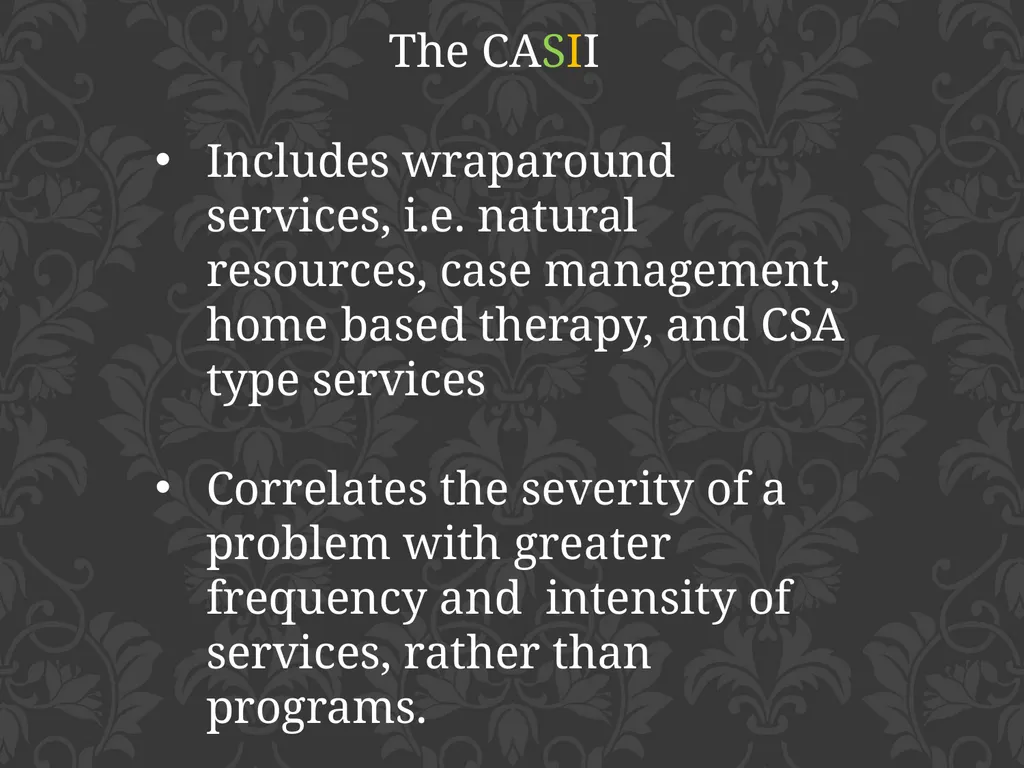
Includes wraparound services, i.e. natural resources, case management, home based therapy, and CSA type services
Correlates the severity of a problem with greater frequency and intensity of services, rather than programs.
These services may be available at all levels of need.<br>
Includes wraparound services, i.e. natural resources, case management, home based therapy, and CSA type services
Correlates the severity of a problem with greater frequency and intensity of services, rather than programs.
These services may be available at all levels of need.<br>
07
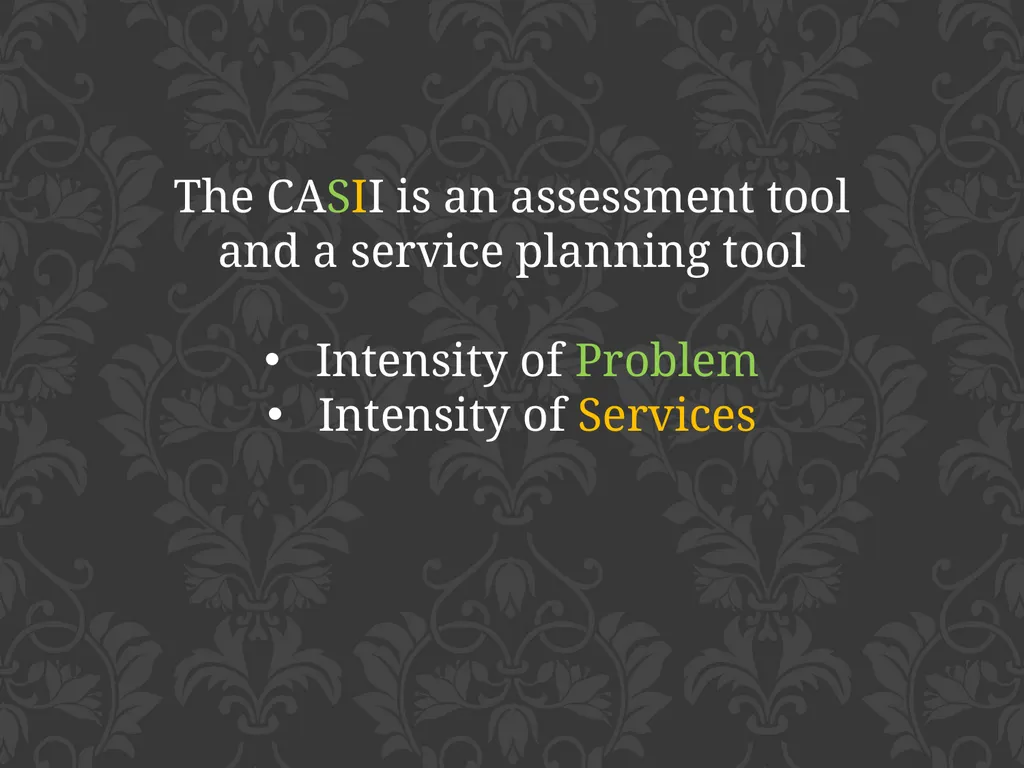
The CASII is an assessment tool and a service planning tool
Intensity of Problem
Intensity of Services<br>
Intensity of Problem
Intensity of Services<br>
08
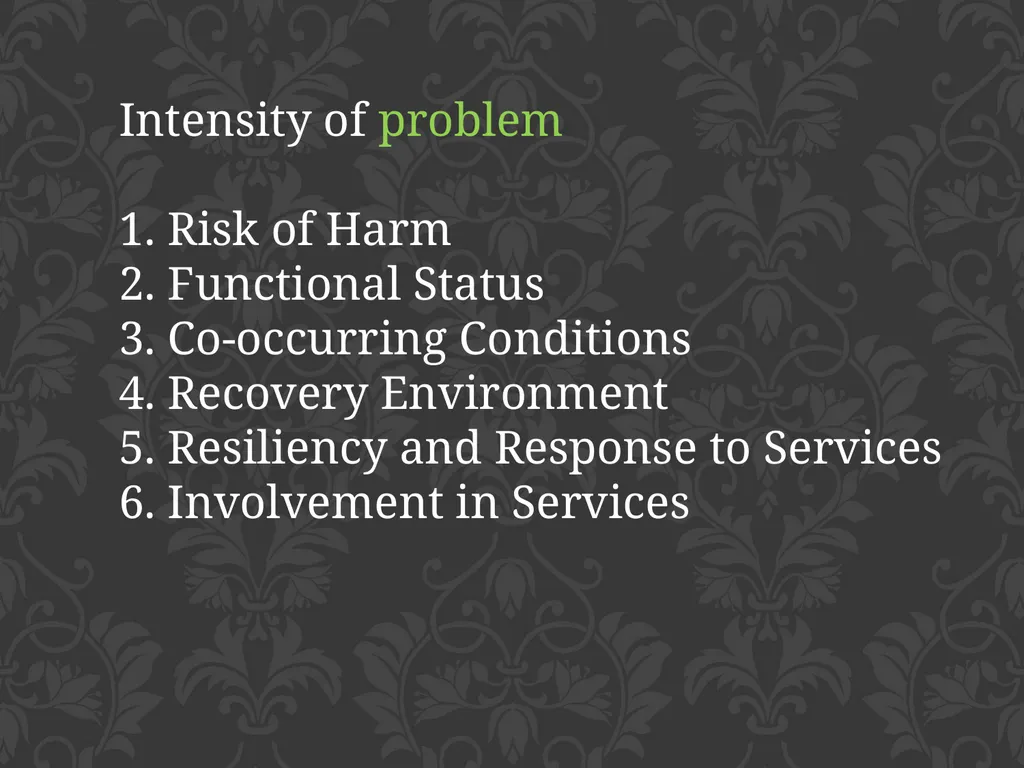
Intensity of problem
1. Risk of Harm
2. Functional Status
3. Co-occurring Conditions
4. Recovery Environment
5. Resiliency and Response to Services
6. Involvement in Services<br>
1. Risk of Harm
2. Functional Status
3. Co-occurring Conditions
4. Recovery Environment
5. Resiliency and Response to Services
6. Involvement in Services<br>
09
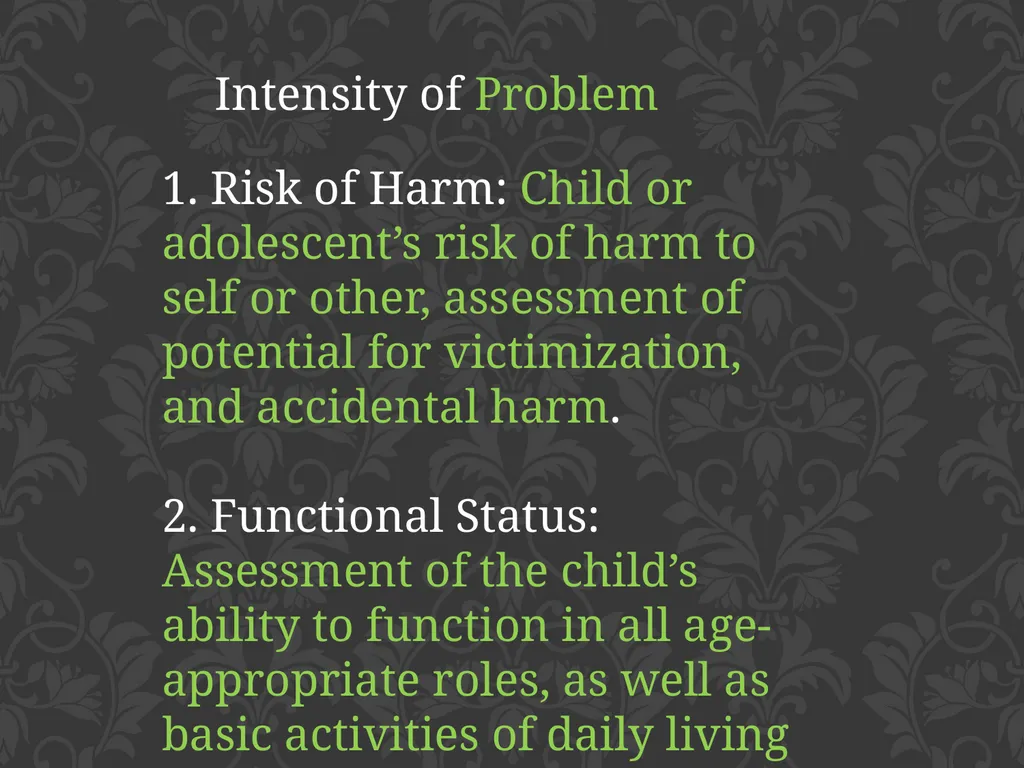
1. Risk of Harm: Child or adolescent’s risk of harm to self or other, assessment of potential for victimization, and accidental harm.
2. Functional Status: Assessment of the child’s ability to function in all age-appropriate roles, as well as basic activities of daily living Intensity of Problem<br>
2. Functional Status: Assessment of the child’s ability to function in all age-appropriate roles, as well as basic activities of daily living Intensity of Problem<br>
10
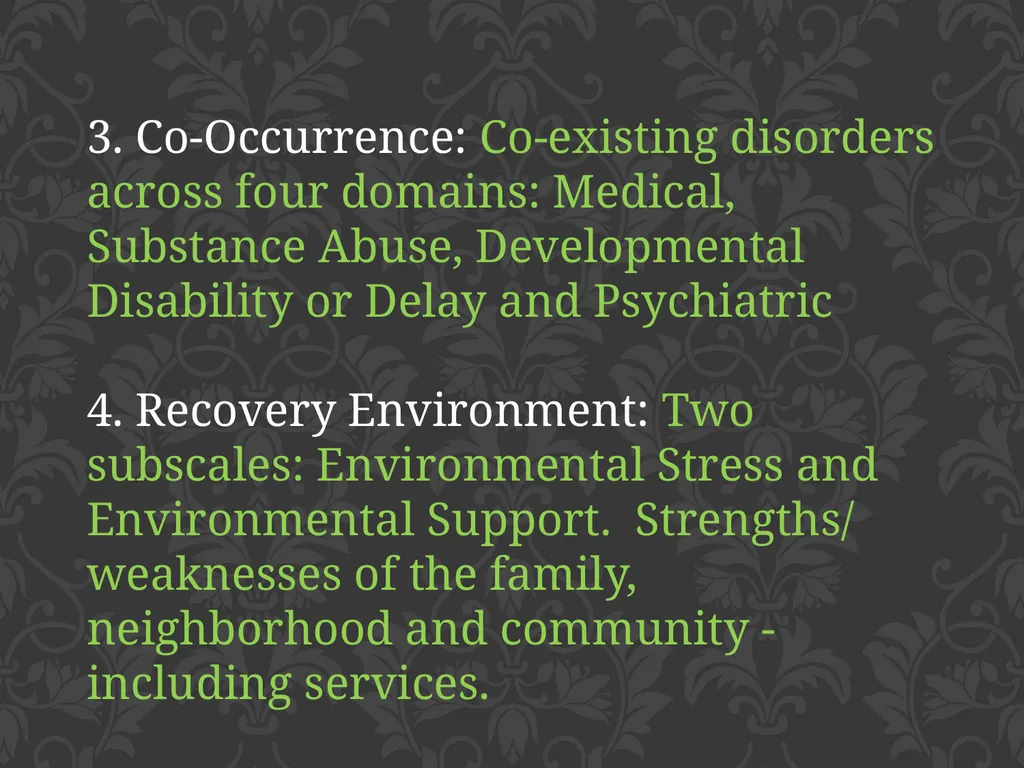
3. Co-Occurrence: Co-existing disorders across four domains: Medical, Substance Abuse, Developmental Disability or Delay and Psychiatric
4. Recovery Environment: Two subscales: Environmental Stress and Environmental Support. Strengths/ weaknesses of the family, neighborhood and community -including services.<br>
4. Recovery Environment: Two subscales: Environmental Stress and Environmental Support. Strengths/ weaknesses of the family, neighborhood and community -including services.<br>
11
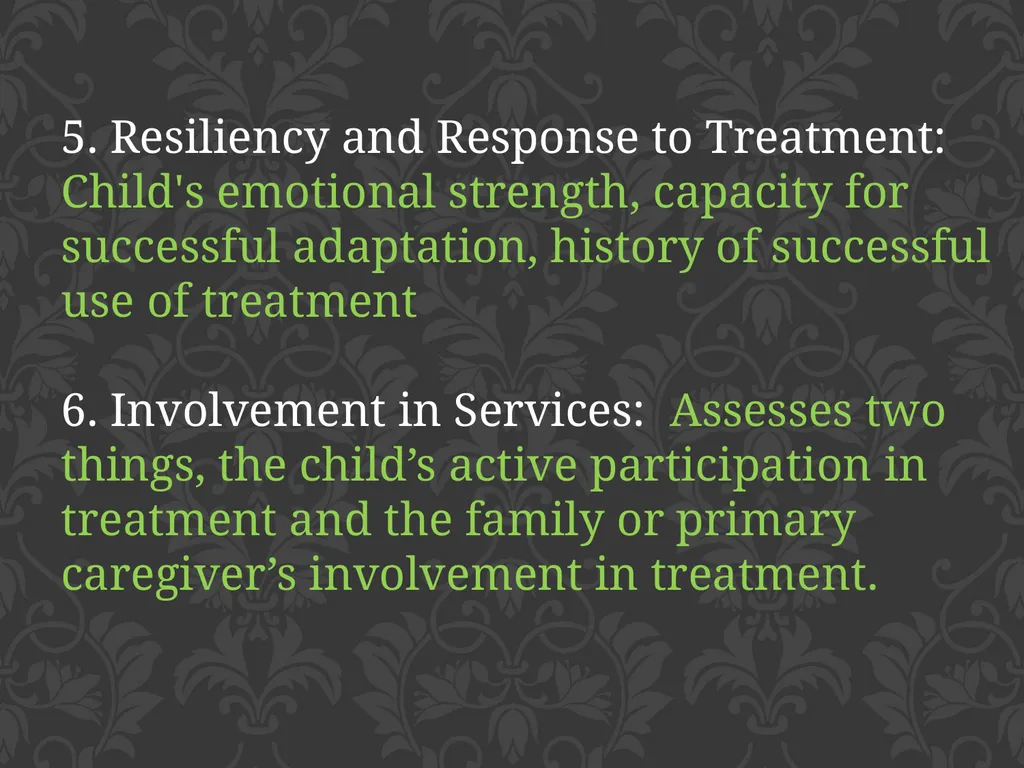
5. Resiliency and Response to Treatment: Child's emotional strength, capacity for successful adaptation, history of successful use of treatment
6. Involvement in Services: Assesses two things, the child’s active participation in treatment and the family or primary caregiver’s involvement in treatment.<br>
6. Involvement in Services: Assesses two things, the child’s active participation in treatment and the family or primary caregiver’s involvement in treatment.<br>
12
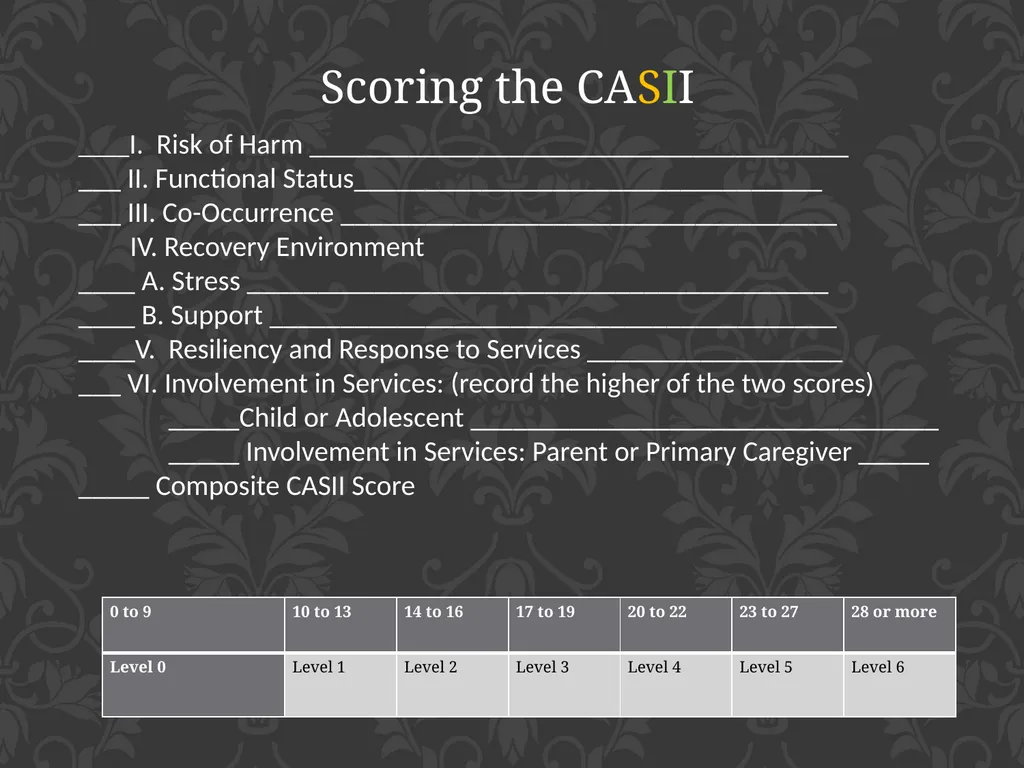
____I. Risk of Harm ______________________________________
___ II. Functional Status_________________________________
___ III. Co-Occurrence ___________________________________
IV. Recovery Environment
____ A. Stress _________________________________________
____ B. Support ________________________________________
____V. Resiliency and Response to Services __________________
___ VI. Involvement in Services: (record the higher of the two scores)
_____Child or Adolescent _________________________________
_____ Involvement in Services: Parent or Primary Caregiver _____
_____ Composite CASII Score Scoring the CASII<br>
___ II. Functional Status_________________________________
___ III. Co-Occurrence ___________________________________
IV. Recovery Environment
____ A. Stress _________________________________________
____ B. Support ________________________________________
____V. Resiliency and Response to Services __________________
___ VI. Involvement in Services: (record the higher of the two scores)
_____Child or Adolescent _________________________________
_____ Involvement in Services: Parent or Primary Caregiver _____
_____ Composite CASII Score Scoring the CASII<br>
13
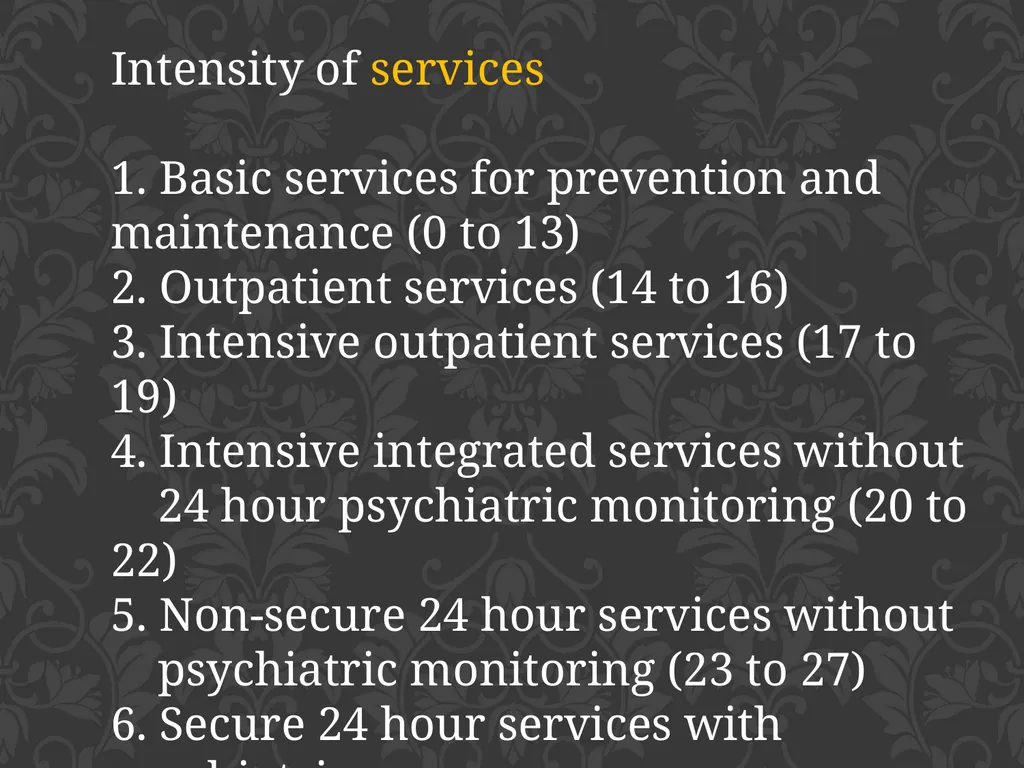
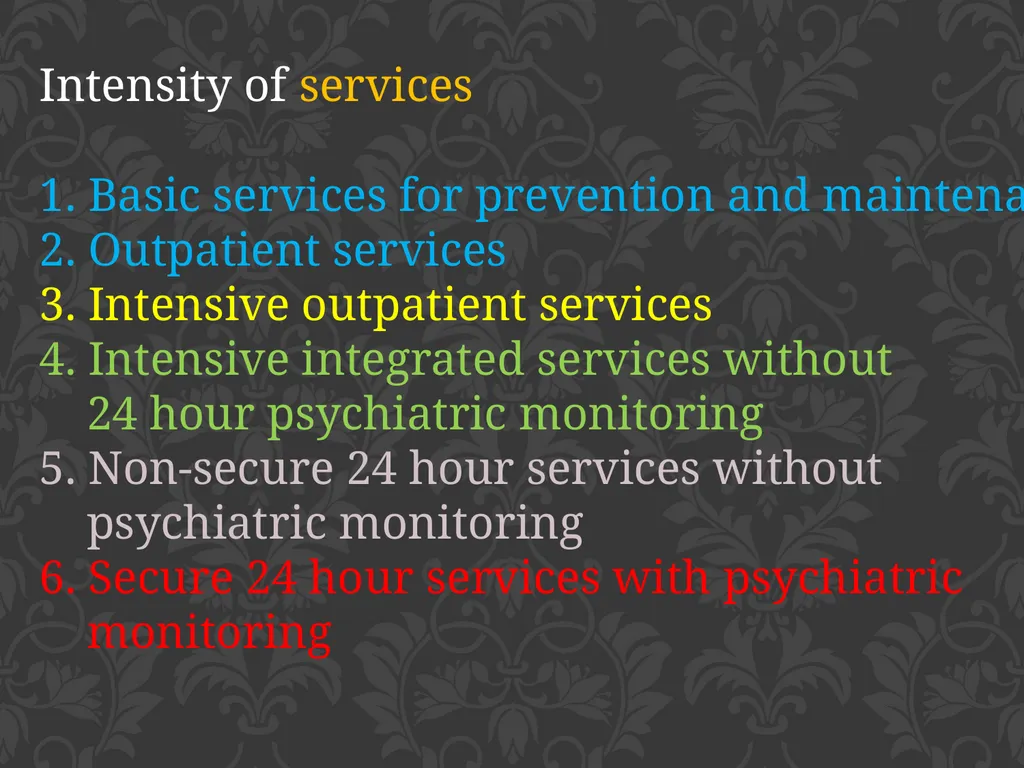
Intensity of services
1. Basic services for prevention and maintenance (0 to 13)
2. Outpatient services (14 to 16)
3. Intensive outpatient services (17 to 19)
4. Intensive integrated services without
24 hour psychiatric monitoring (20 to 22)
5. Non-secure 24 hour services without
psychiatric monitoring (23 to 27)
6. Secure 24 hour services with psychiatric
monitoring (28 or more)<br>
1. Basic services for prevention and maintenance (0 to 13)
2. Outpatient services (14 to 16)
3. Intensive outpatient services (17 to 19)
4. Intensive integrated services without
24 hour psychiatric monitoring (20 to 22)
5. Non-secure 24 hour services without
psychiatric monitoring (23 to 27)
6. Secure 24 hour services with psychiatric
monitoring (28 or more)<br>
14
Intensity of services
1. Basic services for prevention and maintenance
2. Outpatient services
3. Intensive outpatient services
4. Intensive integrated services without
24 hour psychiatric monitoring
5. Non-secure 24 hour services without
psychiatric monitoring
6. Secure 24 hour services with psychiatric
monitoring<br>
1. Basic services for prevention and maintenance
2. Outpatient services
3. Intensive outpatient services
4. Intensive integrated services without
24 hour psychiatric monitoring
5. Non-secure 24 hour services without
psychiatric monitoring
6. Secure 24 hour services with psychiatric
monitoring<br>
15
Intensity of services
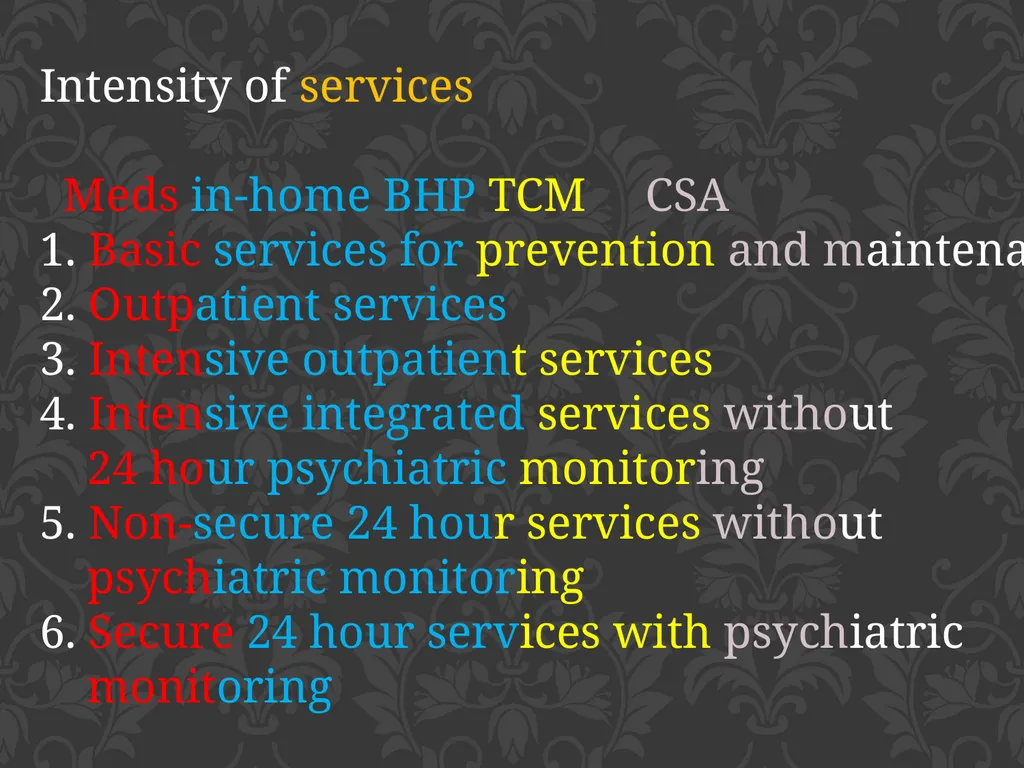
Meds in-home BHP TCM CSA
1. Basic services for prevention and maintenance
2. Outpatient services
3. Intensive outpatient services
4. Intensive integrated services without
24 hour psychiatric monitoring
5. Non-secure 24 hour services without
psychiatric monitoring
6. Secure 24 hour services with psychiatric
monitoring<br>
Meds in-home BHP TCM CSA
1. Basic services for prevention and maintenance
2. Outpatient services
3. Intensive outpatient services
4. Intensive integrated services without
24 hour psychiatric monitoring
5. Non-secure 24 hour services without
psychiatric monitoring
6. Secure 24 hour services with psychiatric
monitoring<br>
16
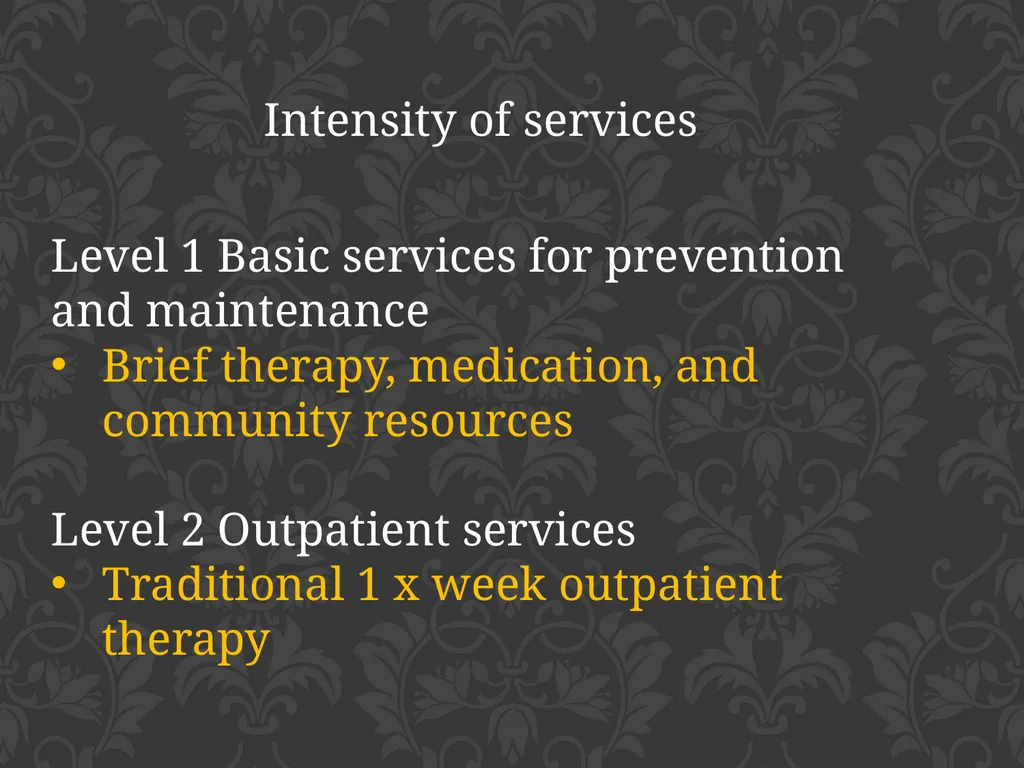
Level 1 Basic services for prevention and maintenance
Brief therapy, medication, and community resources
Level 2 Outpatient services
Traditional 1 x week outpatient therapy Intensity of services<br>
Brief therapy, medication, and community resources
Level 2 Outpatient services
Traditional 1 x week outpatient therapy Intensity of services<br>
17
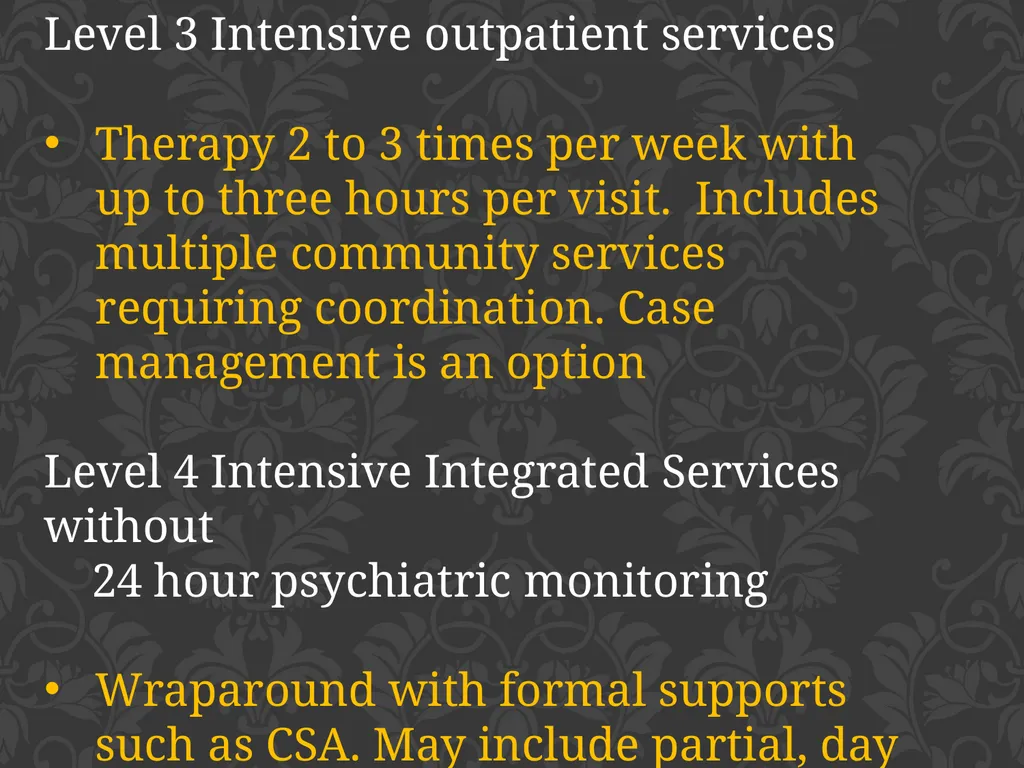
Level 3 Intensive outpatient services
Therapy 2 to 3 times per week with up to three hours per visit. Includes multiple community services requiring coordination. Case management is an option
Level 4 Intensive Integrated Services without
24 hour psychiatric monitoring
Wraparound with formal supports such as CSA. May include partial, day treatment, case management is required.<br>
Therapy 2 to 3 times per week with up to three hours per visit. Includes multiple community services requiring coordination. Case management is an option
Level 4 Intensive Integrated Services without
24 hour psychiatric monitoring
Wraparound with formal supports such as CSA. May include partial, day treatment, case management is required.<br>
18
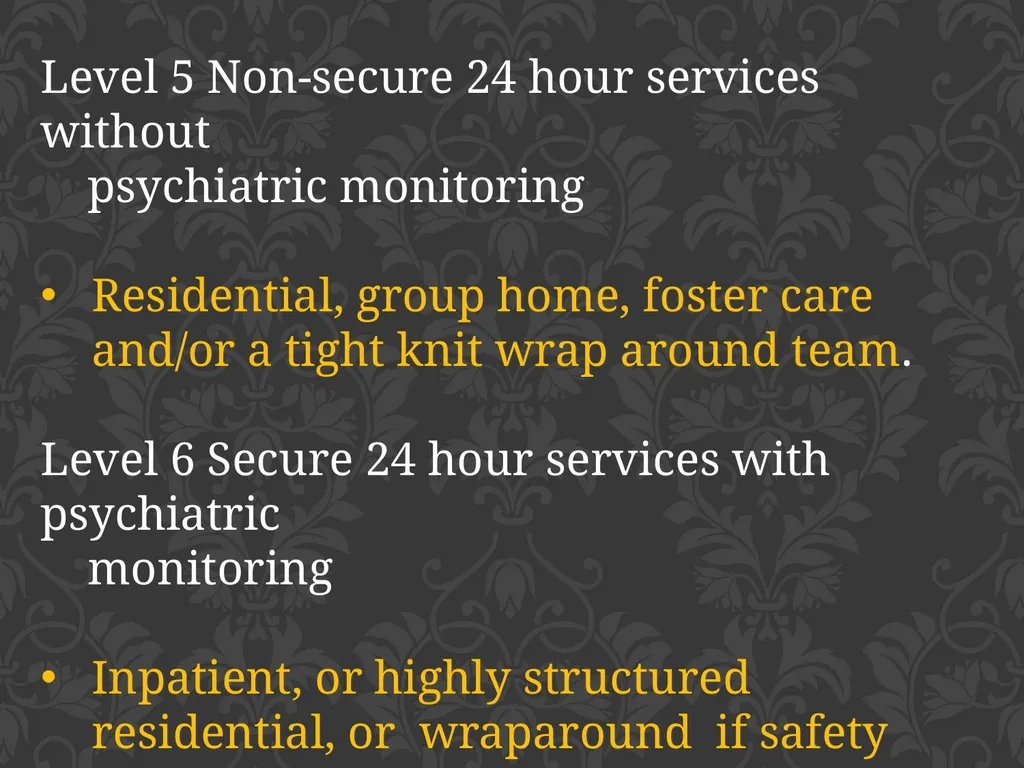
Level 5 Non-secure 24 hour services without
psychiatric monitoring
Residential, group home, foster care and/or a tight knit wrap around team.
Level 6 Secure 24 hour services with psychiatric
monitoring
Inpatient, or highly structured residential, or wraparound if safety needs are met. Case management is essential<br>
psychiatric monitoring
Residential, group home, foster care and/or a tight knit wrap around team.
Level 6 Secure 24 hour services with psychiatric
monitoring
Inpatient, or highly structured residential, or wraparound if safety needs are met. Case management is essential<br>
19
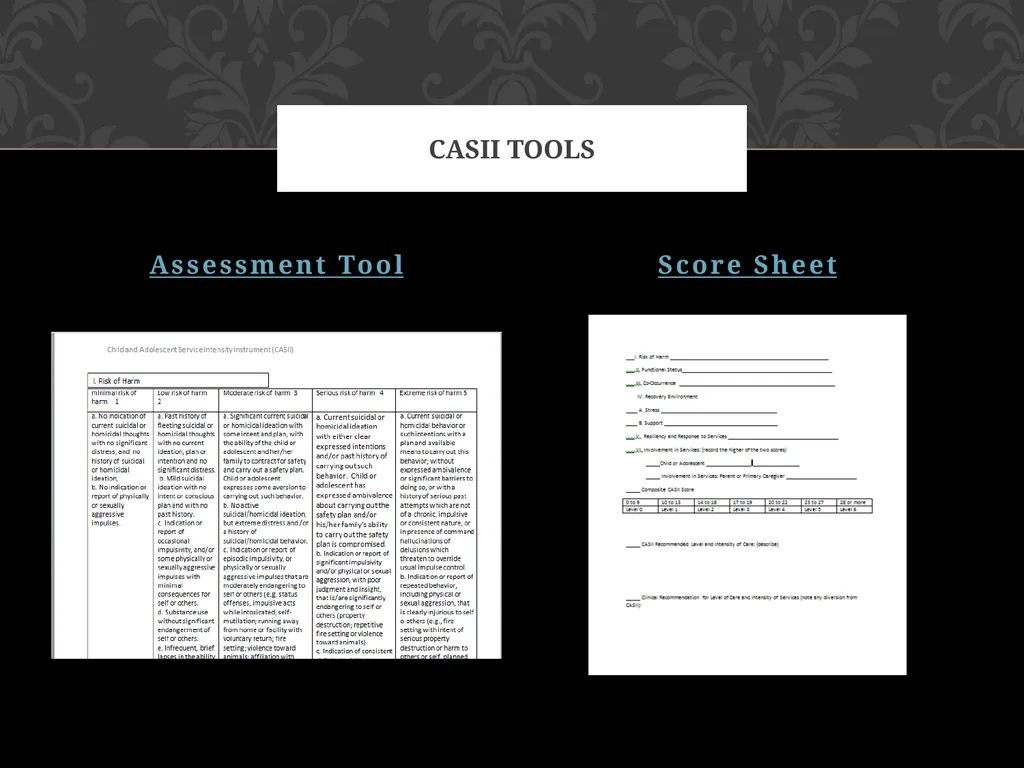
Assessment Tool Score Sheet CASII Tools<br>
20
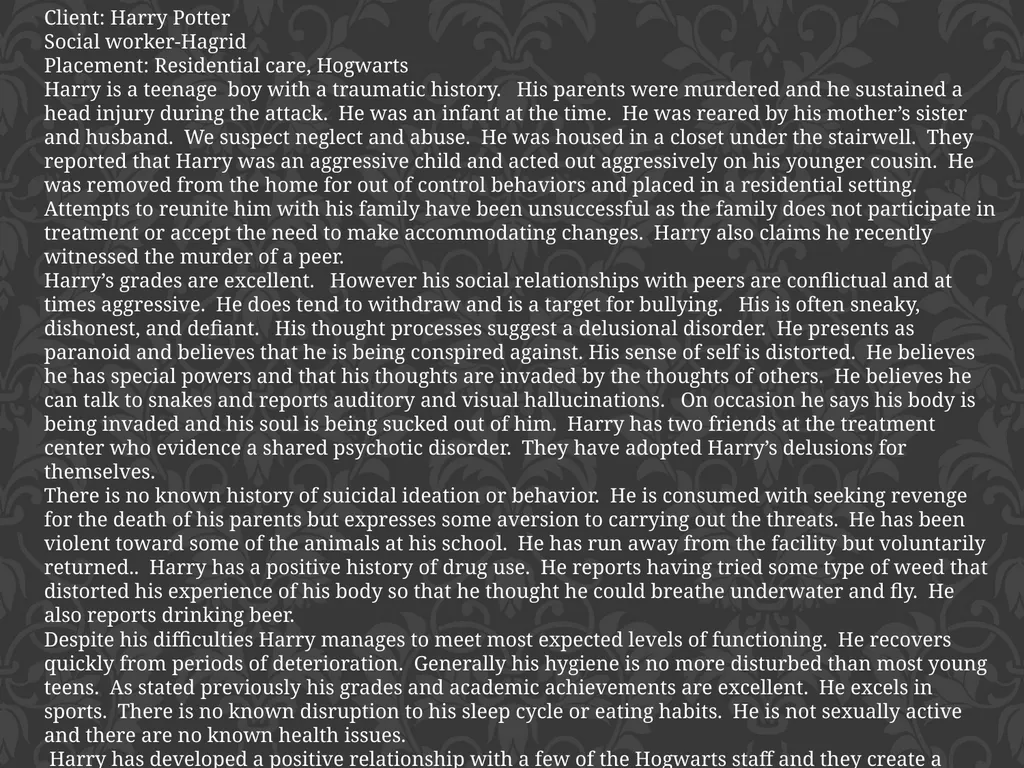
Client: Harry Potter
Social worker-Hagrid
Placement: Residential care, Hogwarts
Harry is a teenage boy with a traumatic history. His parents were murdered and he sustained a head injury during the attack. He was an infant at the time. He was reared by his mother’s sister and husband. We suspect neglect and abuse. He was housed in a closet under the stairwell. They reported that Harry was an aggressive child and acted out aggressively on his younger cousin. He was removed from the home for out of control behaviors and placed in a residential setting. Attempts to reunite him with his family have been unsuccessful as the family does not participate in treatment or accept the need to make accommodating changes. Harry also claims he recently witnessed the murder of a peer.
Harry’s grades are excellent. However his social relationships with peers are conflictual and at times aggressive. He does tend to withdraw and is a target for bullying. His is often sneaky, dishonest, and defiant. His thought processes suggest a delusional disorder. He presents as paranoid and believes that he is being conspired against. His sense of self is distorted. He believes he has special powers and that his thoughts are invaded by the thoughts of others. He believes he can talk to snakes and reports auditory and visual hallucinations. On occasion he says his body is being invaded and his soul is being sucked out of him. Harry has two friends at the treatment center who evidence a shared psychotic disorder. They have adopted Harry’s delusions for themselves.
There is no known history of suicidal ideation or behavior. He is consumed with seeking revenge for the death of his parents but expresses some aversion to carrying out the threats. He has been violent toward some of the animals at his school. He has run away from the facility but voluntarily returned.. Harry has a positive history of drug use. He reports having tried some type of weed that distorted his experience of his body so that he thought he could breathe underwater and fly. He also reports drinking beer.
Despite his difficulties Harry manages to meet most expected levels of functioning. He recovers quickly from periods of deterioration. Generally his hygiene is no more disturbed than most young teens. As stated previously his grades and academic achievements are excellent. He excels in sports. There is no known disruption to his sleep cycle or eating habits. He is not sexually active and there are no known health issues.
Harry has developed a positive relationship with a few of the Hogwarts staff and they create a network that is partially able to compensate for Harry’s unmet needs. Unfortunately he does not have access to them during the summer break and decompensates when returned to his family. Harry cooperates with treatment and is bright enough to know that there is something wrong with him. He just doesn’t always agree with the staff’s interpretation of his difficulties.
The client’s social worker is considering placing Harry in foster care for the summer break and referring for in-home therapy with wrap around care. He has asked for your assessment on level of care and transition to lower intensity of services. Use the CASII assessment tool and your clinical judgement for your report.<br>
Social worker-Hagrid
Placement: Residential care, Hogwarts
Harry is a teenage boy with a traumatic history. His parents were murdered and he sustained a head injury during the attack. He was an infant at the time. He was reared by his mother’s sister and husband. We suspect neglect and abuse. He was housed in a closet under the stairwell. They reported that Harry was an aggressive child and acted out aggressively on his younger cousin. He was removed from the home for out of control behaviors and placed in a residential setting. Attempts to reunite him with his family have been unsuccessful as the family does not participate in treatment or accept the need to make accommodating changes. Harry also claims he recently witnessed the murder of a peer.
Harry’s grades are excellent. However his social relationships with peers are conflictual and at times aggressive. He does tend to withdraw and is a target for bullying. His is often sneaky, dishonest, and defiant. His thought processes suggest a delusional disorder. He presents as paranoid and believes that he is being conspired against. His sense of self is distorted. He believes he has special powers and that his thoughts are invaded by the thoughts of others. He believes he can talk to snakes and reports auditory and visual hallucinations. On occasion he says his body is being invaded and his soul is being sucked out of him. Harry has two friends at the treatment center who evidence a shared psychotic disorder. They have adopted Harry’s delusions for themselves.
There is no known history of suicidal ideation or behavior. He is consumed with seeking revenge for the death of his parents but expresses some aversion to carrying out the threats. He has been violent toward some of the animals at his school. He has run away from the facility but voluntarily returned.. Harry has a positive history of drug use. He reports having tried some type of weed that distorted his experience of his body so that he thought he could breathe underwater and fly. He also reports drinking beer.
Despite his difficulties Harry manages to meet most expected levels of functioning. He recovers quickly from periods of deterioration. Generally his hygiene is no more disturbed than most young teens. As stated previously his grades and academic achievements are excellent. He excels in sports. There is no known disruption to his sleep cycle or eating habits. He is not sexually active and there are no known health issues.
Harry has developed a positive relationship with a few of the Hogwarts staff and they create a network that is partially able to compensate for Harry’s unmet needs. Unfortunately he does not have access to them during the summer break and decompensates when returned to his family. Harry cooperates with treatment and is bright enough to know that there is something wrong with him. He just doesn’t always agree with the staff’s interpretation of his difficulties.
The client’s social worker is considering placing Harry in foster care for the summer break and referring for in-home therapy with wrap around care. He has asked for your assessment on level of care and transition to lower intensity of services. Use the CASII assessment tool and your clinical judgement for your report.<br>
21
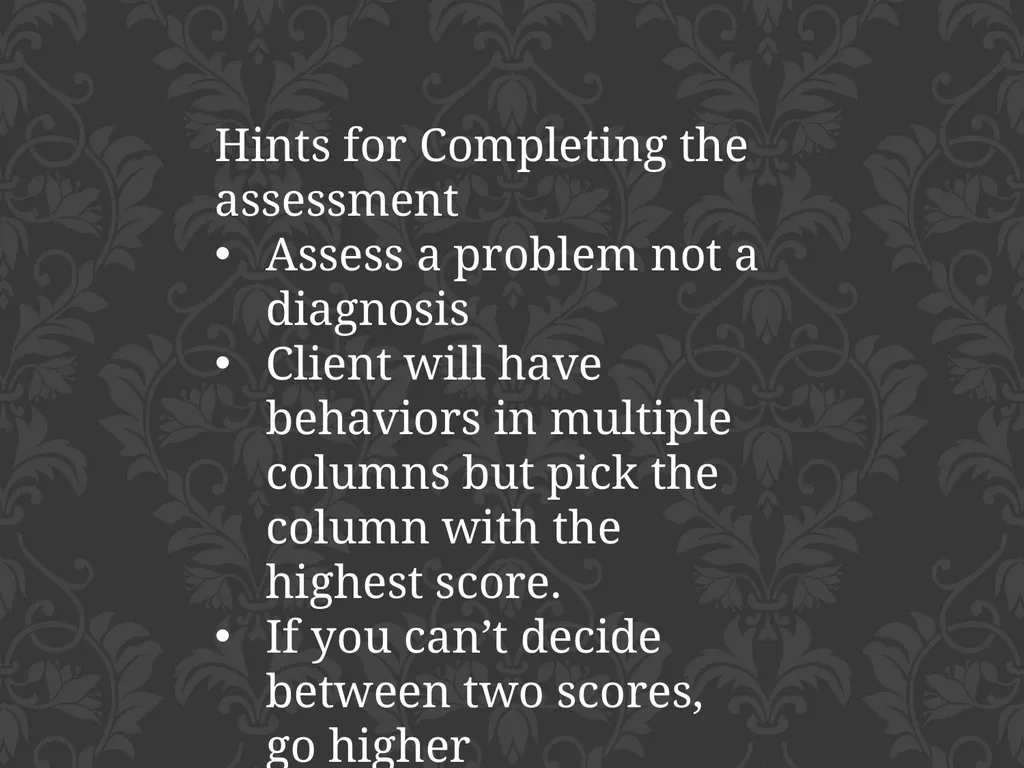
Hints for Completing the assessment
Assess a problem not a diagnosis
Client will have behaviors in multiple columns but pick the column with the highest score.
If you can’t decide between two scores, go higher<br>
Assess a problem not a diagnosis
Client will have behaviors in multiple columns but pick the column with the highest score.
If you can’t decide between two scores, go higher<br>
22
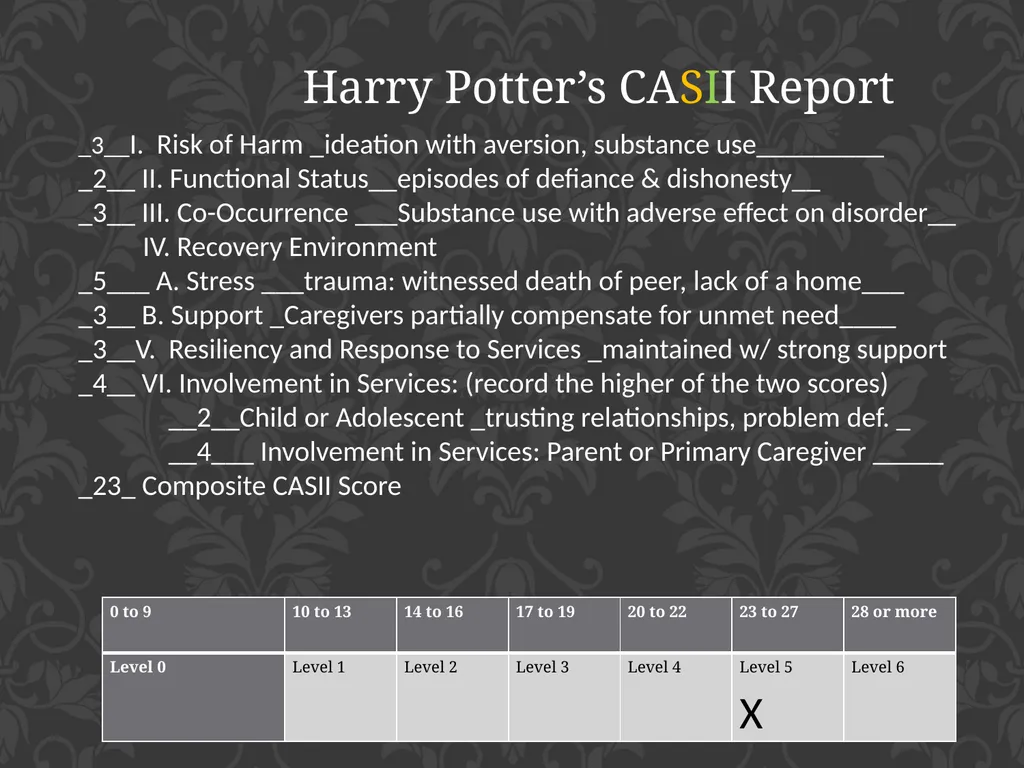
_3__I. Risk of Harm _ideation with aversion, substance use_________
_2__ II. Functional Status__episodes of defiance & dishonesty__
_3__ III. Co-Occurrence ___Substance use with adverse effect on disorder__
IV. Recovery Environment
_5___ A. Stress ___trauma: witnessed death of peer, lack of a home___
_3__ B. Support _Caregivers partially compensate for unmet need____
_3__V. Resiliency and Response to Services _maintained w/ strong support
_4__ VI. Involvement in Services: (record the higher of the two scores)
__2__Child or Adolescent _trusting relationships, problem def. _
__4___ Involvement in Services: Parent or Primary Caregiver _____
_23_ Composite CASII Score Harry Potter’s CASII Report<br>
_2__ II. Functional Status__episodes of defiance & dishonesty__
_3__ III. Co-Occurrence ___Substance use with adverse effect on disorder__
IV. Recovery Environment
_5___ A. Stress ___trauma: witnessed death of peer, lack of a home___
_3__ B. Support _Caregivers partially compensate for unmet need____
_3__V. Resiliency and Response to Services _maintained w/ strong support
_4__ VI. Involvement in Services: (record the higher of the two scores)
__2__Child or Adolescent _trusting relationships, problem def. _
__4___ Involvement in Services: Parent or Primary Caregiver _____
_23_ Composite CASII Score Harry Potter’s CASII Report<br>
23
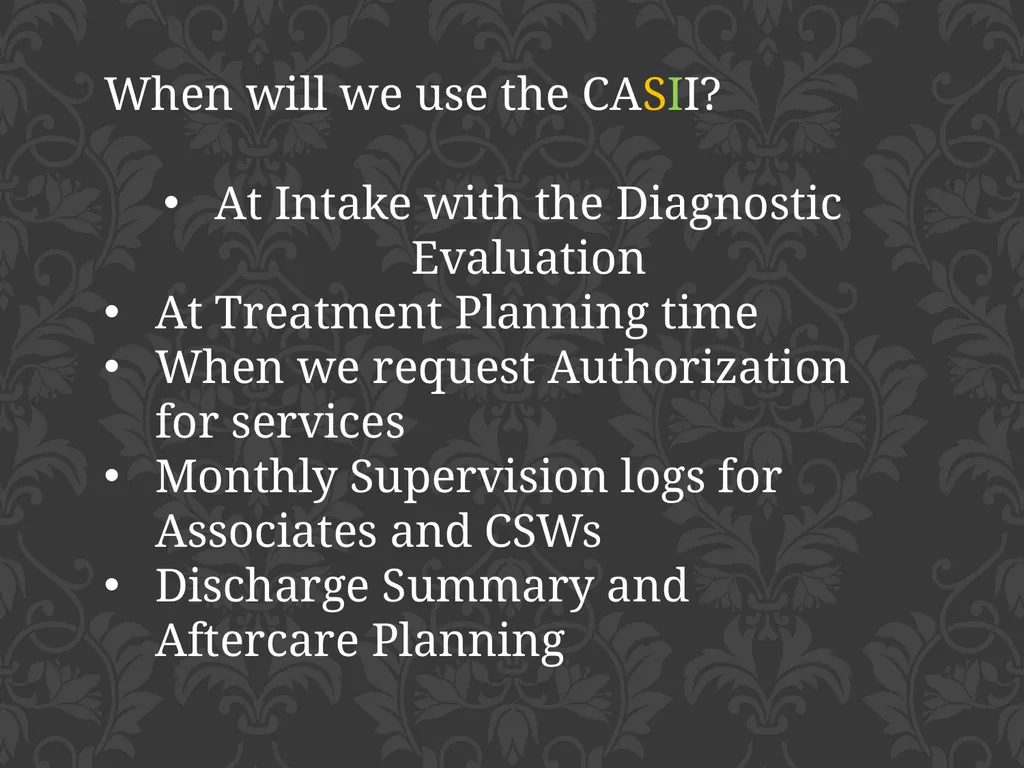
When will we use the CASII?
At Intake with the Diagnostic Evaluation
At Treatment Planning time
When we request Authorization for services
Monthly Supervision logs for Associates and CSWs
Discharge Summary and Aftercare Planning<br>
At Intake with the Diagnostic Evaluation
At Treatment Planning time
When we request Authorization for services
Monthly Supervision logs for Associates and CSWs
Discharge Summary and Aftercare Planning<br>
24
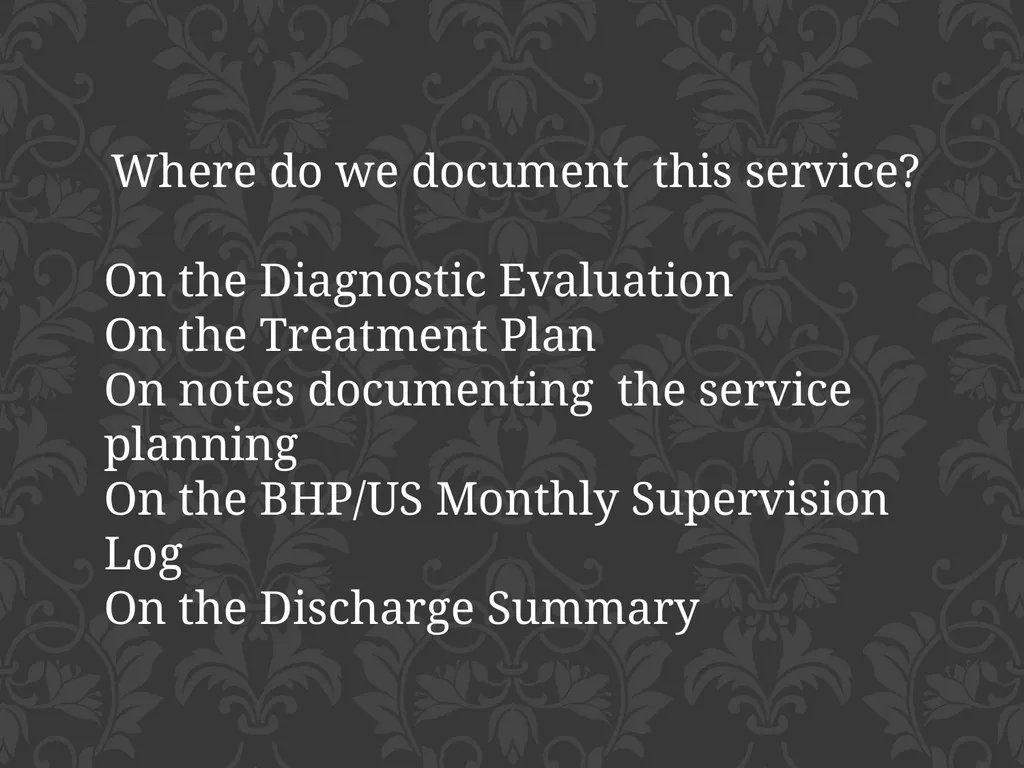
Where do we document this service?
On the Diagnostic Evaluation
On the Treatment Plan
On notes documenting the service planning
On the BHP/US Monthly Supervision Log
On the Discharge Summary<br>
On the Diagnostic Evaluation
On the Treatment Plan
On notes documenting the service planning
On the BHP/US Monthly Supervision Log
On the Discharge Summary<br>
25
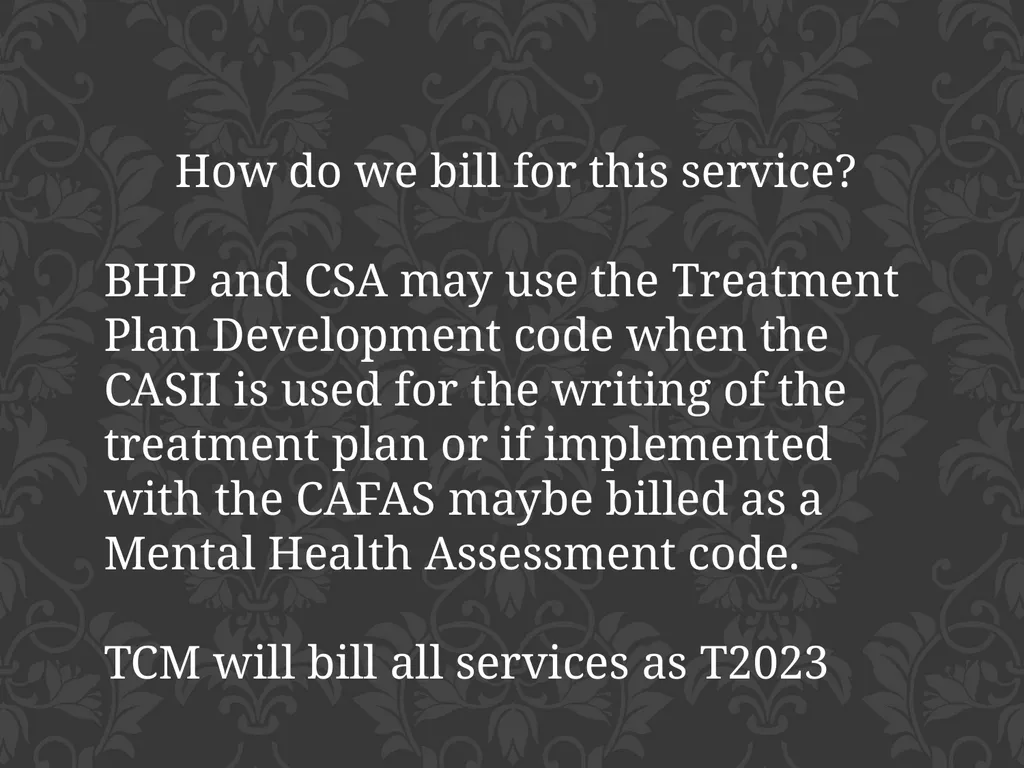
How do we bill for this service?
BHP and CSA may use the Treatment Plan Development code when the CASII is used for the writing of the treatment plan or if implemented with the CAFAS maybe billed as a Mental Health Assessment code.
TCM will bill all services as T2023<br>
BHP and CSA may use the Treatment Plan Development code when the CASII is used for the writing of the treatment plan or if implemented with the CAFAS maybe billed as a Mental Health Assessment code.
TCM will bill all services as T2023<br>
26
Level of care utilization services LOCUS<br>
27
The CASII was developed from the LOCUS so you will find that these two assessment tools are very similar
The LOCUS also assesses intensity of need in six dimensions and utilizes a 5 point scale to quantify severity
The LOCUS correlates the severity of the behavior with the intensity of services<br>
The LOCUS also assesses intensity of need in six dimensions and utilizes a 5 point scale to quantify severity
The LOCUS correlates the severity of the behavior with the intensity of services<br>
28
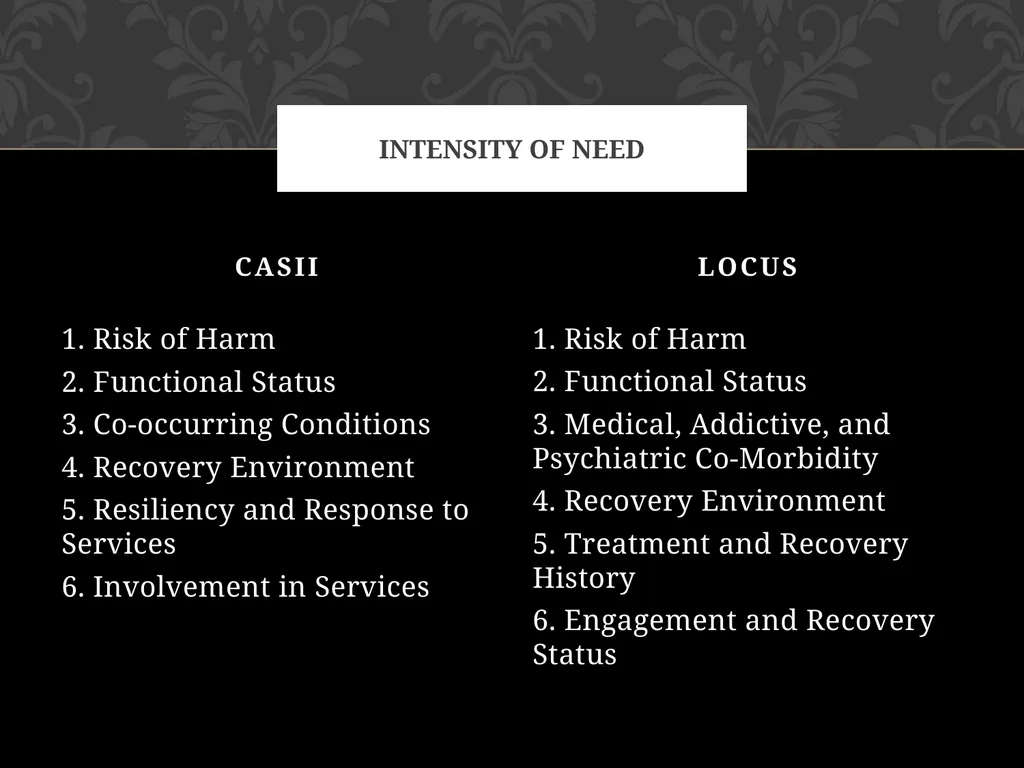
1. Risk of Harm
2. Functional Status
3. Co-occurring Conditions
4. Recovery Environment
5. Resiliency and Response to Services
6. Involvement in Services 1. Risk of Harm
2. Functional Status
3. Medical, Addictive, and Psychiatric Co-Morbidity
4. Recovery Environment
5. Treatment and Recovery History
6. Engagement and Recovery Status CASII LOCUS Intensity of Need<br>
2. Functional Status
3. Co-occurring Conditions
4. Recovery Environment
5. Resiliency and Response to Services
6. Involvement in Services 1. Risk of Harm
2. Functional Status
3. Medical, Addictive, and Psychiatric Co-Morbidity
4. Recovery Environment
5. Treatment and Recovery History
6. Engagement and Recovery Status CASII LOCUS Intensity of Need<br>
29
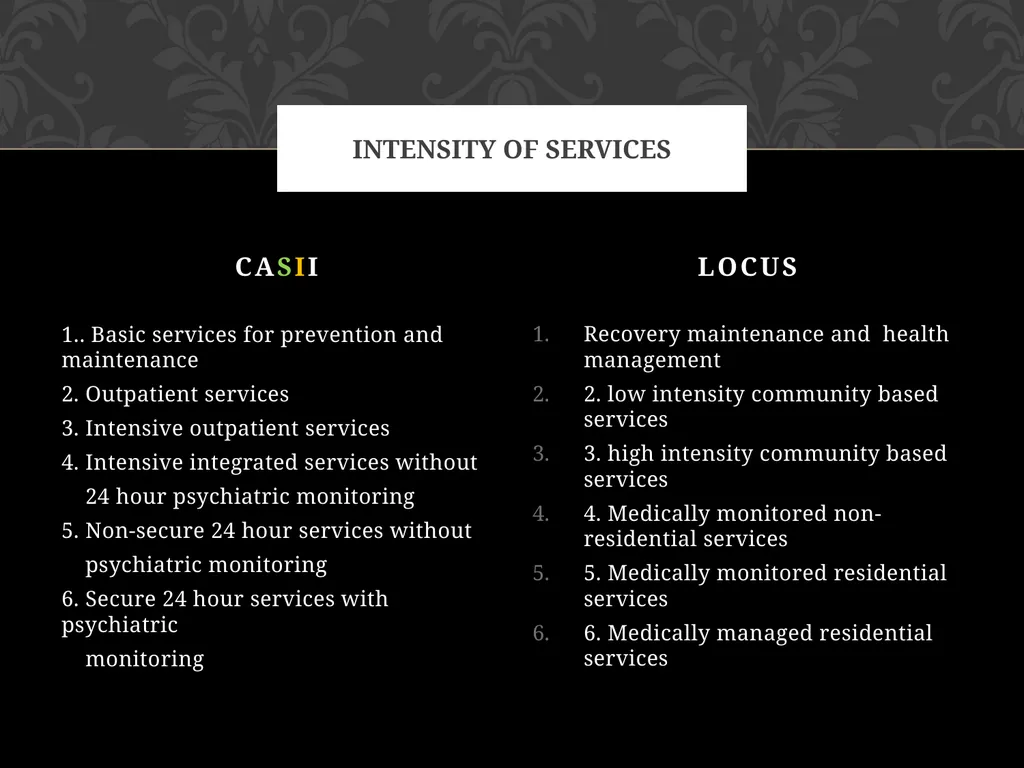
1.. Basic services for prevention and maintenance
2. Outpatient services
3. Intensive outpatient services
4. Intensive integrated services without
24 hour psychiatric monitoring
5. Non-secure 24 hour services without
psychiatric monitoring
6. Secure 24 hour services with psychiatric
monitoring Recovery maintenance and health management
2. low intensity community based services
3. high intensity community based services
4. Medically monitored non-residential services
5. Medically monitored residential services
6. Medically managed residential services CASII LOCUS INTENSITY OF SERVICES<br>
2. Outpatient services
3. Intensive outpatient services
4. Intensive integrated services without
24 hour psychiatric monitoring
5. Non-secure 24 hour services without
psychiatric monitoring
6. Secure 24 hour services with psychiatric
monitoring Recovery maintenance and health management
2. low intensity community based services
3. high intensity community based services
4. Medically monitored non-residential services
5. Medically monitored residential services
6. Medically managed residential services CASII LOCUS INTENSITY OF SERVICES<br>
30
The LOCUS manual is posted on our website
As well as a power point presentation by Mary Thornton, a Medicaid trainer<br>
As well as a power point presentation by Mary Thornton, a Medicaid trainer<br>
31
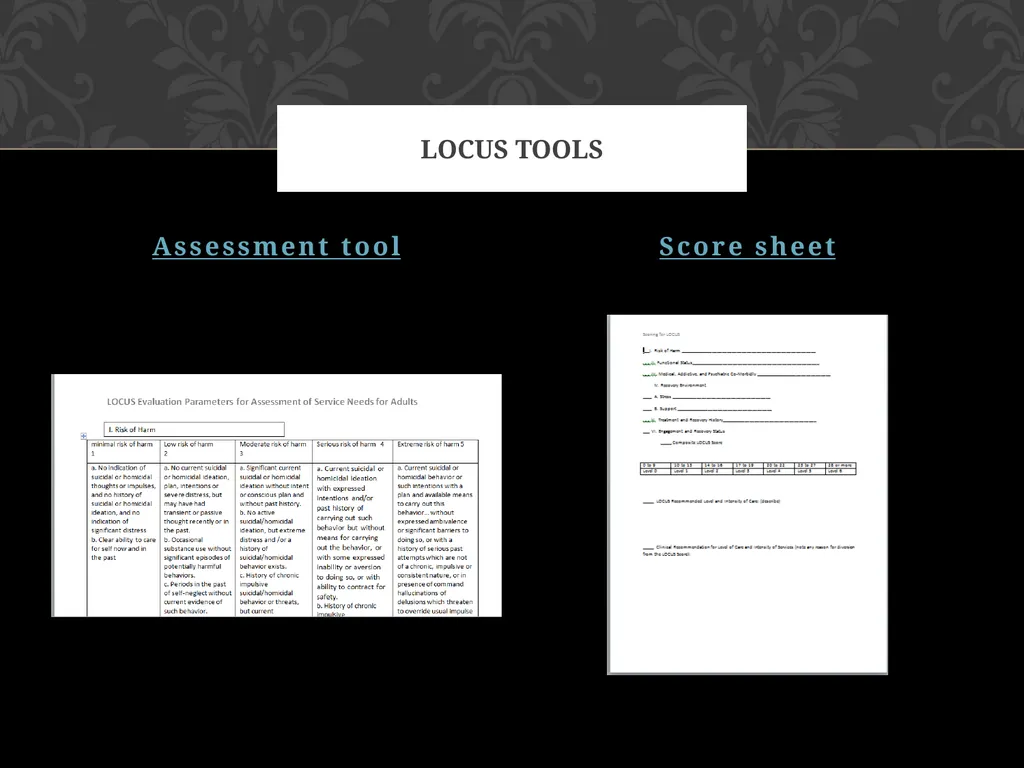
Assessment tool Score sheet LOCUS TOOls<br>
32
Lars and the real girl A delightful movie<br>
33
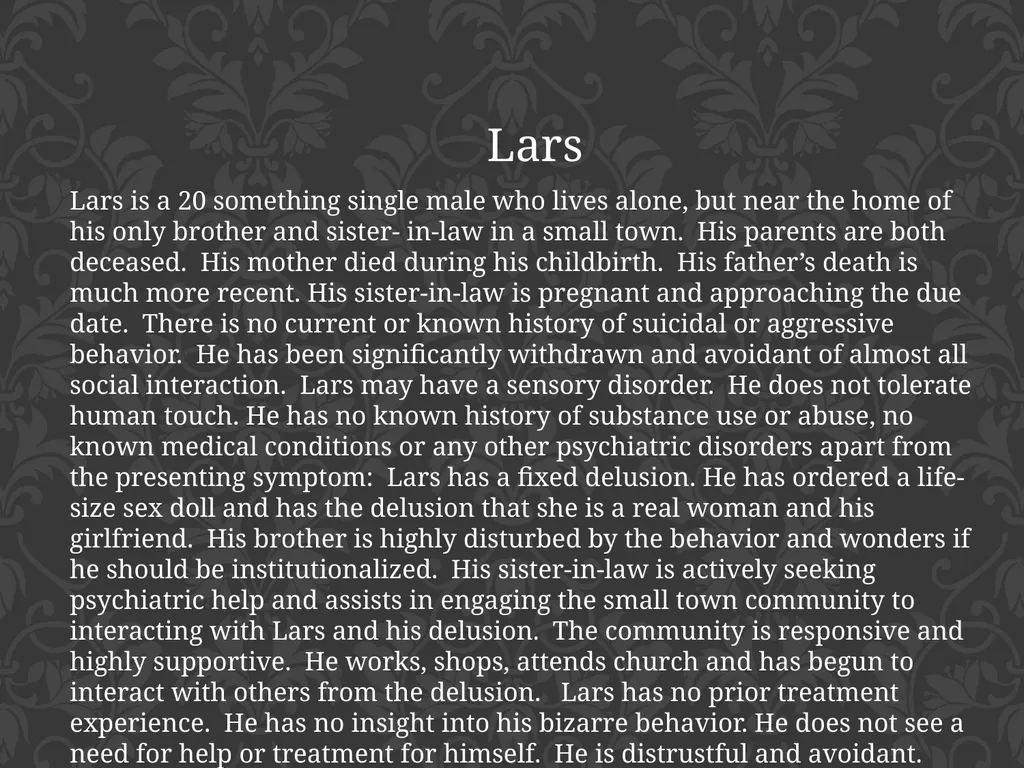
Lars is a 20 something single male who lives alone, but near the home of his only brother and sister- in-law in a small town. His parents are both deceased. His mother died during his childbirth. His father’s death is much more recent. His sister-in-law is pregnant and approaching the due date. There is no current or known history of suicidal or aggressive behavior. He has been significantly withdrawn and avoidant of almost all social interaction. Lars may have a sensory disorder. He does not tolerate human touch. He has no known history of substance use or abuse, no known medical conditions or any other psychiatric disorders apart from the presenting symptom: Lars has a fixed delusion. He has ordered a life-size sex doll and has the delusion that she is a real woman and his girlfriend. His brother is highly disturbed by the behavior and wonders if he should be institutionalized. His sister-in-law is actively seeking psychiatric help and assists in engaging the small town community to interacting with Lars and his delusion. The community is responsive and highly supportive. He works, shops, attends church and has begun to interact with others from the delusion. Lars has no prior treatment experience. He has no insight into his bizarre behavior. He does not see a need for help or treatment for himself. He is distrustful and avoidant.
What is his LOCUS score and level of service intensity? Lars<br>
What is his LOCUS score and level of service intensity? Lars<br>
34
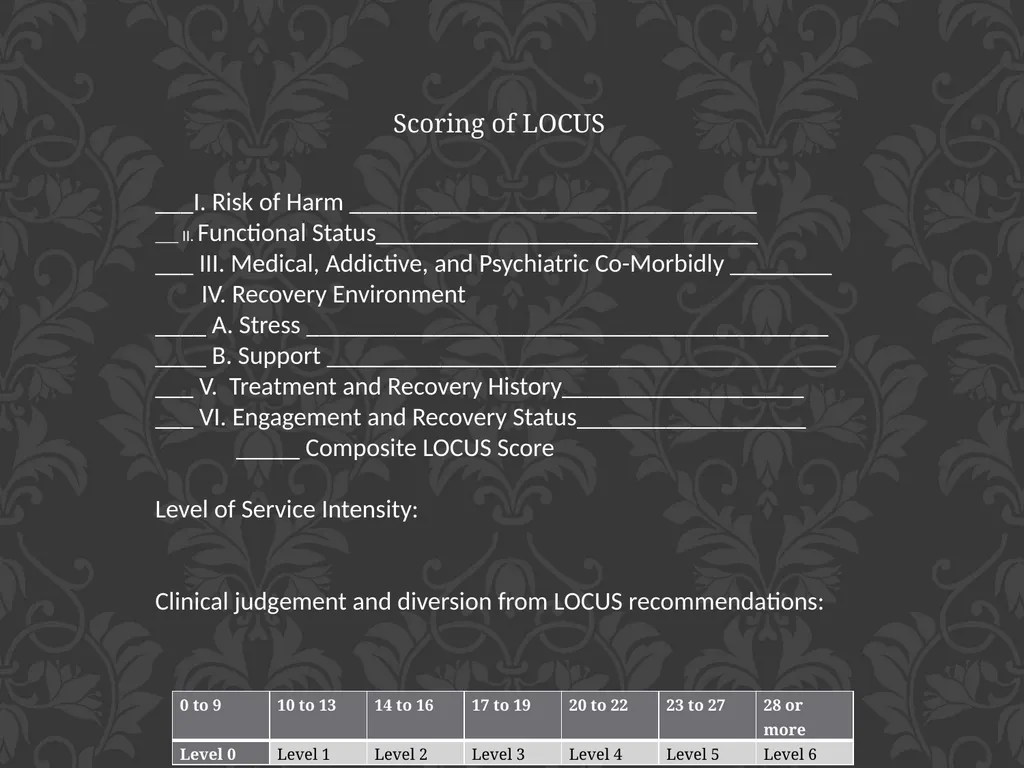
___I. Risk of Harm ________________________________
___ II. Functional Status______________________________
___ III. Medical, Addictive, and Psychiatric Co-Morbidly ________
IV. Recovery Environment
____ A. Stress _________________________________________
____ B. Support ________________________________________
___ V. Treatment and Recovery History___________________
___ VI. Engagement and Recovery Status__________________
_____ Composite LOCUS Score
Level of Service Intensity:
Clinical judgement and diversion from LOCUS recommendations: Scoring of LOCUS<br>
___ II. Functional Status______________________________
___ III. Medical, Addictive, and Psychiatric Co-Morbidly ________
IV. Recovery Environment
____ A. Stress _________________________________________
____ B. Support ________________________________________
___ V. Treatment and Recovery History___________________
___ VI. Engagement and Recovery Status__________________
_____ Composite LOCUS Score
Level of Service Intensity:
Clinical judgement and diversion from LOCUS recommendations: Scoring of LOCUS<br>
35
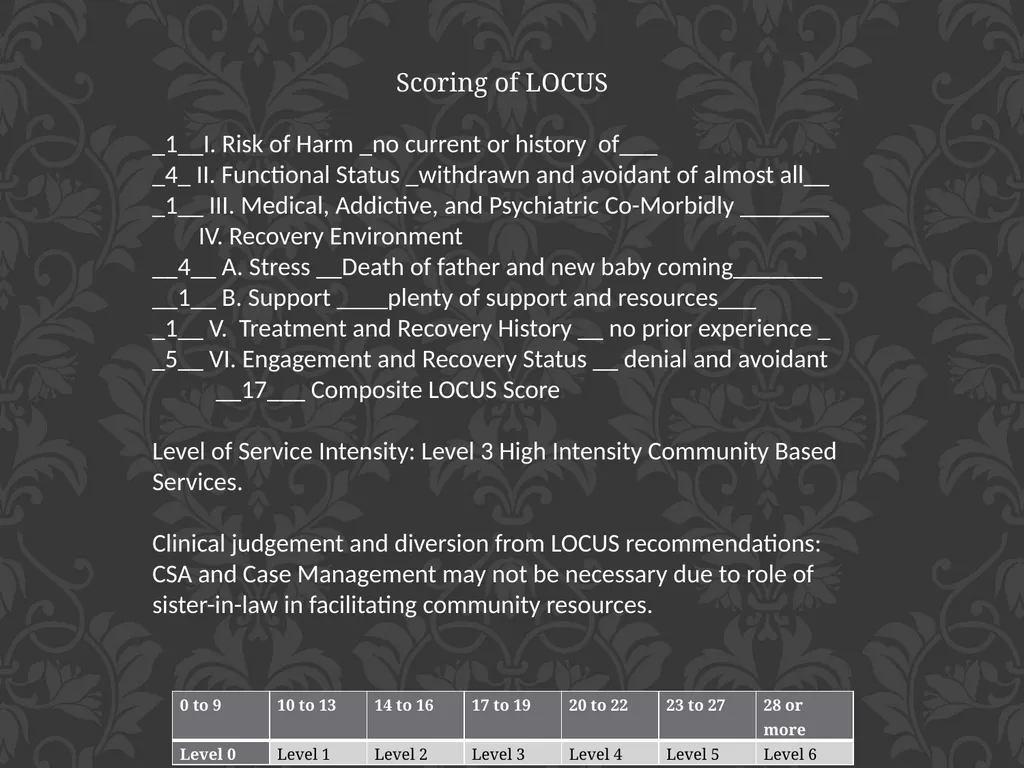
_1__I. Risk of Harm _no current or history of___
_4_ II. Functional Status _withdrawn and avoidant of almost all__
_1__ III. Medical, Addictive, and Psychiatric Co-Morbidly _______
IV. Recovery Environment
__4__ A. Stress __Death of father and new baby coming_______
__1__ B. Support ____plenty of support and resources___
_1__ V. Treatment and Recovery History __ no prior experience _
_5__ VI. Engagement and Recovery Status __ denial and avoidant __17___ Composite LOCUS Score
Level of Service Intensity: Level 3 High Intensity Community Based Services.
Clinical judgement and diversion from LOCUS recommendations: CSA and Case Management may not be necessary due to role of sister-in-law in facilitating community resources. Scoring of LOCUS<br>
_4_ II. Functional Status _withdrawn and avoidant of almost all__
_1__ III. Medical, Addictive, and Psychiatric Co-Morbidly _______
IV. Recovery Environment
__4__ A. Stress __Death of father and new baby coming_______
__1__ B. Support ____plenty of support and resources___
_1__ V. Treatment and Recovery History __ no prior experience _
_5__ VI. Engagement and Recovery Status __ denial and avoidant __17___ Composite LOCUS Score
Level of Service Intensity: Level 3 High Intensity Community Based Services.
Clinical judgement and diversion from LOCUS recommendations: CSA and Case Management may not be necessary due to role of sister-in-law in facilitating community resources. Scoring of LOCUS<br>
36
Early Childhood Service Intensity Instrument ESCII<br>
37
The Early Childhood Service Intensity Instrument (ESCII) was developed to determine intensity for services for children age 0 to 5<br>
38
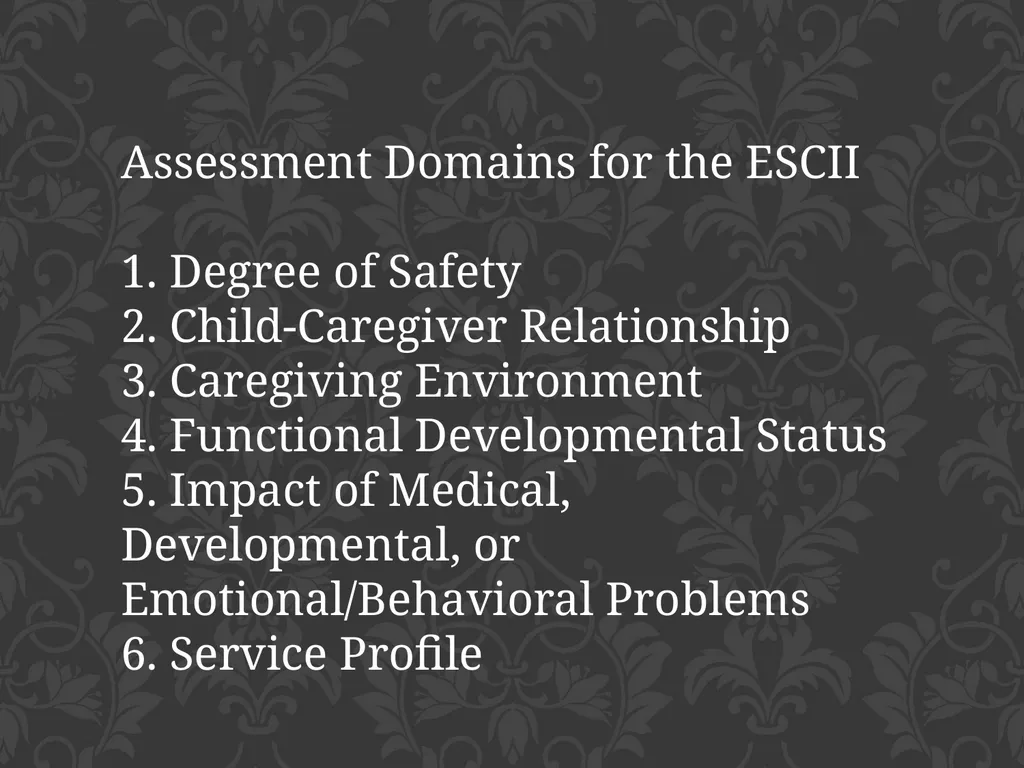
Assessment Domains for the ESCII
1. Degree of Safety
2. Child-Caregiver Relationship
3. Caregiving Environment
4. Functional Developmental Status
5. Impact of Medical, Developmental, or Emotional/Behavioral Problems
6. Service Profile<br>
1. Degree of Safety
2. Child-Caregiver Relationship
3. Caregiving Environment
4. Functional Developmental Status
5. Impact of Medical, Developmental, or Emotional/Behavioral Problems
6. Service Profile<br>
39
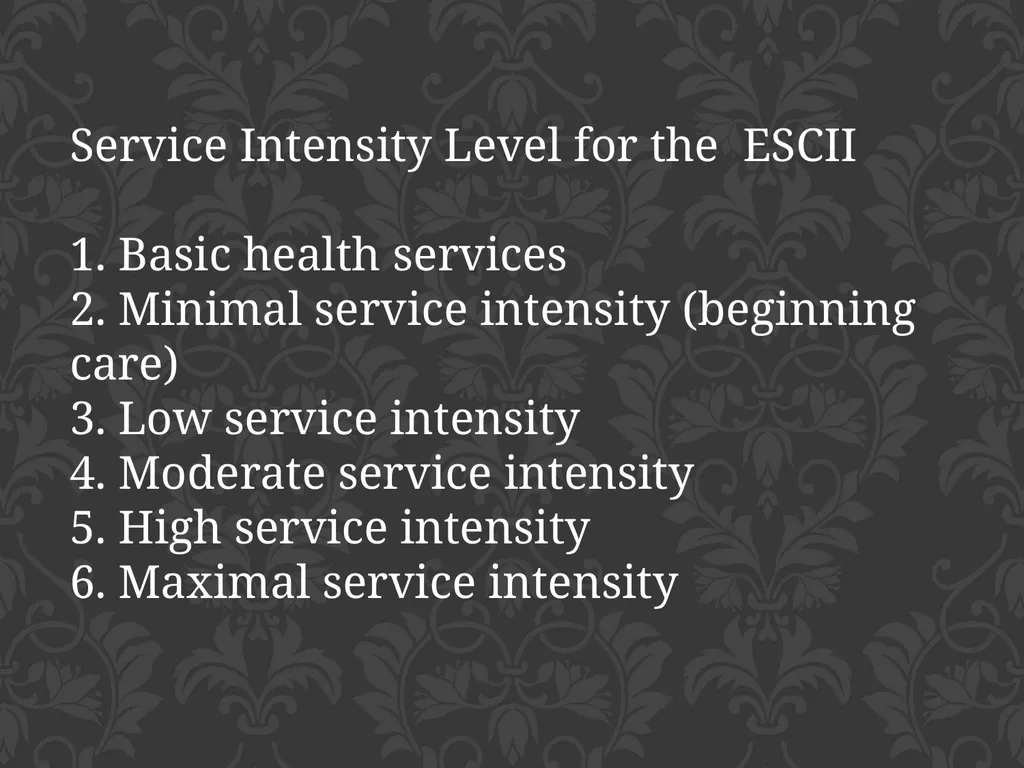
Service Intensity Level for the ESCII
1. Basic health services
2. Minimal service intensity (beginning care)
3. Low service intensity
4. Moderate service intensity
5. High service intensity
6. Maximal service intensity<br>
1. Basic health services
2. Minimal service intensity (beginning care)
3. Low service intensity
4. Moderate service intensity
5. High service intensity
6. Maximal service intensity<br>
40
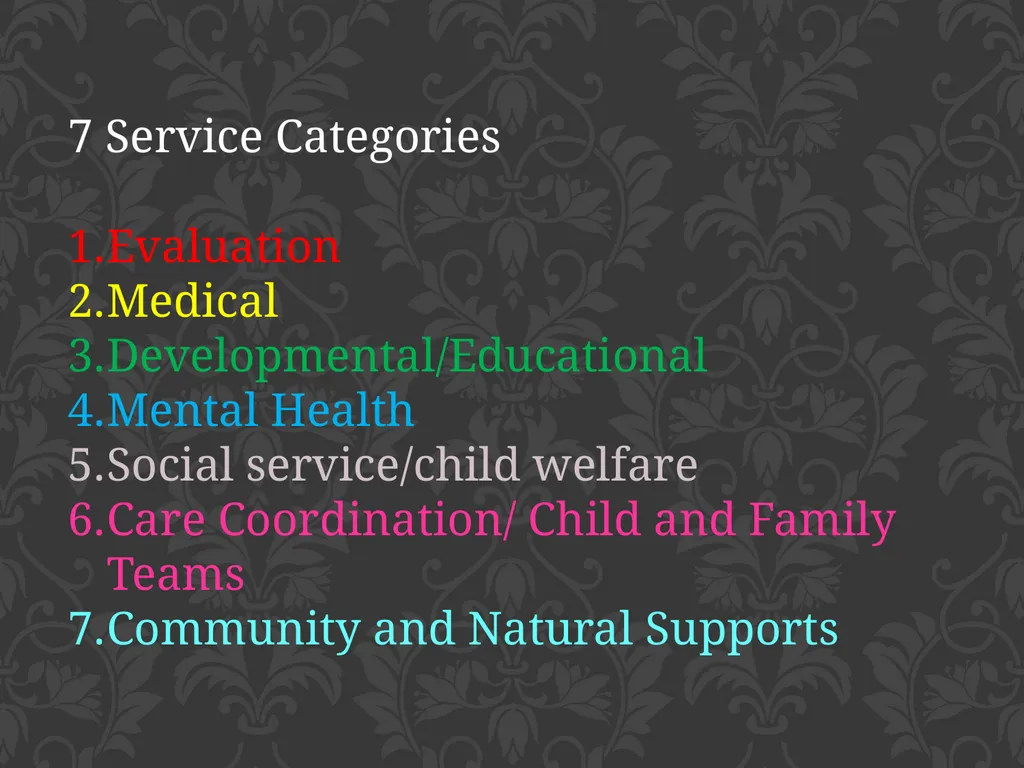
7 Service Categories
Evaluation
Medical
Developmental/Educational
Mental Health
Social service/child welfare
Care Coordination/ Child and Family Teams
Community and Natural Supports<br>
Evaluation
Medical
Developmental/Educational
Mental Health
Social service/child welfare
Care Coordination/ Child and Family Teams
Community and Natural Supports<br>
41
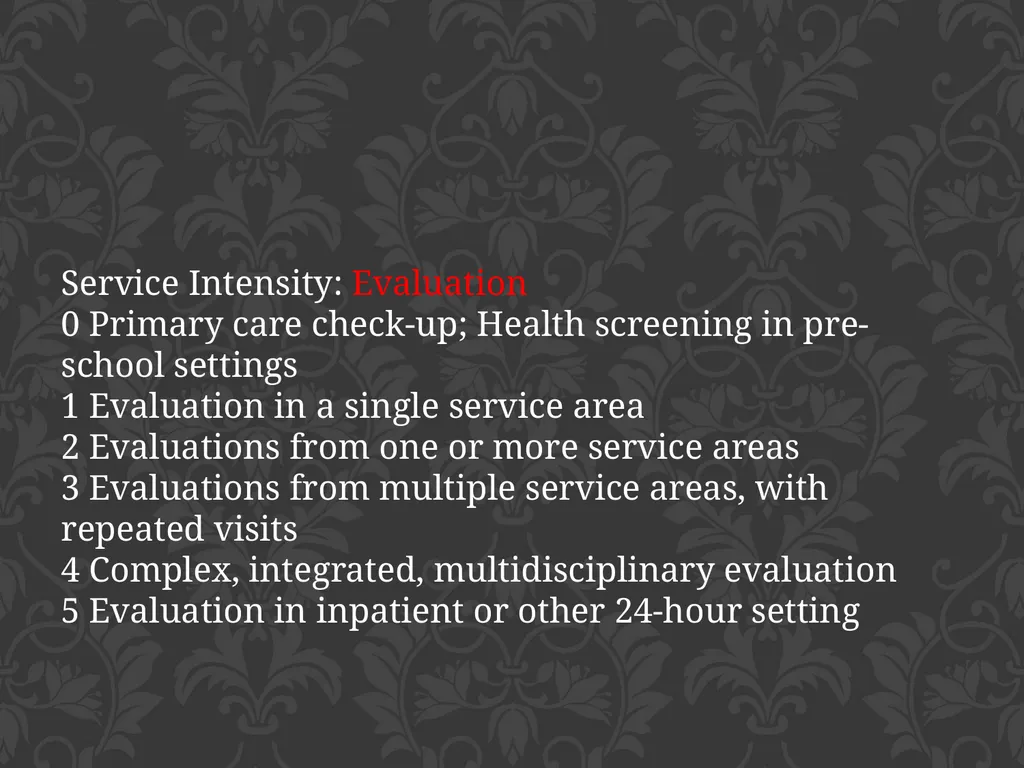
Service Intensity: Evaluation
0 Primary care check-up; Health screening in pre-school settings
1 Evaluation in a single service area
2 Evaluations from one or more service areas
3 Evaluations from multiple service areas, with repeated visits
4 Complex, integrated, multidisciplinary evaluation
5 Evaluation in inpatient or other 24-hour setting<br>
0 Primary care check-up; Health screening in pre-school settings
1 Evaluation in a single service area
2 Evaluations from one or more service areas
3 Evaluations from multiple service areas, with repeated visits
4 Complex, integrated, multidisciplinary evaluation
5 Evaluation in inpatient or other 24-hour setting<br>
42
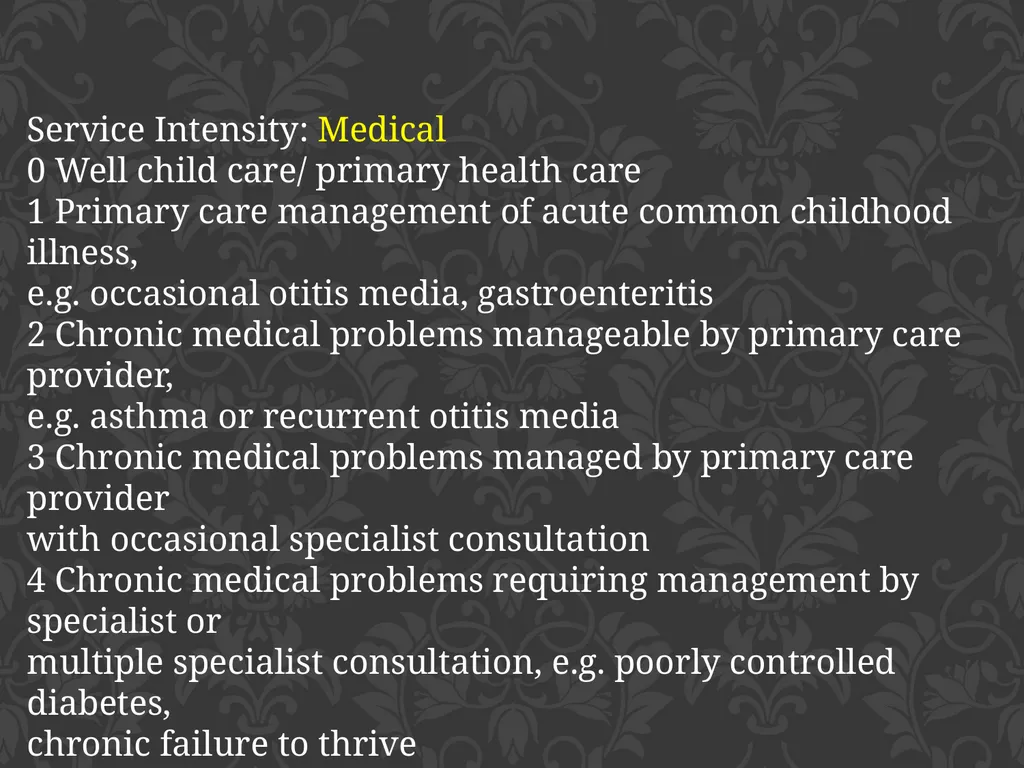
Service Intensity: Medical
0 Well child care/ primary health care
1 Primary care management of acute common childhood illness,
e.g. occasional otitis media, gastroenteritis
2 Chronic medical problems manageable by primary care provider,
e.g. asthma or recurrent otitis media
3 Chronic medical problems managed by primary care provider
with occasional specialist consultation
4 Chronic medical problems requiring management by specialist or
multiple specialist consultation, e.g. poorly controlled diabetes,
chronic failure to thrive
5 Frequent hospital admissions, secure nursing facility or chronic
care facility; medical foster<br>
0 Well child care/ primary health care
1 Primary care management of acute common childhood illness,
e.g. occasional otitis media, gastroenteritis
2 Chronic medical problems manageable by primary care provider,
e.g. asthma or recurrent otitis media
3 Chronic medical problems managed by primary care provider
with occasional specialist consultation
4 Chronic medical problems requiring management by specialist or
multiple specialist consultation, e.g. poorly controlled diabetes,
chronic failure to thrive
5 Frequent hospital admissions, secure nursing facility or chronic
care facility; medical foster<br>
43
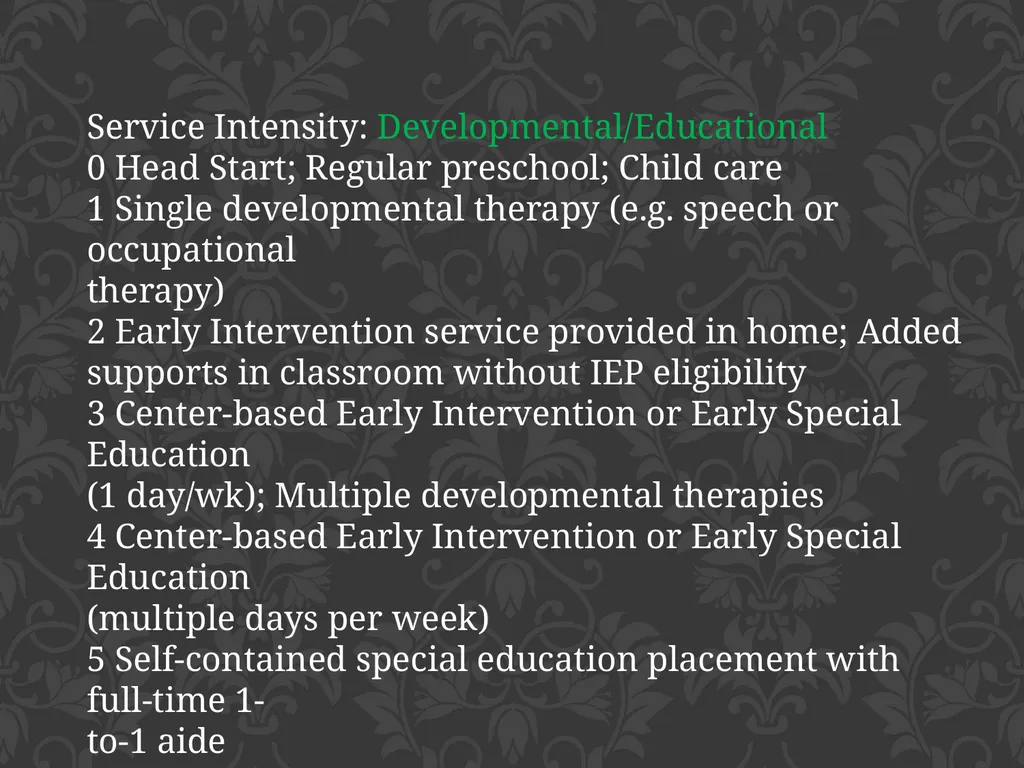
Service Intensity: Developmental/Educational
0 Head Start; Regular preschool; Child care
1 Single developmental therapy (e.g. speech or occupational
therapy)
2 Early Intervention service provided in home; Added
supports in classroom without IEP eligibility
3 Center-based Early Intervention or Early Special Education
(1 day/wk); Multiple developmental therapies
4 Center-based Early Intervention or Early Special Education
(multiple days per week)
5 Self-contained special education placement with full-time 1-
to-1 aide<br>
0 Head Start; Regular preschool; Child care
1 Single developmental therapy (e.g. speech or occupational
therapy)
2 Early Intervention service provided in home; Added
supports in classroom without IEP eligibility
3 Center-based Early Intervention or Early Special Education
(1 day/wk); Multiple developmental therapies
4 Center-based Early Intervention or Early Special Education
(multiple days per week)
5 Self-contained special education placement with full-time 1-
to-1 aide<br>
44
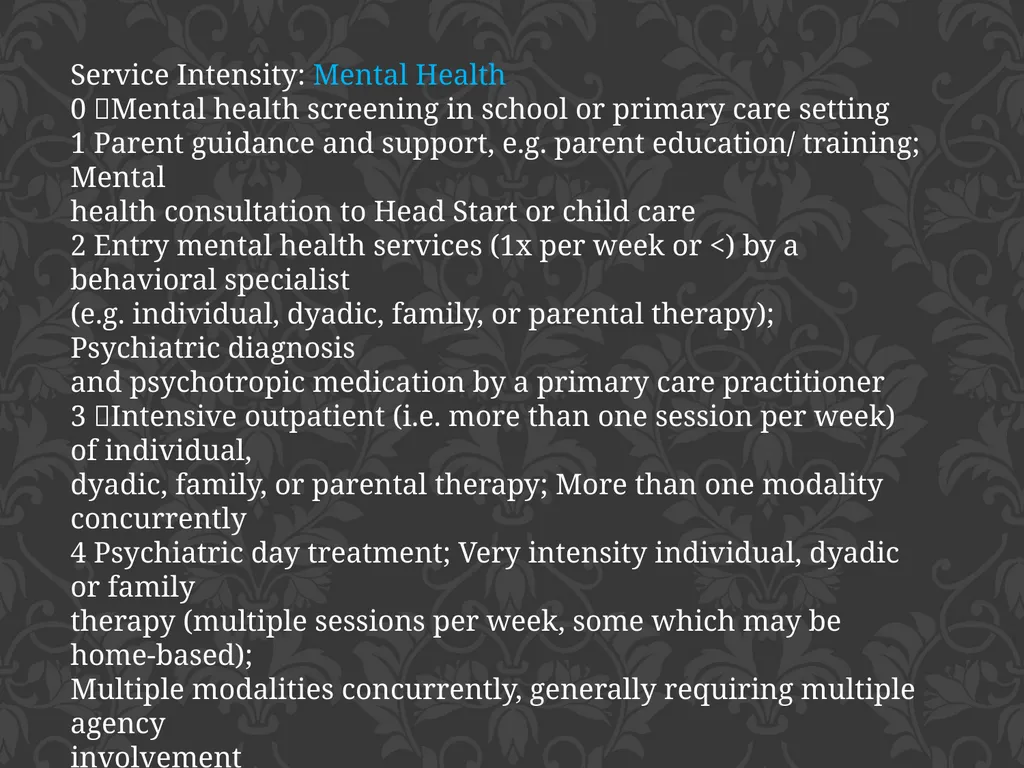
Service Intensity: Mental Health
0 Mental health screening in school or primary care setting
1 Parent guidance and support, e.g. parent education/ training; Mental
health consultation to Head Start or child care
2 Entry mental health services (1x per week or <) by a behavioral specialist
(e.g. individual, dyadic, family, or parental therapy); Psychiatric diagnosis
and psychotropic medication by a primary care practitioner
3 Intensive outpatient (i.e. more than one session per week) of individual,
dyadic, family, or parental therapy; More than one modality concurrently
4 Psychiatric day treatment; Very intensity individual, dyadic or family
therapy (multiple sessions per week, some which may be home-based);
Multiple modalities concurrently, generally requiring multiple agency
involvement
5 Therapeutic out-of-home placement (e.g. treatment foster care);
Psychiatric hospital (for children > 2 ½); Residential treatment<br>
0 Mental health screening in school or primary care setting
1 Parent guidance and support, e.g. parent education/ training; Mental
health consultation to Head Start or child care
2 Entry mental health services (1x per week or <) by a behavioral specialist
(e.g. individual, dyadic, family, or parental therapy); Psychiatric diagnosis
and psychotropic medication by a primary care practitioner
3 Intensive outpatient (i.e. more than one session per week) of individual,
dyadic, family, or parental therapy; More than one modality concurrently
4 Psychiatric day treatment; Very intensity individual, dyadic or family
therapy (multiple sessions per week, some which may be home-based);
Multiple modalities concurrently, generally requiring multiple agency
involvement
5 Therapeutic out-of-home placement (e.g. treatment foster care);
Psychiatric hospital (for children > 2 ½); Residential treatment<br>
45
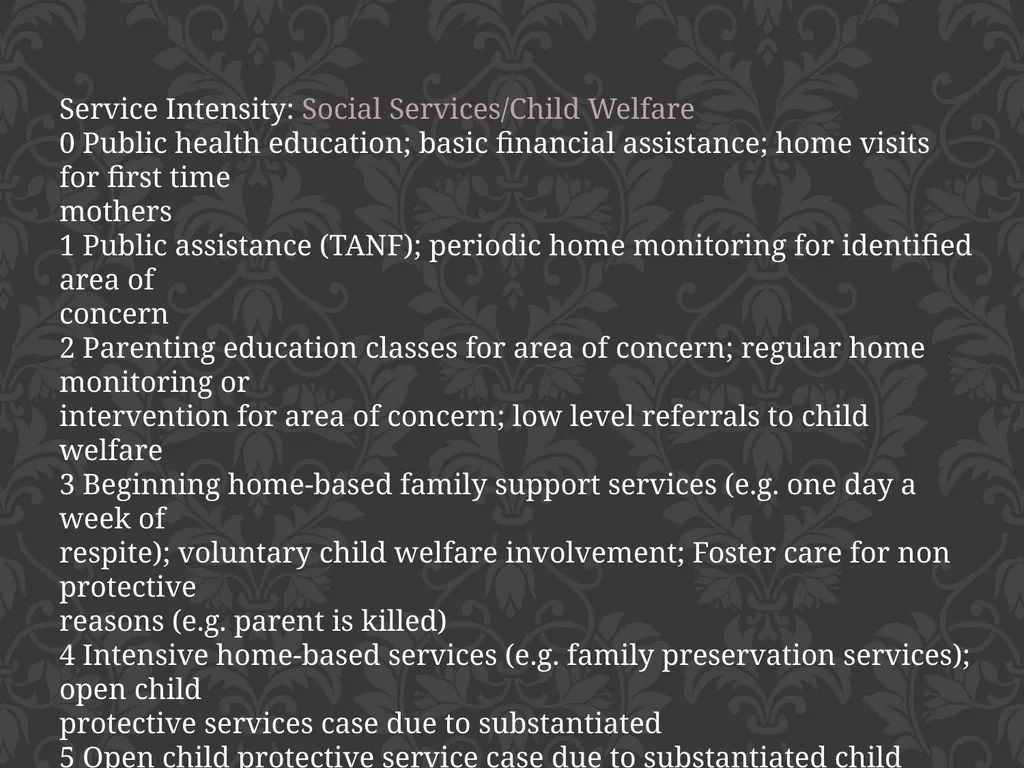
Service Intensity: Social Services/Child Welfare
0 Public health education; basic financial assistance; home visits for first time
mothers
1 Public assistance (TANF); periodic home monitoring for identified area of
concern
2 Parenting education classes for area of concern; regular home monitoring or
intervention for area of concern; low level referrals to child welfare
3 Beginning home-based family support services (e.g. one day a week of
respite); voluntary child welfare involvement; Foster care for non protective
reasons (e.g. parent is killed)
4 Intensive home-based services (e.g. family preservation services); open child
protective services case due to substantiated
5 Open child protective service case due to substantiated child maltreatment
that may require removal from the home; treatment foster care<br>
0 Public health education; basic financial assistance; home visits for first time
mothers
1 Public assistance (TANF); periodic home monitoring for identified area of
concern
2 Parenting education classes for area of concern; regular home monitoring or
intervention for area of concern; low level referrals to child welfare
3 Beginning home-based family support services (e.g. one day a week of
respite); voluntary child welfare involvement; Foster care for non protective
reasons (e.g. parent is killed)
4 Intensive home-based services (e.g. family preservation services); open child
protective services case due to substantiated
5 Open child protective service case due to substantiated child maltreatment
that may require removal from the home; treatment foster care<br>
46
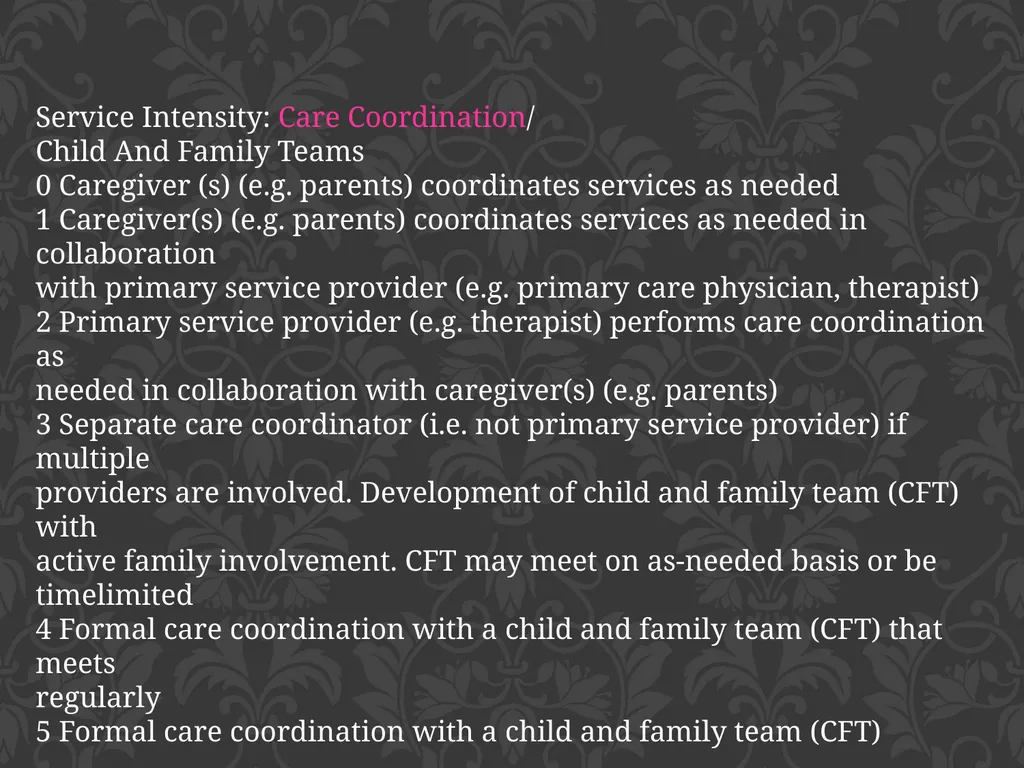
Service Intensity: Care Coordination/
Child And Family Teams
0 Caregiver (s) (e.g. parents) coordinates services as needed
1 Caregiver(s) (e.g. parents) coordinates services as needed in collaboration
with primary service provider (e.g. primary care physician, therapist)
2 Primary service provider (e.g. therapist) performs care coordination as
needed in collaboration with caregiver(s) (e.g. parents)
3 Separate care coordinator (i.e. not primary service provider) if multiple
providers are involved. Development of child and family team (CFT) with
active family involvement. CFT may meet on as-needed basis or be timelimited
4 Formal care coordination with a child and family team (CFT) that meets
regularly
5 Formal care coordination with a child and family team (CFT)<br>
Child And Family Teams
0 Caregiver (s) (e.g. parents) coordinates services as needed
1 Caregiver(s) (e.g. parents) coordinates services as needed in collaboration
with primary service provider (e.g. primary care physician, therapist)
2 Primary service provider (e.g. therapist) performs care coordination as
needed in collaboration with caregiver(s) (e.g. parents)
3 Separate care coordinator (i.e. not primary service provider) if multiple
providers are involved. Development of child and family team (CFT) with
active family involvement. CFT may meet on as-needed basis or be timelimited
4 Formal care coordination with a child and family team (CFT) that meets
regularly
5 Formal care coordination with a child and family team (CFT)<br>
47
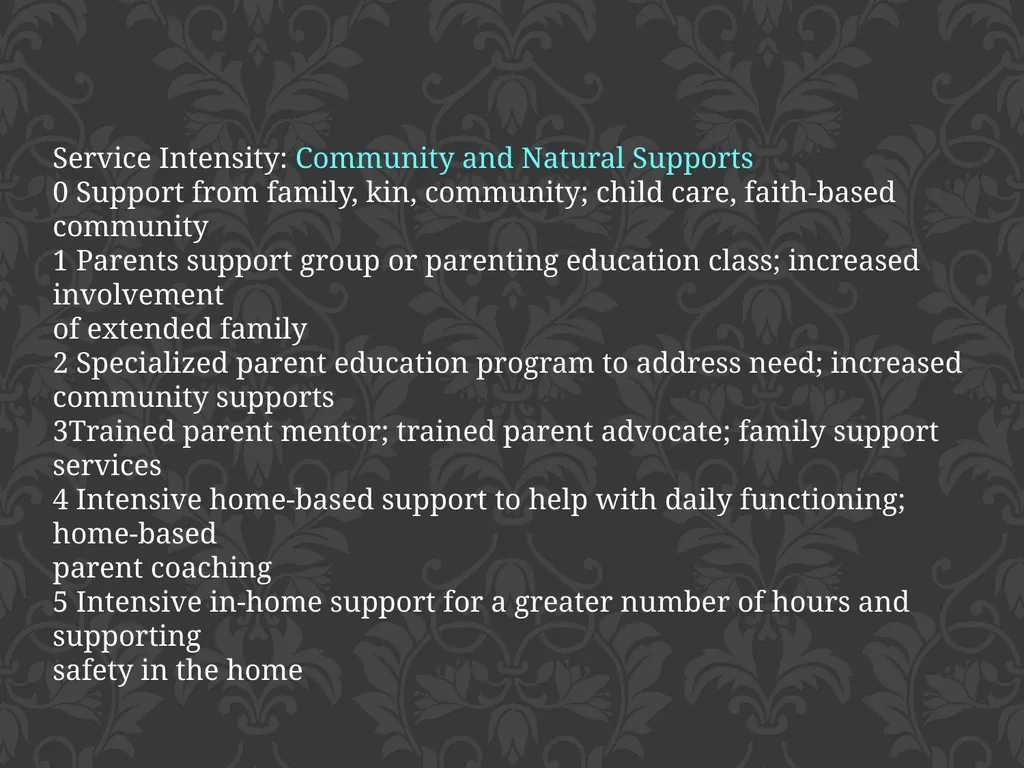
Service Intensity: Community and Natural Supports
0 Support from family, kin, community; child care, faith-based community
1 Parents support group or parenting education class; increased involvement
of extended family
2 Specialized parent education program to address need; increased
community supports
3Trained parent mentor; trained parent advocate; family support services
4 Intensive home-based support to help with daily functioning; home-based
parent coaching
5 Intensive in-home support for a greater number of hours and supporting
safety in the home<br>
0 Support from family, kin, community; child care, faith-based community
1 Parents support group or parenting education class; increased involvement
of extended family
2 Specialized parent education program to address need; increased
community supports
3Trained parent mentor; trained parent advocate; family support services
4 Intensive home-based support to help with daily functioning; home-based
parent coaching
5 Intensive in-home support for a greater number of hours and supporting
safety in the home<br>
48
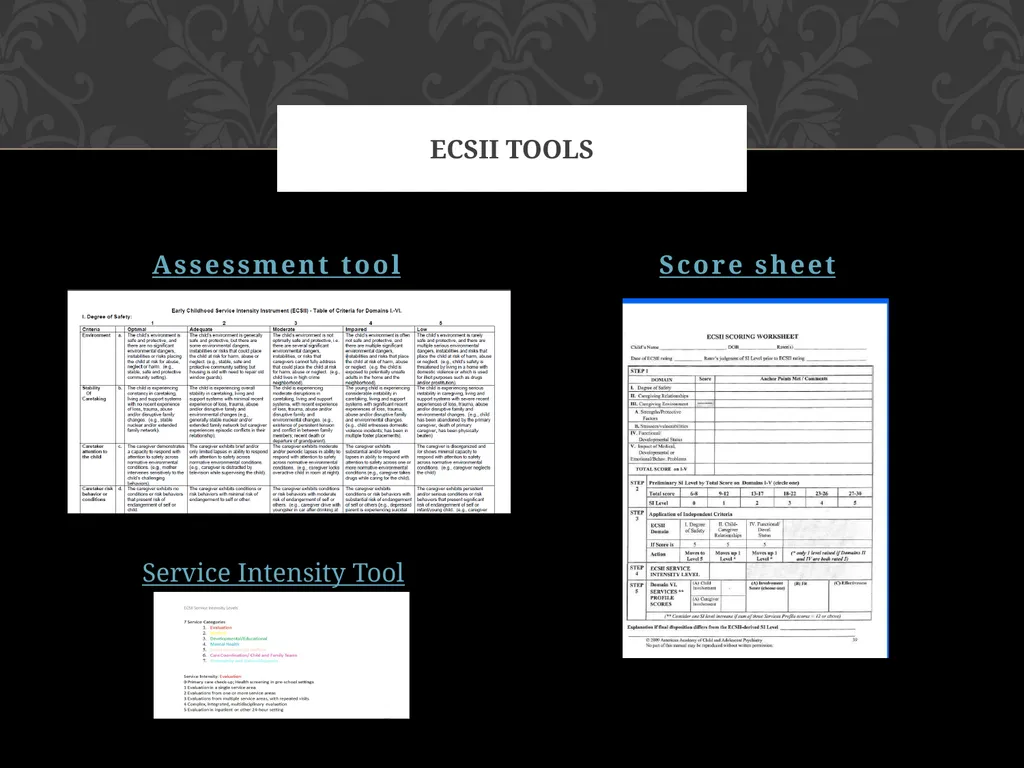
Assessment tool Score sheet ECSII Tools Service Intensity Tool<br>
49
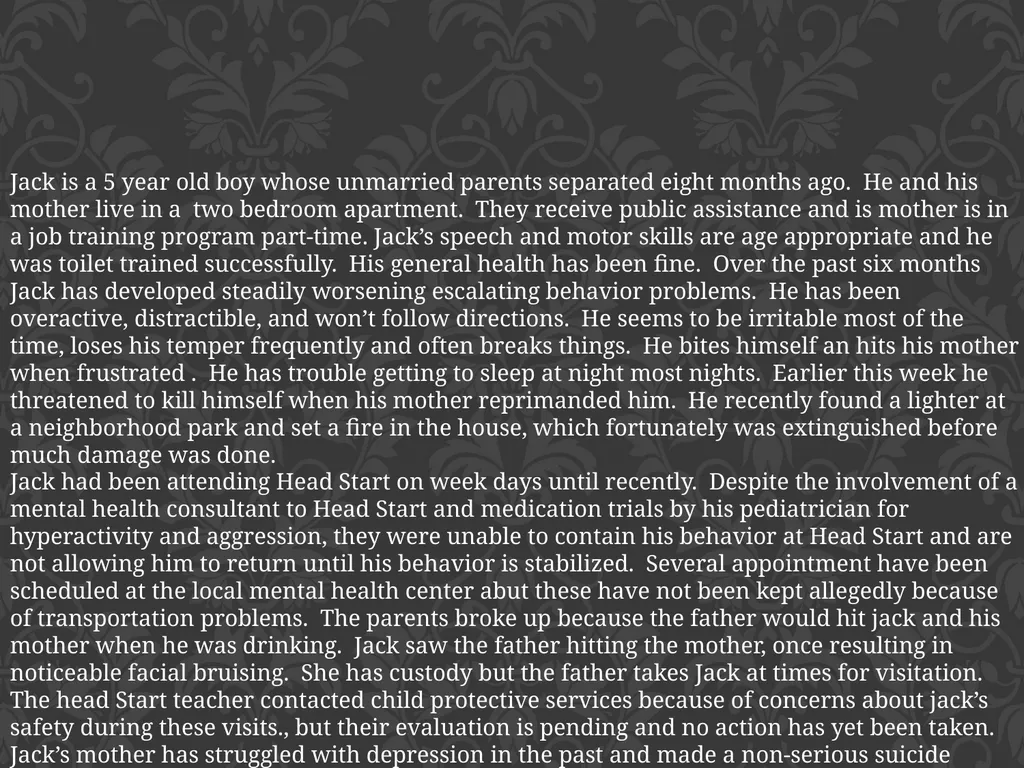
Jack is a 5 year old boy whose unmarried parents separated eight months ago. He and his mother live in a two bedroom apartment. They receive public assistance and is mother is in a job training program part-time. Jack’s speech and motor skills are age appropriate and he was toilet trained successfully. His general health has been fine. Over the past six months Jack has developed steadily worsening escalating behavior problems. He has been overactive, distractible, and won’t follow directions. He seems to be irritable most of the time, loses his temper frequently and often breaks things. He bites himself an hits his mother when frustrated . He has trouble getting to sleep at night most nights. Earlier this week he threatened to kill himself when his mother reprimanded him. He recently found a lighter at a neighborhood park and set a fire in the house, which fortunately was extinguished before much damage was done.
Jack had been attending Head Start on week days until recently. Despite the involvement of a mental health consultant to Head Start and medication trials by his pediatrician for hyperactivity and aggression, they were unable to contain his behavior at Head Start and are not allowing him to return until his behavior is stabilized. Several appointment have been scheduled at the local mental health center abut these have not been kept allegedly because of transportation problems. The parents broke up because the father would hit jack and his mother when he was drinking. Jack saw the father hitting the mother, once resulting in noticeable facial bruising. She has custody but the father takes Jack at times for visitation. The head Start teacher contacted child protective services because of concerns about jack’s safety during these visits., but their evaluation is pending and no action has yet been taken. Jack’s mother has struggled with depression in the past and made a non-serious suicide attempt by a pill overdose tow years ago. She was hospitalized briefly by elected not to pursue ongoing mental health treatment after discharge. She denies any history of substance abuse.<br>
Jack had been attending Head Start on week days until recently. Despite the involvement of a mental health consultant to Head Start and medication trials by his pediatrician for hyperactivity and aggression, they were unable to contain his behavior at Head Start and are not allowing him to return until his behavior is stabilized. Several appointment have been scheduled at the local mental health center abut these have not been kept allegedly because of transportation problems. The parents broke up because the father would hit jack and his mother when he was drinking. Jack saw the father hitting the mother, once resulting in noticeable facial bruising. She has custody but the father takes Jack at times for visitation. The head Start teacher contacted child protective services because of concerns about jack’s safety during these visits., but their evaluation is pending and no action has yet been taken. Jack’s mother has struggled with depression in the past and made a non-serious suicide attempt by a pill overdose tow years ago. She was hospitalized briefly by elected not to pursue ongoing mental health treatment after discharge. She denies any history of substance abuse.<br>
50
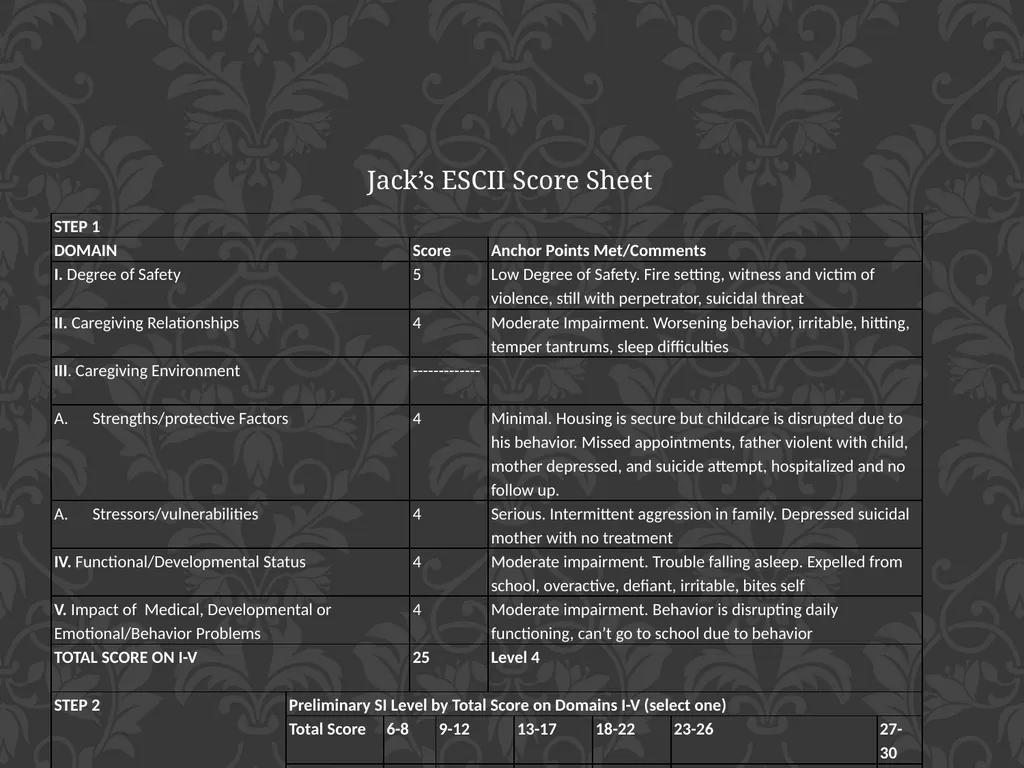
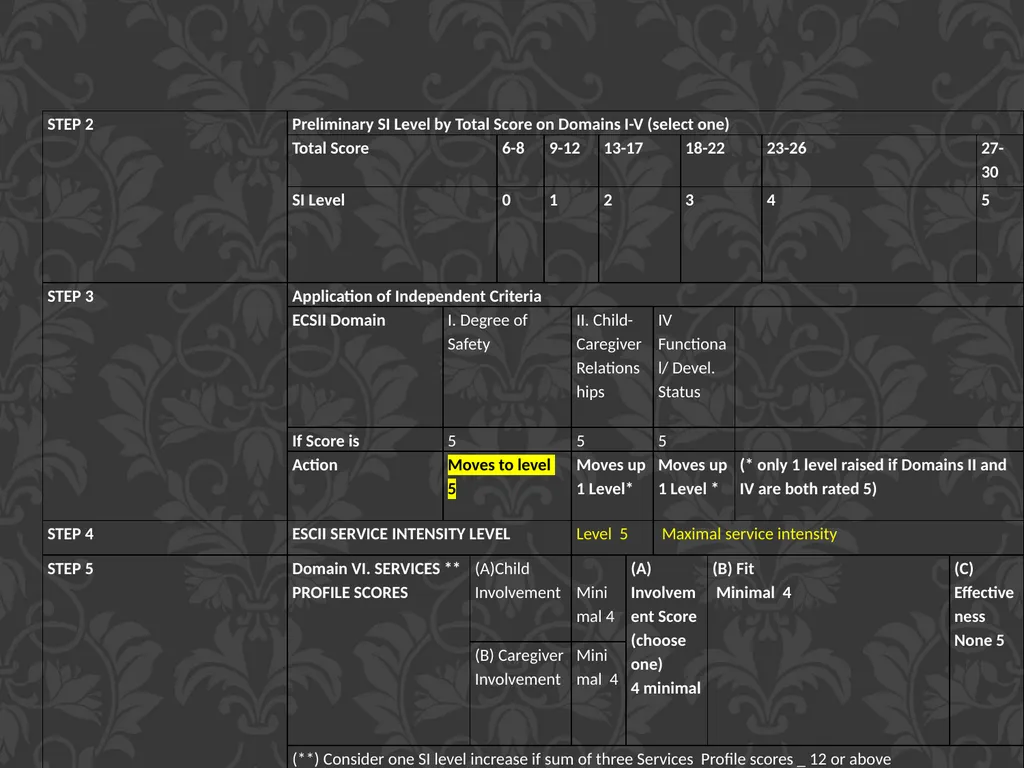
Jack’s ESCII Score Sheet<br>
51
Take a look at the Assessment tool and lets run through 6 dimensions of the Assessment<br>