
Child Development Revision Guide CNAT OCR TA3
PT
Published · 45 slides · 0 views
1 / 1




Description
Child Development Revision Guide CNAT OCR TA3 Topic Area 3: Postnatal checks, postnatal care and the conditions for development Name: Introduction Welcome to your TA2 Child Development Revision Booklet! This booklet is designed to be your
Related Topics
Share
Embed code
Download this presentation From Below
"Child Development Revision Guide CNAT OCR TA3" is the property of its rightful owner. Permission is granted to download and print the materials on this website for personal, non-commercial use only, and to display it on your personal computer provided you do not modify the materials and that you retain all copyright notices contained in the materials. By downloading content from our website, you accept the terms of this agreement.
Presentation Transcript
01
Child Development Revision Guide
CNAT OCR
TA3
Topic Area 3: Postnatal checks, postnatal care and the conditions for development Name:<br>
02
Introduction Welcome to your TA2 Child Development Revision Booklet! This booklet is designed to be your comprehensive guide to preparing for the OCR Child Development TA1 exam. Inside, you'll find everything you need to confidently tackle the assessment.
To help you organise your revision, we've included helpful checklists to break down the information into manageable chunks. Each section of the TA2 specification is covered, providing a clear and concise overview of the key concepts. We've also included QR codes throughout the booklet that link to helpful websites, offering supplementary information and different perspectives on the topics.
To really get you thinking and applying your knowledge, each section concludes with activities designed to address common misconceptions and challenge your understanding. You'll also find practice exam questions, complete with model answers, to give you a feel for the exam format and the level of detail required.
Finally, a comprehensive glossary of key terms is provided at the back of the booklet.
Don't forget to check the very back for a complete answer section for all the activities.
Good luck with your revision!<br>
To help you organise your revision, we've included helpful checklists to break down the information into manageable chunks. Each section of the TA2 specification is covered, providing a clear and concise overview of the key concepts. We've also included QR codes throughout the booklet that link to helpful websites, offering supplementary information and different perspectives on the topics.
To really get you thinking and applying your knowledge, each section concludes with activities designed to address common misconceptions and challenge your understanding. You'll also find practice exam questions, complete with model answers, to give you a feel for the exam format and the level of detail required.
Finally, a comprehensive glossary of key terms is provided at the back of the booklet.
Don't forget to check the very back for a complete answer section for all the activities.
Good luck with your revision!<br>
03
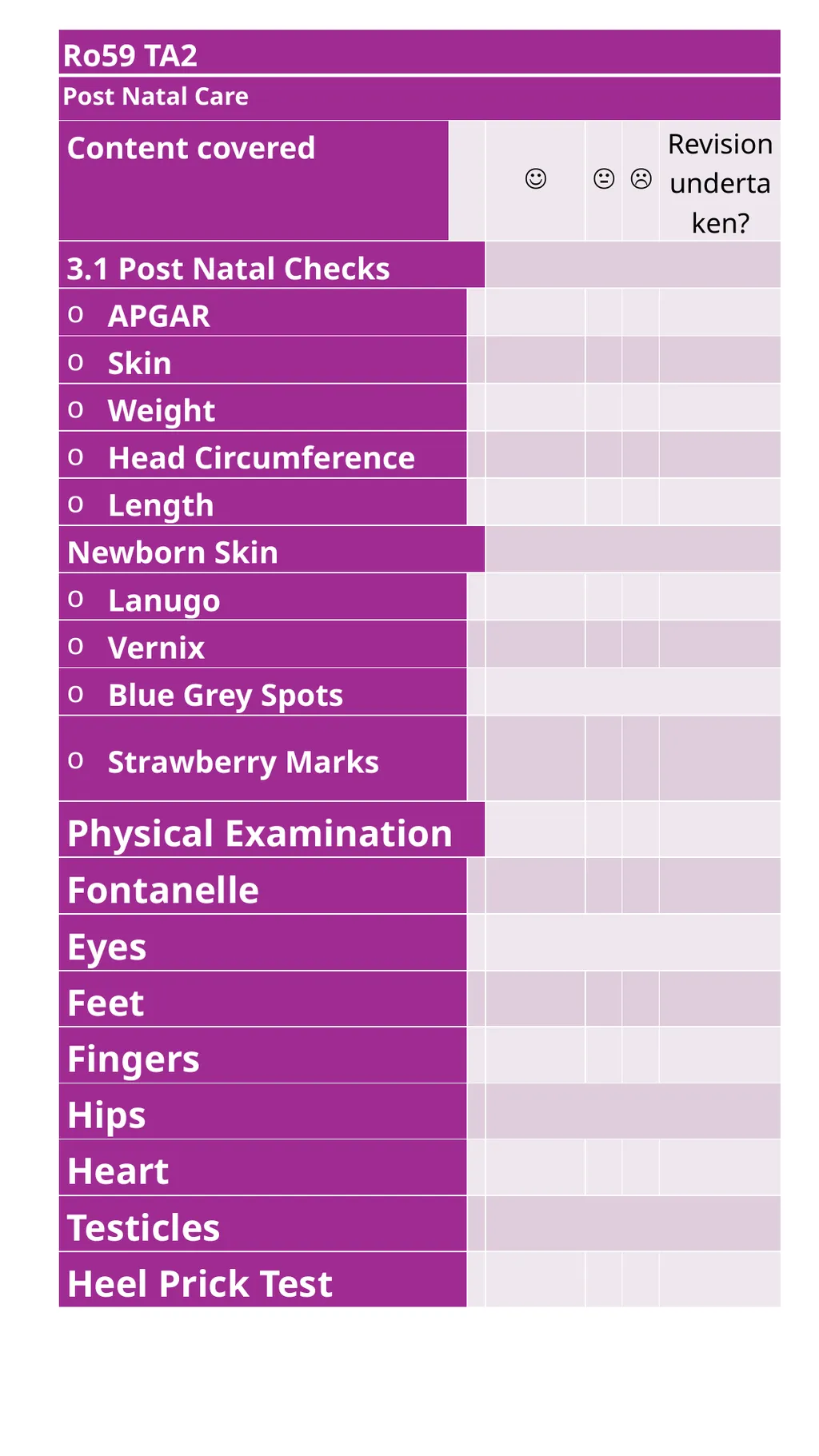
3.1 Postnatal Checks:
3.1.1 Checks Immediately After Birth:
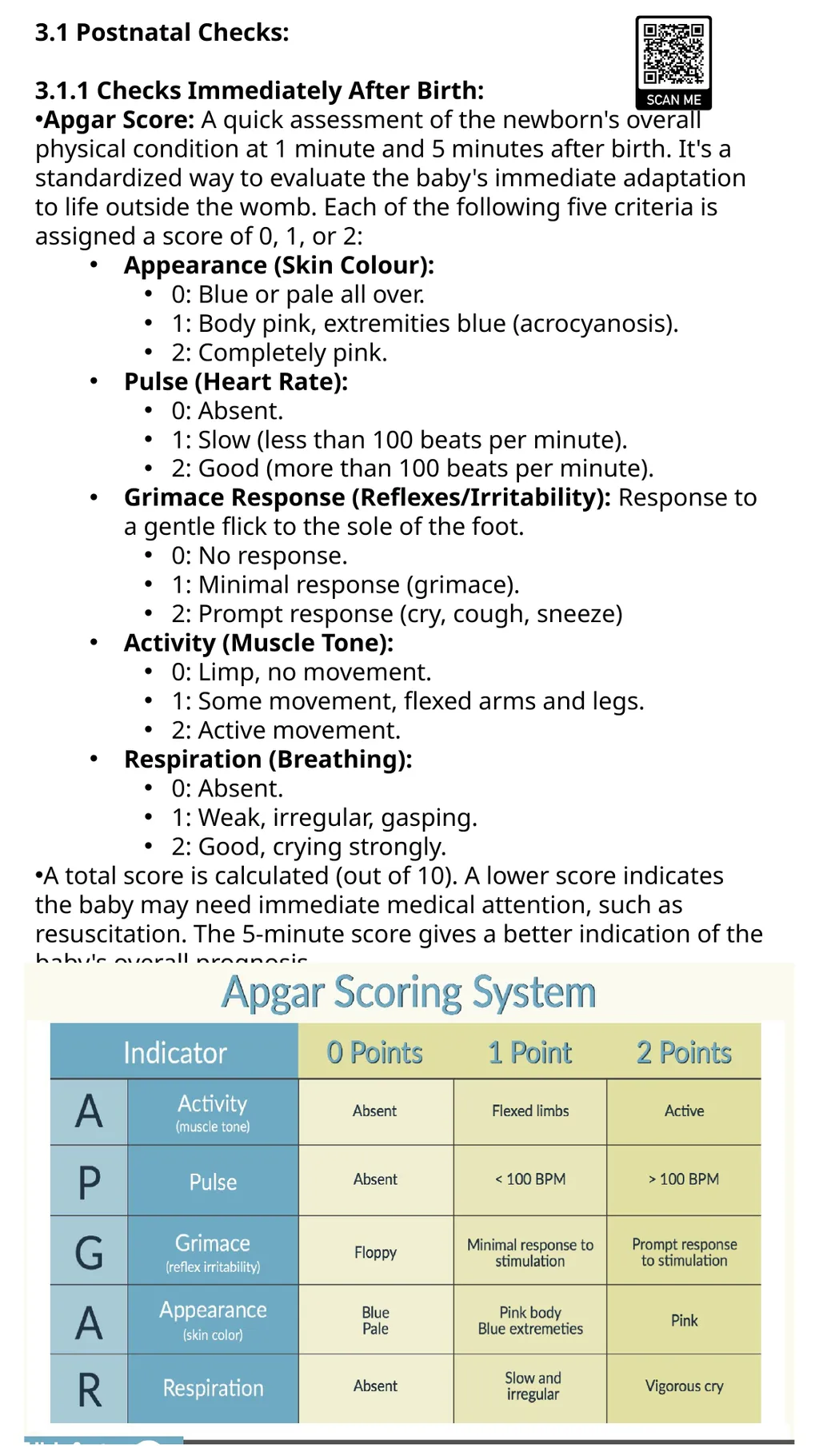
Apgar Score: A quick assessment of the newborn's overall physical condition at 1 minute and 5 minutes after birth. It's a standardized way to evaluate the baby's immediate adaptation to life outside the womb. Each of the following five criteria is assigned a score of 0, 1, or 2:
Appearance (Skin Colour):
0: Blue or pale all over.
1: Body pink, extremities blue (acrocyanosis).
2: Completely pink.
Pulse (Heart Rate):
0: Absent.
1: Slow (less than 100 beats per minute).
2: Good (more than 100 beats per minute).
Grimace Response (Reflexes/Irritability): Response to a gentle flick to the sole of the foot.
0: No response.
1: Minimal response (grimace).
2: Prompt response (cry, cough, sneeze)
Activity (Muscle Tone):
0: Limp, no movement.
1: Some movement, flexed arms and legs.
2: Active movement.
Respiration (Breathing):
0: Absent.
1: Weak, irregular, gasping.
2: Good, crying strongly.
A total score is calculated (out of 10). A lower score indicates the baby may need immediate medical attention, such as resuscitation. The 5-minute score gives a better indication of the baby's overall prognosis<br>
3.1.1 Checks Immediately After Birth:
Apgar Score: A quick assessment of the newborn's overall physical condition at 1 minute and 5 minutes after birth. It's a standardized way to evaluate the baby's immediate adaptation to life outside the womb. Each of the following five criteria is assigned a score of 0, 1, or 2:
Appearance (Skin Colour):
0: Blue or pale all over.
1: Body pink, extremities blue (acrocyanosis).
2: Completely pink.
Pulse (Heart Rate):
0: Absent.
1: Slow (less than 100 beats per minute).
2: Good (more than 100 beats per minute).
Grimace Response (Reflexes/Irritability): Response to a gentle flick to the sole of the foot.
0: No response.
1: Minimal response (grimace).
2: Prompt response (cry, cough, sneeze)
Activity (Muscle Tone):
0: Limp, no movement.
1: Some movement, flexed arms and legs.
2: Active movement.
Respiration (Breathing):
0: Absent.
1: Weak, irregular, gasping.
2: Good, crying strongly.
A total score is calculated (out of 10). A lower score indicates the baby may need immediate medical attention, such as resuscitation. The 5-minute score gives a better indication of the baby's overall prognosis<br>
04
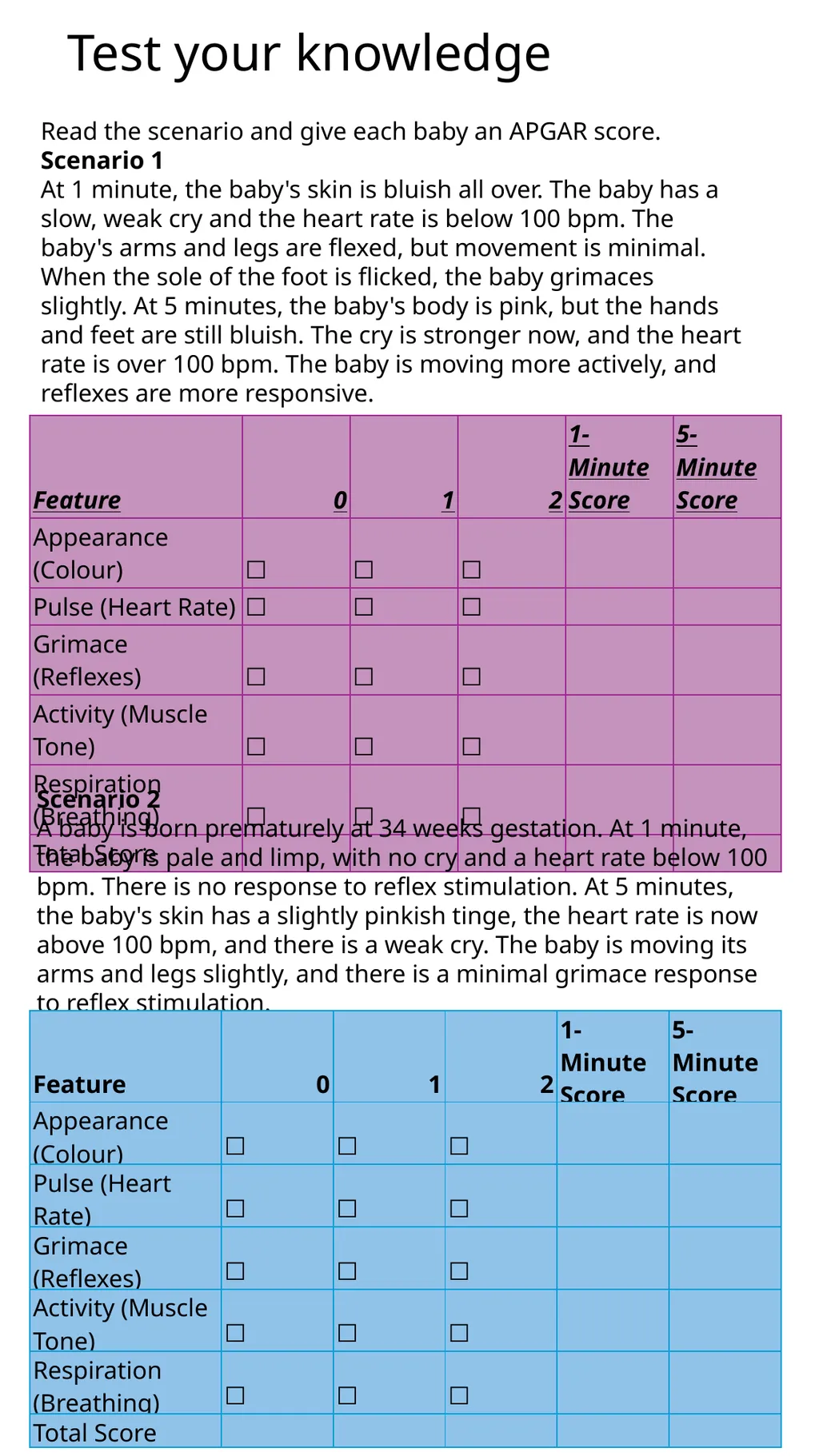
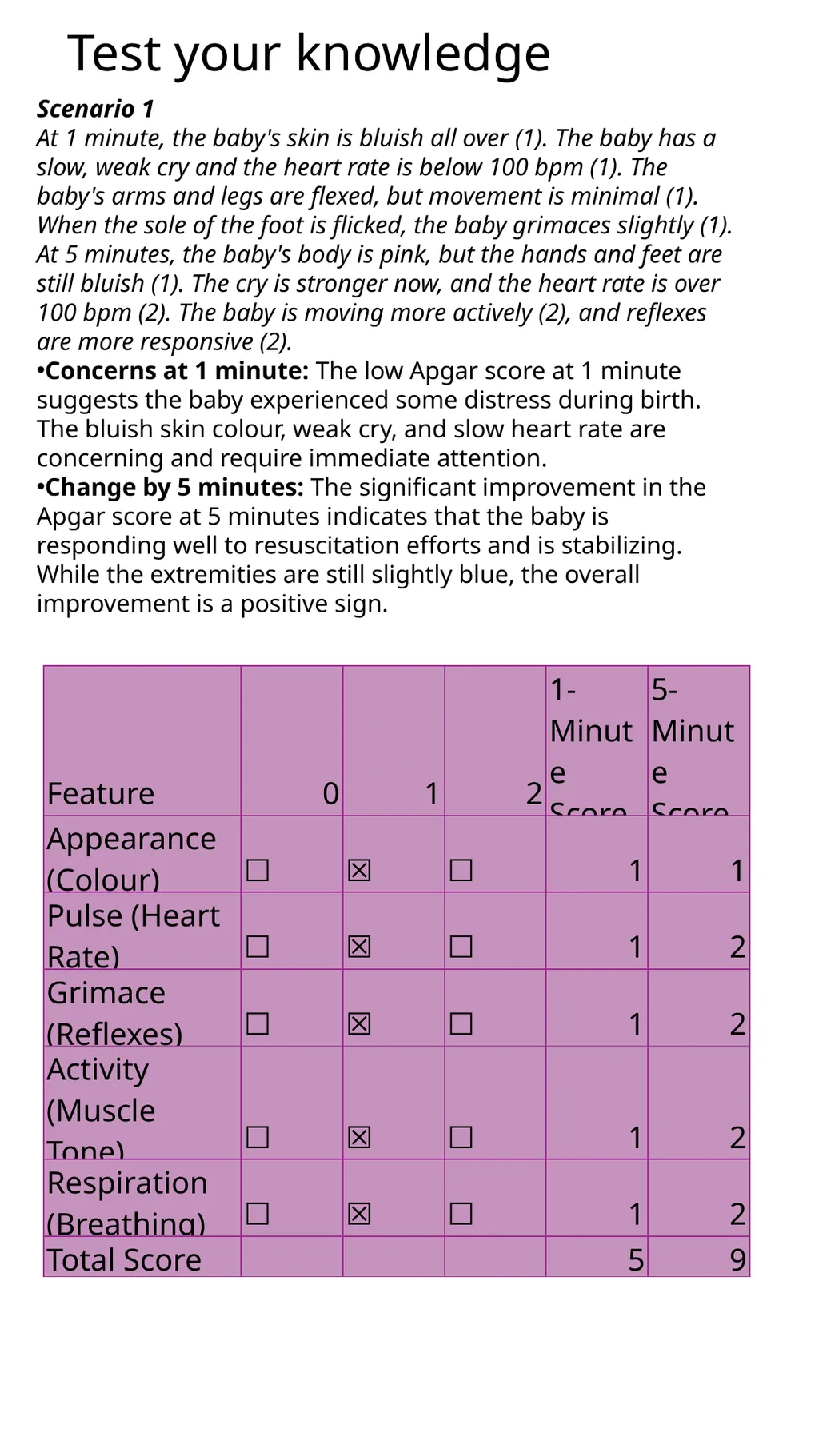
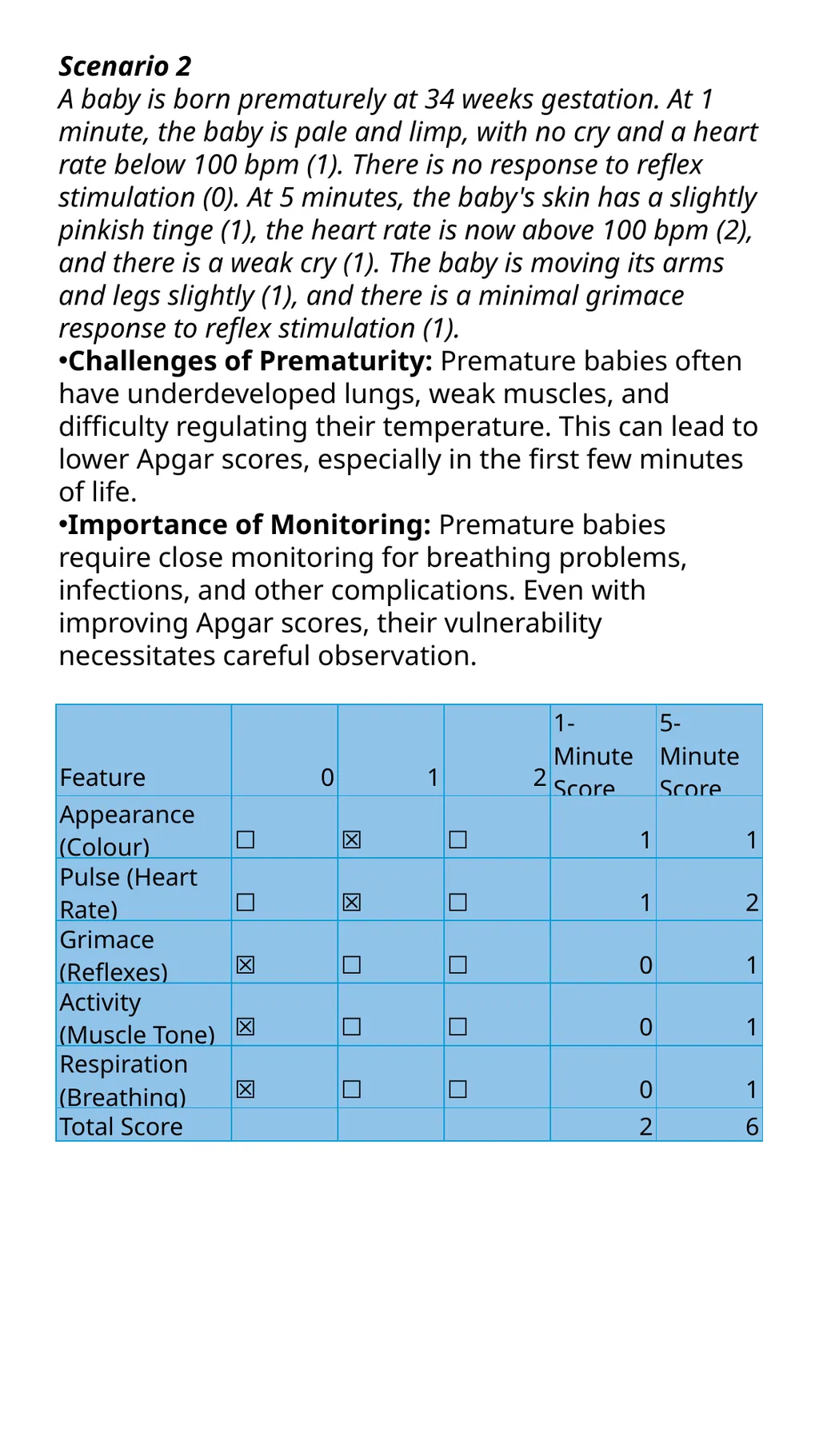
Test your knowledge Read the scenario and give each baby an APGAR score.
Scenario 1
At 1 minute, the baby's skin is bluish all over. The baby has a slow, weak cry and the heart rate is below 100 bpm. The baby's arms and legs are flexed, but movement is minimal. When the sole of the foot is flicked, the baby grimaces slightly. At 5 minutes, the baby's body is pink, but the hands and feet are still bluish. The cry is stronger now, and the heart rate is over 100 bpm. The baby is moving more actively, and reflexes are more responsive. Scenario 2
A baby is born prematurely at 34 weeks gestation. At 1 minute, the baby is pale and limp, with no cry and a heart rate below 100 bpm. There is no response to reflex stimulation. At 5 minutes, the baby's skin has a slightly pinkish tinge, the heart rate is now above 100 bpm, and there is a weak cry. The baby is moving its arms and legs slightly, and there is a minimal grimace response to reflex stimulation.<br>
Scenario 1
At 1 minute, the baby's skin is bluish all over. The baby has a slow, weak cry and the heart rate is below 100 bpm. The baby's arms and legs are flexed, but movement is minimal. When the sole of the foot is flicked, the baby grimaces slightly. At 5 minutes, the baby's body is pink, but the hands and feet are still bluish. The cry is stronger now, and the heart rate is over 100 bpm. The baby is moving more actively, and reflexes are more responsive. Scenario 2
A baby is born prematurely at 34 weeks gestation. At 1 minute, the baby is pale and limp, with no cry and a heart rate below 100 bpm. There is no response to reflex stimulation. At 5 minutes, the baby's skin has a slightly pinkish tinge, the heart rate is now above 100 bpm, and there is a weak cry. The baby is moving its arms and legs slightly, and there is a minimal grimace response to reflex stimulation.<br>
05
Zophia gives birth to a healthy baby girl. Straight after the birth the baby’s five vital signs are checked and the baby is given a score.
What is the name given to this score?
_______________________________________________________
[1]
Identify the baby’s five vital signs that are checked as soon as the baby is born.
1
2
3
4
5
[5] Exam Practice<br>
What is the name given to this score?
_______________________________________________________
[1]
Identify the baby’s five vital signs that are checked as soon as the baby is born.
1
2
3
4
5
[5] Exam Practice<br>
06
Skin:
Newborn skin is unique and goes through some interesting changes in the first few days and weeks. Here's what you need to know for your revision:
Vernix Caseosa:
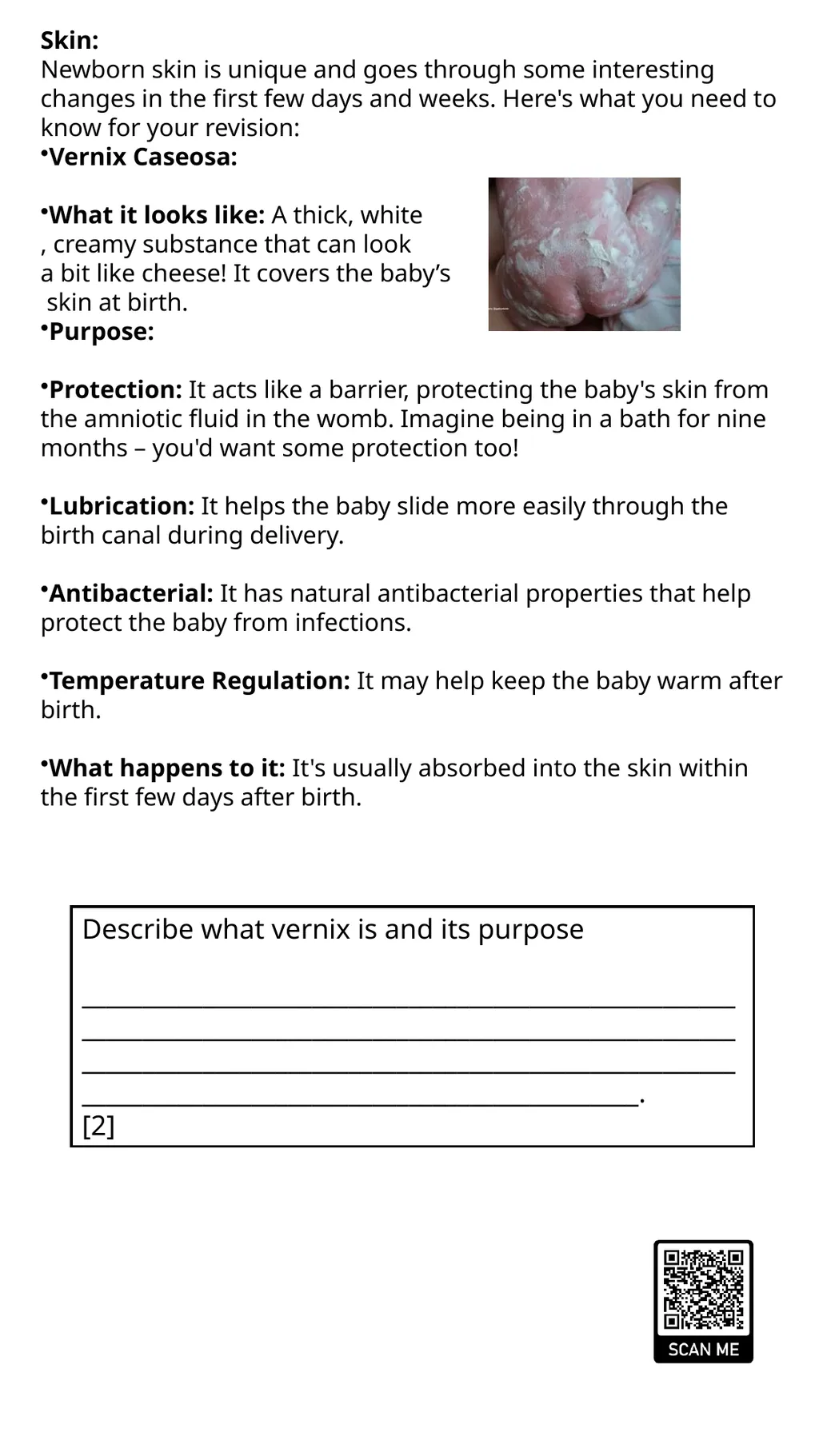
What it looks like: A thick, white
, creamy substance that can look
a bit like cheese! It covers the baby’s
skin at birth.
Purpose:
Protection: It acts like a barrier, protecting the baby's skin from the amniotic fluid in the womb. Imagine being in a bath for nine months – you'd want some protection too!
Lubrication: It helps the baby slide more easily through the birth canal during delivery.
Antibacterial: It has natural antibacterial properties that help protect the baby from infections.
Temperature Regulation: It may help keep the baby warm after birth.
What happens to it: It's usually absorbed into the skin within the first few days after birth. Describe what vernix is and its purpose
________________________________________________________________________________________________________________________________________________________________________________________________________________.
[2]<br>
Newborn skin is unique and goes through some interesting changes in the first few days and weeks. Here's what you need to know for your revision:
Vernix Caseosa:
What it looks like: A thick, white
, creamy substance that can look
a bit like cheese! It covers the baby’s
skin at birth.
Purpose:
Protection: It acts like a barrier, protecting the baby's skin from the amniotic fluid in the womb. Imagine being in a bath for nine months – you'd want some protection too!
Lubrication: It helps the baby slide more easily through the birth canal during delivery.
Antibacterial: It has natural antibacterial properties that help protect the baby from infections.
Temperature Regulation: It may help keep the baby warm after birth.
What happens to it: It's usually absorbed into the skin within the first few days after birth. Describe what vernix is and its purpose
________________________________________________________________________________________________________________________________________________________________________________________________________________.
[2]<br>
07
Lanugo:
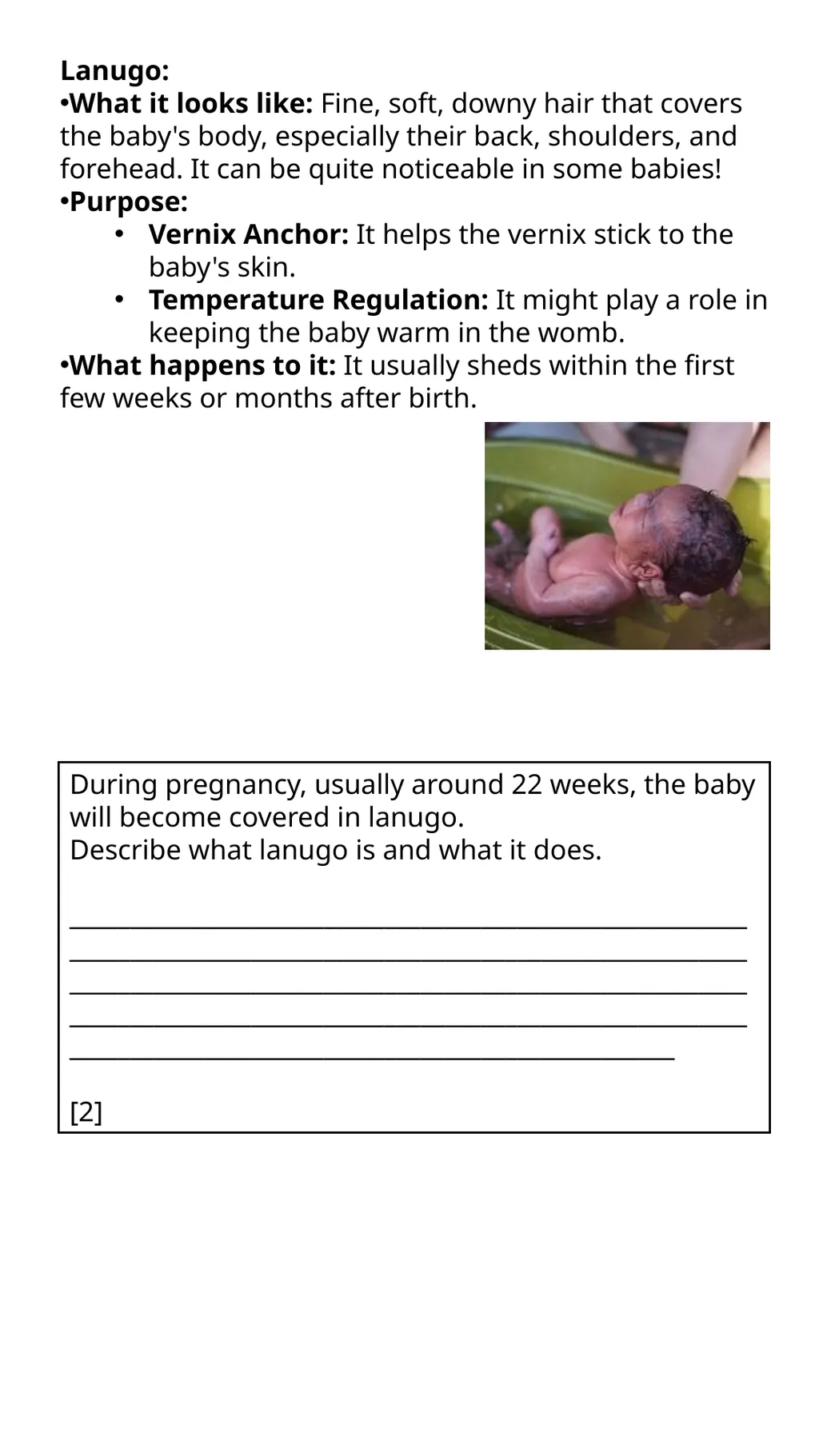
What it looks like: Fine, soft, downy hair that covers the baby's body, especially their back, shoulders, and forehead. It can be quite noticeable in some babies!
Purpose:
Vernix Anchor: It helps the vernix stick to the baby's skin.
Temperature Regulation: It might play a role in keeping the baby warm in the womb.
What happens to it: It usually sheds within the first few weeks or months after birth. During pregnancy, usually around 22 weeks, the baby will become covered in lanugo.
Describe what lanugo is and what it does.
__________________________________________________________________________________________________________________________________________________________________________________________________________________________________________________________________________________
[2]<br>
What it looks like: Fine, soft, downy hair that covers the baby's body, especially their back, shoulders, and forehead. It can be quite noticeable in some babies!
Purpose:
Vernix Anchor: It helps the vernix stick to the baby's skin.
Temperature Regulation: It might play a role in keeping the baby warm in the womb.
What happens to it: It usually sheds within the first few weeks or months after birth. During pregnancy, usually around 22 weeks, the baby will become covered in lanugo.
Describe what lanugo is and what it does.
__________________________________________________________________________________________________________________________________________________________________________________________________________________________________________________________________________________
[2]<br>
08
Weight, Length, and Head Circumference:
These measurements might seem simple, but they give healthcare professionals important clues about a baby's health and development right after birth.
Weight:
How it's done: Babies are gently placed on a special scale designed for newborns.
Why it's important:
Growth and Development: Weight is a key indicator of a baby's overall growth and development. It helps track if they're gaining weight as expected.
Feeding: Weight helps monitor how well a baby is feeding and if they're getting enough milk.
Health Issues: Unexpected weight loss or gain can sometimes signal underlying health problems.
Length:
How it's done: A baby's length is measured from the top of their head to the bottom of their heel while they're lying down.
Why it's important:
Growth Spurts: Length measurements help track a baby's growth spurts and overall development.
Proportions: It helps check if the baby's body is growing in proportion.
Head Circumference:
How it's done: A measuring tape is gently placed around the largest part of the baby's head, usually just above the eyebrows.
Why it's important:
Brain Development: Head circumference reflects the growth of the baby's brain.
Potential Issues: An unusually large or small head circumference can sometimes indicate a health concern that needs further investigation.
Why do we take these measurements right after birth?
Baseline: These measurements create a baseline to compare future measurements against, helping to track the baby's progress.
Early Detection: Any unusual findings can be investigated early on.
Reassurance: For parents, knowing these measurements can provide reassurance about their baby's health and development.<br>
These measurements might seem simple, but they give healthcare professionals important clues about a baby's health and development right after birth.
Weight:
How it's done: Babies are gently placed on a special scale designed for newborns.
Why it's important:
Growth and Development: Weight is a key indicator of a baby's overall growth and development. It helps track if they're gaining weight as expected.
Feeding: Weight helps monitor how well a baby is feeding and if they're getting enough milk.
Health Issues: Unexpected weight loss or gain can sometimes signal underlying health problems.
Length:
How it's done: A baby's length is measured from the top of their head to the bottom of their heel while they're lying down.
Why it's important:
Growth Spurts: Length measurements help track a baby's growth spurts and overall development.
Proportions: It helps check if the baby's body is growing in proportion.
Head Circumference:
How it's done: A measuring tape is gently placed around the largest part of the baby's head, usually just above the eyebrows.
Why it's important:
Brain Development: Head circumference reflects the growth of the baby's brain.
Potential Issues: An unusually large or small head circumference can sometimes indicate a health concern that needs further investigation.
Why do we take these measurements right after birth?
Baseline: These measurements create a baseline to compare future measurements against, helping to track the baby's progress.
Early Detection: Any unusual findings can be investigated early on.
Reassurance: For parents, knowing these measurements can provide reassurance about their baby's health and development.<br>
09
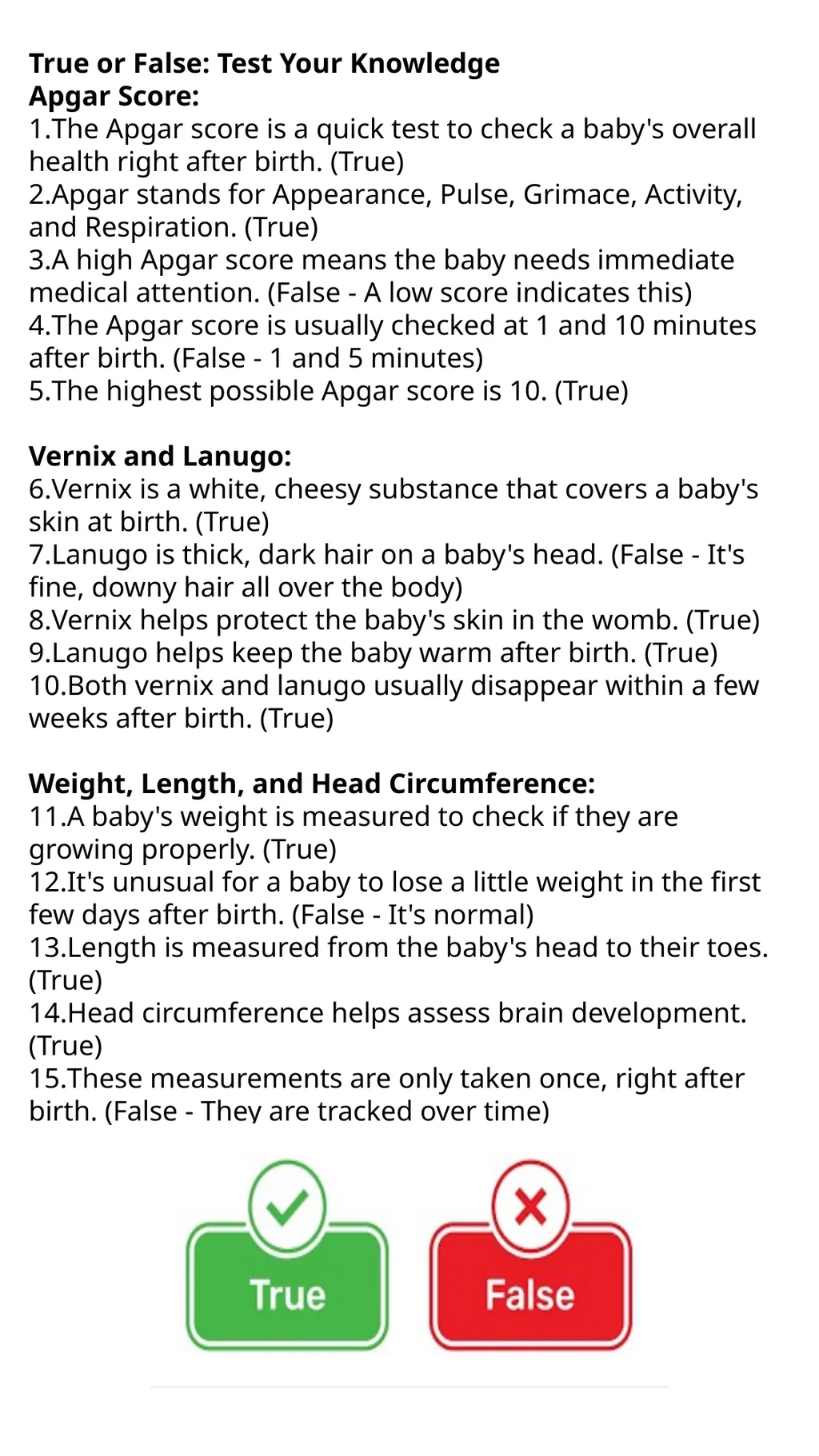
Test Your Knowledge
Apgar Score:
The Apgar score is a quick test to check a baby's overall health right after birth.
Apgar stands for Appearance, Pulse, Grimace, Activity, and Respiration.
A high Apgar score means the baby needs immediate medical attention.
The Apgar score is usually checked at 1 and 10 minutes after birth.
The highest possible Apgar score is 10.
Vernix and Lanugo:
Vernix is a white, cheesy substance that covers a baby's skin at birth.
Lanugo is thick, dark hair on a baby's head.
Vernix helps protect the baby's skin in the womb.
Lanugo helps keep the baby warm after birth.
Both vernix and lanugo usually disappear within a few weeks after birth
.
Weight, Length, and Head Circumference:
A baby's weight is measured to check if they are growing properly.
It's unusual for a baby to lose a little weight in the first few days after birth.
Length is measured from the baby's head to their toes.
Head circumference helps assess brain development.
These measurements are only taken once, right after birth.<br>
Apgar Score:
The Apgar score is a quick test to check a baby's overall health right after birth.
Apgar stands for Appearance, Pulse, Grimace, Activity, and Respiration.
A high Apgar score means the baby needs immediate medical attention.
The Apgar score is usually checked at 1 and 10 minutes after birth.
The highest possible Apgar score is 10.
Vernix and Lanugo:
Vernix is a white, cheesy substance that covers a baby's skin at birth.
Lanugo is thick, dark hair on a baby's head.
Vernix helps protect the baby's skin in the womb.
Lanugo helps keep the baby warm after birth.
Both vernix and lanugo usually disappear within a few weeks after birth
.
Weight, Length, and Head Circumference:
A baby's weight is measured to check if they are growing properly.
It's unusual for a baby to lose a little weight in the first few days after birth.
Length is measured from the baby's head to their toes.
Head circumference helps assess brain development.
These measurements are only taken once, right after birth.<br>
10
3.1.2 Postnatal Checks (Days 1-5) 3.1.2 Checks Within Days 1-5:
These checks are more detailed than those done immediately after birth and aim to identify any potential health issues that might not be apparent right away.
Physical Examination:
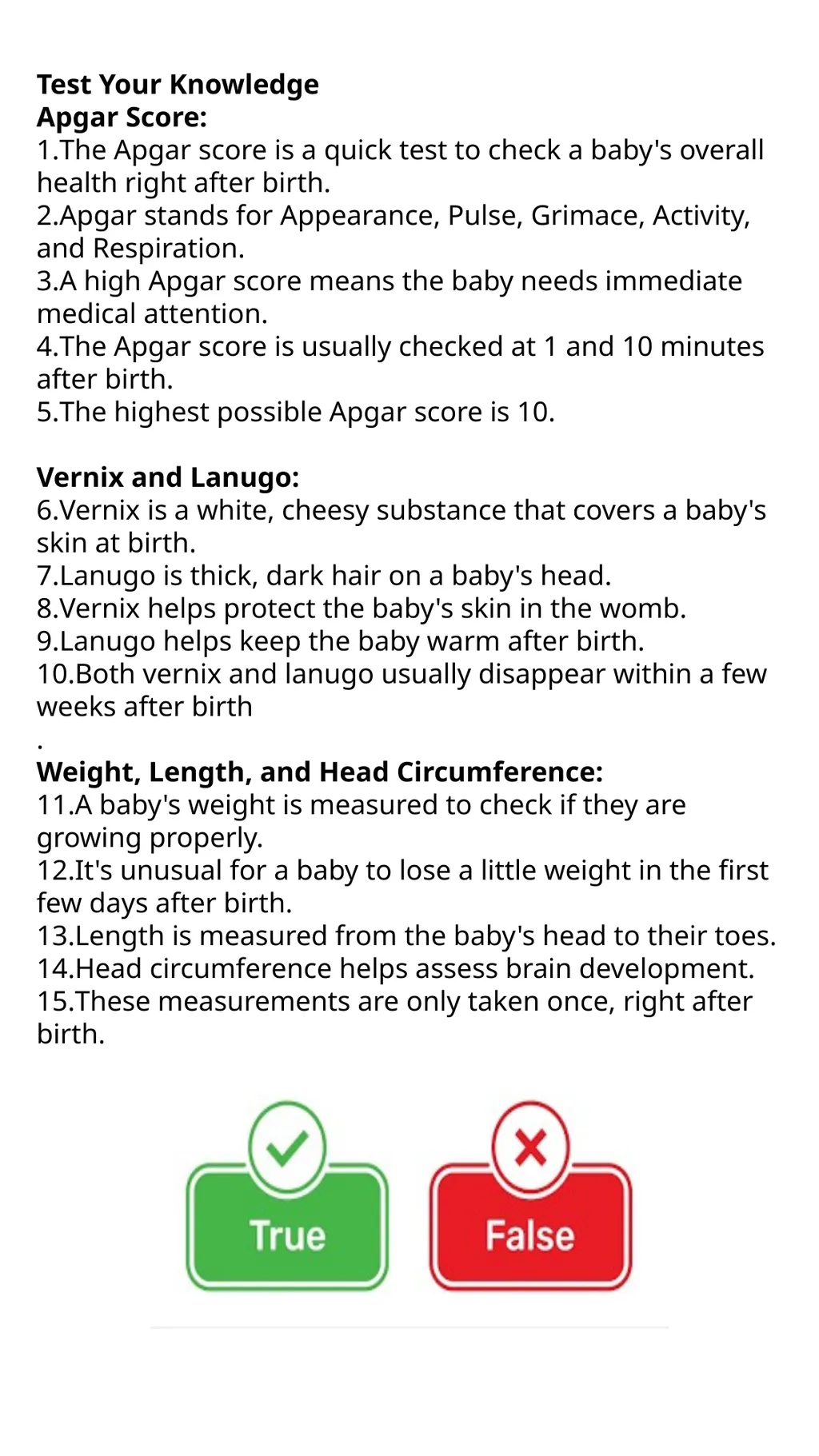
Feet and Fingers: Examined for any abnormalities in shape, number, or movement e.g. club foot, palmers crease, extra fingers, extra toes and webbing.
Hips: Checked for hip dysplasia (a condition where the hip joint doesn't form properly). This involves gently moving the baby's legs to assess the stability of the hip joints.
Eyes: Examined for signs of redness, discharge, or any abnormalities in structure. A red reflex test may be done to check for cataracts.
Heart: Listened to with a stethoscope to detect any murmurs or unusual heart rhythms.
Testicles (in boys): Checked to ensure both testicles have descended into the scrotum.
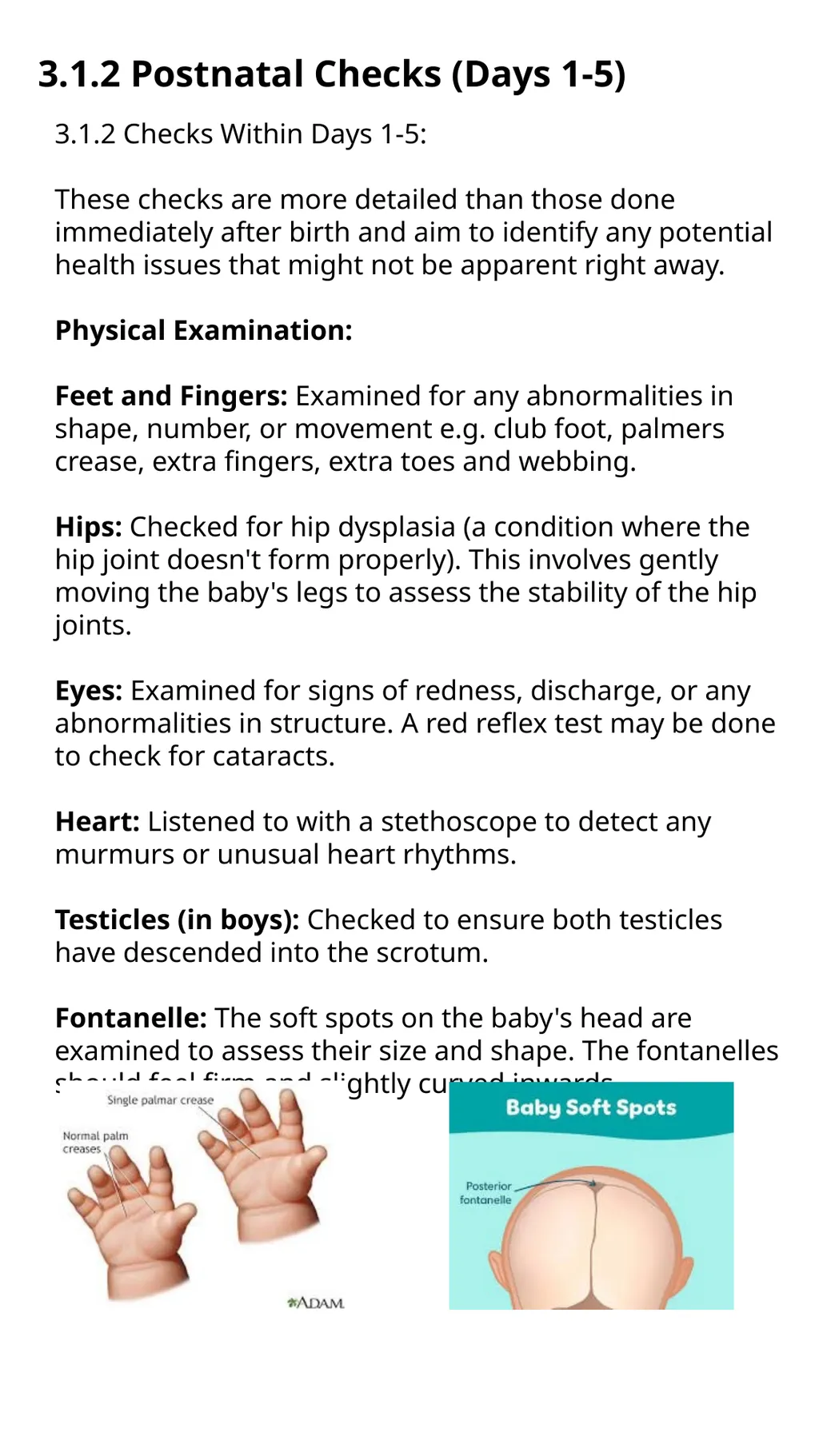
Fontanelle: The soft spots on the baby's head are examined to assess their size and shape. The fontanelles should feel firm and slightly curved inwards.<br>
These checks are more detailed than those done immediately after birth and aim to identify any potential health issues that might not be apparent right away.
Physical Examination:
Feet and Fingers: Examined for any abnormalities in shape, number, or movement e.g. club foot, palmers crease, extra fingers, extra toes and webbing.
Hips: Checked for hip dysplasia (a condition where the hip joint doesn't form properly). This involves gently moving the baby's legs to assess the stability of the hip joints.
Eyes: Examined for signs of redness, discharge, or any abnormalities in structure. A red reflex test may be done to check for cataracts.
Heart: Listened to with a stethoscope to detect any murmurs or unusual heart rhythms.
Testicles (in boys): Checked to ensure both testicles have descended into the scrotum.
Fontanelle: The soft spots on the baby's head are examined to assess their size and shape. The fontanelles should feel firm and slightly curved inwards.<br>
11
Heel Prick Test (Blood Spot Test):
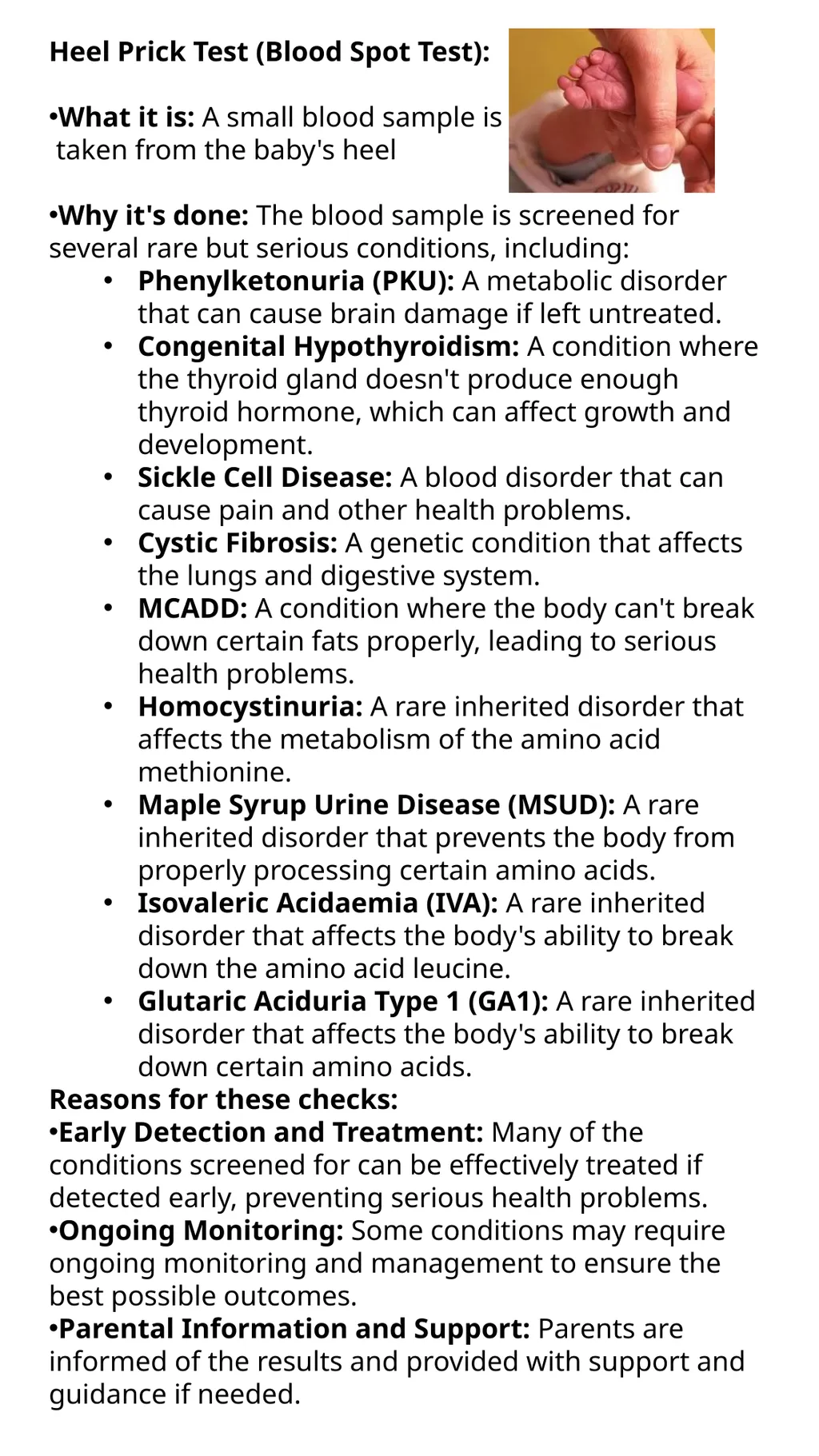
What it is: A small blood sample is
taken from the baby's heel
Why it's done: The blood sample is screened for several rare but serious conditions, including:
Phenylketonuria (PKU): A metabolic disorder that can cause brain damage if left untreated.
Congenital Hypothyroidism: A condition where the thyroid gland doesn't produce enough thyroid hormone, which can affect growth and development.
Sickle Cell Disease: A blood disorder that can cause pain and other health problems.
Cystic Fibrosis: A genetic condition that affects the lungs and digestive system.
MCADD: A condition where the body can't break down certain fats properly, leading to serious health problems.
Homocystinuria: A rare inherited disorder that affects the metabolism of the amino acid methionine.
Maple Syrup Urine Disease (MSUD): A rare inherited disorder that prevents the body from properly processing certain amino acids.
Isovaleric Acidaemia (IVA): A rare inherited disorder that affects the body's ability to break down the amino acid leucine.
Glutaric Aciduria Type 1 (GA1): A rare inherited disorder that affects the body's ability to break down certain amino acids.
Reasons for these checks:
Early Detection and Treatment: Many of the conditions screened for can be effectively treated if detected early, preventing serious health problems.
Ongoing Monitoring: Some conditions may require ongoing monitoring and management to ensure the best possible outcomes.
Parental Information and Support: Parents are informed of the results and provided with support and guidance if needed.<br>
What it is: A small blood sample is
taken from the baby's heel
Why it's done: The blood sample is screened for several rare but serious conditions, including:
Phenylketonuria (PKU): A metabolic disorder that can cause brain damage if left untreated.
Congenital Hypothyroidism: A condition where the thyroid gland doesn't produce enough thyroid hormone, which can affect growth and development.
Sickle Cell Disease: A blood disorder that can cause pain and other health problems.
Cystic Fibrosis: A genetic condition that affects the lungs and digestive system.
MCADD: A condition where the body can't break down certain fats properly, leading to serious health problems.
Homocystinuria: A rare inherited disorder that affects the metabolism of the amino acid methionine.
Maple Syrup Urine Disease (MSUD): A rare inherited disorder that prevents the body from properly processing certain amino acids.
Isovaleric Acidaemia (IVA): A rare inherited disorder that affects the body's ability to break down the amino acid leucine.
Glutaric Aciduria Type 1 (GA1): A rare inherited disorder that affects the body's ability to break down certain amino acids.
Reasons for these checks:
Early Detection and Treatment: Many of the conditions screened for can be effectively treated if detected early, preventing serious health problems.
Ongoing Monitoring: Some conditions may require ongoing monitoring and management to ensure the best possible outcomes.
Parental Information and Support: Parents are informed of the results and provided with support and guidance if needed.<br>
12
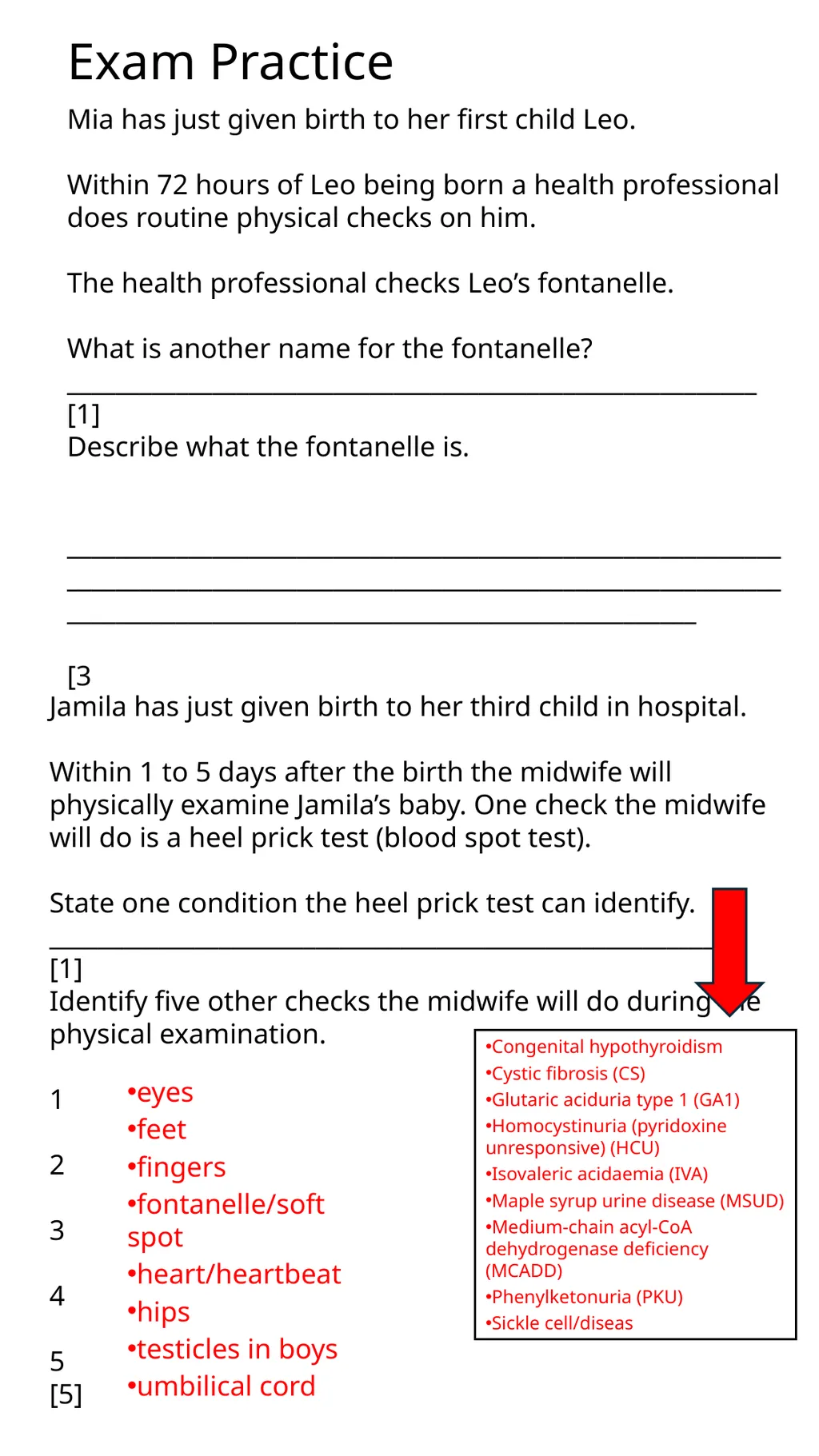
Exam Practice Mia has just given birth to her first child Leo.
Within 72 hours of Leo being born a health professional does routine physical checks on him.
The health professional checks Leo’s fontanelle.
What is another name for the fontanelle?
_________________________________________________________
[1]
Describe what the fontanelle is.
__________________________________________________________________________________________________________________________________________________________________________
[3 Jamila has just given birth to her third child in hospital.
Within 1 to 5 days after the birth the midwife will physically examine Jamila’s baby. One check the midwife will do is a heel prick test (blood spot test).
State one condition the heel prick test can identify.
_________________________________________________________
[1]
Identify five other checks the midwife will do during the physical examination.
1
2
3
4
5
[5]<br>
Within 72 hours of Leo being born a health professional does routine physical checks on him.
The health professional checks Leo’s fontanelle.
What is another name for the fontanelle?
_________________________________________________________
[1]
Describe what the fontanelle is.
__________________________________________________________________________________________________________________________________________________________________________
[3 Jamila has just given birth to her third child in hospital.
Within 1 to 5 days after the birth the midwife will physically examine Jamila’s baby. One check the midwife will do is a heel prick test (blood spot test).
State one condition the heel prick test can identify.
_________________________________________________________
[1]
Identify five other checks the midwife will do during the physical examination.
1
2
3
4
5
[5]<br>
13
3.2.1 Role of the Health Visitor:
Health Visitors are qualified nurses with specialist training in child health and development. They provide support and advice to families with young children.
Support for the New Family:
Home Visits: Health Visitors usually visit families at home within the first few weeks after birth to assess the baby's health and well-being and offer support to parents.
Information and Advice: They provide information on a range of topics, including:
Feeding: Breastfeeding support, formula feeding guidance, weaning advice.
Growth and Development: Monitoring the baby's growth, developmental milestones, and providing activities to stimulate development.
Immunisations: Explaining the importance of immunisations and addressing any concerns.
Safe Sleeping: Providing guidance on safe sleep practices to reduce the risk of Sudden Infant Death Syndrome (SIDS).
Parenting Skills: Offering advice on parenting techniques, coping with crying, and managing common challenges.
Maternal Health: Checking on the mother's physical and emotional well-being, offering support for postnatal depression or anxiety.
Community Resources: Connecting families with local support groups, childcare services, and other resources.<br>
Health Visitors are qualified nurses with specialist training in child health and development. They provide support and advice to families with young children.
Support for the New Family:
Home Visits: Health Visitors usually visit families at home within the first few weeks after birth to assess the baby's health and well-being and offer support to parents.
Information and Advice: They provide information on a range of topics, including:
Feeding: Breastfeeding support, formula feeding guidance, weaning advice.
Growth and Development: Monitoring the baby's growth, developmental milestones, and providing activities to stimulate development.
Immunisations: Explaining the importance of immunisations and addressing any concerns.
Safe Sleeping: Providing guidance on safe sleep practices to reduce the risk of Sudden Infant Death Syndrome (SIDS).
Parenting Skills: Offering advice on parenting techniques, coping with crying, and managing common challenges.
Maternal Health: Checking on the mother's physical and emotional well-being, offering support for postnatal depression or anxiety.
Community Resources: Connecting families with local support groups, childcare services, and other resources.<br>
14
Safe Sleeping and SIDS:
Sudden Infant Death Syndrome (SIDS): The sudden and unexpected death of a baby under one year old, where no cause is found after a thorough investigation.
Reducing the Risk: Health Visitors provide guidance on safe sleep practices, including:
"Back to Sleep": Always placing the baby on their back to sleep.
Firm, Flat Surface: Using a firm, flat mattress in a safety-approved cot.
Smoke-Free Environment: Avoiding smoking during pregnancy and after birth, and keeping the baby's environment smoke-free.
Appropriate Bedding: Using light bedding and avoiding pillows, bumpers, and soft toys in the cot.
Room Temperature: Keeping the room at a comfortable temperature (around 16-20°C).
Breastfeeding: Breastfeeding is associated with a reduced risk of SIDS.<br>
Sudden Infant Death Syndrome (SIDS): The sudden and unexpected death of a baby under one year old, where no cause is found after a thorough investigation.
Reducing the Risk: Health Visitors provide guidance on safe sleep practices, including:
"Back to Sleep": Always placing the baby on their back to sleep.
Firm, Flat Surface: Using a firm, flat mattress in a safety-approved cot.
Smoke-Free Environment: Avoiding smoking during pregnancy and after birth, and keeping the baby's environment smoke-free.
Appropriate Bedding: Using light bedding and avoiding pillows, bumpers, and soft toys in the cot.
Room Temperature: Keeping the room at a comfortable temperature (around 16-20°C).
Breastfeeding: Breastfeeding is associated with a reduced risk of SIDS.<br>
15
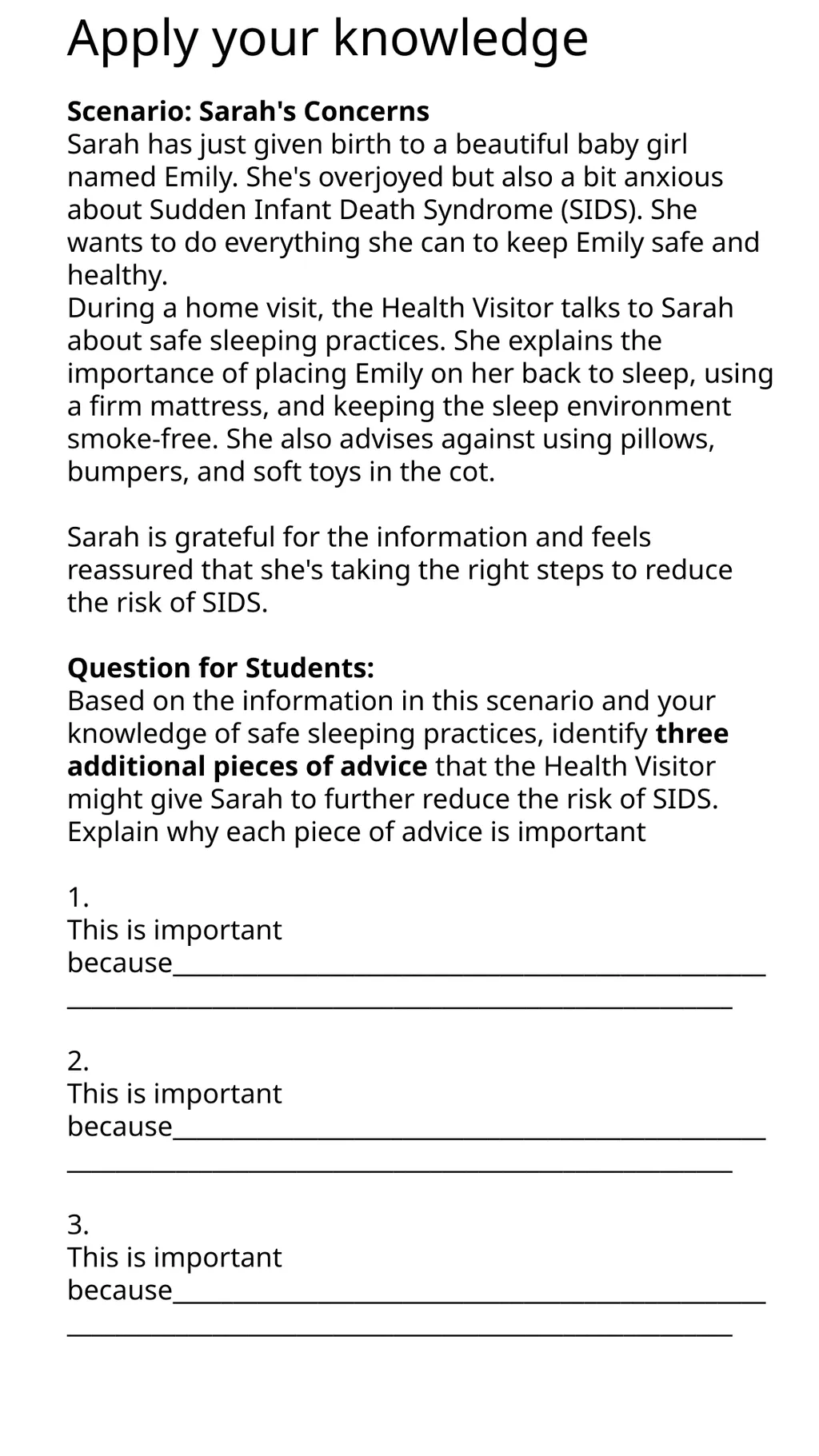
Apply your knowledge Scenario: Sarah's Concerns
Sarah has just given birth to a beautiful baby girl named Emily. She's overjoyed but also a bit anxious about Sudden Infant Death Syndrome (SIDS). She wants to do everything she can to keep Emily safe and healthy.
During a home visit, the Health Visitor talks to Sarah about safe sleeping practices. She explains the importance of placing Emily on her back to sleep, using a firm mattress, and keeping the sleep environment smoke-free. She also advises against using pillows, bumpers, and soft toys in the cot.
Sarah is grateful for the information and feels reassured that she's taking the right steps to reduce the risk of SIDS.
Question for Students:
Based on the information in this scenario and your knowledge of safe sleeping practices, identify three additional pieces of advice that the Health Visitor might give Sarah to further reduce the risk of SIDS. Explain why each piece of advice is important
1.
This is important because________________________________________________________________________________________________________
2.
This is important because________________________________________________________________________________________________________
3.
This is important because________________________________________________________________________________________________________<br>
Sarah has just given birth to a beautiful baby girl named Emily. She's overjoyed but also a bit anxious about Sudden Infant Death Syndrome (SIDS). She wants to do everything she can to keep Emily safe and healthy.
During a home visit, the Health Visitor talks to Sarah about safe sleeping practices. She explains the importance of placing Emily on her back to sleep, using a firm mattress, and keeping the sleep environment smoke-free. She also advises against using pillows, bumpers, and soft toys in the cot.
Sarah is grateful for the information and feels reassured that she's taking the right steps to reduce the risk of SIDS.
Question for Students:
Based on the information in this scenario and your knowledge of safe sleeping practices, identify three additional pieces of advice that the Health Visitor might give Sarah to further reduce the risk of SIDS. Explain why each piece of advice is important
1.
This is important because________________________________________________________________________________________________________
2.
This is important because________________________________________________________________________________________________________
3.
This is important because________________________________________________________________________________________________________<br>
16
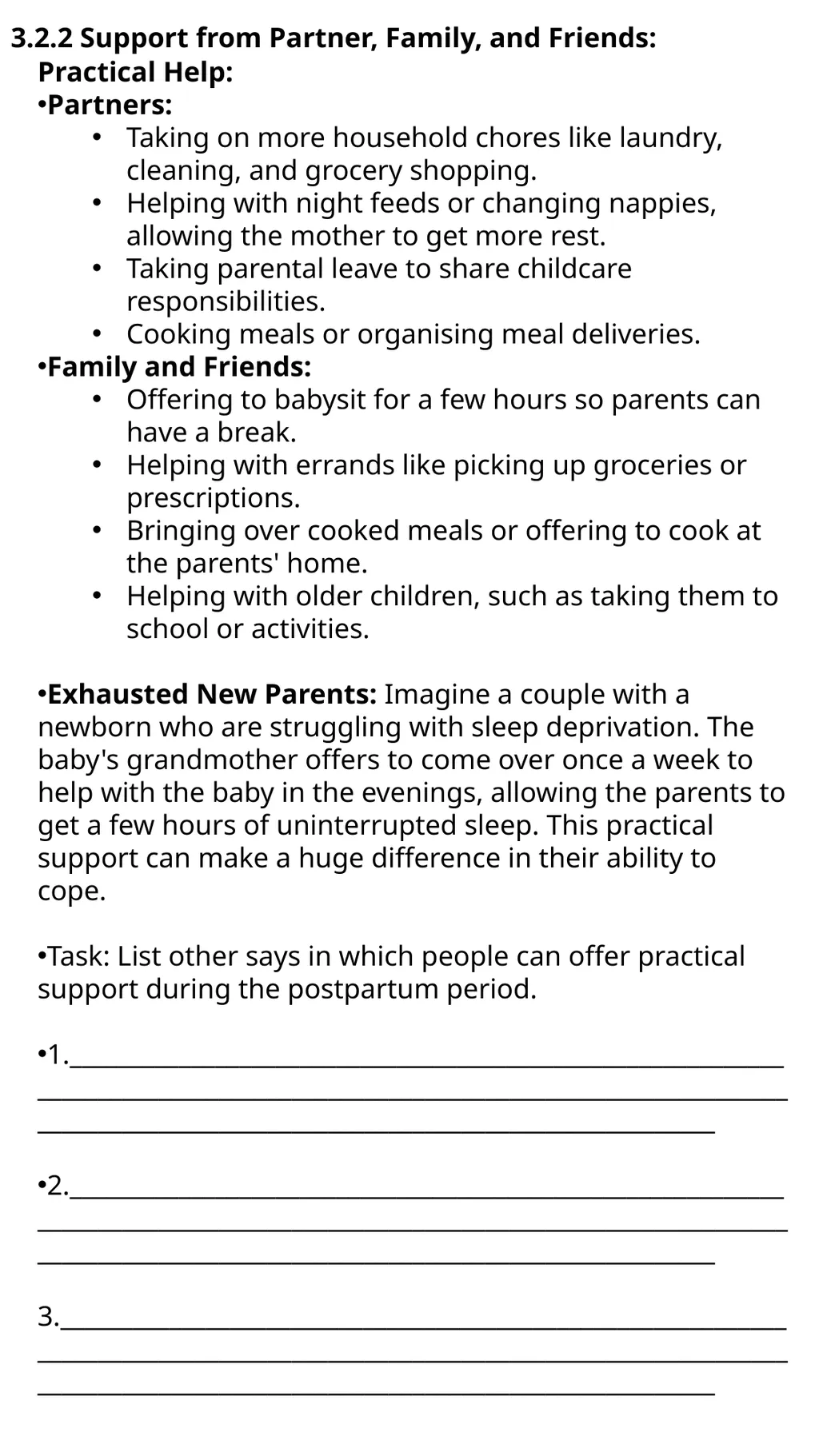
3.2.2 Support from Partner, Family, and Friends: Practical Help:
Partners:
Taking on more household chores like laundry, cleaning, and grocery shopping.
Helping with night feeds or changing nappies, allowing the mother to get more rest.
Taking parental leave to share childcare responsibilities.
Cooking meals or organising meal deliveries.
Family and Friends:
Offering to babysit for a few hours so parents can have a break.
Helping with errands like picking up groceries or prescriptions.
Bringing over cooked meals or offering to cook at the parents' home.
Helping with older children, such as taking them to school or activities.
Exhausted New Parents: Imagine a couple with a newborn who are struggling with sleep deprivation. The baby's grandmother offers to come over once a week to help with the baby in the evenings, allowing the parents to get a few hours of uninterrupted sleep. This practical support can make a huge difference in their ability to cope.
Task: List other says in which people can offer practical support during the postpartum period.
1._________________________________________________________________________________________________________________________________________________________________________________
2._________________________________________________________________________________________________________________________________________________________________________________
3.__________________________________________________________________________________________________________________________________________________________________________________<br>
Partners:
Taking on more household chores like laundry, cleaning, and grocery shopping.
Helping with night feeds or changing nappies, allowing the mother to get more rest.
Taking parental leave to share childcare responsibilities.
Cooking meals or organising meal deliveries.
Family and Friends:
Offering to babysit for a few hours so parents can have a break.
Helping with errands like picking up groceries or prescriptions.
Bringing over cooked meals or offering to cook at the parents' home.
Helping with older children, such as taking them to school or activities.
Exhausted New Parents: Imagine a couple with a newborn who are struggling with sleep deprivation. The baby's grandmother offers to come over once a week to help with the baby in the evenings, allowing the parents to get a few hours of uninterrupted sleep. This practical support can make a huge difference in their ability to cope.
Task: List other says in which people can offer practical support during the postpartum period.
1._________________________________________________________________________________________________________________________________________________________________________________
2._________________________________________________________________________________________________________________________________________________________________________________
3.__________________________________________________________________________________________________________________________________________________________________________________<br>
17
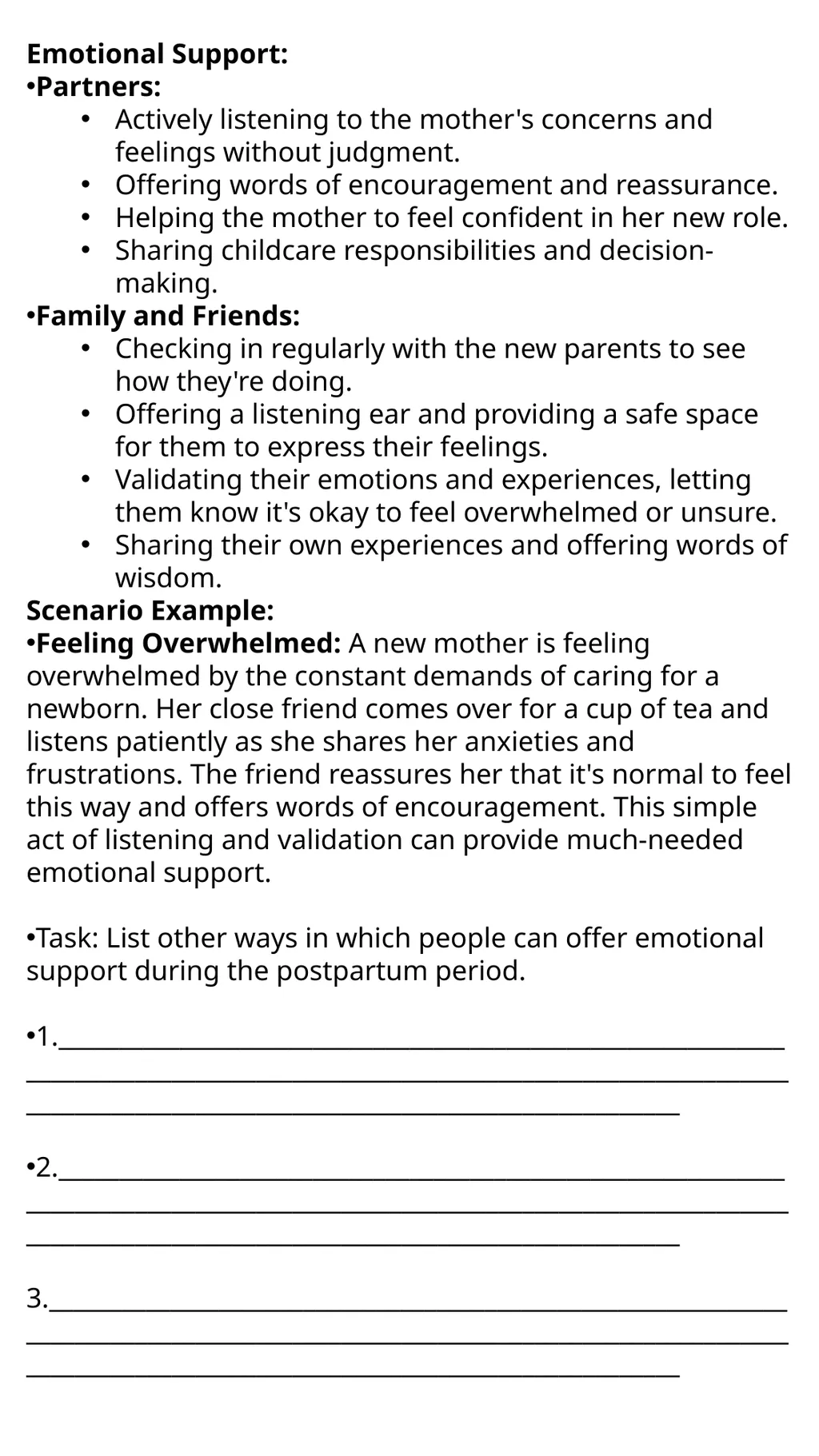
Emotional Support:
Partners:
Actively listening to the mother's concerns and feelings without judgment.
Offering words of encouragement and reassurance.
Helping the mother to feel confident in her new role.
Sharing childcare responsibilities and decision-making.
Family and Friends:
Checking in regularly with the new parents to see how they're doing.
Offering a listening ear and providing a safe space for them to express their feelings.
Validating their emotions and experiences, letting them know it's okay to feel overwhelmed or unsure.
Sharing their own experiences and offering words of wisdom.
Scenario Example:
Feeling Overwhelmed: A new mother is feeling overwhelmed by the constant demands of caring for a newborn. Her close friend comes over for a cup of tea and listens patiently as she shares her anxieties and frustrations. The friend reassures her that it's normal to feel this way and offers words of encouragement. This simple act of listening and validation can provide much-needed emotional support.
Task: List other ways in which people can offer emotional support during the postpartum period.
1._________________________________________________________________________________________________________________________________________________________________________________
2._________________________________________________________________________________________________________________________________________________________________________________
3.__________________________________________________________________________________________________________________________________________________________________________________<br>
Partners:
Actively listening to the mother's concerns and feelings without judgment.
Offering words of encouragement and reassurance.
Helping the mother to feel confident in her new role.
Sharing childcare responsibilities and decision-making.
Family and Friends:
Checking in regularly with the new parents to see how they're doing.
Offering a listening ear and providing a safe space for them to express their feelings.
Validating their emotions and experiences, letting them know it's okay to feel overwhelmed or unsure.
Sharing their own experiences and offering words of wisdom.
Scenario Example:
Feeling Overwhelmed: A new mother is feeling overwhelmed by the constant demands of caring for a newborn. Her close friend comes over for a cup of tea and listens patiently as she shares her anxieties and frustrations. The friend reassures her that it's normal to feel this way and offers words of encouragement. This simple act of listening and validation can provide much-needed emotional support.
Task: List other ways in which people can offer emotional support during the postpartum period.
1._________________________________________________________________________________________________________________________________________________________________________________
2._________________________________________________________________________________________________________________________________________________________________________________
3.__________________________________________________________________________________________________________________________________________________________________________________<br>
18
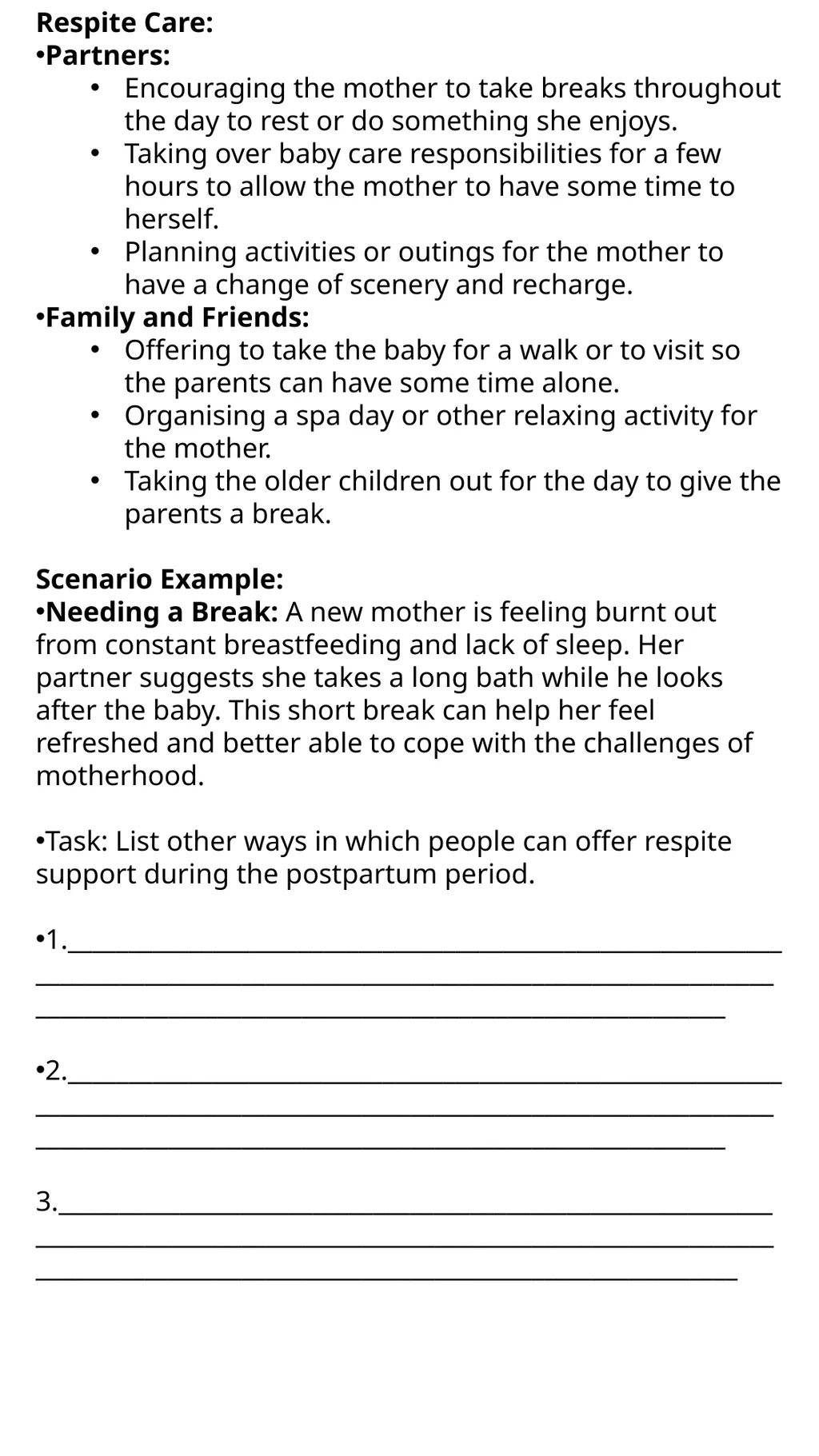
Respite Care:
Partners:
Encouraging the mother to take breaks throughout the day to rest or do something she enjoys.
Taking over baby care responsibilities for a few hours to allow the mother to have some time to herself.
Planning activities or outings for the mother to have a change of scenery and recharge.
Family and Friends:
Offering to take the baby for a walk or to visit so the parents can have some time alone.
Organising a spa day or other relaxing activity for the mother.
Taking the older children out for the day to give the parents a break.
Scenario Example:
Needing a Break: A new mother is feeling burnt out from constant breastfeeding and lack of sleep. Her partner suggests she takes a long bath while he looks after the baby. This short break can help her feel refreshed and better able to cope with the challenges of motherhood.
Task: List other ways in which people can offer respite support during the postpartum period.
1._________________________________________________________________________________________________________________________________________________________________________________
2._________________________________________________________________________________________________________________________________________________________________________________
3.__________________________________________________________________________________________________________________________________________________________________________________<br>
Partners:
Encouraging the mother to take breaks throughout the day to rest or do something she enjoys.
Taking over baby care responsibilities for a few hours to allow the mother to have some time to herself.
Planning activities or outings for the mother to have a change of scenery and recharge.
Family and Friends:
Offering to take the baby for a walk or to visit so the parents can have some time alone.
Organising a spa day or other relaxing activity for the mother.
Taking the older children out for the day to give the parents a break.
Scenario Example:
Needing a Break: A new mother is feeling burnt out from constant breastfeeding and lack of sleep. Her partner suggests she takes a long bath while he looks after the baby. This short break can help her feel refreshed and better able to cope with the challenges of motherhood.
Task: List other ways in which people can offer respite support during the postpartum period.
1._________________________________________________________________________________________________________________________________________________________________________________
2._________________________________________________________________________________________________________________________________________________________________________________
3.__________________________________________________________________________________________________________________________________________________________________________________<br>
19
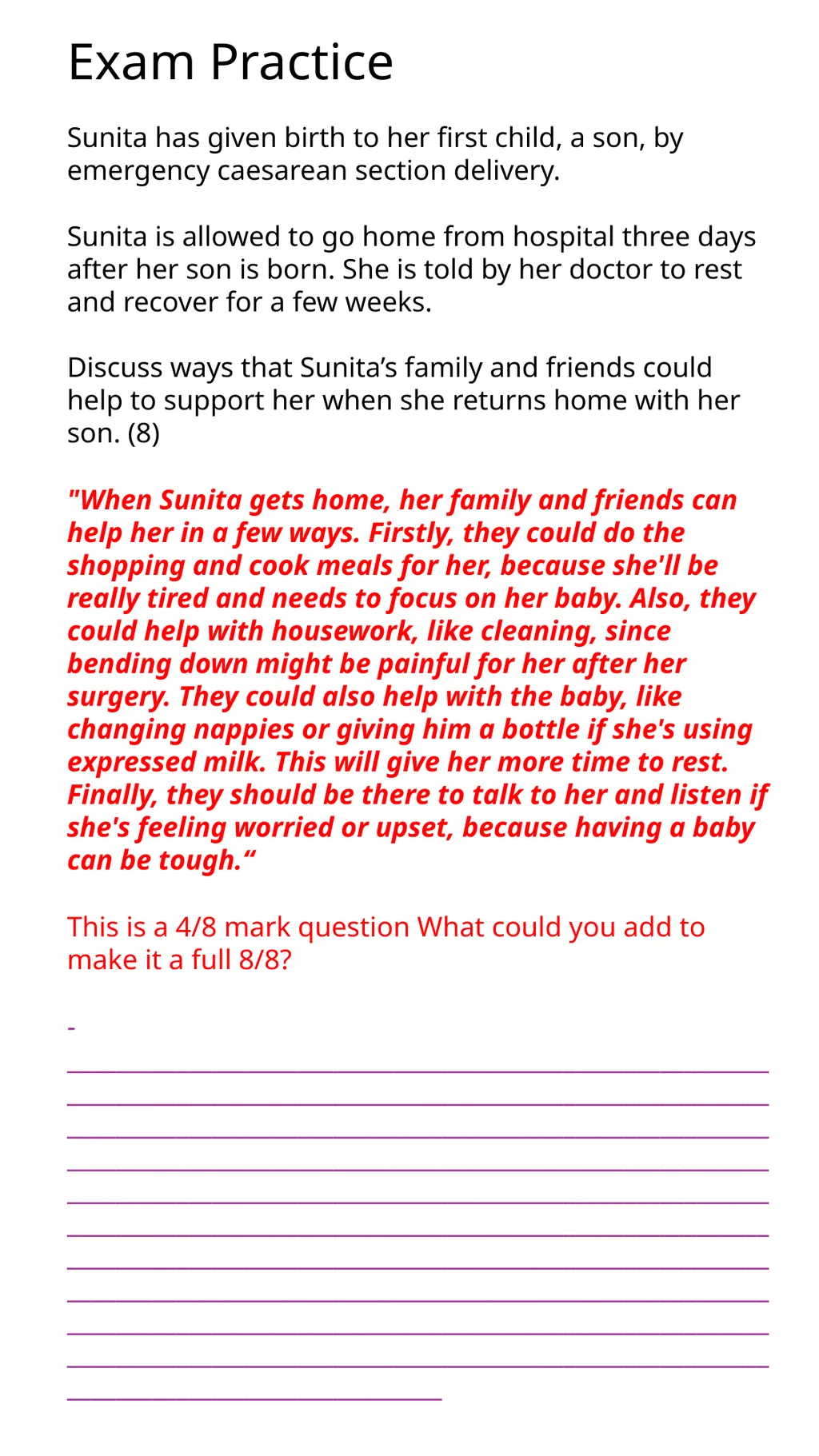
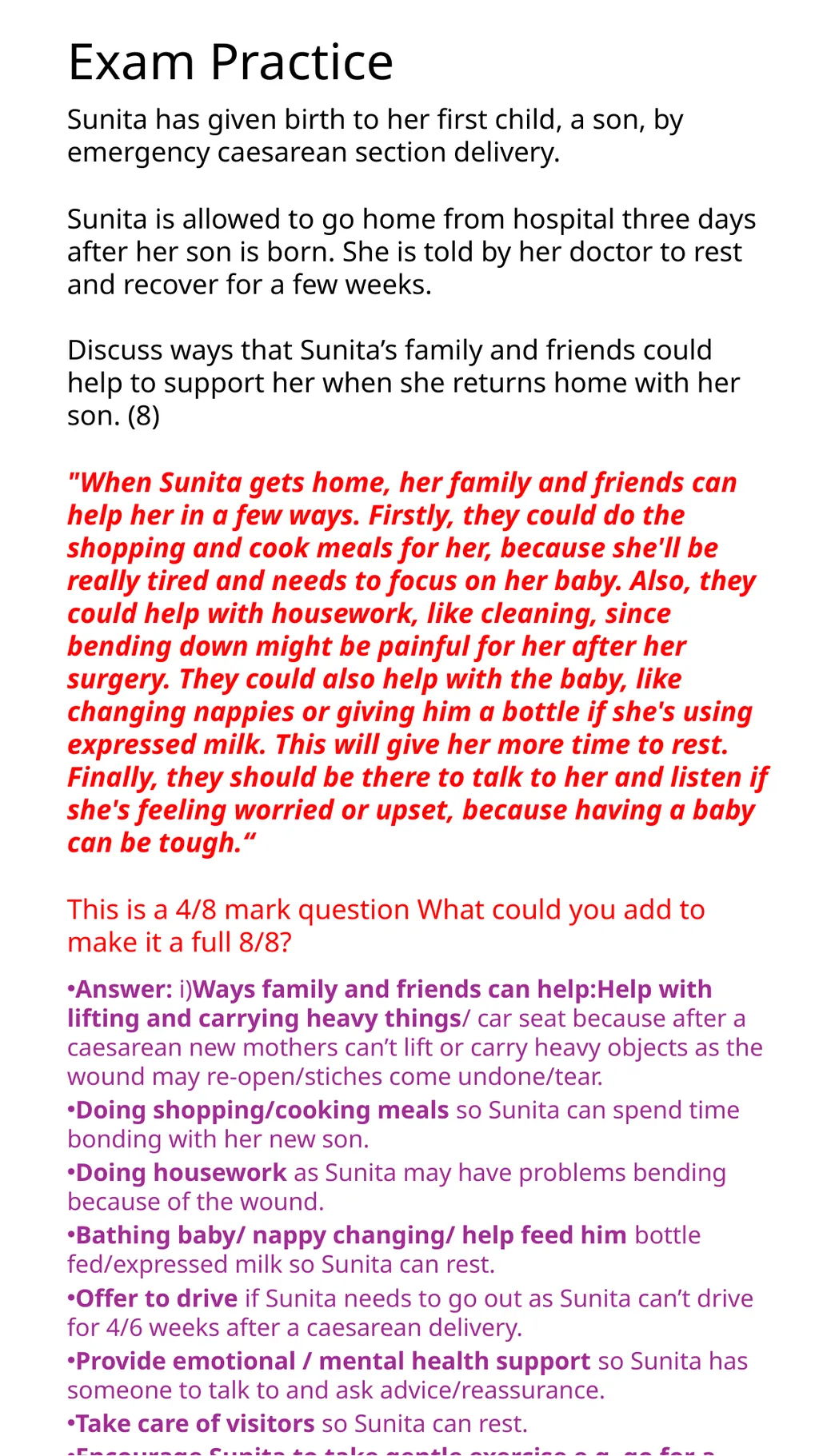
Exam Practice Sunita has given birth to her first child, a son, by emergency caesarean section delivery.
Sunita is allowed to go home from hospital three days after her son is born. She is told by her doctor to rest and recover for a few weeks. Discuss ways that Sunita’s family and friends could help to support her when she returns home with her son. (8)
"When Sunita gets home, her family and friends can help her in a few ways. Firstly, they could do the shopping and cook meals for her, because she'll be really tired and needs to focus on her baby. Also, they could help with housework, like cleaning, since bending down might be painful for her after her surgery. They could also help with the baby, like changing nappies or giving him a bottle if she's using expressed milk. This will give her more time to rest. Finally, they should be there to talk to her and listen if she's feeling worried or upset, because having a baby can be tough.“
This is a 4/8 mark question What could you add to make it a full 8/8?
-___________________________________________________________________________________________________________________________________________________________________________________________________________________________________________________________________________________________________________________________________________________________________________________________________________________________________________________________________________________________________________________________________________________________________________________________________________________________________<br>
Sunita is allowed to go home from hospital three days after her son is born. She is told by her doctor to rest and recover for a few weeks. Discuss ways that Sunita’s family and friends could help to support her when she returns home with her son. (8)
"When Sunita gets home, her family and friends can help her in a few ways. Firstly, they could do the shopping and cook meals for her, because she'll be really tired and needs to focus on her baby. Also, they could help with housework, like cleaning, since bending down might be painful for her after her surgery. They could also help with the baby, like changing nappies or giving him a bottle if she's using expressed milk. This will give her more time to rest. Finally, they should be there to talk to her and listen if she's feeling worried or upset, because having a baby can be tough.“
This is a 4/8 mark question What could you add to make it a full 8/8?
-___________________________________________________________________________________________________________________________________________________________________________________________________________________________________________________________________________________________________________________________________________________________________________________________________________________________________________________________________________________________________________________________________________________________________________________________________________________________________<br>
20
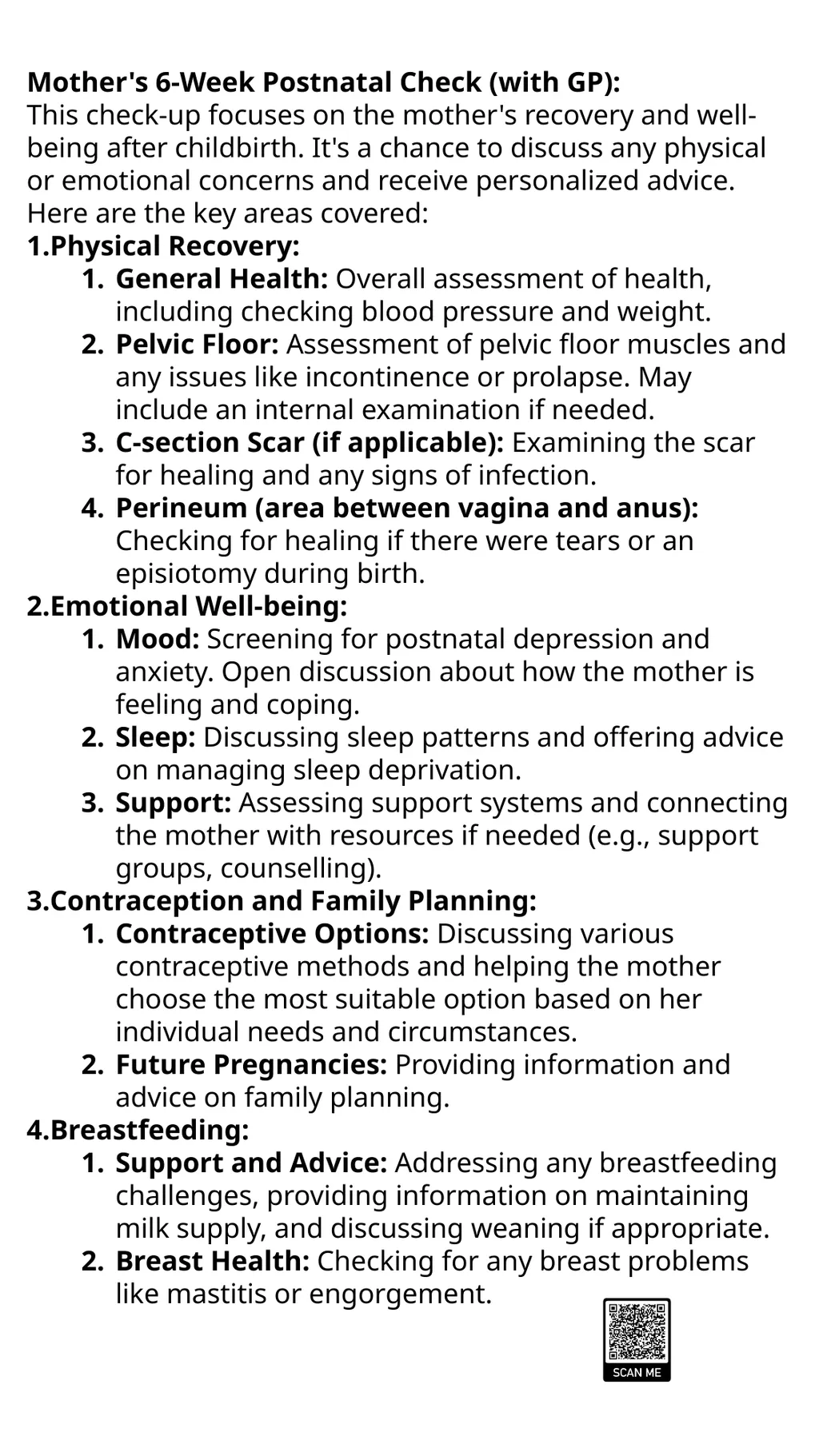
Mother's 6-Week Postnatal Check (with GP):
This check-up focuses on the mother's recovery and well-being after childbirth. It's a chance to discuss any physical or emotional concerns and receive personalized advice. Here are the key areas covered:
Physical Recovery:
General Health: Overall assessment of health, including checking blood pressure and weight.
Pelvic Floor: Assessment of pelvic floor muscles and any issues like incontinence or prolapse. May include an internal examination if needed.
C-section Scar (if applicable): Examining the scar for healing and any signs of infection.
Perineum (area between vagina and anus): Checking for healing if there were tears or an episiotomy during birth.
Emotional Well-being:
Mood: Screening for postnatal depression and anxiety. Open discussion about how the mother is feeling and coping.
Sleep: Discussing sleep patterns and offering advice on managing sleep deprivation.
Support: Assessing support systems and connecting the mother with resources if needed (e.g., support groups, counselling).
Contraception and Family Planning:
Contraceptive Options: Discussing various contraceptive methods and helping the mother choose the most suitable option based on her individual needs and circumstances.
Future Pregnancies: Providing information and advice on family planning.
Breastfeeding:
Support and Advice: Addressing any breastfeeding challenges, providing information on maintaining milk supply, and discussing weaning if appropriate.
Breast Health: Checking for any breast problems like mastitis or engorgement.<br>
This check-up focuses on the mother's recovery and well-being after childbirth. It's a chance to discuss any physical or emotional concerns and receive personalized advice. Here are the key areas covered:
Physical Recovery:
General Health: Overall assessment of health, including checking blood pressure and weight.
Pelvic Floor: Assessment of pelvic floor muscles and any issues like incontinence or prolapse. May include an internal examination if needed.
C-section Scar (if applicable): Examining the scar for healing and any signs of infection.
Perineum (area between vagina and anus): Checking for healing if there were tears or an episiotomy during birth.
Emotional Well-being:
Mood: Screening for postnatal depression and anxiety. Open discussion about how the mother is feeling and coping.
Sleep: Discussing sleep patterns and offering advice on managing sleep deprivation.
Support: Assessing support systems and connecting the mother with resources if needed (e.g., support groups, counselling).
Contraception and Family Planning:
Contraceptive Options: Discussing various contraceptive methods and helping the mother choose the most suitable option based on her individual needs and circumstances.
Future Pregnancies: Providing information and advice on family planning.
Breastfeeding:
Support and Advice: Addressing any breastfeeding challenges, providing information on maintaining milk supply, and discussing weaning if appropriate.
Breast Health: Checking for any breast problems like mastitis or engorgement.<br>
21
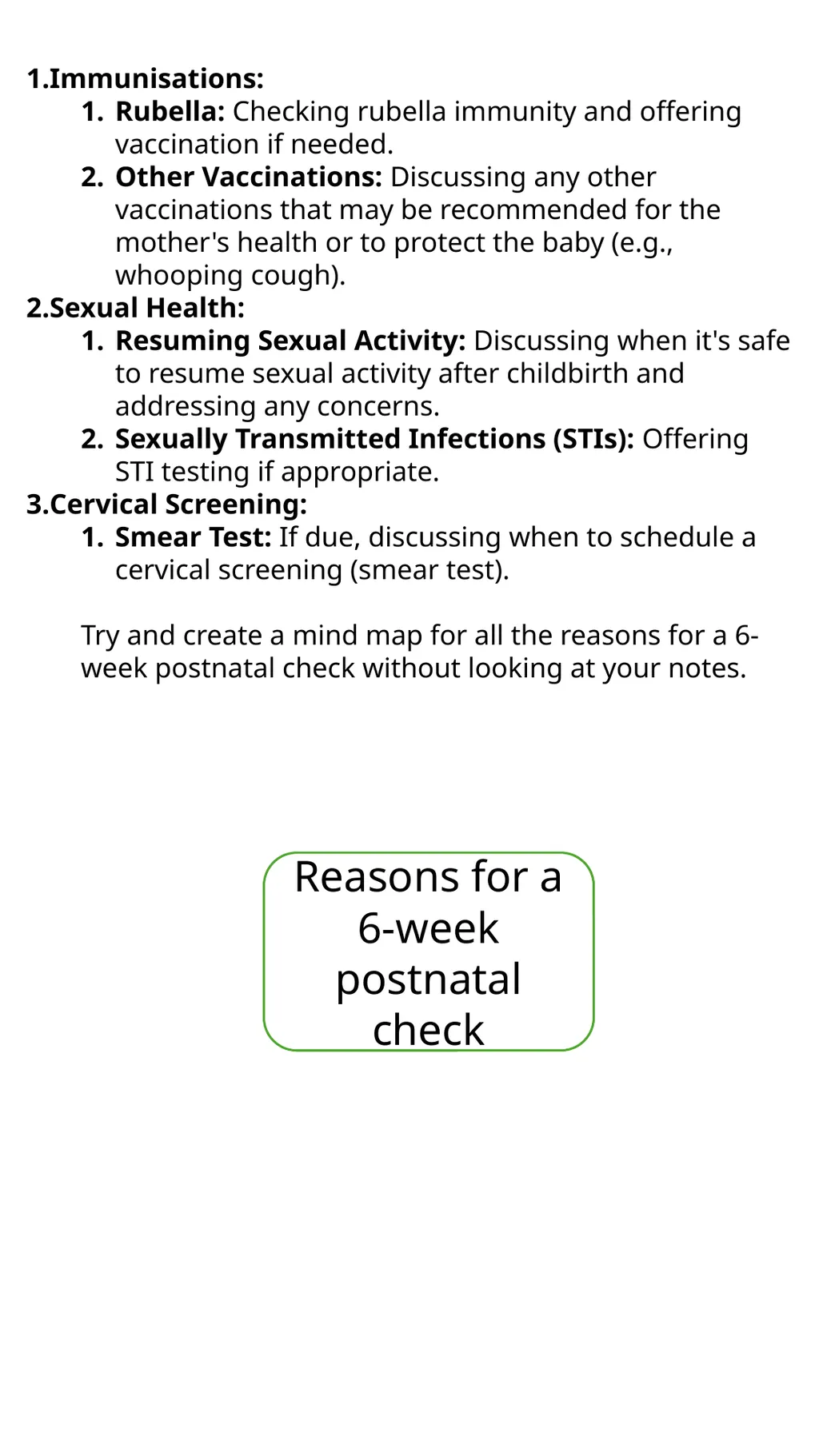
Immunisations:
Rubella: Checking rubella immunity and offering vaccination if needed.
Other Vaccinations: Discussing any other vaccinations that may be recommended for the mother's health or to protect the baby (e.g., whooping cough).
Sexual Health:
Resuming Sexual Activity: Discussing when it's safe to resume sexual activity after childbirth and addressing any concerns.
Sexually Transmitted Infections (STIs): Offering STI testing if appropriate.
Cervical Screening:
Smear Test: If due, discussing when to schedule a cervical screening (smear test).
Try and create a mind map for all the reasons for a 6-week postnatal check without looking at your notes. Reasons for a 6-week postnatal check<br>
Rubella: Checking rubella immunity and offering vaccination if needed.
Other Vaccinations: Discussing any other vaccinations that may be recommended for the mother's health or to protect the baby (e.g., whooping cough).
Sexual Health:
Resuming Sexual Activity: Discussing when it's safe to resume sexual activity after childbirth and addressing any concerns.
Sexually Transmitted Infections (STIs): Offering STI testing if appropriate.
Cervical Screening:
Smear Test: If due, discussing when to schedule a cervical screening (smear test).
Try and create a mind map for all the reasons for a 6-week postnatal check without looking at your notes. Reasons for a 6-week postnatal check<br>
22
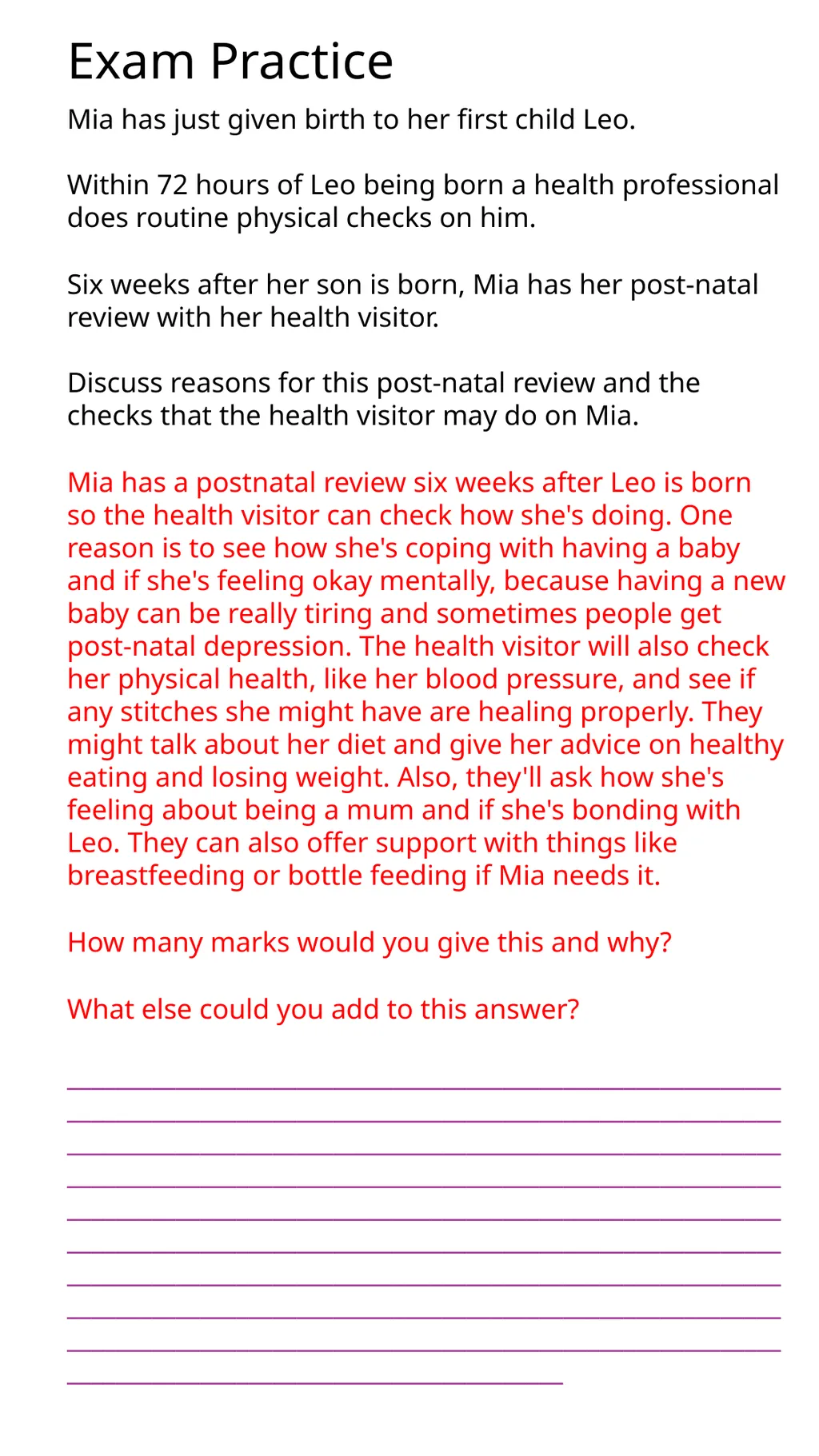
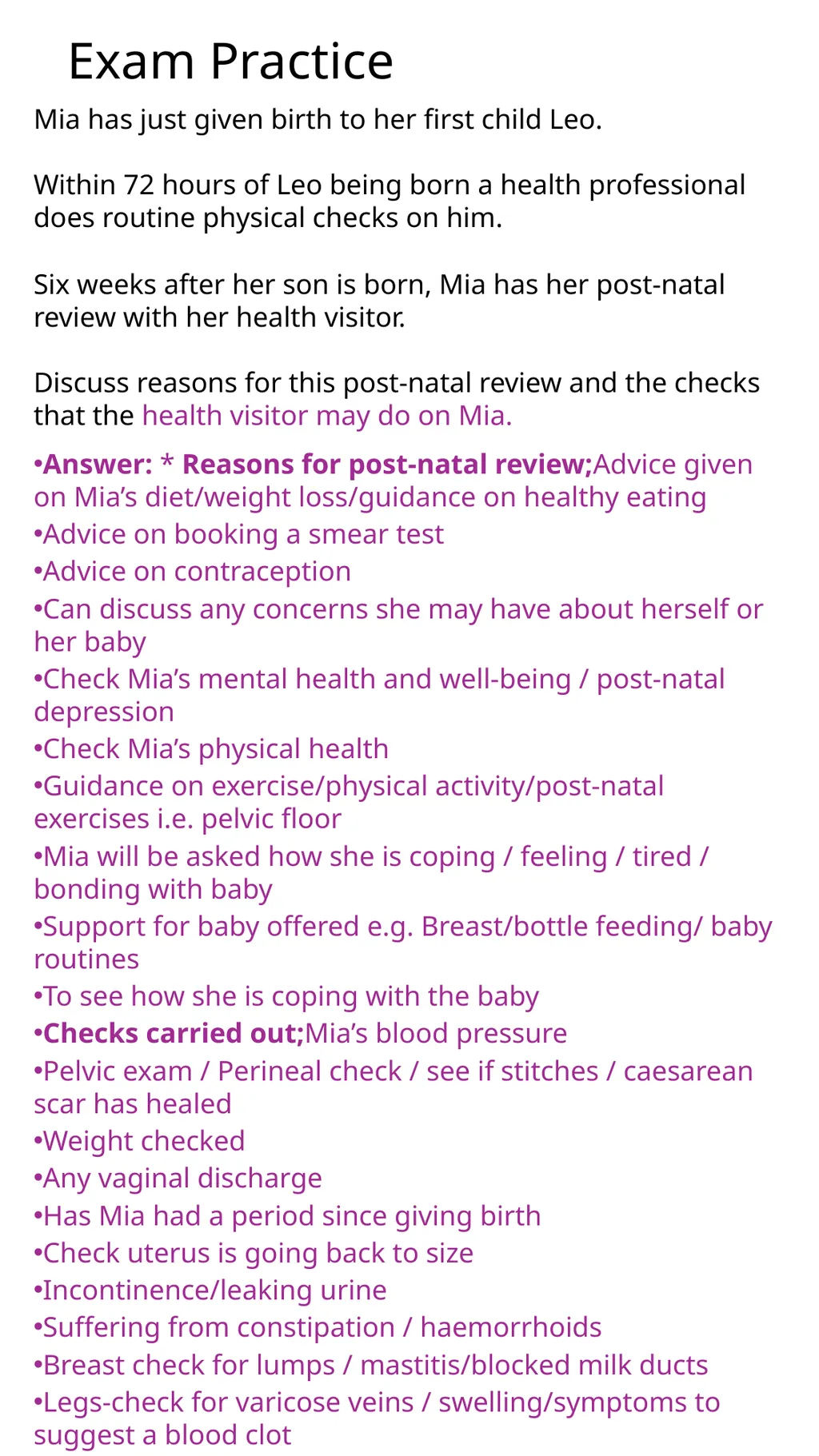
Exam Practice Mia has just given birth to her first child Leo.
Within 72 hours of Leo being born a health professional does routine physical checks on him.
Six weeks after her son is born, Mia has her post-natal review with her health visitor. Discuss reasons for this post-natal review and the checks that the health visitor may do on Mia.
Mia has a postnatal review six weeks after Leo is born so the health visitor can check how she's doing. One reason is to see how she's coping with having a baby and if she's feeling okay mentally, because having a new baby can be really tiring and sometimes people get post-natal depression. The health visitor will also check her physical health, like her blood pressure, and see if any stitches she might have are healing properly. They might talk about her diet and give her advice on healthy eating and losing weight. Also, they'll ask how she's feeling about being a mum and if she's bonding with Leo. They can also offer support with things like breastfeeding or bottle feeding if Mia needs it.
How many marks would you give this and why?
What else could you add to this answer?
____________________________________________________________________________________________________________________________________________________________________________________________________________________________________________________________________________________________________________________________________________________________________________________________________________________________________________________________________________________________________________________________________________________________________________________________<br>
Six weeks after her son is born, Mia has her post-natal review with her health visitor. Discuss reasons for this post-natal review and the checks that the health visitor may do on Mia.
Mia has a postnatal review six weeks after Leo is born so the health visitor can check how she's doing. One reason is to see how she's coping with having a baby and if she's feeling okay mentally, because having a new baby can be really tiring and sometimes people get post-natal depression. The health visitor will also check her physical health, like her blood pressure, and see if any stitches she might have are healing properly. They might talk about her diet and give her advice on healthy eating and losing weight. Also, they'll ask how she's feeling about being a mum and if she's bonding with Leo. They can also offer support with things like breastfeeding or bottle feeding if Mia needs it.
How many marks would you give this and why?
What else could you add to this answer?
____________________________________________________________________________________________________________________________________________________________________________________________________________________________________________________________________________________________________________________________________________________________________________________________________________________________________________________________________________________________________________________________________________________________________________________________<br>
23
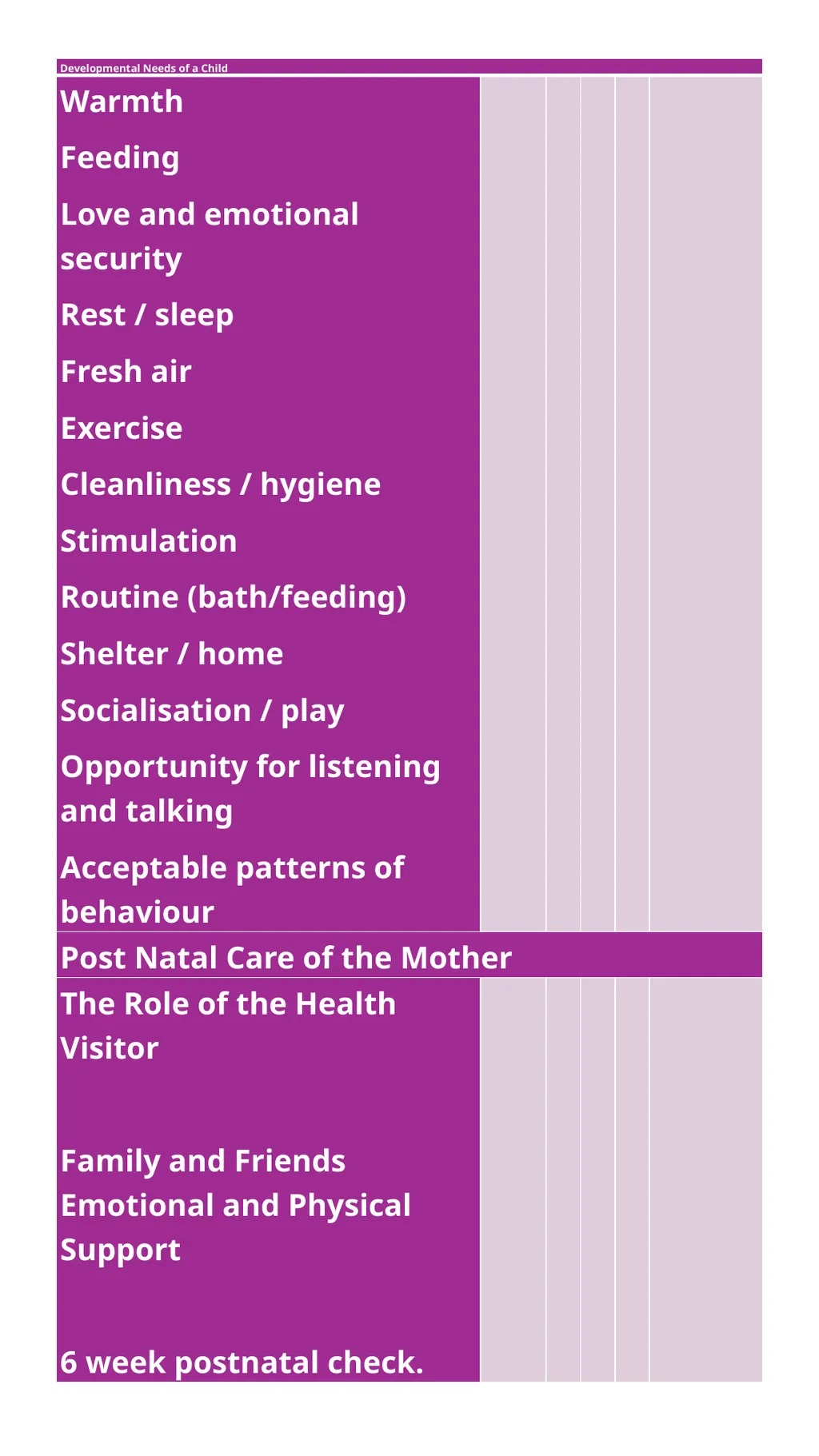
3.3 Developmental Needs (Birth to 5 Years)
This section explores the essential developmental needs of children from birth to five years, explaining their importance and how to meet them.
Why These Needs Matter:
Meeting these needs is crucial for children's healthy growth, development, and well-being. It lays the foundation for their physical health, emotional security, cognitive development, and social skills.
1. Physical Needs:
Warmth: Young children are more susceptible to temperature changes. Warmth ensures comfort and helps prevent illness.
How to meet: Appropriate clothing, comfortable room temperature, warm bedding.
Feeding: Provides essential nutrients for growth, energy, and healthy development.
How to meet: Regular breastfeeding or formula feeding, introducing nutritious solid foods at around 6 months, offering healthy snacks, and ensuring adequate hydration.
Rest/Sleep: Essential for physical growth, brain development, and emotional regulation.
How to meet: Establishing a consistent sleep routine, creating a calming bedtime environment, ensuring adequate sleep duration (varies with age), and providing opportunities for naps.
Fresh Air: Exposure to fresh air promotes good respiratory health, boosts the immune system, and provides opportunities for exploration and play.
How to meet: Daily outdoor activities, ensuring good ventilation in indoor spaces.
Exercise: Physical activity strengthens muscles, develops coordination, and supports overall health and well-being.
How to meet: Tummy time for infants, encouraging active play (crawling, walking, running, climbing), and providing opportunities for outdoor exploration.
Cleanliness/Hygiene: Maintaining cleanliness helps prevent infections and promotes healthy habits.
How to meet: Regular bathing, handwashing, nappy changing, and keeping the environment clean.<br>
This section explores the essential developmental needs of children from birth to five years, explaining their importance and how to meet them.
Why These Needs Matter:
Meeting these needs is crucial for children's healthy growth, development, and well-being. It lays the foundation for their physical health, emotional security, cognitive development, and social skills.
1. Physical Needs:
Warmth: Young children are more susceptible to temperature changes. Warmth ensures comfort and helps prevent illness.
How to meet: Appropriate clothing, comfortable room temperature, warm bedding.
Feeding: Provides essential nutrients for growth, energy, and healthy development.
How to meet: Regular breastfeeding or formula feeding, introducing nutritious solid foods at around 6 months, offering healthy snacks, and ensuring adequate hydration.
Rest/Sleep: Essential for physical growth, brain development, and emotional regulation.
How to meet: Establishing a consistent sleep routine, creating a calming bedtime environment, ensuring adequate sleep duration (varies with age), and providing opportunities for naps.
Fresh Air: Exposure to fresh air promotes good respiratory health, boosts the immune system, and provides opportunities for exploration and play.
How to meet: Daily outdoor activities, ensuring good ventilation in indoor spaces.
Exercise: Physical activity strengthens muscles, develops coordination, and supports overall health and well-being.
How to meet: Tummy time for infants, encouraging active play (crawling, walking, running, climbing), and providing opportunities for outdoor exploration.
Cleanliness/Hygiene: Maintaining cleanliness helps prevent infections and promotes healthy habits.
How to meet: Regular bathing, handwashing, nappy changing, and keeping the environment clean.<br>
24
2. Emotional and Social Needs:
Love and Emotional Security: Feeling loved and secure provides a strong foundation for emotional development, self-esteem, and healthy relationships.
How to meet: Showing affection through cuddles, kisses, and positive words, responding sensitively to the child's needs, providing consistent care, and creating a nurturing and supportive environment.
Socialisation/Play: Interacting with others and engaging in play develops social skills, communication, creativity, and problem-solving abilities.
How to meet: Providing opportunities for playdates, attending playgroups, interacting with family and friends, and offering a variety of play experiences (imaginative play, outdoor play, etc.).
Opportunities for Listening and Talking: Language development is crucial for communication, learning, and social interaction.
How to meet: Talking to the child from birth, reading stories, singing songs, engaging in conversations, and responding to their attempts to communicate.
3. Cognitive and Behavioural Needs:
Stimulation: A stimulating environment encourages exploration, learning, and cognitive development.
How to meet: Providing age-appropriate toys and activities, reading books, singing songs, playing games, and exposing the child to new experiences.
Routine: Predictable routines provide a sense of security and help children understand expectations.
How to meet: Establishing consistent routines for bath time, feeding, sleep, and other daily activities. Shelter/Home: A safe and secure home environment provides a sense of belonging and stability.
How to meet: Creating a comfortable and nurturing home environment, ensuring safety measures are in place, and providing a sense of routine and predictability.
Acceptable Patterns of Behaviour: Setting clear and consistent boundaries helps children learn acceptable behaviour and develop self-control.
How to meet: Using positive reinforcement, setting clear expectations, providing consistent consequences for unacceptable behaviour, and modelling appropriate behaviour.<br>
Love and Emotional Security: Feeling loved and secure provides a strong foundation for emotional development, self-esteem, and healthy relationships.
How to meet: Showing affection through cuddles, kisses, and positive words, responding sensitively to the child's needs, providing consistent care, and creating a nurturing and supportive environment.
Socialisation/Play: Interacting with others and engaging in play develops social skills, communication, creativity, and problem-solving abilities.
How to meet: Providing opportunities for playdates, attending playgroups, interacting with family and friends, and offering a variety of play experiences (imaginative play, outdoor play, etc.).
Opportunities for Listening and Talking: Language development is crucial for communication, learning, and social interaction.
How to meet: Talking to the child from birth, reading stories, singing songs, engaging in conversations, and responding to their attempts to communicate.
3. Cognitive and Behavioural Needs:
Stimulation: A stimulating environment encourages exploration, learning, and cognitive development.
How to meet: Providing age-appropriate toys and activities, reading books, singing songs, playing games, and exposing the child to new experiences.
Routine: Predictable routines provide a sense of security and help children understand expectations.
How to meet: Establishing consistent routines for bath time, feeding, sleep, and other daily activities. Shelter/Home: A safe and secure home environment provides a sense of belonging and stability.
How to meet: Creating a comfortable and nurturing home environment, ensuring safety measures are in place, and providing a sense of routine and predictability.
Acceptable Patterns of Behaviour: Setting clear and consistent boundaries helps children learn acceptable behaviour and develop self-control.
How to meet: Using positive reinforcement, setting clear expectations, providing consistent consequences for unacceptable behaviour, and modelling appropriate behaviour.<br>
25
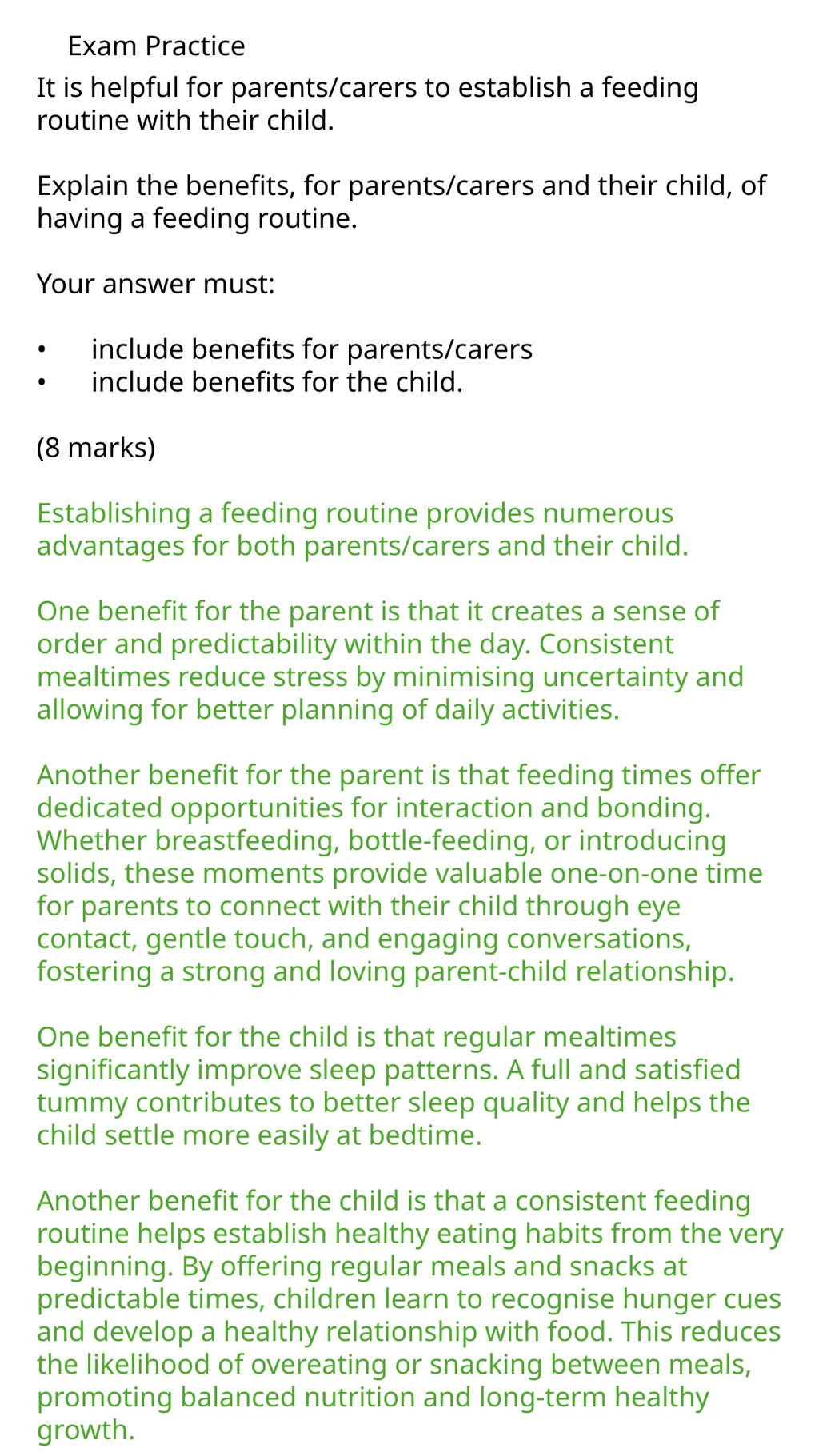
Exam Practice It is helpful for parents/carers to establish a feeding routine with their child.
Explain the benefits, for parents/carers and their child, of having a feeding routine.
Your answer must:
• include benefits for parents/carers
• include benefits for the child.
(8 marks)
Establishing a feeding routine provides numerous advantages for both parents/carers and their child.
One benefit for the parent is that it creates a sense of order and predictability within the day. Consistent mealtimes reduce stress by minimising uncertainty and allowing for better planning of daily activities.
Another benefit for the parent is that feeding times offer dedicated opportunities for interaction and bonding. Whether breastfeeding, bottle-feeding, or introducing solids, these moments provide valuable one-on-one time for parents to connect with their child through eye contact, gentle touch, and engaging conversations, fostering a strong and loving parent-child relationship.
One benefit for the child is that regular mealtimes significantly improve sleep patterns. A full and satisfied tummy contributes to better sleep quality and helps the child settle more easily at bedtime.
Another benefit for the child is that a consistent feeding routine helps establish healthy eating habits from the very beginning. By offering regular meals and snacks at predictable times, children learn to recognise hunger cues and develop a healthy relationship with food. This reduces the likelihood of overeating or snacking between meals, promoting balanced nutrition and long-term healthy growth.<br>
Explain the benefits, for parents/carers and their child, of having a feeding routine.
Your answer must:
• include benefits for parents/carers
• include benefits for the child.
(8 marks)
Establishing a feeding routine provides numerous advantages for both parents/carers and their child.
One benefit for the parent is that it creates a sense of order and predictability within the day. Consistent mealtimes reduce stress by minimising uncertainty and allowing for better planning of daily activities.
Another benefit for the parent is that feeding times offer dedicated opportunities for interaction and bonding. Whether breastfeeding, bottle-feeding, or introducing solids, these moments provide valuable one-on-one time for parents to connect with their child through eye contact, gentle touch, and engaging conversations, fostering a strong and loving parent-child relationship.
One benefit for the child is that regular mealtimes significantly improve sleep patterns. A full and satisfied tummy contributes to better sleep quality and helps the child settle more easily at bedtime.
Another benefit for the child is that a consistent feeding routine helps establish healthy eating habits from the very beginning. By offering regular meals and snacks at predictable times, children learn to recognise hunger cues and develop a healthy relationship with food. This reduces the likelihood of overeating or snacking between meals, promoting balanced nutrition and long-term healthy growth.<br>
26
Exam Practice It is helpful for parents/carers to establish a feeding routine with their child.
Explain the benefits, for parents/carers and their child, of having a feeding routine.
Your answer must:
• include benefits for parents/carers
• include benefits for the child.
(8 marks)
Now have a go for yourself
_______________________________________________________________________________________________________________________________________________________________________________________________________________________________________________________________________________________________________________________________________________________________________________________________________________________________________________________________________________________________________________________________________________________________________________________________________________________________________________________________________________________________________________________________________________________________________________________________________________________________________________________________________________________________________________________________________________________________________________________________________________________________________________________________________________________________________________________________________________________________________________________________________________________________________________________________________________________________________________________________________________________________________________________________________________________________________________________________________________________________________________________________________________________________________________________________________________________<br>
Explain the benefits, for parents/carers and their child, of having a feeding routine.
Your answer must:
• include benefits for parents/carers
• include benefits for the child.
(8 marks)
Now have a go for yourself
_______________________________________________________________________________________________________________________________________________________________________________________________________________________________________________________________________________________________________________________________________________________________________________________________________________________________________________________________________________________________________________________________________________________________________________________________________________________________________________________________________________________________________________________________________________________________________________________________________________________________________________________________________________________________________________________________________________________________________________________________________________________________________________________________________________________________________________________________________________________________________________________________________________________________________________________________________________________________________________________________________________________________________________________________________________________________________________________________________________________________________________________________________________________________________________________________________________________<br>
27
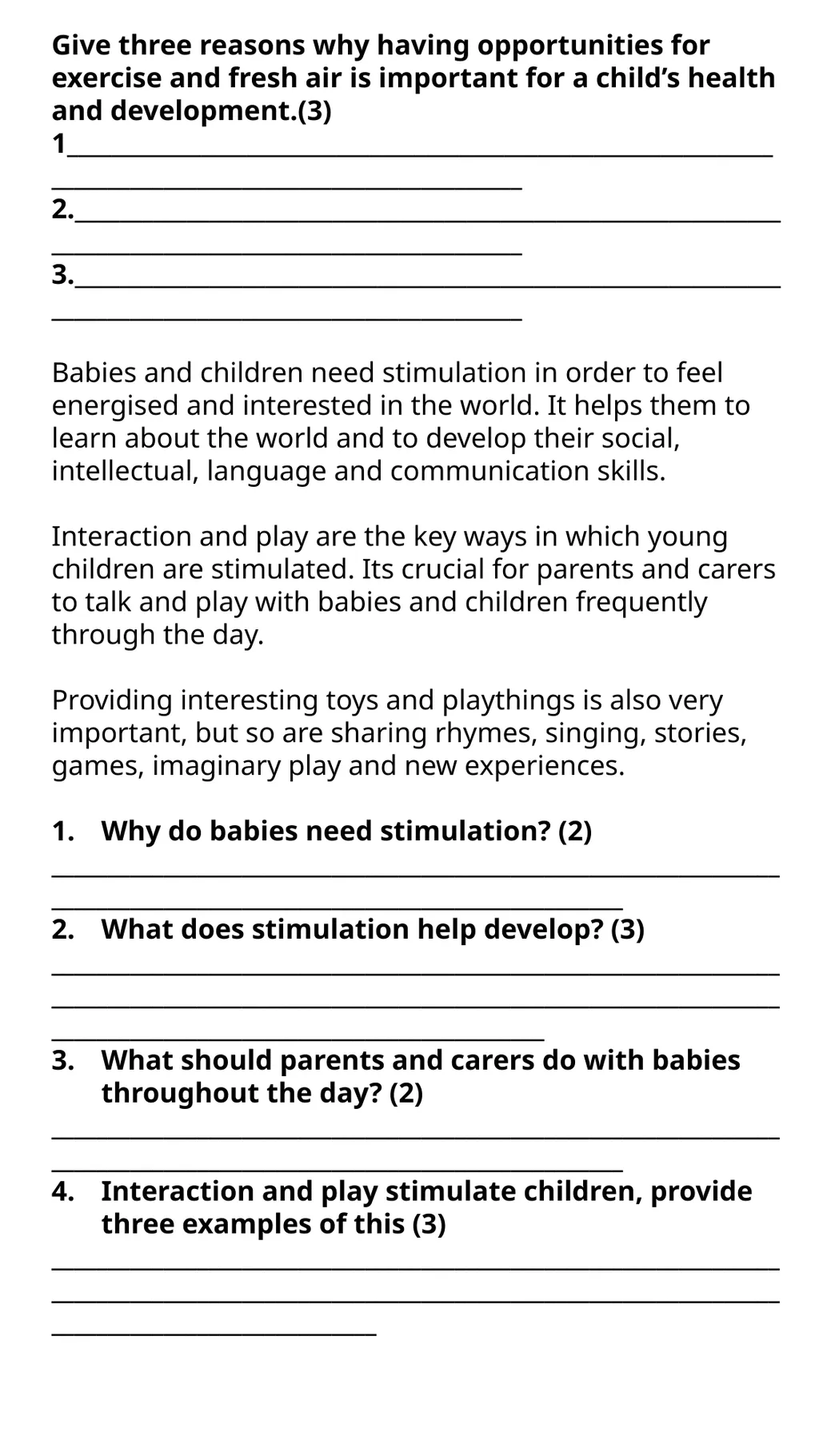
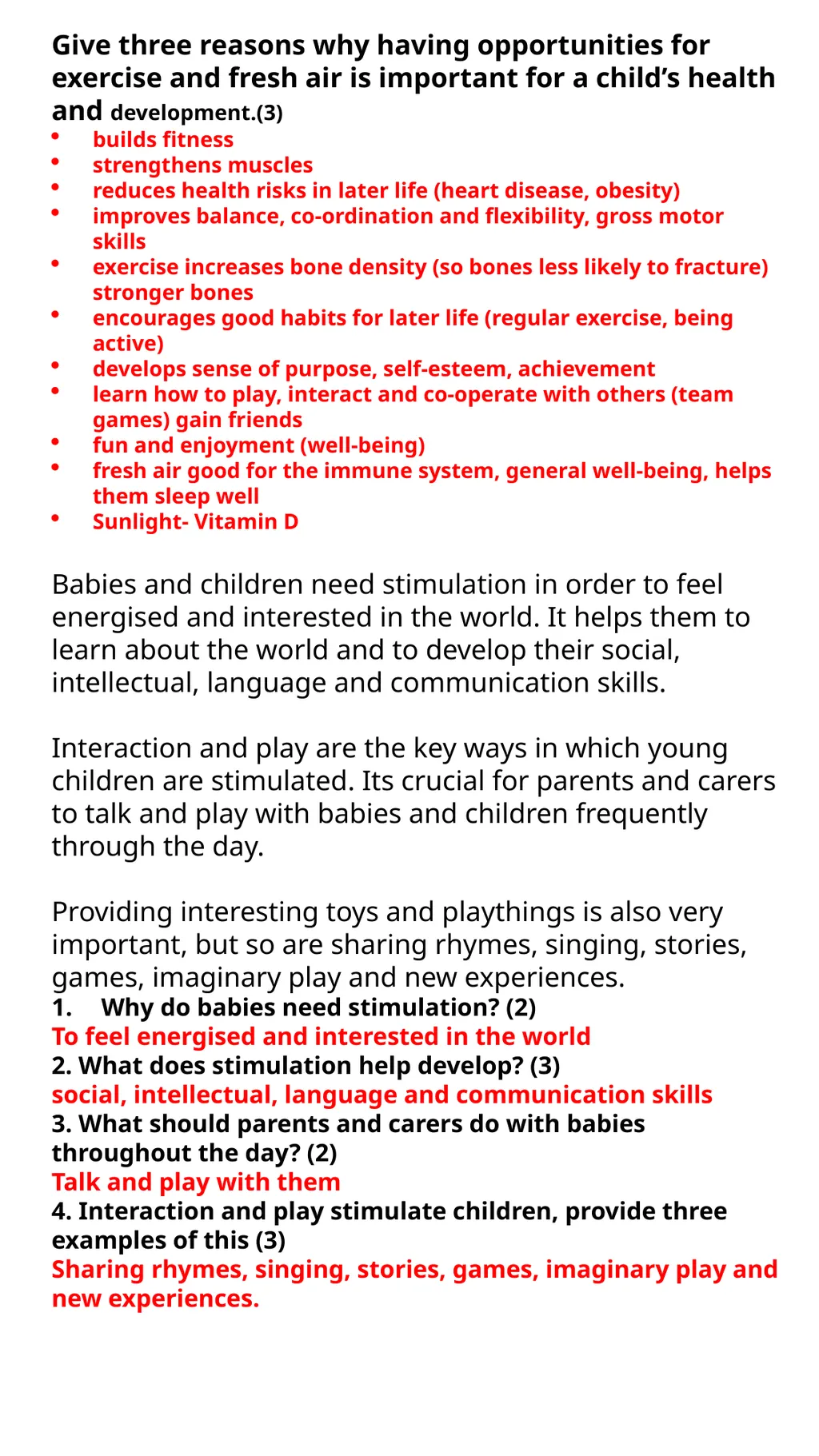
Give three reasons why having opportunities for exercise and fresh air is important for a child’s health and development.(3)
1_________________________________________________________________________________________________________
2._________________________________________________________________________________________________________
3._________________________________________________________________________________________________________
Babies and children need stimulation in order to feel energised and interested in the world. It helps them to learn about the world and to develop their social, intellectual, language and communication skills.
Interaction and play are the key ways in which young children are stimulated. Its crucial for parents and carers to talk and play with babies and children frequently through the day.
Providing interesting toys and playthings is also very important, but so are sharing rhymes, singing, stories, games, imaginary play and new experiences.
Why do babies need stimulation? (2)
____________________________________________________________________________________________________________________
What does stimulation help develop? (3)
______________________________________________________________________________________________________________________________________________________________________________
What should parents and carers do with babies throughout the day? (2)
____________________________________________________________________________________________________________________
Interaction and play stimulate children, provide three examples of this (3)
_______________________________________________________________________________________________________________________________________________________________<br>
1_________________________________________________________________________________________________________
2._________________________________________________________________________________________________________
3._________________________________________________________________________________________________________
Babies and children need stimulation in order to feel energised and interested in the world. It helps them to learn about the world and to develop their social, intellectual, language and communication skills.
Interaction and play are the key ways in which young children are stimulated. Its crucial for parents and carers to talk and play with babies and children frequently through the day.
Providing interesting toys and playthings is also very important, but so are sharing rhymes, singing, stories, games, imaginary play and new experiences.
Why do babies need stimulation? (2)
____________________________________________________________________________________________________________________
What does stimulation help develop? (3)
______________________________________________________________________________________________________________________________________________________________________________
What should parents and carers do with babies throughout the day? (2)
____________________________________________________________________________________________________________________
Interaction and play stimulate children, provide three examples of this (3)
_______________________________________________________________________________________________________________________________________________________________<br>
28
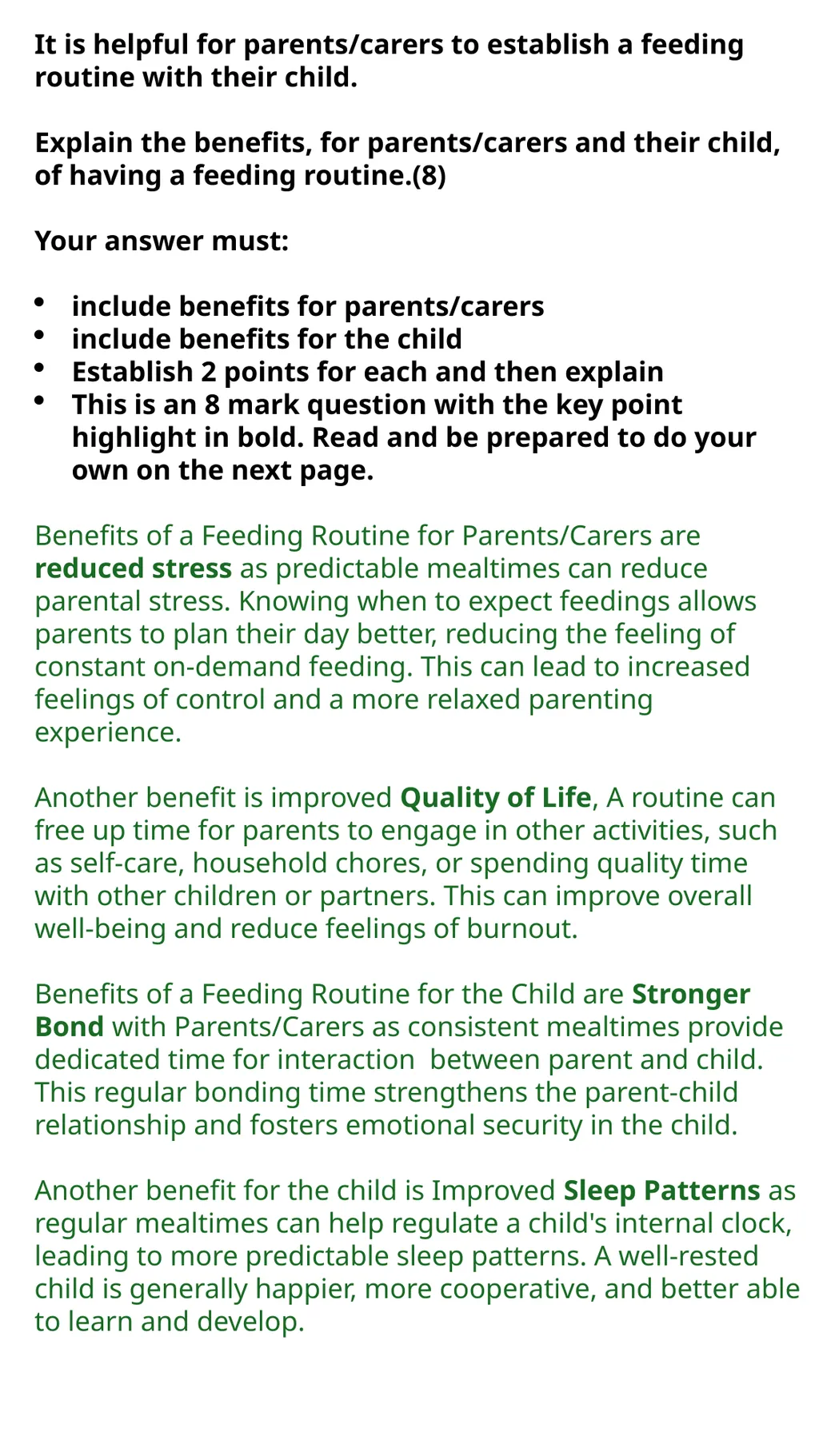
It is helpful for parents/carers to establish a feeding routine with their child.
Explain the benefits, for parents/carers and their child, of having a feeding routine.(8)
Your answer must:
include benefits for parents/carers
include benefits for the child
Establish 2 points for each and then explain
This is an 8 mark question with the key point highlight in bold. Read and be prepared to do your own on the next page.
Benefits of a Feeding Routine for Parents/Carers are reduced stress as predictable mealtimes can reduce parental stress. Knowing when to expect feedings allows parents to plan their day better, reducing the feeling of constant on-demand feeding. This can lead to increased feelings of control and a more relaxed parenting experience.
Another benefit is improved Quality of Life, A routine can free up time for parents to engage in other activities, such as self-care, household chores, or spending quality time with other children or partners. This can improve overall well-being and reduce feelings of burnout.
Benefits of a Feeding Routine for the Child are Stronger Bond with Parents/Carers as consistent mealtimes provide dedicated time for interaction between parent and child. This regular bonding time strengthens the parent-child relationship and fosters emotional security in the child.
Another benefit for the child is Improved Sleep Patterns as regular mealtimes can help regulate a child's internal clock, leading to more predictable sleep patterns. A well-rested child is generally happier, more cooperative, and better able to learn and develop.<br>
include benefits for parents/carers
include benefits for the child
Establish 2 points for each and then explain
This is an 8 mark question with the key point highlight in bold. Read and be prepared to do your own on the next page.
Benefits of a Feeding Routine for Parents/Carers are reduced stress as predictable mealtimes can reduce parental stress. Knowing when to expect feedings allows parents to plan their day better, reducing the feeling of constant on-demand feeding. This can lead to increased feelings of control and a more relaxed parenting experience.
Another benefit is improved Quality of Life, A routine can free up time for parents to engage in other activities, such as self-care, household chores, or spending quality time with other children or partners. This can improve overall well-being and reduce feelings of burnout.
Benefits of a Feeding Routine for the Child are Stronger Bond with Parents/Carers as consistent mealtimes provide dedicated time for interaction between parent and child. This regular bonding time strengthens the parent-child relationship and fosters emotional security in the child.
Another benefit for the child is Improved Sleep Patterns as regular mealtimes can help regulate a child's internal clock, leading to more predictable sleep patterns. A well-rested child is generally happier, more cooperative, and better able to learn and develop.<br>
29
It is helpful for parents/carers to establish a feeding routine with their child.
Explain the benefits, for parents/carers and their child, of having a feeding routine.(8)
Your answer must:
include benefits for parents/carers
include benefits for the child
Establish 2 points for each and then explain
This is an 8 mark question with the key point highlight in bold. Read and be prepared to do your own on the next page.
Now have a go for yourself
__________________________________________________________________________________________________________________________________________________________________________________________________________________________________________________________________________________________________________________________________________________________________________________________________________________________________________________________________________________________________________________________________________________________________________________________________________________________________________________________________________________________________________________________________________________________________________________________________________________________________________________________________________________________________________________________________________________________________________________________________________________________________________________________________________________________________________________________________________________________________________________________________________________________________________________________________________________________________________________________________________________________________________________________________________________________________________________________________________________________________________________________________________________________________________________________________________________________________________________<br>
include benefits for parents/carers
include benefits for the child
Establish 2 points for each and then explain
This is an 8 mark question with the key point highlight in bold. Read and be prepared to do your own on the next page.
Now have a go for yourself
__________________________________________________________________________________________________________________________________________________________________________________________________________________________________________________________________________________________________________________________________________________________________________________________________________________________________________________________________________________________________________________________________________________________________________________________________________________________________________________________________________________________________________________________________________________________________________________________________________________________________________________________________________________________________________________________________________________________________________________________________________________________________________________________________________________________________________________________________________________________________________________________________________________________________________________________________________________________________________________________________________________________________________________________________________________________________________________________________________________________________________________________________________________________________________________________________________________________________________________<br>
30
Read the case study below. Give two explanations as to why Skye might have had a tantrum. (4)
_______________________________________________________________________________________________________________________________________________________________________________________________________________________________________________________________________________________________________________________________________________________
State two reasons why giving in and buying the sweets is not a good way to deal with Skye’s tantrum. (2)
1___________________________________________________________________________________________________
2___________________________________________________________________________________________________
Describe two ways that Jayne could prevent Skye from having tantrums when shopping. (4)
_____________________________________________________________________________________________________________________________________________________________________________________________________________________________________________________
_____________________________________________________________________________________________________________________________________________________________________________________________________________________________________________________ Skye is 3 years old. She enjoys going to the supermarket with her grandparents. They always let her choose some sweets or chocolate. When Skye goes to the supermarket with her mum (Jayne) she asks for sweets but is told she cannot have any. Skye has started having tantrums when she is refused the sweets. She cries, sobs and stamps the floor.
Jayne is embarrassed so she gives in to Skye and buys the sweets to calm her down.<br>
_______________________________________________________________________________________________________________________________________________________________________________________________________________________________________________________________________________________________________________________________________________________
State two reasons why giving in and buying the sweets is not a good way to deal with Skye’s tantrum. (2)
1___________________________________________________________________________________________________
2___________________________________________________________________________________________________
Describe two ways that Jayne could prevent Skye from having tantrums when shopping. (4)
_____________________________________________________________________________________________________________________________________________________________________________________________________________________________________________________
_____________________________________________________________________________________________________________________________________________________________________________________________________________________________________________________ Skye is 3 years old. She enjoys going to the supermarket with her grandparents. They always let her choose some sweets or chocolate. When Skye goes to the supermarket with her mum (Jayne) she asks for sweets but is told she cannot have any. Skye has started having tantrums when she is refused the sweets. She cries, sobs and stamps the floor.
Jayne is embarrassed so she gives in to Skye and buys the sweets to calm her down.<br>
31
A child’s behaviour can be influenced by the example set by their parents/carers.
Give four examples of how parents/carers can be role models and set a good example for their child’s behaviour (4)
1_________________________________________________________________________________________________________________________
2_________________________________________________________________________________________________________________________
3_________________________________________________________________________________________________________________________
4_________________________________________________________________________________________________________________________ Identify and explain one way that parents/carers could promote positive behaviour in their child (4)
____________________________________________________________________________________________________________________________________________________________________________________________________________________________________________________________________________________ Amjad knows it is important to provide good conditions for development for his 3-year-old twins Mira and Elaina. To help with their development Amjad takes the twins to toddlers’ football class every Saturday morning. It is something they all enjoy. Explain two different ways that taking part in toddlers’ football classes provides Mira and Elaina with good conditions for development. (6)
Taking part in toddlers’ football classes provides Mira and Elaina with good conditions for development in two key ways. Firstly, the class environment encourages communication. Instructions from the coach, interactions with other children (e.g., "Pass the ball!"), and social play all require listening and responding verbally. This helps develop their language and communication skills.
Secondly, participation in sports activities often involves physical exertion and can lead to getting dirty. The need to change clothes and wash hands after the class reinforces the importance of hygiene and cleanliness habits in a practical and engaging way
6/6<br>
1_________________________________________________________________________________________________________________________
2_________________________________________________________________________________________________________________________
3_________________________________________________________________________________________________________________________
4_________________________________________________________________________________________________________________________ Identify and explain one way that parents/carers could promote positive behaviour in their child (4)
____________________________________________________________________________________________________________________________________________________________________________________________________________________________________________________________________________________ Amjad knows it is important to provide good conditions for development for his 3-year-old twins Mira and Elaina. To help with their development Amjad takes the twins to toddlers’ football class every Saturday morning. It is something they all enjoy. Explain two different ways that taking part in toddlers’ football classes provides Mira and Elaina with good conditions for development. (6)
Taking part in toddlers’ football classes provides Mira and Elaina with good conditions for development in two key ways. Firstly, the class environment encourages communication. Instructions from the coach, interactions with other children (e.g., "Pass the ball!"), and social play all require listening and responding verbally. This helps develop their language and communication skills.
Secondly, participation in sports activities often involves physical exertion and can lead to getting dirty. The need to change clothes and wash hands after the class reinforces the importance of hygiene and cleanliness habits in a practical and engaging way
6/6<br>
32
Answers – Don’t peek until the end.<br>
33
Test your knowledge Scenario 1
At 1 minute, the baby's skin is bluish all over (1). The baby has a slow, weak cry and the heart rate is below 100 bpm (1). The baby's arms and legs are flexed, but movement is minimal (1). When the sole of the foot is flicked, the baby grimaces slightly (1). At 5 minutes, the baby's body is pink, but the hands and feet are still bluish (1). The cry is stronger now, and the heart rate is over 100 bpm (2). The baby is moving more actively (2), and reflexes are more responsive (2).
Concerns at 1 minute: The low Apgar score at 1 minute suggests the baby experienced some distress during birth. The bluish skin colour, weak cry, and slow heart rate are concerning and require immediate attention.
Change by 5 minutes: The significant improvement in the Apgar score at 5 minutes indicates that the baby is responding well to resuscitation efforts and is stabilizing. While the extremities are still slightly blue, the overall improvement is a positive sign.<br>
At 1 minute, the baby's skin is bluish all over (1). The baby has a slow, weak cry and the heart rate is below 100 bpm (1). The baby's arms and legs are flexed, but movement is minimal (1). When the sole of the foot is flicked, the baby grimaces slightly (1). At 5 minutes, the baby's body is pink, but the hands and feet are still bluish (1). The cry is stronger now, and the heart rate is over 100 bpm (2). The baby is moving more actively (2), and reflexes are more responsive (2).
Concerns at 1 minute: The low Apgar score at 1 minute suggests the baby experienced some distress during birth. The bluish skin colour, weak cry, and slow heart rate are concerning and require immediate attention.
Change by 5 minutes: The significant improvement in the Apgar score at 5 minutes indicates that the baby is responding well to resuscitation efforts and is stabilizing. While the extremities are still slightly blue, the overall improvement is a positive sign.<br>
34
Scenario 2
A baby is born prematurely at 34 weeks gestation. At 1 minute, the baby is pale and limp, with no cry and a heart rate below 100 bpm (1). There is no response to reflex stimulation (0). At 5 minutes, the baby's skin has a slightly pinkish tinge (1), the heart rate is now above 100 bpm (2), and there is a weak cry (1). The baby is moving its arms and legs slightly (1), and there is a minimal grimace response to reflex stimulation (1).
Challenges of Prematurity: Premature babies often have underdeveloped lungs, weak muscles, and difficulty regulating their temperature. This can lead to lower Apgar scores, especially in the first few minutes of life.
Importance of Monitoring: Premature babies require close monitoring for breathing problems, infections, and other complications. Even with improving Apgar scores, their vulnerability necessitates careful observation.<br>
A baby is born prematurely at 34 weeks gestation. At 1 minute, the baby is pale and limp, with no cry and a heart rate below 100 bpm (1). There is no response to reflex stimulation (0). At 5 minutes, the baby's skin has a slightly pinkish tinge (1), the heart rate is now above 100 bpm (2), and there is a weak cry (1). The baby is moving its arms and legs slightly (1), and there is a minimal grimace response to reflex stimulation (1).
Challenges of Prematurity: Premature babies often have underdeveloped lungs, weak muscles, and difficulty regulating their temperature. This can lead to lower Apgar scores, especially in the first few minutes of life.
Importance of Monitoring: Premature babies require close monitoring for breathing problems, infections, and other complications. Even with improving Apgar scores, their vulnerability necessitates careful observation.<br>
35
Zophia gives birth to a healthy baby girl. Straight after the birth the baby’s five vital signs are checked and the baby is given a score.
What is the name given to this score?
APGAR SCORE
_______________________________________________________
[1]
Identify the baby’s five vital signs that are checked as soon as the baby is born.
1
2
3
4
5
[5] Exam Practice Spelling must be correct. ii)One mark for an identification, five required. The 5 vital signs
:Heartbeat / heart rate / pulse
Breathing / respiration
Muscle tone / if limp or active / movement
Reflex response / reflexes (when foot or nostril tickled)/ grimace / a named reflex e.g. sucking
Colour / colour of skin / appearance<br>
What is the name given to this score?
APGAR SCORE
_______________________________________________________
[1]
Identify the baby’s five vital signs that are checked as soon as the baby is born.
1
2
3
4
5
[5] Exam Practice Spelling must be correct. ii)One mark for an identification, five required. The 5 vital signs
:Heartbeat / heart rate / pulse
Breathing / respiration
Muscle tone / if limp or active / movement
Reflex response / reflexes (when foot or nostril tickled)/ grimace / a named reflex e.g. sucking
Colour / colour of skin / appearance<br>
36
Describe what vernix is and its purpose
One mark for description. One mark for purpose. Vernixwhite
waxy / greasy substance
substance that covers baby’s skin
Purposenatural moisturiser
protects baby’s skin from infection / disease
provides protective layer
Marks: 2 (2x1) During pregnancy, usually around 22 weeks, the baby will become covered in lanugo.
Describe what lanugo is and what it does.
One mark for description. One mark for purpose. Lanugosoft fine hair
hair without colour
downy hair
Purposehelps keep baby’s body at right temperature
protects baby’s skin (from being damaged by amniotic fluid)
helps hold vernix on skin
Example 2 mark answer: Lanugo is a soft fine hair (1) that covers the baby to protect its skin (1) from amniotic fluid.<br>
One mark for description. One mark for purpose. Vernixwhite
waxy / greasy substance
substance that covers baby’s skin
Purposenatural moisturiser
protects baby’s skin from infection / disease
provides protective layer
Marks: 2 (2x1) During pregnancy, usually around 22 weeks, the baby will become covered in lanugo.
Describe what lanugo is and what it does.
One mark for description. One mark for purpose. Lanugosoft fine hair
hair without colour
downy hair
Purposehelps keep baby’s body at right temperature
protects baby’s skin (from being damaged by amniotic fluid)
helps hold vernix on skin
Example 2 mark answer: Lanugo is a soft fine hair (1) that covers the baby to protect its skin (1) from amniotic fluid.<br>
37
True or False: Test Your Knowledge
Apgar Score:
The Apgar score is a quick test to check a baby's overall health right after birth. (True)
Apgar stands for Appearance, Pulse, Grimace, Activity, and Respiration. (True)
A high Apgar score means the baby needs immediate medical attention. (False - A low score indicates this)
The Apgar score is usually checked at 1 and 10 minutes after birth. (False - 1 and 5 minutes)
The highest possible Apgar score is 10. (True)
Vernix and Lanugo:
Vernix is a white, cheesy substance that covers a baby's skin at birth. (True)
Lanugo is thick, dark hair on a baby's head. (False - It's fine, downy hair all over the body)
Vernix helps protect the baby's skin in the womb. (True)
Lanugo helps keep the baby warm after birth. (True)
Both vernix and lanugo usually disappear within a few weeks after birth. (True)
Weight, Length, and Head Circumference:
A baby's weight is measured to check if they are growing properly. (True)
It's unusual for a baby to lose a little weight in the first few days after birth. (False - It's normal)
Length is measured from the baby's head to their toes. (True)
Head circumference helps assess brain development. (True)
These measurements are only taken once, right after birth. (False - They are tracked over time)<br>
Apgar Score:
The Apgar score is a quick test to check a baby's overall health right after birth. (True)
Apgar stands for Appearance, Pulse, Grimace, Activity, and Respiration. (True)
A high Apgar score means the baby needs immediate medical attention. (False - A low score indicates this)
The Apgar score is usually checked at 1 and 10 minutes after birth. (False - 1 and 5 minutes)
The highest possible Apgar score is 10. (True)
Vernix and Lanugo:
Vernix is a white, cheesy substance that covers a baby's skin at birth. (True)
Lanugo is thick, dark hair on a baby's head. (False - It's fine, downy hair all over the body)
Vernix helps protect the baby's skin in the womb. (True)
Lanugo helps keep the baby warm after birth. (True)
Both vernix and lanugo usually disappear within a few weeks after birth. (True)
Weight, Length, and Head Circumference:
A baby's weight is measured to check if they are growing properly. (True)
It's unusual for a baby to lose a little weight in the first few days after birth. (False - It's normal)
Length is measured from the baby's head to their toes. (True)
Head circumference helps assess brain development. (True)
These measurements are only taken once, right after birth. (False - They are tracked over time)<br>
38
Exam Practice Mia has just given birth to her first child Leo.
Within 72 hours of Leo being born a health professional does routine physical checks on him.
The health professional checks Leo’s fontanelle.
What is another name for the fontanelle?
_________________________________________________________
[1]
Describe what the fontanelle is.
__________________________________________________________________________________________________________________________________________________________________________
[3 Jamila has just given birth to her third child in hospital.
Within 1 to 5 days after the birth the midwife will physically examine Jamila’s baby. One check the midwife will do is a heel prick test (blood spot test).
State one condition the heel prick test can identify.
_________________________________________________________
[1]
Identify five other checks the midwife will do during the physical examination.
1
2
3
4
5
[5] Congenital hypothyroidism
Cystic fibrosis (CS)
Glutaric aciduria type 1 (GA1)
Homocystinuria (pyridoxine unresponsive) (HCU)
Isovaleric acidaemia (IVA)
Maple syrup urine disease (MSUD)
Medium-chain acyl-CoA dehydrogenase deficiency (MCADD)
Phenylketonuria (PKU)
Sickle cell/diseas eyes
feet
fingers
fontanelle/soft spot
heart/heartbeat
hips
testicles in boys
umbilical cord<br>
Within 72 hours of Leo being born a health professional does routine physical checks on him.
The health professional checks Leo’s fontanelle.
What is another name for the fontanelle?
_________________________________________________________
[1]
Describe what the fontanelle is.
__________________________________________________________________________________________________________________________________________________________________________
[3 Jamila has just given birth to her third child in hospital.
Within 1 to 5 days after the birth the midwife will physically examine Jamila’s baby. One check the midwife will do is a heel prick test (blood spot test).
State one condition the heel prick test can identify.
_________________________________________________________
[1]
Identify five other checks the midwife will do during the physical examination.
1
2
3
4
5
[5] Congenital hypothyroidism
Cystic fibrosis (CS)
Glutaric aciduria type 1 (GA1)
Homocystinuria (pyridoxine unresponsive) (HCU)
Isovaleric acidaemia (IVA)
Maple syrup urine disease (MSUD)
Medium-chain acyl-CoA dehydrogenase deficiency (MCADD)
Phenylketonuria (PKU)
Sickle cell/diseas eyes
feet
fingers
fontanelle/soft spot
heart/heartbeat
hips
testicles in boys
umbilical cord<br>
39
Exam Practice Sunita has given birth to her first child, a son, by emergency caesarean section delivery.
Sunita is allowed to go home from hospital three days after her son is born. She is told by her doctor to rest and recover for a few weeks. Discuss ways that Sunita’s family and friends could help to support her when she returns home with her son. (8)
"When Sunita gets home, her family and friends can help her in a few ways. Firstly, they could do the shopping and cook meals for her, because she'll be really tired and needs to focus on her baby. Also, they could help with housework, like cleaning, since bending down might be painful for her after her surgery. They could also help with the baby, like changing nappies or giving him a bottle if she's using expressed milk. This will give her more time to rest. Finally, they should be there to talk to her and listen if she's feeling worried or upset, because having a baby can be tough.“
This is a 4/8 mark question What could you add to make it a full 8/8?
Answer: i)Ways family and friends can help:Help with lifting and carrying heavy things/ car seat because after a caesarean new mothers can’t lift or carry heavy objects as the wound may re-open/stiches come undone/tear.
Doing shopping/cooking meals so Sunita can spend time bonding with her new son.
Doing housework as Sunita may have problems bending because of the wound.
Bathing baby/ nappy changing/ help feed him bottle fed/expressed milk so Sunita can rest.
Offer to drive if Sunita needs to go out as Sunita can’t drive for 4/6 weeks after a caesarean delivery.
Provide emotional / mental health support so Sunita has someone to talk to and ask advice/reassurance.
Take care of visitors so Sunita can rest.
Encourage Sunita to take gentle exercise e.g. go for a walk with her this aids recovery and mental health<br>
Sunita is allowed to go home from hospital three days after her son is born. She is told by her doctor to rest and recover for a few weeks. Discuss ways that Sunita’s family and friends could help to support her when she returns home with her son. (8)
"When Sunita gets home, her family and friends can help her in a few ways. Firstly, they could do the shopping and cook meals for her, because she'll be really tired and needs to focus on her baby. Also, they could help with housework, like cleaning, since bending down might be painful for her after her surgery. They could also help with the baby, like changing nappies or giving him a bottle if she's using expressed milk. This will give her more time to rest. Finally, they should be there to talk to her and listen if she's feeling worried or upset, because having a baby can be tough.“
This is a 4/8 mark question What could you add to make it a full 8/8?
Answer: i)Ways family and friends can help:Help with lifting and carrying heavy things/ car seat because after a caesarean new mothers can’t lift or carry heavy objects as the wound may re-open/stiches come undone/tear.
Doing shopping/cooking meals so Sunita can spend time bonding with her new son.
Doing housework as Sunita may have problems bending because of the wound.
Bathing baby/ nappy changing/ help feed him bottle fed/expressed milk so Sunita can rest.
Offer to drive if Sunita needs to go out as Sunita can’t drive for 4/6 weeks after a caesarean delivery.
Provide emotional / mental health support so Sunita has someone to talk to and ask advice/reassurance.
Take care of visitors so Sunita can rest.
Encourage Sunita to take gentle exercise e.g. go for a walk with her this aids recovery and mental health<br>
40
Exam Practice Mia has just given birth to her first child Leo.
Within 72 hours of Leo being born a health professional does routine physical checks on him.
Six weeks after her son is born, Mia has her post-natal review with her health visitor. Discuss reasons for this post-natal review and the checks that the health visitor may do on Mia.
Answer: * Reasons for post-natal review;Advice given on Mia’s diet/weight loss/guidance on healthy eating
Advice on booking a smear test
Advice on contraception
Can discuss any concerns she may have about herself or her baby
Check Mia’s mental health and well-being / post-natal depression
Check Mia’s physical health
Guidance on exercise/physical activity/post-natal exercises i.e. pelvic floor
Mia will be asked how she is coping / feeling / tired / bonding with baby
Support for baby offered e.g. Breast/bottle feeding/ baby routines
To see how she is coping with the baby
Checks carried out;Mia’s blood pressure
Pelvic exam / Perineal check / see if stitches / caesarean scar has healed
Weight checked
Any vaginal discharge
Has Mia had a period since giving birth
Check uterus is going back to size
Incontinence/leaking urine
Suffering from constipation / haemorrhoids
Breast check for lumps / mastitis/blocked milk ducts
Legs-check for varicose veins / swelling/symptoms to suggest a blood clot
Diet checks-need supplements e.g. Iron/calcium<br>
Six weeks after her son is born, Mia has her post-natal review with her health visitor. Discuss reasons for this post-natal review and the checks that the health visitor may do on Mia.
Answer: * Reasons for post-natal review;Advice given on Mia’s diet/weight loss/guidance on healthy eating
Advice on booking a smear test
Advice on contraception
Can discuss any concerns she may have about herself or her baby
Check Mia’s mental health and well-being / post-natal depression
Check Mia’s physical health
Guidance on exercise/physical activity/post-natal exercises i.e. pelvic floor
Mia will be asked how she is coping / feeling / tired / bonding with baby
Support for baby offered e.g. Breast/bottle feeding/ baby routines
To see how she is coping with the baby
Checks carried out;Mia’s blood pressure
Pelvic exam / Perineal check / see if stitches / caesarean scar has healed
Weight checked
Any vaginal discharge
Has Mia had a period since giving birth
Check uterus is going back to size
Incontinence/leaking urine
Suffering from constipation / haemorrhoids
Breast check for lumps / mastitis/blocked milk ducts
Legs-check for varicose veins / swelling/symptoms to suggest a blood clot
Diet checks-need supplements e.g. Iron/calcium<br>
41
Give three reasons why having opportunities for exercise and fresh air is important for a child’s health and development.(3)
builds fitness
strengthens muscles
reduces health risks in later life (heart disease, obesity)
improves balance, co-ordination and flexibility, gross motor skills
exercise increases bone density (so bones less likely to fracture) stronger bones
encourages good habits for later life (regular exercise, being active)
develops sense of purpose, self-esteem, achievement
learn how to play, interact and co-operate with others (team games) gain friends
fun and enjoyment (well-being)
fresh air good for the immune system, general well-being, helps them sleep well
Sunlight- Vitamin D
Babies and children need stimulation in order to feel energised and interested in the world. It helps them to learn about the world and to develop their social, intellectual, language and communication skills.
Interaction and play are the key ways in which young children are stimulated. Its crucial for parents and carers to talk and play with babies and children frequently through the day.
Providing interesting toys and playthings is also very important, but so are sharing rhymes, singing, stories, games, imaginary play and new experiences.
Why do babies need stimulation? (2)
To feel energised and interested in the world
2. What does stimulation help develop? (3)
social, intellectual, language and communication skills
3. What should parents and carers do with babies throughout the day? (2)
Talk and play with them
4. Interaction and play stimulate children, provide three examples of this (3)
Sharing rhymes, singing, stories, games, imaginary play and new experiences.<br>
builds fitness
strengthens muscles
reduces health risks in later life (heart disease, obesity)
improves balance, co-ordination and flexibility, gross motor skills
exercise increases bone density (so bones less likely to fracture) stronger bones
encourages good habits for later life (regular exercise, being active)
develops sense of purpose, self-esteem, achievement
learn how to play, interact and co-operate with others (team games) gain friends
fun and enjoyment (well-being)
fresh air good for the immune system, general well-being, helps them sleep well
Sunlight- Vitamin D
Babies and children need stimulation in order to feel energised and interested in the world. It helps them to learn about the world and to develop their social, intellectual, language and communication skills.
Interaction and play are the key ways in which young children are stimulated. Its crucial for parents and carers to talk and play with babies and children frequently through the day.
Providing interesting toys and playthings is also very important, but so are sharing rhymes, singing, stories, games, imaginary play and new experiences.
Why do babies need stimulation? (2)
To feel energised and interested in the world
2. What does stimulation help develop? (3)
social, intellectual, language and communication skills
3. What should parents and carers do with babies throughout the day? (2)
Talk and play with them
4. Interaction and play stimulate children, provide three examples of this (3)
Sharing rhymes, singing, stories, games, imaginary play and new experiences.<br>
42
Read the case study below. Give two explanations as to why Skye might have had a tantrum. (4)
Reasons Skye has a tantrum:
She is used to having sweets and chocolate from her grandparents – and does not understand why she has none
Skye is confused – she isn’t usually refused sweets/chocolate
Frustration – she doesn’t like being told ‘no’ / can’t have what she wants
Attention seeking – due to boredom with the shopping
Skye is tired or hungry – less likely to handle emotions
State two reasons why giving in and buying the sweets is not a good way to deal with Skye’s tantrum. (2)
Why giving in is not a good way to deal with a tantrum:
reinforces Skye’s bad behaviour / getting her own way all the time
leads to repeating the behaviour
Skye learns she gets what she wants if she makes a fuss
rewarding bad / un co-operative behaviour / will keep having tantrums
Skye will not learn that sometimes she cannot have what she wants
Skye continues to associate supermarket shopping with sweets and chocolate
Skye needs to learn bad behaviour will not get rewards
Describe two ways that Jayne could prevent Skye from having tantrums when shopping. (4)
Distract
point to something Skye will be interested in
direct her attention to something else
so Skye will forget about the sweets
praise for something else (good) that Skye has done / reward chart
avoid the sweets aisle
get Skye involved in the shopping / prevents boredom
Give choices
give Skye a choice of something else that Jayne knows she likes
makes Skye feel she has some control
Ignore
just carry on with the shopping (but checking Skye is ok)
the more attention given the longer the tantrum can last
when Skye realises Jayne’s not interested the tantrum will stop
praise as soon as she behaves nicely again to reinforce the idea that good behaviour = praise and attention
Stay calm
Skye will react if Jayne shows anger / stress / embarrassment
Jayne should smile, take a deep breath
talk calmly to avoid making the situation worse
can diffuse the situation
Create some consequences
Jayne could say Skye will not be allowed to go shopping if she behaves like this
must follow through for it to work
Be consistent with rules
no sweets or chocolates – stick to this to avoid confusion
speak to grandparents and suggest healthy alternatives Skye could have instead of sweets<br>
Reasons Skye has a tantrum:
She is used to having sweets and chocolate from her grandparents – and does not understand why she has none
Skye is confused – she isn’t usually refused sweets/chocolate
Frustration – she doesn’t like being told ‘no’ / can’t have what she wants
Attention seeking – due to boredom with the shopping
Skye is tired or hungry – less likely to handle emotions
State two reasons why giving in and buying the sweets is not a good way to deal with Skye’s tantrum. (2)
Why giving in is not a good way to deal with a tantrum:
reinforces Skye’s bad behaviour / getting her own way all the time
leads to repeating the behaviour
Skye learns she gets what she wants if she makes a fuss
rewarding bad / un co-operative behaviour / will keep having tantrums
Skye will not learn that sometimes she cannot have what she wants
Skye continues to associate supermarket shopping with sweets and chocolate
Skye needs to learn bad behaviour will not get rewards
Describe two ways that Jayne could prevent Skye from having tantrums when shopping. (4)
Distract
point to something Skye will be interested in
direct her attention to something else
so Skye will forget about the sweets
praise for something else (good) that Skye has done / reward chart
avoid the sweets aisle
get Skye involved in the shopping / prevents boredom
Give choices
give Skye a choice of something else that Jayne knows she likes
makes Skye feel she has some control
Ignore
just carry on with the shopping (but checking Skye is ok)
the more attention given the longer the tantrum can last
when Skye realises Jayne’s not interested the tantrum will stop
praise as soon as she behaves nicely again to reinforce the idea that good behaviour = praise and attention
Stay calm
Skye will react if Jayne shows anger / stress / embarrassment
Jayne should smile, take a deep breath
talk calmly to avoid making the situation worse
can diffuse the situation
Create some consequences
Jayne could say Skye will not be allowed to go shopping if she behaves like this
must follow through for it to work
Be consistent with rules
no sweets or chocolates – stick to this to avoid confusion
speak to grandparents and suggest healthy alternatives Skye could have instead of sweets<br>
43
A child’s behaviour can be influenced by the example set by their parents/carers.
Give four examples of how parents/carers can be role models and set a good example for their child’s behaviour (4)
1always saying please and thank you
taking turns
never dropping litter
not interrupting someone when they are talking
always being polite / manners / please and thank you
not smoking / drinking alcohol / taking non-prescribed drugs in front of children
not shouting
sharing
tidy up after playing
listen when mummy/daddy’s talking
not swearing
not arguing / fighting in front of the children
using green cross code when crossing the road
saying sorry
good eating habits / using knife and fork correctly / manners when eating / healthy diet choices
good personal hygiene habits – teeth/hair/hand washing
having a positive attitude
demonstrate a good work ethic Identify and explain one way that parents/carers could promote positive behaviour in their child (4)
Ways-
Give praise for good behaviour
Reward chart / sticker chart
Be a good role model / set a good example
Set out rules / expectations
Teach / use good manners
Appropriate rewards e.g. trip to park
Keep promises
Listen actively to what the child is saying _ Explanation-
child feels proud of themselves and enjoys approval they receive so is more likely to continue to behave well
children will copy parents/carers behaviour
child will learn to trust and respect parents/carers so more likely to behave well
child can talk to parents/carers about how they are feeling so less likely to vent their frustration in other ways<br>
1always saying please and thank you
taking turns
never dropping litter
not interrupting someone when they are talking
always being polite / manners / please and thank you
not smoking / drinking alcohol / taking non-prescribed drugs in front of children
not shouting
sharing
tidy up after playing
listen when mummy/daddy’s talking
not swearing
not arguing / fighting in front of the children
using green cross code when crossing the road
saying sorry
good eating habits / using knife and fork correctly / manners when eating / healthy diet choices
good personal hygiene habits – teeth/hair/hand washing
having a positive attitude
demonstrate a good work ethic Identify and explain one way that parents/carers could promote positive behaviour in their child (4)
Ways-
Give praise for good behaviour
Reward chart / sticker chart
Be a good role model / set a good example
Set out rules / expectations
Teach / use good manners
Appropriate rewards e.g. trip to park
Keep promises
Listen actively to what the child is saying _ Explanation-
child feels proud of themselves and enjoys approval they receive so is more likely to continue to behave well
children will copy parents/carers behaviour
child will learn to trust and respect parents/carers so more likely to behave well
child can talk to parents/carers about how they are feeling so less likely to vent their frustration in other ways<br>