
Child poverty in the 2nd Arab Multidimensional

Description: Child poverty in the 2nd Arab Multidimensional Poverty Report Highlights UNICEF MENARO Amman - 29 November 2029 The Arab Multidimensional Poverty Report First Arab Multidimensional Poverty Report 2017, a cooperation between UNESCWA,
Related Topics
Download Presentation
"Child poverty in the 2nd Arab Multidimensional" is the property of its rightful owner. Permission is granted to download and print the materials on this website for personal, non-commercial use only, and to display it on your personal computer provided you do not modify the materials and that you retain all copyright notices contained in the materials. By downloading content from our website, you accept the terms of this agreement.
Presentation Transcript
slide1. Child poverty in the 2nd
Arab Multidimensional Poverty Report
Highlights UNICEF MENARO – Amman - 29 November 2029<br>
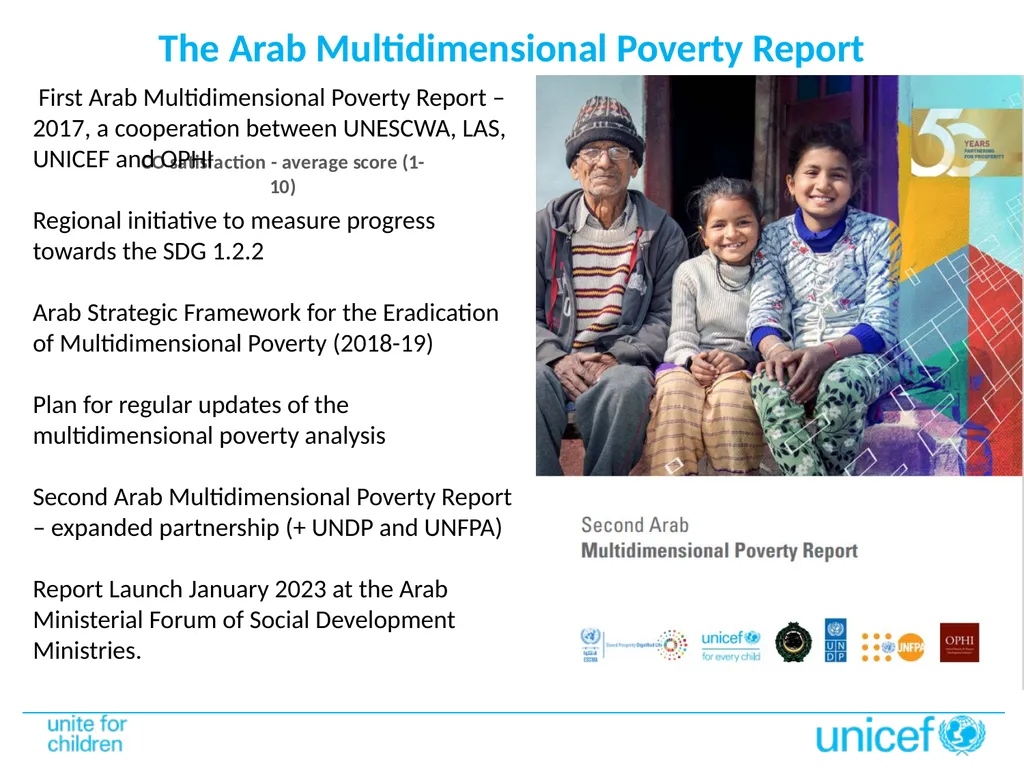
slide2. The Arab Multidimensional Poverty Report First Arab Multidimensional Poverty Report – 2017, a cooperation between UNESCWA, LAS, UNICEF and OPHI
Regional initiative to measure progress towards the SDG 1.2.2
Arab Strategic Framework for the Eradication of Multidimensional Poverty (2018-19)
Plan for regular updates of the multidimensional poverty analysis
Second Arab Multidimensional Poverty Report – expanded partnership (+ UNDP and UNFPA)
Report Launch January 2023 at the Arab Ministerial Forum of Social Development Ministries.<br>
slide3. The second Arab Multidimensional Poverty Report Assess the multidimensional poverty in the Arab Region, comparing the early 2010s to the late 2010s, with a focus on the region’s Middle-Income countries (7 countries with suitable data – Separated analysis for the state of Palestine)
Two separate measures for multidimensional poverty, one for the household level and one for the child
Discuss the impact of COVID-19 on the determinants of poverty
Review the policy recommendations of the 1st Report, in view of the new findings and the impacts of COVID-19 and the spillover effects of the war in Ukraine.<br>
slide4. Child poverty in the Arab Poverty report The 1st Arab Poverty Report recognizes the importance of having a specific focus on children, along with the household level measurement (assessed through the Arab-MPI).
Child poverty is different from adult poverty (and different are their consequences). Poverty measured at the household level may hide childhood poverty (complementarity of household-level and child-level measurements).
Importance of having a measure with the child as unit of observation/measurement and based on the constitutive rights of poverty (material deprivation), grounded on the Convention on the Rights of the Child.<br>
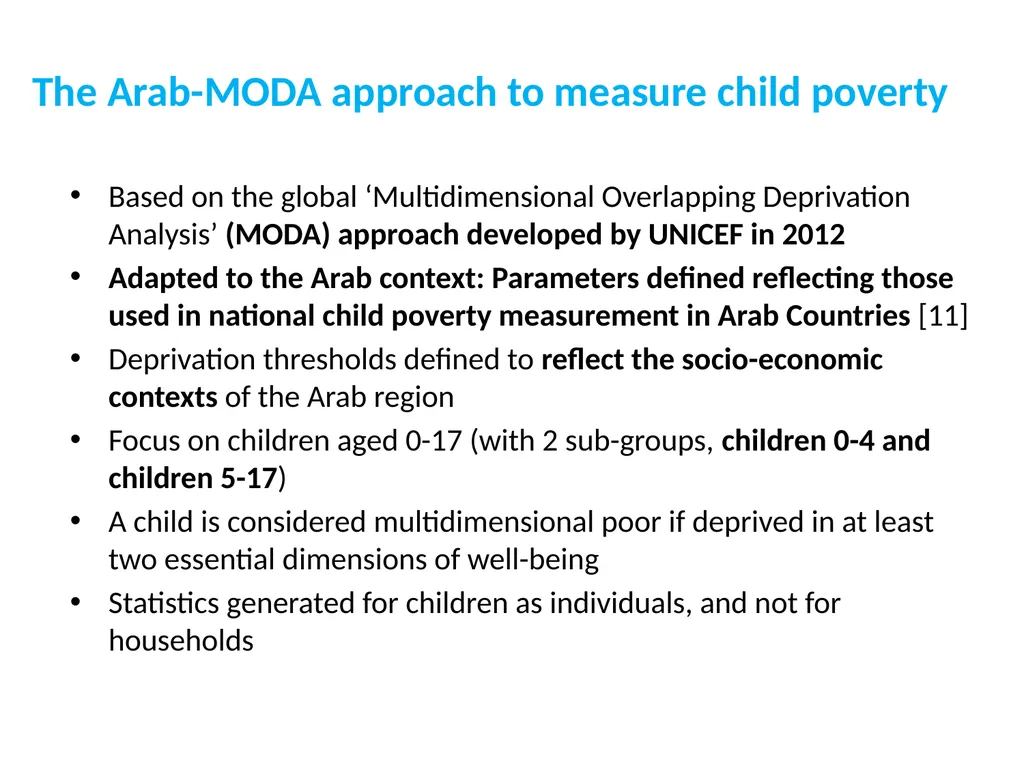
slide5. The Arab-MODA approach to measure child poverty Based on the global ‘Multidimensional Overlapping Deprivation Analysis’ (MODA) approach developed by UNICEF in 2012
Adapted to the Arab context: Parameters defined reflecting those used in national child poverty measurement in Arab Countries [11]
Deprivation thresholds defined to reflect the socio-economic contexts of the Arab region
Focus on children aged 0-17 (with 2 sub-groups, children 0-4 and children 5-17)
A child is considered multidimensional poor if deprived in at least two essential dimensions of well-being
Statistics generated for children as individuals, and not for households<br>
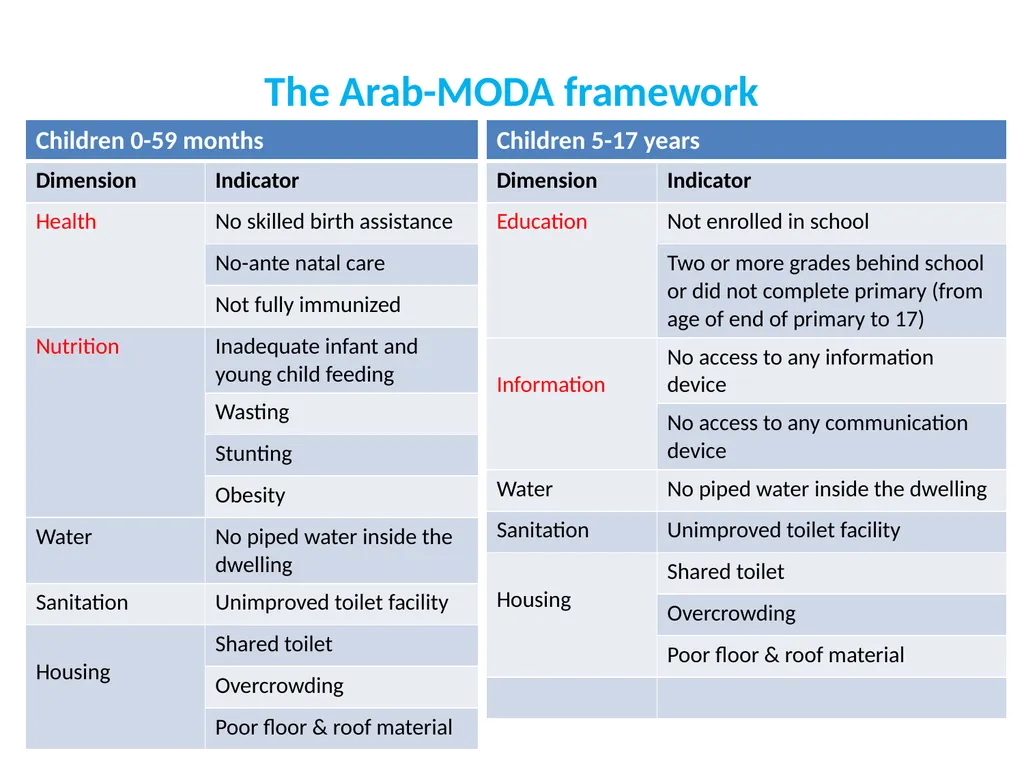
slide6. The Arab-MODA framework<br>
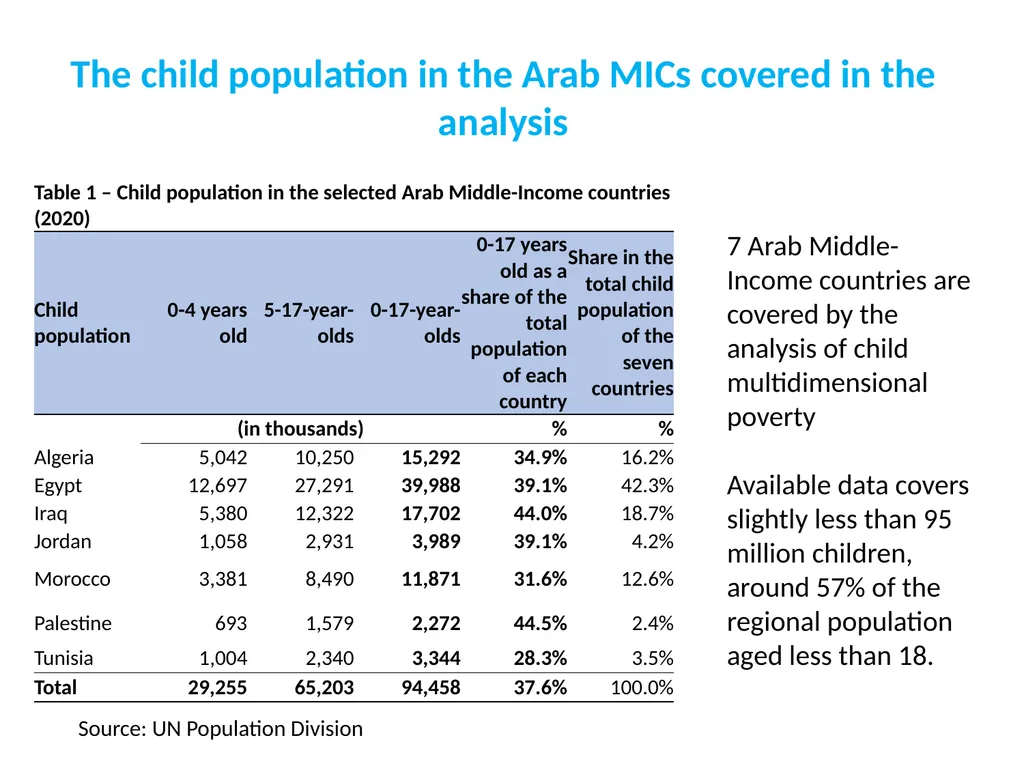
slide7. The child population in the Arab MICs covered in the analysis 7 Arab Middle- Income countries are covered by the analysis of child multidimensional poverty
Available data covers slightly less than 95 million children, around 57% of the regional population aged less than 18. Source: UN Population Division<br>
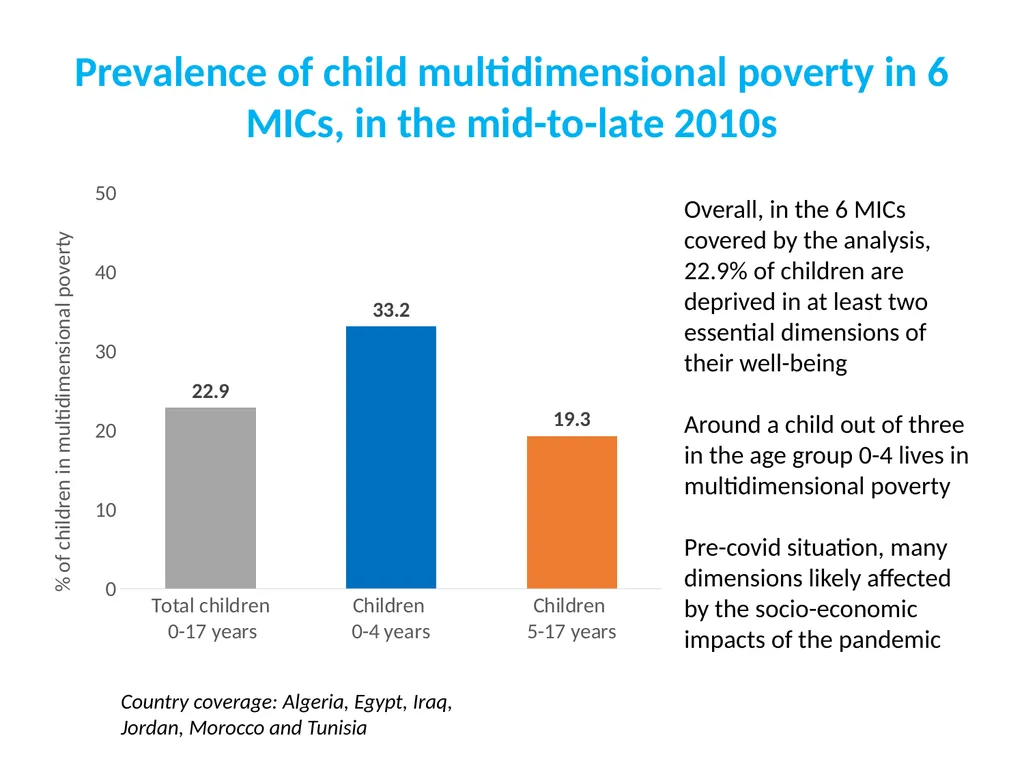
slide8. Prevalence of child multidimensional poverty in 6 MICs, in the mid-to-late 2010s Overall, in the 6 MICs covered by the analysis, 22.9% of children are deprived in at least two essential dimensions of their well-being
Around a child out of three in the age group 0-4 lives in multidimensional poverty
Pre-covid situation, many dimensions likely affected by the socio-economic impacts of the pandemic Country coverage: Algeria, Egypt, Iraq, Jordan, Morocco and Tunisia<br>
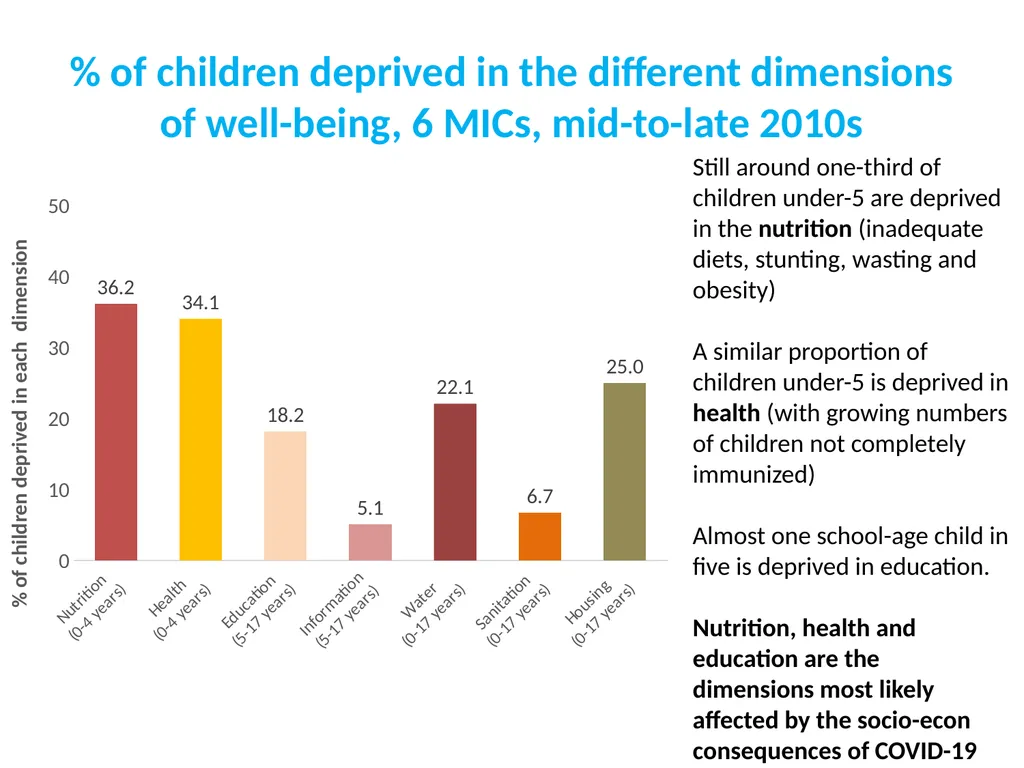
slide9. % of children deprived in the different dimensions of well-being, 6 MICs, mid-to-late 2010s Still around one-third of children under-5 are deprived in the nutrition (inadequate diets, stunting, wasting and obesity)
A similar proportion of children under-5 is deprived in health (with growing numbers of children not completely immunized)
Almost one school-age child in five is deprived in education.
Nutrition, health and education are the
dimensions most likely affected by the socio-econ consequences of COVID-19<br>
slide10. Changes in the prevalence of multidimensional child poverty in 6 Arab MICs, from early to mid-to-late 2010s<br>
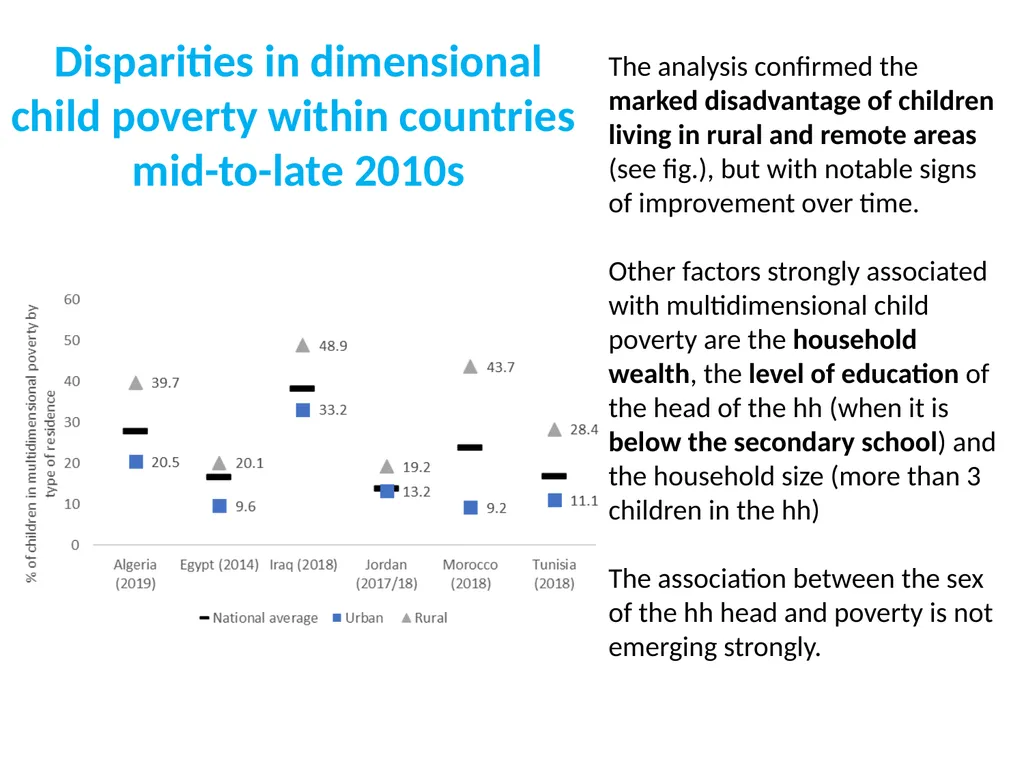
slide11. Disparities in dimensional child poverty within countries mid-to-late 2010s The analysis confirmed the marked disadvantage of children living in rural and remote areas (see fig.), but with notable signs of improvement over time.
Other factors strongly associated with multidimensional child poverty are the household wealth, the level of education of the head of the hh (when it is below the secondary school) and the household size (more than 3 children in the hh)
The association between the sex of the hh head and poverty is not emerging strongly.<br>
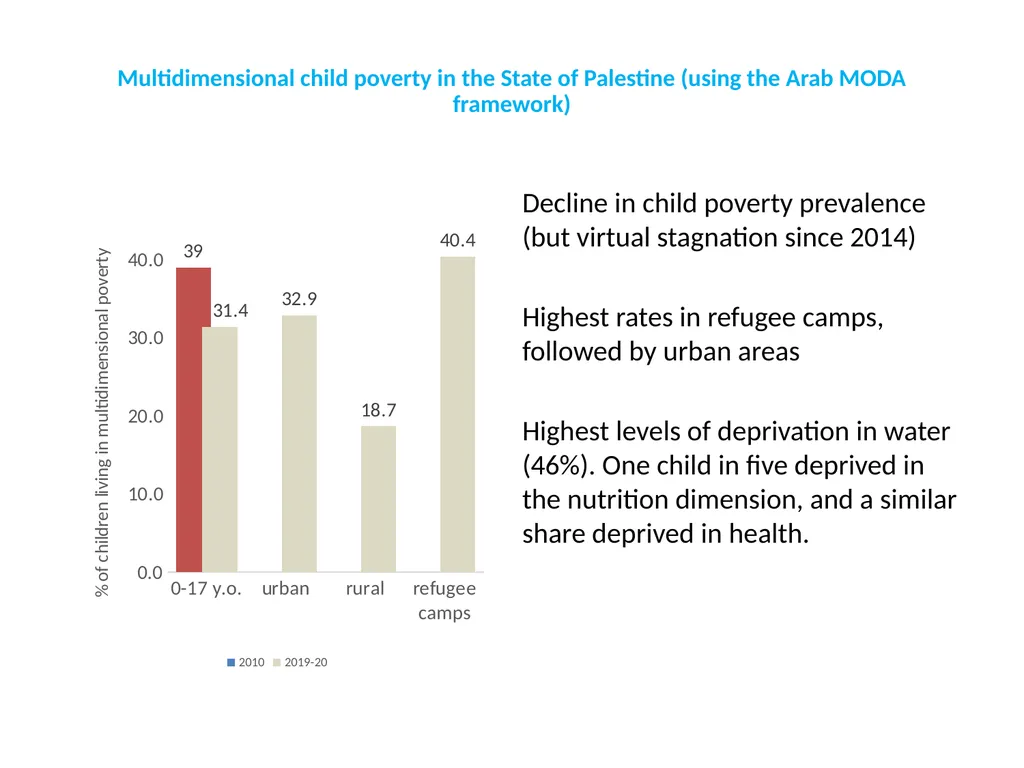
slide12. Multidimensional child poverty in the State of Palestine (using the Arab MODA framework) Decline in child poverty prevalence (but virtual stagnation since 2014)
Highest rates in refugee camps, followed by urban areas
Highest levels of deprivation in water (46%). One child in five deprived in the nutrition dimension, and a similar share deprived in health.<br>
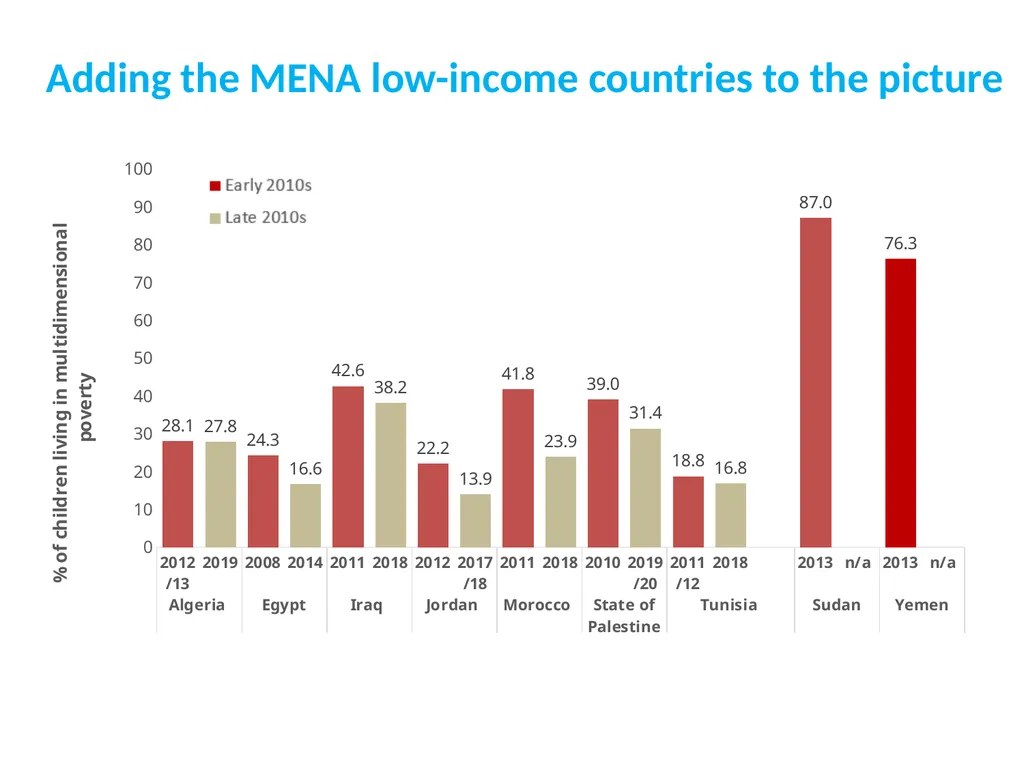
slide13. Adding the MENA low-income countries to the picture<br>
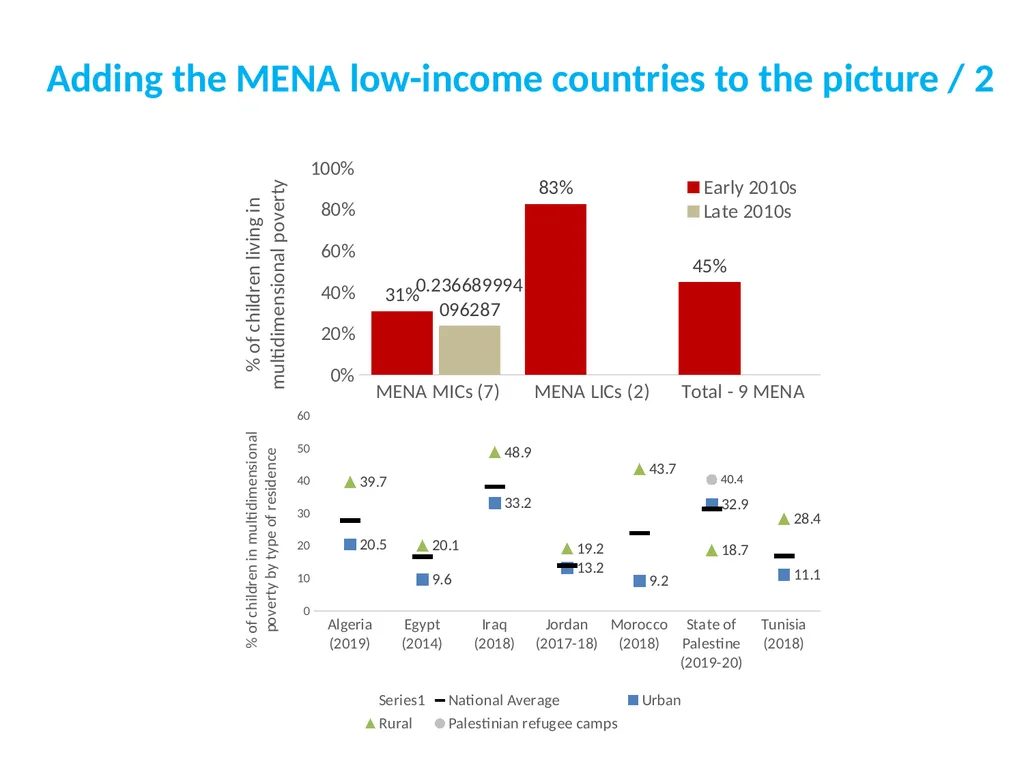
slide14. Adding the MENA low-income countries to the picture / 2<br>
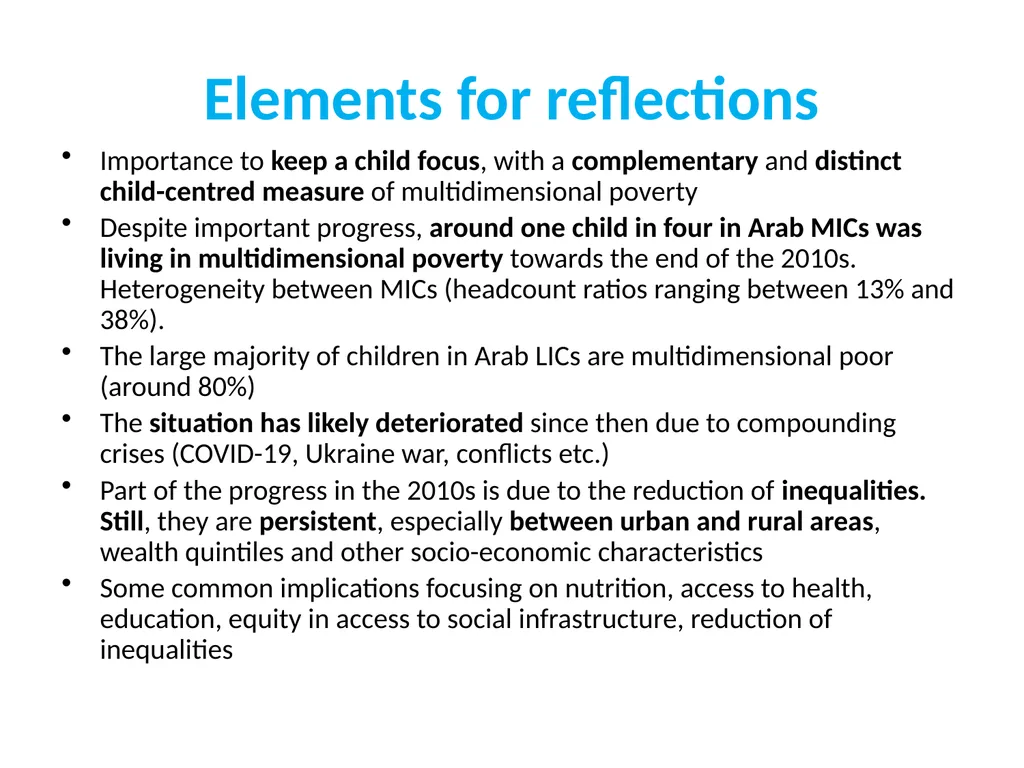
slide15. Elements for reflections Importance to keep a child focus, with a complementary and distinct child-centred measure of multidimensional poverty
Despite important progress, around one child in four in Arab MICs was living in multidimensional poverty towards the end of the 2010s. Heterogeneity between MICs (headcount ratios ranging between 13% and 38%).
The large majority of children in Arab LICs are multidimensional poor (around 80%)
The situation has likely deteriorated since then due to compounding crises (COVID-19, Ukraine war, conflicts etc.)
Part of the progress in the 2010s is due to the reduction of inequalities. Still, they are persistent, especially between urban and rural areas, wealth quintiles and other socio-economic characteristics
Some common implications focusing on nutrition, access to health, education, equity in access to social infrastructure, reduction of inequalities<br>
slide16. Recommendations of the 2nd Arab Poverty Report Building on the recommendations of the first Arab Multidimensional Poverty Report, this report emphasizes some recommendations that are still relevant and introduces new necessary actions in light of the new developments. The report’s proposals in this respect can be summarized as follows:
A. Health
1- Strengthening the capacity of health systems to respond to existing health demands as well as unexpected shocks.
2- Prioritizing maternal and child health, along with sexual and reproductive health and investing in water, sanitation and child nutrition.
B. Education
1- A shift in focus from quantity to quality of education is needed.
2- Implementing inclusive policies that target educational attainment for all children, regardless of sex, socioeconomic background or ability<br>
slide17. Recommendations of the 2nd Arab Poverty Report C. Building resilience and the capacity to manage risks and vulnerability
1- A greater policy focus on incomes, expenditure, markets and prices to achieve food security objectives.
2- Strengthening disaster risks and early warning systems.
3- Managing risks and vulnerability which involves investing in social protection and scaling up effective coverage of protection.
4- In the longer term, empowering a healthy and inclusive labour market, and realizing the economic capacity to create decent jobs.
D. Spearheading digital transformation and narrowing the digital divides, particularly in Arab LDCs.
1- Investing in information and communications technology infrastructure in LDCs
2- Ensuring inclusion in access to digital services by promoting digital literacy and integrating digitalization into the school curriculum;
3- Re-examining policies and the regulatory environment.<br>
slide18. Recommendations of the 2nd Arab Poverty Report E. Striving towards a faster, greener, resilient and equitable recovery from current crises
1- Embarking on investing in an inclusive green economy and boosting a green and resilient recovery
2- Promoting community-based and community-owned solutions and approaches, particularly in indigenous communities, and accelerating the transition to green energy as part of the COVID-19 response.
F. Building Arab states’ institutional capacity
1- Strengthening the data collection system in Arab countries and encouraging regional collaboration for multidimensional poverty analysis.
2- Empowering the Arab Centre for Social Policy Studies and Eradication of Poverty in Arab States, with financial and human resources, and operationalizing the Arab Strategic Framework.
G. Strengthening cross-country economic ties.
1- Exchanging resources, including water, animal, agricultural, technological and petrochemical resources, as a pillar of safety for all societies.<br>
slide19. Thank you
The second Arab Multidimensional Poverty Report is available at:
https://www.unescwa.org/publications/second-arab-multidimensional-poverty-report<br>
slide20. Annex
Status of multidimensional poverty measurement and analysis in MENA countries<br>
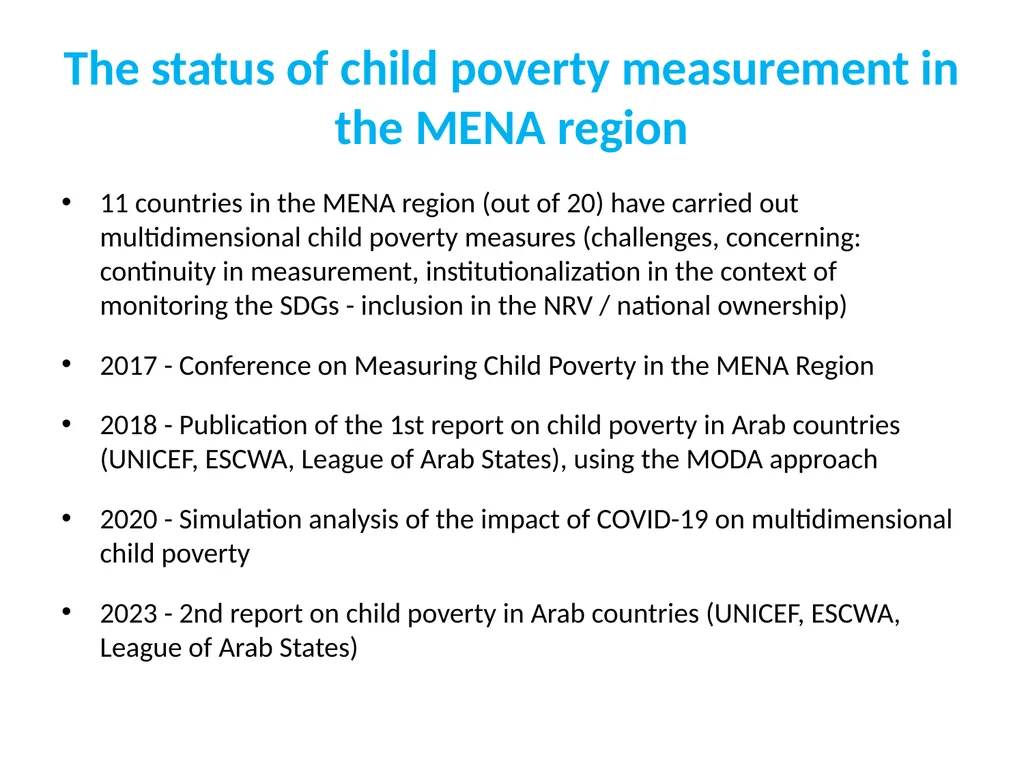
slide21. The status of child poverty measurement in the MENA region 11 countries in the MENA region (out of 20) have carried out multidimensional child poverty measures (challenges, concerning: continuity in measurement, institutionalization in the context of monitoring the SDGs - inclusion in the NRV / national ownership)
2017 - Conference on Measuring Child Poverty in the MENA Region
2018 - Publication of the 1st report on child poverty in Arab countries (UNICEF, ESCWA, League of Arab States), using the MODA approach
2020 - Simulation analysis of the impact of COVID-19 on multidimensional child poverty
2023 - 2nd report on child poverty in Arab countries (UNICEF, ESCWA, League of Arab States)<br>
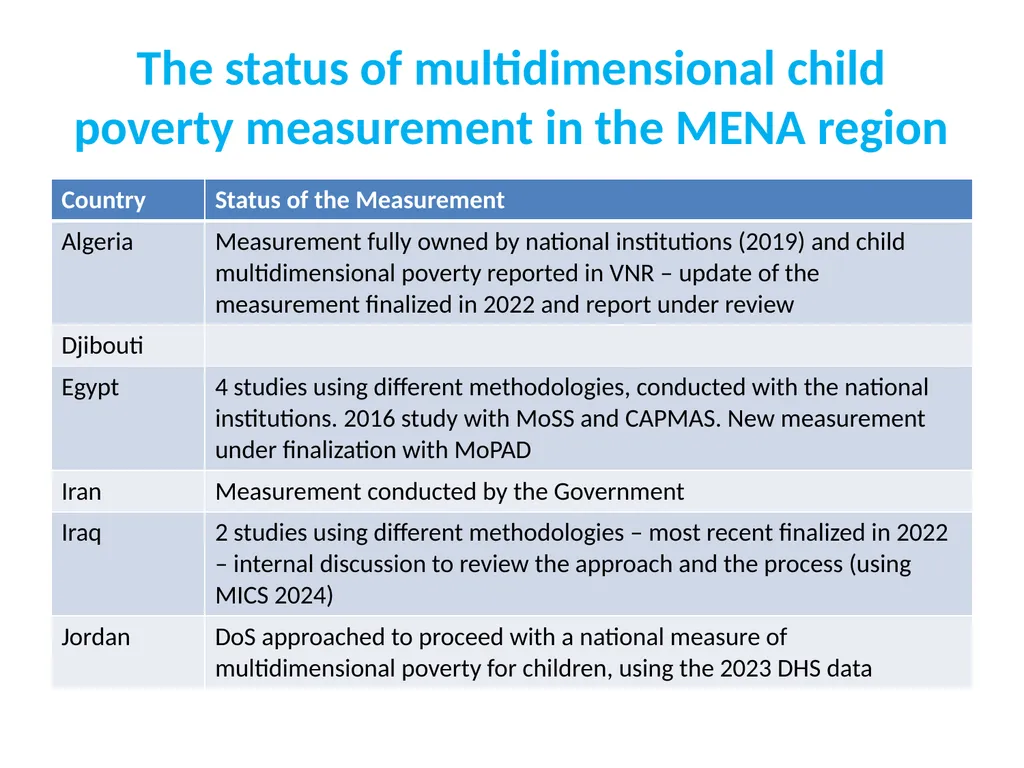
slide22. The status of multidimensional child poverty measurement in the MENA region<br>
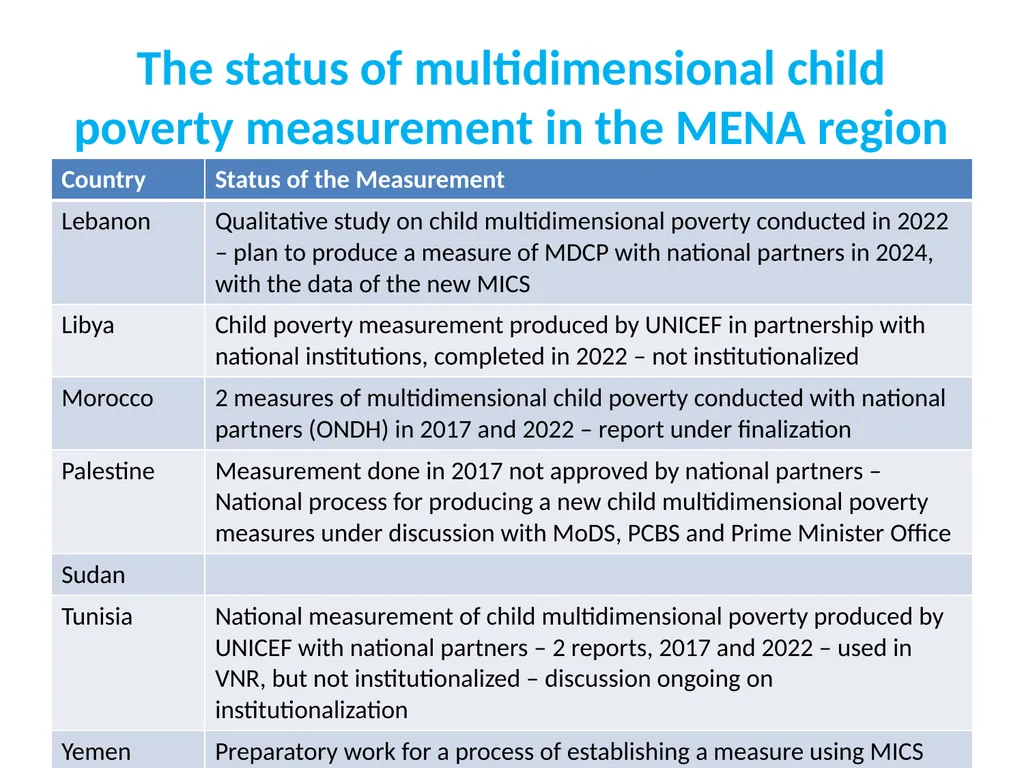
slide23. The status of multidimensional child poverty measurement in the MENA region<br>
Arab Multidimensional Poverty Report
Highlights UNICEF MENARO – Amman - 29 November 2029<br>
slide2. The Arab Multidimensional Poverty Report First Arab Multidimensional Poverty Report – 2017, a cooperation between UNESCWA, LAS, UNICEF and OPHI
Regional initiative to measure progress towards the SDG 1.2.2
Arab Strategic Framework for the Eradication of Multidimensional Poverty (2018-19)
Plan for regular updates of the multidimensional poverty analysis
Second Arab Multidimensional Poverty Report – expanded partnership (+ UNDP and UNFPA)
Report Launch January 2023 at the Arab Ministerial Forum of Social Development Ministries.<br>
slide3. The second Arab Multidimensional Poverty Report Assess the multidimensional poverty in the Arab Region, comparing the early 2010s to the late 2010s, with a focus on the region’s Middle-Income countries (7 countries with suitable data – Separated analysis for the state of Palestine)
Two separate measures for multidimensional poverty, one for the household level and one for the child
Discuss the impact of COVID-19 on the determinants of poverty
Review the policy recommendations of the 1st Report, in view of the new findings and the impacts of COVID-19 and the spillover effects of the war in Ukraine.<br>
slide4. Child poverty in the Arab Poverty report The 1st Arab Poverty Report recognizes the importance of having a specific focus on children, along with the household level measurement (assessed through the Arab-MPI).
Child poverty is different from adult poverty (and different are their consequences). Poverty measured at the household level may hide childhood poverty (complementarity of household-level and child-level measurements).
Importance of having a measure with the child as unit of observation/measurement and based on the constitutive rights of poverty (material deprivation), grounded on the Convention on the Rights of the Child.<br>
slide5. The Arab-MODA approach to measure child poverty Based on the global ‘Multidimensional Overlapping Deprivation Analysis’ (MODA) approach developed by UNICEF in 2012
Adapted to the Arab context: Parameters defined reflecting those used in national child poverty measurement in Arab Countries [11]
Deprivation thresholds defined to reflect the socio-economic contexts of the Arab region
Focus on children aged 0-17 (with 2 sub-groups, children 0-4 and children 5-17)
A child is considered multidimensional poor if deprived in at least two essential dimensions of well-being
Statistics generated for children as individuals, and not for households<br>
slide6. The Arab-MODA framework<br>
slide7. The child population in the Arab MICs covered in the analysis 7 Arab Middle- Income countries are covered by the analysis of child multidimensional poverty
Available data covers slightly less than 95 million children, around 57% of the regional population aged less than 18. Source: UN Population Division<br>
slide8. Prevalence of child multidimensional poverty in 6 MICs, in the mid-to-late 2010s Overall, in the 6 MICs covered by the analysis, 22.9% of children are deprived in at least two essential dimensions of their well-being
Around a child out of three in the age group 0-4 lives in multidimensional poverty
Pre-covid situation, many dimensions likely affected by the socio-economic impacts of the pandemic Country coverage: Algeria, Egypt, Iraq, Jordan, Morocco and Tunisia<br>
slide9. % of children deprived in the different dimensions of well-being, 6 MICs, mid-to-late 2010s Still around one-third of children under-5 are deprived in the nutrition (inadequate diets, stunting, wasting and obesity)
A similar proportion of children under-5 is deprived in health (with growing numbers of children not completely immunized)
Almost one school-age child in five is deprived in education.
Nutrition, health and education are the
dimensions most likely affected by the socio-econ consequences of COVID-19<br>
slide10. Changes in the prevalence of multidimensional child poverty in 6 Arab MICs, from early to mid-to-late 2010s<br>
slide11. Disparities in dimensional child poverty within countries mid-to-late 2010s The analysis confirmed the marked disadvantage of children living in rural and remote areas (see fig.), but with notable signs of improvement over time.
Other factors strongly associated with multidimensional child poverty are the household wealth, the level of education of the head of the hh (when it is below the secondary school) and the household size (more than 3 children in the hh)
The association between the sex of the hh head and poverty is not emerging strongly.<br>
slide12. Multidimensional child poverty in the State of Palestine (using the Arab MODA framework) Decline in child poverty prevalence (but virtual stagnation since 2014)
Highest rates in refugee camps, followed by urban areas
Highest levels of deprivation in water (46%). One child in five deprived in the nutrition dimension, and a similar share deprived in health.<br>
slide13. Adding the MENA low-income countries to the picture<br>
slide14. Adding the MENA low-income countries to the picture / 2<br>
slide15. Elements for reflections Importance to keep a child focus, with a complementary and distinct child-centred measure of multidimensional poverty
Despite important progress, around one child in four in Arab MICs was living in multidimensional poverty towards the end of the 2010s. Heterogeneity between MICs (headcount ratios ranging between 13% and 38%).
The large majority of children in Arab LICs are multidimensional poor (around 80%)
The situation has likely deteriorated since then due to compounding crises (COVID-19, Ukraine war, conflicts etc.)
Part of the progress in the 2010s is due to the reduction of inequalities. Still, they are persistent, especially between urban and rural areas, wealth quintiles and other socio-economic characteristics
Some common implications focusing on nutrition, access to health, education, equity in access to social infrastructure, reduction of inequalities<br>
slide16. Recommendations of the 2nd Arab Poverty Report Building on the recommendations of the first Arab Multidimensional Poverty Report, this report emphasizes some recommendations that are still relevant and introduces new necessary actions in light of the new developments. The report’s proposals in this respect can be summarized as follows:
A. Health
1- Strengthening the capacity of health systems to respond to existing health demands as well as unexpected shocks.
2- Prioritizing maternal and child health, along with sexual and reproductive health and investing in water, sanitation and child nutrition.
B. Education
1- A shift in focus from quantity to quality of education is needed.
2- Implementing inclusive policies that target educational attainment for all children, regardless of sex, socioeconomic background or ability<br>
slide17. Recommendations of the 2nd Arab Poverty Report C. Building resilience and the capacity to manage risks and vulnerability
1- A greater policy focus on incomes, expenditure, markets and prices to achieve food security objectives.
2- Strengthening disaster risks and early warning systems.
3- Managing risks and vulnerability which involves investing in social protection and scaling up effective coverage of protection.
4- In the longer term, empowering a healthy and inclusive labour market, and realizing the economic capacity to create decent jobs.
D. Spearheading digital transformation and narrowing the digital divides, particularly in Arab LDCs.
1- Investing in information and communications technology infrastructure in LDCs
2- Ensuring inclusion in access to digital services by promoting digital literacy and integrating digitalization into the school curriculum;
3- Re-examining policies and the regulatory environment.<br>
slide18. Recommendations of the 2nd Arab Poverty Report E. Striving towards a faster, greener, resilient and equitable recovery from current crises
1- Embarking on investing in an inclusive green economy and boosting a green and resilient recovery
2- Promoting community-based and community-owned solutions and approaches, particularly in indigenous communities, and accelerating the transition to green energy as part of the COVID-19 response.
F. Building Arab states’ institutional capacity
1- Strengthening the data collection system in Arab countries and encouraging regional collaboration for multidimensional poverty analysis.
2- Empowering the Arab Centre for Social Policy Studies and Eradication of Poverty in Arab States, with financial and human resources, and operationalizing the Arab Strategic Framework.
G. Strengthening cross-country economic ties.
1- Exchanging resources, including water, animal, agricultural, technological and petrochemical resources, as a pillar of safety for all societies.<br>
slide19. Thank you
The second Arab Multidimensional Poverty Report is available at:
https://www.unescwa.org/publications/second-arab-multidimensional-poverty-report<br>
slide20. Annex
Status of multidimensional poverty measurement and analysis in MENA countries<br>
slide21. The status of child poverty measurement in the MENA region 11 countries in the MENA region (out of 20) have carried out multidimensional child poverty measures (challenges, concerning: continuity in measurement, institutionalization in the context of monitoring the SDGs - inclusion in the NRV / national ownership)
2017 - Conference on Measuring Child Poverty in the MENA Region
2018 - Publication of the 1st report on child poverty in Arab countries (UNICEF, ESCWA, League of Arab States), using the MODA approach
2020 - Simulation analysis of the impact of COVID-19 on multidimensional child poverty
2023 - 2nd report on child poverty in Arab countries (UNICEF, ESCWA, League of Arab States)<br>
slide22. The status of multidimensional child poverty measurement in the MENA region<br>
slide23. The status of multidimensional child poverty measurement in the MENA region<br>