
Child Safeguarding Update Dr David W Jones Named
LS
Published · 43 slides · 0 views

1 / 1


Description
Child Safeguarding Update Dr David W Jones Named GP for Child Safeguarding Newcastle CCGs Note of Caution This subject may raise painful memories or associations This is not a safe time to share personal memories If required, seek advice
Related Topics
Share
Embed code
Download this presentation From Below
"Child Safeguarding Update Dr David W Jones Named" is the property of its rightful owner. Permission is granted to download and print the materials on this website for personal, non-commercial use only, and to display it on your personal computer provided you do not modify the materials and that you retain all copyright notices contained in the materials. By downloading content from our website, you accept the terms of this agreement.
Presentation Transcript
01
Child Safeguarding Update Dr David W Jones
Named GP for Child Safeguarding
Newcastle CCGs<br>
Named GP for Child Safeguarding
Newcastle CCGs<br>
02
Note of Caution This subject may raise painful memories or associations
This is not a safe time to share personal memories
If required, seek advice from a professional outside of this meeting, or contact the NSPCC helpline 0808 800 5000<br>
This is not a safe time to share personal memories
If required, seek advice from a professional outside of this meeting, or contact the NSPCC helpline 0808 800 5000<br>
03
Subjects to be covered Child safeguarding – a brief bit of background
Female Genital Mutilation (FGM)
Child Sexual Exploitation (CSE)
Child Death Review
CQC inspection
RCGP Child Safeguarding Toolkit
and some ‘don’t forgets’!<br>
Female Genital Mutilation (FGM)
Child Sexual Exploitation (CSE)
Child Death Review
CQC inspection
RCGP Child Safeguarding Toolkit
and some ‘don’t forgets’!<br>
04
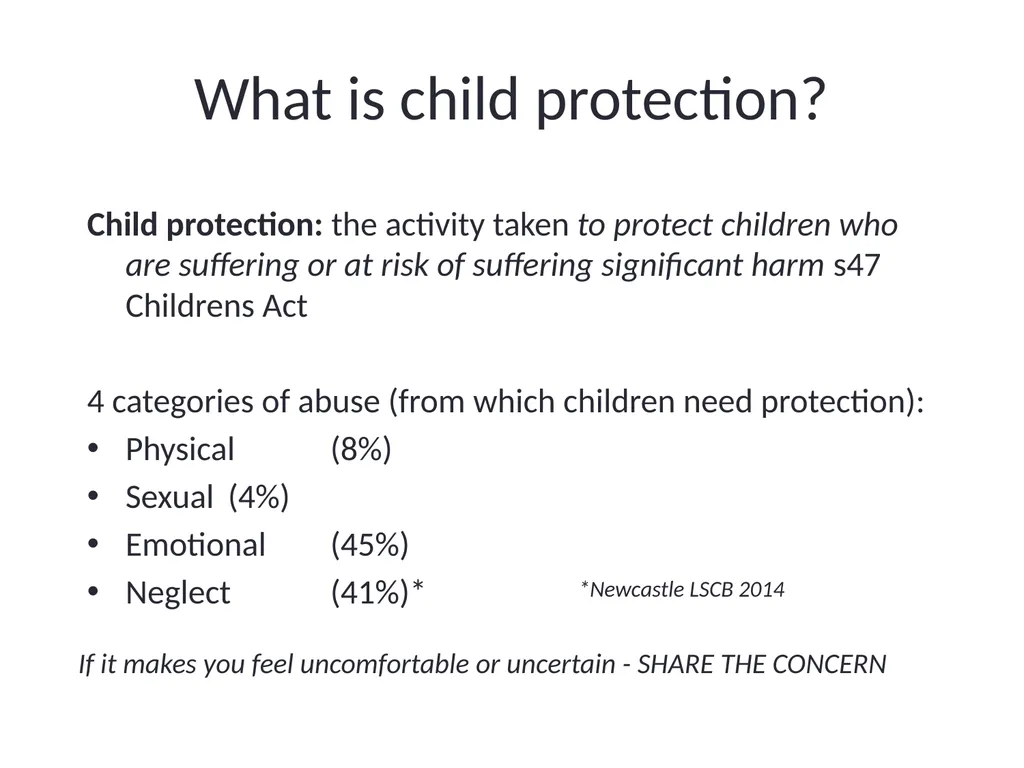
What is child protection? Child protection: the activity taken to protect children who are suffering or at risk of suffering significant harm s47 Childrens Act
4 categories of abuse (from which children need protection):
Physical (8%)
Sexual (4%)
Emotional (45%)
Neglect (41%)* If it makes you feel uncomfortable or uncertain - SHARE THE CONCERN *Newcastle LSCB 2014<br>
4 categories of abuse (from which children need protection):
Physical (8%)
Sexual (4%)
Emotional (45%)
Neglect (41%)* If it makes you feel uncomfortable or uncertain - SHARE THE CONCERN *Newcastle LSCB 2014<br>
05
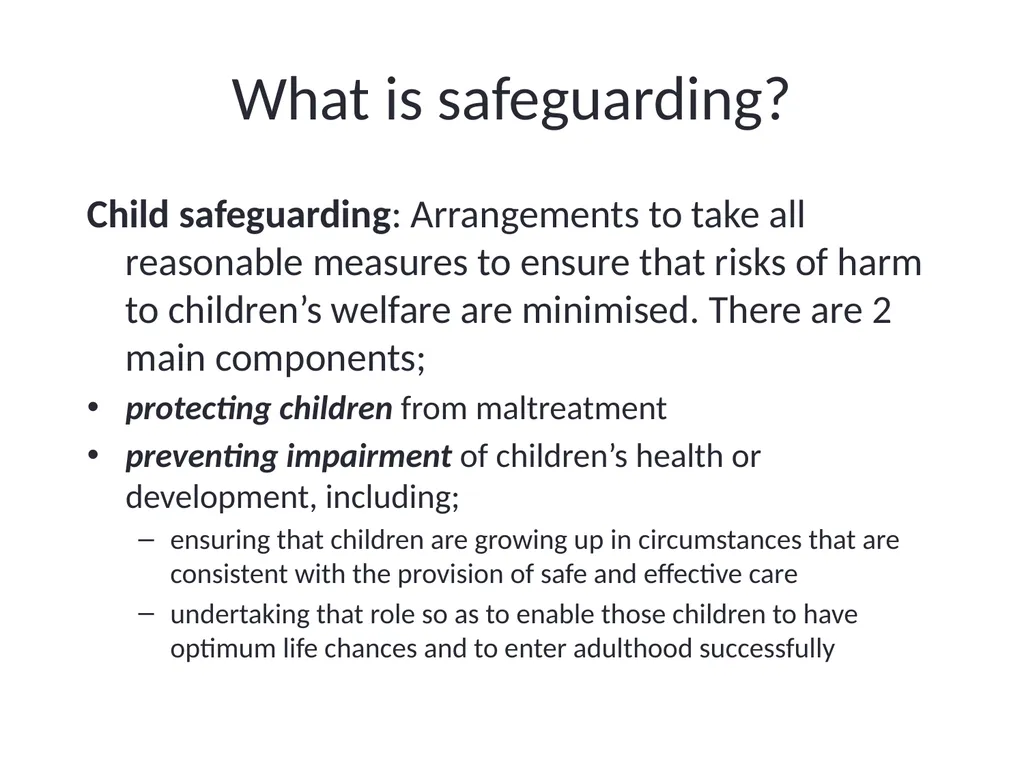
What is safeguarding? Child safeguarding: Arrangements to take all reasonable measures to ensure that risks of harm to children’s welfare are minimised. There are 2 main components;
protecting children from maltreatment
preventing impairment of children’s health or development, including;
ensuring that children are growing up in circumstances that are consistent with the provision of safe and effective care
undertaking that role so as to enable those children to have optimum life chances and to enter adulthood successfully<br>
protecting children from maltreatment
preventing impairment of children’s health or development, including;
ensuring that children are growing up in circumstances that are consistent with the provision of safe and effective care
undertaking that role so as to enable those children to have optimum life chances and to enter adulthood successfully<br>
06
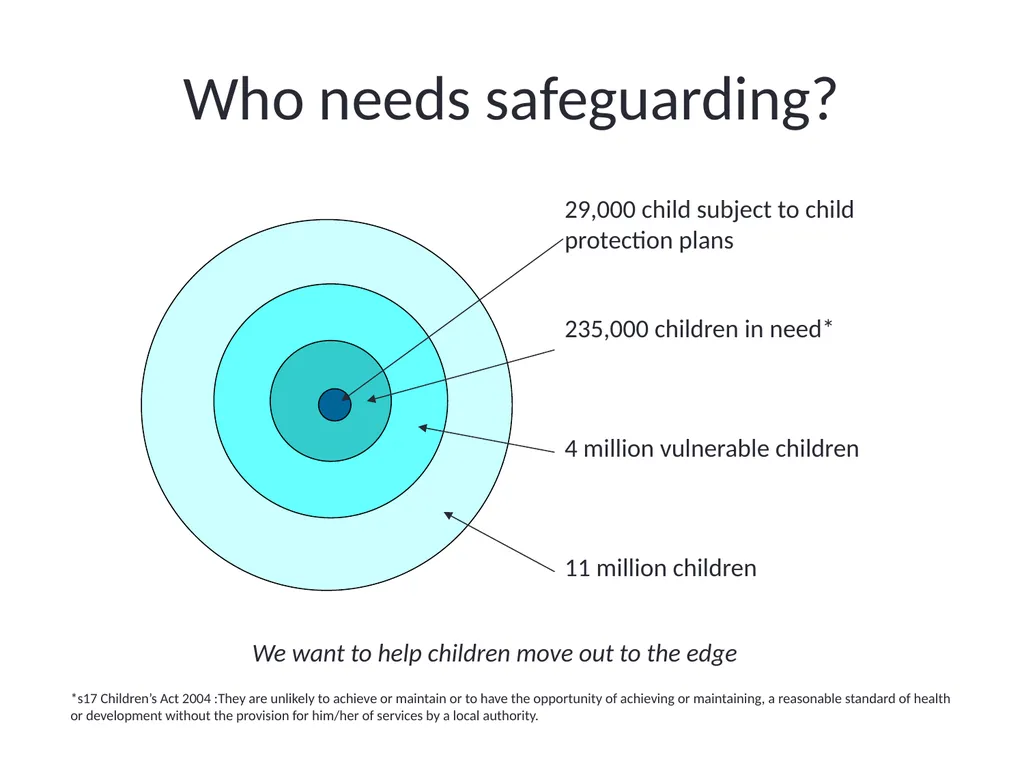
Who needs safeguarding? We want to help children move out to the edge 29,000 child subject to child protection plans 235,000 children in need* 4 million vulnerable children 11 million children *s17 Children’s Act 2004 :They are unlikely to achieve or maintain or to have the opportunity of achieving or maintaining, a reasonable standard of health or development without the provision for him/her of services by a local authority.<br>
07
The child health and safeguarding vortex<br>
08
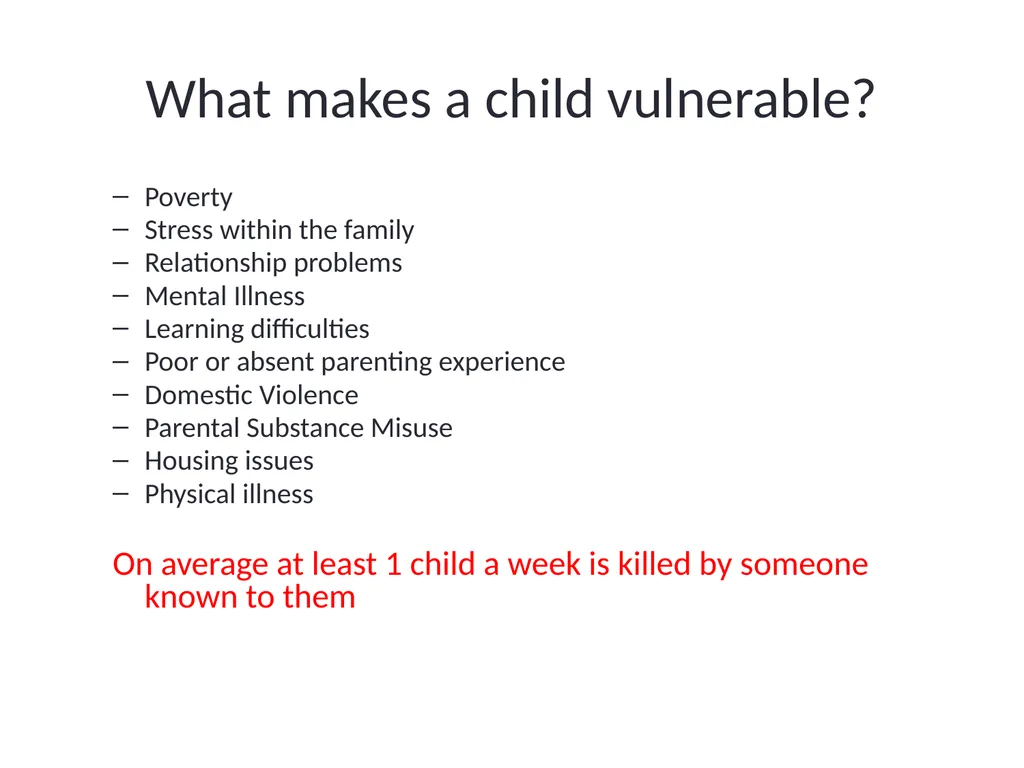
What makes a child vulnerable? Poverty
Stress within the family
Relationship problems
Mental Illness
Learning difficulties
Poor or absent parenting experience
Domestic Violence
Parental Substance Misuse
Housing issues
Physical illness
On average at least 1 child a week is killed by someone known to them<br>
Stress within the family
Relationship problems
Mental Illness
Learning difficulties
Poor or absent parenting experience
Domestic Violence
Parental Substance Misuse
Housing issues
Physical illness
On average at least 1 child a week is killed by someone known to them<br>
09
The better we safeguard
the many,
The better we protect the few<br>
10
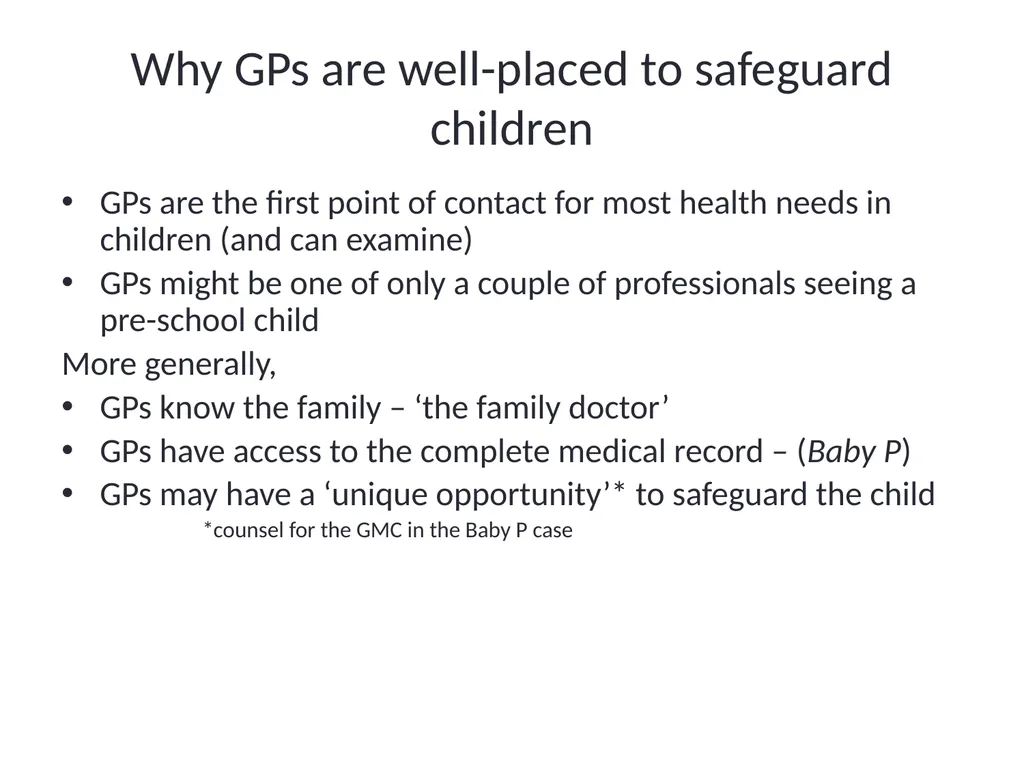
Why GPs are well-placed to safeguard children GPs are the first point of contact for most health needs in children (and can examine)
GPs might be one of only a couple of professionals seeing a pre-school child
More generally,
GPs know the family – ‘the family doctor’
GPs have access to the complete medical record – (Baby P)
GPs may have a ‘unique opportunity’* to safeguard the child
*counsel for the GMC in the Baby P case<br>
GPs might be one of only a couple of professionals seeing a pre-school child
More generally,
GPs know the family – ‘the family doctor’
GPs have access to the complete medical record – (Baby P)
GPs may have a ‘unique opportunity’* to safeguard the child
*counsel for the GMC in the Baby P case<br>
11
Lord Laming said…. “Investigation and management of a case of possible harm to a child must be approached in the same systematic and rigorous manner as would be appropriate to the investigation and management of any other potentially fatal disease”
The Victoria Climbie Inquiry 2003: Lord Laming para. 11.53)<br>
The Victoria Climbie Inquiry 2003: Lord Laming para. 11.53)<br>
12
Case 1 A 10 year old Somalian girl is brought in by her mother (who speaks very little english) for immunisations - she is about to go on an extended holiday overseas
You are aware that the family is not integrated into UK society quite as much as other families have
An older sister who’s doing most of the talking appears anxious, and reluctant to give any details about the purpose of the trip.<br>
You are aware that the family is not integrated into UK society quite as much as other families have
An older sister who’s doing most of the talking appears anxious, and reluctant to give any details about the purpose of the trip.<br>
13
What is FGM? All procedures which involve the partial or total removal of the external genitalia or injury to the female genital organs whether for cultural or any other non-therapeutic reasons
The World Health Organisation Female Genital Mutilation<br>
The World Health Organisation Female Genital Mutilation<br>
14
Who is at risk? 2 million girls around the world every year are subject to FGM
Mainly African and Middle Eastern countries and alarmingly now in the immigrant population of Europe, America and Australia
It is estimated that as many as 20,000 girls are at risk of FGM within the UK every year
Any girl is at risk – usually between 4-14<br>
Mainly African and Middle Eastern countries and alarmingly now in the immigrant population of Europe, America and Australia
It is estimated that as many as 20,000 girls are at risk of FGM within the UK every year
Any girl is at risk – usually between 4-14<br>
15
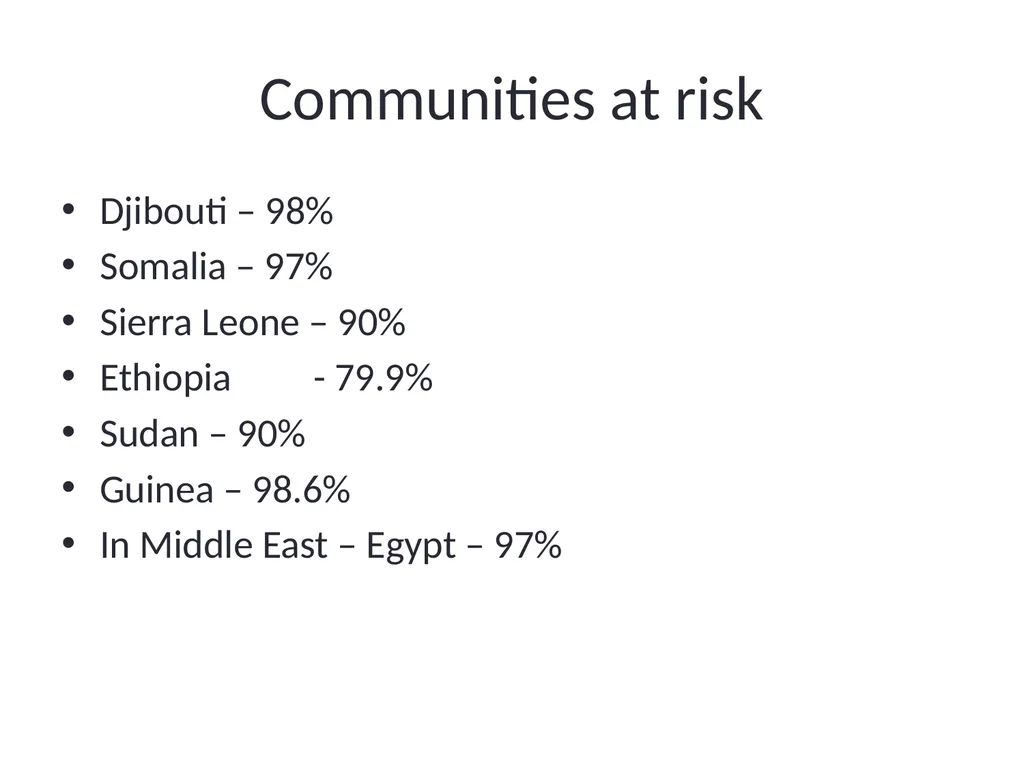
Communities at risk Djibouti – 98%
Somalia – 97%
Sierra Leone – 90%
Ethiopia - 79.9%
Sudan – 90%
Guinea – 98.6%
In Middle East – Egypt – 97%<br>
Somalia – 97%
Sierra Leone – 90%
Ethiopia - 79.9%
Sudan – 90%
Guinea – 98.6%
In Middle East – Egypt – 97%<br>
16
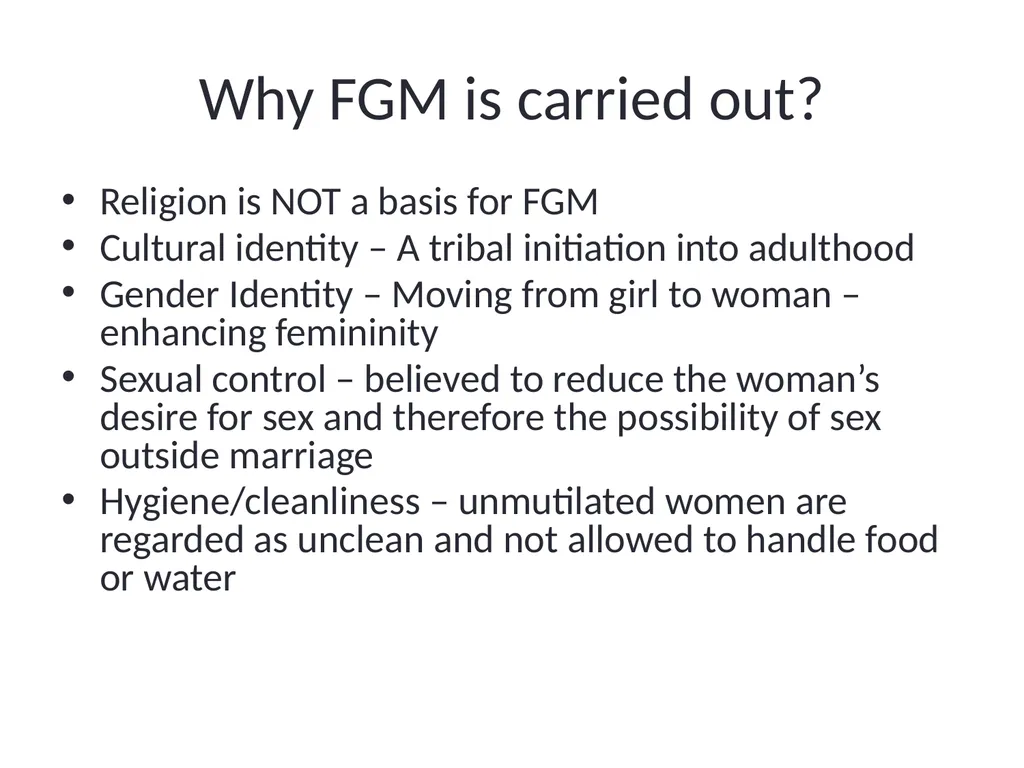
Why FGM is carried out? Religion is NOT a basis for FGM
Cultural identity – A tribal initiation into adulthood
Gender Identity – Moving from girl to woman – enhancing femininity
Sexual control – believed to reduce the woman’s desire for sex and therefore the possibility of sex outside marriage
Hygiene/cleanliness – unmutilated women are regarded as unclean and not allowed to handle food or water<br>
Cultural identity – A tribal initiation into adulthood
Gender Identity – Moving from girl to woman – enhancing femininity
Sexual control – believed to reduce the woman’s desire for sex and therefore the possibility of sex outside marriage
Hygiene/cleanliness – unmutilated women are regarded as unclean and not allowed to handle food or water<br>
17
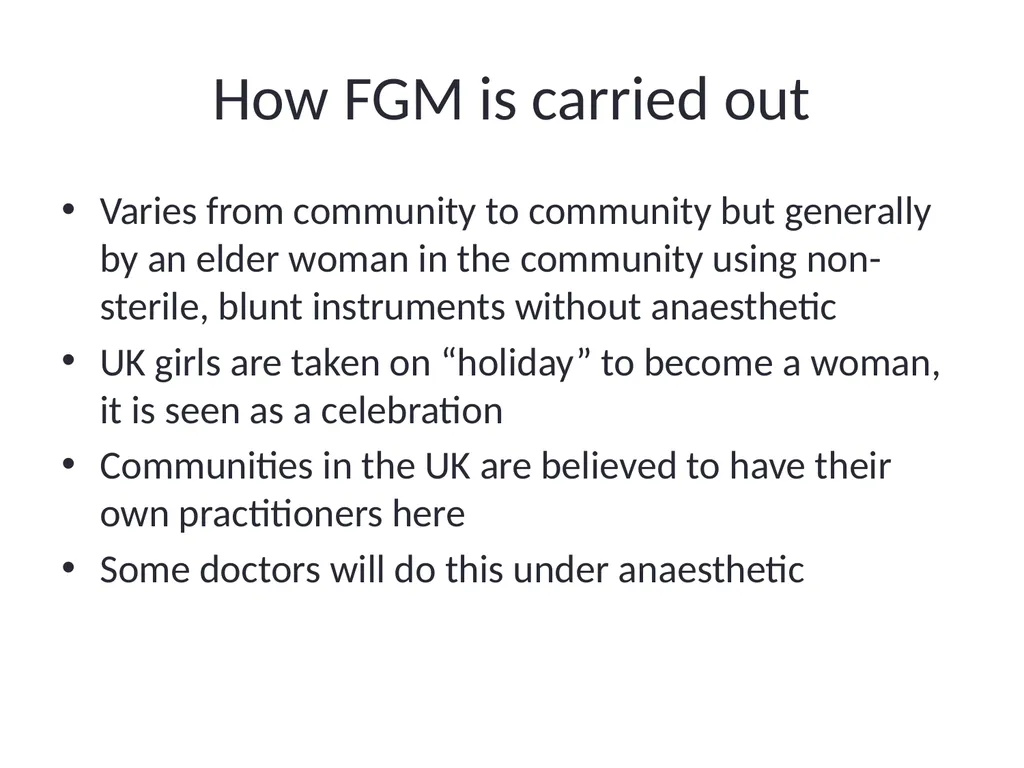
How FGM is carried out Varies from community to community but generally by an elder woman in the community using non-sterile, blunt instruments without anaesthetic
UK girls are taken on “holiday” to become a woman, it is seen as a celebration
Communities in the UK are believed to have their own practitioners here
Some doctors will do this under anaesthetic<br>
UK girls are taken on “holiday” to become a woman, it is seen as a celebration
Communities in the UK are believed to have their own practitioners here
Some doctors will do this under anaesthetic<br>
18
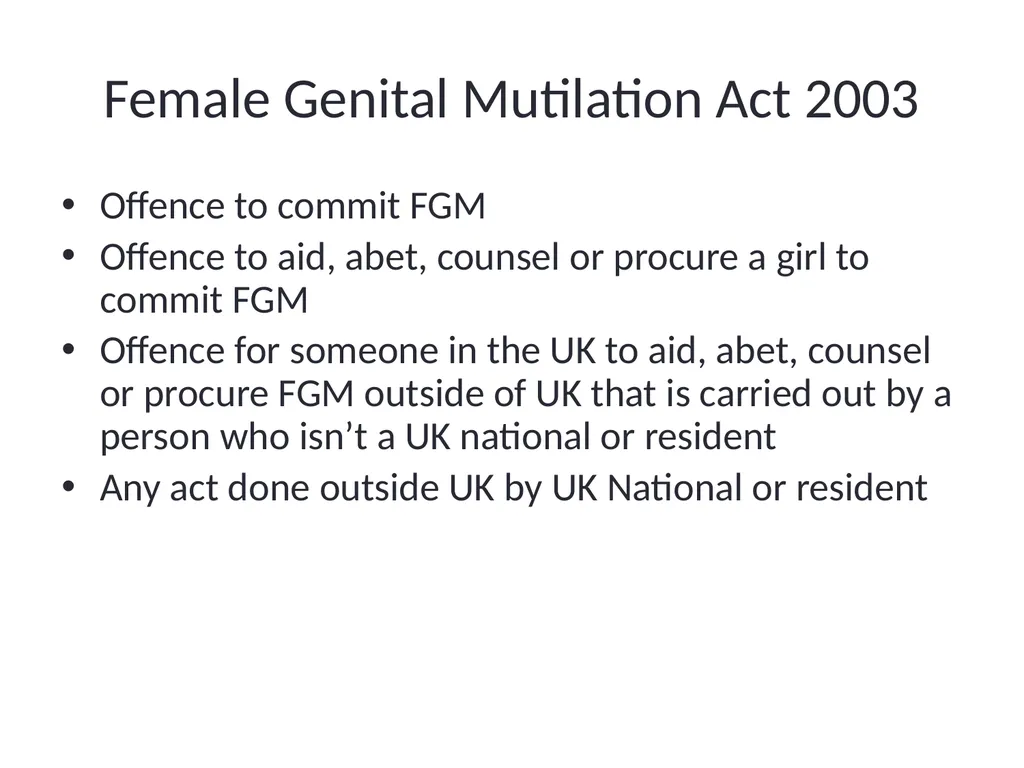
Female Genital Mutilation Act 2003 Offence to commit FGM
Offence to aid, abet, counsel or procure a girl to commit FGM
Offence for someone in the UK to aid, abet, counsel or procure FGM outside of UK that is carried out by a person who isn’t a UK national or resident
Any act done outside UK by UK National or resident<br>
Offence to aid, abet, counsel or procure a girl to commit FGM
Offence for someone in the UK to aid, abet, counsel or procure FGM outside of UK that is carried out by a person who isn’t a UK national or resident
Any act done outside UK by UK National or resident<br>
19
Indications FGM is about to take place The family come from a community that is known to practise FGM
Parents state they will take the child out of the country for a prolonged period
A child may talk about a long holiday to a country where the practice is prevalent
A child may confide that she is to have a “special procedure” or celebration<br>
Parents state they will take the child out of the country for a prolonged period
A child may talk about a long holiday to a country where the practice is prevalent
A child may confide that she is to have a “special procedure” or celebration<br>
20
How should we respond? You should discuss any concerns with the practice lead for safeguarding / Named GP
You must consider making a referral to the Local Authority Children’s Social Care or police if urgent
Follow local multi agency pathway/guidance<br>
You must consider making a referral to the Local Authority Children’s Social Care or police if urgent
Follow local multi agency pathway/guidance<br>
21
What can we do about it? Been trained
http://www.fgmelearning.co.uk/
Aware of FGM during examinations
Awareness around requests for immunisation for travel purposes in children
Alert to adverse consequences of FGM (physical and psychological)
Information about FGM could be made part of any ‘welcome pack’ given to a practice’s new patients.<br>
http://www.fgmelearning.co.uk/
Aware of FGM during examinations
Awareness around requests for immunisation for travel purposes in children
Alert to adverse consequences of FGM (physical and psychological)
Information about FGM could be made part of any ‘welcome pack’ given to a practice’s new patients.<br>
22
Case 2 A 14 year old girl presents requesting contraception. She appears to be Gillick competent.
She describes some symptoms suggestive of a sexual transmitted infection and wants treatment for that too.
She has evidence of ‘cutting’ on her arm when you check her blood pressure<br>
She describes some symptoms suggestive of a sexual transmitted infection and wants treatment for that too.
She has evidence of ‘cutting’ on her arm when you check her blood pressure<br>
23
Child Sexual Exploitation Sexual exploitation of children and young people under 18 involves exploitative situations, contexts and relationships where young people (or a third person or persons) receive ‘something’ (e.g. food, accommodation, drugs, alcohol, cigarettes, affection, gifts, money) as a result of them performing, and/or another or others performing on them, sexual activities.
“For children over 10, sexual exploitation is the most pressing and hidden child protection issue in this country.” (Barnardo’s)<br>
“For children over 10, sexual exploitation is the most pressing and hidden child protection issue in this country.” (Barnardo’s)<br>
24
Rotherham Inquiry The Rotherham Inquiry into CSE in Rotherham found that approximately 1400 children were sexually exploited over the full Inquiry period, from 1997 to 2013
There is a current ongoing investigation in Newcastle (Operation Sanctuary) into the same issue of sexual abuse of children and young people.<br>
There is a current ongoing investigation in Newcastle (Operation Sanctuary) into the same issue of sexual abuse of children and young people.<br>
25
What did we learn from the Rotherham Inquiry? Of the children who were victims of CSE;
50% had misused alcohol or other substances (this was typically part of the grooming process)
33% had mental health problems (again, often as a result of abuse) and two thirds had emotional health difficulties
parental addiction was present in 20% of cases and parental mental health issues in over a third of cases
there was a history of domestic violence in 46% of cases
truancy and school refusal were recorded in 63% of cases and 63% of children had been reported missing more than once
many were Looked After Children<br>
50% had misused alcohol or other substances (this was typically part of the grooming process)
33% had mental health problems (again, often as a result of abuse) and two thirds had emotional health difficulties
parental addiction was present in 20% of cases and parental mental health issues in over a third of cases
there was a history of domestic violence in 46% of cases
truancy and school refusal were recorded in 63% of cases and 63% of children had been reported missing more than once
many were Looked After Children<br>
26
Recommendations 1) All staff need to be aware of the problem of child sexual exploitation - check LSCB online learning
2) All clinicians should be aware of the possibility of CSE when discussing contraception with young people GMC guidance 0-18 para 64-69:
3) All staff should be aware of the locally agreed flowchart for managing cases of suspected CSE (included at the end of this alert, from Northumbria Police) – see handout
4) Do not allow issues of race or culture to obscure decision-making in the safeguarding of children
- consider equality and diversity training<br>
2) All clinicians should be aware of the possibility of CSE when discussing contraception with young people GMC guidance 0-18 para 64-69:
3) All staff should be aware of the locally agreed flowchart for managing cases of suspected CSE (included at the end of this alert, from Northumbria Police) – see handout
4) Do not allow issues of race or culture to obscure decision-making in the safeguarding of children
- consider equality and diversity training<br>
27
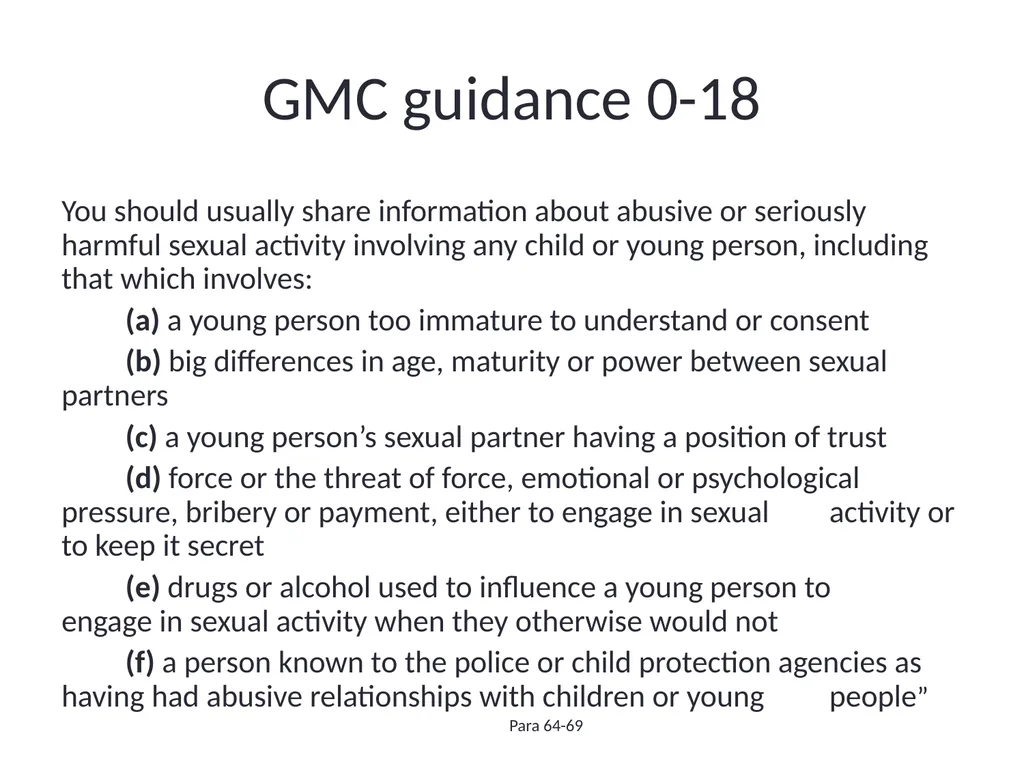
GMC guidance 0-18 You should usually share information about abusive or seriously harmful sexual activity involving any child or young person, including that which involves:
(a) a young person too immature to understand or consent
(b) big differences in age, maturity or power between sexual partners
(c) a young person’s sexual partner having a position of trust
(d) force or the threat of force, emotional or psychological pressure, bribery or payment, either to engage in sexual activity or to keep it secret
(e) drugs or alcohol used to influence a young person to engage in sexual activity when they otherwise would not
(f) a person known to the police or child protection agencies as having had abusive relationships with children or young people”
Para 64-69<br>
(a) a young person too immature to understand or consent
(b) big differences in age, maturity or power between sexual partners
(c) a young person’s sexual partner having a position of trust
(d) force or the threat of force, emotional or psychological pressure, bribery or payment, either to engage in sexual activity or to keep it secret
(e) drugs or alcohol used to influence a young person to engage in sexual activity when they otherwise would not
(f) a person known to the police or child protection agencies as having had abusive relationships with children or young people”
Para 64-69<br>
28
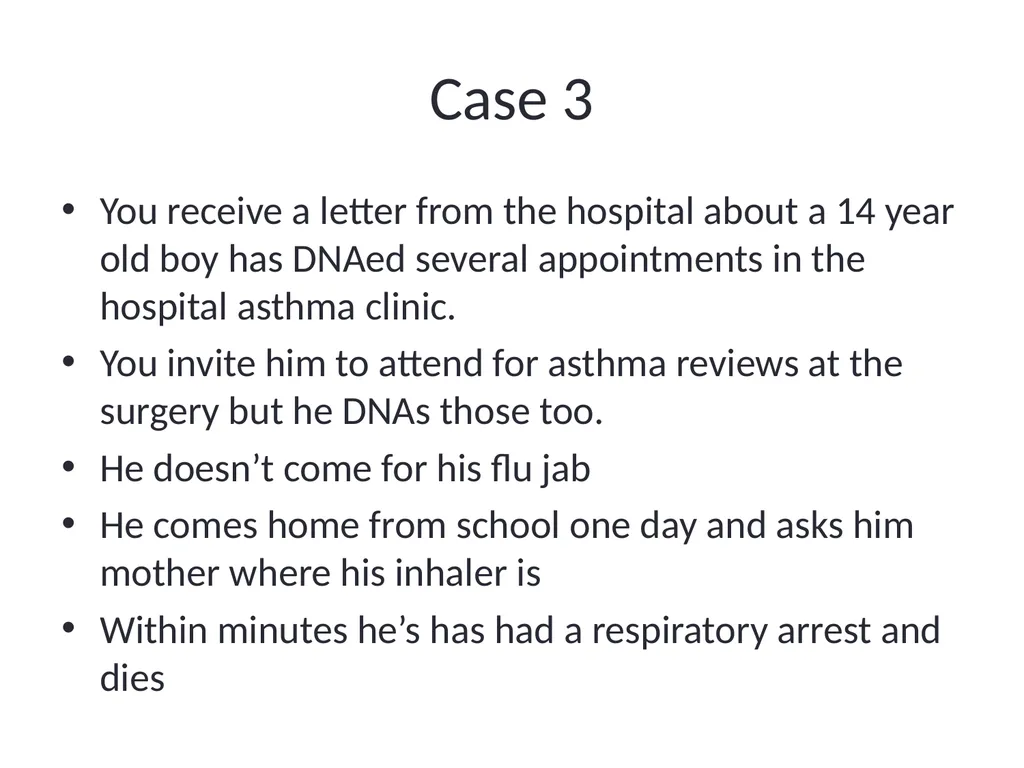
Case 3 You receive a letter from the hospital about a 14 year old boy has DNAed several appointments in the hospital asthma clinic.
You invite him to attend for asthma reviews at the surgery but he DNAs those too.
He doesn’t come for his flu jab
He comes home from school one day and asks him mother where his inhaler is
Within minutes he’s has had a respiratory arrest and dies<br>
You invite him to attend for asthma reviews at the surgery but he DNAs those too.
He doesn’t come for his flu jab
He comes home from school one day and asks him mother where his inhaler is
Within minutes he’s has had a respiratory arrest and dies<br>
29
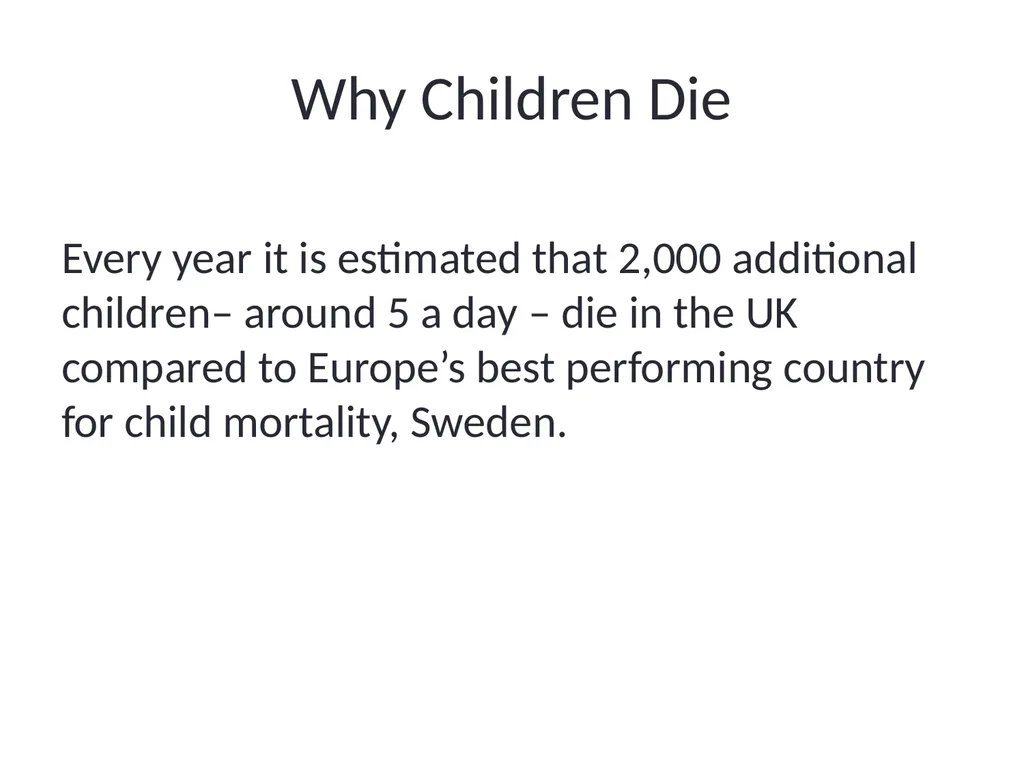
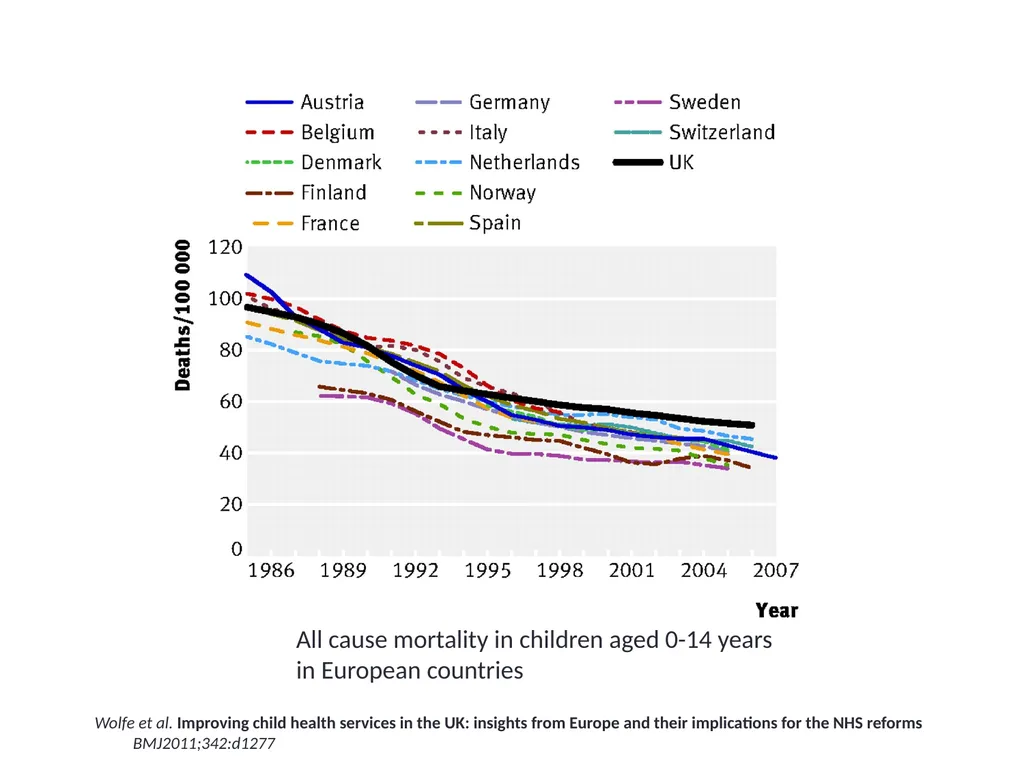
Why Children Die Every year it is estimated that 2,000 additional children– around 5 a day – die in the UK compared to Europe’s best performing country for child mortality, Sweden.<br>
30
All cause mortality in children aged 0-14 years in European countries Wolfe et al. Improving child health services in the UK: insights from Europe and their implications for the NHS reforms BMJ2011;342:d1277<br>
31
Over half of deaths in childhood occur during the first year of a child’s life, and are strongly influenced by pre-term delivery and low birth weight; with risk factors including maternal age, smoking and disadvantaged circumstances.
Suicide remains a leading cause of death in young people in the UK, and the number of deaths due to intentional injuries and self-harm have not declined in 30 years.
After the age of one, injury is the most frequent cause of death; over three quarters of deaths due to injury in the age bracket of 10-18 year olds are related to traffic incidents.<br>
Suicide remains a leading cause of death in young people in the UK, and the number of deaths due to intentional injuries and self-harm have not declined in 30 years.
After the age of one, injury is the most frequent cause of death; over three quarters of deaths due to injury in the age bracket of 10-18 year olds are related to traffic incidents.<br>
32
Why Children Die The report;
highlights the importance of access to high quality healthcare for children and young people
calls for a reduction in preventable deaths through better training of healthcare professionals to enable confident, competent, early identification and treatment of illness
recommends better use of tools such as epilepsy passports, asthma plans and coordinated care between hospitals and schools
recommends all frontline health professionals involved in the acute assessment of children and young people should utilise resources such as the ‘Spotting the sick child’ web resource
action against the wider determinants of child health and death<br>
highlights the importance of access to high quality healthcare for children and young people
calls for a reduction in preventable deaths through better training of healthcare professionals to enable confident, competent, early identification and treatment of illness
recommends better use of tools such as epilepsy passports, asthma plans and coordinated care between hospitals and schools
recommends all frontline health professionals involved in the acute assessment of children and young people should utilise resources such as the ‘Spotting the sick child’ web resource
action against the wider determinants of child health and death<br>
33
Child Death Review 1. A rapid response by a group of key professionals (sometimes known as a rapid response team) who come together for the purpose of enquiring into and evaluating each unexpected death of a child;
2. An overview of all child deaths (under 18 years) in the local safeguarding children board (LSCB) area
Lessons learnt are disseminated<br>
2. An overview of all child deaths (under 18 years) in the local safeguarding children board (LSCB) area
Lessons learnt are disseminated<br>
34
Child Death Overview Panel Report The North of Tyne CDOP identified modifiable factors were identified in four out of ten recent cases. The factors were:
Co-sleeping
Consanguinity
Smoking and health issues in pregnancy
Co-sleeping with maternal and postnatal smoking by both parents incorporated with alcohol and drug use.<br>
Co-sleeping
Consanguinity
Smoking and health issues in pregnancy
Co-sleeping with maternal and postnatal smoking by both parents incorporated with alcohol and drug use.<br>
35
What lessons might we learn in this case? Proactive response to C+YP who DNA appts
Development of asthma management plans
More young people friendly services
Better links with school nursing teams
We need to address issues of poverty and inequality<br>
Development of asthma management plans
More young people friendly services
Better links with school nursing teams
We need to address issues of poverty and inequality<br>
36
Care Quality Commission<br>
37
CQC Inspection of Children’s Services CQC will inspect general practices as part of a citywide inspection of children’s services
They will announce a visit on a Thursday and expect to be looking at notes early the following week<br>
They will announce a visit on a Thursday and expect to be looking at notes early the following week<br>
38
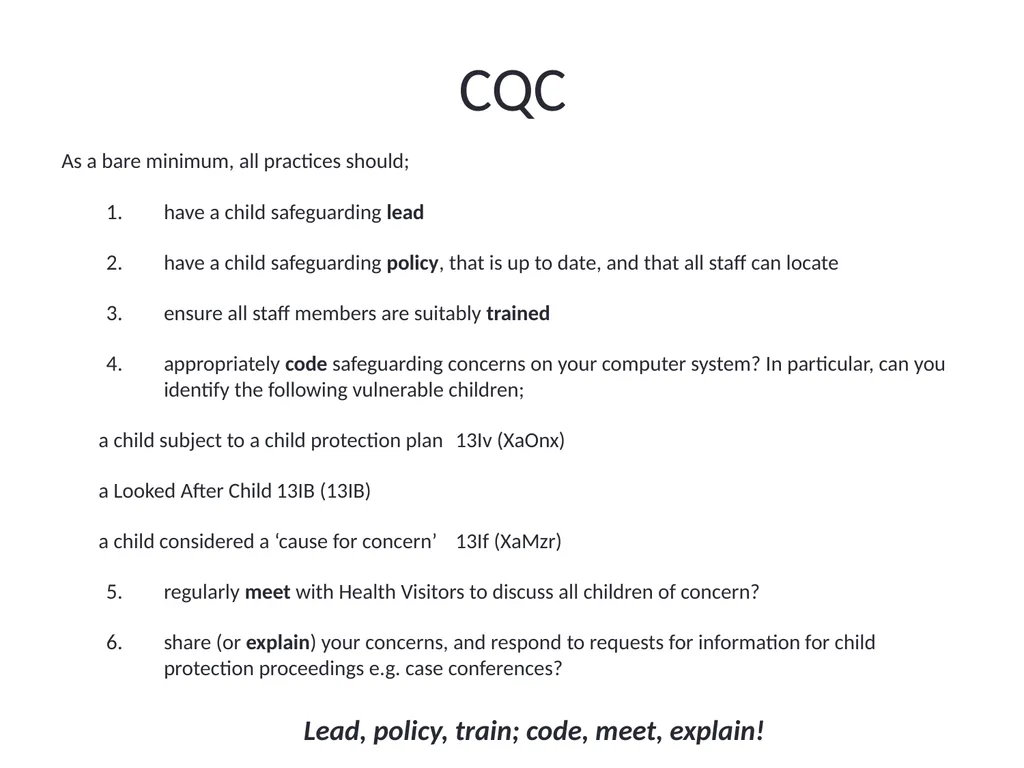
CQC As a bare minimum, all practices should;
have a child safeguarding lead
have a child safeguarding policy, that is up to date, and that all staff can locate
ensure all staff members are suitably trained
appropriately code safeguarding concerns on your computer system? In particular, can you identify the following vulnerable children;
a child subject to a child protection plan 13Iv (XaOnx)
a Looked After Child 13IB (13IB)
a child considered a ‘cause for concern’ 13If (XaMzr)
regularly meet with Health Visitors to discuss all children of concern?
share (or explain) your concerns, and respond to requests for information for child protection proceedings e.g. case conferences?
Lead, policy, train; code, meet, explain!<br>
have a child safeguarding lead
have a child safeguarding policy, that is up to date, and that all staff can locate
ensure all staff members are suitably trained
appropriately code safeguarding concerns on your computer system? In particular, can you identify the following vulnerable children;
a child subject to a child protection plan 13Iv (XaOnx)
a Looked After Child 13IB (13IB)
a child considered a ‘cause for concern’ 13If (XaMzr)
regularly meet with Health Visitors to discuss all children of concern?
share (or explain) your concerns, and respond to requests for information for child protection proceedings e.g. case conferences?
Lead, policy, train; code, meet, explain!<br>
39
RCGP Child Safeguarding Toolkit<br>
40
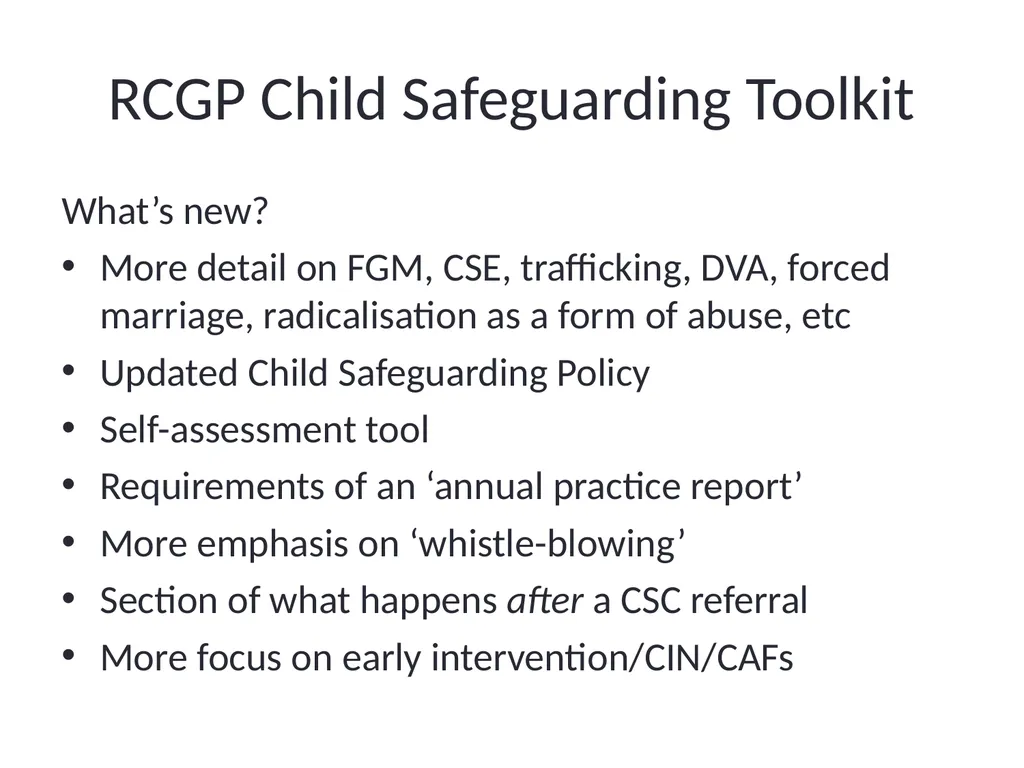
RCGP Child Safeguarding Toolkit What’s new?
More detail on FGM, CSE, trafficking, DVA, forced marriage, radicalisation as a form of abuse, etc
Updated Child Safeguarding Policy
Self-assessment tool
Requirements of an ‘annual practice report’
More emphasis on ‘whistle-blowing’
Section of what happens after a CSC referral
More focus on early intervention/CIN/CAFs<br>
More detail on FGM, CSE, trafficking, DVA, forced marriage, radicalisation as a form of abuse, etc
Updated Child Safeguarding Policy
Self-assessment tool
Requirements of an ‘annual practice report’
More emphasis on ‘whistle-blowing’
Section of what happens after a CSC referral
More focus on early intervention/CIN/CAFs<br>
41
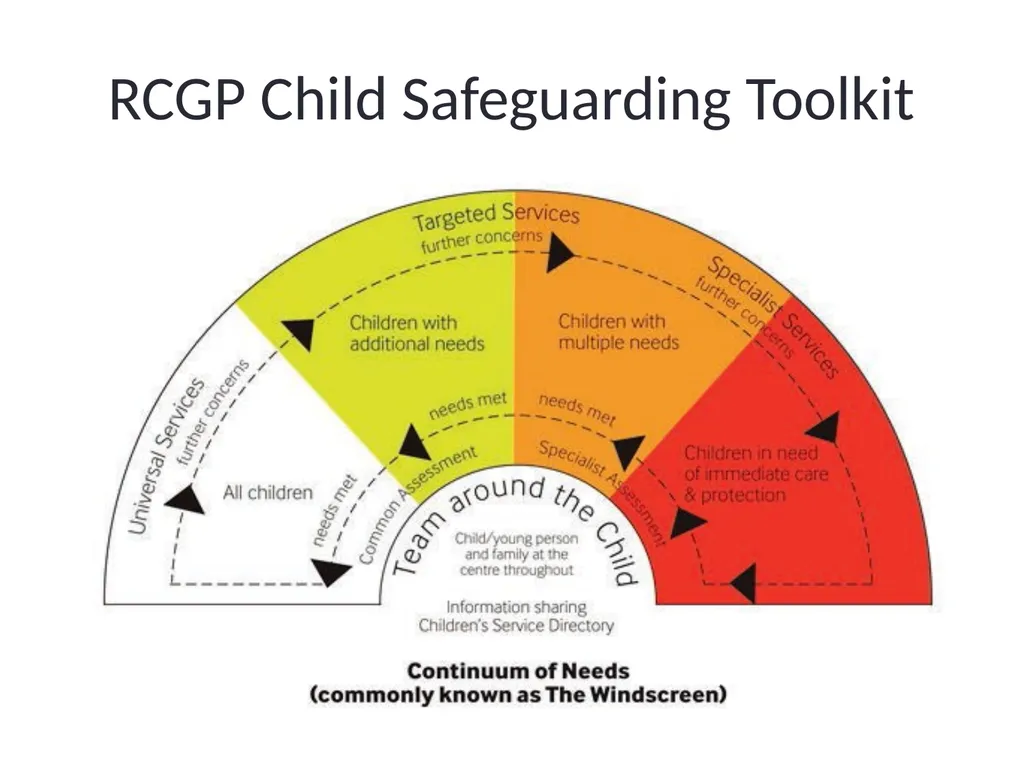
RCGP Child Safeguarding Toolkit<br>
42
And don’t forget….<br>
43
… some key facts! Those that don’t cruise rarely bruise
Disclosure of DVA occurs after the 36th incident (on average)
Consider parental explanations of unusual symptoms or signs of disease/injury with ‘respectful uncertainty’
Consider safeguarding issues when assessing a child whose behaviour is causing concern
Actively engage in child protection procedures<br>
Disclosure of DVA occurs after the 36th incident (on average)
Consider parental explanations of unusual symptoms or signs of disease/injury with ‘respectful uncertainty’
Consider safeguarding issues when assessing a child whose behaviour is causing concern
Actively engage in child protection procedures<br>