
CHILDREN Fifteenth Edition JOHN W. SANTROCK
DJ
Published · 49 slides · 0 views

1 / 1






Description
CHILDREN Fifteenth Edition JOHN W. SANTROCK JENNIFER E. LANSFORD KIRBY DEATER-DECKARD Copyright 2022 McGraw Hill LLC. All rights reserved. No reproduction or distribution without the prior written consent of McGraw Hill LLC. Chapter 13
Related Topics
Share
Embed code
Download this presentation From Below
"CHILDREN Fifteenth Edition JOHN W. SANTROCK" is the property of its rightful owner. Permission is granted to download and print the materials on this website for personal, non-commercial use only, and to display it on your personal computer provided you do not modify the materials and that you retain all copyright notices contained in the materials. By downloading content from our website, you accept the terms of this agreement.
Presentation Transcript
01
CHILDREN
Fifteenth Edition JOHN W. SANTROCK
JENNIFER E. LANSFORD
KIRBY DEATER-DECKARD Copyright 2022 © McGraw Hill LLC. All rights reserved. No reproduction or distribution without the prior written consent of McGraw Hill LLC.<br>
JENNIFER E. LANSFORD
KIRBY DEATER-DECKARD Copyright 2022 © McGraw Hill LLC. All rights reserved. No reproduction or distribution without the prior written consent of McGraw Hill LLC.<br>
02
Chapter 13 Socioemotional Development in Middle and Late Childhood Copyright 2022 © McGraw Hill LLC. All rights reserved. No reproduction or distribution without the prior written consent of McGraw Hill LLC.<br>
03
Learning Goals Discuss emotional and personality development in middle and late childhood.
Describe changes in parenting and families in middle and late childhood.
Identify changes in peer relationships in middle and late childhood.
Characterize contemporary approaches to student learning and sociocultural diversity in schools. 3<br>
Describe changes in parenting and families in middle and late childhood.
Identify changes in peer relationships in middle and late childhood.
Characterize contemporary approaches to student learning and sociocultural diversity in schools. 3<br>
04
The Self In middle and late childhood, children increasingly describe themselves in terms of psychological characteristics and traits.
Popular, nice, helpful, mean, smart, dumb.
Children also become more likely to recognize social aspects of the self, including references to social groups.
References to social comparison increase in this period. 4<br>
Popular, nice, helpful, mean, smart, dumb.
Children also become more likely to recognize social aspects of the self, including references to social groups.
References to social comparison increase in this period. 4<br>
05
Understanding Others Perspective taking increases with age.
Ability to take other people’s perspectives and understand their thoughts and feelings.
In Selman’s view, at about 6 to 8 years of age children develop perspective-taking as a way of judging another person’s intentions, purposes, and actions.
Perspective taking is thought to be important in whether children develop prosocial or antisocial attitudes and behavior.
Children also become more skeptical of others’ claims. 5<br>
Ability to take other people’s perspectives and understand their thoughts and feelings.
In Selman’s view, at about 6 to 8 years of age children develop perspective-taking as a way of judging another person’s intentions, purposes, and actions.
Perspective taking is thought to be important in whether children develop prosocial or antisocial attitudes and behavior.
Children also become more skeptical of others’ claims. 5<br>
06
Self-Esteem and Self-Concept Self-esteem: global evaluations of the self.
Also called self-worth or self-image.
Variations in self-esteem have been linked to many aspects of children’s development, but much of the research is correlational rather than experimental.
Self-concept: domain-specific evaluations of the self.
Academic, athletic, appearance, etc.
Perceptions may not always match reality. 6<br>
Also called self-worth or self-image.
Variations in self-esteem have been linked to many aspects of children’s development, but much of the research is correlational rather than experimental.
Self-concept: domain-specific evaluations of the self.
Academic, athletic, appearance, etc.
Perceptions may not always match reality. 6<br>
07
Self-Regulation; and Erikson’s Industry versus Inferiority Capacity for self-regulation increases with age and development.
Characterized by deliberate efforts to manage one’s behavior, emotions, and thoughts.
Erikson’s fourth stage, industry versus inferiority:
Encouragement increases the child’s sense of industry (how things are made and how they work).
Criticism results in a sense of inferiority. 7<br>
Characterized by deliberate efforts to manage one’s behavior, emotions, and thoughts.
Erikson’s fourth stage, industry versus inferiority:
Encouragement increases the child’s sense of industry (how things are made and how they work).
Criticism results in a sense of inferiority. 7<br>
08
Emotional Development Preschoolers show a growing awareness of the need to control emotions and meet social standards.
Developmental changes:
Improved emotional understanding.
Increased understanding that more than one emotion can be experienced in a particular situation.
Increased tendency to be aware of the events leading to emotional reactions.
Ability to suppress or conceal negative emotional reactions.
Use of self-initiated strategies for redirecting feelings.
Capacity for genuine empathy. 8<br>
Developmental changes:
Improved emotional understanding.
Increased understanding that more than one emotion can be experienced in a particular situation.
Increased tendency to be aware of the events leading to emotional reactions.
Ability to suppress or conceal negative emotional reactions.
Use of self-initiated strategies for redirecting feelings.
Capacity for genuine empathy. 8<br>
09
Attachment in Middle and Late Childhood Attachment process continues to be developmentally important.
Becomes more sophisticated as children’s social worlds expand to include peers, teachers, and others.
One study linked secure attachment with:
Less anxiety and depression.
Less exclusion among peers at school.
Lowered likelihood of aggressive behavior. 9<br>
Becomes more sophisticated as children’s social worlds expand to include peers, teachers, and others.
One study linked secure attachment with:
Less anxiety and depression.
Less exclusion among peers at school.
Lowered likelihood of aggressive behavior. 9<br>
10
Social-Emotional Education Programs Increasing number of social-emotional educational programs have been developed.
Intended to improve many aspects of children’s and adolescents’ lives.
Two such programs:
Second Step.
Collaborative for Academic, Social, and Emotional Learning (CASEL). 10<br>
Intended to improve many aspects of children’s and adolescents’ lives.
Two such programs:
Second Step.
Collaborative for Academic, Social, and Emotional Learning (CASEL). 10<br>
11
Coping with Stress 1 Ability to use more coping strategies increases with age.
More accurately appraise a stressful situation.
Five main strategies: problem solving, emotional suppression, cognitive reappraisal, distraction, avoidance.
Disasters, especially, can harm children’s development and produce adjustment problems.
Children should be reassured, allowed to talk about their feelings and the events, and protected from re-exposure. 11<br>
More accurately appraise a stressful situation.
Five main strategies: problem solving, emotional suppression, cognitive reappraisal, distraction, avoidance.
Disasters, especially, can harm children’s development and produce adjustment problems.
Children should be reassured, allowed to talk about their feelings and the events, and protected from re-exposure. 11<br>
12
Coping with Stress 2 Dose-response effect: the more severe the disaster or trauma (dose), the worse the adaptation and adjustment (response).
In early 2020 the abrupt emergence and worldwide spread of the novel coronavirus increased the stress and anxiety level of many adults and children. 12<br>
In early 2020 the abrupt emergence and worldwide spread of the novel coronavirus increased the stress and anxiety level of many adults and children. 12<br>
13
Moral Development: Kohlberg’s Theory 1 Piaget’s cognitive stages of development serve as the underpinnings for the theory proposed by Lawrence Kohlberg.
Based on 20 years of interviewing children, using stories in which characters face moral dilemmas.
Kohlberg suggested that there are six stages of moral development.
Argues the stages are universal. 13<br>
Based on 20 years of interviewing children, using stories in which characters face moral dilemmas.
Kohlberg suggested that there are six stages of moral development.
Argues the stages are universal. 13<br>
14
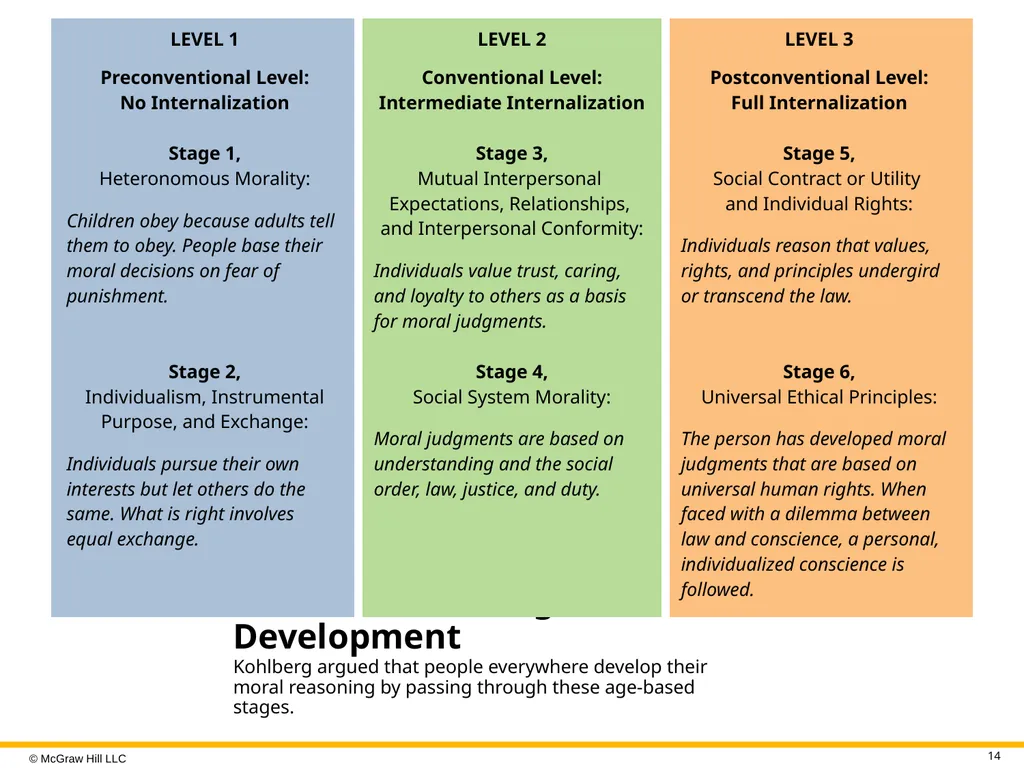
TABLE 1 Kohlberg’s Three Levels and Six Stages of Moral Development Table divided into three columns summarizes Kohlberg's three levels and six stages of moral development. Column one notes level one, stage one and stage two; column two notes level two stage three and stage four; and column three notes level three, stage five and stage six. Kohlberg argued that people everywhere develop their moral reasoning by passing through these age-based stages. 14<br>
15
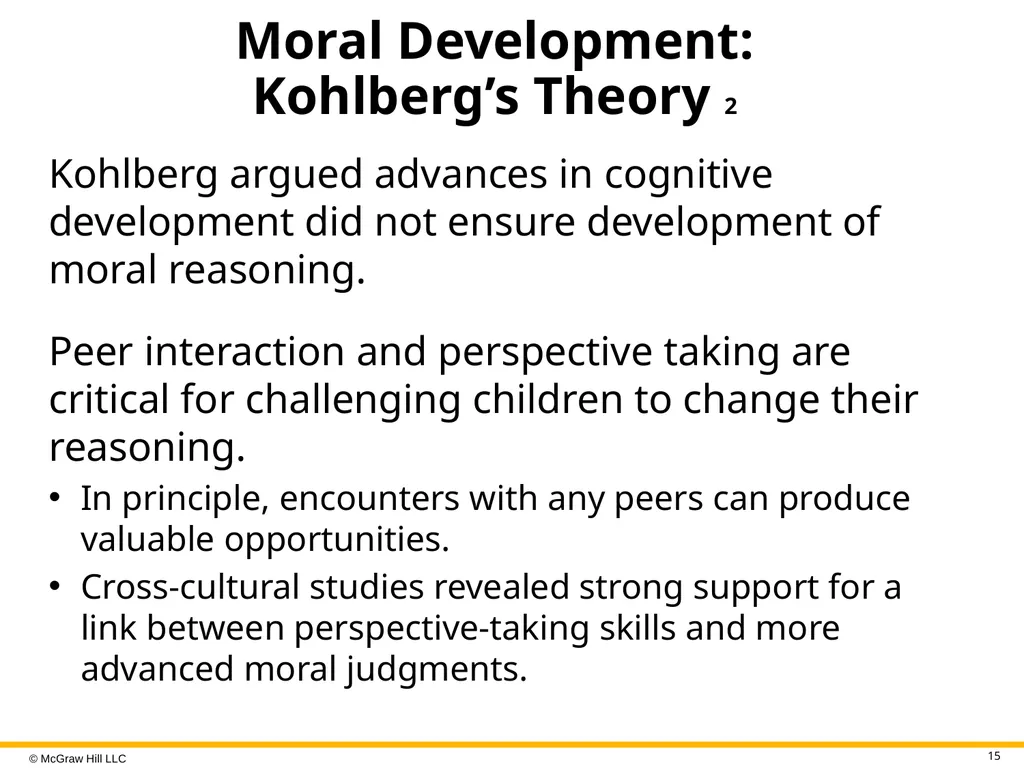
Moral Development: Kohlberg’s Theory 2 Kohlberg argued advances in cognitive development did not ensure development of moral reasoning.
Peer interaction and perspective taking are critical for challenging children to change their reasoning.
In principle, encounters with any peers can produce valuable opportunities.
Cross-cultural studies revealed strong support for a link between perspective-taking skills and more advanced moral judgments. 15<br>
Peer interaction and perspective taking are critical for challenging children to change their reasoning.
In principle, encounters with any peers can produce valuable opportunities.
Cross-cultural studies revealed strong support for a link between perspective-taking skills and more advanced moral judgments. 15<br>
16
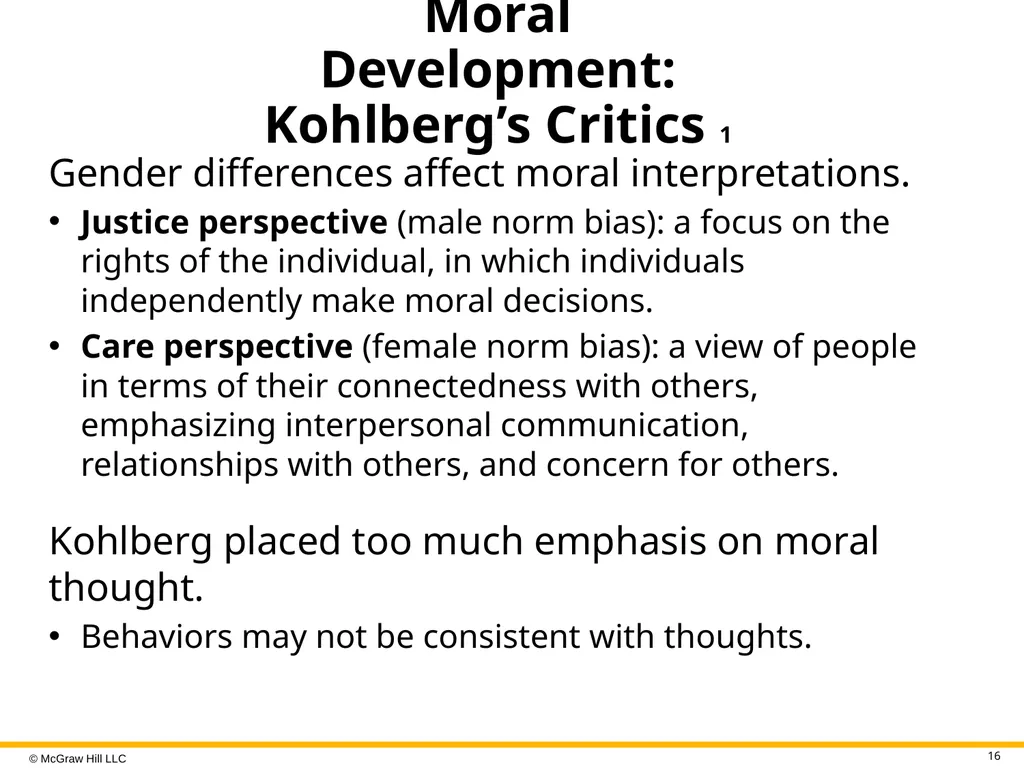
Moral Development: Kohlberg’s Critics 1 Gender differences affect moral interpretations.
Justice perspective (male norm bias): a focus on the rights of the individual, in which individuals independently make moral decisions.
Care perspective (female norm bias): a view of people in terms of their connectedness with others, emphasizing interpersonal communication, relationships with others, and concern for others.
Kohlberg placed too much emphasis on moral thought.
Behaviors may not be consistent with thoughts. 16<br>
Justice perspective (male norm bias): a focus on the rights of the individual, in which individuals independently make moral decisions.
Care perspective (female norm bias): a view of people in terms of their connectedness with others, emphasizing interpersonal communication, relationships with others, and concern for others.
Kohlberg placed too much emphasis on moral thought.
Behaviors may not be consistent with thoughts. 16<br>
17
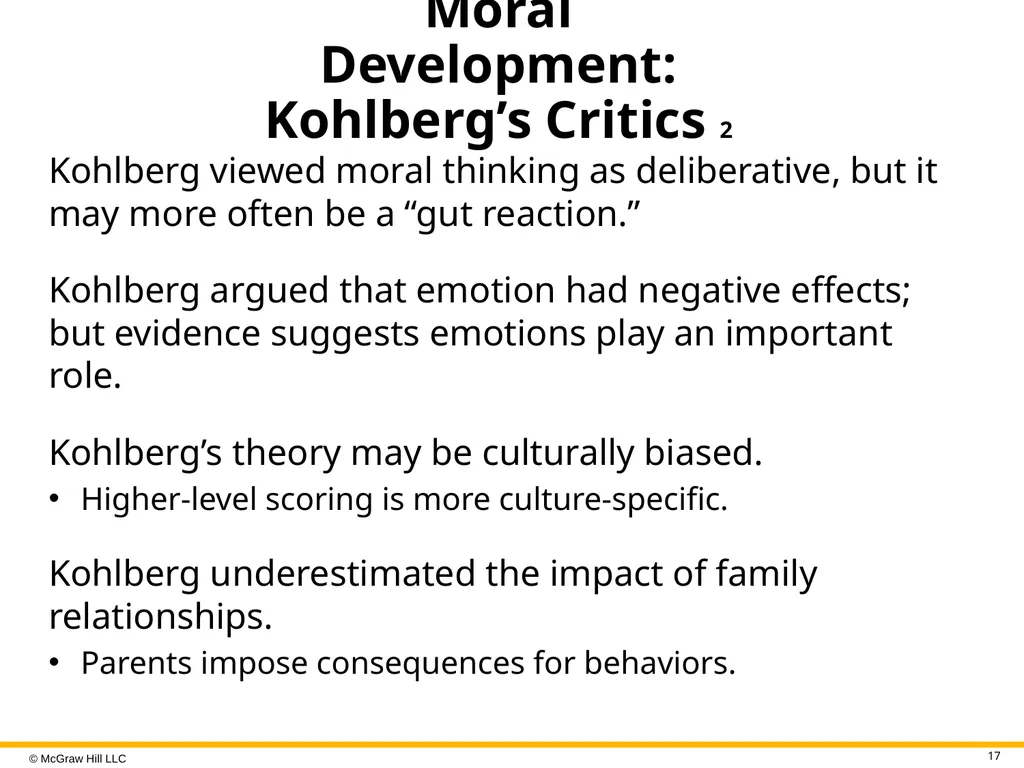
Moral Development: Kohlberg’s Critics 2 Kohlberg viewed moral thinking as deliberative, but it may more often be a “gut reaction.”
Kohlberg argued that emotion had negative effects; but evidence suggests emotions play an important role.
Kohlberg’s theory may be culturally biased.
Higher-level scoring is more culture-specific.
Kohlberg underestimated the impact of family relationships.
Parents impose consequences for behaviors. 17<br>
Kohlberg argued that emotion had negative effects; but evidence suggests emotions play an important role.
Kohlberg’s theory may be culturally biased.
Higher-level scoring is more culture-specific.
Kohlberg underestimated the impact of family relationships.
Parents impose consequences for behaviors. 17<br>
18
Domain Theory: Moral, Social Conventional, and Personal Reasoning Domain theory of moral development: there are different domains of social knowledge and reasoning.
Some argue that Kohlberg did not adequately distinguish between moral reasoning and social conventional reasoning.
Social conventional reasoning focuses on conventional rules established by social consensus in order to control behavior and maintain the social system.
According to social conventional reasoning, the rules themselves are arbitrary.
Moral reasoning instead focuses on ethical issues, and the rules are obligatory, widely accepted, and somewhat impersonal. 18<br>
Some argue that Kohlberg did not adequately distinguish between moral reasoning and social conventional reasoning.
Social conventional reasoning focuses on conventional rules established by social consensus in order to control behavior and maintain the social system.
According to social conventional reasoning, the rules themselves are arbitrary.
Moral reasoning instead focuses on ethical issues, and the rules are obligatory, widely accepted, and somewhat impersonal. 18<br>
19
Prosocial Behavior Social behaviors of many children:
Immoral antisocial (lying, cheating).
Prosocial moral behavior (empathy, altruism).
William Damon:
Social play rituals and imitation at age 4 create empathic awareness and sharing (with adult encouragement).
Sharing fosters a more complex sense of awareness in middle and late childhood. 19<br>
Immoral antisocial (lying, cheating).
Prosocial moral behavior (empathy, altruism).
William Damon:
Social play rituals and imitation at age 4 create empathic awareness and sharing (with adult encouragement).
Sharing fosters a more complex sense of awareness in middle and late childhood. 19<br>
20
Gender Gender identity and gender-typed behavior reflects biological, cognitive, and social influences.
Gender stereotypes: broad categories that reflect general impressions and beliefs about females and males.
Well-adjusted boy should be independent, aggressive, and powerful.
Well-adjusted girl should be dependent, nurturing, and uninterested in power. 20<br>
Gender stereotypes: broad categories that reflect general impressions and beliefs about females and males.
Well-adjusted boy should be independent, aggressive, and powerful.
Well-adjusted girl should be dependent, nurturing, and uninterested in power. 20<br>
21
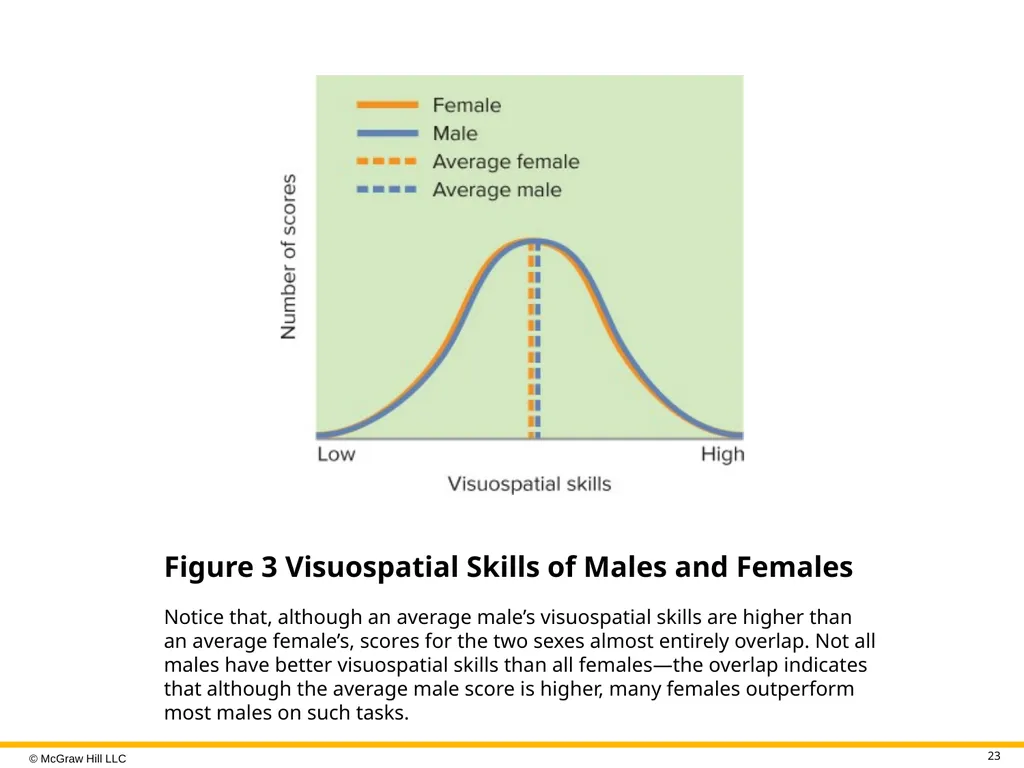
Gender Similarities and Differences 1 Reality is that differences between the sexes are averages—not all females versus all males.
When there are differences, there is overlap.
Differences may be due to biological factors, sociocultural factors, or both.
Basic physical differences:
Women typically have more body fat, have a longer life expectancy, and are less likely to develop disorders.
Men are taller and have twice the risk of coronary disease. 21<br>
When there are differences, there is overlap.
Differences may be due to biological factors, sociocultural factors, or both.
Basic physical differences:
Women typically have more body fat, have a longer life expectancy, and are less likely to develop disorders.
Men are taller and have twice the risk of coronary disease. 21<br>
22
Gender Similarities and Differences 2 Research on sex differences in the brain is still in its infancy, but there are likely far more similarities than differences.
Female brains typically are 10 percent smaller.
Some specific regions of the brain are larger in males, whereas others are larger in females.
Females, on average, perform better on some tasks related to language processing, while males, on average, perform better on some tasks related to visuospatial functioning. 22<br>
Female brains typically are 10 percent smaller.
Some specific regions of the brain are larger in males, whereas others are larger in females.
Females, on average, perform better on some tasks related to language processing, while males, on average, perform better on some tasks related to visuospatial functioning. 22<br>
23
Figure 3 Visuospatial Skills of Males and Females Notice that, although an average male’s visuospatial skills are higher than an average female’s, scores for the two sexes almost entirely overlap. Not all males have better visuospatial skills than all females—the overlap indicates that although the average male score is higher, many females outperform most males on such tasks. 23<br>
24
Gender Similarities and Differences 3 Moderate to large differences were found in 10 areas:
Males score higher in aggression, masculinity, spatial rotation ability, attention to physical attractiveness in mate selection, confidence in physical abilities, and performance in same-sex groups.
Females scored higher in reactions to painful stimuli, fear, attachment to peers, and interest in people over things. 24<br>
Males score higher in aggression, masculinity, spatial rotation ability, attention to physical attractiveness in mate selection, confidence in physical abilities, and performance in same-sex groups.
Females scored higher in reactions to painful stimuli, fear, attachment to peers, and interest in people over things. 24<br>
25
Gender Similarities and Differences 4 In terms of socioemotional development, one consistent difference is that boys are more physically aggressive.
Girls’ verbal and relational aggression is sometimes more pronounced.
Gender differences occur in some aspects of emotion.
Girls are more expressive, are better at decoding emotion, smile more, cry more, and are happier.
Boys report experiencing and expressing more anger; and they usually show less self-regulation, which can translate into behavior problems. 25<br>
Girls’ verbal and relational aggression is sometimes more pronounced.
Gender differences occur in some aspects of emotion.
Girls are more expressive, are better at decoding emotion, smile more, cry more, and are happier.
Boys report experiencing and expressing more anger; and they usually show less self-regulation, which can translate into behavior problems. 25<br>
26
Gender Similarities and Differences 5 Research suggests girls are more “people oriented” and boys are more “things oriented.”
Recent research reveals some gender differences in communication.
Deborah Tannen distinguishes between report talk (males) and rapport talk (females).
Females listen and disclose more.
Overall differences are small. 26<br>
Recent research reveals some gender differences in communication.
Deborah Tannen distinguishes between report talk (males) and rapport talk (females).
Females listen and disclose more.
Overall differences are small. 26<br>
27
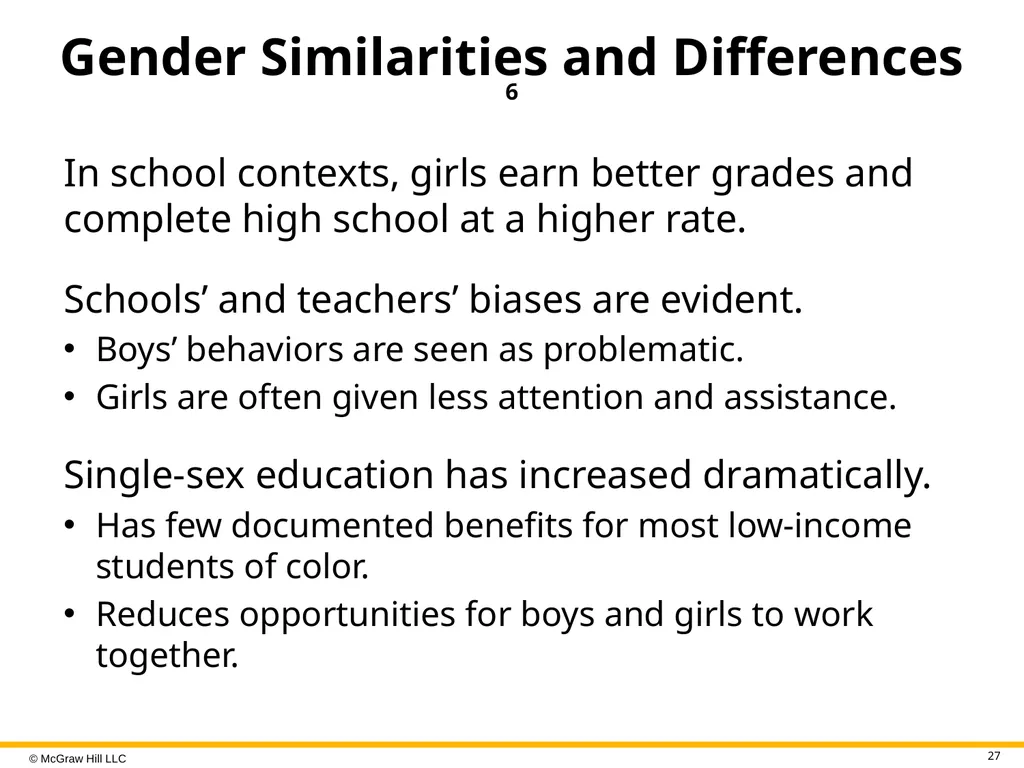
Gender Similarities and Differences 6 In school contexts, girls earn better grades and complete high school at a higher rate.
Schools’ and teachers’ biases are evident.
Boys’ behaviors are seen as problematic.
Girls are often given less attention and assistance.
Single-sex education has increased dramatically.
Has few documented benefits for most low-income students of color.
Reduces opportunities for boys and girls to work together. 27<br>
Schools’ and teachers’ biases are evident.
Boys’ behaviors are seen as problematic.
Girls are often given less attention and assistance.
Single-sex education has increased dramatically.
Has few documented benefits for most low-income students of color.
Reduces opportunities for boys and girls to work together. 27<br>
28
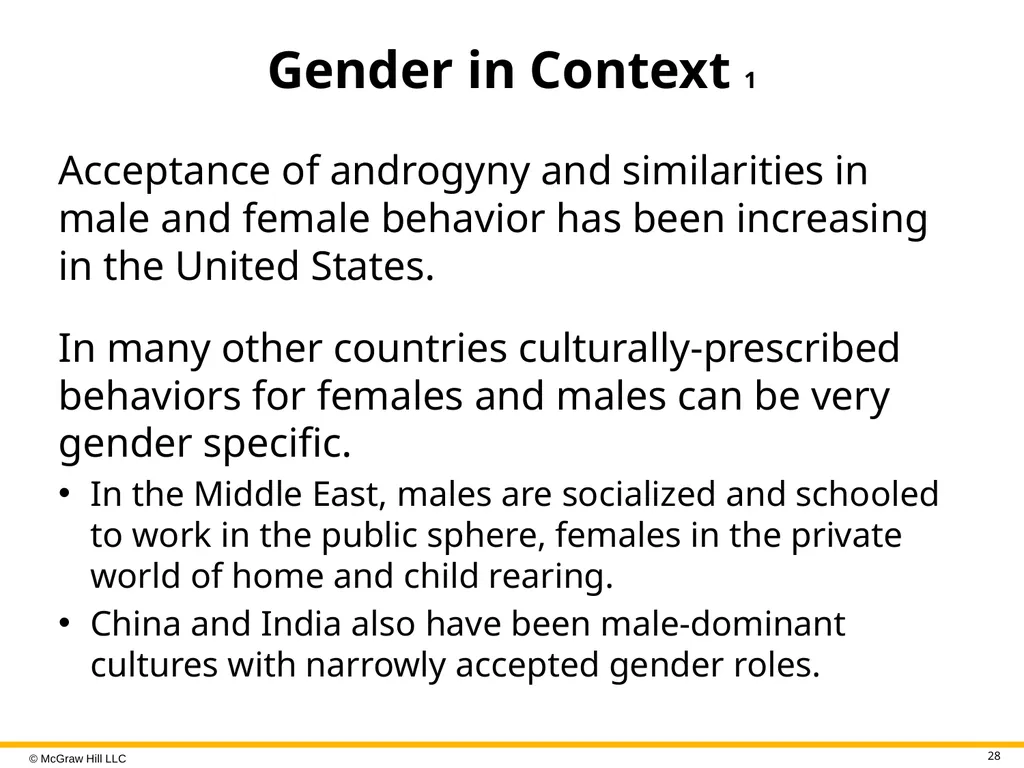
Gender in Context 1 Acceptance of androgyny and similarities in male and female behavior has been increasing in the United States.
In many other countries culturally-prescribed behaviors for females and males can be very gender specific.
In the Middle East, males are socialized and schooled to work in the public sphere, females in the private world of home and child rearing.
China and India also have been male-dominant cultures with narrowly accepted gender roles. 28<br>
In many other countries culturally-prescribed behaviors for females and males can be very gender specific.
In the Middle East, males are socialized and schooled to work in the public sphere, females in the private world of home and child rearing.
China and India also have been male-dominant cultures with narrowly accepted gender roles. 28<br>
29
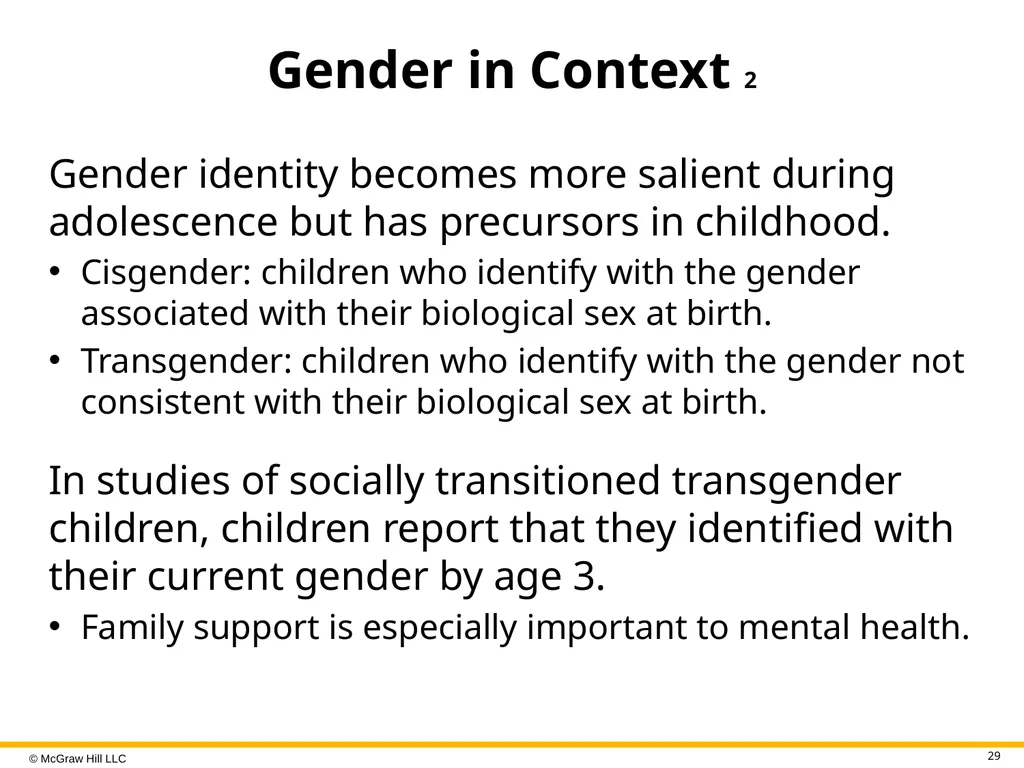
Gender in Context 2 Gender identity becomes more salient during adolescence but has precursors in childhood.
Cisgender: children who identify with the gender associated with their biological sex at birth.
Transgender: children who identify with the gender not consistent with their biological sex at birth.
In studies of socially transitioned transgender children, children report that they identified with their current gender by age 3.
Family support is especially important to mental health. 29<br>
Cisgender: children who identify with the gender associated with their biological sex at birth.
Transgender: children who identify with the gender not consistent with their biological sex at birth.
In studies of socially transitioned transgender children, children report that they identified with their current gender by age 3.
Family support is especially important to mental health. 29<br>
30
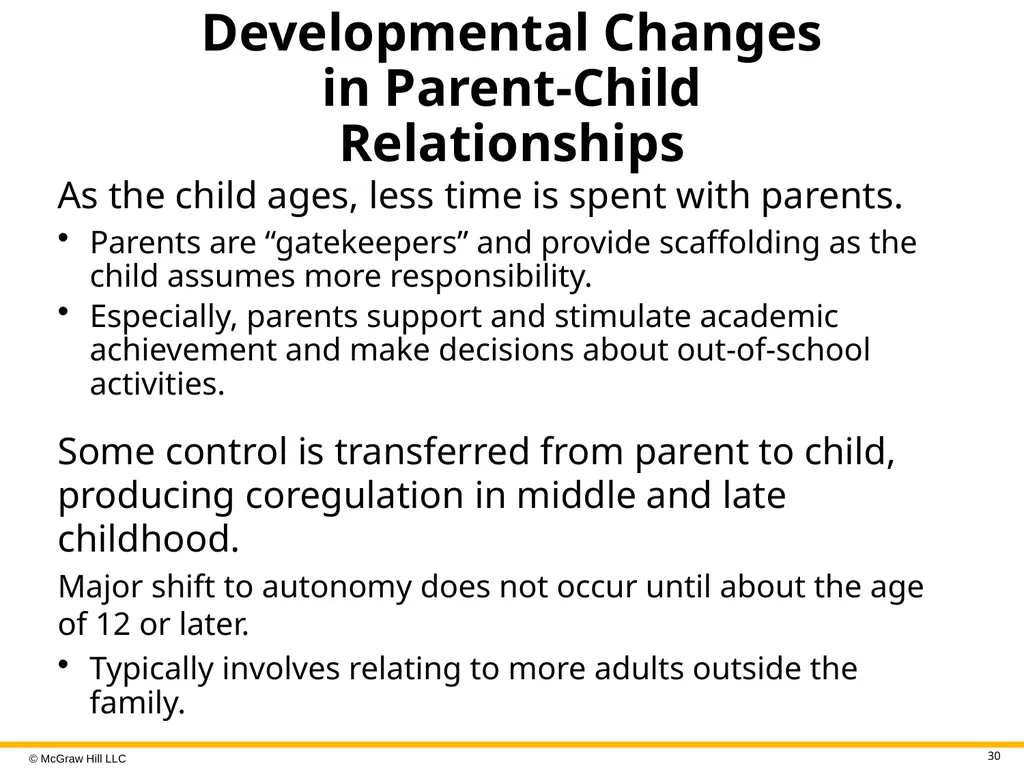
Developmental Changes in Parent-Child Relationships As the child ages, less time is spent with parents.
Parents are “gatekeepers” and provide scaffolding as the child assumes more responsibility.
Especially, parents support and stimulate academic achievement and make decisions about out-of-school activities.
Some control is transferred from parent to child, producing coregulation in middle and late childhood.
Major shift to autonomy does not occur until about the age of 12 or later.
Typically involves relating to more adults outside the family. 30<br>
Parents are “gatekeepers” and provide scaffolding as the child assumes more responsibility.
Especially, parents support and stimulate academic achievement and make decisions about out-of-school activities.
Some control is transferred from parent to child, producing coregulation in middle and late childhood.
Major shift to autonomy does not occur until about the age of 12 or later.
Typically involves relating to more adults outside the family. 30<br>
31
Parents as Managers Parents’ managerial role includes provide opportunities, monitoring behavior, and acting as social initiators and arrangers.
Mothers manage more than fathers.
Family management practices are positively related to grades and self-responsibility, and negatively to school problems.
Important functions: maintain routines and effectively monitor the child. 31<br>
Mothers manage more than fathers.
Family management practices are positively related to grades and self-responsibility, and negatively to school problems.
Important functions: maintain routines and effectively monitor the child. 31<br>
32
Stepfamilies 1 Divorce and remarriage is common in the U.S.
Half of divorces involve children.
Half of all children whose parents divorce will have a stepparent within 4 years.
Remarried parents face unique challenges.
Establish new relationships in the stepfamily.
Renegotiate existing relationships.
Better child adjustment is seen in long-established simple stepfamilies compared to children in conflicted nondivorced families. 32<br>
Half of divorces involve children.
Half of all children whose parents divorce will have a stepparent within 4 years.
Remarried parents face unique challenges.
Establish new relationships in the stepfamily.
Renegotiate existing relationships.
Better child adjustment is seen in long-established simple stepfamilies compared to children in conflicted nondivorced families. 32<br>
33
Stepfamilies 2 While some stepfamilies are preceded by the death of a spouse, far more are preceded by divorce.
Three common types:
Stepfather (custodial mother).
Stepmother (custodial father).
Blended or complex (both parents bring children into stepfamily).
Children usually have better relationship with custodial parent than stepparent. 33<br>
Three common types:
Stepfather (custodial mother).
Stepmother (custodial father).
Blended or complex (both parents bring children into stepfamily).
Children usually have better relationship with custodial parent than stepparent. 33<br>
34
Developmental Changes in Peer Relationships Time spent in social interaction with peers increases considerably between the elementary school years and middle and late childhood.
Size of peer groups increases, and peer interaction is less closely supervised.
Until about 12 years old, children’s preference for same-sex peer groups increases. 34<br>
Size of peer groups increases, and peer interaction is less closely supervised.
Until about 12 years old, children’s preference for same-sex peer groups increases. 34<br>
35
Peer Status 1 Sociometric status: the extent to which children are liked or disliked by their peer group.
Typically assessed by asking children how much they like or dislike classmates; or by asking them to nominate the children they like the most and the least. 35<br>
Typically assessed by asking children how much they like or dislike classmates; or by asking them to nominate the children they like the most and the least. 35<br>
36
Peer Status 2 Five peer statuses:
Popular children are frequently nominated as a best friend and are rarely disliked by their peers.
Average children receive an average number of both positive and negative nominations from their peers.
Neglected children are infrequently nominated as a best friend but are not disliked by their peers.
Rejected children are infrequently nominated as someone’s best friend and are actively disliked by their peers.
Controversial children are frequently nominated both as someone’s best friend and as being disliked. 36<br>
Popular children are frequently nominated as a best friend and are rarely disliked by their peers.
Average children receive an average number of both positive and negative nominations from their peers.
Neglected children are infrequently nominated as a best friend but are not disliked by their peers.
Rejected children are infrequently nominated as someone’s best friend and are actively disliked by their peers.
Controversial children are frequently nominated both as someone’s best friend and as being disliked. 36<br>
37
Peer Status 3 Children of each status have characteristics in common.
Popular children give out reinforcements, listen carefully, keep communication open, and show enthusiasm and concern for others; and appear happy, natural, self-confident, and in control of negative emotions.
Neglected children interact little and often appear shy.
Rejected children have more serious adjustment problems, are less likely to participate in class, express a dislike of school, and report being lonely.
Aggressive, peer-rejected boys tend to be impulsive, disruptive, and emotionally reactive. 37<br>
Popular children give out reinforcements, listen carefully, keep communication open, and show enthusiasm and concern for others; and appear happy, natural, self-confident, and in control of negative emotions.
Neglected children interact little and often appear shy.
Rejected children have more serious adjustment problems, are less likely to participate in class, express a dislike of school, and report being lonely.
Aggressive, peer-rejected boys tend to be impulsive, disruptive, and emotionally reactive. 37<br>
38
Social Cognition 1 Dodge’s five steps in children’s processing of information about their social world:
Decode social cues.
Interpret.
Search for a response.
Select an optimal response.
Enact.
Aggressive children are more likely to perceive another child’s actions as hostile when the child’s intention is ambiguous. 38<br>
Decode social cues.
Interpret.
Search for a response.
Select an optimal response.
Enact.
Aggressive children are more likely to perceive another child’s actions as hostile when the child’s intention is ambiguous. 38<br>
39
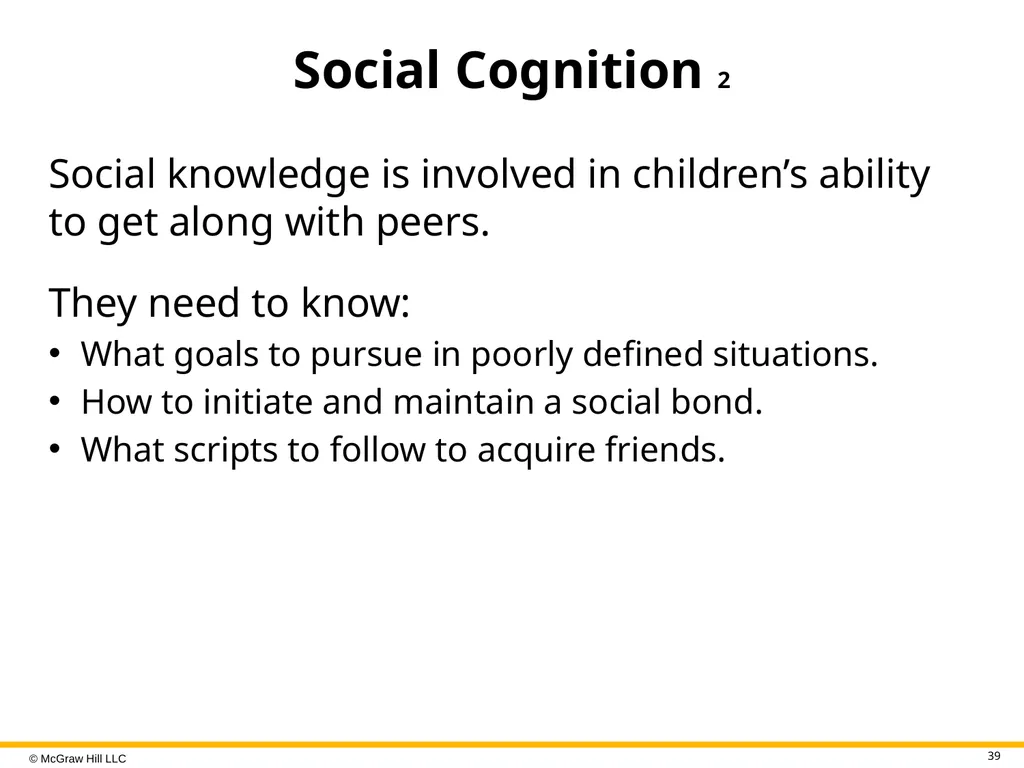
Social Cognition 2 Social knowledge is involved in children’s ability to get along with peers.
They need to know:
What goals to pursue in poorly defined situations.
How to initiate and maintain a social bond.
What scripts to follow to acquire friends. 39<br>
They need to know:
What goals to pursue in poorly defined situations.
How to initiate and maintain a social bond.
What scripts to follow to acquire friends. 39<br>
40
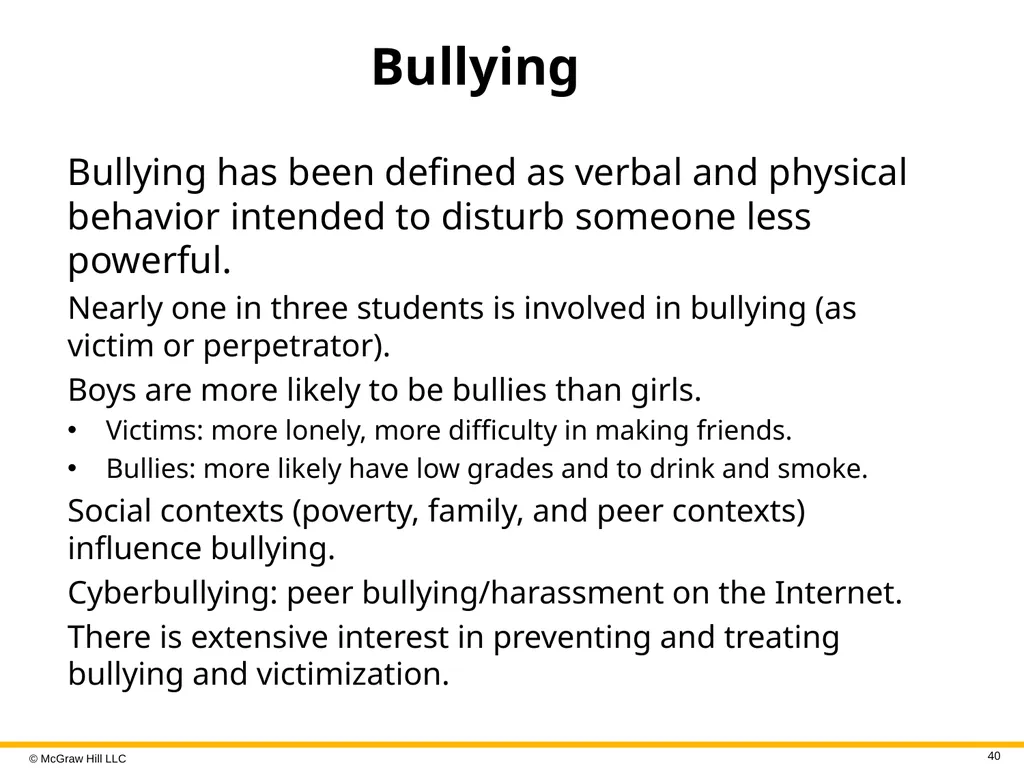
Bullying Bullying has been defined as verbal and physical behavior intended to disturb someone less powerful.
Nearly one in three students is involved in bullying (as victim or perpetrator).
Boys are more likely to be bullies than girls.
Victims: more lonely, more difficulty in making friends.
Bullies: more likely have low grades and to drink and smoke.
Social contexts (poverty, family, and peer contexts) influence bullying.
Cyberbullying: peer bullying/harassment on the Internet.
There is extensive interest in preventing and treating bullying and victimization. 40<br>
Nearly one in three students is involved in bullying (as victim or perpetrator).
Boys are more likely to be bullies than girls.
Victims: more lonely, more difficulty in making friends.
Bullies: more likely have low grades and to drink and smoke.
Social contexts (poverty, family, and peer contexts) influence bullying.
Cyberbullying: peer bullying/harassment on the Internet.
There is extensive interest in preventing and treating bullying and victimization. 40<br>
41
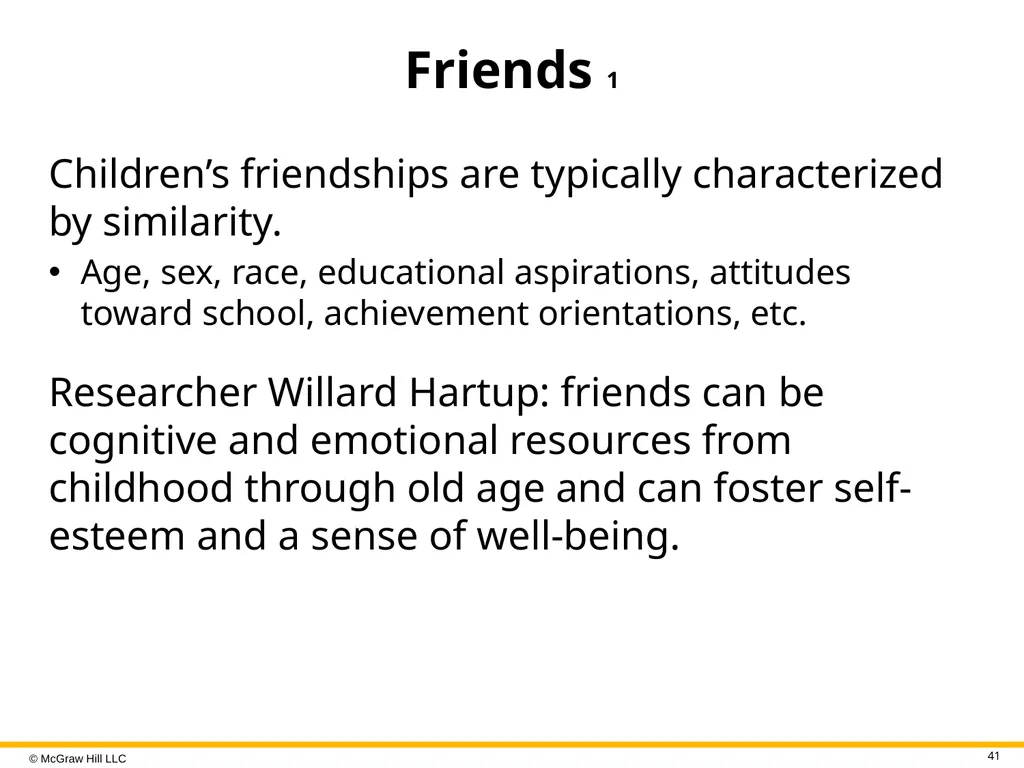
Friends 1 Children’s friendships are typically characterized by similarity.
Age, sex, race, educational aspirations, attitudes toward school, achievement orientations, etc.
Researcher Willard Hartup: friends can be cognitive and emotional resources from childhood through old age and can foster self-esteem and a sense of well-being. 41<br>
Age, sex, race, educational aspirations, attitudes toward school, achievement orientations, etc.
Researcher Willard Hartup: friends can be cognitive and emotional resources from childhood through old age and can foster self-esteem and a sense of well-being. 41<br>
42
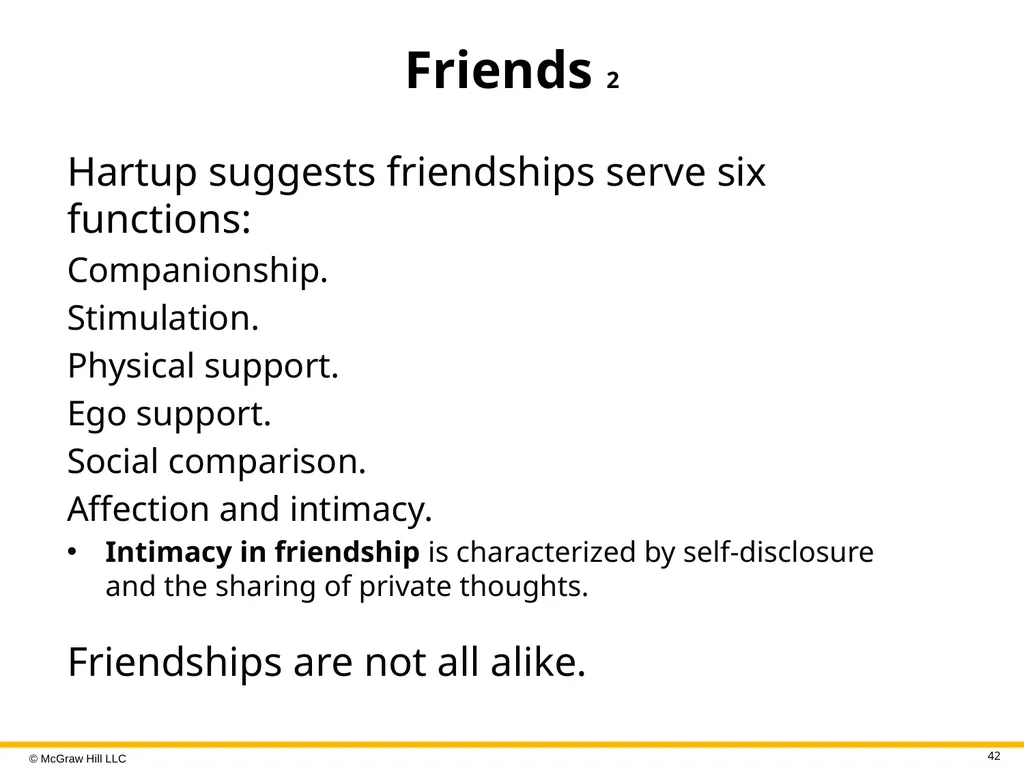
Friends 2 Hartup suggests friendships serve six functions:
Companionship.
Stimulation.
Physical support.
Ego support.
Social comparison.
Affection and intimacy.
Intimacy in friendship is characterized by self-disclosure and the sharing of private thoughts.
Friendships are not all alike. 42<br>
Companionship.
Stimulation.
Physical support.
Ego support.
Social comparison.
Affection and intimacy.
Intimacy in friendship is characterized by self-disclosure and the sharing of private thoughts.
Friendships are not all alike. 42<br>
43
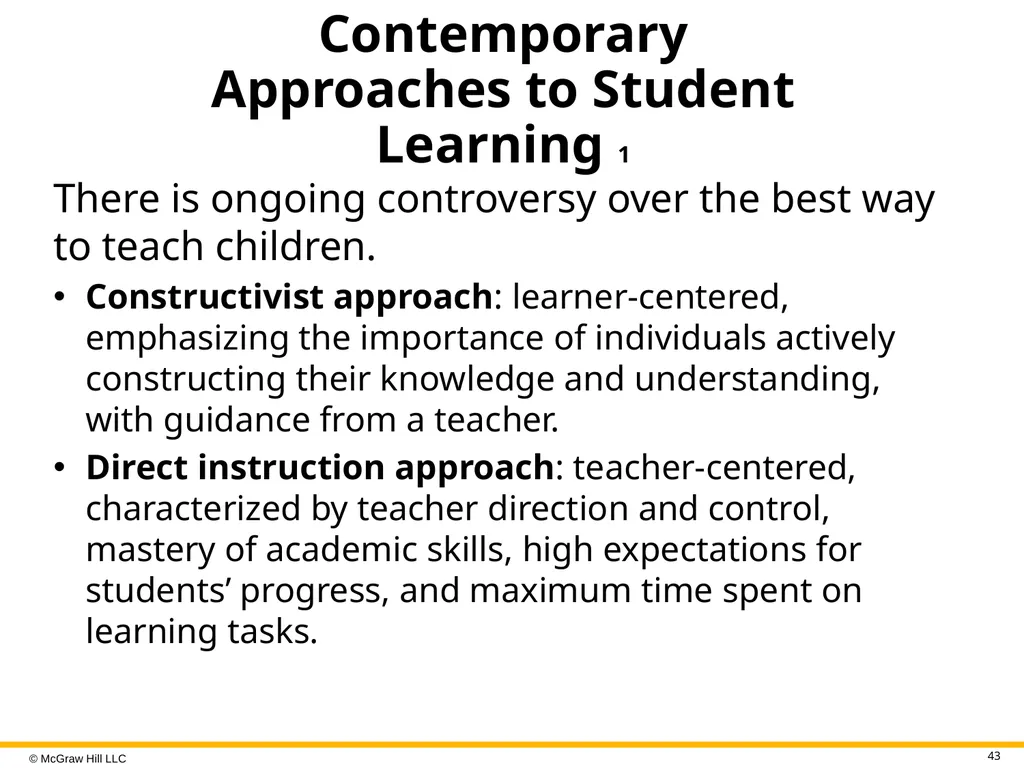
Contemporary Approaches to Student Learning 1 There is ongoing controversy over the best way to teach children.
Constructivist approach: learner-centered, emphasizing the importance of individuals actively constructing their knowledge and understanding, with guidance from a teacher.
Direct instruction approach: teacher-centered, characterized by teacher direction and control, mastery of academic skills, high expectations for students’ progress, and maximum time spent on learning tasks. 43<br>
Constructivist approach: learner-centered, emphasizing the importance of individuals actively constructing their knowledge and understanding, with guidance from a teacher.
Direct instruction approach: teacher-centered, characterized by teacher direction and control, mastery of academic skills, high expectations for students’ progress, and maximum time spent on learning tasks. 43<br>
44
Contemporary Approaches to Student Learning 2 Public and governments at every level have increasingly demanded accountability from schools.
No Child Left Behind (NCLB) Act of 2002.
Criticisms of NCLB:
Single score is the sole indicator of students’ progress and competence.
Teachers spend for too much time “teaching to the test.”
Common Core State Standards Initiative (2009) was an effort toward more rigorous state guidelines. 44<br>
No Child Left Behind (NCLB) Act of 2002.
Criticisms of NCLB:
Single score is the sole indicator of students’ progress and competence.
Teachers spend for too much time “teaching to the test.”
Common Core State Standards Initiative (2009) was an effort toward more rigorous state guidelines. 44<br>
45
Education and Socioeconomic Status and Ethnicity Barriers to learning can be created by poverty.
Parents lack financial resources, are uneducated, or have low educational expectations for their children.
Students may be malnourished and/or attend old and crumbling schools in high crime neighborhoods.
Students’ social and emotional functioning is often ignored
Schools tend to have more students with low scores; less experienced teachers; and a focus on rote learning.
Intervention efforts, some underway, need to jointly focus on improving schools and neighborhoods. 45<br>
Parents lack financial resources, are uneducated, or have low educational expectations for their children.
Students may be malnourished and/or attend old and crumbling schools in high crime neighborhoods.
Students’ social and emotional functioning is often ignored
Schools tend to have more students with low scores; less experienced teachers; and a focus on rote learning.
Intervention efforts, some underway, need to jointly focus on improving schools and neighborhoods. 45<br>
46
Ethnicity in Schools 1 In the U.S., the 47 largest city school districts are attended by more than a third of all African American students and almost one-third of all Latino students.
22% of all Asian American students.
5% of all non-Latino white students.
Many inner-city schools are informally segregated, underfunded, and provide inadequate learning opportunities.
Effects of SES and ethnic minority status are often intertwined. 46<br>
22% of all Asian American students.
5% of all non-Latino white students.
Many inner-city schools are informally segregated, underfunded, and provide inadequate learning opportunities.
Effects of SES and ethnic minority status are often intertwined. 46<br>
47
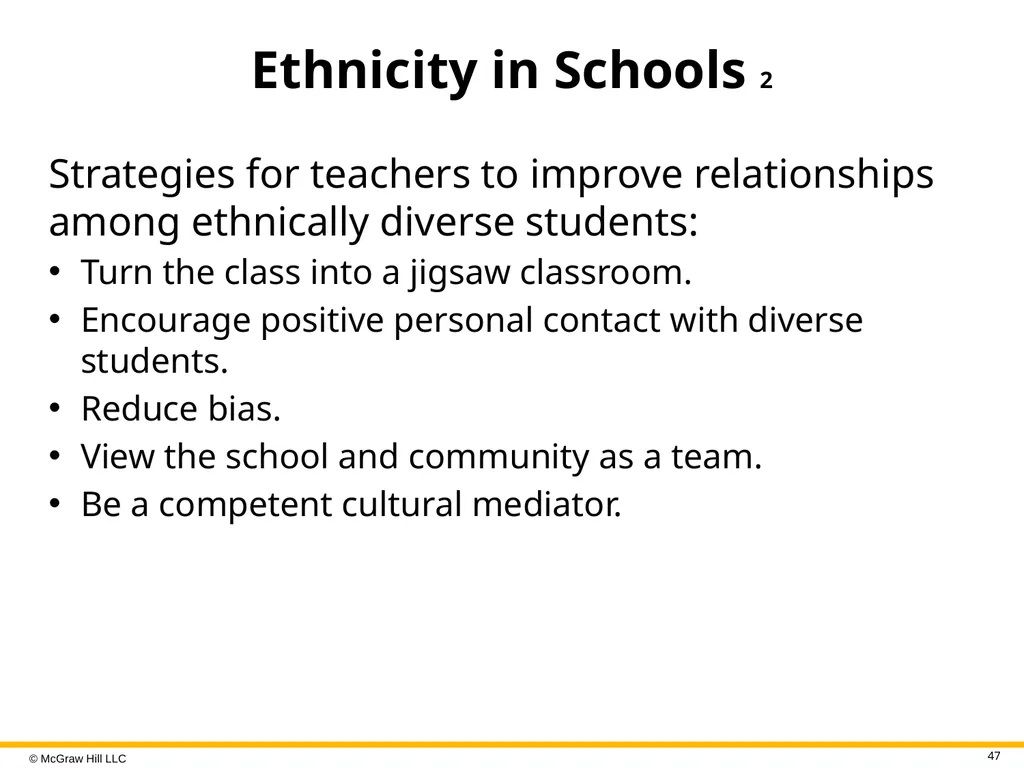
Ethnicity in Schools 2 Strategies for teachers to improve relationships among ethnically diverse students:
Turn the class into a jigsaw classroom.
Encourage positive personal contact with diverse students.
Reduce bias.
View the school and community as a team.
Be a competent cultural mediator. 47<br>
Turn the class into a jigsaw classroom.
Encourage positive personal contact with diverse students.
Reduce bias.
View the school and community as a team.
Be a competent cultural mediator. 47<br>
48
Review Discuss emotional and personality development in middle and late childhood.
Describe changes in parenting and families in middle and late childhood.
Identify changes in peer relationships in middle and late childhood.
Characterize contemporary approaches to student learning and sociocultural diversity in schools. 48<br>
Describe changes in parenting and families in middle and late childhood.
Identify changes in peer relationships in middle and late childhood.
Characterize contemporary approaches to student learning and sociocultural diversity in schools. 48<br>
49
End of Main Content Copyright 2022 © McGraw Hill LLC. All rights reserved. No reproduction or distribution without the prior written consent of McGraw Hill LLC.<br>